
The Rediscovery of America: For Young People
by Ned Blackhawk
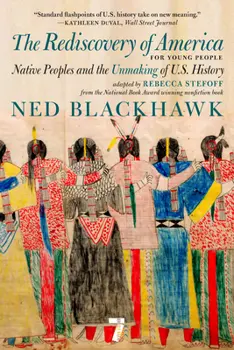
Reviewed by Hank Bitten, NJCSS Executive Director
The names of many of our cities, lakes, sports teams, high schools, and street signs remind us that there was once a nation of 8 million people living here. They inhabited Lake Tahoe, Niagara, Denali, and Appalachia. They were a population the size of Denmark, Switzerland, and New Jersey. In fact, there are currently 97 countries with populations with less than 8 million people.
The name “America” is derived from a 15th century cartographer, Amerigo Vespucci. There was no geographic division of North and South America before the explorers and conquistadores discovered the wealth of this “new world”. The indigenous people were organized as tribes, societies, nations, and empires. We teach the Iroquois, Navajo, Cherokee, Lenape, Pueblo, Aztec, and Inca. Our students learn about their civic ideals, government, economy, and inventions.
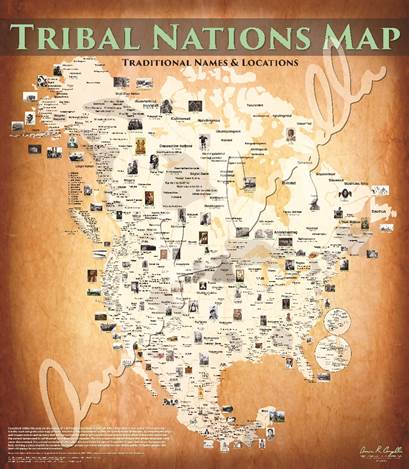
Source: Aaron R, Carapella, 2015
The role of the social studies teacher is to guide their students through an inquiry design model about the past and using knowledge and evidence to understand the different perspectives of the past. The study of history asks us to revise our view of the past in a search for truth and historical accuracy. The Rediscovery of America is a book that provides recent scholarship on the encounters between European nation-states and Native people in early America, the roles Native people played in American independence and our government, and a century of conflict over land and civil rights.
“Natives were not given US citizenship until 1924. By that time, the US government had seized hundreds of millions of acres of land from Native nations in more than three hundred treaties. During the Civil War (1861-1865), settlers and US armed forces killed tens of thousands of Natives. By 1928, government sponsored campaigns had taken 40 percent of Indian children by force from their families and communities on reservations.” (page 3)
The book offers teachers valuable information on the economy, alliances, disease, and conflicts between the Native Americans and the arrival of the Pilgrims and Puritans. The enslavement of Native Americans has not been part of the story shared in classrooms. It is not part of the Disney perspective of Native Americans or the current textbook version of the economic success of the British colonies. Native Americans, especially in the New England and Middle Colonies, experienced enslavement as the result of invitations by captains to board their ships, the stealing of their relatives, seizing their land, and forcing them to clear their land for farming. In 1641, Massachusetts passed a law to legally sanction the enslavement of war captives. This followed the Pequot War on Long Island in 1637. The Puritans shipped survivors of this massacre to Bermuda, Barbados, and Providence Island off the coast of Nicaragua. The 600,000 Native Americans who were taken into slavery by deception, human trafficking, and capture should be part of lessons about the horrific stories we teach about African American enslavement. The historical record of disease and enslavement is a direct assault on the existence of the populations living in North America, and in particular the area of New Jersey, New York, Connecticut and Massachusetts.
“It did not take Natives long to learn that invitations to board ships of the foreigners could end in betrayal and kidnapping. As early as 1602, a party of Wampanoag in their own boat off the coast of present-day Massachusetts ‘refused and …departed’ when Europeans on a ship made gestures inviting them aboard.
Many other Native leaders also turned down such invitations or hurried away. Still, hundreds of captives were either seized or killed in New England before the Puritans found the first colony there. Captains struggled to get captives aboard. One witness reported five or six men were needed to subdue each victim.” (page 59)
The “new” information in The Rediscovery of America will allow teachers to revise their lessons emphasizing the important skills to teach how to make a claim, the prompts to search for evidence, the validity of sources, and historical thinking. For example, Did the economic success of Massachusetts Bay depend on the enslavement of Native Americans in the area? Was the reason for the Pequot War in 1637 the control of wampum or the enslavement of Natives? Was the enslavement of Natives by the British based on religious or economic exploitation?
These perspectives are critical for understanding the historical events that will continue into the middle of the 20th century regarding the depopulation and control of Native Americans through wars, reservations, and boarding schools. In my own teaching, the selection of documents for students to read from William Bradford, Jonathan Winthrop, John Adams, Ben Franklin, Jonathan Edwards, Thomas Shepard, Roger Williams, and John Cotton each supported the success of the British colonies with a perspective of religious freedom, economic opportunity and democratic principles. After reading The Rediscovery of America, I feel humbled and guilty about misleading my students.
Students will also find the short stories about Tisquantum (Squanto), Arakhie, who died of smallpox, Anne, who was blind and cared for her orphaned grandchildren, and Pierre-Esprit Radisson, the young teenager adopted by the Mohawks to provide a context for discussions relevant to historical empathy.
Teachers will find the information about the power of the Iroquois confederacy, the westward expansion of the Algonquins as a result of conflict and disease, and trade in the backcountry to be very useful in understanding the sovereignty of the indigenous nations and the diplomacy that led to peace in the first half of the 18th century.
“The French settlement at Detroit, founded in 1701, the year the peace began, marked the western border of the confederacy’s territory. Beyond it lay a French-Algonquin world that soon attracted a variety of European and Native residents, including Iroquois who were dissatisfied with life in the confederacy.
The French and English each feared that the the other would get the confederacy to join them. To keep the Iroquois neutral, both empires and their North American colonies honored their agreements. Meanwhile, staying out of European conflicts sheltered the Haudenosaunee and their followers from war. Like a three-legged stool, this diplomatic world balanced on three legs. One was New France and its many Algonquian-speaking allies. Another was the thirteen English colonies, which were diverse but connected. The third leg, the confederacy, kept it from tipping-a political balance that lasted for the first half of the eighteenth century.“ (page 126)
The perspective of the French and Indian War by Dr. Ned Blackwell offers new scholarship and an understanding of the importance of the Algonquin and Iroquois nations. The backcountry trade along the Susquehanna River was critically important to the French and Algonquins, but also to the Virginian farmers who desired to expand their farms in this area. The soil was fertile and just about everything (potatoes, melons, oats, hay, fruit, etc.) grew in this area!
The area in the Appalachian Mountains, where the Ohio and Susquehanna rivers begin, was unfamiliar to George Washington. He relied on the advice of the Seneca leader, Tanaghrisson, but his lack of understanding of Native American culture and economy contributed to the escalation of a conflict that might have been prevented. The information in The Rediscovery of America provides an opportunity for decision-making, making a claim as to who is responsible for the French and Indian War, and understanding the importance of the British blockade of the St. Lawrence at Louisburg in 1758.
“Their farms threatened the region’s long-standing Native trading networks, hunting lands, and game animals. They also soiled fresh waters. Outraged Haudenosaunee leaders appealed to colonial officials, reminding them that they had promised neutrality and had recognized Iroquois authority over their lands. ‘You told me…you would build a fort against the French, and you told me you wanted none of our lands,…’” (page 161)
Teachers who use a thematic approach to teaching U.S. History will find the perspective an information in this book to be helpful, especially when teaching various perspectives about the displacement of people during wars and immigration. The traditional view from Letters to an American Farmer (1782) by Hector St. Jean de Crèvecœur describe the new American as one who has assimilated into a new and prosperous society:
“He is an American, who leaving behind him all his ancient prejudices and manners, receives new ones from the new mode of life he has embraced, the new government he obeys, and the new rank he holds. He becomes an American by being received in the broad lap of our great Alma Mater. Here individuals of all nations are melted into a new race of men, whose labors and posterity will one day cause great changes in the world. Americans are the western pilgrims, who are carrying along with them that great mass of arts, sciences, vigor, and industry which began long since in the east; they will finish the great circle.” Source
Dr. Ned Blackwell provides an alternative perspective during the American Revolution and the taking of land after the war as the “new Americans’ moved west.
“Natives suffered from the war in multiple ways. Tens of thousands died in the fighting, mostly as allies of the British. It wasn’t only fighters who died. Colonial leaders targeted Native communities that were allies of the British. For countless villagers, the Revolution deepened the challenges of finding food, obtaining trade goods, and maintaining shelter….Soldiers destroyed dozens of Iroquois towns, hundreds of long houses, and thousands of bushels of the Natives’ corn, beans, and squash. American forces spent entire days burning harvest of Iroquoian fields. One Onondaga chief said, ‘They put to death all the Women and Children, excepting some of the Young Women, whom they carried away for the use of their Soldiers.” (page 209)
The excerpt above reminds us of the terror, genocide, and human rights abuses currently being experienced by innocent people in Ukraine, Gaza, and Iran. Students need to understand the causes of racism, violence, and how opposite views may appear credible. The Louisiana Purchase, War of 1812, and completion of the Erie Canal impacted the Native Americans in ways that could not have been predicted. The book provides the resources for a structured classroom debate regarding the proposed options of assimilation or removal from the perspective of different Native American nations. Students might also enjoy defending a claim that the War of 1812 ended Tecumseh’s plan for a grand alliance with the British to protect the Shawnee and other sovereign nations. The resources in the book also provide insightful information on how the Erie Canal affected trade routes from the St. Lawrence River to the Hudson River. Teachers who want their student to reflect on the ‘big picture’ of history at mid-century might consider the information in the excerpt below for a writing assignment:
“These years established the racial and economic foundations of America. Native peoples across Eastern North American lost more than one hundred million acres of land. In the Native Inland Sea, settlers renamed Indian villages, and the government created new states. The Northwest Ordinance of 1787 made it far easier for individuals to obtain private property in the Old Northwest than in New York, Pennsylvania, and Kentucky.” (page 250)
Although every student learns about the Trail of Tears, their understanding of the Cherokee Nation v. Georgia (1831) and Worcester v. Georgia (1832) Supreme Court cases are often confusing to them. President Andrew Jackson’s Second Annual Message to Congress on December 6, 1830 announced a profound change in America’s relationship with Native Americans.
“The present policy of the Government is but a continuation of the same progressive change by a milder process. The tribes which occupied the countries now constituting the Eastern States were annihilated or have melted away to make room for the whites. The waves of population and civilization are rolling to the westward, and we now propose to acquire the countries occupied by the red men of the South and West by a fair exchange, and, at the expense of the United States, to send them to a land where their existence may be prolonged and perhaps made perpetual.” (The American Presidency Project)
The Rediscovery of America provides students with critical information to examine and question the support for the Indian Removal Act, which passed by only five votes, and its relationship to the expansion of slavery. Students have an opportunity to review the statements of Native tribes, analyze the unanimous votes opposing the bill by the representatives from New Jersey, and comparing it with the divided votes in New York and Maine. The ruling by Chief Justice John Marshall provides an opportunity for a constitutional debate or press conference in your classroom.
“A distinct community occupying its own territory…in which the laws of Georgia can nave no force, and which the citizens of Georgia have no right to enter, [except] with the assent of the Cherokee themselves, or in conformity with treaties, and with the acts of congress….The act of the state of Georgia…is consequently void.” (page 275)
The study of Native Americans for most students unfortunately ends with the Trail of Tears, unless their teacher is aware of the significance of the Battle of Little Bighorn (1876), nine days before the 100th anniversary of the Declaration of Independence, the Dawes Act (1887), and the Wounded Knee Massacre (1890), four days after Christmas.
The book offers teachers valuable information on the impact the migration of settlers to the west, the Civil War, and industrialization had on Native Americans. The Rediscovery of America took me on a path of hard history as government policies of assimilation and relocation evolved into unconditional surrender and genocide, The stories of human trafficking, indentured servitude, and captivity are very powerful and essential reading for understanding human nature and racism. The information on the Lakota and the Dakota Wars provides excellent sources for lessons following the Civil War.
“In the years after the Civil War, a growing number of treaties shrank tribal lands and made it easier for whole peoples to be removed to Indian Territory. In the 1867 Treaty of Medicine Lodge, for example, Apache, Comanche, Kiowa, Cheyenne, and Arapaho leaders exchanged their claims to nearly ninety million acres for three million acres in Indian Territory.” (page 367)
The story of Lucia Martinez, a ten-year-old Yaqui girl living in Arizona, will engage students studying law and government with opportunities for debate, decision-making, and problem solving regarding our federal system, governmental overreach, common law, and the importance of our constitution in territories. The Yaqui owned their land as a community, and this frustrated authorities and businessmen who bought and sold indigenous land. During a raid Lucia was captured by King S. Woolsey who made her his indentured servant and fathered three children with her. Lucia Martinez was forced to leave the ranch where she lived but her children remained controlled by Woolsey. Lucia Martinez received help from local lawyers in Yuma, New Mexico and filed a writ of habeas corpus in the Superior Court in Maricopa County in Arizona to be reunited with her biological children. Lucia Martinez vs. Thomas Barrman, K. S. Woolsey, John Ammerman & Mrs. Ammerman (Source), (pages 361-364)
The news today focuses on unprecedented powers of the Executive Branch. However, in the last 25 years of the 19th century it was Congress that overreached its powers by ending treaties with sovereign indigenous nations and forcing their relocation without due process. Frederick Jackson Turner presented an argument at the Columbian Exposition in Chicago in 1893 that westward expansion defined our identity and character. This year also marked the 400th anniversary of the voyage of Columbus to the New World and the beginning of the ending of the identity and character of Native Americans.
The insights and research of Dr. Blackwell provides significant information on the Carlisle Indian Industrial School in Carlisle, PA., founded by Richard Henry Pratt, and other boarding schools, that should engage your students in purposeful policy debates.
“The young people had to wear woolen clothing and follow regimented work schedules. They were forced to speak English and punished for speaking their own languages, even to each other, Untold numbers suffered physical or sexual abuse. Thousands died from disease, overly strict discipline, and lack of nourishment or care.” (page 398)
Other opportunities for engaging classroom activities include President Teddy Roosevelt as “The Conservationist President” for his protection of the environment and the designation of national parks under the 1906 Antiquities Act. In our teaching of Yellowstone, Yosemite, Glacier and other parks, we neglect the loss of these lands that were the homes of Native Americans. The collapse of the stock market in 1929 also provides an opportunity to debate the use of federal funds for the unemployed, farmers, or Native Americans.
Fortunately, Laura Cornelius Kellogg, Zitkala-Sa, Charles Curtis, a Kaw citizen and Vice-President 1927-31, John Collier, Henry Roe Cloud, Elizabeth Bender Cloud, Felix Cohen, and Lewis Meriam were advocates for 20th century reform and they investigated the decades of abuse and neglect to Native Americans. The American Indian Citizenship Act of 1924, the Meriam Report of 1928, and The Indian Reorganization Act of 1934 need to be integrated into every U.S. History curriculum.
According to the U.S. Census Bureau, 9.7 million people in the United States identified as American Indian or Alaska Native alone or in combination with another race in 2020. The Census reports 3.7 million Native Americans who identify as alone. There are 574 federally recognized tribes, 325 reservations, and 221 Alaska Native village areas. Approximately 13% or 1.3 million live on reservations. New Jersey’s Native American population varies depending on whether the data counts individuals alone or in combination with other races. The population is about 135,000 people or a little less than 1.5% of our state’s population. New Jersey recognizes the Nanticoke Lenni-Lenape Tribal Nation, the Ramapough Lenape Nation, and the Powhatan Renape Nation.
The vocabulary of The Rediscovery of America is age appropriate for middle and high school students. However, as an adult with advanced education, I also found the book informative and engaging. An integrated approach to the teaching of U.S. History will benefit our students in asking questions about our past priorities as a country and our priorities for this century.
As educators, we need to discuss how 250 years of decisions by our government have impacted Native Americans. We can start by…
- Understanding the reasons for a lower life expectancy of at least 10 years compared to our national average.
- Understanding the reasons for higher rates of diabetes, heart disease, cancer, liver disease, asthma, mental health, and substance abuse.
- Understanding the reasons for poverty rates that are double the national average.
In addition to integrating Native American history and culture into lessons, educators might also
- Encourage local colleges to teach preservice teachers about Native American history and culture.
- Recognize the contributions of Native American veterans and share the digital stories of Native Americans on Veterans Day.
- Visit the National Museum of the American Indian in Washington, D.C. or their online resources.
- Visit a Native American reservation in the summer and provide economic support during the year. (www.teem.org)
- Learn about the National American Indian Monument that broke ground at Fort Wadsworth, Staten Island, NY, in 1913 that was never built.
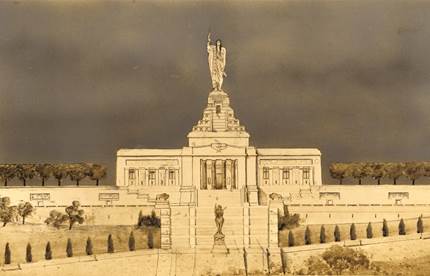
Paperback $22.46, Publish Date: 2026-11-17, ISBN: 9781644215647, Pages: 576

