
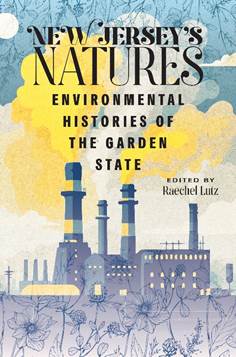
New Jersey’s Natures Environmental Histories of the Garden State
By Raechel Lutz
Reviewed by Hank Bitten, NJCSS Executive Director
The names of the Copper Tree Mall, Powder Mill Lane, Cannonball Trail, and Campgaw Mountain in Oakland, New Jersey reveal the mysteries of the environmental history of the town where I live. When a new septic was installed on our property, the excavation revealed sand about ten feet under the soil. This discovery explained why half of the houses on our block did not have full basements and why homes with basements often had water seepage from a hidden underground stream.
Environmental history is exciting for students who enjoy the role of historical detective. The names on our street signs, the boardwalk, the Great Swamp, and utility poles, train tracks, and churches are evidence of environmental history. There is likely evidence of trees where you live that are 300 years old and the trees that are less than 100 years old reveal evidence of deforestation or the presence of invasive species. The names of many places in New Jersey reveal an environmental history of past centuries from the Native Americans who walked on the land where we walk or drive today:
Absecon (little stream)
Mahwah (meeting place)
Passaic (valley)
Paramus (wild turkeys)
Pequannock (cleared land)
Piscataway (large deer)
Pompton (place of soft fish)
Wyckoff (high ground)
“In the twenty-first century, the state has it all: protected ecological environments, active agricultural tracts, preserved farmland, contemporary industrial landscapes, postindustrial landscapes, mid-century Levittown-inspired suburbs, elite rolling estates, historic sites, tribal lands, massive interstate highways, and many, many other features of a cultural landscape that has been inexorably changed by humanity. These factors make New Jersey, as this book argues, a prime site for the study of environmental history.” (page 2)
The articles in New Jersey’s Natures are organized geographically. They reveal a history that has been ignored, unimagined, or recently revealed. The stories of the Meadowlands and Pinelands may be familiar, the articles on the forests of Joseph Bonaparte and the landscape of the diaries of William Livingston may be new, and the research on industrial pollution, agricultural economics, and the migration of populations may prove shocking.
The environmental history of New Jersey (and the world) is dramatically changing as we are already living in a world that is 1.2C degrees warmer than when most of us were born. A warmer climate leads to atmospheric changes affecting crops and trees, rising sea levels, droughts, fires, and the migration of populations. The evidence we currently have in the oral histories of our collective memories, historical sites, landscape paintings, photographs, and newspaper articles are in need of documentation, organization, and publication. Teachers are the catalyst for inspiring and encouraging this in their school and community.
For example, perhaps every person living in New Jersey has looked out of the window in their vehicle when driving on the New Jersey Turnpike between Exit 15 and 16. They see the landscape of Jersey City and New York City and the strange landscape of the rock known as Snake Hill or Laurel Hill. The environmental history of the roads and railroads, the memories of people seeking cleaner air for relief from lung diseases and the importance of this rock as a sacred place for burial, the presence of water snakes, oysters, clams, and fish are part of the story of our history. Raechel Lutz inspires us to think and discover.
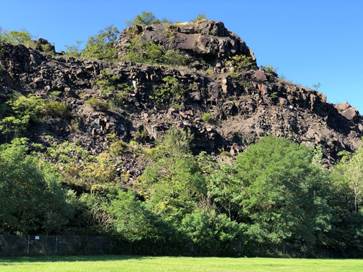
Snake Hill Rock
My early years were in Paterson, and I watched the construction of Route 20 and 21 along the banks of the Passaic River. Many American cities constructed highways next to rivers to avoid the demolition of neighborhoods in towns that were established before the automobile. These highways were built at the time Rachel Carson was writing about water runoff and the pollution of rivers. I remember the clean and clear waters of Greenwood Lake before the speedboats came, the fresh waters of the reservoirs that provided potable water to Newark, Hackensack, Jersey City, and Paterson, and the dangers of eating fish or swimming in the Passaic River. Unfortunately, the pollution of this scenic river uncovers a frightening history.
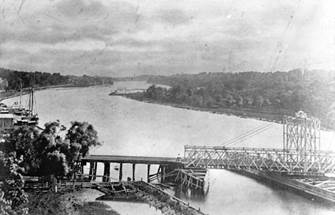
Passaic River in Newark, circa, 1875
“The river’s pollution problems worsened right around the time the Essex County Park Commission first convened, in 1894, as oil refining and trade activities in the Newark area picked up and a drought lowered water levels in the Passaic. That summer, acid fumes caused paint to peel from riverside structures, triggering nosebleeds and nausea. Meanwhile, oil products, sewage, and factory waste continued to cause the river’s quality to plummet, so that by 1897 the local sewerage commission declared its “fisheries…destroyed.” The river’s recreational value also declined: Boating clubs stopped holding regattas along the Lower Passaic in 1900, children swimming in its waters at the turn of the century emerged “covered with oil and tar,” and many residents living along the river abandoned their homes.” (page 43)
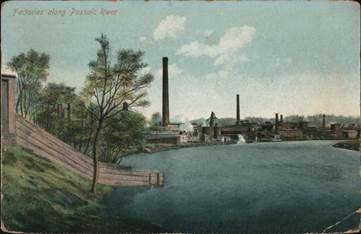
Passaic River in Newark, circa 1940
New Jersey is the most densely populated state in the United States and one of the most densely populated regions in the world. The people of New Jersey depend on reservoirs and ground water for potable drinking water. Our potable water is threatened by droughts, the movement of salt water into ground water, pollution, and depleted oxygen from warmer temperatures. The effects of a changing climate are the biggest threat to New Jersey, which makes the study of our environmental history an urgent priority.
The two chapters on agricultural history include information on Seabrook Farms, the challenges facing small truck farms in New Jersey, and the conditions experienced by migrant workers from the South, Italy, and the Caribbean. For social studies teachers these chapters provide a perspective on loans provided by the Reconstruction Finance Corporation in the Hoover Administration and the effects of the Great Depression, wars, technology, and weather on Seabrook Farms and New Jersey agriculture. The research is commended and the personal stories and images are powerful.
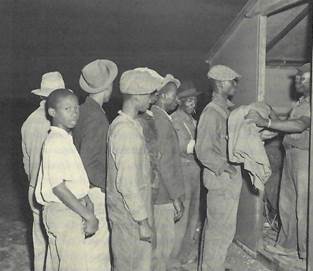
Migrant workers receiving blankets in 1942 (page 123)
The New Jersey Social Studies Standards provide sufficient emphasis on labor history, transportation history, and immigration history. The chapters in New Jersey’s Natures on the agricultural history of New Jersey and the debate over state financial assistance to control the mosquito and drain the stagnant water of our salt marshes provide information leading to the decisions of local, county, and state governments regarding the Jersey shore, agriculture, and fisheries. Social Studies instruction about the significance of the Morrill Act (1862) and the Smith-Lever Act (1914) should include the contributions of Rutgers University to dairy and vegetable farmers today as each year average temperatures are increasing and sea levels rising. The environmental history of New Jersey in the next decade is likely to see dramatic changes and challenges for our state government.
“In the 20th century, sea level rose by 12 inches at bedrock locations (Bayonne, Trenton, and Camden). Along the Jersey shore from Sandy Hook to Cape May, it rose an additional four inches due to compaction of sediments caused by natural effects and groundwater withdrawal. There is a 95% probability that the 20th century rate of sea-level rise along the New Jersey shore was faster than it was in any century in the last 4,000 years.” Source (Rutgers University)
The teaching of the market revolution in middle and high school focuses on the Erie Canal and manufacturing in New England. An important contribution in this book is the forgotten story of oysters, muskrats, and sturgeons in Delaware Bay. Bivalve was the center of the oyster market and with the Central Railroad connections to major carriers, annual production exceeded one million oysters annually. Teachers looking for a local history lesson emphasizing the importance of civic engagement will also find the chapter on the arguments for and against a jetport in the Pine Barrens to have value. The information in “The End of These Woods: The Pinelands Jetport and Grassroots Environmentalism in the New Jersey Pine Barrens” will find the debate over housing, economic growth, and the need for a large airport to serve Atlantic City and Philadelphia to be informative. The Pine Barrens are a protected area that comprises 20% of the land in our state and includes populated towns in seven counties. In New Jersey, then and today, the protection of the environment appears to be a lower priority in the debate for economic growth and personal opportunity. The debate regarding the development of the Pine Barrens did not end with Governor William Cahill in the 1960s and the current threats from recreation, pollution, illegal dumping, lack of leadership, fires, and water use are topics every student needs to be informed about.
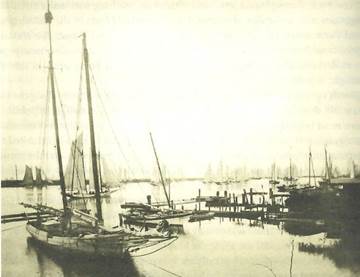
Photograph by Harvey W. Porch, (c. 1905-1915(page 178)
The Beach Park Act of 1894 from an environmental perspective provides another opportunity for analysis of the Jersey shore economy over time. The Jersey Shore is the one geographic location in New Jersey that every student from kindergarten through college can identify with. The article “Reclaiming the Boardwalk” includes case studies of Atlantic City and Asbury Park. The development of these resorts’ centers on the issue of private v. public ownership. For teachers who value interdisciplinary instruction during the Industrial Revolution and the Progressive Era, this article prompts a search for literature, Protestant religion (Methodist Church), economics, art, music, and science.
I was impressed with the number of questions that came to my mind as I was reading New Jersey’s Natures. Some of my questions were:
- How have people used this brook, stream, or river over time?
- Why does the Garden State Parkway divide a cemetery in Newark?
- Why do our state roads have many curves?
- Why do many towns in New Jersey have names with Biblical references? (Zarephath, Mount Olive, Asbury, Shiloh, Tabernacle, Brainard, Churchtown, Galilee, etc.)
- What did people from the past see and think as they travel through New Jersey?
- What changes have I seen to the landscape of New Jersey in my lifetime?
Environmental history prompts thinking about the human impact on place, the shaping of policy decisions by government over time, and the importance of nature in shaping the historical record.
New Jersey’s Natures: Environmental Histories of the Garden State is available from Rutgers University press, ISBN: 9781978836433 Published: May 12, 2026, 280 pages.

