
The Climate Book
By Greta Thunberg
Reviewed by Hank Bitten, NJCSS Executive Director
In 2097, on the 100th anniversary of the Kyoto Protocol, historians will ask why did we not do something to prevent the warming of the planet. After all, we experienced record breaking temperatures every year, were the most educated population in world history, and had the technology and economic resources to reduce carbon emissions. They will likely establish an historical argument based on our obsession with laissez-faire economics and consumer spending.
Will the people at the beginning of the 21st century blame the scientists, economists, and politicians or will they blame misinformation, self-interest, and neglect of spiritual perspective? Fortunately, there is substantial evidence to support the contributions of the government, business, and educational leaders from New Jersey and New York in addressing the crisis of climate that has already defined the 21st century.
Greta Thunberg’s The Climate Book is a collection of articles that future historians will read in their inquiry into the decisions of the top 1% of the population of the “Global North” and everyone else with a net worth over $1 million in 2026. The data will serve as evidence of how we abused carbon. In 1900- the cumulative carbon emissions totaled 45 billion tons and in 2000 it was1,000 gigatons. In 2026, it doubled to 2,000 gigatons. (Page 14) The question on the 2097 AP World History exam will be, “Why?”
This book is the “go to” book for educators. Climate education is relevant to history, science, economics, sociology, literature, art, math, and civics. The problem of climate cannot be debated as there is no place for compromise. Greta Thunberg’s analogy made this clear to me:
“It is like walking on thin ice – either it carries your weight, or it does not. Either you make it to the shore, or you fall into the deep dark, cold waters.” (page 2)
Teachers are the first responders who need to make students aware by teaching the importance of sustainability, understanding that the economic freedom we value is changing our environment, that the problem with carbon is one of chemistry and physics. The slightest increase in temperature changes the composition of oceans and our atmosphere. According to Thuberg, since most political and business leaders are not able to address the problem; the collective action of the global population is our best hope. This is why teachers and curriculum matter!
The book is organized into five sections with concise articles of three or four pages explaining and analyzing the theme of each section. Each article provides excellent information for discussion, further exploration, and cooperative learning. For example, Section 2, “How Our Planet is Changing”, includes articles on heat, methane, air pollution, clouds, the jet stream, polar ice caps, acidification, droughts, floods, fresh water, and microplastics. These articles explain the fragile nature of our atmosphere, how small changes over time lead to major changes in food production, and the economic and human cost of extreme weather events.
“A new line of research has also uncovered a summer connection that contributes to recent severe heatwaves, wildfires, droughts and deluges. These extreme events are more likely when the jet stream splits, with one branch flowing across the middle of the continent and another along the Arctic coast. These splits tend to occur when the spring snow cover on high-latitude land areas melts earlier than normal, a strong trend observed in recent decades. When the snow disappears early, underlying soils dry out and warm sooner, creating a belt of abnormally high temperatures over high latitude land areas. This warm belt favors jet-stream splits. Rossby waves can then become trapped between the two jet-stream branches, causing stagnant weather conditions that can cause persistent heatwaves, dry periods and rain spells, often leading to extreme summer events.” (Page 65)
If all the ice in Greenland and Antarctica melt, sea levels have the potential to rise by 65 meters or 200 feet. (page 83) According to the New Jersey Department of Environmental Protection, “As identified in the New Jersey’s Rising Seas and Changing Coastal Storms: Report of the Science and Technical Advisory Panel and the New Jersey Scientific Report on Climate Change, sea-levels are increasing at a greater rate in New Jersey than other parts of the world. By 2050, it is likely that sea-level rise will meet or exceed 1.7 feet and increase to 3.8 feet by the end of the century. “Sunny day flooding” will occur more often across the entire coastal area with Atlantic City experiencing “sunny day flooding” 131 days a year and a 50% chance it will experience 326 days a year by 2100.” (A sea level rise of 1.7 feet is less than one meter.) Source
Every article in Chapter 3, “How It Affects US” explicitly documents the reality of climate change. Here are some examples:
“Up to one fifth of the global land surface was affected by extreme drought in 2020, leading to a stark rise in food and water shortages.” (page 134)
“Anthropogenic climate change is responsible for one in three deaths due to heat today – accounting for 37 percent of heat-related deaths between 1991 and 2018.” (page 137)
“Malaria and dengue may spread into temperate areas such as France, Bulgaria, Hungary, Germany and the eastern coast of the Ununited states extending from south of Atlanta to north of Boston.” (page 245)
“We grew crops at a carbon dioxide concentration of 550 parts per million (ppm), the level the world is expected to reach around the middle of this century. We found that crops grown at these elevated CO2 concentrations had significantly lower amounts of iron, zinc and protein than identical cultivators of those crops grown at today’s CO2 levels.” (page 149)
“The fact that 3 billion people use less energy, on an annual per capita basis, than a standard American refrigerator gives you an idea of how far away from global equity and climate justice we currently are.” (page 154)
“With current warming trends, 1.2 billion people could be forced to migrate by 2050.” (page 180)
The content in this chapter relating to disappearing insects, deforestation, rising sea levels, psychology of violence related to temperature increases, and political instability should be considered as essential reading. Although our goal is to keep temperatures below 1.50C in this century, Greta Thunberg explains that this is an average and some areas will see up to 4.0oC temperatures and others closer to 10C. “In 2021, Moody Analytics estimated that the global economic toll of 20C of warming would be $69 trillion.” (page 192)
Chapter 4 provided me with valuable insights that I can use as a social studies teacher. These insights provide information on the changes in carbon emissions between 1970 and 2025 and how consumption in OECD countries is contributing to the coming crisis on our planet. The information in this section is also important if individuals are going to educate the adult population. The population of the United States is in denial about what is happening and the fact that in approximately 20 years, 1.5 billion people will need to relocate to a different location within the United States as a result of water shortages, transportation costs, rising sea levels, crop failures, dangerous insects, extreme heat, and unprecedented storms! The target of a 1.5oC increase by 2050 is likely unattainable and we need to expect an average temperature increase of 2.5oC or higher by 2100. While civic engagement by individuals and families is important, the hope for the future will require action by local, state, and national governments.
“The carbon dioxide safety level for such climate stability is often considered to be around 350 parts per million (ppm) – a level we passed in around 1987. In February 2022, we surpassed 421 ppm. At current emission levels, our remaining carbon budgets for a decent change of staying below 1.5oC and, by doing so, minimizing the risk of setting off irreversible chain reactions beyond human control, will be gone before the end of this decade. There are no effective policies in place.” (page 241)
The complexity of the problem is difficult to understand. As populations increase, food production requires more land for agricultural production. As a result species migrate, trees are removed, fertilizer production increases, and the shipping of food to where the people are living increases. The two graphs below include significant data. The first graph, “Greenhouse gas emissions from transport subsectors in 1970, 1990, and 2010” provides evidence on the increase in emissions as the population of the world increased from approximately 3 billion in 1970 to 8 billion today. The graph also provides evidence of the problem of global equity as the amount of emissions in 2010 is that to the total emissions from Latin America, Middle East and Africa, and Asia total 2.75 gigatons is less than the amount of 3.14 gigatons emitted from the 38 OECD countries with market-based economies and democratic forms of government.
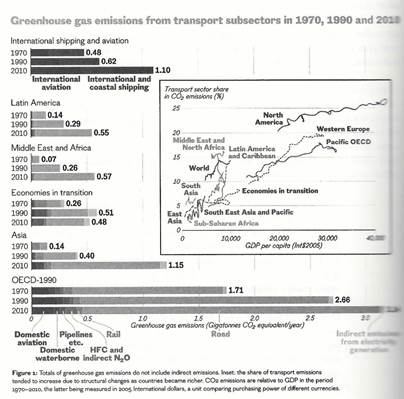
(page 266)
The second graph, “A comparison of greenhouse-gas-emissions intensity”, illustrates the emissions from airplanes, automobiles, and trains. The graph does not include the cost of international shipping, a decision made by the Kyoto Protocol in 1997. “This is extremely problematic since international aviation and shipping together contribute the equivalent amount of CO2 as Japan, the fifth biggest CO2-emitting nation in the world.” (page 269)
The greenhouse gas emissions form airplanes is greater than the emissions from automobiles. Students need to understand the paradox of buying an EV or hybrid vehicle for transportation to reduce carbon emissions and then taking a plane to the Caribbean for Spring Break or a trip to Europe is counterproductive. We need to change our behavior. Education has the potential to change behavior!
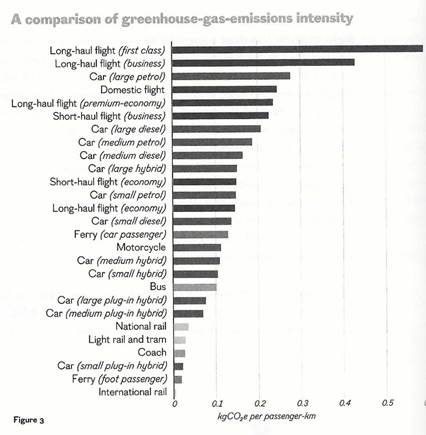
(page 267)
Perhaps the most important insight for me in this section was the information on consumerism. A household in the United States contains, on average, 300,000 individual items,…” (page 282) Teachers need to bring awareness about human behavior and the impact of production and disposal, and life expectancy and efficiency.
“An American one-percenter accounts for ten times the greenhouse gas emissions of the average American; the average American is responsible for three times the emissions of the average person in France; the average French person accounts for ten times that of the typical person in Bangladesh.” (page 282) This section provides perspectives that are excellent resources for teachers.
Students need information about solutions for living in a world that is 1.5oC warmer and likely closer to 2.0oC. Solutions are more than wind turbines, solar panels, and electric vehicles. The psychology of human behavior, the importance of civic engagement, preparation for a sudden crisis, the economic potential of incentives, awareness of the role of the media, and an understanding of the actions of citizens are essential understandings for students.
“The wealthiest 10 percent of people globally produce around half of all greenhouse gas emissions, as well as having more to do to achieve a sustainable way of life,….” (page 330) The graph below clearly explains why climate education for students in the United States should be a curriculum mandate. The graph also illustrates the problems of inequality and injustice as a result of the economic system that currently dominates our world. An understanding of the big picture from 19th century colonialism and imperialism to the global supply chains of the 21st century are essential for understanding the invisible atmospheric changes that have been taking place for 150 years. The existential crisis that threatens to disrupt the comfortable lives of the students we are teaching will take place in the next few years or decades. This is the “inconvenient truth!”

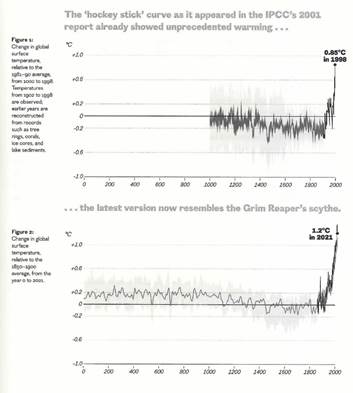
As social studies educators we are responsible for teaching the lessons of the past, especially as they relate to the rise and fall of civilizations. The discovery of fire, writing, cement, crop rotation, the three-part plow, animal, water, and steam power, fossil fuels, electricity, nuclear energy, the automobile, department stores, credit cards, e-commerce, and artificial intelligence are curriculum topics that need to be carefully reviewed in how we are teaching them because they cumulatively contribute to a warmer planet. The graph below illustrates why this is a critical curriculum topic for social studies educators.
The great migrations in history are the result of wars, trade, investments, escape from authoritarian rulers, genocide, poverty, and extreme weather events. We teach about the migrations from the Irish famine, religious wars in Europe, African Slave Trade, European migration to the United States, Harlem Renaissance, Dust Bowl, Partition of India, Resettlement after World War II, and the urbanization of China. If history is a guide, the largest migration will occur in the 21st century because of the impact of extreme weather on agriculture, potable water, heat-related deaths, and higher sea levels.
The Climate Book is essential reading for teachers. The section on solutions (Chapter 5) provides critical information for debate and discussion with your students.

