When the Declaration of Independence Was News
by Emily Sneff
Reviewed by Hank Bitten, NJCSS Executive Director
Let me begin my review with the 63 pages of Notes to the sources used in this book of 187 pages. After reading through the 15 pages of the Introduction, I recognized the wealth of new scholarship available to students and historians from when I studied colonial history. The Papers of George Washington, John Adams, Thomas Jefferson, and John Jay, Journals of the Continental Congress, documents from theCommittee of Secret Correspondence, and The Revolutionary Diplomatic Correspondence of the United States provide historical information that has become available through generous research grants from our government and the scholarship of distinguished historians and editors and the work of the Gilder Lehrman Institute of American History and Teaching American History grants. The benefit to the American public, teachers, and students is enormous!
Dr. Emily Sneff takes the readers behind the scenes into the political, economic, and diplomatic correspondence in colonial state congresses, correspondence transported by ship captains from the harbors of Philadelphia and New York to the Caribbean and Europe, and the economic blockades by foreign ships on America’s rivers, especially the Delaware. For example, this is her report for the week of May 6, 1776:
“The mood in Philadelphia became anxious, and the Continental Congress witnessed how much terror British ships could cause. No one in the Congress knew yet if the British and German reinforcements were going to target Philadelphia or New York City. They could only rely in intelligence from captains of merchant vessels who sailed alongside the massive, slow-moving fleet of British ships bringing supplies and soldiers across the Atlantic.” (page 22)
The debate over rights and rebellion was further complicated by the fact that the Continental Congress and the Pennsylvania State House met in the same building. “The Congress shared the Pennsylvania State House with the provincial assembly. In the first few months of 1776, the delegates were increasingly aware that the decisions they made on the first floor of the State House might be undermined by decisions made by the conservative Pennsylvania Assembly on the second floor.” (page 23)
The book provides important contextual information for teachers who want their students to debate if the Continental Congress should have passed the Articles of Confederation at the time of the Declaration of Independence. The articles of Confederation were discussed in the Second Continental Congress but adopted four months after the Declaration of Independence and formally ratified on March 1, 1781, seven months before the surrender of General Cornwallis at Yorktown, Virginia. During this time, the 13 states were at risk of attack, surrender, rebellion, and disease. The purpose of the Articles was to establish and protect the sovereignty of the original 13 colonies and now the ‘league of friendship’ of the 13 states.
As of May 15, 1776, “There was no consensus on what a declaration of independence needed to be, or whether it needed to be issued before or after the plans for a confederation and foreign treaties. From its context to its contents to the men who voted for and against it, the Declaration of Independence was a product of specific circumstances, including multiple proponents of the debate about whether or not to separate from Great Britain.” (page 34)
The resolution proposed by Richard Henry Lee on June 7 included the clause “That a plan of confederation be prepare and transmitted to the respective Colonies for their consideration and approbation.” (page 37)
This is an important discussion or debate for students regarding the political, economic, and diplomatic issues that are part of the debate for independence. The risks the representatives faced in Philadelphia were high as was the protection of the 2.5 million colonists. One week before the vote on the Declaration of Independence, the plot by Thomas Hickey to assassinate General George Washington in New York City was revealed. Emily Sneff provides an excellent account of this plot and its relevance to the Declaration of Independence, especially if the British were victorious, even in one colony or region. (pages 41-42)
Students, especially from New Jersey, Pennsylvania, and New York will find the information regarding the printing of the Declaration by John Dunlop and others to be of interest. The ability to duplicate multiple copies, setting the type for newspapers, the shortage of paper, the presence of British ships along the coast and in rivers, and the translation of the document into German should engage students with asking many questions and the opportunity for students studying German to analyze the translations and understand how the colonists of German heritage viewed the relationship of the House of Hanover to King George III.
Dr. Sneff takes us on a journey through the perspective of the forming of an American identity as the Declaration was read in Philadelphia, Easton, Hamburg, Reading, Trenton, the College of New Jersey (Princeton University), New York City, Boston and New England, and the arduous journey by land to the Carolinas and Savannah.
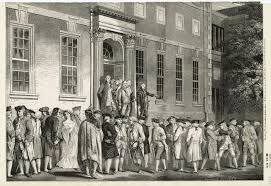
Col. John Nixon reading the Declaration of Independence at the New Jersey state capitol in Trenton on July 8, 1776. The New Jersey Constitution ratified on July 2 was also read.
Princeton, July 10
“Last night Nassau Halls was grandly illuminated, and INDEPENDANCY proclaimed under a triple volley of musketry, and universal acclamation for the prosperity of the UNITED STATES. The ceremony was conducted with the greatest decorum.” (From NJ. State Library)
General William Howe arrived on board HMS Greyhound off the coast at Sandy Hook on June 25 waiting for his brother Vice-Admiral Richard Howe on board HMS Eagle on July 12. There was an armada of British ships carrying 32,000 soldiers in the area of New York when General Washington read the Declaration of Independence to his troops at 6:00 p.m. on July 9 on the Commons (now City Hall Park). A few hours later the statue of King George III on horseback was pulled down and transported to the farm of Oliver Wolcott in Litchfield, Connecticut to be melted into 42,088 bullets.
Students discuss the Preamble of the Declaration and its importance of human rights. The insights on the British perspective of the Declaration are often ignored but important for students to understand.
“Washington hoped that hearing the Declaration would provide a ‘fresh incentive to every officer, and soldier, to act with Fidelity and Courage, as knowing that now the peace and safety of his country depends (under God) solely on the success of our arms.” (page 80)
Students need to view this in contrast to the statement by Ambrose Serle, Vice Admiral Richard Howe’s Secretary, in his journal, dated July 12, 1776:
“The Declaration of Independence proved that the Continental Congress had never truly wanted to reconcile with Great Britain. Independence had been ‘their Object from the Beginning.’ Serle had never seen ‘a more impudent, false and atrocious Proclamation’ than the Declaration. As he vented in his journal, Serle noted that, in their previous petitions, the Congress had ‘thrown all the Blame and Insult upon the Parliament and ministry,’ but in the declaration they had ‘the Audacity to calumniate the King and People of Great Britain.’ Even worse, they dared to invoke divine protection. ‘Tis impossible to read this Paper,’ Serle wrote, ‘without Horror at the Hypocrisy of these Men, who call GOD to witness the uprightness of their Proceedings.’” (page 73)
Students should ask “What if?” ‘What if’ the British negotiated a diplomatic solution? ‘What if’ the attack on Brooklyn Heights happened in July? ‘What if’ the Articles of Confederation were ratified in July, 1776? When the Declaration of Independence Was News provides important primary sources and historical context for teachers.
The chapter on Massachusetts provides an excellent analysis of the smallpox epidemic in 1776 and the inoculation of Abigail Adams and her children. The letters from the Adams Family Papers are clearly documented and helpful to teachers who want their students to explore the impact of smallpox in the year of our independence. There is also information available online about the spread of smallpox in other colonies, especially in New York and New Jersey.
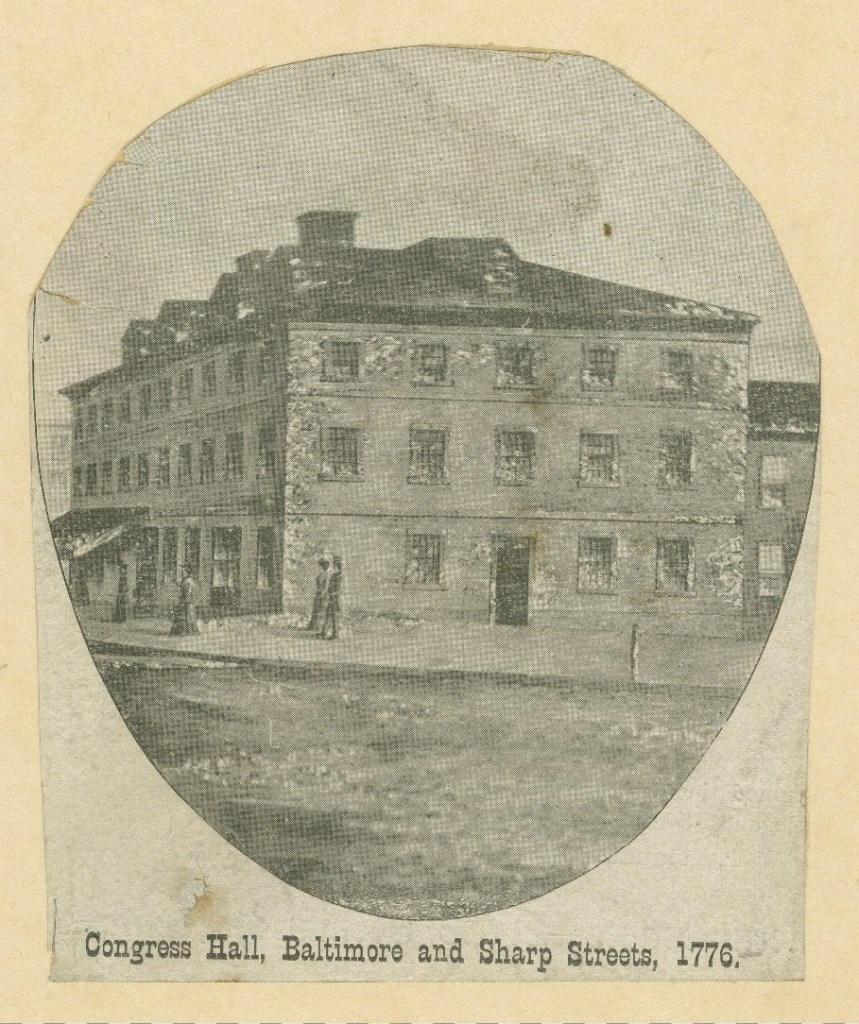
Some of the most important information in the book explains the impact of the naval blockade on mail delivery to Europe, the behind-the-scenes diplomatic negotiations with the Dutch Republic, France and Spain, the relocation of the Continental Congress from Philadelphia to Baltimore in December 1776, the role of Mary Katherine Goddard in printing the “official” signed copy of the Declaration for each of the 13 states.