
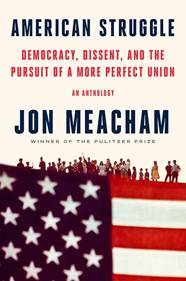
American Struggle
By Jon Meacham
Reviewed by Hank Bitten, NJCSS Executive Director
In the middle of the 19th century, the U.S. Supreme Court announced a cataclysmic decision denying the human rights of life, liberty, and the pursuit of happiness as defined in our declaration of Independence to Black people. Frederick Douglass spoke at the Anti-Slavery Society, “I base my sense of the certain overthrow of slavery, in part, upon the nature of the American Government, the Constitution, the tendencies of the age, and the character of the American people, and this, notwithstanding the important decision of Judge Taney.” (page xxii)
In the middle of the 20th century, the President of the United States led the people of the United States in prayer, beseeching the Almighty God with this closing petition: “With Thy blessing, we shall prevail over the unholy forces of our enemy. Help us to conquer the apostles of greed and racial arrogancies. Lead us to the saving of our country and with our sister nations into a world unity that will spell a sure peace – a peace invulnerable to the schemings (sic) of unworthy men. And a peace that will let all of men live in freedom, reaping the just rewards of their honest toil. Thy will be done, Almighty God. Amen.” (page 221)
In the beginning of the second quartile of the 21st century, the people of America are experiencing an attack on their institutions, the dehumanization of significant populations of its citizens, and strategies restricting their human rights to life, liberty, and the pursuit of happiness. Many educators are rewriting curriculum to teach civics with lessons on our constitution. The contribution of American Struggle by Jon Meacham is the lessons of history as he provides us with an anthology of118 documents that provide a winning strategy for students and ordinary people who want to protect and preserve our republic.
The organization of the chapters in this book provides a chronological perspective of the challenges our country has faced since its beginning. Jamestown was under martial law in 1618-19 because of the lack of food and the crisis of starvation. From this crisis came the first meeting of the burgesses on July 30, 1619, with an agreement to meet in the pews of the Jamestown church. One of the first laws passed by the burgess was to establish a fair price for tobacco. The Mayflower Compact in 1620 was another historic agreement by the first people who left Britain to escape the persecution King Charles I. Jon Meacham selected Thomas Paine’s Common Sense in the selection of documents between 1607 and 1776. This pamphlet was motivated by the tragedy of April 19, 1775, at Lexington and published on January 10, 1776. Paine reminded the 2.5 million colonists, who were predominately English, Irish, Scots, Dutch, German, Swedes, French, Black, and Native Americans…
“Where, say some, is the king of America? I’ll tell you. Friend, he reigns above, and doth not make havoc of mankind like the royal brute of Great Britain…. So far as we approve of monarch… in America the law is king.” (page13)
In Chapter 2, Federalist Paper #1 reminded me of the importance of discipline and rules in my classroom. There will always be students who avoid doing their homework, arrive late, abuse the attendance policy, push the limits of appropriate dress, and take advantage of others. In the debates for and against the ratification of our Constitution, Alexander Hamilton warned us about people who will test the limits of a democracy in Federalist #1:
“An enlightened zeal for the energy and efficiency of government will be stigmatized as the offspring of a temper fond of despotic power and hostile to the principles of liberty. An overscrupulous jealousy of danger to the rights of the people, which is more commonly the fault of the head than the heart, will be represented as mere pretense and artifice, the stale bait for popularity at the expense of the public good. It will be forgotten, on the one hand, that jealousy is the usual concomitant of love, and that the noble enthusiasm of liberty is apt to be infected with a spirit of narrow and illiberal districts. On the other hand, it will be equally forgotten that the vigor of government is essential to the security of liberty, that , in the contemplation of a sound and well-informed judgment, their interest can never be separated; and that a dangerous ambition more often lurks behind the specious mask of zeal for the rights of the people than under the forbidden appearance of zeal for the firmness and efficiency of government.” (page 29)
Jon Meacham offers a context through documents which motivate reflective thinking. The challenges for each era are different and yet he reminds us of the continuing theme that our freedom is fragile. The selections in the chapters for the 19th century, “The Union and Its Discontents,” “The Fiery Trial,” and “A Troubled Peace” provide teachers with the diversity of perspectives and valuable insights into the importance of religion as social and intellectual history.
The Tariff of 1828 was issued only two years after the 50th anniversary of the Declaration of Independence. During these 50 years, approximately 800,000 immigrants arrived, the cotton gin increased the demand for slave labor and the number of slaves increased to 2 million from 700,000 in 1790, we experienced three contested presidential elections, had several internal rebellions, and experienced two economic crises. Ask your students, what they think motivated Daniel Webster to write the words in the excerpt from his speech below, “Liberty and Union, Now and Forever” on January 26, 1830. What voices did he listen to with his ears? What did his eyes see on the horizon? What memories was he thinking of with his brain?
“God grant that in my day, at least, that curtain may not rise! God grant that on my vision never may be opened what lies behind! When my eyes shall be turned to behold for the last time the sun in heaven, may I not see him shining on the broken and dishonored fragments of a land rent with civil feuds, or drenched, it may be, in fraternal blood! Let their last feeble and lingering glance rather behold the gorgeous ensign of the republic, now known and honored through the earth, still full high and advanced, its arms and trophies streaming in their original luster, not a stripe erased or polluted, nor a single star obscured, bearing for its motto, no such miserable interrogatory as “What is all this worth?” nor those other words of delusion and folly, “Liberty first and Union afterwards”, but everywhere spread all over in characters of living light, blazing on all its ample folds, as they float over the sea and over the land, and in every wind under the whole heavens, that other sentiment, dear top every true American heart – Liberty and Union, now and forever, one and inseparable.” (page 53)
Teachers might use this speech to ask their students on the 200th anniversary of this landmark speech and the 250th anniversary of the Declaration of Independence if liberty is still the enduring legacy of the American identity or if it is justice or equality. Daniel Webster at the age of 36 argued before the U.S. Supreme Court in 1818 for his alma mater in Dartmouth College v. Woodward that Dartmouth College had a charter (contract) and that the government could not amend or change to make Dartmouth College a state or public institution. This landmark decision reflects national unity and the decisions on tariffs and wars led to division. Six years before this decision, several New England states met in Hartford, Connecticut to challenge the decision of the Congress to declare war on England in 1812, which negatively impacted their economy and livelihood. The Tariff of 1816 and the Panic of 1819 negatively affected the economy of South Carolina with 10% of its population moving west. Students need to debate if states’ rights matter and to the extent they matter today on issues of elections, immigration, gender, health care, and reproductive rights. A resolution in the Lincoln-Douglas style could be “America was, is, and will continue to be a divided democracy.”
Daniel Webster was elected to Congress in 1812 from New Hampshire as an anti-war Federalist, He was aware that perhaps 50% of the farmers and merchants in New England were out of work because of the Embargo Act, that the federal government ordered Massachusetts to send their state militia to fight in the war, that Britain wanted to sign a separate agreement with the New England states, and that Washington D.C. was burned. Students can debate if the extent of authority granted in the constitution to the three branches of the national government is more important than the individual rights of each state.
After students complete their debate on states’ rights and national unity, they need to answer if liberty is still the enduring legacy of the American identity. Is it the liberty of the people (popular sovereignty), the liberty of the states (compact theory and right to secession), or the authority of the national government (Supremacy Clause) that defines the legacy of liberty in the 21st century? To develop historical thinking, it is necessary to include the context of the primary sources in American Struggle.
The document, “The Arc is a Long One” by Theodore Parker in 1853, speaks to the importance of justice as the enduring legacy of our American identity. This sermon was presented three years after the Compromise of 1850, at a time when African Americans were taken from their homes and jobs in northern states, and at a time when the arguments of the Christian religion were used to support enslavement.
“What an idea democracy now floats before the eyes of earnest and religious men-fairer than the “Republic” of Plato or More’s “Utopia,” or the golden age of fabled memory! It is justice that we want to organize – justice for all, for rich and poor. There the slave shall be free from the master. There shall be no want, no oppression, no fear of man, no fear of God, but only love. “There is a good time coming” – so we all believe when we are young and full of life and healthy hope.” (page 82)
In this context, students are introduced to intellectual history, philosophy, and the importance of moral education. Students might explore the extent this sermon influenced people beyond Parker’s Unitarian congregation on Centre Street in the West Roxbury neighborhood of Boston? Consider asking what is meant by the moral arc of justice and examples from history as to when justice prevailed over evil. To enable students to connect with the issues of personal liberty, human trafficking, gun violence, proliferation of narcotics, and greed, consider the speeches by Rev. Dr. Martin Luther King, Jr, in Montgomery (3/25/1965) and in President Barack Obama’s Second Inaugural Address on the ‘arc of history.” (1/21/2013)
The perspective of Edward A. Pollard, editor of the Daily Richmond Examiner and the author of The Lost Cause: A New Southern History of the War of the Confederates, (1866) provides students with the lessons of war. It is important to remember that the battles of war continue after the battles end. The question for students to consider is how should historians determine the outcome of war, conflict, or crisis?
Theodore Parker explains the contributions of the South to the moral and intellectual identity of the American people. The South produced the majority (10/16) of American presidents before the Civil War, and produced influential literature about living in the colonies, on plantations, and in Charleston. Encourage your students to debate the power of the people in the context of their vision of liberty, justice, equality, and freedom in the United States.
“The war has not swallowed up everything. There are great interests which stand out of the pale of the contest, which is for the South still to cultivate and maintain. She must submit fairly and truthfully to what the war has properly decided. But the war properly decided only what was put in issue: the restoration of the Union and the excision of slavery; and to these two conditions the South submits. But the war did not decide negro equality; it did not decide negro suffrage; it did not decide State Rights, although it may have exploded their abuse; it did not decide the orthodoxy of the Democratic party; it did not decide the right of a people to show dignity in misfortune; and to maintain self-respect in the face of adversity. And these things which the war did not decide, the Southern people will still cling to, still claim, and still assert in them their rights and views.” (page 126)
The selection of documents within defined time periods provides teachers with an opportunity to have their students read them and then select excerpts from them for a press conference, podcast, or town hall meeting on Reconstruction, the Depression or World War 2. The 12-20 documents in each chapter of American Struggle are short, represent different points of view, and are relevant to the experiences of Americans today. Do the words of President Franklin Roosevelt’s First Inaugural Address on March 4, 1933, or the words of Senator Huey P. Long in his radio address, “Every Man a King” on February 23, 1934 apply to how the students in your school understand America today?
“In such a spirt on my part and on yours we face our common difficulties. They concern, thank God, only material things. Values have shrunken to fantastic levels, taxes have risen, our ability to pay has fallen; government of all kinds is faced by serious curtailment of income, the means of exchange are frozen in the currents of trade; the withered leaves of industrial enterprise lie on every side; farmers find no markets for their produce; the savings of many years in thousands of families are gone.” (Roosevelt, page 193)
“We have in America today more wealth, more goods, more food, more clothing, more houses than we have ever had. We have everything in abundance here. We have the farm problem, my friends, because we have too much cotton, because we have too much wheat, and have too much corn, and too much potatoes….
We have in America today, my friends, a condition by which about ten men dominate the means of activity in at least 85 percent of the activities that you own, They either own directly everything or they have got some kind of mortgage on it, with a very small percentage to be excepted.” (Long, page 200)
The section on Rights and Reactions offers teachers the following documents within a six-year time frame. This defined period offers teachers resources for varying perspectives on civil rights and the Vietnam War. Students can read and analyze these documents and then research the reactions to them in newspapers using Chronicling America on the Library of Congress website, recently updated in April 2026. There are few sources compiling a vivid description of the defining events of the Sixties, enabling teachers to teach the curriculum standards using a thematic, chronological, and interdisciplinary model of instruction.
U.S. Supreme Court decision in Engle v. Vitale, June 25, 1962 on school prayer
George C. Wallace’s Inaugural address, January 14, 1963
John F. Kennedy’s address on Civil Rights, June 11, 1963
New York Times article on Medgar Evans assassination (June 13, 1963 (2 days later)
John Lewis’ address at the March on Washington, August 28, 1963
President Lyndon Johnson’s speech on the Great Society on May 22, 1964
Senator Everett Dirksen’s speech on civil rights bill, June 10, 1964
Gov. Nelson A. Rockefeller’s speech at the Republican National Convention, July 14, 1964
Senator Barry Goldwater’s Acceptance Speech to the Republican National Convention, July 16, 1964
Fannie Lou Hamer Testimony before the Democratic National Convention on August 22, 1964
President Lyndon Johnson’s Address to Congress, March 15, 1965
Rev. Jerry Falwell’s sermon, March 21, 1965
James Baldwin’s article in Ebony, August, 1965
President Lyndon Johnson on the Immigration & Nationality Act, October 3, 1965
Walter Cronkite’s Editorial on Vietnam and the Tet Offensive, February 27, 1968
Martin Luther King, Jr.’s sermon on April 3, 1968 (day before his assassination)
Senator Robert F, Kennedy’s remarks on the assassination of Dr. King, Jr. April 4, 1968
The events of this decade will represent a turning point in American history and American Struggle provides a critical perspective through documents from 1969 to the present. The documents below guide students in an exploration of the changes in America’s role from its zenith in 1969 to the present. Students and teachers need to explore and debate how historians will define this 60-year period in both American and world history. The 19 documents provide the first steps for inquiry using the framework of a chronological outline about the domestic and foreign policy challenges in this era. Each document has relevance to the challenges students see in the world today: Here is a sample:
‘There are No Founding Mothers” – Shirley Chisholm on the ERA
“We are a Government of Laws, Not of Men”- President Ford on his second day as President
“A Crisis of Confidence” – President Jimmy Carter on The Energy Crisis
“The Infrastructure of Democracy” – President Roanld Reagan’s Address to the British Parliament
“They Came from Every Land” – President Ronald Reagan on the 100th Anniversary of the Statue of Liberty
“Take Back Our Culture” – Patrick J. Buchanan’s Address to the Republican national Convention
“Justice Will Prevail” – President Bill Clinton at the Oklahoma City Memorial Prayer Service
“Country Before Party” – Vice-President Al Gore’s Presidential Concession Speech
“That’s Not the America I Know” – President George W. Bush on the Attack on America in 2001
“Love is Love” – President Barack Obama’s Remarks on Marriage Equality
“American Carnage” – President Trump’s First Inaugural Address
A final thought on how the words from President Reagan, 45 years ago, are relevant to what students are studying in high school classes today in relationship to America’s foreign policy”
“The objective I propose is quite simple to state: to foster the infrastructure of democracy – the system of a free press, unions, political parties, universities – which allows a people to choose their own way, to develop their own culture, to reconciles their own differences through peaceful means.
This is not cultural imperialism: it is [providing the means for genuine self-determination and protection for diversity. Democracy already flourishes in countries with very different cultures and historical experiences. It would be cultural condescension, or worse, to say that any people prefer dictatorship to democracy. Who would voluntarily choose not to have the right to vote, decide to purchase government propaganda handouts instead of independent newspapers, prefer government to worker-controlled unions, opt for land to be owned by the state instead of those who till it, want government repression of religious liberty, a single political party instead of a free choice, a rigid cultural orthodoxy instead of democratic tolerance and diversity?” (page 408)

