Ukrainian Homodor

Ukrainian “Homodor”

(Murder by Hunger)

Images of starving Ukrainian peasant children, c. 1932-1933

Animosity between Russia and Ukraine has deep roots. This “Father Stalin” children’s song is from the 1930s when Soviet Union policies created famine in Ukraine. Father Stalin is Josef Stalin, head of the Communist Party and government in the Soviet Union that was dominated by Russia. The author of the poem is unknown. This version is from the 2012 book Bloodlands: Europe Between Hitler and Stalin (Basic Books, 2012: 36) by Timothy Snyder. A “kolkhoz” is a collective farm.

Father Stalin, look at this

Collective farming is just bliss

The hut’s in ruins, the barn’s all sagged

All the horses broken nags

And on the hut a hammer and sickle

And in the hut death and famine

No cows left, no pigs at all

Just your picture on the wall

Daddy and mommy are in the kolkhoz

The poor child cries as alone he goes

There’s no bread and there’s no fat

The Party’s ended all of that

Seek not the gentle nor the mild

A father’s eaten his own child

The Party man he beats and stamps

And sends us to Siberian camps.

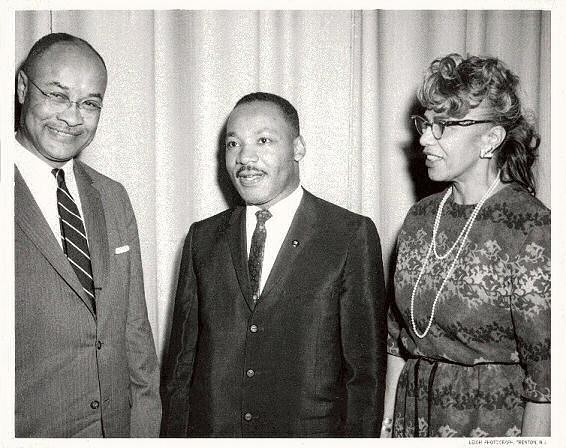
New Jersey History: Dr. Martin Luther King, Jr. Discusses the “American Dream,” Drew University, Madison, New Jersey, February 5, 1965

New Jersey History: Dr. Martin Luther King, Jr. Discusses the “American Dream,” Drew University, Madison, New Jersey, February 5, 1965

Source:https://depts.drew.edu/lib/archives/online_exhibits/king/speech/theamericandream.pdf

An audio of the entire speech is available online at: https://depts.drew.edu/lib/archives/online_exhibits/King/index.html

Dr. Martin Luther King Jr. gave his “American Dream” speech to an audience of 5,000 at Drew University. He is with Drew professor Dr. George D. Kelsey and his wife.

A. I would like to use as a subject from which to speak tonight, the American Dream. And I use this subject because America is essentially a dream, a dream yet unfulfilled. The substance of the dream is expressed in some very familiar words found in the Declaration of Independence. “We hold these truths to be self-evident: that all men are created equal; that they are endowed by their Creator with certain inalienable rights; that among these are life, liberty, and the pursuit of happiness.” This is a dream. Now one of the first things we notice about this dream is an amazing universalism. It does not say some men, it says all men. It does not say all white men, but it says all men which includes black men. It doesn’t say all Protestants, but it says all men which includes Catholics. It doesn’t say all Gentiles, it says all men which includes Jews. And that is something else at the center of the American Dream which is one of the distinguishing points, one of the things that distinguishes it from other forms of government, particularly totalitarian systems. It says that each individual has certain basic rights that are neither derived from nor conferred by the state. They are gifts from the hands of the Almighty God. Very seldom if ever in the history of the world has a socio-political document expressed in such profound eloquent and unequivocal language the dignity and the worth of human personality.

B. But ever since the Founding Fathers of our nation dreamed this dream, America has been something of a schizophrenic personality, tragically divided against herself. On the one hand we have proudly professed the great principles of democracy. On the other hand we have sadly practiced the very antithesis of those principles. Indeed, slavery and racial segregation are strange paradoxes in the nation founded on the principle that all men are created equal. But now, more than ever before, our nation is challenged to realize this dream. For the shape of the world today does not afford us the luxury of an anemic democracy, and the price that America must pay for the continued oppression of the Negro and other minority groups is the price of its own destruction. The hour is late and the clock of destiny is ticking out, and we must act now before it is too late.

C. I would like to suggest some of the things that must be done in our nation if this American Dream is to be realized, some of the challenges that we face at this hour; and in facing the challenges we will be able to bring this dream into full realization. I would like to start on the world scale, so to speak, by saying if the American Dream is to be a reality we must develop a world perspective. It goes without saying that the world in which we live is geographically one, and now more than ever before we are challenged to make it one in terms of brotherhood . . . Mrs. King and I had the privilege to journey to that great country known as India. I never will forget the experience of meeting and talking with the great leaders of India, meeting and talking with thousands and thousands of people in the cities and villages all over that vast country. These experiences will remain meaningful and dear to me as long as the chords of memory shall let them. But I must say to you that there were those depressing moments. How can one avoid being depressed when he sees with his own eyes evidences of people by the millions going to bed hungry at night? How can one avoid being depressed when he sees with his own eyes thousands of people sleeping on the sidewalks at night, no houses to go in, no beds to sleep in? How can one avoid being depressed when he discovers that out of India’s population of more than 400 million people, some 375 million make an annual income of less than $80 a year? And most of these people have never seen a doctor or a dentist. As I noticed these conditions, something within me cried out, “Can we in America stand idly by and not be concerned?” And an answer came, “Oh, no, because the destiny of the United States is tied up with the destiny of India and every other nation. And I started thinking about the fact that we spend millions of dollars a day in America to store surplus food. I said to myself, “I know where we can store that food free of charge, in the wrinkled stomachs of the millions of God’s children in Asia and Africa and in South America.

D. I think this is the first challenge and it is necessary to meet it in order to move on toward the realization of the American Dream, the dream of men of all races, creeds, national backgrounds, living together as brothers. If the American Dream is to be a reality, secondly we must get rid of the notion once and for all that there are superior and inferior races. This idea still lingers around in some situations and in some circles . . . There may be superior and inferior individuals academically within all races. But there are no superior and inferior races. But in spite of this, the notion still lingers around . . . We have enough evidence in practical experiences and practical accomplishments of individuals in the Negro community and individuals in other minority groups to demonstrate that there is no truth in the idea of the inferiority of the Negro race, of the superiority of any other race.

Questions

  1. According to Dr. King, what is the American Dream?
  2. In your opinion, are any groups missing from the list described in section A. If so, who is missing?
  3. In section B, why does Dr. King call the United States “schizophrenic”?
  4. In section C, why did Dr. King have an extended discussion of conditions in India?

Dr. King delivered this speech in 1965. In your opinion, are the problems he described still present in American society? Explain.

New York History: Colored School No. 4

New York History: Colored School No. 4

Tom Miller

(Reprinted with permission from “The Daytonian in Manhattan)

The first Blacks arrived in New Amsterdam in 1626, imported from Africa as slaves by the Dutch West India Company. During the British occupation of New York City in 1776 the population soared after the Crown promised freedom to slaves who deserted their rebel masters. It resulted in thousands of runaway slaves flocking into the city. By 1780, there were more than 10,000 Blacks living in New York. Finally, in 1827, slavery was abolished in New York. But freedom did not necessarily translate into improvement in the lives of Black citizens.

The city, of course, was tasked with the education of all children; but integrated classrooms was not conceivable. “Colored schools” were established, staffed by Blacks. They were an offshoot of the first African Free School, established in 1787 on Mulberry Street. Seven Colored Schools were organized in 1834.

In 1853 Primary Schools No. 27 and 29 shared the new 25-foot wide building at No. 98 West 17th Street (renumbered 128 in 1868). Three stories tall and faced in brick, it had two entrances–one for boys and the other for girls–as expected in Victorian school buildings. In the basement was a small living space for the janitress, Mary Sallie.

There were four teachers in each school, all unmarried women. Their wages in 1855 ranged from $400, earned by H. A. McCormick (about $12,200 a year today), to the $100 salaries earned by Abbie M. Saunders and Eliza Ideson. How the women survived on the equivalent of $3,000 a year in today’s money is remarkable.

The street address was not the only thing about the school building that would change. By 1861 it was renumbered Primary School No. 14 (H. A. McCormick was still teaching here at the time), and within two years it became Colored School No. 7. That year it was staffed by seven teachers–four teachers in the Boys’ Department and three in the Primary Department.

By 1866 the name was changed yet again, now known as Colored Grammar School No. 4. Schools across the city staged a yearly exhibition of the children’s work and this one was no exception. On May 30 that year, the New York Herald reported “The exhibition of Colored Grammar School No. 4 took place last evening at the Cooper Institute. The audience was quite large, and included a few white persons, both male and female, and was well pleased with the exercises embraced in the programme.” The newspaper was careful to point out that the school was “formerly No. 7.”

Rather surprisingly, two specialized teachers were added to the staff in 1868. William Appo, a renowned Black musician, taught music and S. Anna Burroughs taught drawing.

Graduating from grammar school was an important milestone, especially for Black children who were often pulled from school in order to work and help their families financially. On March 5, 1869 The Sun reported “In Colored Grammar School No. 4, in Seventeenth street, Mrs. Sarah J. S. Thompkins, the principal, treated her pupils to an inauguration celebration. Remarks were made by the Rev. Charles B. Ray, Fred Sill, C. E. Blake, Jacob Thomas, and William F. Busler.”

The position of music teacher was taken by Joan Imogen Howard, who came from Boston, Massachusetts. Like William Appo, she was recognized as an accomplished musician. She was as well an ardent worker for integration and racial rights. On October 30, 1892 The World reported “Miss J. Imogen Howard, the only colored woman on the Board of Lady Managers of the [Chicago] World’s Fair, is busily engaged in gathering statistics concerning colored women in New York State.

Reflecting the innate racism of the time, the reporter asked Howard if it was possible for a Black woman to become a member of “the learned professions here.” Her reaction was visible. “Miss Howard looked surprised,” said the article. She replied “I know of a great many. In Brooklyn there are three doctors, each of them enjoying a large practice and doing well…I am personally acquainted with one colored woman who graduated from law school with honors…Miss Ida B. Wells, a young colored girl, is assistant editor of the New York Age, a weekly paper devoted to the interests of the colored people.” She went on to list a number of other successful professional women.

In 1873 the attendance of Colored School No. 4 was 120 pupils. The school building was showing the effects of two decades of use. An inspection by the School Board that year found in part: “ceilings cracked through and need repairing; ventilation by windows; water closets of wood, in poor condition; heated by seven wood stoves, properly shielded with tin.”

The tin-lined flues of the cast iron stoves would cause problems at least twice. On January 6, 1879 The New York Evening Express entitled an article “Scared Colored School-Children” and reported “A defective flue caused a fire this morning in Colored School No. 4, at 128 West Seventeenth street. The fire occurred just before the assembling of the school, and a panic was thus averted, although the children collected around the building were considerably frightened.”

It may have been that incident that prompted Principal Sarah J. S. Garnet to routinely instruct the pupils on how to react to a fire. (Sarah Garnet was the widow of the Rev. Dr. Henry Highland Garnet, the former Minister to Liberia.) It proved to be worthwhile instruction. On February 14, 1883 The Sun reported that another flue fire had broken out.

At around 10:30 that morning children on the second floor noticed wisps of smoke “and became restless.” Mrs. Garnet told a reporter “I had frequently told the children that if fire broke out they would have sufficient warning from me to enable them to walk safely out of the school building. Their faith in me is what saved them from a panic.”

There was a total of 150 children in the building. Garnet instructed a teacher to arrange the pupils on the second floor in straight lines, while she went upstairs to do the same with the youngest children. “At a signal the pupils marched down the narrow, wooden stairways and stood quietly in the inner court yard.” One child ran three blocks to the nearest fire station. The fire was quickly extinguished and the pupils were marched back to their desks. “They were as busy in the afternoon as though nothing had happened,” said The Sun.

In 1884, Joshua S. Lawrence published an article in Ballou’s Monthly Magazine entitled “The Negroes of New York.” He praised racial advances, beginning, “What a contrast between now and twenty years ago! Then they were vassals, now they are clamoring for the offices and other perquisites of a free government.” His out-of-touch assessment was highly biased and he insisted “The negro in this city is not debarred or hindered in any way…Their children are allowed to enter public schools all over the city, besides having separate ones, taught by their own teachers.”

The article pointed out that integration was slowly coming about. “In order to show that the color line is breaking in this regard, an idea encouraged by the Board of Education, is not to take notice of complaints when two or more negro children happen to be near the offspring of some fastidious parent.” Lawrence mentioned Colored School No. 4, saying it combined “both primary and grammar,” levels.

At the time of the article the prospects for the school were dim. The Board of Education had already proposed closing the school. The minutes of the Board of Education on March 5, 1884 documented the receipt of a petition “From the Teachers of Colored Grammar School No. 4, asking that said school be continued for a longer period than that assigned by the action of the Board in 1883.” The petition was forwarded to the Committee of Colored Schools. Its decision was no doubt disheartening.

The teachers were permitted to continue to teach “in other premises than the school building, but without incurring any expense on the part of the Board.” In other words, if the teachers wanted to continue the school, they were responsible for all aspects of it, including funding.

But there was obviously a change of heart. The facility continued, now known as Grammar School No. 81. Sarah J. S. Garnet was still principal, and Joan Imogen Howard was still teaching here in 1892. Another inspection that year reflected the poor sanitary conditions. It said “the sinks are defective and cannot be cleaned and flushed regularly. The closets [i.e. toilet rooms] are not ventilated, but are filled with sewer gas and foul air.”

The push to discontinue the school in the 17th Street property continued. In December 1894, Mayor William L. Strong received a resolution from the Board of Education “requesting the sale of property No. 128 West Seventeenth street.” By the following year, the building was unoccupied.

Finally, on March 24, 1896 the City signed a deal with the Civil War veterans of the 73rd Regiment to lease the ground floor as its clubhouse. Four months later renovations had been completed and on July 6, 1896 the New-York Daily Tribune reported “The members of the Veteran Association of the 73d New-York Volunteers-2d Fire Zouaves–held a celebration in honor of the opening of their new headquarters, No. 128 West Seventeenth Street–the old schoolhouse.” Among the entertainment that night was John J. Moloney, who “gave his bone solo, which elicited much applause.”

The club rooms were decorated with war relics, perhaps the most significant of which was the first Confederate war flag captured by the North. On March 11, 1907 The Yonkers Statesman explained that it had been taken by Corporal Daniel Boone on May 2, 1862 at Yorktown, Virginia. Interestingly, the city retained possession of the old school house property. On January 19, 1921 The City Record announced that renovations would be made “to properly place the premises…in a state of occupancy for the Veteran Fire Association.” The 73rd Regiment Veterans remained in the ground floor while $5,000 was spent in renovations on the upper floors for the Veteran Fire Association.

The new residents renamed their portion of the building Firemen’s Hall. Like its downstairs neighbor, it was a social club. On February 17, 1923, for instance, The Brooklyn Standard Union reported “The Veteran Firemen’s Association held its annual banquet last Saturday night, at Firemen’s Hall, 128 West 17th Street, Manhattan. There were 300 members and their guests present, and it was a most unique affair.” The two organizations remained in the building at least into the 1930’s. A renovation in 1931 made “general repairs to the toilets, urinals and all the fixtures.” The building was later acquired by the New York City Department of Sanitation, which utilizes it today. At some point a veneer of yellow brick was applied. Remarkably, the small paned windows survive. The little building with its remarkable history is easily passed by today with little notice.

Thinking and Teaching the Implications of Federalist Paper #10

Thinking and Teaching the Implications of Federalist #10 for Democracy

Jeff Schneider

When I picked up my copy of Federalist #10 to begin writing this article, I was stunned by the subtitle: “The Union as a Safeguard Against Domestic Faction and Insurrection.” Despite my 30 years of teaching this document, the emotions that welled up in me upon reading “Insurrection” were a shock. These are hard times. That the present shapes our understanding of the history we study was brought home to me with new force.

Knowing that Shays’ Rebellion was a cause of the calling for and high attendance at the Constitutional Convention, and the prominence of the phrase “to insure Domestic Tranquility” in the preamble, helps explain what the framers thought was at stake in 1787. As a high school teacher, I always spent 10 or 15 minutes parsing the meanings of the preamble, but even though I taught the Constitution more than 150 times over the years, I never felt the depth of those words as I do at this time. The January 6, 2021 insurrection at the United States Capitol by followers of Donald Trump puts us in a situation James Madison would recognize. Donald Trump and his followers have been frightening us every day for years now. It is time to analyze the most famous of Madison’s Constitutional commentaries: Federalist #10. This essay is addressed to teachers.

This article is in two major parts: An analysis of Madison’s Federalist #10 on his terms in the first section, which is a pared down student-led lesson, and a second section which builds on the first to critique #10. Usually historians and political scientists refer to the electoral college as the major anti-democratic feature of the Constitution, but in Federalist #10 Madison, as you will see, had fundamentally no respect for the will of the of the people. He baked this idea into his theory of the republic.

That final section takes on the chimerical idea of the (single) public good and Madison’s outright rejection of “the people themselves” to protect the government from dangerous majorities. In 2022 the white supremacist Republican Party has ditched democracy and gerrymandered Madison’s constitutional structure. We are on the brink of a fascist takeover. These contradictions could not be compromised away in 1787 and cannot be smoothed over in 2022. “The Miracle in Philadelphia” nearly failed as a system on January 6, 2021. Democracy cannot be defended by depending on a group of men of “wisdom” to lead us to control “the mischiefs of faction.” Instead we need majority rule.

Part I: Federalist #10 taken on Madison’s terms

When I assigned Federalist #10 I asked the students to download and read the document. They were required to choose two sentences from the beginning, three from the middle, and two from the end of the document. As I have explained in detail in “The Tarzan Theory of Reading,” on my Substack site, the students were to single out sentences with which they agreed or disagreed strongly or those that they thought were important and explain why. The students will lead the discussion with their questions, comments, and the sentences they choose which they will read out loud to the class. In addition, I asked them to identify the sentence that was at the logical center of the argument in Federalist #10, which has an elegant architecture.

When I began the class, I asked for questions or comments. Students often made comments on the definitions of faction or insurrection, which is now a term many students will encounter in the news. The definition of faction is “a majority or minority… opposed to the permanent and aggregate interests of the community.” The students will come up with the common term “special interest,” but how can that be a majority? This is key problem with Federalist #10, since Madison’s understanding of the term faction is not intuitive. The students may object that the Constitution describes a democracy: does not the majority rule? You should put that idea in a separate list on the board and leave it until the end of the discussion (we will discuss that separate list of ideas in depth in the Part II critique). The students know that Shays’ Rebellion (1786 – 87) was an insurrection, an attempt at the violent overthrow of a government.

Majority faction is itself a contradiction that can be addressed by working through Madison’s series of subtopics: the climate of disorder in the country, his diagnosis of factions the proposals to eliminate them, or to control them, and a critique of his solution. Although the discussion will jump around the document, as the students volunteer their sentences those subtopics will organize the notes as we go along.

Disorder in the country

Shays’ Rebellion was a major factor in Madison’s concerns. The students will know that indebted farmers in western Massachusetts denounced unaffordable taxes and complained that they were losing their mortgages to foreclosure. Daniel Shays was a Revolutionary War captain who led his followers to attempt to close the courts to prevent the foreclosures. In addition, they demanded representation equal to the proportional per capita representation in the east close to Boston. After the rebellion was quashed, Shaysites were elected to the Massachusetts legislature. Another problem was that the rebellion was a protest against unfair taxation reminiscent of the protests in the 1760s and 70s. It reminded many leaders in Massachusetts of the lead-up to 1776 (similarly, some of the insurrectionists in 2022 used 1776 as a threatening slogan). This armed insurrection was a major cause of the convening of the Constitutional Convention in Philadelphia, because the Articles Congress had no power to raise an army directly: the state had to defend itself along with any allies it could muster.

Madison describes how, in his view, the public good was being ignored. “The friend of popular governments” opposes the “violence of faction” which causes “instability, injustice and confusion.” There are “overbearing” majorities that cause “ governments” to be “too unstable” because they do not respect the “rights of the minority,” and governments controlled by “specious (unsupportable) arguments” causing “mortal diseases under which popular governments have everywhere perished.” Madison blames the “factious spirit that has tainted our public administrations.”

Madison’s definition of faction

“By faction I understand a number of citizens whether amounting to a majority or a minority of the whole who are united and actuated by some common impulse or passion or of interest adversed (sic) to the rights of other citizens or the permanent and aggregate interests of the community.” If a student chooses this sentence, you have to be careful to explain each part of the definition. I ask, “How do you explain this definition?”. Eventually the students come to realize that Madison expected that the people would support particular conclusions (how else could he call it a majority faction?). How could a leader find “the permanent and aggregate interests of the community,” I ask. This should also go in the Critique section for discussion. The rest of Federalist #10 discusses how to eliminate factions or how to control them.

Eliminating factions

This is the first of the methods to secure the government against the “mischief of faction.” There are two methods to eliminate factions: destroying liberty or giving everyone the same opinions. The students will then come to the conclusion that restricting liberty is not possible in a democratic government because we depend on freedom of thought and action to maintain democracy.

The second method, giving “everyone the same opinions,” is also an impossible solution because “as long as man continues fallible, and he is at liberty to exercise it, different opinions will be formed.” I ask, “How do you understand that?” Here, students might note Madison’s identification of opinions based on “self-love,” the diagnosis that “reason is connected to passion” and the observation that “Diversity in the faculties of man” were factors in the differences of political opinions.

The rights of property and the ownership of different kinds of property and the faculties to obtain those kinds of property all cause divisions. “Faculties” seems to mean “abilities,” students will likely conclude. So, Madison describes it thus: “(t)he latent (underlying) causes of faction are thus sown in the nature of man.” It soon becomes clear that Madison was not making an argument for the change in distribution or the control of production or property or goods in the U.S. — Madison was not a Marxist! Instead, the students will conclude that Madison was attempting to find ways to manage the political effects of that inequality or those differences. But in whose interest did he want to manage those inequalities: was it to be a country of the enslaved, the ordinary people, or did he favor his class of the southern gentry?

Controlling the effects of faction

“The inference to which we are brought is, that the CAUSES of faction cannot be removed and that relief is only to be sought in controlling its EFFECTS.” In the ensuing discussion students will come to the conclusion that this sentence begins the second half of the argument. It is the sentence at the logical center of the argument. Here Madison turns to the idea of controlling the effects of factions instead of eliminating them, and eventually introduces the republic as a solution.

“If the faction consists of less than a majority” voting, the “republican principle” is the remedy. There might be disagreements, but majority rule does offer a solution. Therefore, what to do about a majority faction is the most intractable problem. Someone is likely to pick the sentence: “To secure the public good and private rights against the danger of such a (majority) faction, and at the same time to preserve the spirit and the form of popular government is then the great object to which our inquiries are directed.” The ensuing discussion can conclude that it is a thesis sentence pointing to the chief point of the whole article.

The “existence of the same passion in the factional majority” must be prevented or “the majority must be rendered unable to concert. When people “concert” they work together. Madison is actually opposing the rule of the majority here. A pure (direct) democracy in which the citizens are the legislature “can admit of no cure” for “the mischiefs of faction” because “the common passion or interest will in almost every case be felt by a majority of the whole and there is nothing to check… an obnoxious individual” or group from influencing everyone.

In a republic as envisioned by Madison, however, “the representatives refine and enlarge the public views by passing through a medium of a chosen body of citizens whose wisdom may best discern the true interest of their country (my italics).” He added, “the public voice pronounced by the representatives of the people might be more consonant to the public good than if pronounced by the people themselves.” Here Madison added the idea of making the republic cover larger areas. He suggests that by “(e)xtend(ing) the sphere — you take in a greater variety of parties and interests (and) you make it less possible they will concert….” The conclusion of this part of the argument can lead to a choice of more famous and experienced statesmen who possess the “wisdom” referred to above, because the a large number of voters would be participating in a larger district, the chances if a more famous or experienced person (i.e. of wisdom) would be greater.

Finally, “The influence of factious leaders may kindle a flame within their particular states, but will be unable to spread a general conflagration through the other states.” He uses religious sects, a rage for paper money, and abolition of debt as examples that are more likely to “taint a particular county or district than an entire State.” These are some of Madison’s most famous statements. The students will see that the purpose of representation and extending the area of the republic was to elect men of wisdom. The factions may cancel each other out or the men of wisdom will convince the other legislators to follow the “true ideas” of the public good because ordinary people cannot end the controversy. Madison and his fellow leaders will decide for them.

Madison’s essay seems clear as a the ringing of two groups of bells: There are two groups of opposing solutions: Eliminating Factions or Controlling its Effects. Each has two methods of solution: He moves through the ideas with alacrity going from one solution to another. The logic is stunning and elegant, like a mathematical proof.

Part II: A critique of Madison’s argument

Now we have to confront the sentences we have put aside or left without exploring thoroughly, in particular the idea of the majority faction: “By faction I understand a number of citizens whether amounting to a majority or a minority of the whole who are united and actuated by some common impulse or passion or of interest adversed (sic) to the rights of other citizens or the permanent and aggregate interests of the community.” Eventually, the students will conclude that a majority vote is not what Madison is seeking as a solution to the problem of the majority faction. Somehow the government must override the majority.

Another example of Madison’s majority problem: The “public voice pronounced by the representatives of the people” might be more consonant “to the public good than if pronounced by the people themselves.” The students will determine that Madison is counter-posing the representatives to “the people themselves.” Representatives certainly do not have to vote by taking instructions from their constituents, but it is clear that Madison is trying to circumvent the majority. Why would a legitimate republic be so designed? When we discuss this idea the students reach the conclusion that he does not trust the people to make the right decisions. It is obvious from the sentences that are there for the choosing.

Another of Madison’s sentences expresses the same contradictory view: “To secure the public good and private rights against the danger of such a (majority) faction, and at the same time to preserve the spirit and the form of popular government is then the great object to which our inquiries are directed.” What, students may ask, is the “public good” other than the will of a majority? If you have not yet discussed “public good,” it is an opportunity to discuss the major contradiction. When the students analyze this, discussion is not done until students understand that although Madison seems to be arguing the solutions benefit all the people, he is claiming the right of the elite to decide for the majority, which citizens are going to benefit.

Eventually the students reach the conclusion that everyone does not have the same interests in society or that the public good may change. It is not clear how to determine the public good, or that the public good can be expressed as a singular rather than a series of public goods. Madison believed, however that the public good was not only attainable, but a key factor in overcoming the mischiefs of the majority faction. Do we really think that the Constitution has been a success for all the people as Madison designed it and the conventional wisdom in the US has always assumed?

Now we have entered a realm of ambiguity and contradiction. Madison’s elegant proof, which seemed so clear, becomes murky, and most importantly, unreachable by the majority of ordinary men — or women! I ask, “How do you understand this “public good” now?” The students will determine that not all people under the Constitution have the same interests as propertied white men. There are women and Black people and the poor and wealthy. In 1787 these individuals were not all formally part of the political community. The First Peoples, “not taxed,” were excluded from representation by the clause on taxing and the 3/5th clause. The Black underclass in the U.S. has been living without the protection of the law for the vast majority of American History; much of white America seemed to only discover the true level of relentless and widespread violence against Black people on May 25, 2020 —  the day of George Floyd’s murder. Madison had been fine with slavery and its terrible consequences; violence against Black men and women was not a new development.

The interracial uprising that resulted was unique. They were the largest multiracial demonstrations ever in the US. The violence against Blacks has been a dark undercurrent in the US since the ratification of the Constitution. What is the public good? Do you think now that Madison was protecting the whole people as he implied in paragraph after paragraph by calling his goal the public good?

Now we come to the final sentence in the statements we have put aside for critique. When Madison brought up the danger of Shays’ Rebellion, he blamed the eastern leaders of Massachusetts for the unequal taxation, which caused the rebellion. The western farmers rebelled against the unfair taxation as they had in the 1760s and 70s. Madison commented: “Enlightened statesmen will not always be at the helm,” i.e. elected to office.

These men on whom Madison depended must convince the other representatives and the senators that they know the public good better than the people themselves. Are these people philosopher kings who see the reality in Plato’s cave? Or are they advocating legislation based on the general will in the theory of Rousseau? The general will is discerned outside of debate, and expresses the “true will” of the people. This ability is a “faculty” of enlightened statesmen. It depends not on majority vote but on “the permanent aggregate interests of the community” or the “public good,” determined by the men “whose wisdom may best discern the true interest of their country” in Madison’s phrase. These men of the “better sort” must convince other legislators to follow their lead. What in Madison’s argument places these statesmen in power, I ask. The students eventually identify the layering that takes the decisions out of the hands of the direct voters who have elected men of deeper perception or who represent more conservative interests that protect the government from the “vexed,” the poor or the enslaved, in other words, the factions born of ambition race, and class. These men can find the public good for the benefit of the permanent aggregate interests of their countrymen. But as I stated at the outset such a belief is a chimera.

How can we call the history of the US a long story of a developing public good for all the people when the 3/5th Compromise was in effect until it was repealed by the 14th Amendment in 1868, when the large white population of the North overwhelmed the slaveholders’ advantages, and up until the Civil War the small population states controlled the Senate with the help of the “dough-faced” northerners who voted with the South in the Senate and the House? These all acted together to repress democratic solutions to slavery and keep women, the poor and the First Peoples in literal and virtual shackles and chains.

When the slave power was overthrown and the Reconstruction Amendments were passed after the Civil War, there was a brief period from 1866 to 1877 when a fragile interracial democracy existed in the South, which for a time kept the Republican reformers in power. But then violent mobs attacked and killed Black Republican voters, overturned that hard won peace between the races, and Blacks lost suffrage in nearly the whole South. White supremacy ruled again until the Civil Rights Revolution capped by the Voting Rights Act of 1965 produced a second period of Black and minority participation.

Now we are in a different era in which our political life has also been commandeered by white supremacy in the form of Republican re-districting in the states so, despite the large populations in the Democratic-controlled states, the Democrats have only bare majorities in the House and only the tie-breaking vote of the vice president in a 50-50 Senate. Democratic senators represent 41.5 million more Americans than the Republicans. These are problems quite different from Madison’s majority factions. It is minority rule that the majority cannot use the “republican principle” to “cure.” It is a deadlock caused by the filibuster and the small population states, which have controlled the Senate since they were born in the Great Compromise. Madison’s “Machine that Would Go of Itself” has been rejiggered. There is a fascist threat to democracy led by the followers of the former President. Madison’s governmental structure has been under threat by these insurrectionists and the democratic traditions have been undermined to the breaking point. It is unclear whether democracy shall survive the next election, let alone the ones after.

The call in Federalist #10 for the protection of the public good and for the permanent and aggregate interests of the community was based on the will and experience of a minority Madison called the “enlightened statesmen,” who protected slavery for the white majority. The white majority in the country is now disappearing and the movements to defend the “historical white republic” are threatening the lives of workers, women and all minorities. This is our problem now, and it is rooted in the ideal of the public good which Madison believed he and other enlightened statesmen could conjure up to protect the true interests of the “whole” community. He fought to maintain the rule of people like himself. There was no working compromise between the interests of slavery and freedom, or today between the evangelical radicals opposed to abortion and advocates of women’s rights, or between the refusal of the rights of the poor to health care and advocates of Medicare for all, or finally, the interests threatening the rights to clean air, water, food, and jobs and the movement for a Green New Deal. The Electoral College and the unrepresentative Senate must not control our politics. We are at a crossroads.

The myth of the “divinely inspired” Constitution has sustained Madison’s reputation of infallibility, but the flaws in his reasoning, as we have pointed out, have come to haunt us and brought us to the brink of losing our democracy. What, after all, is the public good if it does not represent a clear majority of the US population? As the students realized in their analysis there is no single or public good. We are a country of classes, races and genders. We should not be controlled by rich white men or their MAGA insurrectionists. We are still being ruled by the magical thinking of former centuries, from ancient Greece to the early modern concepts of the virtue of the white landed aristocracy. All this is embodied the persons of senators from states with populations smaller than assembly districts in New York or the city of Washington DC. These modern-day conservatives talk about the Constitution as a document describing a republic, not a democracy. They believe that the proper leaders of this republic are the whites: the real Americans. This idea brings us back to the earlier argument concerning the dangers of reaching for the single public good or the “permanent aggregate interests of the community.” The chimera of the public good turns out to be a smokescreen for white supremacy — as it always was. No amount of leisure or learning can motivate the white supremacists to discern the true interests of our country; they are in it for themselves.

Suppressing or Inhibiting Teaching

Suppressing or Inhibiting Teaching

 Cynthia Vitere

I have been teaching history on the secondary and college level for almost thirty years. Much of this time has been spent as a teacher on Long Island, New York where my area of expertise has ranged from contemporary issues and criminal justice to leading the International Baccalaureate program in history in my current district. As a trained historian, educator and administrator I bring all of these mindsets to my curriculum and pedagogy.

In considering the question of how one addresses attempts to suppress or inhibit teaching I believe it is essential to first discuss one’s understanding of the discipline of history, why we teach it and how we teach it. Why do we ask students to take a history course? I believe the most important function of history education is to establish the foundations for informed democratic citizenship. In the primary grades, students develop a narrative of U.S. history and at the secondary level they acquire the tools to examine and critically analyze that narrative. This critically thinking student is empowered and encouraged to then articulate multiple narratives which reflect our pluralistic society. Education is no longer a hierarchical relationship between the teacher and student, but a collaborative relationship where knowledge can be nourished and exercised through regular open discourse.

When I first engage students in my classroom, too many of them assume that history is a set narrative with established facts that must be memorized. Very few students like history. Many adults I meet say they hated history class as children but now appreciate it because they finally see its utility. It is not their fault; as that educational experience is the rule for most of us, rather than the exception. For me, it wasn’t until pursuing my graduate degree in history that I was truly engaged in thinking and acting like a historian. I quickly learned that the historical narratives we tell are governed by time and place, by the perspectives of the historians and their audience, and by the availability of evidence. Historiography, or the study of how history is written, tells us that this process of continuity and change results in fantastic disputes among scholars; disputes that rarely trickle down to the high school classroom. For many, this critical history is not welcome in the classroom because it is perceived as being “too hard” or “too nuanced for the high school student”. Since “that’s not going to be on the test” it is deemed irrelevant, or worse yet, an expression of the teacher’s political agenda.

I do have a point of view. I want my students to take a seat at the historians’ communal roundtable, use the critical thinking skills particular to history, and contest our curriculum. By acknowledging the role of race, gender, class, ethnicity and every other “divisive” lens students confront the fullness of our sometimes painful past and forge a meaningful place for their own individual narrative in our shared story. For much of my career this approach to history education was not controversial but encouraged and valued as an essential component of civics education.

When I first started teaching history I was asked to create and implement a course in Multiculturalism. This course was initiated in response to racial and ethnic tensions in my district. This senior elective was seen as a corrective to those divisions. There was a desire to confront racism, ethnocentrism and sexism head on. While this was a challenging course, I felt fully supported by my administrators to engage my students with challenging readings and to moderate discourse which was frequently impassioned, sometimes tense, but ultimately a source of greater understanding and community building.

Since 9/11 the question about what should be taught in a history classroom became more problematic. With so many of my students’ families directly or indirectly affected by 9/11, history was no longer a distant topic. One had to regularly question how your topics and discussions might upset students or community members. I began to introduce trigger warnings into my practice as a way to acknowledge students’ emotional challenges, sensitively modify my instruction, but not silence necessary discourse.

With the election of President Obama the issue of race became more problematic but not one to be avoided. In my economics and history classes I freely used the PBS program entitled “Race: The power of an Illusion”. This program and its complementary website provided interactive resources which challenged student preconceptions about race and how it has influenced government legislation and programs in the 20th century. Students were challenged to critically examine, discuss and assess the subject matter. Although this curriculum demanded careful implementation, I never felt significantly anxious about the curriculum or my pedagogy. I never experienced any negative feedback or reproach. When I consider using those resources today, a paralyzing doubt stops me. Even though my graduate mentor and acclaimed historian Ira Berlin is a source in the program, the current political educational environment stops me from freely using him. Why? The website explicitly addresses the structural and historical nature of racism. Simply put, I would be targeted as a practitioner of critical race theory and pilloried.

If I were to teach the transformation of my pedagogy I would ask my students to identify a chronology of contributing factors. I would introduce the following: the emergence of Donald Trump as the voice of the Republican Party, the 1619 Project, the Black Lives Matter Movement and the Covid-19 Pandemic. When the 1619 Project was published in August of 2019 I was excited by the opportunity to introduce a reframing of American history. The beginning of my year focused on having students examine, discuss and evaluate the use of 1619 and 1776 as the defining dates in our national origin story. Excerpts from Nicole Hannah Jones’s introduction, as well as the rebuttal by Marxist and conservative historians were considered. We replicated the debate that ensued among historians. Students were not insulted, nor did they feel bad about themselves or experience any less pride as Americans. What they did do was engage in a lively critical discussion. With this introductory unit I sought to establish the transitory nature of history and the importance of critical thinking. I was neither worried or challenged by this lesson.

This, of course, is not the world we live in today. As 2019 turned into the presidential election year of 2020, the critical engagement of race became much more politicized. Still, I did not veer away from the lens of race as it is a foundational factor for historical inquiry, especially American history. After four years of the Trump Administration’s attack on evidence-based reasoning, the engagement of history became much more problematic. The normalization of framing evidence that you don’t like as fake by politicians and members of the media on both sides of the political spectrum impacted the classroom. Students would actually respond to historical evidence and claims in class with “fake news” as a silencing response. When silence is the aim, discourse itself is the problem. As a practitioner of critical thinking and discourse, my pedagogy became increasingly problematic. By 2021, I would become a target in our contemporary political culture wars.

As a teacher of the two-year IB History of the Americas curriculum, we examine U.S. history in year one and the emergence and consolidation of 20th century authoritarian regimes in year two. As I was teaching the Reichstag Fire and Hitler’s Enabling Act the January 6 insurrection took place. The continuity of this contemporary event and our historical inquiry provided a teachable moment. Students read contemporary German authors’ examination of American events from their unique historical perspective. The narratives were examined, interrogated and disputed. The sources were used to stimulate discussion, not as an equation of Nazi Germany 1931 and the United States 2021. I believed that I had a responsibility to my students to address what was happening around them, but felt that I had to mediate it through the lens of the past. Unfortunately, silence, self-censorship and discomfort became an unwelcome norm. I increasingly incorporated student writing in private blogs so that they could safely and critically engage history and contemporary events. Increasingly, I, too, self-censored in response to my discomfort. In speaking with colleagues both in the United States and on international IB web spaces, the professional fear was palpable. Was it possible to address these momentous events or was it best to safely stick to the proscribed curriculum? While many departments worked collectively to navigate a response, many others avoided discussion and left pedagogic choices to the conscience of individual teachers. In collective avoidance of this thorny issue, many hoped to protect themselves from acrimony.

Ultimately, the practitioner of critical pedagogy will be targeted by those who choose to close the door on the past, no matter how carefully they tread. My public crucible was in response to a lesson which asked students to assess the impact of racism. I did not feel comfortable or safe directly addressing the George Floyd/Derrick Chauvin trial but I did feel a professional responsibility to address the deep threads of racism and division. As a way to displace the dialogue, I focused on student generated claims which judged quantitative analysis to be more objective and useful than qualitative analysis. I asked students to apply these lenses to the impacts of racism. Students did engage in critical discourse, but what I found is that many do not want critical discourse to be taking place in public schools. If we cannot engage in critical discourse then we as educators have lost our most important teaching tool.

In historical retrospect, what have I learned? I would like to say that the experience of having my curriculum and pedagogy subjected to media and community scrutiny and attack would energize my efforts as a democratic educator. The reality is not so heroic. Much like the American Revolution, ⅓ of my professional and personal community supported me, ⅓ actively opposed me and ⅓ avoided me at all costs. This did not surprise me. When nations slide towards authoritarianism, teachers are often the first targets. The public attack on my pedagogy made this slide harder to deny and avoid. It made all teachers the target.

As teachers we are public figures who are under incredible pressure and scrutiny. One can hope to lay low and never make a mistake or misstep. One can stick to the text and avoid anything that hints of controversy, but this is not tenable. I came into education with a toolbox. The tools have evolved over time, but their purpose remains the same. My use of these tools in our current climate is much riskier. My curricular choices are more conservative, I hesitate to bring contemporary documents into our discussions of the past. I speak obliquely and ask neutered questions. To do differently is too charged, too dangerous, and too divisive but I must also acknowledge that there is a point at which I cannot surrender who I am as a critical educator. History itself calls on me to hone my critical pedagogy for these challenging times. The risk of not doing so is too great. The challenge for today’s social studies educators is how to cultivate democratic students in a world that is increasingly opposed to democracy? I do not have a singular answer, but I commit myself to seeking new methods and mediums so that we as social studies educators can reject complicity and collectively facilitate the better angels of our nature.

The History of the Lenni Lenape Before, During, and After the American Revolution

The History of the Lenni-Lenape Before, During, and After the American Revolution

(Image courtesy of Legends of America)

By Mr. David A. Di Costanzo, M. Ed Social Studies Department Chair Vineland High School

Introduction:

During the first year of this grant, seven Social Studies teachers from around the state conducted research for the New Jersey Council for the Social Studies (NJCSS). The teachers examined the histories of ordinary people in New Jersey and how the events leading up to and during the Revolutionary War impacted their lives. The grant, “Telling Our Story: Living in New Jersey Before and During the American Revolution”, is an ongoing effort by the NJCSS to prepare educators in New Jersey for the 250th anniversary of the American Revolution during the 2025-26 school year. The 250th anniversary celebrations will continue through 2031 and is part of the overall mission of the NJCSS to provide and make available meaningful lessons and activities to students, teachers, and the public.

During Year Two of the grant, the focus of the research has shifted to include the role and contributions of African Americans, Native Americans, and prisoners of war before, during, and after the American Revolution. An emphasis on the experiences of women and children during this time period will also be researched. The lives of the Lenni-Lenape from New Jersey before, during, and after the American Revolution is a fascinating and important part of American history. Professor of History and Native American Studies Colin G. Calloway from Dartmouth University said, “with few exceptions, the Indian story in the Revolution remains relegated to secondary importance and easy explanation: The Indians chose the wrong side and lost. To better understand the reality of the Revolution for American Indians, we need to shift our focus to Indian country and to the Indian community.” [1] Sadly, the story of the Lenni-Lenape during this time period has been “relegated to secondary importance” and not been told enough.

The role of Lenni-Lenape is crucial in our understanding of the American experience. What was lifelike for the Lenni-Lenape in New Jersey?  Unfortunately, the Lenni-Lenape, dealt with racist mindsets which were the primary impetus that led to a negative and mostly superficial historiography of their culture that took centuries to completely shift. Historical perceptions and the racial mindsets of Native Americans did eventually change but only after they were deprived of their land, forced to live on reservations, and required to assimilate into mainstream American culture.  

It’s also important to note that for Native Americans the Revolutionary War began way before Lexington and Concord.  Most historians agree that the American Indians had been fighting for their own independence since the Europeans made contact.  Accepting and embracing the fate of the Lenni-Lenape and discovering how people lived before and during the American Revolution in New Jersey is important work. It allows students and residents in various counties throughout New Jersey to discover a more objective truth about Native Americans before and during the American Revolution. This more objective truth is an honest attempt to provide greater transparency for everyone, whether they agree with it or not.

Historical Background:

The cultural history of Native Americans is interesting for a variety of reasons. The treatment of Native Americans is viewed by most historians as horrific. Native Americans were systematically excluded from having a true voice during European exploration and colonization as well as after the United States was founded. The explorers ravaged the indigenous people of this continent with violence, disease and deprivation.  Native Americans had non-Christian spiritual beliefs which went against the religious doctrine of the early explorers. This difference in cultures created a severe spiritual divide.  Later on, colonists traded with Native Americans but European settlers viewed them as nothing more than savages and barbarians. 

            By the nineteenth century, Native Americans had no choice but to assimilate in order to survive. Forced assimilation in order to survive is not the same thing as having a legitimate stake in the system.  Time has made most ethnicities, including American Indians, a larger part of the American landscape. All of these factors created a system of severe limitations for most Native Americans that still lingers today.  The situation in New Jersey regarding the treatment of the Lenni-Lenape was similar to the way Native Americans were dealt with throughout the colonies and the United States.

            The Lenni-Lenape of New Jersey are descendants of the Paleo-Indian whose history on this continent has been traced back to 13,000 years ago.  The Lenni-Lenape were also referred to as the Delaware Indians by the English and the Dutch.  Professor of History Maxine Lurie from Seton Hall University and Professor of Anthropology Richard Veit from Monmouth University said, “the first settlers to reach what is now New Jersey probably did so during or before the Paleo-Indian period.  Archaeological sites from this period are quite rare.” [2] Nevertheless, Paleo-Indian artifacts have been found across New Jersey as well as in New York and Pennsylvania. Excavations during the nineteenth and twentieth centuries confirmed the presence of Paleo-Indians throughout New Jersey.

            Various cultural periods would ensue for the next several thousand years leading to the final phase prior to European contact which is referred to as the Woodland Period.  This period began roughly a thousand years ago and continued until contact with Europeans during the early sixteenth century. [3] The earliest reports of contact with European explorers occurred in 1524 when Giovanni da Verrazano explored the Atlantic coast of North America. He described the natives in and around what today is New Jersey as “most loving”. [4]  Contact with whites was sporadic until the early 1600’s. The interactions with the Lenni-Lenape and the explorers increased and progressed during the early seventeenth century and beyond. 

            The Dutch and English had a sincere desire to trade with the American Indians from the Garden State.  It’s well documented that, “the Dutch West India Company, formed in Holland in 1621 to develop commerce, especially fur trading, constituted the present New Jersey Hudson River area into the province of New Nether (often “New Netherlands”) in 1623.” [5]  Furs, cooper, and other perishable commodities, such as alcohol, were all eagerly exchanged.  It became clear almost immediately that most Native Americans didn’t react well to the consumption of alcohol.  This inability to consume alcohol in moderation was something European traders would quickly learn to take advantage of without hesitation. The Dutch and English traded with the Lenni-Lenape of New Jersey in spite of the animosity and racism that existed.  Most Dutch traders had very little respect for the American Indians.

This map is from John Snyder’s The Story of New Jersey Civil Boundaries 1202-1968 

This map shows various Indian trails that crisscrossed New Jersey. The Assunpink Trail goes from the lower left on the Delaware River and continues northward, crosses the Raritan River and heads for Staten Island.

            An unintended consequence or impact of European exploration was the massive spread of numerous diseases. Professor Lurie and Professor Veit, said that in and around New Jersey

“The impact of disease on Native American populations was disastrous. Population estimates for the Lenape vary significantly, with some scholars arguing for 12,000 natives at the time of European contact and others for much smaller numbers.  In the seventeenth century smallpox epidemics, malaria, measles, and influenza significantly reduced the Native American population” [6]

Like all of the other Native American tribes in North America, disease had a devastating effect on the Lenni-Lenape of New Jersey that would linger on for decades.  It put the indigenous people of this continent at a serious disadvantage from the beginning of their contact with the Europeans.

            In spite of the effects of alcohol and disease on the Lenni-Lenape of New Jersey, they maintained a serious control of trade during most of the seventeenth century. Professor of History Jean Soderlund from Lehigh University said that

“Because of mythology, the Lenape are often portrayed as a weak people lacking the numbers and fortitude to defend their homeland.  The prevailing narrative ignores the period of 1615-1681 when the Lenape dominated trade and determined if, when and where Europeans could travel and take up land.” [7] 

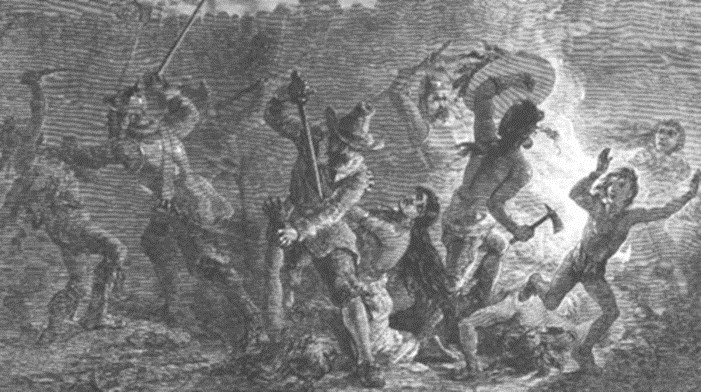
Except for the Pavonia Massacre in February of 1643, the Lenni-Lenape avoided major conflicts during this time period. This was in stark contrast to the Anglo-Powhatan War and Bacon’s Rebellion in Virginia which were both larger in terms of the number of people that were killed. [8]  The Pavonia Massacre was the first known attack led by Dutch soldiers that saw over one hundred Native American men, women, and children slaughtered in the area of what is today Jersey City.  After the massacre, hostilities would remain for almost three years until a truce was agreed to in 1645.

A Depiction of the Pavonia Massacre in 1643 (Image courtesy of Timetoast)

Professor Soderlund said “the Lenapes’ firm grip on south and central New Jersey is clear in a map from 1670 created by a merchant named Augustine Herrman, who had settled in New Amsterdam in 1644 and then established his plantation, Bohemia Manor, on the Maryland Eastern Shore in 1661.” [9] The map below shows New Jersey illustrated on the lower right-side of the map.  Numerous Lenape populated the area shown on the map that constitutes most of present-day New Jersey. This map is definitive evidence of the control the Lenni-Lenape had over New Jersey during the late seventeenth century.  

A map by Augustine Hermann of Virginia and Maryland and New Jersey as it was planted and inhabited in 1670, W. Faithorne, sculpt.  (Map courtesy of the Library of Congress)

            The Lenni-Lenape had an interesting relationship with the Quakers, especially in West Jersey. The influence of the Quakers could be felt throughout New Jersey during the colonial period.  Professor of History Richard McCormick from Rutgers University said

“Lacking the peculiar fervor that had stamped them as religious radicals in the previous century, the Quakers manifested increasing concern with social problems and took leadership in many areas of humanitarian reform.  Impelled by that saintly friend, John Woolman, of Mount Holly that came out firmly against slave holding in 1758, displayed a deep concern for the plight of the Indians, developed a system of education, and even began to withdraw from political activities because of their opposition to the war and military preparations.” [10]

Unfortunately, the Quakers, as well as other religious groups were guilty of displacing the Lenni-Lenape particularly in West Jersey and in Pennsylvania.  Professor McCormick made it clear that the Quakers weren’t transparent with the Native Americans of New Jersey and Pennsylvania, including the Lenni-Lenape, in various land deals.

            During the eighteenth century, the relationship between the Lenni-Lenape and the colonists would continue to deteriorate. Land ownership became a major issue throughout New Jersey, as well as the rest of the colonies, as the English took over control and established their dominance throughout the continent.             Several Lenape chiefs attempted to secure land deals with the New Jersey, Pennsylvania and Delaware colonies. These efforts culminated in the Walking Purchase of 1737. Chief Tishcohan (or He Who Never Blackens Himself) was one of the signers of the Walking Purchase of 1737, a treaty with the Penn family that later caused the Lenape to lose most of their land in the Delaware Valley.  It’s certain that “the infamous Walking Purchase defrauded them of considerable land in eastern Pennsylvania.  The Walking Purchase led to years of recriminations and bad feelings. [11] 

Delaware Chief Tishcohan

Tishcohan by Gustavus Hesselius. A 1735 portrait of the Delaware chief Tishcohan, commissioned by John Penn. William Penn’s son. (Portrait courtesy of the Millstone Valley Scenic Byway)

            Another victim of the Walking Purchase, Chief Teedyuscung would eventually leave New Jersey and make his way to Bensalem and align himself with the Moravians. Prior to the American Revolution Chief Teedyuscung would be killed by white vigilantes.  These killings made it clear that it was in the best interest of the Lenape to continue moving west. The legacies of both Chief Tishcohan and Chief Teedyuscung  include their efforts in trying to preserve the culture and legal rights of the Lenape.

Chief Teedyuscung

A depiction of Teedyuscung (Image courtesy of the Wissahickon Valley Park)

            The role of religion became even more prominent during this time period.  Missionaries from various Christian faiths made attempts at converting numerous Native American tribes including the Lenni-Lenape. Associate Professor of History Linford D. Fisher from Brown University said “the rich, overlapping worlds of Native spirituality and Christian practice, one in which the rituals, symbols, and beliefs of European Christianity were adopted by Indians over time, either voluntarily or in response to the overtures of English missionaries.” [12]

One missionary, David Brainerd, played an important role in attempting the religious conversion of the Lenni-Lenape. Professor Lurie and Professor Veit said that “Presbyterian missionaries also were active among the Delaware.  In 1745, David Brainerd, a young Presbyterian minister who belonged to the New Light faction of the church, which emphasized personal salvation and evangelical zeal, began mission work among the Lenape.” [13]  David Brainerd died in 1747 and was succeeded by his brother John who held similar beliefs regarding personal salvation and missionary work.  John Brainerd would be instrumental in the conferences the New Jersey Colonial government held in 1756 and 1758 in which the colony attempted to address the Native Americans consumption of alcohol and made clear the process for selling Indian lands. [14] 

            Throughout the French and Indian War, countless Native American tribes fought on the side of the British and the French. Numerous tribes, including the Lenni-Lenape of New Jersey, signed the Treaty of Easton of 1758. Part of the treaty included a provision that the Lenni-Lenape avoid alliances with the French during the war. They also had to forfeit their eastern lands. In return, the British promised to stop expeditions into Indian territory west of the Alleghenies. As a result, many Lenape left New Jersey.  It was around this time that New Jersey created its first Indian reservation, which was called “Brotherton,” and was located in the present-day Indian Mills section of Shamong in Burlington County.   Reverend John Brainerd assisted in the settlement of the reservation. [15] A result of the Treaty of Easton was the establishment of a permanent home for the Lenape that initially saw some success but was ultimately unsuccessful.       

            The Native Americans throughout the colonies had a very distinct role during the American Revolution.  Professor Wilcomb E. Washburn, the former Director for the Smithsonian’s American Studies Program said, “it was a shadowy role, but an important one. It was shadowy not only because the Indian operated physically from the interior forests of North America and made his presence felt suddenly and violently on the seaboard settlements, but because the Indian was present also in the subconscious mind of the colonists as a central ingredient in the conflict with the Mother Country.” [16]  The British and the Colonists made numerous attempts to form alliances with various tribes throughout the colonies.  There was some success in getting the Indians to align with one side or the other. 

            The Lenni-Lenape from New Jersey had already begun to leave by the start of the American Revolution. The Lenape were a divided people with only a small number remaining in the Garden State, while most moved north or west. [17] The Lenni-Lenape that remained in New Jersey during the American Revolution played a significant role. Professor Lurie said,

“During the Revolution, the western Delaware at first tried to stay neutral, but then split as some joined with the British, while others sided with the Patriots.  Thus, this also became a civil war for them.  The United States signed a treaty in 1778 with the chiefs who sided with the Patriots, but White Eyes, the strongest supporter, was murdered, promised supplies were not delivered, and villages of friendly natives were attacked.  In the end, the results were disastrous for the Delaware, whichever side they took, as well as for members of other Indian nations.” [18] 

Following the Revolution, the Lenni-Lenape of New Jersey suffered through more broken promises first by the British, who basically abandoned them, and then by the United States government.  By the early nineteenth century, most of the Lenni-Lenape either integrated into the local communities in New Jersey or left the state.  Many went to Canada or the Kansas Territory while others joined other Native American tribes such as the Cherokee.  Others ventured west to “Indian territory” which is today Oklahoma.

            During the nineteenth century, Native Americans, including the Lenni-Lenape, were instrumental in shaping abolitionism, both as participants in antislavery activities and as objects of concern.  In fact, abolitionist support for Native Americans before the Civil War did exist.  Unfortunately, it’s made clear that not all politicians from New Jersey supported both Native American rights and the abolition of slavery. Associate Professor of History Natalie Joy from Northern Illinois University said,

“Especially disappointing was New Jersey senator Theodore Frelinghuysen, among the most vociferous congressional opponents of removal and yet an avowed supporter of the American Colonization Society. Though they praised his “unwearied zeal in the cause of the injured and insulted Cherokees, abolitionists highlighted Frelinghuysen’s continued disengagement with the antislavery cause.” [19]

It appears that Congressman Frelinghuysen was against Indian removal but refused to support the abolition of slavery. This is not surprisingly particularly since New Jersey was the last northern state to abolish slavery following the Civil War. After rejecting the 13th Amendment, New Jersey did finally ratify it on January 23, 1866. 

            By the conclusion of the Civil War, many Lenni-Lenape were living in Kansas. Professor of History C.A. Weslager from Widener University said, “in the winter of 1866, the Department of Indian Affairs brought to Washington the chiefs and councils representing the Indian tribes living in Kansas for the purpose of persuading them to sell their reservations and move to new homes in what was then called Indian Territory, or even further west.” [20]  Treaties were made with various Native American tribes including the Lenni-Lenape.  The Lenni-Lenape sold or gave up their land holdings in Kansas and settled in Oklahoma.

Jennie Bobb, and her daughter, Nellie Longhat, both Delaware (Lenape), Oklahoma, 1915. (Photo courtesy of the National Anthropological Archives, Smithsonian Institution, Washington)

            The remaining Lenni-Lenape that stayed in Oklahoma were the final collective remnants of a once proud, dominant, and successful people.  Many had already assimilated into American culture by the end of the nineteenth century.  Continued pressure from the United States government would force even more Lenni-Lenape to integrate into white communities.  Sadly, this indigenous group, like the vast majority of other Native American tribes, were systematically deprived of their land, forced to live on reservations, and required to assimilate into mainstream American culture. Professor Weslager said, “by 1946, Congress established the Indian Claims Commission to act as a court and provide a regular means of adjudicating claims involving injuries to Indian tribal groups.” [21]  Historians have surmised that this commission was essentially an admission of guilt by the United States Government. The Indian Claims Commission would go on to adjudicate hundreds of claims and award millions of dollars to various Native Americans.  Reparations would be awarded to the Lenni-Lenape and start to be distributed during the late 1960s. 

Conclusion:

            The lives of the Lenni-Lenape from New Jersey before, during, and after the American Revolution is a fascinating and important part of American history. They were a thriving and successful culture until European contact. The Lenni-Lenape were able to remain successful in New Jersey for over a century after European colonization. The Lenni-Lenape had largely left by the beginning of the American Revolution.  However, those who remained did play a role.  During the American Revolution, there was some success in getting the Indians to align with one side or the other.  Regardless, as the United States continued to develop and grow the Native Americans of this continent were deprived of their natural and lawful rights. Native Americans were systematically excluded from having a true voice during European exploration and colonization as well as after the United States was founded.

            By the nineteenth century, Native Americans had no choice but to assimilate in order to survive. Forced assimilation in order to survive is not the same thing as having a legitimate stake in the system.  Time has made most ethnicities, including American Indians, a larger part of the American composition. The role of Lenni-Lenape is crucial in our understanding of the American experience. Regrettably, the Lenni-Lenape, dealt with racist mindsets which were the primary impetus that led to a negative and mostly superficial historiography of their culture that took centuries to completely shift. Historical perceptions and the racial mindsets of Native Americans did eventually change but only after they were deprived of their land, forced to live on reservations, and required to assimilate into mainstream American culture.

Works Cited

Calloway, Colin G. “‘We Have Always Been the Frontier’: The American Revolution in Shawnee Country.” American Indian Quarterly 16, no. 1 (1992): 39–52. https://doi.org/10.2307/1185604.

Fisher, Linford D. “Native Americans, Conversion, and Christian Practice in Colonial New England, 1640-1730.” The Harvard Theological Review 102, no. 1 (2009): 102.

Joy, Natalie. “The Indian’s Cause: Abolitionists and Native American Rights.” Journal of the Civil War Era 8, no. 2 (2018).

Lurie, Maxine N., and Richard F. Veit. New Jersey: A History of the Garden State. New Brunswick, NJ: Rutgers   University Press, 2018.

Lurie, Maxine N. Taking Sides in Revolutionary New Jersey Caught in the Crossfire. New Brunswick: Rutgers University Press, 2022

McCormick Richard P. New Jersey from Colony to State 1609 to 1789. The New Jersey Historical Series, Rutgers University Press, New Brunswick, New Jersey 1964.

Snyder, John Parr. The Story of New Jersey’s Civil Boundaries, 1606-1968. Trenton: New Jersey Dept. of Environmental Protection, Division of Water Resources, Geological Survey, 1969.

Soderlund, Jean R. Lenape Country: Delaware Valley Society Before William Penn. Philadelphia, PA: University of Pennsylvania Press, 2015.

Washburn, Wilcomb E. Indians and the American Revolution. Accessed December 14, 2022. https://www.americanrevolution.org/ind1.php. 

 Weslager, C. A. The Delaware Indians: A History. Rutgers University Press, 1972.


[1] Calloway, Colin G. “‘We Have Always Been the Frontier’: The American Revolution in Shawnee Country.” American Indian Quarterly 16, no. 1 (1992): 39–52. https://doi.org/10.2307/1185604.

[2] Lurie, Maxine N., and Richard F. Veit. New Jersey: A History of the Garden State. New Brunswick, NJ: Rutgers   University Press, 2018, 11.

[3] Lurie & Veit, 16.

[4] Lurie & Veit, 18.

[5] Snyder, John Parr. The Story of New Jersey’s Civil Boundaries, 1606-1968. Trenton: New Jersey Dept. of Environmental Protection, Division of Water Resources, Geological Survey, 1969.

[6] Lurie & Veit, 20.

[7] Soderlund, Jean R. Lenape Country: Delaware Valley Society Before William Penn. Philadelphia, PA: University of Pennsylvania Press, 2015, 5.

[8] Soderlund, 5.

[9] Soderlund, 2.

[10] McCormick Richard P. New Jersey from Colony to State 1609 to 1789. The New Jersey Historical Series, Rutgers University Press, New Brunswick, New Jersey 1964, 95.

[11] Lurie & Veit, 25.

[12] Fisher, Linford D. “Native Americans, Conversion, and Christian Practice in Colonial New England, 1640-1730.” The Harvard Theological Review 102, no. 1 (2009): 102.

[13] Lurie & Veit, 24.

[14] Lurie & Veit, 24.

[15] Lurie & Veit, 25.

[16] Washburn, Wilcomb E. Indians and the American Revolution. Accessed December 14, 2022. https://www.americanrevolution.org/ind1.php

[17] Lurie, Maxine N. Taking Sides in Revolutionary New Jersey Caught in the Crossfire. New Brunswick: Rutgers University Press, 2022, 107.

[18] Lurie, 8.

[19] Joy, Natalie. “The Indian’s Cause: Abolitionists and Native American Rights.” Journal of the Civil War Era 8, no. 2 (2018): 222.

[20] Weslager, C. A. The Delaware Indians: A History. Rutgers University Press, 1972, 421.

[21] Weslager, 457.

The Hanoi Train Station: Perspectives and Empathy in Social Studies Education

The Hanoi Train Station: Perspectives and Empathy in Social Studies Education

Jonathan Lee Lancaster

The picture above is “Hanoi station,” which is one of the main train stations in Hanoi, the capital of Vietnam. The train station has keenly unique features; it is centered with a modern, cement block-style design, which is flanked by stunningly ornate yellow wings.

Having conducted research in Vietnam for a few months earlier in the year, I had walked by the Hanoi train station dozens of times without taking much notice; the train station was simply just another building that I passed on my way to my favorite cafe. It wasn’t until I was sitting on the back of a motorbike with a Vietnamese friend while passing the train station that I inquired further about the building. My friend told me that the building was originally built by the French in the early 1900s during France’s colonization of the country; it was then bombed during the war with the United States in the early 1970s; then, it was reconstructed with the help of the Soviet Union later in the 1970s. All of these foreign influences throughout the course of Vietnamese history have given the Hanoi train station its unique look, with its French-style wings and cold, Soviet-looking center. I was baffled at this revelation. For months, I had naively walked by this building without an ounce of knowledge of its origin, supremely oblivious to the historical factors that created it, and – despite being a social studies teacher – ignorant to ask about it earlier.

The Hanoi train station became a symbol to me. It symbolized all of the history that I, as an American, had the privilege to be unaware of. I did not have to live the realities of the Vietnam War’s destruction of Vietnam or its legacies, even if my father’s generation were the ones who perpetrated it. I could simply walk by that history and move on with my day, while the Vietnamese people truly lived in the reality of the wake of the war. Though this was simply a building that embodied the legacies of the war, it symbolized the ongoing Agent Orange effects from the Vietnam War – which continue to produce birth defects – and the thousands of unexploded ordinances (UXOs) that continue to kill people yearly in Southeast Asia. These were the realities that I lived outside, never having to confront.

A few months later, after finishing my research and returning home to New Jersey, I met with some social studies colleagues who were planning their classes for the upcoming year. The overarching topic of discussion was making our social studies classes engaging and interesting for students. While our conversation ebbed and flowed between how to teach colonial American history, the Civil War, the Great Depression, and more, the topic of the Vietnam War emerged.

One colleague was passionately lobbying others to implement an engaging game that he had developed for students last year, in which students were to attempt to create the best strategy for Americans in Vietnam. Students would be put into groups and earn points depending on the evidence and argument for their strategy. The conversation continued, with sprinkled remarks from the other teachers about how they had overheard students talking about the game the previous year, and how students were so engaged. While the discussion continued, my mind started to stray back to one thing in particular: the Hanoi train station.

While American students have the luxury to make a game – no matter the intent or effectiveness – out of the Vietnam War, the Vietnamese people do not. While American students can, in their groups, pitch their argument for the best war strategy for 4 points and then proceed to hurry off to biology class, completely forgetting about the Vietnam War until the 41-minute block the next day, the Vietnamese people do not. While American students can “walk by” the realities of the war and move on with their days, as I had done, the Vietnamese people must live the reality of a post-war torn nation.

This is not a story of Vietnamese pain, nor an attempt to highlight the struggle for recovery of Vietnam after the war. This is about how we, as educators, frame and conceptualize history for our students. It seems that, especially with the passage of time, our empathetic sense weakens; educators are more prone to create seemingly harmless simulations and games in the name of “engagement” out of truly devastating historical events. When we, as educators, have students conduct a “World War II Twitter Project” where student groups embody different nations that fought in the war that must post “comments” to each other, or when students must engage in a simulation in which they are meant to see what it feels like to be {insert some group from history here}, or when we create games for students out of history, we are communicating that the history isn’t reality – it is entertainment. We are, in fact, hurting students’ abilities to empathize with others, as it promotes a dissociative outlook on history where the people described in their textbooks (which hopefully we have moved away from already) or readings are nothing more than mere ink blots on a page. It blends the line between reality and fiction, leading students to believe that it is appropriate to be ignorant of historical processes and products.

Though this is focused mostly on international events, the same applies with domestic history. The sad reality is that if you search for news articles regarding social studies teachers in New Jersey attempting simulations, a number of incredibly grotesque articles will appear of teachers having students do a “simulation” of a slave auction or having students lay on the ground to “simulate” being whipped after picking cotton.

For example, in March of 2017, a Maplewood, NJ teacher held a mock slave auction. Moreover, in the same year, a teacher in South Orange, NJ had students create slave auction posters. More recently, a Toms River teacher had students “pick cotton” and simulate being whipped through sounds of cracking whips. Though these selection of stories are from my home state of New Jersey, this phenomenon is occurring nationwide.

These examples are products of our distorted view of “engagement” in social studies education. It is simply not possible for students to “feel” what it was like to be in any historical event in which a peoples suffer, and it is problematic to attempt to do so. Our attempts to “engage” students seemingly to trick them into learning history while doing so hurts our students’ formulation of their worldview.

While making sure students have “fun” is an important element of a successful classroom, we must ensure that “fun” does not come at the expense of empathy. Unfortunately, the topics that are in humanities’ curricula are seldomly “fun.” It is not easy teaching about wars, plagues, racism, and more; however, social studies provides educators with the ability to leverage those underbellies of our societies and histories to promote cultural competencies, perspective-taking, and contextualization.

While I am not claiming that every simulation or game in social studies is inherently bad, I am saying we have to be very, very careful about what we are doing when we incorporate them. Is the point of the simulation or game merely engagement? If so, it could be extremely problematic. If the point of the simulation or game is towards genuine understanding and empathy, then it may be a sound pedagogical choice.

Nonetheless, bear in mind that history is real, tangible, and has consequences – even if those consequences aren’t felt by you, your students, or in your nation. Just because an event happened long ago or in some other area of the world does not mean we should feel tempted to take it less seriously. Truly reflect on if that game or simulation is presenting history as it should be: a tool to build empathy, analyze the past, and understand our contemporary realities.

So, I urge you to think of the Hanoi train station. What history are you possibly “walking by”? What history are you tempted to represent through a game, simulation, or creative project and what is it truly communicating to students? To what extent can we have “fun” in social studies classrooms while also staying true to fostering the cultural competencies and perspective-taking elements we are striving for? And how can we teach social studies in a manner that promotes global empathy?

Apprehensive About Teaching

Apprehensive About Teaching

Adeola Tella-Williams

The attack on Critical Race Theory is creating controversy in education. For the first time in my professional career, I am apprehensive about teaching any subject having to do with race, religion, Blackness, Whiteness and all things cultural. Why? The simple answer lies in the attempted coup of education by some parents over their misunderstanding about Critical Race Theory and conflating it with Culturally Relevant Teaching. IT IS being used as a political ping-pong, mainly by the Republicans to erase parts of American history that mainly deals with the cruelties of slavery and mistreatment of people of color. While apprehensive, I remain true to history and will always teach as I have been doing for the past 20 plus years.

I have been an educator for 21 years. I began my teaching career in East New York, Brooklyn, as a middle school Social Studies teacher at one of the lowest performing schools in New York City. Regardless of the school’s low performance status, my students were some of the smartest and kindest I have ever taught. They were aware of the shortcomings of their reality. They knew the truth and were not afraid to voice their opinions, good, bad or indifferent. It was fun and challenging teaching them, but they took their agency, no one had to give it to them. After a year in Brooklyn, I left in 2000 to teach conversational English in Tokyo, Japan for a half year and returned to East New York for another year. The past two decades, I have been in the Uniondale School District. I took a sabbatical in 2016 to teach in the United Arab Emirates, where I taught Humanities to Arab, continental African, Canadian, South American, and Indian middle school scholars at American International School, Abu Dhabi. This year, I am teaching African and Latinx History to upperclassmen and Global History to 9th graders in Uniondale High School.

In my years as an educator, I have assisted and led many activities and events outside of the classroom; most notably, a student forum on police brutality in the wake of the Michael Brown shooting back in 2014. I also created a girls Rite of Passage program in 2004 at one of the two middle schools in Uniondale. When President Barack Obama was elected in 2008, I assisted the Uniondale High School in planning a “controversial” inauguration assembly in recognition of the first African American elected President of the United States. The program was considered “controversial” because a number of white teachers objected and boycotted the event.

I have also worked with Dr. Alan Singer, professor at Hofstra University, for many years. I asked him to lead a discussion on the complexities surrounding the Iraq war back in 2003 to my middle schoolers and he was the keynote speaker for a forum held between two racially segregated communities, Oceanside and Uniondale. We discussed police brutality and other racially charged issues on Long Island in 2015. The discussion of the U.S. invasion of Iraq and the absence of weapons of mass destructive also produced heated faculty blowback.

I have immersed myself in “controversial,” or as I would prefer to call them, “contemporary issues” my entire career. I am finding that in this day and age, the topics I chose to cover back then would be considered blasphemy today. For example, Bridges was created to foster empathy, and collaboration amongst White, Black and Hispanic students who live in neighboring communities, attend different schools, and have little contact with each other. It is the goal of the program to engage students in the evaluation of contemporary issues related to race, economics, and politics that will lead to well-rounded, active, and engaged citizens. In Bridges, difficult conversations are encouraged and the asking of challenging questions is nurtured. Divergent points of views are not shunned with the understanding that students can agree to disagree with civility. In this program we have discussed the January 6th insurrection, the legacy of segregation on Black and Brown communities, cross-cultural experiences of Black and White students, and other contemporary issues that would make those who dislike Critical Race Theory very uncomfortable.

Back in 2014, when I decided to do the forum about police brutality in the wake of the Michael Brown shooting with my Participation and Government scholars, I did not think of the backlash or its “controversial” nature. I thought about the hopelessness I saw in my students that September. They looked at me as just another teacher. It was as if they gave up on learning and embraced the Read, Answer Questions, Pass a Test and Repeat pedagogical style. But, little did they know, I was not that teacher, I have never been that teacher. Recognizing this hopelessness in the wake of the Michael Brown shooting prompted me to change the way I would teach this course. As it was my first time teaching the course, I wanted to make it real for the students. After all, it’s a “Participation” in Government class. I took that term “participation” literally and decided they would be active, as opposed to passively learning in this course. Therefore, learning through doing became one of the goals. Their hopelessness from my perspective was due to the way the year began, with the shooting coupled with normal senioritis and a genuine boredom for all things related to school. Therefore, empowering their voices became my mission, and so I challenged them to put on a forum on police brutality. After all, our early ancestors, who created great civilizations in Africa, Greece, Rome and the Americas, held forums to gauge the feelings of their subjects on controversial issues. Furthermore, forums give voice to the voiceless and empower citizens to take further action. To me this is how a democratic society prospers; it actively engages young people early on.

Gone are the days of sitting in the class and taking notes on how great democracy is when in reality my students were not having, or seeing, that same example in their day-to-day lives. In their world, fairness was a fairytale. To them education was boring and they were tired and ready to graduate and join the rest of humanity in the rat race called life. However, I refused to let them leave in this manner. I was, and am, still very idealistic and optimistic about education and what it can do for young people charged with taking over, ready or not. Nonetheless, I charged them with putting on a school-wide forum on police brutality. They were very reluctant at first, as they were not used to being placed in leadership positions. But I assured them that the worst that can happen is the principal says no and then they don’t have the forum, but they had to ask first. They asked and to their surprise, not mine, the principal agreed. My principal at the time, was very supportive of student engagement. Having a strong principal makes a world of difference for a teacher like me. She was not afraid to support any program or event that gave students a voice. Again, as their teacher, my concern was not the backlash. My goals were to help them love learning, give them agency and have them practice their voice.

In preparation for the forum, they researched about the Civil Rights Movement and the history of police brutality in America. I felt they needed to see the trend, be informed, and be armed with solid information when they spoke in front of their peers. I wanted them to be confident when they took to the stage. I wanted them to lead. Many scholars are not given the tools to be leaders in real world scenarios. It was important to me to have these non-AP scholars lead an academic forum in front of their peers who only saw them in non-academic settings. These were scholars that always got in trouble; they were not jocks or honor students, just “regular,” sometimes forgotten people. I wanted them to be heard and seen, as they have something to say and lots to give.

All of the above were also my goals in starting the Rite of Passage program. These were also my goals when I decided to be the first advisor of the Bridges High School program. I believe giving scholars the opportunity to lead and participate in real world scenarios makes education palatable – it makes it real. As with science and math, many scholars ask, “When will I need this in real life?” Some teachers are able to show the why and some aren’t. These days however, STEAM and STEM have become the norm. As a history teacher, Historical and Civic Literacy is just as important as STEAM and STEM to me. Making space for these contemporary issues gives students agency and time to hone their Social Studies skills of argumentation, observation, listening, speaking, analyzing, synthesizing and application.

When I started the Rite of Passage program some ten years ago in my district, it was to help girls of color, especially darker hue girls, accept themselves in a world that constantly ignores them. Another goal was to help girls get along better, to learn how to respect each other despite their difference in hair texture, complexion or whatever else distract girls from being their best. While I did not see this program as controversial, today it seems as though it is. With the Crown Act being passed in California and other states, African textured hair seems to be a problem in the workplace and in schools. Girls of color are 5.5 times more likely to be suspended from school, starting in pre-school. Programs like the Rite of Passage aim to reveal the controversial issues that plague Black girls. Many of the girls I had in the program have since graduated college and are well into their careers. I have received Facebook posts and text messages from them referencing our time together and how impactful those times had on them then and now.

Simply put, I am an educator who does not shy away from contemporary topics or historical controversies in and out of the classroom. My goal has always been to make sure scholars love learning and intrinsically love the art of learning about themselves, within the context of mirrors, windows, and glass sliding doors. I also aim to instill the love of learning in order to help them make their communities a place they are proud of and value. My upbringing in a Jamaican-Nigerian household has strongly shaped my approach as an educator. I also received these messages from my upbringing in my African American community after moving to the United States in 1987 from Nigeria.

Curriculum focused on Culturally Relevant Teaching is under attack and it is being interwoven in the debate about Critical Race Theory. While some elements of culture are in Critical Race Theory, the philosophy was not intended for K-12 education. When parents fail to understand the importance of creating safe spaces for scholars to speak about controversial issues or contemporary issues, it marginalizes young people of color. For instance, White teachers make up 79% of the teaching staff across America, and Black and Hispanic teachers make up less than 5% of the teaching staff in predominantly white schools. Where is the diversity of thought when scholars graduate from high school? How are students of color being taught, let alone having their issues addressed in forums or in the classroom? When does a white child meet or interact with a Black or Brown teacher? These are questions that need to be raised in education. But how can we discuss these and other topics when Critical Race Theory is being conflated with Culturally Relevant Teaching and anything having to do with race or culture is seen as divisive rather than an integral part of progress? School is the place to teach and grapple with controversial topics in a responsible way, of course. The attacks on Critical Race Theory and Culturally Relevant Teaching are making it harder to teach controversial topics in history as well as put on programs about contemporary issues as I have done in the past, creating a tense environment to discuss these topics freely and responsibly. I am afraid educators like me will continue to be apprehensive about teaching subjects having to do with race or spear head programs that raise contemporary issues. I am afraid that the attack on CRT will take over education and take us back to a time when teachers wrote notes on the board, students copied, memorized information, did not or could not ask questions, took a test, barely passed and moved on to the next grade anyway. This type of “teaching” has not been productive, especially in Black and Brown school districts. As a result of this style of pedagogy, if you can call it that, our Black and Brown scholars have been mislabeled, wrongly disciplined and have been marginalized from the curriculum. Really, they are just bored and uninterested in an education that fails to recognize them. As educators we have a responsibility to speak up and not allow the attack on Critical Race Theory to lead us back to the 80’s, 90’s, and early 2000’s when schools did not address the academic needs of Black and Brown students, but instead disproportionately placed them in SPED classes and suspended them in droves, creating the school-to-prison pipeline that so many in education reference today. All students really need is a true education.

The Nazi in the Classroom

The Nazi in the Classroom

Gary Ostrower

(Reprinted with permission from History News Network)

Three days after World War II began, as Nazi troops stormed into Poland, Ohio-born Edward Vieth Sittler (1916-1975), a 23-year-old study-abroad student in Germany, applied for German citizenship. Not only did he become a German citizen; he renounced his American citizenship, became a member of the Nazi Party, and then broadcasted Hitler’s propaganda to American troops in Europe. 

What kind of propaganda? Among other things, he had denounced FDR as a traitor, called for his impeachment, denounced Jews as war profiteers, and predicted that the US would suffer defeat and partition unless it surrendered. Sittler had company. A number of other Americans also served Hitler, including the notorious Axis Sally. After VE-Day, they were arrested by the American military. The Department of Justice charged all but one with treason; the one was Edward Sittler.

Why not Sittler? Because he was no longer a U.S. citizen and only citizens can commit treason.

Sittler soon returned to the United States. Odd that he would be invited back, but the Department of Justice wanted him to testify against the others. He did, sort of. He testified for both the prosecution and the defense. He also used the technicalities of American immigration law to remain in the U.S., perhaps aided by his anti-communism during the 1950s. During that decade, he taught at a number of small colleges including Shurtleff College in Illinois, Thiel in Pennsylvania, Alfred University in western NY, and in 1959, C.W. Post College on Long Island (part of Long Island University today). 

In December 1959 an enterprising reporter for the Long Island Daily Press discovered that he had a Nazi past, the story went national. Protests from veterans’ groups and Jewish organizations flooded into the CW Post president’s office. The college allowed him to “resign.” But Sittler wasn’t about to fade away. He initiated efforts to regain his American citizenship. The Immigration and Naturalization Service investigated him. It recommended against granting him citizenship. Was this proper? Immigration law states that citizenship shall be conferred if an applicant has shown “good moral character” and attachment “to the principles of the Constitution” and has been “well disposed to the good order and happiness of the United States” for five years preceding his or her application. Sittler argued that he met this requirement, and nothing suggests otherwise. But when Sittler went to Federal Court to reverse the verdict of the Immigration Service, the highly respected Judge Lloyd McMahon of the US District Court in New York rejected his petition. The judge wrote in a blistering opinion that Sittler’s testimony to the Immigration Service was riddled with “distortions, half-truths, incomplete answers, misleading responses, evasion, [and] concealment” so that “the court can give it no credence whatever.” 

In fact, Sittler claimed that he had simultaneously been loyal to both U.S. constitutional principles and to Nazi Germany. What the judge understood, but Sittler did not, is that he could indeed be loyal to the Constitution or to Nazi ideology, but not to both at the same time. Sittler then appealed to the second highest court in the land, the U.S. Court of Appeals. Same result. He didn’t help himself by asserting that that he had believed stories about Nazi persecution of Jews were just communist propaganda.

One other corner of this story bears mention. Sittler had told C.W. Post’s Dean L. Gordon Hoxie before he was hired about his Nazi past. Then why hire him in the first place? The college president, “The Admiral” Richard L. Conolly, later explained that everyone has the right to “repent [and] mend his ways.” Only after publicity about Sittler threatened to embarrass the college — and President Conolly – did CW Post demand his resignation. 

And then we have the matter of academic freedom. The American Association of University Professors (AAUP) strongly criticized CW Post because Sittler had not been granted a hearing before the college cut ties with him. The fact that Sittler had agreed in advance to resign if his Nazi background became a problem was considered irrelevant. To the AAUP, the college had violated his “due process” rights. The AAUP viewed this as abridging the principle of academic freedom.

Was Sittler still a Nazi at heart after he returned to the US in 1946? The answer remains murky. Apparently, nothing he did at any of the colleges where he taught revealed Nazi sympathies. Even Jewish students found him unobjectionable. Did he lie when he applied for naturalization? Sure, for he undoubtedly knew that telling “the whole truth, and nothing but the truth” would doom his application. Today, his case is forgotten. It shouldn’t be. It raises questions that are still relevant about the law of treason, of citizenship, and about the meaning and limits of academic freedom.[1]

Twists and Turns in the Sittler Saga as Reported in the New York Times

Questions to Consider

  1. Why was Sittler originally permitted to return to the United States?
  2. Why wasn’t Sittler prosecuted for treason?
  3. Should Sittler have been allowed to teach in the United States?
  4. Should Sittler’s United States citizenship have been restored?
  5. Did U.S. officials act responsibly in their treatment of Sittler?
Treason Case Jury to Hear 3 Germans, Will Testify in Capital as U.S. Moves to Reindict Chandler, Best for Nazi Broadcasts New York Times, October 19, 1946    Three Germans will arrive in about a week to testify before a Federal Grand Jury in the cases of Robert Best and Douglas Chandler, American citizens who are charged with broadcasting Nazi propaganda directed against this country from a Berlin radio station. The Justice Department also stated today that new indictments would be sought against the two men, who with six other persons were indicted three years ago for treason in their broadcasts. Under present plans, the Department expects to bring Best and Chandler to trial sometime in November. They will be flown to this country from an Army prison camp at Obresul, Germany. The Germans are Karl Linnard Schotte, an actor and employee of the German broadcasting system in the American Occupation Zone; Edward Vieth Sittler, a singer born in this country, but who has renounced his citizenship, and Margaret Eggers of Hamburg, now an employee of the British Military Government. They will presumably testify to having seen or known that the broadcasts were made by the prisoners. In treason cases, the Government must present two witnesses to an overt act.
Chandler Accused by ‘Best Friend,’ He Testifies that he Watched U.S. Writer Broadcast Propaganda for Nazis New York Times, June 14, 1947          That he had seen Douglas Chandler, American writer on trial here in Federal Court here on charges of treason, speaking into the microphone of the German Broadcasting Corporation was testified today by Edward Veith Sittler, American-born German naturalized Nazi. By his and Chandler’s own statements, Sittler was Chandler’s best friend in Berlin. This did not keep Sittler, born in Baltimore and initiated as a member of Hitler’s party in 1940, from testifying against Chandler on fifteen counts which the Government contends were “overt.” Two persons must provide direct testimony against any person charged with treason if he is to be sentenced to the ultimate penalty – death – or for imprisonment for treason. This was repeatedly emphasized to the jury by the presiding judge as phonograph records bearing what was testified to be Chandler’s voice condemning “the Jews” and warning of the “menace of communism” were played in court. Sittler testified today that his wife, Margaret, was with him on most of the occasions when he observed Chandler’s activities directly. It was thought, therefore, that she would be the second eyewitness. The Sittlers have four children who were brought to this country with him for the trial.
Hopes to Fight Deportation New York Times, February 16, 1950 Edward V. Sittler, former college professor, and admitted wartime Nazi, said today he would fight deportation to Germany if he could raise the money. Told that the Government had ordered him deported, the former professor at Michigan College of Mining and Technology said he would appeal “if at all possible.”
Sittler Appeals Deportation New York Times, December 22, 1950 Edward V. Sittler, former Michigan college teacher who worked for the Nazis in World War II, today appealed from a Nov. 29 deportation order. Mr. Sittler, a native American, went to Germany in 1939, became a German citizen and worked for the Nazi radio. He was brought to tis country by the Justice Department in 1946 to testify in treason trials. He got teaching jobs at Northwestern University and the Michigan College he of Mining and technology.
School to Review Hiring of Ex-Nazi, Post College staff Meets Today on Case of Teacher Who Broadcast in War By Roy R Silver, New York Times, December 15, 1959 Officials of C.W. Post College will meet with the faculty here tomorrow to review the college’s appointment of a former Nazi-party member. Admiral Richard L. Coolly, retired, president of Long Island University, Post College’s parent school, said today that the meeting would cover particulars on the appointment of Dr. Edward V. Sittler as Associate Professor of English and Modern Languages. Dr. Sittler, a 43-year-old native of Delaware, Ohio, has been attacked as having renounced his American citizenship in 1939 propaganda during World War II. The attacks, made in anonymous letters to the college, also said Dr. Sittler has been dismissed from two teaching positions because of his past activities. Dr. Sittler said he had been a news commentator and not a political analyst. He said he had “tried to be as factual as I could.” “I don’t think I ever broadcast deliberately and false information,” Dr. Sittler said. Dean R. Gordon Hoxie of Post College and Admiral Conolly said that Dr. Sittler’s background had been thoroughly investigated before he had been named to the faculty in September. Dr. Sittler said that he had gone to Germany to study in 1937. Two years later he renounced his American citizenship and became a citizen of Germany, where he became a civilian employee of the radio office. He was returned to this country in 1946 as a German national to testify in the treason trial of two Americans who had broadcast for the Nazis. No charge was made against Dr. Sittler. Dr. Sittler was dismissed from Northwestern University, from which he had received his Ph.D., and the Michigan Institute of Mining and Technology. Since then, he said, he has worked at odd jobs and taught at four small colleges. His last employment before Post was at Alfred College, Alfred, N.Y.
Post Faculty Backs Hiring of an Ex-Nazi New York Times, December 16, 1959 The faculty of C. W. Post College in Brookville, L. I. endorsed yesterday the college’s hiring of Dr. Edward V. Sittler, a former Nazi party member. Meanwhile Senator Jacob K. Javits, Assemblyman Alfred Lerner of Jamaica, Queens, and six veterans’ organizations demanded a Federal investigation of the appointment. Admiral Richard L. Connolly, retired, the president of Long Island University, Post College’s parent school, said in a statement that “there was no evidence of sedition or sub version against the United States involved.” Senator Javits has requested details from the Immigration and Naturalization Service on Dr. Sittler’s entry into this country as an immigrant from Cuba in 1954. Meanwhile, the Civil Liberties Union said a teacher should be judged on his competence, not on his political associations.
Former Nazi Voluntarily Quits as a Professor at College on L. I., Dr. Sittler Resigns to Avoid Embarrassing C. W. Post, L. I. U. Chief Says New York Times, December 17, 1959 Dr. Edward V. Sittler, a former Nazi party member, resigned from the faculty of C. W. Post College here today. In announcing the resignation, which had not been requested, Admiral Richard L. Conolly, retired, the president of Long Island University, said: “In order to relieve the college and the university of embarrassment incidental to the recent publicity concerning his case, Dr. Sittler has tendered his resignation as a member of the faculty of the college. “This action came at a time when I was engaged in restudying his suitability as a faculty member. I have accepted his resignation. “I want to make it perfectly clear that in defending Dr. Sittler the university in no sense had any sympathy for his former Nazi viewpoint, but was concerned only for his rights as an individual and member of an academic faculty.” Dr. Sittler had been hired in September by C. W. Post College, a branch of Long Island University, for a one-year term as associate professor of English and modern languages.
Ohioan Explains Work for Nazis, Ex-Professor, in Citizenship Bid, Says He Was Misled on Trip to Germany New York Times, March 30, 1960 An Ohio-born broadcaster for Nazi Germany who is seeking to recover his American citizenship offered his explanation yesterday for renouncing it in Berlin in the spring of 1940. Dr. Edward V. Sittler, the appellant, resigned from the faculty of C. W. Post College of Long Island University last December when his past came under attack. He testified at a hearing on his petition at the Immigration and Naturalization Service, 20 West Broadway. He said he applied for German citizenship in the fall of 1939 because he thought Germany was “up against a crucial test” with enemies in Europe and “needed a helping hand.” He said that on receiving his certificate of German nationality he notified the American Embassy in Berlin that he was giving up American citizenship. He said he had scarcely imagined that Germany might later be at war with the United States. Dr. Sittler said he was drafted briefly into the German army, but was deferred against his wishes and returned to his former duties. He was a translator and later an announcer and commentator for the “U.S.A. Zone” of the Reichsrundfunkgesellschaft, the German state broadcasting corporation in Berlin. He emphasized the immaturity and the superficiality of his political understanding when he went to Germany at the age of 21 in 1937 to study German with a view to teaching comparative literature. He acknowledged joining the Nazi party in 1942 or 1943. His present view, he said, is that “the only genuine security lies in a constitution and a legal system.”
Nazis’ Radio Aide Cites his Naivete, Disbelieved Wartime Report of Death Camps, Sittler Tells Inquiry Here New York Times, March 31, 1960                                                                                                                                                                                                                                                                                                             Dr. Edward V. Sittler, who became a German citizen and broadcast over the Nazi radio in World War II, said yesterday that during the war he had heard only one report of extermination camps. “I thought it was incredible,” he told a preliminary hearing at the Immigration and Naturalization Service, 20 West Broadway, on his petition to regain the citizenship he renounced in 1940. He said the report came in 1943 from Gerhardt Wagner, his immediate superior in the Berlin broadcasts beamed to the United States. He said Wagner had heard on a trip to northern Poland and Lithuania that German Jews ostensibly sent there for resettlement were actually being put to death. Dr. Sittler later testified that he had suggested that Wagner be investigated “to see if he was a Communist agent.” He told also of his wartime friendship with and assistance to Douglas Chandler, an American-born broadcaster for the Germans who was sentenced to life imprisonment by the United States. Mitchel Levitas, reporter for The New York Post, testified under subpoena to the accuracy of quotations in an account he and Ted Poston of the same paper published Dec. 15 following an interview with Dr. Sittler. These included statements by Dr. Sittler that Hitler had the good of his country at heart, that Hitler and National Socialism were a tragic and disgraceful chapter in many respects, and that the influence of the Jewish community on President Roosevelt was one of the prime reasons the United States had become involved in World War II. Dr. Sittler, under questioning by his attorney, William Stringfellow, acknowledged “errors” in his past, then said, “I look on America as my home and want to re-establish my citizenship with it.”
Sittler Loses Citizenship Plea; His Activities as Nazi are Cited, Examiner Rules He Does Not Deserve to Regain His Rights as American New York Times, September 2, 1960 Dr. Edward V. Sittler’s plea for the restoration of his United States citizenship should be denied, an examiner of the Immigration and Naturalization Service recommended yesterday. Dr. Sittler, a 44-year old native of Delaware, Ohio, lost his citizenship in 1940 when he became a German citizen. During World War II he was a radio broadcaster for the Nazis. The examiner, William J. Kenville, said the applicant’s wartime conduct, including membership in the Nazi party, “must be regarded as indicative of an utter and complete lack of faith in the democratic way of life under which he had been reared in the United States, and of completely embracing the diametrically opposed totalitarian form of government then existing in Nazi Germany.” Mr. Kenville also reported that Dr. Sittler’s testimony was “not at all convincing that he has changed his mind or altered his philosophy since 1945.”  

Citizenship Plea Lost by Ex-Nazi, Ban on Renaturalization of Sittler is Upheld By Edward Ranzal, New York Times, April 13, 1963. The United States Court of Appeals refused yesterday to restore citizenship to an American who became a Nazi propaganda broadcaster in Germany during World War II. The judges were divided 2 to 1. The 47-year old American, Edward Vieth Sittler, became a German citizen in 1940, but returned here after the war and sought to regain his American citizenship. Since his return he has been a professor or instructor in various colleges and universities in this country. In each instance he lost his position when it was learned that he had been a Nazi. Sittler, who has five children – two born here and three in Germany — is residing with his family in West Germany, according to Roy S. Babitt, assistant United States Attorney.

[1] Note from Gary B. Ostrower: I was a student at Alfred University when Sittler taught here in 1958-59. My roommate, a Jewish student from Yonkers, was a student in a German class that Sittler taught. I know even today a number of people—former colleagues and neighbors—who knew and continue to think highly of Sittler. I think it is fair to say that we all were stunned when news broke in 1959 about Sittler’s Nazi past.