Era 5 – Engaging High School Students in Global Civic Education Lessons in U.S. History

New Jersey Council for the Social Studies

www.njcss.org

The relationship between the individual and the state is present in every country, society, and civilization. Relevant questions about individual liberty, civic engagement, government authority, equality and justice, and protection are important for every demographic group in the population.  In your teaching of World History, consider the examples and questions provided below that should be familiar to students in the history of the United States with application to the experiences of others around the world.

These civic activities are designed to present civics in a global context as civic education happens in every country.  The design is flexible regarding using one of the activities, allowing students to explore multiple activities in groups, and as a lesson for a substitute teacher. The lessons are free, although a donation to the New Jersey Council for the Social Studies is greatly appreciated. www.njcss.org

The development of the industrial United States is a transformational period in our history. The United States became more industrial, urban, and diverse during the last quarter of the 19th century. The use of fossil fuels for energy led to mechanized farming, railroads changed the way people traveled and transported raw materials and goods, the demand for labor saw one of the largest migrations in world history to America, and laissez-faire economics provided opportunities for wealth while increasing the divide between the poor and rich. During this period local governments were challenged to meet the needs of large populations in urban areas regarding their health, safety, and education.  

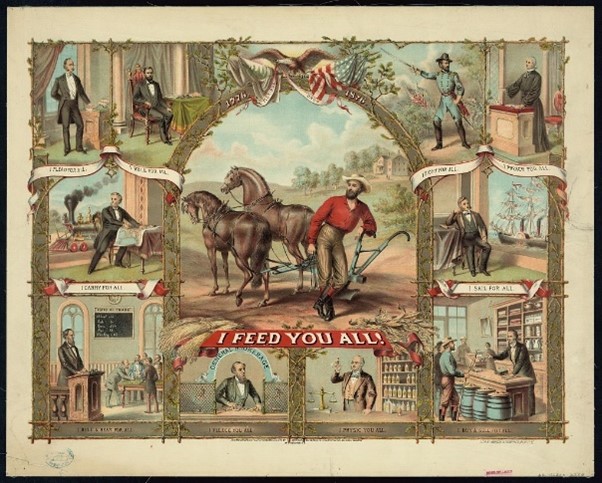
The Patrons of Husbandry, or the Grange, was founded in 1867 to advance methods of agriculture, as well as to promote the social and economic needs of farmers in the United States. The financial crisis of 1873, along with falling crop prices, increases in railroad fees to ship crops, and Congress’s reduction of paper money in favor of gold and silver devastated farmers’ livelihoods and caused a surge in Grange membership in the mid-1870s. Both at the state and national level, Grangers gave their support to reform-minded groups such as the Greenback Party, the Populist Party, and, eventually, the Progressives.

The social turmoil that the Western farmers were in was mainly a result of the complete dependence on outside markets for the selling of their produce. This meant that they had to rely on corporately owned railroads and grain elevators for the transport of their crops. To make matters worse, “elevators, often themselves owned by railroads, charged high prices for their services, weighed and graded grain without supervision, and used their influence with the railroads to ensure that cars were not available to farmers who sought to evade elevator service.” In 1871, Illinois created a new constitution allowing the state to set maximum freight rates but the railroads simply refused to follow the mandates of the state government.

The Grangers became political by encouraging friends to elect only those officials with the same views. Furthermore, while Republicans and Democrats had already been bought out by corporations looking to curry favor in the government, Grangers vowed to create their own independent party devoted to upholding the rights of the general populace.

On Independence Day, 1873 (known as the Farmer’s Fourth of July), the Grangers read their Farmer’s Declaration of Independence, which cited all of their grievances and in which they vowed to free themselves from the tyranny of monopoly.  The Supreme Court decision in Munn v. Illinois stated that businesses of a public nature could, in accordance with the federal constitution, be subject to state regulation. Following this ruling, several pieces of legislation, collectively known as the Granger Laws, were passed. Unfortunately, many of these laws were repealed.

Though the organization did not last, it demonstrated the effects that monopolies have on society. It subjugated these individuals to its whims, and then forced them to take action against it. 

The Yellow Vests Protest in France

Donning the now-famous fluorescent waistcoats that are mandatory in French cars, the  Yellow Vests staged 52 consecutive weeks of protests against economic hardship, mounting inequality and a discredited political establishment. They manned roundabouts across the country night and day, took to the streets on every Saturday since November 17, and at their peak in December even stormed the Arc de Triomphe in central Paris, amid scenes of chaos not witnessed since May ’68. The movement had an indelible mark on France, forcing the government into billions of euros of tax breaks.

“The picture that emerged was that of a movement made up largely of workers and former workers in a situation of financial insecurity, with relatively few unemployed,” said Gonthier. Yellow Vests were present across France, but strongest in small towns and rural areas. They came from all walks of life, but liberal professions were underrepresented, while small business owners and employees, craftspeople and care workers formed the bulk of the movement. About two thirds of respondents earned less than the average wage, and a slightly higher percentage registered as having a “deficit of cultural resources and social links”. This in turn “conditioned the way they defined themselves, and helped distance them from traditional social movements”, Gonthier added.

Another defining feature was the high proportion of women, who made up roughly half the Yellow Vests, whereas social movements traditionally tend to be male-dominated. Gonthier said this reflected the significant mobilization of women in care work, “most notably hospital workers from a public health sector that is plunging deeper into crisis”. They included a high number of single mothers who couldn’t go out and protest, or were scared away by the police’s heavy-handed response, but who supported the movement online.

  1. Are monopolies harmful to a growing economy or are they a necessary ‘evil’?
  2. Is it inevitable that an oppressed people will revolt and attempt to destroy that which has kept them down?
  3. How can governments best address poverty and inequality?
  4. If a significant minority feels oppressed, do they have a right to overthrow their government by protest or violence if they cannot get satisfaction through the process of elections?
  5. Do you support the Grangers, Yellow Vests, both or neither?

The Granger Revolution

The Grange Movement

A Brief Essay on the Grange Movement

Who are France’s Yellow Vest Protestors and What do they Want?

The Yellow Vest Movement Explained

Activity #2: Munn-Wabash Railroad in Illinois and the Trans-Siberian Railroad in Russia

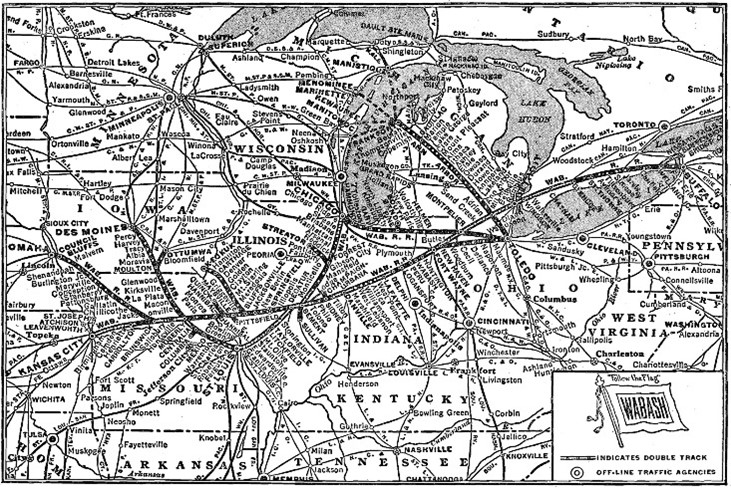
Route of the Wabash Railroad in the Midwest

The Wabash Railroad Company went bankrupt and was sold. The new Toledo and Wabash Railroad Company was chartered October 7, 1858. The Wabash and Western Railroad was chartered on September 27 and acquired the Indiana portion on October 5. On December 15, the two companies merged as the Toledo and Wabash Railway, which merged with the Great Western Railway of Illinois. The right of continuous transportation from one end of the country to the other is essential in modern times to that freedom of commerce. The Commerce Clause in the U.S. Constitution gives Congress the power to regulate commerce among the States and with foreign nations. If Illinois or any other state within whose were permitted to impose regulations concerning the price, compensation, or taxation, or any other restrictive regulation it would be harmful to commerce between states.

The Trans-Siberian Road in Russia

Trans-Siberian Railroad Crossing a large river in Siberia

The construction of the longest railway in the world  was launched in April 1891 and was completed in 1894. Three years later the section between Vladivostok to Khabarovsk with a length of 772km was opened in November 1897. The Central Siberian Railway from the River Ob to Irkutsk with a length of 1839km was built in 1899. The construction involved more than 100,000 workers, including prisoners, and the work was carried out by hand using shovels, axes, crowbars, saws. Despite the many challenges of the taiga, mountains, wide rivers, deep lakes, and floods, the tracks were built with amazing speed – around 740km per year.

  1. Does the protection of technology for the efficiency of commerce justify federal regulations over state regulations?
  2. If a corporation is losing money, do they have a right or obligation to raise rates to become profitable?
  3. Do authoritarian governments have an advantage or disadvantage in the construction of large infrastructure projects?

Consolidation of Railroads in Four States

The Supreme Court Strikes Down Railroad Regulation

Interstate Commerce Act (1887)

Construction of the Trans-Siberian Railroad

History of the Trans-Siberian Road

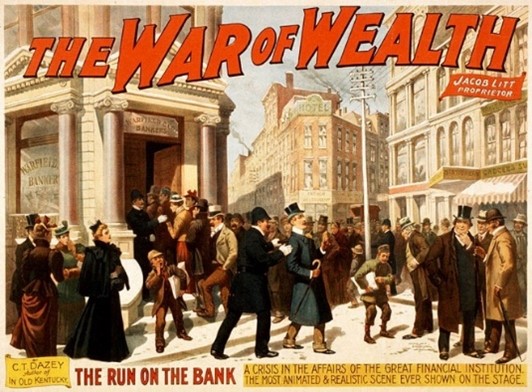
No crisis of the Cleveland presidencies exceeded the magnitude of the financial panic that gripped the nation at the start of his second term in 1893, and which presaged a depression that still lingered when he left office in March 1897.

The Constitution granted Congress the power “to coin money, regulate the value thereof, and of foreign coin, and fix the standard of weights and measures.” (Article 1, Section 8) Article I, Section 8, and Clause 2 The Congress shall have power to borrow money on the credit of the United States. In the 14th Amendment, Section 4, it states that “the validity of the public debt of the United States, authorized by law … shall not be questioned.”

In the century preceding 1893, Congress experimented with two central banks, a national banking system, laws regulating so-called “wildcat banks,” paper money issues, legalized suspension of specie payments, and fixed ratios of gold and silver. Gold and silver rose to prominence as the predominant monies of the civilized world because of their scarcity and value. Under the direction of Alexander Hamilton, the federal government adopted an official policy of bimetallism and a fixed ratio of 15 to 1 in 1792.

In 1875, the newly-formed National Greenback Party called for currency inflation through the issuance of paper money tied, at best, only minimally to the stock of specie. The proposal attracted widespread support in the West and South where many farmers and debtors joined associations to lobby for inflation, knowing that a reduction in the value of the currency unit would alleviate the burden of their debts.

When President Cleveland assumed office on March 4, 1893, the Treasury’s gold reserve stood at the historic low of $100,982,410 — slightly above the $100 million minimum required for protecting the supply of greenbacks. The Panic of 1893 began when the gold reserves fell below $100,000,000. Stocks fell and factories closed with many going bankrupt. Unemployment rose to 9.6%, nearly three times the rate for 1892. By 1894, the unemployment rate was almost 17%. The Sherman Silver Purchase Act was repealed in support of gold as a stable currency.

Cleveland’s position on sound money was not supported by his Democratic Party. The Gold Standard Act of 1900 resulted in a stable gold standard and economic growth. Cleveland’s position on sound money worked.

Hyperinflation in Germany

Under the Treaty of Versailles Germany was forced to make a reparations payment in gold-backed Marks. On June 24, 1922, Walter Rathenau, the foreign minister was assassinated. The French sent their army into the Ruhr to enforce their demands for reparations and the Germans were powerless to resist. More than inflation, the Germans feared unemployment. A cheaper Mark, they reasoned, would make German goods cheap and easy to export, and they needed the export earnings to buy raw materials abroad. Inflation kept everyone working.

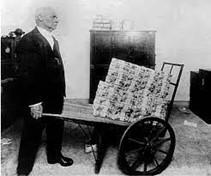
The price increases began to be dizzying. Menus in cafes could not be revised quickly enough. For example, a student at Freiburg University ordered a cup of coffee at a café for 5,000 Marks. He had two cups but when the bill came, it was for 14,000 Marks. When the 1,000-billion Mark note came out, few bothered to collect the change when they spent it. By November 1923, with one dollar equal to one trillion Marks, the breakdown was complete. The currency had lost meaning and value.

Although the currency was worthless, Germany was still a rich country — with mines, farms, factories, forests. The backing for the new Rentenmark was the value of the land for mortgages and bonds for the factories. Since the factories and land couldn’t be turned into cash or used abroad the value of one Rentenmark was equal to one billion of the former Marks. People lost their savings and homes.

Questions:

  1. Is a sound currency policy, where the dollar is backed by gold or some other form of credit, always the best policy for governments to follow?

    2. Does the financial debt of a country matter if its economy is growing?  Does it matter in times of war or the recovery from a natural disaster?

    3. In a financial crisis, a depression, does everyone suffer equally or are some more affected than others?

    4. Which problem should the government address first? High Unemployment of 8% or rising inflation of 5%? Why?

    5. Is foreign investment in a country’s economy necessary to maintain a balance of payments?

    6. Based on the U.S. Constitution, is the debt of our government limited or unlimited?

    The Panic of 1893 and the Election of 1896

    Price Stability and the Fed

    The Weimar Republic

    The German Hyperinflation, 1923

    Hyperinflation in Germany

    Historians often call the period between 1870 and the early 1900s the Gilded Age. This was an era of rapid industrialization, laissez-faire capitalism, and no income tax. Captains of industry like John D. Rockefeller and Andrew Carnegie made fortunes. They also preached “survival of the fittest” in business.

    By the late 1800s, however, monopolies, not competing companies, increasingly controlled the production and prices of goods in many American industries.

    Workers’ wages and working conditions were unregulated. Millions of men, women, and children worked long hours for low pay in dangerous factories and mines. There were few work-safety regulations, no worker compensation laws, no company pensions, and no government social security.

    Starting in the 1880s, worker strikes and protests increased and became more violent. Social reformers demanded a tax on large incomes and the breakup of monopolies. They looked to state and federal governments to regulate capitalism. They sought legislation on working conditions, wages, and child labor.

    Railroad builders accepted grants of land and public subsidies in the 19th century. Industries facing strong competition from abroad have appealed for higher tariffs. American agriculture benefited with land grants and government support. State governments helped finance canals, railroads, and roads.

    It is difficult to separate government intervention, regulation, and laissez-faire in American history. It is likely even more difficult to find the proper balance between government and free enterprise. Perhaps the most serious violations occurred during this era in America’s history with land grants to railroads, regulating the rates railroads could charge, mandating time zones, and allowing paper currency.

    1. Why is limited government and laissez-faire economics popular in the United States over time and today?
    2. Should the federal government regulate education and schools or should this be left to the local and state governments?
    3. Does laissez-faire economics bridge or widen the income gap between the social classes?
    4. Who benefits the most from increasing government regulation?

    Laissez-faire Economics in Practice

    Social Darwinism and Laissez-faire Capitalism in America

    Defending the Free Market from Laissez-faire?

    Era 4 – Engaging High School Students in Global Civic Education Lessons of in U.S. History

    www.njcss.org

    The relationship between the individual and the state is present in every country, society, and civilization.  Relevant questions about individual liberty, civic engagement, government authority, equality and justice, and protection are important for every demographic group in the population.  In your teaching of World History, consider the examples and questions provided below that should be familiar to students in the history of the United States with application to the experiences of others around the world.

    These civic activities are designed to present civics in a global context as civic education happens in every country.  The design is flexible regarding using one of the activities, allowing students to explore multiple activities in groups, and as a lesson for a substitute teacher. The lessons are free, although a donation to the New Jersey Council for the Social Studies is greatly appreciated.

    The Civil War put the constitutional government of the United States to its severest test. It challenged the Legislative, Executive, and Judicial branches of government as well as the federal system of power with state and local government. The activities below provide an opportunity to learn about the breakdown of a democratic political system, the conflict between geographic regions and different subcultural, and the competitive ideas for reconstruction. Students will learn about the hope regarding equality for black Americans through the 13th, 14th, and 15th Amendments and the resistance leading to disenfranchisement, segregation, and debt peonage.

    Did the Supreme Court have jurisdiction to hear the case? The law suit was properly in federal court only if a “citizen” of one State was suing a “citizen” of another State. Sanford was a citizen of New York. Even if we assume, with Scott, that the law made him a free man, was he then a “citizen” of Missouri?  If Scott was a “citizen” and jurisdiction was proper, then what about the basic issue on the merits? Did the law make Scott a free man?

    Was the Dred Scott Decision a failure of the Judicial system in the United States because it violated the fundamental principle in the Magna Carta regarding the rule of law and the individual rights and liberties of all people, regardless of their estate or condition.  Article 39 of the Magna Carta, secured a promise from the monarchy that “no free man shall be arrested or imprisoned, or disseized or outlawed or exiled or in any way victimized, neither will we attack him or send anyone to attack him, except by the lawful judgment of his peers or by the law of the land.” In the fourteenth century, Article 39 was redrafted by Parliament to apply not only to free men but also to any man “of whatever estate or condition he may be.”

    The Supreme Court’s conclusion: It “is the opinion of the Court that the act of Congress, which prohibited a citizen from holding and owning property of this kind . . . is not warranted by the Constitution and is therefore void; and that neither Dred Scott himself, nor any of his family, were made free by being carried into this territory, even if they had been carried there by the owner with the intention of becoming a permanent resident.”

    How do the principles of the Magna Carta and the precedent of the Dred Scott decision apply to the restrictive immigration decisions legislated by Congress in the Emergency Quota Act of 1921 and the Johnson-Reed Immigration Act of 1924? Does the United States, or any country, have the authority to restrict immigration based on race, ethnicity, or geographic location?  Aliens in the United States do not have a right to a court-appointed attorney, Miranda rights, the right to a jury trial, or the right to see all the evidence against them. However, they have the protection of the Due Process of Law clause.

    But one constitutional right that applies to aliens in removal proceedings is Due Process. According to the Supreme Court: “The Due Process Clause applies to all “persons” within the United States, including aliens, whether their presence here is lawful, unlawful, temporary, or permanent. Santa Clara County v. Southern Pacific Railroad Company, (1886)

    Questions:

    1. Did the U.S. Supreme Court have the authority to issue an obiter dictum regarding Mr. Dred Scott?
    2. Did enslaved persons who received freedom also become citizens of the state where they lived? Would their status as citizens change because of their race or ethnicity if they moved to another state?
    3. Does Article 39 of the Magna Carta apply to free blacks who were arrested as fugitives?
    4. Do people living in America, who are not citizens, entitled to rights in addition to the due process of law and should they also receive the equal protection of the laws of the United States?
    5. What about people living in America who entered illegal or have expired documents?
    6. Should birthright citizenship, everyone born in the United States or one of its territories, be considered a full citizen regardless of the status of their immigrant parent(s)?

    Associate Justice Stephen Breyer’s Address to the Supreme Court Historical Society on June 1, 2009

    Slavery and the Magna Carta in the development of Anglo American Constitutionalism

    The Immigration Act of 1924 (Johnson-Reed Act)

    The 1924 Act that Slammed the Door on Immigrants and the Politicians who Pushed it Back Open

    The question is whether the Southern states possessed the legal right to secede. Jefferson Davis, president of the new Confederate States of America, argued that the Tenth Amendment was the legal basis for secession. The U.S. Constitution is silent on the question of secession. Therefore, secession is a right reserved to the states and is supported by the ‘compact theory’ regarding the right to nullify a federal law.

    Another argument in support of the right of secession involves the states of Virginia, New York, and Rhode Island because these states included a clause in their constitutions that permitted them to withdraw from the Union if the government should become oppressive. Virginia cited this provision when it seceded in 1861. The Constitution is also based on the principle that all the states are equal and no state can have more rights than another. The right of secession cited by these three states must extend equally to all the states.  This is an interesting question for debate and discussion.

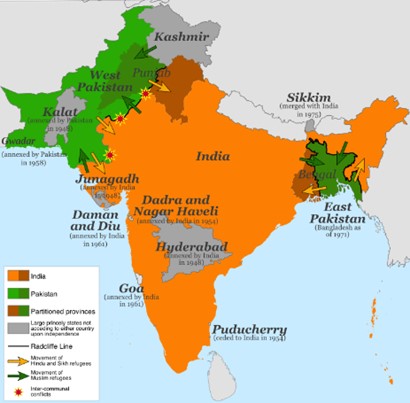
    In 1971, the Pakistan army launched a brutal campaign to suppress its breakaway eastern province.  A large number of people lost their lives, an estimated 300,000 to 500,000 died. The Bangladesh government puts the figure at three million. Bangladesh seceded because of the oppressive genocide against their population. It is now more than 40 years since they became an independent country.

    1. Do the “opt out’ clauses by Virginia, New York, and Rhode Island support secession at a later date from an early agreement to join into the common government or the Union?
    2. If a government violates the natural rights of life, liberty, property, or the pursuit of happiness against a specific group of people or a state, do they have the right to secede?
    3. Would you support the secession of Bangladesh if less than 1,000 people were killed?

    The Secession of East Pakistan in 1971 and the Question of Genocide

    The Secession of Bangladesh in International Law: Setting New Standards?

    Activity #3: Emancipation Act of 1863, 13th Amendment, Civil Rights Act of 1866

    Historians and constitutional scholars question if the Emancipation Proclamation was constitutional. This is a different question than asking if the Proclamation was justified. The debate over constitutionality is based on the question if it was lawful to own another human being if you lived in a state that was loyal to the Union. The Supreme Court in Prigg v. Pennsylvania (1842) upheld the Fugitive Slave Law of 1793  stating that Pennsylvania could not prevent the return of a fugitive slave to its owner. Consequently, The Thirteenth Amendment was necessary to make the Emancipation Proclamation constitutional.

    On January 5, 1866, a few weeks after the ratification of the Thirteenth Amendment, Senator Lyman Trumbull, from Illinois, introduced the first federal civil rights bill in our history. President Andrew Johnson vetoed the bill, opposing laws for the equality of African Americans as compared to the natural progression for this to happen over time. The veto message incensed Congress, who had evidence of widespread mistreatment of African Americans throughout the South by both private and public parties.  Congress overrode Johnson’s veto on April 9, 1866, and elements of the Civil Rights Act of 1866 eventually became the framework for the Fourteenth Amendment.  The constitutional question relates to the argument if the Act applies only to states that discriminate or if it applies to both state governments and private citizens.

    1. Does the U.S. Constitution need to explicitly state that all human beings are guaranteed life, liberty, and the pursuit of happiness?
    2. Did the Civil Rights Act of 1866 go too far or was it too limited in prohibiting discrimination?
    3. Should the Thirteenth Amendment have included a provision for reparations for enslaved persons and a provision for compensating slave owners for their losses?

    Emancipation Proclamation (National Archives)

    Was the Emancipation Proclamation Constitutional? (Illinois Law Review)

    Origin and Purpose of the Thirteenth Amendment (Cornell Law School)

    The Civil Rights Act of 1866

    Racial Discrimination and the Civil Rights Act of 1866

    The 14th amendment explicitly contains an equal protection clause. Miranda warnings and other amendments were not only created to protect certain individuals but all individuals.  Equal protection is a foundational principle in our society. No one should have their rights unjustly taken away from them; and no one should be allowed to get away with crimes because of their ethnicity, gender, socioeconomic status, etc. Everyone is under the rule of law.

    An uneducated or uninformed individual may be pressured by authorities in an interrogation and confess to a crime they did not commit in order to stop the questioning. The right to remain silent and the right to an attorney ensures that all individuals get equal protection regarding of their situation or circumstance.

    1. Does Miranda provide adequate protections for accused persons?
    2. Does the right to remain silent benefit an innocent person who is detained or accused?
    3. Should a detained or accused person have to specifically state and document their request to remain silent?
    4. Do the police have to stop questioning after a person states their intention to remain silent?
    5. If the police need information two or three weeks after the initial detainment, do they need to repeat the Miranda warning a second time?
    6. Should Miranda warnings apply to juveniles in school or only in matters involving questions by the police?

    Miranda v. Arizona, 1966

    Fourteenth Amendment(Cornell Law)

    Journal of Criminal Law and Criminology(Northwestern University School of Law, 1996)

    Era 3 – Engaging High School Students in Global Civic Education Lessons in U.S. History

    New Jersey Council for the Social Studies

    www.njcss.org

    The relationship between the individual and the state is present in every country, society, and civilization.  Relevant questions about individual liberty, civic engagement, government authority, equality and justice, and protection are important for every demographic group in the population.  In your teaching of World History, consider the examples and questions provided below that should be familiar to students in the history of the United States with application to the experiences of others around the world.

    These civic activities are designed to present civics in a global context as civic education happens in every country.  The design is flexible regarding using one of the activities, allowing students to explore multiple activities in groups, and as a lesson for a substitute teacher. The lessons are free, although a donation to the New Jersey Council for the Social Studies is greatly appreciated. www.njcss.org

    Concept of Self-Government

    In the late 17thcentury the colony of New Jersey was divided between East Jersey with a capital city in Perth Amboy and West Jersey with a capital city in Burlington. The situation was chaotic with arguments over property investments and the selection of governors. In 1702, a decision was made for New Jersey to become a royal colony with the appointment of Edward Hyde, Lord Cornbury.

    In the first 50 years of the 19th century the United States expanded its territory from the Atlantic to the Pacific Ocean and from Canada to the Rio Grande River. The expansion of territory also challenged the fundamental principles of democracy in the United States with the debt of purchasing land, wars with other countries, determining the meaning of equality, the migration of populations, and conflicts between the branches of government. In this era, teachers and students will discover that these conflicts in our government are not unique.

    Activity #1: Orders of Nullification and Conflicts over Laws – United States (1832) and Catalonia(2017)

    One of the challenges facing sovereign states is when the right of self-determination conflicts with the rule of law, especially constitutional law. The people of South Carolina opposed the Tariff of 1828, the law of the land, because of the economic harm to their citizens. On November 24, 1832, the state legislature adopted the Orders of Nullification which included the following statement, …”and that the people of this State will henceforth hold themselves absolved from all further obligation to maintain or preserve their political connection with the people of the other States; and will forthwith proceed to organize a separate government, and do all other acts and things which sovereign and independent States may of right do.”

    In 2017, the state of Catalonia, one of Spain’s wealthiest states, filed a petition for independence following the sentencing of nine of their citizens to jail for protests against the government and charges that the government does not tax the people of Catalonia equally with other citizens in Spain.

    1. Do the people of a territory have the legal right to withdraw from a compact or union?
    2. If a federal government violates the rights of the people it promises to protect, does this justify a right to withdraw from the compact or union?
    3. What states or territories have attempted to separate from a federal union? (Quebec,

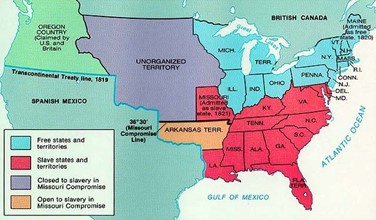
    Missouri applied for statehood in 1819 allowing for slavery.  Congress was already divided and there was a competitive debate over human rights and how Missouri’s application would tip the balance of an equally divided legislature of 11 free states and 11 slave states. The last state admitted was Louisiana in 1812.  Illinois was admitted on December 3, 1818 and Alabama on December 14, 1819.  The compromise was that Maine (part of Massachusetts) would be admitted as a free state and Missouri as a slave state, providing that slavery would be banned north of the latitude line 36o 30’.

    The European Union was created in 1993 with the signing of the Maastricht Treaty. Today it has 27 states. In 2009 the Lisbon treaty amended the constitution and adopted the Charter of Fundamental Rights of the European Union and the acceptance of this charter and human rights is a requirement for membership. However, Hungary and Poland do not embrace the Charter of Fundamental Rights in the same manner as the other member states.

    The newly elected leaders in Poland and Hungary have taken strong positions against abortion and the equality of individuals identifying as LGBTQ. The constitutional question before the Court of Justice is similar to the Dred Scott v. Sanford case of 1857 which challenged the legal authority of the Missouri Compromise and prohibiting slave property in states.

    1. Why was the United Kingdom allowed to leave the European Union?
    • Should states without an ‘opt out’ clause be allowed to leave the European Union? What conditions should be considered?
    • How does the secession of one state impact its own people and the other states in Europe?
    • Under Article 7 of the Treaty of the European Union, can a state leave if it is suspended?
    • Is it possible for member states to end diplomatic relations with another member state?

    After eight years of government by the Democratic-Republican Party, in 1824, the Democratic-Republican Party splintered as four separate candidates sought the presidency. The election tested the Twelfth Amendment. Since no candidate received a majority of the electoral vote, it was decided by the House of Representatives.  Although Andrew Jackson received the most popular votes and the most electoral votes, he did not become president.  At this time, several states did not have a popular vote for president and electors in some states were chosen by state legislators.

    In 2018, the Green Party in Germany became the second strongest political party. After years of government by the Social Democratic Party and the Christian Democratic Party, the Green Party has rallied the citizens of Germany around environmental issues, specifically climate change. They also have positions against racism and support immigration.  The parliamentary system of government selects the chancellor or leader of Germany through alliances of the political parties elected.

    1. How would you describe a competitive democracy?
    • Are political parties supporting a single issue with limited experience in diplomacy or political administration qualified to govern in countries defined as the G20?
    • Why do populist movements emerge? Is there strength based on the issues or the charisma of an individual?
    • How do new voices and political leaders gain support withing their countries?
    • Does the Electoral College in the United States provide protection against third parties?  Is this appropriate for a 21st century democracy?
    • Do you think the Democratic and Republican parties will be the leaders of the two-party system of government in the United states at mid-century, the election of 2048 or 2052?

    Presidential Election of 1824: A Resource Guide (Virtual Programs & Services, Library of Congress) (loc.gov)

    The ‘gag rule’ was a legislative tactic employed by southern members of Congress beginning in the 1830s to prevent any discussion of enslavement in the House of Representatives. The silencing of enslavement opponents was accomplished by a resolution first passed in 1836 and renewed repeatedly for eight years.

    The suppression of free speech in the House was naturally deemed offensive to northern members of Congress and their constituents. What came to be widely known as the gag rule faced opposition for years, most notably from former president John Quincy Adams. The gag rule was finally rescinded in December 1844.

    Democratic Centralism is essential to the internal political debates withing the Communist Party of the Soviet Union. To what extent is debate permitted withing the Soviet Congress influencing policy and implementing changes?  In the 1920’s there was dissent within the Communist Party regarding the proletariat and farmers. In December 1927, the opposition voices led by Leon Trotsky were expelled from the Congress, a ‘gag rule’ as debate was ended. In the 1980s, some voices within the Communist Party called for reforms and supported market forces in the economy and more democracy. The principle of democratic centralism challenged the authority of Gorbachev in a failed attempt to overthrow his authority. Eventually, democratic centralism changed the government as the former Soviet Union collapsed.

    1. Is a single party system, two-party-system, or a multi-party system the most practical way to govern in the 21st century?
    • In a democracy, should the majority have the right to limit or suppress debate on controversial issues?
    • What is the most effective way for people to change their government: public protests or elections?
    • How effective is a strong leader with charisma in today’s government?
    • To what extent is the news media (including social media) a political influence or force in the United States?
    • What type of government does Russia have today and what type of government does the United States have today?
    • Is a parliamentary system of government more effective than the two-party system of representative government that the United States has?

    Era 2 – Engaging High School Students in Global Civic Education Lessons in U.S. History

    New Jersey Council for the Social Studies

    www.njcss.org

    The relationship between the individual and the state is present in every country, society, and civilization.  Relevant questions about individual liberty, civic engagement, government authority, equality and justice, and protection are important for every demographic group in the population.  In your teaching of World History, consider the examples and questions provided below that should be familiar to students in the history of the United States with application to the experiences of others around the world.

    These civic activities are designed to present civics in a global context as civic education happens in every country.  The design is flexible regarding using one of the activities, allowing students to explore multiple activities in groups, and as a lesson for a substitute teacher. The lessons are free, although a donation to the New Jersey Council for the Social Studies is greatly appreciated. www.njcss.org

    Concept of Self-Government

    In the late 17thcentury the colony of New Jersey was divided between East Jersey with a capital city in Perth Amboy and West Jersey with a capital city in Burlington. The situation was chaotic with arguments over property investments and the selection of governors. In 1702, a decision was made for New Jersey to become a royal colony with the appointment of Edward Hyde, Lord Cornbury.

    The 18th century was a unique time in world history as this was a time when the concept of government changed in Europe from the authority of the divine right of kings to the authority of the social contract and sovereignty of the people.  This period is unique in western civilizations because of its focus on natural rights, limited government, and enlightened ideas.

    The Ujamaa concept was the centerpiece in Tanzania’s Declaration of Independence (1967) and the concept of natural or inalienable rights is the centerpiece of America’s Declaration of Independence (1776). This is an opportunity to analyze how the pursuit of happiness was defined in the 18th century and in the 20th century. To what extent has time and history changed our understanding of equal opportunity, empowerment, property, and the means to establish social justice and independence?

    1. Compare how America and Tanzania defined equality, property, and opportunity for their people in different centuries.
    2. Are there unique advantages or disadvantages in each document?

    The Land Ordinance of 1785 is considered a hallmark for considering future states as equals to the original 13 states which declared independence from Great Britain. Equality is a fundamental principle in democracy. Under the Land Ordinances of 1784, 1785, and 1787, slavery was abolished, religious and civil liberties, and an education about democratic values provided opportunities for all citizens.

    Although Canada was settled around the same time as the thirteen American colonies, the colonies in Canada were divided culturally and politically.  Lower Canada was settled by France and the majority of the people professed the Roman Catholic religion and Upper Canada was influenced by England and the Protestant religion. In the Unification of Upper and Lower Canada in 1867, there was a debate about future territories and democracy.

    1. Compare and contrast the fundamental ideals of democratic government in the United States and Canada regarding the structure of government, role of education, concept of equality and opportunities for all citizens, end the separation of powers in both governments. 
    • Does one country emphasize direct democracy over indirect democracy or do both countries have similar governments?

    Land Ordinance of 1785 – Ohio History Central

    The History of Upper and Lower  Canada

    An Act of Union (1867)

    The Road to Democracy in Canada

    What was the force behind the emancipation of enslaved persons in the 19th century?  Was the movement to end slavery motivated by the abolitionist movement, economics, legislation, resistance, or something else? Liberty is considered a natural or inalienable right and for millions in North America, this basic right was denied.  The Atlantic slave trade ended in 1807 but slavery continued and the population of enslaved persons continued.

    1. What is the role of civic responsibility and empowerment in the movement to abolish slavery in the British colonies in the Caribbean and in the United States of America?  
    2. One defense of slavery in opposition to those who would abolish it was the claim that slaves were private property essential to a slaveowner’s way of life and livelihood. Therefore, to abolish the institution of slavery was to force an owner of slaves into a life of having to work for wages or hire people and pay them wages. Thus, the slaveowner would be enslaved by a law abolishing slavery. Does this claim of individual freedom through the ownership of property have any constitutional support?

    Use the links below for evidence to support your thesis or claim.

    Jamaica                                                                  The Act for the Gradual Abolition of Slavery in NJ (Feb. 15, 1804)

    Jamaica and the Atlantic World                        Legislating Slavery in New Jersey

    Emancipation in Jamaica                                    Resources for the Abolition of Slavery in New Jersey

    The Emancipation Act of 1833

    The history of the United States was determined by compromises regarding the legislature, property, and the importation of slaves.  A controversial compromise was over the counting of enslaved persons in the 13 independent states for purposes of representation and taxation. An agreement was reached to count enslaved persons for the purpose of taxation and representation as only three-fifths of the population. This method of determining representation in the House of Representatives continued until the Thirteenth Amendment abolished slavery.

    Article I, Section 2 of the U.S. Constitution states: “Representatives and direct Taxes shall be apportioned among the several States which may be included within this Union, according to their respective Numbers, which shall be determined by adding to the whole Number of free Persons, including those bound to Service for a Term of Years, and excluding Indians not taxed, three fifths of all other Persons.” The “other Persons” were slaves.  The Southern states wanted to count the entire slave population, which would increase their number of members of Congress. The Northern delegates and others opposed to slavery wanted to count only free persons, including free blacks in the North and South.

    The Continental Congress debated the ratio of slaves to free persons at great length. Northerners favored a 4-to-3 ratio, while southerners favored a 2-to-1 or 4-to-1 ratio. Finally, James Madison suggested a compromise: a 5-to-3 ratio.

    Slavery was essential to the Brazilian economy. 40 percent of the 10 million enslaved African brought to the New World ended up in Brazil. The institution of slavery in Brazil was supported by a majority of white citizens and the Roman Catholic Church. Gradual abolition began in 1871 for children born to enslaved women. Unfortunately, with no plan for assimilation into Brazilian slavery continued into the 20th century with informal agreements for food and housing.

    1. Should the decisions about equality and freedom be determined by governments or by the vote of the citizens?
    2. How should decisions be made about the protection of property when property conflicts with human life and personal liberty?
    3. If automobiles are harmful to the environment should government have the authority to ban them without compensation?

    Thirteenth Amendment to the Constitution of the United States, 1865

    Golden Law of 1883 in Brazil

    Era 1 – Engaging High School Students in Global Civic Education Lessons in U.S. History

    New Jersey Council for the Social Studies

    www.njcss.org

    The relationship between the individual and the state is present in every country, society, and civilization.  Relevant questions about individual liberty, civic engagement, government authority, equality and justice, and protection are important for every demographic group in the population.  In your teaching of World History, consider the examples and questions provided below that should be familiar to students in the history of the United States with application to the experiences of others around the world.

    These civic activities are designed to present civics in a global context as civic education happens in every country.  The design is flexible regarding using one of the activities, allowing students to explore multiple activities in groups, and as a lesson for a substitute teacher. The lessons are free, although a donation to the New Jersey Council for the Social Studies is greatly appreciated. www.njcss.org

    Era 1 Colonization and Settlement

    Concept of Self-Government

    In the late 17thcentury the colony of New Jersey was divided between East Jersey with a capital city in Perth Amboy and West Jersey with a capital city in Burlington. The situation was chaotic with arguments over property investments and the selection of governors. In 1702, a decision was made for New Jersey to become a royal colony with the appointment of Edward Hyde, Lord Cornbury.

    Throughout most of world history, the ownership of property was challenged by trespassers, squatters, and invaders. The amount of autonomy for citizens, especially the wealthiest citizens and the protection of the rights of others is an issue that goes beyond New Jersey and the American colonies.  The desire for protection and rule by law often leads people to a decision involving the exchange of some independence for the authority of a government to provide for order and protection.  As a result of this ‘social contract’ there is competition between the authority of the state and the independent lives of private citizens. 

    Compare the account of Queen Anne’s Instruction to Lord Cornbury (Green. Words That Make NJ History, p.20) with the account in China in 221 B.C.E following the chaos of the warring states and the unification of independent Chinese states under Chu De (Shi Huangdi).

    1. How effective are these instructions in bringing order to chaos in the colony of New Jersey?
    2. How did Chu De (Shi Huangdi) bring order and unity to China?
    3. How important is self-government to people if the government is not willing or able to protect their property and lives?
    4. In a large country like the United States, how would our leaders restore order today in the event of chaos and disorder?

    In the colony of New Jersey during the 18th century there were frequent cases of trespass, stealing, and claiming land.  The reason for this was that titles to property were confusing, lost, and in many cases gave non-owners permission to live or work on a particular tract of land. Although rent was required, it frequently was not paid which resulted in vigilantes or mobs removing offenders and having them imprisoned for theft or treason for disobeying the Crown.

    The migration of people in the Natal province in southern Africa provides another case study over the titles to property and riots that resulted over a shortage of land with thousands of people fleeing for their safety. Research the Mfecane Invasion and how this despotic leader gained control of property and redistributed it to the Zulu. The conflict resulted in the migration of Boers and Bantu to areas outside of the vast resources in Natal.  

    Read the account, Land Riots and the Revolution in NJ and compare it with the Mfecane Invasion in southern Africa.

    1. Should a government have the authority to collect money to improve property and collect taxes on property without their consent?
    2. Are people without property entitled to the same economic and political rights as people with property?
    3. When rulers or invaders gain control of property, what recourse do innocent people have?

    Throughout history, the individual liberty of individuals regarding their freedom to express ideas, defend scientific evidence, and express diverse opinions has frequently been challenged by the state or other powerful institution in the community or state.  In Salem, Massachusetts in 1692-93, more than 200 men and women were accused of being witches and the mass hysteria led to the conviction and execution of 20 women in the Salem Trials. The hysteria was motivated by the fear of the devil in unexplained incidents in the community. The religious bias of the judicial system resulted in injustice.

    In Naples, Italy the scientific research of Copernicus challenged the Biblically based teaching in the Book of Joshua 10:13 that the earth was the center of the universe. Compare the hysteria in support of the Aristotelian view of the universe with the persecution of Giordano Bruno and the house arrest of Galileo Galilei with the hysteria and the religious bias that supported injustice in the Salem trials..

    1. Has the evolution of our system of justice improved since the Salem trials of the 17th century?
    2. Does biased or false testimony in a trial violate the principle of equal justice for all?

    Throughout history, people have been persecuted for their religious beliefs. In many cultures, religious institutions are an important part of the culture. However, when individuals or groups express beliefs different from those accepted by the majority and when new populations migrate into a country or culture, they have frequently been persecuted. Although the freedom to worship is considered as a fundamental right by the United Nations Declaration of Human Rights (1948), there continue to be examples of persecution and conflict.

    Read the accounts of the persecution and exile experienced by Anne Hutchinson & Roger Williams in colonial America and compare their accounts to the religious zeal expressed in the  Taiping Rebellions in China (1850-1867). 

    Have a separate group read about the experience of Quakers in West Jersey and Puritans and Presbyterians in East Jersey in the late 17th century. Discover the reasons for the adoption of religious liberty in Concessions and Agreements of West Jersey and restrictions against atheists in East Jersey.  Read the accounts of persecution against Christians and others for their beliefs by the Taliban in Afghanistan and the reaction of groups in Afghanistan to the mass killings of Hazara, a Shiite community.

    1. To what extent can freedom be restrained?
    2. Is it possible to maintain the separation of church and state and legislate morality that is inherent in the religious teachings of specific faiths?
    3. Do you think the separation of church and state is essential to a democracy when citizens believe in different faiths or are atheists without faith in any deity or religion?

    Book Review: A Brief History of France: People, History, and Culture, by Cecil Jenkins

    In 15 information-filled chapters, Jenkins gives us a decent amount of French history in a short book.  Chapter One is called “Cro-Magnon Man, Roman Gaul and the Feudal Kingdom,” and the last chapter is called “France in the New Global Order.”  By chapter 6 we are already reading about Napoleon, so if that is any indication of the coverage here you know that means most of the book is about the last few hundred years and not about Cro-Magnons or Romans or Celts.  If you want more emphasis on those guys, you have to seek a different book.

    Jenkins is a great writer, and he not only uses clever turns of phrase.  He also uses a great deal of humor and fun in his writing.  The book is enjoyable to read.  I hold a BA in French Language & Literature, but I found a huge amount of information here I had not expected and had not known about before reading the book.

    The book is really quite funny, at points.  For example, on page 28, Jenkins explains, “Again, the old practice of dividing estates among the sons, which had created so many problems with the royal succession, caused continual private wars among the minor nobles who had often little else to do but strike knightly attitudes.”

    This striking-a-pose reference is typical of the funny ways Jenkins tells us in more modern terms what went on in the French past.  See, also, the mention of Philippe IV’s “cold good looks (p. 33) and the “déjà vu all over again” discussion on page 72 and the bitchiness notes on page 75.

    Without giving too much of the actual content away, I will say here that the framework of French history gives Jenkins a wonderful playground to exercise in.  He enjoys writing about this topic, obviously, and the reader will enjoy finding out about some of the more interesting and sometimes weird passages of time within the French world.’

    Teachers of social studies and of history will probably like the book because of its approach and clever language.  More advanced students—especially those who know something of French history—may like this also.  It is not a very basic review of French history, however.  It does demand some overall familiarity with the topic so that the reader can follow what is happening.  I have read some other similar books recently on history of countries I knew little about and feel for those who read this one if they are not somewhat versed in French history.

    This is a brief history, indeed, and best for those who need a good review and an exciting read about the topic.  I recommend the book especially for Francophiles who want another perspective.  This point of view is certainly refreshing.

    Book Review: Britain Begins by Barry Cunliffe

    The author tells the story here of both England and Ireland because they cannot be separated easily.  Since the very beginning of humans’ time in that part of the world, both lands and cultures were connected.  It is that united history that leads the way in this incredible story of the sometimes icy, sometimes verdant northern reaches of civilization.

    The reader will find here exciting and revealing chapters in the history of movements throughout the pre-historic, Celtic, Roman, Anglo-Saxon, Norman, and modern times of the isles.  There are clear and helpful illustrations, and there is enough information here to fill any semester-long course on the history of England, or rather Albion, as it was first called by those who were using formal language.

    The author paints rich stories onto a canvas of what was once a chilly ice-covered region and which came to be a world power.  The author makes use of language, tools, science, history, and other major fields to tell about the different eras of the isles.

    The years of the Celts are very intriguing ones, indeed.  Cunliffe speaks of the idea that there were two entirely distinct waves of movement among them—including Iberia, Britain, Ireland, Scotland, Brittany, and Wales (pp. 248-249).  He also speaks to the idea that the Celts started in the north and later in one era migrated as a large group southward to Brittany (p. 428).  He has a number of additional theories related to this and other good examples of “movement.”

    Another very interesting idea is that language, culture, and tools were shared up and down the west coast of Europe and up between the isles—a sort of “Atlantic” civilization (p. 344) emerging over time among the Celts.  This explains linguistic and other hints pointing to migrations and movements up and down the coast—as opposed to some earlier notions of “Spanish” Celts trudging only northward to the further reaches of what came to be the UK.

    Cunliffe talks about the notion of Celts moving southward—starting in Scotland and Ireland and coming down into Europe along the Atlantic.  The author uses many different sorts of proof to advance this theory, at the same time he asks additional questions.    

    Teachers will be able to use this big book in a variety of ways.  First and foremost, it is important personal reading for any teacher interested in social studies in general and in the history of English-speaking people specifically.  Understanding the history of northwest Europe is helpful in understanding the intricate connections among the Celts and Europeans, the British and the Irish, and the Scandinavian and Germanic stock among the English.

    Another important use is for helping students understand the power of “movement” among peoples, the conflicts created and agreements forged, and the resulting cultural and linguistic differences and similarities resulting from peoples coming into contact.  The notion of movement relates also to the traveling ideas, tools, traditions, names, weapons, foods, trades, and books, later.  Any standards and benchmarks related to movement are connected through teacher use of this book as a reference and resource.

    Yet another good use of this volume is a textbook for a college-level course in history, of course.  Because it covers so very much information, it could also be used as a summer reading project for advanced rising college freshman students needing timely non-fiction reading. 

    Those four uses of the book can be joined by another one I propose here: coffee table teaser.  It would be interesting to set this in plain view and see who would pick it up and want to start reading it.  It has a beautiful green cover.  There are in fact many photos, drawings, and illustrations inside.  The cover just might draw in some unsuspecting readers.

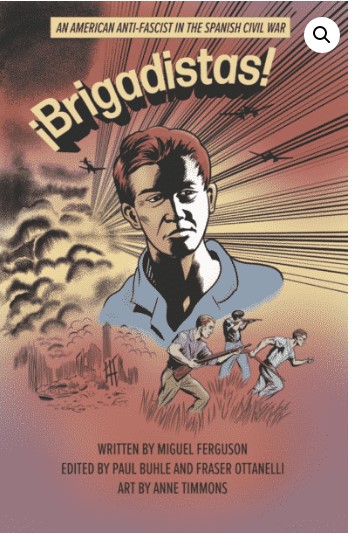
    Book Review: !Brigadistas! An American Anti-Fascist in the Spanish Civil War edited by Miguel Ferguson, Anne Timmons, Paul Buhle, and Fraser Ottanelli

    (Review by Anika Amin, St. Ann’s, Brooklyn)

     ¡Brigadistas! is a graphic novel about the Spanish Civil War (1936-1939). It tells the story of three friends from Brooklyn, New York who travel to Spain where they join the Abraham Lincoln Brigade. The book was super descriptive and did not include unnecessary details. This made it comprehensive but still clear and intelligible. The moments about the effects of the war and the regular people it affected were extremely powerful. The descriptions of the war’s effects on children and people who were not soldiers made the graphic novel very impactful. There could have even been more of these moments included to reinforce the significance. Overall it was informative, clear, and very powerful. Although it was very clear, it could have made it easier to read if it had chapters or sections. Breaking up the text and providing landmarks throughout the story could have also made it easier to follow. Additionally, depending on the target age group, some of the terms and concepts could have been explained more to keep the writing flowing. Overall it was great to read and it presented important and difficult topics in an understandable way.

    British Exacerbation of the Great Hunger 1845-1852

    An Gorta Mór is the Irish word for Great Hunger, but most people know this event as the Irish Potato Famine. The Great Hunger began in 1845 when a disease in plants, that was caused by mold and fungus, spread among the crops. This plant disease is called Phytophthora infestans and it spread swiftly across the island nation. Potato crops were ruined for the next several years and this was especially devastating considering the main source of food for the Irish were potatoes. At the time Ireland was a colony that was controlled by Great Britain and due to this they were forced to be subject to the rules implemented by the British. Great Britain, being Ireland’s colonizer, took it upon themselves to send soldiers over to Ireland and implement new laws in order to help the issue from getting more out of hand. The rules subjected upon the Irish by the British hurt the country of Ireland and its people at a time when they needed as much help as possible. Life in Ireland had become so unbearable that many looked to leave the country, but unfortunately emigration was not accessible to all people. By the end of the Great Hunger there were approximately one million Irish people who had died during the famine years and another one million who were forced to seek refuge in other countries.

    The Great Hunger in Ireland occurred in 1845 and lasted until 1852. Throughout the seven years things didn’t seem to get any better, but the British government insisted they were doing what needed to be done to fight this mass hunger. During this famine, if people were supplied with food and the proper resources, there would not have been widespread death across the country. The help England was claiming to give actually had the opposite effect and made problems in Ireland worse. Workhouses provided jobs that paid less than the cost of food, and landlords were being given the incentive to evict poor tenants. On top of this, Britain had not stopped exporting mass amounts of food from Ireland back to England. So when the British are claiming they are helping the issue, why are they making decisions that have the opposite effect?

    The actions of the British government tell a bit of a different story to this ‘famine’.What were these decisions being made by the British government that were continually harming the already struggling Irish people? Weren’t the British supposed to be the ones helping Ireland through this dreadful period of history? By looking at the history of the Great Hunger, authors – Cormac O’Grada, Christine Kinealy, Jill Sherman, Peter Gray, Edna Delaney, Peter Solar, Tom Yager, and Mark McGowan – all give crucial details into the problems going on during the famine and what made it worse. These historians paint a picture of how a beautiful country like Ireland turned into a place of death and poverty. The heavy impact the new laws and relief measures had on the people as well as lack of care for Irish citizens’ welfare on the part of the British government is also discussed. I will also be using my sources to describe the first hand accounts of the Irish who struggled during this time. The authors actively contest the whitewashed stories behind the Great Hunger and use first hand accounts as well as written evidence to show British culpability. The argument states that the actions taken by the British government show that they knew what they were doing. Some of the authors go in depth about how the British government ended up seeing this as a solution for population control, because if people died then less would need to be fed and taken care of.

    In this writing I use scholarly sources to reshape people’s thinking on the Great Hunger. Drawing from a few sources, I will use firsthand accounts of people who survived the Great Hunger, published books on the Great Hunger’s history, journals about laws enacted in Ireland, and articles about how the laws impacted Irish citizens to show how England exacerbated this famine. Ireland has dealt with a few famines throughout its history but nothing compared to the Great Hunger of 1845. Ireland had experience in how to help make the famine more manageable, but there were other factors at play that continuously made the issue worse. If Ireland had been properly supplied this famine would have ended in much less death. Other nations/groups of people saw the struggle not getting better and donated to the cause, such as the Choctaw Native Americans. In contrast the British Crown went out of their way to not help the Irish get donations. When the Ottoman Sultan offered to send money for famine relief, the representatives of the Queen rejected them, stating that they couldn’t donate that much due to the fact that it was much higher than the amount the Queen donated. This would be seen as an insult to donate more than the Queen. The actions of the British were the reason the death toll went up as high as it did and they continued to act in their best interest. This has been viewed for years as a tragedy that couldn’t be avoided, but diving deeper into this topic allows readers to see the man made factors that helped exacerbate this problem.

    By looking at the significance of the laws put in place by the British government and the food being transported from Ireland to England, it is clear that this famine was very much exacerbated by the British. In general people believe this was a famine caused by a disease in the potatoes, but the lengths the British went to in order to ‘help’ Ireland actually ended up making everything worse and leading to more death. By looking at scholarly sources the reader can see that the British didn’t act in the best interest of the Irish and instead ignored the problem at hand. British bias towards the Irish drove the government to pass the Poor Relief Act, The Temporary Relief Act, or the Poor Law Extension Act which were said to be effective measures in fighting the famine but they were all ineffective. The treatment of the Irish people by Britain will always be remembered by those who survived those traumatic years, but in order to learn from history the story must be true and unbiased. In order to understand the trauma and hardships caused by the British government, one must look into the actions that harmed the Irish and how the people were affected by them. By looking at the living conditions brought upon the Irish by Britain’s relief and the laws enacted by the government it is clear that this famine was amplified by England.

    Exacerbating the Famine

    Ireland is no stranger to food shortages, as the Irish have experienced sixteen different food shortages from the year 1800 to 1845. But when the blight arrived in Ireland in 1845, this happened to be the first food shortage that affected the entire country of Ireland. “By late 1845 Ireland had lost about half of its potato crop to the blight. The English still believed the food shortage would not last. They thought that if the Irish people needed more help, Ireland should use its own tax revenue”( Sherman, 2017, p.18). In the beginning of the famine, government officials in England did not believe that the blight was as bad as people were saying and they thought this whole thing is an Irish problem. This was initially seen by the British government as an Irish issue that required action from no one but the Irish. What was going on in Ireland was being overlooked by those in England. It was assumed that if the British were to help the Irish by giving them government assistance, the Irish would rely too heavily on handouts and things would never get better in the country.

    Prime Minister Sir Robert Peel had a harsh view of the Irish people and felt they were exaggerating when talking about how bad the blight was. When scientists told him that this should not to be taken lightly and that they weren’t overreacting, he chose to believe that they were still overreacting and that this wasn’t a big deal. When the Irish did look to see what the British were doing they were shocked and horrified to see them making things worse:

    “In the midst of all this suffering, the Irish began to examine the actions of the British government. Food continued to be exported out of Ireland. British owners of Irish land were still entitled to the crops grown on that land. Their businesses relied on these crops. And British policy did not prevent the export. Starving Irish people became furious as they watched boatloads of grain depart from their docks for England. Food riots erupted at ports such as Youghal and Dungaran in southeast Ireland”(Sherman, 2017, p.22).

    Ireland was growing enough food to feed its people but they had to watch this food get shipped out of the country.The fact that Britain wasn’t taking this issue seriously was clear when seeing that they continued to transport food from Ireland back to England. During a famine the goal is to get enough food to feed the entire country, but if the English government decided to keep that food they were exporting in Ireland, then the majority of people would have been fed.

    Allowing Britain to export food out of Ireland hurt the poor in the country for years and allowed many people to starve to death. The exportation of food out of Ireland, made this whole issue of not having enough food worse. Importing food would help this mass hunger, but taking food away from the starving people when they could be surviving off that food is helping nobody. In the beginning it was the blight that caused Ireland’s food shortage, but as time went on it was the policies that were implemented by Britain that made the issue worse. It was said that the weak policies “did not help much” and that “stronger action by the British government could have prevented some suffering”( Sherman, 2017, p.34). The British government made efforts to start soup kitchens and public works projects to provide food and work to those who were affected the most in Ireland. The problem with these public works was they weren’t well funded and they weren’t long term solutions. Members of Parliament in England blasted the politicians who were going out of their way to do less to help the suffering Irish because it was inhumane and England would be looked down on if the problem got more out of hand. Christine Kinealy in her works “The Great Irish Famine: Impact, Ideology, and Rebellion” points out: “The decision to make public works unproductive divided members of the Whig Party and caused a rift between the Irish Executive and the Treasury, a division that developed as the Famine progressed” (Kinealy, 2002, p.38).

    There were certain members of parliament who were doing what they could to not help this famine die down. Decisions like this enraged the Irish people because they were expecting help from the country that has power over them. Instead Whig policy was focused on getting poor people off the land “and if it took mass death to achieve that directive, so be it”(McGowan, 2017, p.87). The intentions of the British government, led by the Whig party, were not that of wanting to give much help to the Irish. By overlooking mass death, the British were willing to undersupply the Irish and do less to help them. Since these were not citizens of England they were very comfortable with death amongst the Irish.

    One man testified that when his grandfather talked about the public relief efforts, he would say “that there were so many making for the poorhouses that there wasn’t accommodation for half of them”(Ó Gráda, 2001, p.134). The decision to make these relief efforts not well funded or well organized hurt many Irish who were struggling. Many Irish looked to these different relief efforts put in place by the British but when people saw how little supply there was, some turned on each other to survive. Decisions like these came about due to a new thought amongst some British, which stated how this famine was an opportunity to bring about a regeneration of Ireland. The issue was that this was based on British views and was built around getting rid of religion and culture in Ireland.

    Throughout the famine years politicians would expect lots of crops to be grown during the farming seasons. In Ireland they were producing enough food to feed the majority of the country but many people were still starving and unable to get access to food. Britain showed how seriously they took this problem:

    “In autumn 1846, the Treasury decided that a portion of the modest amount of grain imported by the government should be sent in the first place to Scotland, despite the greater destitution in Ireland. This action caused considerable alarm amongst relief officials in Ireland. It was also an early example of decisions being made in London which ignored advice from relief officials on the ground”( Kinealy, 39).

    This was a huge indicator to the Irish that they were not being taken seriously. People were starving and struggling to survive, but the British government continued to claim that this was not a big deal and that if the Irish needed help they should help themselves. Since this issue wasn’t taken seriously, people assumed that this was an Irish problem which required solutions made by the Irish government.

    After debates about what to do, in the Autumn of 1845 Prime Minister Robert Peel decided to implement a Temporary Relief Committee with the goal of feeding the poor. He also shipped in 100,000 pounds of Indian Corn into Ireland with the thought that this food will replace potatoes in Ireland. These relief efforts were not put into place immediately because Prime Minister Peel felt that there was enough time to wait before the impacts of the shortages were to be felt in the following Spring and Summer. He expected the cheap Indian corn to take the place of the potato on the Irish palate. The relief efforts were better than nothing, but this was also seen as temporary relief. The British government expected this to get Ireland back up on its feet, but that was not the case. Prime Minister Peel was replaced in 1846 by Prime Minister John Russell. This then led to new relief efforts under the Russell administration.

    When Prime Minister Russell came into power he introduced new relief efforts that were vastly different from the measures in which Peel put into place. Robert Peel’s measures were already not much help for the poor Irish, but when Russell’s relief efforts replaced the old ones it was clear that this would hurt the Irish. Russell’s measures meant much less food being provided for them and access to places to stay and eat were going to be more restrictive than they were before. These new measures also made Public Works the centerpiece of the help offered, but the measures were made to be unproductive. The most important part of the relief systems that was changed after the transition of leadership, the government still did not import food into Ireland.

    During a famine, importing food would have been one of the best things they could have done. The only reason Peel’s relief efforts were more successful than Russell’s was because the new administration was clearly trying to make relief efforts in Ireland as unproductive as possible.

    The Whig government had made the Public Works much harsher than it was before. Some big issues with the Public Works were that there were delays in people getting paid, people got paid low wages that did nothing against inflation, and changes in working hours to 6am to 6pm with a pay cut penalty for being late.“Despite daily reports to Trevelyan recounting instances of death from starvation of people dependent on the relief works, the Treasury insisted that the wages paid were adequate. The lowness of the wages contrasted with the high level of administrative expenses for the public works”( Kinealy, 40). The Irish thought that Public Works should be properly funded and the workers should be paid enough to survive during the famine. The pay was less than the cost of food for poor people and the jobs didn’t make much sense in terms of economic relief or famine relief. The thought process of adding jobs was also ineffective because the British would have Irish workers build things such as roads but these roads wouldn’t go anywhere. The jobs were not meant to help boost job growth or the economy, they were instead put there to provide some type of work for the Irish. The British government used the excuse that they were spending a lot of money on these relief systems but they should be using some of that money to properly pay the poor, hard working people. When the British realized the public works were failing they decided that:

    “At the beginning of 1847, in recognition of the failure of the public works, the government decided to abandon them and replace them with a new relief measure based on the provision of free food in a number of specially established soup kitchens. The legislation, known as the Temporary Relief Act or ‘Soup Kitchen Act’, opposed current orthodoxy which viewed the provision of gratuitous relief as both ideologically flawed and expensive”( Kinealy, 41).

    This is another example of the British doing something nice but it is not getting a lot of applause because members of the Whig party thought this would cost Britain too much money. They also had their own biases, in which they believed that the thought of generously helping the Irish was erroneous. Even though the British government was actively talking about helping the Irish, there were members of the government who allowed their biases to get in the way of providing relief to people who were struggling.

    In the year 1847, when looking at the crops across the country, there was very little blight to be found, but the potato and there wasn’t as much corn being grown. The new policies instituted by the British marked a turning point because in their minds this was where responsibility shifted from Britain to Ireland. This led the British to feel that the Irish would finance relief efforts on their own from now on. As time went on more evictions occurred and more people were in poverty each day. During the Great Hunger land prices started to drop which allowed wealthy businessmen from Britain to seize this golden opportunity. As they started to buy up all the land, the landowners immediately either evicted the tenants or raised rent so they would have to move out. If families couldn’t afford these high prices then they would be left homeless and their homes would be knocked down so the land could be used. By increasing rent on farmers there was a now homelessness problem which made the poverty/death rate rise. By evicting families from their home or land, they were effectively giving them a death sentence because being evicted meant they lost everything. Experts claimed that “ultimately, there is history to blame: the creation of the landlord class”( Solar, 2015, p.73). Without the land they couldn’t support their family in any way, because that land gave them a home and a source of income. By putting responsibility of the poor on landlords they created a divide amongst those trying to survive in Ireland.

    The further incentive for landlords to evict, was a raucous product of the new Poor Law Relief. From when this started in 1847 to the peak in 1850, there were 100,000 Irish men, women, and children stranded without a home. The evictions didn’t stop in 1850 either, “many more were illegally evicted or voluntarily surrendered their holdings in an effort to become eligible for relief, forced to do so by the harsh regulations of the new Quarter-Acre Clause which deemed that anybody occupying more than this quantity of land was not eligible to receive relief. Homelessness and social dislocation, therefore, became a major source of distress and death in the latter years of famine”(Kinealy, 44-45). Families who didn’t leave their homes or land suffered consequences. Many families had the roofs burned off their homes because the soldiers knew that a home without a roof wouldn’t help a family during the brutal Irish winter. At this point thousands have died or are in poverty, but the British still felt it was right to continue shipping food out of the country. Shipping food out of Ireland made the hunger worse, but when Irish families were being kicked off their land things were thrown more into turmoil.

    The brutal winter that came also interfered with importation of foods from the United States to Ireland, which led England to look to other European countries for help. Unfortunately due to other European countries also being hit with blight the English couldn’t look to them for Irish aid. The Irish were struggling during the winter because there wasn’t more help on the way but evictions also started to rise leaving more people homeless. Scholars said that “evictions reached massive proportions during the winter which is commonly regarded as the Famine’s worst”( Yager, 1996, p.30). During the worst time of the year people are being kicked out of their homes and left homeless. People who refused to leave had the roof burned off or were forcefully removed. Many had no choice but to give up their homes because when they were formally evicted, landlord’s hired men to burn roofs or destroy the affected dwellings there. They would then, as soon as the tenants’ effects had been removed, have soldiers or police who were likely to quell any thought of resistance. During this brutal winter, many soldiers burned the roofs off people’s homes in order to ensure people don’t stay on the land. The winters in Ireland had been ruthless, so not having a roof over their homes would ensure they would freeze to death if they stayed. Tenants were evicted in the dead of winter and ended up losing their lives due to the unbearable conditions. But even through all of that, British Home Secretary Sir George Grey communicated that landlords were not going to get into any trouble with the government for destroying people’s homes.

    Landlords were able to brutally evict people without having to fear for any consequences from the government. But landlords were acting in response to the Irish Poor Law, which put the government’s responsibilities of famine relief on landlords. Local newspapers stated that the good landlords were turning into not so good ones because they used cruel and heartless methods of removal. Landlords were put in a situation where they were responsible for stuff the government should have taken care of. When these landlords’ livelihoods were turned upside down, they decided to help themselves, but not all turned to burning roofs or having soldiers remove the tenants. Some landlords went to efforts to pay for their tenants to emigrate instead of forcefully evicting them. Many weren’t lucky enough to have someone pay for them to emigrate, but even those who were lucky enough experienced the brutal times at sea on ‘coffin ships’.

    Mass immigration caused by England

    The Great Hunger in Ireland started a mass exodus from the country starting in 1845. It’s estimated that more than one million people emigrated from Ireland due to the horrible living conditions. The cost of leaving the country was often too great to help entire families, so oftentimes only one person was given the money to leave. But there were many who continued to live a life of horrors even after getting onto the boat:

    “The horrors of famine did not end on leaving Ireland as disease and mortality were rampant on board the ships, especially during the long journeys to America or Australia. Moreover, on arrival, the survivors were frequently subjected to degrading periods of quarantine or anti-irish prejudice. Because the demand to leave Ireland was so high, vessels which had previously been considered unseaworthy were utilized, leading to the sobriquet ‘coffin ships”(Kinealy, 58-59).

    There were so many people trying to leave Ireland that ships were overcrowded and unsanitary.

    They were called coffin ships because this was essentially a coffin for the Irish who rode in it. These ships were not well supplied with food or water and often were riddled with disease so many people died at sea. The use of unseaworthy boats were only just the start to the fright at sea. Many Irish were treated like cargo and this resulted in examples of Irish people suffocating on boats exiting Ireland. Emigration to North America was a lifeline for so many Irish people and unfortunately many didn’t get the opportunity to leave famine-stricken Ireland.

    When emigrating out of Ireland, the treatment of the Irish was horrendous and they were often judged based on their appearance. If they appeared to look poor, hungry, or in any sign of poverty they were looked down upon, almost as if they were sick. The health officers at ports would inspect the Irish to determine if they have ‘Irish fever’ but would run into trouble with the emigrants because they tended to hide themselves on instinct. It is also very important to note that those who were emigrating had basically nothing with them most of the time so they were not prepared for setbacks or delays on departures. People would come to the port expecting the ship to depart but oftentimes would have to scramble to find somewhere to stay when the departure is delayed. These desperate emigrants were also often victims of devious practices. These practices were commonly used on the Irish, because they were very vulnerable due to desperation from their recent living conditions and many weren’t educated enough to understand otherwise. Many of the thieves practiced stealing the Irish people’s baggage and made them pay for its return. Half-fare children’s tickets were often sold to illiterate adults who would be turned away when trying to get on the boat. Frauds also sold worthless out-of-date tickets that were altered to the gullible or desperate. These little immoral practices piled on to the hard time the Irish already were enduring. People saw an opportunity to pick on the Irish who were already poor and suffering. Many people lost their possessions while traveling to new places because their bags would get stolen and they wouldn’t have the money to get it back. A lot of people didn’t have more money to use after paying for the boat out of the country. It was very common for families to use their savings to get however many of their children out of the country. It was seen as the only way to give their kids a good future, but what they didn’t know about was the conditions on board the boats.

    The conditions on the ships were unsanitary and caused a lot of deaths. These ships were often not supplied well and provided horrible living conditions of passengers on board. Depending on where these boats were going, Irish emigrants had to endure long journeys through rough seas with little supplies:

    “The food, de Vere continued, was seldom sufficiently cooked because there were not enough cooking places. The supply of water was hardly enough for drinking and cooking-washing was impossible; and in many ships the filthy beds were never brought up on deck and aired, nor was the narrow space between the sleeping-berths washed or scraped until arrival at quarantine. Provisions, doled out by ounces, consisted of meals of the worst quality and salt meat; water was so short that the passengers threw their salt provisions overboard – they could not eat them and satisfy their raging thirst afterwards. People lay for days on end in their dark dose berths, because by that method they suffered less from hunger”(Kinealy, 85).

    In the eyes of Prime Minister Peel emigration was seen as the most humane method for helping the country, which he believed to be overpopulated. He thought it was wrong to evict the people, but believed that having them emigrate was the only solution. This was also seen as the cheapest solution for England because employing them in a workhouse cost a lot more over time. The British and sometimes landlords often paid for Irish to leave the country because it was half the cost of what it would be to provide famine relief for them. Authors christine Kinealy and Gerard Moran discuss why the British believed encouraging emigration to the Irish was the best solution:

    “But how different from such an Ireland with which we have to deal – bare, naked, and unimproved! – no capital in the hands of its people – its population unskilled – its natural advantages unemployed – such an Ireland is incapable of supporting its present population”(Kinealy, 2018, p. 347).

    By the time this was decided within the government, they were tempted to ship people off in order to save their money. This again showed the English government looking to help in a way that will cost them the least amount of time and money. The British government thought getting the population to decrease would be the easiest and cheapest way to end this issue. On top of encouraging emigration from the country, members of the House of Lords named Mr. Murray, Mr. Shafto Adair, and Colonel Torrens used pamphlets to get people to consider leaving the country. These pamphlets that they handed out “urged strongly in the pamphlet titles… the necessity of encouraging emigration[1] ”(Kinealy, 346). The British politicians went out of their way to encourage emigration because it was beneficial to the English. By encouraging emigration the British would only have to pay half the cost to ship them than it would to provide them famine relief. But what these politicians didn’t consider were the horrendous conditions at sea. By not taking this into consideration, they allowed other countries to see how inhumane these people were treated. This often sparked concern in other countries when boats would show up with half naked Irish men, women, and children.

    There was often outrage at ports when seeing men, women, or children naked or barely clothed on these crowded ships. On top of that they were also very sick and all stuck in a small space where this illness was able to spread among the passengers. This made people who already looked and were very ill from the conditions in Ireland even worse than before. There had sometimes been women who were fully naked when the boats docked and they would wrap her in a sheet before they brought her ashore. The conditions were inhumane and many lost their lives in the pursuit to save their own.


    Firsthand accounts

    Those who felt the effects of this hunger the most were those of the lower classes. The people who were part of that quarter lost were farmers, farm laborers, elderly people, and those who depended on smaller farms. “However, the famine’s impact was uneven; poverty and death were closely correlated, both at local level and in cross section”(Ó Gráda, 123). This was a tragedy that unfortunately impacted mainly lower-class people and for years things kept getting worse. Since things continuously got worse, people were always on the move in order to find food, money, or anything to help their families. Some were on the move because they didn’t have a home meanwhile others would have one family member go out to get resources while the others hide in the home. Many died on the roadside while out looking for food, and others died while waiting for their family member to return. One man described the conditions of the bodies found on his journey as “emaciated corpses, partly green from eating docks (weeds) and nettles and partly blue from the cholera and dysentery”(Kinealy, 76). The bodies were all sorts of different colors due to the conditions from weather, quality of food, and the lack of food intake. Many wouldn’t be buried out of fear that those who would be around the body would get sick. It also was physically too much for some people to do proper burials for their family members. Many of the people were very sick and had little strength to do anything due to lack of food and water. “The people had neither the material nor the strength to make coffins nor dig graves. When a person died they got a plank and tied the feet of the corpse to one end of it and the head to the other end, and the hands together, then two men took hold of it at each end and carried it to a bog nearby where the water was deep and threw it in”(Kinealy, 78). These burials were unfortunate for family members who couldn’t give their loved ones a proper burial. The death count got so high that graveyards didn’t have enough plots to bury people. Trenches were dug in graveyards to fill the demand needed for deaths. They would fill every inch of the trench with bodies then fill it in with dirt. The living conditions England brought upon the Irish prevented them from being able to bury their dead.

    Some Irish who journeyed through the country searching for help of any kind stumbled across terrifying scenes when looking at huts or other homes. One man described his experience looking into what seemed to be an abandoned home:

    “A cabin was seen closed one day a little out of town, when a man had the curiosity to open it, and in a dark corner he found a family of the father, mother, and two children, lying in close compact. The father was considerably decomposed; the mother, it appeared, had died last, and probably fastened the door, which was always the custom when all hope was extinguished, to get into the darkest corner and die, where passers-by could not see them. Such family scenes were quite common, and the cabin was generally pulled down upon them for a grave”(Kinealy, 76).

    Many didn’t have the strength to venture for help and unfortunately died in their huts. It was custom for the last person alive to shut the door so people walking by couldn’t see the dead bodies. An occurrence like this also provided a place for the family members to be buried at a time when people were afraid to go near the dead. The scenes in this cabin were horrendous, but it describes how a lot of families were found and the conditions in which people died.

    One man who worked for the relief committee in Killane described the reactions of some poor when they noticed favoritism among who was given help and who was not:

    “A man half starved, and considerably more than half naked, bare head, bare legs, and arms, nothing to cover him but the skeletons of an old pair of breeches and waistcoat…[who] seized me by my coat with the grasp of death” (Delaney, 2012, p.108). There were examples of Irish men and women who would go to famine relief institutions and would either get nothing or would see workers giving some people more resources than others. Actions like this caused a lot of commotion because everyone was desperate and starving yet some people would get special treatment.

    Another story describes a man’s experience meeting a traveler looking to get help: “Going out one cold day in a bleak waste on the coast, I met a pitiful old man in hunger and tatters, with a child on his back, almost entirely naked, and to appearance in the last stages of starvation; whether his naked legs had been scratched, or whether the cold had affected them I knew not, but the blood was in small streams in different places, and the sight was a horrid one. The old man said he lived seven miles off, and was afraid the child would die in the cabin, with the two little children he had left starving, and he had come to get the bit of meal, as it was the day he heard food relief was being given out. The officer told him he had no time to enter his name in the book, and he was sent away in that condition. A penny or two was given to him, for which he expressed the greatest gratitude”(Kinealy, 76).

    Parents had to walk several miles with very little energy in hopes of getting something that would help the family. This man was lucky enough to get at least some money, but many often had to make the journey with nothing to show for it. It is very important to note that without much food or water it is very hard for people to gain the energy to do things, so walking for many miles is a sign of desperation on the part of the Irish. The living conditions were made so poor that people did anything they needed to survive. They even took risks when going on these journeys for example, in the last quote the man had to leave two of his kids at home, and he had fears that they wouldn’t be alive by the time he got back.

    This same old man was seen again by the same person but this time his journey had not gotten him anything. This is an example of when some Irish started to understand that with barely any help there was little to no hope. “The next Saturday we saw the old man creeping slowly in a bending posture upon the road. The old man looked up and recognized me. On inquiring where the child was, he said the three were left in the cabin, and had not taken a ‘sup or a bit’ since yesterday morning, and he was afraid some of them would be dead upon the hearth when he returned. He was so weak that he could not carry the child and had crept seven miles to get the meal. He was sent away again with a promise to wait till next Tuesday, and come and have his name on the books. This poor man had not a penny nor a mouthful of food, and he said tremulously, ‘I must go home and die on the hearth with the hungry ones” (Kinealy, 76). People like him sacrificed and gave a lot just to be rejected multiple times by British soldiers. This shows how bad the relief system was in Ireland because people were being denied relief multiple days in a row. People went there because they had nothing, but they were often disappointed to find the only source of help couldn’t do anything. If people have no water or food and the relief system has barely enough to help them then can they be expected to survive? Another man by the name of Denis M’Kennedy, who worked for the Board of Works, dropped dead and was later spotted on the roadside. After the body was recovered a doctor performed a post-mortem examination on him and was shocked because “he had never seen a body so attenuated from lack of food”(Delaney, 100). The conditions of the bodies were mortifying to the doctors who had to examine them. When examining the bodies doctors could see how the Great Hunger impacted their bodies.

    Another story from the Great Hunger tells of people who were so starved that eating food could kill them. Some people had been starved for so long that their bodies couldn’t handle certain amounts of food. The bodies of the Irish often struggled to absorb nutrients in foods and their hearts weren’t able to keep up with the body’s increased metabolic rate. The story went:

    ‘Carthy swallowed a little warm milk and died’ was the simple statement of one man’s death from starvation in Skibbereen. One man connected with the Quaker Society of Friends said, ‘If they get a full meal it kills them immediately.’ When the Indian meal came out, some of them were so desperate from starvation that they didn’t wait for it to be cooked properly, they ate it almost raw and that brought on intestinal troubles that killed a lot of them that otherwise might have survived”(Kinealy, 77).

    The conditions of life brought upon the Irish were unlivable. People were so starved that eating killed them and their desperation drove them to often eat uncooked food. Other times they drank or ate anything they could because there was not food and water always readily available. There were often times where those who did have more access to resources tried to be generous but experienced frightening encounters. This story is about a woman whose family left out soup for poor people that were traveling to find food:

    “The house was near the road and a pot of stirabout was kept for any starving person who passed the way. My mother Mary was a young girl at the time and alone in the house one day when a big giant of a fellow staggered in. He wolfed his share of stirabout and made for the door, but there was a tub of chopped raw cabbage and porridge for the pigs. He fell on his knees by the tub and devoured the stuff till she was in a fright, then he reeled out to the road and was found dead there a short time after”(Kinealy, 77).

    This is another example of someone being so starved and desperate for food that he died due to scarfing down the first bit of food he saw. The people who survived the Great Hunger saw a whole different side of their countrymen because of how the laws and lack of help from Britain affected them. By removing mass quantities of food and not helping those struggling in the country, Britain made living conditions in Ireland unbearable for the Irish. There were families who had to “[survive] on a single meal of cabbage, supplemented by seaweed”(Delaney, 100).

    Families had to be fed portions meant to serve one person and had to survive off meals like that. Meals like this led to starvation among many and made people very desperate. These first hand accounts show how the conditions of life brought on by the British were detrimental to the Irish people’s physical, mental, and overall health as well as a first hand view of the impact Britain had in exacerbating this famine.

    The year 1852 marked the end of the Great Hunger in Ireland, but life did not go back to normal very quickly. The mass amounts of death and emigration meant there were less people to feed and the harvests were starting to be enough to feed people. But the biggest reason the famine came to an end was when England finally stopped exporting food out of Ireland. Throughout the next several years there would be rebellions against the British until they gained their independence in 1922. However, the history of the Great Hunger has been formed through British interpretations and has ignored the evidence suggesting that Britain is responsible for making the Great Hunger much worse than it should have been.

    The eventual end to the Great Hunger came due to food not being exported out of Ireland, the recovery of the new harvest, and there were now less mouths to feed across the country. But this dark period didn’t end simultaneously across the country. Some counties suffered longer than others and some recovered quicker. The British could have played a different role in history, but instead worried more about themselves and let prejudice get in the way of doing what was right. They did make efforts to help the Irish but they were poor attempts at help that only did more harm than good. Choctaw Native Americans did what they could to help, but they could only donate so much meanwhile, some had their help rejected by the British government. The rejection of help was very telling of a country that didn’t want to help another in need. Famine relief was put in place as a placeholder until they could pass off the responsibility of relief onto the Irish. Rejecting help from another country and not making famine relief that is beneficial showed the intentions of the British government. The forced exportation of abundances of food that were produced in Ireland was adequate enough to prevent a famine threatened by potato failure.

    These actions by the British illuminate the actual problems that exacerbated this famine. The Great Hunger could have resulted in much less death if the British had not stolen mass quantities of food from Ireland. But this also adds to our understanding of why this problem went on for years and only seemed to get worse. Generally it is thought that the British helped the Irish and that the problem in Ireland had to do with the potatoes. Though scholarly sources and first hand tellings of the Great Hunger paint a different picture of a country begging for help from a country that was not looking to get involved. England initially took a more hands off approach to famine relief but only changed course when there was pressure put on the government. They also did not do anything to make sure these famine relief efforts were long term and effective. This is shown through scholarly sources that show statements made by government officials and through multiple authors’ writings of the impact Britain’s laws had on the issue at hand. Through this research it becomes clear that this issue got worse over the years because England’s sad excuse for help actually made life worse for those already suffering. Britain deserves more blame for the famine getting out of control than they do credit for providing any sort of relief. The Great Hunger in Ireland was not a story of not being able to grow enough food, but instead is a story of British exacerbation of a famine.

    A topic such as the Great Hunger would be a great topic to teach when learning about genocide. In school the only genocide students learn is about the holocaust and sometimes Native Americans which leaves many students not knowing that there were many more genocides that occurred in history. The fact that there have been so many in history is horrific so if we show our students more examples then we can start to teach the next generations of students about being good citizens and preventing tragedies like that from happening. As the old saying goes those who don’t know history are doomed to repeat it and if schools don’t teach about more genocides then students will grow up not knowing much about genocides or how impactful they have been on so many lives. Coming out of high school I didn’t think there were many genocides besides the Holocaust and Native American removal because we weren’t taught about any others in school. Genocides also give students a deeper look into extremism and the forms of government that allows this kind of tragedy to happen. That being said this can also be used to show different forms of abuse of power by governments when teaching about different forms and levels of government.

    Topics such as this can lead to conversations about discrimination and oppression and how governments have used their law making powers to push those discriminatory or oppressive laws. In the example of the Great Hunger the British Parliament made laws they knew would make the effects of the famine worse which can be compared to laws made in other countries including the U.S. that were harmful towards a specific group of people. The British government treated the Irish as if they were an inferior race which is a similar school of thought used against people of color that has been seen for years in American society.

    Another interesting topic a teacher could teach the Great hunger with would be British Colonialism and how it’s impacted other nations/groups of people. The British have settled all over the world and have had impacts on the histories of many different countries. When teaching about the Great Hunger the teacher could have the class examine the effects of British Colonialism across the globe. Colonialism shapes people’s ideas of race, class, gender, and sexuality and all of these ideas are relevant in modern society. These are all topics that have some sort of controversy surrounding them in today’s society, so teaching students about the origins of the schools of thought would help them understand the world they live in. The topics of race, class, gender, and sexuality are all impacting our government today because laws are being made to protect the rights of those who are of different races, classes, genders and sexualities. By looking at British colonialism students can examine how those of different races, classes, genders, and sexualities were treated by governments in the past. There are a plethora of different topics that can be taught using the Great Hunger and it can open doors to really interesting and informative discussions which will only benefit the students.

    Delaney, Enda. The Great Irish Famine – A History in Four Lives Personal Accounts of the Great Irish Potato Famine. Dublin: Gill Books, 2012. https://b-ok.cc/ireader/11743229.

    Gráda, Cormac Ó. The Great Irish Famine. Cambridge: Cambridge Univ. Press, 1995.

    Gráda, Cormac Ó. “Famine, Trauma and Memory.” Béaloideas 69 (2001): 121. https://doi.org/10.2307/20520760.

    Gray, Peter. “Was the Great Irish Famine a Colonial Famine?” East/West: Journal of Ukrainian Studies 8, no. 1 (2021): 159–72. https://doi.org/10.21226/ewjus643.

    Kinealy, Christine. The Great Irish Famine: Impact, Ideology and Rebellion. Basingstoke:Palgrave, 2002.

    Kinealy, Christine, Jason King, and Gerard Moran, eds. History of the Irish Famine. Routledge, 2018.

    McGowan, Mark G. “The Famine Plot Revisited: A Reassessment of the Great Irish Famine as Genocide.” Genocide Studies International 11, no. 1 (2017): 87–104. https://doi.org/10.3138/gsi.11.1.04.

    Sherman, Jill. The Irish Potato Famine: A Cause-and-Effect Investigation. Minneapolis: Lerner Publications, 2017.

    Solar, Peter. “Why Ireland Starved and the Big Issues in Pre-Famine Irish Economic History.” Irish Economic and Social History 42, no. 1 (2015): 62–75. https://doi.org/10.7227/iesh.42.1.4.

    Yager, Tom. “Mass Eviction in the Mullet Peninsula during and after the Great Famine.” Irish Economic and Social History 23, no. 1 (1996): 24–44. https://doi.org/10.1177/033248939602300103.


    The Evolution of Disability Rights Movements: Great Britain and the United States

    “Know your limits, but never stop trying to break them,” said Kyle Maynard, a man born with congenital amputation, which means that his arms stopped forming at his elbows and his legs stopped forming at his knees. This however did not stop him from a motivational speaker, best selling author, entrepreneur, award-winning extreme athlete, and the first man to crawl to the summit of Mount Kilimanjaro[1]. The rights of people with disabilities have evolved rapidly over the past hundred years, specifically in the last thirty years, both within the United States and Great Britain. These two movements have similarities connecting the two, but appear to develop independently of one another.

    It is important to understand two different things when discussing the history of disability rights and the discourse as a whole. The first is the two different models of disability, one being the medical model of disability and the other being the social model of disability. The medical model contends that individuals with disabilities are broken and that they need to be fixed or cured, whereas this social model contends that individuals with disabilities are not broken but instead handicapped by their environment. An example of the medical model would be certain very dangerous medical procedures such as chelation.[2] Since there is no actual “cure” for autism these medical procedures can cause a lot of damage to the individual that is receiving them. An example of the social model would be if a building does not have a ramp or elevator for an individual who uses a wheelchair. These two models have been used to define “disability” throughout U.S. disability history and separate the latter stages of the movement.

    The second thing is the language that is used throughout history is very offensive and outdated and while these words are used in this paper they are not meant to be used in a harmful and demeaning way, but instead to give the reader a greater context to the way the individuals with disabilities have been treated throughout history.

    Historically disability history focuses on learning about the different laws and acts, and how these ideas progress. However, not much time has been spent looking more in depth into the larger discourse of disability rights as well as how this discourse progressed and how it led to effective change. This fostered interest in if there might be any connection or similarities between the way that the disability rights movement progresses in the United States to how it developed overseas, and more specifically in a country relatively similar to the United States, Great Britain. More specifically, how did the disability rights movement with the United States evolve? How did the disability rights movement in Great Britain evolve over time? And were there any connections between these two movements, and if so what are they?

    There is not a large variety of literature about the history of the disability rights movements in both the United States and Great Britain as they are relatively recent movements, only having progressed in the last fifty or so years. There is some literature regarding theories of disability, and the normalcy of disability. People, such Elizabeth Barnes[3] who writes about the social model of disability, and Lennard J Davis,[4] who writes about how normalization of individuals with disabilities within society has led to positive changes being brought about. These books, along with speeches by famous disability rights activists such as Judith Heumann and the Netflix documentary Crip Camp: A Disability Revolution, have all aided in the research process in defining the evolution of these movements and how they compare to one another.[5]

    The disability rights movement in the United States has evolved much more rapidly than the subsequent movement in Great Britain, with landmark legislation such as the Section 504 of the Rehabilitation Act of 1973, Developmentally Disabled Assistance and Bill of Rights Act (DD Act) of 1975, The Americans with Disabilities Act (ADA) and many others coming before the major landmark decisions in the United Kingdom. The United States and Great Britain both see the beginning of their disability rights movements begin with a heavy focus on physically disabled veterans after World War two. However, the exposure of the Willowbrook Institution ushers in a new wave of disability rights within the United States, one that focuses on individuals with neurological disabilities, before the subsequent movement evolution inside Great Britain. The U.S. remains ahead of Great Britain with its evolution of disability rights for the remainder of the 20th century and into the 21st century.

    This paper will begin to dive deeper into the progression of the disability rights movement within the United States and then look towards Great Britain and its evolution. It will discuss the different waves of the movement and how the discourse present in the United States during the 20th century leading up to the passage of the ADA. Next this paper will look at the way that the disability rights Movement within Great Britain develops, from mainly focusing on ex-service men with physical disabilities, to then sudden shift to focusing on individuals with more neurological and mental disabilities.

    United States history is filled with many different rights movements that all seemingly overlap with one another. The Disability Rights movement is one of these, finding its beginning in the middle part of the 20th century, with a heavy focus on the veterans that had been disabled in World War 2. Laws and organizations form to help these individuals reintegrate back into society after the war and begin the normalization of individuals with physical disabilities, which leads to the eventual story of the Willowbrook institution. This story begins to shine the light on individuals with cerebral disabilities, such as autism, down syndrome, and many others. From the outcry of these individuals and more specifically their families the attention becomes on how they can be “cured” or “fixed” and brought back into society. It is not until these individuals begin to speak up on their own, that there is a real shift not only in policy but attitude and mindset within society. This continues with the discussion around independent living, which will begin the third and final era of disability rights within the United States, the self-advocacy era. This all culminates in the passing of the ADA in 1990, which marks a new beginning for individuals with disabilities in speaking up for themselves and how they can be integrated into society as a whole.

    One of the key areas of overlap that the United States has in its disability rights movement with Great Britain is the early focus on veterans and ex-service men that had become physically disabled following World War two. This is where we see some of the first rhetoric of the medical model of disability, in an article published in the New York Times in 1946, Howard A. Rusk M.D. writes “Today public attention is focused on the young men of America who are returning from war disabled and handicapped. They number in the thousands.”[6] This highlights just how much of a focus this was during this time, it was a large part of the discussion happening, so much so that it was a full page article within the New York Times. Rusk makes it known how important it is to have systems in place that can help physically disabled veterans, who were the main group that was being advocated for during this time.

    We see some of this help that had been put into place in the form of the Purple Heart Unit, also known as the Military Order of the Purple Heart, which is a national veterans organization. In an article about the Purple Heart Unit, the New York Times writes:

    “The Military Order of the Purple Heart, nation-wide veterans’ organization, will embark on a peacetime program to speed veterans housing and to provide additional benefits for disabled servicemen, it was announced yesterday by the order’s new national commander Ray Dorris of Portland Ore…The housing program will take precedence over all other programs, Mr. Dorris said, adding that he would confer this week with Housing Expedite Wilson W. Wyatt and officials of the War Assets Administration in Washington on the granting of priorities on surplus equipment needed to complete the partially constructed housing projects.”[7]

    This is one of the key organizations at the time putting a focus on helping disabled veterans. This is such a big and important undertaking that the organization is working with the U.S. government to try and get the necessary funding and supplies as quickly as possible. This is their paramount objective, surpassing all others, showing just how important the rights of the disabled veterans were during this time. After this there is a steady amount of legislation that is passed and signed to help disabled veterans, but the next evolution in the disability rights movement begins in the mid-1960s.

    In 1965 Senator Robert F. Kennedy made an unannounced visit to one of the biggest institutions for individuals with neurological disabilities at the time, Willowbrook located in upstate New York. While there, Senator Kennedy observed some of the most inhumane and deplorable living conditions imaginable. After his visit to Willowbrook, Senator Kennedy testified at a committee hearing, which resulted in an investigation in the state institution. When speaking on the institution Kennedy had this to say “We hear a great deal these days about civil rights and civil liberties and equality of opportunity and justice … But there are no civil rights for young retarded adults when they are denied the protection of the State Education Law, which commands that all other children must receive an education.”[8] This was the first time that a major public figure spoke up in regards to disability rights in the United States. This would not be the last time that Willowbrook was public news, as around five years later a reporter named Geraldo Rivera ran a documentary that showed the deplorable conditions within Willowbrook. This would spark major outrage, and lead to a new nationwide conversation about the effectiveness and moral need for these large state institutions.

    While it would take another five years for state institutions to begin to change with their unimaginable conditions, the interview of Bernard Carabello, this would mark the 1970s, the next evolution of the disability rights movement. The United States enters into its second wave of its Disability Rights Movement, which is the Parent wave, which sees the parents of the individuals with disabilities to be the advocates for their children, and puts the emphasis on helping and “fixing” individuals with disabilities. While this is a step in the right direction it still creates numerous problems and harmful stereotypes. The medical model of disability, which paints individuals with disabilities as “broken” and in need of being “fixed”, is still very much prevalent during this time. This period was very short as it only lasted a few years, but it is a crucial step in the evolution of the disability rights movement within the United States, as it moves the spotlight closer to the individuals with disabilities themselves which ultimately marks the final evolution of this movement.

    While the independent living model was the first time that the idea of things such as civil rights would be discussed in regards to individuals with disabilities, a few years before this there was discourse around hiring individuals with disabilities into the workforce. In an article about how the year the employment market for individuals with disabilities is starting to become more normalized in society, Howard Rusk writes, “Throughout the country, community programs for the mentally retarded have been slowly demonstrating the truth of the slogan of the National Association for Retarded Children – ‘the retarded can be helped.”[9] While Robert Kennedy’s visit to Willowbrook was mainly about individuals living there and the inhumane conditions of the state institutions, this discourse is clearly more geared towards helping adults, people who are out of these state institutions, and how they can start to become included within society as a large.

    This in turn would create a space for a lot of people such as self-advocates and the families of individuals with disabilities to begin talking about similar issues in regards to disabilities.  In their article Romel Mackelprand and Richard Slasgiver talk about the shift that occurred at the beginning of the 1970s, “The disability movement matures with the development of the independent living concept in the early 1970s. Initially led by people such Lex Frieden, Judy Heumann, and Ed Roberts, independent living applied the minority model as the foundation of the political process of gaining the civil rights of peoples with disabilities.”[10] These are just some of the prominent figures that come about and make names for themselves as Disability Rights activists during the early parts of the movement. The minority model, also known as the social model of disability, is something that is very important to modern disability rights activists, as it states that people with disabilities are not “disabled” by their bodies but by the “able-bodied” society that they live in. This is also referred to as the Social Model of Disability and provides a pivotal framework for discussing changes surrounding disability. This is the first large step into a new evolution of the disability rights movement, where the individuals with disabilities themselves are the ones advocating for change and what is best for them.

    One of the major issues that was seen in these institutions was forced sterilization, in which individuals with disabilities were viewed by the public as not being able to contribute to society. An interesting case of this is seen outside of institutions, where parents of three kids all with disabilities are fighting to have them sterilized, however no hospital or medical facility near them would perform the procedure, since there were massive gains made by individuals in protecting others with disabilities from being forcefully sterilized. The parents took their argument to court and “thwarting them, either directly or indirectly, have been the tremendous gains made by the champions of individual freedoms and rights who have won many successes in trying to protect the mentally retarded who are capable of functioning independently in society.”[11] This is the perfect example of how the parent wave of disability and the medical model of disability which arose from the professional wave had very negative impacts on individuals with disabilities. This does however cause massive shifts that are happening during this time, as forced sterilizations, especially for those under the age of 21, were being rejected and more control and rights were being given to those with disabilities.

    In the area of education, there are also discussions happening during the 1970s about making sure that students with disabilities are more included. In 1974 the New Jersey legislature began debating the idea of passing legislation that would improve the conditions of students with disabilities in schools. In an article published by the New York Times an unnamed author writes “But proponents of improved education for the retarded children contend that the special session also provides the lawmakers with an ideal chance to require local school districts to install programs for youngsters with severe mental handicaps.”[12] Here it becomes clear just how inclusive the conversation has become. In just a few short years the narrative has switched from individuals with disabilities needing to be kept aside and isolated, to know there is a push for them to become integrated into schools, and as this article states, the push is for even those with neurological disabilities as well as just physical disabilities. This highlights just how much it took for people to fight for more protections for students with disabilities, specifically within schools. 

    We continue to see the push for protections for individuals with disabilities at the state level, specifically in New Jersey. In his article titled Disabled Children Get New State Aid, Martin Whaldron writes, “This new policy is only one of several that reflect the quiet revolution underway in the state to protect the rights of New Jersey’s mentally ill, handicapped and ‘developmentally impaired’ residents. Some of these policies reflect an almost complete change in attitudes.”[13] This sudden shift in attitude comes from the work of many activists such but in particular, Judith Huemann is the most prominent of them, especially as she becomes famous for her work in New York City. She became famous for her self-advocacy in being the first person in a wheelchair to obtain a teaching license in New York, something that she had to fight very hard to get.

     There are also efforts at a national level as well to help give rights to individuals with disabilities, especially the right to education. In her article for the New York Times, Judy Glass writes about the changes that are arising out of the conversations about individuals with more neurological disabilities, such as learning disabilities. She writes, “Ten or 15 years ago, the term ‘learning disabled’ as a handicap was largely unheard of… five years ago, the learning disabled children were defined more by exclusion than by objective criteria.”[14] This is another example of the rapid change that occurred in this time frame, as the movement evolves more and more individuals begin to become involved in the movement. The term disability has not crossed over into the realm of education adding another step in ensuring the rights for those with disabilities.

    There were also some setbacks that accompanied the disability rights movement, one of the biggest came in April of 1981, in which the Supreme Court ruled:

    “that a Federal “bill of rights” for the mentally retarded enacted six years ago, did not oblige states to provide any particular level of care or training for retarded people in state institutions… In the case involving the retarded, the appeals court had ruled that the 1200 residents of Pennhurst, a state institution, were being deprived of their right to treatment.”[15]

    This was a huge deal at the time as it further restricted the rights of individuals with disabilities who were still living within these institutions. These institutions were mistreating these individuals and with these laws saying that individuals with disabilities did not need to have their caretakers properly trained, it would only further their mistreatment. It is an unfortunate step backwards in this movement, but it contributes to the continued movement to get these institutions shut down and to get individuals with disabilities out of them and living on their own.

    The representation of individuals with disabilities in public spaces went a very long way in helping the Disability Rights Movement within the United States. It gave those with disabilities someone that they could see themselves in, and feel like they were a part of society as a whole. This representation really started to take shape as we head into the late 1980s and early 1990s. One prominent figure at this time was Bob Dole, the Senate Republican leader who made it known that he was an individual with a disability, which was something that had not been discussed before.  In an article from 1986, Dole is quoted as saying:

    “I can’t do buttons like you do, just feel and push them in there… I’ve got to be able to see the hole and sort of push the button in. The trouble is these buttons on this shirt are just about a fraction too high, so it’s very hard to do that. So every day you get a little test; you’re tested.”[16]

    Dole at the time dealt with many physical disabilities, the main one being all the damage that he has suffered to his right arm. This was one of the first times that someone this prominent and well known within the United States government began advocating for himself as an individual with a disability. This is where we begin to enter into the final stage of the evolution of the disability rights movement, where these issues are not something that is being discussed within the federal government, and changes being implemented on a national scale, whereas before changes were often made on a smaller scale, either by state or even more local.

    As the disability rights movement enters into its final stages there is now an even bigger push to help get individuals with disabilities normalized and integrated into society. The Americans with Disabilities Act (ADA) was passed in late 1989 and was set into law in 1990. The New York Times wrote this when discussing the new act, “The act was considered by its supporters to be one of the most sweeping pieces of civil rights legislation in decades. It extended throughout private industry a prohibition against discrimination toward the disabled by government agencies and companies that receive government contracts.”[17] The ADA was a monumental piece of legislation in regards to the disability rights movement in the United States resulting in federal mandates that made every aspect of society more accessible to those with a disability. It comes after years of hard work by many people and paved the road for the future legislation that would be passed in the years to come.

    The Americans with Disabilities Act (ADA) marked a true turning point in the American disability rights movement, as it is one of the first acts passed that was focused on helping individuals with disabilities be able to feel a part of larger society. Steve Holmes a writer for the New York Times, described the ADA in the following way:

    “The public accommodations provisions of the law, the Americans with Disabilities Act, mean more than merely providing adequate parking spaces or ramps for the handicapped. Restaurants may have to provide Braille or large-type menus for the blind or visually impaired people,… space for customers with wheelchairs and ensure that their friends and family may sit with them.”[18]

    These are some of the major changes that came about as a result of the ADA, and they highlight just how little people with disabilities were seen in society, and how powerful the ADA was in shining a light on them. We see things today such as ramps, handicap parking spaces, and other inclusive infrastructure and think of it as common and something that has always been there, but for many people it has not. This time back into the social model of disability, showing how an individual can be disabled and handicapped, because there is no ramp to help them access a building.

    There were numerous people that played a large role in helping to get the act passed, many of whom were famous disability rights activists within the United States at the time, including a man named Justin Dart Jr. “Mr. Dart was best known as one of the primary forces behind the Amercians with Disabilities Act, which was passed by Congress and signed into law by President Georgre Bush with Mr. Dart as his side, in 1990.”[19] Justin Dart Jr. was one of the most influential Disability Rights activists within the United States, he was constantly arguing and advocating for the passage of this act. He became very well known among those serving during this time, simply for how much he was around and speaking with people about how important this act was.

    The disability rights movement within Great Britain is rooted in highlighting the conditions of the physically disabled, specifically wounded veterans. Much of the early discussion that takes place within Great Britain deals with this select group of people with disabilities. It was not until more recently that the conversation has shifted to be more inclusive of people with neurological disabilities, along with people with more visible physical disabilities.  The movement moved towards the focus on group homes, which were similar to the institutions within the United States, before leading to Great Britain’s own version of the Americans with Disabilities Act, the Disability Discrimination Act in 2005.

    An early example of Great Britain’s focus on veterans can be seen when the Parliament is discussing a new finance bill that would have been used to raise money in 1951, Lieutenant-Commander Braithwaite said that “it would also adversely affect disabled ex-service men.”[20] His argument was that the petrol tax that was included in the new finance bill would increase the cost of road transport, and would force more people into using public transport, which was used a lot by disabled individuals at the time. Also when discussing this bill Sir Ian Fraser said that disabled individuals should be excused from the extra petrol duty. This shows how much people were thinking about the physically disabled veterans, as a part of society as a whole, similar to the conversation in the United States.

                Disabled veterans dominated a lot of the early discussion of disability rights within Great Britain as they were the most visible individuals with disabilities that were actively trying to be included into society. When discussing the approach to the idea of the  economic situation post war, Mr. King of Southampton urged “for an increase in the basic rate for disability pensions of disability pensions for disabled ex-service men.”[21] This is a good start for the conversation about disability rights in Great Britain and provides a solid foundation for the future.

                The idea of working and labor was also something that came up in discussions when discussing how to best include them in the labor force. When discussing the idea of defense-workers, looking specifically at summer resorts during the winter time. There is a group of workers that were used to help advance the “national effort”. The argument that these disabled workers could be employed to help in other aspects of the country, was taken before the Ministry of labor, and the position of disabled men specifically was brought up by a man named Mr. E. Evans, stating that it can be difficult for them to find work at times.[22] Mr. Evans is one of the first people that begins to speak out for those with physical disabilities within Great Britain, that is not speaking solely for disabled veterans, advancing the disability rights movement further.

                The infantilization and idea that individuals with disabilities need to be helped and cared for by others, even when they may be perfectly able to take care of themselves, is something that is present. For example, the London times published a newspaper article entitled, Debate on employment of disabled and elder persons[23]. Having people with disabilities be associated with the elderly shows how they were seen by larger society. People with disabilities and specifically in this case, those with physical disabilities are seen as weak and in need of someone to be helping them at all times even though there are things that they still might be able to do by themselves. In this case a lot of them are former veterans, specifically men, so they would most likely still be in good physical condition, only needing help in the area of their handicap. This is a very early argument describing the Social Model of Disability, where the individuals themselves are perfectly fine, it is society and their environment that is handicapping them.

                At the start of the 1960s we began to see the conversation in Great Britain evolve to begin to include individuals with neurological disabilities, alongside those with physical disabilities. Similar to the pattern in the United States at this time, it appears that Great Britain thought its best course of action was to have these individuals placed into group homes. In March of 1961 there was discussion about the construction of a new home in Bognor Regis, near the southern British Coast. The issue that was brought up was about whether or not that project had been abandoned because two local private schools apparently rejected the idea as they felt that the location was too close to their location, and they did not think it would be able to be the proper size necessary.. When talking about the issue Mr. Kenneth Robinson, who was a representative in Parliament during this time had this to say “Projects of this kind are constantly being frustrated by local difficulties being raised about sitting. Is there nothing the Minister can do, perhaps in conjunction with the Minister of Housing and Local Government, in trying to influence local authorities to be a little more sympathetic towards this type of development.”[24] This shows some of the issues that the disability rights movement in Great Britain faced in its early stages, with many doubting if it was even necessary to have these group homes.

                Similar to the United States, in Great Britain these individuals with neurological disabilities are subjected to being separated from the larger part of society by being placed into these group homes. These group homes similar to the institutions in the United States seem to be mistreating the individuals with disabilities as well. Unfortunately, at this time individuals with neurological disabilities are seen as “rejects” and “outcasts”. This also led to the mistreatment of these individuals as they were seen as needing to be removed from society, including many horrible things being done to them such as Euthanasia.

    One of the most prominent people in both England and the United States was C. Killick Millard, who was mainly working between 1930-1955 but was the main figure and was a very well known and respected doctor during this time. Ian Dowbiggin writes about Millaird describing him as having “dedicated much of his life to legalizing the right to die, he was likewise motivated by the conviction that an educated, rational and mentally competent person would consent to mercy-killing if suffering from a painful, terminal illness or disability.”[25] This gives insight into how individuals with disabilities were viewed as not able to be educated the same way as their non-disabled counterparts, and how having a disability was seen as something that would not make you of use to the larger part of society. This is another aspect of the disability rights movement in Great Britain that has a parallel to the United States, which is the way that both of these movements had a time where they looked to medical professionals for the answers.

    One of the first major pieces of legislation to come from Great Britain in the realm of disability rights is the Chronically Sick and Disabled Persons Act of 1970. This bill established welfare for those who were disabled or for those who suffered from chronic illness. This is an important part of the Disability Rights movement in Great Britain because while there may have been support for the bill, the speaker, who themselves identified as disabled, thought that the bill needed to be stronger. An article written in the London Times “Under the Chronically Sick and Disabled Persons Act, 1970, builders had to provide access facilities where it was ‘in the circumstances both practicable and reasonable. There have been instances in the past 11 years when such facilities were not provided, mainly because nobody has enforced the law.”[26] The prolonged and delayed enforcement of laws is something that is far too common in disability law in particular, with vague and non-descript wording allowing companies and others to get away with not fully giving people with disabilities the accommodations they need. As mentioned in the London Times article it took almost eleven years for something to be done about this, and it is one of the reasons why disability rights are still an active fight.

    Prolonged enforcement of laws and regulations can be tied back to an issue that was brought up almost twenty years prior to this incident, which involved giving disabled drivers a badge that would help identify them. In March of 1961, in response to the increasing parking problems of disabled drivers, a man named Mr Dobbs, who was a member of Parliament proposed “to provide a badge to be displayed by disabled drivers to help them and to assist police in using their discretion in dealing with traffic problems.”[27]It would take almost ten more years for this idea to become mainstream and implemented in the Chronically Sick and Disabled Persons Act in 1970. The idea of these badges being used to assist police is very interesting because it speaks to a debate that is happening right now in the United States about how to best aid individuals with disabilities, specifically those with more “invisible disabilities” in regards to things such as traffic stops, and their interactions with police officers. For individuals with disabilities, especially those who may have neurological disabilities, understanding social cues and following directions can often be a tough task, and unfortunately in the United States, police officers can at times give conflicting directions. This can lead to individuals with disabilities being treated harmfully by police officers and not fully understanding why.

    We began to see a mindset shift in Great Britain in the late 1990s and one example of this comes from a man Lee Duffin, who although he spent most of his life working in sales and marketing, joined a charity that helped young adults with disabilities to become more self-reliant and independent. Although his main job was fundraising, he said “I had no experiences in fund-raising or the mentally handicapped, but I was so impressed by the charity’s philosophy of helping the young adults to lead a fairly independent and fulfilled life that I wanted to help.”[28] This is a massive shift from just thirty years prior where individuals with disabilities, specifically those with neurological disabilities, were seen as needing to be kept away from society and kept in group homes. This comes in the years following the United States and the idea of independent living that was introduced by disability rights activists there.

    As we enter into the 21st century we see the last of the group homes or “long-stay care homes” that were prominent in the late 60s and early 70s and began to become less prominent into the late 80s and 90s. The last of these homes shut down in Great Britain in 2004 and was a part of the effort to help people with disabilities become larger members of society. John Hutton the public health minister had this to say “people in Britain with learning disabilities were among the most socially excluded in the country. Only one of them has a friend outside the immediate circle of their family or paid-for carers.”[29] This is one of the biggest shifts and evolutions in the direction of fostering independence for those with disabilities. In 2001, there were an estimated 1.4 million people living with disabilities in Britain. Around this time as well, there were schools in Britain that received investments in communication aids for students who would need them. This is similar to what happens in the United States, which is that if schools receive federal funding that they have to provide students with the accommodations that they need.

    In the United States the Americans with Disabilities Act (or the ADA) in the 1990s provided people with disabilities the rights to access society and for changes to be made to help them it is not until the early 2000s that Great Britain enacts something similar. In 2004 the British government passed the Disability Discrimination Act which acts similar to the ADA. it was described by the media as:

    “The most significant aspect of the new provisions is the duty of service providers to make reasonable adjustments to any physical features that are a barrier to the enjoyment of goods and services by disabled people … includes widening a doorway; providing a permanent ramp for a wheelchair user; relocating light switches, for someone who has difficulty reaching;… and providing tactile buttons in lifts’.’[30]

    This directly connects to what the ADA did for Americans with disabilities and relates back to the social model, contending that in order for individuals with disabilities to be included within society there needed to be changes made to the environment as well.

    Another piece of legislation that was passed in Great Britain that is similar to the ADA is the Disability Discrimination Act (DDA), which was passed in 2005. This act made it illegal to discriminate against individuals with disabilities within the workplace and to make the necessary accommodations to allow these individuals to succeed in the workplace. “Employing disabled people can attract disabled customers.”[31] This is a great way to think about how it feels to include individuals with disabilities within not only the workplace but society as a whole. Seeing people that represent who you are and how you view yourself is very important in helping people feel safe in society.           

                In conclusion, the disability rights movements of both the United States and Great Britain have some connections with one another but it was mainly the United States setting the precedent for and leading the way. Both of these movements have their foundations in the way that society began to see and treat veterans with disabilities following World War II. The care and thought that was given to these veterans opened the door for disability rights activists in each country to begin to further the conversation on disability rights. While the United States had its focused turn to institutions by parents, Great Britain began to look at group homes. In 1990 the United States passed the Americans with Disabilities Act, which provided comprehensive changes that would grant individuals with disabilities a chance to participate in society. 15 years later Great Britain would pass the Disability Discrimination Act, which would act similarly to the ADA. Ultimately showing how, even though the two movements evolve similarly over time, it is the United States that has its evolutions before Great Britain.

    The significance of this capstone paper is that it allows for the start of a discussion on the history of disability rights not only in the United States but in Great Britain as well. It is important to just study the history of one nation’s evolution as it can close you off to possible ideas and changes that have been made in other nations that can be adopted in one’s own country. Individuals with disabilities have been mistreated throughout history in many different parts of the world and it is important to begin to understand how this happens and how different nations are able to move forward and away from this awful mindset and treatment of individuals with disabilities.

    This capstone paper is significant for education as it allows for students to learn about a history and a movement that has rarely been discussed before. Much of the activism that occurs during the disability rights movement occurs during the late 1970s and 1980s, a time that is just now being discussed more and more in schools, particularly in secondary education. Individuals with disabilities have been treated inhumanely and as outsiders, but if we allow for their story to become a part of our taught history, we can work towards people accepting them for who they are. The disability rights movement also has connections to other historical events, including how the disability rights activists used tactics of other civil rights groups to help fight for their cause. There is also great opportunity for current events with this topic, as this movement is still going today, as many disability rights activists fight to have individuals with disabilities seen by the rest of society.

    Alambritis, Stephen. “The Business View.” Times, March 4, 2008, 4[S3]. The Times Digital Archive (accessed November 21, 2022). https://link.gale.com/apps/doc/IF0503625387/TTDA?u=tconj_ca&sid=bookmark-TTDA&xid=b85a4ad4.

    “An equal workforce, not forced.” Times, October 17, 1985, 12. The Times Digital Archive (accessed September 25, 2022). -https://link-gale com.ezproxy.tcnj.edu/apps/doc/CS201822545/TTDA?u=tconj_ca&sid=book—-mark-TTDA&xid=f91d7aa7.

    Barnes, Elizabeth. The Minority Body a Theory of Disability. Oxford: Oxford University Press, 2018.

    “Benefits defeats in Lords.” Times, May 22, 1990, 7. The Times Digital Archive (accessed October 17, 2022). https://link-gale-com.ezproxy.tcnj.edu/apps/doc/IF0501825665/TTDA?u=tconj_ca&sid=bookmark-TTDA&xid=c3331e85.

    Burch, Susan, and Ian Sutherland. “Who’s Not Yet Here? American Disability History.” Radical History Review 2006, no. 94 (2006): 127–47. https://doi.org/10.1215/01636545-2006-94-127.

    Cragg, Stephen. “Legislation Update.” Times, September 7, 2004, 7[S1]. The Times Digital Archive (accessed November 21, 2022). https://link.gale.com/apps/doc/IF0502698209/TTDA?u=tconj_ca&sid=bookmark-TTDA&xid=ec9de613.

    Cooper, Jeremy. Law, Rights, and Disability. London: Jessica Kingsley Publishers, 2003.

    Davis, Lennard J. Enforcing Normalcy: Disability, Deafness, and the Body. London: Verso, 1995.

    Dearlove, Desmond. “A fight for the right to work.” Times, September 10, 1992, 19[S]. The Times Digital Archive (accessed September 25, 2022). https://link-gale-com.ezproxy.tcnj.edu/apps/doc/IF0503341113/TTDA?u=tconj_ca&sid=bookmark-TTDA&xid=36a91163.

    Diane Henry, Special to The New York Times. 1977. “Parents of 3 Retarded Girls Fight Hospital Refusal to Sterilize them: Parents Press Bid to Sterilize Retarded Girls.” New York Times (1923-), Oct 02, 1. https://ezproxy.tcnj.edu/login?url=https://www.proquest.com/historical-newspapers/parents-3-retarded-girls-fight-hospital-refusal/docview/123174722/se-2.

    “Diary Of Next Week’s Events.” Times, July 8, 1961, 11. The Times Digital Archive (accessed November 21, 2022). https://link.gale.com/apps/doc/CS184901864/TTDA?u=tconj_ca&sid=bookmark-TTDA&xid=5718e179.

    Dowbiggin, Ian. “‘A Prey on Normal People’: C. Killick Millard and the Euthanasia Movement in Great Britain, 1930-55.” Journal of Contemporary History 36, no. 1 (2001): 59–85. http://www.jstor.org/stable/261131.

    Evans, Richard. “Law will ensure access for disabled in new buildings.” Times, June 2, 1981, 3. The Times Digital Archive (accessed October 17, 2022). https://link-gale-com.ezproxy.tcnj.edu/apps/doc/CS50694338/TTDA?u=tconj_ca&sid=bookmark-TTDA&xid=7a585a9f.

    Frean, Alexandra. “Care homes for the mentally disabled to shut.” Times, March 21, 2001, 4. The Times Digital Archive (accessed November 21, 2022). https://link.gale.com/apps/doc/IF0502655359/TTDA?u=tconj_ca&sid=bookmark-TTDA&xid=caf8b513.

    From Our Correspondent. “Assisting The Disabled.” Times, December 4, 1951, 5. The Times Digital Archive (accessed November 21, 2022). https://link.gale.com/apps/doc/CS85675396/TTDA?u=tconj_ca&sid=bookmark-TTDA&xid=8da0813e.

    Heumann, Judith. Being Heumann. S.l.: WH. Allen, 2021.

    Hobson, Rodney. “Working at a different pace.” Times, July 31, 1990, 17. The Times Digital Archive (accessed November 21, 2022). https://link.gale.com/apps/doc/IF0503253499/TTDA?u=tconj_ca&sid=bookmark-TTDA&xid=476c1f07.

    “House Of Commons.” Times, June 6, 1951, 4. The Times Digital Archive (accessed November 21, 2022). —-https://link.gale.com/apps/doc/CS67456198/TTDA?u=tconj_ca&sid=bookmark-TTDA&xid=f90b3-07e.

    “House Of Commons.” Times, November 7, 1951, 7. The Times Digital Archive (accessed November 21, 2022). —-https://link.gale.com/apps/doc/CS117788007/TTDA?u=tconj_ca&sid=bookmark-TTDA&xid=20fbf67

    Howard A Rusk, MD Formerly Chief, Convalescent Services Division, Office of, Air Surgeon. 1946. “Hope for our Disabled Millions: They can be Rehabilitated, Says a Physician, if we Apply Methods used in Restoring Handicapped Veterans. our Disabled Millions our Disabled Millions.” New York Times (1923-), Jan 27, 1946. —-https://ezproxy.tcnj.edu/login?url=https://www.proquest.com/historical-newspapers/hope-our-—-disabled-millions/docview/107574818/se-2.

    Howard A. Rusk, M.D. 1964. “Hiring the Retarded: ‘ 63 Marked Employment Turning Point for Mentally Handicapped in the U.S.” New York Times (1923-), Jan 06, 121. —-https://ezproxy.tcnj.edu/login?url=https://www.proquest.com/historical-newspapers/hiring-ret—-arded/docview/115529793/se-2..

    John Sibley. 1965. “Kennedy Charges Neglect in State Care of Retarded: KENNEDY ASSAILS CARE OF RETARDED.” New York Times (1923-), Sep 10, 1. —-https://ezproxy.tcnj.edu/login?url=https://www.proquest.com/historical-newspapers/kennedy-charges-neglect-state-care-retarded/docview/116840893/se-2.

    Jonathan Fuerbringer Special to The New York Times. 1986. “To Dole, it was an Education to Get Past Disability.” New York Times (1923-), Jun 16, 1. —-_https://ezproxy.tcnj.edu/login?url=https://www.proquest.com/historical-newspapers/dole-was-education-get-past-disability/docview/110931546/se-2.

    Judy Glass. 1980. “New Efforts to Assist ‘Learning Disabled’ Debated Across L.I.: New Efforts to Assist ‘Learning Disabled’ New Efforts to Assist ‘Learning Disabled’.” New York Times (1923-), Nov 23, 4. —-https://ezproxy.tcnj.edu/login?url=https://www.proquest.com/historical-newspapers/new-effor—-ts-assist-learning-disabled-debated/docview/121268082/se-2.

    “Legal Appointments.” Times, May 7, 1985, 29. The Times Digital Archive (accessed September 25, 2022). https://link-gale-com.ezproxy.tcnj.edu/apps/doc/CS486772903/TTDA?u=tconj_ca&sid=boo——kmark-TTDA&xid=28b1fa67.

    Linda Greenhouse, Special to The NewYork Times. 1981. “Justices Restrict A ‘Bill of Rights’ for the Retarded: High Court Calls U.S. Law Only Advisory for States Release of Retarded People ‘Findings’ in ‘Bill of Rights’ Court Restricts ‘Rights’ of Retarded Right to Refuse Medication.” New York Times (1923-), Apr 21, 2. —–https://ezproxy.tcnj.edu/login?url=https://www.proquest.com/historical-newspapers/justices-restrict-bill-rights-retarded/docview/121615394/se-2.

    Mackelprang, Romel W. and Richard O. Salsgiver. “People with Disabilities and Social Work: Historical and Contemporary Issues.” Social Work 41, no. 1 (01, 1996): 7-14. —https://ezproxy.tcnj.edu/login?url=https://www.proquest.com/scholarly-journals/people-with–disabilities-social-work-historical/docview/215272364/se-2.

    Martin Waldron. 1978. “Disabled Children Get New State Aid: Disabled Children are Getting New Help from the State.” New York Times (1923-), Mar 05, 3. —-https://ezproxy.tcnj.edu/login?url=https://www.proquest.com/historical-newspapers/disabled-children-get-new-state-aid/docview/123790595/se-2.

    Noyes, Hugh. “Disabled peers put aid plea.” Times, April 10, 1970, 1. The Times Digital Archive (accessed October 17, 2022). —- https://link-gale-com.ezproxy.tcnj.edu/apps/doc/CS17134218/TTDA?u=tconj_ca&sid=bookmark-TTDA&xid=8a9252f9.

    “Parliament.” Times, August 3, 1951, 3. The Times Digital Archive (accessed November 21, 2022). Retrieved from  —https://link.gale.com/apps/doc/CS50547971/TTDA?u=tconj_ca&sid=bookmark-TTDA&xid=92465—-b0b.

    “Purple Heart Unit To Act On Housing: Order Back Speed-Up Of U.S. Efforts To Aid Veterans–Also To Help Disabled Men.” 1946. New York Times (1923-), Sep 08, 40. –https://ezproxy.tcnj.edu/login?url=https://www.proquest.com/historical-newspapers/purple-heart-unit-act-on-housing/docview/107403078/se-2.

    Special to The NewYork Times. 1974. “Improved Education Urged for Retarded: Disparities seen Resulting.” New York Times (1923-), Jun 23, 78. —–https://ezproxy.tcnj.edu/login?url=https://www.proquest.com/historical-newspapers/improved-education-urged-retarded/docview/120059739/se-2.  

    Steven A. Holmes. “Sweeping U.S. Law To Help Disabled Goes Into Effect: Gains Seen For Millions Statute May Force Businesses To Alter Buildings And Offer Specialized Services Sweeping U.S. Law To Help Millions Of The Disabled Goes Into Effect New Anti-Bias Legislation Could Bring Changes To Many Businesses.” Jan 27, 1992. New York Times ——https://ezproxy.tcnj.edu/login?url=https://www.proquest.com/historical-newspapers/sweeping-u-s-law-help-disabled-goes-into-effect/docview/109037130/se-2.

    Stevenson, Richard W. “Justin Dart Jr., 71, Advocate for Rights of Disabled People.” New York Times (1923-), Jun 24, 2002. —https://ezproxy.tcnj.edu/login?url=https://www.proquest.com/historical-newspapers/justin-dart-jr-71-advocate-rights-disabled-people/docview/92295369/se-2.

    “Subsidy Rate In Airport Charges.” Times, March 7, 1961, 4. The Times Digital Archive (accessed November 21, 2022). —-https://link.gale.com/apps/doc/CS67723367/TTDA?u=tconj_ca&sid=bookmark-TTDA&xid=7df135cc.

    Walker Alan and Peter Townsend. 1981. Disability in Britain: A Manifesto of Rights. Oxford: Martin Robertson.


    [1] GDA Podcasts, GDA Podcasts, April 26, 2017.

    [2] NHS, “Treatments That Are Not Recommended for Autism,” NHS choices (NHS, December 16, 2022),

    [3] Elizabeth Barnes, The Minority Body: A Theory of Disability (Oxford, United Kingdom: Oxford University Press, 2018).

    [4] Lennard J. Davis, Enforcing Normalcy: Disability, Deafness, and the Body (London: Verso, 1995).

    [5] Crip Camp: A revolution, Netflix, 2020.

    [6] Howard A Rusk, “Hope for our Disabled Millions”, New York Times, January 27th, 1946.

    [7] “Purple Heart Unit To Act On Housing: Order Back Speed-Up Of U.S. Efforts To Aid Veterans–Also To Help Disabled Men.”, 1946, New York Times.

    [8]John Sibley, “Kennedy Charges Neglect in State Care of Retarded. September 10, 1965. New York Times

    [9] Howard A. Rusk, “Hiring the Retarded”, January 6, 1963, New York Times.

    [10]Romel W. Mackeprang, and Richard O. Salsgiver, “People with disabilities and Social Work: Historical and Contemporary Issues”.1996, Social Work.

    [11] Diane Henry, “Parents of 3 Retarded Girls Fight Hospital Refusal to Sterilize Them”, October 2, 1977, New York Times.

    [12] “Improved Education Urged for Retarded”, June 23, 1978, New York Times.

    [13] Martin Waldron, “Disabled Children Get New State Aid”, March 5, 1978, New York Times.

    [14] Judy Glass, “New Efforts to Assist ‘Learning Disabled’ Debated Across L.I.” November 23, 1980, New York Times.

    [15] Linda Greenhouse, “Justices Restrict A ‘Bill of Rights’ For the Retarded”, April 21, 1981, New York Times

    [16] Jonathan Fuerbringer, “To Dole, It Was An Education to Get Past Disability”, June 16, 1986, New York Times.

    [17]Richard, “Justin Dart Jr., 71, June 14, 2002.

    [18]  Steven A. Holmes, “Sweeping U.S. Law To Help Disabled Goes Into Effect: Gains Seen For Millions Statute May Force Businesses To Alter Buildings And Offer Specialized Services Sweeping U.S. Law To Help Millions Of The DisabledI Goes Into Effect New AntI-Bias Legislation Could Bring Changes To Many Businesses.” Jan 27, 1992, New York Times.

    [19] Richard W Stevenson, “Justin Dart Jr., 71, Advocate for Rights of Disabled People”, June 14, 2002.

    [20] “House of Commons”, Times, June 6,1951, The Times Digital Archive.

    [21] “House of Commons”, Times, November 7, 1951, The Time Digital Archive.

    [22] “Parliament”, Times, August 3, 1951, The Times Digital Archive.

    [23] “Diary Of Next Week’s Events”, Times, July 8, 1961, The Times Digital Archive.

    [24] “Subsidy Rate In Airport Changes”, Times, March 7, 1961, The Time Digital Archive.

    [25]Ian Dowbiggin, “A Prey on Normal People”, Journal of Contemporary History, (2001), 65.

    [26] Richard Evans, “Law will ensure access for disabled in new buildings”, Times, June 2, 1981, The Times Digital Archive.

    [27] “Launchers For Research in Space”, Times, March 14, 1961, The Times Digital Archive.

    [28] Rodney Hobson, “Working at a different pace”, Times, July 31, 1990, The Times Digital Archive.

    [29] Alexandra Frean, “Care homes for the mentally disabled to shut”, Times, March 21, 2001, The Times Digital Archive.

    [30] Stephen Cragg,“Legislation Update”, Times, September 7th, 2004, The Times Digital Archive.

    [31] Stephen Alambritis, “The Business View”, Times, March 4, 2008, The Times Digital Archive.