International law―the recognized rules of behavior among nations based on customary practices and treaties, among them the United Nations Charter and the Universal Declaration of Human Rights―has been agreed upon by large and small nations alike. To implement this law, the nations of the world have established a UN Security Council (to maintain international peace and security) and a variety of international courts, including the UN’s International Court of Justice (which adjudicates disputes between nations and gives advisory opinions on international legal issues) and the International Criminal Court (which prosecutes individuals for crimes of genocide, crimes against humanity, war crimes, and the crime of aggression). Yet nations continue to defy international law.
In the ongoing Gaza crisis, the Israeli government has failed to uphold international law by rebuffing the calls of international organizations to end its massive slaughter of Palestinian civilians. The U.S. government has facilitated this behavior by vetoing three UN Security Council resolutions calling for a ceasefire, while the Israeli government has ignored an International Court of Justice ruling that it should head off genocide in Gaza by ensuring sufficient humanitarian assistance to the Palestinian population. The Israeli government has also refused to honor an order by the International Court of Justice to halt its offensive in Rafah and denounced the International Criminal Court’s request for arrest warrants for its top officials.
Russia’s military assault upon Ukraine provides another example of flouting international law. Given the UN Charter’s prohibition of the “use of force against the territorial integrity or political independence of any state,” when Russian military forces seized and annexed Crimea and commenced military operations to gobble up eastern Ukraine in early 2014, the issue came before the UN Security Council, where condemnation of Russia’s action was promptly vetoed by Russia. Similarly, in February 2022, when the Russian government commenced a full-scale invasion of Ukraine, Russia again vetoed Security Council action. That March, the International Court of Justice, by an overwhelming vote, ordered Russia to halt its invasion of Ukraine—but, as usual, to no avail. Unfortunately, these violations of international law are not unusual for, over many decades, numerous nations have ignored the recognized rules of international conduct.
What is lacking is not international law but, rather, its consistent and universal enforcement. For decades, the five permanent members of the UN Security Council (the United States, Russia, China, Britain, and France) have repeatedly used their veto power in that entity to block UN action to maintain international peace and security. Furthermore, nearly two-thirds of the world’s nations do not accept the compulsory jurisdiction of the International Court of Justice, while more than a third of the world’s nations (including some of the largest, such as Russia, the United States, China, and India) have resisted becoming parties to the International Criminal Court.
Despite such obstacles, these organizations have sometimes played very useful roles in resolving international disputes. The UN Security Council has dispatched numerous peacekeeping missions around the world―including 60 alone in the years since the dissolution of the Soviet Union―that have helped defuse crises in conflict-ridden regions.
For its part, the International Court of Justice (ICJ) paved the way for the Central American Peace Accords during the 1980s through its ruling in Nicaragua v United States, while its ruling in the Nuclear Tests case helped bring an end to nuclear weapons testing in the Pacific. In addition, the ICJ’s ruling in Chad v Libya resolved a territorial dispute between these two nations and ended their military conflict.
Although the International Criminal Court has only been in operation since 2002, it has thus far convicted ten individuals of heinous crimes, issued or requested warrants for the arrest of prominent figures charged with war crimes (including Vladimir Putin, Benjamin Netanyahu, and the leaders of Hamas), and conducted or begun investigations of yet other notorious individuals. But, of course, as demonstrated by the persistence of wars of aggression and massive violations of human rights, enforcing international law remains a major problem in the contemporary world.
Therefore, if the world is to move beyond national impunity―if it is finally to scrap the long and disgraceful tradition among nations of might makes right―it is necessary to empower the world’s major international organizations to enforce the international law that nations have agreed to respect. This strengthening of global governance is certainly possible.
Although provisions in the UN Charter make outright abolition of the UN Security Council veto very difficult, other means are available for reducing the veto’s baneful effects. In many cases ―including those of the Ukraine and Gaza conflicts―simply invoking Article 27(3) of the UN Charter would be sufficient, for it states that a party to a dispute before the Security Council shall abstain from voting in connection with that dispute. Furthermore, 124 UN nations have already endorsed a proposal for renunciation of the veto when taking action against genocide, crimes against humanity, and mass atrocities. Moreover, the UN General Assembly has occasionally employed “Uniting for Peace” resolutions to take action when the Security Council has failed to do so.
Improving the effectiveness of the international judicial system has also generated attention in recent years. The LAW Not War campaign, championed by organizations dedicated to improving global governance, advocates strengthening the International Court of Justice, principally by increasing the number of nations accepting the compulsory jurisdiction of the Court. Similarly, the Coalition for the International Criminal Court, representing numerous organizations, calls on all nations to ratify the Court’s founding statute and, thereby, “expand the Court’s reach and reduce the impunity gap.”
National impunity is not inevitable, at least if people and governments of the world are willing to take the necessary actions. Are they? Or will they continue talking of a “rules-based international order” while they avoid enforcing the rules?
Jiwon Kim and Christine Grabowski Monmouth University
We live in one world. What we do affects others, and what others do affects us, now more than ever. To recognize that we are all members of a world community and that we all have responsibilities to each other is not romantic rhetoric, but modern economic and social reality (McNulty, Davies, and Maddoux, 2010). If our neighborhoods and nations are both affecting and being affected by the world, then our political consciousness must be world-minded (Merryfield and Duty, 2008). A sense of global mindedness or global awareness must also be promoted in elementary school, but many educators still find it challenging. The purpose of this article is to explore how we engage elementary students in learning global issues and to examine how introducing United Nations Sustainable Development Goals to the elementary classroom helps young students develop their interest and understanding of current issues in the world and become active citizens.
Global
Citizenship Education and the United Nations
Sustainable Development Goals
Scholarship on
globalization suggests that new forms of democratic citizenship and politics
are emerging (Andreotti, 2011; Davies, 2006; Gaudelli, 2016; Myers,
2006; Oxley & Morris, 2010; Parker, 2011; Schattle, 2008), and this demands
critical and active global citizenship education. As Myers
(2006) indicates, however, “while
a global perspective is often incorporated into the curriculum and courses, the
concept of global citizenship, suggesting a commitment and responsibility to
the global community based in human rights, is less coherent” (p. 389).
Citizenship is a
verb – learning about our nation and the world, thinking about dilemmas of
equality and equity, and acting on issues of collective concern (Boyle-Base and
Zevin, 2009). Therefore, Global citizenship relates to important concepts such
as awareness, responsibility, participation, cross-cultural empathy,
international mobility, and achievement (Schattle, 2008). From this perspective, global education
should be global citizenship education. Understanding and concern for such
issues should lead to action, and local, state, and global studies should be
used as a “springboard for deliberation, problem-solving, and community action”
(Boyle-Base, et al. 2011). Boyle-Base and Zevin (2009) propose a three-part
framework of citizenship: Young citizens of the world (and their teachers)
should be informed, reflective, and active. This model means (1) becoming
informed (about ideas, events, and issues); (2) thinking it through (presenting
fair and balanced views), and (3) taking action (teaching deliberation,
decision-making, and civic action) (Boyle-Base, et al., 2011).
We adopted this
model in order to engage elementary students in global issues, by introducing
the United Nations Sustainable Development Goals (UN SDGs) to an elementary
classroom. The Model United Nations is well known with many students
participating in this program, but few realize that the UN SDGs are designed to
educate our society and transform the world.
The UN
SDGs, officially known as ‘Transforming our World: the 2030 Agenda for
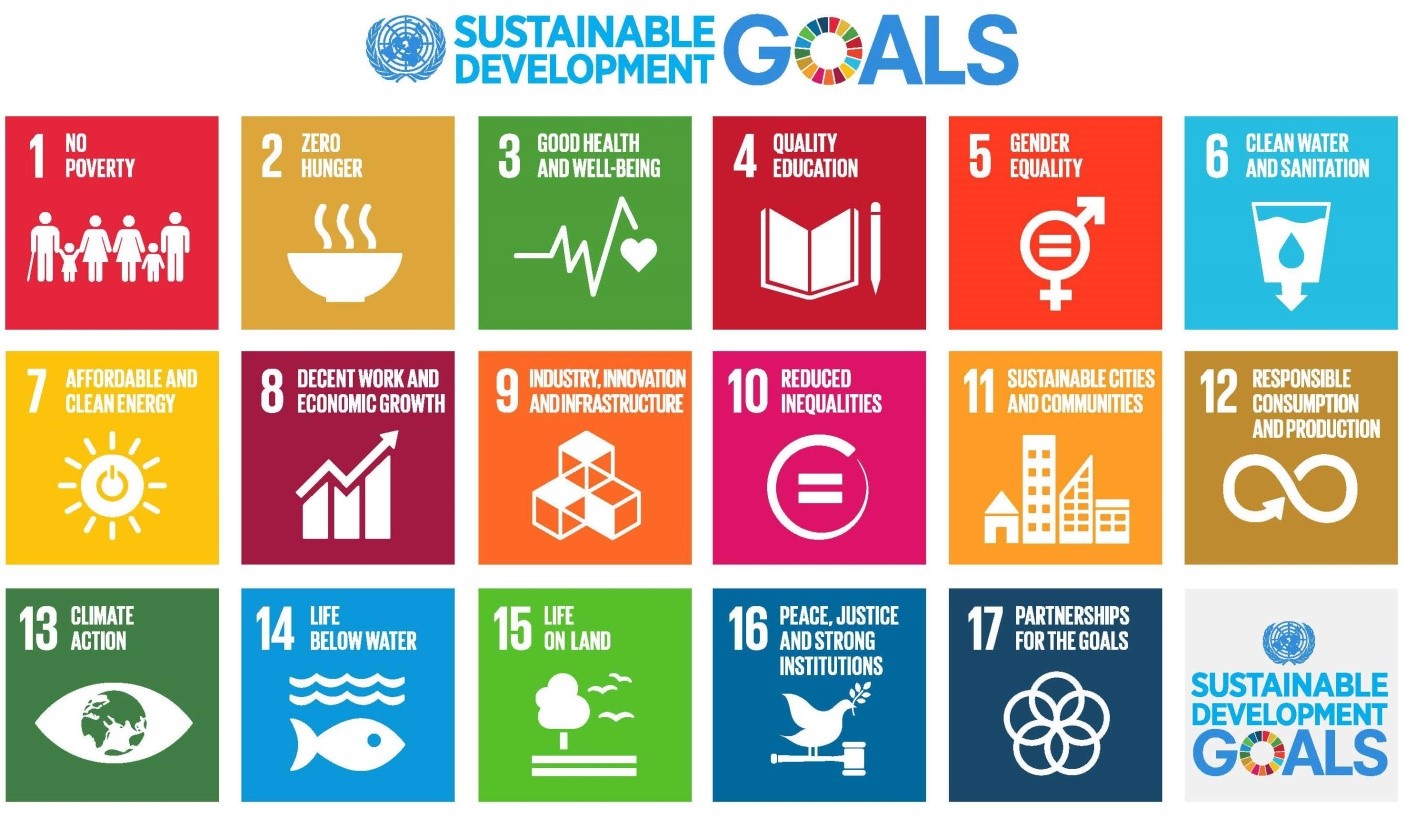
Sustainable Development’ is a set of 17 Global Goals around world issues. On
September 2015, countries adopted the 2030 Agenda for Sustainable Development
and its 17 Sustainable Development Goals. In 2016, the Paris Agreement on
climate change entered into force, addressing the need to limit the rise of
global temperatures. Governments, businesses, and civil society together with
the United Nations, are mobilizing efforts to achieve the Sustainable Development
Agenda by 2030. Universal, inclusive and indivisible, the agenda calls for
action by all countries to improve the lives of people everywhere. Each goal
has specific targets to be achieved. The 17 goals are as follows:
The UN and UNESCO
explicitly support these goals and resources that are useful materials for
global citizenship education. While global citizenship is geared towards older
students, there are many ways that elementary school teachers can apply these
goals and resources within their classroom. For example, the World’s Largest
Lesson, which is a website created in partnership with UNICEF and UNESCO, introduces the
Sustainable Development Goals to children and young people everywhere and
unites them in action through various projects. If educators are planning an
assembly or a lesson to introduce the Global Goals, there are a lot of
resources listed on the website and educators can choose them based on the
specific goal (http://worldslargestlesson.globalgoals.org/). These resources include
training courses, activities, books, films, games, lesson plans for each grade
level, decorations and posters, as well as support for students’ action and
change project. Materials are available in English and nine other languages. Students
can share their work online and help create a map of the world, for instance,
that reflects why Goal 5, Gender Equality, is so relevant worldwide today.
Context
Mrs. G, an
elementary school teacher leads a multi grade third and fourth grade class of
sixteen students. This unique style of teaching embodies project-based learning
with one to one Chromebooks for the students.
They are not seated at traditional desks; instead students are seated at
whiteboard tables with rolling chairs for flexible collaboration and learning.
Self-driven students who take initiative in their own learning, had become
integral parts of how this exciting project about the UN SDGs had grown and
developed.
The UN SDGs
lessons started out as requirement for the preservice teachers of Monmouth
University that were presented in the third and fourth grade classroom. As the
interest piqued in the classroom, Mrs. G decided to capitalize on students’
enthusiasm and design classroom activities to address the UN SDGs at their
developmental level. The goal was for the students to become more globally
aware about issues in the world, while honing their reading, writing, research,
and presentation skills. This unit project addressed multiple NCSS standards
and C3 Framework.
Table 1: Social
Studies Standards Addressed in This Unit Project
Social Studies Standards Addressed in This Unit Project
NJCSS
C3 Framework
1. CULTURE
2. PEOPLE, PLACES, AND ENVIRONEMNTS
3. INDIVIDUAL DEVELOPMENT AND IDENTITY
4. INDIVIDUALS, GROUPS, AND INSTITUTIONS
5. POWER, AUTHORITY, AND GOVERNANCE
6. PRODUCTION, DISTRIBUTION, AND CONSUMPTION
7. GLOBAL CONNECTION
8. CIVIC IDEALS AND PRACTICES
D1.2.3-5. Identify disciplinary concepts and ideas associated with a compelling question that are open to different interpretations. D2.Civ.2.3-5. Explain how a democracy relies on people’s responsible participation, and draw implications for how individuals should participate. D2.Civ.6.3-5. Describe ways in which people benefit from and are challenged by working together, including through government, workplaces, voluntary organizations, and families. D2.Civ.7.3-5. Apply civic virtues and democratic principles in school settings. D2.Civ.10.3-5. Identify the beliefs, experiences, perspectives, and values that underlie their own and others’ points of view about civic issues. D2.Soc.3.9-12. Identify how social context influences individuals. D2.Soc.6.9-12. Identify the major components of culture. D2.Soc.7.9-12. Cite examples of how culture influences the individuals in it. D2.Soc.13.9-12. Identify characteristics of groups, as well as the effects groups have on individuals and society, and the effects of individuals and societies on groups. D2.Soc.16.9-12. Interpret the effects of inequality on groups and individuals. D2.Soc.18.9-12. Propose and evaluate alternative responses to inequality. D4.3.3-5. Present a summary of arguments and explanations to others outside the classroom using print and oral technologies (e.g., posters, essays, letters, debates, speeches, and reports) and digital technologies (e.g., Internet, social media, and digital documentary) D4.6.3-5. Draw on disciplinary concepts to explain the challenges people have faced and opportunities they have created, in addressing local, regional, and global problems at various times and places. D4.7.3-5.Explain different strategies and approaches students and others could take in working alone and together to address local, regional, and global problems, and predict possible results of their actions. D4.8.3-5. Use a range of deliberative and democratic procedures to make decisions about and act on civic problems in their classrooms and schools.
This was accomplished through a multifaceted project that
included learning about the UN Sustainable Development Goals through reading,
research, presenting a goal, and sharing. Additionally, there was discussing
information through a class blog, and leading and participating in service
projects. This project continued in the successive school year due to the
success and interest in the project.
Part I: Becoming Informed
Reading
and Research
While introducing the UN Sustainable Development Goals, one
challenge was to ensure that elementary students could understand these complex
concepts. In the beginning, students were introduced to two brief videos that
gave an overview of the UN Goals in terminology that was easier for them to
understand. Next, each of the sixteen students was assigned one of the goals to
research in depth. They were given a rubric with specific items that needed to
be included in their presentation. The students were required to include: the
name of the goal, the definition of the goal, why the goal is important, and
three interesting facts.
The next step was to research the goals to truly understand
the meaning, decide why it would be an important goal for citizens to be aware
of and potentially take action. The UN website offers articles, video clips,
facts and a plethora of additional information about the goals, but can be
difficult for elementary students at various reading levels. The
paraprofessional and teacher engaged individual conferences for each student to
ensure that there was an understanding of what the student was reading, as well
as recommendations of particular parts of the site to focus on for their
research. The seventeenth goal, which was not assigned to a student, was
completed together as a group. Using the classroom SMART board, Mrs. G led the
class in modeling how to find appropriate research, navigate the United Nations
website, and make decisions about information that was pertinent to present on
the visual document.
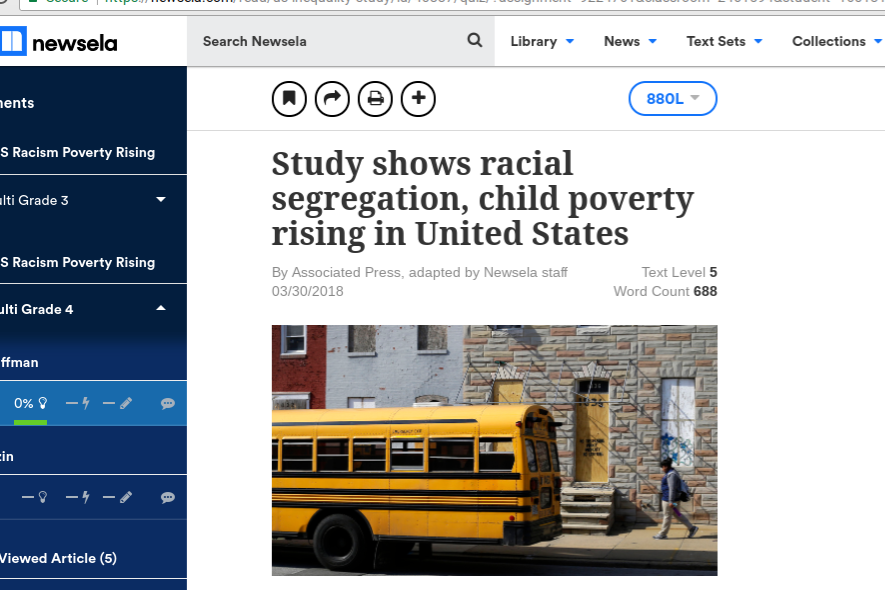
To further develop their reading and research skills, Mrs. G
used Newsela, a large database of current events articles that are written at
specific Lexile levels. Articles that related to the UN Goals were assigned to
the students. They decided which articles to read to assist in gaining more
knowledge and understanding of their specific goal. This platform worked well,
because it is tailored to the student’s independent reading level, which aids
in comprehension of the material. Some students worked with partners to help
mitigate difficulties in reading articles and participated in discussions
together, in order to better understand the topic of study. Individual
conferences with partners and the teacher or paraprofessional were essential in
supporting the students in tackling very advanced concepts. Goal 9- Industry, Innovation, and
Infrastructure was an especially challenging concept for a young elementary
student and required a good deal of discussion with the teacher to ensure
understanding of a complicated topic.
Reading informational text in social studies is the perfect
way to enhance learning. However, when the vocabulary and content was above
level for many of the students involved in the project, the teacher and
paraprofessional met individually to read with students to ensure comprehension
of the literature regarding the goals on the UN website. This one on one time
was helpful in making sure the elementary school students understood their
goal, and were equipped with the knowledge to become experts and explain it to
others.
Part II: Thinking It Through
Presenting,
Sharing and Discussing Information about the Goals
Next the students created a visual product to communicate
the required information about their goal using what they have learned through
reading and researching their assigned goal. The students created posters in
the first year when the project was implemented, and in the next year they used
Google Slides to present information about the goal. The expectations on the
rubric were the same for both the poster and the digital presentation.
Figure 2: Sample Article from Newsela Website- www.newsela.com
Table 2: UN SDGs Google Slides Rubric
Please include the following
on your slide:
Name of goal
Definition of goal
Why important
3 Interesting facts
UN SDGs Google Slides Rubric
3
2
1
Name & Definition
The correct name and an accurate definition is present
The name or definition may be correct
The name and definition are not correct
Why Important
A clear and accurate explanation of why the goal is important in the world
Attempts to write an explanation of why the goal is important in the word. May have some ideas that are correct
Does not include why it is important or it does not make sense
3 Interesting Facts
3 appropriate facts about the topic are present
3 facts that are not relevant or just 2 facts are present
Did not include three facts
Design of Slide
The pictures and design are related to and represent the goal. Is well organized
The pictures make an attempt to represent the goal. Shows some organization
The design does not relate to the goal, is disorganized
The students reflected upon their presentations and
completed the rubric self-assessing their work. The expectation was to either
draw or find photos that represented the theme of the goal. When making
posters, the required information was verbally presented in a recording that
eventually was combined with other students using the DoInk app. They used the
green screen to record and uploaded the recordings to the app to create a
video. The other option was to use a shared Google Slides presentation where each
student created one slide to represent their goal and provided the required
information.
Figure 3: Examples of Posters
Figure 4: Examples of Google Slide Presentation
Each student took a turn presenting their visual poster or
Google Slide to explain and teach the class about their specific goal. They
utilized speaking and listening skills to effectively communicate the
information that they researched and engaged in question and answers from their
classmates. Mrs. G could also further assess their learning by observing how
well they could answer questions about their assigned goal.
Deliberation
through Blog Session
Next, the students participated in blog sessions to further
discuss the goals, their thoughts and opinions.
The blog is an effective tool and another way of assessing the students’
critical thinking skills, knowledge of content, and how they communicate.
Google Classroom has a feature to “Create a Question” that allows students to
respond to each other. These questions were posed to the sessions:
List your goal and write an
interesting fact that you learned about your goal.
Explain something that surprised you
about the goals. Why did it surprise you?
What can you do to help achieve the
UN goals?
The explanation of something surprising from the students
was enlightening in providing a student perspective at their developmental
level. The following is a sample entry with responses:
Student “O”:
1. My goal is
Quality Education. One interesting fact about my goal is more than half of
children that have not enrolled in school live in sub Saharan-Africa.
2. Something
surprising I learned from this lesson is that, Goal 16 Peace, Justice, and
Institutions is that people all over the world do not have the freedom of
speech for their rights. I feel that is devastating to live under rules that
are hardly even thought about just made a law. They live under circumstances
that are very sad, and that is very careless of people.
3. To help these
goals we need to supply things that are needed. Americans can provide books all
over the world for Quality Education, We can provide vaccines to needed, we can
give food and vitamins needed to people in need.
Student “C”: Also, for every 100 boys enrolled in school
in Sub-Saharan Africa, there’s only 74 girls!
Student “A”: Where
is Saharan-Africa? What is it?
Student “J”: Who tells them that they can’t go to school
and why don’t they?
Student “O”: Saharan is basically all the countries of
Africa except the three at the top.
Student “O”: They can’t’ go to school because some people
(dictators, presidents, kings or queens) think that school is a waste of time.
They rather kids go and work the fields and harvest crops
Student “J”: Thanks for the answer
Student “S”: It is very sad that people don’t get to go
to school, but at the same time it might be fun to not go to school for a
couple of days but never going to school would be hard. But everybody needs
education.
Student “C”: It’s not fun. The reason they avoid school
is to make the kids do work. And they have to work on the fields, harvesting,
growing, and taking care of crops ALL DAY, until night!
Student “E”: How many
school houses are in Africa?
Student “O”: Would it really be fun not to be able to
read, write, and say the right words in a sentence? What would you do if you
couldn’t read or anything? Would you ask your mom to teach you? What if you
don’t have a mom? Put yourself in other people’s shoes.
Student “C”: It wouldn’t be fun at all not to be able to
read or write. If we couldn’t read or write, we couldn’t blog now!
Reading the responses of
the students allowed Mrs. G to capture a conversation that the students might
have in a group discussion in the classroom. It was determined that
Student “O” understood that students in Africa and other parts of the world do
not have the same opportunity for education that children in the United States
are afforded. The student expressed empathy for children who cannot
attend school, and Student “C” even responds stating that they would not be
able to blog if they did not have an education.
When the students blogged, there was silence in the classroom because
they were all actively engaged using the technology in a meaningful manner.
Mrs. G expected the students to answer the three questions and then
thoughtfully responded to at least five students in the class with comments and
insight. She accessed all of this and could comment on Google Classroom to
leave feedback for students. The use of
technology like Google Classroom allowed the class activity to become more
student-focused. By assigning students different UN goals, the students were
able to take ownership of their own topic and became the class expert who is
accountable for discussion on the goal. This enabled the teachers to see the
student’s ability to comprehend the UN goals as well as to apply that knowledge
gained to form a discussion with their fellow peers. This deliberation process
helped students think about higher-order thinking questions beyond immediately
noticeable facts. Students sometimes left with some simplistic and
self-oriented/US-centric views of the world. Therefore, it was important for
Mrs. G. to capture a troubled conversation and follow up as a group discussion
in the classroom.
Part III: Taking Action
Leading and Participating in Service
Project
Each year of
implementation of this project has led to the students taking action to address
the UN SDGs. In the first year, the class was saddened and upset to see the
prevalence of poverty and hunger in the world. Through a class discussion, they
decided to take action and have a food drive to support a local food pantry.
Mrs. G led a discussion on local organizations that helped the poor, and
ultimately the students decided to support St. Vincent de Paul Pantry at a
church that some students attend. They gathered information from the church
bulletin, organized a collection based on the pantry’s needs, created flyers
and made announcements daily to the school promoting the food drive and giving
the school community facts about hunger and poverty. The students used Google
Sheets to collect data and provided updates to the school community about the
number of items collected. The young learners took ownership of the whole
project and completed it to its final steps of packing the donations and
sending thank you notes to the St. Vincent de Paul members for their service to
the poor. The class felt proud of themselves for spearheading this project that
would align with the UN SDGs.
In the following school
year, the service project that the class decided to organize was related to
recycling and saving the environment. The students collected plastic film to be
sent to the Trex Company, which uses recycled materials to make composite
lumber. Many schools compete against each other to recycle the most plastic
film and Mrs. G’s multi grade class took a leadership role with this contest.
The students created a Google Slides presentation, developed flyers to be sent
home with students in the school, and visited all of the classes in the school
to explain what can be recycled, where the collection bins were placed and all
of the details about the project. They weighed and packaged the plastic, as
well as recording the data for the competition. The students were proud of
their contribution to the UN SDGs and helping the environment.
Service projects such as these were a
wonderful way for students to feel empowered as elementary students. It started with one student stating in class,
“People are hungry, we have to do something to help!” Through this experience,
they realized that their small contribution to helping the poor and hungry, or
recycling to help the environment were ways that they could join people all
over the world to obtain the UN SDGs. They were able to recognize their power
as citizens of a global community. It was important to reflect and determine if
there was a lasting impression made by studying the UN Goals.
Results: Impact of the Project on the Students
Mrs. G polled her
students with Google Forms at the end of the school year to assess the impact
that this project had on the students. There were seven questions ranging from
how important are the goals to written responses about how they can be global
citizens. One student wrote, “The food drive helps the people that are starving
and have no money so they get food that is donated from other people. Then they
can have food to fill their stomachs.” Another
student commented, “Doing Trex made us global citizens because we helped by
recycling. So the world won’t be filled with plastic. Also because we can reuse
it.” Some even commented about the
Marker Recycling Program that was underway in the school, or about the garden
at their school. They were applying the knowledge that they had gained from the
project and analyzing how activities conducted by other organizations relate to
the UN SDGs.
By exposing the
elementary students to the UN SDGs, they were given an awareness of the world
around them, beyond their community, state, and country. While engaged in this
project, most of the students were shocked to hear some of the statistics.
Student “S” wrote in her blog post that some people in the world live on $1.25
a day and it elicited quite a discussion. One response from Student “G” was
that “People in North Korea and most of Africa live a daily life of poverty.”
The class discussion was facilitated by the teacher to assist in explaining
different cultures, religions, governments and such in terms that were on the
developmental level of the children, including censoring material that would
not be appropriate for discussion at their age. Students were more interested
and empathetic towards the issues that were associated with their age group children,
such as not going to school, than other issues, like living with little money
and resources. Also, their understanding of those problems and causes were
sometimes limited. This confirms that the blog session is a good tool to
promote students’ learning, to assess their understanding, and to inform
teachers what they need for the next instruction.
These UN SDGs are global
objectives that are being addressed by corporations, governments and even
students. By teaching the children as
young as elementary school, they are being provided with information, facts and
statistics that reach beyond “their world”.
One young lady wrote a very impactful statement, “We can make our world
a better place to be by making these small donations and commitments, but in
reality, that can make a lifetime difference.” Empowering young children to
believe that they can have an impact will cultivate adults and forward thinking
global citizens.
Conclusion
The project can be easily adaptable for multiple grade
levels to provide elementary school students a creative and interesting way to
learn about global issues and give them a lens into other countries and ways of
life. Any classroom with Internet access and devices to utilize Google
Classroom or other online program such as Otus, Kiddom, or Edmoto can apply the
principles of this multifaceted project.
The three-part framework: (1)
becoming informed (about ideas, events, issues); (2) thinking it through
(presenting fair and balanced views); and (3) taking action (teaching
deliberation, decision-making, and civic action) effectively engaged elementary
students in learning global issues. The UN SDGs were a good source and tool in
carrying out this model.
While there are few studies and practices of teaching the United
Nations and global issues in elementary level, this classroom practice provides
a good example of how it can be successfully done and build young learners’
global awareness and active citizenship. ELA, science, math, and the arts can
be integrated in addition to Social Studies as well as the skills of reading,
interpreting, and presenting can be taught in this unit project learning.
Because it deals with subject matter that is of immediate interest and bridges
school learning with life outside school, it is highly motivating to critically
think and take action. It provides elementary school students with information
that they have not been exposed to and helps them build a knowledge base for
understanding current and future problems.
References
Andreotti, V. O. (2011). (Towards) decoloniality and
diversality in global citizenship education, Globalisation, Societies and Education, 9(3-4), 381-397.
Boyle-Base, M. & Zevin, J. (2009). Young citizens of the world: Teaching elementary social
studies through civic engagement. New York, NY: Routledge.
Boyle-Base, M., Bernens-Kinkead, D., Coake, W., Loudermilk, L., Lukasik, D. & Podany, W. (2011). Citizenship
as a verb teaching students to become informed, think it through, and take
action, Social Studies and The Young
Learner, 24(1), 5-9.
Davies, L. (2006). Global citizenship: Abstraction or framework for action?, Educational
Review, 58(1), 5-25.
Gaudelli, W. (2016). Global
citizenship education: Everyday transcendence, New York, NY:
Routledge.
Mcnulty, C. P., Davies, M. & Maddoux, M. (2010). Living
in the global village: Strategies for teaching mental flexibility, Social Studies and The Young Learner, 23(2), 21-24.
Merryfield, M. M. & Duty, L. (2008). Globalization. In J. Arthur, I.
Davies, &
C. Hahn (Eds.), The sage handbook of education
for citizenship and democracy (pp. 80-91). Los
Angeles, CA: Sage.
Myers, M. P. (2006). Rethinking the social studies
curriculum in the context of globalization: Education for global citizenship in
the U.S., Theory & Research in Social
Education, 34(3), 370-394.
Oxley, L. & Morris, P. (2013). Global citizenship: A
typology for distinguishing its multiple conceptions, British Journal of Educational Studies, 61(3), 301-325.
Parker, W.C. (2011). ‘International education’ in US public
schools, Globalisation, Societies and
Education, 9(3-4), 487-501.
Schattle,
H. (2008). The practices of global citizenship, Lanham, MD: Rowman &
Littlefield Publishers



 njcssjournal