Book Review of Homeless Outreach and Housing First: Lessons Learned, by Jay S. Levy, 2012. Ann Arbor, MI: Loving Healing Press. Paper, 36 pages.
Reviewed by Thomas Hansen, Ph.D.
Jay S. Levy has written an excellent book for aldermen, social workers, counselors, taxpayers, nurses, street helpers, and many others to read. It is excellent because of how it gets the reader into the topic and provides clear definitions and examples. *See the two articles below for more explanation of this important topic, housing first.
This book looks like a workbook, actually. It is a thinner paperback, and it is a brief and clear guide about not only providing outreach to get people ready to be housed but also moving ahead with the well-known strategy of using “housing first.” Housing first is the successful—but underused—process of getting persons indoors right away in the move to solve homelessness. Rather than making people jump through a dozen hoops, plus half-way houses and shelters, plus appropriate counseling, housing first gets the person stable housing so that all of the other pieces can fall into place.
The phenomenon of housing first, developed by Stefancic and Tsemberis, is highly successful, but more expensive than approaches which pick and choose from the homeless person’s needs. Books and articles by those two experts are easy to locate through a quick search.
It costs more because in housing first somebody has to pay the rent for the ex-homeless person to be housed—typically in an apartment. The documentation is very clear. The successes are great. It is a longer-term solution. Housing first allows the newly-indoors individual to save money by having a refrigerator to keep leftovers, a place to keep any needed medication, a place to be safe from attack and danger and murder.
Housing first provides—very importantly—a secure dwelling for sleep and safety. Therefore, Housing first is a lifesaver. This should be simple to understand.
The book’s clarity and brevity are both plusses. The book can be read easily in one sitting and therefore it is perfect for weekend retreats with board members and others who need to come to a quick understanding of how housing first works as the key element to successful placement of persons into the indoors.
Also helpful is the way Levy brings together three different pieces to provide context, definitions, and an example of an individual who “makes it” despite his challenges of addiction, homelessness, and depression. It is a good and quick reference—clear explanation—of the world of housing first.
Part One is an article about hope and ethics. Part Two is the first housing first process used by the author, Jay S; Levy. Part Three is an interview with someone who was helped by Levy’s intervention.
The author is a social worker who tells of the quality of the housing first strategy and his own growth—not just that of the individuals he helps. It is an inspiring book, and the author is an encouraging and prayerful professional. Levy has written not only about homeless first strategies but also about the pretreatment necessary for the system to work. This is a piece of the puzzle people need to know more about.
As an educator, I recommend this book highly and hope all persons helping the homeless will read it, study it, and reflect on it. I admire professionals who can write clearly and well, explaining, using illustrations, and making their point succinctly. Great information here, and easy to understand and utilize.
As an educator with a Jesuit background, I am forever reflecting on my own ideas and decisions, thinking about how I could have done things better… how I can communicate better, and how I can help the unhoused with their challenges more effectively. I grew from reading this book.
The book is good background reading and important to get onto your bookshelf to be loaned to others. The book would also be great for professional development classes, retreats, fundraising, and other uses. I encourage everyone to read it soon.
For further reading:
Levy, J. S. (1998, Fall). “Homeless Outreach: On the Road to Pretreatment Alternatives. Families in Society: The Journal of Contemporary Human Services, 81(4), pp. 360-368.
Levy, J. S., (2011, July). “The Case for Housing First: Moral, Fiscal, and Quality of Life Reasons for Ending Chronic Homelessness. Recovering the Self: A Journal of Hope and Healing, III(3), pp. 45-51.
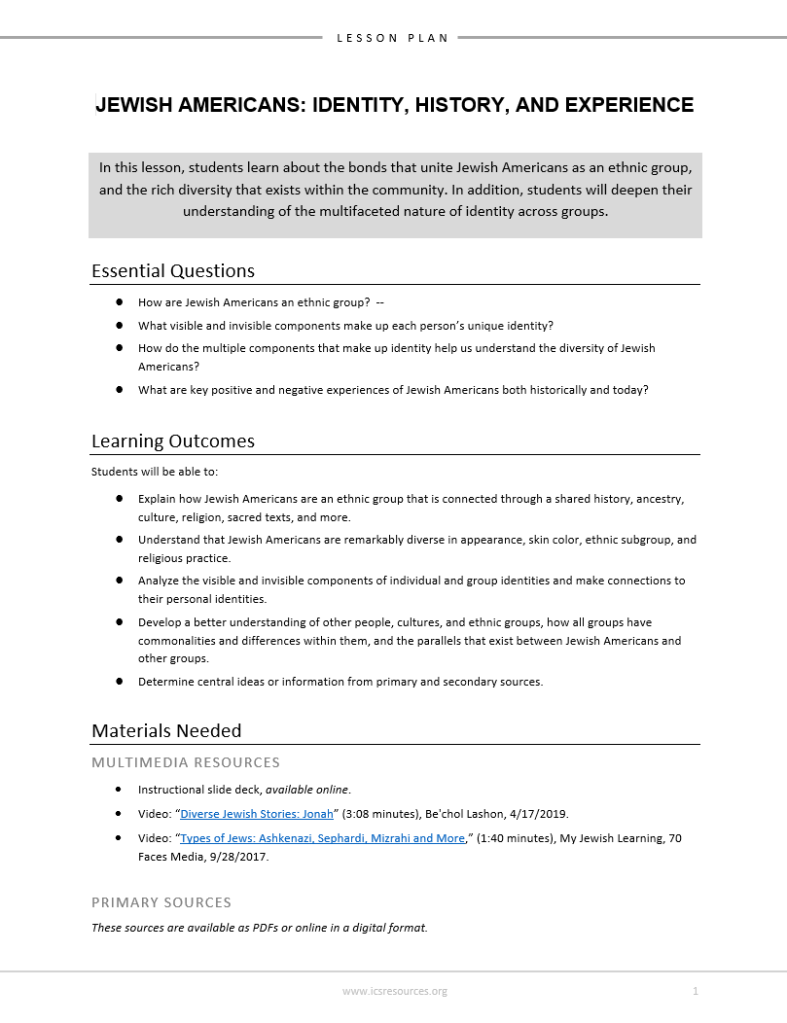
In this lesson, students learn about the bonds that unite Jewish Americans as an ethnic group, and the rich diversity that exists within the community. In addition, students will deepen their understanding of the multifaceted nature of identity across groups.
Essential Questions
● How are Jewish Americans an ethnic group?
● What visible and invisible components make up each person’s unique identity?
● How do the multiple components that make up identity help us understand the diversity of Jewish Americans?
● What are key positive and negative experiences of Jewish Americans both historically and today?
Learning Outcomes Students will be able to:
● Explain how Jewish Americans are an ethnic group that is connected through a shared history, ancestry, culture, religion, sacred texts, and more.
● Understand that Jewish Americans are remarkably diverse in appearance, skin color, ethnic subgroup, and religious practice.
● Analyze the visible and invisible components of individual and group identities and make connections to their personal identities.
● Develop a better understanding of other people, cultures, and ethnic groups, how all groups have commonalities and differences within them, and the parallels that exist between Jewish Americans and other groups.
● Determine central ideas or information from primary and secondary sources.
● IAmJewish:PersonalReflectionsInspiredbytheLastWordsofDanielPearl, Ruth Pearl and Judea Pearl eds., Woodstock, VT: Jewish Lights Publishing, 2004. (9 excerpts)
HANDOUTS
Identity Iceberg document, availableonline
Jewish American Diversity Fact Sheet, availableonline
Jewish Americans: Identity, History, and Experience Fact Sheet, availableonline
Lesson Plan
1. INTRODUCTION
Introduce the topic and emphasize that this lesson examines what unites the Jewish American community, as well as its diversity. While individual identity is personal, Jewish American group identity is based on ties of history, culture, ancestry, religion, language, celebrations, communal and familial traditions, common values, and a sense of a common ethnic peoplehood.
Further explain that this lesson explains some of the challenges Jewish Americans faced historically and continue to face today, including prejudice, discrimination, and antisemitism. It also explains experiences of acculturation and assimilation, and associated benefits and losses. Ultimately, students will be introduced to Jewish American history to deepen understanding of Jewish American experiences over time and Jewish American contributions to American society.
2. IDENTITY ICEBERG ACTIVITY
Provide students with the identity iceberg worksheet and explain that only a small part of an iceberg is visible above the waterline, while most of the iceberg’s mass lies below the waterline and is invisible. Tell students, that like an iceberg, some parts of identity are visible to others, while other parts are invisible.
Watch the video: “Diverse Jewish Stories: Jonah” (3:08 minutes) and ask students what they can determine about Jonah’s identity from what they viewed.
Explain that they are going to investigate various components of an individual’s identity. For this activity, students may choose to focus on their own identity, an imaginary student identity, or a celebrity’s identity. Emphasize that it is optional to use themselves as the subject in this activity, and that no one should disclose private information unless they would like to do so.
Either in small groups or as a whole group, students can brainstorm categories that will be used on the identity iceberg worksheet, or you can share suggested categories below, that include visible, sometimes visible, and invisible aspects of identity.
Suggestedcategories:
● Gender
● Race
● Ethnic appearance
● Visible religious signs: religious head coverings (kippah, yarmulke, hijab, turban); tzitzit (Jewish ritual fringes); cross, Star of David necklace, kirpan (Sikh religious knife), other)
● Age (child, middle schooler, teen, young adult, middle age, elderly, etc.)
● Language(s) (accent, second language, regional dialect, formality of speech)
● Religion/level of religious practice/spirituality/philosophy
● Family’s national origin/immigrant/refugee/forced migration
● Nationality/citizenship
● Violence, trauma, or intergenerational trauma
● Activity, passion, or a job that is an important part of identity
● Other cultural or group or family aspect of identity
With the list of identities categories handy, ask students to write in categories of identity on a blank identity iceberg worksheet that are:
● usually visible to others above the water line, in the top third
● sometimes visible, and sometimes invisible, close to the waterline
● usually invisible to others, in the bottom third of the iceberg
Ask for student volunteers to share their identity icebergs with the class. Identify commonalities and differences across the student examples.
MakingConnections
Think about groups whose identities are sometimes visible and sometimes invisible. What happens when members of these groups publicly express their identities?
The following are two options for an activity centered on learning about Jewish American diversity.
Option A: Arrange students into small groups. Provide each group with the Jewish American Diversity Fact Sheet (2 pages) and review the contents together. Instruct the groups to cut the document so that each fact is its own strip of paper. Next, have the students put the facts into groupings that they think go together, encouraging them to have no more than six groups. Once the facts have been grouped, have the students provide a title for each of the groupings. They then should review each grouping and revise until they are satisfied with their sorting. Finally, have each group share the titles they came up with, the facts they included with that title, and explanation as to how they arrived at the title and the facts that they have associated with it.
Option B: Have students read the Jewish American Diversity Fact Sheet (2 pages).
In small groups or as a class, have students discuss and respond to the following questions:
● In what ways are Jewish Americans a diverse ethnic group?
o Suggestedresponses: racial and physical appearance, ethnic subgroup, language, food and cultural traditions, religious observance, origins, etc.
● What bonds Jewish Americans across diversity?
JEWISHAMERICANS:IDENTITY,HISTORY,ANDEXPERIENC
o Suggestedresponses: shared Jewish history, ancestry, values, sacred texts, religious rituals, traditions, celebrations, culture, and a sense of common peoplehood.
● What is meant by the term “Jewish peoplehood”?
o Suggestedresponses: Jewish peoplehood refers to the idea that all Jews are connected to one another across time and geography and share a common destiny. Other identity categories fail to capture the complexity of Jewish group identity.
● What did you learn that surprised you?
o Suggestedresponses:Jews are incredibly diverse and are multiracial. There is not one way of being Jewish, but many, and there is no single physical appearance that characterizes what Jews look like. At the same time, Jews feel a strong sense of common peoplehood.
● Where have Jewish Americans come from?
o Suggestedresponses: Jewish Americans have ancestry from many different countries, and some Jewish Americans have lived in the U.S. for centuries. Many Jewish Americans are of Eastern and Central European Jewish descent. There is a significant Middle Eastern Jewish population in many parts of the U.S. (from Iran, Iraq, Israel, Lebanon, Syria, Turkey, and Yemen). Jewish Americans also have roots in North Africa (Egypt, Libya, Tunisia, Algeria, Morocco), East Africa (Ethiopia), Central Asia (Bukharan Jews from Uzbekistan and Tajikistan), Central and South America, and beyond. Regardless of recent origins, Jewish Americans, like Jews everywhere, are connected to each other and to their ancestral homeland of Israel; Judaism highlights this connection in daily prayers and Jewish holidays.
MakingConnections
In what ways are other American ethnic groups diverse? Consider the diversity among other American ethnic groups and pan-ethnic groups (groups with origins in a large diverse region). Consider diversity among African Americans, Asian Americans, Latino/a Americans, and Native Americans.
o Suggestedresponses: racial and physical appearance, language, food and cultural traditions, religious observance, origins, ethnic subgroups, etc.
The following additional videos and texts can be viewed by students to provide examples of Jewish American racial, ethnic, and religious diversity, and may help to answer the previous questions on Jewish American diversity.
● Video Series on Jewish Americans: Faces of American Jewry, is a 2021 series of 2-3 minute long videos on Jewish Americans produced by the American Jewish Committee.
● Reading: “Being Jewish in the United States,” (2 pages), Facing History and Ourselves. Judaism’s religious diversity in three short readings by three teens on their relationship to Judaism with discussion questions.
4. I AM JEWISH: PERSONAL REFLECTIONS INSPIRED BY THE LAST WORDS OF DANIEL PEARL ACTIVITY
This activity is based on excerpts from the book, IAmJewish:PersonalReflectionsInspiredbytheLastWordsofDanielPearl.
Tell students that Daniel Pearl was a Jewish American journalist, raised in California. Pearl was working as the South Asia Bureau Chief of TheWallStreetJournal, based in Mumbai, India. In early 2002, soon after 9/11, he was kidnapped and later beheaded by terrorists in Pakistan for being Jewish. After losing their son, Daniel Pearl’s parents asked a diverse group of Jews to reflect on what being Jewish means to them in memory of Pearl, reflecting on Pearl’s last words which were: “My father is Jewish, my mother is Jewish, I am Jewish.”
Divide students into small groups and assign each group to read two or three brief excerpts from IAmJewish:PersonalReflectionsInspiredbytheLastWordsofDanielPearl. Provide them with the PDFs or digital versions so that they can respond to the following prompts on the excerpts regarding individual and group identity:
1. What elements of identity does the author stress? (culture, family, ancestry, history, religion, social justice, community, etc.)
2. Highlight or underline one key sentence or phrase from each excerpt to share with the class. 3. Why do Jews not fit neatly into racial and religious categories?
Ask students to share one word that jumps out on what being Jewish means to the writers and compile them in a shared visual medium for the class.
AdditionalResourceforIAmJewishActivity
The following additional video can also be viewed by students and used to answer the activity questions.
Video: “I Love Being Jewish,” (7:24 minutes) Jane Parven, high school student Jane Parven discusses her Jewish American identity, antisemitism, and goal of eliminating all forms of hate. 3/14/2018, Massachusetts
5. JEWISH AMERICANS: IDENTITY, HISTORY, AND EXPERIENCE ACTIVITY
Have students read the Jewish Americans: Identity, History, and Experience Fact Sheet (4 pages).
You may first want to explain and define the key terms from the Fact Sheet before students read it, or you may check comprehension of the following key terms during the discussion: acculturation,assimilation,racialization,WhiteSupremacy,andantisemitism.
Next, in small groups or as a class, ask students to discuss and respond to the following questions:
● What does acculturation and assimilation mean? Why do people acculturate or assimilate?
oSuggestedresponsestosecondquestion: To fit in, make friends, succeed in school, get a job, not feel different, or because after living and going to school in the new culture and language, they feel part of the dominant culture.
● What does a member of an ethnic group gain from assimilation? What does a member of an ethnic group lose from assimilation?
o Suggestedresponses: Gains: a sense of belonging, success in school and jobs, a new positive hyphenated culture and identity. Losses: lack of connection to their parents’ culture, gap between generations, loss of language, traditions, and religious practices.
● What are some of the ways Jews have been racially categorized? What does racialization mean? o Suggestedresponses: While Jews are not a racial group, they have been categorized as non-white, as the “Hebrew race,” seen by Nazis as an inferior race, seen by White Supremacists as non-white, as threatening to replace white people, and as a threat to racial purity. Racialization is when a dominant group decides another group is a separate lower race.
● What were some of the push factors for Jewish immigration in the 19th and 20th centuries? Why were Jewish refugees from Nazi Germany refused entry to the U.S.? How has immigration shaped the Jewish American experience?
o Suggestedresponses: Jews came to the U.S. as immigrants and refugees fleeing persecution, pogroms, poverty, war, and revolution in the 19th and 20th centuries. Anti-Jewish prejudice in the U.S. in the 1930s and U.S. immigration law prevented most Jewish refugees from being admitted during the Holocaust, dooming Jews to their deaths in Nazi-occupied Europe. Jewish immigration experiences and family histories of escaping persecution have made many Jewish Americans empathetic to the plight of other immigrant and refugee groups in the U.S. today.
● In what way(s) do you think the Holocaust shifted perceptions of Jews in American society?
o Suggestedresponses: Before the Holocaust, Jews experienced a lot of open discrimination. After learning how prejudice led to the genocide of the Holocaust, more overt forms of anti-Jewish discrimination decreased but hatred of Jews did not go away.
● Based on what we have learned about changes in how Jews have been racially categorized, what conclusions can we draw about race as a social construct?
o Suggestedresponses: If light-skinned Jews can be categorized as non-white or white, then racial categories and boundaries are socially constructed and can and do change.
● What are some of the noteworthy contributions Jewish Americans have made to American society?
o Suggestedresponses: Jews have been leaders in the labor, civil rights, feminist, and other rights movements; contributors and founders in the film industry, in American music, literature, and comedy, and in science, and medicine.
● What is antisemitism? How does anti-Jewish hate show up in different ways?
JEWISHAMERICANS:IDENTITY,HISTORY,ANDEXPERIENC
o Suggestedresponses: Antisemitism is anti-Jewish prejudice or hate. It often shows up through Holocaust or Nazi imagery that is used to intimidate or threaten Jewish students. It shows up with Jewish students being excluded from diversity discussions or allyship, or in being excluded for not disassociating themselves from Israel. It also shows up in accusations that the Jewish “race” threatens white purity. Historically, Jews faced discrimination in jobs, education, housing, and social acceptance.
MakingConnections
What parallels are there between Jewish Americans and other American ethnic groups?
o Suggested responses: Experiences of immigration and being refugees, prejudice and discrimination, assimilation and acculturation, connection to origins and traditions, contributions, and communal pride.
How have other groups responded to prejudice and discrimination?
o Suggested responses: Activism, legislation, education, ethnic pride, celebratory events, seeking representation, standing up for others experiencing discrimination.
6. CONCLUSION
In an Exit Slip, or as a group discussion, have students reflect on what they have learned in this lesson. The following questions can help guide the discussion:
1. Name some ways Jewish Americans are connected as an ethnic group, how are they internally diverse, and what you have learned about Jewish American history and experiences?
2. When you think about your individual and group identities, what are some things that connect the group, and some ways your identity reflects diversity within that group?
3. How are the experiences of Jewish Americans distinct from other groups’ experiences?
7. EXTENSION ACTIVITIES
1. Through the resources from this lesson and external research, students have been provided with detailed information on the positive impact Jewish Americans have made on society. To spotlight these contributions, have students create social media style posts that highlight three reasons Jewish Americans should be recognized and celebrated alongside other American ethnic groups, for example with Jewish American Heritage Month, celebrated in May (no actual social media accounts are needed, as this can be done using templates here , or use your own).
2. Have students conduct research about Jewish American contributions to American society and evaluate how these contributions have impacted their lives or the lives of others. Students could focus on contributions in particular fields, such as science, medicine, literature, art, music, politics, law, business, sports, entertainment, etc. Students can use people from the Jewish Americans: Identity, History, and Experience Fact Sheet or follow their own interests. Their research and discoveries can be presented in a variety of ways, such as a multimedia presentation, a digital or traditional poster, a speech, a written biography, etc. Students can use people from the Jewish Americans: Identity, History, and Experience Face Sheet, the Weitzman National Museum ofAmerican Jewish History Hall of Fame virtual exhibit, or follow their own interests.
3. Ask students to choose one aspect of their own identity and write a one-paragraph reflection on why that aspect of their identity is important to them. Please complete: “I am (chooseanaspectofidentity) because …, and it is important to me because ….”
Jewish Americans: Identity, History, and Experience Fact Sheet
Jewish American Diversity Fact Sheet
Jewish Americans have come to the United States from all over the world and have brought a rich variety of different Jewish cultural traditions with them.
The Jewish people originated about 3,000 years ago in Southwest Asia, in the land of Israel.
Jewish Americans, like Jews everywhere, feel a strong connection to each other and to the ancestral homeland of Israel. Jewish tradition and rituals reinforce these connections in many ways, from the content and direction of daily prayers to Jewish holidays. For example, Jews around the world conclude the Passover Seder with “Next year in Jerusalem.”
Jews are a distinct ethnic group connected by rich traditions, thousands of years of history, ancestry, language, and religion. Jewish American ethnic identity may be expressed through food, language, holidays, celebrations, a feeling of connectedness to other Jews (Jewish peoplehood), remembrances of historical and ancestral experiences, connections to Israel, a commitment to social justice, and cultural elements such as music, literature, art, and philosophy that are also part of Jewish life.
Jews do not fit exclusively into predefined categories, and frequently self-identify as both an ethnic group and a people.
o Jewish Americans are an ethnic group among diverse American ethnic groups.
o The concept of Jewish peoplehood means that Jews around the world are connected to each other across time and geography and share a common destiny.
There are several major Jewish ethnic subgroups:
o Mizrahi Jews are racially diverse Arabic- and Farsi-speaking Jews indigenous to the Middle East and North Africa for over 2,500 years.
o Sephardic Jews are originally Judeo-Spanish or Ladino-speaking Jews expelled from Spain and Portugal to North Africa, the Ottoman Empire, and Central and South America, beginning with Spain’s expulsion in 1492.
o Ethiopian Jews are Amharic-speaking Jews originally from Ethiopia.
o Ashkenazi Jews are or were Yiddish-speaking Eastern and Central European Jews.
Major languages and literature of Jewish expression include English, Hebrew, Arabic, Yiddish, Ladino, and Farsi. Hebrew, the language of Jewish scripture, is often a lingua franca that has united different Jewish ethnic subgroups.
The physical appearance of Jewish Americans is very diverse, and skin color can range from light skinned to dark skinned, and includes Middle Eastern Jews, African American Jews, Asian American Jews, Latino/a/x Jews, and Native American Jews. Jewish families include multiracial households and there are diverse appearances both within families and within communities.
The majority of Jewish Americans emigrated from Eastern Europe, and while their racial appearance often reflects this, there is a range of physical appearances, reflecting the movement of Jews over time and place.
For many Jews, Jewish identity is primary, but they may be classified by others based on their skin color. Therefore, Jews often experience a divergence between internal identity and external classification.
Other Jewish Americans or their families emigrated from the Middle East (Iran, Iraq, Israel, Lebanon, Syria, Turkey, Yemen), North Africa (Egypt, Libya, Tunisia, Algeria, Morocco), East Africa (Ethiopia), Central Asia (Bukharan Jews from Uzbekistan and Tajikistan), Central and South America, and beyond, and are of Mizrachi and Sephardic heritage.
American Judaism has a range of religious denominations, including Reform, Reconstructionist, Conservative, and Orthodox, with a range of observances and practices. At the same time, Jews
are united by shared sacred texts, like the Torah, by celebrations, traditions, and a feeling of connection to other Jews around the world.
Jewish Americans have a wide range of opinions and beliefs about what it means to be Jewish, how Jewish identity is defined, and the extent to which they identify with the religion of Judaism.
Across Jewish denominations, ancestry marks a person as Jewish regardless of the individual’s personal level of religious observance. Traditionally, a person is considered Jewish if born to a Jewish mother. Reform Jews among others consider a person with a Jewish father to also be Jewish.
Jews consider a person who converts to Judaism, without Jewish ancestry, to be as Jewish as any other Jew.
Jews are part of the Jewish American community by birth, adoption, marriage, and by throwing their lot in with the Jewish people through conversion or being part of a Jewish family
Douglas Rushkoff is a writer, journalist, and professor of media studies. “Jews are not a tribe but an amalgamation of tribes around a single premise that human beings have a role. Judaism dared to make human beings responsible for this realm. Instead of depending on the gods for food and protection, we decided to enact God, ourselves, and to depend on one another. So out of the death cults of Mitzrayim [Egypt] came a repudiation of idolatry and a way of living that celebrated life itself. To say “l’chaim [to life]” was new, revolutionary, even naughty. It overturned sacred truths in favor of sacred living.… It’s important to me that those, who throughout our history, have attacked the Jews on the basis of blood not be allowed to redefine our indescribable process or our internally evolving civilization. We are attacked for our refusal to accept the boundaries, yet sometimes we incorporate these very attacks into our thinking and beliefs. It was Pharaoh who first used the term Am Yisrael [People of Israel] in Torah, fearing a people who might replicate like bugs and not support him in a war. It was the Spanish of the Inquisition who invented the notion of Jewish blood, looking for a new reason to murder those who had converted to Catholicism. It was Hitler, via Jung, who spread the idea of a Jewish “genetic memory” capable of instilling an uncooperative nature in even those with partial Jewish ancestry. And it was Danny Pearl’s killers who defined his Judaism as a sin of birth. I refuse these definitions. Yes, our parents pass our Judaism on to us, but not through their race, blood, or genes — it is through their teaching, their love, and their spirit. Judaism is not bestowed; it is enacted. Judaism is not a boundary; it is the force that breaks down boundaries. And Judaism is the refusal to let anyone tell us otherwise.” (pages 90–91)
1. Highlight or bold/underline a sentence or phrase from the excerpt that leaves a lasting impression on you. Explain your selection.
2. What elements of their identity does the author stress (culture, family, ancestry, history, religion, social justice, community, etc.)?
3. What do you think being Jewish means to the person in the excerpt?
4. Why do Jewish Americans not fit neatly into racial and religious categories?
Justice Ruth Bader Ginsburg was a Justice of the U. S. Supreme Court from 1993 to 2020 and advocate for women’s rights. “I say who I am in certain visible signs. The command from Deuteronomy appears in artworks, in Hebrew letters, on three walls and a table in my chambers. “Zedek, zedek, tirdof,” Justice, Justice shalt thou pursue,” these artworks proclaim; they are ever-present reminders to me what judges must do “that they may thrive.” There is also a large silver mezuzah [Torah verses in a small case] on my door post… I am a judge, born, raised, and proud of being a Jew. The demand for justice runs through the entirety of Jewish history and Jewish tradition. I hope, in all the years I have the good fortune to serve on the bench of the Supreme Court of the United States, I will have the strength and courage to remain steadfast in the service of that demand.” (pages 201–202)
1. Highlight or bold/underline a sentence or phrase from the excerpt that leaves a lasting impression on you. Explain your selection.
2. What elements of their identity does the author stress (culture, family, ancestry, history, religion, social justice, community, etc.)?
3. What do you think being Jewish means to the person in the excerpt?
4. Why do Jewish Americans not fit neatly into racial and religious categories?
Naim Dangoor was a leader of Iraqi Jewry outside Iraq. The location of Babylonia is primarily modern-day Iraq. “When I was a young boy a teacher at school asked me, “Why are you a Jew?” I, with all the practicality of youth, replied, because I was born one!” There is, however, something in this sentiment that rings truer than one might think Judaism is a birthright, a glorious gift from one’s forefathers of faith, culture, and heritage. For me, it is this: my strong Babylonian heritage, the heritage that Daniel Pearl also shared, his mother having been born in Baghdad, that makes me so proud to be a Jew. Babylonia was one of the main birthplaces of the Jewish people, from where Abraham emerged as a founder, and later from where the Babylonian Talmud, forming the framework for Rabbinic Judaism, was created. Its glorious Jewish intellectual eminence fanned out across the known world for more than a thousand years. Currently the descendants of this tradition are spread throughout the globe.” (pages 97–98)
1. Highlight or bold/underline a sentence or phrase from the excerpt that leaves a lasting impression on you. Explain your selection.
2. What elements of their identity does the author stress (culture, family, ancestry, history, religion, social justice, community, etc.)?
3. What do you think being Jewish means to the person in the excerpt?
4. Why do Jewish Americans not fit neatly into racial and religious categories?
Norman Lear is a writer, producer, and social activist. “I identify with everything in life as a Jew. The Jewish contribution over the centuries to literature, art, science, theater, music, philosophy, the humanities, public policy, and the field of philanthropy awes me and fills me with pride and inspiration. As to Judaism, the religion: I love the congregation and find myself less interested in the ritual. If that describes me to others as a “cultural Jew,” I have failed. My description, as I feel it, would be: total Jew.” (page 34)
1. Highlight or bold/underline a sentence or phrase from the excerpt that leaves a lasting impression on you. Explain your selection.
2. What elements of their identity does the author stress (culture, family, ancestry, history, religion, social justice, community, etc.)?
3. What do you think being Jewish means to the person in the excerpt?
4. Why do Jewish Americans not fit neatly into racial and religious categories?
Rabbi Angela Warnick Buchdahl is an Asian American Rabbi ordained by Hebrew Union College. She spent her college summers working as head song leader at Camp Swig, a Reform Jewish camp in Saratoga, California. “My father is a Jew and my mother is a Korean Buddhist. As the child of a mother who carried her own distinct ethnic and cultural traditions — and wore them on her face — I internalized the belief that I can never be “fully Jewish” because I could never be “purely” Jewish. My daily reminders included strangers’ comments “Funny you don’t look Jewish”), other Jews’ challenges to my halakhic [Jewish law] status, and every look in the mirror. Jewish identity is not solely a religious identification, but also a cultural and ethnic marker. While we have been a “mixed multitude” since Biblical times, over the centuries the idea of a Jewish race became popularized. After all, Jews have their own language, foods, even genetic diseases. But what does the Jewish “race” mean to you if you are Black and Jewish? Or Arab and Jewish? Or even German and Jewish, for that matter? How should Jewish identity be understood, given that Am Yisrael [people of Israel] reflects the faces of so many nations? Years ago… I called my mother to declare that I no longer wanted to be Jewish. I did not look Jewish. I did not carry a Jewish name, and I no longer wanted the heavy burden of having to explain and prove myself every time I entered a new Jewish community. My Buddhist mother’s response was profoundly simple: “Is that possible?” At that moment I realized I could no sooner stop being a Jew than I can stop being Korean, or female, or me. Judaism might not be my “race” but it is an internal identification as indestructible as my DNA. Jewish identity remains a complicated and controversial issue in the Jewish community. Ultimately, Judaism cannot be about race, but must be a way of walking in this world that transcends racial lines. Only then will the “mixed multitude” truly be Am Yisrael.” (pages 19-20)
1. Highlight or bold/underline a sentence or phrase from the excerpt that leaves a lasting impression on you. Explain your selection.
2. What elements of their identity does the author stress (culture, family, ancestry, history, religion, social justice, community, etc.)?
3. What do you think being Jewish means to the person in the excerpt?
4. Why do Jewish Americans not fit neatly into racial and religious categories?
Rabbi Eric H. Yoffie is President Emeritus of the Union for Reform Judaism who focuses on interfaith relations and social justice. “I am Jewish. This means, above all else, that I was present at Sinai and that when the Torah was given on that mountain, my DNA was to be found in the crowd… A people is usually defined by race, origin, language, territory or statehood, and none of these categories is an obvious common denominator for the worldwide Jewish people. Peoplehood is a puzzling concept for modern Jews, particularly the younger ones, who often cannot understand what connects them to other Jews in Moscow, Buenos Aires, and Tel Aviv. But I am convinced, to the depth of my being, that Jewish destiny is a collective destiny… It is the covenant at Sinai that links all Jews, including non-observant ones, in a bond of shared responsibility. And if we hope to strengthen the unity and interdependence of the Jewish people, we will have to revive the religious ideas on which these notions are based.” (pages 114–115)
1. Highlight or bold/underline a sentence or phrase from the excerpt that leaves a lasting impression on you. Explain your selection.
2. What elements of their identity does the author stress (culture, family, ancestry, history, religion, social justice, community, etc.)?
3. What do you think being Jewish means to the person in the excerpt?
4. Why do Jewish Americans not fit neatly into racial and religious categories?
Sarah Rosenbuam is a 15 years old from Southern California. “When I say that I am Jewish, I am identifying myself as part of a tradition, connected to our foremothers and fathers, and carrying on to the future a culture, a religion, a way of life. I feel pride and am overwhelmed with joy when I declare that I am part of this incredible people, our people Israel.” (page 54)
1. Highlight or bold/underline a sentence or phrase from the excerpt that leaves a lasting impression on you. Explain your selection.
2. What elements of their identity does the author stress (culture, family, ancestry, history, religion, social justice, community, etc.)?
3. What do you think being Jewish means to the person in the excerpt?
4. Why do Jewish Americans not fit neatly into racial and religious categories?
Senator Dianne Feinstein is the senior US Senator from California since 1992. “I was born during the Holocaust. If I had lived in Russia or Poland — the birthplaces of my grandparents — I probably would not be alive today, and I certainly wouldn’t have had the opportunities afforded to me here. When I think of the six million people who were murdered, and the horrors that can take hold of a society, it reinforces my commitment to social justice and progress, principles that have always been central to Jewish history and tradition. For those of us who hold elected office, governing in this complex country can often be difficult. My experience is that bigotry and prejudice in diverse societies ultimately leads to some form of violence, and we must be constantly vigilant against this. Our Jewish culture is one that values tolerance with an enduring spirit of democracy. If I’ve learned anything from the past and from my heritage, it’s that it takes all of us who cherish beauty and humankind to be mindful and respectful of one another. Every day we’re called upon to put aside our animosities, to search together for common ground, and to settle differences before they fester and become problems. Despite terrible events, so deeply etched in their souls, Jews continue to be taught to do their part in repairing the world. That is why I’ve dedicated my life to the pursuit of justice; sought equality for the underdog; and fought for the rights of every person regardless of their race, creed, color, sex, or sexual orientation, to live a safe, good life. For me that’s what it means to be a Jew, and every day I rededicate myself to that ideal.” (pages 228–229)
1. Highlight or bold/underline a sentence or phrase from the excerpt that leaves a lasting impression on you. Explain your selection.
2. What elements of their identity does the author stress (culture, family, ancestry, history, religion, social justice, community, etc.)?
3. What do you think being Jewish means to the person in the excerpt?
4. Why do Jewish Americans not fit neatly into racial and religious categories?
Senator Joe Lieberman is a former U.S. Senator from Connecticut from 1989 to 2013, and a Vice-Presidential candidate in 2000. “What does being Jewish mean to me? To me, being Jewish means having help in answering life’s most fundamental questions. How did I come to this place? And, now that I am here, how should I live? My faith, which has anchored my life, begins with a joyful gratitude that there is a God who created the universe and then, because He continued to care for what He created, gave us laws and values to order and improve our lives. God also gave us a purpose and a destiny —to do justice and to protect, indeed to perfect, the human community and natural environment. Being Jewish in America also means feeling a special love for this country, which has provided such unprecedented freedom and opportunity to the millions who have come and lived here. My parents raised me to believe that I did not have to mute my religious faith or ethnic identity to be a good American, that, on the contrary, America invites all its people to be what they are and believe what they wish…. Jews around the world and all who love freedom— the freedom to think, to speak, to write, to question, to pray—will hold Daniel [Pearl] near to our hearts, and from his courage we will draw internal light and strength.” (pages 107-108)
1. Highlight or bold/underline a sentence or phrase from the excerpt that leaves a lasting impression on you. Explain your selection. 2. What elements of their identity does the author stress (culture, family, ancestry, history, religion, social justice, community, etc.)? 3. What do you think being Jewish means to the person in the excerpt? 4. Why do Jewish Americans not fit neatly into racial and religious categories?
Jewish Americans: Identity, History, and Experience Fact Sheet
● The first Jews to arrive in 1654 to what became the United States were Sephardic Portuguese Jews from Brazil, who fled the Portuguese expulsion and Inquisition. The American Jewish community was predominantly Sephardic through the first decades of the U.S.
● From 1840 to 1880, Jewish immigrants were primarily from Central Europe and Germany, fleeing poverty, persecution, anti-Jewish violence, and revolution. During this time, the Reform Movement transformed Jewish practice in America, created the first prayer book for Americans, and established a rabbinical school. By 1880, the majority of U.S. synagogues were Reform congregations.
● Between 1880 and 1924, 2 million Jewish immigrants came to the U.S. from Eastern Europe, pushed by persecution, pogroms, war, and poverty. White supremacist prejudice against Jews and Catholics from Eastern and Southern Europe motivated the passing of the Johnson-Reed Immigration Act of 1924, greatly restricting Jewish immigration through 1965.
● In official U.S. immigration and naturalization law from 1898 to 1941, Jews were categorized as part of the “Hebrew race.” This racialization deemed Jews non-white.
○ Racialization is when a group becomes categorized as a stigmatized group, and that group is seen as a separate lower race by another dominant group.
● Yiddish became a major language of Jewish newspapers, theatre, and culture, while at the same time public schools became the vehicle for acculturation, Americanization, and learning English, with many Jews entering teaching.
● American Judaism was changed by the large wave of Ashkenazi immigrants 1880-1924 from Eastern Europe, and in the next three decades, by the growth of the Orthodox (1920s-50s) and Conservative (1950s) movements. These movements established synagogues, rabbinical schools, seminaries, and universities. For many decades, American Judaism was defined by the Reform, Conservative, and Orthodox denominations.
● In addition to targeting African Americans, the white supremacist racism of the Ku Klux Klan (KKK) deemed Jews as non-white, a separate and lesser race that was a threat to American “racial purity,” and targeted Jews with exclusionary immigration legislation and intimidation in large marches on Washington, D.C.
○ White supremacy is the belief that white people are a superior race and should dominate society. White supremacists target other racial and ethnic groups, such as African Americans and Jews, who they view as inferior.
● In the first half of the 20th century, Jews were usually not considered white in American society and, as a result, experienced discrimination in employment, housing, education, and social acceptance.
● From the 1880s through the 1960s, antisemitic employment discrimination with overt and covert “no Jews allowed” notices often led Jews to enter new industries with less discrimination. Housing covenants prohibited Jews or “Hebrews” from purchasing houses in many areas. Elite universities also had quotas, limiting the number of Jews who could attend them until the early 1960s.
● Jewish American allies to the African American community played a significant role in the founding and funding of the NAACP, Rosenwald Schools, and the Southern Poverty Law Center. Julius Rosenwald partnered with Booker T. Washington to build over 5,000 schools for African American students between 1917 and 1932, and by 1928, one-third of the South’s rural Black school children and teachers were served by Rosenwald Schools. In 1931, lawyer Samuel Leibowitz defended the Scottsboro boys.
● Motivated by Jewish tradition’s concern for the worker, and oppressive working conditions for Jewish immigrants, the U.S. labor movement included many Jewish labor organizers, such as Samuel Gompers (founder of American Federation of Labor (AFL) and president 1886-1924); Rose Schneiderman (active 1904-1940s in the Women’s Trade Union League); and Pauline M. Newman (active 1907-1983), Clara Lemlich (active 1909-1951), and David Dubinsky (active 1932-1966 as president) in the International Ladies Garment Worker Union (ILGWU).
● Jews were pioneers in the new film industry in California in the early decades of the 20th century. This included studio heads Harry Cohn (Columbia Pictures 1919-1958), Samuel Goldwyn (active 1913-1959), Louis B. Mayer (active MGM 1915-1951), Carl Laemmle (Universal Pictures active 1909-1939), the Warner Brothers (active 1918-1973), and Adolph Zukor (Paramount Pictures active 1903-1959). Though there was less overt discrimination in California, anti-Jewish prejudice in the U.S. led many studio heads and producers to shy away from Jewish themes in movies for many decades.
● Jewish songwriters enthusiastically embraced American music and contributed to the Great American songbook (1911-1960), Tin Pan Alley (1885-1940), Broadway musicals (1949-2018), and folk and protest music (1930s-1970s). Among these were: George and Ira Gershwin, Irving Berlin, Rodgers and Hammerstein, Aaron Copland, Stephen Sondheim, Leonard Bernstein, Bob Dylan, Arlo Guthrie, Phil Ochs, Art Garfunkel, Paul Simon, Peter Yarrow, Carole King, Country Joe McDonald, and Ramblin’ Jack Elliott.
● In the 1920s and 1930s, anti-Jewish conspiracy theories (later used in Nazi propaganda) were openly distributed in the U.S., for example by Henry Ford’s newspaper (TheDearbornIndependent) and Father Edward Coughlin’s radio show.
● Drawing upon white supremacist ideas about Jews and pseudoscientific eugenics “theories,” Nazi racial theories deemed Jews a separate non-white race (racialization), and the lowest race in their racial hierarchy, leading to the genocide of the Holocaust.
● In the 1930s, growing anti-Jewish prejudice in the U.S. led to the U.S. government’s refusal of entry to Jewish refugees from Nazi Germany until 1944, after millions of Jews were already murdered.
○ Refugees are people with a history of persecution or a well-founded fear of future persecution on account of their race, religion, nationality, membership in a particular social group, or political opinion.
○ Immigrants are people who have left their country of origin and arrived in another country.
● Some Jews changed their Jewish sounding names to avoid discrimination, be more accepted by American society, not feel different or other, or because they had internalized other people’s negative attitudes about Jews. Starting with immigrants, and common with actors, this practice of name-changing continues to the present day. At the same time, today, many Jewish Americans proudly select Jewish ethnic names, as an expression of pride in their heritage.
● In the decades after the Holocaust, American attitudes toward Jews gradually changed, and overt anti-Jewish discrimination decreased. Descendants of light-skinned Jewish immigrants were able to acculturate or assimilate which brought gains and losses.
○ Acculturation refers to the adoption of many of the practices and values of the majority or dominant culture while still retaining a connection to one’s culture of origin, or a balance between cultures.
○ Assimilation is a process by which a minority group or culture comes to resemble that of the majority culture.
● Assimilation allowed the children of light-skinned Jewish immigrants to change their position on the racial hierarchy from their immigrant parents, though they remained vulnerable to antisemitism. Assimilation also brought loss of community, identity, cultural traditions, and practic
● During the civil rights movement, a large percentage of allies were Jewish activists, disproportionate to their small percentage in the U.S. population. Nearly half the country’s civil rights lawyers were Jewish, and more than half of the non-African American civil rights workers were Jewish, including two of the three men murdered during the 1964 Freedom Summer.
● Jewish women played critical roles in the second wave feminist movement in the 1960s and 1970s: Betty Friedan, Bella Abzug, Gloria Steinem, Letty Cottin Pogrebin, and Supreme Court Justice Ruth Bader Ginsberg when she worked for the ACLU.
● Jews have also been at the forefront of the LGBTQ rights movement, contributing to major milestones such as the advancement of marriage equality and the fight for HIV/AIDS recognition: Evan Wolfson, Edie Windsor, Roberta Kaplan, and Larry Kramer. Pioneering LGBTQ Jewish elected officials include Harvey Milk in California, and Barney Frank from Massachusetts.
● While anti-Jewish prejudice became less socially accepted over time, antisemitism persisted and persists in various forms today.
○ Antisemitism is hatred, discrimination, fear, and prejudice against Jews based on stereotypes and myths that target their ethnicity, culture, religion, traditions, right to self-determination, or connection to the State of Israel.
● Antisemitism is found across the political spectrum, and manifests differently. In schools, it often shows up through Holocaust or Nazi imagery that is used to intimidate or threaten Jewish students. It also shows up with Jewish students being excluded from diversity discussions or allyship, or for not disassociating themselves from Israel.
● Jews and Jewish institutions continue to be targets of anti-Jewish hate, which can include vandalism, bomb threats, harassment and bullying, physical assaults and violent attacks such as bombings and shootings. For example, in Pittsburgh, PA in 2018, and in Poway, CA in 2019, there were two synagogue shootings with a total of 12 fatalities.
● In different contexts, Jewish Americans may have very different experiences.
○ Light-skinned Jews may experience the benefits of conditional whiteness on the basis of their appearance, for example, in safer encounters with law enforcement. At the same time, they may experience antisemitic prejudice and discrimination on the basis of their Jewishness from people on both extremes of the political spectrum.
○ Jews of color, like all communities of color, face systemic racism, and also face antisemitic prejudice and discrimination on the basis of their Jewishness.
● Jews of all skin colors who are visibly Jewish, from their appearance, name, self-identification, or religious clothing or symbols, e.g., a Star of David necklace or kippah, experience more overt antisemitism.
● Reflecting Jewish tradition’s fondness for the written word, Jewish Americans have contributed extensively to American literature. Among these literary figures are:
○ poets Emma Lazarus, Allen Ginsberg, Adrienne Rich, and Louise Glück.
○ playwrights Ben Hecht, Lillian Hellman, Clifford Odets, Arthur Miller, Neil Simon, David Mamet, and Tony Kushner.
○ writers Mary Antin, Anzia Yezierska, Isaac Bashevis Singer, Isaac Asimov, Saul Bellow, Herman Wouk, Norman Mailer, Bernard Malamud, Elie Wiesel, Philip Roth, Cynthia Ozick, Judy Blume, Art Spiegelman, Anita Diamant, Faye Kellerman, Nathan Englander, Jonathan Safran Foer, and Dara Hor
● Jewish comedians have also played an important role in shaping American popular culture, drawing on their experiences as outsiders looking in on American society. Examples include: Groucho Marx and the Marx brothers, Three Stooges, Jack Benny, Sid Cesar, Mel Brooks, Joan Rivers, Jerry Seinfeld, Sarah Silverman, and Jon Stewart.
● Jewish Americans have made significant contributions to life saving medical advances that have saved millions of American lives including: chlorination of drinking water (Abel Wolman in 1918); polio vaccine (Jonas Salk in 1955, and Albert Sabin in 1961-64); measles vaccine (Samuel Katz in 1958); heart pacemaker and defibrillator (Paul Zoll 1956 and 1960); the mammogram (Jacob Gershon-Cohen in 1964); the Heimlich maneuver (Henry Heimlich in 1974); and identifying that virus genes can cause cancer (Harold Varmus in the 1970s).
Aporophobia: Why We Reject the Poor Instead of Helping Them
by Adela Cortina
The author is a professor emerita of ethics and political philosophy and paints a broad sweep of a picture here including both the history and politics of what people think of the poor. Cortina speaks to the changes in this country—President Biden welcoming the poor immigrants in—and the ongoing nightmares—such as the Haitians who were chased by guards on horseback.
All is not well in the land of the poor, which Cortina explains, is pretty much every land. The notion that immigrants bring lots of problems but certainly nothing of value to offer is an important theme in the book.
Since the days of the “undeserving poor” and the various battles against poverty (none have really succeeded in conquering it) persons who find themselves trapped in poverty have been in the news. Every day, we hear about what the poor are doing, what the homeless are up to, and what the people out there without jobs and money are (supposedly) doing to destroy our nation.
Currently, just within Chicago, we have over 60,000 (native) homeless, over 20,000 new migrants who are homeless, and all the numbers are up, up, up. There are over 16,000 homeless students who attend Chicago Public Schools. There are over 50,000 children in Illinois.
These ideas of this big (and growing) part of the world population are strong in the media and the sources and causes of the views and opinions about this burgeoning sector of the US (and world) population. Without giving away all of the book’s content, I must say, I do not like to tell readers all the most important parts and facts and conclusions of a book. Rather, I leave the discovery and discussion to the reader to find, consider, and ponder.
What this text does is provide an interesting outline of where our fear of the poor comes from… a clear understanding of the Greek root words used to come up with a term for this fear, and an ethical framework for understanding all of this.
Now, it is up to the reader, the educator, the social worker, and the taxpayer to make sense of the outline, the map, provided here, and develop a better understanding of oneself as we venture out into the street to help the poor.
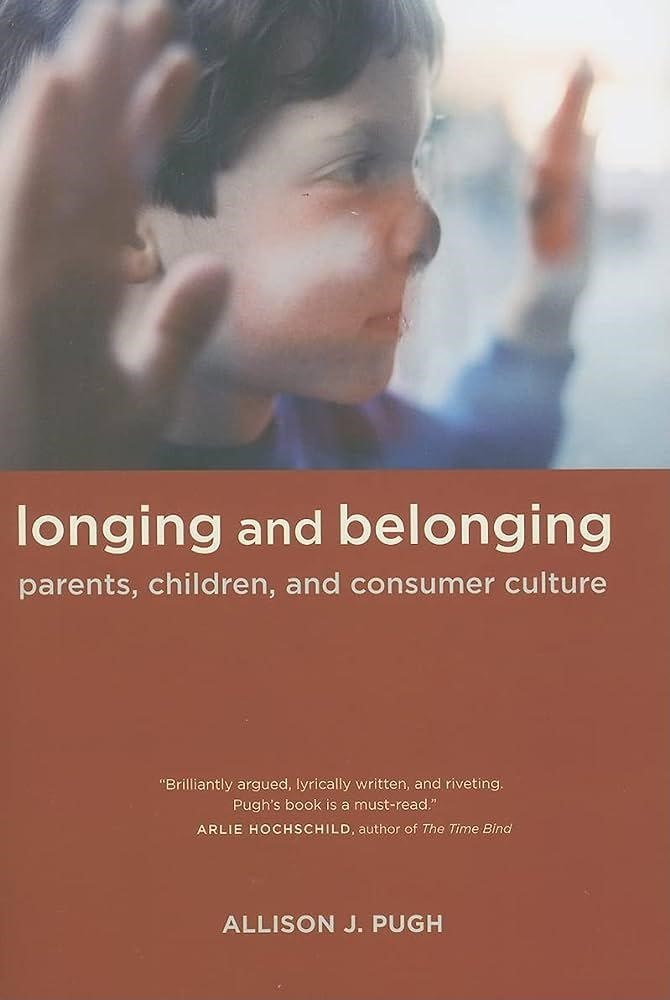
Longing and Belonging: Parents, Children, and Consumer Culture, by Allison J. Pugh (Berkeley, CA: University of California Press, 2009)
This is a very important book for teachers, teacher trainers, and teacher candidates to read because it offers an explanation of the desires of children and the interesting way the desires are met, or not met, by their parents. In this day of increasing demand for newer and better toys and technology, children ask for more and more expensive items.
Allison Pugh uses a qualitative research approach from the side of sociology to look at the phenomenon, namely the decision to reward children with gifts or to withhold them, and why or why not. Pugh looks at the desires and needs of kids from very disparate family backgrounds, socioeconomic class, and racial and cultural experiences in a region of southern California.
The pivotal point is the school, the type of school, including whether it is public or private, and the ways that having technology and other assets are viewed by the students. The author interviews several parents to find out how the decision is made as to whether the kids will receive something they want. In some cases, the parents do buy the items so that the kids will not stand out as being too different from others, so that the kids will be able to participate with others in their school and be able to “save face.”
Not all parents immediately purchase items for their child, however, sometimes waiting to make sure it is a wise choice or until the family can afford it. In other cases, the parents can indeed afford the time but wait before buying it. The author uses the term “symbolic deprivation” to describe parents waiting until the child truly deserves the item or it is somehow time to go ahead and purchase the gift, toy, or technology.
In this ethnographic study, the author discovers some surprising aspects many people do not consider. Parents often want their children to fit in, so buying them fruit snacks or certain kinds of lunch items is very important as they help their kids to be part of the scene. Some parents consider the social life at school to be as important or even more important than what the kids are learning. Sometimes parents do try to get children to adopt better eating habits, but they agree to help them fit in better by purchasing trendy snacks or desserts for the lunchbox.
For a variety of reasons, parents do or do not buy certain items. Parents of all income levels explained it was a struggle to know when to say enough is enough. In many cases, the parents say they try to buy the majority of the things the kids want, and sometimes that means kids do have to wait so the family will not wind up “in trouble” financially. Still, though, kids in this study tended to eventually get the lion’s share of what they had on their conscious wish list.
Important reading for educators, this book shows the social and family side of the desires and needs of children in three very different kinds of schools. Other factors such as class and race place interesting roles in the decision process employed by parents. It is essential to better understand the kinds of pressures on kids and their parents in terms of the technology and toys so much of the kid landscape these days. Understanding what is going on behind the scenes, in the lunchroom, and in the playground can be very helpful in comprehending a little more of the kid’s world and that of the parents raising them.
It will be interesting to study these patterns and decisions after COVID-19 has come to a more secure stop at the end of the road.
A Discussion for Social Studies & Sociology Students on the Future of Religion in America
Hank Bitten, Executive Director, NJ Council for the Social Studies
The free exercise of religious beliefs is written into our constitution and has been part of the framework of our democratic society and American identity since the Pilgrims arrived in 1620. The principle of the separation of church and state prevented America from having a religious institution or denomination supported by the state, it has enabled the proliferation of houses of worship, the establishment of colleges to train clergy, the dissemination of religious beliefs into our culture through art, literature, and music, and prayers in public places. Religious beliefs and the practices of denominational churches are part of the tapestry of America.
“Congress shall make no law respecting an establishment of religion, or prohibiting the free exercise thereof; or abridging the freedom of speech, or of the press; or the right of the people peaceably to assemble, and to petition the Government for a redress of grievances.” (First Amendment)
This is clearly evident in the First and Second Great Awakening, the Sunday School movement, and the missionary zeal in the 19th century to convert people to the Christian faith. The names of Jonathan Edwards, George Whitfield, Charles and John Wesley, Francis Asbury, Billy Sunday, Billy and Franklin Graham, Dwight Moody, Phoebe Smith, Mary Baker Eddy, James Dobson, Tim Keller, Oral Roberts, and Pat Robertson are just a few names that are part of several high school history textbooks.
In the first two chapters of the dissertation, “Behind the Numbers: A Traditional Church Faces a New America”, Rev. Larry Vogel, presents us with a turning point in the first two decades of the 21st century that is an opportunity for discussion, debate, and discernment. The dissertation provides a sociological, anthropological, and theological perspective that is insightful in how evidence is used to support a claim or thesis.
The data from the U.S. Census Bureau presents a vision of America that is as influential today as Jean de Crèvecoeur’s “Letters from an American Farmer” were in 1782. Crèvecoeur tried to describe the ‘new American’ as industrious and religious. The experiences of living during and after the American Revolution changed the colonists from Europeans to Americans. The ‘new American’ following the passage of the Immigration and Nationality Act of 1965 is from global origins and the ‘new American’ is Hispanic, African, and Asian.
By analyzing the census data in this dissertation, high school students will be able to make a claim regarding the importance of religion in American by 2050, the impact of immigration on society, the consequences of a society that is changing over time, and make predictions for the future. In a Sociology class, students can also survey their own community and compare the data with the national data in the U.S. Census.
“As for ethnicity, 61.6% of the US population is White alone (204.3 million), a decline from 223.6 million and 72.4% in 2010. Blacks who self-identified without any other racial combination increased slightly in number between 2010 and 2020 (from 38.9 to 41.1 million), but declined very slightly as a percentage of the population (from 12.6% to 12.4%). The Asian alone population of the US increased both numerically and proportionately. In 2010 14.7 M (4.8%) Americans identified as Asian alone. In 2020 that number swelled to 19.9 M (6%).”The Asian population is projected to more than double, from 15.9 million in 2012 to 34.4 million in 2060, with its share of nation’s total population climbing from 5.1 percent to 8.2 percent in the same period. (p. 58)
In the table below, the majority population in the United States declined 11% in ten years from 2010-2020. Will this trend continue to fall another 10% or will it be greater than 10% in this decade?
In high school social studies classes, teachers ask questions about our American identity. Students look at this over time by discussing how each century defined the emerging American identity? The demographics of what is happening to the religious beliefs of the ‘new American’ are important to our culture, economy, education, families, and government. Religion is perhaps the largest service industry in the United States with more than 100 million people attending worship regularly. The number of subscribers to weekly worship experiences is declining but this change is likely disguised as the ‘new American’ still believes in a supreme deity but expresses this belief differently than the way Crèvecoeur’s ‘American’ did. The insights in “Behind the Numbers: A Traditional Church Faces a New America” encourages the debate in the classroom and in the chancel. The analysis of the data provides a perspective of what life will be like in the United States at mid-century. Some will see this as an opportunity and others as a threat.
To begin our inquiry into the data, examine the population profile of the top ten states with the highest immigrant populations. (pp.66) Half of these states are in the Boston-New York-Philadelphia-Baltimore- Washington, D.C. corridor. A third of these states are in the western region of the United States.
One of the striking observations in the census report is that these changes have occurred after 2000.
“The continued growth of the US population is due to immigration rather than to immigrant birth rates. All-in-all, the foreign-born US population in 2018 was nearly 14% of the total US population and their second-generation children were an additional 12.3% of the total population. This means that fully 25% of the current US population is the result of immigration and that the changing racial-ethnic profile of the US is due almost entirely to immigration in recent decades. As Taylor puts it: “Immigration is driving our national makeover.” (p. 67)
As you review the data in the graph below, consider the implications of this decline in your community and state.
Here are some questions to ask regarding this data?
Will these demographic trends continue on the same trajectory over the next three decades or escalate?
Will external events (i.e., climate, artificial intelligence, economic conditions, etc.) have a direct effect on immigration trends?
Will the immigrant population move to other states as they have in the past?
As the immigrant population of 2020 ages, how will this influence the ‘new American’ identity?
As immigrants assimilate into American culture, will they be influenced by the religious institutions in America?
The Census Bureau predicts that the trend toward racial-ethnic diversity will continue: The non-Hispanic White population is projected to shrink over coming decades, from 199 million in 2020 to 179 million people in 2060—even as the U.S. population continues to grow. Their decline is driven by falling birth rates and a rising number of deaths over time as the non-Hispanic White population ages. In comparison, the White population, regardless of Hispanic origin, is projected to grow from 253 million to 275 million over the same period. (p. 236)
Dr. Vogel’s thesis claims that “the underlying support and stimulus for Global Christianity’s surge is the Bible translated into the vernacular. The Bible in whole or in part is available in over 1500 languages, including more than 650 African tongues. With the Bible in their own tongue, Christians in Africa and throughout the globe “can claim not just the biblical story, but their own culture and lore in addition.” (p. 82) However, his thesis also raises the counterargument that the Millennial generation (birth years 1981-1996) is leading the shift away from organized religion, specifically, Christian denominations. According to the Pew research from 2019, 40% of the Millennials (also Generation Y) identify as unaffiliated with 9% claiming a faith other than Christianity. The trend for Generation Z (birth years 1996-2010) will likely be higher.
The perspective of Dr. Mark Chaves of Duke University (and high school student of the author of this article), is that America will likely continue its religious identity in this century. The diversity of the American population will lead to changes, notably that non-Christian beliefs also lead to eternal life. Church membership and worship practices will likely change. A new subculture within the religious and worshipping population may emerge in the 21st century. The ‘new American’ will likely continue helping others in need by donating food, working in a soup kitchen, providing assistance after a disaster, building homes for the homeless, as the volunteer spirit will likely continue throughout this century. But this ‘new American’ may also be influenced by social media and artificial intelligence. Engage your students in exploring answers to these questions and possibilities.
George Hawley of the University of Alabama presents a strong counter argument regarding the demographics of the denominational church in 2022. He cites that 23 percent (almost one-fourth) of the population affiliated with a Christian denominational church are over the age of 65. He also observed that only 13 percent who attend church regularly are under the age of 30. This is not sustainable beyond 2050. Non-Christian religious traditions increased from 5% percent to 7% since 2010. In terms of actual numbers, 13 million Americans identify as atheists and 33 million or 10 percent) have no particular religious affiliation. To place this in perspective, the populations of 49 states are less than 33 million people. The population of Texas is 31 million.
To add a second layer of analysis to our scaffold is the research of the Barna Group which used three factors in determining affiliation with a Christian Church.
Christian identity with a denominational church
Regular worship attendance
Placing faith as a high priority
The data reports that 25% of the American population of 330 million people are practicing Christians. In 2000, the number was 45%! (p. 113) Although weekly church attendance continues to decrease in both Protestant and Roman Catholic churches, the diversity of Roman Catholic congregations appears positive, especially if the United States will continue as a Christian country. “Nearly 40% of Catholic churches are either predominantly or very much non-White. In 2014, The Center for Applied Research in the Apostolate (CARA) study of RCC parishes, 323 out of 846 responding parishes could be identified as multi-cultural parishes.
By using the data below, ask this question: ‘Why is Roman Catholic weekly attendance decreasing in the first quarter of this century and Protestant weekly attendance showing a slight increase?’ (Note: the years on the y axis appear to have 1983-1986 reversed with 1995-1996)
This article reflects the data in Chapters 1 and 2 of the dissertation. Chapters 3, 4, 5 include prescriptive information on a case study of the Lutheran Church and information about other denominations. Chapters 4 and 5 include a theological analysis of church history and the inclusion of all people.
The dissertation examines membership data for The Lutheran Church—Missouri Synod (LCMS) from the mid-1970s to the present. It considers the analysis of LCMS decline by two scholars, George Hawley and Ryan MacPherson, who independently proposed that LCMS membership decline was internal in causation due to diminished birthrates and fewer young families. While acknowledging the reality of such internal decline, this dissertation argues that the lack of external growth is a greater cause for LCMS decline. Its lack of external growth is due primarily to the racial and ethnic homogeneity of the LCMS and its failure effectively to evangelize the increasingly diverse American population. This indicates a theological weakness: a failure to teach and emphasize the catholicity of the church adequately in LCMS catechesis and dogmatic theology.
Recommended Citation
Vogel, Larry, “Behind the Numbers: A Traditional Church Faces a New America” (2023). Doctor of Philosophy Dissertation. 146. https://scholar.csl.edu/phd/146





 njcssjournal