New York State Resource Guide for the 250th Anniversary of the American Revolution

Created for teachers of the 4th and 7th grades, this educational guide provides five lessons that introduce students to Fort Orange and the world of New Netherland.

The birthplace of the modern gay rights movement took place on Christopher Street in Greenwich Village in June 1969 at the Stonewall Inn. 

Using Stories in History and Social Studies Courses

Teachers often find that stories are a good way to engage students in their U.S. history and social studies courses.  Stories illustrate historical themes, bring historical events and characters to life, and leave a lasting impression. People can sometimes remember a particular story from history years later even if they cannot recall all of the context. There are many stories from New York history that may be of interest to teachers in Grades 4 (local and state history), 7-8 (New York and U.S. history). Lots of them are also useful in Grade 11 (U.S. history) because, while the history-makers were New Yorkers, the stories also illustrate national themes and developments as well.

The historical episodes cited below are all good examples of engaging stories. Each one centers around an event or events, illustrates what led up to the event, and also shows the consequences of it. They all fit into and illustrate broader themes in state and local history. Perhaps best of all, they all have exciting people at their core. In several cases, in fact, the story is best told by the people themselves, through first-hand accounts that students can access and use.

The stories included here – and others — are all covered in my three new books, cited at the end of this article. The first privacy law is included in The Crucible of Public Policy, the others in The Spirit of New York and there is also a Glenn Curtiss document in Progressive New York. But the stories are also covered in many other sources. I have tried to cite some of the most helpful for each story.

Two good starting points for any New York history topic are Peter Eisenstadt, ed., The Encyclopedia of New York State (2005) and Kenneth T. Jackson, The Encyclopedia of New York City (2010). Two sites where you can follow developments in New York history and find out about news books are the Office of State History in the State Museum (https://www.nysm.nysed.gov/research-collections/state-history) and New York Almanack (https://www.newyorkalmanack.com). The journal New York History (https://www.cornellpress.cornell.edu/new-york-history) carries articles and book reviews.

New York State’s “Birthday,” April 20, 1777: The upcoming 250th anniversary of the American Revolution is a great time to examine New York’s experiences and its role in the war. At the beginning of 1777, “New York State” did not actually exist yet. A convention elected to draft a constitution worked in Kingston to complete the document on April 20, 1777, in effect New York’s “birthday.” That document laid out state government and powers. The first governor and legislature were elected in the summer and got to work in the fall. Before the end of 1777, New York would survive British onslaughts, including the burning of its temporary capital, Kingston, and invasions from the north, west, and east. 1777 might be called New York’s “miracle year,” an exciting time when the state got started.

William A. Polf’s booklet 1777: The Political Revolution and New York’s First Constitution (1977)is available at https://babel.hathitrust.org/cgi/pt?id=osu.32437123007011&seq=3

A copy of the first state constitution is available on the State Archives website, https://digitalcollections.archives.nysed.gov/index.php/Detail/objects/10485; the text is at https://avalon.law.yale.edu/18th_century/ny01.asp. The Archives Partnership Trust has made available the chapter on the first constitution from my book, The Spirit of New York: https://considerthesource.s3.amazonaws.com/3917/2556/5316/Dearstyne_Constitution_Chapter.pdf

“Anti-Rent Wars,” 1839-ca. 1880: New York tenant farmers in the Hudson valley waged one of the largest tenant rebellions in history in these years. They were fighting for the right to purchase and own the farms; where as tenants they had to pay exorbitant rents. They kicked it off with a declaration against the tyranny of landlords on July 4, 1839. The intrepid farmers’ struggle was waged in the courts, the state legislature, a state constitutional convention, and sometimes through armed resistance to sheriffs who tried to evict them for non-payment of rents. By 1880, most owned their farms, but their struggle had been a heroic and exciting one. Henry Christman, Tin Horns and Calico (1945); Charles McCurdy, The Anti-Rent Era in New York Law and Politics (2001).

Elizabeth Cady Stanton led the campaign for women’s rights. This is really two stories in one – the famous 1848 Seneca Falls women’s rights convention, which demanded the right to vote for women, with Stanton as the chief organizer; and Stanton’s long career as an advocate for woman suffrage and women’s rights generally at the state and federal level (she kept working until the time of her death,1902).

Elisabeth Griffith, In Her Own Right: The Life of Elizabeth Cady Stanton (1984); Lori D. Ginsberg, Elizabeth Cady Stanton: An American Life (2009); Elizabeth Cady Stanton, Eighty Years and More: Reminiscences, 1815-1897 1898; reprint, 1993). Women’s Rights National Historical Park. https://www.nps.gov/wori/index.htm

Syracuse citizens rescued a fugitive slave, 1851. On October 3, 1851, a mob of over 2,000 citizens broke down the doors of a Syracuse police station to liberate William “Jerry” Henry, a fugitive slave, who had been arrested by a Deputy U.S. Marshal under the federal Fugitive Slave Law. That law provided for arrest and return of slaves fleeing the oppression of slavery in the south. New York was an important part of the “underground railroad” which helped escaping slaves find new homes in the North (where slavery was illegal) or Canada (which had also abolished it.). The “Jerry Rescue” was one of the most dramatic events in New York’s growing opposition to slavery. Fergus M. Bordewich, Bound for Canaan: The Epic Story of the Underground Railroad, America’s First Civil Rights Movement (2006); Monique Patenaude Roach, “The Rescue of William ‘Jerry’ Henry: Antislavery and Racism in the Burned-Over District, New York History (2001); Gerald Sorin, The New York Abolitionists: A Case Study of Political Radicalism (1970). “Jerry Rescue” historic marker: https://www.hmdb.org/m.asp?m=138797

New York’s – and the nation’s– first personal privacy law, 1903. In the late 19th and early 20th centuries, advertisers widely used the photos of women in ads for their products, without the women’s consent. There was no law against it. That changed when a seventeen-year old Rochester girl, whose photo was being used in ads for flour, went to court to stop it. The Court of Appeals ruled against her in 1902, but, under pressure from the public, the legislature took up the cause and passed a personal privacy law in 1903, the first in the nation. The main provisions of that law are still on the statute books. New York State Archives Partnership Trust, “Who Owns a Photo of Your Face? The Right of Privacy and the Courts,” (Podcast, October 18, 2022. https://www.nysarchivestrust.org/events/recorded-events); Sarah E. Igo, The Known Citizen: A History of Privacy in Modern America (2018); Jessica Lake, The Face That Launched a Thousand Lawsuits: The American Women Who Forged the Right to Privacy (2016).

Hammondsport aviation pioneer Glenn Curtiss made aviation history. Most students probably have heard of the Wright Brothers and their famous flight at Kitty Hawk, NC in 1903. But the story of their contemporary and rival, Glenn Curtiss, is almost equally important and unknown to post[HB1]  people. Curtiss developed essential airplane designs and controls, including ailerons – adjustable wing flaps on the trailing edges of wings, essential for take offs and landings — still in use today. He made the first pre-announced, publicly witnessed, professionally certified airplane flight (July 4, 1908), and the first flight from Albany to New York City, May 29, 1910). He made the first amphibious flight and convinced the Navy to buy airplanes and train pilots, earning him the title “The Father of Naval Aviation.” This is a story of invention, daring, and doing what has never been done before. Lawrence Goldstone, Birdmen: The Wright Brothers, Glenn Curtiss, and the Battle to Control the Skies (2915); Seth Shulman, Unlocking the Sky: Glenn Hammond Curtiss and the Race to Invent the Airplane (2002); Glenn H. Curtiss Museum, Hammondsport. https://glennhcurtissmuseum.org 

Jackie Robinson broke the color barrier in major league baseball, April 15, 1947. Major league baseball was a whites-only sport until the day in 1947 when Jackie Robinson debuted as the first Black player for a major league team, the Brooklyn Dodgers. Robinson proved to be a stellar player, and his pioneering role paved the way for other Blacks who followed. He also helped undermine racial prejudice and discrimination and was an early example of what would be called the Civil Rights movement. Jackie Robinson and Alfred Duckett, I Never Had it Made: The Autobiography of Jackie Robinson (2003); Carl T. Rowan with Jackie Robinson, Wait Till Next Year: The Life Story of Jackie Robinson (1960); Jules Tygiel, Baseball’s Great Experiment: Jackie Robinson and His Legacy (1983)

Hamilton: An American Musical debuted in New York City. Feb. 17, 2015. The hit musical Hamilton presented the life and achievements of New Yorker Alexander Hamilton, Revolutionary war patriot leader and the first U.S. Secretary of the Treasury, in the form of a lively musical. The play features a multi-ethnic cast, superb acting, smart dialog, humor, and rap and hip-hop musical scores. It recasts Revolutionary era history in the language of today; it is about “America then, as told by America now,” as its writer and lead actor, Lin-Manuel Miranda put it.  This is an exciting way to explore history. Students can study the history behind the musical, watch the musical itself, and compare and contrast the two. Sources: Ron Chernow, Alexander Hamilton (2004); Edward Delman, “How Lin-Manuel Miranda Shapes History,” Atlantic September 29, 2015; Lin-Manuel Miranda and Jeremy McCarter, Hamilton the Revolution. Being the Complete Libretto of the Broadway Musical and a True Account of its Creation (2016)


A Self-Guided Walking Tour of the Battle of Brooklyn Sites

A Self-Guided Walking Tour of the Battle of Brooklyn Sites

Marion Palm

Used by permission from the Brooklyn Eagle (Source: http://www.brooklyneagle.com/categories/category.php?category_id=27&id=35883)

Two scouts from the leading column of the Royal Marines and Tories and two companies of Long Island Tories were attracted to watermelons growing near the southwest corner of Green-Wood Cemetery. Riflemen fired on the would-be melon poachers.

The Old Stone House now at Fifth Avenue and Third Street in Park Slope, which has an interpretive center, was then named the Vechte Farmhouse, located south of Gowanus Creek. The event involving the retreat of the Americans says that Lord Stirling (he was on our side) gathered 2,000 men. These included troops from Delaware and Pennsylvania, along with an elite regiment from the First Maryland Regiment.

The Old Lyon Inn is now an American Legion Post near the IKEA on the point of Red Hook. The chance meeting at the watermelon patch became a major confrontation that stretched for a quarter of a mile and was responsible for convincing the Americans that the major attack would be on the Gowanus Road. With two sides confronting each other in regular battle formation, this was the first time the Americans, as an independent nation, faced the British in an open field. With no fortifications or stones to hide behind, only hedges and trees to face Grant, the commander of the British (not related to our former president General Grant) took on the fight.

The Brits, however, went east and linked up with the Hessians (paid German mercenaries) to seize high ground in what we now know as Battle-Hill in Green-Wood Cemetery.

The main body of the enemy came down through Flatbush to the intersection of Nostrand Avenue and Fulton Street in Bed-Stuy. (5). The British were very sneaky in this maneuver, as they swung around in a loop behind the Americans and attempted to capture them all. Howe, the British general ordered his men to cut off the American retreat to the Brooklyn forts on Brooklyn Heights. Most of the Americans survived, some were captured by the British, and others were bayoneted as they tried to surrender to the Hessians.

There is a monument to those who died in terrible conditions as prisoners of the British on ships in our harbor. An obelisk stands in Fort Greene Park that is a 150-foot tall Prison Ship Martyrs’ Monument and crypt, which honors some 11,500 patriots who died aboard British prison ships during the American Revolution.

Washington’s headquarters, and he had many of them during the war, was at The Four Chimneys in a mansion overlooking the harbor from Brooklyn Heights. A small garden with a flagpole now marks this spot on the Brooklyn Heights Promenade. There is also a small plaque with information about the house embedded into the stand that supports the flag. Washington held his war council there on August 29, 1776. The British, despite their clever advances, made a tactical error. They wasted time digging trenches. This decision took away the Brits’ opportunity to win the war in one stroke.

Lord Stirling managed to disengage from Grant and get around Cornwallis’s forces stationed around the Vechte farmhouse, blocking the Post Road, now First Street in Park Slope. Stirling ordered his troops to plunge into the marsh and go across Gowanus Creek on August 27, 1776.

On what can be seen now as a suicide mission, he staged a preemptive strike against Cornwallis in and around the Vechte farmhouse and its orchard. This sacrificial rearguard gave the bulk of the American wing a chance to escape across the marshes along Gowanus Creek.

A very dense fog drifted in and Washington and his men escaped from the Ferry Landing next to what is now the elegant River Cafe. Washington took the whole regiment by ferry to New York. The last man over received permission to go back for his horse and he and the volunteers were fired upon in what he said was a salute from the enemy with musketry that couldn’t reach them as they returned to safety.

General Howe was in Red Hook and his men were spread all the way to Hells Gate to keep the Americans guessing where he would attack, but he never crossed the East River to pursue them. Howe did succeed to take Brooklyn Heights and Governor’s Island, concealing his invasion flotilla in Newton’s Creek, the border between the Boroughs of Brooklyn and Queens at approximately 32nd Street.

General Howe is said to have dallied too long at the home of Robert Murray on a hot evening of September 15th when Mrs. Murray and her two daughters opened the wine cellar at the mansion and served cakes and Madeira to the British generals and Governor Tyron. Howe’s delay allowed the Americans to slip away again. There is a plaque to mark the mansion on Park Avenue and 37th Street in Manhattan.

Historic New Jersey: Long Pond Ironworks

Historic New Jersey: Long Pond Ironworks

Long Pond Ironworks in Hewitt takes its name from the nearby “Long Pond,” a translation of the Native American name for Greenwood Lake. Set alongside the swiftly flowing Wanaque, or “Long Pond,” River, the only natural drainage from Greenwood Lake, the site offered a perfect combination of natural resources for making iron. Long Pond Ironworks was founded by the German ironmaster Peter Hasenclever.

Reprinted with Permission from the Long Pond Ironworks Museum www.longpondironworks.org/pdf/brochure.pdf

With financial backing from English investors, Hasenclever purchased the existing Ringwood Ironworks in 1765, along with huge parcels of land, including the 55,000 acre Long Pond Tract.  He then imported more than 500 European workers and their families to build iron-making plantations at Ringwood, Long Pond, and Charlottenburg in New Jersey, and at Cortland in New York.

From the wilderness they carved roads; built forges, furnaces, and homes; and created supporting farms. At Long Pond, they dammed the river to provide water power to operate the air blast for a furnace and a large forge.  Robert Erskine, the ironmaster at Long Pond and Ringwood during the 1770s, took up the American cause during the Revolutionary War, supplying iron products to the Continental Army and serving as George Washington’s chief mapmaker until his death in 1780.

In 1807, Long Pond Ironworks was acquired by Martin J. Ryerson, owner of the Pompton Ironworks. The Ryerson family retained ownership until 1853, when they sold the properties to the industrialists Peter Cooper, Edward Cooper, and Abram S. Hewitt. The Cooper-Hewitt enterprise operated Long Pond Ironworks as part of the larger Trenton Iron Company. During the Civil War, two new blast furnaces, new waterwheels, and workers’ housing were built at Long Pond. The iron made here was found to be especially well suited to making guns for the Union Army.

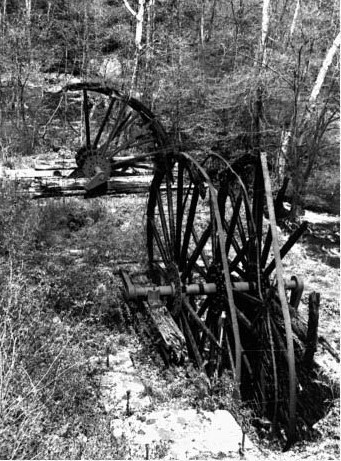
Civil War era Water Wheel

The 1870s brought major changes in the American iron industry—notably, the rise of cheap steel manufacturing and the discovery of new coalfields in Pennsylvania and ore beds in the Midwest. Although Hewitt planned cost-saving improvements to keep his northern New Jersey ironworks in operation, on April 30, 1882, the last fires were blown out at Long Pond, ending more than 120 years of iron-making history at the site.

Although iron was no longer made at Long Pond after 1882, mining continued as a major industry. Through the turn of the twentieth century, residents of Hewitt, the village that had grown up around the ironworks, adapted to changing times. They built a new school and church between 1895 and 1905 and a new sawmill in 1913. Ice cutting on Greenwood Lake and recreation also became key industries. By the 1930s and the onset of the Great Depression, however, these industries were in decline. Residents of historic Hewitt began to move away, seeking opportunity elsewhere.

In 1957, the Ringwood Company donated the Long Pond Ironworks property to the State of New Jersey. In 1987, Long Pond Ironworks was dedicated as a State Park. Administered by the NJ Department of Environmental Protection, Division of Parks and Forestry, and maintained by the Friends of Long Pond Ironworks, Inc., the Long Pond Ironworks Historic District stands as a testament to the vital role our region has played in our local, state, and national history.

Long Pond Today

Long Pond Ironworks is a microcosm of our industrial and cultural heritage. Its history tells a fascinating tale of the ironmasters who developed the iron industry in northern New Jersey. Their contributions to history in times of peace and times of war reach far beyond the local economy. These nearly forgotten chapters of history deserve to be retold and remembered.

Within the 175-acre Long Pond Ironworks Historic District lie the ruins of three iron blast furnaces, including the original Colonial-era furnace built in 1766 and two larger furnaces built for Civil War production. Also visible are remains of iron forges, waterpower systems, and a variety of workers’ homes and commercial buildings that were critical parts of the iron-working village.

Long Pond also illustrates the evolution of iron-making technology in the remains of the three successive blast furnaces, the ore roaster, and the hydropower systems. The continual search for more efficient operations and materials is a story of industrial ingenuity at its best.

The workers’ story at Long Pond Ironworks is a saga of immigration, hard work, and adaptation to changing times. The company town of Hewitt grew, thrived and declined along with the fortunes of the iron industry in the Northeast. The personal and community struggle to adapt to an evolving economy is a theme in our cultural heritage from which we can still learn.

The historical value of Long Pond Ironworks is paralleled only by its natural beauty. The forests that were once cut down to make charcoal for the furnaces have returned, and the river that was once diverted into the hydropower systems again cascades over ancient rock formations. The Friends of Long Pond Ironworks are working to ensure that the Historical District is preserved and remembered for its contributions to our past, present, and future.