
The Hundred Years’ War on Palestine, A History of Settler Colonialism and Resistance, 1917- 2017
by Rashid Khalidi (New York: Holt, 2020)

Review by Alan Singer
A year after the brutal attack on Israel by Hamas on October 7, 2023 and the devastating Israeli military response that has killed over 45,000 Palestinians, I reexamined The Hundred Years’ War on Palestine, A History of Settler Colonialism and Resistance, 1917- 2017 by Columbia University Professor Rashid Khalidi, originally published in 2020. A reviewer for The Nation (Hawa, 2020) described it as “one of the best-researched general surveys of 20th and early 21st century Palestinian life, but it’s also a deeply personal work.” A review in The Guardian (Hughes, 2020) called it “informed and passionate. It pulls no punches in its critique of Jewish-Israeli policies (policies that have had wholehearted US support after 1967), but it also lays out the failings of the Palestinian leadership . . . An elegy for the Palestinians.” The New York Times (Anderson, 2020) reviewer was more critical arguing that Khalidi failed to spell out a resolution to the conflicts between Israel and Palestine and dismissing what he did offer as having an “increasingly fantastic quality.”
Rashid Khalidi’s main arguments are that during the 100-year war on Palestine, the dominant powers, including the United States, favored Zionist ambitions and either ignored or thwarted Palestinian nationalism and that Israel justifies inequality and its aggressive nationalism as part of its need for security. Khalidi’s response is that there are two peoples who legitimately occupy Palestine and there can be no resolution until they both acknowledge the legitimacy of the other. This would require removing external support for the discriminatory and unequal current arrangement. At best the United States has paid lip service to the idea of a two-state solution, but it never placed the needed pressure on Israel to make this possible (245-247).
Khalidi comes from a prominent Palestinian family, so the history of Palestine is interwoven with his family’s history and his own personal experiences. Khalidi was born and educated in New York City while his father was a United Nations official. He has lived and taught in Lebanon and frequently visited Palestine/Israel for research and family visits. His Palestinian family included generations of Islamic and legal scholars and government officials. One noteworthy relative warned of the threat of Zionism to Palestinians as early as 1899 (4). His grandfather was Hussain al-Khalidi, an advocate for Palestinian rights, a mayor of Jerusalem, and member of the Ottoman parliament. A paternal uncle, Husayn al-Khalidi, was mayor of Jerusalem from 1934 to 1937 when he was sent into exile by the British to the Indian Ocean Seychelles archipelago. He was not able to return to Palestine until 1943.
In The Hundred Years’ War on Palestine, Rashid Khalidi writes a history of the region from a Palestinian lens and deconstructs what he considers to be myths about the founding of Israel and its rise as a regional military power. While Khalidi’s title has the history of the struggle of Palestinians for nationhood beginning in 1917, the book actually begins in the 1890s when Theodore Herzl offered a Zionist vision for a Jewish homeland in Palestine. Herzl proposed a settlement plan based on the expulsion of Palestinians that continued to be implemented after the founding of Israel as an independent state in 1948. Herzl believed that European Jews had to “expropriate gently the private property on the estates assigned to us. We shall try to spirit the penniless population across the border by procuring employment for it in transit countries, while denying it employment in our own country” (4).
Yusuf Diya, the late 19th century Palestinian Mayor of Jerusalem, responded to growing Zionist sentiment in an 1899 letter to the chief rabbi of France. Diya argued that “Palestine is an integral part of the Ottoman Empire, and more gravely, it is inhabited by others.” He concluded the letter “in the name of God, let Palestine be left alone” (5). Herzl answered Diya’s letter acknowledging that a Jewish state in Palestine would be a European settler colony and argued it would “form a part of a wall of defense for Europe in Asia, an outpost of civilization against barbarism” (10). In the 1920s, Ze’ev Jabotinsky, a British World War I veteran who promoted a militaristic Zionism, called for military action to support a Jewish state. In 1925, Jabotinsky wrote “If you wish to colonize a land in which people are already living, you must find a garrison for the land, or find a benefactor who will provide a garrison on your behalf . . . Zionism is a colonizing venture, and therefore, it stands or falls on the question of armed forces” (51).
Khalidi believes that the British Empire was never motivated by altruism towards colonized people, but supported Jewish emigration to Palestine because it would buttress Britain’s position in the eastern Mediterranean and solve its own antisemitic “Jewish Problem.” At the same time during and after World War I the British were promising European Zionists a Jewish state in Palestine with the Balfour Declaration, they were also promising Middle Eastern Arab leaders that independent Arab states including a Palestinian state would be carved out of the Ottoman Empire (25). Balfour recognized the contradictory promises that were made, and in a confidential memo to the British cabinet he wrote “we do not propose even to go through the form of consulting the wishes of the present inhabitants of the country . . . the 700,000 Arabs who now inhabit that ancient land” (38).
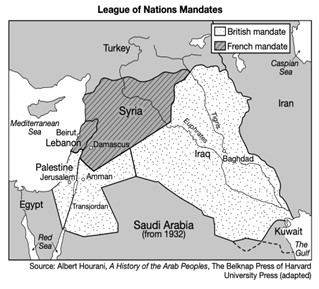
The hypocrisy of the British position continued when the League of Nations Mandate for Palestine issued in 1922 formalized British control over Palestine. It included a pledge to honor the Balfour Declaration’s promise of a “national home for the Jewish people” in Palestine and while the mandate included a clause that “nothing should be done which might prejudice the civil and religious rights of existing non-Jewish communities,” it never directly referenced Palestinians as a people with a right to self-determination, something British and the Americans continued to do in Middle East peace talks into the 1990s (34).
In the 1930s, as Jewish migration from Europe to Palestine expanded, there was growing Palestinian nationalist resistance to the British Mandate including armed battles between the British military and Palestinian rebels that resulted in about one-sixth of the Palestinian male population killed, wounded, imprisoned, or exiled. In response to the uprisings, a British Commission recommended the division of the mandate into two separate states with the formation of a small Jewish homeland on less than 20% of the territory from which the Palestinian population would be transferred, a euphonism for expelled. Khalidi argues that prior to and during World War II, the Palestinian nationalist movement was weakened by British repression and internal division while the Zionist movement was strengthened by British policy that included creating a Jewish Brigade that marched under their own banner in the British Army and arming and training Jewish settlers to help defeat a wartime Palestinian uprising (43-47). The Jewish Brigade and the armed settlers became the core of the Israeli army during the war for independence.
As the horrors of the Nazi extermination campaign became known, with increasing support from diasporan Jews living in the United States and the American and British governments, Zionists positioned themselves for creation of a post-war Jewish state either in a portion of the Palestinian Mandate or in the entire territory (61). After the war, the British Empire receded as the British were forced to accept Indian independence, faced armed colonial resistance in a number of areas, and Jewish settler opposed continuation of the Palestinian Mandate. Great Britain finally turned the future of Palestine over to the newly established United Nations which issued a proposal highly favorable to the Jewish settlers. The Jewish minority would receive over half of the mandate territory to establish an independent state while the much larger Palestinian population would receive a significantly smaller amount of land. The proposed revision led to the Nakba, the catastrophe, the expulsion of tens of thousands of Palestinians from what would become the Jewish state and war between Israel and neighboring Arab states. Khalidi describes the forced removal of Palestinians from their land and villages as ethnic cleansing (72-75).
According to Khalidi’s chronology, the expulsion of Palestinians began in November 1947, six months before the declaration of Israeli independence in May 1948 and before the invasion of a well-armed Israel by virtually non-existent Arab armies, an invasion that Khalidi dismisses as ill-conceived at best and not necessarily intended to benefit Palestinians. It is a myth that a small and ill-prepared Jewish state defeated seven powerful Arab nations against overwhelming odds to secure its independence. The reality, according to Khalidi, is that Lebanon, Iraq, Saudi Arabia, and Yemen did not significantly participate, Egypt and Syria were overmatched, and Transjordan, later Jordan, used the Israeli war for independence as an opportunity to seize control over West Bank territory that was intended as part of an independent Palestinian state (75-77).
Israel’s military victory was aided by a shift in American foreign policy from balanced support for both a Jewish state and newly emerging Arab governments in the region, to near total diplomatic and military support for Israel. While elements of the American foreign policy establishment initially expressed concern that support for Israel would hurt American oil interests in the region, that did not manifest as a problem until the 1970s when the United States began sending Israel massive amounts of military aid. Decisions were often made because of domestic political concerns. President Truman reportedly told a meeting of U.S. diplomats “I am sorry gentlemen, but I have to answer to hundreds of thousands who are anxious for the success of Zionism. I do not have hundreds of thousands of Arabs among my constituents” (79-80).
After independence, Israel treated the remaining Palestinians within its territory as second-class citizens subject to martial law. Dispossessed Palestinians within Israel were prevented from leasing or purchasing land that they had been driven off that was now reserved for Jewish settlement. Palestinians forced into refugee camps in Gaza, Jordan, Lebanon, and Syria were completely dependent on the United Nations for relief aid and for maintaining the most basic conditions for survival. They were never integrated into host countries and increasingly they identified as Palestinians with a desire to return to their traditional homes. Military incursions into Israel by Palestinian nationalist groups were met with disproportionate force and collective punishment by Israel which only intensified the desire for an independent Palestinian state (83-88).
One of Khalidi’s more controversial assertions is that justifications given by Israel for the 1967 preemptive strike that destroyed the Egyptian, Syrian, and Jordanian air forces are unfounded. Israel claimed that it faced an impending attack that threatened its existence. Khalidi cites a report by U.S. Secretary of Defense Robert McNamara to President Lyndon Johnson and Israeli Foreign Minister Abba Eban stating that no attack was imminent and that if the Arab states actually did attack Israel, they would be easily defeated by a far superior Israeli military. In support of his argument, Khalidi cites Lyndon Johnson’s The Vantage Point: Perspectives of the Presidency (Holt, Rinehart and Winston, 1971) and a Department of State analysis from 1967 (Foreign Relations, 1964-1968, Volume XIX, Arab-Israeli Crisis and War, 1967). At the meeting, President Johnson added “All of our intelligence people are unanimous” that if Egypt did attack “You will whip hell out of them” (97). According to U.S. documents later published, General Earl Wheeler, the chairman of the Joint Chiefs of Staff, informed the President “The UAR’s [United Arab Republic, Egypt and Syria] dispositions are defensive and do not look as if they are preparatory for an invasion of Israel” and a C.I.A. memorandum reported “Israel could almost certainly attain air superiority over the Sinai Peninsula in 24 hours after the initiative or in two or three days if the UAR struck first” (276). Despite U.S. intelligence reports and the meeting between Johnson, McNamara, and Eban, the head of the Israeli intelligence agency informed McNamara that Israel planned to go ahead with a preemptive attack and McNamara gave tacit approval (104). These documents undermine the myth that the preemptive Israel strike on its neighbors in 1967 was necessitated by survival.
Khalidi accuses the America media of being complicit with this country’s one-sided approach to repeated Middle Eastern crises and the treatment of Palestinians. He opens Chapter 4 with a quote from a 1982 communication between Thomas Friedman, at the time the New York Times Beirut Bureau Chief, with editors at the newspaper. Friedman accuses them of being “afraid to tell our readers and those who might complain to you that the Israelis are capable of indiscriminately shelling an entire city” (139), a telling complaint given Israel’s current bombing campaigns in the Gaza Strip and Lebanon and Israel’s claims that the bombings are carefully directed at military targets.
Pointedly, United Nations efforts to mediate the conflict between Israel and its neighbors with Security Council Resolution 242 in 1967 made no mention of Palestinians except to call for a resolution of the refugee crisis. Ignoring the existence of the Palestinian people as a party to the conflict contributed to a claim by Israeli Prime Minister Golda Meir in an interview published in the Sunday Times of London on June 15, 1969 (106). Khalidi quoted an excerpt from the interview; however, the full statement is worth citing because of its total denial of a Palestinian nationality. According to Meir “There was no such thing as Palestinians. When was there an independent Palestinian people with a Palestinian state? It was either Southern Syria, before the First World War, and then it was a Palestine, including Jordan. It was not as though there was a Palestinian people in Palestine considering itself as a Palestinian people and we came and threw them out and took their country from them. They did not exist.”
Israel’s resounding victory in the 1967 war the exposed military weaknesses of the major Arab nations. Khalidi believes their failure to advance the Palestinian cause spurred a sense of political, literary, and artistic Palestinian nationalism and the emergence of Yassar Arafat, the PLO, and Fatah as dominant forces in Palestinian society. Israel countered this resurgence by continually equating Palestinian with terrorist in efforts to discredit the movement in the United States and on the international stage, although the Fatah and the PLO were never a military threat to Israel (110-119). The 1978 Camp David Accords between Egypt and Israel, Khalidi considers them part of a United States Cold War strategy for pulling Egypt out of the Soviet orbit and effectively dividing the Arab bloc, excluded Palestinians from the negotiations (122). They established as a goal respecting the “legitimate rights of the Palestinian people” and the creation of civilian “autonomy” on the Israeli occupied West Bank, but not statehood, something Khalidi criticized in Brokers of Deceit: How the U.S. Has Undermined Peace in the Middle East (Beacon Press, 2013) as “devoid of meaning and content.” Developments since the 1978 agreement bear out Khalidi’s view as Israel has absorbed East Jerusalem, built West Bank settlements that are illegal under international law, effectively blockaded the Gaza Strip, and it has continually blocked efforts to create an independent Palestinian state, even after the PLO and Fatah endorsed a two-state solution, accepting the legitimacy of a Jewish state (126).
Khalidi provides much greater coverage of the Israeli invasion of Lebanon in 1982, than the 1973 Yom Kippur War. In his view it was much more closely linked to the future of Palestine and argues that proponents of a “Greater Israel,” including Ariel Sharon, Menachim Begin, and Yitzhak Shamir, believed the battle to defeat Palestinian forces in Lebanon would destroy the PLO as an effective military force and severely weaken the Palestinian nationalist movement. He quotes former Israeli Chief of Staff Mordechai Gur’s explanation of the war to a Knesset committee that in the “Occupied Territories” it would provide Israel with “greater freedom of action” (142-143). Khalidi also believes that United States Secretary of State Alexander Haig had prior knowledge of the invasion and gave Israel tacit approval.
In an effort to prevent a broader war, the Reagan administration did propose limiting Israeli settlements on the West Bank and the creation of an autonomous Palestinian Authority, but not an independent Palestinian state (151). Despite warnings to Israel, the United States never limited its support for Israeli action in Lebanon, even after the Western press documented Israel’s role in massacres carried out by its local allies at the Sabra and Shatila Palestinian refugee camps (158-162). We see similar warnings by the U.S. today that continued Israeli attacks on civilians in Gaza and Lebanon will lead to reduced U.S. support, but in both cases the United States took no action.
Unanticipated results of the Israeli invasion of Lebanon were the emergence of Hizballah as a new armed opponent of Israel, growing international sympathy for Palestinians, and increased militancy by Palestinians on the West Bank and in Gaza as they realized they could not rely on the either the major powers or Arab nations to mediate conflicts with Israel or to press for creation of the long promised Palestinian state. This new Palestinian awareness led to the spontaneous eruption of the First Intifada in 1987 in Gaza that then spread to the West Bank with street battles between largely unarmed young Palestinian protesters and heavily armed Israeli troops (168-169). The Intifada also exposed a growing rift between the PLO/Fatah leadership in exile and the local Palestinian population directly challenging the Israeli occupation although in 1988, the PLO did issue a Palestinian “Declaration of Independence “(178).
In his discussion of the Madrid Peace Conference in 1991 and Oslo Accords meetings in 1993, Khalidi believes an important concession by Israel was acceptance that the Palestinians were a people and that the PLO were their legitimate representatives. However, the Palestinian delegation at Oslo was a delegation of exiles who had not been in occupied Palestine for decades; they were not well versed on conditions there and were ill-prepared for negotiations. In exchange for receiving limited administrative responsibility for scattered areas across the West Bank and the ability to return from exile, the PLO leadership conceded the continuation of the Israeli occupation. Arafat mistakenly believed that future negotiations based on the Oslo Accords would bring further concessions from Israel, something the Israeli’s were never prepared to do as they drew out the timeframe for reaching new agreements. The United States, solidly in the same camp as Israel, blamed the PLO and Arafat for any delays. U.S. bias and Israeli intransigence torpedoed the accords despite PLO willingness to acquiesce on virtually every front, acquiescence that further alienated the PLO from Palestinian activists on the West Bank and in Gaza (194-199).
Relocated to the West Bank headquarters, the PLO served at consent of the of the Israeli military, and in 2002, during a Second Intifada set off by Palestinian frustration and Israeli provocations, the headquarters of the Palestinian Authority were forcibly closed (199-203). Khalidi views the Second Intifada as a setback for Palestinians because scenes of violence broadcast globally seemed to justify the Israeli intransigence that caused the violence (2019).
Following Oslo, the Israeli occupation completely sealed off the Gaza Strip. Awareness that Oslo agreements would never end the occupation eventually brought Hamas to power in the Gaza and created the conditions that ultimately forced Israel to close its settlements there and withdraw. Meanwhile, the United States in the wake of the attacks on September 11, 2001, stiffened laws against terrorism making an even remote connection to an organization or individual on its terrorist list impossible to maintain, isolating the groups, reinforcing their alienation, and preventing any attempts to modify their goals or actions (221).
Khalidi cites instances where Israeli actions ran counter to U.S. policy goals, especially during the Cold War with the Soviet Union. In these cases, the United States attempted to put a break on aggressive Israeli actions, however American governments were primarily concerned with its relationship with Arab governments and not with Israel’s treatment of Palestinians. Writing before the October 7, 2023 Hamas attack and the Israeli response, Khalidi believed there was a gradual shift taking place in American public opinion recognizing the legitimacy of Palestinian grievances and aspirations. The problem, he saw, was that the political leadership in the country was non-responsive to this shift. The Republican Party was heavily dependent for votes on Evangelical Christian supporters that perceived the State of Israel as signaling the fulfillment of Biblical prophecy and both parties relied on wealthy pro-Israel donors to finance election campaigns. Israel’s success in equating Palestinians with terrorists undermined sympathy for the Palestinian cause after al Qaeda attacked the United States on September 11, 2001 and the Bush administration launched a war on terror that continued into the Obama presidency (228-232).
In his conclusion, Khalidi addresses possibilities for shifting public opinion in the United States to become more favorable to the Palestinian cause. One approach is to identify the Palestinian cause with other liberation movements by colonized indigenous people, specifically South Africa, Ireland, and Native Americans. However, this has been difficult because Zionism claims biblical roots in Palestine and that the ancient Jews are the indigenous population, not Palestinian Arabs. American perceptions of United States history and a positive view of settler colonialism have also made it difficult to change American views about Palestinian statehood (41-242).
A second tactic proposed by Khalidi is challenging the myth that Israel is David hoping for peace but prepared to fight against a powerful Arab Goliath. Khalidi wants to reverse the idea of who is powerful and who is victimized. He also wants to challenge the moral legitimacy of Israel, that it cannot be both Jewish and democratic. The Israeli charter ensures Jewish supremacy which makes it illiberal and discriminatory (243-244).
Khalidi believes that at this point the United States cannot be relied on to broker a fair solution and a massive campaign within the United States is needed to shift public opinion. Palestinians will also need to win support in Europe, Russia, India, China, and Brazil. In Arab countries, Khalidi argues Palestinians must appeal to sympathetic populations rather than unsympathetic regimes (252). It may also be possible to influence Israelis tired of decades of war and the intense fighting and hostage situation in the latest conflict. Palestinians, for their part, need to reject Oslo gradualism, demand an entirely new timetable, and insist on a set of conditions based on the initial United Nations decision to establish two independent states.
Khalidi’s coverage of most of the events in the hundred years’ war on Palestine are comprehensive, however there is almost no discussion of the 1973 Yom Kipper War. I think it is a significant omission because in that war neighboring Arab states did attack Israel in an attempt to regain territory seized by Israel in 1967, and at least at the start, Israel appeared to be vulnerable. For many American Jews and for Israelis the attack on Israel and the successful Israeli counterattack justified their belief that Israel’s survival as a small country was continually threatened by hostile neighbors, could only be ensured through a dominant military supported by U.S. aid, and that the occupation of Gaza Strip, the Golan Heights, and the West Bank were essential for Israel’s defense. I can only conjecture that the 1973 war is of limited importance in Khalidi’s narrative because the United States was already committed to one-sided support for Israel in Middle Eastern conflicts and because it did not significantly change the situation for Palestinians in the occupied territories.
References
Anderson, S. (2020, January 28). “Is There Any Way to End the Israeli-Palestinian Conflict?” New York Times. https://www.nytimes.com/2020/01/28/books/review/the-hundred-years-war-on-palestine-rashid-khalidi.html. Accessed December 23, 2024.
Hawa, K. (2020, August 10/17). “Present Absences, A century of struggle in Palestine,” The Nation. https://www.thenation.com/article/world/hundred-years-war-on-palestine-rashid-khalidi/. Accessed December 23, 2024.
Hughes, M. (2020, May 7). “The Hundred Years’ War on Palestine by Rashid Khalidi review – conquest and resistance,” The Guardian. https://www.theguardian.com/books/2020/may/07/the-hundred-years-war-on-palestine-by-rashid-khalidi-review-conquest-and-resistance# Accessed December 23, 2024.
Marantz, A. 2023, December 2. “Columbia Suspended Pro-Palestine Student Groups. The Faculty Revolted,” The New Yorker. https://www.newyorker.com/news/our-local-correspondents/columbia-suspended-pro-palestine-student-groups-the-faculty-revolted. Accessed December 23, 2024.
Mashiach, I. (2024, November 30). “Palestinian-American Historian Rashid Khalidi: ‘Israel Has Created a Nightmare Scenario for Itself. The Clock Is Ticking,” Haaretz. https://www.haaretz.com/israel-news/2024-11-30/ty-article-magazine/.highlight/rashid-khalidi-israel-has-created-a-nightmare-scenario-for-itself-the-clock-is-ticking/00000193-7b6a-d1df-a79f-7beab0db0000. Accessed December 23, 2024.
Notes and Commentary 2023, December “Tenured Barbarians, On academic antisemitism,” The New Criterion, v. 42, n. 4. https://newcriterion.com/article/tenured-barbarians/ . Accessed December 23, 2024.
Shezaf, H. (2019, July 5) “Burying the Nakba: How Israel Systematically Hides Evidence of 1948 Expulsion of Arabs,” Haaretz
https://www.haaretz.com/israel-news/2019-07-05/ty-article-magazine/.premium/how-israel-systematically-hides-evidence-of-1948-expulsion-of-arabs/0000017f-f303-d487-abff-f3ff69de0000. Accessed December 23, 2024.











 njcssjournal