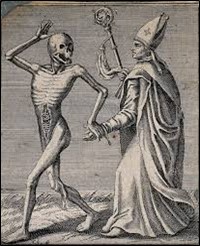
Death Transformed: How the Black Death Impacted the Dying in the 14th Century

            From 1348 to 1350, Europe was consumed by a deadly plague that left one-third to one-half of the population dead. All aspects of society at the time were impacted in some way by a large number of deaths. People lived in fear of this invisible foe, bodies littered the streets, resulting from the overwhelming amount of death all at once. Cemeteries and churches could not continue traditional ways of burying the dead and death was no longer celebrated as a community event with friends and family. Bodies were collected from houses and from the streets and buried in mass graves, with no bells, no singing, and no one to accompany the dead as they were buried in their final resting place. Sometimes bodies remained at the place of death for days until the body collector eventually reached that part of town, the smell of rotting corpses could be smelled across the city. The dying suffered alone, friends, family, and even doctors were too afraid to be in contact with the infected, no priests would visit for last confessions and the infected would die with no one at their side. How did the Black Death impact the practices and experiences surrounding death? This essay will argue the Black Death dehumanized the traditional funerary practices, methods of handling the dead, and the experiences of the dying in society. The Black Death disrupted the normal functions surrounding death by no longer allowing for funerary traditions and as a result, new methods of handling and burying the dead were practiced. The abandonment of friends and family as the dying suffered added to the dehumanization of society’s experience as a whole. The term dehumanizing is used in this context to show how the infected were treated like animals and their bodies were disposed of in inhuman ways that would be considered criminal in the present time.    

The Black Death, also known as the bubonic plague, was one of the deadliest pandemics in human history. It is estimated that the disease killed one-third to half of the population in Europe during the 14th century (Horrox) from 1348-1350, and its impact on the population and treatment of the dead was significant and important to be researched. The historiography of the Black Death has been shaped by various factors, including the availability of primary sources, and the methodological approaches of historians from secondary sources. Although these sources have various points and information they come together for supporting information. 

The first article that explores the gruesome realities of the Black Death is “The Black Death in English Towns” by author Richard Britnell. This article offers a glimpse into the horrors of the Black Death, from the mass graves that were used to dispose of the bodies of the dead to the role of “body collectors” who were tasked with gathering the corpses and disposing of them. The author explains the dangers the “body collectors” faced and the horrific jobs they were expected to complete. In this article, the methodologies of archeology and social history, are shown from the included examples of how the dead were collected and buried and how society adapted to a large number of dead. In the second source “The Politics of Burial in Late Medieval Hereford” written by Ian Forrest, the author expands on how the social and cultural development of burials was impacted because of the Black Death. The religious practices that impacted how bodies were buried during this time of great death are also included in the article.   The author includes information on how the large number of bodies piled in the cities and families abandoning each other became the new normalcy in cities.

The third secondary source “Plague Violence and Abandonment from the Black Death to the Early Modern Period,” by author Sam Cohen, examines the ways in which the sick and dying were abandoned as the fear of the plague grew and the violence created between family members tore society apart from within. The article also includes social methodology examples, of the violence in society, the refusal by doctors to treat the sick, and the abandonment of loved ones caused no hope of traditional burials and funerary practices. The final article, “The Black Death, 1348”, written by John Carey on Eyewitness to History, provides a variety of information on the topics surrounding the responses to the Plague. Further information on the ways bodies were disposed of and the social responses to the impending danger, inform the readers why there was no concern for the health status of neighbors, friends, and sometimes family members as well. Again like the other articles this one contains archeological and social methodologies are included in this article.

All four secondary sources contribute to the overall thesis of the paper, providing information that the plague impacted the ways in which society dealt with death during the plague and how it affected the many principles that contributed to death. These principles include the new methods of burying the dead, and how the experiences of the dying were no longer peaceful because they were suffering alone and believed to be dying with sin. I agree with the author’s overall thesis and points because it contributes to the thesis of this paper however, the only holes I have found were small the amount of information on the experiences of the dying moments before death and how the stress of giving confession before death was so important to the citizens, along with the hopes of a “good death” not being possible during this time. Although they are secondary sources rather than primary sources it is unrealistic to expect first-hand experiences to be included, however, It would have been helpful to have more general information on how the victims came to terms with the inevitable death and help reinforce the overall thesis. Instead of continuing where they left off, I will fill the holes of important points and information that each article did not include and will reinforce their information with the completed research from the primary sources included in this essay. 

The Black Death impacted traditional funerary practices in society, as a result of a large number of people dying, no longer were services held in the households of the dead for people to come to say their final goodbyes. Traditional gifts were not able to be sent because of fear of transmission through the gifts “No one shall dare or presume to give or send any gift to the house of the deceased,” (Chiappelli, P.197).  No longer were family members attending funerals because of the ordinances preventing them, however, they were too afraid to risk attending, one source noted, “It was rare for bodies of the dead to be accompanied by more than 10 or 12 neighbors to church” (Boccaccio, p. 31). As the death toll started to increase the more the traditional funerary activities changed, no longer mourners or criers to honor the dead. No longer could the sounds of bells be heard or prayer groups be seen, the fear of death had traditional practices in a chokehold, as one author describes the experience, “No prayer, trumpet or bell summoned friends or neighbors to the funeral, nor was massed performed” (Boccaccio, P. 23). The fear of death played a great role in disrupting the normal religious and community traditions.

Regardless, if someone was too scared to leave their house no longer was there any notification that a person has passed, without any bells, tolled, invitations sent, posters hung, or chairs set up in the streets there was no way to know when someone had died as one author points out, “mourners should not gather in the houses of the dead, nor should banners or seats be placed in the streets, nor should other customary observances be present,” no longer was there any way of honoring the death of a friend or family member, even the customary religious practices were also provoked, instead “crowds should not be invited, but instead, people should pray for the dead and attend vigil and mass”(Muisis, P. 53). The religious practices surrounding death also broke down as a result and other activities were done by living members of society to fill the time normally spend doing religious works.

 Members of society quarantine themselves and blocked out all the death-related obligations of attending funerals, ringing bells, and partaking in mourning groups that they were previously held. The Black Death was impactful on traditional funerary practices that normally brought friends and family together to honor the dead, instead, the accustomed practices were altered as a result of the epidemic, and these experiences as a whole were dehumanizing to all cities struck by the plague across Europe. 

The great plague in Europe during the 14th century resulted in one-third to half the population dead, the traditional methods of burial were unable to keep up with the large number of people dying on a daily basis, and a change in the way of burial was needed. The known tradition of burying loved ones as a family event with friends in attendance was no longer a possibility considering the dangerous circumstances and the great fear of contracting the disease. The conventional way in which bodies were buried was substituted with a more efficient way to account for the dramatically large amount of death. No longer were the dead buried in single graves with other dead family members, instead, mass graves were dug and the bodies of the dead were placed with strangers. Also, as a result, bodies were disposed of in inhumane ways without receiving blessings or last goodbyes from family members. One way of disposal as described by Horrox was, “the townspeople dumped as many of the bodies they could in the sea” (Mussis, P.17). Eventually, of all the people dying the bodies could not be disposed of as quickly because not as many people were working. This caused rotting bodies to be in the streets for days and rather than the corpses of the dead being taken from their houses by a hearse with their families, the bodies were left on the streets until a body collector reached them for pick up. One author explains how the long time between death and burial caused “movement of the bones within the corpse” (Forrest, 1117). This movement was referred to as “Bone Float” and was another side effect of the bodies not being buried in a timely matter.  

Experiencing the large number of bodies in the streets is described by the author Boccaccio, “the bodies of the dead were extracted from their houses and left lying outside their front doors” and “Funeral biers would be sent for and it was by no means rare for one of these biers to be seen with two or three bodies at a time” (Boccaccio, P.32). By the time the body collectors reached the rotting bodies they were not in good shape, Buboes might burst, leaking rancid pus. Flea bites that transmitted the deadly bacteria Yersinia pestis could become infected. The terrible stench of rotting flesh was unable to be blocked out from the nostrils of the collectors. Instead of bodies being buried in caskets like today’s standards, the bodies were exposed to mud and bugs in the soil. One author included, “a third of all burials, whether in one of the trenches or in an ordinary grave was in a coffin”(Britnell, 205). Buried like animals with no “Grave Markers” as the author also mentions, no way of identifying where loved ones were laid to rest. The job was disgusting and dangerous for these body collectors, they knew the risks, however, someone needed to complete the job. Clothing and any belongings from a diseased person could transfer the disease to one of these body collectors, which increased the risk of the job. After the bodies were collected no longer was single graves a possibility because of the sheer amount of bodies needed to be disposed of.

A new way of burying bodies in large trenches rather than singular graves was called “mass graves”. This was described by the chronicler Bocaccio, “when all the graves were full, huge trenches were excavated in the churchyards, new arrivals were placed by the hundreds, each layer of corpses being covered by a thin layer of soil till the trench was filled to the top” (Boccaccio, P. 33). There was also new regulations referred to as ordinances in some cities in Europe, such as Pistoia in 1348. Some of these ordinances were created to affect the way in which people were buried and handled, in Pistoia, “The bodies of the dead should not be removed from the place of death until enclosed in a wooden box” (Chiapelli, P.196). These ordinances were created to stop the stench of the dead to contaminate or infect the person handling them. Other regulations were created in Pistoia regarding the requirements for burials. One requirement created was that “each grave shall be dug two and a half armlengths deep” (Chiapelli, P.196). This was done to stop the stench of the rotting bodies to reach the surface of the ground. The Black Death caused many inhuman ways of transporting and burying bodies to be seen during the 14th-century plague.

The plague during the 14th century caused a wave of fear to encompass all of Europe, the disease was an invisible enemy that could not be seen but, was very much felt. With no one at the bedside of the infected moments before death, the desire for a painless sin-free “good death” was no longer possible for the victims of the Black Death. The hope of the last confession as an attempt to clear the sins of the infected was no longer possible in Europe during the 14th-century Black Death. The fear caused the abandonment of dying friends and family as people search for a safe place to escape the disease. The hope to be cleared of sin was no longer a possibility many of the priests were too afraid to visit the dying, but in some cases, “the priests, panic-stricken, administered the sacraments with fear and trembling” (Mussis, P.22). Not everyone was so lucky, in some parts of Europe many people died without giving a confession, in hopes of having a clean slate while entering the afterlife.

Not only were priests abandoning the sick and their duties, family, and friends no longer cared for their loved ones, “when one person lay sick in a house no one would come near, even dear friends would hide themselves away” and the children’s cries were loud as one author describes, “Oh father, why have you abandoned me? Mother where have you gone? Do you forget I am your child?” (Mussis, P. 22). Instead of people caring for their neighbors like they once did, they avoided them at all cost. Instead of hiding some people, “formed small communities, living entirely separate from everybody else. They shut themselves up in houses where there were no sick, eating the finest food and drinking the best wine very temperately, avoiding all excess, allowing no news or discussion of death and sickness, and passing the time in music and suchlike pleasures” (Carey, 2020). The ways in which society interacted with one another were altered. In some cases people would have survived if they received some type of help or care from another person, whether it be food or water brought to them, the abandonment aided in the cause of death in some cases. The dying suffered alone with no one at their bedside, and the hope of a “good death” was no longer possible, without family members surrounding the dying members to be made comfortable, the sick often were treated terribly by loved ones who at one time promised to always be there for them, one author described the experience, “the sick are treated like dogs by their families-they give them food and drink, then flee the house” (Heyligen, P. 44). It was a dehumanizing experience for those infected. 

The fear caused by The Black Death increased the abandonment of the dying, the social construct continued to collapse and doctors and physicians would no longer visit the infected and let the disease run its course. Author Sam Cohen includes information on the social breakdown of medical care during the plague, “the same connection between ferocious contagion and the social consequences, causing physicians not to visit the stricken” (Cohen, 2017). Living and dying were the same thing during the Black Death, everyone suffered regardless of being infected or not, the fear caused abandonment from loved ones, and the chances of receiving a final confession in hopes of a traditional “good death” was unlikely, the social breakdown of no one caring for other and medical personal abandoning their duties of helping the sick aided in the death toll being so tremendous. The abandonment added to the inhumanity of the experiences caused by The Black Death in all parts of society.

The period of the Black Death in the 14th century was a dehumanizing experience for all members of society. The traditional funerary practices and methods of handling the dead were no longer a possibility. The great number of people sick and dying prevented community get-togethers to honor the lives of those who passed, instead, people were buried without friends or family in attendance. A large number of dying caused “mass graves” to be the new method for burial because it was a faster way of burying a large number of corpses at once and was more space efficient, now three to four bodies could fit the same space of one traditional grave. The fear of the plague caused the abandonment of friends and family in society, the infected died alone without doctors tending to them or priests present to clear their sins before death. The main points contribute to the argument that the Black Death was a dehumanizing experience for those who lived in Europe during the epidemic.   

References

Britnell, R. (1994). The black death in English towns. Urban history, 21(2), 195–210. http://www.jstor.org/stable/44613912

Carey, J. “the black death, 1348.” eyewitness to history. Last modified august 25, 2020.  http://www.eyewitnesstohistory.com/plague.htm

Cohn, S. (2017). Plague violence and abandonment from the black death to the early modern period. Annales de démographie historique, 2 (134), 39–61. https://www.jstor.org/stable/26627248

Forrest, I. (2010). The politics of burial in late medieval hereford. The english historical review, 125(516), 1110–1138. http://www.jstor.org/stable/40963124

Book Review: Britain Begins by Barry Cunliffe

The author tells the story here of both England and Ireland because they cannot be separated easily.  Since the very beginning of humans’ time in that part of the world, both lands and cultures were connected.  It is that united history that leads the way in this incredible story of the sometimes icy, sometimes verdant northern reaches of civilization.

The reader will find here exciting and revealing chapters in the history of movements throughout the pre-historic, Celtic, Roman, Anglo-Saxon, Norman, and modern times of the isles.  There are clear and helpful illustrations, and there is enough information here to fill any semester-long course on the history of England, or rather Albion, as it was first called by those who were using formal language.

The author paints rich stories onto a canvas of what was once a chilly ice-covered region and which came to be a world power.  The author makes use of language, tools, science, history, and other major fields to tell about the different eras of the isles.

The years of the Celts are very intriguing ones, indeed.  Cunliffe speaks of the idea that there were two entirely distinct waves of movement among them—including Iberia, Britain, Ireland, Scotland, Brittany, and Wales (pp. 248-249).  He also speaks to the idea that the Celts started in the north and later in one era migrated as a large group southward to Brittany (p. 428).  He has a number of additional theories related to this and other good examples of “movement.”

Another very interesting idea is that language, culture, and tools were shared up and down the west coast of Europe and up between the isles—a sort of “Atlantic” civilization (p. 344) emerging over time among the Celts.  This explains linguistic and other hints pointing to migrations and movements up and down the coast—as opposed to some earlier notions of “Spanish” Celts trudging only northward to the further reaches of what came to be the UK.

Cunliffe talks about the notion of Celts moving southward—starting in Scotland and Ireland and coming down into Europe along the Atlantic.  The author uses many different sorts of proof to advance this theory, at the same time he asks additional questions.    

Teachers will be able to use this big book in a variety of ways.  First and foremost, it is important personal reading for any teacher interested in social studies in general and in the history of English-speaking people specifically.  Understanding the history of northwest Europe is helpful in understanding the intricate connections among the Celts and Europeans, the British and the Irish, and the Scandinavian and Germanic stock among the English.

Another important use is for helping students understand the power of “movement” among peoples, the conflicts created and agreements forged, and the resulting cultural and linguistic differences and similarities resulting from peoples coming into contact.  The notion of movement relates also to the traveling ideas, tools, traditions, names, weapons, foods, trades, and books, later.  Any standards and benchmarks related to movement are connected through teacher use of this book as a reference and resource.

Yet another good use of this volume is a textbook for a college-level course in history, of course.  Because it covers so very much information, it could also be used as a summer reading project for advanced rising college freshman students needing timely non-fiction reading. 

Those four uses of the book can be joined by another one I propose here: coffee table teaser.  It would be interesting to set this in plain view and see who would pick it up and want to start reading it.  It has a beautiful green cover.  There are in fact many photos, drawings, and illustrations inside.  The cover just might draw in some unsuspecting readers.

Teaching and Learning Medievalism in Popular Culture as History Education

Mark Helmsing and Andrew Vardas-Doane
George Mason University, Fairfax VA

Although the period in human history we call the medieval period ended around the year 1500 CE, we are surrounded by medievalism in our lives today. For most history and social studies educators, a claim such as this does not make sense. We accept the end of the medieval period with the Renaissance, ushering in what we teach our students as the early modern period in our human history. Historians and educators position the medieval period, as a “middle” period used to demarcate Western history, occurs after the end of ancient history and before the period in which we currently live (Arnold, 2008). And yet, as we explain in this paper, medievalism—the icons, images, tropes, and representations of how humans think of that time period—permeates our lives today. Learning to understand medievalism in relation to the broadly defined medieval period and from the specific construct of the European Middle Ages enables our students to develop a sharper sense of periodization and significance within their broader historical thinking.

Because of the elision between fact and fiction, reality and fantasy, history and social studies educators should take seriously the need to point out medievalism with their students and strive to make more visible and explicit the historical inspiration for such representations. In the first half of this article we provide some ways of thinking about medievalism. In the second half of this article we take these aspects of historical thinking related to medievalism and examine how they work in a popular video game and film franchise, Assassin’s Creed, a form of medieval world building that is popular amongst adolescents and young adults (Gilbert, 2017; Hammar, 2017). Our aim with this article to encourage educators to consider some implications for history and social studies educators related to the intersections of popular culture and medievalism as history education.

Approaching Medievalism for Historical Thinking

To assume that the medieval is irrelevant or antiquated, or to discount how medievalism effects our contemporary thought and shapes so many images and ideas in popular culture, is to neglect the significance of properly understanding and accounting for historical periodization (Cole & Smith, 2010). One may think that historical periodization is cut-and-dry as a commonplace of historical thinking. Say “medieval” and we think of courtly love, knights in shining armor, kings and queens residing in large castles (often with moats and drawbridges). My (Author 1) thinking about medievalism as an issue worthy of considering in relation to historical thinking occurred in early 2017 when I spent a semester away from my university duties teaching 7th graders. The topic of the HBO television series Game of Thrones came up in conversation one day and a student remarked that he thought “it must have been awful living back then.” It took me a few seconds to realize that he was engaging in two aspects of historical thinking. First, he assumed that the time period in which the Game of Thrones world is set was a long time ago, ostensibly linking it to the history of the Middle Ages. Secondly, and more importantly (or pressingly, depending on how you look at it), the student was conflating the imaginary fantasy world of Game of Thrones—and entirely fictional world and text—with ‘actually existing’ medieval history from real life. When I pressed him on the matter he said that of course he knew the dragons and White Walkers were not real, but that he assumed what he saw on the television series was what life was like “back then, with all of the kings and stuff.” This conversation set me about to think about what it is we may need to be more explicit about in our curriculum and pedagogy to help students not only to separate fact from fiction, works of fantasy from works of history, but also to help our students be more perspicacious and attentive to when, how, and why aspects of medievalism appear to us throughout art, literature, music, film, theater, and popular culture at large. In this section we offer some reasons for why history and social studies educators should investigate (both professionally for their own historical thinking and with their students) aspects of medievalism and the medieval world.

Examples of Encountering Medievalism in Popular Culture

            First, we need to help our students see that we engage with medievalism when we consume media about actually existing persons and events from the medieval period, as in Kingdom of Heaven (2005), a feature film about the Crusades in the 12th century, or in Pippin (1972/2013), a Broadway musical about the eldest son of Charlemagne in the 8th and 9th centuries. Yet we also engage with medievalism when we consume media that is speculative fiction and fantasies using icons, images, tropes, and representations of the medieval world, as in Game of Thrones, a massively popular book and television series about feudal royal houses warring with each other, or in King Arthur: Legend of the Sword (2017), only the latest of several feature films inspired by the Arthurian legends of Camelot, the Round Table, and the Lady in the Lake.

            Secondly, we and our students engage with medievalism when we encounter phrases, concepts, and iconographies that remain embedded in Western thought long after the end of the medieval period. For example, when teaching about torture that occurred in the Abu Ghraib prison in Iraq or the Guantánamo Bay detention camp in Cuba, we may describe documented examples of torture as “medieval” in their barbarity, despite the fact that much of what we think of as medieval torture did not actually exist until the Tudor period that began with the end of medievalism in the 1500s (Matthews, 2015). To use another example, our notions of chivalry, courtship, and courtly love are concepts that took on distinctive forms as part of a complex code of rules and conduct in the medieval period (Emery & Utz, 2017). These concepts remain in our thought today, as evidenced by news headlines such as “Chivalry isn’t dead” (Fuller-Hall, 2018) and “Stanford professor puts desire in a medieval context” (Marian, 2013). Educators can select some medieval phrases, concepts, and iconographies for students to identify in our current social and political discourse, helping students map these concepts back to the actually existing historical medieval world. For example, in their edited volume Medievalism: Key Critical Terms, Emery and Utz (2017) survey the significance of terms such as feast, gothic, heresy, humor, love, purity, and troubadour, connecting how these concepts existed within the medieval world and how they have maintained their medieval legacy in our contemporary cultures. In investigating these and other concepts of the medieval, students are able to examine the continuity and change of the history of medieval thought in our world. In some cases, regrettably, medieval concepts, ideas, and iconography are taken up to promote repellant nationalist, racist, and supremacist beliefs, such as the adoption of the Templar Knights and runes with Norse warrior mythology and other medieval marks used to signify racial purity by white supremacists (Devega, 2017; Livingstone, 2017; Weill, 2018). Such uses and abuses should also be interrogated and critiqued in history and social studies education, ranging from how we describe something as violent or regressive as being “medieval” to invoking language and associations to the Crusades as Holy Wars with jihads and ISIS/ISIL.

            Thirdly, educators and students should realize we place ourselves within contemporary medieval worlds that we often visit in the present, such as medieval fairs and Renaissance fairs or “Ren Fests,” which are anachronistic for many reasons, least of which is that they visually blur and blend the High Middle Ages with Elizabethan England and the European Renaissance. I (Author 1) studied the history of the Middle Ages as a sixth-grade student in a project-based social studies unit where I and my fellow classmates created and hosted a “medieval faire” for the entire school (my contribution was learning to walk on stilts and recite ballads and folk poems). A popular choice for some high school history and/or British literature classes, Renaissance fairs allow visitors to dress in robes, boots, and bodices and converse with strolling troubadours and jolly court jesters. When I (Author 1) taught high school social studies and English courses, I chaperoned a number of field trips to such fairs, often cringing at what I perceived as historically inaccurate cross-periodizations of Elizabethan England, medieval France, and 17th century swashbuckling seafarers and pirates. Nonetheless, watching students marvel at medieval blacksmiths and singing troubadours may make up for the lack of precise periodization.

We also consume medievalism when we cheer on jousting knights while feasting on drumsticks and drinking frothy ales at one of the Medieval Times Dinner and TournamentÒ locations throughout Canada and the United States, notable for their scripted performance’s references to the medieval worlds of the Iberian Peninsula in the characters of King Don Carlos, Princes Catalina, and Lord Ulrich. These and other examples of medieval worldbuilding at public events and themed amusement parks offer ample opportunities for educators to have their students challenge the accuracy, veracity, and legibility of medieval representations in these spaces, calling upon students to think critically (and historically) about how such places and spaces evoke and ‘use’ medievalism.

             Finally, medievalism and fantasy as a genre for fiction and popular culture is fully entangled. The many dragons, elves, and giants in the fantasy franchise Dungeons & DragonsÒ have no existing evidence in historical fact, but the bards, monks, and paladins of the fantasy role-playing game are based on actually existing classes of people in the medieval period. Indeed, paladins, (with a name that derives from Palantine, a Latin word for servant) were high-ranking warriors in Charlemagne’s court (Freeman, 2017). The paladins did not, however, roll multi-sided dice when engaged in battle to the best of historians’ knowledge. Because representations of fire-breathing dragons often appear in literature and other mass media in landscapes occupied with castles, villages, dense forests, and feudal farms and fields. In the following section, we investigate the play of the medieval in one example: Assassin’s Creed.

Overview of Assassin’s Creed

With a global gaming market of $70.6 billion in 2012 to a soaring $121.7 in 2017, the market for games and gamers is climbing at an exponential rate. Projections for 2021 peak at over $180 billion dollars spent worldwide. Of the games produced and developed, many carry a medieval theme that draws millions of players each year. One game, Assassin’s Creed serves as an example of how our students may confront medievalism in their everyday lives. Operating as a medieval historical and science fiction twist on real-world events, Assassin’s Creed has sparked a franchise that as of September 2016 has sold over 100 million copies (Makuch, 2016). The latest of ten installments, Assassin’s Creed: Origins ranked as the eighth bestselling game of 2017. Therefore, based upon these numbers and our anecdotal experience of having middle and high school students express their fandom for the video games series and its film adaptation, we use it as an example of popular culture primed for some historical thinking about medievalism.

Plot Structure of Assassin’s Creed

            Released in 2007, the first Assassin’s Creed game features a character, Desmond Miles, who is kidnapped by Absergo Industries. This multinational corporate conglomerate forces Desmond to use a device called an animus to (re)live the memories of his ancestors through memories stored in his genes. He is thrown back in time to the twelfth century following the Third Crusade to Masyaf Castle (an actual medieval castle in present-day Syria) where he must live out the life of his ancestor who belongs to the Assassin Order. The plot revolves around a historical conflict between the Assassins and the Knights Templar, suggesting that students actively confront historical markers and significance about the Knights Templar, the Crusades, and Holy Wars in medieval Europe and what we now identify as the Middle East. In the video game, the goal of the Templars is to create world peace by subjugating the human race who they believe are incapable of ruling themselves without barbarism. The assassins fight against this stripping of free will and believe in the progression of new ideas and individuality. As a character in the game, the player progresses the storyline of his forefather, learning more about the history of the world and the conflict between the two factions (IGN, 2012).

As the player continues through the game, Desmond finds out Absergo Industries is the modern face of the Knights Templar who are attempting to have Desmond lead them to ancient objects of power called Pieces of Eden. These artifacts were created by a primeval race of Homo sapiens divinus, a highly advanced humanoid species. This race, termed the Isu, genetically modified the homo genus species in order to create a force of slave-labor. Using the Pieces of Eden, devices interacting with neurotransmitters in the minds of humans, they controlled humans until Adam and Eve escaped and began humanity as it is known today. The epic battle between the Templars and Assassin Order exists as a repercussion to the fall of the Isu and the eventual use of Pieces of Eden by humans against humans. The Templars, believing freedom leads to chaos, hope to use the artifacts to eliminate autonomy. The Assassins exist to prevent that dream from becoming a reality (Assassin’s Creed Wiki, 2018).

Problematizing the Knights Templar in Assassin’s Creed

Using the Assassin’s Creed plotline as a teaching tool for exploring medievalism encourages teachers and students to enact a critical media literacy with existing historical thinking skills and approaches. Throughout the gameplay, many deaths of actually existing historical figures are changed to assassinations to keep in with the themed narrative of the storyline. Acknowledging this plot device as an adaptation of history helps students identify historical errors, but also to be alert to when popular culture gets the history of the Middle Ages right and when it gets it wrong. Shifting students’ historical perspectives to view a real military order, the Knights Templar, portrayed as a power-hungry collection of world dominating fanatics can confuse and inspire conspiracy where no evidence is evident. The disbanding of the Knights Templars in 1312 at the behest of Pope Clement V marks the end of their historical timeline, despite, however, their continued presence in (questionable) usage amongst contemporary subgroups and populations as mentioned earlier in this article. This, unsurprisingly, takes on what we deem to be a concerningly problematic stance within the video game. The assassinations necessary to complete the game are made out to be necessary evils in order to protect the human race from the Templars. The historical record from the Middle Ages informs us that the real ‘assassins’ were a small Muslim Shiite sect, the Nizari Ismailis. Known as heretics by both Sunnis and Shiites, this group’s origin can be traced to immediately preceding the First Crusade during the crisis of the Fatamid Caliphate (Liebel, 2009).

Contextualizing History in Assassin’s Creed

Almost all the historical content in the movie is a complete fabrication. Claims that major players in history such as Alexander the Great, Napoleon Bonaparte, Mahatma Gandhi, and Genghis Khan used Pieces of Eden to further their agendas can leave players questioning their understanding of historical reality. There are, however, two accurate representations that can be used in the social studies classroom to help further students’ understanding of medieval times and see medievalism in action.

First, as mentioned previously, students can learn about the real Masyaf Castle. This castle exists in partial ruin and is in modern day Syria near the Mediterranean Sea. It served as a base of operations of sorts for a guild of assassins identified as the Nizari Ismailis during and following the Third Crusade (1189-1192 CE). The game’s developers worked tirelessly to make their depictions of main cities (Jerusalem, Acre, and Damascus) as accurate as possible. Ubisoft hired a team of historians to advise on their gameplay and narrativization to make sure the layout and worldbuilding appear historically suitable. Using the game as an exploration and inquiry tool would be an application of critical media literacy for exploring medievalism in popular culture.

Standing alone without an educator to intervene in offering some historical contextualization, Assassin’s Creed is, unsurprisingly, a weak classroom resource for history and social studies educators. As an example of medievalism for our students in the 21st century, it offers much to consider, deconstruct, and critique. We argue the game can be used as a springboard for students interested in history resulting from their engagement in the game’s fictitious portrayals of historical events through elements of historical fantasy and fiction. We urge educators to be cautious in discounting the game’s appeal to student, suggesting instead that educators become more alert to which aspects of medievalism appeal to our students and to find out how and why. Expanding upon this foundation and using the inaccurate storyline as a method for introducing historical accuracies could be exciting for students. With ten games set in time periods ranging from Ptolemaic Egypt to the American and French Revolutions to the Industrial Revolution and the Russian Revolution, a curriculum created around something akin to “The Truth Behind the Assassin’s Creed Histories” could be an engaging and productive avenue for educators. The curriculum would have the added benefit of exploring historically accurate renditions of cities such as London, Venice, Florence, Alexandria, Memphis, Jerusalem, Spain, Istanbul, and Paris.

In closing, we offer a final thought from medievalist Jeffrey Jerome Cohen. The idea of the medieval and its immortal memorialization and representation across our cultural, political, and experiential encounters in everyday life can cultivate in students the idea that the medieval is “alluringly strange” and also “discomfortingly familiar” (Cohen, 2000, p. 3). It is something we hope will keep our students’ interests in the past alive.

References

Arnold, J.H. (2008). What is medieval history? Cambridge, MA: Polity Press.

Assassin’s Creed Wiki. (2018). Retrieved from http://assassinscreed.wikia.com/wiki/Assassin%27s_Creed_Wiki

Cohen, J.J. (Ed.) (2000). The postcolonial Middle Ages. New York, NY: Palgrave Macmillan.

Cole, A. & Smith, D.V. (Eds.) (2010). The legitimacy of the Middle Ages: On the unwritten history of theory. Durham, NC: Duke University Press.

Devega, C. (2017, December 1). Alt-right catches knight fever—but medieval scholars strike back. Salon. Online.

Emery, E. & Utz, R. (2017). Medievalism: Key critical terms. Rochester, NY: D.S. Brewer.

Freeman, E. (2017). Charles the Great, or just plain Charles: Was Charlemagne a great medieval leader? Agora, 52(1), 10-19.

Fuller-Hall, S. (2018, February 13). Chivalry isn’t dead. The Sundial. Online.

Gilbert, L. (2017). “The past is your playground”: The challenges and possibilities of Assassin’s Creed: Syndicate for social education. Theory & Research in Social Education, 45(1), 145-155.

Hammar, E.L. (2017).  Counter-hegemonic commemorative play: Marginalized pasts and the politics of memory in the digital game Assassin’s Creed: Freedom Cry. Rethinking History, 21(3), 372-395.

IGN. (2012, October 26). Assassin’s Creed in 5 minutes [Video file]. Retrieved from https://www.youtube.com/watch?v=Rnfg1rDmNIw

Kain, E. (2018, January 19). The best-selling video games of 2017. Retrieved from https://www.forbes.com/sites/erikkain/2018/01/19/the-best-selling-video-games-of-2017/#31d639366226

Kim, D. (2017, August 28). Teaching Medieval Studies in a time of white supremacy. In the Middle. Online.

Liebl, V. (2009). The caliphate. Middle Eastern Studies, 45(3), 373-391.

Livingstone, J. (2017, August 15). Racism, medievalism, and the white supremacists of Charlottesville. The New Republic. Online.

Makuch, E. (2016). Assassin’s Creed Franchise Reaches 100 Million Copies Sold. Retrieved from https://www.gamespot.com/articles/assassins-creed-franchise-reaches-100-million-copi/1100-6443544/

Marian, V. (2013, February 11). Stanford professor puts desire in a medieval context. The Stanford Report. Online.

Matthews, D. (2015). Medievalism: A critical history. Rochester, NY: D.S. Brewer.

Sapieha, C. (2015). How historians and artists crafted a ‘highly authentic impression’ of London for Assassin’s Creed Syndicate. Retrieved from https://business.financialpost.com/technology/gaming/how-historians-and-artists-crafted-a-highly-authentic-impression-of-london-for-assassins-creed-syndicate Weill, K. (2018, July 27). The alt-right is taking over Renaissance fairs. Daily Beast. Online.