
New Jersey Council for the Social Studies
Engaging High School Students in Global Civic Education Lessons in U.S. History
The relationship between the individual and the state is present in every country, society, and civilization. Relevant questions about individual liberty, civic engagement, government authority, equality and justice, and protection are important for every demographic group in the population. In your teaching of World History, consider the examples and questions provided below that should be familiar to students in the history of the United States with application to the experiences of others around the world.
These civic activities are designed to present civics in a global context as civic education happens in every country. The design is flexible regarding using one of the activities, allowing students to explore multiple activities in groups, and as a lesson for a substitute teacher. The lessons are free, although a donation to the New Jersey Council for the Social Studies is greatly appreciated. www.njcss.org
Era 15 Contemporary United States: International Policies (1970–Today)
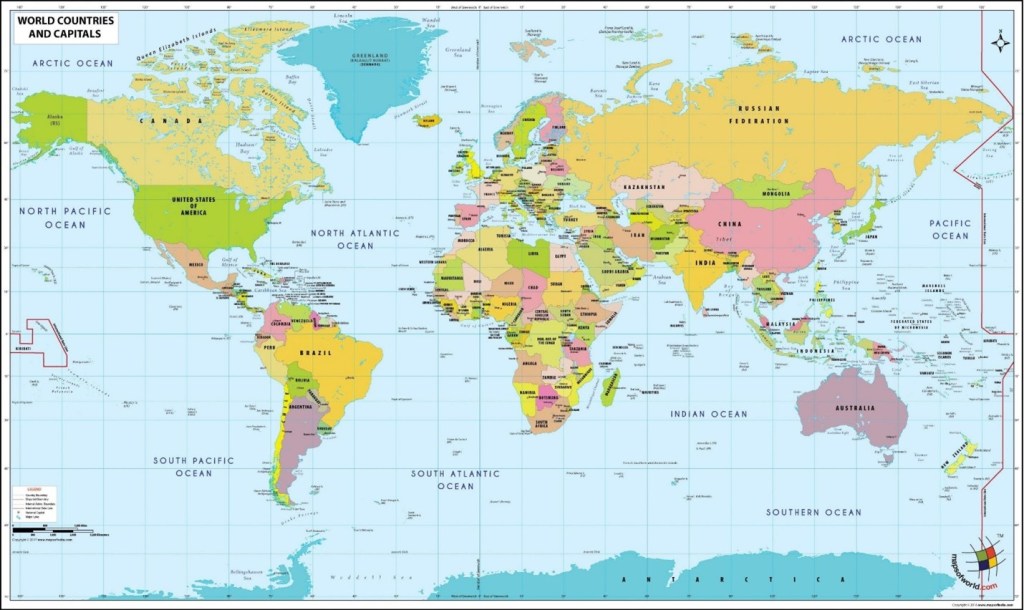
The middle of the 20th century marks the foundation of the transformation of the United States into a world power. In this era the United States developed alliances, promoted free trade agreements, advocated for human rights, and assisted developing countries. Toward the end of the century, the United States was a target of terrorist organizations, had and increasing national debt, and saw its power as a world leader challenged by China and Russia. As the United States entered the 21st century, its role as a leader in the international community was questioned by the Republican Party,
Activity #1: Department of Homeland Security in the United Kingdom and the United States
In 2026, the Domesday Clock was set at 85 seconds to midnight, the end of the civilized world as we know it.The primary reasons for this are the threats of a nuclear arms race, climate change, and bioterrorism.As a result, every major country is re-evaluating its national security plans at the domestic and international level.
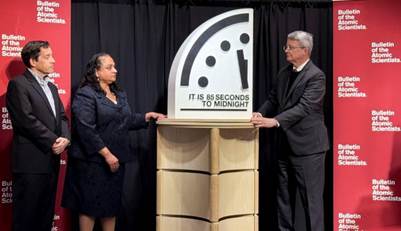
“Doomsday Clock on Jan. 27, 2026.Reuters/Kevin Fogarty
United States
In your United States History classes, you have likely discussed national security strategies since the end of World War II in 1945. These include containment, brinkmanship NSC-68, co-existence, Mutually Assured Destruction collective security, human rights, and the United States as the world’s policeman. Each of these policies have been rigorously debated within the government and in public opinion. The debate is often framed in the context of isolationism (U.S. has the military strength to protect itself) and internationalism (U.S. needs the support of alliances and international organizations). The central part of America’s new strategy is our economic strength. The 2025 National Security Strategy rightly asserts that “strength is the best deterrent,” and elevates economic vitality as central to that strength.
The policy announced by the Trump administration in December 2025 diminishes the threat of Russia and China as a top priority. “Mass migration” is deemed to be the major external threat to the United States—more than China, Russia, or terrorism. The document makes clear that the divide is political between transatlantic liberals and authoritarians.
The Western Hemisphere is the new priority and immigration is elevated to a major national security concern. The U.S. military will focus on the Western Hemisphere. The rules of international law are considered less important than the interests of peace, diplomacy, or human rights. Cybersecurity is considered a major threat and the strategy of the United States will become dependent on the private sector.
It is difficult to identify an exact amount for spending by Homeland Security in the United States because of the increased emphasis on immigration. We will use the number of $332 billion or 2.9% of GDP as a comparison to the 2.5% spent by the United Kingdom.
United Kingdom
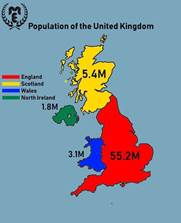
The population of the United Kingdom is about 70 million. In addition, the United Kingdom also includes territories around the globe. National security threats include terrorism, organized immigration crime, cybersecurity, bioterrorism, exposure to nuclear radiation, and effects from climate change. The United Kingdom in 2025 announced a new long-range security strategy for homeland security at a cost of 2.5% of GDP or about 62 billion euros annually.
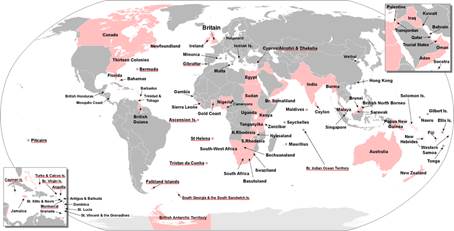
The strategy involves a network of alliances to address these threats. The recent announcement by the United States to acquire Greenland by purchase or military action has caused the United Kingdom and other NATO countries to increase financial investments in military equipment, NATO, and other regional alliances. The Calais Group is committed to preventing organized immigration crime, the Joint Migration Taskforce addresses human trafficking, and the Border Security Pact targets smuggling. Homeland security for the United Kingdom also includes agreements promoting economic and financial stability regarding technology, energy, access to minerals, and renewable energy. Russia, China, North Korea, and Iraq are viewed as the biggest threats to homeland security.
The priorities for Homeland Security in the United Kingdom include the following:
- Identify and prevent terrorist actors and criminal gangs from entering.
- Increased investment in armed forces.
- Strengthen existing alliances (NATO, AUKUS, and GCAP) and form new ones.
- Pursue deeper trade, technology, and security agreements with the United States, European Union, and India.
- Protect its underwater fiber optic network and natural gas pipelines.
- The UK has created a new Border Security Command to secure its borders.
Questions:
- What are the advantages and disadvantages of the new national security strategies by the United States and the United Kingdom?
- How dependent is each country on economic growth to support its strategy?
- How significant are the lessons of history regarding national security based on internationalism through alliances and isolationism through dependence on geography and military strength?
- Is one strategy better poised for success than the other or are both strategies poised for disappointment or failure?
Breaking Down Trump’s 2025 National Security Strategy (Brookings)
Department of Homeland Security Budget (USA Spending)
National Security Strategy: 2025: Security for the British People in a Dangerous World (UK Cabinet Office)
UK Defense Spending (House of Commons Library)
Activity #2: Foreign Aid in Africa: Japan and Norway
Japan
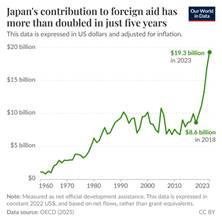
Japan provides significant economic aid to Africa. In 2018, Japan gave $8.6 billion and is currently giving $20 billion. Japan’s foreign aid budget is equal to 0.44% of its gross national income, which is almost double the 0.24% from the United States.
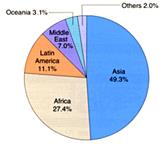
The Japanese government values its relationship with Africa. It understands the importance of rare earth minerals, specifically lithium, nickel, and cobalt. In August 2023 Japan signed contracts with Namibia, Angola, and the Democratic Republic of the Congo (DRC) to secure minerals. The 54 African countries account for more than a quarter of the 193 members in the United Nations. Japan’s foreign policy values free and open markets based on the rule of law, which is viewed as a deterrent to the coercion used by China in Africa.
Norway
Norway’s oil reserves enabled it to maintain financial assets in its Wealth Management Fund. The fund is valued at $1.8 trillion (USD) Norway contributes 3.1 billion krone to the African Development Fund. There are about 30 Western and non-Western countries contributing to this fund annually, including some countries in Africa. Norway places a high priority on providing Africa’s 300 million people with access to electricity, potable water, and food,. In addition, Norway is actively providing financial resources for sustainable living, women’s rights, education, and human rights.
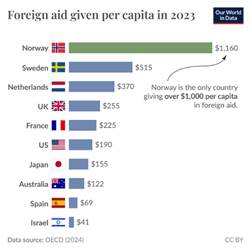
On a per capita basis, Norwegians contribute $1,160, and Japan contributes $155. The United States was contributing $190 per person before its recent withdrawal of funds in 2025.
Norway’s foreign policy includes the following:
- Multilateral and regional cooperation: Strengthen cooperation in multilateral forums, enhance African representation, and continue close collaboration with the AU (African Union);
- Security and peace efforts: Support African-led peace initiatives, integrate gender perspectives in decision-making, and bolster cooperation with the AU and UN on security;
- Democracy, human rights, and gender equality: Promote democracy, human rights, and gender equality through civil society engagement, justice reform, and educational access;
- Business, clean energy, and knowledge: Boost economic cooperation, promote Norwegian solutions, and support renewable energy development in African markets; and
- Climate, environment, food security, and health: Collaborate on climate action, sustainable food systems, and resilient health systems to address environmental and health challenges.
Questions:
- How significant are the foreign policy differences of investment in Africa between Japan, and Norway?
- How are the foreign policy initiatives of China, Russia, and the United States influencing the foreign policy of Japan?
- Why do you think the people of Japan are supporting additional investment in Africa compared to reducing tariffs or improving the quality of life for the people of Japan?
- Which foreign policy strategy is aligned with your values?
- In 2000, the United Nations adopted ambitious Millennial Development Goals which were on target until the global financial crisis of 2008. Is it possible in today’s political and economic environment to return to them and improve the quality of life for people in the global South?
Japan’s Strategic Interests in Africa
Countering China’s Expansionism: Japan-India Synergy in Africa Amid U.S. Retrenchment
Norway Gives More Foreign Aid Per Capita Than any other OCED Country
Norway to Increase Support for African Development Fund
Strategy for Norwegian Engagement with African Countries
Activity #3: Separation of Powers: North Korea and the United States
North Korea
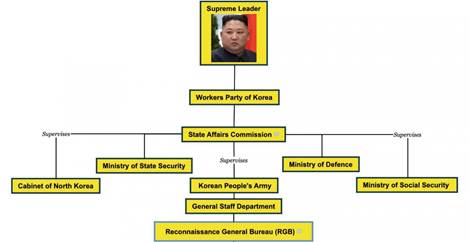
Authoritarian governments also have constitutions. Dictatorships may divide power between the supreme ruler, political party, army, or another group. Democracies may divide power between legislative and judicial branches with the chief executive. The people and media may also have power in a society. A constitution reflects the values of the State and is still one of the best ways to understand how it manages problems and provides for its citizens.
The KPG (Korean Provisional Government) was organized in 1919 and was a government in exile as a result of Japan’s imperialism. It ended on August 15, 1945 with the surrender of Japan and the Republic of Korea became the new government. A new constitution was ratified on August 15, 1948 and Syngman Rhee was elected as President.After the occupation of Korea during World War II ended, Korea adopted a constitution in 1948. Power was given to the SPA (Supreme People’s Assembly) This Assembly was given the authority to enact basic domestic and foreign policies; create a Presidium to operate on its behalf when the Assembly was not in session; approve laws; revise and amend the Constitution; approve the budget; elect or recall a Prime Minister; and appoint officials such as the Chief Justice of the Supreme Court.
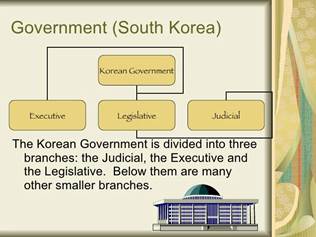
The 1972 Constitution stated that the Democratic People’s Republic of Korea (DPRK) was an independent socialist state representing all the Korean people. The constitution is based on democratic centralism, which states that citizens must obey all the decisions of their elected leaders. There is no system of checks and balances, only submission and loyalty. The Constitution of North Korea gives absolute power to the Workers’ Party. It follows the ‘juche’ ideology of self-reliance and is above the law. It fosters Korean nationalism and requires absolute loyalty to the ruler, currently Kim Jong Il. The Constitution values the superiority of the State over its citizens. In theory, the cabinet, military, and party check each other, although the loyalty of the military to Kim Jong Il has ended this system of checks and balances. These three groups could conceivably fight one another in a civil war for control or support each other, which they currently are doing.
United States
The Constitution of the Republic of Korea (South Korea) has been amended nine times since 1948 and reflects six republics which reflect political changes. The Constitution of The Democratic People’s Republic of Korea (North Korea) was completely replaced in 1972 and this constitution has had significant amendments. In contrast, the Constitution of the United States has made changes through 27 amendments and judicial decisions by the Supreme Court. The Constitution of the United States was meant to be flexible.
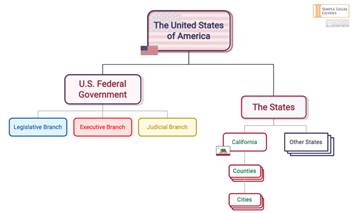
The powers of government in the United States are also divided between the states and the federal government and between the three branches of the federal government. The framework of the constitution specifically limits the power of the national government and allows the three branches of government to ‘check and balance’ the power of the legislative, executive, and judicial branches.
The principle of popular sovereignty gives power to the people to make changes to their government every two years through the election of their representatives to Congress and the election of one-third of their senators. Currently, the United States has a two-party system with the Republican Party and democratic Party as the two major political parties, Although inn theory, the individual members in each party have independence and vote on the interests of the people they represent; in practice they form caucuses or alliances supporting an ideology or regional interest. Currently, the members of the Republican Party are demonstrating loyalty to the agenda of President Trump and the members of the Democratic Party have caucuses representing different views on immigration, the economy, health care, and the role of the federal government.
Questions:
- How important is the role of the political party to the stability of the government?
- Are there inherent weaknesses in the Constitution of The Republic of Korea (South Korea) and the Democratic People’s Republic of Korea (North Korea)?
- How important is a strong executive to a stable government?
- How has President Trump increased the authority of the executive Branch more than previous presidents? (party loyalty, the media, support from the Supreme Court, etc.)
The Constitution of North Korea: Its Changes and Implications
Foreign Relations of the United States, 1948, The Far East and Australasia
Case Studies: Checks and Balances(United States)
How the U.S. Constitution Has Changed and Expanded Since 1787
Activity #4: The Executive Branch: St. Kitts and Nevis and the United States
United States
The United States is the largest country in the Americas with a population of 340 million. It has the largest military and economy in the world. The U.S. GDP is approximately 32 trillion followed by China at 21 billion USD. The power of the Executive Branch is vested in the President of the United States, who is the head of state and Commander-in-Chief of the armed forces. The President is responsible for implementing and enforcing the laws written by Congress.
The President must be 35 years of age, a natural born citizen, and must have lived in the United States for at least 14 years. The people elect the president every four years by voting for members in their state who are part of the Electoral College. The Electors vote for President. There are currently 538 electors in the Electoral College representing the 435 members of the House of Representatives, the 100 senators, and the three representatives of the District of Columbia (Washington, D.C.).
The Cabinet and independent federal agencies are responsible for the enforcement and administration of federal laws. Examples are the Department of Defense, Environmental Protection Agency, Homeland Security, and Social Security Administration.
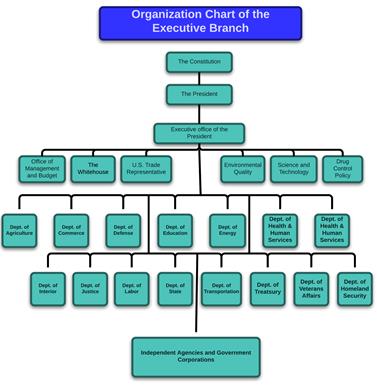
The President has the power either to sign legislation into law or veto bills passed by Congress, although Congress may override a veto with a two-thirds vote of both houses. The Executive Branch
- conducts diplomacy with other nations,
- negotiates and signs treaties, which must be ratified by two-thirds of the Senate,
- issues executive orders, which may clarify and implement existing laws,
- extend pardons for federal crimes, and
- gives an annual address to Congress outlining the agenda for the coming year.
The president is subject to impeachment for treason, bribery, or high crimes and misdemeanors or smaller crimes. The process to remove a president from office requires a two-thirds vote of the Senate. No American president has been removed from office through the impeachment process, although three presidents have been impeached.
St. Kitts and Nevis
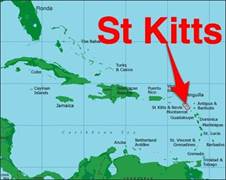
The islands of Saint Kitts and Nevis were created as a federation in 1983 after centuries of British colonial rule. They have the smallest population in the Americas with 46,000, with 11,000 on the island of Nevis and 35,000 on St. Kitts. The population is expected to decline by 20% over the next decade. Nevis has its own assembly, an elected premier and a deputy-governor-general. Tourism, finance, and service sector businesses are the main sources of income. In 1998, Nevis voted to secede but the resolution did to receive the required 2/3 majority vote of the people.
The Government of St. Kitts and Nevis is a parliamentary democracy within the framework of a constitutional monarchy with King Charles III (United Kingdom) as the head of state. The Governor-General represents the monarch, and the Prime Minister is the head of government and leader of the majority party in the National Assembly. The Cabinet is appointed by the Governor-General on the advice of the Prime Minister.
The National Assembly is unicameral, consisting of 15 members: 11 elected representatives, 3 senators appointed by the Governor-General, and the Attorney General. Elections are held every five years. The judiciary is independent and based on the British legal system and uses the Eastern Caribbean Supreme Court, which serves several islands in the region.
| Main Powers | Election Process | Election Cycle 1 | |
| Executive | Monarch of the United Kingdom acts as a ceremonial figurehead, governor-general represents the king, and prime minister provides advice for the governor-general and leads the cabinet of ministers. | Governor-general is appointed by the monarch and prime minister is appointed by the governor-general. | Governor-General and Prime Minister: At His Majesty’s discretion |
| Judicial | Eastern Caribbean Supreme Court presides over multiple countries, one justice resides in St. Kitts. | Appointed by British monarch and the Judicial and Legal Services Commission. | Mandatory retirement age of 65 |
| Legislative | Responsible for drafting legislation. | National Assembly has 11 members elected by plurality vote in single-member constituencies and 3 members are appointed by the governor-general. | 5 years |
Questions:
- What are the advantages and disadvantages of a constitutional monarchy, federal parliamentary democracy, and a representative democracy?
- Is a government of three branches an effective and efficient structure of government for the 21st century?
- Is one government structure better for countries with smaller populations of under 100 million than countries with larger populations? (Only 16 countries have populations larger than 100 million. The ten largest countries are: India, China, U.S. Indonesia, Pakistan, Nigeria, Brazil, Bangladesh, Russia, and Mexico)
- How frequently and for how many years should the President, Prime Minister or Governor serve?
- Should the President of the United States be given any additional powers?
The Government of St. Kitts and Nevis (Official Website of the Government of St. Kitts and Nevis)
Political Database of the Americas (Georgetown University)
The Executive Branch (White House)
The Executive Branch (National Constitution Center)
 njcssjournal