As United States citizens we are given the right to vote. This opportunity allows our country to be a democracy and gives people a voice in the government. As a young adult, one would think that our generation would choose to voice their opinions for the future, since it will affect our lives immensely. Unfortunately, many individuals among my generation do not see this as a priority. Young adults, from the ages eighteen to twenty-four have the lowest voting participation rates out of everyone who is eligible to vote. This is due to the Presidential Election in 2016 between Donald J. Trump and Hillary Rodham Clinton. Young adults share their voice and opinions on politics, but when it comes to the polls, they do not vote. Many young adults also believe that they do not have to go and vote because they believe that their voices will not be heard. In this article, I discuss the reasons behind this lack of commitment to the polls. What is the reason that young adults right out of high school do not vote? Is it the lack of teaching politics in social studies classrooms? Or, is the focus of social studies classrooms too dedicated to teaching the same past events? Furthermore, could this turn out be evidence that social studies needs to be renovated? Maybe there needs to be a class that is dedicated to current events and individual responsibility as a citizen that all students must take. I can recall when I was a student in high school, my teachers never fully expressed the importance of voting because we were not old enough to vote at that point in our lives. The presidential election of 2016 should be a warning for adolescents and young adults that our votes, in fact, do matter. All votes matter, but when it comes to the future of the United States, the younger Americans need to vote so our concerns can be handled properly.
I remember, too, when I was in high
school four years ago and all my social studies teachers never emphasized the
importance of voting. Teachers always briefly stated the importance of the
rights that we have, one being the right to vote. Before the 2016 election,
there was not a recent election where the younger generation believed that they
had to vote. Since the outcome of the election, this was a wakeup call to many
people. Many people just believed that the person that they wanted to win,
would. When the outcome was the presidential candidate that they did not want,
they were the first people to complain all over social media. How can someone
complain if they did not actively practice their right to vote? From my past
experiences in the field at Ewing High School, my cooperating teacher expressed
to the students how important it is to vote. We collaborated on a lesson about
Andrew Jackson and tracing his presidency from his actions as a common man to
his actions as having “king-like qualities”. Our students were curious on our
views on the past election and what we believed. Together, we were honest with
them. We expressed how significant it is to do your research, hear everyone’s
side, and develop your own beliefs. We discussed the voter turnout and why
their vote will matter someday. It is important for students to be taught that
when they are of age to go out and make their voices heard.
After researching why, it is that
the younger generation does not vote, I found out that the average age that
voted in the 2016 election was fifty-seven (Strauss, 2018). These means that
all the reforms and laws that the younger generation wants to be passed, will
not. All new laws, reforms, acts, will be towards what the older generation
needs. Carolyn DeWitt and Maureen Costello state
that, “If there is one thing we believe in America, we believe in government of
the people, by the people, for the people.” and later explain that American
citizens, “…haven’t learned how to register to vote. They haven’t learned the
best way to influence their elected representatives. They haven’t learned that
they have power.” (Strauss, 2018). How can we be a democracy that
countries want to mimic if we cannot get our own to get up and vote? Have
Americans stopped caring or are we too lazy to vote? Joel Stein explains the millennial turnout
and states that he, “calls millennials the “narcissistic generation,” and Jean Twenge says they are
the “me generation,” stuck to their phones and uninterested in politics.”
(Dalton, 2016). I do believe that millennials and people who are younger are
addicted to their phones. Social media overtakes people’s lives, day to day.
Instead of going out to make sure their vote counts, they will voice their
opinions on Twitter or Facebook hoping that by posting their opinion it will
help the vote. I agree, it is essential to voice your opinions, but if you are
not going to act, then why are you choosing to not vote?
I always ask my peers why they do
not bother to go vote because I understood the importance of this aspect my
whole life. The answer I frequently receive is, “Because my vote won’t make a
difference”. This answer, I personally feel is a selfish statement. Every vote
matters no matter who you are or what you believe. If everyone who did not
believe in their vote, voted, then the voter turnout would be completely
different. Health care is so prominent because it is what most older people
want for themselves. If the younger generation would go out and vote we could help
our education systems and our futures. Caroline Beaton expresses that, “In 2016, we view engaging in politics
as a personal choice, not a civic obligation.” (Beaton, 2016). This is accurate
because many younger people see voting as an option and not an obligation. They
believe it is not their civic duty to express what they want. If people were
educated more on voting and constantly informed on the importance of it, I
believe that they would go out and exercise
their right to vote.
I have hope for my generation in the
2020 election. The past election was, without a doubt, a wakeup call. This
article is not intended to bash the younger generation, however, to express my
aspiration for them to be more active participants in the future of our
country. We are the future and I believe that we will come together as one
fighting for what we believe.
On the night of October 4, 1957, Americans could tune in on their radios to hear a small sphere floating in orbit sounding off beeps as it goes along. Sputnik was the first human-made object to go into an orbit around Earth, and thus start something called the Space Race. For such a breakthrough technological achievement, however, it was somewhat limited in its own performance. It could orbit and transmit radio signals back to earth, but beyond that, Sputnik was practically useless except for its role in Cold War Symbolism. It is this symbolism that is thought more often than not, then the education reform that comes after it. The launch of Sputnik is much more than the start of the Space Race; it was a catalyst for education reform and by my calculations, it will take another Sputnik to launch another wave of widely accepted reforms instead of the patchwork introduction of fixes like SGOs, Common Core, and PARCC.
“It is essential to examine the America school system before the launch of Sputnik in 1957. Before 1947 and stemming out of World War Two American schools were still primarily influenced by Progressivist school of ideas and practices from John Dewey. Progressivism emphasized the concept that students could only learn when they had “internalized what they had gained through experience and practiced in their own lives.” (Olson, 2000) In the mid-1940s, a new group called the ‘Life-Adjusters’ began to challenge the progressivist idea and thus began to change them. The main reason being that progressive education failed the majority. This so-called failure along with these new ideas for education and its purpose were based in the 1918 study titled Cardinal Principles of Secondary Education. The goal of this new educational philosophy entitled ‘Life-Adjustment’ was to change the fundamental practices of the school. What fundamental practices did this study mean, it was no other than the core academic classes. By disregarding traditional academics, this meant that history, languages, science, and mathematics were less valued to instead focus on the concept of ‘fundamental processes.’ The fundamental process was the curricula and activities for the general student and would thus be the considerations for vocational education, use of leisure time, and other wholesome topics that would improve the capability of a student to live a good and productive life. What supported this study was a national education conference in 1945. From its findings, the committee has found that no more than 20% of students could be reasonably expected to ever attend college, with another 20% destined for a vocational program. This means that only 40 percent of students can further their education and contribute to society; the other problem becomes the other 60%. The obvious recommendation was the adoption of the previously mentioned Life Adjustment education model. It, however, was not going to be all in favor of the Life Adjusters, as these beliefs were incorporated with some progressive concepts. The most important being the concept of tracking students by ability level on every topic. This meant that higher achieving college-and vocational school-bound kids could still get the same education while the other students can get a more general track in which they can succeed. In 1951 the Life Adjustment approach was formalized in the Educational Policy Commission’s report, Education for All American Children. (Bybee, 1997) Life-adjustment education was more utilitarian when compared to the previous progressive practices of earlier education models. The reason for this utilitarian nature is that schools were failing in preparing a majority of its student population for its future so this model instead focused on the needs of the general student. Its proposed curriculum was on functional experiences in areas such as arts, family living, and civic participation. This kind of curriculum was more about preparing an active citizen instead of an educated academic.
Now, when you examine these tracks based on the ability for the student you can draw a comparison to the modern day with Special Education with the process of inclusion and mainstreaming. The method of mainstreaming and inclusion is the result of placing students in the Least Restrictive Environment as a part of the requirements of the IDEA act. (Morin) Mainstreaming is the process of taking your kids with disabilities and putting them in a general classroom, hence the mainstream. This typically comes with some form of help for the student or that the student spends time in special education or resource classes. Without the IDEA act, special education would not have advanced as quickly as it did which thus leads us to why Sputnik was so important.
The National Defense Education Act was spurred into creation off the impact of the Sputnik launch. The overall goal of this specific legislation was to change the country’s educational system to meet the standards of the national government concerning the nation’s defense. Regarding the national defense that meant the subject thought and focused on would have a direct benefit to those job fields. Thus, by increasing the standards of education, the United States hoped the changes would help them either compete or pass the Soviet Union. The importance of the NDEA, much like IDEA, is in the acceleration for reform it caused. The overall effects of NDEA are grants and federal aid for higher education and also a restructuring of school curriculum around that funding. Because of the scientific nature and international significance of Sputnik, the course requirements for students became aligned toward national security and jobs of that nature. Thus, the standard course load stiffened away from Life-Adjustment and added more Math and Science classes. If The Association of American Universities described the NDEA as “inspiring generations of U.S. students to pursue study in fields vital to national security and aide.” (American Association of Universities, 2006) Then it was effective in changing education as they knew it. And when you examine education curricula today, you see that the impact clear as day as almost every high school student for graduation shall have four years of math and 2-3 years of science by the time they do so.
The apparent result of Sputnik is not just in the historical context of historians of Devine and Dickson who propose a situation of American paranoia in retrospect to their calm leader, but rather the impact on education reform that we can see in the foundation of today’s schools. (Divine, 1993; Dickson, 2001) In an interesting article by a psychologist, he recognizes that there is a problem with modern educational reform. At the national level, the federal government spending on education has skyrocketed, with no comparable improvement in educational outcomes in such programs like Head Start, New Math, Nation at Risk, Goals 2000, Race to the Top, No Child Left Behind, charter schools, Next Generation Science Standards, and Common Core? (Klemm). We have had little to show in terms of the results of these programs as we keep trying to create better-standardized tests and are even thinking of replacing the common core in many states even though it only came out in 2009. The problem with modern education reform may not be with the program, but with the implementation. If states are allowed to pick and choose on adopting or adapting these reforms based on the fear of losing government spending, then the speed and acceptance rate would be relatively minor and too late before it impacted most of the nation. Klemm later states in the previous article “I think the real problem is that students generally lack learning competencies. Amazingly, schools tell students more about what to learn than how to learn” (Klemm, 2014). This is something that can have a much more lasting impact because it is on the level of teacher adaptation. If we are teaching these competencies instead of solely content, we can make sure that students can turn into these lifelong learners. It is effortless for a teacher to teach Organization, Understanding, Synthesis, Memory, Application, Creativity because it involves no money, but instead an adaptation of a lesson plan. Organization can be as simple as upgrading our technology to a cohesive system like Google Classroom where students can access all work and assignments and the same can be said for teachers. Creativity can be new ways to teach a lesson or new activities.
It’s important to touch on memory, which is commonly related to tests. Instead of teaching kids to take these tests, let’s make them create better mental connections for better learning. If students can connect historical themes to present day events than they can more easily recall this knowledge for other subjects. The problem with social studies is the idea that we teach to one test, and then the student can forget that knowledge. If we work on creating these connections, they can easily recall this knowledge in other classes or everyday life. Instead of a focus on a national reform movement that is bogged down by politics, let’s do something that only teachers have control over, which is how we teach students.
If we want to change education before national reform is ever sufficient, we as teachers must be proactive and as Social Studies teacher that may be the essential part of our jobs. If we can get tour students to transfer the Think like a Historian skill to other subjects, we can change their mind on the value of history. So until we have another Sputnik, we are stuck in the process of revolution. (Kuhn 1962) We had Sputnik in 1957, We had The Nation at Risk in 1983, what is the next event to revolutionize education? The next logical step is the quick improvement in technology, which may drastically change how and where we teach. Whatever the next Sputnik is, to make sure it is a more effective reform like NDEA it takes us as Teachers to be open-minded and accepting to the changes. Because, whatever reform or new ideas are thrown our way, we still need to be ready to change for the sake of our students.
References:
American
Association of Universities. (2006). A National Defense Education Act for the
21st century: Renewing our commitment to U.S. students, science,
scholarship, and security.
Bybee, R. (1997). The Sputnik era: Why is this educational
reform different from all the others? Center
for Science, Mathematics, and Engineering Education Symposium “Reflecting on Sputnik: Linking the Past,
Present, and Future of Educational Reform.” Washington, DC.
Dickson,
P. (2001). Sputnik: Shock of the Century.
New York, NY: Walker Publishers.
Divine, R.A.
(1993). The Sputnik Challenge. New
York: Oxford University Press.
Olson, L. (2000). Tugging at tradition. In V. Edwards (Ed.), Lessons of a Century: A Nation’s Schools Come of Age (94-118). Bethesda, MD: Editorial Projects in Education.
Jiwon Kim and Christine Grabowski Monmouth University
We live in one world. What we do affects others, and what others do affects us, now more than ever. To recognize that we are all members of a world community and that we all have responsibilities to each other is not romantic rhetoric, but modern economic and social reality (McNulty, Davies, and Maddoux, 2010). If our neighborhoods and nations are both affecting and being affected by the world, then our political consciousness must be world-minded (Merryfield and Duty, 2008). A sense of global mindedness or global awareness must also be promoted in elementary school, but many educators still find it challenging. The purpose of this article is to explore how we engage elementary students in learning global issues and to examine how introducing United Nations Sustainable Development Goals to the elementary classroom helps young students develop their interest and understanding of current issues in the world and become active citizens.
Global
Citizenship Education and the United Nations
Sustainable Development Goals
Scholarship on
globalization suggests that new forms of democratic citizenship and politics
are emerging (Andreotti, 2011; Davies, 2006; Gaudelli, 2016; Myers,
2006; Oxley & Morris, 2010; Parker, 2011; Schattle, 2008), and this demands
critical and active global citizenship education. As Myers
(2006) indicates, however, “while
a global perspective is often incorporated into the curriculum and courses, the
concept of global citizenship, suggesting a commitment and responsibility to
the global community based in human rights, is less coherent” (p. 389).
Citizenship is a
verb – learning about our nation and the world, thinking about dilemmas of
equality and equity, and acting on issues of collective concern (Boyle-Base and
Zevin, 2009). Therefore, Global citizenship relates to important concepts such
as awareness, responsibility, participation, cross-cultural empathy,
international mobility, and achievement (Schattle, 2008). From this perspective, global education
should be global citizenship education. Understanding and concern for such
issues should lead to action, and local, state, and global studies should be
used as a “springboard for deliberation, problem-solving, and community action”
(Boyle-Base, et al. 2011). Boyle-Base and Zevin (2009) propose a three-part
framework of citizenship: Young citizens of the world (and their teachers)
should be informed, reflective, and active. This model means (1) becoming
informed (about ideas, events, and issues); (2) thinking it through (presenting
fair and balanced views), and (3) taking action (teaching deliberation,
decision-making, and civic action) (Boyle-Base, et al., 2011).
We adopted this
model in order to engage elementary students in global issues, by introducing
the United Nations Sustainable Development Goals (UN SDGs) to an elementary
classroom. The Model United Nations is well known with many students
participating in this program, but few realize that the UN SDGs are designed to
educate our society and transform the world.
The UN
SDGs, officially known as ‘Transforming our World: the 2030 Agenda for
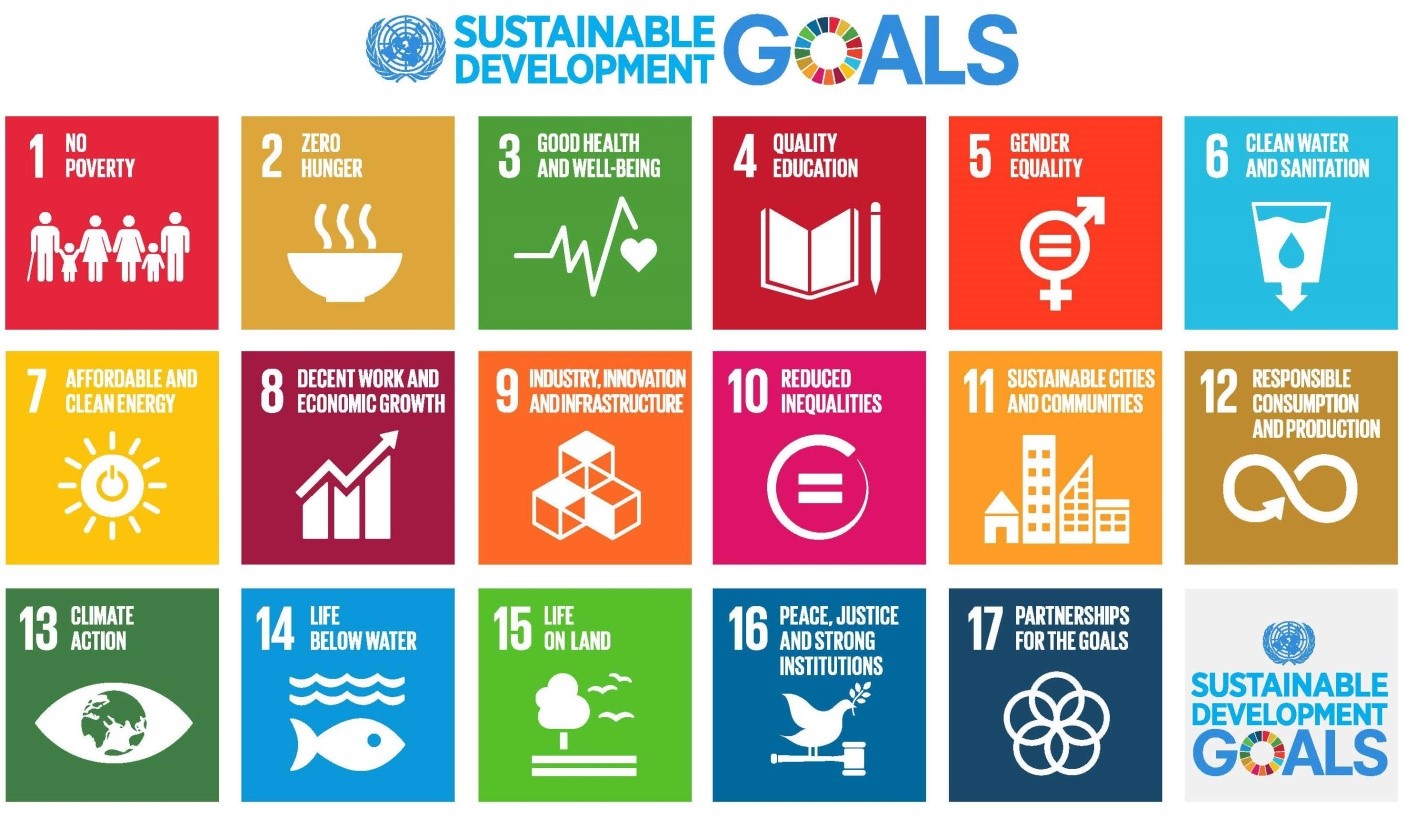
Sustainable Development’ is a set of 17 Global Goals around world issues. On
September 2015, countries adopted the 2030 Agenda for Sustainable Development
and its 17 Sustainable Development Goals. In 2016, the Paris Agreement on
climate change entered into force, addressing the need to limit the rise of
global temperatures. Governments, businesses, and civil society together with
the United Nations, are mobilizing efforts to achieve the Sustainable Development
Agenda by 2030. Universal, inclusive and indivisible, the agenda calls for
action by all countries to improve the lives of people everywhere. Each goal
has specific targets to be achieved. The 17 goals are as follows:
The UN and UNESCO
explicitly support these goals and resources that are useful materials for
global citizenship education. While global citizenship is geared towards older
students, there are many ways that elementary school teachers can apply these
goals and resources within their classroom. For example, the World’s Largest
Lesson, which is a website created in partnership with UNICEF and UNESCO, introduces the
Sustainable Development Goals to children and young people everywhere and
unites them in action through various projects. If educators are planning an
assembly or a lesson to introduce the Global Goals, there are a lot of
resources listed on the website and educators can choose them based on the
specific goal (http://worldslargestlesson.globalgoals.org/). These resources include
training courses, activities, books, films, games, lesson plans for each grade
level, decorations and posters, as well as support for students’ action and
change project. Materials are available in English and nine other languages. Students
can share their work online and help create a map of the world, for instance,
that reflects why Goal 5, Gender Equality, is so relevant worldwide today.
Context
Mrs. G, an
elementary school teacher leads a multi grade third and fourth grade class of
sixteen students. This unique style of teaching embodies project-based learning
with one to one Chromebooks for the students.
They are not seated at traditional desks; instead students are seated at
whiteboard tables with rolling chairs for flexible collaboration and learning.
Self-driven students who take initiative in their own learning, had become
integral parts of how this exciting project about the UN SDGs had grown and
developed.
The UN SDGs
lessons started out as requirement for the preservice teachers of Monmouth
University that were presented in the third and fourth grade classroom. As the
interest piqued in the classroom, Mrs. G decided to capitalize on students’
enthusiasm and design classroom activities to address the UN SDGs at their
developmental level. The goal was for the students to become more globally
aware about issues in the world, while honing their reading, writing, research,
and presentation skills. This unit project addressed multiple NCSS standards
and C3 Framework.
Table 1: Social
Studies Standards Addressed in This Unit Project
Social Studies Standards Addressed in This Unit Project
NJCSS
C3 Framework
1. CULTURE
2. PEOPLE, PLACES, AND ENVIRONEMNTS
3. INDIVIDUAL DEVELOPMENT AND IDENTITY
4. INDIVIDUALS, GROUPS, AND INSTITUTIONS
5. POWER, AUTHORITY, AND GOVERNANCE
6. PRODUCTION, DISTRIBUTION, AND CONSUMPTION
7. GLOBAL CONNECTION
8. CIVIC IDEALS AND PRACTICES
D1.2.3-5. Identify disciplinary concepts and ideas associated with a compelling question that are open to different interpretations. D2.Civ.2.3-5. Explain how a democracy relies on people’s responsible participation, and draw implications for how individuals should participate. D2.Civ.6.3-5. Describe ways in which people benefit from and are challenged by working together, including through government, workplaces, voluntary organizations, and families. D2.Civ.7.3-5. Apply civic virtues and democratic principles in school settings. D2.Civ.10.3-5. Identify the beliefs, experiences, perspectives, and values that underlie their own and others’ points of view about civic issues. D2.Soc.3.9-12. Identify how social context influences individuals. D2.Soc.6.9-12. Identify the major components of culture. D2.Soc.7.9-12. Cite examples of how culture influences the individuals in it. D2.Soc.13.9-12. Identify characteristics of groups, as well as the effects groups have on individuals and society, and the effects of individuals and societies on groups. D2.Soc.16.9-12. Interpret the effects of inequality on groups and individuals. D2.Soc.18.9-12. Propose and evaluate alternative responses to inequality. D4.3.3-5. Present a summary of arguments and explanations to others outside the classroom using print and oral technologies (e.g., posters, essays, letters, debates, speeches, and reports) and digital technologies (e.g., Internet, social media, and digital documentary) D4.6.3-5. Draw on disciplinary concepts to explain the challenges people have faced and opportunities they have created, in addressing local, regional, and global problems at various times and places. D4.7.3-5.Explain different strategies and approaches students and others could take in working alone and together to address local, regional, and global problems, and predict possible results of their actions. D4.8.3-5. Use a range of deliberative and democratic procedures to make decisions about and act on civic problems in their classrooms and schools.
This was accomplished through a multifaceted project that
included learning about the UN Sustainable Development Goals through reading,
research, presenting a goal, and sharing. Additionally, there was discussing
information through a class blog, and leading and participating in service
projects. This project continued in the successive school year due to the
success and interest in the project.
Part I: Becoming Informed
Reading
and Research
While introducing the UN Sustainable Development Goals, one
challenge was to ensure that elementary students could understand these complex
concepts. In the beginning, students were introduced to two brief videos that
gave an overview of the UN Goals in terminology that was easier for them to
understand. Next, each of the sixteen students was assigned one of the goals to
research in depth. They were given a rubric with specific items that needed to
be included in their presentation. The students were required to include: the
name of the goal, the definition of the goal, why the goal is important, and
three interesting facts.
The next step was to research the goals to truly understand
the meaning, decide why it would be an important goal for citizens to be aware
of and potentially take action. The UN website offers articles, video clips,
facts and a plethora of additional information about the goals, but can be
difficult for elementary students at various reading levels. The
paraprofessional and teacher engaged individual conferences for each student to
ensure that there was an understanding of what the student was reading, as well
as recommendations of particular parts of the site to focus on for their
research. The seventeenth goal, which was not assigned to a student, was
completed together as a group. Using the classroom SMART board, Mrs. G led the
class in modeling how to find appropriate research, navigate the United Nations
website, and make decisions about information that was pertinent to present on
the visual document.
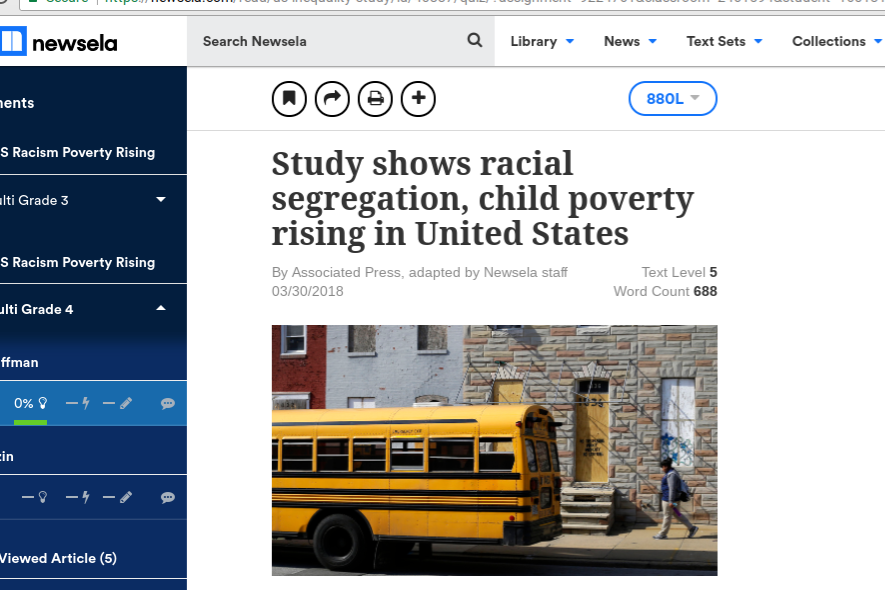
To further develop their reading and research skills, Mrs. G
used Newsela, a large database of current events articles that are written at
specific Lexile levels. Articles that related to the UN Goals were assigned to
the students. They decided which articles to read to assist in gaining more
knowledge and understanding of their specific goal. This platform worked well,
because it is tailored to the student’s independent reading level, which aids
in comprehension of the material. Some students worked with partners to help
mitigate difficulties in reading articles and participated in discussions
together, in order to better understand the topic of study. Individual
conferences with partners and the teacher or paraprofessional were essential in
supporting the students in tackling very advanced concepts. Goal 9- Industry, Innovation, and
Infrastructure was an especially challenging concept for a young elementary
student and required a good deal of discussion with the teacher to ensure
understanding of a complicated topic.
Reading informational text in social studies is the perfect
way to enhance learning. However, when the vocabulary and content was above
level for many of the students involved in the project, the teacher and
paraprofessional met individually to read with students to ensure comprehension
of the literature regarding the goals on the UN website. This one on one time
was helpful in making sure the elementary school students understood their
goal, and were equipped with the knowledge to become experts and explain it to
others.
Part II: Thinking It Through
Presenting,
Sharing and Discussing Information about the Goals
Next the students created a visual product to communicate
the required information about their goal using what they have learned through
reading and researching their assigned goal. The students created posters in
the first year when the project was implemented, and in the next year they used
Google Slides to present information about the goal. The expectations on the
rubric were the same for both the poster and the digital presentation.
Figure 2: Sample Article from Newsela Website- www.newsela.com
Table 2: UN SDGs Google Slides Rubric
Please include the following
on your slide:
Name of goal
Definition of goal
Why important
3 Interesting facts
UN SDGs Google Slides Rubric
3
2
1
Name & Definition
The correct name and an accurate definition is present
The name or definition may be correct
The name and definition are not correct
Why Important
A clear and accurate explanation of why the goal is important in the world
Attempts to write an explanation of why the goal is important in the word. May have some ideas that are correct
Does not include why it is important or it does not make sense
3 Interesting Facts
3 appropriate facts about the topic are present
3 facts that are not relevant or just 2 facts are present
Did not include three facts
Design of Slide
The pictures and design are related to and represent the goal. Is well organized
The pictures make an attempt to represent the goal. Shows some organization
The design does not relate to the goal, is disorganized
The students reflected upon their presentations and
completed the rubric self-assessing their work. The expectation was to either
draw or find photos that represented the theme of the goal. When making
posters, the required information was verbally presented in a recording that
eventually was combined with other students using the DoInk app. They used the
green screen to record and uploaded the recordings to the app to create a
video. The other option was to use a shared Google Slides presentation where each
student created one slide to represent their goal and provided the required
information.
Figure 3: Examples of Posters
Figure 4: Examples of Google Slide Presentation
Each student took a turn presenting their visual poster or
Google Slide to explain and teach the class about their specific goal. They
utilized speaking and listening skills to effectively communicate the
information that they researched and engaged in question and answers from their
classmates. Mrs. G could also further assess their learning by observing how
well they could answer questions about their assigned goal.
Deliberation
through Blog Session
Next, the students participated in blog sessions to further
discuss the goals, their thoughts and opinions.
The blog is an effective tool and another way of assessing the students’
critical thinking skills, knowledge of content, and how they communicate.
Google Classroom has a feature to “Create a Question” that allows students to
respond to each other. These questions were posed to the sessions:
List your goal and write an
interesting fact that you learned about your goal.
Explain something that surprised you
about the goals. Why did it surprise you?
What can you do to help achieve the
UN goals?
The explanation of something surprising from the students
was enlightening in providing a student perspective at their developmental
level. The following is a sample entry with responses:
Student “O”:
1. My goal is
Quality Education. One interesting fact about my goal is more than half of
children that have not enrolled in school live in sub Saharan-Africa.
2. Something
surprising I learned from this lesson is that, Goal 16 Peace, Justice, and
Institutions is that people all over the world do not have the freedom of
speech for their rights. I feel that is devastating to live under rules that
are hardly even thought about just made a law. They live under circumstances
that are very sad, and that is very careless of people.
3. To help these
goals we need to supply things that are needed. Americans can provide books all
over the world for Quality Education, We can provide vaccines to needed, we can
give food and vitamins needed to people in need.
Student “C”: Also, for every 100 boys enrolled in school
in Sub-Saharan Africa, there’s only 74 girls!
Student “A”: Where
is Saharan-Africa? What is it?
Student “J”: Who tells them that they can’t go to school
and why don’t they?
Student “O”: Saharan is basically all the countries of
Africa except the three at the top.
Student “O”: They can’t’ go to school because some people
(dictators, presidents, kings or queens) think that school is a waste of time.
They rather kids go and work the fields and harvest crops
Student “J”: Thanks for the answer
Student “S”: It is very sad that people don’t get to go
to school, but at the same time it might be fun to not go to school for a
couple of days but never going to school would be hard. But everybody needs
education.
Student “C”: It’s not fun. The reason they avoid school
is to make the kids do work. And they have to work on the fields, harvesting,
growing, and taking care of crops ALL DAY, until night!
Student “E”: How many
school houses are in Africa?
Student “O”: Would it really be fun not to be able to
read, write, and say the right words in a sentence? What would you do if you
couldn’t read or anything? Would you ask your mom to teach you? What if you
don’t have a mom? Put yourself in other people’s shoes.
Student “C”: It wouldn’t be fun at all not to be able to
read or write. If we couldn’t read or write, we couldn’t blog now!
Reading the responses of
the students allowed Mrs. G to capture a conversation that the students might
have in a group discussion in the classroom. It was determined that
Student “O” understood that students in Africa and other parts of the world do
not have the same opportunity for education that children in the United States
are afforded. The student expressed empathy for children who cannot
attend school, and Student “C” even responds stating that they would not be
able to blog if they did not have an education.
When the students blogged, there was silence in the classroom because
they were all actively engaged using the technology in a meaningful manner.
Mrs. G expected the students to answer the three questions and then
thoughtfully responded to at least five students in the class with comments and
insight. She accessed all of this and could comment on Google Classroom to
leave feedback for students. The use of
technology like Google Classroom allowed the class activity to become more
student-focused. By assigning students different UN goals, the students were
able to take ownership of their own topic and became the class expert who is
accountable for discussion on the goal. This enabled the teachers to see the
student’s ability to comprehend the UN goals as well as to apply that knowledge
gained to form a discussion with their fellow peers. This deliberation process
helped students think about higher-order thinking questions beyond immediately
noticeable facts. Students sometimes left with some simplistic and
self-oriented/US-centric views of the world. Therefore, it was important for
Mrs. G. to capture a troubled conversation and follow up as a group discussion
in the classroom.
Part III: Taking Action
Leading and Participating in Service
Project
Each year of
implementation of this project has led to the students taking action to address
the UN SDGs. In the first year, the class was saddened and upset to see the
prevalence of poverty and hunger in the world. Through a class discussion, they
decided to take action and have a food drive to support a local food pantry.
Mrs. G led a discussion on local organizations that helped the poor, and
ultimately the students decided to support St. Vincent de Paul Pantry at a
church that some students attend. They gathered information from the church
bulletin, organized a collection based on the pantry’s needs, created flyers
and made announcements daily to the school promoting the food drive and giving
the school community facts about hunger and poverty. The students used Google
Sheets to collect data and provided updates to the school community about the
number of items collected. The young learners took ownership of the whole
project and completed it to its final steps of packing the donations and
sending thank you notes to the St. Vincent de Paul members for their service to
the poor. The class felt proud of themselves for spearheading this project that
would align with the UN SDGs.
In the following school
year, the service project that the class decided to organize was related to
recycling and saving the environment. The students collected plastic film to be
sent to the Trex Company, which uses recycled materials to make composite
lumber. Many schools compete against each other to recycle the most plastic
film and Mrs. G’s multi grade class took a leadership role with this contest.
The students created a Google Slides presentation, developed flyers to be sent
home with students in the school, and visited all of the classes in the school
to explain what can be recycled, where the collection bins were placed and all
of the details about the project. They weighed and packaged the plastic, as
well as recording the data for the competition. The students were proud of
their contribution to the UN SDGs and helping the environment.
Service projects such as these were a
wonderful way for students to feel empowered as elementary students. It started with one student stating in class,
“People are hungry, we have to do something to help!” Through this experience,
they realized that their small contribution to helping the poor and hungry, or
recycling to help the environment were ways that they could join people all
over the world to obtain the UN SDGs. They were able to recognize their power
as citizens of a global community. It was important to reflect and determine if
there was a lasting impression made by studying the UN Goals.
Results: Impact of the Project on the Students
Mrs. G polled her
students with Google Forms at the end of the school year to assess the impact
that this project had on the students. There were seven questions ranging from
how important are the goals to written responses about how they can be global
citizens. One student wrote, “The food drive helps the people that are starving
and have no money so they get food that is donated from other people. Then they
can have food to fill their stomachs.” Another
student commented, “Doing Trex made us global citizens because we helped by
recycling. So the world won’t be filled with plastic. Also because we can reuse
it.” Some even commented about the
Marker Recycling Program that was underway in the school, or about the garden
at their school. They were applying the knowledge that they had gained from the
project and analyzing how activities conducted by other organizations relate to
the UN SDGs.
By exposing the
elementary students to the UN SDGs, they were given an awareness of the world
around them, beyond their community, state, and country. While engaged in this
project, most of the students were shocked to hear some of the statistics.
Student “S” wrote in her blog post that some people in the world live on $1.25
a day and it elicited quite a discussion. One response from Student “G” was
that “People in North Korea and most of Africa live a daily life of poverty.”
The class discussion was facilitated by the teacher to assist in explaining
different cultures, religions, governments and such in terms that were on the
developmental level of the children, including censoring material that would
not be appropriate for discussion at their age. Students were more interested
and empathetic towards the issues that were associated with their age group children,
such as not going to school, than other issues, like living with little money
and resources. Also, their understanding of those problems and causes were
sometimes limited. This confirms that the blog session is a good tool to
promote students’ learning, to assess their understanding, and to inform
teachers what they need for the next instruction.
These UN SDGs are global
objectives that are being addressed by corporations, governments and even
students. By teaching the children as
young as elementary school, they are being provided with information, facts and
statistics that reach beyond “their world”.
One young lady wrote a very impactful statement, “We can make our world
a better place to be by making these small donations and commitments, but in
reality, that can make a lifetime difference.” Empowering young children to
believe that they can have an impact will cultivate adults and forward thinking
global citizens.
Conclusion
The project can be easily adaptable for multiple grade
levels to provide elementary school students a creative and interesting way to
learn about global issues and give them a lens into other countries and ways of
life. Any classroom with Internet access and devices to utilize Google
Classroom or other online program such as Otus, Kiddom, or Edmoto can apply the
principles of this multifaceted project.
The three-part framework: (1)
becoming informed (about ideas, events, issues); (2) thinking it through
(presenting fair and balanced views); and (3) taking action (teaching
deliberation, decision-making, and civic action) effectively engaged elementary
students in learning global issues. The UN SDGs were a good source and tool in
carrying out this model.
While there are few studies and practices of teaching the United
Nations and global issues in elementary level, this classroom practice provides
a good example of how it can be successfully done and build young learners’
global awareness and active citizenship. ELA, science, math, and the arts can
be integrated in addition to Social Studies as well as the skills of reading,
interpreting, and presenting can be taught in this unit project learning.
Because it deals with subject matter that is of immediate interest and bridges
school learning with life outside school, it is highly motivating to critically
think and take action. It provides elementary school students with information
that they have not been exposed to and helps them build a knowledge base for
understanding current and future problems.
References
Andreotti, V. O. (2011). (Towards) decoloniality and
diversality in global citizenship education, Globalisation, Societies and Education, 9(3-4), 381-397.
Boyle-Base, M. & Zevin, J. (2009). Young citizens of the world: Teaching elementary social
studies through civic engagement. New York, NY: Routledge.
Boyle-Base, M., Bernens-Kinkead, D., Coake, W., Loudermilk, L., Lukasik, D. & Podany, W. (2011). Citizenship
as a verb teaching students to become informed, think it through, and take
action, Social Studies and The Young
Learner, 24(1), 5-9.
Davies, L. (2006). Global citizenship: Abstraction or framework for action?, Educational
Review, 58(1), 5-25.
Gaudelli, W. (2016). Global
citizenship education: Everyday transcendence, New York, NY:
Routledge.
Mcnulty, C. P., Davies, M. & Maddoux, M. (2010). Living
in the global village: Strategies for teaching mental flexibility, Social Studies and The Young Learner, 23(2), 21-24.
Merryfield, M. M. & Duty, L. (2008). Globalization. In J. Arthur, I.
Davies, &
C. Hahn (Eds.), The sage handbook of education
for citizenship and democracy (pp. 80-91). Los
Angeles, CA: Sage.
Myers, M. P. (2006). Rethinking the social studies
curriculum in the context of globalization: Education for global citizenship in
the U.S., Theory & Research in Social
Education, 34(3), 370-394.
Oxley, L. & Morris, P. (2013). Global citizenship: A
typology for distinguishing its multiple conceptions, British Journal of Educational Studies, 61(3), 301-325.
Parker, W.C. (2011). ‘International education’ in US public
schools, Globalisation, Societies and
Education, 9(3-4), 487-501.
Schattle,
H. (2008). The practices of global citizenship, Lanham, MD: Rowman &
Littlefield Publishers
Julie A. Taylor, Danielle DeFauw, Glovetta Williams, and Matthew Hundley University of Michigan-Dearborn Douglass Academy for Young Men, Detroit MI
Three-dimensional
technologies are proliferating, yet their use in authentic writing and social
studies education has not been explored fully.
The Smithsonian Digitization Office increasingly offers digital assets,
including life masks and sculptures, to educators and students as
downloads. Visitors may view objects
multi-dimensionally and in high resolution online. In 2014, Barack Obama became the first United
States president to sit for a 3D portrait.
He was scanned by imaging specialists from the Smithsonian and the
University of Southern California (Fawcett, 2014). Inspired by these developments, this
action-research study examines the use of technologies to create realistic, 3D
student avatars in writing projects. Avatar is a Sanskrit word that means the
physical embodiment of a deity (Ballin, Lawson, Lumkin, & Osborne, 2002;
Graber & Graber, 2011). In its most
common usage today, the term refers to virtual representations of users of
interfaces (Blais & Ippolito, 2006; Graber & Graber, 2011; Liao,
2008). The graphical illustrations may
be two- or three-dimensional (Berdic, Dragan, Mihic, & Anisic, 2017).
The theoretical framework
of this study is rooted in deeper learning, a constructivist approach to
teaching and learning in which the cultivation of transferable skills, critical
thinking, and creativity are emphasized (Bellanca, 2015; Martinez &
McGrath, 2014; Zhao, 2015). Through deeper
learning, students develop academic mindsets as they engage in relevant
projects. In this study, the authors’
research questions were a) would the
creation of realistic avatars, based on 3D scans, increase levels of student
interest? If so, why?; b) How does three
dimensionality enrich the learning experience?; c) Would students perceive the
inclusion of personal avatars with writing assignments as enhancements to
communication? If so, why?; and d) What are students’ views of avatar
technologies in the social studies?
With its emphasis on the expression of
students’ views of social and political issues and autobiographical writing,
the project supported civics standards in the College, Career, and Civic (C3) Life Framework for Social Studies State
Standards, namely on the application of civic virtues and democratic
principles when working with others and the evaluation of social and political
systems (National Council for the Social Studies, 2013). Standards in history education were also
addressed; students considered scanned, three-dimensional artifacts as historic
evidence. Additionally, the project
addressed Common Core State Standards for English language arts (ELA). Students were afforded opportunities to write,
integrate visual literacy components, listen and speak collaboratively, and
develop visual literacy skills using different media (National
Governors Association Center for Best Practices & Council of Chief State
School Officers, 2010). Concerted efforts to connect social studies
and ELA support secondary students’ instructional needs (Kern & Bean,
2018).
The School and the Students
The
students, who participated in this action-research project as part of an
enrichment program, attended an all-male school in Detroit, Michigan. With emphases on alternative and special
education, the Title I, public school serves middle and high school
students. All 18 high school students,
who participated in the IRB-approved study in 2018, were African American. Each year since 2012, students have studied
different social, historical, and cultural topics. They have also explored emerging
technologies.
The Avatar Project
Inspired by the creation of a 3D portrait of
President Barack Obama by the Smithsonian’s Digitization Office, the authors
acquired a 3D printer, and they invited the developer of a scanning app for the
iPhone and the chief executive officer of TRNIO, Jan-Michael Tressler, to share
his knowledge of 3D technologies at the school.
In preparation for a two-day workshop by Tressler, the students
considered current applications of 3D technologies. They also viewed and discussed the
Smithsonian’s video, The President, in 3D,
on the creation of Obama’s portrait.
This project provided
students an opportunity to develop digital literacies in an environment that fostered
motivation (Kern & Bean, 2018).
Advancing students’ writing skills was a key objective; students created
hybrid texts to narrate and inform through writing as well as 3D images (Bintz
& Ciecierski, 2017). Asked to
imagine that their avatars would be displayed in a national museum, the
students reflected on current social, political, and economic issues, and they
considered what they wanted to tell the public.
On Google Slides or Google Sites, each student wrote an autobiographical
statement to accompany his avatar in which he responded to the following
questions: a) What is your first name?;
b) How old are you?; c) In what grade are you?; d) What is your favorite
subject in high school?; e) How do you spend your free time?; f) Of what are
you the most proud?; g) Who has had the biggest influence on your life? Why?; h) What current political, social,
and/or economic issues concern you the most?
Explain; i) What issues in the local community concern you the most?; j)
What does your future hold?; and k)
What else would you like to tell people?
During
the workshop, Tressler engaged students in an exploration of 3D technologies in
an interactive format. He showed images
of scanned objects and people as well as design features. Tressler taught the students how to download
and use the TRNIO scanning app. With
parental permission, they used iPhones to scan one another in order to generate
avatars. Each young student had the
option of adding facial expressions. To
protect the students’ privacy, all files were deleted from the TRNIO
server. No avatars were published on the
Internet.
Tressler engaged in
spontaneous discussions with students about the use of avatars in video games
and films. He spoke about developments
in avatar technologies that are forthcoming.
In the near future, realistic avatars, generated rapidly with handheld
devices, will speak and emote. Users
will choose appropriate environments for their avatars, including historic
settings. Students will engage in
virtual travels in time and space.
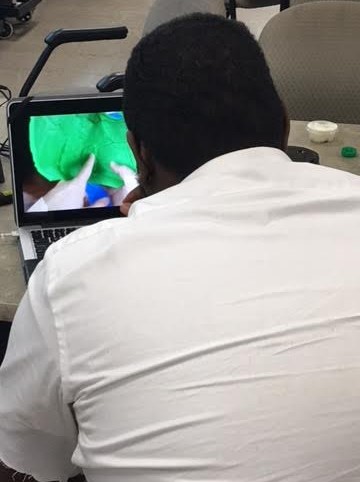
Figure 1: Student (right) explored 3D technologies with Tressler (left).
The authors worked with
student volunteers to demonstrate 3D printing by an Ultimaker II. Because the digitization of the Lincoln Life
Mask had inspired the staff at the Smithsonian to approach Obama about a 3D
portrait, a STL file of the Lincoln Life Mask was downloaded and printed using
PLA filament, which is nontoxic and biodegradable. At the time of the project, the 3D file of
Obama had not been released to the public.
Research Methods
Action research is a
participative, systematic approach to understanding the process of learning
(Efron & Ravid, 2013; Mertler, 2014).
Because mixed-methods approaches to research offer insights into
multi-faceted questions, they were adopted by the researchers (Teddlie &
Tashakkori, 2009). Mixed methods
strengthen inferences and cull diverse views (Creswell & Plano Clark, 2011;
Teddlie & Tashakkori, 2009).
Jennifer Greene (2007) wrote, “…a mixed methods study seeks broader, deeper,
and more comprehensive social understandings by using methods that tap into
different facets or dimensions of the same complex phenomenon…results from the
different methods serve to elaborate, enhance, deepen, and broaden the overall
interpretations and inferences from the study” (p. 101).
The
researchers created an eight-item survey, with an embedded design, for
distribution in hard copy upon completion of the project. The survey included four Likert-scale
items. The students indicated the degree
to which they agreed or disagreed with these statements: a) Creating a realistic avatar increased my interest; b) Including an
avatar with my statement made the communication more powerful; c) I would like
to use realistic avatars in my social studies classes; and d) Avatar technologies should be explored
in schools. After each item, the
students were asked to explain their responses.
The survey had two
fixed-choice questions to assess students’ familiarity with video games and
avatars: a) Do you play video games?
and b)Before this project, had you ever seen avatars in video games or
movies? The students had the option
of responding “yes” or “no.” The final
two items on the survey were open ended.
To gain understanding of the participants’ views of 3D-printed portraits
and avatars, they were asked to write responses to these questions: What do you think about having 3D printed
portraits of yourself and others in museums, homes, and other places? and What additional comments about avatars
and/or 3D printing do you have?
Fifteen of the 18
(83.33%) students completed the optional and anonymous surveys. For the calculation of percentages, the
authors manually entered the data into the cloud-based site, Survey
Monkey. They prepared graphs with the
graphing tool of the National Center for Education Statistics. In addition to reading the students’ comments
multiple times, the researchers repeatedly reviewed the students’
autobiographical statements.
On avatar technologies,
they conducted a semi-structured interview with Tressler. This action-research project was
noncommercial and autonomous; it was not sponsored by TRNIO.
Findings
The students recognized the impact of having
strong likenesses with their written communication. They had the option of adding some facial
expressions to their avatars. Over 86%
of the students strongly agreed (60%) or agreed (26.67%) that including avatars
with their statements had made the communication more powerful. Two students (13.33%) disagreed. The following comments were representative:
With 3D scanning,
faithful and compelling portraits can be rendered. The strongest finding in this study was that
all students either strongly agreed (66.67%) or agreed (33.33%) that creating a
realistic avatar had increased their interest.
As was the Smithsonian’s 3D Obama portrait, the students’ avatars were
based on data.
I really think the avatar
is cool because it’s a mixture of science and history.
Realistic avatars show
how people feel.
The avatar increased my
interest because my creative skills came out.
It made it more powerful
because it was like I was actually there saying everything.
(The avatar) added a lot of extra information.
People will think it’s
true.
Figure 2. Including an avatar with my statement made the communication more powerful.
Figure 3. Avatar technologies should be explored in schools.
The majority of the students (73.33%)
indicated that they would like to use realistic avatars in their social studies
classes. Sixty percent strongly agreed,
13.33% agreed, 20% were neutral, and 6.67% disagreed. They commented on how avatars draw attention,
bring things to life, and serve as strong visuals. With the statement, “Avatar technologies
should be explored in schools,” 93.33% strongly agreed (53.33%) or agreed
(40%). One student (6.67%) was
neutral. Students wrote the following
comments:
It’s an interesting, fun
way to learn.
It would make kids more
involved and interested.
…kids would learn better.
Media consumption by children and teens in the
United States has been steadily increasing due to the ubiquity of mobile
devices (Henry J. Kaiser Family Foundation, 2010; Katz, Felix, & Gubernick,
2014). Over 93% of the students, who
participated in this action-research study, indicated that they played video
games. Eighty percent had seen avatars
in video games or movies before the project.
Self-reports by adolescents suggest that playing strategic video games
may improve problem-solving skills (Adachi & Willoughby, 2013). Virtual spaces are integral to the lives of
teens and young adults today. In the
manifesto, We, the Web Kids, Polish
writer, Piotr Czerski (2012), wrote, “The Internet to us is not something
external to reality but a part of it: an invisible yet constantly present layer
intertwined with the physical environment.
We do not use the Internet; we live on the Internet and along it” (para.
1).
The Smithsonian
transferred Barack Obama’s portrait to the National Portrait Gallery, where it
was placed on display. On the survey,
the students wrote about the prospect of having printed, 3D portraits of
themselves and others in museums, homes, and other places. They expressed an interest in viewing such
portraits, and they commented on the value of having a legacy. When asked to share comments about the avatar
project, students used adjectives such as “fun,” “cool,” “great,”
“interesting,” “fantastic,” and “rich.”
One young man stated that he would be interested in the development of
3D technologies as a career. During the
project, other students conveyed similar goals verbally to the authors.
On Google Slides and
Google Sites, the students wrote autobiographical statements to accompany
avatars. They communicated concerns
about social, economic, and political issues.
Global warming, pollution, and racism were the dominant issues. “We create factories, cars, and plastics that
pollute the earth. I think that if we
keep doing what we’re currently doing, we might make the earth unsafe for
future generations,” stated a student.
Writing around the time
of President Trump’s summit with Kim Jong-Un of North Korea, the students also
expressed worry about the potential outbreak of war. “The current political issue that scares me
the most is the issue with us and North Korea,” wrote one student. Of local community issues, crime and
littering were primary. “The issue in
the local community that concerns me the most is the crime rate because it
moves people out of the neighborhood, which brings down the population,” wrote
one young man. “I want the crime to go
down in my city so that we don’t have to be worried…when we are outside,”
stated another.
When asked about the
future, the students described aspirations such as attending college, becoming
entrepreneurs, entering skilled trades, and starting families. In response to the prompt, “What else would
you like to tell people?”, the majority of students offered forward-looking and
encouraging messages. “I would like to
tell people to spread positivity and help us create a better community,” wrote
one young man. “What I want to tell
people is that you should take your education seriously because it is the best
way to become successful later in your life,” stated another. “I would like to tell people to keep strong,”
wrote a third.
Discussion
In video games and films
and as icons on social media sites and blogs, avatars are pervasive. Because they exist in artificial space, they
challenge notions of embodiment (Leaver, 2012).
Self-avatars increase users’ sense of presence in virtual environments
(Wolfendale, 2007). Although they may
intentionally alter phenotypic characteristics (Graber & Graber, 2011;
Villani, Gatti, Triberti, Confalonieri, & Riva, 2016) when designing
avatars, people often integrate aspects of their identities (Carruth &
Hill, 2015). Businesses, libraries, and
universities have piloted programs in virtual worlds, such as Second Life,
though the platform does not lend itself for use by K-12 students presently
(Mon, 2012; Schultz, 2010). With
templates, users of Second Life customize avatars, cultivate social
relationships, own land, and engage in business transactions (Schechtman,
2012). With over 600,000 regular users,
Second Life offers avatar-mediated communication (Koda, Ishida, Rehm, &
André, 2009). Often imaginative, avatars
in Second Life may be viewed as a form of new media art (Liao, 2008).
With facial expressions
and gestures, empathic avatars, referred to as animated pedagogical agents,
have been used in computer-aided learning programs to motivate students to
continue working (Chen, Lee, Wang, Chao, Li, & Lee, 2012). In affective computing or artificial
emotional intelligence, computer scientists and cognitive psychologists study
the recognition and simulation of emotions by computers and devices. Interpretations of the facial expressions of
avatars vary by culture (Koda, Ishida, Rehm, & André, 2009). Affective computing has implications for
education, neuroscience, medicine, and other fields (Calvo, D’Mello, Gratch,
& Kappas, 2015; Powell, Garner, Tonks, & Lee, 2017).
Three-dimensional models
of people and artifacts in the collections of the Smithsonian, the National
Gallery of Art, and other institutions advance historical knowledge. Internationally, 3D imaging is being used to capture
threatened objects and sites; the Institute for Digital Archaeology is
currently collaborating with UNESCO.
Evaluating sources and using evidence is the critical third dimension of
the inquiry arc in the social studies (National Council for the Social Studies,
2013). Lévesque (2008), wrote, “The
intellectual ability to collect, process, analyze, and cross-reference evidence
is crucial to an informed citizenry” (p. 115).
Figure 4: A student selected facial expressions for his avatar.
What is unique about the TRNIO app is
its nearly instantaneous generation of three-dimensional, realistic likenesses
with handheld devices. In a
photogrammetric process, between 10 and 70 pictures of each subject are
taken. The pictures are then digitally
meshed together. Blender and SketchUp
Make software can be used to model 3D images; both are user-friendly and
free. It should be noted that the TRNIO
app is still under development. Several
scans had to be redone during the project.
In his interview, Tressler stated that TRNIO is currently developing a
web-based platform for classroom use.
Because 3D scanning
renders images of high fidelity, a 3D video file offers a record of the subject
at a particular point in time. The use
of realistic avatars is in alignment with goals for the study of history as
students consider people in time and space (Drake & Nelson, 2005). In creating realistic avatars, the students,
who participated in the project, left “traces” of themselves (Seixas &
Morton, 2013, pp. 50-51). When they
critiqued real, contemporary issues, they engaged in democratic education
(Beyer, 1996). In their statements, the
students took identificatory and analytical stances as they weighed the history
of the present (Barton & Levstik, 2004).
As embodiments of people within virtual environments, avatars enhance
expression. Lifelike representations may
increase the persuasiveness and effectiveness of communication (Schultz,
2010). With high degrees of
representational fidelity, the avatars afford authenticity, increase ways of
knowing, and amplify individuals’ voices.
The majority of the students in the study felt that the inclusion of the
avatars had made their statements more powerful. The likenesses offered vitality, realism, and
agency. They enhanced performative
value.
Projects that respect
students’ voices increase their interest in exploring content (Hidi &
Renninger, 2006). Writers use voice to
speak to and connect emotionally with audiences (Fletcher, 2006). Writers are
motivated to write to authentic audiences, which may be themselves (Murray,
1982) or authentic or fictionalized readers (Ede & Lunsford, 1984; Ong,
1975; Steinbeck, 1975). Expanding the audience beyond the
classroom increases the authenticity of a task (Duke,
Purcell-Gates, Hall, & Tower, 2006) and creates more interest (Hidi &
Harackiewicz, 2000). In the avatar project, students created
authentic, hybrid texts as they communicated through writing and
three-dimensional representations (Bintz & Ciecierski, 2017).
Implications
Inquiry design and technological exploration
are pedagogically synergistic (Magana, 2017).
Students are motivated to use technology and to create media (Unrath
& Mudd, 2011).
To support learning, openness to new literacies (Kern & Bean, 2018;
Kist, 2012), including screen-based texts, is vital. Reflecting on today’s youth, Unrath and Mudd
(2011) stated, “[They] are increasingly multi-modal, alternatively literate and
technologically driven. Their world
demands the ability to think critically, create and re-create, and combine and
recombine multiple sources to produce something new” (p. 10).
Figure 5: Inspired by the project, a student conducted research on 3D printing.
As 3D technologies
develop, avatars and 3D prints will combine representational fidelity with
customization. TRNIO is currently working
with artists on garments and hairstyles for avatars. Other software developers are designing
sketch interfaces to enable users to draw personalized garments on avatars (Yu,
Qin, Sun, & Wright, 2012). In the
future, students will be able to place their avatars in diverse, including
historic, digital settings. Such visual
landscapes will offer “imaginative entry” into the past (Levstik & Barton,
2001, p. 78). Potentially, avatars could
be used to increase students’ telepresence in virtual, educational
contexts.
Conclusion
The
exploration of 3D technologies engages students in deeper learning while
advancing educational objectives in the social studies and English language
arts. Three-dimensional images are
records of people and objects at specific points in time. The realism of scanned portraits increases
agency and credibility. Students
perceive the inclusion of personal avatars with written statements as
enhancements to communication. Though
still in the early stages of development, technologies for the creation of
realistic avatars in classroom settings are promising. This study suggests that 3D technologies have
the potential to build upon and generate students’ interests and skills.
References
Adachi, P. J. C., & Willoughby,
T. (2013). More than just fun and games: The
longitudinal relationships between strategic video games, self-reported problem
solving skills, and academic grades. Journal of Youth and Adolescence, 42(7),
1041–1052.
Ballin, D., Lawson, M., Lumkin, M.
A., & Osborne, J. (2002). Personal virtual humans: Inhabiting the Talk
Zone and beyond. BT Technology Journal, 20(1), 115–129.
Barton, K. C., & Levstik, L. S. (2004). Teaching history for the common good. Mahwah, NJ: Lawrence Erlbaum Associates.
Bellanca, J. (2015).
Advancing a new agenda. In J.A.
Bellanca (Ed.), Deeper learning: Beyond
21st century skills (pp. 1–18).
Bloomington, IN: Solution Tree Press.
Berdic, N., Dragan, D., Mihic, S.,
& Anisic, Z. (2017). Creation and use of 3D full body avatars. Annals
of the Faculty of Engineering, 15(1), 29 –34.
Beyer, L. E. (1996). Introduction.
In L.E. Beyer (Ed.), Creating
democratic classrooms: The struggle to integrate theory and practice (pp.
1–26). New York, NY: Teachers College
Press.
Bintz, W. P., & Ciecierski, L. M.
(2017). Hybrid text: An engaging genre to teach content area material across
the curriculum. The Reading Teacher, 71(1),
61–69. doi: 10.1002/trtr.1560
Blais, J., & Ippolito, J. (2006).
At the edge of art. London, England: Thames & Hudson.
Calvo, R., D’Mello, S., Gratch, J.,
& Kappas, A. (2015). Introduction to
affective computing. In R. Calvo, S.
D’Mello, J. Gratch, & A. Kappas (Eds.).
The Oxford handbook of affective
computing (pp. 1–10). Oxford, United Kingdom: Oxford University Press.
Carruth, A. D., & Hill, D.
W. (2015). Identity and distinctness in online
interaction: Encountering a problem for narrative accounts of self. Ethics
and Information Technology, 17(2), 103–112.
Chen, G.-D., Lee, J.-H., Wang C.-Y.,
Chao, P.-Y., Li, L.-Y., & Lee, T.-Y.
(2012). An empathic avatar in a
computer-aided learning program to encourage and persuade learners. Educational Technology & Society,
15(2), 62–72.
Creswell, J. W., & Plano Clark,
V. L. (2011). Designing
and conducting mixed methods Research (2nd Ed.). Los Angeles, CA: Sage.
Drake, F. D., & Nelson, L. N.
(2005). Engagement in teaching history: Theory and practices for middle and
secondary teachers. Upper Saddle
River, NJ: Pearson.
Duke,
N. K., Purcell-Gates, V., Hall, L. A., & Tower, C. (2006). Authentic
literacy activities for developing comprehension and writing. The Reading Teacher, 60(4), 344–355.
Ede,
L., & Lunsford, A. (1984). Audience addressed/audience invoked: The role of
audience in composition theory and pedagogy. College Composition and Communication, 35(2), 155–171.
Efron, S. E., & Ravid, R. (2013).
Action research in education: A
practical guide. New York, NY: The
Guilford Press.
Fletcher, R. (2006). Boy writers: Reclaiming their voices. Portland,
ME: Stenhouse Publishers.
Graber, M. A., & Graber, A. D.
(2011). Black, white or green: ‘Race’,
gender, and avatars within the therapeutic space. Medical
Humanities, 37(1), 9–12.
Greene, J. C. (2007). Mixed
methods in social inquiry. San
Francisco, CA: Jossey-Bass.
Hidi,
S., & Harackiewicz, J. M. (2000). Motivating the academically unmotivated:
A critical issue for the 21st century. Review
of Educational Research, 70(2), 151–179.
Hidi, S., & Renninger, K. A. (2006). The four-phase model of interest development. Educational Psychologist, 41(2), 111–127.
Katz, R. L., Felix, M. &
Gubernick, M. (2014). Technology and
adolescents: Perspectives on things to come.
Education and Information
Technologies, 19(4), 863–886.
Kern, D., & Bean, R. M. (2018). ILA 2017 standards: Key notions, challenges, and opportunities for middle and high school classroom teachers. Journal of Adolescent & Adult Literacy, 62(1), 89–94. doi: 10.1002/jaal.875
Kist, W. (2012). Middle schools and
new literacies: Looking back and moving forward. Voices from the Middle, 19(4), 17–21.
Koda, T., Ishida, T., Rehm, M., &
André, E. (2009). Avatar culture: Cross-cultural evaluations of
avatar facial expressions. AI & Society, 24(3), 237–250.
Leaver, T. (2012). Artificial culture: Identity, technology, and bodies. New York, NY: Routledge.Routledge.
Lévesque, S. (2008). Thinking historically: Educating students for the twenty-first century. Toronto, Canada: University of Toronto Press.
Levstik, L. S., & Barton, K.
C. (2001). Doing
history: Investigating with children in elementary and middle schools. Mahwah, NJ: Lawrence Erlbaum Associates.
Liao, C. L. (2008).
Avatars, SECOND LIFE®, and new media art. Art
Education, 61(2), 87–91.
Magana, S. (2017).
Disruptive classroom technologies:
A framework for innovation in education.
Thousand Oaks, CA: Corwin.
Martinez, M. R., & McGrath,
D. (2014). Deeper
learning: How eight innovative public schools are transforming education in the
twenty-first century. New York, NY:
The New Press.
Mertler, C. A. (2014). Action
research: Improving schools and empowering educators (4th Ed.). Los Angeles, CA: Sage.
Mon, L. M. (2012).
Professional avatars: Librarians and educators in virtual worlds. Journal
of Documentation, 68(3), 318–329.
Murray, D. M. (1982). Teaching the other
self: The writer’s first reader. College
Composition and Communication, 33(2),
140–147.
National Governors Association Center for Best Practices
& Council of Chief State School Officers. (2010). Common core state
standards: English language arts. Washington, DC: National Governors
Association Center for Best Practices and Council of Chief State School
Officers http://www.corestandards.org/ELA-Literacy/
Ong, W. J. (1975). The writer’s
audience is always fiction. Publications
of the Modern Language Association of America, 90(1), 9–21.
Powell, W., Garner, T. A., Tonks, D.
& Lee, T. (2017). Evidence-based
facial design of an interactive virtual advocate. Journal
of Alternative Medicine Research, 9(2), 103–107.
Schechtman, M. (2012).
The story of my (second) life: Virtual worlds and narrative
identity. Philosophy & Technology, 25(3), 329–343.
Schultz, U. (2010).
Embodiment and presence in virtual worlds: A review. Journal
of Information Technology, 25(4), 434–449.
Seixas, P., &
Morton, T. (2013). The big
six historical thinking concepts.
Toronto, Canada: Nelson Education Ltd.
Teddlie, C., & Tashakkori,
A. (2009). Foundations
of mixed methods research: Integrating quantitative and qualitative approaches
in the social and behavioral sciences.
Los Angeles, CA: Sage.
Unrath, K.A., & Mudd, M.A. (2011).
Signs of change: Art education in the age of the iKid. Art Education,
64(4), 6-11.
Villani, D., Gatti, E., Triberti, S.,
Confalonieri, E., & Riva, G. (2016). Exploration of virtual body representation in
adolescence. SpringerPlus 5(1), 1–13.
Wolfendale, J. (2007).
My avatar, my self: Virtual harm and attachment. Ethics
and Information Technology, 9(2), 111–119.
Yu, H., Qin, S., Sun, G., Wright, D.
K. (2012). On generating realistic
avatars: Dress in your own style. Multimedia Tools and Applications,
59(3), 973–990.
Zhao, Y. (2015).
Paradigm shift: Educating creative and entrepreneurial students. In J. A. Bellanca (Ed.), Deeper learning: Beyond 21st century skills (pp.
83–108). Bloomington, IN: Solution Tree
Press.