“Those who cannot remember the past are condemned to repeat it.” – George Santayana, The Life of Reason (1905)
In this era of educational systems dominated by the pursuit of all things STEM (science, technology, engineering and mathematics), this retired social studies teacher would like to buck the trend — stem the tide, if you will — and make the case for the expansion of social studies education.
So, why study social studies? It’s not so you can do well at Trivia Night at the pub or impress your friends with your knowledge of arcane facts. We can Google that stuff.
The Spanish American philosopher George Santayana, in warning of the dire consequence of not knowing history, provided perhaps the strongest argument. We study history to learn from the past, which enables an educated citizenry, the lifeblood of a genuine democracy, to repeat successes while avoiding pitfalls.
Students in social studies classes examine events, movements, ideas and people to uncover lessons that can be applied today and in the future.
Studying global history helps one navigate an increasingly interdependent world, and in a diverse nation like the United States, it will help us to understand and appreciate one another, leading to greater peace and harmony and less tension, animosity and turmoil. With greater understanding of other cultures, international relations will improve.
Studying civics provides students the opportunity to become familiar with the basic features of representative democracy and how to function effectively as citizens. When informed citizens are at the helm, actively participating in our democracy, liberty is safeguarded. Conversely, if citizens are ill-informed, lack the requisite critical thinking skills to analyze information, do not know how to engage with one another in a civil manner, or check out entirely by not bothering to stay informed or participate in the democratic process, the void will be filled by special interests, often narrowly defined and committed to pursuing policies that may not be for the greater good.
As Founding Father James Madison asserted in 1822, “Knowledge will forever govern ignorance: And a people who mean to be their own Governors must arm themselves with the power which knowledge gives.”
Social studies education not only equips students with essential knowledge of the past, but a skill set that will empower them as citizens of this nation and members of the global community.
Although Albert Einstein is best-known as a theoretical physicist, he also spent much of his life grappling with the problem of war. In 1914, shortly after he moved to Berlin to serve as director of the Kaiser Wilhelm Institute of Physics, Einstein was horrified by the onset of World War I. “Europe, in her insanity, has started something unbelievable,” he told a friend. “In such times one realizes to what a sad species of animal one belongs.” Writing to the French author Romain Rolland, he wondered whether “centuries of painstaking cultural effort” have “carried us no further than . . . the insanity of nationalism.”
As militarist propaganda swept through Germany, accompanied that fall by a heated patriotic “Manifesto” from 93 prominent German intellectuals, Einstein teamed up with the German pacifist Georg Friedrich Nicolai to draft an antiwar response, the “Manifesto to Europeans.” Condemning “this barbarous war” and the “hostile spirit” of its intellectual apologists, the Einstein-Nicolai statement maintained that “nationalist passions cannot excuse this attitude which is unworthy of what the world has heretofore called culture.”
In the context of the war’s growing destructiveness, Einstein also helped launch and promote a new German antiwar organization, the New Fatherland League, which called for a prompt peace without annexations and the formation of a world government to make future wars impossible. It engaged in petitioning the Reichstag, challenging proposals for territorial gain, and distributing statements by British pacifists. In response, the German government harassed the League and, in 1916, formally suppressed it.
After the World War came to an end, Einstein became one of the Weimar Republic’s most influential pacifists and internationalists. Despite venomous attacks by Germany’s rightwing nationalists, he grew increasingly outspoken. “I believe the world has had enough of war,” he told an American journalist. “Some sort of international agreement must be reached among nations.” Meanwhile, he promoted organized war resistance, denounced military conscription, and, in 1932, drew Sigmund Freud into a famous exchange of letters, later published as Why War.
Although technically a Zionist, Einstein had a rather relaxed view of that term, contending that it meant a respect for Jewish rights around the world. Appalled by Palestinian-Jewish violence in British-ruled Palestine, he pleaded for cooperation between the two constituencies. In 1938, he declared that he would “much rather see reasonable agreement with the Arabs on the basis of living together in peace than the creation of a Jewish state.” He disliked “the idea of a Jewish state with borders, an army, and a measure of temporal power,” plus “the development of a narrow nationalism within our own ranks.”
The most serious challenge to Einstein’s pacifism came with the Nazi takeover of Germany in 1933 and the advent of that nation’s imperialist juggernaut. “My views have not changed,” he told a French pacifist, “but the European situation has.” As long as “Germany persists in rearming and systematically indoctrinating its citizens in preparation for a war of revenge, the nations of Western Europe depend, unfortunately, on military defense.” In his heart, he said, he continued to “loathe violence and militarism as much as ever; but I cannot shut my eyes to realities.” Consequently, Einstein became a proponent of collective security against fascism.
Fleeing from Nazi Germany, Einstein took refuge in the United States, which became his new home. Thanks to his renown, he was approached in 1939 by one of his former physics students, Leo Szilard, a Hungarian refugee who brought ominous news about advances in nuclear fission research in Nazi Germany. At Szilard’s urging, Einstein sent a warning letter to President Franklin Roosevelt about German nuclear progress. In response, the U.S. government launched the Manhattan Project, a secret program to build an atomic bomb.
Einstein, like Szilard, considered the Manhattan Project necessary solely to prevent Nazi Germany’s employment of nuclear weapons to conquer the world. Therefore, when Germany’s war effort neared collapse and the U.S. bomb project neared completion, Einstein helped facilitate a mission by Szilard to Roosevelt with the goal of preventing the use of atomic bombs by the United States. He also fired off an impassioned appeal to the prominent Danish physicist, Niels Bohr, urging scientists to take the lead in heading off a dangerous postwar nuclear arms race. Neither venture proved successful, and the U.S. government, under the direction of the new president, Harry Truman, launched the nuclear age with the atomic bombing of Japan. Einstein later remarked that his 1939 letter to Roosevelt had been the worst mistake of his life.
Convinced that humanity now faced the prospect of utter annihilation, Einstein resurrected one of his earlier ideas and organized a new campaign against war. “The only salvation for civilization and the human race,” he told an interviewer in September 1945, “lies in the creation of a world government, with security of nations founded upon law.” Again and again, he reiterated this message. In January 1946, he declared: “As long as there exist sovereign states, each with its own, independent armaments, the prevention of war becomes a virtual impossibility.” Consequently, humanity’s “desire for peace can be realized only by the creation of a world government.”
In 1946, he and other prominent scientists, fearful of the world’s future, established the Emergency Committee of Atomic Scientists. As chair of the new venture, Einstein repeatedly assailed militarism, nuclear weapons, and runaway nationalism. “We shall require a substantially new manner of thinking,” he said, “if mankind is to survive.”
Until his death in 1955, Einstein continued his quest for peace, criticizing the Cold War and the nuclear arms race and calling for strengthened global governance as the only “way out of the impasse.” Today, as we face a violent, nuclear-armed world, Einstein’s warnings about unrestrained nationalism and his proposals to control it are increasingly relevant.
Documenting the Debate Over the Use of Nuclear Weapons Against Japan
Einstein-Szilard Letter to President Franklin D. Roosevelt, August 2, 1939
Background: Albert Einstein was the world’s most renowned physicist and a Nobel Prize winner. He fled Germany in the 1930s and established himself in the United States. Nuclear scientists Leo Szilard, Eugene Wigner, and Edward Teller, refugees from Nazi occupied Europe, persuaded Einstein to send a letter to President Franklin D. Roosevelt warning him of the possibility that Germany could develop an atomic bomb. In this letter, Einstein urged Roosevelt to support a program to develop atomic weapons.
“Some recent work by E. Fermi and L. Szilard, which has been communicated to me in manuscript, leads me to expect that the element uranium may be turned into a new and important source of energy in the immediate future. Certain aspects of the situation which has arisen seem to call for watchfulness and, if necessary, quick action on the part of the Administration. I believe therefore that it is my duty to bring to your attention the following facts and recommendations:
In the course of the last four months it has been made probable — through the work of Joliot in France as well as Fermi and Szilard in America — that it may become possible to set up a nuclear chain reaction in a large mass of uranium by which vast amounts of power and large quantities of new radium-like elements would be generated. Now it appears almost certain that this could be achieved in the immediate future. This phenomenon would also lead to the construction of bombs, and it is conceivable — though much less certain — that extremely powerful bombs of a new type may thus be constructed. A single bomb of this type, carried by boat and exploded in a port, might very well destroy the whole port together with some of the surrounding territory. However, such bombs might very well prove to be too heavy for transportation by air. The United States has only very poor ores of uranium in moderate quantities. There is some good ore in Canada and the former Czechoslovakia, while the most important source of uranium is Belgian Congo.
In view of this situation you may think it desirable to have some permanent contact maintained between the Administration and the group of physicists working on chain reactions in America. One possible way of achieving this might be for you to entrust with this task a person who has your confidence and who could perhaps serve in an unofficial capacity. His task might comprise the following:
a) to approach Government Departments, keep them informed of the further development, and put forward recommendations for Government action, giving particular attention to the problem of securing a supply of uranium ore for the United States.
b) to speed up the experimental work, which is at present being carried on within the limits of the budgets of University laboratories, by providing funds, if such funds be required, through his contacts with private persons who are willing to make contributions for this cause, and perhaps also by obtaining the co-operation of industrial laboratories which have the necessary equipment.
I understand that Germany has actually stopped the sale of uranium from the Czechoslovakian mines which she has taken over. That she should have taken such early action might perhaps be understood on the ground that the son of the German Under-Secretary of State, von Weizsäcker, is attached to the Kaiser-Wilhelm-Institut in Berlin where some of the American work on uranium is now being repeated.
The Franck Report, Report of the Committee on Political and Social Problems
Manhattan Project “Metallurgical Laboratory,” University of Chicago, June 11, 1945
Background: As the U.S. drew up plans to drop the first atomic bomb in August 1945, a group of scientists at the University of Chicago prepared a report arguing against the use of the bomb. Headed by James Franck and including notable scientists such as Leo Szilard and Glenn Seaborg, a Nobel laureate. The classified document was submitted to the Interim Committee, a group appointed by President Truman to advise him on the use of the bomb, in June 1945, one month before the Trinity test and two months before Hiroshima and Nagasaki. The Interim Committee rejected their recommendations.
A) “The development of nuclear power not only constitutes an important addition to the technological and military power of the United States, but also creates grave political and economic problems for the future of this country.”
B) “Nuclear bombs cannot possibly remain a ‘secret weapon’ at the exclusive disposal of this country, for more than a few years. The scientific facts on which their construction is based are well known to scientists of other countries. Unless an effective international control of nuclear explosives is instituted, a race of nuclear armaments is certain to ensue following the first revelation of our possession of nuclear weapons to the world. Within ten years other countries may have nuclear bombs, each of which, weighing less than a ton, could destroy an urban area of more than ten square miles. In the war to which such an armaments race is likely to lead, the United States, with its agglomeration of population and industry in comparatively few metropolitan districts, will be at a disadvantage compared to the nations whose population and industry are scattered over large areas.”
C) “We believe that these considerations make the use of nuclear bombs for an early, unannounced attack against Japan inadvisable. If the United States would be the first to release this new means of indiscriminate destruction upon mankind, she would sacrifice public support throughout the world, precipitate the race of armaments, and prejudice the possibility of reaching an international agreement on the future control of such weapons.”
D) “Much more favorable conditions for the eventual achievement of such an agreement could be created if nuclear bombs were first revealed to the world by a demonstration in an appropriately selected uninhabited area.”
Recommendation of the Scientific Panel of the Interim Committee
Background: The panel that issued this report to Secretary of War Henry Stimson consisted of four prominent physicists who were part of the Manhattan Project, J. Robert Oppenheimer, Director of the Los Alamos Laboratory; Enrico Fermi, lead scientist for the first nuclear reactor at the University of Chicago Met Lab; Arthur Compton, Nobel laureate and head of the Metallurgical Laboratory; and Ernest Lawrence, Nobel laureate and head of the Radiation Laboratory at UC Berkeley.
“You have asked us to comment on the initial use of the new weapon. This use, in our opinion, should be such as to promote a satisfactory adjustment of our international relations. At the same time, we recognize our obligation to our nation to use the weapons to help save American lives in the Japanese war.
(1) To accomplish these ends we recommend that before the weapons are used not only Britain, but also Russia, France, and China be advised that we have made considerable progress in our work on atomic weapons, and that we would welcome suggestions as to how we can cooperate in making this development contribute to improved international relations.
(2) The opinions of our scientific colleagues on the initial use of these weapons are not unanimous: they range from the proposal of a purely technical demonstration to that of the military application best designed to induce surrender. Those who advocate a purely technical demonstration would wish to outlaw the use of atomic weapons, and have feared that if we use the weapons now our position in future negotiations will be prejudiced. Others emphasize the opportunity of saving American lives by immediate military use, and believe that such use will improve the international prospects, in that they are more concerned with the prevention of war than with the elimination of this specific weapon. We find ourselves closer to these latter views; we can propose no technical demonstration likely to bring an end to the war; we see no acceptable alternative to direct military use.
(3) With regard to these general aspects of the use of atomic energy, it is clear that we, as scientific men, have no proprietary rights. It is true that we are among the few citizens who have had occasion to give thoughtful consideration to these problems during the past few years. We have, however, no claim to special competence in solving the political, social, and military problems which are presented by the advent of atomic power.”
Petition to the President of the United States, July 17, 1945
Background: Nuclear physicist Leo Szilard, a refugee from Hungary who worked on the Manhattan Project, drafted a petition to President Harry Truman in the summer of 1945 hoping to avert the use of the atomic bomb against Japan. The petition was signed by seventy other scientists but was not seen by the President or the Secretary of War before the first atomic bomb was dropped on Hiroshima. Albert Einstein and Robert Oppenheimer were not listed as signers.
Discoveries of which the people of the United States are not aware may affect the welfare of this nation in the near future. The liberation of the atomic power which has been achieved places atomic bombs in the hands of the Army. It places in your hands, as Commander-in-Chief, the fateful decision whether or not to sanction the use of such bombs in the present phase of the war against Japan. We, the undersigned scientists, have been working in the field of atomic power. Until recently we have had to fear that the United States might be attacked by atomic bombs during this war and that her only defense might lie in a counterattack by the same means. Today, with the defeat of Germany, this danger is averted and we feel impelled to say what follows: The war has to be brought speedily to a successful conclusion and attacks by atomic bombs may very well be an effective method of warfare. We feel, however, that such attacks on Japan could not be justified, at least not until the terms which will be imposed after the war on Japan were made public in detail and Japan were given an opportunity to surrender. If such public announcement gave assurance to the Japanese that they could look forward to a life devoted to peaceful pursuit in their homeland and if Japan still refused to surrender, our nation might then, in certain circumstances, find itself forced to resort to the use of atomic bombs. Such a step, however, ought not to be made at any time without seriously considering the moral responsibilities which are involved.
The development of atomic power will provide the nations with new means of destruction. The atomic bombs at our disposal represent only the first step in this direction, and there is almost no limit to the destructive power which will become available in the course of their future development. Thus a nation which sets the precedent of using these newly liberated forces of nature for purposes of destruction may have to bear the responsibility of opening the door to an era of devastation on an unimaginable scale.
If after the war a situation is allowed to develop in the world which permits rival powers to be in uncontrolled possession of these new means of destruction, the cities of the United States as well as the cities of other nations will be in continuous danger of sudden annihilation. All the resources of the United States, moral and material, may have to be mobilized to prevent the advent of such a world situation. Its prevention is at present the solemn responsibility of the United States—singled out by virtue of her lead in the field of atomic power. The added material strength which this lead gives to the United States brings with it the obligation of restraint and if we were to violate this obligation our moral position would be weakened in the eyes of the world and in our own eyes. It would then be more difficult for us to live up to our responsibility of bringing the unloosened forces of destruction under control.
In view of the foregoing, we, the undersigned, respectfully petition: first, that you exercise your power as Commander-in-Chief, to rule that the United States shall not resort to the use of atomic bombs in this war unless the terms which will be imposed upon Japan have been made public in detail and Japan knowing these terms has refused to surrender; second, that in such an event the question whether or not to use atomic bombs be decided by you in the light of the consideration presented in this petition as well as all the other moral responsibilities which are involved.
A Policy for Survival: A Statement by the Emergency Committee of Atomic Scientists
Published in the June 1948 issue of the Bulletin of the Atomic Scientists
Background: The Emergency Committee of Atomic Scientists was formed in May, 1946, by Albert Einstein, R.F. Bacher, Hans A. Bethe, Edward U. Condon, R. Hogness, Leo Szilard, Harold C. Urey, and V.F. Weisskopf. Their objective was to encourage and further the peaceful uses of atomic energy and to do this they would solicit private contributions in support of the work of the National Committee for Atomic Information.
“Two years ago this month the United Nations Atomic Energy Commission was in process of formation. Now the discussions on international control of atomic energy are about to be adjourned indefinitely, perhaps never again to be resumed. One of the most fateful events in history has passed almost unnoticed. Its importance must be realized: its lesson for mankind must be made clear. To clarify the importance of the collapse of these discussions, we reiterate here our Six Point Statement published originally on November 17, 1946:
Atomic bombs can now be made cheaply and in large number. They will become more destructive.
There is no military defense against atomic bombs and none is to be expected.
Other nations can rediscover our secret processes by themselves.
Preparedness against atomic war is futile, and if attempted, will ruin the structure of our social order.
If war breaks out, atomic bombs will be used and they will surely destroy our civilization.
There is no solution to this problem except international control of atomic energy, and ultimately, the elimination of war.”
Let me begin my review with the 63 pages of Notes to the sources used in this book of 187 pages. After reading through the 15 pages of the Introduction, I recognized the wealth of new scholarship available to students and historians from when I studied colonial history. The Papers of George Washington, John Adams, Thomas Jefferson, and John Jay, Journals of the Continental Congress, documents from theCommittee of Secret Correspondence, and The Revolutionary Diplomatic Correspondence of the United States provide historical information that has become available through generous research grants from our government and the scholarship of distinguished historians and editors and the work of the Gilder Lehrman Institute of American History and Teaching American History grants. The benefit to the American public, teachers, and students is enormous!
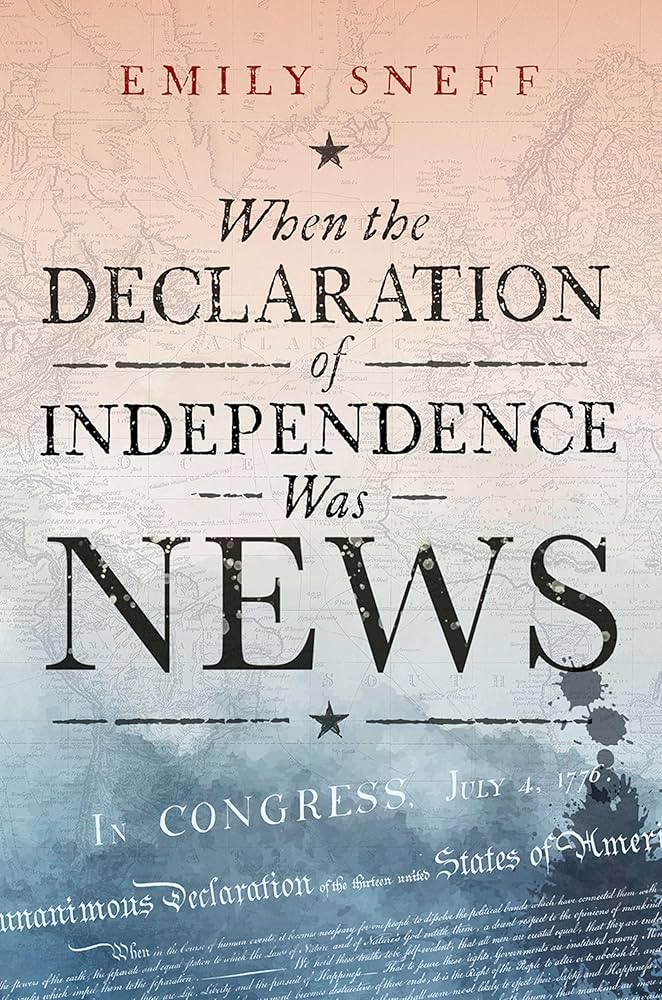
Dr. Emily Sneff takes the readers behind the scenes into the political, economic, and diplomatic correspondence in colonial state congresses, correspondence transported by ship captains from the harbors of Philadelphia and New York to the Caribbean and Europe, and the economic blockades by foreign ships on America’s rivers, especially the Delaware. For example, this is her report for the week of May 6, 1776:
“The mood in Philadelphia became anxious, and the Continental Congress witnessed how much terror British ships could cause. No one in the Congress knew yet if the British and German reinforcements were going to target Philadelphia or New York City. They could only rely in intelligence from captains of merchant vessels who sailed alongside the massive, slow-moving fleet of British ships bringing supplies and soldiers across the Atlantic.” (page 22)
The debate over rights and rebellion was further complicated by the fact that the Continental Congress and the Pennsylvania State House met in the same building. “The Congress shared the Pennsylvania State House with the provincial assembly. In the first few months of 1776, the delegates were increasingly aware that the decisions they made on the first floor of the State House might be undermined by decisions made by the conservative Pennsylvania Assembly on the second floor.” (page 23)
The book provides important contextual information for teachers who want their students to debate if the Continental Congress should have passed the Articles of Confederation at the time of the Declaration of Independence. The articles of Confederation were discussed in the Second Continental Congress but adopted four months after the Declaration of Independence and formally ratified on March 1, 1781, seven months before the surrender of General Cornwallis at Yorktown, Virginia. During this time, the 13 states were at risk of attack, surrender, rebellion, and disease. The purpose of the Articles was to establish and protect the sovereignty of the original 13 colonies and now the ‘league of friendship’ of the 13 states.
As of May 15, 1776, “There was no consensus on what a declaration of independence needed to be, or whether it needed to be issued before or after the plans for a confederation and foreign treaties. From its context to its contents to the men who voted for and against it, the Declaration of Independence was a product of specific circumstances, including multiple proponents of the debate about whether or not to separate from Great Britain.” (page 34)
The resolution proposed by Richard Henry Lee on June 7 included the clause “That a plan of confederation be prepare and transmitted to the respective Colonies for their consideration and approbation.” (page 37)
This is an important discussion or debate for students regarding the political, economic, and diplomatic issues that are part of the debate for independence. The risks the representatives faced in Philadelphia were high as was the protection of the 2.5 million colonists. One week before the vote on the Declaration of Independence, the plot by Thomas Hickey to assassinate General George Washington in New York City was revealed. Emily Sneff provides an excellent account of this plot and its relevance to the Declaration of Independence, especially if the British were victorious, even in one colony or region. (pages 41-42)
Students, especially from New Jersey, Pennsylvania, and New York will find the information regarding the printing of the Declaration by John Dunlop and others to be of interest. The ability to duplicate multiple copies, setting the type for newspapers, the shortage of paper, the presence of British ships along the coast and in rivers, and the translation of the document into German should engage students with asking many questions and the opportunity for students studying German to analyze the translations and understand how the colonists of German heritage viewed the relationship of the House of Hanover to King George III.
Dr. Sneff takes us on a journey through the perspective of the forming of an American identity as the Declaration was read in Philadelphia, Easton, Hamburg, Reading, Trenton, the College of New Jersey (Princeton University), New York City, Boston and New England, and the arduous journey by land to the Carolinas and Savannah.
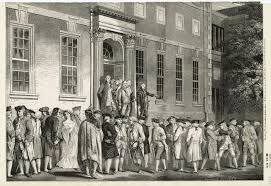
Col. John Nixon reading the Declaration of Independence at the New Jersey state capitol in Trenton on July 8, 1776. The New Jersey Constitution ratified on July 2 was also read.
Princeton, July 10
“Last night Nassau Halls was grandly illuminated, and INDEPENDANCY proclaimed under a triple volley of musketry, and universal acclamation for the prosperity of the UNITED STATES. The ceremony was conducted with the greatest decorum.” (From NJ. State Library)
General William Howe arrived on board HMS Greyhound off the coast at Sandy Hook on June 25 waiting for his brother Vice-Admiral Richard Howe on board HMS Eagle on July 12. There was an armada of British ships carrying 32,000 soldiers in the area of New York when General Washington read the Declaration of Independence to his troops at 6:00 p.m. on July 9 on the Commons (now City Hall Park). A few hours later the statue of King George III on horseback was pulled down and transported to the farm of Oliver Wolcott in Litchfield, Connecticut to be melted into 42,088 bullets.
Students discuss the Preamble of the Declaration and its importance of human rights. The insights on the British perspective of the Declaration are often ignored but important for students to understand.
“Washington hoped that hearing the Declaration would provide a ‘fresh incentive to every officer, and soldier, to act with Fidelity and Courage, as knowing that now the peace and safety of his country depends (under God) solely on the success of our arms.” (page 80)
Students need to view this in contrast to the statement by Ambrose Serle, Vice Admiral Richard Howe’s Secretary, in his journal, dated July 12, 1776:
“The Declaration of Independence proved that the Continental Congress had never truly wanted to reconcile with Great Britain. Independence had been ‘their Object from the Beginning.’ Serle had never seen ‘a more impudent, false and atrocious Proclamation’ than the Declaration. As he vented in his journal, Serle noted that, in their previous petitions, the Congress had ‘thrown all the Blame and Insult upon the Parliament and ministry,’ but in the declaration they had ‘the Audacity to calumniate the King and People of Great Britain.’ Even worse, they dared to invoke divine protection. ‘Tis impossible to read this Paper,’ Serle wrote, ‘without Horror at the Hypocrisy of these Men, who call GOD to witness the uprightness of their Proceedings.’” (page 73)
Students should ask “What if?” ‘What if’ the British negotiated a diplomatic solution? ‘What if’ the attack on Brooklyn Heights happened in July? ‘What if’ the Articles of Confederation were ratified in July, 1776? When the Declaration of Independence Was News provides important primary sources and historical context for teachers.
The chapter on Massachusetts provides an excellent analysis of the smallpox epidemic in 1776 and the inoculation of Abigail Adams and her children. The letters from the Adams Family Papers are clearly documented and helpful to teachers who want their students to explore the impact of smallpox in the year of our independence. There is also information available online about the spread of smallpox in other colonies, especially in New York and New Jersey.
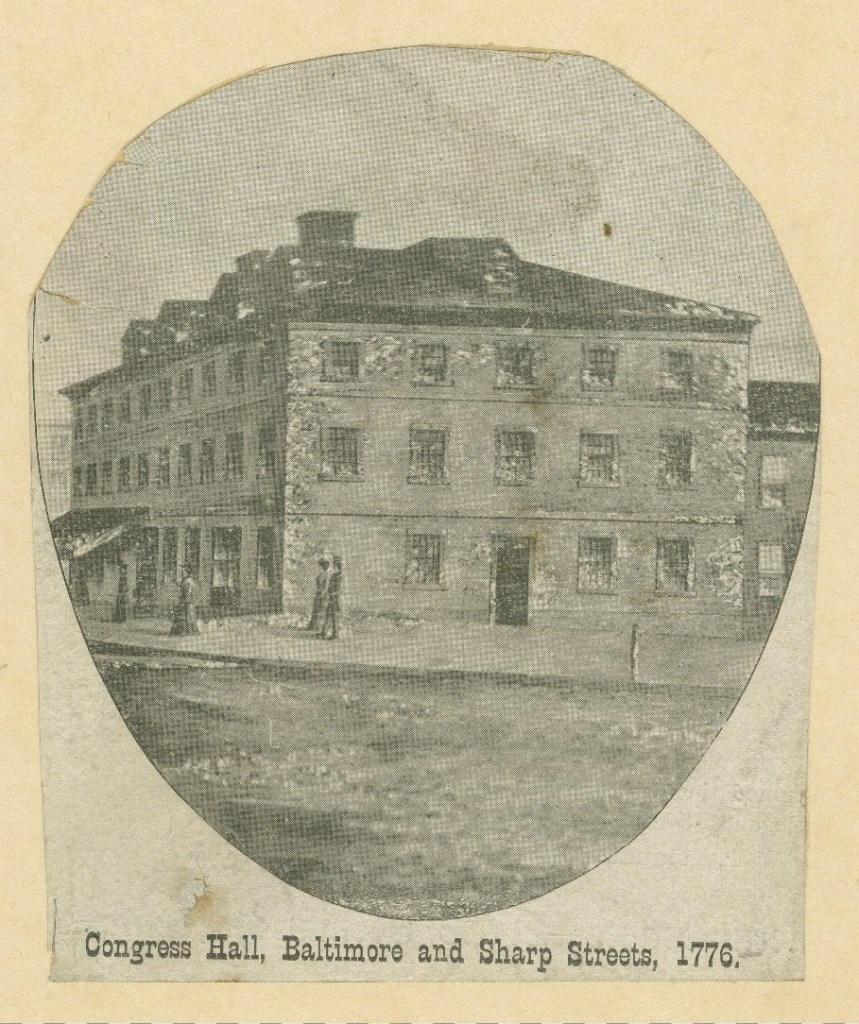
Some of the most important information in the book explains the impact of the naval blockade on mail delivery to Europe, the behind-the-scenes diplomatic negotiations with the Dutch Republic, France and Spain, the relocation of the Continental Congress from Philadelphia to Baltimore in December 1776, the role of Mary Katherine Goddard in printing the “official” signed copy of the Declaration for each of the 13 states.
In the middle of the 19th century, the U.S. Supreme Court announced a cataclysmic decision denying the human rights of life, liberty, and the pursuit of happiness as defined in our declaration of Independence to Black people. Frederick Douglass spoke at the Anti-Slavery Society, “I base my sense of the certain overthrow of slavery, in part, upon the nature of the American Government, the Constitution, the tendencies of the age, and the character of the American people, and this, notwithstanding the important decision of Judge Taney.” (page xxii)
In the middle of the 20th century, the President of the United States led the people of the United States in prayer, beseeching the Almighty God with this closing petition: “With Thy blessing, we shall prevail over the unholy forces of our enemy. Help us to conquer the apostles of greed and racial arrogancies. Lead us to the saving of our country and with our sister nations into a world unity that will spell a sure peace – a peace invulnerable to the schemings (sic) of unworthy men. And a peace that will let all of men live in freedom, reaping the just rewards of their honest toil. Thy will be done, Almighty God. Amen.” (page 221)
In the beginning of the second quartile of the 21st century, the people of America are experiencing an attack on their institutions, the dehumanization of significant populations of its citizens, and strategies restricting their human rights to life, liberty, and the pursuit of happiness. Many educators are rewriting curriculum to teach civics with lessons on our constitution. The contribution of American Struggle by Jon Meacham is the lessons of history as he provides us with an anthology of118 documents that provide a winning strategy for students and ordinary people who want to protect and preserve our republic.
The organization of the chapters in this book provides a chronological perspective of the challenges our country has faced since its beginning. Jamestown was under martial law in 1618-19 because of the lack of food and the crisis of starvation. From this crisis came the first meeting of the burgesses on July 30, 1619, with an agreement to meet in the pews of the Jamestown church. One of the first laws passed by the burgess was to establish a fair price for tobacco. The Mayflower Compact in 1620 was another historic agreement by the first people who left Britain to escape the persecution King Charles I. Jon Meacham selected Thomas Paine’s Common Sense in the selection of documents between 1607 and 1776. This pamphlet was motivated by the tragedy of April 19, 1775, at Lexington and published on January 10, 1776. Paine reminded the 2.5 million colonists, who were predominately English, Irish, Scots, Dutch, German, Swedes, French, Black, and Native Americans…
“Where, say some, is the king of America? I’ll tell you. Friend, he reigns above, and doth not make havoc of mankind like the royal brute of Great Britain…. So far as we approve of monarch… in America the law is king.” (page13)
In Chapter 2, Federalist Paper #1 reminded me of the importance of discipline and rules in my classroom. There will always be students who avoid doing their homework, arrive late, abuse the attendance policy, push the limits of appropriate dress, and take advantage of others. In the debates for and against the ratification of our Constitution, Alexander Hamilton warned us about people who will test the limits of a democracy in Federalist #1:
“An enlightened zeal for the energy and efficiency of government will be stigmatized as the offspring of a temper fond of despotic power and hostile to the principles of liberty. An overscrupulous jealousy of danger to the rights of the people, which is more commonly the fault of the head than the heart, will be represented as mere pretense and artifice, the stale bait for popularity at the expense of the public good. It will be forgotten, on the one hand, that jealousy is the usual concomitant of love, and that the noble enthusiasm of liberty is apt to be infected with a spirit of narrow and illiberal districts. On the other hand, it will be equally forgotten that the vigor of government is essential to the security of liberty, that , in the contemplation of a sound and well-informed judgment, their interest can never be separated; and that a dangerous ambition more often lurks behind the specious mask of zeal for the rights of the people than under the forbidden appearance of zeal for the firmness and efficiency of government.” (page 29)
Jon Meacham offers a context through documents which motivate reflective thinking. The challenges for each era are different and yet he reminds us of the continuing theme that our freedom is fragile. The selections in the chapters for the 19th century, “The Union and Its Discontents,” “The Fiery Trial,” and “A Troubled Peace” provide teachers with the diversity of perspectives and valuable insights into the importance of religion as social and intellectual history.
The Tariff of 1828 was issued only two years after the 50th anniversary of the Declaration of Independence. During these 50 years, approximately 800,000 immigrants arrived, the cotton gin increased the demand for slave labor and the number of slaves increased to 2 million from 700,000 in 1790, we experienced three contested presidential elections, had several internal rebellions, and experienced two economic crises. Ask your students, what they think motivated Daniel Webster to write the words in the excerpt from his speech below, “Liberty and Union, Now and Forever” on January 26, 1830. What voices did he listen to with his ears? What did his eyes see on the horizon? What memories was he thinking of with his brain?
“God grant that in my day, at least, that curtain may not rise! God grant that on my vision never may be opened what lies behind! When my eyes shall be turned to behold for the last time the sun in heaven, may I not see him shining on the broken and dishonored fragments of a land rent with civil feuds, or drenched, it may be, in fraternal blood! Let their last feeble and lingering glance rather behold the gorgeous ensign of the republic, now known and honored through the earth, still full high and advanced, its arms and trophies streaming in their original luster, not a stripe erased or polluted, nor a single star obscured, bearing for its motto, no such miserable interrogatory as “What is all this worth?” nor those other words of delusion and folly, “Liberty first and Union afterwards”, but everywhere spread all over in characters of living light, blazing on all its ample folds, as they float over the sea and over the land, and in every wind under the whole heavens, that other sentiment, dear top every true American heart – Liberty and Union, now and forever, one and inseparable.” (page 53)
Teachers might use this speech to ask their students on the 200th anniversary of this landmark speech and the 250th anniversary of the Declaration of Independence if liberty is still the enduring legacy of the American identity or if it is justice or equality. Daniel Webster at the age of 36 argued before the U.S. Supreme Court in 1818 for his alma mater in Dartmouth College v. Woodward that Dartmouth College had a charter (contract) and that the government could not amend or change to make Dartmouth College a state or public institution. This landmark decision reflects national unity and the decisions on tariffs and wars led to division. Six years before this decision, several New England states met in Hartford, Connecticut to challenge the decision of the Congress to declare war on England in 1812, which negatively impacted their economy and livelihood. The Tariff of 1816 and the Panic of 1819 negatively affected the economy of South Carolina with 10% of its population moving west. Students need to debate if states’ rights matter and to the extent they matter today on issues of elections, immigration, gender, health care, and reproductive rights. A resolution in the Lincoln-Douglas style could be “America was, is, and will continue to be a divided democracy.”
Daniel Webster was elected to Congress in 1812 from New Hampshire as an anti-war Federalist, He was aware that perhaps 50% of the farmers and merchants in New England were out of work because of the Embargo Act, that the federal government ordered Massachusetts to send their state militia to fight in the war, that Britain wanted to sign a separate agreement with the New England states, and that Washington D.C. was burned. Students can debate if the extent of authority granted in the constitution to the three branches of the national government is more important than the individual rights of each state.
After students complete their debate on states’ rights and national unity, they need to answer if liberty is still the enduring legacy of the American identity. Is it the liberty of the people (popular sovereignty), the liberty of the states (compact theory and right to secession), or the authority of the national government (Supremacy Clause) that defines the legacy of liberty in the 21st century? To develop historical thinking, it is necessary to include the context of the primary sources in American Struggle.
The document, “The Arc is a Long One” by Theodore Parker in 1853, speaks to the importance of justice as the enduring legacy of our American identity. This sermon was presented three years after the Compromise of 1850, at a time when African Americans were taken from their homes and jobs in northern states, and at a time when the arguments of the Christian religion were used to support enslavement.
“What an idea democracy now floats before the eyes of earnest and religious men-fairer than the “Republic” of Plato or More’s “Utopia,” or the golden age of fabled memory! It is justice that we want to organize – justice for all, for rich and poor. There the slave shall be free from the master. There shall be no want, no oppression, no fear of man, no fear of God, but only love. “There is a good time coming” – so we all believe when we are young and full of life and healthy hope.” (page 82)
In this context, students are introduced to intellectual history, philosophy, and the importance of moral education. Students might explore the extent this sermon influenced people beyond Parker’s Unitarian congregation on Centre Street in the West Roxbury neighborhood of Boston? Consider asking what is meant by the moral arc of justice and examples from history as to when justice prevailed over evil. To enable students to connect with the issues of personal liberty, human trafficking, gun violence, proliferation of narcotics, and greed, consider the speeches by Rev. Dr. Martin Luther King, Jr, in Montgomery (3/25/1965) and in President Barack Obama’s Second Inaugural Address on the ‘arc of history.” (1/21/2013)
The perspective of Edward A. Pollard, editor of the Daily Richmond Examiner and the author of The Lost Cause: A New Southern History of the War of the Confederates, (1866) provides students with the lessons of war. It is important to remember that the battles of war continue after the battles end. The question for students to consider is how should historians determine the outcome of war, conflict, or crisis?
Theodore Parker explains the contributions of the South to the moral and intellectual identity of the American people. The South produced the majority (10/16) of American presidents before the Civil War, and produced influential literature about living in the colonies, on plantations, and in Charleston. Encourage your students to debate the power of the people in the context of their vision of liberty, justice, equality, and freedom in the United States.
“The war has not swallowed up everything. There are great interests which stand out of the pale of the contest, which is for the South still to cultivate and maintain. She must submit fairly and truthfully to what the war has properly decided. But the war properly decided only what was put in issue: the restoration of the Union and the excision of slavery; and to these two conditions the South submits. But the war did not decide negro equality; it did not decide negro suffrage; it did not decide State Rights, although it may have exploded their abuse; it did not decide the orthodoxy of the Democratic party; it did not decide the right of a people to show dignity in misfortune; and to maintain self-respect in the face of adversity. And these things which the war did not decide, the Southern people will still cling to, still claim, and still assert in them their rights and views.” (page 126)
The selection of documents within defined time periods provides teachers with an opportunity to have their students read them and then select excerpts from them for a press conference, podcast, or town hall meeting on Reconstruction, the Depression or World War 2. The 12-20 documents in each chapter of American Struggle are short, represent different points of view, and are relevant to the experiences of Americans today. Do the words of President Franklin Roosevelt’s First Inaugural Address on March 4, 1933, or the words of Senator Huey P. Long in his radio address, “Every Man a King” on February 23, 1934 apply to how the students in your school understand America today?
“In such a spirt on my part and on yours we face our common difficulties. They concern, thank God, only material things. Values have shrunken to fantastic levels, taxes have risen, our ability to pay has fallen; government of all kinds is faced by serious curtailment of income, the means of exchange are frozen in the currents of trade; the withered leaves of industrial enterprise lie on every side; farmers find no markets for their produce; the savings of many years in thousands of families are gone.” (Roosevelt, page 193)
“We have in America today more wealth, more goods, more food, more clothing, more houses than we have ever had. We have everything in abundance here. We have the farm problem, my friends, because we have too much cotton, because we have too much wheat, and have too much corn, and too much potatoes….
We have in America today, my friends, a condition by which about ten men dominate the means of activity in at least 85 percent of the activities that you own, They either own directly everything or they have got some kind of mortgage on it, with a very small percentage to be excepted.” (Long, page 200)
The section on Rights and Reactions offers teachers the following documents within a six-year time frame. This defined period offers teachers resources for varying perspectives on civil rights and the Vietnam War. Students can read and analyze these documents and then research the reactions to them in newspapers using Chronicling America on the Library of Congress website, recently updated in April 2026. There are few sources compiling a vivid description of the defining events of the Sixties, enabling teachers to teach the curriculum standards using a thematic, chronological, and interdisciplinary model of instruction.
U.S. Supreme Court decision in Engle v. Vitale, June 25, 1962 on school prayer
George C. Wallace’s Inaugural address, January 14, 1963
John F. Kennedy’s address on Civil Rights, June 11, 1963
New York Times article on Medgar Evans assassination (June 13, 1963 (2 days later)
John Lewis’ address at the March on Washington, August 28, 1963
President Lyndon Johnson’s speech on the Great Society on May 22, 1964
Senator Everett Dirksen’s speech on civil rights bill, June 10, 1964
Gov. Nelson A. Rockefeller’s speech at the Republican National Convention, July 14, 1964
Senator Barry Goldwater’s Acceptance Speech to the Republican National Convention, July 16, 1964
Fannie Lou Hamer Testimony before the Democratic National Convention on August 22, 1964
President Lyndon Johnson’s Address to Congress, March 15, 1965
Rev. Jerry Falwell’s sermon, March 21, 1965
James Baldwin’s article in Ebony, August, 1965
President Lyndon Johnson on the Immigration & Nationality Act, October 3, 1965
Walter Cronkite’s Editorial on Vietnam and the Tet Offensive, February 27, 1968
Martin Luther King, Jr.’s sermon on April 3, 1968 (day before his assassination)
Senator Robert F, Kennedy’s remarks on the assassination of Dr. King, Jr. April 4, 1968
The events of this decade will represent a turning point in American history and American Struggle provides a critical perspective through documents from 1969 to the present. The documents below guide students in an exploration of the changes in America’s role from its zenith in 1969 to the present. Students and teachers need to explore and debate how historians will define this 60-year period in both American and world history. The 19 documents provide the first steps for inquiry using the framework of a chronological outline about the domestic and foreign policy challenges in this era. Each document has relevance to the challenges students see in the world today: Here is a sample:
‘There are No Founding Mothers” – Shirley Chisholm on the ERA
“We are a Government of Laws, Not of Men”- President Ford on his second day as President
“A Crisis of Confidence” – President Jimmy Carter on The Energy Crisis
“The Infrastructure of Democracy” – President Roanld Reagan’s Address to the British Parliament
“They Came from Every Land” – President Ronald Reagan on the 100th Anniversary of the Statue of Liberty
“Take Back Our Culture” – Patrick J. Buchanan’s Address to the Republican national Convention
“Justice Will Prevail” – President Bill Clinton at the Oklahoma City Memorial Prayer Service
“Country Before Party” – Vice-President Al Gore’s Presidential Concession Speech
“That’s Not the America I Know” – President George W. Bush on the Attack on America in 2001
“Love is Love” – President Barack Obama’s Remarks on Marriage Equality
“American Carnage” – President Trump’s First Inaugural Address
A final thought on how the words from President Reagan, 45 years ago, are relevant to what students are studying in high school classes today in relationship to America’s foreign policy”
“The objective I propose is quite simple to state: to foster the infrastructure of democracy – the system of a free press, unions, political parties, universities – which allows a people to choose their own way, to develop their own culture, to reconciles their own differences through peaceful means.
This is not cultural imperialism: it is [providing the means for genuine self-determination and protection for diversity. Democracy already flourishes in countries with very different cultures and historical experiences. It would be cultural condescension, or worse, to say that any people prefer dictatorship to democracy. Who would voluntarily choose not to have the right to vote, decide to purchase government propaganda handouts instead of independent newspapers, prefer government to worker-controlled unions, opt for land to be owned by the state instead of those who till it, want government repression of religious liberty, a single political party instead of a free choice, a rigid cultural orthodoxy instead of democratic tolerance and diversity?” (page 408)
Engaging High School Students in Global Civic Education Lessons in U.S. History
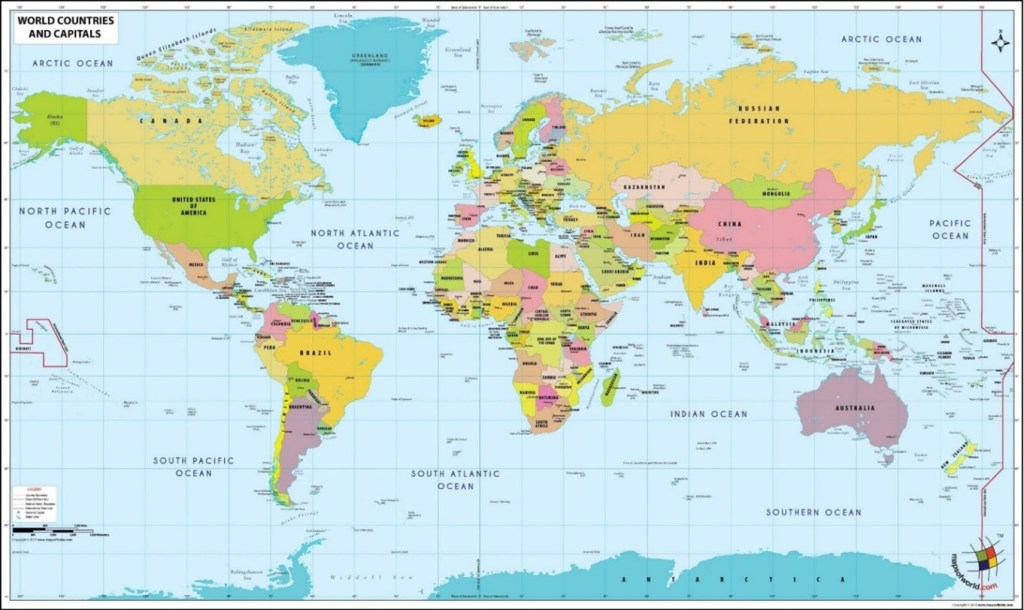
The relationship between the individual and the state is present in every country, society, and civilization. Relevant questions about individual liberty, civic engagement, government authority, equality and justice, and protection are important for every demographic group in the population. In your teaching of World History, consider the examples and questions provided below that should be familiar to students in the history of the United States with application to the experiences of others around the world.
These civic activities are designed to present civics in a global context as civic education happens in every country. The design is flexible regarding using one of the activities, allowing students to explore multiple activities in groups, and as a lesson for a substitute teacher. The lessons are free, although a donation to the New Jersey Council for the Social Studies is greatly appreciated. www.njcss.org
Era 16 Contemporary United States: Interconnected Global Society (1970–Today)
We are in the second quarter of the 21st century. Critical issues for governments center around fairness of elections, gender issues, food stability, artificial intelligence and intellectual property, and trade. The importance of collective security through alliances and the ability of international organizations like the World Bank and International Monetary Fund depend on leaders in countries supporting them and following their decisions.
Activity #1: Voting Rights and LGBTQ Individuals: Nigeria and the United States
Nigeria
Nigeria is the largest country in Africa with a population of 240 million. Its population growth rate is almost 3% with a projected population of 350 million by 2050. More than half of the population lives is cities. Nigeria has a diverse population with about 55% confessing Islam and 45% Christian beliefs.
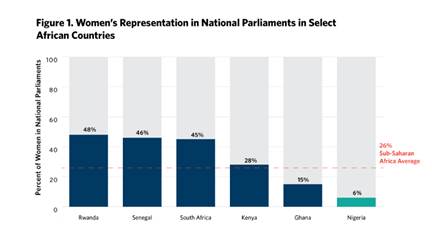
The Nigerian Constitution Amendment Act of 1954 eliminated gender restrictions on voting and allowed men and women to engage in the political process equally. Unfortunately, the patriarchal culture that existed before Nigeria became independent and the influence of Muslim beliefs on the role of women are two factors restricting the civic engagement of many women.
In 2022, the Nigerian Congress passed legislation making voting in state and national elections mandatory for all Nigerians eligible to vote. Voter apathy is a problem and coercion is the strategy by the current government to address this issue. In 2023, only 27% of registered voters participated in the national election. President Tinubu signed the Electoral Act of 2026, which fines and arrests citizens who do not exercise their right to vote.
The Electoral Act 2026:
Formalizes the use of the Bimodal Voter Accreditation System (BVAS) as the sole mandatory method for voter accreditation, officially replacing older technologies.
Streamlines election administration by adjusting the “Notice of Election” window to 180 days and requiring the submission of candidate lists 90 days before a general election.
Increases the fine for the illegal buying or selling of Permanent Voter Cards (PVCs) to ₦5 million, maintaining a strict two-year imprisonment term for offenders.
Grants the Independent National Electoral Commission (INEC) the authority to prescribe the specific manner for the transfer of results and accreditation data, ensuring operational flexibility in areas with varying infrastructure.
President Tinubu stated. “We are ensuring that the voice of every Nigerian is not only heard but accurately recorded and protected by the law.” The 2026 Electoral Act is based on the premise that a high voter participation rate reduces election fraud. Singapore, Australia, Argentina, and Brazil also require mandatory voting and voter participation is 80% or higher. These countries also have secure, trusted, and efficient systems in place.
Although the Act provides for transparency through digital reporting of election results, the Act includes a provision for the manual submission of election results in areas where the technology is not available or reliable. The 2026 Act also maintains the Permanent Voter Card (PVC) as the mandatory identification for voting. The Constitution (Section 40) states that the right not to participate in voting is as important as the right to vote.
However, not everyone agrees with this position because it may increase voter apathy. Voting must be a choice freely made, not forced by threat of jail. The law is also viewed as unconstitutional because Chapter 4: Section 40 provides for the right not to participate in elections. The new law does not address the problems of insecurity and lack of credibility in political leadership, and buying votes.
LGBTQ+
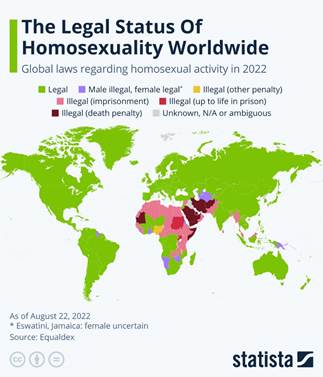
Nigeria is a conservative country with a history that has made homosexuality and lesbianism illegal. The Islamic and Christian religious beliefs in Nigeria oppose homosexuality and lesbianism. It is estimated that there are 15-20 million Individuals who identify as LGBTQ+ and are subject to arrest, which is often accompanied by police violence and brutality. LGBTQ+ individuals are victims of assault, mob attacks, harassment, extortion, and the denial of basic rights and services. As a result they are living in hiding.
In 2024, President Tinubo approved an order preventing LGBTQ+ individuals from serving in the armed forces. In 2014, the Same Sex Marriage (Prohibition) Act 2013 (SSMPA) came into force. The Act includes criminal penalties for same sex marriages or civil unions; solemnizing a same-sex marriage or union; “gay clubs, societies or organizations”; and same sex amorous relationships in public. Sharia law in the 12 northern States criminalizes same-sex intimacy between both men and women, as well as cross-dressing. These recent actions mark an aggressive effort by the government against LGBTQ+ individuals.
United States
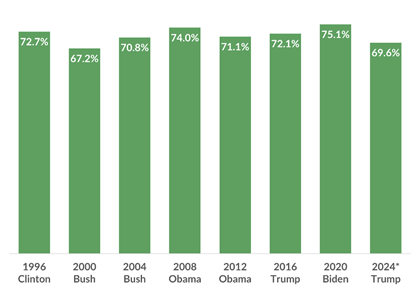
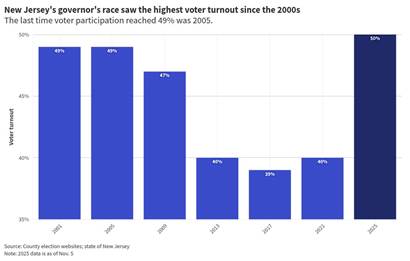
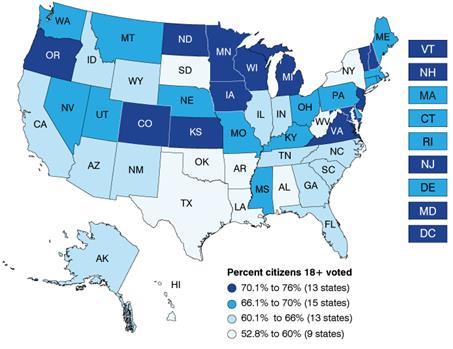
The United States amended its constitution four times (Amendments #15, 19, 24, and 26) to increase voter participation and establish a fair and efficient process for elections. The Constitution delegates elections to its 50 states, with the exception of the date in November for the national election of president every four years. The United States has a long history of expanding voter registration, participation in elections, and encouraging civic engagement. Although voter participation is around 50% in general elections, the participation rate to elect the president every four years is about 70%.
In 2013, the 5-4 decision in Shelby County v. Holder, marked a turning point in the election laws in the United States. The decision was that states and localities with a history of suppressing voting rights no longer were required to submit changes in their election laws to the U.S. Justice Department for review. As a result. Texas, Mississippi, Alabama, and Virginia passed legislation requiring voter identification to vote.
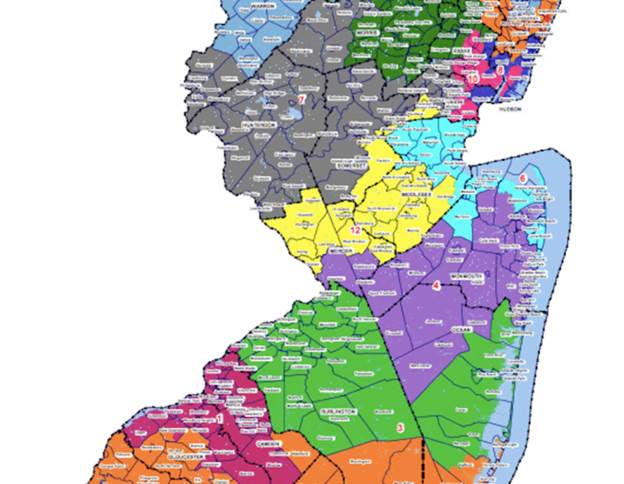
Although the United States is viewed as a country with fair elections, the incumbent administration of President Trump claims it is not fair, influenced by foreign governments, and to rewrite election rules. Some states have attempted to change their congressional districts to favor one party over another. This process is called gerrymandering and takes place every ten years based on the data provided by the U.S. Census Bureau.
The major changes currently being attempted in the United States include:
rewriting election rules to control election systems;
threatening to target election officials who keep elections free and fair;
supporting people in the states who question the current election administration;
retreating from the federal government’s role of protecting voters and assuring fair elections.
LGBTQ+
The U.S. Supreme Court extended LGBTQ+ rights after the Stonewall riot in 1967. However, in 1996, Congress passed the Defense of Marriage Act banning federal recognition of same-sex marriage by defining marriage as the union of one man and one woman. It also allowed states to refuse to recognize a same-sex marriage granted by another state. In 2022, the Defense of Marriage Act was repealed by the passage of the Respect for Marriage Act which recognizes the validity of same-sex and interracial civil marriages in the United States. The Respect for Marriage Act received support following the 2015 Obergefell v. Hodges 5-4 decision which stated that the Fourteenth Amendment’s Equal Protection Clause requires states to license and recognize marriage between two people of the same sex.
Questions:
How can governments increase voter participation and civic engagement?
Do the attempts in Nigeria to require eligible voters to vote support or hinder democracy and civic participation?
Should the Electoral Reform Act of 2022 and the Amendment (2026) be viewed as supporting democracy or limiting democracy?
Does Voter Identification requirements enure fairness in elections or suppress voter participation?
In 2001, the U.S. Supreme Court’s controversial 5-4 decision in Bush v. Gore established a precedent for determining the outcome of a close election (271 – 266). If a future election is questioned in the United States, how should the outcome be decided?
In the United States, should the federal government or the states have the authority to license and recognize marriages?
Do individuals in Nigeria, who identify as LGBTQ+, have any protections from physical abuse by the government? Where would they begin?
Activity #2: Copyright Protection: Kenya and the United States
Kenya
Kenya updated the Copyright Act of 2001 in 2020 and amended it in 2022 and 2026 because of the unique challenges in the arts and creative markets. Kenya realized the potential of the creative arts industry in their economy. The amendments offer protected rights to authors for 50 years after their death and 50 years after the work was first created.
The primary purpose of copyright protection is to safeguard the rights of authors and creators. Kenya’s laws encourage new artistic and intellectual content. The Copyright Act also defines how the works are reproduced, distributed, and publicly displayed. The fair use doctrine allows for limited usage of copyrighted materials for criticism, news reporting, education, and research. A unique provision in the Act provides for moral rights protecting the creator’s identity.
You may want to read the court case of Kimani v Safaricom Limited regarding use of intellectual property from other parties.
United States
The U.S. Constitution provides for copyright protection in Article I, Section 8, Clause 8. The United States update the Copyright Act of 1976 in 2025 with provisions for intellectual property, and semiconductor chips. The United States issues licenses for creative, artistic, and technology authors. The United States protects the rights of authors for 70 years.
One of the core functions of copyright law is to grant exclusive rights to creators, allowing them to control how their works are used, reproduced, distributed, and displayed. These exclusive rights include the right to reproduce the work, prepare derivative works from another source, distribute copies, and perform or display the work publicly. Copyright laws provide financial incentives and protect the integrity of creative and artistic works from duplication, alteration, or diminishing the creator’s reputation.
Copyright protection supports cultural, educational, and technological advancement by encouraging authors to write books, musicians to compose songs, films to be produced, and developers to create software. This cycle of creation and protection benefits society as a whole, enriching public knowledge and entertainment while fostering economic growth in creative industries. These laws must also protect the public interest to use the content in these protected products for education and research. You may want to read the court case decision regarding the use of the Happy Birthday song.
Questions:
Should artists receive royalties when their music is played on the radio or only on subscription based platforms?
What is a reasonable number of years for copyright protection?
Should information and content generated by artificial intelligence and not a human be protected by copyright laws?
How should the public interest of content protected by copyright laws be defined? For example, should a child be able to play a popular song in their home without paying a royalty and should a student or teacher be allowed to download an image or select a paragraph from a published book for free?
What should educators teach about copyright laws and citing sources and in what grade should these be taught?
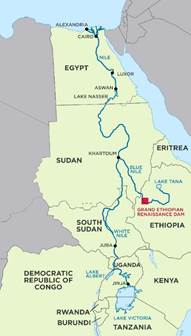
Activity #3: The Nile River and the Environment: Ethiopia and Egypt
Egypt
In September 2025, Ethiopia began diverting water from the Nile River with the operation of the Grand Ethiopian Renaissance Dam. (GERD) The Nile River is the longest river in the world (although some claim the Amazon River is the longest) and is a vital resource for millions of people in Sudan and Egypt who depend on it for potable water, agriculture, fishing, navigation, and tourism. Ethiopia built the dam as a vital source of energy, flood control, and to support the economic development of the region.
Egypt claims the dam violates international law governing international waterways and is a violation of the human rights of its people. Studies provide evidence that any significant decrease in Egypt’s share of the Nile River water will lead to a decline in food production and increase poverty. However, these violations were also used to criticize the Awan Dam built on the Nile River in 1970. The Aswan Dam has prevented serious flooding, provided economic growth, and is a vital source of clean energy. The Grand Ethiopian Renaissance Dam is more than doubles the hydroelectric power of the Aswan Dam.
Aswan Dam
Ethiopia
The Grand Ethiopian Renaissance Dam is the largest hydropower project in Africa. The Grand Ethiopian Renaissance Dam project has generated significant occupational and social impact as it was financed and built by the people of Ethiopia. The plant also ensures a reduction of 1.3 million tons of carbon emissions per year. The complex includes three housing developments for 10,000 people, three medical centres and schools, food stores, recreational areas, a club, a swimming pool, and sports fields.
The dam produces more electricity than Ethiopia needs providing for the possibility of exporting clean energy to Djibouti and Kenya. It was constructed with the expectation that this will enable economic growth in Ethiopia for manufacturing, technology, and food production.
Questions:
Does a country have the right to make a unilateral decision that affects international waters?
Are the economic and environmental benefits of clean energy greater than the disadvantages of water flowing to neighboring countries?
The Nile River is known for transporting sediment in its journey of approximately 3,000 miles. Will this sediment prove harmful to the Greater Ethiopian Renaissance Dam over time?
Does Ethiopia have a promising or a disappointing future? What is your prediction for Ethiopia in 2050?
Activity #4: Trade: European Union and the United States
The economies of the European Union and the United States are fairly similar in size. Between 1950 and 2025, the countries of the Europe were major trading partners with the United States. Beginning in 2025, this relationship changed as the United States levied tariffs on many products exported to the United States.
The EU is the largest economy in the world with a GDP per head of €25,000 for its 440 million consumers and the volume of trade represents 29% of global trade. It is the world’s largest producer of both manufactured goods and services. They are the top trading partner for 80 countries and the United States is the top trading partner for about 20 countries. The 27 countries in the European Union had a trade surplus of $272 billion (USD) in 2024. The major exports are machinery, computers, vehicles, pharmaceuticals, plastics, optical equipment, organic chemicals, and iron, steel. The major imports are vehicles and oil.
United States
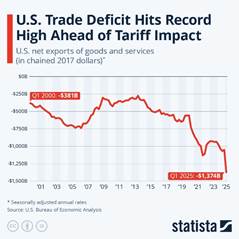
Mexico and Canada are the largest trading partners for the United States representing 30% of trade. China, Germany and Japan account for 20%. The United States has a trade deficit with all of its top 15 trading partners with the exception of a surplus with the United Kingdom and Netherlands. In 2025, the annual trade deficit of the United States was $901.5 billon.
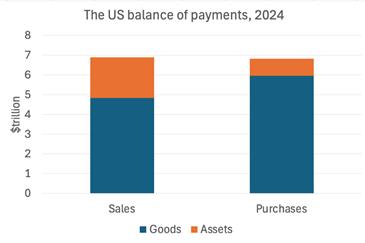
A trade deficit is often misleading and students need to analyze it from different perspectives. First, the Current Account represents the net value of trade and the Capital Account represents the value of assets, including property, investments, and foreign aid. Together, these two accounts are called the balance of payments. The current account is always offset by the capital or financial account so that the sum of these accounts – the balance of payments – is zero. When the balance of one account is in surplus (i.e. has a positive value, representing a credit), the balance of the other account must be in a deficit (i.e. has a negative value, representing a debit). The Current Account and the Capital Account are different from the national debt of $39 trillion or annual deficit of $1.8 trillion for the United States. The national debt and annual deficit directly affect the credit rating of a country and the value of its currency.
Questions:
Why does one country purchase goods or services from another country when the result is a trade deficit?
President Trump has issued tariffs against countries that the United Staes has a trade deficit with. How does this affect trade and the Current Account in the future?
Will the new trade strategy of using tariffs and incentives for companies to manufacture in the United States lead to more economic growth and employment or higher prices and a recession?
How serious is a trade deficit for a country? As an advisor to the President of the United States would you favor a strong or weak currency?
How did the European Union become the world’s largest economy?
Are there lessons for the United States to consider regarding a North American Union or a Western Hemisphere Union of free trade?
Engaging High School Students in Global Civic Education Lessons in U.S. History
The relationship between the individual and the state is present in every country, society, and civilization. Relevant questions about individual liberty, civic engagement, government authority, equality and justice, and protection are important for every demographic group in the population. In your teaching of World History, consider the examples and questions provided below that should be familiar to students in the history of the United States with application to the experiences of others around the world.
These civic activities are designed to present civics in a global context as civic education happens in every country. The design is flexible regarding using one of the activities, allowing students to explore multiple activities in groups, and as a lesson for a substitute teacher. The lessons are free, although a donation to the New Jersey Council for the Social Studies is greatly appreciated. www.njcss.org
Era 15 Contemporary United States: International Policies (1970–Today)
The middle of the 20th century marks the foundation of the transformation of the United States into a world power. In this era the United States developed alliances, promoted free trade agreements, advocated for human rights, and assisted developing countries. Toward the end of the century, the United States was a target of terrorist organizations, had and increasing national debt, and saw its power as a world leader challenged by China and Russia. As the United States entered the 21st century, its role as a leader in the international community was questioned by the Republican Party,
Activity #1: Department of Homeland Security in the United Kingdom and the United States
In 2026, the Domesday Clock was set at 85 seconds to midnight, the end of the civilized world as we know it.The primary reasons for this are the threats of a nuclear arms race, climate change, and bioterrorism.As a result, every major country is re-evaluating its national security plans at the domestic and international level.
“Doomsday Clock on Jan. 27, 2026.Reuters/Kevin Fogarty
United States
In your United States History classes, you have likely discussed national security strategies since the end of World War II in 1945. These include containment, brinkmanship NSC-68, co-existence, Mutually Assured Destruction collective security, human rights, and the United States as the world’s policeman. Each of these policies have been rigorously debated within the government and in public opinion. The debate is often framed in the context of isolationism (U.S. has the military strength to protect itself) and internationalism (U.S. needs the support of alliances and international organizations). The central part of America’s new strategy is our economic strength. The 2025 National Security Strategy rightly asserts that “strength is the best deterrent,” and elevates economic vitality as central to that strength.
The policy announced by the Trump administration in December 2025 diminishes the threat of Russia and China as a top priority. “Mass migration” is deemed to be the major external threat to the United States—more than China, Russia, or terrorism. The document makes clear that the divide is political between transatlantic liberals and authoritarians.
The Western Hemisphere is the new priority and immigration is elevated to a major national security concern. The U.S. military will focus on the Western Hemisphere. The rules of international law are considered less important than the interests of peace, diplomacy, or human rights. Cybersecurity is considered a major threat and the strategy of the United States will become dependent on the private sector.
It is difficult to identify an exact amount for spending by Homeland Security in the United States because of the increased emphasis on immigration. We will use the number of $332 billion or 2.9% of GDP as a comparison to the 2.5% spent by the United Kingdom.
United Kingdom
The population of the United Kingdom is about 70 million. In addition, the United Kingdom also includes territories around the globe. National security threats include terrorism, organized immigration crime, cybersecurity, bioterrorism, exposure to nuclear radiation, and effects from climate change. The United Kingdom in 2025 announced a new long-range security strategy for homeland security at a cost of 2.5% of GDP or about 62 billion euros annually.
The strategy involves a network of alliances to address these threats. The recent announcement by the United States to acquire Greenland by purchase or military action has caused the United Kingdom and other NATO countries to increase financial investments in military equipment, NATO, and other regional alliances. The Calais Group is committed to preventing organized immigration crime, the Joint Migration Taskforce addresses human trafficking, and the Border Security Pact targets smuggling. Homeland security for the United Kingdom also includes agreements promoting economic and financial stability regarding technology, energy, access to minerals, and renewable energy. Russia, China, North Korea, and Iraq are viewed as the biggest threats to homeland security.
The priorities for Homeland Security in the United Kingdom include the following:
Identify and prevent terrorist actors and criminal gangs from entering.
Increased investment in armed forces.
Strengthen existing alliances (NATO, AUKUS, and GCAP) and form new ones.
Pursue deeper trade, technology, and security agreements with the United States, European Union, and India.
Protect its underwater fiber optic network and natural gas pipelines.
The UK has created a new Border Security Command to secure its borders.
Questions:
What are the advantages and disadvantages of the new national security strategies by the United States and the United Kingdom?
How dependent is each country on economic growth to support its strategy?
How significant are the lessons of history regarding national security based on internationalism through alliances and isolationism through dependence on geography and military strength?
Is one strategy better poised for success than the other or are both strategies poised for disappointment or failure?
Activity #2: Foreign Aid in Africa: Japan and Norway
Japan
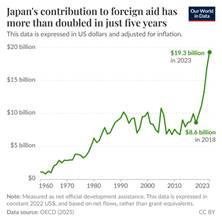
Japan provides significant economic aid to Africa. In 2018, Japan gave $8.6 billion and is currently giving $20 billion. Japan’s foreign aid budget is equal to 0.44% of its gross national income, which is almost double the 0.24% from the United States.
The Japanese government values its relationship with Africa. It understands the importance of rare earth minerals, specifically lithium, nickel, and cobalt. In August 2023 Japan signed contracts with Namibia, Angola, and the Democratic Republic of the Congo (DRC) to secure minerals. The 54 African countries account for more than a quarter of the 193 members in the United Nations. Japan’s foreign policy values free and open markets based on the rule of law, which is viewed as a deterrent to the coercion used by China in Africa.
Norway
Norway’s oil reserves enabled it to maintain financial assets in its Wealth Management Fund. The fund is valued at $1.8 trillion (USD) Norway contributes 3.1 billion krone to the African Development Fund. There are about 30 Western and non-Western countries contributing to this fund annually, including some countries in Africa. Norway places a high priority on providing Africa’s 300 million people with access to electricity, potable water, and food,. In addition, Norway is actively providing financial resources for sustainable living, women’s rights, education, and human rights.
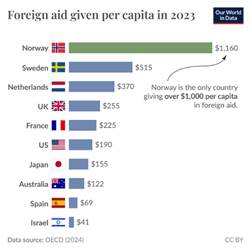
On a per capita basis, Norwegians contribute $1,160, and Japan contributes $155. The United States was contributing $190 per person before its recent withdrawal of funds in 2025.
Norway’s foreign policy includes the following:
Multilateral and regional cooperation: Strengthen cooperation in multilateral forums, enhance African representation, and continue close collaboration with the AU (African Union);
Security and peace efforts: Support African-led peace initiatives, integrate gender perspectives in decision-making, and bolster cooperation with the AU and UN on security;
Democracy, human rights, and gender equality: Promote democracy, human rights, and gender equality through civil society engagement, justice reform, and educational access;
Business, clean energy, and knowledge: Boost economic cooperation, promote Norwegian solutions, and support renewable energy development in African markets; and
Climate, environment, food security, and health: Collaborate on climate action, sustainable food systems, and resilient health systems to address environmental and health challenges.
Questions:
How significant are the foreign policy differences of investment in Africa between Japan, and Norway?
How are the foreign policy initiatives of China, Russia, and the United States influencing the foreign policy of Japan?
Why do you think the people of Japan are supporting additional investment in Africa compared to reducing tariffs or improving the quality of life for the people of Japan?
Which foreign policy strategy is aligned with your values?
In 2000, the United Nations adopted ambitious Millennial Development Goals which were on target until the global financial crisis of 2008. Is it possible in today’s political and economic environment to return to them and improve the quality of life for people in the global South?
Activity #3: Separation of Powers: North Korea and the United States
North Korea
Authoritarian governments also have constitutions. Dictatorships may divide power between the supreme ruler, political party, army, or another group. Democracies may divide power between legislative and judicial branches with the chief executive. The people and media may also have power in a society. A constitution reflects the values of the State and is still one of the best ways to understand how it manages problems and provides for its citizens.
The KPG (Korean Provisional Government) was organized in 1919 and was a government in exile as a result of Japan’s imperialism.It ended on August 15, 1945 with the surrender of Japan and the Republic of Korea became the new government. A new constitution was ratified on August 15, 1948 and Syngman Rhee was elected as President.After the occupation of Korea during World War II ended, Korea adopted a constitution in 1948. Power was given to the SPA (Supreme People’s Assembly) This Assembly was given the authority to enact basic domestic and foreign policies; create a Presidium to operate on its behalf when the Assembly was not in session; approve laws; revise and amend the Constitution; approve the budget; elect or recall a Prime Minister; and appoint officials such as the Chief Justice of the Supreme Court.
The 1972 Constitution stated that the Democratic People’s Republic of Korea (DPRK) was an independent socialist state representing all the Korean people. The constitution is based on democratic centralism, which states that citizens must obey all the decisions of their elected leaders. There is no system of checks and balances, only submission and loyalty. The Constitution of North Korea gives absolute power to the Workers’ Party. It follows the ‘juche’ ideology of self-reliance and is above the law. It fosters Korean nationalism and requires absolute loyalty to the ruler, currently Kim Jong Il. The Constitution values the superiority of the State over its citizens. In theory, the cabinet, military, and party check each other, although the loyalty of the military to Kim Jong Il has ended this system of checks and balances. These three groups could conceivably fight one another in a civil war for control or support each other, which they currently are doing.
United States
The Constitution of the Republic of Korea (South Korea) has been amended nine times since 1948 and reflects six republics which reflect political changes. The Constitution of The Democratic People’s Republic of Korea (North Korea) was completely replaced in 1972 and this constitution has had significant amendments. In contrast, the Constitution of the United States has made changes through 27 amendments and judicial decisions by the Supreme Court. The Constitution of the United States was meant to be flexible.
The powers of government in the United States are also divided between the states and the federal government and between the three branches of the federal government. The framework of the constitution specifically limits the power of the national government and allows the three branches of government to ‘check and balance’ the power of the legislative, executive, and judicial branches.
The principle of popular sovereignty gives power to the people to make changes to their government every two years through the election of their representatives to Congress and the election of one-third of their senators. Currently, the United States has a two-party system with the Republican Party and democratic Party as the two major political parties, Although inn theory, the individual members in each party have independence and vote on the interests of the people they represent; in practice they form caucuses or alliances supporting an ideology or regional interest. Currently, the members of the Republican Party are demonstrating loyalty to the agenda of President Trump and the members of the Democratic Party have caucuses representing different views on immigration, the economy, health care, and the role of the federal government.
Questions:
How important is the role of the political party to the stability of the government?
Are there inherent weaknesses in the Constitution of The Republic of Korea (South Korea) and the Democratic People’s Republic of Korea (North Korea)?
How important is a strong executive to a stable government?
How has President Trump increased the authority of the executive Branch more than previous presidents? (party loyalty, the media, support from the Supreme Court, etc.)
Activity #4: The Executive Branch: St. Kitts and Nevis and the United States
United States
The United States is the largest country in the Americas with a population of 340 million. It has the largest military and economy in the world. The U.S. GDP is approximately 32 trillion followed by China at 21 billion USD. The power of the Executive Branch is vested in the President of the United States, who is the head of state and Commander-in-Chief of the armed forces. The President is responsible for implementing and enforcing the laws written by Congress.
The President must be 35 years of age, a natural born citizen, and must have lived in the United States for at least 14 years. The people elect the president every four years by voting for members in their state who are part of the Electoral College. The Electors vote for President. There are currently 538 electors in the Electoral College representing the 435 members of the House of Representatives, the 100 senators, and the three representatives of the District of Columbia (Washington, D.C.).
The Cabinet and independent federal agencies are responsible for the enforcement and administration of federal laws. Examples are the Department of Defense, Environmental Protection Agency, Homeland Security, and Social Security Administration.
The President has the power either to sign legislation into law or veto bills passed by Congress, although Congress may override a veto with a two-thirds vote of both houses. The Executive Branch
conducts diplomacy with other nations,
negotiates and signs treaties, which must be ratified by two-thirds of the Senate,
issues executive orders, which may clarify and implement existing laws,
extend pardons for federal crimes, and
gives an annual address to Congress outlining the agenda for the coming year.
The president is subject to impeachment for treason, bribery, or high crimes and misdemeanors or smaller crimes. The process to remove a president from office requires a two-thirds vote of the Senate. No American president has been removed from office through the impeachment process, although three presidents have been impeached.
St. Kitts and Nevis
The islands of Saint Kitts and Nevis were created as a federation in 1983 after centuries of British colonial rule. They have the smallest population in the Americas with 46,000, with 11,000 on the island of Nevis and 35,000 on St. Kitts. The population is expected to decline by 20% over the next decade. Nevis has its own assembly, an elected premier and a deputy-governor-general. Tourism, finance, and service sector businesses are the main sources of income. In 1998, Nevis voted to secede but the resolution did to receive the required 2/3 majority vote of the people.
The Government of St. Kitts and Nevis is a parliamentary democracy within the framework of a constitutional monarchy with King Charles III (United Kingdom) as the head of state. The Governor-General represents the monarch, and the Prime Minister is the head of government and leader of the majority party in the National Assembly. The Cabinet is appointed by the Governor-General on the advice of the Prime Minister.
The National Assembly is unicameral, consisting of 15 members: 11 elected representatives, 3 senators appointed by the Governor-General, and the Attorney General. Elections are held every five years. The judiciary is independent and based on the British legal system and uses the Eastern Caribbean Supreme Court, which serves several islands in the region.
Monarch of the United Kingdom acts as a ceremonial figurehead, governor-general represents the king, and prime minister provides advice for the governor-general and leads the cabinet of ministers.
Governor-general is appointed by the monarch and prime minister is appointed by the governor-general.
Governor-General and Prime Minister: At His Majesty’s discretion
Judicial
Eastern Caribbean Supreme Court presides over multiple countries, one justice resides in St. Kitts.
Appointed by British monarch and the Judicial and Legal Services Commission.
Mandatory retirement age of 65
Legislative
Responsible for drafting legislation.
National Assembly has 11 members elected by plurality vote in single-member constituencies and 3 members are appointed by the governor-general.
5 years
Questions:
What are the advantages and disadvantages of a constitutional monarchy, federal parliamentary democracy, and a representative democracy?
Is a government of three branches an effective and efficient structure of government for the 21st century?
Is one government structure better for countries with smaller populations of under 100 million than countries with larger populations? (Only 16 countries have populations larger than 100 million. The ten largest countries are: India, China, U.S. Indonesia, Pakistan, Nigeria, Brazil, Bangladesh, Russia, and Mexico)
How frequently and for how many years should the President, Prime Minister or Governor serve?
Should the President of the United States be given any additional powers?
As Social Studies educators, we often look for resources that inspire students. When we find a resource that sheds light on a previously “unknown” event, particularly one told from multiple perspectives, it is like striking gold. The documentary “Ain’t No Back to a Merry Go Round” is precisely that resource. Created by award-winning director and masterful story teller Ilana Trachtman, this meticulously-researched film weaves together primary and secondary source footage from the struggle to integrate the Glen Echo Amusement Park in 1960 in Maryland.
Most people who visit Glen Echo Park today know it as a cultural center with an emphasis on art classes, concerts, dance lessons, galleries, and a place for special events. Few know that the history of this park includes lessons from the early Civil Rights Movement that teach about youth activism, community organizing and allyship, standing up for basic dignity, unity, and perseverance. Teachers can use excerpts or the entire film in a multitude of ways:
to enhance a unit on the Civil Rights Movement,
to demonstrate the power of ordinary individuals to make a difference in their local community,
to foster empathy, and
the importance of collaboration.
“Ain’t No Back. . .” uniquely shines a light on those who have been forgotten by history.
“Most of the people who made history are invisible. They don’t exist. The real story is that all these people are important because had they not been there, no change would have been made. No change would have been made.” -Courtland Cox, student activist and Chairman of the SNCC Legacy Project
The Story
Focusing on six individuals — from Howard University students to primarily Jewish and Quaker neighbors from nearby communities — the film quickly engages viewers by delving into their experiences, motivations and struggles. Alternating between current day interviews and news footage from the time, viewers are transported directly to the daily boycott of Glen Echo which lasted for months, as well as behind the scenes showing how the protestors organized,interacted, and forged friendships. Most of the activists had never socialized with members of a different race before this pivotal moment. It also focuses on the impact on the activists in the short and long term, the sacrifices they made in their personal relationships by dedicating themselves to the cause even beyond Glen Echo in subsequent protests.
The themes presented are broad enough that they can blend easily into Social Studies, History and English classes at both the middle and high school level. I strongly recommend previewing the entire film at least once in order to gain a better understanding of the full picture and to determine how to best integrate it into your teaching. You know your students best, as well as ways to connect the many relevant lessons of the film to your curriculum. You will become engrossed in the story of the main characters, their struggle against injustice, and how the different generations of activists bonded together over a common cause.
The collaboration between key student leaders such as Dion Diamond, Hank Thomas and current Congresswoman Eleanor Holmes (Norton) with suburban neighbors such as Helene Wilson, Esther Delaplaine and Loren Weinberg provides crucial lessons in allyship and community organizing. Echoes of World War II, the Holocaust and the Nazi party are integral in motivating many of the white protestors to dedicate themselves to fight for a greater cause, and are also seen in the counter-protests by the American Neo-Nazi party. While their signs contain offensive language, it is important for students to see how the history unfolded, and the examples of negative words and images which still rear their ugly heads today. You, of course, are the best judge of what is right for your students, but there are many helpful suggestions in the teacher’s guide on how to introduce this part.
Educator’s Guide
The Teacher’s Guide is filled with ideas for lessons of varying lengths as well as opportunities for extension, including thought provoking and relevant guiding questions for discussion and reflection throughout. I had the privilege of reviewing this expert guide after it was created. A sampling of the questions include:
Why is student leadership so critical in movements for change?
What personal qualities help someone take bold but peaceful action?
What does it take to stand tall in the face of hate?
What does protest “courage” really look like?
How do movements today make sure their message is heard?
What role does the media play in shaping public understanding of protest movements? How has the role of media changed?
In addition to ways to engage with the content, there are also numerous instructional strategies such as: media literacy by comparing tactics used then and now, analyzing the use of art such as poetry, summarizing skills and creative thinking, plus a very extensive glossary identifying key people, places, and terms connected to this story and the entire Civil Rights Movement. Each module contains well-organized teacher support materials and lesson sequencing filled with essential questions, learning standards, objectives, primary source quotes and images, bios of critical activists, activities for engagement, assessment and much more.
Both the film and teacher’s guide are clearly organized into chapters that allow for easy accessibility. Some segments include:
the Student Activists
the White Neighbors
the Black Neighbors
the Impact
Such organization allows teachers to choose how to best implement the strategies in the guide. as well as ways to use the excerpts or entire documentary to deepen understanding of what it took for ordinary individuals to commit to this struggle. It also brings to light a pivotal event of the Civil Rights Movement that had been almost forgotten by history. The struggle for the integration of Glen Echo Amusement Park can be used in conjunction with lessons on nonviolent resistance, such as the Nashville Lunch Counter Sit-ins, or as a springboard for further research into other lesser known protests against segregation in public spaces.
The guide also contains a very helpful section on “Navigating Racial Slurs and Sensitive Topics”, a letter to parents/guardians and sample permission slip before embarking on this unit of study, and tips for establishing norms for creating a safe space when delving into such a difficult and emotional topic.
In my nearly thirty years of teaching middle school Social Studies, I have rarely found a guide as thorough and adaptable as this one. I cannot recommend this documentary, and the extremely thorough teacher’s guide, enough to both new and veteran teachers. You and your students will be impacted by this story for many years to come.
Engaging High School Students in Global Civic Education Lessons in U.S. History
The relationship between the individual and the state is present in every country, society, and civilization. Relevant questions about individual liberty, civic engagement, government authority, equality and justice, and protection are important for every demographic group in the population. In your teaching of World History, consider the examples and questions provided below that should be familiar to students in the history of the United States with application to the experiences of others around the world.
These civic activities are designed to present civics in a global context as civic education happens in every country. The design is flexible regarding using one of the activities, allowing students to explore multiple activities in groups, and as a lesson for a substitute teacher. The lessons are free, although a donation to the New Jersey Council for the Social Studies is greatly appreciated. www.njcss.org
Era 14 Contemporary United States: Domestic Policies (1970–Today)
During the last quarter of the 20th century and the first quarter of the 21st century, the United States and the world experienced rapid changes in the environment, technology, human rights, and world governments. During this period there were three economic crises, a global pandemic, migrations of populations, and a global pandemic. There were also opportunities in health care, biotechnology, and sustainable sources of energy. The debate over individual freedoms, human rights, guns, voting, affordability, and poverty were present in many countries, including the United States.
Activity #1: Miranda in some countries accused must prove they are innocent
As the United States became more diverse and inclusive after the 1965 Immigration and Nationality Act, our population became divided on the assimilation of immigrants and restricting the number entering the United States. The civil liberties in our constitution become challenged as people wanted “law and order.” One civil liberty that has weakened over time is the “Miranda Warning” from the U.S. Supreme Court decision in Miranda v. Arizona, (1966).
“Ernesto Miranda was convicted on charges of kidnapping and rape. He was identified in a police lineup and questioned by the police. He confessed and then signed a written statement without first having been told that he had the right to have a lawyer present to advise him (under the Sixth Amendment) or that he had a right to remain silent (under the Fifth Amendment). Miranda’s confession was later used against him at his trial and a conviction was obtained. When Miranda’s case came before the United States Supreme Court and the Court ruled that, “detained criminal suspects, prior to police questioning, must be informed of their constitutional right against self-incrimination and the right to an attorney.” The court explained, “a defendant’s statement to authorities are inadmissible in court unless the defendant has been informed of their right to have an attorney present during questioning and an understanding that anything, they say will be held against them.” The court reasoned that these procedural safeguards were required under the United States Constitution.”
Miranda rights typically do not apply to individuals stopped for traffic violations until the individual is taken into custody. There are four rights that are usually read to someone about to be interrogated or detained against their will.
The Right to Remain Silent: You are not obligated to answer any questions from law enforcement.
Anything You Say Can Be Used Against You: Statements you make during questioning can be presented as evidence in court.
The Right to an Attorney: You have the right to consult with a lawyer before answering questions and to have one present during interrogation.
If You Can’t Afford a Lawyer, One Will Be Provided: This guarantees access to legal counsel, regardless of your financial situation.
This basic civil liberty has weakened over time giving more power to the police (government). This power has resulted in forced confessions, false statements by the police, accusations of resisting arrest by not providing the police with basic information, and delaying the reading of the Miranda Warning. In Vega v. Tekoh (2022), the U.S. Supreme Court held, Miranda warnings are not rights but rather judicially crafted rules, significantly weakening this civil liberty as a constitutional protection.
Japan’s Criminal Justice System
Unlike in the United states, in Japan, individuals are presumed guilty. There is no right to remain silent or the offer of a lawyer. Many people, including juveniles, may be detained for months as the authorities try to obtain a signed confession. Most people are unaware of these practices because of Japan’s reputation as a democracy and their international human rights record.
“Tomo A., arrested in August 2017 for allegedly killing his six-week-old child by shaking. He spent nine months in detention awaiting trial, and during that time, prosecutors told him that either he or his wife must have killed their baby and his wife would be prosecuted if he did not confess. He was acquitted in November 2018.”
Bail is not an option during the pre-indictment period and it is frequently denied after a person is indicted of a crime. Bail, when granted, is limited to a maximum of 10 days with an appeal for an additional extension of up to 23 days. Individuals who are released, are watched closely and new arrests are fairly common.
“Yusuke Doi, a musician, was held for 10 months without bail after being arrested on suspicion of stealing 10,000 yen (US$90) from a convenience store. His application for bail was denied nine times. Even though he was ultimately acquitted, a contract that Doi had signed with a record company prior to his arrest to produce an album was cancelled, resulting in financial loss and setting back his career.”
Police often use intimidation, threats, verbal abuse, and sleep deprivation to get someone to confess or provide information. The Japanese Constitution states that “no person shall be compelled to testify against himself” and a “confession made under compulsion, torture or threat, or after prolonged arrest or detention shall not be admitted in evidence.”
The accused are not allowed to meet, call, or even exchange letters with anyone else, including family members. Many individuals interviewed by Human Rights Watch cited this ban on communications as a cause of significant anxiety while in detention.
In 2015, Kayo N. was arrested for conspiracy to commit fraud. Kayo N. said that she worked as a secretary at a company from February 2008 to October 2011. In December 2008, the company president asked her to become the interim president of another company owned by her boss while a replacement was sought. She said that she was unaware that the company only existed on paper and that her boss had previously been blacklisted from obtaining loans. After her arrest and detention, the judge issued a contact prohibition order on the grounds that she might conspire to destroy evidence. Kayo N. was not allowed to see anyone but her lawyer for one year, could not receive letters, and could only write to her two adult sons with the permission of the presiding judge.
She said: “After I was moved to the Tokyo detention center, I was kept in the “bird cage” [solitary confinement] from April 2016 to July 2017. It was so cold that it felt like sleeping in a field, I had frostbite. I spoke only twice during the day to call out my number. It felt like I was losing my voice. The contact prohibition order was removed one year after my arrest. However, I remained in solitary confinement.
Kayo N. said she did not know why she had been put in solitary confinement. She says that police also interrogated her sons to compel her to confess. The long trial process also exacerbated financial hardships. She was sentenced to three years’ imprisonment.”
Japan has a 99.8 percent conviction rate in cases that go to trial, according to 2021 Supreme Court statistics.
Questions:
Should the rights of an individual receive greater or lesser weight than the police powers of the state when someone is accused of a criminal offense?
How can the Miranda rights be protected and preserved in the United States or should they be interpreted and implemented at the local or state level?
How is Japan able to continue with its preference for police powers when international human rights organizations have called for reform?
In the context of detainment by federal immigration officers in the United States in 2026, do U.S. citizens (and undocumented immigrants) have any protected rights or an appeal process when detained without cause?
Activity #2: Gun laws in United States and New Zealand
United States
Since 1966, 1,728 people have been killed and 2,697 injured in mass public shootings in the United States. The definition of a mass shooting is three or more individuals being killed. (Investigative Assistance for Violent Crimes Act, 2012) The U.S. Federal Bureau of Investigation does not define a mass shooting with a specific number of deaths. Technology, especially the production of ‘ghost guns’ with 3-D printers has contributed to gun violence. Handguns are used in 73% of mass shootings and rifles, shotguns, assault weapons, and multiple weapons are also used.
Before 2008, the District of Columbia prohibited the possession of usable handguns in the home. This was challenged by Dick Heller, a special police officer in the District of Columbia who was licensed to carry a firearm while on duty. He applied to the chief of police for permission to have a firearm in his home for one year. The chief of police had the authority to grant a temporary license but denied the license to Dick Heller, who appealed the decision in a federal court.
The Second Amendment states that “A well-regulated Militia, being necessary to the security of a free State, the right of the people to keep and bear Arms, shall not be infringed.” Several state constitutions give citizens the right to bear arms in defense of themselves and outside an organized state militia. Individuals used weapons against Native Americans and enslaved individuals.
The United States has the highest number of registered guns per person in the world. Estimates range from 300 million (one per person) to over 400 million. Even with effective legislation on restricting guns, these weapons would still be availabile. Approximately 10 million firearms are produced annually.
A discussion in your classroom might focus on the debate within the state legislatures during the ratification of the Constitution regarding the use or arms for a state militia and the right of individuals to carry weapons for hunting. The Bruen decision (2022) requires that gun laws today need to be consistent with the historical understanding from when the states ratified the Bill of Rights.
1. Is this requirement possible and relevant? In 1789 people hunted for their food and today people go shopping in supermarkets. In 1789, the federal government relied on states to support an army and today we have a highly trained military.
2. Has the technology on producing guns change the right to keep and bear arms? Assault weapons and the production of ghost guns did not exist 200 years ago.
3. Should the need to restrict the right to keep and bear arms be consider as a result that the population of the United States is now over 300 million? A significant portion of the population lives in urban areas with high-rise apartment complexes. Should the history of previous centuries alongside the mass shooting events of the 21st century, be careful considered in the debate to restrict gun ownership?
New Zealand
March 15, 2019 marks one of the darkest days in New Zealand when 51 people were killed and 50 others wounded when a gunman fired at two mosques in the city of ChristChurch. This was the worst peacetime mass shooting in New Zealand’s history. Within one month New Zealand’s Parliament voted 119-1 on a nationwide ban on semi-automatic weapons and assault rifles. The gun reform law also set up a commission to establish limits on social media, accessibility to weapons, and education. In addition to the sweeping reform of gun laws, a special commission is being set up to explore broader issues around accessibility of weapons and the role of social media.
Australia also introduced a ban on automatic and semi-automatic weapons and restrictive licensing laws after a mass shooting in 1996. Some states in the United States have enacted strict laws restricting ghost guns (New Jersey, Oregon) and automatic weapons (New Jersey). However, the debate has been contentious in these states and the almost unanimous vote in New Zealand is not likely in the United States.
Questions:
How significant would restrictive legislation in the United States be in curtailing mass shootings and/or murders?
In addition to the influence of the gun lobby in the United States, what is the next most powerful influence against gun reforms in the United States?
Is it possible for states to have their own restrictive gun laws with the Bruen decision by the U.S. Supreme Court?
Why do you think restrictive gun laws were enacted in New Zealand and Australia? (absence of a constitutional protection, common national identity, religious beliefs, culture, leadership by the government, public outrage, etc.)
As a class, do you think gun reform laws in the United States are possible in the next 5-10 years?
According to the Congressional Research Service (CRS), poverty has decreased in the United States from 15% 2010 to 11.1% in 2023, and in 2025 it is estimated to be 9.2%. Poverty is measured both as the number of people below a defined income threshold of $31,200 for a family of four in 2025 (absolute poverty or below the poverty line) and as a quality of life issue for people living in a community. (relative poverty) Source
Figure 1. Official Poverty Rate and Number of Persons in Poverty: 1959 to 2023
(poverty rates in percentages, number of persons in millions; shaded bars indicate recessions)
Unfortunately, poverty rates vary by sex, gender, and race. The current ‘affordability’ crisis in the United States is an example of relative poverty with many complex factors contributing to it.
Figure 4. Official Poverty Rates by Race and Hispanic Origin: 2023
A general guideline for budgeting housing expenses (rent or mortgage) is 33% of a household income, although expenses for rent and mortgage will vary by zip code. The U.S. Census Bureau reported a per capita income of $43,289 (in 2023 dollars) for 2019-2023, while the Federal Reserve Bank reported a personal income per capita of $73,207 for 2024. Personal income is the total earnings an individual receives from wages, salaries, investments and government benefits before income taxes are deducted. For your discussion consider the following based on $73,207 for one person. A family of four income with two working adults would be $146,414.
Federal Taxes (22%) $16,104
NJ State Taxes (5%) $3,660.
Housing (33%) $24,156 ($2,000 a month)
Food (10%) $7,300 ($140 per week)
Auto Transportation (15%) $10,980
Discretionary Spending (15%) $10,980
Consider the discretionary expenses in your family for phones, cable and internet, car lease or loan payments, vacation, gifts, savings, clothing, credit card debt, education, etc.
As incomes rise people spend more money on food, but it represents a smaller share of their income. In 2023, households with the lowest incomes spent an average of $5,278 on food representing 32.6% of after-tax income. Middle income households spent an average of $8,989 representing 13.5% of after-tax income) and the highest income households spent an average of $16,996 on food representing 8.1 percent of after-tax income.
The starting salary for many individuals with a four-year college education is about $70,000. Living in New Jersey is more expensive than living in many other states but for the purpose of discussion, we will use New Jersey as our reference.
Italy
The poverty rate in Italy is 9.8%, similar to the rate in the United States. However, the poverty rate for individuals below the poverty line (income level) is 5%. Approximately half of the people in poverty are living in southern Italy. Two contributing factors are the continuing effects from the government shutdown during the Covid-19 pandemic in 2020 and an aging population. These factors are related to Italy’s high unemployment rate of 6.8% (2024), which is higher than the 4.4% in the United States, weak GDP growth of less than 1%. With a per capita income of $39,000 USD, Italy also has an affordability crisis. The per capita income in Italy is about one-half of the per capita income in the United States.
In 2017, Italy approved a program of “Inclusion Income: which has been reformed twice since its adoption. Under the current (2024) “Income Allowance” about 50% of the population receives supplemental income. This program supports economic upward mobility through education and health care. Italy has partnered with the World Bank to support this program. Another benefit of the program is that poverty is not increasing and will be significantly reduced over time.
Questions:
Is the solution for affordability a higher minimum wage, lower taxes, price controls on food and housing, a guaranteed minimum income, or something else?
Is it possible to lower the poverty rate through education and effective budgeting skills?
Where do most Americans overspend their money and how can this best be corrected?
Are transfer payments by the government (child care, Medicaid, Social Security, Unemployment Insurance, SNAP), wasteful or helpful?
As a policy maker in the federal or state government, what is the first action you would take to address the affordability problem in the United States or in your state?
How is Italy addressing the causes of poverty in addition to providing a guaranteed income to support people and families with basic needs?
How is Italy financing its program and is it cost effective?
Are tax cuts or tax credits an effective policy to assist people facing affordability issues?
Activity #4: Voter Participation in USA and Greece
United States
Voter participation is based on many factors and the structure for electing representatives to Congress is complex and is related to the selection of electors in each state who vote for the president and vice-president every four years. In the first 25 years of the 21st century, voting has changed significantly in the United States regarding the way citizens vote and in the definition of a legally registered voter. In this activity, you will discuss and analyze the issues of gerrymandering, voter participation, and voter eligibility in the United States and compare our process with voter participation in Greece.
Gerrymandering:
Every 10 years, states redraw the boundaries of congressional districts to reflect population changes reported in the census. The purpose is to create districts/maps that elect legislative bodies that fairly represent communities. In 1929, the number of representatives for the population was set at 435. In the 1920s the debate about fairness was between urban and rural populations and today it is between racial and ethnic populations and political parties. This practice is ‘partisan gerrymandering’. In 2019, the Supreme Court ruled in Rucho v. Common Cause, that gerrymandered maps cannot be challenged in federal court.
Partisan gerrymandering is undemocratic when one party controls the process at the state level. Cracking is a strategy that places some voters in districts that are a a distance from their immediate geographic area, making it very difficult for them to elect a candidate from their political party preference or racial or ethnic group. The majority of voters in New Jersey favored the Democratic Party making it difficult to establish districts that are fair to residents who favor the Republican Party. The issue of fairness may conflict with what is considered legal, fair, and constitutional. This complexity should engage students in a lively debate regarding its relationship to voter participation.
After the 2020 census, Republicans controlled the redistricting process in more states than Democrats.
In Illinois, the Democratic majority designed the congressional map limiting Republicans to just 3 of 17 seats. The use of algorithms and artificial intelligence are assisting the drawing of partisan districts. South Carolina offers an example of racial bias in a reconfigured district in Charleston that removed many Black voters. However, when challenged under the Voting Rights Act of 1965, the new design was defended based on politics rather than race or ethnicity.
Section 2 of the Voting Rights Act has been challenged in the federal courts and amended in 1982. The decision in Village of Arlington Heights v. Metropolitan Hous Development Corporation (1977) is the current standard regarding a requirement that discrimination would actually harm minority voting strength. This standard is more difficult to prove than an expectation that it might be discriminatory. In 2013, a requirement of photo identification in North Carolina was challenged in Shelby County v. Holder but there was insufficient evidence to meet the standard of discrimination.
Voter Registration and Eligibility:
Voting is basically controlled by the states, although they must be in compliance with federal laws regarding elections for Congress and the President. Every state, except North Dakota, requires citizens to register to vote. Voter registration can help prevent ineligible voters from voting. The registration process generally includes identification to validate age, residency, citizenship, and a valid signature or state ID. Registration also prevents people from voting multiple times and someone stealing their ballot and submitting it.
Voter Participation:
There are different ways to measure voter participation regarding trends over time, in years when voters elected a governor or president, by age, race, or ethnicity, when a popular issue was on the ballot, etc. In New Jersey, voter participation is generally less than 50% of the population.
In presidential elections, the voter turnout is between 60% and 70% on average. New Jersey has more than 70% of the population voting. Efforts to increase voter participation include early voting, mail-in ballots, and extended hours at polls.
Greece
Voter Participation:
Voter participation rates in the European Union are less than 50%. The democracies in most European Union countries have multiple political parties, unlike the United States which has two major parties. One of the reasons for the lower voter turnout is pessimism regarding both the candidates and issues. The voter participation rate in Greece is above the average of EU countries, and we will use this as our case study.
In 2025, Greece’s political scene is dominated by the center-right party, New Democracy. The largest opposition party is the SYRIZA, a left wing of progressive party. Some of the current problems or issues facing the people in Greece are high prices, health care, and public safety. The Russia-Ukraine War and the authoritarian government in Turkey are also concerns.
The survey revealed a significant and concerning trend, with recent elections showing record-high abstention rates—46.3% in the June 2023 national elections and 58.8% in the June 2024 European elections. A recent scandal in Greece also impacted the election involving a spyware tool, Predator, which has been associated with associates of the current Prime Minister, Kyriakos Mitsotakis. The illustration below is a guide to the numerous ideologies of the political parties in Greece. There are also restrictions on the freedom of the press, which fosters a credibility gap between the people and their government.
Questions:
Why do you think the U.S. Supreme Court ruled that racial gerrymandering is illegal but partisan gerrymandering is permitted?
In Rucho, the U.S. Supreme Court acknowledged that partisan gerrymandering may be “incompatible with democratic principles.” Do you agree or disagree? Explain your answer.
Even though gerrymandering may benefit one political party over another, it is the people who elect the state representatives who draw the maps for the congressional districts. Is this practice fair or unfair?
What is the best way to significantly increase voter participation in the United States, Greece, and other countries?
Are the requirements for voter registration and proof of identification significant restrictions on voters?
To what extent is voting in New Jersey fair for all eligible voters?
The author tells the story here of both England and Ireland because they cannot be separated easily. Since the very beginning of humans’ time in that part of the world, both lands and cultures were connected. It is that united history that leads the way in this incredible story of the sometimes icy, sometimes verdant northern reaches of civilization.
The reader will find here exciting and revealing chapters in the history of movements throughout the pre-historic, Celtic, Roman, Anglo-Saxon, Norman, and modern times of the isles. There are clear and helpful illustrations, and there is enough information here to fill any semester-long course on the history of England, or rather Albion, as it was first called by those who were using formal language.
The author paints rich stories onto a canvas of what was once a chilly ice-covered region and which came to be a world power. The author makes use of language, tools, science, history, and other major fields to tell about the different eras of the isles.
The years of the Celts are very intriguing ones, indeed. Cunliffe speaks of the idea that there were two entirely distinct waves of movement among them—including Iberia, Britain, Ireland, Scotland, Brittany, and Wales (pp. 248-249). He also speaks to the idea that the Celts started in the north and later in one era migrated as a large group southward to Brittany (p. 428). He has a number of additional theories related to this and other good examples of “movement.”
Another very interesting idea is that language, culture, and tools were shared up and down the west coast of Europe and up between the isles—a sort of “Atlantic” civilization (p. 344) emerging over time among the Celts. This explains linguistic and other hints pointing to migrations and movements up and down the coast—as opposed to some earlier notions of “Spanish” Celts trudging only northward to the further reaches of what came to be the UK.
Cunliffe talks about the notion of Celts moving southward—starting in Scotland and Ireland and coming down into Europe along the Atlantic. The author uses many different sorts of proof to advance this theory, at the same time he asks additional questions.
Teachers will be able to use this big book in a variety of ways. First and foremost, it is important personal reading for any teacher interested in social studies in general and in the history of English-speaking people specifically. Understanding the history of northwest Europe is helpful in understanding the intricate connections among the Celts and Europeans, the British and the Irish, and the Scandinavian and Germanic stock among the English.
Another important use is for helping students understand the power of “movement” among peoples, the conflicts created and agreements forged, and the resulting cultural and linguistic differences and similarities resulting from peoples coming into contact. The notion of movement relates also to the travelling ideas, tools, traditions, names, weapons, foods, trades, and books, later. Any standards and benchmarks related to movement are connected through teacher use of this book as a reference and resource.
Yet another good use of this volume is a textbook for a college-level course in history, of course. Because it covers so very much information, it could also be used as a summer reading project for advanced rising college freshman students needing timely non-fiction reading.
Those four uses of the book can be joined by another one I propose here: coffee table teaser. It would be interesting to set this in plain view and see who would pick it up and want to start reading it. It has a beautiful green cover. There are in fact many photos, drawings, and illustrations inside. The cover just might draw in some unsuspecting readers.
Right after the end of the Second World War, there was a new issue that took center stage that would essentially divide the entire world in half for the next several decades, that being the rise and spread of communism. Initially starting during the Russian Revolution in 1917, communism was starting to spread throughout the world due to the expanding influences of socialist ideologies that were turning many civilizations into communist states either under or at the very least inspired by the Soviet Union. Many other countries began seeing their own revolutions that would lead to a rebirth or major change within their government system, with one such example being China becoming a communist nation in 1949. The man who single handedly led the people of China into a new era in Chinese history and would become their new leader was Mao Zedong. During this time in the world, the cold war was in full effect with many countries not only falling to communism, but also the race to advance a nation’s status among the world. Mao Zedong saw that China had the full potential to grow stronger and faster in their economy, resources, and military. Starting in 1958, Mao Zedong would launch the Great Leap Forward, a movement that would focus on improving China’s stature as fast as possible to catch up with other global powers such as the Soviet Union and the United States. However, Mao’s ambitious methods and dedication to rapidly increasing production and change in China would majorly backfire. It isn’t a disputed claim that the Great Leap Forward did not work and was in fact a major failure under Mao Zedong’s leadership, but how bad were the repercussions from the Great Leap Forward? This paper will be discussing the extent of the failures and cost of human lives caused by the Great Leap Forward.
The early stages of the Cold War consisted of the biggest, most powerful nations during that time displaying their strength, alliances, power, and influence over the world. One side of the conflict was the United States, which had significant military strength, government leadership, and made it their goal to get involved when necessary to prevent other countries from falling to communism. On the other side of the spectrum was the Soviet Union, who held control over nearly half of Europe (particularly the nations who were formerly occupied by the Axis powers during World War II), and was starting to spread their influences throughout several parts of Asia, including China. The leader of the newly founded People’s Republic of China, Mao Zedong, took notice of how fast the Soviet Union was able to rapidly catch up to the world, and that it was one of the biggest reasons towards what led the U.S.S.R. to be seen as major and powerful threats towards the rest of the world.
In the article Demographic Consequences of the Great Leap Forward in China’s Provinces by Xizhe Peng, Mao’s ambition to replicate what was done just earlier under Stalin’s five year plans is what would inspire his decision to speed up production throughout the country’s systems in order to quickly reach the level of and even outperform other countries1. “the late Chairman Mao Zedong proposed the goal for China of overtaking Great Britain in industrial production within 15 years…The general line of the Party that guided the Great Leap Forward was ‘Going all out, aiming high and achieving greater, faster, better, and more economical results in building socialism’” (Peng)1. Beginning in 1958, China wanted to reach certain levels of production in which Mao Zedong would see as great improvements for China in building strength within resources, such as industrializing faster in order to catch up on steel production in order to provide more tools, resources, and military equipment. Nearly all citizens would be put to work in order to help contribute towards the bigger collection, and while in practice this may seem like a good idea, there would only be problems that quickly emerged which eventually lead bad situations to catastrophic failures.
Poor decisions, bad thought processes, and poor actions that were made by Chairman Mao Zedong would heavily damage his own society and would be the somewhat direct cause of the deaths of millions of people. In the article Dealing with Responsibility for the Great Leap Famine in the People’s Republic of China by Felix Wemheuer, it discusses about who or what the Chinese communist party blamed for the disastrous results that the Great Leap Forward caused in the rise of famine and deaths throughout China, and many felt that Mao Zedong himself was solely responsible.2 For a short while, Mao Zedong was so stubborn that he refused to accept responsibility for what he caused to happen throughout China, instead wanting to blame other elements. However, due to pressure from his party and the massive amount of devastation that was now throughout China due to the failure of wanting to mass produce, Mao Zedong would eventually take some of the blame.
The rapid growth that the Soviet Union was able to accomplish in just a short amount of time was a remarkable feat. The Soviet Union succeeded in becoming the industrial powerhouse that they were in the mid-20th century, and it was an impressive achievement for showing how any country can shift their goals and, within a short time period, can grow in the eyes of the world in terms of strength and power. In the period of world history where many countries were racing in the growth of their industry, military, and their level of dominance in the world, Mao Zedong was looking to use, explore, and expand upon similar strategies in order for China to join the arms race and to be seen as a powerful contender. Mao Zedong was clearly trying to follow in their footsteps in rapidly increasing their resources and financial stock, but just as how the Russians suffered through major push-back, the people of China would face similar, yet even greater push-back towards their economy. The article Causes, Consequences and Impact of the Great Leap Forward in China by Hsiung-Shen Jung and Jui-Lung Chen describes the detrimental damage the Great Leap Forward caused to China’s economy3. “After the Great Leap Forward, it took five years to adjust the national economy before it was restored to the 1957 level… economic losses of up to RMB 120 billion” (Hsiung-Shen and Jui-Lung)3. The nation was put under tremendous debt due to the poor planning and even worse results caused by Mao Zedong during the period of the Great Leap Forward, and to top it off, Mao’s stubbornness prevented him from taking any responsibility. Mao would even go on to make claims to purposely lead the people of China’s frustrations towards something else. It is stated within Hsiung-Shen Jung and Jui-Lung Chen’s article that “Mao remained reluctant to fully acknowledge the mistakes of the Great Leap Forward… he proposed the Party’s fundamental approach in the socialist stage, followed by a left-wing socialist educational campaign aimed at cracking down on the capitalist roaders,” (Hsiung-Shen and Jui-Lung)3. Just as Mao spread his ideologies and political messages throughout China to the people, he responded to the major hardship of a failed experiment he caused by trying to shift the blame onto those with the opposite economic and business philosophies of the Chinese Communist Party. The main cause of the detrimental shape of China’s economy due to major loss in food production, labor, and the loss of people’s lives was caused pushing the country too hard and too fast in Mao’s egotistical push for China to change and grow faster rather than taking his time for proper developmental growth and a fair distribution of the wealth, food, and supplies to his own citizens.
The famine caused by the Great Leap Forward is one of just a few of the most infamous famines throughout history, such as the notorious Irish potato famine of the 19th century that killed over a million people. The total death toll of the famine caused in China during the Great Leap Forward was in the tens of millions, and as the article Mortality consequences of the 1959-1961 Great Leap Forward famine in China: Debilitation, selection, and mortality crossovers by Shige Song describes famines, “Famine is a catastrophic event” (Song)4.
This same article goes into a research study done by the author who has not only compromised data from the mortality rate and statistics during the Chinese famine, but also how it had such negative repercussions for the people and birth rates afterwards, such as a graph that shows the probability of survival decreasing4. The declining rate of survival not only affected very young kids and teens, but was affecting people years after the famine was over. The distribution of food supplies and decreasing amount of crops successfully growing made such a major dent in the health and lifespan of the average citizen in China, and that the famine itself began so quickly and rapidly within a short period of time. The Great Leap Forward only lasted for a few years, but its severe damages caused upon China would cause the people of China to continue to suffer for the following years to come.
When thinking about how to measure the severity of an event or period of time, one may look at the total number of people that died who were directly linked to the occurrence. While this is certainly a fully reasonable statistic to use, in the case of a famine where the main cause of death is starvation, it can create the question of how much of a difference in food output really was there? The article The Great Leap Forward: Anatomy of a Central Planning Disaster by Wei Li and Dennis Tao Yang goes into many exact pieces of data and statistics regarding the output of grain being grown, the number of workers, and other elements of farm production5.
The Great Leap Forward lasted from 1958-1962, and within Li and Tao Yang’s grain output table in China, it shows that the total grain output during the years of the Great Leap Forward decreased by almost 100 million tons of grain, which is a loss of almost half of the total grain output just before the Great Leap Forward5. During this same time range, there was a noticeable decrease in workers, presumably dying due to the famine and harsh labor they were being put through. However, there was also an increase in both farm machinery and chemical fertilizer which would rapidly increase more in the years after the Great Leap Forward. Now while this can be considered a small victory for Mao’s intent on rapidly increasing and modernizing China’s agriculture, it did come at the major cost of both a famine, a decrease in crops being grown, and the loss of many Chinese farmers. The advanced farming tools, machinery, and techniques that did come from the Great Leap Forward still came at a major cost for the people and economy of China.
While farming and grain production was a very big part in the overall progression of China’s resources, it wasn’t the only thing that Mao Zedong was trying to rapidly change and try to improve in order to make China a more powerful country. For most of history, China was primarily an agricultural society, but in the turn of the 20th century, many countries were beginning to not only industrialize in materials, resources, and military, but they were doing so at a very fast rate. The production of steel in China was to be taken much more seriously in order for China to catch up with the other world powers in terms of strength in industrialized resources, but just like with the negative consequences of rapidly changing grain production, Mao’s attempt to reform steel production in China also came with its own tolls. Going back to Wei Li and Dennis Tao Yang’s article The Great Leap Forward: Anatomy of a Central Planning Disaster, there is a statistics table done on the steel production and output in China during this time period, and it shows how big of a jump there was in steel and iron output within a very short amount of time5. China was able to triple their steel and iron output during the years of the Great Leap Forward, and the number of production units increased from tens of households to over two thousand households in just a few years5. However, during this same time gap, the number of provinces that allowed its people to have exit rights quickly went down as more and more provinces were quickly taking away rights from its own workers. Also, in the years after the Great Leap Forward, the output of steel and the number of production units would decrease by a noticeable amount, showing that it was only just a very short term benefit with major consequences5. This shows how quick, rapid, and big changes in the production of any resource within a country is not good for the other elements of that country, such as human rights and households with either food or enough materials and resources.
The rapid increase in the demand for more food and a faster input of the growth of crops was not good in the long run for the people themselves, since it would cause a famine and leave millions upon millions of people to starve to death. Starvation is already a major issue for the population of one of the most populous countries in the world, but not only were the Chinese people affected negatively by the Great Leap Forward’s farming strategies, but the ground itself was severely damaged by the rapid changes and increased activity in China. The article Terrain Ruggedness and Limits of Political Repression: Evidence from China’s Great Leap Forward and Famine (1959–61) by Elizabeth Gooch explains how Mao’s farming campaign during the Great Leap Forward not only increased the mortality rate, but also damaged the dirt and soil of China6. There are statistics and graphs put together by Elizbeth Gooch in her article showing how because of the Great Leap Forward, there was an increased number in the amount of rugged terrain due to a vast increase of production, manufacturing and pollution that were caused by the Great Leap Forward6. A lot of the natural dirt, soil, and nutrients found within the farming grounds used for growing crops, plants, and foods were now blighted by the overproduction going on throughout China, and that there are even parallels between the death rate and the rate of soil becoming rugged. Mao Zedong wanted grain production, along with the production of other resources, to keep increasing, but due to his plans being executed in poor fashion and horrendous results, he was causing so much harm and damage towards the people of China and to China’s natural environment.
The number of crops being harvested is down, the natural land of China is dwindling, and there is a famine that has taken the lives of millions of people, but there’s a chance that this was all worth it in the long run for the growth and prosperity of China. The main purpose of Mao Zedong’s Great Leap Forward was for China to catch up with the other fully developed and powerful countries, and one of the biggest factors that can help with that is having an efficient, well running, and strong industrial production system. Ever since the Industrial Revolution began back in the 19th century, civilizations one by one have moved forward with their main economic resource production with the building of many factories that produced metal, steel, and other materials. This was also one of the biggest things to come out of the Soviet Union’s rapid growth in power in the early 20th century, and it was the strong industrial powerhouse that Joseph Stalin achieved for his country that Mao Zedong wanted to implement for China. Returning to Elizabeth Gooch’s Terrain Ruggedness and Limits of Political Repression: Evidence from China’s Great Leap Forward and Famine (1959–61), the growth of industrialization within China was perhaps one of the biggest accomplishments in the Great Leap Forward6. As the line graphs in Gooch’s article shows, industry increased by a very large amount during the years of the Great Leap Forward, although agriculture took a slight decrease during that same time frame, most likely due to many of the farmers being forced to work in the newly made factories and steel producing areas6. However, while looking at the rates of birth, growth, and death during these same few years, it becomes clear that the success of rapid Chinese industrialization came at the expense of the people themselves. The birth and growth rate took a big decrease during this time, and the rate of death tremendously increased6. While China did greatly benefit from the growth of industry and metal production, it was done at the cost of the health and safety of the people, along with attention being shifted away from agriculture and polluting the land.
Besides the main elements of the Great Leap Forward that were seen as major problems for the people of China, such as grain, steel, food, and other resources, there was also another very important element that is crucial for the survival of people and civilizations: water. In the Great Leap Forward, there were also campaigns for the industrial working, usage, and processing of water that in itself would cause even more issues for China. In the article The Great Leap Forward (1958-1961) Historical events and causes of one of the biggest tragedies in People’s Republic of China’s history by Adriana Palese, it describes the effects of the increase of water conservation projects from 25 million to 100 million, “inhuman working hours”, and that the the projects themselves weren’t a success with a cost at the expense of the people of China, as “most were useless and caused disasters some years after and other projects were simply abandoned and left uncompleted” (Palese)7. While there is mention of a decrease in flooding, this is once again an example of the many campaigns launched by Mao Zedong to improve and advance China with rapid industrialization, it did not at all work for the benefit of the people of China as a whole since the vast majority of people would suffer from this, along with the other failed campaigns during the Great Leap Forward.
While rapidly increasing the production of everything in China may be seen as good in concept, not only would it very negatively harm the people and the society of China, but sometimes these bold campaigns would actually make these situations worse than they were before. In Adriana Palese’s The Great Leap Forward (1958-1961) Historical events and causes of one of the biggest tragedies in People’s Republic of China’s history, she writes that “there were total shortages of other foods and other products such as cooking oil, sugar, thermos bottles, porcelain dishes, glasses, shoes, etc” (Palese)7. Not only could less food be made due to the dwindling number of crops being grown and an ongoing famine, but the manufactured goods of simple tools and supplies were faxing a big shortage and that it seems like the simple transactional market based economy of China for all goods and products was collapsing. Palese’s article even includes the wide percentage decrease in the output of agriculture and industrial goods that were happening during this time period7. The Great Leap Forward was rapidly deteriorating all elements that make up Chinese society, their economy, public morale, and way of life.
During one of the most crucial parts of the Great Leap Forward, Mao Zedong aimed to improve and increase the farming of grain since it was still seen as a very important part in actually feeding the population. However, a common enemy to the growth of any crops in a farming society is bugs, pests, and other insects since they can eat away at the growing crops. Mao Zedong had his own solution to this problem. In the article China’s deadly science lesson: How an ill-conceived campaign against sparrows contributed to one of the worst famines in history by Jemimah Steinfeld, “As part of the Four Pests campaign – a hygiene campaign against flies, mosquitoes, rats and sparrows – people were called upon to shoot sparrows, destroy their nests and bang pots and pans until the birds died of exhaustion” (Steinfeld)8. Anyone in China, men, women, and children were able to participate in the killing/removal of these target pests. While there were minor victories removing these pests, it overall came at a serious cost. One of these so called pests, the sparrows, were removed from the China’s agricultural society, but they were responsible for keep an even bigger threat towards crops away, locusts.8 Even after Mao Zedong had stop the killing of sparrows, the damage has already been dead, as this was one of the biggest reasons in what led to the famine spreading so rapidly and quickly through China, causing the deaths of millions of people in just a few short years.8 This was seen as why no matter the circumstances or beliefs, the ecosystem of any land should never be altered or drastically changed for the human need, since removing living creatures from their natural habitat and cycle would cause such a direct correlation between the farming/pest campaign to the millions of deaths caused by famine.
In conclusion, while the Great Leap Forward was initially seen as a progressive strategy to quickly advance Chinese society, it ultimately resulted in failure. Millions of people would die due to starvation caused by mass famines throughout the vast farmland of China. Many farmers were taken from their fields and forced to work in industrial yards in order to catch up on steel and metal resources for China. Mao Zedong was so blinded by the result of other nation’s rapid industrialization that he ignored what negative consequences can come of it, only this time China would suffer greater than any country has suffered before with little to nothing to show for it. Mao Zedong’s attempt in advancing China only set back the country, reduced morale and reduced support from his own party. The Great Leap Forward will go down in history as one of the most devastating eras in Chinese history due to the major count of the loss of life and how one of the oldest and culture rich societies in the world nearly destroyed themselves over ambitious goals due to the global affairs in the Cold War.
Endnotes
Peng, Xizhe. “Demographic Consequences of the Great Leap Forward in China’s Provinces.” The China Quarterly 159 (1999): 430-453.
Wemheuer, Felix. “Dealing with Responsibility for the Great Leap Famine in the People’s Republic of China.” The China Quarterly 216 (2013): 402-423.
Jung, Hsiung-Shen, and Jui-Lung Chen. “Causes, Consequences and Impact of the Great Leap Forward in China.” Asian Culture and History 11, no. 2 (2019): 61–70.
Song, Shige. “Mortality Consequences of the 1959–1961 Great Leap Forward Famine in China: Debilitation, Selection, and Mortality Crossovers.” Social Science & Medicine 71, no. 3 (2010): 551–558.
Li, Wei, and Dennis Tao Yang. “The Great Leap Forward: Anatomy of a Central Planning Disaster.” Journal of Political Economy 113, no. 4 (2005): 840–77.
Gooch, Elizabeth. “Terrain Ruggedness and Limits of Political Repression: Evidence from China’s Great Leap Forward and Famine (1959–61).” Journal of Comparative Economics 47, no. 4 (2019): 699–718.
Palese, Adriana. The Great Leap Forward (1958–1961): Historical Events and Causes of One of the Biggest Tragedies in People’s Republic of China’s History. Bachelor’s thesis, Lund University, 2009.
Steinfeld, Jemimah. “China’s Deadly Science Lesson: How an Ill-Conceived Campaign Against Sparrows Contributed to One of the Worst Famines in History.” Index on Censorship 47, no. 3 (September 2018): 6–8.
References
Jung, Hsiung-Shen, and Jui-Lung Chen. “Causes, Consequences and Impact of the Great Leap Forward in China.” Asian Culture and History 11, no. 2 (2019): 61–70.
Gooch, Elizabeth. “Terrain Ruggedness and Limits of Political Repression: Evidence from China’s Great Leap Forward and Famine (1959–61).” Journal of Comparative Economics 47, no. 4 (2019): 699–718.
Li, Wei, and Dennis Tao Yang. “The Great Leap Forward: Anatomy of a Central Planning Disaster.” Journal of Political Economy 113, no. 4 (2005): 840–77.
Palese, Adriana. The Great Leap Forward (1958–1961): Historical Events and Causes of One of the Biggest Tragedies in People’s Republic of China’s History. Bachelor’s thesis, Lund University, 2009.
Peng, Xizhe. “Demographic Consequences of the Great Leap Forward in China’s Provinces.” The China Quarterly 159 (1999): 430-453.
Song, Shige. “Mortality Consequences of the 1959–1961 Great Leap Forward Famine in China: Debilitation, Selection, and Mortality Crossovers.” Social Science & Medicine 71, no. 3 (2010): 551–558.
Steinfeld, Jemimah. “China’s Deadly Science Lesson: How an Ill-Conceived Campaign Against Sparrows Contributed to One of the Worst Famines in History.” Index on Censorship 47, no. 3 (September 2018): 6–8.
Wemheuer, Felix. “Dealing with Responsibility for the Great Leap Famine in the People’s Republic of China.” The China Quarterly 216 (2013): 402-423.