Documenting the 250th Anniversary of the Declaration of Independence

  1. Common Sense by Thomas Paine (1776)
  2. Remember the Ladies by Abigail Adams (1776)
  3. Declaration of Independence, July 4, 1776
  4. Preamble to the United States Constitution (1787)
  5. Declaration of the Rights of Man, August 26, (1789)
  6. Celebrating the Declaration of Independence by John Q. Adams (1821)
  7. Speech on the Oregon Bill by John C. Calhoun (1848)
  8. Declaration of Sentiments (1848)
  9. What to the Slave is the Fourth of July by Frederick Douglass (1852)
  10. Gettysburg Address by Abraham Lincoln (1863)
  11. Thirteenth Amendment (1865)
  12. The New Colossus by Emma Lazarus (1883)
  13. Release from Woodstock Jail by Eugene V. Debs (1895)
  14. Nineteenth Amendment (1920)
  15. Four Freedoms Speech by Franklin Roosevelt (1941)
  16. The Struggle for Human Rights by Eleanor Roosevelt (1948)
  17. Universal Declaration of Human Rights (1948)
  18. Declaration of Conscience by Senator Margaret Chase Smith (1950)
  19. Farewell Address by Dwight D. Eisenhower (1961)
  20. Nation’s Space Effort by John F. Kennedy (1962)
  21. I Have a dream by Dr. Martin Luther King, Jr. (1963)
  22. Civil Rights Act (1964)
  23. Bicentennial Ceremony by Gerald R. Ford (1976)
  24. The Hill We Climb by Amanda Gorman (2021)

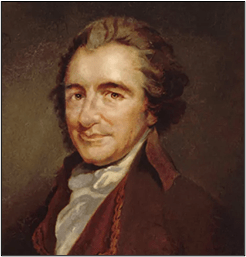
Thomas Paine published Common Sense anonymously in a pamphlet in 1776. In it, he called for independence from Great Britain, which was a foreign idea at the time. He argued that his claims were common sense and that breaking away from the rule of Great Britain was a necessity for the good of the colonists.

Portrait of Thomas Paine, a key figure in American history known for his influential writings advocating for independence and civil rights.

In the following pages I offer nothing more than simple facts, plain arguments, and common sense…

I have heard it asserted by some, that as America has flourished under her former connection with Great-Britain, the same connection is necessary towards her future happiness, and will always have the same effect. Nothing can be more fallacious than this kind of argument. We may as well assert that because a child has thrived upon milk, that is never to have meat, or that the first twenty years of our lives is to become a precedent for the next twenty. But even this is admitting more than is true; for I answer… that America would have flourished as much, and probably much more, had no European power taken any notice of her. The commerce by which she hath enriched herself are the necessaries of life, and will always have a market while eating is the custom of Europe.

But she has protected us, say some… We have boasted the protection of Great Britain, without considering, that her motive was interest not attachment… This new World hath been the asylum for the persecuted lovers of civil and religious liberty from every part of Europe… As Europe is our market for trade, we ought to form no partial connection with any part of it…

Europe is too thickly planted with Kingdoms to be long at peace, and whenever a war breaks out between England and any foreign power, the trade of America goes to ruin, because of her connection with Britain… There is something absurd, in supposing a Continent to be perpetually governed by an island…

Where, say some, is the king of America? I’ll tell you, Friend, he reigns above, and doth not make havoc of mankind like the royal brute of Great Britain… So far as we approve of monarchy… in America the law is king…

A government of our own is our natural right… Ye that oppose independence now, ye know not what ye do: ye are opening the door to eternal tyranny. . .

  1. How does Paine compare America to a child? How does this compare to the situation of America wanting independence?
  2. Why is Great Britain protecting America, according to Paine?
  3. What happens to America whenever Great Britain is at war? Why?
  4. According to Paine, who is the king of America?
  5. What does Paine say of people who are opposing independence?

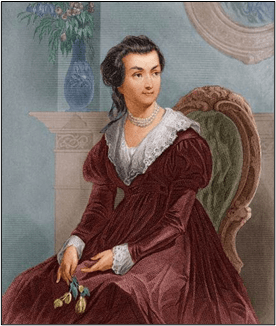
Abigail Adams was the wife of revolutionary and second president John Adams. She herself fought for the rights of colonists and advocated for equal rights for women in a time where this was uncommon. In one of her frequent letters to John Adams, she urged him to “remember the ladies” as he was working on the initial draft to the Declaration of Independence. Ultimately, the wording of the Declaration of Independence was exclusionary and women did not receive equal rights until the twentieth century.

A portrait of a woman seated in an ornate chair, wearing a burgundy dress with a white lace collar, holding a bouquet of flowers, against a backdrop with decorative elements.

Tho we felicitate ourselves, we sympathize with those who are trembling least the Lot of Boston should be theirs. But they cannot be in similar circumstances unless pusillanimity and cowardise should take possession of them. They have time and warning given them to see the Evil and shun it. — I long to hear that you have declared an independancy — and by the way in the new Code of Laws which I suppose it will be necessary for you to make I desire you would Remember the Ladies, and be more generous and favourable to them than your ancestors. Do not put such unlimited power into the hands of the Husbands. Remember all Men would be tyrants if they could. If particular care and attention is not paid to the Ladies, we are determined to foment a Rebellion, and will not hold ourselves bound by any Laws in which we have no voice, or Representation.

That your Sex are Naturally Tyrannical is a Truth so thoroughly established as to admit of no dispute, but such of you as wish to be happy willingly give up the harsh title of Master for the more tender and endearing one of Friend. Why then, not put it out of the power of the vicious and the Lawless to use us with cruelty and indignity with impunity. Men of Sense in all Ages abhor those customs which treat us only as the vassals of your Sex. Regard us then as Beings placed by providence under your protection and in imitation of the Supreme Being make use of that power only for our happiness.

  1. What is Abigail Adams asking of John Adams?
  2. What does Abigail Adams believe of all men?
  3. Why must men pay attention to the ladies, according to Adams?

On July 4, 1776, the most important foundational document in the history of the United States was approved by the Second Continental Congress. The Declaration of Independence, penned by Thomas Jefferson, outlined a formal “declaration” of the 13 colonies as an independent, sovereign state that had broken away from the British Crown and listed various grievances that the new country had against the King. Jefferson scattered the document with political and social ideological thought that would become ingrained principles of American government and society.

A historical painting depicting the signing of the Declaration of Independence, featuring prominent figures in a grand room adorned with an American flag.

“When in the Course of human events, it becomes necessary for one people to dissolve the political bands which have connected them with another, and to assume among the powers of the earth, the separate and equal station to which the Laws of Nature and of Nature’s God entitle them, a decent respect to the opinions of mankind requires that they should declare the causes which impel them to the separation.

We hold these truths to be self-evident, that all men are created equal, that they are endowed by their Creator with certain unalienable Rights, that among these are Life, Liberty and the pursuit of Happiness.–That to secure these rights, Governments are instituted among Men, deriving their just powers from the consent of the governed, –That whenever any Form of Government becomes destructive of these ends, it is the Right of the People to alter or to abolish it, and to institute new Government, laying its foundation on such principles and organizing its powers in such form, as to them shall seem most likely to effect their Safety and Happiness. Prudence, indeed, will dictate that Governments long established should not be changed for light and transient causes; and accordingly all experience hath shewn, that mankind are more disposed to suffer, while evils are sufferable, than to right themselves by abolishing the forms to which they are accustomed. But when a long train of abuses and usurpations, pursuing invariably the same Object evinces a design to reduce them under absolute Despotism, it is their right, it is their duty, to throw off such Government, and to provide new Guards for their future security.–Such has been the patient sufferance of these Colonies; and such is now the necessity which constrains them to alter their former Systems of Government…”

  1. What are the three “unalienable Rights” Thomas Jefferson identifies?
  2. According to Jefferson, what must the people do if a government fails to safeguard these unalienable Rights?
  3. In your opinion, has the U.S. government upheld the message and liberties outlined in the Declaration of Independence. Explain.

Once the United States declared its independence from Great Britain, the nation’s founders needed a stronger, more structured set of laws for government. The initial Articles of Confederation were weak and did structure the government in a way that would be sustainable. Thus, the Constitution was formed after deliberation at the Constitutional Convention. The Preamble serves as the introduction to the Constitution as a whole and establishes the tone and goals for this new budding nation.

A historical painting depicting the signing of the United States Constitution, featuring delegates in formal attire gathered in a large room with decorative details, including a chandelier and an American flag.

“We the People of the United States, in Order to form a more perfect Union, establish Justice, insure domestic Tranquility, provide for the common defense, promote the general Welfare, and secure the Blessings of Liberty to ourselves and our Posterity, do ordain and establish this Constitution for the United States of America.”

  1. What is the importance of the first three words of the Constitution?
  2. List the six goals outlined in the Constitution.
  3. Why was it important for the United States to write the Constitution after the Articles of Confederation?
  4. Select one of the goals of the Constitution. Why do you think the authors believed it was important to include the goal that you chose?

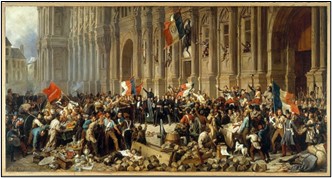
Just a few years after the end of the American Revolution, France was experiencing a revolution of their own. The Third Estate had become overwhelmingly frustrated by the poverty, stagnant economic growth, inept leadership, and poor quality of life they faced while the First and Second Estates lived in luxury and prosperity. The newly formed National Assembly released the Declaration of the Rights of Man in the midst of this violent revolution.

A large crowd gathered in front of a historical building, waving flags and holding banners, as they engage in a passionate display of political support or protest.

“The representatives of the French people, organized as a National Assembly, believing that the ignorance, neglect, or contempt of the rights of man are the sole cause of public calamities and of the corruption of governments, have determined to set forth in a solemn declaration the natural, unalienable, and sacred rights of man, in order that this declaration, being constantly before all the members of the Social body, shall remind them continually of their rights and duties…Therefore the National Assembly recognizes and proclaims, in the presence and under the auspices of the Supreme Being, the following rights of man and of the citizen:

1. Men are born and remain free and equal in rights. Social distinctions may be founded only upon the general good.

2. The aim of all political association is the preservation of the natural and imprescriptible rights of man. These rights are liberty, property, and security, and resistance to oppression.

3. The principle of all sovereignty resides essentially in the nation. No body nor individual may exercise any authority which does not proceed directly from the nation.

…7. No personal shall be accused, arrested, or imprisoned except in the cases and according to the forms prescribed by law. Any one soliciting, transmitting, executing, or causing to be executed, any arbitrary order, shall be punished.

…9. As all persons are held innocent until they have been declared guilty…

10. No one shall be disquieted on account of his opinions, including his religious views, provided their manifestation does not disturb the public order established by law.

11. The free communication of ideas and opinions is one of the most precious of the rights…

  1. According to the preamble, what is the purpose of this declaration?
  2. In the context of the French Revolution, why is the wording of “equal in rights” significant?
  3. Discuss the extent in which this declaration compares to the Declaration of Independence?
  4. How do the two declarations define the rights guaranteed to all men?

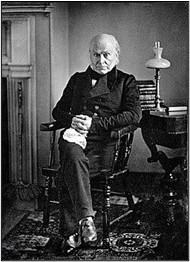
While serving as Secretary of State under President James Monroe, John Quincy Adams was invited to Congress to give a speech to commemorate the 45th anniversary of the Declaration of Independence. Adams spends much of this speech praising the Declaration and commending the Founding Fathers’ bravery and triumph over the British Crown in establishing the new nation. This speech has become synonymous with the idea of “American exceptionalism.”

Portrait of a seated elderly man with gray hair, dressed in formal attire, sitting in a wooden chair with hands clasped, set in a domestic interior with a lamp and a patterned rug.

“…In the long conflict of twelve years which had preceded and led to the Declaration of Independence, our fathers had been not less faithful to their duties, than tenacious of their rights. Their resistance had not been rebellion. It was not a restive and ungovernable spirit of ambition, bursting from the bonds of colonial subjection; it was the deep and wounded sense of successive wrongs, upon which complaint had been only answered by aggravation, and petition repelled with contumely, which had driven them to their last stand upon the adamantine rock of human rights.

            …It was the first solemn declaration by a nation of the only legitimate foundation of civil government. It was the cornerstone of a new fabric, destined to cover the surface of the globe. It demolished at a stroke the lawfulness of all governments founded upon conquest. It swept away all the rubbish of accumulated centuries of servitude.

            …It will be acted o’er [over], fellow-citizens, but it can never be repeated. It stands, and must forever stand alone, a beacon on the summit of the mountain, to which all the inhabitants of the earth may turn their eyes for a genial and saving light, till time shall be lost in eternity, and this globe itself dissolve, nor leave a wreck behind. It stands forever, a light of admonition to the rulers of men; a light of salvation and redemption to the oppressed…so long shall this declaration hold out to the sovereign and to the subject the extent and the boundaries of their respective rights and duties; founded in the laws of nature and of nature’s God. Five and forty years have passed away since this Declaration was issued by our fathers; and here are we, fellow-citizens, assembled in the full enjoyment of its fruits.”

  1. What does John Quincy Adams say the Declaration of Independence was the “first” declaration to do?
  2. Why does Adams call the American Revolution a “resistance,” not a “rebellion?”
  3. Why does Adams call the Declaration a “beacon on the summit of the mountain?”
  4. Do you agree with Adams’ perspective of the revolution and the Declaration? Explain.

As the nation crept closer to an impending Civil War, American politics became engulfed over the issue of slavery. One of the leading voices of the pro-slavery movement was South Carolina Democrat senator John C. Calhoun. After serving as Andrew Jackson’s vice president, he ended his career in the Senate. There, he was one of the Democratic Party’s most outspoken supporters for “states’ rights” to defend and uphold slavery within its borders. This speech was in response to the Oregon Bill, which was set to outlaw slavery practices in the new Oregon territory.

A historical black and white portrait of a man with long hair, dressed in a dark suit and vest, seated with hands clasped together.

“The proposition to which I allude, has become an axiom in the minds of a vast majority on both sides of the Atlantic, and is repeated daily from tongue to tongue, as an established and incontrovertible truth; it is, that “all men are born free and equal.” I am not afraid to attack error, however deeply it may be entrenched, or however widely extended, whenever it becomes my duty to do so, as I believe it to be on this subject and occasion.

            Taking the proposition literally (it is in that sense it is understood), there is not a word of truth in it. It begins with “all men are born,” which is utterly untrue. Men are not born. Infants are born. They grow to be men. And concludes with asserting that they are born “free and equal,” which is not less false. They are not born free. While infants they are incapable of freedom, being destitute alike of the capacity of thinking and acting, without which there can be no freedom. Besides, they are necessarily born subject to their parents, and remain so among all people, savage and civilized, until the development of their intellect and physical capacity enables them to take care of themselves…

If we trace it back, we shall find the proposition differently expressed in the Declaration of Independence. That asserts that “all men are created equal.” The form of expression, though less dangerous, is not less erroneous…

… [G]overnment has no right to control individual liberty beyond what is necessary to the safety and well-being of society. Such is the boundary which separates the power of government and the liberty of the citizen or subject in the political state, which, as I have shown, is the natural state of man—the only one in which his race can exist, and the one in which he is born, lives, and dies.”

  1. What does Senator Calhoun say about the phrase “all men are created equal?”
  2. According to Calhoun, how should the government’s role be limited?
  3. What is the connection that Senator Calhoun makes between liberty and race? What does this mean about his message in this speech?

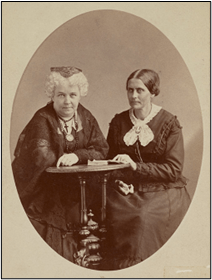
At the Women’s Rights Convention in 1848, 68 women and 32 men signed the “Declaration of Sentiments”, which was essentially a Bill of Rights for women. The document called for equal social, civil, and political liberties for women, which included the right to vote, equal education opportunities, and more legal protections. Elizabeth Cady Stanton served as the primary author as well as Lucretia Mott and Martha Coffin Wright. The Declaration of Sentiments was modeled after the Declaration of Independence, which was written just 72 years prior.

Two women in 19th century attire seated together at a table, with a decorative backdrop.

“We hold these truths to be self-evident; that all men and women are created equal; that they are endowed by their Creator with certain inalienable rights; that among these are life, liberty, and the pursuit of happiness; that to secure these rights governments are instituted, deriving their just powers from the consent of the governed. […]

“The history of mankind is a history of repeated injuries and usurpations on the part of man toward woman, having in direct object the establishment of an absolute tyranny over her. To prove this, let facts be submitted to a candid world. He has never permitted her to exercise her inalienable right to the elective franchise. He has compelled her to submit to laws, in the formation of which she had no voice. He has withheld from her rights which are given to the most ignorant and degraded men – both natives and foreigners. Having deprived her of this first right as a citizen, the elective franchise, thereby leaving her without representation in the halls of legislation, he has oppressed her on all sides. He has made her, if married, in the eye of the law, civilly dead. He has taken from her all right in property, even to the wages she earns. […]

“Now, in view of this entire disfranchisement of one-half the people of this country, their social and religious degradation, – in view of the unjust laws above mentioned, and because women do feel themselves aggrieved, oppressed, and fraudulently deprived of their most sacred rights, we insist that they have immediate admission to all the rights and privileges which belong to them as citizens of these United States.”

  1. What other document is the introduction to the Declaration of Sentiments modeled after?
  2. What is the purpose of this excerpt of the Declaration of Sentiments?
  3. List two of the grievances that the authors included.
  4. Do you believe that this declaration is convincing enough to help women gain equal rights? What would you change if anything?

Frederick Douglass was born into slavery in Maryland in 1818. He escaped slavery in 1838 and used his tutoring of the English language to become a renowned orator and writer. He used the strength of his words to call for the abolition of slavery and worked to ensure freedom for all enslaved people. This speech was written to encourage people to think about what the Fourth of July means for those in America who are not free and who do not experience the same rights and opportunities as their White counterparts.

A historical portrait of Frederick Douglass, a prominent abolitionist and social reformer, seated with an earnest expression, showcasing his distinctive hairstyle and 19th-century attire.

“This, for the purpose of this celebration, is the 4th of July. It is the birthday of your National Independence, and of your political freedom . . . There is consolation in the thought that America is young […] The simple story of it is, that, 76 years ago, the people of this country were British subjects . . . You were under the British Crown . . . But, your fathers . . . They went so far in their excitement as to pronounce the measures of government unjust, unreasonable, and oppressive, and altogether such as ought not to be quietly submitted to […] Citizens, your fathers made good that resolution. They succeeded; and to-­‐day you reap the fruits of their success. The freedom gained is yours; and you, therefore, may properly celebrate this anniversary. The 4th of July is the first great fact in your nation’s history—the very ring-­‐bolt in the chain of your yet undeveloped destiny.

“What, to the American slave, is your 4th of July? I answer: a day that reveals to him, more than all other days in the year, the gross injustice and cruelty to which he is the constant victim. To him, your celebration is a sham; your boasted liberty, an unholy license; your national greatness, swelling vanity; your sounds of rejoicing are empty and heartless; your denunciations of tyrants, brass fronted impudence; your shouts of liberty and equality, hollow mockery; your prayers and hymns, your sermons and thanksgivings, with all your religious parade, and solemnity, are, to him, mere bombast, fraud, deception, impiety, and hypocrisy—a thin veil to cover up crimes which would disgrace a nation of savages. There is not a nation on the earth guilty of practices, more shocking and bloody, than are the people of these United States, at this very hour. Go where you may, search where you will, roam through all the monarchies and despotisms of the old world, travel through South America, search out every abuse, and when you have found the last, lay your facts by the side of the every day practices of this nation, and you will say with me, that, for revolting barbarity and shameless hypocrisy, America reigns without a rival […]

“Allow me to say, in conclusion . . . I do not despair of this country. There are forces in operation, which must inevitably, work the downfall of slavery. “The arm of the Lord is not shortened,” and the doom of slavery is certain. I, therefore, leave off where I began, with hope.”

  1. What words does Douglass use that show he does not align with free Americans?
  2. How is the fourth of July different for enslaved people and free people? Use one example from the text.
  3. How does Douglass conclude his speech? Why do you think he feels this way?

Between July 1 and 3, 1863, the bloodiest battle of the Civil War took place in Gettysburg, Pennsylvania. Both the Union and Confederacy faced catastrophic losses, with casualties totaling over 50,000 men. The Battle of Gettysburg remains the deadliest battle of American history. Four months later, President Abraham Lincoln arrived at Gettysburg to declare the battlefield as a national cemetery. Many in the crowd were anticipating a long speech from President Lincoln, however this famous address only lasted about 3 minutes. Nevertheless, the Gettysburg Address would become enshrined as one of Lincoln’s, and U.S. history’s, most powerful speeches.

Black and white portrait of a man with a beard and a bow tie, looking directly at the camera.

“Four score and seven years ago our fathers brought forth on this continent, a new nation, conceived in Liberty, and dedicated to the proposition that all men are created equal.

Now we are engaged in a great civil war, testing whether that nation, or any nation so conceived and so dedicated, can long endure. We are met on a great battle-field of that war. We have come to dedicate a portion of that field, as a final resting place for those who here gave their lives that that nation might live. It is altogether fitting and proper that we should do this.

…But, in a larger sense, we can not dedicate–we can not consecrate–we can not hallow–this ground. The brave men, living and dead, who struggled here, have consecrated it, far above our poor power to add or detract. The world will little note, nor long remember what we say here, but it can never forget what they did here. It is for us the living, rather, to be dedicated here to the unfinished work which they who fought here have thus far so nobly advanced. It is rather for us to be here dedicated to the great task remaining before us–that from these honored dead we take increased devotion to that cause for which they gave the last full measure of devotion–that we here highly resolve that these dead shall not have died in vain–that this nation, under God, shall have a new birth of freedom–and that government of the people, by the people, for the people, shall not perish from the earth.”

  1. According to Lincoln, what is the “proposition” that the nation was founded on?
  2. What is this civil war “testing?”
  3. What is Lincoln’s tone throughout the speech? Use at least two pieces of textual evidence to support your response.
  4. How does President Lincoln use ideas from the Declaration of Independence in this speech? To what extent is it effective? Use at least two pieces of textual evidence to support your response.

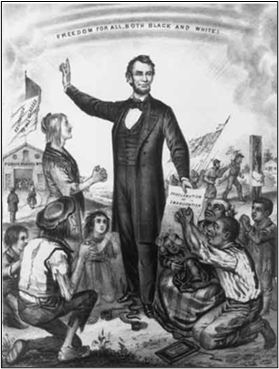
The Thirteenth Amendment to the Constitution abolished slavery and involuntary servitude in the United States. Slavery had been an institution in the United States since the first ship holding enslaved people arrived from the shores of Africa in 1619. Prior to the entire United States abolishing slavery, some states had already dismantled the system of slavery. Many became champions for the abolition of slavery and helped enslaved people escape to freedom. The amendment was ratified in December 1865 after being passed by Congress in January 1865. The Thirteenth Amendment serves as the first of the three Reconstruction Amendments. While it ended legal slavery, Southern states later used the “punishment for crime” clause to create “Black Codes”, which prevented Black people from voting and limited their rights.

An 1860s political cartoon depicting Abraham Lincoln addressing a group of people, including both Black and white individuals, with a banner stating 'Freedom for all, both Black and White.'

“Section 1

Neither slavery nor involuntary servitude, except as a punishment for crime whereof the party shall have been duly convicted, shall exist within the United States, or any place subject to their jurisdiction.

“Section 2

Congress shall have power to enforce this article by appropriate legislation.”

1. What did the thirteenth amendment accomplish?

2. Where is involuntary servitude still legal?

3. Who has the power to enforce the thirteenth amendment?

4. Do you believe that it is justified for involuntary servitude to be used for criminal offenders? Why or why not?

The New Colossus – Emma Lazarus, 1883

Emma Lazarus was an American poet who wrote the poem “The New Colossus” in 1883. When writing this sonnet, she was inspired by the Statue of Liberty and what the statue represents. In 1903, this poem was engraved onto a bronze plaque and is now on the base of the Statue of Liberty in New York.

Image of the Statue of Liberty against a backdrop of the New York City skyline.

Not like the brazen giant of Greek fame,

With conquering limbs astride from land to land;

Here at our sea-washed, sunset gates shall stand

A mighty woman with a torch, whose flame

Is the imprisoned lightning, and her name

Mother of Exiles. From her beacon-hand

Glows world-wide welcome; her mild eyes command

The air-bridged harbor that twin cities frame.

“Keep, ancient lands, your storied pomp!” cries she

With silent lips. “Give me your tired, your poor,

Your huddled masses yearning to breathe free,

The wretched refuse of your teeming shore.

Send these, the homeless, tempest-tost to me,

I lift my lamp beside the golden door!”

  1. How does Emma Lazarus describe the Statue of Liberty in the poem? Use one line from the text that supports your answer.
  2. What group of people might lines 10-14 be referring to? How do you know?
  3. Why is it appropriate that Emma Lazarus’s poem “The New Colossus” appears on the base of the Statue of Liberty?

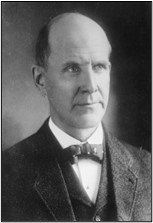
Eugene V. Debs was one of the nation’s leading critics of big business and corporations. He was an adamant socialist and sought to educate workers to unionize to combat malicious business practices by their employers. In 1893, there was a massive strike organized against the Pullman Sleeping Car Company. Debs helped organize a boycott with the American Railway Union. President Grover Cleveland had sent the U.S. military to handle the strike, and Debs was later arrested for federal contempt and conspiracy charges.

A black and white portrait of a man wearing a suit and bowtie, looking directly at the camera.

            “Manifestly the spirit of ‘76 still survives. The fires of liberty and noble aspirations are not yet extinguished. I greet you tonight as lovers of liberty and as despisers of despotism. I comprehend the significance of this demonstration and appreciate the honor that makes it possible for me to be your guest on such an occasion. The vindication and glorification of American principles of government, as proclaimed to the world in the Declaration of Independence, is the high purpose of this convocation.

            Speaking for myself personally I am not certain whether this is an occasion for rejoicing or lamentation. I confess to a serious doubt as to whether this day marks my deliverance from bondage to freedom or my doom from freedom to bondage…It is not law nor the administration of law of which I complain. It is the flagrant violation of the Constitution, the total abrogation of law and the usurpation of judicial and despotic power, by virtue of which my colleagues and myself were committed to jail, against which I enter my solemn protest; and any honest analysis of the proceedings must sustain the haggard truth of the indictment.

            In a letter recently written by the venerable Judge Trumbull that eminent jurist says: “The doctrine announced by the Supreme Court in the Debs case, carried to its logical conclusion, places every citizen at the mercy of any prejudiced or malicious federal judge who may think proper to imprison him.”. .

            The theme tonight is personal liberty; or giving it its full height, depth, and breadth, American liberty, something that Americans have been accustomed to eulogize since the foundation of the Republic, and multiplied thousands of them continue in the habit to this day because they do not recognize the truth that in the imprisonment of one man in defiance of all constitutional guarantees, the liberties of all are invaded and placed in peril.

  1. What ideas is Debs referencing when he says “the spirit of ‘76 still survives?”
  2. What rights does Debs claim the government has taken away from him and/or denied?
  3. Do you agree with Debs’ analysis of the situation he faced during the Pullman Strike? Explain your answer using evidence from the speech.

From the founding of the United States, women have been championing for equal rights and the ability to vote. From Abigail Adams calling for John Adams to “remember the ladies” to the suffragettes of the nineteenth and twentieth centuries, women and their allies had been calling for equal opportunities since America’s inception. In 1920, the nineteenth amendment was ratified and women were guaranteed the right to vote.

Historical photograph of a women's suffrage march, featuring women holding signs that advocate for the right to vote.

“The right of citizens of the United States to vote shall not be denied or abridged by the United States or by any State on account of sex.

“Congress shall have power to enforce this article by appropriate legislation.”

Questions:

  1. What did the nineteenth amendment accomplish?
  2. Who holds the power to enforce this amendment?

Do you think that any women were prevented from voting following the 19th amendment? Who? Why?

As World War II engulfed Europe, President Roosevelt and the U.S. government navigated the tightrope of effective foreign policy. The United States had long held a strong position of isolationism, and many Americans were firmly opposed to any involvement in Europe’s second world war. However, the U.S. government had shifted away from its isolationism by the end of the 1930s. FDR’s State of the Union address in 1941 echoed a new dawn of American interventionism, as he outlined the four freedoms everybody in the world was entitled to.

A formal portrait of Franklin D. Roosevelt, the 32nd President of the United States, smiling and dressed in a suit with a tie, set against a plain background.

“Since the permanent formation of our Government under the Constitution, in 1789, most of the periods of crisis in our history have related to our domestic affairs. Fortunately, only one of these–the four year War Between the States–ever threatened our national unity. Today, thank God, one hundred and thirty million Americans, in forty-eight States, have forgotten points of compass in our national unity.

            …In like fashion from 1815 to 1914–ninety-nine years–no single war in Europe or in Asia constituted a real threat against our future or against the future of any other American nationf…In the future days, which we seek to make secure, we look forward to a world founded upon four essential human freedoms.

            The first is freedom of speech and expression–everywhere in the world.

            The second is freedom of every person to worship God in his own way–everywhere in the world.

            The third is freedom from want–which, translated into world terms, means economic understandings which will secure to every nation a healthy peacetime life for its inhabitants–everywhere in the world.

            The fourth is freedom from fear–which, translated into world terms, means a world-wide reduction of armaments to such a point in such a thorough fashion that no nation will be in a position to commit an act of physical aggression against any neighbor–anywhere in the world.

            That is no vision of a distant millennium. It is a definite basis for a kind of world attainable in our own time and generation. That kind of world is the very anthesis of the so-called new order of tyranny which the dictators seek to create with the crash of a bomb.”

  1. What does FDR say has been the reason for (most) periods of crisis in U.S. history? Why is the current situation in Europe (World War II) different?
  2. What are the four freedoms FDR lists in this speech?
  3. In your opinion, do people “everywhere in the world” experience the four freedoms today? Explain your answer.

Eleanor Roosevelt was the first lady of the United States from 1933-1945 while her husband, Franklin D. Roosevelt, was president. She redefined the role by speaking out often and calling attention to important social issues. Her speech “The Struggle for Human Rights” was given at the United Nations, to which she served as a delegate to its General Assembly, where she served as chair of the commission that drafted the Universal Declaration of Human Rights.

Eleanor Roosevelt holding the Universal Declaration of Human Rights document during a presentation.

We must not be confused about what freedom is. Basic human rights are simple and easily understood: freedom of speech and a free press; freedom of religion and worship; freedom of assembly and the right of petition; the right of men to be secure in their homes and free from unreasonable search and seizure and from arbitrary arrest and punishment. We must not be deluded by the efforts of the forces of reaction to prostitute the great words of our free tradition and thereby to confuse the struggle. Democracy, freedom, human rights have come to have a definite meaning to the people of the world which we must not allow any nation to so change that they are made synonymous with suppression and dictatorship…

The basic problem confronting the world today, as I said in the beginning, is the preservation of human freedom for the individual and consequently for the society of which he is a part. We are fighting this battle again today as it was fought at the time of the French Revolution and at the time of the American Revolution. The issue of human liberty is as decisive now as it was then. I want to give you my conception of what is meant in my country by freedom of the individual…

            Indeed, in our democracies we make our freedoms secure because each of us is expected to respect the rights of others and we are free to make our own laws…

​             Basic decisions of our society are made through the expressed will of the people. That is why when we see these liberties threatened, instead of falling apart, our nation becomes unified and our democracies come together as a unified group in spite of our varied backgrounds and many racial strains…

            It is my belief, and I am sure it is also yours, that the struggle for democracy and freedom is a critical struggle, for their preservation is essential to the great objective of the United Nations to maintain international peace and security…

            The future must see the broadening of human rights throughout the world. People who have glimpsed freedom will never be content until they have secured it for themselves. In a true sense, human rights are a fundamental object of law and government in a just society. Human rights exist to the degree that they are respected by people in relations with each other and by governments in relations with their citizens.

  1. What are the basic human rights that Eleanor Roosevelt claims are “simple and easily understood”?
  2. What does Roosevelt say makes freedom secure?
  3. In your opinion, why are freedom and democracy essential for all people?

Following the end of World War II, the victorious European powers and the United States created a new global organization to govern international affairs. The United Nations was created to replace the failed League of Nations, and serve as the leading world institution to maintain peace, protect human rights, and prevent future wars and conflict. One of the first declarations of the United Nations was the Universal Declaration of Human Rights (UDHR). Below are Articles 1 through 7 of the UDHR.

United Nations emblem featuring a world map encircled by olive branches on a blue background.

Article 1

All human beings are born free and equal in dignity and rights. They are endowed with reason and conscience and should act towards one another in a spirit of brotherhood.

Article 2

Everyone is entitled to all the rights and freedoms set forth in this Declaration, without distinction of any kind, such as race, colour, sex, language, religion, political or other opinion, national or social origin, property, birth or other status. Furthermore, no distinction shall be made on the basis of the political, jurisdictional or international status of the country or territory to which a person belongs, whether it be independent, trust, non-self-governing or under any other limitation of sovereignty.

Article 3

Everyone has the right to life, liberty and the security of person.

Article 4

No one shall be held in slavery or servitude; slavery and the slave trade shall be prohibited in all their forms.

Article 5

No one shall be subjected to torture or to cruel, inhuman or degrading treatment or punishment.

Article 6

Everyone has the right to recognition everywhere as a person before the law.

Article 7

All are equal before the law and are entitled without any discrimination to equal protection of the law. All are entitled to equal protection against any discrimination in violation of this Declaration and against any incitement to such discrimination.

Questions:

  1. Identify three (3) rights that are guaranteed by the UDHR.
  2. According to Article 2, what kinds of “distinctions” are prohibited from deny people their rights?
  3. Which phrases of ideas in the UDHR connect to the Declaration of Independence?
  4. How does the UDHR expand on the phrase “all men are created equal?”
  5. In your opinion, does the world today uphold these human rights? Explain.

In June 1950, in the midst of an anti-communist campaign identified with Senator Joseph McCarthy (R-Wisconsin), Senator Margaret Chase Smith (R-Maine) spoke out against “selfish political exploitation” targeting innocent people and threatening basic American rights.

Political cartoon depicting Senator Margaret Chase Smith confronting smear tactics used during the anti-communist campaign.

“I would like to speak briefly and simply about a serious national condition. It is a national feeling of fear and frustration that could result in national suicide and the end of everything that we Americans hold dear. It is a condition that comes from the lack of effective leadership either in the legislative branch or the executive branch of our government. … I speak as a Republican. I speak as a woman. I speak as a United States senator. I speak as an American. …  I think that it is high time for the United States Senate and its members to do some real soul searching and to weigh our consciences as to the manner in which we are performing our duty to the people of America and the manner in which we are using or abusing our individual powers and privileges.   I think that it is high time that we remembered that we have sworn to uphold and defend the Constitution. I think that it is high time that we remembered that the Constitution, as amended, speaks not only of the freedom of speech, but also of trial by jury instead of trial by accusation.”

Whether it be a criminal prosecution in court or a character prosecution in the Senate, there is little practical distinction when the life of a person has been ruined.

Those of us who shout the loudest about Americanism in making character assassinations are all too frequently those who, by our own words and acts, ignore some of the basic principles of Americanism –

The right to criticize.

The right to hold unpopular beliefs.

The right to protest.

The right of independent thought.

The exercise of these rights should not cost one single American citizen his reputation or his right to a livelihood nor should he be in danger of losing his reputation or livelihood merely because he happens to know someone who holds unpopular beliefs. Who of us does not? Otherwise none of us could call our souls our own. Otherwise thought control would have set in.

The American people are sick and tired of being afraid to speak their minds lest they be politically smeared as “Communists” or “Fascists” by their opponents. Freedom of speech is not what it used to be in America. It has been so abused by some that it is not exercised by others. The American people are sick and tired of seeing innocent people smeared and guilty people whitewashed.”

1. What is the national feeling identified by Senator Smith?

2. What does she want American leaders to do?

3. What basic rights does Senator Smith believe are threatened?

4. In your opinion, why did Senator Smith focus on “The Basic Principles of Americanism”?

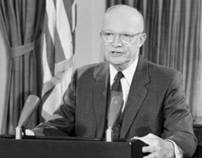
On January 17, 1961, President Eisenhower delivered a ten-minute farewell to the American people on national television from the Oval Office of the White House. In the speech, Eisenhower warned that a large, permanent “military-industrial complex,” an alliance between the military and defense contractors, posed a threat to American democracy. 

Black and white photograph of President Dwight D. Eisenhower delivering a speech from the Oval Office, with microphones in front and the U.S. flag in the background.

“We now stand ten years past the midpoint of a century that has witnessed four major wars among great nations. Three of these involved our own country. Despite these holocausts America is today the strongest, the most influential and most productive nation in the world. Understandably proud of this pre-eminence, we yet realize that America’s leadership and prestige depend, not merely upon our unmatched material progress, riches and military strength, but on how we use our power in the interests of world peace and human betterment.”

Throughout America’s adventure in free government, our basic purposes have been to keep the peace; to foster progress in human achievement, and to enhance liberty, dignity and integrity among people and among nations. To strive for less would be unworthy of a free and religious people. Any failure traceable to arrogance, or our lack of comprehension or readiness to sacrifice would inflict upon us grievous hurt both at home and abroad.

A vital element in keeping the peace is our military establishment. Our arms must be mighty, ready for instant action, so that no potential aggressor may be tempted to risk his own destruction. … Until the latest of our world conflicts, the United States had no armaments industry. American makers of plowshares could, with time and as required, make swords as well. But now we can no longer risk emergency improvisation of national defense; we have been compelled to create a permanent armaments industry of vast proportions. Added to this, three and a half million men and women are directly engaged in the defense establishment. We annually spend on military security more than the net income of all United State corporations. … This conjunction of an immense military establishment and a large arms industry is new in the American experience. The total influence – economic, political, even spiritual – is felt in every city, every state house, every office of the Federal government. We recognize the imperative need for this development. Yet we must not fail to comprehend its grave implications. Our toil, resources and livelihood are all involved; so is the very structure of our society.

In the councils of government, we must guard against the acquisition of unwarranted influence, whether sought or unsought, by the military-industrial complex. The potential for the disastrous rise of misplaced power exists and will persist. We must never let the weight of this combination endanger our liberties or democratic processes. We should take nothing for granted.”

1. According to President Eisenhower, why does the United States need to maintain a strong military?

2. Why is President Eisenhower concerned about a “military-industrial complex”?

3. What does President Eisenhower alert the American people to do?

Five years prior, the Soviet Union had successfully launched Sputnik 1 into orbit, sparking the beginning of the Space Race between the U.S. and U.S.S.R. The United States quickly sought to catch up to the Soviet Union’s many “firsts” in the Space Race (first satellite, first man in space, first man to orbit the Earth, etc.). Then, in September 1962, President Kennedy gave a speech at Rice University discussing the new goal for America’s space program: put a man on the Moon before the end of the decade.

President John F. Kennedy delivering a speech at Rice University, discussing the United States' commitment to space exploration.

“…We set sail on this new sea because there is new knowledge to be gained, and new rights to be won, and they must be won and used for the progress of all people. For space science, like nuclear science and all technology, has no conscience of its own. Whether it will become a force for good or ill depends on man, and only if the United States occupies a position of pre-eminence can we help decide whether this new ocean will be a sea of peace or a new terrifying theater of war. I do not say the we should or will go unprotected against the hostile misuse of space any more than we go unprotected against the hostile use of land or sea, but I do say that space can be explored and mastered without feeding the fires of war, without repeating the mistakes that man has made in extending his writ around this globe of ours.

NASA Apollo program logo featuring the letter A with a depiction of Earth and the Moon.

There is no strife, no prejudice, no national conflict in outer space as yet. Its hazards are hostile to us all. Its conquest deserves the best of all mankind, and its opportunity for peaceful cooperation may never come again. But why, some say, the moon? Why choose this as our goal? And they may well ask why climb the highest mountain? Why, 35 years ago, fly the Atlantic? Why does Rice play Texas?

We choose to go to the moon. We choose to go to the moon in this decade and do the other things, not because they are easy, but because they are hard, because that goal will serve to organize and measure the best of our energies and and skills, because that challenge is one that we are willing to accept, one we are unwilling to postpone, and one which we intend to win, and the others, too.”

  1. Why does President Kennedy say it is important to “set sail on this new sea?”
  2. What justification does President Kennedy give that the United States should be the first nation to conquer space?
  3. How does Kennedy’s vision for space reflect the ideals in the founding documents?

On August 28, 1963, in the midst of the Civil Rights Movement, civil rights leaders and organizations planned a momentous rally in Washington, D. C. Officially known as the March on Washington for Jobs and Freedom, over 200,000 people gathered to protest and advocate for the end of segregation and guarantee of civil rights for African Americans. At the end of the march, at the Lincoln Memorial, Dr. Martin Luther King, Jr., one of the Civil Rights Movement’s most influential leaders, delivered his most famous speech.

Dr. Martin Luther King Jr. delivering his 'I Have a Dream' speech at the March on Washington, with a large crowd in attendance.

“…It would be fatal for the nation to overlook the urgency of the moment. This sweltering summer of the Negro’s legitimate discontent will not pass until there is an invigorating autumn of freedom and equality. 1963 is not an end, but a beginning. Those who hope that the Negro needed to blow off steam and will now be content will have a rude awakening if the nation returns to business as usual…

            …We cannot be satisfied as long as the Negro’s basic mobility is from a smaller ghetto to a larger one. We can never be satisfied as long as our children are stripped of their selfhood and robbed of their dignity by signs stating: for whites only…

            …So even though we face the difficulties of today and tomorrow, I still have a dream. It is a dream deeply rooted in the American dream. I have a dream that one day this nation will rise up and live out the true meaning of its creed: We hold these truths to be self-evident, that all men are created equal.

            I have a dream that one day on the red hills of Georgia, the sons of former slaves and the sons of former slave owners will be able to sit down together at the table of brotherhood.

I have a dream that one day even the state of Mississippi, a state sweltering with the heat of injustice, sweltering with the heat of oppression will be transformed into an oasis of freedom and justice. I have a dream that my four little children will one day live in a nation where they will not be judged by the color of their skin but by the content of their character. I have a dream today.”

  1. How does Dr. King describe the current situation of African Americans in 1963?
  2. Why does Dr. King call 1963 “not an end, but a beginning?”
  3. What founding document does Dr. King reference in this speech? Why does he reference this document?
  4. In your opinion, has the “dream” described in this speech been achieved? Explain.

On July 2, 1964, President Lyndon B. Johnson signed the Civil Rights Act of 1964 into law. This act called for desegregation of public spaces, schools, and made voting free and fair for all. This was the most sweeping civil rights legislation since Reconstruction. The act made segregation illegal but it also created the Equal Employment Opportunity Commission (EEOC) to enforce laws that prohibit discrimination based on race, color, religion, sex, national origin, disability, or age in hiring, promoting, firing, setting wages, testing, training, apprenticeship, and all other terms and conditions of employment.

A historic moment capturing President Lyndon B. Johnson and Dr. Martin Luther King Jr. engaged in a conversation, with other attendees in the background, symbolizing the partnership in the Civil Rights Movement.

To enforce the constitutional right to vote, to confer jurisdiction upon the district courts of the United States to provide injunctive relief against discrimination in public accommodations, to authorize the Attorney General to institute suits to protect constitutional rights in public facilities and public education, to extend the Commission on Civil Rights, to prevent discrimination in federally assisted programs, to establish a Commission on Equal Employment Opportunity, and for other purposes. Be it enacted by the Senate and House of Representatives of the United States of America in Congress assembled, That this Act may be cited as the “Civil Rights Act of 1964”.

TITLE I: No person acting under color of law shall … apply any standard, practice, or procedure different from the standards, practices, or procedures applied under such law or laws to other individuals within the same county, parish, or similar political subdivision who have been found by State officials to be qualified to vote; deny the right of any individual to vote in any Federal election because of an error or omission on any record or paper relating to any application, registration, or other act requisite to voting … employ any literacy test as a qualification for voting in any Federal election unless (i) such test is administered to each individual and is conducted wholly in writing…

TITLE II: All persons shall be entitled to the full and equal enjoyment of the goods, services, facilities, and privileges, advantages, and accommodations of any place of public accommodation, as defined in this section, without discrimination or segregation on the ground of race, color, religion, or national origin.

            All persons shall be entitled to be free, at any establishment or place, from discrimination or segregation of any kind on the ground of race, color, religion, or national origin, if such discrimination or segregation is or purports to be required by any law, statute, ordinance, regulation, rule, or order of a State or any agency or political subdivision thereof…

  1. What era of history led to the Civil Rights Act of 1964?
  2. What does Title I of the Civil Rights Act pertain to?
  3. What caused Title I to be necessary?
  4. What is the goal of Title II?
  5. Why do you believe that the Civil Rights Act was essential?

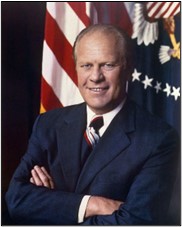
On August 9, 1974, President Richard Nixon had resigned from the presidency following the disastrous Watergate scandal. Gerald Ford, Nixon’s vice president, assumed the office immediately and pardoned Nixon one month later. The entire Watergate scandal and Nixon’s resignation created great disdain against the U.S. government. Many Americans became extremely untrustworthy of elected officials and had little faith in the government. Becoming President during the bicentennial of the U.S., Ford dealt with difficult challenges both domestically and abroad.

Portrait of Gerald Ford, the 38th President of the United States.

“The Declaration is the Polaris of our political order–the fixed star of freedom. It is impervious to change because it states moral truths that are eternal.

The Constitution provides for its own changes having equal force with the original articles. It began to change soon after it was ratified, when the Bill of Rights was added. We have since amended it 16 times more, and before we celebrate our 300th birthday, there will be more changes…

Jefferson’s principles are very much present. The Constitution, when it is done, will translate the great ideals of the Declaration into a legal mechanism for effective government where the unalienable rights of individual Americans are secure. In grade school we were taught to memorize the first and last parts of the Declaration. Nowadays, even many scholars skip over the long recitation of alleged abuses by King George III and his misguided ministers. But occasionally we ought to read them, because the injuries and invasions of individual rights listed there are the very excesses of government power which the Constitution, the Bill of Rights, and subsequent amendments were designed to prevent…

But the source of all unalienable rights, the proper purposes for which governments are instituted among men, and the reasons why free people should consent to an equitable ordering of their God-given freedom have never been better stated than by Jefferson in our Declaration of Independence. Life, liberty, and the pursuit of happiness are cited as being among the most precious endowments of the Creator–but not the only ones.”

  1. What role does President Ford say the Constitution has in relation to the Declaration?
  2. Why does President Ford say it is important to read the grievances listed against King George III in the Declaration?
  3. Do you agree with President Ford that the Declaration is unchanging while the Constitution changes over time? Explain your answer.

This poem was read at the inauguration of President Joseph Biden in 2021 by its author, Amanda Gorman. She is a poet, activist, and author who wrote this poem for the inauguration under the theme of “America United”.

Amanda Gorman delivers a poem during the inauguration of President Joe Biden, wearing a yellow coat and red headband, with an audience in the background.

…We, the successors of a country and a time where a skinny black girl descended from slaves and raised by a single mother can dream of becoming president only to find herself reciting for one. And, yes, we are far from polished, far from pristine, but that doesn’t mean we are striving to form a union that is perfect, we are striving to forge a union with purpose, to compose a country committed to all cultures, colors, characters and conditions of man.

So we lift our gazes not to what stands between us, but what stands before us. We close the divide because we know to put our future first, we must first put our differences aside. We lay down our arms so we can reach out our arms to one another, we seek harm to none and harmony for all…

That is the promise to glade, the hill we climb if only we dare it because being American is more than a pride we inherit, it’s the past we step into and how we repair it. We’ve seen a force that would shatter our nation rather than share it. That would destroy our country if it meant delaying democracy, and this effort very nearly succeeded. But while democracy can periodically be delayed, but it can never be permanently defeated.

In this truth, in this faith, we trust, for while we have our eyes on the future, history has its eyes on us, this is the era of just redemption we feared in its inception we did not feel prepared to be the heirs of such a terrifying hour but within it we found the power to author a new chapter, to offer hope and laughter to ourselves, so while once we asked how can we possibly prevail over catastrophe, now we assert how could catastrophe possibly prevail over us. We will not march back to what was but move to what shall be, a country that is bruised but whole, benevolent but bold, fierce and free, we will not be turned around or interrupted by intimidation because we know our inaction and inertia will be the inheritance of the next generation, our blunders become their burden. But one thing is certain: if we merge mercy with might and might with right, then love becomes our legacy and change our children’s birthright.

So let us leave behind a country better than the one we were left, with every breath from my bronze, pounded chest, we will raise this wounded world into a wondrous one, we will rise from the golden hills of the West, we will rise from the windswept Northeast where our forefathers first realized revolution, we will rise from the lake-rimmed cities of the Midwestern states, we will rise from the sunbaked South, we will rebuild, reconcile, and recover in every known nook of our nation in every corner called our country our people diverse and beautiful will emerge battered and beautiful, when the day comes we step out of the shade aflame and unafraid, the new dawn blooms as we free it, for there is always light if only we’re brave enough to see it, if only we’re brave enough to be it.

  1. Why does Amanda Gorman urge readers to look towards the future?
  2. What does Gorman believe that being an American includes?
  3. What is the overall tone of the poem? Cite two quotes that support your answer.

New York State Resource Guide for the 250th Anniversary of the American Revolution

Created for teachers of the 4th and 7th grades, this educational guide provides five lessons that introduce students to Fort Orange and the world of New Netherland.

The birthplace of the modern gay rights movement took place on Christopher Street in Greenwich Village in June 1969 at the Stonewall Inn. 

Book Review – Erasing History: How Fascist Rewrite the Past to Control the Future by Jason Stanley

This quote published in the Washington Post on May 7, 2024 is the opening statement in Chapter 1 of Erasing History. It is a powerful statement and thesis for this book and a compelling reason for teachers to read the arguments presented by Jason Stanley, Yale University Professor of Philosophy. There are numerous examples in this book explaining the biased perspective of American history regarding Black Americans, Latinx, Native Americans, women, children, etc. and there are examples of how history has been erased in Kenya, Palestine, India, China, and Ukraine.

Every teacher of U.S. history teaches the different views of Booker T. Washington and W.E.B. Dubois to assimilate into American society at the turn of the 20th century. However, the perspective presented by Jason Stanley offers students in our classes the opportunity for a critical debate regarding two different paths towards assimilation.

Some societies and governments favor a part of their population as the dominant or protected class and discount or “erase” the contributions of other people in their state. The technological advances of artificial intelligence present new challenges for teachers as history can easily be revised from quoting textbooks, historical papers, and extremist views from the past and make them appear as valid scholarship.  The increasing popularity of PraegerU is an example of how school districts, Departments of Education, and individual teachers are accepting the information and lessons provided by non-academic institutions. Teachers have a unique responsibility and position because they are trusted by students and what they say is transformed from sight and sound to memory.

Teachers will find the historiography and analysis of the concepts of nationalism, American exceptionalism, and colonialism to be helpful for the development of lesson plans in both U.S. history and world history. It is less about ‘erasing’ history than changing history or emphasizing certain historical themes while ignoring others. Curriculum designers and teachers have both power and responsibility in how lessons are structured, implemented, and assessed. One example from the book is including the “I Have a Dream” speech by Dr. Martin Luther King, Jr. and ignoring his many contributions in the civil rights movement.

This is an important debate regarding assimilation in a society with a dominant class. A current example is the debate of how the working class earning an hourly wage without benefits can assimilate into the middle class. Is the best way to address this through subsidized education, new tax policies, or paying a living wage?

Teachers must have a strong content background in the westward movement, labor, Reconstruction, civil rights, Ukraine, Palestine, etc. to be aware of what is missing in the sources and resources they are using with students. The example below provides different points of view on the 1932-33 engineered famine that killed millions of people in Ukraine.

Fascism is not taught is most high schools and college courses may not have provided this instruction for teachers. Fascism, socialism, Marxism, communism, and Naziism are critical movements in world history and they are complicated to teach because the are not monolithic. Professor Stanley provides five major themes that are part of a fascist education: (page 78)

The strategy that wins the support of people is often fear and patriotism.  In the United States, the theme of national greatness is most visible with “Make America Great Again” and defining the United States as the greatest nation or what is defined as American exceptionalism.  However, associating crime, poverty, homelessness, unemployment, etc. with a specific demographic group is part of the fascist goal of national purity. In Germany, it was the Aryan population.  In the United States it is critical race theory, structural racism, and making white Americans feel guilty. We see the theme of strict gender roles in the directives to teach traditional roles of women and banning references to the contributions of the LGBTQ persons. The placing of blame for everything on a past president or a specific political party is another effective strategy. Teachers should be aware of these five signs and why populations embrace it.

President Trump delivered a speech in September 2020 when he introduced the White House Conference on American History. Particularly, in the 250th anniversary year of the signing of the declaration of Independence, teachers need to be aware of how President Trump understands the teaching of patriotic history.

Erasing History dedicates three chapters to the importance of education in both preventing and promoting authoritarian rulers or advocating against democracy and for authoritarianism. Teachers of social studies, history, and literature have a responsibility to recognize bias and ignorance and to select the sources and perspectives that lead to an understanding of the American values of equality, liberty, and the rule of law.

The movement for school vouchers, criticisms of curriculum, the attack on the 1619 Project, and the emphasis on America’s greatness contribute to distrust about public schools and confuses parents.

I found Professor Stanley’s analysis of classical education to be exceptional. The extreme right and the extreme left (and those in between) support the teaching of Greek and Roman civilizations. What I found interesting is how each side selects the leaders and documents that support their perspective of government. For example, Pericles Funeral Oration describes Athenian democracy:

While the above speech favors democracy, others look to Plato as evidence of a strong ruler with a clear authoritarian philosophy.  The Greeks and Romans supported gender and racial superiority, owned slaves, favored landowners and intellectuals, and had colonies. These examples support a fascist ideology. Teachers have the responsibility to teach historical context, provide the reasons for social changes, help students to analyze how freedom is related to continuity and change over time, and an understanding of equality, reason, liberty, and power. Concepts we thought had clear definitions have become complicated.

There are more compelling insights in this book than I can comment on in a book review. Teachers of all subjects should read this book, but in particular history, social studies, and teachers of literature. Pre-service teachers also need to read and discuss this book.  Let me conclude with these observations:

As a teacher of history and/or social studies, you are on the front line and can expect to be criticized! Our responsibility as teachers is to include the experiences and contributions of all people – especially women, children, immigrants, people of different faiths, Black and Native Americans, laborers, individuals with disabilities, individuals who are LGBTQ, etc. Teaching history includes compassion, empathy, struggles, contributions, and the untold stories that you will discover. Erasing History is about forgotten and neglected history.

Three Social Studies Lessons Using Baseball as an Introduction to History

How Baseball and Jackie Robinson Shaped New York’s Identity

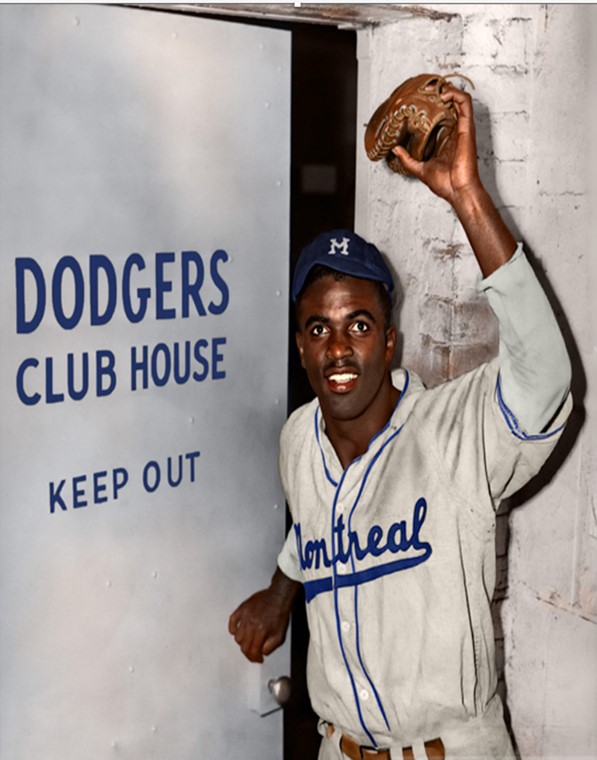
Jackie Robinson played with the Dodgers’ minor league Montreal team.

Introduction: The Brooklyn Dodgers were not just a baseball team; they were a cultural institution that embodied Brooklyn’s identity from 1883 until their departure in 1957. Prior to 1898, Brooklyn was the fourth largest city in America. After incorporation into the greater city of New York, the Dodgers contributed to Brooklynites maintaining their separate sense of identity. In 1947, Jackie Robinson broke baseball’s color barrier when he joined the Brooklyn Dodgers. This historic moment changed not only baseball but also had profound social implications that shaped Brooklyn’s identity. After decades of falling short, particularly against the Yankees, the Dodgers finally won the World Series in 1955. This victory was a defining moment for Brooklyn’s collective identity. In 1957, Dodgers owner Walter O’Malley moved the team to Los Angeles after failing to secure a deal to build a new stadium in Brooklyn. This departure left a profound impact on Brooklyn’s identity and development. The departure of the Dodgers coincided with other significant changes in Brooklyn and New York City. The borough’s identity had to evolve in the absence of its beloved team.

  1. In your opinion, what does the phrase “Wait ’til next year” reveal about Brooklyn’s character and the relationship between the team and its fans?
  2. Why was defeating the Yankees particularly significant for Brooklynites’ sense of identity?
  3. How did Brooklyn residents react to the Dodgers leaving Brooklyn?
  4. Do professional sports teams have any obligations to their loyal fanbase?
  5. The proposed site for a new Dodgers stadium at Atlantic and Flatbush Avenues eventually became the Barclays Center in 2012. What does the building of this arena reveal about Brooklyn’s evolution in your lifetime?
  • 1865-1877: Reconstruction era provides brief period of expanded rights for Black Americans.  Republican support among Black voters, however, declines when President Hayes withdrew federal troops from the South
  • 1876: National League founded (all-white)
  • 1884: Moses Fleetwood Walker becomes last Black player in major leagues prior to International League institutes unwritten “gentlemen’s agreement” (1887) barring Black players
  • 1920s: Negro National League established as segregated professional baseball thrives
  • 1939: Jackie Robinson enrolls at UCLA, becomes first athlete to letter in four sports
  • 1944: Robinson court-martialed for refusing to move to back of segregated bus while in Army
  • 1945: Branch Rickey signs Robinson to Montreal Royals (Dodgers’ farm team). Robinson agrees to avoid responding to provocations from racist white fans and players
  • 1946: Robinson leads International League with .349 average and 40 stolen bases
  • April 15, 1947: Robinson debuts with Brooklyn Dodgers
  • 1948: President Truman issues Executive Order 9981 desegregating armed forces
  • 1949: Robinson wins NL MVP, batting .342 with 37 stolen bases
  • 1954: Brown v. Board of Education Supreme Court decision outlawed school segregation
  • 1955: Rosa Parks, MLK and the Montgomery Bus Boycott
  • 1955: Robinson helps Dodgers win World Series
  • 1956: Robinson retires from baseball rather than accept trade to Giants
  • 1957: Robinson is hired as VP at Chock Full O’Nuts
  • 1957: Robinson heads NAACP Fund Drive
  • 1957: Little Rock Nine integrate Central High School in Arkansas
  • 1959: Robinson begins writing syndicated newspaper columns
  • 1960: Robinson campaigns for Richard Nixon in presidential election
  • 1963: Robinson participates in March on Washington with MLK
  • 1964: Robinson co-founds Freedom National Bank in Harlem
  • 1964: Civil Rights Act passed
  • 1965: Voting Rights Act passed
  • 1968: Robinson supports Hubert Humphrey after disillusionment with Republican Party
  • 1970: Robinson creates Jackie Robinson Construction Corporation
  • October 15, 1972: Final appearance at World Series, calls for Black MLB managers
  • October 24, 1972: Robinson dies at age 53 from heart attack and diabetes complications
  • 1973: Rachel Robinson establishes Jackie Robinson Foundation
  • 1997: MLB universally retires Robinson’s number 42
  • 2004: MLB establishes Jackie Robinson Day (April 15)
  1. What economic, cultural, or social factors might have made baseball more willing to accept racial integration before other American Institutions?
  2. Why did MLB’s integration have such a profound impact on American society?

On April 15, 1947, Jackie Robinson played first base for the Brooklyn Dodgers at Ebbets Field, becoming the first Black player in Major League Baseball since 1884. The Dodgers defeated the Boston Braves 5-3. This historic moment ended the “gentlemen’s agreement” among team owners that had kept baseball segregated. Robinson’s journey began when Branch Rickey, the Dodgers’ general manager, signed him to the Montreal Royals (the Dodgers’ minor league affiliate) in 1945. Rickey specifically chose Robinson not only for his athletic ability and competitive fire but for his character and temperament, asking him to “turn the other cheek” in the face of racial hostility. After excelling in Montreal during the 1946 season, Robinson joined the Dodgers for the 1947 season. Robinson’s debut received dramatically different coverage in white and Black newspapers. Most mainstream white papers barely mentioned the historic significance, focusing instead on other aspects of the game. In contrast, Black newspapers across the country made Robinson’s debut front-page news, with extensive coverage and photography.

Throughout his first season, Robinson endured racist taunts, pitches thrown at his head, and opponents attempting to spike him on the basepaths. Despite this, he batted .297, led the league in stolen bases, and won the first Rookie of the Year award. His decade-long career included six National League pennants, a World Series championship in 1955, and the National League MVP award in 1949. He was inducted into the Baseball Hall of Fame in 1962.

Robinson was politically engaged throughout his post-baseball life. He served as chairman of the NAACP Freedom Fund Drive, traveling the country to recruit members and raise funds. From 1959, he wrote syndicated newspaper columns addressing race relations, politics, and other social issues for the New York Post and later the New York Amsterdam News. Robinson developed close relationships with civil rights leaders, including Martin Luther King Jr., whom he accompanied on numerous speaking tours. Robinson supported King’s work and helped raise funds for the Civil Rights Movement. Specifically, he and his wife Rachel hosted jazz concerts at their Connecticut home to raise bail money for protesters arrested during civil rights Robinson’s impact on civil rights was summarized by Martin Luther King Jr., who told Dodgers pitcher Don Newcombe: “You will never know how easy it was for me because of Jackie Robinson.” Robinson’s approach to civil rights combined direct advocacy with practical action. Robinson believed that speaking out against injustice was a responsibility that came with his privileged celebrity position, frequently stating he would not remain silent when witnessing wrongdoing. He challenged professional sports leagues, politicians, and fellow athletes to do better on racial issues throughout his life.

After retiring from baseball in 1956, Robinson became vice president of personnel at Chock Full O’Nuts, becoming the first African American to hold such a position at a major American corporation. He used this platform to advocate for civil rights, writing letters to politicians on company letterhead and challenging discriminatory practices. Robinson believed strongly in economic independence for Black Americans. He co-founded the Freedom National Bank in Harlem in 1964 to provide financial services to the Black community, and in 1970 he created the Jackie Robinson Construction Corporation to build affordable housing. He consistently advocated for Black capitalism and criticized businesses that failed to employ African Americans.

In presidential politics, Robinson initially supported Hubert Humphrey in the 1960 Democratic primaries before backing Republican Richard Nixon in the general election, believing Nixon had a stronger civil rights record than John Kennedy. Later, he campaigned for progressive Republican candidate Nelson Rockefeller and opposed Barry Goldwater’s 1964 Republican nomination, which he felt represented a rightward shift that would attract more white voters by alienating Black voters. By 1968, disillusioned with Nixon, he supported Humphrey again.

At his final public appearance at the 1972 World Series, just nine days before his death, Robinson used the opportunity to call for more Black managers and coaches in baseball. After his death from a heart attack on October 24, 1972, civil rights activist Jesse Jackson delivered his eulogy, calling him “the Black Knight in a chess game… checking the King’s bigotry and the Queen’s indifference.” In 1973, Rachel Robinson established the Jackie Robinson Foundation, which provides scholarships and support services to minority students. By 2021, the foundation had graduated over 1,500 students, maintained a nearly 100% graduation rate, and provided more than $70 million in assistance. The Jackie Robinson Museum in New York City was created to further preserve his legacy. Robinson’s own quote, engraved on his tombstone, captures his philosophy: “A life is not important except in the impact it has on other lives.” Through both his baseball career and his activism, Jackie Robinson’s life embodied this principle, changing American sports and society forever.

As “the Party of Lincoln,” Republicans had delivered emancipation, the Reconstruction Amendments (13th, 14th, and 15th), and various civil rights acts from 1866 to 1875. However, this alignment between Republicans & Black Americans began to fracture after Republican President Rutherford B. Hayes ended Reconstruction by withdrawing federal troops from the South in 1877. In 1932, Franklin Roosevelt’s New Deal attracted Black voters to the Democratic Party.

In 1960, Robinson supported Richard Nixon over John Kennedy. This choice reflected Robinson’s approval of the Eisenhower administration’s deployment of federal troops to protect Black students in Little Rock and passage of the 1957 Civil Rights Act. At that time, Nixon’s civil rights record appeared stronger than Kennedy’s or Johnson’s.

As an executive at Chock Full O’Nuts, Robinson championed Black economic self-sufficiency, believing that Black-owned businesses and financial institutions were crucial for community advancement. This economic philosophy aligned with traditional Republican values. Robinson’s party loyalty evolved as the political landscape shifted. He supported Democrat Lyndon Johnson over Republican Barry Goldwater in 1964 after Goldwater opposed that year’s Civil Rights Act. By 1968, Robinson had broken with Nixon and voted for Democrat Hubert Humphrey. By 1972, the year of Robinson’s death, Democrat George McGovern won 87% of the Black vote —a percentage that has remained consistent in subsequent elections, demonstrating the complete reversal of Black voters’ historical party alignment.

In his approach Robinson built on several core beliefs and principles established 60 years earlier by Black economic equality activists such as Booker T. Washington. Both men emphasized the importance of Black economic independence and viewed entrepreneurship as essential for advancement. Both created or supported Black-owned institutions that could serve community needs without relying on white approval or support. Both valued practical education that could translate directly into economic opportunities. Both saw Black-owned businesses as vehicles for community development and racial advancement. Both believed that demonstrating Black capability and success would help undermine racist stereotypes and arguments.

Despite these similarities, there were crucial differences in their approaches. Robinson saw economic initiatives as complementary to—not a replacement for—the fight for immediate civil and political rights. Robinson actively challenged segregation and participated in direct civil rights activism alongside his economic initiatives. Robinson directly challenged racial inequities, even when it alienated white supporters. As Robinson stated, he was “very much concerned over the lack of understanding in White America of the desires and ambitions of most Black Americans.” Robinson pursued integration across both social and economic spheres. As Robinson experienced the limitations of Black political advancement, he intensified his focus on economic institutions. Robinson’s economic vision expanded from individual advancement to community-wide initiatives that could create systemic change.

Robinson’s approach to Black capitalism influenced later civil rights leaders who recognized the importance of economic power alongside political rights. His founding of Freedom National Bank was a pioneering step in the community development banking movement. The bank served as the financial backbone of Harlem into the 1990s. In many of his actions and words, Robinson further developed the idea that economic empowerment without political rights is insufficient, but that political rights without economic power remains incomplete.

  1. How was Major League Baseball’s “Gentlemen’s Agreement” supported by social, legal and economic factors?
  2. Explain how Robinson’s post-baseball activities reflected his commitment to economic justice for Black Americans.
  3. Robinson said, “A life is not important except in the impact it has on other lives.” Identify three specific ways Robinson impacted American society beyond sports.
  4. Compare and contrast Jackie Robinson’s approach, tactics, philosophies, to other prominent civil rights figures (Paul Robeson, Martin Luther King Jr., Malcolm X, etc.).
  5. What do Robinson’s shifting endorsements of Republican and Democratic candidates reveal about the politics of civil rights?
  6. How have recent events in sports and society continued Robinson’s legacy of athlete activism?
  7. Examine how Robinson’s story has been memorialized, commemorated, and sometimes sanitized with the removal of controversy in American public memory.

As students of history, examining primary sources allows us to understand historical figures in their own context rather than solely through the lens of later interpretations. Robinson’s words reveal the complex interplay between his baseball career, civil rights activism, and political engagement.

Robinson’s Letter to President Eisenhower (May 13, 1958): Robinson wrote this letter on Chock Full O’Nuts letterhead to express his disappointment with President Eisenhower’s advice that Black Americans should be patient in their quest for civil rights. By this time, Robinson had been retired from baseball for two years and was using his position as a corporate executive to advocate for civil rights.

“I was sitting in the audience at the Summit Meeting of Negro Leaders yesterday when you said we must have patience… On behalf of myself, and I know thousands and thousands of my fellow Americans, I respectfully remind you sir that we have been the most patient of all people.”

  1. How does Robinson’s tone and words differ from his public persona during his playing days?
  2. What does Robinson’s use of corporate letterhead suggest about his business position and his activism?
  3. How might Robinson’s letter have influenced Dr. King’s 1963 “Letter from Birmingham Jail.” What risks did Robinson and King face in writing their letters?

“I Never Had It Made” Autobiography (1972): Published in the year of his death, Robinson’s autobiography presented a more critical and candid perspective on American racism than he had publicly expressed during much of his baseball career. This statement reflects his evolving views on patriotism and racial progress.

“I cannot stand and sing the anthem. I cannot salute the flag; I know that I am a Black man in a white world. In 1972, in 1947, at my birth in 1919, I know that I never had it made.”

  1. How does this statement challenge simplified narratives about Robinson as a symbol of American progress? Why might Robinson have felt more comfortable expressing these views in 1972 than earlier in his baseball career?
  2. Compare Robinson’s perspective with athlete activism today. What parallels and differences can you make?

Robinson on Economic Justice (New York Amsterdam News, 1962): Robinson wrote regular columns for the New York Amsterdam News, a prominent Black newspaper. In these columns, he advocated for economic opportunities for Black Americans and challenged discriminatory practices in business and sports.

“It is the duty and responsibility of each and every one of us to refuse to accept the faintest sign or token of prejudice. It does not matter whether it is directed against us or against others. Racial prejudice is not only a vicious disease, it is contagious.”

  1. How did Robinson’s economic perspectives and activities promote civil rights?
  2. How did Robinson’s status as a former athlete and business executive shape his particular form of civil rights activism?

Robinson’s Final Public Statement (October 15, 1972): This statement came nine days before Robinson’s death during a ceremony honoring the 25th anniversary of his breaking baseball’s color barrier. Despite the celebratory occasion, Robinson used the platform to highlight ongoing inequalities in Major League Baseball.

“I’d like to see a Black manager. I’d like to see the day when there’s a Black man coaching at third base.”

  1. What does this statement reveal about Robinson’s assessment of baseball’s progress on racial equality since 1947? Why would Robinson choose this particular moment to highlight the status of Black Athletes? How does it add to the statements historical significance?
  2. How long did it take for Robinson’s wish to be fulfilled? What does this reveal about institutional resistance to social change? What does this reveal about Robinson’s impact on Baseball and American society?
  1. How did the Brooklyn Dodgers both reflect and shape Brooklyn’s identity and how did their departure impact the region? Use specific examples for both.
  2. What lessons can be learned from the Dodgers story about the relationship between sports teams or cultural institutions and a community’s identity? Provide one modern example.
  • The Jackie Robinson Foundation Archives
  • Papers of the NAACP (Library of Congress)
  • Robinson, Jackie. I Never Had It Made (autobiography)*
  • Robinson, Rachel. Jackie Robinson: An Intimate Portrait*
  • Tygiel, Jules. Baseball’s Great Experiment
  • Long, Michael G. First Class Citizenship: The Civil Rights Letters of Jackie Robinson
  • Rampersad, Arnold. Jackie Robinson: A Biography
  • Long, Michael. 42 Today: Jackie Robinson and His Legacy
  • Long, Michael G. First Class Citizenship: The Civil Rights Letters of Jackie Robinson
  • Burns, Ken. Jackie Robinson (documentary)

This worksheet is based on an article originally published by PBS American Experience, written by Eduardo Obregón Pagán.

In the shadows of Los Angeles’ urban development lies the story of Chavez Ravine, a once-thriving Mexican-American community sacrificed for the creation of Dodger’s Stadium. This rural enclave near downtown Los Angeles maintained a tight-knit, self-sufficient character despite lacking basic city services. Residents grew their own food, raised livestock, and fostered strong community bonds through local institutions like their Catholic church, elementary school, and neighborhood businesses.

The community’s fate changed dramatically in the post-World War II era. Initially, Chavez Ravine was designated for a federally-funded public housing development. Residents were forced to sell their homes at below-market prices with promises they would receive priority housing in the new development. Many families complied, believing the government’s promises.

However, the story took a decisive turn when Brooklyn Dodgers owner Walter O’Malley sought a new location for his team. Los Angeles investors, eager to attract a major sports franchise, offered Chavez Ravine as the perfect stadium site. In the politically charged McCarthy era, city leadership abandoned the housing project, labeling it as too “communist,” and voters approved the stadium plan in a referendum.

Community resistance formed as remaining residents organized, created petitions, and testified at city meetings about their rights to their homes and land. Their efforts ultimately failed when, on May 9, 1959 – known as “Black Friday” – sheriff’s deputies forcibly removed the last families from their homes. Bulldozers quickly moved in, destroying all traces of the once-vibrant neighborhoods. The promised replacement housing never materialized for those who had initially complied with orders to sell their properties.

Dodger Stadium rose from these ruins, becoming a celebrated landmark for baseball fans while simultaneously standing as what many consider “a monument to the power of wealth over the impoverished.” The stadium represents the racialized nature of urban renewal policies and the unjust displacement of marginalized communities in favor of commercial interests.

This history demonstrates several significant patterns that continue to resonate in American urban development: racial and economic injustice in planning decisions, broken promises to vulnerable communities, tensions between public housing needs and commercial development, and the erasure of marginalized histories from popular narratives. From a legal perspective, O’Malley & The Dodgers operated within existing law – the land acquisition occurred through government processes, was approved by voters, and evictions were executed by law enforcement. However, ethical questions linger about a process that exploited residents with limited political power and the acceptance of land obtained through broken promises. The story of Chavez Ravine remains relevant today as cities continue to wrestle with questions of development, displacement, gentrification, and whose interests take priority in urban planning decisions.

The story of Chavez Ravine’s transformation from a Mexican-American community to the site of Dodger Stadium represents one of baseball’s most complex historical chapters, yet it remains unfamiliar to many fans and virtually erased from the popular baseball narrative. Baseball’s dominant stories traditionally focus on on-field achievements.. The mythology of Dodger Stadium emphasizes its picturesque setting, perfect sightlines, and the excitement of the Dodgers’ arrival in Los Angeles rather than examining the displacement that preceded it. When the Dodgers moved to Los Angeles in 1958, the media celebrated the economic benefits and civic pride the team would bring rather than investigating the local community costs.

Additionally, baseball’s gatekeepers (team and league officials, journalists, TV & marketing execs, and fans) have traditionally reflected baseball’s power structures. The voices and perspectives of displaced Mexican-American residents had little representation in the game’s official story.

More recently, as sports history has become more inclusive and critical, the Chavez Ravine story has gained increased attention through academic studies, documentaries, and community remembrance projects. However, these efforts remain peripheral to mainstream baseball coverage, which continues to celebrate ballparks without fully acknowledging any complicated origins.

For baseball to fully reckon with this history would require confronting uncomfortable questions about who benefits from and who pays the price for the growth of the sports industry across the world – a conversation that challenges the game’s preferred self-image as an innocent pastime above politics and social conflict.

  1. How has baseball’s storytelling traditions (which emphasizes baseball’s positive impact on communities) contributed to the erasure of the Chavez Ravine displacement story?
  2. How might the Chavez Ravine controversy further complicate Walter O’Malley’s legacy in New York’s baseball history?
  3. What does the Dodgers departure from Brooklyn and their relocation to LA teach us about community dynamics and professional sports teams business decisions?

Civics Era 9 The Great Depression and World War II (1929–1945)

www.njcss.org

The relationship between the individual and the state is present in every country, society, and civilization. Relevant questions about individual liberty, civic engagement, government authority, equality and justice, and protection are important for every demographic group in the population.  In your teaching of World History, consider the examples and questions provided below that should be familiar to students in the history of the United States with application to the experiences of others around the world.

These civic activities are designed to present civics in a global context as civic education happens in every country.  The design is flexible regarding using one of the activities, allowing students to explore multiple activities in groups, and as a lesson for a substitute teacher. The lessons are free, although a donation to the New Jersey Council for the Social Studies is greatly appreciated. www.njcss.org

The Great Depression brought about significant changes in the regulatory power of the federal government of the United States. The reforms of the New Deal were to stabilize the capitalistic economics system of the United States and they also imposed a mild form of welfare state capitalism that was prevalent in European countries. As a result, this era provides students with several opportunities to test their analytical skills regarding presidential power, the effectiveness of a democracy in addressing a major crisis, and the effect of the reforms of the New Deal on racial minorities, women, children and other groups.

The Constitution does not stipulate the number of Supreme Court Justices; the number is set by Congress. There have been as few as six, but since 1869 there have been nine Justices, including one Chief Justice. All Justices are nominated by the President, confirmed by the Senate, and hold their offices under life tenure. Justices may remain in office until they resign, pass away, or are impeached and convicted by Congress.

After winning a landslide election in 1936, President Franklin D. Roosevelt introduced the Judicial Procedures Reform Act which would allow the president to nominate an additional judge to the Court for every sitting judge who had served at least ten years and reached the age of 70. The initial reason that was explained by President Roosevelt was that the aging justices could not keep up with their caseload. Roosevelt changed his reasoning when this argument appeared flawed because the additional judges would likely increase deliberations and delay the time to make a decision. The new argument that the appointed justices did not reflect the will of the people at a time when the United States faced unprecedented economic problems was explained to the people in a Fireside Chat.

President Roosevelt continued to advocate for the Judicial Procedures Reform Act until the Senate voted 70-20 to send the bill back to committee in July, 1937. It was never passed.

The individual states determine the number of judges on their state supreme courts. The number varies between five and nine justices. The Supreme Court of New Jersey has seven judges.

The Supreme Court is the highest Court in the administration of justice in Ghana.

The Court is presided over by the Chief Justice and in his absence the most senior of the Justices of the Supreme Court, as constituted shall preside. Judges who sit in the Supreme Court are referred to as Justices of the Supreme Court.

The Supreme Court consists of the Chief Justice and not less than nine Justices. It has exclusive original jurisdiction in all matters relating to the enforcement or interpretation of the 1992 Constitution. It also has supervisory jurisdiction over all the Courts in Ghana. It is located only at the Headquarters in Accra.

  1. In the United States, should the final decision on legislation be made by non-elected judges on the U.S. Supreme Court?
  2.  If the United States Congress was to reform the U.S. Supreme Court, what changes would you recommend they consider?
  3. Does the Tenth Amendment best serve the interests of representative democracy by allowing the individual states to make decision on issues not specifically delegated to Congress or is popular sovereignty served through the popular vote of the election of congressional representatives and senators?
  4. Do you prefer the structure of the Supreme Court in Ghana, which establishes a minimum number of judges, to be a better plan for decision making than how the United States structures its Supreme Court?
  5. Can Ghana prevent a president from adding judges with a similar political philosophy?

National Constitution Center

Information on State Supreme Courts

The Structure and Jurisdiction of the Courts of Ghana

To Cap or Not Cap the Justices on the Supreme Court of Ghana

The right of parents to take advantage of the productive capacity of their children was long recognized both in the United States and abroad. The perceived value of the child can be viewed through how the legal system treated the wrongful death of a child and the damages the parents could hope to recover. Courts of that period usually found that the proper amount due was “the probable value of the services of the deceased from the time of his death to the time he would have attained his majority, less the expense of his maintenance during the same time.” The courts recognized that the parent naturally benefited from the productive labors of his child until the child reached the age of majority.

The wages the child earned served the common purpose of supporting the family. The wages of a child generally became the property of the parents and often were the key to survival for many working-class families. Rather than the wife being the secondary wage earner, as became the case in the 1970s, for many families the child performed this role in American history.

Today, states have moved to extending working hours for children, eliminate work permit requirements and lower the age for teens to handle alcohol or work in hazardous industries. At the same time, there has been a 69% increase in children employed illegally by companies since 2018, according to the U.S. Department of Labor.” Source 

New Jersey: 34:2-21.2. Minors under 16 not to be employed; exceptions; nonresidents.

“No minor under 16 years of age shall be employed, permitted, or suffered to work in, about, or in connection with any gainful occupation at any time; provided, that minors between 14 and 16 years of age may be employed, permitted or suffered to work outside school hours and during school vacations but not in or for a factory or in any occupation otherwise prohibited by law or by order or regulation made in pursuance of law; and provided, further, that minors under 16 years of age may engage in professional employment in theatrical productions upon the obtaining of a permit therefor and may engage outside school hours and during school vacations in agricultural pursuits or in street trades and as newspaper boys as defined in this act, in accordance with the provisions of section 15 of this act.”

Except as to the employment of a minor for whom a theatrical employment permit has been issued, no minor under 16 years of age not a resident of this State shall be employed, permitted or suffered to work in any occupation or service whatsoever at any time during which the law of the state of his residence required his attendance at school, or at any time during the hours when the public schools in the district in which employment in such occupation or services may be available are in session.

NLS data show that 52 percent of 12- and 13-year-olds in its 1997 cohort had paid work experience. The work performed at these ages was found to be freelance in nature. Babysitting and yardwork accounted for more than 70 percent of the work they performed.  For 14- and 15-year-olds, the dominant form of work remains freelancing. When children do work, it is most commonly when school is out of session. Children have largely shifted to the service industries.

Due to security issues in both Mali and Burkina Faso, Côte d’Ivoire has an estimated 13,214 refugees (2,489 households), of which an estimated 59 percent are children. Children are also brought to Côte d’Ivoire from those countries for commercial sexual exploitation and forced labor, including in begging, cocoa production, and mining. Children from Côte d’Ivoire are also subjected to human trafficking for forced labor in domestic work within the country and North Africa. Although the minimum age for a child to work is 16, this law lacks enforcement.

School is mandatory for children ages 6 to 16 in Côte d’Ivoire. Although the Law on Education provides for free education, students are often required to pay for textbooks and uniforms, which may be prohibitive to some families. A shortage of teachers, poor school infrastructure, lack of transportation systems in rural areas, and inadequate sanitation facilities have negatively impacted children’s ability to attend school.  Research also suggests that some students are physically and sexually abused at school, which may deter some students from attending school. Because of this, roughly one in four girls (25%) in Côte d’Ivoire are not able to attend primary school.

The UN Special Rapporteur, Tomoya Obokata, reported in November 2023 on the progress the government is making:

“I commend Côte d’Ivoire for its solid legal and institutional architecture on child labor and trafficking in persons. But the Government needs to do more to lift people, including in rural areas, out of poverty, promote the economic empowerment of women and ensure access to decent work, particularly for young people,” the expert said.

“Despite the efforts undertaken, I was informed that instances of child labor persist in various sectors of the economy including agriculture, domestic work, street vending and in artisanal gold mining. I am also concerned about the fate of girls who have either been trafficked from countries in the region for the purpose of sexual exploitation or who are subject to forced and early marriage in the country,” Obokata said.”

Questions:

  1. Should the state or federal government regulate child labor laws?
  2. Should the government have any authority over parental decisions regarding child labor?
  3. Should children be protected from working in unhealthy or dangerous occupations? (serving alcohol, casinos, nail salons, landscaping, etc.)

History of Child Labor in the United States (Part 1, Bureau of Labor Statistics)

History of Child Labor in the United States, (Part 2, Bureau of Labor Statistics)

Child Labor in America, 1920 (NPR)

The Unjust Cost of Child Labor (Roosevelt Institute)

Hammer v. Dagenhart (U.S. Supreme Court, 1918)

Child Labor and Forced Labor Reports in Côte d’Ivoire  (U.S. Department of Labor)

Child Labor Rises to 160 Million-First Increase in Two Decades (UNICEF)

The U.S. government influences private business through compulsory taxes by spending the tax revenues on public functions such as parks, roads and other infrastructure, schools, law enforcement, homeland security, and scientific research, as well as welfare and social insurance programs such as Social Security, Medicare, Medicaid, food stamps, and unemployment assistance. The federal government also issues and enforces standards ranging from environmental quality, to consumer protection, business and banking practices, nondiscrimination in employment, Internet privacy, and safety for food, drugs, manufactured products, and the places where people work.

Chinese tech giant ByteDance, in 2017, purchased the popular karaoke app Musical.ly and relaunched the service as TikTok. Since then, the app has been under the microscope of national security officials in Washington fearing possible influence by the Chinese government.

India began its regulatory reforms in the early 1990s, reducing state involvement through the privatization of companies, by putting in place independent regulatory mechanisms to boost competition and private-sector-led growth, and to strengthen consumer protection. But the reform efforts lacked coherence and have stalled. Even though the economy grew rapidly over the past decade, the slowing-down of reforms created an image of a country where doing business is difficult.

India lacks a modern regulatory governance regime. Based on the Constitution, all levels of government can regulate, including the Central Government and 29 state governments. Regulatory barriers to competition are high and rule-making in India is complex due to the different layers of government.

India needs to further strengthen the governance of state-owned enterprises, simplify regulations, and reduce administrative burdens on firms. India should develop and implement a regulatory governance system following international good practices such as regulatory impact assessment, public consultation, and administrative simplification. The creation of national Regulatory Commissions since 2005 was a positive move, but there is lack of accountability and consistency of the overall regulatory system.

Establishing a whole-of-government approach to regulation, using international best practice tools and systems such as regulatory impact assessments and public consultation, and building effective institutions for regulatory quality management, are key. In this sense, India needs to catch up with other emerging economies such as China, Mexico and Vietnam, which have already taken important steps in that direction, in line with the OECD’s 2012 Recommendation on Regulatory Policy and Governance.

In 2019, India passed a new Consumer Protection Act which streamlined all methods of exchanges relating to the purchase of merchandise and e-commerce. It also expanded the protections for deceptive trade practices and introduced product liability laws for the first time.

  1. Should governments encourage or restrict startup businesses?
  2. Is it possible for governments to regulate the safety of products manufactured and sold withing their country?
  3. Are government requirements for minimum wage, social security, safety, equal opportunity in hiring, necessary or should they be optional?

Examples of Government Regulation of Business in the United States

The Role of the U.S. Government in the Economy

Consumer Protection Act of 2019 in India

Consumer Handbook in India

OCED Regulatory Reform in India

The Roosevelt Corollary signaled an important shift in the economic and diplomatic policy of the United States in Latin America at the beginning of the 20th century. In its efforts to ensure that Latin and Central American governments repaid their debts, the United States also used its military power to protect its hegemony or interests. By doing this the Roosevelt Corollary also negatively affected our diplomatic relations with Europe and set a precedent for the foundation for the Fourteen Points after World War I.

There are different perspectives about the impact of the Roosevelt Corollary in policy regarding its history of imperialism, limitations on self-government, and the impact it had on the social order and culture in Latin and Central America.  The U.S. Constitution is silent on a president acting as the international policeman to correct wrong behaviors in another country. President Roosevelt changed the original interpretation of the Monroe Doctrine from keeping foreign powers out of the western Hemisphere to justifying America’s intervention in independent countries in Latin America.

This set a precedent for future presidents who sent American troops into Latin American countries eight times.

In the beginning of the 21st century, China expanded its naval power and influence in the Pacific and Indian Oceans. Since 2016, China has constructed naval ports in an around the Spratly Islands. China’s actions impinge in the maritime entitlements and legal claims of Malaysia, the Philippines, and Vietnam for fishing and oil exploration. The South China Sea may have billions of barrels of untapped oil and trillions of cubic feet of natural gas.

China should consider the economic cost of its investments in these small islands as the impact of rising sea levels is likely to limit their economy and increase their debt. Will the economic costs weaken instead of strengthening China in the future?  The security of Australia, Taiwan, and Japan is a concern as military support from the United States may be limited by China’s presence in this area. The distance from the United States to Japan, Taiwan, and Australia is much further than it is for its rivals of North Korea, Russia, and China.

The novel legal argument is that under the Belt and Road Initiative, China is providing economic assistance to these small island in exchange for a ‘good neighbor’ policy with Beijing.

  1. Does the Roosevelt Corollary set a precedent for giving the president of the United States too much authority in foreign affairs?
  2. How should situations of violations of international laws regarding financial matters and human rights be addressed in the 21st century?
  3. Is China’s policy of expanding its military and economic influence into the South China Sea a violation of the UN’s Law of the Sea?

President Theodore Roosevelt’s State of the Union Address: The Roosevelt Corollary (1904)

How Theodore Roosevelt Changed the Way America Operated in the World

Council of Foreign Relations Perspective on the Roosevelt Corollary to the Monroe Doctrine

Isolationism: FDR’s Immigration Crisis 

Auschwitz, Bergen-Belsen, Belzec, and Ravensbrück. Think of an ice-cold place with no hope of getting out of your worst nightmare. These were some of the most well-known labor camps during World War 2 in Germany and Poland. They were built to target many different groups, like Jehovah’s witnesses, gypsies, and homosexuals. The biggest group targeted was the Jewish population. Hitler’s goal with building these labor camps was to relocate as many Jewish people as possible and make them work to death or just to kill them, these camps were meant for mass murder. There is a lot of hidden history that is not discussed about the Holocaust.

There was a lot of blame going around and new power coming into place that America was not fully aware of because they focused on being stable after the Great Depression. In Europe tensions rose and Germany became very angry about the outcome of World War 1. Germany believed the repercussion from World War I they had gotten was not fair.  Hitler blamed the Jewish population for their loss in World War 1 and thought that they had to pay for their betrayal to the German people. Thus, sparked the idea for Hitler to create labor camps to torture and destroy the Jewish population. While the labor camps were being built there were things going on beforehand that sparked antisemitism in Germany. They had to go around wearing the star of David on all their clothing, they couldn’t go to public schools just Jewish schools, couldn’t go to the movies or to certain restaurants and a lot of Jewish business owners lost their businesses from German soldiers trashing it and shutting them down all because they were Jewish. 

Gas chambers were the kiss of death. Jews and others who made it farther would get tattoos. Jews had no name anymore and just were referred to as a number. All hair would be cut off and then would be told to change into the same striped outfits and sent to their barracks and from there they would be sent to work all day and every day with little to no food. One wrong move and anyone could be killed. Reapings would happen as well. Those who were picked were sent to either different camps or to the gas chambers to be killed. This was kept secret in Europe and only thought to be rumors for many years. Around 6 million lives were lost. 

            FDR was a great leader in so many ways and did want to help the country and the people of the United States out first and foremost. He wanted to get the country out of the Great Depression and make sure that the people were being taken care of. However, there were split sides on what the United States should have been doing during this time. Historians are still debating this topic to this day and disagree with the isolationist mindsets that were put into place and FDR should have gotten involved and helped the Jewish population more. Saying he should have done what he wanted regardless of the backlash he would have gotten from the people. The isolationist mindset and closed-door policies has been seen as something that ruined the United States because in 1941 Japan had conducted a surprise attack on Pearl Harbor. That created other countries to have animosity towards the United States. Pearl Harbor ended up being the turning point for the United States to get involved in the war, leading to all of those closed-door policies to go out of the window. America was finally waking up and realizing what was going on outside of the country. 

The public loved FDR. He had a great relationship with the country because they had felt like they truly knew him. This starts with his fireside chats where the country was able to listen to him and what he wanted to do for the American people. While he was their president there was his hominess about him where he became more than a president to them.  The people saw how FDR had a helping hand in the reason the country got out of the Great Depression because of his New Deal policy. The New Deal was a domestic program between 1933-1939 which aimed to provide relief and reform the people of the country.

So many lives were lost. Lives were lost because of leaders not believing the rumors of the labor camps, but also because of the restraints put on the immigration policies and visas that would have helped the immigrants trying to get into the country.  Policies have to get passed through many different levels of the government because of the checks and balances system so FDR isn’t the main source of the issue, it was the government as a whole. While the borders had been closed and not as open for quite some time, the decision to close the border angered immigrants who greatly needed help.. There was a genocide happening in Europe because of Nazi regime and the antisemitism running through Germany. America had a lot of difficult decisions to make when it came to policies and deciding what they wanted to do with the immigrants, specifically the Jewish population. America wants to be neutral, and the Jewish population was not something the country was prioritizing. From another entry that was written by FDR he states “I have no intention in getting into a war with Germany. American will not enter. (343) There was no way that FDR was going to allow American to assist with anything including with the immigrants.  The US turned an eye and the immigrants had to then go back to their countries they were trying to leave. Many went into hiding and others were captured and sent to different places, whether it be different countries or a labor camp. This did not just affect the Jewish population, it affected so many immigrants from all over and while the Holocaust as a whole killed around 13 million innocent lives, 6 million of which were Jewish men, women and children. 

At this point the country was torn on what to do. There were some groups that wanted to just get involved in the war because they didn’t want anything to happen to us because we were staying out and cutting ties with other countries. Yet there were the other groups that wanted nothing to do with the war because it was on European soil and did not concern the US in any way.  Due to this split there were discussions being had in Congress over what to do with these sets of Neutrality acts that were rolled out and how to rethink the mindsets of the isolationist. 

After the attack on Pearl Harbor it was like the United States woke up. The Japanese had bombed America’s soil and the people were shocked and distraught. This is what isolationist mindsets do, they had created enemies because with these policies the US was cutting ties with allies and countries had been trading with which was going to create conflict. We never truly had any issues with Japan until all of this happened. The immigration policies after the attack got even tighter than they were before. They truly didn’t want anyone, no matter where they were coming from, to come in and that showed because of the way they were treating the Japanese American groups in the country. However, the containment mindset and isolationism changed completely after the attack on Pearl Harbor in 1941. The people were angry; they wanted everyone who was on the axis side to pay for what they had just done to us, so America joined the allied powers and in 1941 America was officially a part of the war. 

The United States was involved in the war and helping out the Allied powers, men and women were being a part of the war being nurses and taking over the jobs that men were doing and in ways being a part of the war was an eye opening for what women’s roles were like showing women can do just as much as men could do. The American citizens started to speak out more about how they were feeling about the policies already in place and in the novel America Between The Wars there is a letter that gets discussed about how the American families are feeling during his time of presidency, this section shows the side of the American families that want nothing to do with the war, it states“ Dear Mr. President, my wife and I have just heard your speech over the radio, I can not refrain from expressing our deepest appreciation for your state will do everything to keep this country neutral.”(214) This was what the American citizens were thinking; however, being isolated was the wrong move for this country even though the leaders and some of the public agreed to just be focused on the country but in the end the country got attacked by enemies. The isolationism did bring harm to the country and didn’t truly help us. It made the country look weak and made the people feel divided because if the country had not been  isolated could Pearl Harbor have been prevented. While that is a question historians will never truly know it shows FDR should have listened to his heart. FDR should have focused on the people like he did but not in a containment isolationist mindset where certain events might have been avoided. 

Overall, FDR did a lot of good for the people of the country. Did he do the same for immigrants that wanted to come into the country or for the immigrants already in the country?  That is questionable. FDR did not treat the Japanese American immigrants in America right after that attack on Pearl Harbor and FDR changing his immigration quotas and rejecting the Jewish population into the country was not seen as a good move. There will always been good and bad things that any president will do but in this case things could have been different and prevented if he did what he wanted to do and stopped listening to mixed opinions of the public and his cabinet members and because of these policies and the split down the middle this caused a lot of antisemitism and hatred in the country to the Japanese Americans and to the Jewish population that were already here and or the ones who were trying to come in. 

Antisemitism is all too well known throughout the world. Antisemitism is something that has been seen for centuries, the meaning of antisemitism is to be hostile or prejudiced against Jewish people, this has dated back to ancient times but became more seen during the time when Hitler was the dictator of Nazi Germany. The Nazi’s were corrupting the youth and they were being taught how to spot a Jew based on their eyes and hair color, their nose side, how their skull lined up etc. The antisemitism that was happening in Germany would later on during the war spread to the United States in a different way.  As mentioned before, it was antisemitism was always around but because of the increase in hate crimes and antisemitism, other countries were seeing what was really going on.

The Jewish population is one of the groups throughout history that have been blamed and have suffered for far too long. Hitlers building of the labor camps was a genocide and a way to try and erase them for good. FDR and the American population had heard word about these labor camps that were built out in Germany and Poland but had just thought they were rumors. Over in the United States, immigrants had always been coming in for quite some time from all over the world for a fresh start for their families and at the time we were a very friendly and welcoming country when it came to these matters. This had stopped for a while and had been tightened during World War I. When the Great Depression began and people were laid off from their jobs and couldn’t afford anything for their families, their outlooks on immigration started to shift. The people of the United States started to think it wasn’t fair that there were all of these immigrants coming into the country and because they had just suffered through a Depression where they could hardly afford anything that the immigrants should either go somewhere else or that America should be going from open door to a closed-door policy with self-containment and isolationism. 

From that moment on when FDR listened to the majority of the public to become self-contained and isolated matters started to get worse from the Jewish population trying to come into the country and the Jewish population that was already here in the states before the policies were put into place. Historian Breitman who has done a lot research specifically when it comes to the Holocaust and the efforts FDR had states “FDR knew that many Americans held prejudicial views of the Jews.”(5) Breitman has done a lot of research through his book to be able to make a statement like this. There were protests before WW2 was happening towards immigrants and the Jewish population because of fear. . There was an argument made my Breitman stating “ Even if FDR has been more willing to override domestic  opposition and twist arms abroad, he could not have stopped the Nazi’s in the mass murder of about six million Jews.”(5) to make this point is saying that nothing was going to change regardless of the United States changing their quotas and foreign policies to now not allowing them in wouldn’t change anything. There was nothing that could have happened from these events and issues from happening. 

Congress at that point was getting very frustrated. They were seeing the reactions from FDR and the people of the US. There was craziness because emotions were all over the place. In Texas the governor had reported “Efforts to expand Jewish immigration, he said had created a terrible anti-semetic sentiment throughout the country which might break into riots if his bills go through.”(150) The people were getting very vocal about their feelings towards immigration. FDR made a case to congress about their concerns and stated “ This would be a divide with the American people and add to widespread perceptions at home and abroad that Jews had manipulated the policies.”(207) Whether Congress believed what FDR had to say is still a mystery however, what FDR had to say about the American people  was something that was already going through the American people’s minds. 

When the rumors were going around about the labor camps in Europe the people wanted nothing to do with. The public didn’t believe that in Europe there could possibly be any chance of a genocide to a specific group of people. FDR had heard wind of these rumors as any leader would have during this time and states in one of his letters to his Secretary of State “ I do not favor American participation over this matter.”(55) The fact he was getting wind of this and still didn’t want to believe it either and was listening to the American people was an outright shock. FDR seemed to be brushing these rumors away and just wanted to continue to only focus on his isolationism and being neutral during this war.

While the Jewish population was living in fear not only in Germany, they had come to fear the United States. The Jewish population had thought the states would be a safe place for them to come to but when they were turned away because FDR and his committee wanted to change his foreign immigration policies that all changed. The Jewish population was happy for what FDR had done for them, they felt like they were finally able to escape the troubles they were having with the Nazi’s slowly growing to have power. However, once World War II had started those policies changed drastically. Some of those policies were not in place anymore or changed significantly. Numbers were cut by over half and so many Jewish families were sent back to Germany at the start of the war and taken to the labor camps or just killed on the spot for trying to escape. In some ways the United States did such a disservice to the Jewish population They lost all of their clothes, jewelry, houses and worst of all their identity, they were not humans anymore according to the Nazi’s.  So many of the Jewish population were killed or died of illness in those labor camps and the antisemitism that was in Germany had spread to the United States. 

The people of the United States were calling the Jewish population spies to the Nazi government thinking they wanted us to get involved in the war. That was not the case. They wanted a safe place to live where they didn’t have to fear for their lives. Some were sent back to Germany. The people did not want to believe that a genocide towards the Jews were actually happening and they wanted to live in their own happy bubble. The government did nothing to stop the hatred that had spread to the United States because it was not their issue. A little later on in the war when the Americans were on Europe soil and came across a strange looking area in the middle of nowhere was when they realized what they had just stumbled upon. The United States had to do something about this, so they sent word back to the United States and FDR declared that all of the labor camps be liberated. The anger and sadness that got back to the American people and their views on the Jewish population changed drastically. 

Breitman, Richard, and Allan J Lichtman. 2014. FDR and the Jews. Cambridge, Massachusetts: Belknap Press Of Harvard University Press.

Wayne, Cole.  1983. Roosevelt & the Isolationists, 1932-45. Lincoln : University of Nebraska Press.

Robert, Divine A. 1969. Roosevelt and World War II. Johns Hopkins University Press.

Bernard, Fay. 1972. Roosevelt and His America.

Rafael,Medoff. 2009. Blowing the Whistle on Genocide : Josiah E. Dubois, Jr. And the Struggle for a U.S. Response to the Holocaust. West Lafayette, Ind: Purdue University Press.

Welky, David, 2012. America between the Wars, 1919-1941: A Documentary Reader. Malden, Mass.: Wiley-Blackwell. Harrap, and Elliot Roosevelt, The Roosevelt Letters Volume 3; 1928-1945.

The John W. Jones Story

Reprinted with permission from https://www.johnwjonesmuseum.org/the-john-w-jones-story

John W. Jones became an active agent in the Underground Railroad in 1851. In 1854, the Northern Central railroad tracks from Williamsport, Pennsylvania to Elmira, New York were completed. Jones made an arrangement with Northern Central employees and hid the fugitives in the 4 o’clock “Freedom Baggage Car,” directly to Niagara Falls via Watkins Glen and Canandaigua. Most of Jones’s “baggage” eventually landed in St. Catharines, Ontario.

By 1860, Jones aided in the escape of 800 runaway slaves. He usually received the fugitives in parties of six to ten, but there were times he found shelter for up to 30 men, women, and children a night. It is believed Jones sheltered many in his own home behind First Baptist Church. Of those 800, none were captured or returned to the South.

Jones became the sexton for Woodlawn Cemetery in 1859. One of his primary roles was to bury each deceased Confederate soldier from the Elmira Prison Camp. Of the 2,973 prisoners who Jones buried, only seven are listed as unknown. Jones kept such precise records that on December 7, 1877, the federal government declared the burial site a national cemetery.

Historically, the house was the private residence of John W. Jones and his family, changed ownership several times, and was last used as rental property that fell into disrepair. Condemned by the City of Elmira in 1997, Lucy Brown brought it to the public’s attention and with a group of concerned citizens, saved it from demolition. The building currently stands on Jones’ original farm property and the site will continue to be visually interpreted as a farm.

The museum highlights the history of African Americans who settled in New York and the activity of local abolitionists, emphasizing Elmira’s role as the only regular agency and published station on the Underground Railroad between Philadelphia and St. Catharine’s, Canada, and explore Mr. Jones’ community involvement and his relationship with his contemporaries.

John W. Jones was born a slave June 21, 1817, on a plantation south of Leesburg, Virginia. He was owned by the Ellzey family, an influential family who treated their slaves with perhaps more kindness than some plantation owners did. Miss Sarah (Sally) Ellzey was fond of John and was a good friend to him. But she was getting on in years and John was concerned about what would happen to him once she passed away.

On June 3, 1844, at the age of 27, John fled north to the place his mother had told him about “where there is no slavery.” It took one month for John, his two half-brothers, George and Charles, and Jefferson Brown and John Smith from an adjoining estate to walk from Virginia to Elmira, New York, a distance of about 300 miles. The route they followed was part of the Underground Railroad coming up through Pennsylvania and into New York by way of Williamsport, Canton, Alba and South Creek. In South Creek they reached the farm of Dr. Nathaniel Smith, where they crawled into the hay mow of his immense barn and went to sleep, more dead than alive. They remained there over night. Mrs. Smith discovered them and cooked food and took it to them. This is the Mrs. Smith whose grave in Woodlawn Cemetery, just beyond the Langdon plot, always had fresh flowers on it and no one knew where they came from. After John Jones died, there were no more mysterious fresh flowers.

John Jones was an ambitious man and never idle. The first thing he did when he arrived in Elmira was to offer to cut wood in exchange for 50¢ for Mrs. John Culp, Colonel John Hendy’s daughter. Another early job he took was in a tallow and candle store working for Seth Kelly. John wanted to get an education, but was refused at first because he was black. Judge Arial Standish Thurston befriended him, realized his potential and made it possible for him to receive an education – in fact, at the same school where before he had been turned down. As a result, John went to school in the winter and worked as janitor for Miss Clara Thurston’s school for young ladies on Main Street. In October, 1847, he was appointed sexton or caretaker of the first church building of the First Baptist Church that had been constituted in 1829 under the name of the Baptist Church of Southport and Elmira. The first members gathered in homes, but as the membership grew they met in a schoolhouse in Southport. By 1832, the membership had grown to the point where they decided to build their own church building. They were sold the piece of land where the Baptist Church still is today for $1.50 by Jeffrey and Elizabeth Wisner who were in-laws of the first pastor, Rev. Philander Gillett. The first building was a barn-like structure constructed at a cost of $954.

By 1848, 16 years later, the Baptists had outgrown that building and decided to build something larger. The 1863 City Directory says this building was constructed of wood, stucco and cost $8000. Mr. Jones was sexton of this second church building for the 42 years that it was in existence.

In 1854 he bought the “yellow house next to the church” from an Ezra Canfield for $500. Two years later, John Jones married Rachel Swails. Rachel’s brother was Stephen Swails, a Lieutenant in the 54th Massachusetts Regiment. If you have ever seen the movie Glory, you know the story of this famous regiment.

By 1859, Jones was already very active in Underground Railroad work. An article in The Liberator (Boston) signed J.W. Jones, Sec. said: “Resolved, That we, the colored citizens of Elmira, do hereby form ourselves into a society for the purpose of protecting ourselves against those persons, [slave-catchers] prowling through different parts of this and other States since the passing of the diabolical act of Sept. 18th, 1850, which consigns freemen of other States to that awful state of brutality which the fiendish slaveholders of the Southern States think desirable for their colored brethren, but are not willing to try it themselves.”

Arch Merrill said in his book on the UGRR, “Jones quietly took command of the Underground in Elmira, a gateway between the South and the North. It became the principal station on the ‘railroad’ between Philadelphia and the Canadian border. Jones worked closely with William Still, the chief Underground agent in Philadelphia, who forwarded parties of from six to 10 fugitives at a time to Elmira.

“Jones had many allies in Elmira. Mrs. John Culp hid runaways in her home. Other Underground leaders were Jervis Langdon; Simeon Benjamin, the founder of Elmira College; Thomas Stanley Day; S. G. Andrus; John Selover; Riggs Watrous and others. The station master concealed as many as 30 slaves at one time in his home—exactly where, he never told. He carried on his operations so secretly that only the inner circle of abolitionists knew that in a decade he dispatched nearly 800 slaves to Canada. “John Jones demonstrated his winning ways in encouraging the railroad baggage men to stow away the hundreds of men, women, and children who were spirited away to freedom.

“In 1854 the railroad from Williamsport to Elmira was completed and Jones received many more fugitives by train, to ship away in the 4 a.m. ‘Freedom Baggage Car,’ directly to Niagara Falls via Watkins Glen and Canandaigua, where the car was shifted to the New York Central. Most of Jones’s ‘baggage’ eventually landed in St. Catharine’s.”

His house right next to the church was the UGRR station of which Mr. Jones was station master. I often wonder about his wife, Rachel, who never knew how many were coming for dinner. I have also wondered if on those nights when he had 30 or more people to hide, if the church building, which he had access to, gave them shelter. There is no record that tells us this, but still, I wonder.

If you stand at the corner of West Church Street and Railroad Avenue and look north toward the Erie depot, you can envision the journey of the fugitives in the middle of the night as they go from Mr. Jones’s home, where the parking lot of First Baptist is now, up Railroad Avenue to the depot.


Wm. Still’s book about the UGRR is full of stories by the actual people involved in the work. In October, 1855, a lady wrote to Still asking, “Please give me again the direction of Hiram Wilson and the friend in Elmira, Mr. Jones, I think.” [Still, page 40]

Here is a letter written by John W. Jones to William Still:
Elmira, June 6, 1860.
Friend Wm Still:


The Eight: The Lemmon Slave Case and the Fight for Freedom

The Eight tells the story of Lemmon v. New York—or, as it’s more popularly known, the Lemmon Slave Case. All but forgotten today, it was one of the most momentous civil rights cases in American history. There had been cases in which the enslaved had won their freedom after having resided in free states, but the Lemmon case was unique, posing the question of whether an enslaved person can win freedom by merely setting foot on New York soil—when brought there in the keep of an “owner.” The case concerned the fates of eight enslaved people from Virginia, brought through New York in 1852 by their owners, Juliet and Jonathan Lemmon. The Eight were in court seeking, legally, to become people—to change their status under law from objects into human beings. The Eight encountered Louis Napoleon, the son of a slave, an abolitionist activist, and a “conductor” of the Underground Railroad, who took enormous risks to help others. He was part of an anti-slavery movement in which African Americans played an integral role in the fight for freedom. The case was part of the broader judicial landscape at the time: If a law was morally repugnant but enshrined in the Constitution, what was the duty of the judge? Should there be, as some people advocated, a “higher law” that transcends the written law? These questions were at the heart of the Lemmon case. They were difficult and important ones in the 1850s—and, more than a century and a half later, we must still grapple with them today.

Teaching with Documents: Wallace’s Defense of Segregation

Alabama Governor George Wallace delivers his first inaugural address.

In Freedom’s Dominion: A Saga of White Resistance to Federal Power (Basic Books, 2002), Jefferson Cowie focused on the history Barbour County, Alabama, to document the way a deeply self-serving concept of “freedom” was used by whites to justify racist policies. It was all about their “freedom.” White freedom meant freedom from government restraints; freedom from taxes to support public institutions and services; freedom to own and use guns; and freedom to mistreat African Americans without federal intervention. White freedom, dating to the era of Black enslavement and Jim Crow segregation, equated with racism. Source:https://www.nytimes.com/2022/12/12/books/review/freedoms-dominion-jefferson-cowie.html

Sadly, fear of federal imposition on white freedom remains alive and well today and was part of the justification for the January 6, 2021 insurrection at the United States Capitol building in Washington DC and is the ideological underpinning for the attack on Critical Race Theory by Florida Governor Ron DeSantis and other conservative Republicans. When DeSantis was reelected in November 2022, he declared that his election signified “Freedom is here to stay!” Polls repeatedly show that a large majority of white voters who identify as Republican believe that there is discrimination against white people in the United States and that little or nothing needs to be done to ensure equal rights for African Americans and other minority groups.

Sources: https://www.local10.com/vote-2022/2022/11/08/is-desantis-on-path-to-remain-governor-of-florida/https://thehill.com/hilltv/what-americas-thinking/433270-poll-republicans-and-democrats-differ-strongly-on-whether-white/https://www.pewresearch.org/politics/2021/08/12/deep-divisions-in-americans-views-of-nations-racial-history-and-how-to-address-it/

Barbour County’s best-known native son was George Wallace, Governor of Alabama from 1963 to 1967, 1971 to 1979, and 1983 to 1987. Wallace was also a candidate for President of the United States four times, both in Democratic Party primaries and as an independent candidate. In June 1963, while Governor of Alabama, Wallace staged standing in the entrance to the University of Alabama in Tuscaloosa to block the enrollment of Black students. In defiance of a federal court order, he accused the federal government of usurping state authority in the field of education by calling for desegregation. Wallace finally backed down when the Kennedy Administration federalized Units of the 31st (Dixie) Division of the Alabama National Guard.

Source: https://archive.nytimes.com/www.nytimes.com/library/national/race/061263race-ra.html

For Black History Month, students, Black, white, Asian, and Latinx, should read texts and listen to speeches by inspiring Black authors and orators. But to understand the depth of racism in the past and today, they also need to read and understand racist texts that defended slavery and racial segregation. In his January 1963 inaugural address, George Wallace, as the newly elected governor of Alabama, issued a defiant defense of racial segregation. At the time, only fourteen percent of eligible Black citizens were registered to vote in Alabama although at least 30% of the population was Black. Poll taxes, literacy tests, and hostile registrars effectively ensured white supremacy, white freedom, in the state. Sources: https://rediscovering-black-history.blogs.archives.gov/2016/10/25/voting-rights-in-the-early-1960s-registering-who-they-wanted-to/; http://www.bplonline.org/resources/government/AlabamaPopulation.aspx

“Segregation Now, Segregation Forever” (1963)

By Alabama Governor George Wallace

A. “Before I begin my talk with you, I want to ask you for a few minutes patience while I say something that is on my heart: I want to thank those home folks of my county who first gave an anxious country boy his opportunity to serve in State politics. I shall always owe a lot to those who gave me that first opportunity to serve . . . This is the day of my Inauguration as Governor of the State of Alabama. And on this day I feel a deep obligation to renew my pledges, my covenants with you . . . the people of this great state.”

B. “General Robert E. Lee said that ‘duty’ is the sublimest word on the English language and I have come, increasingly, to realize what he meant. I SHALL do my duty to you, God helping . . . to every man, to every woman . . . yes, to every child in this state . . . I shall fulfill my duty in working hard to bring industry into our state, not only by maintaining an honest, sober and free­ enterprise climate of government in which industry can have confidence . . . but in going out and getting it . . . so that our people can have industrial jobs in Alabama and provide a better life for their children.”

C. “Today I have stood, where once Jefferson Davis stood, and took an oath to my people. It is very appropriate then that from this Cradle of the Confederacy, this very Heart of the Great Anglo­ Saxon Southland, that today we sound the drum for freedom as have our generations of forebears before us done, time and time again through history. Let us rise to the call of freedom­ loving blood that is in us and send our answer to the tyranny that clanks its chains upon the South. In the name of the greatest people that have ever trod this earth, I draw the line in the dust and toss the gauntlet before the feet of tyranny . . . and I say . . . segregation today . . . segregation tomorrow . . . segregation forever.”

  1. Who did Wallace quote on the importance of “duty”? What signal was Wallace sending to his audience by quoting him?
  2. What other references does Wallace make in the speech to ensure his audience understands his political point of view?
  3. How does Wallace propose to battle “tyranny” and defend “freedom”?
  4. Wallace pledged to honor “covenants with you . . . the people of this great state.” In your opinion, to who was Wallace referring? What evidence in the text supports this interpretation?

Teaching “What to the Slave Is the 4th of July?” by Frederick Douglass: A Two-Part Student Led Lesson

Reprinted with permission (https://historyideasandlessons.substack.com/p/teaching-what-to-the-slave-is-the-66e?r=710fi&utm_campaign=post&utm_medium=web)

Now that Ron DeSantis has caused a widespread walkout by Florida college students defending both their right to diversity and the free exchange of ideas in the classroom, and he virtually outlawed any teaching of conflict in Black history, it is evident that he will run into serious roadblocks in his campaign to rule the whole country with an iron fist. The increasingly cloudy and claustrophobic atmosphere emanating from the formerly sunny state of Florida begs for an eloquent and big-hearted response. The following two-day student-led lesson will introduce American history students to one of our leading intellectuals and, arguably, the greatest speaker of the 19th century: America’s teacher, Frederick Douglass. He never fails to impress.

The assignment I give the students for the first day is to download and read the first 10 pages of “What to the Slave Is the Fourth of July?” They choose one sentence from each page for homework, write it down on a separate sheet of paper, and explain underneath each one why they chose it. They are to read to the end of the top paragraph of the second column of page 10. The students are asked to underline their sentences on the PDF. It is necessary to collect the homework at the beginning of the class in order to make sure each one of them did their own work. Since they had underlined their sentences on the PDF, the students did not need their homework for class. I asked the students to write the first 5 words of those sentences on the blackboard. I picked the students randomly by jumping around asking for their fifth sentence or their first sentence or their eighth sentence and so on. Each student was to sign their name and sit down. Before class I had drawn 10 vertical lines with one horizontal line across the middle, forming 20 boxes on the board for the students to write in. I placed two pieces of chalk under each vertical group of two boxes so that the writing could go faster. The teacher should know the speech inside and out to create an ease of discussion. It makes the class more interesting. While the students were writing the words they had to start at the beginning of their sentence and make sure that no one else had picked the same sentence. From the time the students were entering the class through the writing on the board, I played a song by the Melodians called “By the Rivers of Babylon.”

Once the students had finished writing on the board, they sat down, and I asked literally “Who has comments or questions?” Nothing more: no suggestions or hints. Usually, they remarked how impressed they were by Douglass’ intelligence and language, or they mentioned how understandable the speech was. They found it a shock to read the work of an escaped slave who could write with clarity and on such a high level of complexity. After the comments died down, I would ask the class to turn to page 6 and look at the bold indented passage in the first column. The students recognize the words of the tune they had just listened to. They appeared in the speech from 1852! I played the song again and asked why Douglass had quoted the verse. Some students might have heard the song because their parents or grandparents had played it at home: It is from the soundtrack of the movie “The Harder they Come” from 1972. Alternatively, some might know that it is the Old Testament Psalm 137 that Douglass quoted. I asked if there were any words they did not understand in the passage, or if someone had picked that passage or would like to comment on it, even if they had not picked it. Someone might want to know what Zion was or eventually someone would notice that the exiled Jews were asked to sing one of the songs of Zion, their homeland. Many thousands of Jews were enslaved in Babylon from 586 BCE to about 538 BCE. It was great insult to be asked to sing for their enslavers the students could conclude. Africa is Zion for Douglass someone might say.

Now it was time to begin analyzing the sentences that the members of the class had chosen. As I called on the students to read their sentences, I asked them to point out the page, the column, and first words of the paragraph where the sentence appeared. The students must read slowly and loudly so that the others can get the meaning. “Why did you choose that?” I asked. Often the student explained what it meant but not what attracted them to it. I would ask what they thought or why they liked it or impressed them or not. Sometimes, I would ask who else wanted to comment, but it is not possible to do that more than a few times because there is not enough time in a period to keep discussing one sentence. The students did not often choose the long period sentences that took up whole paragraphs. Most of those we would pick up later because they are the emotional heart of the speech.

When there is time at the end of each class, I asked the students for their favorite sentences and had them read these out loud. The speech is so powerful partly because the rhythm of the words, the internal rhymes and alliterations drive you on. Reading the “Fourth of July Oration” is a real learning experience: Douglass employs grand and deeply affecting rhetoric to illuminate wrongs of slavery. It also shows the great power of the Declaration of Independence despite its obvious hypocrisy. These contradictions have led to tragic cancellations of the Declaration by Nikole Hannah-Jones of The 1619 Project and others. The importance of the study of slavery and of the Declaration has been confused by these journalists who are not trained historians.

In the course of this exposition of my lesson on Douglass’s speech, I will discuss sentences frequently chosen by the students. We had to leave out much of the speech, but what we did in class explored the breadth and depth of the oration giving the students giving them the confidence that they had discussed the work in detail and that they had directed the learning themselves. I had them write a paper on the speech by first summarizing it, choosing 2 ideas in the speech and explaining what each meant and why they were important. They often produced wonderful papers because we had gone over the Oration in sufficient detail. They were comfortable in their interpretations and almost everyone was excited by the assignment. I chose one essay each year to go in our social studies magazine.

Now we are ready to dive into the speech itself.

At the beginning of the Oration, Douglass confesses his trepidations about the task before him. Despite his close relationship with the Rochester Ladies Anti-Slavery Society and the Corinthian Hall, where he had spoken many times, he declared, “The fact is ladies and gentlemen the distance between this platform and the plantation from which I escaped, is considerable. . .  That I am here today is a matter of astonishment as well as gratitude.” The students will know that he was born into slavery. “This, for the purpose of this celebration, is the Fourth of July.” “Why did you choose that?” I asked. The students will realize he is not speaking on July 4th. Instead, he said that he is protesting the day right from the start. Many versions of the speech on the web, in fact, begin with that sentence. He continues, “It is the birthday of your political independence and political freedom,” starkly using the second person plural that he was not speaking of his liberation, but theirs. All this the students can glean after you ask why did you choose that? He then compares the day to Passover when the Jews, the “emancipated people of God,” were delivered from bondage in Egypt. The students will notice that there are numerous quotes from and references to the Bible.

Douglass’ writing is so densely packed that the ideas rush at you as you read. He points out that the country is “young,” only “76 years old,” in 1852; That it is a topic for rejoicing, noting that a young river that can change its course more easily than an old river or a country thousands of years old. He adds that the nation is still in the “impressible stage of its existence . . . Great rivers are not easily torn from their channels worn deep by the ages . . . [but while] refreshing and fertilizing the earth . . . they may also rise in wrath and fury and bear away on their angry waves the accumulated wealth of years toil and hardship. . . As with rivers so with nations.” Recently floods and tornadoes have been ravaging wide swaths of land and forests in nearly every part of the US. From the waters and winds of Hurricane Katrina to the floods of Hurricane Sandy to the fires and droughts in the far West, we have seen unprecedented levels of destruction. Eliciting these resonances with open-ended questions such as why did you choose that or what does that remind you of should be straight forward. At some point in discussing the speech it will be clear that Douglass is setting the context for discussing the effects of the multifarious and wholly predictable dangers of slavery to the body politic of the young nation.

In the second paragraph of the second page, he turns to his duty to the 4th of July itself. Addressing his “Fellow citizens,” he introduces the history of the Revolution explaining that in 1776 “your fathers were British subjects” who “esteemed the English Government as the home government” which “imposed upon…its colonial children such restraints, burdens and limitations…it deemed wise, right and proper.” However, these acts produced a widespread reaction by the future revolutionists not “fashionable in its day” because the colonists did not believe in the “infallibility of government” but “pronounced the measures unjust, unreasonable and oppressive.”

“To side with the right against the wrong, the weak against the strong and with the oppressed against the oppressor! here lies the merit and one which seems unfashionable in our day . . .” Here, is the first burst of eloquence from Frederick Douglass. The internal rhyme and the rhythm of these lines stand out. Douglass could astound the listener in just a few words. His eloquence matched the gravity of the cause. His description of the Stamp Act protests and the protests against the Townshend Acts and the Tea Tax bring us back to the streets and the harbors of our colonial past connecting his listeners to our heritage of activism.

But the colonists “saw themselves treated with sovereign indifference, coldness and scorn . . . As the sheet anchor [heaviest anchor] takes a firmer hold when the ship is tossed by the storm, so did the cause of your fathers grow stronger as it breasted the chilling blasts of kingly displeasure.” But “like the Pharaoh whose hosts were drowned in the Red Sea, the British Government persisted in the exactions complained of . . . Oppression makes a wise man mad. Your fathers were wise men. They did not go mad . . . They became restive under this treatment . . . With brave men there is always a remedy for oppression. Just here the (startling) idea of the separation of the colonies from Britain was born!” However, the opposition Loyalists or Tories “hate all changes . . .  (b)ut silver gold and copper change! . . . amid all their terror and affrighted vociferations against it the alarming and revolutionary idea moved on and the country with it.” Are there words here you do not know, I ask. Mad of course refers to mental illness and restive means to be agitated. Vociferations are chants shouted by the demonstrators.

The revolutionists’ solution was to “solemnly publish and declare that these united colonies are and of right ought to be free and independent states and that they are absolved from all allegiance to the British Crown.” This is the famous core of the Declaration by Richard Henry Lee that is in the penultimate paragraph of the document. It rings with preternatural force shocking the sleepy 18th century kings and subjects in the monarchies of Europe. Many American and British historians who still claim in 2023 that the Americans were provincials who had no good reason to rebel, but over the course of the next 7 years the British learned they had to accept the wishes of these “naive” colonists.

Douglass continues “I have said that the Declaration of Independence is the ring-bolt [fastener] to the chain of your nation’s destiny, so, indeed I regard it. The principles contained in that instrument are saving principles. Stand by those principles, be true to them on all occasions in all places, against all foes and at whatever cost.” Students will realize that Douglass had great respect for the Declaration and the dogged persistence of the revolutionary forces.

Douglass says, “My business, if I have any this day, is with the present. The accepted time with God and His cause is the ever-living now.” A phrase I had to look up to confirm that it was Douglass”! “We have to do with the past only as we can make it useful to the present . . . Washington could not die until he had broken the chains of his slaves. Yet his monument is built up by the price of human blood and the traders in the bodies and souls of men shout — ‘We have Washington to our father.’– Alas that it should be so, yet so it is. ‘The evil that men do, lives after them, The good is oft’ interred in their bones.’” Douglass challenges his audience with that quote from Shakespeare: Mark Antony’s funeral oration for Julius Caesar.

He praises Washington for freeing some of his stolen human “property” before he died, but immediately pulls the compliment back by condemning the first president’s admirers for employing enslaved workers to build the Washington monument. “Can anyone comment on that?” I asked the students. Some members of the class might know that later the capitol building and the White House were also built by slaves. Now he is done with his task of recalling the Fourth of July.

“Fellow-citizens, pardon me, allow me to ask why am I called upon to speak here today? What have I, or those I represent, to do with your national independence? . . . I am not included within the pale of this glorious anniversary! Your high independence only reveals the immeasurable distance between us . . . The rich inheritance of justice, liberty, prosperity and independence bequeathed by your fathers is shared by you, not by me. The sunlight that brought light and healing to you, has brought stripes and death to me. This Fourth of July is yours not mine. You may rejoice, I must mourn. to drag a man in fetters into the grand illuminated temple of liberty and call upon him to join you in joyous anthems were inhuman mockery and sacrilegious irony. Do you mean, citizens, to mock me by asking me to speak here today?”

In discussing these lines above someone will point out that the stripes are the wounds caused by whips and also are the stripes on the flag. This was a common abolitionist trope utilized even in an Abecedarium, an alphabet book for children. 

“Are there any words you do not know?” I asked. The students will probably not know what a pale is. Those were the segregated areas where Jews were confined in the shtetls of Russian-Poland, but also more precisely in this case the English confined themselves in a pale after conquering Northern Ireland. The idea of “American exceptionalism” was clearly a commonplace in 1852. His sarcastic description of the “grand illuminated temple of liberty” is shocking to see in his 1852 speech. Americans, even then, had a bloated idea of the purity of American democracy. He goes right for the jugular: Douglass states his thesis as his duty to defend the slave and his condition.

He refers in the paragraph above the Psalm to the violent retribution that Yahweh ( a Jewish name for God) at the Hebrews’ request to be visited upon the Babylonians for enslaving them and mocking them, which is rarely quoted by Christians. The shocking lines which Douglass avoided are in the King James Version of the Old Testament. 

Then he quotes the first parts of Psalm 137 that we have encountered before: “By the rivers of Babylon, there we sat down. Yea! we wept when we remembered Zion. We hanged our harps upon the willows in the midst thereof. For there, they that carried us away captive, required of us a song; and they who wasted us required of us mirth, saying, Sing us one of the songs of Zion. How can we sing the Lord’s song in a strange land? If I forget thee, O Jerusalem, let my right hand forget her cunning. If I do not remember thee, let my tongue cleave to the roof of my mouth.”

I asked the students to recall the song we heard at the beginning of the class in the light of our analysis so far. “How can you interpret these words now?” I asked. The students will conclude that the enslaved Jews were mocked by the Babylonians who asked them to sing a song of their homeland, Zion – just as he is in America singing the praises of the white people’s freedom document while his people are enslaved.

“My subject, then fellow-citizens is American slavery. I shall see this day . . . from the slave’s point of view . . . I do not hesitate to declare… that the character and conduct of this nation never looked blacker to me than it does on this 4th of July! . . . (T)he conduct of the nation seems equally hideous and revolting. America is false to the past, false to the present, and solemnly binds herself to be false to the future.” He dares to “call into question and to denounce . . . everything that serves to perpetuate slavery, the great sin and shame of America.” Then, quoting his teacher, William Lloyd Garrison, “’I will not equivocate, I will not excuse’ . . . and yet no one word shall escape me that any man whose judgment is not blinded by prejudice, or who is not at heart a slaveholder, shall not confess to be right and just.”

The students will conclude that the Declaration from the past is the founding document but has been desecrated and tossed aside by the slave holders in power in the country from then, through the present and into the future. Anyone who finds slavery to be repugnant will discern the truth in his arguments.

In order to continue with the lesson, over the next few pages (from the last paragraph of 6 to the middle of the second column on page 9), every sentence and every word is crafted to thrill the reader with Douglass’s intelligence and skill and cringe in horror as he speaks the truth of the brutality of American slavery. Each passage is another lesson in the illogic of the excuses for the system and cruel treatment perpetrated on the Black population in our so-called democratic and freedom-loving land. I will provide the teacher with sentences and clauses comprising a bare bones narrative. But most of this, must be read aloud in class. These paragraphs are too dramatic and inspiring to skip over. Here is a precis of the next few pages. I quote some of the sentences, but the full power is in the reading. Be sure to have the students read them. They will be shocked at how the words help them keep the rhythm with both understanding and expression: The images, the sounds, and the meters carry them, pushing and pulling them along. Douglass’s energy is so intense that the quotes never lose their power.

“Must I undertake to prove that the slave is a man? . . . Nobody doubts it . . . There are seventy-two crimes in the State of Virginia, which, if committed by a black man . . . (no matter how ignorant he be), . . . (acknowledging) that the slave is a moral, intellectual and responsible being . . . It is admitted in the fact that Southern statute books are covered with enactments forbidding, under severe fines and penalties, the teaching of the slave to read or to write… When you can point to any such laws, in reference to the… dogs in your streets, (or) when the fowls of the air, when the cattle on your hills, when the fish of the sea, and the reptiles that crawl, shall be unable to distinguish the slave from a brute, then will I argue with you that the slave is a man!”

When you ask how the students understand this sentence you are not done until they can say “Even animals see the enslaved as men, but the slaveholders cannot.” The students discover that the enslaved are expected to know right from wrong, but animals are not expected to. “For the present, it is enough to affirm the equal manhood of the Negro race. Is it not astonishing that, while we are ploughing, planting and reaping, using all kinds of mechanical tools, erecting houses, constructing bridges, building ships, working in metals of brass, iron, copper, . . . having among us lawyers, doctors, ministers, poets, authors, . . . living, moving, acting, thinking, planning, living in families as husbands, wives and children, and, above all, confessing and worshipping the Christian’s God, . . . we are called upon to prove that we are men! . . . Would you have me argue that man is entitled to liberty? that he is the rightful owner of his own body?”

All the verbs, all the verbs strung together: An astonishing effect! So many powerful images in this paragraph.

“There is not a man beneath the canopy of heaven, that does not know that slavery is wrong for him.”

Here we must stop and make sure the last thought is clear. The students must interpret this last sentence. Is there a word you do not know in this? A canopy is a covering. All men are beneath the canopy of heaven. The analysis is not complete until the students state that no man wants to be a slave. The listeners are cornered. The orator has taken their minds hostage.

And now one of the most powerful passages of all. “[T]o work them without wages . . . to beat them with sticks, to flay their flesh with the lash, to load their limbs with irons, to hunt them with dogs, to sell them at auction, to sunder their families.” The paragraph is a masterpiece. This is a sonorous but brutal description of violence complete with startling images, crafted with alliterations and internal rhymes. As above the reader must ask: Is he arguing or not while he claims not to argue at all? “What, then, remains to be argued? Is it that slavery is not divine; that God did not establish it; that our doctors of divinity are mistaken? . . . Who can reason on such a proposition? They that can, may; I cannot. The time for such argument is past.”

And now the most famous paragraph: “What, to the American slave, is your Fourth of July? I answer: a day that reveals to him, more than all other days in the year, the gross injustice and cruelty to which he is the constant victim. To him, your celebration is a sham; your boasted liberty, an unholy license; your national greatness, swelling vanity; your sounds of rejoicing are empty and heartless . . . your prayers and hymns, your sermons and thanksgivings, with all your religious parade, and solemnity, are, to him, mere bombast, fraud, deception, impiety, and hypocrisy—a thin veil to cover up crimes which would disgrace a nation of savages. There is not a nation on the earth guilty of practices, more shocking and bloody, than are the people of these United States, at this very hour.”

“How do you comment on this?” I asked. It is a perfect description of systemic racism: Incontrovertible intersectionality. It is where Governor DeSantis’s views come to die.

“Go where you may, . . . for revolting barbarity and shameless hypocrisy, America reigns without a rival. Take the American slave-trade, . . . This trade is one of the peculiarities of American institutions. It is carried on in all the large towns and cities in one-half of this confederacy; and millions are pocketed every year, by dealers in this horrid traffic.”

Here Douglass refers to the euphemism, “the peculiar institution,” which is supposed to assuage the guilt of the leaders of the so-called southern “civilization.” It is the hackneyed trope of a racist attempting to endear himself to his audience by turning slavery into a peccadillo. Continuing, he quotes the proposed paragraph written by Thomas Jefferson for the Declaration of Independence but rejected by the Continental Congress calling slavery “piracy” [manstealing] and “execrable commerce.” “Are there words here you do not know?” I asked. Excrement is human waste. Nearing the end of this paragraph, he denounces the scheme of colonization that our “colored brethren should leave this country and establish themselves on the western coast of Africa!”

“Behold the practical operation of this internal slave-trade, (The slave drivers) perambulate the country, and crowd the highways of the nation, with droves of human stock…They are food for the cotton-field, and the deadly sugar-mill. . . Cast one glance, if you please, upon that young mother, whose shoulders are bare to the scorching sun, her briny tears falling on the brow of the babe in her arms. See, too, that girl of thirteen, weeping, yes! weeping, as she thinks of the mother from whom she has been torn! . . . suddenly you hear a quick snap, like the discharge of a rifle; the fetters clank, and the chain rattles simultaneously; your ears are saluted with a scream, that seems to have torn its way to the center of your soul! The crack you heard, was the sound of the slave-whip; the scream you heard, was from the woman you saw with the babe. Her speed had faltered under the weight of her child and her chains! that gash on her shoulder tells her to move on.”

The students will comment that this paragraph is filled with images and rings with sounds of whips and clanging chains. The powerful ideas are matched by the thundering rhetoric keep you on the edge of your seat.

Then: “I was born amid such sights and scenes. To me the American slave-trade is a terrible reality. When a child, my soul was often pierced with a sense of its horrors. I lived on Philpot Street, Fell’s Point, Baltimore, and have watched…this murderous traffic (which) is, to-day, in active operation in this boasted republic. In the solitude of my spirit . . . My soul sickens at the sight.”

Students will see how he brings this experience directly to our hearts. Is this the land your fathers loved, the freedom which they toiled to win? Is this the earth whereon they moved? Are these the graves they slumber in? Students will react to the emotion in the lines of his childhood memories. The paragraph and the lines of the poem are poignance beyond measure. The lines by the abolitionist poet, John Greenleaf Whittier, are a tribute to the lost glory of the American promise. It can make the reader cry. When activists say that the “personal is political” there is no better example than this memory of Douglass’s childhood traumas. This concludes the first day of the lesson.

The second day I would ask the students to finish the speech, choosing 5 more sentences from pages 11 to 15 and to find places in the first 10 pages that explain that the slave is a man. They also were asked to point out the structure of the speech: where does the introduction end and the conclusion begin? Where is the thesis? Here we discussed the major sections of the speech which they could identify as the introduction, the Revolution, the section in which the thesis is stated and the proofs of why the slave is a man and why slavery is wrong. The speech’s final sections Douglass argues that slavery is not divine, examines the politics of slavery, and the Constitution, delivers a summary, and a peroration (conclusion).

“But a still more inhumane, disgraceful, and scandalous state of things remains to be presented. By an act of the American Congress, not yet two years old, slavery has been nationalized . . .  (T)he Mason & Dixon’s line has been obliterated; New York has become as Virginia; and the power to hold, hunt, and sell men, women, and children as slaves . . . the liberty and person of every man are put in peril…. The oath of any two villains is sufficient, for black men there are neither law, justice, humanity, not religion. The Fugitive Slave Law makes mercy to them a crime; and bribes the judge who tries them. An American judge gets ten dollars for every victim he consigns to slavery, and five, when he fails to do so.”

“How can you comment on this?” I asked. This bribe is rarely mentioned in the standard discussion of the odious Fugitive Slave Law of 1850, which of course, was part of the Compromise of 1850. In 2021 the vicious Texas anti-abortion bill borrowed its form and method of enforcement to this law. The reward of $10,000 has been substituted for the $10 in the 19th century law. It deputizes the whole population of Texas to arrest anyone who aids in arranging for an abortion. Douglass points out that the magistrates for the fugitive slave law were acting like the Protestant, John Knox, denouncing the Catholic supporters of Mary Queen of Scots who were threatening to murder Queen Elizabeth.

The leading American ministers “have taught that man may properly be a slave that the relation of master and slave is ordained of God . . . and this horrible blasphemy is palmed off upon the world for Christianity.” “How do you think about this,” I asked. Black men slave or free walking down the street even in the North were subject to false identification, imprisonment, and enslavement. It became a religious duty to show no mercy! What an abomination and evisceration of religious belief and practice. Are these Evangelical Christians in the Texas legislature or in 1852 practicing the teachings of mercy and forgiveness?

Douglass answers the question: “For my part, I would say, Welcome infidelity! welcome atheism! welcome anything—in preference to the gospel, as preached by those divines. They convert the very name of religion into an engine of tyranny, and barbarous cruelty, and serve to confirm more infidels, in this age, than all the infidel writings of Thomas Paine, Voltaire, and Bolingbroke, put together, have done! These ministers make religion a cold and flinty-hearted thing, having neither principles of right action, nor bowels of compassion.”

“Do you know these names,” I asked? Some students might know Thomas Paine or Voltaire. Bolingbroke was also a free thinker, an 18th century term for atheists, agnostics, and deists. Here Douglass claims he would favor these anti-slavery free thinkers, Thomas Paine, and Voltaire and he adds the dissenter Viscount Bolingbroke, claiming they were all three at least sympathetic to the plight of the enslaved. If students have a question, bowels of compassion refers to the deepest recesses of the human body, a common 18th and 19th century expression. These last lines are really shocking coming from such a religious man as Frederick Douglass.

“At the very moment that they are thanking God for the enjoyment of civil and religious liberty, and for the right to worship God according to the dictates of their own consciences, they are utterly silent in respect to a law which robs religion of its chief significance and makes it utterly worthless to a world lying in wickedness.” “How would you interpret that,” I asked. The students will come to the conclusion that Douglass is emphasizing the hypocrisy of the leaders of the congregations and denominations in the United States.

Douglass continues: “The American theologian, Albert Barnes uttered what the common sense of every man at all observant of the actual state of the case will receive as truth, when he declared that ‘There is no power out of the church that could sustain slavery an hour, if it were not sustained in it.’” “How do you understand that?” I asked. The students will reach a conclusion that this is a very broad statement. It is a condemnation undercutting all the pronouncements of the pro-slavery divines. In contemporary terms, this is a thought based in the ideas of systemic racism and embedded in the American economy and society. It is an example of intersectionality between religion and politics, an unmistakable interdependence, however much Ron DeSantis might argue to the contrary. In a previous passage, Douglass had pointed out that there were many minister abolitionists in Britain where the monarchy opposed slavery since the 1820s but very few in America where the weight of the church was behind the slaveholders. Above on page 12 of the speech he calls them out: the many pro-slavery American ministers and the few anti-slavery heroes in the United States.

And now we are coming to the ending of the speech. There are just two topics left before the Summary and Conclusion: America’s hypocrisy toward foreign nations and the nature of the Constitution.

Douglass turns to yet another theater of hypocrisy in the United States. “Americans! your republican politics, not less than your republican religion, are flagrantly inconsistent. You boast of your love of liberty, your superior civilization . . . You hurl your anathemas [condemnations] at the crowned headed tyrants of Russia and Austria, and pride yourselves on your democratic institutions, while you yourselves consent to be the mere tools and bodyguards of the tyrants of Virginia and Carolina. You invite to your shores fugitives of oppression from abroad, honor them with banquets, greet them with ovations, cheer them, toast them, salute them, protect them . . . You profess to believe ‘that, of one blood, God made all nations of men to dwell on the face of all the earth’ . . . yet, you hold securely, in a bondage [a seventh part of the inhabitants of your country] which, according to your own Thomas Jefferson ‘is worse than ages of that which your fathers rose in rebellion to oppose’.”

The students will understand that Douglass contrasted the boasts of equality including in the Declaration of Independence that “‘all men are created equal’ yet (they) steal Black wages and deny the common ancestry of Adam that all men are of one blood.” “How do you interpret that quote from the Bible?” I asked. The students will conclude that a single origin for all humanity [Adam], which we now know to be African, proves the equality of all men. Finally, Douglass quotes Jefferson’s comments in his book, Notes on the State of Virginia, on the oppression of the enslaved as being worse than the so-called slavery of the Patriots to England.

If a student chooses the sentence containing “as it ought to be interpreted the Constitution is a glorious liberty document,” it is likely they will not agree with Douglass. Currently, almost all textbooks and historians contend that the Constitution is pro-slavery. Douglass’s interpretation is frankly a surprise for Americans even in 2023. The great abolitionist has been criticized for the latter statement by everyone from William Lloyd Garrison in the 1850s to Nicole Hannah-Jones in The 1619 Project, but his argument has a more complex basis that has not been brought to light except in the most recent academic monographs on abolitionism. 

Douglass debated for more than two years until he became exhausted with his friend and ardent supporter, Gerrit Smith, whether there existed a morally justified position that the founders opposed slavery. In the oration he said, “if the Constitution were intended to be, by its framers and adopters, a slave-holding instrument, why neither slavery, slave holding, nor slave can anywhere be found in it.” Students might know that the words slave or slavery are never mentioned in the Constitution. Instead in the 3/5 Compromise slaves are called “other persons.” In the international slave trade compromise in Article I section 9, slaves are called “such persons.” Finally in the fugitive slave clause in Article 4 the escaped slave is called “no person.” Douglass was still hesitant in 1852 about this position as you can see when he continued, that the founders were not to blame for the apparent support of slavery “or at least so I believe.” But after such a long struggle he was relieved to be able to support a fight in the Congress (i.e., politically) and not just by “moral suasion,” as Garrison had taught. The Constitution, then, was not Garrison’s “covenant with death,” but became a “glorious liberty document” that he could use to fight for the freedom of his people. 

“Fellow-citizens! I will not enlarge further on your national inconsistencies. The existence of slavery in this country brands your republicanism as a sham, your humanity as a base pretence, and your Christianity as a lie. It destroys your moral power abroad; it corrupts your politicians at home.

“How do you interpret that sentence?” I asked. The students will realize that Douglass is signaling he is coming to the end of the oration: he is ready to conclude. Here he lists the topics of the oration after the recital of the facts and ideas of the Revolution. At this point he adds one powerful metaphor relating to slavery that we have before encountered in the raging rivers and their dangerous floods in the introduction. Now these dangers have become one “horrible reptile…coiled up in your nation’s bosom; the venomous creature is nursing at the tender breast of your youthful republic; for the love of God, tear away, and fling from you the hideous monster, and let the weight of twenty millions crush and destroy it forever!” “How do you interpret this?” I asked. The students will realize that the twenty million was the northern majority. The undemocratic nature of the slave power is reminiscent of the white nationalist minority we are suffering from today in the arguments about abortion, the warming of the planet and the massive inequality to which our mainstream politicians are bowing today.

Here is where Douglass defends the founders as blameless, as above, for the pro-slavery Constitution, “at least, so I believe,” he maintained. “Allow me to say, in conclusion, notwithstanding the dark picture I have this day presented of the state of the nation, I do not despair of this country. There are forces in operation, which must inevitably work the downfall of slavery. ‘The arm of the Lord is not shortened,’ and the doom of slavery is certain. I, therefore, leave off where I began, with hope.” “How can you comment on this,” I ask. The students will remember that at the beginning Douglass, pointed out that the young country was only 76 years old in 1852. God’s arm is all powerful. “The arm of commerce has borne away the gates of the strong city. Intelligence is penetrating the darkest corners of the globe. It makes its pathway over and under the sea, as well as on the earth. Wind, steam, and lightning are its chartered agents. Oceans no longer divide, but link nations together . . . Thoughts expressed on one side of the Atlantic are, distinctly heard on the other.”

The students will interpret these ideas as the familiar causes and effects of globalization. “Wind, steam, and lightning” are boats and telegrams. These are all causes of optimism the students will conclude.

“The fiat of the Almighty, ‘Let there be Light,’ has not yet spent its force. No abuse, no outrage whether in taste, sport or avarice, can now hide itself from the all-pervading light. The iron shoe, and crippled foot of China must be seen, in contrast with nature. Africa must rise and put on her yet unwoven garment. ‘Ethiopia shall stretch out her hand unto God.’” “Are there words here you do not know?” I ask. A fiat is a command. The passage also refers to foot-binding in China that ended only with the revolution in 1911, and Ethiopia is a reference to all of Africa and the effects of imperialism and racism. The very last part of the speech is a poem by William Lloyd Garrison who was Douglass’ teacher and mentor from early in his life as a free man. Here is an excerpt:

“How would you interpret that?” I asked. Certainly, first of all the speech has been about freedom for the slaves, but second as a personal and political gesture Douglass showed his respect and admiration for Garrison even though their interpretations of the Constitution conflicted. Jubilee is the abolitionist term for emancipation which originated among the secular kings in the ancient holy land of the Hebrews as a 50-year celebration of forgiveness of slaves, debts, and debtors. There is a similar concession to Garrison’s leadership of the abolitionist movement when Douglass states his thesis later on.

Now that we are at the end of the speech, it is time to go back and figure out how Douglass put the speech together. Seeing the speech as a whole is a revelation for the students. After the rhetorical apologies at the very beginning, the speech proper begins: “This, for the purpose of this celebration, is the 4th of July” is near the top of the second column of the first page of the speech. The students have realized that he begins with a protest, it is the 5th. The first extended section is about the Revolution which comes after the context of the young nation and the hopes and dangers of rivers with their dual roles of fertility and flooding. His recounting of the floods includes power of the Red Sea. “How do you understand his reasoning?” I ask.

To begin with these stories, the students might say that he is clearly paying respect to the tradition of July 4th celebrations. But the great upheaval of 1776 was marked by patriotic sacrifice and brave action by the ancestors of the whites. There is a strong and dangerous undertow preceding the discussion of the Revolution. Douglass is setting a context unique to his purpose in the speech.

In the next section Douglass introduces his Thesis. He leads up to it from the first full paragraph on the left column of page 5 of the document. The thesis itself is on the bottom of the right column on page 6.

“My subject, then fellow-citizens, is American slavery . . . Standing with God and the crushed and bleeding slave on this occasion, I will, in the name of humanity which is outraged, in the name of liberty which is fettered, in the name of the constitution and the Bible, which are disregarded and trampled upon, dare to call in question and to denounce, with all the emphasis I can command, everything that serves to perpetuate slavery—the great sin and shame of America!” It is a bold and dramatic period sentence. Next is his first quote from Garrison, his mentor. “I will not equivocate; I will not excuse.” This is one of the most famous lines from the great leader.

The optimism Douglass feels for the young country at the “impressible stage of its existence” only 76 years old at the beginning is always in conflict in the speech with the dangers of nature and the wrath of God against the Egyptians and Babylonians. Similarly at the end he describes his feeling of possibility for peace and abolition despite the “dark picture” he has painted. But this joy in the chances for change are abruptly flung aside as he describes the “horrible reptile . . . coiled up in your nation’s bosom,” of the “youthful” republic. However, again, the “arm of the Lord is not shortened” and change can be part of the work of history and if Americans “act in the living present.”

Douglass signals many of the sections by using the phrase, “My fellow citizens” or directly addressing his audience as “Americans.” He introduces the section on the Revolution with “Fellow-citizens.”  He asks, “Fellow-citizens, pardon me, allow me to ask why am I called upon to speak here today?” after the description of the Revolution to introduce the central conflict of the speech with Psalm 137 that identifies the oppression of the Jews during the Babylonian Captivity with his cause as a representative of the American slaves. We have quoted the thesis above that contains the same signal. Again, as he begins the topic of slavery: “Fellow-citizens; above your national, tumultuous joy, I hear the mournful wail of millions!” right under the quote of Psalm 137. It is in this section that Douglass proves that the Slave is a Man despite his protestations to the contrary and then he describes the slave trade in Bringing Slavery Before the Eyes saying, “Behold the practical operation of this internal slave-trade.”

Finally, Douglass introduces his Summary and Conclusion going back to the very same call to attention. This time with a deeply sarcastic turn of phrase: “Fellow-citizens! I will not enlarge further on your national inconsistencies. The existence of slavery in this country brands your republicanism as a sham, your humanity as a base pretence, and your Christianity as a lie.”

This statement shows the power behind the ideas of systemic racism. The teacher is now prepared to take on the machinations of Ron DeSantis. The self-educated escaped slave puts the Governor’s inhumane and frankly ignorant ideas in the dustbin of history. Frederick Douglass oration, “What to the Slave is the Fourth of July?” is a powerful antidote to DeSantis’ anti-woke bullying. Douglass’s descriptions make you feel their power. They will entrance your students and leave them ready to defend their values as learners and humanitarians. Douglass’ oration shows Ron DeSantis to be a man of limited intellectual force and a mean spirited and dangerous leader who acts with thoughtless abandon. His actions are the very definition of performative. He is an authoritarian poseur. In the face of Douglass’s oration DeSantis is shamed and outclassed.

I dedicate this this lesson to the brave students and educators who are in the classrooms fighting for the truth and complexity in the study of history. Remember that Frederick Douglass believed, “If there is no struggle, there is no progress.”