Boosting Reading Skills Through Social Studies at the Elementary Level

Boosting Reading Skills through Social Studies at the Elementary Level

Karissa Neely

Want to improve students’ reading scores? Incorporate more social studies into their instruction.

“The Early Childhood Longitudinal Study shows that social studies is the only subject with a clear, positive, and statistically significant effect on reading improvement. In contrast, extra time spent on English Language Arts (ELA) instruction has no significant relationship with reading improvement,” Adam Tyner and Sarah Kabourek explain in their 2021 Social Education journal article, “How Social Studies Improves Elementary Literacy.”

According to the study, social studies has the power to boost literacy and student language acquisition. Because of its focus on people and the world around us, social studies gives students context for their ELA learning. As students use background knowledge to decipher informational text, they build real-world vocabulary and gain stronger reading comprehension skills.

In many elementary schools, where teachers have very limited social studies instruction time, they can use informational text from social studies during their language arts block.

“Integration of ELA strategies into social studies gives students an opportunity to use and refine ELA skills while using relevant content,” says Kelly Jeffery, ELA curriculum director at Studies Weekly.

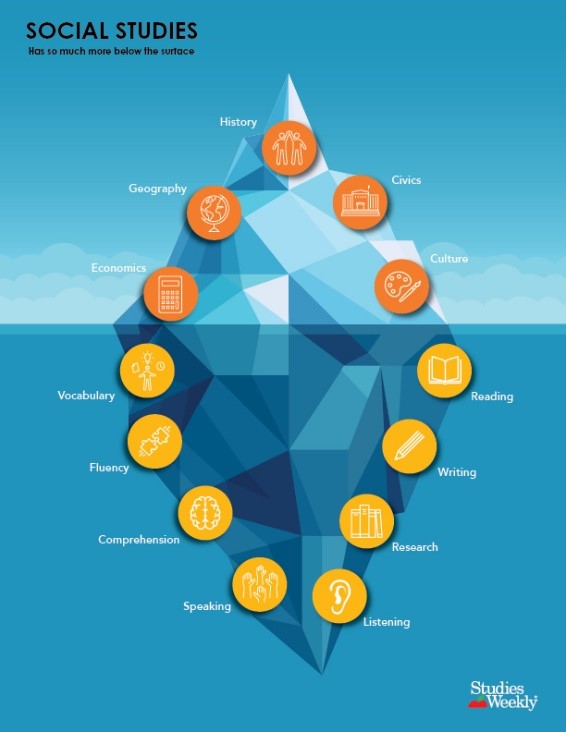
Beyond reading, social studies instruction can also be more deeply blended with ELA, and support reading, writing, listening and speaking skills. Here are four tips for further integrating social studies and ELA:

1. Use Interactive Notebooks

“[I]nteractive notebooks are simple spiral-bound notebooks into which students glue or tape my handouts,” says Christina Gil in a 2016 article for Edutopia. “It’s just a simple, functional way for students to create, write, and explore ideas all in the same place.”

Jeffery adds that interactive notebooks are a way for both the teacher to see what students are learning and thinking. Students use them to take notes, explore ideas, ask questions, reflect and respond. They then become a sourcebook for students as they review for assessments.

“They pair very well with Studies Weekly because it is a perfect way to consume our publications,” Jeffery explains.

2. Create a Presentation

Students need different types of opportunities to share their understanding and presentations are perfect for this.

Brochures, posters, Google Slides, Nearpods, etc. are all interactive avenues for students to work individually or collaborate together to demonstrate knowledge. Similarly, students can create video journals to storyboard events and their responses. The goal is not a perfect analysis of the event or the historical figure they are studying, but a reflection on it.

Additionally, students can create readers’ theaters or short plays based on historic events, and perform them for the class. Others might opt to write a poem about a historic figure or create a children’s book explaining about an even


Three examples of easy ways students can show learning (from top left): file folders used to summarize information, popsicle puppets to share information from a historical figure’s point of view, and trioramas used for summarizing, fact/opinion, analyzing a primary source, or as a mini-report.

3. Create a Supported Response

Using informational texts, students can create a reasoned persuasive argument sharing their opinion on an event or person.

One form of supported response is a small paragraph following the TEES Template as explained by Jeannette Balantic and Erica Fregosi in their 2012 article, “Strengthening Student Thinking and Writing about World History,” for Social Studies and the Young Learner.

The TEES Template helps students strengthen their thinking, reasoning, and responses to open-ended assessments. With this exercise students go beyond learning historical facts — instead they use these facts to form arguments and support.

4. Hold Collaborative Groups

After reading an article, students may analyze the information and reflect on it within their interactive notebook.

With their notebooks and/or articles in front of them, teachers can guide students in opening up a dialogue about what they read with a small group or the entire class. Students should consider all voices and sides to an issue or event, and use additional sources, if needed, to deepen their understanding.

As they share their opinions and factual evidence, students should also be instructed to actively listen to the other side. The goal of this exercise is not to win but to try to find a compromise between both positions.

These four tips are only just few options to help teachers blend social studies and ELA in the elementary classroom. Even more, in addition to integrating with ELA, social studies is also the gateway to deeper learning in all subjects. For example, as students learn geography, they learn spatial math concepts. Or as they learn about historical developments in technology, they develop background knowledge for science. Even within the study of social studies, students learn how to make connections between a specific topic and its effect on people, events, and society. They begin to understand how geography affects a region’s economics, history affects governments, and governments affect society.

Teaching social studies with an integrated learning approach strengthens students’ ability to reason and think critically, gain a deeper understanding of the content, and transfer information to solve new problems. This knowledge can prepare them for the future as they become the world’s government, business, and family leaders.

References:

Balantic, J., & Fregosi, E. (2012, November). Strengthening student thinking and writing about world history. Social Studies and the Young Learner, National Council for the Social Studies. Retrieved May 27, 2022, from https://www.socialstudies.org/social-studies-and-young-learner/25/2/strengthening-student-thinking-and-writing-about-world

Gil, C. (2016, August 30). Interactive notebooks: No special hardware required. Edutopia. Retrieved May 27, 2022, from https://www.edutopia.org/blog/interactive-notebooks-no-special-hardware-christina-lovdal-gil

Tyner, A., & Kabourek, S. (2021, January). How social studies improves elementary literacy. Social Education, National Council for the Social Studies. Retrieved May 27, 2022, from https://www.socialstudies.org/social-education/85/1/how-social-studies-improves-elementary-literacy

The Rise of Corporate Power and the Disintegration of American Democracy

The Rise of Corporate Power and the Disintegration of American Democracy

by Anthony  Higueruela

“No thoughtful person can question that the American economic system is under broad attack”.[1]  These words open the Powell Memorandum’s “Attack on American free enterprise System”, written by Lewis Powell and sent to the United States Chamber of Commerce in 1971.  Lewis Powell would become one of four justices Richard Nixon appointed to the United States Supreme Court that would gradually dismantle the more liberal leaning Warren court of the 1950s and 1960s.[2]  For Powell the sources of the assault on American business were wide and varied.  “They include, not unexpectedly, the Communists, New Leftists, and other revolutionaries who would destroy the entire system, both political and economic”.[3]  Powell is thorough in his inquiry into the many forces at work throughout the United States hell-bent on upending the capitalist order.  He states that: “Yale, like every other major college, is graduating scores of bright young men who are practitioners of despair.  These young men despise the American political and economic system… their minds seem to be wholly closed.  They live, not by rational discussion but by mindless slogans.  A recent poll of students on 12 representative campuses reported that: almost half of the students favored socialization of basic U.S. industries”.[4]  The Powell Memorandum would prove to be a rallying cry for big business and global corporations to assert their rightful place in the sphere of American economic and political life.  Powell argues in almost Orwellian tones that the battle for corporate dominance must be waged on multiple fronts: that textbooks in universities should be kept under surveillance, television networks closely monitored and scholarly articles propagated on the positive benefits of a capitalistic system.[5]  He urged corporations to take a page out of the playbooks of labor and realize that political power is essential for corporate growth and must be meticulously cultivated.[6]  The Powell Memorandum is essential because it provides a framework for business interests to utilize and manipulate the existing framework of the United States legal system to gain rights that would become akin to corporate personhood.  One can think of Powell’s letter to the Chamber of Commerce as both a rallying cry and a blueprint for corporate America in order to gain greater hegemony in the United States.  The purpose of this paper is to argue that through corporations’ utilization of the legal system to gain personhood and the rights that accompany it, the political and economic welfare of the American citizen has been jeopardized. 

The first battles in the war for corporate supremacy would be waged on the legal front.  Corporations used the court system to gain access to rights historically reserved for United States citizens.  With the continual accruement of First Amendment speech rights, corporate America argued that monetary contributions by business is protected free speech guaranteed by the constitution.  This came to have disastrous consequences for the future of America’s political and democratic systems.  As corporations grew more powerful they were able to use the wealth and resources at their disposal to buy political influence and favorable legislation.

The first defining court case appeared in 1976, a few years after the establishment of the Federal Election Campaign Act (FECA).  FECA’s primary goal was to establish new standards for fundraising and influence in the political spheres, much of which grew out of the reforms post-Watergate scandal.[7]  This act mandated public disclosure of contributions, made campaign contributions over a certain amount of money illegal and set caps on the amounts for campaign spending.[8]  The most ardent opponents of FECA were anxious that the law could be used as a tool by established politicians in order to maintain their own stranglehold on power.[9]  Their main concern lie in the fact that if the government could enact punitive measures on political communication, then entrenched politicians could utilize spending limits on insurgent political operatives in order to hold onto their own power.[10]  This law would eventually be challenged in the United States Supreme Court with the case of Buckley v. Valeo.  On January 2, 1975 a suit was filed in the U.S. District Court for the District of Columbia by New York Senator James L. Buckley and Eugene McCarthy.[11]  The plaintiffs in this case argued that the Federal Election Campaign Act of 1971 and the Presidential Election Campaign Fund Act were unconstitutional.[12]  The Supreme Court upheld the majority of the law, however it struck down the spending limits on grounds of the First Amendment.[13]  The Supreme Court reached the conclusion that legislatively passed limits on spending were unconstitutional due to the fact that they infringed on the First Amendment and were not adequately related to solving the issue of corruption.[14]  Buckley would serve as a starting point for the Supreme Court’s jurisprudence on money and political affairs.[15]  The influence of money and monetary contributions to politicians had far reaching consequences to the U.S. political system.  Robert Kaiser’s So Damn Much Money makes note that “the more important money became to the politicians, the more important the donors become to them”.[16]  This new setup, although beneficial to corporate America, was problematic to the health of American democracy and the right of the average citizen to have fair representation.  With the growth of corporate donors and their extensive resources which allow them to donate large sums of money to political campaigns, one must ask the question—what does this do to the balance of influence between people and corporations?  This answer is simple: it dramatically shifts it in favor of corporations.

The culmination of over three decades worth of litigation would result in Citizens United v. FEC (2010).  This seminal case proved to be the crowning victory for corporate America’s right to donate unfettered amounts of money based on their first amendment rights to freedom of speech.  Just as Bellotti opened up a loophole for corporations to donate money in ballot measures, Citizens United threatened to do the same for corporate money in campaign elections.[17]  The case that would forever alter the landscape of campaign finance law began when a conservative nonprofit corporation sought to air a ninety minute movie about Hillary Clinton on DirecTV.[18]  Citizens United also wished to air thirty second advertisements for their movie regarding Hillary Clinton on cable television.[19]  The Federal Election Committee (FEC) sought to block both the movie and the television ads on the basis that they violated the Bipartisan Campaign Reform Act (2002), which did not allow corporate funded campaign ads within thirty day of a presidential primary contest.[20]  Citizens United challenged the decision handed down by FEC on the basis that it was a documentary and not offered on broadcast television, therefore BCRA was not applicable.[21]  The government, however, argued that it was a ninety minute advertisement designed to damage Clinton in the primaries and its distribution did indeed count as broadcast.[22]  Ted Olsen, one of the leading lawyers for Citizens United argued that the law had no justification since there was no quid pro quo when corporations donate money to campaigns.[23]  His argument rested on the fact that Congress’s power to limit corruption in elections rested on their power to punish and deter clearly explicit bribes, anything else could not truly be counted as corruption.[24]  Olson went so far as to tell the court that the Bipartisan Campaign Reform Act was essentially a ban on the free speech of corporations, and that the government had distinctly prohibited speech.[25] 

Proponents of Citizens United often attempt to downplay the damage it did to democracy.  In the Wall Street Journal, Bradley Smith argues that the ruling allowed corporations to make independent expenditures in campaigns and elections.[26]  He also argues that Citizens United opened the door to new political challengers and is quick to dismiss any critics as simply being put off that their preferred candidates did not win.[27]  What Smith fails to recognize is that the ruling from Citizens United puts corporations and wealthy individuals at a disproportionate advantage when compared to the ordinary citizen.  Citizens United essentially gave big business and special interests a pass to legally bribe politicians for legislation favorable to their interests.  This in turn diminishes the political rights of the American citizenry.  

Citizens United is unique in the sense that corporations are described as associations that have taken on corporate form.[28]  Historian Adam Winkler noted, “if the first amendment has any force, Kennedy read aloud from his opinion, it prohibits Congress from fining or jailing citizens or associations of citizens for simply engaging in political speech” (Winkler 364).  What is significant in this fact is that by defining corporations as associations of citizens, it allows them to subsume the rights of other people, in other words the corporations own members.[29] 

One must then examine the implications of allowing corporations to assume rights of multiple individuals.  If a corporation, as an association of individuals, can assume their collective rights then what recourse is left to individuals within the corporation to seek redress from grievances perpetrated by the corporation?  If all rights belonging to individuals within a corporate framework are taken by the corporate entity then workers and employees are left powerless against corporate abuse and excess.  The adoption of corporate personhood and corporate legal speech rights to utilize money in campaigns robbed the average citizen of their rights to a free and fair democracy.  According to Zephyr Teachout, “while corruption has narrowed to quid pro quo, free speech has expanded to encompass all money spent on communication”.[30]  Large corporations, due to their wealth and resources, are at an unnatural advantage when compared to the average citizen in terms of spending money on campaigns and referendums.  This undermines democracy as it creates rule by a few large corporate entities as opposed to rule by the people.  It also allows corporations to buy greater access to political candidates in order to secure favorable legislation towards their own interests.  Taken a step further, Teachout argues, “because of Citizens United it is not illegal for a corporation to spend millions of dollars to punish a congressperson who voted against their interests”.[31]  This only further increases the power of corporations at the expense of the American citizens due to the fact that corporations are able to use their money and lobbying power to ensure favorable outcomes for themselves in regards to legislation.


[1] Lewis Powell, greenpeace.org, 1.

[2] Adam Winkler, We the Corporations (Liveright Publishing Corporation, 2018)

[3] Lewis Powell, greenpeace.org, 3.

[4] Powell, 3.

[5] Winkler, 286-87

[6] Winkler, 287.

[7]Teachout, 206.

[8] Teachout, 206-07

[9] Teachout, 207

[10] Teachout, 207.

[11] Fec.gov, 1.

[12] Fec.gov, 1.

[13] Teachout, 207.

[14] Teachout, 207.

[15] Teachout, 207.

[16] Teachout, 209.

[17] Winkler,

[18] Teachout, 229-230

[19] Teachout, 230

[20] Teachout, 230

[21] Teachout,  230

[22] Teachout, 230

[23] Teachout, 231

[24] Teachout, 231

[25] Winkler, 361

[26] Bradley Smith, “The Incumbent’s Bane: Citizens United and the 2010 Election”, Wall Street Journal, 2.

[27] Smith, 2.

[28] Winkler, 364

[29] Winkler, 364

[30] Teachout, 241.

[31] Teachout, 112.

Transforming Education for Our Children’s Future

Parts of this essay appear in At the Center of All Possibilities: Transforming Education for our Children’s Future (Peter Lang, 2022). https://www.peterlang.com/document/1166664

Transforming Education for Our Children’s Future

by Doug Selwyn

            A group of approximately 30 teachers, administrators, over the family members, health officials and others in our town of Greenfield, Massachusetts met summer of 2020 attempting to plan for the opening of the 2020-2021 school year. COVID-19 was raging and we had to make choices about whether to have in-person schooling, a hybrid model that had children in schools some of the week and learning remotely the rest of the week, or to conduct school entirely remotely, at least to start.

            Several things became evident as we considered our options. First, there might be no institution as inextricably bound to the community than are schools. Any decision we made would reverberate through the community, with consequences for families, for businesses, for those needing childcare, for virtually every aspect of town life. It also meant that what was happening in the community would have significant consequences for what was happening in the schools. Second, it was clear that what we already knew, that there was (and is) significant inequality across our community, was even more prevalent and more consequential than we had realized. Third, our schools were already severely underfunded and under-resourced before Covid. The arrival of Covid made things even worse, stretching resources beyond the breaking point, which made realistic planning all but impossible because there was no way to really do what needed to be done. Fourth, there would be no time to offer adequate professional development or preparation time for faculty and staff. And fifth, the federal and state governments were prioritizing political and economic interests over educational or health-related concerns.

And what was most clear was that the best-case scenario was to be able to get back to near “normal,” to the education we had before the arrival of the pandemic. We were in crisis mode and getting ready for the school year was all that mattered.

I had written a book two years before focused on the question, what would our schools look like if our primary focus was on the health and wellbeing of our children. What I found was that if that really was our primary concern we would have to address the underlying issues in our society such as the increasing gap between rich and poor, a lack of health care for mothers during pregnancy and for newborns and their families through their first months and years of life, and the various stresses and traumas our children were experiencing from racism, from living in a toxic environment, from a lack of access to health care, and from other social, or economic factors if we wanted our children to both be healthy and able to come to school ready to learn. We could not simply say to schools fix yourselves while doing nothing about the underlying issues in our communities and country.

No one on our committee had time or energy to think about these larger issues as we pondered how to open schools. They simply wanted to get back to as close to “normal” as possible. While I recognized the enormous pressure the committee was under to get schools open one way or another, having as a goal returning to a school system that was failing so many of our children, particularly those who are most vulnerable, was not good enough, so I decided to research the question what do our children need to learn and know and how can we help them to learn it so that they are going to be as prepared as possible to move into their future, which is, by definition, unpredictable. While we recognize that one of the responsibilities of the adults in our society is to educate our young, there is not always agreement about what that education should consist of, who should receive it, who should offer it, who should pay for it, and how it should be assessed. These questions led me to invite the thoughts of educators and activists on what education our children needed and how we might help them to achieve it. I cast as wide a net as I could in gathering points of view, experience, perspectives, and understandings, and we looked at several aspects of the question including understanding the role of schools within the larger society, learning from our experiences with COVID, looking at the content we offer, considering who should be teaching and how they should be educated, how we might assess, and what other models of education might we consider, beyond public schooling. I pulled the essays and interviews together into a book, At the Center of All Possibilities: Transforming Education for Our Children’s Future (2022), and want to briefly share what I learned, starting with a brief look at my own story.

I was mis educated about much of U.S. history by Walt Disney and other programs on television. I “learned” from Disney and other media that U.S. history really began with the “discovery” of America by Christopher Columbus in 1492 and continued as (white) European Americans moved across North America fulfilling their Manifest Destiny to civilize and settle the essentially empty continent. I watched Disney’s take on Davy Crockett to learn about what that meant; fighting hostile, savage Indians who stood in the way of that Manifest Destiny, and later, fighting hostile, evil Mexicans who surrounded and murdered heroic Americans at the Alamo. Disney never mentioned the genocide and forced resettlements that were at the heart of Manifest Destiny, or the land grab that was the so-called Mexican War, or its link to perpetuating and maintaining slavery. It was nationalistic myth making that was echoed by virtually everything else that appeared on television, our prime window on the world outside of our neighborhoods.

Disney and other media also (mis) educated me about race relations, gender roles and values, which seemed to center on strong, silent, gun toting men who traveled alone or sometimes with a clownish sidekick, and pretty, vulnerable and relatively helpless women. And, of course, all the good guys (and women) were white.

Despite the fact that I went through a well-regarded K-12 school system, I did not encounter any real pushback to the Disney version of history until I was in college, and that pushback mostly came from “teachers” and situations outside of the classroom. I spent my summers living across the street from the Six Nations Museum, in Onchiota, NY (population 62), within a small Mohawk community, and got to know Ray Fadden, the man who built and ran the museum., “Uncle” Ray and my other neighbors helped me to learn a much more accurate picture of the genocide and forced removal that were the hallmarks of Manifest Destiny, and I learned more about the complex and layered governing and social systems at the heart of the Iroquois Confederacy that challenged virtually everything I’d been taught at school, or by Disney.

This experience awakened me to the need to question, to challenge, and to not automatically accept what I was being told in school, in my neighborhood (which was an essentially middle class, white, quietly racist community of young families), and from media of all sorts, including the news.

When I finally decided on becoming a teacher, more than a decade after graduating from college I thought back on my relentless mis education and realized I had to formulate my own goals, my own purpose as an educator. I came up with a short list of goals and aspirations for my work as a teacher, which I continued to add to with experience. They included:

The children are more important than any of the subjects.

  • Every child should feel welcomed and valued.
  • All children in class should have the opportunity to explore what is most important to them, at least some of the time.
  • I should avoid using textbooks as much as possible as they are both deadly boring and inaccurate or incomplete.
  • It is crucial to bring in more points of view and voices than what are featured in textbooks or in mandated curriculum.
  • I must be a learner, to model what I hope the students will take from their time with me.
  • I will bring as much joy and excitement to learning as possible.
  • I want to help students to learn to critically question what they are encountering, including me.
  • I must do everything I can to tell them the truth, and to help to learn to find the truth for themselves.

I can’t say that I have always been successful in meeting those goals, but they are always the compass points I try to steer by. My research and conversations while editing At the Center of All Possibilities have moved me to update my list. I would now add:

  • Having an increased awareness of the cultures, histories, and contexts of the students.
  • Learning much more about the impact that inequality, white supremacy, racism, and capitalism play in determining, or strongly influencing the lives we lead
  • Becoming a more active and engaged advocate for social justice outside of the classroom. Helping students understand the crippling impact of slavery and racism on our society, that continues to this day
  • Supporting students learning to listen and communicate clearly with their peers, and to work with them as allies and cooperators rather than as competitors.
  • Developing alternative ways of organizing education that pattern after the freedom school model, with a focus is on a smaller, more personal educational experience focused on the needs and interests of the students.
  • Assessing the quality of our work together, in my classroom and in my school by the quality of our lives inside and outside of school. How are we feeling about ourselves and each other, how are we behaving with each other, how much are we engaging in learning that is of interest, and how are putting what we learn to use in service to what we care about, in school and out. If there is no evidence that school is moving them towards becoming engaged, caring, and joyful humans then we are failing them and need to change what we are doing.

I would also add to my list the importance of reaching out to the community to help me to learn about the students, to learn about content I don’t know, to help me identify resources and to help me think through how best to make the educational experience as effective and meaningful and joyful as possible. Many of us enter classrooms thinking we must do it all ourselves and are reluctant to “blow our cover” by admitting we don’t know how to deal with particular content or a particular student or situation. That is evidence of a flaw in how we are trained rather than educated in our K-12 and university systems. I learned so much by asking them to be a part of this project. I hope that readers will keep this learning in mind as you think about how to transform education in your school or district, that you will be well served by inviting others to think and plan and act with you. We are in this together and are wiser and more powerful when we join together.

I want to close with a few words from Myles Horton, the founder of the Highlander Folk School, in Tennessee. He was in dialog with Brazilian educator Paolo Freire and said this: “If I had to put a finger on what I consider a good education, a good radical education, it wouldn’t be about methods or techniques. It would be loving people first…. and that means people everywhere, not just your family or your own countrymen or your own color. And wanting for them what you want for yourself. And then next is respect for people’s abilities to learn and to act and to shape their own lives. You have to have confidence that people can do that… The third thing grows out of caring for people and having respect for people’s ability to do things, and that is that you value their experiences. You can’t say that you respect people and not respect their experiences.” (Bell, Gaventa, & Peters, 1990, p 177-178)

There is so much that we can do if we trust, respect, and value the people we work with, beginning with our students and their families. When we trust, respect, and value people enough to listen to them when they share who they are, what they care about, and what their goals and dreams are, we have already taken a significant step towards the transformation of their educational experience, and ours.

References

Bell, B, Gaventa, J, & Peters, J. (1990). We make the road by walking: Conversations on education and social change. Philadelphia: Temple University Press.

Selwyn, D. (2022). At the center of all possibilities: Transforming education for our children’s future. Peter Lang.

The Freedom to Teach by the National Council for the Social Studies

This statement is from March 2022 and can be found at https://www.socialstudies.org/current-events-response/freedom-teach

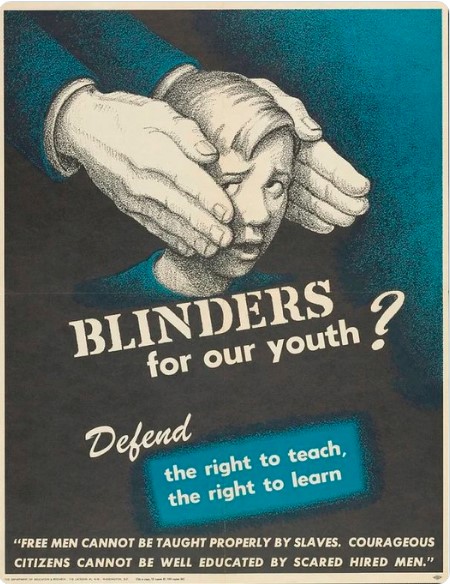
Poster-Congress of Industrial Organizations, 1950s

School districts, the most active battlefield in the American culture wars today, are facing an unprecedented number of calls to remove books from schools and libraries, false claims about “obscenity” invading classrooms, the elimination of teaching about evolution and climate change, challenges to the need for making sense of and critiquing our world in the mathematics classrooms, and legislation redlining teaching about racism in American history. These actions are putting excessive and undue pressure on teachers, who are caught in the crossfire of larger political conflict, motivated by cultural shifts and stoked for political gain.

Teachers are being maligned as “harming” children and are subjected to constant scrutiny (and even direct surveillance) by many parents, school administrators, and activist groups. Some are afraid to offer their students award-winning books that may violate vaguely stated laws about teaching the history of racism or that may be misleadingly labeled as pornographic. As a result, teachers’ very ability to do their job is under threat.

In their zeal, activists of the current culture wars unfortunately treat teachers as if they are enemies. The truth is that teachers are uniquely important leaders who, in educating current and new generations of students, bear responsibility for this country’s future. They are trained professionals with one of the hardest and most demanding jobs, a job that requires deep commitment, but brings little financial reward.  

Teachers need our support; they need our trust; they need to have the freedom to exercise their professional judgment. And that freedom includes the freedom to decide what materials best suit their students in meeting the demands of the curriculum, the freedom to discuss disturbing parts of American history if and when they judge students are ready for it, and the freedom to determine how to help young people navigate the psychological and social challenges of growing up. In short, teachers need the freedom to prepare students to become future members of a democratic society who can engage in making responsible and informed contributions and decisions about our world.

The stakes are too high. We cannot let good teachers leave the field because they no longer have the freedom to do their job. We cannot let the education of our children and young adults become collateral damage in partisan political machination.

Teaching Controversial Issues: Teachers’ Freedom of Speech in the Classroom

Teaching Controversial Issues: Teachers’ Freedom of Speech in the Classroom

by Arlene Gardner

Executive Director, New Jersey Center for Civic Education

What is the purpose of education? The conventional answer is the acquisition of knowledge. Looking beyond this facile response, most people will agree that the true purpose of education is to produce citizens. One of the primary reasons our nation’s founders envisioned a vast public education system was to prepare youth to be active participants in our system of self-government.  John Dewey makes a strong case for the importance of education not only as a place to gain content knowledge, but also as a place to learn how to live. In his eyes, the purpose of education should not revolve around the acquisition of a pre-determined set of skills, but rather the realization of one’s full potential and the ability to use those skills for the greater good.

Democratic self-government requires constant discussions and decisions about controversial issues. There is an intrinsic and crucial connection between the discussion of controversial political issues and the health of democracy. If we want our students to become informed, engaged citizens, we need to teach them how to “do” democracy by practicing the skills of discussing controversial issues in the classroom and learning how to respectfully disagree.

Research has demonstrated that controversy during classroom discussion also promotes cognitive gains in complex reasoning, integrated thinking, and decision-making. Controversy can be a useful, powerful, and memorable tool to promote learning. In addition to its value in promoting skills for democracy, discussing current controversial public issues:

  • Is authentic and relevant
  • Enhances students’ sense of political efficacy
  • Improves critical thinking skills
  • Increases students’ comfort with conflict that exists in the world outside of the classroom
  • Develops political tolerance
  • Motivates students
  • Results in students gaining greater content knowledge.

(Diana Hess, Controversy in the Classroom: The Democratic Power of Discussion (2009); Nel Noddings and Laurie Brooks, Teaching Controversial Issues: The Case for Critical Thinking and Moral Commitment in the Classroom (2017); “Guardian of Democracy: The Civic Mission of Schools” (2011); Center for Research on Learning and Teaching, University of Michigan at https://crlt.umich.edu/tstrategies/tsd).

Yet, teachers may consciously (or unconsciously) avoid controversial issues in the classroom because of the difficulty involved in managing heated discussions and/or for fear that parents will complain or that the school administration will admonish or punish them for “being controversial.” These concerns are certainly not groundless. How well are teachers protected from negative repercussions if they address controversial issues in their classrooms? How extensive are teachers’ First Amendment rights to free speech? How can heated disagreements among students be contained in the classroom?

Two different legal issues exist regarding free speech rights of teachers: The First Amendment directly protects a teacher’s personal right to speak about public issues outside of the classroom and “Academic Freedom” protects a teacher’s right and responsibility to teach controversial issues in the classroom.  However, both have certain limitations.

First Amendment Protection of Public Speech by Teachers

Although the First Amendment free speech protection is written in absolute terms (“Congress shall make no law…”), the courts have carved out several exceptions (for national security, libel and slander, pornography, imminent threats, etc.).  The courts have also carved out a limited “government employee” exception based on the rationale that a government employee is paid a salary to work and contribute to an agency’s effective operation and, therefore, the government employer must have the power to prevent or restrain the employee from doing or saying things that detract from the agency’s effective operation.  Thus, the government has been given greater latitude to engage in actions that impose restrictions on a person’s right to speak when the person is a governmental employee, which includes teachers who work in public schools.

Some of the earliest threats to the free speech rights of public school teachers were the loyalty oaths that many states imposed on government employees during the ‘‘red scare’’ and early ‘‘cold war’’ years of American history. In Adler v. Board of Education (1952), the Supreme Court in a 6-3 decision rejected First Amendment claims and upheld a New York statute designed to enforce existing civil service regulations to prevent members of subversive groups, particularly of the Communist Party, from teaching in public schools. The Supreme Court effectively overturned this ruling in the 1960s and declared several loyalty oath schemes to be unconstitutional because they had chilling effects on individuals which violated their First Amendment rights (Baggett v. Bullitt (1964); Cramp v. Board of Public Instruction (1961); and Keyishian v. Board of Education (1967)).

Much of the reasoning regarding the “government employee” exception to the First Amendment outlined in Adler was abandoned altogether in the 1968 U.S. Supreme Court decision in Pickering v. Board of Education. Teacher Marvin Pickering had written a letter complaining about a recently defeated school budget proposal to increase school taxes. The school board felt that the letter was “detrimental to the efficient operation and administration of the schools” and decided to terminate Pickering, who sued claiming his letter was protected speech under the First Amendment. The U.S. Supreme Court held that Pickering’s dismissal violated his First Amendment right to free speech because public employees are entitled to the same measure of constitutional protection as enjoyed by their civilian counterparts when speaking as “citizens” and not as “employees.”

In Mt. Healthy City School District v. Doyle (1977), non-tenured teacher Fred Doyle conveyed the substance of an internal memorandum regarding a proposed staff dress code to a local radio station, which released it. When the board of education refused to rehire him, Doyle claimed that his First and Fourteenth Amendment rights had been violated. The court developed a “balancing test” that required the teacher to demonstrate that the speech act was a ‘‘substantial’’ or ‘‘motivating factor’’ in the administration’s decision and gave the school board the opportunity to demonstrate, based on the preponderance of the evidence, that the teacher’s speech act was not the ‘‘but for’’ cause of the negative consequences imposed on the teacher by the school board. Finally, the court would “balance” the free speech interests of the teacher and the administrative interests of the school district to determine which carried more weight.  Based on this test, the U.S. Supreme Court found that the teacher’s call to the radio station was protected by the First Amendment, that the call played a substantial part in the board’s decision not to rehire Doyle, and that this action was a violation of Doyle’s rights under the First and Fourteenth Amendments.

In a 5/4 decision in Connick v. Meyers (1983), the U.S. Supreme Court held that speech by public employees is generally only protected when they are addressing matters of public concern, not personal issues. Sheila Meyers was an Assistant District Attorney who had been transferred.  She strongly opposed her transfer and prepared a questionnaire asking for her co-workers views on the transfer policy, office morale and confidence in supervisors.  She was terminated for insubordination. Meyers alleged her termination violated her First Amendment right to free speech. The district court agreed and the Fifth Circuit affirmed. However, the U.S. Supreme Court reversed because Meyer’s speech only dealt with personal not public issues.  “When a public employee speaks not as a citizen upon matters of public concern, but instead as an employee upon matters only of personal interest, absent the most unusual circumstances, a federal court is not the appropriate forum in which to review the wisdom of a personnel decision taken by a public agency allegedly in reaction to the employee’s behavior.” Although the case involved an Assistant District Attorney, it is applicable to all public employees: teachers must demonstrate that their speech is of public concern.

This was confirmed in Kirkland v. Northside Independent School District (1989) where the school district did not rehire non-tenured teacher Timothy Kirkland because of poor performance and substandard teaching evaluations. Kirkland filed a lawsuit in federal district court against Northside, claiming that he was not rehired in violation of his First Amendment rights after he gave his students a reading list that was different from Northside’s list. Northside argued that Kirkland had no right to substitute his list without permission or consent and he had failed to obtain either. The district court ruled in favor of Kirkland and Northside appealed. The Fifth Circuit Court of Appeals reversed and dismissed Kirkland’s complaint, holding that Kirkland’s “speech” did not infringe on any matter of public concern and was in fact “private speech.” If the nature of the speech is purely private, such as a dispute over one employee’s job performance, judicial inquiry then comes to an end, and the question of whether the employee’s speech was a substantial or motivating factor in the decision not to rehire him need not even be reached. The U.S. Supreme Court denied cert, leaving this decision in place.

Academic Freedom

Although primarily used in the context of university faculty rights, “Academic Freedom” protects a teacher’s ability to determine the content and method of addressing controversial issues in the classroom.  This is more limited at the K-12 level because the courts have long held the view that the administration of K-12 public schools resides with state and local authorities. Primary and secondary education is, for the most part, funded by local sources of revenue, and it has traditionally been a government service that residents of the community have structured to fit their needs. Therefore, a teacher’s “Academic Freedom” is limited to his or her content and method of teaching within the policies and curriculum established by the state and local school board. By finding no First Amendment violation, the court in Kirkland implicitly held that he had no right to substitute his own book list for the one approved by the district without permission or consent, which he failed to obtain. 

In an early case, following the end of World War I, Nebraska had passed a law prohibiting teaching grade school children any language other than English and Robert Meyer was punished for teaching German at a private Lutheran school. The court held that the Nebraska law was an unnecessarily restrictive way to ensure English language learning and was an unconstitutional violation of the 14th Amendment due process clause (the 14th Amendment had not yet applied the First Amendment to the states until Gitlow v.  New York in 1925) that exceeded the power of the state (Meyer v. Nebraska, 262 U.S. 390 (1923).

“The Fourteenth Amendment, as now applied to the States, protects the citizen against the State itself and all of its creatures-Boards of Education not excepted. These have, of course, important, delicate, and highly discretionary functions, but none that they may not perform within the limits of the Bill of Rights. That they are educating the young for citizenship is reason for scrupulous protection of Constitutional freedoms of the individual, if we are not to strangle the free mind at its source and teach youth to discount important principles of our government as mere platitudes.” Justice Jackson in West Virginia Board of Education v. Barnett (1943)(holding unconstitutional a requirement that all children in public schools salute the flag).

The Supreme Court has more than once instructed that “[t]he vigilant protection of constitutional freedoms is nowhere more vital than in the community of American schools” (Shelton v. Tucker (1960)). In Epperson v. Arkansas (1968)(a reprise of the famous 1927 “Scopes Trial”), the Arkansas legislature had passed a law prohibiting teachers in public or state-supported schools from teaching, or using textbooks that teach, human evolution. Sue Epperson, a public school teacher, sued, claiming that the law violated her First Amendment right to free speech as well as the Establishment Clause. A unanimous U.S. Supreme Court declared the state law unconstitutional. The Court found that “the State’s undoubted right to prescribe the curriculum for its public schools does not carry with it the right to prohibit, on pain of criminal penalty, the teaching of a scientific theory or doctrine where that prohibition is based upon reasons that violate the First Amendment.” Seven members of the court based their decision on the Establishment Clause, whereas two concurred in the result based on the Due Process clause of the 14th Amendment (because it was unconstitutionally vague) or the Free Speech clause of the First Amendment.

The Supreme Court, however, has not clearly defined the scope of academic freedom protections under the First Amendment, and commentators disagree about the scope of those protections. (See, e.g., William W. Van Alstyne, “The Specific Theory of Academic Freedom and the General Issue of Civil Liberty,” in The Concept of Academic Freedom 59, 61-63 (Edmund L. Pincoffs ed., 1972); J. Peter Byrne, “Academic Freedom: A ‘Special Concern of the First Amendment’,” 99 Yale L.J. 251 (1989); and Neil Hamilton, Zealotry and Academic Freedom: A Legal and Historical Perspective (New Brunswick, 1998).  

Whatever the legal scope, it is clear that the First Amendment protection of individual academic freedom is not absolute. For example, in Boring v. Buncombe County Board of Education (1998), the Fourth Circuit Court of Appeals held that a teacher could be reprimanded (in this case transferred) because she sponsored the performance of a play that school authorities subsequently deemed inappropriate for her students and inconsistent with the curriculum developed by the local school authorities. This judicial deference toward K through 12 institutions often can be seen in cases involving teachers who assert that their First Amendment rights were violated when school administrators imposed punishments on them for engaging—while they taught their classes—in some form of expressive activity that the administrators disapproved.

The content

While cases about academic freedom, such as Epperson, involved state laws that limited or prohibited certain content being taught (in this case prohibiting teachers in public or state-supported schools from teaching, or using textbooks that teach, human evolution); New Jersey has taken a very broad approach to classroom content.  Since 1996, New Jersey has established state standards (currently called “Student Learning Standards”) that set a framework for each content area.  Unlike many other states, New Jersey does not establish a state curriculum but rather leaves this to local school boards. Subject to applicable provisions of state law and standards set by the State Department of Education, district school boards have control of public elementary and secondary schools.  How much protection do New Jersey teachers have when they address controversial topics?  Most First Amendment education cases in New Jersey involve students’ rights rather than teachers’ rights (e.g., school dress, vulgar language, threats, religious speech, equal access, See http://www.njpsa.org/documents/pdf/lawprimer_FirstAmendment.pdf). However, several recent cases from the Third Circuit (which includes New Jersey) provide some parameters.

In Edwards v. California University of Pennsylvania (3rd Cir. 1998), a tenured professor in media studies sued the administration for violating his right to free speech by restricting his choice of classroom materials in an educational media course. Instead of using the approval syllabus, Edwards emphasized the issues of “bias, censorship, religion and humanism.” Students complained that he was promoting religious ideas in the class. The U.S. Supreme Court declined to review the Third Circuit’s summary judgement against Edwards, holding that a university professor does not have a First Amendment right to choose classroom materials and subjects in contravention of the University’s dictates.

A very recent decision regarding a New Jersey teacher confirms the fact that the First Amendment does not provide absolute protection for teachers in public schools to decide the content of their lessons if it is not within the curriculum set by the school district.  In Ali v. Woodbridge Twp. School District (3rd Cir. April 22, 2020) a non-tenured public high school teacher at Woodbridge High School was teaching Holocaust denial to his students and was posting links to articles on the school’s website saying things such as, “The Jews are like a cancer” and expressing conspiracy theories accusing the United States of planning a 9/11-style attack. When the Board of Education fired Ali, he sued claiming that his employment was terminated on the basis of his race and religion, and that defendants had violated his rights to free speech and academic freedom, among other claims. The District Court rejected all of Ali’s claims, awarding summary judgment to the school board, and the Third Circuit affirmed.

These are extreme cases where a teacher is addressing issues that are NOT within the curriculum set by the university or within the state social studies standards and the local school district’s curriculum.  When teachers are teaching a controversial topic that is included in the New Jersey Student Learning Standards for Social Studies and their school district’s social studies curriculum, the existing case law seems to support the fact that they would be protected  by the Fourteenth Amendment, unless they are violating school policies that require teaching in a neutral, balanced manner that does not seek to indoctrinate students.

For example, what if a teacher wants to assign a research paper about the Stonewall Riots or the Lavender Project?   Since the history of LGBT rights is in the state standards and supposed to be included in local school district social studies curriculum, the Stonewell Riots and Lavender Project would be part of this history. This is not a situation like Ali where the materials were beyond the scope of the local curriculum (as well as being taught in an indoctrinating manner—see below). If the teacher fears that the topics will be controversial with the community, he or she should make the school administration aware of what he or she is planning to do.  Since here, what the teacher plans to teach is within the state standards and the local school district curriculum, the school administration should support the teacher.  If parents object, the real issue is one of policy (Should LGBT history be taught?), which is decided by the state and local boards of education, not the teacher. Therefore, the parents’ argument should be with the state and local boards of education.

What if a teacher wants to show scenes of an R-rated movie in the classroom (i.e. Revolutionary War scenes from The Patriot or D-Day from Saving Private Ryan?) Obviously, the American Revolution and Would War II are part of the state standards for U.S. History and in every local school district’s curriculum.  The movie scenes would need to relate to the district curriculum and the teacher should get prior administrative and parental approval if some movie scenes are going to be very graphic.

How should a teacher prepare lessons on Nazi Germany during the 1930s? Nazi Germany is also part of the state history standards and every school district’s curriculum. It should be taught in a way so that students can understand how the Nazis came to power and the prejudices they carried.  Some of the World War II footage and movies may be shocking but our students will not be able to become informed, engaged citizens if we hide the past from them.  

An ounce of prevention beforehand will help.  Before starting, teachers should be clear about the goal of their lesson: The classroom activities should encourage critical thinking. You are not trying to convince students of any particular point of view. Preview any materials, especially visual media which may be very powerful or provocative. Be aware of the biases of the sources of information that will be used by students.

Teaching Tolerance suggests in Civil Discourse in the Classroom that “Teachers can effectively use current and controversial events instruction to address a wide variety of standards and even mandated content. To do so, however, teachers must work carefully and incrementally to integrate this new approach in their classrooms.”  The University of Michigan’s Center for Research on Learning and Teaching offers guidance for how instructors (offered for college instructors but applicable for K-12) can successfully manage discussions on controversial topics. See Center for Research on Learning and Teaching, University of Michigan at https://crlt.umich.edu/tstrategies/tsd). The 1940 “Statement on Academic Freedom and Tenure” of the American Association of University Professors, suggests that teachers should be careful to avoid controversial matters that are unrelated to the subject discussed.

Before engaging students in an activity or discussion involving a controversial subject, tell your supervisor and/or principal what you are planning on teaching and, if necessary, reference the district policy on teaching controversial issues, explain the lesson’s connection with the district social studies curriculum and explain the goal and value of what you plan to do.  Then, consider the demographics of your community. If you anticipate that the topic of your lesson will be controversial with the community, send a note and/or talk with your students’ parents and/or the Parent Teacher Organization.

In an informative piece titled “Do You Have the Right to be an Advocate?,” published by EdWeek.org, Julie Underwood, a professor of law and educational leadership and policy analysis at the School of Education, University of Wisconsin-Madison, explains that the “district or the state can regulate employee speech during school hours or at school-sponsored activities to protect their own interests in instruction and political neutrality.” Despite the ambiguity in the laws protecting a teacher’s freedom of speech, Underwood concludes: “If it relates to the in class instruction and is age appropriate there is a good rationale for having a political discussion”.

Teaching in a Neutral or Balanced Manner

If the teacher has created a supportive, respectful classroom climate and built tolerance for opposing views, it will be easier to consider controversial topics. For example, considering historical controversies might be good background as practice for looking at current controversies. Establish a process and rules of adequate evidence or support so that the discussion is based on facts rather than simply opinions. To help maintain classroom order even when students are having heated disagreements, set clear rules for discussions or use activities that require students to use active listening skills when considering controversial issues, such as:

  • Continuum/Take a Stand
  • Civil Conversations
  • C3 Inquiries
  • Guided discussions
  • Socratic Smackdown
  • Moot courts—structured format for considering constitutional issues
  • Philosophical Chairs discussion
  • Legislative hearings—structured format for considering solutions to problems

Carefully consider how students are grouped if they are to work cooperatively.  Provide closure (which may be acknowledging the difficulty of the issue).

School boards work primarily through policies which set guidelines for principals, teachers, parents and students, as well as the district curriculum. To avoid a problem afterwards, the teacher should make sure that the controversial topic is within the state standards and the curriculum adopted by their local school board. Then the teacher should consult the school district’s policy regarding the teaching of controversial issues. Most school districts have a policy (usually #2240) that supports and encourages the teaching of controversial issues and sets guidelines for teaching controversial issues, including a process for dealing with challenges.  Although the language may differ, policies dealing with controversial issues generally focus on the need for the classroom lesson to be balanced, unprejudiced, fair, objective, and not aimed at indoctrinating students to a particular point of view.

Clearly, the type of indoctrination attempted by the teachers in the Edwards or Ali cases is beyond protected speech.  In addition to avoiding indoctrination, teachers should avoid telling a joke in the classroom that might imply a negative characterization of an ethnic group, religion or gender.  A “joke” that might be a put down of any ethnic group, religion or gender told in the classroom to students is never a good idea. It is not even a good idea for a teacher to post such a “joke” on Facebook because such speech might be considered as not addressing a matter of public concern and would not be protected by the First Amendment. However, using an historical photo, engraving or picture that included a negative image of an ethnic, racial or religious group might be okay in the context of examining what was seen as humor in the past and understanding the prejudice that existed during a particular time period. For example, when teaching about the Holocaust, a teacher might carefully use Nazi cartoons to demonstrate the high level of prejudice at the time. Another example might be using images of blackface or corporate ad campaigns to show racial attitudes when teaching about Jim Crow. The teacher does not need many examples to make the point. Know your audience. Choose carefully and be aware that certain advertising images from the Jim Crow era may offend some students in the class. The purpose of using controversial issues is important. At the core of deciding what a teacher should or should not say or do in the classroom is good judgment.

Should a teacher share his or her viewpoint on a controversial issue with the students?

Whether a teacher should share his or her opinion or viewpoint on a controversial issue will depend on the age of the students, if the opinion was requested by the students, and the comfort-level of the teacher.  A teacher’s opinion may have too much influence on younger students and should probably be avoided. What if a middle or high school student specifically asks for your opinion? Such “natural disclosures” in response to a direct question by a student should be accompanied by a disclaimer, such as “This is my view because…” or “Other people may have different views”.  If you prefer not to disclose your view, explicitly state that and explain why. Remember, the goal is to help students develop their own well-informed positions. Be mindful of your position as the “classroom expert” and the potential impact on the students. If you decide to disclose your own view, do it carefully and only after the students have expressed their views. Unrequested disclosures may be seen as preachy, or may stop the discussion. (See Hess, Controversy in the Classroom)

So, for example, should a teacher take a position on climate change?  In terms of content, climate change is in the state standards and should be in the local school curriculum. If parents disapprove of this topic, this disagreement is really with the curriculum set by the school board, not with the teacher.  However, the teaching strategy is important. Rather than taking a position, which may be seen as indoctrination or may simply stop the classroom inquiry, the better approach might be to have the students examine the issue and let the facts speak for themselves.  Let students use the facts that exist to construct their own arguments about whether or not climate change is the result of mankind’s use of fossil fuels in industry and transportation.  If the topic is presented in a balanced, neutral, non-indoctrinating manner, the teacher should not be subject to discipline. Objections by parents should be referred to the school administration because it is a matter of policy (Should climate change be taught?), which is decided by the state and local boards of education, not the teacher.

How should teachers address questions from students regarding Black Lives Matter and racial inequality? The ACLU in the state of Washington prepared a short online article, “Free Speech Rights of Teachers in Washington State” (NJ’s ACLU only has a publication about students’ rights) with a related hypothetical:  The teacher is instructed not to discuss personal opinions on political matters with students.  In a classroom discussion on racial issues in America, the teacher tells the class that he/she has recently participated in a Black Lives Matter demonstration.  Revealing this is the same as giving an opinion and may not be protected speech. Teachers can be disciplined for departing from the curriculum adopted by the school district and this would be a departure.

Can a teacher state that New Jersey is a segregated state when it comes to communities? Is the teacher stating this as a personal opinion or as a fact related to a topic of learning? There is no reason to simply state that NJ is segregated unless it is in the context of helping students understand and appreciate the history of segregation in NJ consistent with state standards and district curriculum. (For example, see “Land Use in NJ” and “School Desegregation and School Finance in NJ” for history, context and facts at http://civiced.rutgers.edu/njlessons.html).

Is a teacher permitted to take a stand on the issue of removing public monuments? Assuming that this is part of a current events lesson, it would be better if the teacher remained neutral and let the students’ voice differing views. If the students all have one position, perhaps the teacher can take a position as “devil’s advocate,” but it should be made clear that this is what the teacher is doing.

Can a teacher assign blame to protests to specific groups or left or right extremist groups? Assigning blame is the same as a teacher giving his or her personal opinion. The better approach would be to have students look at the actions of specific groups and determine their appropriateness.

Can a teacher assign blame to Associate Justice Amy Coney Barrett regarding a Supreme Court decision that is 5-4 and against the teacher’s preference (i.e. Affordable Care Act, marriage, etc.).  Assuming that this is part of a classroom lesson about the Supreme Court, the teacher should refrain from “assigning blame” because this is expressing his or her opinion, but should instead let the students consider the reasoning and impact of the decisions.

Is a teacher permitted to criticize or defend the government’s policies or actions on immigration? Outside the classroom, a teacher has a first amendment right to express his or her views on public issues. As part of a classroom lesson about immigration, rather than criticizing or defending the government’s policies or actions on immigration, the better approach would be to present or let students research the history of immigration policy and its impact and let the students discuss and draw their own conclusions (For example, see “Immigration Policy and its impact on NJ” at http://civiced.rutgers.edu/njlessons.html).

Can a teacher show a video clip from a specific news station (Fox, CNN) or assign students to watch a specific news program as an assignment?  As long as the purpose is not indoctrination to any particular point of view and the assignments are balanced. If the teacher wants students to see and compare various media views on the same topic, that would be a valuable classroom activity. (For example, see “Educating for Informed, Engaged Citizens” virtual workshop, for background on helping students understand bias in news, at the New Jersey Council for the Social Studies website at http://www.njcss.org/;  also see Choices Program at Brown University: Teaching with the News at https://www.choices.edu/teaching-with-the-news/;   and Constitutional Rights Foundation Fake News at https://www.crf-usa.org/images/pdf/challenge/Understanding-Fake-News1.pdf and https://www.crf-usa.org/images/pdf/challenge/Tackling-Fake-News.pdf).

Conclusions

A teacher has a personal right under the First Amendment to share his view on public policy issues in public but NOT in the classroom.  A teacher sharing his opinion or viewpoint in the classroom may be seen as indoctrination. So, for example, teachers should avoid sharing personal views on one’s sexual preference, regarding a particular candidate, President Trump’s taxes, a decision by a Grand Jury, prosecutor, FBI on racial issues, etc. Your school district may even have an explicit policy that teachers should not discuss personal views on political matters in the classroom, in which case, this policy should be followed.  Everything a teacher says or does in the classroom should be considered based on the possible impact on the students.

This does not mean that teachers should avoid having students examine and discuss controversial topics. Encouraging the development of civic skills and attitudes among young people has been an important goal of education since the start of the country.  Schools are communities in which young people learn to interact, argue, and work together with others, an important foundation for future citizenship.  Since the purpose of social education is to prepare students for participation in a pluralist democracy, social studies classes NEED to address controversial issues.  Teachers have the right and the responsibility to help their students understand controversial topics and to develop critical thinking skills.  However, the controversial topics should relate to the broad scope of subjects included in the NJ Student Learning Standards and the local school district curriculum.  And controversial subjects should be addressed in a neutral or balanced manner, without any effort to indoctrinate students, but rather to help them develop the knowledge and skills they will need as workers, parents and citizens in a democratic society.

Background Materials

Meyer v. Nebraska, 262 U.S. 390 (1923)

West Virginia Board of Education v. Barnett, 319 U.S. 624 (1943)

Adler v. Board of Education, 342 U.S. 485 (1952)

Shelton v. Tucker, 364 U.S. 479 (1960)

Cramp v. Board of Public Instruction, 368 U.S. 278 (1961)

Baggett v. Bullitt, 377 U.S. 360(1964)

Keyishian v. Board of Regents, 385 U.S. 589 (1967)

Pickering v. Board of Education, 391 U.S. 563 (1968)

Epperson v. Arkansas, 393 U.S. 97 (1968)

Mt. Healthy City School District Board of Education v. Doyle, 429 U.S. 274 (1977)

Connick v. Meyers, 461 U.S. 138 (1983)

Kirkland v. Northside Independent School District, 890 F.2d 694 (5th Cir. 1989), cert. denied (1990)

Bradley v. Pittsburgh Bd. of Educ., 910 F.2d 1172 (3d Cir.1990)

Boring v. Buncombe County Board of Education, 136 F.3d 364 (4th Cir. 1998)

Edwards v. California University of Pennsylvania, 156 F.3d 488 (3rd Cir. 1998), cert. denied, 525 U.S. 1143 (1999)

Ali v. Woodbridge Twp. School District, 957 F.3d 174 (3rd Cir. April 22, 2020)

Keith Barton and Linda Levstik, Teaching History for the Common Good (Erlbaum, 2004)

Diana E. Hess, Controversy in the Classroom: The Democratic Power of Discussion (New York: Routledge, 2009)

Nel Noddings and Laurie Brooks, Teaching Controversial Issues: The Case for Critical Thinking and Moral Commitment in the Classroom (New York:  Teacher’s College Press, 2017).

William W. Van Alstyne, “Academic Freedom and the First Amendment in the Supreme Court of the United States: An Unhurried Historical Review,” 53 Law and Contemp. Probs. 79 (1990)

ACLU-Washington at https://www.aclu-wa.org/docs/free-speech-rights-public-school-teachers-washington-state

American Association of University Professors, “Academic Freedom of Professors and Institutions,” (2002) at https://www.aaup.org/issues/academic-freedom/professors-and-institutions

Center for Research on Instruction and Teaching, University of Michigan at https://crlt.umich.edu/tstrategies/tsd

Choices Program at Brown University: Teaching with the News at https://www.choices.edu/teaching-with-the-news/

Constitutional Rights Foundation at https://www.crf-usa.org/

EdSurge at https://www.edsurge.com/news/2018-01-17-why-we-need-controversy-in-our-classrooms

Facing History at https://www.facinghistory.org/educator-resources

Find Law at https://www.findlaw.com/education/teachers-rights/teachers-different-freedoms-and-rights-article.html

Forbes at https://www.forbes.com/sites/jessicabohrer/2020/09/14/teaching-children-about-freedom-of-speech/#25cb6ff07101

John Goodlad, “Fulfilling the Public Purpose of Schooling: Educating the Young in Support of Democracy May Be Leadership’s Highest Calling,” School Administrator, v61 n5 p14 May 2004.

Jonathan Gould, Kathleen Hall Jamieson, Peter Levine, Ted McConnell, and David B. Smith, eds“Guardian of Democracy: The Civic Mission of Schools, Philadelphia: Annenberg Public Policy Center, 2011

Amanda Litvinov, “Forgotten Purpose: Civic Education in Public Schools, NEA Today, Mar 16, 2017 at https://www.nea.org/advocating-for-change/new-from-nea/forgotten-purpose-civics-education-public-schools#:~:text=Research%20into%20this%20long%2Dneglected,it%20holds%20for%20student%20achievement.

New Jersey Center for Civic Education (New Jersey lessons) at http://civiced.rutgers.edu/njlessons.html

New Jersey Law Journal at https://www.law.com/njlawjournal/2020/06/28/as-woodbridge-teachers-case-shows-facts-do-matter/?slreturn=20200929134110

New Jersey Principals and Supervisors Association at http://www.njpsa.org/documents/pdf/lawprimer_FirstAmendment.pdf

Phi Delta Kappa, “Do you have the right to be an Advocate?, at https://kappanonline.org/underwood-school-districts-control-teachers-classroom-speech/

Poorvu Center, Yale University at https://poorvucenter.yale.edu/teaching/ideas-teaching/teaching-controversial-topics

Teaching Tolerance at https://www.tolerance.org/magazine/publications/civil-discourse-in-the-classroom/chapter-4-teaching-controversy

Texas Association of School Boards at https://www.tasb.org/services/legal-services/tasb-school-law-esource/personnel/documents/employee_free_speech_rights.aspx

The First Amendment Encyclopedia at https://www.mtsu.edu/first-amendment/article/973/rights-of-teachers

U.S. Civil Liberties at https://uscivilliberties.org/themes/4571-teacher-speech-in-public-schools.html

Prepared by Arlene Gardner, Executive Director, New Jersey Center for Civic Education, Rutgers-The State University, Piscataway, NJ (2020)

Social Studies for a Better World: An Anti-Oppressive Approach for Elementary Education


Social Studies for a Better World: An Anti-Oppressive Approach for Elementary Education

by Rodriguez Naseem, Noreen, and Katy Swalwell. (2021)

Reviewed by Natalie House

In “Social Studies for a Better World: An Anti-Oppressive Approach for Elementary
Education,” the authors are taking on the task of how to teach anti-oppressive history and how to implement those teachings in an elementary classroom. This book aims to “…offer advice for addressing two major fears that the preservice teachers we work with often express: teaching controversial issues and being accused of indoctrination.” Noreen Naseem Rodriguez and Katy Swalwell (2021).” This book showcases the negative realities that the current social studies curriculum offers to all students in America, and takes the audience on a necessary journey that will help educators offer better learning experiences for students moving forward. The authors have created a work that is easily accessible for teachers at any level. Furthermore, the resources and research contained in this book will allow teachers to apply the authors’ ideas in their own classroom.

The authors of the book have taken the time to research different ways in which social studies can be taught. They are able to show multiple examples of effective social studies instruction by describing real lessons that teachers are currently using to help students have meaningful interactions with the curriculum. The authors help guide teachers by discussing the common pitfalls they might encounter while also giving the educators tips and tricks on how to find a solution. All of the examples in this text come with supplemental resources to help the reader implement the lessons or strategies with students easily. Teachers should also feel comfortable utilizing this information because it is all grounded in scholarly research. As a
first-year teacher myself, this book was encouraging and helped to validate my emotions as it pertains to teaching hard histories. It lays out the lessons in ways that are fair to our students, while also celebrating the diversity of all people. This is critical because many students feel ignored, or left out, of the current social studies curriculum.

This book is written in a way that supports teachers, but could also be beneficial to
pre-service teachers. By discussing the most controversial issues to teach, it also gives the educator time to reflect by posing thoughtful questions. These questions are meant to guide the educator through a lesson, however they also give the educator something to think about as well.

For instance, how they have been unknowingly teaching specific histories incorrectly. It offers a refreshing way for students and teachers to consider what information is being taught, as well as the ways that teachers and students are engaging with the content. The use of real-life examples helps connect the reader with the content that is being shared. Additionally, offering practical advice on how to handle the backlash that might come from teaching controversial issues is
something that new teachers will find incredibly helpful.

“In addition to everything laid out in this book about curriculum and instruction,
we must understand the bureaucracy and hierarchy of our states and districts so we can know where best to direct our change-making energies, buffer our credibility with ongoing meaningful professional development, and assess our own safety (mental, emotional, physical, financial) so we know exactly how far we are willing to go,
” Naseem Rodriguez and Swalwell (2021).

The authors do not sugar-coat anything and they let the reader know that teaching histories in this way is not an easy task. However, it is not a task that has ever been easy in the first place.

“Anti-oppressive elementary social studies may not be easy, but it is absolutely worth it (Naseem Rodriguez and Swalwell (2021).” The opportunity for growth through dialogue with students and colleagues is endless with this book. It opens so many doors for educators to walk through and have thoughtful conversations that will benefit our students.

This book by Noreen Naseem Rodriguez and Katy Swalwell is one that I will be
encouraging all of my fellow social studies teachers to read. It was refreshing to read something that was made with so much passion. By using accessible language that all teachers can understand, it made it seem as though teaching these histories today is not as daunting as it might seem. It just takes time to understand and make connections with all of humanity. I feel as though this book did a wonderful job of reaching its target audience. It is well written and has found its place in social studies literature. The reflections and informative way of thinking in this book are
exactly what education needs today, and this is a book that social studies educators desperately need.

My name is Natalie House, and I am a current social studies teacher in Oklahoma. I am currently enrolled at The University of Oklahoma as a Master’s student in Instructional Leadership and Academic Curriculum with a focus on Social Studies.

Teaching Critical Thinking in the Context of Political Rhetoric: A Guide for Classroom Practice

Teaching Critical Thinking in the Context of Political Rhetoric: A Guide for Classroom Practice

by Joseph Sanacore

During the past several decades, there has been a blitz of information, sometimes referred to as the knowledge explosion, and students have struggled in their attempts to distinguish true, fake, and terribly biased information, especially regarding political issues. This book highlights the value of critical thinking as a way to navigate this difficult and frustrating terrain, so that students grow and develop as knowledgeable, independent thinkers. To promote this growth, the book offers thoughtful, evidence-based advice for teachers to support students’ deep thinking as it relates to real-world contexts. Strategies presented include student reflection based on experience, moving from narrow to broader perspectives, and using graphic organizers to build and activate knowledge before, during, and after instructional activities. With the instructional guidance and activities presented in this short, easy-to-apply volume, teachers can give students the tools they need to negotiate the often-murky waters of political. Chapters include: The Need to Teach Critical Thinking; Promoting Critical Thinking; Application and Transfer of Learning; Other Strategies and Activities That Support Transfer of Learning; The Value of Hard Work; and Reflections on Critical Thinking.

In a review, Alina Reznitskaya, Professor, Department of Educational Foundations, Montclair State University, New Jersey, writes “Written at a time when news can be fake and facts can have alternatives, this book provides teachers with innovative research-based instructional strategies that help students learn how to think through complex questions in a deliberate and informed way. It is a timely and valuable resource for practitioners who are looking for effective ways to address a pressing educational priority: teaching students how to critically evaluate various types of information and reach a sound conclusion. Importantly, the book treats teachers as co-inquirers, who reflect on their own thinking and continue to learn with their students.”

Joseph Sanacore is a journalist, researcher, and professor in the Department of Teaching and Learning at the Post Campus of Long Island University, Brookville, NY. He has authored more than 100 articles, essays, and book chapters. He also was an elementary, middle, and high school teacher and a K-12 Director of Language Arts and Literacy.

Suffrage and Its Limits: The New York Story

Suffrage and Its Limits: The New York Story

Edited by Kathleen M. Dowley, Susan Ingalls Lewis, and Meg Devlin O’Sullivan

Suffrage and Its Limits offers a unique interdisciplinary overview of the legacy and limits of suffrage for the women of New York State. It commemorates the state suffrage centennial of 2017, yet arrives in time to contribute to celebrations around the national centennial of 2020. Bringing together scholars with a wide variety of research specialties, it initiates a timely dialogue that links an appreciation of accomplishments to a clearer understanding of present problems and an agenda for future progress. The first three chapters explore the state suffrage movement, the 1917 victory, and what New York women did with the vote. The next three chapters focus on the status of women and politics in New York today. The final three chapters take a prospective look at the limits of liberal feminism and its unfinished agenda for women’s equality in New York. A preface by Lieutenant Governor Katherine Hochul and a final chapter by activist Barbara Smith bookend the discussion. Combining diverse approaches and analyses, this collection enables readers to make connections between history, political science, public policy, sociology, philosophy, and activism. This study moves beyond merely celebrating the centennial to tackle women’s issues of today and tomorrow.          

Kathleen M. Dowley is Associate Professor and Chair of Political Science and International Relations, Susan Ingalls Lewis is Professor Emerita of History, and Meg Devlin O’Sullivan is Associate Professor of History and Women’s, Gender, and Sexuality Studies, at SUNY New Paltz.

Teaching Climate History: There is No Planet B

Teaching Climate History: There is No Planet B

by Alan Singer

Welcome to the Anthropocene. Since the start of the Industrial Revolution, human-caused climate change has impacted the globe with the burning of fossil fuels. The debate in classrooms and the political realm should not be whether climate change is happening or how much it places human civilization at risk but over how societies and individuals should respond. This interdisciplinary book offers an in-depth examination of the history of the Earth’s climate and how historians and citizens can influence contemporary climate debate and activism. The author explains climate history and climate science and makes this important subject matter accessible to a general audience. Chapter topics include examining the Earth’s geological past, the impact of climate on human evolution, the impact of climate on earlier civilizations, climate activism, and the need for international cooperation. Presenting climate history, human history, and climate science in a readable format and featuring resources for students, this book is meant for use by teachers in high school elective or an introductory college course setting.

Chapters include “Our House is on Fire”; Tipping Points; Great Climate Migration; Earth’s Past Climates; Climate Change and Human Evolution; Extreme Heat; Four Billion Years of Climate History; Mass Extinctions; “Clocking” Climate Change; Diseases Carried by Mosquitoes or Hidden in the Ice; Climate Change Deniers and Minimizers; A Short Cold Snap of about 500 Years; Power of Ice; Climate Repercussions; Water Scarcity, Water’s Vengeance; Technology Debate; Saving the Amazon Rainforest; Capitalism vs. the Climate; and Climate Activism. There is an annotated bibliography and a list of resources for teaching about climate change.

The 1619 Project: A New Origin Story

The 1619 Project: A New Origin Story

by Nikole Hannah-Jones, Caitlin Roper, Ilena Silverman, and Jake Silverstein

Review by Alan Singer

            The 1619 Project was released as an issue of the Sunday New York Times Magazine on August 18, 2019, 400 years after the arrival of the first slave ship at the British Virginia colony. It is now published in book formats. According to the Times, the project’s goal is to “reframe American history by considering what it would mean to regard 1619 as our nation’s birth year. Doing so requires us to place the consequences of slavery and the contributions of black Americans at the very center of the story we tell ourselves about who we are as a country” (4-5). The introductory essay by project director Nikole Hannah-Jones opens with a full-page bold-faced headline, “Our founding ideals of liberty and equality were false when they were written. Black Americans fought to make them true. Without this struggle, America would have no democracy at all” (14). For the essay, Hannah-Jones received a 2020 Pulitzer Prize for Commentary.

Other essays in the issue covered the role capitalism played in the establishment of chattel slavery and the plantation system in British North America; persistent racism after the Civil War that continues to shape the current era including Jennen Interlandi on unequal health care; Jamelle Bouie on undemocratic democracy; Brian Stevenson on mass incarceration; Trymaine Lee on the racial wealth gap; and African America contributions to America, especially American culture.

The 1619 Project has been criticized from across the political spectrum since it was released. Former President Donald Trump denounced it as anti-American propaganda in his call for “patriotic history,” former Secretary of Education Betsy DeVos described it as “insidious lies,” and the World Socialist website branded it as a “politically motivated falsification of history” The New York Times Magazine printed a letter from five prominent American historians along with a response by the magazine’s editor-in-chief. The historians, who demanded corrections be made in the 1619 Project, applauded “efforts to address the enduring centrality of slavery and racism to our history,” but were “dismayed at some of the factual errors in the project” that “suggest a displacement of historical understanding by ideology.” Their claims, however, were at least as ideological in nature. The historians charged the “project asserts that the United States was founded on racial slavery, an argument rejected by a majority of abolitionists and proclaimed by champions of slavery like John C. Calhoun.” Actually, that was the position taken by William Lloyd Garrison, who publicly burned a copy of the United States Constitution on July 4, 1854, a document he called “a covenant with death, and an agreement with Hell.” The group also ignored Frederick Douglass’ 1852 Independence Day speech where he calls the Fourth of July a day that reveals the “gross injustice and cruelty” of American society. For Douglass, “There is not a nation of the earth guilty of practices more shocking and bloody than are the people of these United States at this very hour.”