Documenting the 250th Anniversary of the Declaration of Independence

  1. Common Sense by Thomas Paine (1776)
  2. Remember the Ladies by Abigail Adams (1776)
  3. Declaration of Independence, July 4, 1776
  4. Preamble to the United States Constitution (1787)
  5. Declaration of the Rights of Man, August 26, (1789)
  6. Celebrating the Declaration of Independence by John Q. Adams (1821)
  7. Speech on the Oregon Bill by John C. Calhoun (1848)
  8. Declaration of Sentiments (1848)
  9. What to the Slave is the Fourth of July by Frederick Douglass (1852)
  10. Gettysburg Address by Abraham Lincoln (1863)
  11. Thirteenth Amendment (1865)
  12. The New Colossus by Emma Lazarus (1883)
  13. Release from Woodstock Jail by Eugene V. Debs (1895)
  14. Nineteenth Amendment (1920)
  15. Four Freedoms Speech by Franklin Roosevelt (1941)
  16. The Struggle for Human Rights by Eleanor Roosevelt (1948)
  17. Universal Declaration of Human Rights (1948)
  18. Declaration of Conscience by Senator Margaret Chase Smith (1950)
  19. Farewell Address by Dwight D. Eisenhower (1961)
  20. Nation’s Space Effort by John F. Kennedy (1962)
  21. I Have a dream by Dr. Martin Luther King, Jr. (1963)
  22. Civil Rights Act (1964)
  23. Bicentennial Ceremony by Gerald R. Ford (1976)
  24. The Hill We Climb by Amanda Gorman (2021)

Thomas Paine published Common Sense anonymously in a pamphlet in 1776. In it, he called for independence from Great Britain, which was a foreign idea at the time. He argued that his claims were common sense and that breaking away from the rule of Great Britain was a necessity for the good of the colonists.
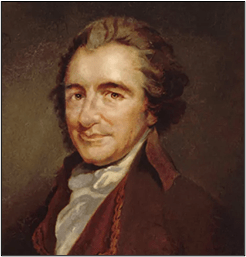
Portrait of Thomas Paine, a key figure in American history known for his influential writings advocating for independence and civil rights.

In the following pages I offer nothing more than simple facts, plain arguments, and common sense…

I have heard it asserted by some, that as America has flourished under her former connection with Great-Britain, the same connection is necessary towards her future happiness, and will always have the same effect. Nothing can be more fallacious than this kind of argument. We may as well assert that because a child has thrived upon milk, that is never to have meat, or that the first twenty years of our lives is to become a precedent for the next twenty. But even this is admitting more than is true; for I answer… that America would have flourished as much, and probably much more, had no European power taken any notice of her. The commerce by which she hath enriched herself are the necessaries of life, and will always have a market while eating is the custom of Europe.

But she has protected us, say some… We have boasted the protection of Great Britain, without considering, that her motive was interest not attachment… This new World hath been the asylum for the persecuted lovers of civil and religious liberty from every part of Europe… As Europe is our market for trade, we ought to form no partial connection with any part of it…

Europe is too thickly planted with Kingdoms to be long at peace, and whenever a war breaks out between England and any foreign power, the trade of America goes to ruin, because of her connection with Britain… There is something absurd, in supposing a Continent to be perpetually governed by an island…

Where, say some, is the king of America? I’ll tell you, Friend, he reigns above, and doth not make havoc of mankind like the royal brute of Great Britain… So far as we approve of monarchy… in America the law is king…

A government of our own is our natural right… Ye that oppose independence now, ye know not what ye do: ye are opening the door to eternal tyranny. . .

  1. How does Paine compare America to a child? How does this compare to the situation of America wanting independence?
  2. Why is Great Britain protecting America, according to Paine?
  3. What happens to America whenever Great Britain is at war? Why?
  4. According to Paine, who is the king of America?
  5. What does Paine say of people who are opposing independence?

Abigail Adams was the wife of revolutionary and second president John Adams. She herself fought for the rights of colonists and advocated for equal rights for women in a time where this was uncommon. In one of her frequent letters to John Adams, she urged him to “remember the ladies” as he was working on the initial draft to the Declaration of Independence. Ultimately, the wording of the Declaration of Independence was exclusionary and women did not receive equal rights until the twentieth century.
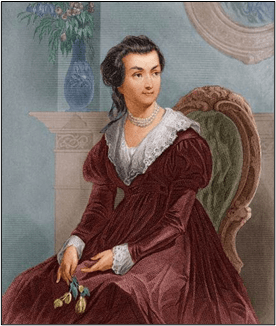
A portrait of a woman seated in an ornate chair, wearing a burgundy dress with a white lace collar, holding a bouquet of flowers, against a backdrop with decorative elements.

Tho we felicitate ourselves, we sympathize with those who are trembling least the Lot of Boston should be theirs. But they cannot be in similar circumstances unless pusillanimity and cowardise should take possession of them. They have time and warning given them to see the Evil and shun it. — I long to hear that you have declared an independancy — and by the way in the new Code of Laws which I suppose it will be necessary for you to make I desire you would Remember the Ladies, and be more generous and favourable to them than your ancestors. Do not put such unlimited power into the hands of the Husbands. Remember all Men would be tyrants if they could. If particular care and attention is not paid to the Ladies, we are determined to foment a Rebellion, and will not hold ourselves bound by any Laws in which we have no voice, or Representation.

That your Sex are Naturally Tyrannical is a Truth so thoroughly established as to admit of no dispute, but such of you as wish to be happy willingly give up the harsh title of Master for the more tender and endearing one of Friend. Why then, not put it out of the power of the vicious and the Lawless to use us with cruelty and indignity with impunity. Men of Sense in all Ages abhor those customs which treat us only as the vassals of your Sex. Regard us then as Beings placed by providence under your protection and in imitation of the Supreme Being make use of that power only for our happiness.

  1. What is Abigail Adams asking of John Adams?
  2. What does Abigail Adams believe of all men?
  3. Why must men pay attention to the ladies, according to Adams?

On July 4, 1776, the most important foundational document in the history of the United States was approved by the Second Continental Congress. The Declaration of Independence, penned by Thomas Jefferson, outlined a formal “declaration” of the 13 colonies as an independent, sovereign state that had broken away from the British Crown and listed various grievances that the new country had against the King. Jefferson scattered the document with political and social ideological thought that would become ingrained principles of American government and society.

A historical painting depicting the signing of the Declaration of Independence, featuring prominent figures in a grand room adorned with an American flag.

“When in the Course of human events, it becomes necessary for one people to dissolve the political bands which have connected them with another, and to assume among the powers of the earth, the separate and equal station to which the Laws of Nature and of Nature’s God entitle them, a decent respect to the opinions of mankind requires that they should declare the causes which impel them to the separation.

We hold these truths to be self-evident, that all men are created equal, that they are endowed by their Creator with certain unalienable Rights, that among these are Life, Liberty and the pursuit of Happiness.–That to secure these rights, Governments are instituted among Men, deriving their just powers from the consent of the governed, –That whenever any Form of Government becomes destructive of these ends, it is the Right of the People to alter or to abolish it, and to institute new Government, laying its foundation on such principles and organizing its powers in such form, as to them shall seem most likely to effect their Safety and Happiness. Prudence, indeed, will dictate that Governments long established should not be changed for light and transient causes; and accordingly all experience hath shewn, that mankind are more disposed to suffer, while evils are sufferable, than to right themselves by abolishing the forms to which they are accustomed. But when a long train of abuses and usurpations, pursuing invariably the same Object evinces a design to reduce them under absolute Despotism, it is their right, it is their duty, to throw off such Government, and to provide new Guards for their future security.–Such has been the patient sufferance of these Colonies; and such is now the necessity which constrains them to alter their former Systems of Government…”

  1. What are the three “unalienable Rights” Thomas Jefferson identifies?
  2. According to Jefferson, what must the people do if a government fails to safeguard these unalienable Rights?
  3. In your opinion, has the U.S. government upheld the message and liberties outlined in the Declaration of Independence. Explain.

Once the United States declared its independence from Great Britain, the nation’s founders needed a stronger, more structured set of laws for government. The initial Articles of Confederation were weak and did structure the government in a way that would be sustainable. Thus, the Constitution was formed after deliberation at the Constitutional Convention. The Preamble serves as the introduction to the Constitution as a whole and establishes the tone and goals for this new budding nation.

A historical painting depicting the signing of the United States Constitution, featuring delegates in formal attire gathered in a large room with decorative details, including a chandelier and an American flag.

“We the People of the United States, in Order to form a more perfect Union, establish Justice, insure domestic Tranquility, provide for the common defense, promote the general Welfare, and secure the Blessings of Liberty to ourselves and our Posterity, do ordain and establish this Constitution for the United States of America.”

  1. What is the importance of the first three words of the Constitution?
  2. List the six goals outlined in the Constitution.
  3. Why was it important for the United States to write the Constitution after the Articles of Confederation?
  4. Select one of the goals of the Constitution. Why do you think the authors believed it was important to include the goal that you chose?

Just a few years after the end of the American Revolution, France was experiencing a revolution of their own. The Third Estate had become overwhelmingly frustrated by the poverty, stagnant economic growth, inept leadership, and poor quality of life they faced while the First and Second Estates lived in luxury and prosperity. The newly formed National Assembly released the Declaration of the Rights of Man in the midst of this violent revolution.
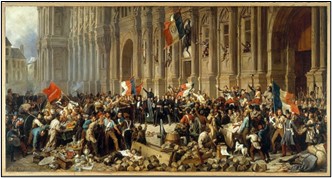
A large crowd gathered in front of a historical building, waving flags and holding banners, as they engage in a passionate display of political support or protest.

“The representatives of the French people, organized as a National Assembly, believing that the ignorance, neglect, or contempt of the rights of man are the sole cause of public calamities and of the corruption of governments, have determined to set forth in a solemn declaration the natural, unalienable, and sacred rights of man, in order that this declaration, being constantly before all the members of the Social body, shall remind them continually of their rights and duties…Therefore the National Assembly recognizes and proclaims, in the presence and under the auspices of the Supreme Being, the following rights of man and of the citizen:

1. Men are born and remain free and equal in rights. Social distinctions may be founded only upon the general good.

2. The aim of all political association is the preservation of the natural and imprescriptible rights of man. These rights are liberty, property, and security, and resistance to oppression.

3. The principle of all sovereignty resides essentially in the nation. No body nor individual may exercise any authority which does not proceed directly from the nation.

…7. No personal shall be accused, arrested, or imprisoned except in the cases and according to the forms prescribed by law. Any one soliciting, transmitting, executing, or causing to be executed, any arbitrary order, shall be punished.

…9. As all persons are held innocent until they have been declared guilty…

10. No one shall be disquieted on account of his opinions, including his religious views, provided their manifestation does not disturb the public order established by law.

11. The free communication of ideas and opinions is one of the most precious of the rights…

  1. According to the preamble, what is the purpose of this declaration?
  2. In the context of the French Revolution, why is the wording of “equal in rights” significant?
  3. Discuss the extent in which this declaration compares to the Declaration of Independence?
  4. How do the two declarations define the rights guaranteed to all men?

While serving as Secretary of State under President James Monroe, John Quincy Adams was invited to Congress to give a speech to commemorate the 45th anniversary of the Declaration of Independence. Adams spends much of this speech praising the Declaration and commending the Founding Fathers’ bravery and triumph over the British Crown in establishing the new nation. This speech has become synonymous with the idea of “American exceptionalism.”
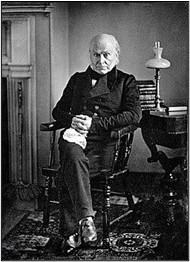
Portrait of a seated elderly man with gray hair, dressed in formal attire, sitting in a wooden chair with hands clasped, set in a domestic interior with a lamp and a patterned rug.

“…In the long conflict of twelve years which had preceded and led to the Declaration of Independence, our fathers had been not less faithful to their duties, than tenacious of their rights. Their resistance had not been rebellion. It was not a restive and ungovernable spirit of ambition, bursting from the bonds of colonial subjection; it was the deep and wounded sense of successive wrongs, upon which complaint had been only answered by aggravation, and petition repelled with contumely, which had driven them to their last stand upon the adamantine rock of human rights.

            …It was the first solemn declaration by a nation of the only legitimate foundation of civil government. It was the cornerstone of a new fabric, destined to cover the surface of the globe. It demolished at a stroke the lawfulness of all governments founded upon conquest. It swept away all the rubbish of accumulated centuries of servitude.

            …It will be acted o’er [over], fellow-citizens, but it can never be repeated. It stands, and must forever stand alone, a beacon on the summit of the mountain, to which all the inhabitants of the earth may turn their eyes for a genial and saving light, till time shall be lost in eternity, and this globe itself dissolve, nor leave a wreck behind. It stands forever, a light of admonition to the rulers of men; a light of salvation and redemption to the oppressed…so long shall this declaration hold out to the sovereign and to the subject the extent and the boundaries of their respective rights and duties; founded in the laws of nature and of nature’s God. Five and forty years have passed away since this Declaration was issued by our fathers; and here are we, fellow-citizens, assembled in the full enjoyment of its fruits.”

  1. What does John Quincy Adams say the Declaration of Independence was the “first” declaration to do?
  2. Why does Adams call the American Revolution a “resistance,” not a “rebellion?”
  3. Why does Adams call the Declaration a “beacon on the summit of the mountain?”
  4. Do you agree with Adams’ perspective of the revolution and the Declaration? Explain.

As the nation crept closer to an impending Civil War, American politics became engulfed over the issue of slavery. One of the leading voices of the pro-slavery movement was South Carolina Democrat senator John C. Calhoun. After serving as Andrew Jackson’s vice president, he ended his career in the Senate. There, he was one of the Democratic Party’s most outspoken supporters for “states’ rights” to defend and uphold slavery within its borders. This speech was in response to the Oregon Bill, which was set to outlaw slavery practices in the new Oregon territory.

A historical black and white portrait of a man with long hair, dressed in a dark suit and vest, seated with hands clasped together.

“The proposition to which I allude, has become an axiom in the minds of a vast majority on both sides of the Atlantic, and is repeated daily from tongue to tongue, as an established and incontrovertible truth; it is, that “all men are born free and equal.” I am not afraid to attack error, however deeply it may be entrenched, or however widely extended, whenever it becomes my duty to do so, as I believe it to be on this subject and occasion.

            Taking the proposition literally (it is in that sense it is understood), there is not a word of truth in it. It begins with “all men are born,” which is utterly untrue. Men are not born. Infants are born. They grow to be men. And concludes with asserting that they are born “free and equal,” which is not less false. They are not born free. While infants they are incapable of freedom, being destitute alike of the capacity of thinking and acting, without which there can be no freedom. Besides, they are necessarily born subject to their parents, and remain so among all people, savage and civilized, until the development of their intellect and physical capacity enables them to take care of themselves…

If we trace it back, we shall find the proposition differently expressed in the Declaration of Independence. That asserts that “all men are created equal.” The form of expression, though less dangerous, is not less erroneous…

… [G]overnment has no right to control individual liberty beyond what is necessary to the safety and well-being of society. Such is the boundary which separates the power of government and the liberty of the citizen or subject in the political state, which, as I have shown, is the natural state of man—the only one in which his race can exist, and the one in which he is born, lives, and dies.”

  1. What does Senator Calhoun say about the phrase “all men are created equal?”
  2. According to Calhoun, how should the government’s role be limited?
  3. What is the connection that Senator Calhoun makes between liberty and race? What does this mean about his message in this speech?

At the Women’s Rights Convention in 1848, 68 women and 32 men signed the “Declaration of Sentiments”, which was essentially a Bill of Rights for women. The document called for equal social, civil, and political liberties for women, which included the right to vote, equal education opportunities, and more legal protections. Elizabeth Cady Stanton served as the primary author as well as Lucretia Mott and Martha Coffin Wright. The Declaration of Sentiments was modeled after the Declaration of Independence, which was written just 72 years prior.
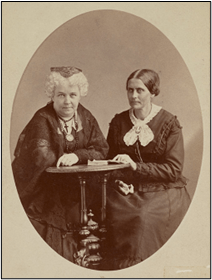
Two women in 19th century attire seated together at a table, with a decorative backdrop.

“We hold these truths to be self-evident; that all men and women are created equal; that they are endowed by their Creator with certain inalienable rights; that among these are life, liberty, and the pursuit of happiness; that to secure these rights governments are instituted, deriving their just powers from the consent of the governed. […]

“The history of mankind is a history of repeated injuries and usurpations on the part of man toward woman, having in direct object the establishment of an absolute tyranny over her. To prove this, let facts be submitted to a candid world. He has never permitted her to exercise her inalienable right to the elective franchise. He has compelled her to submit to laws, in the formation of which she had no voice. He has withheld from her rights which are given to the most ignorant and degraded men – both natives and foreigners. Having deprived her of this first right as a citizen, the elective franchise, thereby leaving her without representation in the halls of legislation, he has oppressed her on all sides. He has made her, if married, in the eye of the law, civilly dead. He has taken from her all right in property, even to the wages she earns. […]

“Now, in view of this entire disfranchisement of one-half the people of this country, their social and religious degradation, – in view of the unjust laws above mentioned, and because women do feel themselves aggrieved, oppressed, and fraudulently deprived of their most sacred rights, we insist that they have immediate admission to all the rights and privileges which belong to them as citizens of these United States.”

  1. What other document is the introduction to the Declaration of Sentiments modeled after?
  2. What is the purpose of this excerpt of the Declaration of Sentiments?
  3. List two of the grievances that the authors included.
  4. Do you believe that this declaration is convincing enough to help women gain equal rights? What would you change if anything?

Frederick Douglass was born into slavery in Maryland in 1818. He escaped slavery in 1838 and used his tutoring of the English language to become a renowned orator and writer. He used the strength of his words to call for the abolition of slavery and worked to ensure freedom for all enslaved people. This speech was written to encourage people to think about what the Fourth of July means for those in America who are not free and who do not experience the same rights and opportunities as their White counterparts.

A historical portrait of Frederick Douglass, a prominent abolitionist and social reformer, seated with an earnest expression, showcasing his distinctive hairstyle and 19th-century attire.

“This, for the purpose of this celebration, is the 4th of July. It is the birthday of your National Independence, and of your political freedom . . . There is consolation in the thought that America is young […] The simple story of it is, that, 76 years ago, the people of this country were British subjects . . . You were under the British Crown . . . But, your fathers . . . They went so far in their excitement as to pronounce the measures of government unjust, unreasonable, and oppressive, and altogether such as ought not to be quietly submitted to […] Citizens, your fathers made good that resolution. They succeeded; and to-­‐day you reap the fruits of their success. The freedom gained is yours; and you, therefore, may properly celebrate this anniversary. The 4th of July is the first great fact in your nation’s history—the very ring-­‐bolt in the chain of your yet undeveloped destiny.

“What, to the American slave, is your 4th of July? I answer: a day that reveals to him, more than all other days in the year, the gross injustice and cruelty to which he is the constant victim. To him, your celebration is a sham; your boasted liberty, an unholy license; your national greatness, swelling vanity; your sounds of rejoicing are empty and heartless; your denunciations of tyrants, brass fronted impudence; your shouts of liberty and equality, hollow mockery; your prayers and hymns, your sermons and thanksgivings, with all your religious parade, and solemnity, are, to him, mere bombast, fraud, deception, impiety, and hypocrisy—a thin veil to cover up crimes which would disgrace a nation of savages. There is not a nation on the earth guilty of practices, more shocking and bloody, than are the people of these United States, at this very hour. Go where you may, search where you will, roam through all the monarchies and despotisms of the old world, travel through South America, search out every abuse, and when you have found the last, lay your facts by the side of the every day practices of this nation, and you will say with me, that, for revolting barbarity and shameless hypocrisy, America reigns without a rival […]

“Allow me to say, in conclusion . . . I do not despair of this country. There are forces in operation, which must inevitably, work the downfall of slavery. “The arm of the Lord is not shortened,” and the doom of slavery is certain. I, therefore, leave off where I began, with hope.”

  1. What words does Douglass use that show he does not align with free Americans?
  2. How is the fourth of July different for enslaved people and free people? Use one example from the text.
  3. How does Douglass conclude his speech? Why do you think he feels this way?

Between July 1 and 3, 1863, the bloodiest battle of the Civil War took place in Gettysburg, Pennsylvania. Both the Union and Confederacy faced catastrophic losses, with casualties totaling over 50,000 men. The Battle of Gettysburg remains the deadliest battle of American history. Four months later, President Abraham Lincoln arrived at Gettysburg to declare the battlefield as a national cemetery. Many in the crowd were anticipating a long speech from President Lincoln, however this famous address only lasted about 3 minutes. Nevertheless, the Gettysburg Address would become enshrined as one of Lincoln’s, and U.S. history’s, most powerful speeches.

Black and white portrait of a man with a beard and a bow tie, looking directly at the camera.

“Four score and seven years ago our fathers brought forth on this continent, a new nation, conceived in Liberty, and dedicated to the proposition that all men are created equal.

Now we are engaged in a great civil war, testing whether that nation, or any nation so conceived and so dedicated, can long endure. We are met on a great battle-field of that war. We have come to dedicate a portion of that field, as a final resting place for those who here gave their lives that that nation might live. It is altogether fitting and proper that we should do this.

…But, in a larger sense, we can not dedicate–we can not consecrate–we can not hallow–this ground. The brave men, living and dead, who struggled here, have consecrated it, far above our poor power to add or detract. The world will little note, nor long remember what we say here, but it can never forget what they did here. It is for us the living, rather, to be dedicated here to the unfinished work which they who fought here have thus far so nobly advanced. It is rather for us to be here dedicated to the great task remaining before us–that from these honored dead we take increased devotion to that cause for which they gave the last full measure of devotion–that we here highly resolve that these dead shall not have died in vain–that this nation, under God, shall have a new birth of freedom–and that government of the people, by the people, for the people, shall not perish from the earth.”

  1. According to Lincoln, what is the “proposition” that the nation was founded on?
  2. What is this civil war “testing?”
  3. What is Lincoln’s tone throughout the speech? Use at least two pieces of textual evidence to support your response.
  4. How does President Lincoln use ideas from the Declaration of Independence in this speech? To what extent is it effective? Use at least two pieces of textual evidence to support your response.

The Thirteenth Amendment to the Constitution abolished slavery and involuntary servitude in the United States. Slavery had been an institution in the United States since the first ship holding enslaved people arrived from the shores of Africa in 1619. Prior to the entire United States abolishing slavery, some states had already dismantled the system of slavery. Many became champions for the abolition of slavery and helped enslaved people escape to freedom. The amendment was ratified in December 1865 after being passed by Congress in January 1865. The Thirteenth Amendment serves as the first of the three Reconstruction Amendments. While it ended legal slavery, Southern states later used the “punishment for crime” clause to create “Black Codes”, which prevented Black people from voting and limited their rights.
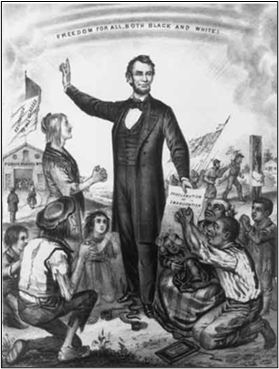
An 1860s political cartoon depicting Abraham Lincoln addressing a group of people, including both Black and white individuals, with a banner stating 'Freedom for all, both Black and White.'

“Section 1

Neither slavery nor involuntary servitude, except as a punishment for crime whereof the party shall have been duly convicted, shall exist within the United States, or any place subject to their jurisdiction.

“Section 2

Congress shall have power to enforce this article by appropriate legislation.”

1. What did the thirteenth amendment accomplish?

2. Where is involuntary servitude still legal?

3. Who has the power to enforce the thirteenth amendment?

4. Do you believe that it is justified for involuntary servitude to be used for criminal offenders? Why or why not?

The New Colossus – Emma Lazarus, 1883

Emma Lazarus was an American poet who wrote the poem “The New Colossus” in 1883. When writing this sonnet, she was inspired by the Statue of Liberty and what the statue represents. In 1903, this poem was engraved onto a bronze plaque and is now on the base of the Statue of Liberty in New York.

Image of the Statue of Liberty against a backdrop of the New York City skyline.

Not like the brazen giant of Greek fame,

With conquering limbs astride from land to land;

Here at our sea-washed, sunset gates shall stand

A mighty woman with a torch, whose flame

Is the imprisoned lightning, and her name

Mother of Exiles. From her beacon-hand

Glows world-wide welcome; her mild eyes command

The air-bridged harbor that twin cities frame.

“Keep, ancient lands, your storied pomp!” cries she

With silent lips. “Give me your tired, your poor,

Your huddled masses yearning to breathe free,

The wretched refuse of your teeming shore.

Send these, the homeless, tempest-tost to me,

I lift my lamp beside the golden door!”

  1. How does Emma Lazarus describe the Statue of Liberty in the poem? Use one line from the text that supports your answer.
  2. What group of people might lines 10-14 be referring to? How do you know?
  3. Why is it appropriate that Emma Lazarus’s poem “The New Colossus” appears on the base of the Statue of Liberty?

Eugene V. Debs was one of the nation’s leading critics of big business and corporations. He was an adamant socialist and sought to educate workers to unionize to combat malicious business practices by their employers. In 1893, there was a massive strike organized against the Pullman Sleeping Car Company. Debs helped organize a boycott with the American Railway Union. President Grover Cleveland had sent the U.S. military to handle the strike, and Debs was later arrested for federal contempt and conspiracy charges.
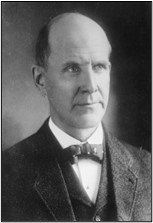
A black and white portrait of a man wearing a suit and bowtie, looking directly at the camera.

            “Manifestly the spirit of ‘76 still survives. The fires of liberty and noble aspirations are not yet extinguished. I greet you tonight as lovers of liberty and as despisers of despotism. I comprehend the significance of this demonstration and appreciate the honor that makes it possible for me to be your guest on such an occasion. The vindication and glorification of American principles of government, as proclaimed to the world in the Declaration of Independence, is the high purpose of this convocation.

            Speaking for myself personally I am not certain whether this is an occasion for rejoicing or lamentation. I confess to a serious doubt as to whether this day marks my deliverance from bondage to freedom or my doom from freedom to bondage…It is not law nor the administration of law of which I complain. It is the flagrant violation of the Constitution, the total abrogation of law and the usurpation of judicial and despotic power, by virtue of which my colleagues and myself were committed to jail, against which I enter my solemn protest; and any honest analysis of the proceedings must sustain the haggard truth of the indictment.

            In a letter recently written by the venerable Judge Trumbull that eminent jurist says: “The doctrine announced by the Supreme Court in the Debs case, carried to its logical conclusion, places every citizen at the mercy of any prejudiced or malicious federal judge who may think proper to imprison him.”. .

            The theme tonight is personal liberty; or giving it its full height, depth, and breadth, American liberty, something that Americans have been accustomed to eulogize since the foundation of the Republic, and multiplied thousands of them continue in the habit to this day because they do not recognize the truth that in the imprisonment of one man in defiance of all constitutional guarantees, the liberties of all are invaded and placed in peril.

  1. What ideas is Debs referencing when he says “the spirit of ‘76 still survives?”
  2. What rights does Debs claim the government has taken away from him and/or denied?
  3. Do you agree with Debs’ analysis of the situation he faced during the Pullman Strike? Explain your answer using evidence from the speech.

From the founding of the United States, women have been championing for equal rights and the ability to vote. From Abigail Adams calling for John Adams to “remember the ladies” to the suffragettes of the nineteenth and twentieth centuries, women and their allies had been calling for equal opportunities since America’s inception. In 1920, the nineteenth amendment was ratified and women were guaranteed the right to vote.

Historical photograph of a women's suffrage march, featuring women holding signs that advocate for the right to vote.

“The right of citizens of the United States to vote shall not be denied or abridged by the United States or by any State on account of sex.

“Congress shall have power to enforce this article by appropriate legislation.”

Questions:

  1. What did the nineteenth amendment accomplish?
  2. Who holds the power to enforce this amendment?

Do you think that any women were prevented from voting following the 19th amendment? Who? Why?

As World War II engulfed Europe, President Roosevelt and the U.S. government navigated the tightrope of effective foreign policy. The United States had long held a strong position of isolationism, and many Americans were firmly opposed to any involvement in Europe’s second world war. However, the U.S. government had shifted away from its isolationism by the end of the 1930s. FDR’s State of the Union address in 1941 echoed a new dawn of American interventionism, as he outlined the four freedoms everybody in the world was entitled to.

A formal portrait of Franklin D. Roosevelt, the 32nd President of the United States, smiling and dressed in a suit with a tie, set against a plain background.

“Since the permanent formation of our Government under the Constitution, in 1789, most of the periods of crisis in our history have related to our domestic affairs. Fortunately, only one of these–the four year War Between the States–ever threatened our national unity. Today, thank God, one hundred and thirty million Americans, in forty-eight States, have forgotten points of compass in our national unity.

            …In like fashion from 1815 to 1914–ninety-nine years–no single war in Europe or in Asia constituted a real threat against our future or against the future of any other American nationf…In the future days, which we seek to make secure, we look forward to a world founded upon four essential human freedoms.

            The first is freedom of speech and expression–everywhere in the world.

            The second is freedom of every person to worship God in his own way–everywhere in the world.

            The third is freedom from want–which, translated into world terms, means economic understandings which will secure to every nation a healthy peacetime life for its inhabitants–everywhere in the world.

            The fourth is freedom from fear–which, translated into world terms, means a world-wide reduction of armaments to such a point in such a thorough fashion that no nation will be in a position to commit an act of physical aggression against any neighbor–anywhere in the world.

            That is no vision of a distant millennium. It is a definite basis for a kind of world attainable in our own time and generation. That kind of world is the very anthesis of the so-called new order of tyranny which the dictators seek to create with the crash of a bomb.”

  1. What does FDR say has been the reason for (most) periods of crisis in U.S. history? Why is the current situation in Europe (World War II) different?
  2. What are the four freedoms FDR lists in this speech?
  3. In your opinion, do people “everywhere in the world” experience the four freedoms today? Explain your answer.

Eleanor Roosevelt was the first lady of the United States from 1933-1945 while her husband, Franklin D. Roosevelt, was president. She redefined the role by speaking out often and calling attention to important social issues. Her speech “The Struggle for Human Rights” was given at the United Nations, to which she served as a delegate to its General Assembly, where she served as chair of the commission that drafted the Universal Declaration of Human Rights.

Eleanor Roosevelt holding the Universal Declaration of Human Rights document during a presentation.

We must not be confused about what freedom is. Basic human rights are simple and easily understood: freedom of speech and a free press; freedom of religion and worship; freedom of assembly and the right of petition; the right of men to be secure in their homes and free from unreasonable search and seizure and from arbitrary arrest and punishment. We must not be deluded by the efforts of the forces of reaction to prostitute the great words of our free tradition and thereby to confuse the struggle. Democracy, freedom, human rights have come to have a definite meaning to the people of the world which we must not allow any nation to so change that they are made synonymous with suppression and dictatorship…

The basic problem confronting the world today, as I said in the beginning, is the preservation of human freedom for the individual and consequently for the society of which he is a part. We are fighting this battle again today as it was fought at the time of the French Revolution and at the time of the American Revolution. The issue of human liberty is as decisive now as it was then. I want to give you my conception of what is meant in my country by freedom of the individual…

            Indeed, in our democracies we make our freedoms secure because each of us is expected to respect the rights of others and we are free to make our own laws…

​             Basic decisions of our society are made through the expressed will of the people. That is why when we see these liberties threatened, instead of falling apart, our nation becomes unified and our democracies come together as a unified group in spite of our varied backgrounds and many racial strains…

            It is my belief, and I am sure it is also yours, that the struggle for democracy and freedom is a critical struggle, for their preservation is essential to the great objective of the United Nations to maintain international peace and security…

            The future must see the broadening of human rights throughout the world. People who have glimpsed freedom will never be content until they have secured it for themselves. In a true sense, human rights are a fundamental object of law and government in a just society. Human rights exist to the degree that they are respected by people in relations with each other and by governments in relations with their citizens.

  1. What are the basic human rights that Eleanor Roosevelt claims are “simple and easily understood”?
  2. What does Roosevelt say makes freedom secure?
  3. In your opinion, why are freedom and democracy essential for all people?

Following the end of World War II, the victorious European powers and the United States created a new global organization to govern international affairs. The United Nations was created to replace the failed League of Nations, and serve as the leading world institution to maintain peace, protect human rights, and prevent future wars and conflict. One of the first declarations of the United Nations was the Universal Declaration of Human Rights (UDHR). Below are Articles 1 through 7 of the UDHR.

United Nations emblem featuring a world map encircled by olive branches on a blue background.

Article 1

All human beings are born free and equal in dignity and rights. They are endowed with reason and conscience and should act towards one another in a spirit of brotherhood.

Article 2

Everyone is entitled to all the rights and freedoms set forth in this Declaration, without distinction of any kind, such as race, colour, sex, language, religion, political or other opinion, national or social origin, property, birth or other status. Furthermore, no distinction shall be made on the basis of the political, jurisdictional or international status of the country or territory to which a person belongs, whether it be independent, trust, non-self-governing or under any other limitation of sovereignty.

Article 3

Everyone has the right to life, liberty and the security of person.

Article 4

No one shall be held in slavery or servitude; slavery and the slave trade shall be prohibited in all their forms.

Article 5

No one shall be subjected to torture or to cruel, inhuman or degrading treatment or punishment.

Article 6

Everyone has the right to recognition everywhere as a person before the law.

Article 7

All are equal before the law and are entitled without any discrimination to equal protection of the law. All are entitled to equal protection against any discrimination in violation of this Declaration and against any incitement to such discrimination.

Questions:

  1. Identify three (3) rights that are guaranteed by the UDHR.
  2. According to Article 2, what kinds of “distinctions” are prohibited from deny people their rights?
  3. Which phrases of ideas in the UDHR connect to the Declaration of Independence?
  4. How does the UDHR expand on the phrase “all men are created equal?”
  5. In your opinion, does the world today uphold these human rights? Explain.

In June 1950, in the midst of an anti-communist campaign identified with Senator Joseph McCarthy (R-Wisconsin), Senator Margaret Chase Smith (R-Maine) spoke out against “selfish political exploitation” targeting innocent people and threatening basic American rights.

Political cartoon depicting Senator Margaret Chase Smith confronting smear tactics used during the anti-communist campaign.

“I would like to speak briefly and simply about a serious national condition. It is a national feeling of fear and frustration that could result in national suicide and the end of everything that we Americans hold dear. It is a condition that comes from the lack of effective leadership either in the legislative branch or the executive branch of our government. … I speak as a Republican. I speak as a woman. I speak as a United States senator. I speak as an American. …  I think that it is high time for the United States Senate and its members to do some real soul searching and to weigh our consciences as to the manner in which we are performing our duty to the people of America and the manner in which we are using or abusing our individual powers and privileges.   I think that it is high time that we remembered that we have sworn to uphold and defend the Constitution. I think that it is high time that we remembered that the Constitution, as amended, speaks not only of the freedom of speech, but also of trial by jury instead of trial by accusation.”

Whether it be a criminal prosecution in court or a character prosecution in the Senate, there is little practical distinction when the life of a person has been ruined.

Those of us who shout the loudest about Americanism in making character assassinations are all too frequently those who, by our own words and acts, ignore some of the basic principles of Americanism –

The right to criticize.

The right to hold unpopular beliefs.

The right to protest.

The right of independent thought.

The exercise of these rights should not cost one single American citizen his reputation or his right to a livelihood nor should he be in danger of losing his reputation or livelihood merely because he happens to know someone who holds unpopular beliefs. Who of us does not? Otherwise none of us could call our souls our own. Otherwise thought control would have set in.

The American people are sick and tired of being afraid to speak their minds lest they be politically smeared as “Communists” or “Fascists” by their opponents. Freedom of speech is not what it used to be in America. It has been so abused by some that it is not exercised by others. The American people are sick and tired of seeing innocent people smeared and guilty people whitewashed.”

1. What is the national feeling identified by Senator Smith?

2. What does she want American leaders to do?

3. What basic rights does Senator Smith believe are threatened?

4. In your opinion, why did Senator Smith focus on “The Basic Principles of Americanism”?

On January 17, 1961, President Eisenhower delivered a ten-minute farewell to the American people on national television from the Oval Office of the White House. In the speech, Eisenhower warned that a large, permanent “military-industrial complex,” an alliance between the military and defense contractors, posed a threat to American democracy. 
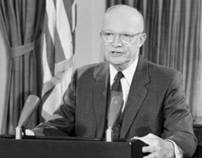
Black and white photograph of President Dwight D. Eisenhower delivering a speech from the Oval Office, with microphones in front and the U.S. flag in the background.

“We now stand ten years past the midpoint of a century that has witnessed four major wars among great nations. Three of these involved our own country. Despite these holocausts America is today the strongest, the most influential and most productive nation in the world. Understandably proud of this pre-eminence, we yet realize that America’s leadership and prestige depend, not merely upon our unmatched material progress, riches and military strength, but on how we use our power in the interests of world peace and human betterment.”

Throughout America’s adventure in free government, our basic purposes have been to keep the peace; to foster progress in human achievement, and to enhance liberty, dignity and integrity among people and among nations. To strive for less would be unworthy of a free and religious people. Any failure traceable to arrogance, or our lack of comprehension or readiness to sacrifice would inflict upon us grievous hurt both at home and abroad.

A vital element in keeping the peace is our military establishment. Our arms must be mighty, ready for instant action, so that no potential aggressor may be tempted to risk his own destruction. … Until the latest of our world conflicts, the United States had no armaments industry. American makers of plowshares could, with time and as required, make swords as well. But now we can no longer risk emergency improvisation of national defense; we have been compelled to create a permanent armaments industry of vast proportions. Added to this, three and a half million men and women are directly engaged in the defense establishment. We annually spend on military security more than the net income of all United State corporations. … This conjunction of an immense military establishment and a large arms industry is new in the American experience. The total influence – economic, political, even spiritual – is felt in every city, every state house, every office of the Federal government. We recognize the imperative need for this development. Yet we must not fail to comprehend its grave implications. Our toil, resources and livelihood are all involved; so is the very structure of our society.

In the councils of government, we must guard against the acquisition of unwarranted influence, whether sought or unsought, by the military-industrial complex. The potential for the disastrous rise of misplaced power exists and will persist. We must never let the weight of this combination endanger our liberties or democratic processes. We should take nothing for granted.”

1. According to President Eisenhower, why does the United States need to maintain a strong military?

2. Why is President Eisenhower concerned about a “military-industrial complex”?

3. What does President Eisenhower alert the American people to do?

Five years prior, the Soviet Union had successfully launched Sputnik 1 into orbit, sparking the beginning of the Space Race between the U.S. and U.S.S.R. The United States quickly sought to catch up to the Soviet Union’s many “firsts” in the Space Race (first satellite, first man in space, first man to orbit the Earth, etc.). Then, in September 1962, President Kennedy gave a speech at Rice University discussing the new goal for America’s space program: put a man on the Moon before the end of the decade.

President John F. Kennedy delivering a speech at Rice University, discussing the United States' commitment to space exploration.

“…We set sail on this new sea because there is new knowledge to be gained, and new rights to be won, and they must be won and used for the progress of all people. For space science, like nuclear science and all technology, has no conscience of its own. Whether it will become a force for good or ill depends on man, and only if the United States occupies a position of pre-eminence can we help decide whether this new ocean will be a sea of peace or a new terrifying theater of war. I do not say the we should or will go unprotected against the hostile misuse of space any more than we go unprotected against the hostile use of land or sea, but I do say that space can be explored and mastered without feeding the fires of war, without repeating the mistakes that man has made in extending his writ around this globe of ours.

NASA Apollo program logo featuring the letter A with a depiction of Earth and the Moon.

There is no strife, no prejudice, no national conflict in outer space as yet. Its hazards are hostile to us all. Its conquest deserves the best of all mankind, and its opportunity for peaceful cooperation may never come again. But why, some say, the moon? Why choose this as our goal? And they may well ask why climb the highest mountain? Why, 35 years ago, fly the Atlantic? Why does Rice play Texas?

We choose to go to the moon. We choose to go to the moon in this decade and do the other things, not because they are easy, but because they are hard, because that goal will serve to organize and measure the best of our energies and and skills, because that challenge is one that we are willing to accept, one we are unwilling to postpone, and one which we intend to win, and the others, too.”

  1. Why does President Kennedy say it is important to “set sail on this new sea?”
  2. What justification does President Kennedy give that the United States should be the first nation to conquer space?
  3. How does Kennedy’s vision for space reflect the ideals in the founding documents?

On August 28, 1963, in the midst of the Civil Rights Movement, civil rights leaders and organizations planned a momentous rally in Washington, D. C. Officially known as the March on Washington for Jobs and Freedom, over 200,000 people gathered to protest and advocate for the end of segregation and guarantee of civil rights for African Americans. At the end of the march, at the Lincoln Memorial, Dr. Martin Luther King, Jr., one of the Civil Rights Movement’s most influential leaders, delivered his most famous speech.

Dr. Martin Luther King Jr. delivering his 'I Have a Dream' speech at the March on Washington, with a large crowd in attendance.

“…It would be fatal for the nation to overlook the urgency of the moment. This sweltering summer of the Negro’s legitimate discontent will not pass until there is an invigorating autumn of freedom and equality. 1963 is not an end, but a beginning. Those who hope that the Negro needed to blow off steam and will now be content will have a rude awakening if the nation returns to business as usual…

            …We cannot be satisfied as long as the Negro’s basic mobility is from a smaller ghetto to a larger one. We can never be satisfied as long as our children are stripped of their selfhood and robbed of their dignity by signs stating: for whites only…

            …So even though we face the difficulties of today and tomorrow, I still have a dream. It is a dream deeply rooted in the American dream. I have a dream that one day this nation will rise up and live out the true meaning of its creed: We hold these truths to be self-evident, that all men are created equal.

            I have a dream that one day on the red hills of Georgia, the sons of former slaves and the sons of former slave owners will be able to sit down together at the table of brotherhood.

I have a dream that one day even the state of Mississippi, a state sweltering with the heat of injustice, sweltering with the heat of oppression will be transformed into an oasis of freedom and justice. I have a dream that my four little children will one day live in a nation where they will not be judged by the color of their skin but by the content of their character. I have a dream today.”

  1. How does Dr. King describe the current situation of African Americans in 1963?
  2. Why does Dr. King call 1963 “not an end, but a beginning?”
  3. What founding document does Dr. King reference in this speech? Why does he reference this document?
  4. In your opinion, has the “dream” described in this speech been achieved? Explain.

On July 2, 1964, President Lyndon B. Johnson signed the Civil Rights Act of 1964 into law. This act called for desegregation of public spaces, schools, and made voting free and fair for all. This was the most sweeping civil rights legislation since Reconstruction. The act made segregation illegal but it also created the Equal Employment Opportunity Commission (EEOC) to enforce laws that prohibit discrimination based on race, color, religion, sex, national origin, disability, or age in hiring, promoting, firing, setting wages, testing, training, apprenticeship, and all other terms and conditions of employment.

A historic moment capturing President Lyndon B. Johnson and Dr. Martin Luther King Jr. engaged in a conversation, with other attendees in the background, symbolizing the partnership in the Civil Rights Movement.

To enforce the constitutional right to vote, to confer jurisdiction upon the district courts of the United States to provide injunctive relief against discrimination in public accommodations, to authorize the Attorney General to institute suits to protect constitutional rights in public facilities and public education, to extend the Commission on Civil Rights, to prevent discrimination in federally assisted programs, to establish a Commission on Equal Employment Opportunity, and for other purposes. Be it enacted by the Senate and House of Representatives of the United States of America in Congress assembled, That this Act may be cited as the “Civil Rights Act of 1964”.

TITLE I: No person acting under color of law shall … apply any standard, practice, or procedure different from the standards, practices, or procedures applied under such law or laws to other individuals within the same county, parish, or similar political subdivision who have been found by State officials to be qualified to vote; deny the right of any individual to vote in any Federal election because of an error or omission on any record or paper relating to any application, registration, or other act requisite to voting … employ any literacy test as a qualification for voting in any Federal election unless (i) such test is administered to each individual and is conducted wholly in writing…

TITLE II: All persons shall be entitled to the full and equal enjoyment of the goods, services, facilities, and privileges, advantages, and accommodations of any place of public accommodation, as defined in this section, without discrimination or segregation on the ground of race, color, religion, or national origin.

            All persons shall be entitled to be free, at any establishment or place, from discrimination or segregation of any kind on the ground of race, color, religion, or national origin, if such discrimination or segregation is or purports to be required by any law, statute, ordinance, regulation, rule, or order of a State or any agency or political subdivision thereof…

  1. What era of history led to the Civil Rights Act of 1964?
  2. What does Title I of the Civil Rights Act pertain to?
  3. What caused Title I to be necessary?
  4. What is the goal of Title II?
  5. Why do you believe that the Civil Rights Act was essential?

On August 9, 1974, President Richard Nixon had resigned from the presidency following the disastrous Watergate scandal. Gerald Ford, Nixon’s vice president, assumed the office immediately and pardoned Nixon one month later. The entire Watergate scandal and Nixon’s resignation created great disdain against the U.S. government. Many Americans became extremely untrustworthy of elected officials and had little faith in the government. Becoming President during the bicentennial of the U.S., Ford dealt with difficult challenges both domestically and abroad.
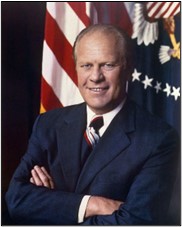
Portrait of Gerald Ford, the 38th President of the United States.

“The Declaration is the Polaris of our political order–the fixed star of freedom. It is impervious to change because it states moral truths that are eternal.

The Constitution provides for its own changes having equal force with the original articles. It began to change soon after it was ratified, when the Bill of Rights was added. We have since amended it 16 times more, and before we celebrate our 300th birthday, there will be more changes…

Jefferson’s principles are very much present. The Constitution, when it is done, will translate the great ideals of the Declaration into a legal mechanism for effective government where the unalienable rights of individual Americans are secure. In grade school we were taught to memorize the first and last parts of the Declaration. Nowadays, even many scholars skip over the long recitation of alleged abuses by King George III and his misguided ministers. But occasionally we ought to read them, because the injuries and invasions of individual rights listed there are the very excesses of government power which the Constitution, the Bill of Rights, and subsequent amendments were designed to prevent…

But the source of all unalienable rights, the proper purposes for which governments are instituted among men, and the reasons why free people should consent to an equitable ordering of their God-given freedom have never been better stated than by Jefferson in our Declaration of Independence. Life, liberty, and the pursuit of happiness are cited as being among the most precious endowments of the Creator–but not the only ones.”

  1. What role does President Ford say the Constitution has in relation to the Declaration?
  2. Why does President Ford say it is important to read the grievances listed against King George III in the Declaration?
  3. Do you agree with President Ford that the Declaration is unchanging while the Constitution changes over time? Explain your answer.

This poem was read at the inauguration of President Joseph Biden in 2021 by its author, Amanda Gorman. She is a poet, activist, and author who wrote this poem for the inauguration under the theme of “America United”.

Amanda Gorman delivers a poem during the inauguration of President Joe Biden, wearing a yellow coat and red headband, with an audience in the background.

…We, the successors of a country and a time where a skinny black girl descended from slaves and raised by a single mother can dream of becoming president only to find herself reciting for one. And, yes, we are far from polished, far from pristine, but that doesn’t mean we are striving to form a union that is perfect, we are striving to forge a union with purpose, to compose a country committed to all cultures, colors, characters and conditions of man.

So we lift our gazes not to what stands between us, but what stands before us. We close the divide because we know to put our future first, we must first put our differences aside. We lay down our arms so we can reach out our arms to one another, we seek harm to none and harmony for all…

That is the promise to glade, the hill we climb if only we dare it because being American is more than a pride we inherit, it’s the past we step into and how we repair it. We’ve seen a force that would shatter our nation rather than share it. That would destroy our country if it meant delaying democracy, and this effort very nearly succeeded. But while democracy can periodically be delayed, but it can never be permanently defeated.

In this truth, in this faith, we trust, for while we have our eyes on the future, history has its eyes on us, this is the era of just redemption we feared in its inception we did not feel prepared to be the heirs of such a terrifying hour but within it we found the power to author a new chapter, to offer hope and laughter to ourselves, so while once we asked how can we possibly prevail over catastrophe, now we assert how could catastrophe possibly prevail over us. We will not march back to what was but move to what shall be, a country that is bruised but whole, benevolent but bold, fierce and free, we will not be turned around or interrupted by intimidation because we know our inaction and inertia will be the inheritance of the next generation, our blunders become their burden. But one thing is certain: if we merge mercy with might and might with right, then love becomes our legacy and change our children’s birthright.

So let us leave behind a country better than the one we were left, with every breath from my bronze, pounded chest, we will raise this wounded world into a wondrous one, we will rise from the golden hills of the West, we will rise from the windswept Northeast where our forefathers first realized revolution, we will rise from the lake-rimmed cities of the Midwestern states, we will rise from the sunbaked South, we will rebuild, reconcile, and recover in every known nook of our nation in every corner called our country our people diverse and beautiful will emerge battered and beautiful, when the day comes we step out of the shade aflame and unafraid, the new dawn blooms as we free it, for there is always light if only we’re brave enough to see it, if only we’re brave enough to be it.

  1. Why does Amanda Gorman urge readers to look towards the future?
  2. What does Gorman believe that being an American includes?
  3. What is the overall tone of the poem? Cite two quotes that support your answer.

The 25th Amendment

It is important for students to understand the constitutional procedures for the transfer of power in the event of the death or physical or mental incapacity of the president. The 25th amendment has been invoked three times since its ratification in 1967. Section 2 was invoked twice, and Section 3 was invoked once in 1981.

1973 Resignation of V.P. Spiro Agnew (R) when both houses approved Gerald Ford (R) as Vice-President

1974 Resignation of President Richard Nixon when V.P. Gerald Ford (R) became President and both houses approved Nelson Rockefeller (R) as Vice-President.

1981 Surgery for President Ronald Reagan following a gunshot wound.

Read Section 2 of the 25th Amendment and discuss the following scenarios:

Section 2

“Whenever there is a vacancy in the office of the Vice President, the President shall nominate a Vice President who shall take office upon confirmation by a majority vote of both Houses of Congress.”

Scenario A: President Trump passes unexpectedly, and Vice-President J.D. Vance becomes President under Section 1 of the 25th Amendment.

Who should President Vance nominate as the new Vice-President?  (Member of Congress, Governor, Cabinet Secretary, someone from the media, business executive, etc.)

  1. Speaker of the House Mike Johnson (Since Rep. Johnson is not able to vote for himself, the Republican majority is 219 with 218 votes required for a majority).
  • If Rep. Mike is not elected by the House, would the election of someone from the Democratic Party be accepted?

119th Congress, Senate (2025–2027) 51 votes needed for a majority.

Majority Party: Republicans (53 seats)

Minority Party: Democrats (45 seats)

Other Parties: 2 Independents

Total Seats: 100

119th Congress, House (2025–2027) 218 votes needed for a majority.

Majority Party: Republicans (220 seats)

Minority Party: Democrats (215 seats)

Other Parties: 2 Independents (Caucus with Democrats)

Total Seats: 435

Scenario B: President Trump passes unexpectedly between the 2026 Midterm Elections and the meeting of the new Congress on January 3, 2027.and Vice-President J.D. Vance becomes President under Section 1 of the 25th Amendment.

  1. Who should President Vance nominate as the new Vice-President if the Democratic Party controls either the House or the Senate?
  • Should the current Congress (House and Senate) that was meeting at the time the Vice-President became President continue until a Vice-President was selected or should the newly elected Congress vote on the candidate?

Scenario C: Who should President Vance nominate as the new Vice-President if the Democratic Party controls both the House and the Senate?

  1. Is there a Republican who would be acceptable to a majority of Democratic representatives in both houses?
  • What would happen if President Vance refused to nominate a Vice-President?
  • If we do not have a Vice-President and if the Speaker of the House is a Democrat but the Senate Majority Leader a Republican, should the person next in line to succession as president be the Speaker of the House as current law states or should the presidency go to the Majority Leader in the Senate who is from the same political party as the President?

Scenario D: If there is no Vice-President, would it be possible under Section 4 to declare that President Vance was unable to discharge the powers and duties of his office? (in the event of a physical, emotional, or mental incapacity.)

Section 4:

Whenever the Vice President and a majority of either the principal officers of the executive departments or of such other body as Congress may by law provide, transmit to the President pro tempore of the Senate and the Speaker of the House of Representatives their written declaration that the President is unable to discharge the powers and duties of his office, the Vice President shall immediately assume the powers and duties of the office as Acting President.

  1. What ‘other body’ should Congress select?
  2. If the Speaker of the House is a Democrat and the person next in line to become Acting President, could this be challenged if the Majority Leader in the Senate was a Republican (same party as President Vance)?
  3. If a Democrat becomes Acting President, could this person fire all members of the Vance Cabinet and replace them with new officers consistent with his/her political party? (Democrat) Would this be challenged?

From Yale University

“In a purely legal sense, as Acting President, the Vice President can employ all the powers and tools of the office of the president. Historians have characterized the Acting President as playing “a critical role as decisionmaker,” and “tak[ing] care of the day-to-day business” of the White House. The Acting President has the constitutional authority to “move the troops, report on the State of the Union, propose a new budget, send judicial nominees to the Senate for confirmation, remove the secretary of the treasury, do virtually all the things that presidents do. He might even prepare to control his national party apparatus and to secure its presidential nomination.” (Page 44)

From Yale University

“Senator Bayh responded by noting that the Vice President does “not have the office of President but that of Acting President. He does not get the full powers and duties of the office of President unabated. He is Acting President.”

Setting this symbolic distinction aside, the Acting President would be constitutionally empowered to conduct the same acts as the President. In the floor debate in the Senate, for instance, Senator Bayh expressed his belief that the Vice President acting as President would be able to fire and appoint cabinet officials. When Senator Hart expressed concern that a Vice President acting as President would remove cabinet members to “consolidate[] his position” as Acting President, Senator Bayh admitted that this concern was legitimate, but declared, “we do not want a Vice President who is acting in good cause, say, for example, in a 3-year term of office, being unable to reappoint Cabinet members who may have died or resigned.” (Page 71)

Scenario 5: President Vance continually frustrates both Houses of Congress with a nomination for Vice-President.

According to the following statement from the Yale Law Reader’s Guide, could President Vance be impeached? From Yale University

“Depending on the circumstances, actions taken by the President or other officials to frustrate the Twenty-Fifth Amendment process may constitute an impeachable offense.” (page 8)

The 25th Amendment

Section 1

In case of the removal of the President from office or of his death or resignation, the Vice President shall become President.

Section 2

Whenever there is a vacancy in the office of the Vice President, the President shall nominate a Vice President who shall take office upon confirmation by a majority vote of both Houses of Congress.

Section 3

Whenever the President transmits to the President pro tempore of the Senate and the Speaker of the House of Representatives his written declaration that he is unable to discharge the powers and duties of his office, and until he transmits to them a written declaration to the contrary, such powers and duties shall be discharged by the Vice President as Acting President.

Section 4

Whenever the Vice President and a majority of either the principal officers of the executive departments or of such other body as Congress may by law provide, transmit to the President pro tempore of the Senate and the Speaker of the House of Representatives their written declaration that the President is unable to discharge the powers and duties of his office, the Vice President shall immediately assume the powers and duties of the office as Acting President.
     
Thereafter, when the President transmits to the President pro tempore of the Senate and the Speaker of the House of Representatives his written declaration that no inability exists, he shall resume the powers and duties of his office unless the Vice President and a majority of either the principal officers of the executive department or of such other body as Congress may by law provide, transmit within four days to the President pro tempore of the Senate and the Speaker of the House of Representatives their written declaration that the President is unable to discharge the powers and duties of his office. Thereupon Congress shall decide the issue, assembling within forty-eight hours for that purpose if not in session. If the Congress, within twenty-one days after receipt of the latter written declaration, or, if Congress is not in session, within twenty-one days after Congress is required to assemble, determines by two-thirds vote of both Houses that the President is unable to discharge the powers and duties of his office, the Vice President shall continue to discharge the same as Acting President; otherwise, the President shall resume the powers and duties of his office.


Read Interpretations of the 25th Amendment

From Yale University

National Constitution Center

Era 6 The Emergence of Modern America: Progressive Reforms (1890–1930)

New Jersey Council for the Social Studies

www.njcss.org

The relationship between the individual and the state is present in every country, society, and civilization. Relevant questions about individual liberty, civic engagement, government authority, equality and justice, and protection are important for every demographic group in the population.  In your teaching of World History, consider the examples and questions provided below that should be familiar to students in the history of the United States with application to the experiences of others around the world.

These civic activities are designed to present civics in a global context as civic education happens in every country.  The design is flexible regarding using one of the activities, allowing students to explore multiple activities in groups, and as a lesson for a substitute teacher. The lessons are free, although a donation to the New Jersey Council for the Social Studies is greatly appreciated. www.njcss.org

Era 6 The Emergence of Modern America: Progressive Reforms (1890–1930)

The development of the industrial United States is a transformational period in our history. The United States became more industrial, urban, and diverse during the last quarter of the 19th century. The use of fossil fuels for energy led to mechanized farming, railroads changed the way people traveled and transported raw materials and goods, the demand for labor saw one of the largest migrations in world history to America, and laissez-faire economics provided opportunities for wealth while increasing the divide between the poor and rich. During this period local governments were challenged to meet the needs of large populations in urban areas regarding their health, safety, and education.  

Read the information below from the constitutions of the United States and Israel on the election of the head of State and discuss the similarities and differences. Until the 20th Amendment was ratified, the United States did not have a designated date for the transfer of power from one elected leader to the next.

Twentieth Amendment

Section 1

The terms of the President and the Vice President shall end at noon on the 20th day of January, and the terms of Senators and Representatives at noon on the 3d day of January, of the years in which such terms would have ended if this article had not been ratified; and the terms of their successors shall then begin.

Section 2

The Congress shall assemble at least once in every year, and such meeting shall begin at noon on the 3d day of January, unless they shall by law appoint a different day.

Section 3

If, at the time fixed for the beginning of the term of the President, the President elect shall have died, the Vice President elect shall become President. If a President shall not have been chosen before the time fixed for the beginning of his term, or if the President elect shall have failed to qualify, then the Vice President elect shall act as President until a President shall have qualified; and the Congress may by law provide for the case wherein neither a President elect nor a Vice President elect shall have qualified, declaring who shall then act as President, or the manner in which one who is to act shall be selected, and such person shall act accordingly until a President or Vice President shall have qualified. (See the 25th Amendment, ratified on February 10, 1967)

Section 4

The Congress may by law provide for the case of the death of any of the persons from whom the House of Representatives may choose a President whenever the right of choice shall have devolved upon them, and for the case of the death of any of the persons from whom the Senate may choose a Vice President whenever the right of choice shall have devolved upon them. Ratified: January 23, 1933 (See the 25th Amendment, ratified on February 10, 1967)

BASIC LAW. THE PRESIDENT OF THE STATE OF ISRAEL (1964)

1. A President shall stand at the head of the State.

2.The place of residence of the President of the State shall be Jerusalem.

3.The President of the State shall be elected by the Knesset for seven years.The President will serve for one term only.

4.Every Israel national who is a resident of Israel is qualified to be a candidate for the office of President of the State.

5.The election of the President of the State shall be held not earlier than ninety days and not later than thirty days before the expiration of the period of tenure of the President in office. If the place of the President of the State falls vacant before the expiration of his period of tenure, the election shall be held within forty-five days from the day on which such place falls vacant. The Chairman of the Knesset, in consultation with the Vice-Chairmen, shall fix

the day of the election and shall notify it to all the members of the Knesset in writing at least three weeks in advance. If the day of the election does not fall in one of the session terms of the Knesset, the Chairman of the Knesset shall convene the Knesset for the election of the President of the State.

6. Proposal of Candidates (Amendment 8)

A proposal of a candidate for President of the State shall be submitted in writing to the Chairman of the Knesset, together with the consent of the candidate in writing, on the fourteenth day before the day of the election;

A member of the Knesset shall not sponsor the proposal of more than one candidate; A person that any ten or more members of the Knesset proposed his candidacy shall be candidate for President of the State, except if the number of sponsors decreased below ten because of the deletion of the name of a member of the Knesset as described in subsection (3);

Where a member of the Knesset sponsored the proposal of more than one candidate, the name of that member of the Knesset shall be deleted from the list of sponsors for all candidates he sponsored; Where the number of sponsors of a candidate decreased below ten because of the deletion of a name from the list of sponsors, a member of the Knesset who did not sponsor any proposal may add his name to the list of sponsors of that candidate, no later than eight days before the day of the election.

The Chairman of the Knesset shall notify all the members of the Knesset, in writing, not later than seven days before the day of the election, of every candidate proposed and of the names of the members of the Knesset who have proposed him and shall announce the candidates at the opening of the meeting at which the election is held.

7. The election of the President of the State shall be by secret ballot at a meeting of the Knesset assigned only for that purpose.

8.If there are two candidates or more, the candidate who has received the votes of a majority of the members of the Knesset is elected. If no candidate receives such a majority, a second ballot shall be held. At the second ballot only the two candidates who received the largest number of votes at the first ballot shall stand for election. The candidate who at the second ballot receives a majority of the votes of the members of the Knesset who take part in the voting and vote for one of the candidates is elected. If two candidates receive the same number of votes, voting shall be repeated.

If there is only one candidate, the ballot will be in favor or against him and he is elected if the number of votes in his favor outweighs the number of votes against him. If the number of votes in his favor equals the number of votes against him, a second ballot shall be held.

1. What was the main problem the 20th Amendment solved? Was this a significant concern at the time?

      2. How did the 20th Amendment solve that problem and what problems were not solved?

      3. Should the United States consider amending the Constitution to provide for the election of the president and vice-president by the House and Senate?

      4. Are the limitations or weaknesses in the way Israel is currently governed or is there system superior to others with popular elections?

      Presidential Term and Succession

      Date Changes for Presidency, Congress, and Succession

      Interpretation and Debate of the 20th Amendment

      Historical Background to the 20th Amendment

      Democracy and Elections in Israel

      Israel’s Elections

      Reforming the Israeli Electoral System

      Regulating communications in the United States has been going on since the Radio Act of 1912. The military, emergency responders, police, and entertainment companies each wanted to get their signals out over the airwaves to the right audiences without interference. The Radio Act of 1912 helped to establish a commission that would designate which airwaves would be for public use and which airwaves would be reserved for the various commercial users who needed them.

      In 1926, the Federal Radio Commission was established to help handle the growing complexities of the country’s radio needs. In 1934, Congress passed the Communications Act, which replaced the Federal Radio Commission with the Federal Communications Commission. The Communications Act also put telephone communications under the FCC’s control. The FCC broke up some of the communications monopolies, such as the National Broadcasting Company (NBC) which part of it became the American Broadcasting Company (ABC).  

      The FCC has been in the middle of controversial decisions. In 1948, the FCC put a freeze on awarding new television station licenses because the fast pace of licensing prior to 1948 had created conflicts with the signals. The freeze was only supposed to last a few months but was extended to four years.

      The breakup of the telephone monopoly AT&T into a series of smaller companies is another example of a controversial decision. The Telecommunications Act of 1996 allowed competition by mandating that the major carriers allow new companies to lease services off of their lines and they could then sell those services to customers.

      Another area where the FCC has been criticized is in regulating the content (“decency”) of radio and television broadcasts. There was an incident at the 2004 Super Bowl halftime show when the wardrobe of Janet Jackson malfunctioned, and part of her breast was exposed. The FCC does not set the content standards for movies but has the authority to issue fines.

      Since 2014, the idea of “net neutrality” has been before the federal courts regarding an open and free internet and permission for providers to charge subscription fees.

      British Broadcasting Corporation (BBC)

      Daily broadcasting by the BBC began on November 14, 1922. John Reith was appointed as the director. There were no rules or standards to guide him. He began experimenting and published the Radio Times.

      The BBC was established by Royal Charter as the British Broadcasting Corporation in 1927. Sir John Reith became the first Director-General. The Charter defined the BBC’s objectives, powers and obligations. It is mainly concerned with broad issues of policy, while the Director-General and senior staff are responsible for detailed fulfilment of that policy.

      1. Is the regulation of radio, television, telephone and internet communications democratic?
      2. Should the freedom of speech be unlimited in the United States or does the government have the responsibility and authority to control the content and images?
      3. Do the Regulatory Agencies of the United States promote the general welfare, or do they restrict the blessings of liberty?
      4. Are monopolies in the communications and technology industries justified because of the expense and protection of patents?
      5. Does the United Kingdom have a state sponsored news media in the BBC?
      6. Which country’s policies on communications do you agree with? Why?

      BBC Guidelines for Inappropriate Content

      The Communications Act of 1934

      History of the Federal Communications Commission

      History of Commercial Radio

      Suez Canal Crisis (1956)

      On July 26, 1956, Egyptian President Gamal Abdel Nasser announced the nationalization of the Suez Canal Company, which was jointly operated by a British and French company since its construction in 1869. The British and French held secret military consultations with Israel, who regarded Nasser as a threat to its security. Israeli forces attacked Egypt’s Sinai Peninsula on October 29, 1956, advancing to within 10 miles of the Suez Canal. Britain and France landed troops of their own a few days later.

      The relations between the United States and Britain weakened when Britain bombed Egypt over their blockade of the Suez Canal. The United Nations threatened Britain with sanctions if there were any civilian casualties. This led to economic panic and Britain faced having to devalue its currency. President Eisenhower was shocked that he was not informed of the British military response and put pressure on the International Monetary Fund to deny Britain any financial assistance. The British reluctantly accepted a UN proposed ceasefire. Under Resolution 1001 on 7 November 1956 the United Nations deployed an emergency force (UNEF) of peacekeepers into Egypt.

      The canal was closed to traffic for five months by ships sunk by the Egyptians during the operations. British access to fuel and oil became limited and resulted in shortages. Egypt maintained control of the canal with the support of the United Nations and the United States. Under huge domestic pressure and suffering ill-health Eden resigned in January 1957, less than two years after becoming prime minister.

      1. Does the United States have a responsibility to support its allies even when our policies do not agree with their policies or actions?
      2. Did President Eisenhower overstep his authority by asking for economic sanctions against Britain?
      3. Did President Roosevelt overstep his constitutional authority in signing the Hay-Bunau-Varilla Treaty or was the overstep committed by the Philip Bunau-Varilla, Panama’s ambassador to the United States?
      4. In matters of foreign policy, do economic interests justify military actions?

      History of the Panama Canal

      The Panama Canal

      International Law and the Panama Canal

      The Suez Canal Crisis

      Why was the Suez Canal Crisis Important?

      Poll Taxes and the 24th Amendment

      The US Constitution leaves voter qualifications, except for age, to individual states. By the mid-19th century, however, most states did not limit voting by property ownership or poll taxes. A poll tax of $2 in 1962 would convert to approximately $17 in 2020 dollars. After the ratification of the 15th Amendment, in an attempt to limit Black voter registration and turnout, many states re-established poll taxes. The combination of poll taxes, literacy tests, White primaries (permitting only Whites to vote in primary elections), intimidation, violence, and disqualification of people convicted of felonies succeeded in reducing voter participation.

      In his 1962 State of the Union Address, President Kennedy put the issue on the national agenda when he called for the elimination of poll taxes and literacy tests, stating that voting rights “should no longer be denied through such arbitrary devices on a local level.” The proposal to ban literacy tests did not make it past a Senate filibuster, but after debating the substance of the proposal to end the poll tax and whether or not the tax should be eliminated by a Constitutional amendment, Congress passed the 24th Amendment, abolishing poll taxes in federal elections on August 27, 1962.

      The passage of the 24th Amendment and the Voting Rights Act of 1965 did not completely eliminate the obstacles for voter registration or voting. On March 24, 1966, the Supreme Court ruled in Harper v. Virginia Board of Elections that poll taxes could not be collected in any election, including state and local elections, since they violated the 14th Amendment’s Equal Protection Clause. The 19th Amendment gave women the right to vote but enforcement is dependent on congressional legislation. To what extent are citizens denied the right to vote today?

      Chartist Movement in the United Kingdom

      In 1838 a People’s Charter was drawn up for the London Working Men’s Association (LWMA) by William Lovett and Francis Place, two self-educated radicals, in consultation with other members of LWMA. The Charter had six demands:

      All men to have the vote (universal manhood suffrage)

      Voting should take place by secret ballot.

      Parliamentary elections every year, not once every five years

      Constituencies should be of equal size.

      Members of Parliament should be paid.

      The property qualification for becoming a Member of Parliament should be abolished.

      The Chartists’ petition was presented to the House of Commons with over 1.25 million signatures. It was rejected by Parliament. This provoked unrest which was swiftly crushed by the authorities. A second petition was presented in May 1842, signed by over three million people but again it was rejected, and further unrest and arrests followed. In April 1848 a third and final petition was presented. The third petition was also rejected but there were no protests. Why did this movement fail to complete its objectives?

      1. Should the requirement of having a birth certificate or another state ID document as proof of residency a modern-day poll tax? In all states these documents have a cost.
      2. Does the Voting Rights Act of 1965 need to be updated with the John R. Lewis Voting Rights Advancement act?
      3. Was the poll tax a financial burden on a low-income family? (In today’s currency about $34 for two adults)
      4. What led to the rise of the Chartists Movement?
      5. Why did the Chartist Movement fail to achieve its objectives?
      6. With the many criticisms of a democracy and a republic, is it the preferred form of government?

      Barriers to Voting: Poll Taxes

      Abolition of Poll Taxes: 24th Amendment

      Voting Rights for African Americans

      Equal Protection Clause of the 14th Amendment

      Voting Rights Act of 1965

      The Chartist Movement

      The Importance of the Chartist Movement

      The Trumpist Supreme Court: Off the Rails of Democracy

      Norman Markowitz

      Rage and confusion over the recent Supreme Court decisions is sweeping the nation. The Roe v. Wade decision (1973) establishing women’s reproductive rights has been repealed. A New York State law prohibiting the carrying of concealed guns, passed in response to escalating shootings and deaths, has been declared unconstitutional. The court has sharply reduced the regulatory powers of the Environmental Protection Agency, established in 1970. This comes after decades of scientific research showing the dangers of climate change and global warming.

      What is the logic behind this? There is a standard used in philosophy which should be applied to the Court’s recent decisions. Statements, or assertions, should be judged by their “validity and reliability.” Are they true statements in terms of logic, reason, and consistency (validity)? Is the evidence (facts, data) used to support the statement true (reliability)? I will use this standard to look at the Court’s rulings.

      The Constitution was a political compromise among merchant capitalists, landlords, slaveholders, creditors, and debtors on a variety of issues — slavery, the payment of debts, and the regulation of trade. It cannot be interpreted like the Jewish Torah, the Christian Gospels, or the Muslim Koran — sacred, unchanging texts. And the Supreme Court has no right to interpret legislation passed by Congress or the directives of the president, since the Constitution did not give the Court the power of judicial review.

      However, that power was in effect taken by the Court in 1805 in a brilliant maneuver by Chief Justice John Marshall in Marbury v. Madison. The court has maintained the power of judicial review for over two centuries, often adjusting its interpretations to major changes in society.

      The representatives who drafted and approved the Constitution, much less the former colonies/states which ratified it, all rejected the principle of universal suffrage. The leaders of the revolution associated the term “democracy” with mob rule. Property qualifications for voting in federal elections was the established rule. If one took the original intent seriously, the Court would have the power to establish property qualifications for voting, since there is no constitutional amendment abolishing property qualifications for voting, just as there are constitutional amendments abolishing slavery and giving women the right to vote.

      When the Constitution was drafted and enacted, English common law defined life as existing when a fetus could be felt moving or kicking in the mother’s womb, called “quickening.” If the mother claimed that the fetus had been aborted before this “quickening,” she was held harmless. Laws banning abortion and contraception, and pamphlets and manuals about both in the mails, were enacted at the state and federal levels in the late 19th century as part of a movement led by the Reverend Anthony Comstock, organizer of the Society for the Suppression of Vice. These laws were part of a backlash against the growing movement for women’s civil rights, equality under the law, and the right to vote. The women’s rights/women’s liberation movement of the 1960s, following in the path of the civil rights/Black liberation movement, led the successful campaign to repeal these laws, which finally resulted in Roe v. Wade, a century after they began to be enacted.

      The Court’s decision invalidating a New York state law prohibiting the carrying of concealed handguns is also unreliable. Here the evidence is direct and incontrovertible. The Second Amendment to the Constitution states, “A well-regulated Militia, being necessary to the security of a free State, the right of the people to keep and bear Arms, shall not be infringed.” But in English law and in colonial theory and practice, as Joshua Zeitz in an excellent analysis argues, the amendment never meant that all citizens had the right to bear arms. This right “was inextricably connected to the citizen’s obligation to serve in a militia and to protect the community from enemies domestic and foreign.” And “well-regulated militias” meant militias constituted by legitimate authorities, not private groups like the later KKK, Nazi storm troopers, or self-proclaimed state militias.

      Zeitz makes the important point that James Madison, a major author of the Constitution and the Bill of Rights, had earlier drafted legislation in the Virginia legislature barring individuals from openly carrying and displaying guns, like the present New York State law that the Court has declared unconstitutional. The purpose of the amendment was clearly to prevent a government from doing what Britain did in the aftermath of the Boston Tea Party: disperse the colonial legislature and its militia and in effect declare martial law. Also, the guns in question fired single “balls,” not bullets, and had very limited range and accuracy. Today’s AR-15 rifles, for example, used in recent mass shootings, have greater fire power and accuracy than the assault rifles used during World War II and the Korean War.

      The Supreme Court’s other decisions on the regulatory powers of the Environmental Protection Agency, and the right of a school employee to engage in religious action, are neither valid in their relationship to the Constitution nor reliable in regard to their factual assertions. They are a repudiation of more than a century of law and policy of the federal regulation of industry and the post–Civil War 14th Amendment defending the civil rights and liberties of citizens from their infringement and/or denial by the states.

      The Supreme Court and the judiciary have been the most conservative section of the federal government throughout most of U.S. history. The fact that the justices are not elected and can be removed only through impeachment, resignation, or death explains this.

      The courts have in the past and once more in recent decades used the Commerce Clause of the Constitution to declare unconstitutional legislation that regulates business and promotes social welfare. Beginning in the 1880s, they declared corporations “persons” to give them 14th Amendment protections from regulation and taxation by the states, and have over and over again used the 10th Amendment to support states’ rights.

      The political nature of the Supreme Court from its very inception is indisputable. The Court, for example, represented the interests of the slaveholder class from the administration of George Washington (himself a slaveholder) up to the Civil War. But as the nation changed, industrial capitalism grew, and the anti-slavery movement became broader, the demands of the slaveholders and the actions of their Supreme Court became more extreme. The Dred Scott decision (1857), which in effect repealed the earlier restrictions on the expansion of slavery in the Western territories, supporting legislation advanced by pro-slavery congresses and presidents, reflected this development. As an afterthought, the slaveholder-dominated Supreme Court claimed that the authors of the Constitution had not intended any Black person, slave or free, to have the rights of an American citizen, an expression of “original intent” which both enraged and strengthened the increasingly militant anti-slavery national coalition.

      With the defeat of the Confederacy, slavery was abolished through constitutional amendment in all the states, and the former Confederate states now under Union army occupation had to ratify the amendment to regain admission to the Union. With the support of President Andrew Johnson, a pro-Union former senator from Tennessee (and himself a former slaveholder), they did so while enacting labor codes that in effect declared the former slaves to be unemployed vagrants and returned them to the “custodial care” of their former owners.

      In response to these acts, Thaddeus Stevens, Charles Sumner, and other militant anti-slavery leaders of the Republican Party proposed a second constitutional amendment to establish national citizenship and protect the civil rights and civil liberties of the nearly 4 million former slaves. They did this for two reasons. They feared that President Johnson would veto the civil rights legislation they were advancing in Congress. And even if they were able to override his veto, they feared that the Supreme Court, where the now former slaveholders remained a powerful force, would declare such legislation unconstitutional.

      The 14th Amendment establishing national citizenship was passed, followed by the 15th, which extended the right to vote. However, the war was a victory for the industrial capitalists and their banker allies, who within a generation betrayed both the former slaves and the workers and farmers who saw Civil War policies like the Homestead Act and the creation of land grant colleges as advancing their class interests.

      The Supreme Court and the federal judiciary in the aftermath of the Civil War fiercely defended the interests of “big business” against organized farmers, workers, state governments, and the federal government. In the 1880s, the Supreme Court in a series of decisions invalidated the civil rights acts of the Reconstruction era and the 14th Amendment’s protection of citizenship rights from state government policies. States were permitted to ignore the Civil Rights Act of 1875, which banned exclusion and discrimination in public accommodations. That protection would only be restored by the Civil Rights Act of 1964 after a century of de jure segregation.

      In 1896, the Plessy v. Ferguson decision gave states the right to establish segregation by law, using as a cover the principle of “separate but equal” under such laws, although it was clear to everyone that the systematic exclusion of African Americans from public schools, public employment, public transportation, and commercial establishments was crudely unequal. The courts also endorsed state laws which denied the overwhelming majority of Black people the right to vote; the convict lease system, a form of slave labor for prisoners; and state “poll taxes,” which primarily discriminated against poor whites (in most places African Americans had been already disenfranchised).

      At the same time, the Court in the 1880s took the 14th Amendment’s defense of the rights of “persons” and applied it to business and corporations, declaring state laws regulating business to be unconstitutional.  At the time the 14th Amendment was proposed and enacted, everyone understood that the “persons” referred to were the 4 million former slaves, no longer under law, but not yet citizens.

      But this was just the beginning. An early modest federal income tax (a surcharge on high incomes) was declared unconstitutional in the Pollock case. It negated the Sherman Anti-Trust Act (1890) by declaring that the federal government and the states could only regulate commerce — not manufacture — under the Constitution. In an industrial society, regulation became a farce.

      Decades later, a constitutional amendment gave the federal government the right to levy income taxes, and Congress passed legislation that, to a limited extent, regulated trade and restructured the banking system. However, the Court routinely declared unconstitutional state laws protecting the right of workers to organize unions, providing for the health and safety regulation of workplaces, minimum wages, and the 1916 federal law outlawing child labor.

      It was not until the Great Depression of the 1930s, which saw the great upsurge of labor with the Communist Party playing a central role, that the New Deal government enacted the most important labor and social welfare legislation since the abolition of slavery and battled to compel the judiciary to accept these major reforms in the interests of the working class and the whole people.

      The struggle for major judicial reform went back to the late 19th century. It sought to de-emphasize precedence, the “dead hand” of previous decisions, and make the law respond to social changes and realities, to connect the “facts” as they existed in the present with past decisions under the law. Law professor Roscoe Pound and attorney Louis Brandeis were the champions of this approach to law, called “legal realism.” Brandeis especially popularized the doctrine in leading campaigns against corporate monopolistic price fixing and business corruption of public officials, which earned him the name “the People’s Attorney.”

      He also developed a legal brief which incorporated social research (the Brandeis brief) in arguing cases. His fame in the early 20th-century Progressive movement led Woodrow Wilson to appoint him to the Supreme Court, where he joined with Justice Oliver Wendell Holmes to represent a minority that supported the regulation of industry, social legislation, and the defense of First Amendment civil liberties. Regarding civil liberties, the minority supported freedom of speech, assembly, and association unless, in Holmes’s language, there was a “clear and present danger” to society, and not just a “dangerous tendency” that certain acts might lead to others, which was the conservative position.

      In the 1936 elections, Roosevelt campaigned against the old-guard Court and the “economic royalists” whom they represented, reviving the language of the American revolution in his and the New Deal’s sweeping victory. Roosevelt sought to expand the court for every justice over the age of 70, which would have increased its size to 15 justices.

      Conservatives fought back, wrapping the Court in the Constitution, attacking his court reorganization plan as “court packing.” In the Court fight, conservative Southern Democrats, including many who had worked behind the scenes against the New Deal like senators Tom Connally of Texas and Walter George of Georgia, along with the vice president, John Nance Garner, turned against Roosevelt. The weakened GOP let the Democrats carry the ball, but it was from this court fight that the informal conservative coalition of Southern Democrats and Republicans began to take shape.

      Faced with the attack, the Court, which had four Coolidge/Hoover “Business of America is Business” conservatives, three urban liberals, and two moderate conservatives, shifted. In 1936 the Court had voted 6-3 against the New York minimum wage law. But in 1937 the Court upheld by a vote of 5 to 4 a similar Washington State minimum wage law, ruled in favor of the Wagner Act in the Jones and Laughlin Steel case, and upheld the Social Security Act and unemployment insurance. In all these rulings, Owen Roberts and Chief Justice Charles Evans Hughes changed their votes to side with Roosevelt.

      By the end of 1937, as the old-guard conservatives began to retire, Roosevelt, defeated in the reorganization fight, began to replace them with New Dealers and by the time of the Pearl Harbor attack had forged a New Deal majority. The new Court moved away from the old doctrines of constitutional original intent associated with the corporate-dominated courts of the post–Civil War era toward a view that the Court must change with changing economic and social conditions. Most of all, the Court retreated from its support for business and its defense of the absolute right of freedom of contract. Instead, a law was to be “presumed constitutional” on questions concerning economic power and government regulation — constitutional regulation came to be seen, as one decision put it, as regulation for the “public good.” Economic freedom was no longer the preferred freedom of the court, and economic activity was no longer local and thus not regulatable.

      The court also upheld in the Fair Labor Standards Act minimum wages for all citizens, whereas later it vetoed state minimum wage legislation for women, refused to apply the anti-trust laws to unions, and outlawed the sit-down strike in 1939 (NLRB v. Fansteel Metallurgical Corp.), but in a decision that defended and established peaceful picketing.

      At the same time, the Court under New Deal leadership began to develop a new doctrine of preferred freedoms, a doctrine that stressed the need to protect the rights of political dissenters and minorities. In late 1937, the Court declared unconstitutional state laws barring speech and assembly that had been used to convict and imprison Communist Party activists like Angelo Herndon in Georgia, later explicitly defended religious freedom in the case of Jehovah’s Witnesses’ refusal to swear allegiance to the flag and revived the clear and present danger criteria to protect free speech and assembly. In 1938 the Court, for the first time since the end of Reconstruction, enforced some civil rights claims when it contended that the state of Missouri, by not supplying legal education for Black students had violated the separate but equal doctrine of Plessy (Missouri had offered to pay part of their tuition). While the decision didn’t challenge segregation, it pressured Southern states to increase educational programs under segregation for African Americans.

      In the Hague case, the Court declared unconstitutional a local Jersey City ordinance against picketing and demonstrations which had been used for mass arrests — subsequently, this was defined to mean peaceful picketing. In U.S. v. Carolene Products (1938), the majority ruled that the court would no longer apply “heightened scrutiny” to economic legislation; however, in a footnote, Harlan Fiske Stone added that the Court was obligated to apply a “more exacting judicial scrutiny” in cases where laws or regulations contradicted the Bill of Rights or adversely affected minorities. The famous “footnote 4” had important implications for Bill of Rights freedoms for dissenters and minorities.

      Following the recession of 1937 and the business-conservative counterattack and backlash of 1938, the New Deal was politically stalemated in Congress and without a clear program. However, by this time, the labor social welfare program was consolidated, at least for the short term. Further, the great fortress of conservative power protected from the electoral process — the Supreme Court — was overthrown.

      Democratic President Harry Truman’s appointees set back the Court’s support for civil liberties, especially in the 1950–51 Eugene Dennis case, where the Court upheld the convictions and imprisonment of the leadership of the CPUSA under the 1940 Smith Act. The appointments of Earl Warren as Chief Justice and William Brennan by Republican President Dwight Eisenhower, however, greatly strengthened the Court’s progressive majority at a time when Cold War policies moved Congress and the president to the right.

      In the Brown decision (1954), the Court declared school segregation unconstitutional. The Supreme Court also in the Yates and other decisions made illegal some of the worst aspects of state and federal anti-Communist policies, leading the FBI to establish its secret Cointelpro program. In the later Miranda and Gideon decisions the Court limited police power to interrogate and hold suspects without formally charging them and reading them their rights, including their right to legal representation or a court-appointed attorney to represent them. The Court also rejected early challenges to the Civil Rights Acts of 1964 and 1965. Although Richard Nixon’s election to the presidency and his appointments moved the Court in a more conservative direction over time, Court decisions in the early 1970s effectively abolished the death penalty in the U.S. and, in Roe v. Wade, legalized abortion.

      Even before Ronald Reagan gained the presidency, the Nixon-influenced Court began to move to the right. In 1976, the court gave states the right to reestablish the death penalty (subsequently the death penalty would be established at the federal level in a more extensive way than at the state level). In 1980, the Supreme Court upheld an amendment to the funding of Medicaid in 1976 which barred the use of Medicaid funds for abortions, a cruel blow to the rights of low-income and poor women.

      Over the following four decades, a series of decisions chipped away at civil rights and civil liberties; weakened the regulation of commerce, industry, and finance; and removed restrictions on the use of money in elections. The Court’s conservative majority became more militantly reactionary, destroying earlier compromise decisions brokered by conservatives. Donald Trump, who gained the presidency in large part because of the deeply undemocratic nature of U.S. politics, failed to implement his far-right domestic policies, which both large numbers of Americans and people throughout the world saw as “neofascism.” However, his “success” in appointing three Supreme Court judges is now his “legacy,” in that they are doing what he failed to accomplish.

      First, we must understand that a large majority of the people oppose these decisions, just as in 1857 and 1936 a large majority of the people opposed the Supreme Court’s pro-slavery Dred Scott decision and its decisions declaring New Deal regulatory and social legislation unconstitutional. The Republican Party mobilized opposition to the Dred Scott decision to win the 1858 congressional elections. More than 70 years later, the Democratic Party mobilized opposition to the conservative Court’s decisions to propel Roosevelt to an overwhelming victory in the 1936 national elections. The same kind of united opposition must be organized now. We must point out that the present Court has set the nation back and may continue to block progress regarding immediate issues such as inflation, health care, or the cost of energy and transportation. Were the government to attempt, for example, to establish price controls, create a national public health system, and expand public transportation, the Court would not be on the people’s side.

      The trade union movement, all civil rights and women’s rights organizations, and all environmental organizations must mobilize supporters and communities throughout the nation to vote against the Republican senators and congresspeople who over decades have created this judiciary. Such an electoral victory is necessary but not in itself sufficient. Many today are calling for an expansion of the Court. Congress and the president have the power to do that, since the number 9 is not in the Constitution. We should begin to think about a larger expansion of the federal judiciary itself. Since the 1980s, the conservative Federalist Society has advanced the doctrine of original intent as a cover to restore Court rulings opposing federal regulation of business and social welfare legislation. A government committed to restoring what the Court had represented in the New Deal–Great Society era should actively appoint attorneys who support those positions.

      Finally, the question of judicial review itself could be formally ended by Congress and the president. As was contended earlier, it is not a part of the Constitution, and there is no evidence that the Constitutional Convention intended it to be established. The Court has acted to strike down and take away from the people major social protections and rights. As such its power of judicial review can and should be taken away from it.

      Constitutional Textualism, Undocumented Immigrants, and the 14th Amendment

      Constitutional Textualism, Undocumented Immigrants, and the Fourteenth Amendment

      Alan Singer

      This article was originally serialized as a three-part post in History News Network.

      Posting on History News Network, Elliott Young, professor of History at Lewis & Clark College, examined the Supreme Court decision in Department of Homeland Security v. Thuraissigiam (2020). Young described the decision as a “fundamental threat to equal protection of the law for all undocumented immigrants” that defied long established legal principles. I strongly support Young’s arguments and, in this article, I wish to extend them. Equally distressing is that it was a seven-to-two majority decision with Ruth Bader Ginsburg and Stephen Breyer joining the rightwing court bloc. Sonia Sotomayor and Elena Kagan posted a powerful joint dissent.

      The 1996 Illegal Immigration Reform and Immigrant Responsibility Act “placed restrictions on the ability of asylum seekers to obtain review under the federal habeas statute.” In this case, Vijayakumar Thuraissigiam, an undocumented immigrant from Sri Lanka applying for refugee status because as a Tamil he faced beatings, torture, and death, claimed that since he had already entered the territory of the United States, he was entitled to due process. Thuraissigiam was represented by the American Civil Liberties Union (ACLU). The Court upheld the constitutionality of the 1996 law and ruled that he was not.

       The majority decision for the rightwing bloc was written by Samuel Alito. Alito argued “Respondent’s Suspension Clause argument fails because it would extend the writ of habeas corpus far beyond its scope ‘when the Constitution was drafted and ratified’” and that the “respondent’s use of the writ would have been unrecognizable at that time.” Not once did Alito reference the 14th Amendment to the United States Constitution. Breyer and Ginsburg, in a concurring opinion written by Breyer, stated that they supported the court majority “in this particular case,” but not the broader assertions made by Alito.

      In a dissent endorsed by Kagan, Sotomayor wrote that “The majority declares that the Executive Branch’s denial of asylum claims in expedited removal proceedings shall be functionally unreviewable through the writ of habeas corpus, no matter whether the denial is arbitrary or irrational or contrary to governing law. That determination flouts over a century of this Court’s practice.” She argued “Taken to its extreme, a rule conditioning due process rights on lawful entry would permit Congress to constitutionally eliminate all procedural protections for any noncitizen the Government deems unlawfully admitted and summarily deport them no matter how many decades they have lived here, how settled and integrated they are in their communities, or how many members of their family are U. S. citizens or residents.” If Sotomayor is correct, and I believe she is, the Thuraissigiam decision puts all DACA (Deferred Action for Childhood Arrivals) recipients at immediate risk.

      I’m not a big fan of the national Common Core Standards and its high-stakes standardized reading tests, but as a historian and social studies teacher, I like the idea that they promote close reading of text. Former Associate Supreme Court Justice Anton Scalia, the halcyon of judicial conservatism and the patron saint of the Supreme Court’s dominant bloc, justified his rightwing jurisprudence claiming to be a textualist. According to Scalia, “If you are a textualist, you don’t care about the intent, and I don’t care if the framers of the Constitution had some secret meaning in mind when they adopted its words. I take the words as they were promulgated to the people of the United States, and what is the fairly understood meaning of those words.”

      But, as Shakespeare reminded us in Hamlet’s famous “To be, or not to be” soliloquy, “There’s the rub.” There is always “the rub.” The problem, with both Common Core and Constitutional textualism is that words have different meanings at different times and to different people and sometimes words are chosen, not to convey meaning, but to obscure it. Understanding “words” requires historical context.

      The word slavery did not appear in the United States Constitution until slavery was banned in 1865 by the Thirteenth Amendment because the Constitution, as originally written, represented a series of compromises and contradictions that the authors left to be decided in the future. It was a decision that three score and fourteen years later led to the American Civil War.

      The humanity of Africans was generally denied at the time the Constitution was written; they were chattel, property. But in Article I, Section II of the Constitution, which established the three-fifth plan for representation in Congress, enslaved Africans are referred to as “other Persons.” And in Article IV, Section II, the Constitution mandates that “No Person held to Service or Labour in one State, under the Laws thereof, escaping into another, shall, in Consequence of any Law or Regulation therein, be discharged from such Service or Labour, but shall be delivered up on Claim of the Party to whom such Service or Labour may be due.”

      I read text pretty well. As persons, enslaved Africans should have been included in the people of the United States who wrote the Constitution “in Order to form a more perfect Union, establish Justice, insure domestic Tranquility, provide for the common defense, promote the general Welfare, and secure the Blessings of Liberty to ourselves and our Posterity, do ordain and establish this Constitution for the United States of America.”

      But of course, they weren’t. Just reading the Constitutional text, without context, does not help us understand what Scalia called “the fairly understood meaning of those words.”

      Unfortunately for the nation, political bias blinded Scalia while he was on the Supreme Court and blinds the rightwing cabal that dominates the Court today so badly that they just don’t read with any level of understanding and ignore historical documents. Because of this, one of the most pressing issues in the 2020 Presidential election is the appointment of future Supreme Court Justices who can read text with understanding, especially the 14th Amendment to the United States Constitution, and are willing to search for supporting historical evidence.

      In his war on immigration, Donald Trump has repeatedly tried to implement regulations that speed-up dismissal of refugee claims so they can be thrown out of the country and others that permit the Department of Homeland Security to indefinitely detain families that cross the Southern border with Mexico into the United States without proper documentation. Trump calls constitutionally protected birthright citizenship “ridiculous” and says his administration is “looking very, very seriously” at ideas for stopping it because the promise that their children will be American citizens is a “magnet for illegal immigration.”

      I am not an expert on magnets, but I do know what the Constitution says, why it was written that way, and what it means. In the 14th amendment to the Constitution, approved after the Civil War, national citizenship, including birth right citizenship, and the rights of citizens of the United States, were defined for the first time. According to Section 1 of the Amendment, “All persons born or naturalized in the United States, and subject to the jurisdiction thereof, are citizens of the United States and of the state wherein they reside.” The only persons born in the United States and excluded from automatic citizenship were Native Americans who were members of sovereign tribes and the children of foreign diplomats stationed in the United States. Native Americans were finally granted birth right citizenship by the Indian Citizenship Act of 1924. According to the 14th Amendment, the children of immigrants, both documented and undocumented, as long as they are born in the United States and subject to its laws, are automatically citizens whether their parents become citizens or not. Among other people, that included my parents – and by extension, me.

      In addition, Section 1 states, “No state shall make or enforce any law which shall abridge the privileges or immunities of citizens of the United States; nor shall any state deprive any person of life, liberty, or property, without due process of law; nor deny to any person within its jurisdiction the equal protection of the laws.” Equal protection of the law, due process, the right to life, liberty, and property, are assured by the Constitution to all persons, not just to citizens, including undocumented immigrants. If we exclude some people from personhood rights, we return to a reading of the Constitution that allowed “other Persons” to be enslaved. To prevent this from happening again, Section 5 of the amendment granted Congress “power to enforce, by appropriate legislation, the provisions of this article,” but not the power to violate it.

      The due legal process guaranteed to persons was earlier defined in the Bill of Rights. The Fifth Amendment bars prosecution for a crime without an indictment from a Grand Jury; the Sixth Amendment ensures that “the accused shall enjoy the right to a speedy and public trial, by an impartial jury of the State and district wherein the crime shall have been committed”; and the Eighth amendment bans “cruel and unusual punishments.” All of these rights were violated during slavery days when Blacks had no legal rights, including a public trial before an impartial jury. The case against Solomon Northup’s kidnappers in Washington DC was dismissed because a Black man could not legally testify against whites. It is important to note that the Sixth Amendment does not make an exception denying legal protection to undocumented immigrants, while the Eighth Amendment would probably be read by a legitimate Supreme Court as denying the separation of children from their parents and indefinite detention at the border – and at Guantanamo.

      The Fourteen Amendment was written to protect persons and to empower Congress to enforce their protection because before the Civil War, Fugitive Slave laws denied due process to persons accused of being runaway slaves. The Fugitive Slave Act of 1850, permitted someone to be detained based on an “affidavit made by the claimant of such fugitive”; provided for the appointment of commissioners who reviewed claims outside of regular judicial channels; required “marshals and deputy marshals” to enforce provisions of the act and paid them doubled if an accused fugitive was enslaved; established penalties for “any person who shall knowingly and willingly obstruct, hinder, or prevent” a “claimant, his agent or attorney, or any person or persons lawfully assisting him, her, or them, from arresting such a fugitive”; and most disturbingly, a “deposition or affidavit” by a claimant against an accused freedom-seeker, was sufficient grounds for a commissioner to declare someone a fugitive and order them enslaved.

      The phrasing of the 14th Amendment was also necessary because Supreme Court Chief Justice Roger Taney, in the 7-2 majority opinion he wrote for the Dred Scott decision, claimed that people of African ancestry “were not intended to be included, under the word ‘citizens’ in the Constitution, and can therefore claim none of the rights and privileges which that instrument provides for and secures to citizens of the United States.” Taney, blinded by his bias against Blacks and determined to permit the spread of slavery into western territories, ignored the Constitutional provision that legal rights were guaranteed to persons, not just to citizens, and that Africans were recognized in the Constitution as persons.

      In his dissent to the Dred Scott decision, Associate Justice Benjamin Curtis made clear that the ruling by Taney and the Court majority were in violation of both the text and intent of the Constitution, and after the decision was made, he resigned in protest. Curtis wrote that “At the time of the ratification of the Articles of Confederation, all free native-born inhabitants of the States of New Hampshire, Massachusetts, New York, New Jersey, and North Carolina, though descended from African slaves, were not only citizens of those States, but such of them as had the other necessary qualifications possessed the franchise of electors, on equal terms with other citizens.” In addition, the Constitution’s fugitive slave clause (Article IV, Section II) established the personhood of enslaved Blacks when it referred to them as “persons held to service in one State, under the laws thereof.”

      Antonin Scalia, rejected examining the original intent of the authors of the Constitution and its amendments, claiming we cannot know what they meant by what they wrote. But the thing is, their explanations of the meaning of the text are often well documented, especially as in the case of the 14th Amendment. Fortunately, while many current justices, like Scalia was when he served on the court, are limited in their understanding of what authors mean by the text, historian don’t have those limitations.

      The Congressional Globe, predecessor to the Congressional Record, contains verbatim debate over the Fourteenth Amendment including extended statements by Congressman John A. Bingham from Ohio (House of Representatives, 39th Congress, 1st Session), the principal author of the amendment, and an elected official who could read very well, especially when the text was the United States Constitution. Bingham’s extended comments on the 14th Amendment appear pages 1088-1094.

      According to Bingham, “I propose, with the help of this Congress and of the American people, that thereafter there shall not be any disregard of this essential guarantee of your Constitution in any State of the Union. And how? By simply adding an amendment to the Constitution to operate on all States of this Union alike, giving to Congress the power to pass all laws necessary and proper to secure to all persons – which includes every citizen of every state – their equal personal rights . . .” Bingham clarified, “the divinest feature of your Constitution is the recognition of the absolute equality before the law of all persons, whether citizens or strangers . . .” Based on this, Bingham advised President Andrew Johnson that “the American system rests on the assertion of the equal right of EVERY MAN to life, liberty, and the pursuit of happiness; to freedom of conscience, to the culture and exercise of all his faculties.”

      As Bingham explained, “Equality before the law” under the Fourteenth Amendment means exactly what it says it means; it is a right guaranteed to “all persons, whether citizens or strangers.”

      In his speech to Congress, Bingham echoed some of the arguments made by Frederick Douglass when Douglass rejected the idea that the United States Constitution was a pro-slavery document. Douglass denied “that the Constitution guarantees the right to hold property in man. Douglass believed “The intentions of those who framed the Constitution, be they good or bad, for slavery or against slavery, are so respected so far, and so far only, as we find those intentions plainly stated in the Constitution . . . Its language is ‘we the people;’ not we the white people, not even we the citizens, . . but we the people . . . The constitutionality of slavery can be made out only by disregarding the plain and common-sense reading of the Constitution itself.”

      Bingham, who analyzed context, as well as text, stated that “everybody at all conversant with the history of the country knows that in the Congress of 1778, upon the adoption of the Articles of Confederation as an article of perpetual union between the States, a motion was made then and there to limit citizenship by the insertion in one of the articles of the word ‘white,’ so that it should read, ‘All white freemen of every State, excluding paupers, vagabonds, and so forth, shall be citizens of the United States.’ There was a vote taken upon it, for all our instruction, I suppose, and four fifths of all the people represented in that Congress rejected with scorn the proposition and excluded it from that fundamental law; and from that day to this it has found no place in the Constitution and laws of the United States, and colored men as well as white men have been and are citizens of the United States.”

      Bingham turned the Comity Clause in the Constitution, which affirms that states must respect each other’s laws and was used by slaveholders to demand the return of freedom-seekers as stolen property, on its head. He argued it should be read as written; that “The citizens of each State shall be entitled to all the privileges and immunities of citizens in the several States.” He argues “This guarantee of your Constitution applies to every citizen of every State of the Union; there is not a guarantee more sacred, and none more vital in that instrument.” Essentially, Bingham believed, as did Douglass, that the slave states and slavery had been in violation of the Constitution all along, and the 14th Amendment, was need because its fifth clause empowered Congress to “enforce, by appropriate legislation, the provisions of this article,” hopefully eviscerating the ability of states and localities to defy the law.

      Supreme Court decisions based on text without context have been responsible for some of the greatest perversions of justice in United States history. The 14th Amendment empowered Congress to pass laws ensuring the rights of citizens and persons. One of the first laws, the Civil Rights Act of 1866, predated approval of the amendment, so Congress ratified it again in 1870. In Congressional debate over the law, Representative James Wilson (Republican-Iowa) explained that it “provides for the equality of citizens of the United States in the enjoyment of ‘civil rights and immunities,’ and that the civil rights protected by the law are “those which have no relation to the establishment, support, or management of government” (Congressional Globe, House of Representatives,  39th Congress, 1st Session,  1115-1117).

      Section 1 of the Civil Rights Act declared “That all persons within the jurisdiction of the United States shall be entitled to the full and equal enjoyment of the accommodations, advantages, facilities, and privileges of inns, public conveyances on land or water, theatres, and other places of public amusement.” Again, a right granted to persons irrespective of citizenship. Section 2 described penalties for violating the law.

      But in 1883, by a seven-to-one vote, the Supreme Court endorsed Jim Crow racism as the law of the land when it ruled the Civil Rights Act unconstitutional. Writing for the court majority, Associate Justice Joseph Bradley argued that the Thirteen Amendment, as written, outlawed slavery, not discrimination, and the text of the Fourteen Amendment only authorized Congress to prohibit government action, not actions by individuals or non-governmental groups.

      The only dissenting voice on the Court was Associate Justice John Marshall Harlan who wrote “The opinion in these cases proceeds, it seems to me, upon grounds entirely too narrow and artificial. I cannot resist the conclusion that the substance and spirit of the recent amendments of the Constitution have been sacrificed by a subtle and ingenious verbal criticism.” Harlan attacked the decision because “the court has departed from the familiar rule requiring, in the interpretation of constitutional provisions, that full effect be given to the intent with which they were adopted” and has “always given a broad and liberal construction to the Constitution, so as to enable Congress, by legislation, to enforce rights secured by that instrument.

      Harlan then cited an interesting precedent for his view of the Constitution – the Court’s position on Fugitive Slave Acts. According to Harlan, “Congress passed the Fugitive Slave Law of 1793, establishing a mode for the recovery of fugitive slaves and prescribing a penalty against any person who should knowingly and willingly obstruct or hinder the master, his agent, or attorney in seizing, arresting, and recovering the fugitive, or who should rescue the fugitive from him, or who should harbor or conceal the slave after notice that he was a fugitive,” a view upheld by the Supreme Court in its 1842 Prigg v. Commonwealth of Pennsylvania decision, which recognized the power of Congress to pass legislation enforcing the rights of slaveholders.

      In a series of rhetorical questions about the Thirteenth Amendment, Harlan asked whether “the freedom thus established involve nothing more than exemption from actual slavery? Was nothing more intended than to forbid one man from owning another as property? Was it the purpose of the nation simply to destroy the institution, and then remit the race, theretofore held in bondage, to the several States for such protection, in their civil rights, necessarily growing out of freedom, as those States, in their discretion, might choose to provide? Were the States against whose protest the institution was destroyed to be left free, so far as national interference was concerned, to make or allow discriminations against that race, as such, in the enjoyment of those fundamental rights which, by universal concession, inhere in a state of freedom?”

      Harlan warned, “Today it is the colored race which is denied, by corporations and individuals wielding public authority, rights fundamental in their freedom and citizenship. At some future time, it may be that some other race will fall under the ban of race discrimination. If the constitutional amendments be enforced according to the intent with which, as I conceive, they were adopted, there cannot be, in this republic, any class of human beings in practical subjection to another class . . .”

      It is significant that in 1896, Harlan was the only dissenting voice in the Supreme Court’s Plessy v. Ferguson legalizing the “separate but equal” doctrine that remained in affect until it was overturned in 1954 by the Brown v. Board of Education decision.

      Returning to John Bingham and Congressional debate over the 14th Amendment, Bingham’s explanation of the amendment as an all embracing guarantee of civil rights was adopted by the woman’s suffrage movement, whose white leadership initially opposed the 14th Amendment because in its second section it included the word male, writing gender distinctions into the Constitution for the first time, and the 15th Amendment because it granted voting rights to Black men, but not white women.

      In 1869, Attorney Francis Minor, whose wife Virginia was the President of the Woman Suffrage Association in Missouri, drafted a series of resolutions that were adopted by National Woman Suffrage Association and endorsed by Elizabeth Cady Stanton and Susan B. Anthony. Minor argued that the Fourteen Amendment barred “provisions of the several state constitutions that exclude women from the franchise on account of sex” as “violative alike of the spirit and letter of the federal Constitution.” Following up on these resolutions, in November 1872, Virginia Minor attempted, unsuccessfully, to vote in St. Louis, while Anthony and fourteen other women in Rochester, New York voted in the Presidential election and Anthony was later arrested. Francis Minor sued the St. Louis registrar because Virginia Minor, as a married woman, was legally not permitted to sue in her own right. In the case Minor v. Happersett (1875), the Supreme Court ruled that while women were citizens of the United States and the state in which they reside, the right to vote was a privilege not granted by the 14th amendment. John Marshall Harlan had not yet been appointed to the Supreme Court

      In 1884, Susan B. Anthony testified before the Senate Select Committee on Woman Suffrage, “The Constitution of the United States as it is protects me. If I could get a practical application of the Constitution it would protect me and all women in the enjoyment of perfect equality of rights everywhere under the shadow of the American flag.”

      Anthony’s testimony is of great importance today because the Supreme Court will be deciding a series of cases on the legal rights of both women and undocumented immigrants. Virginia recently became the thirty-eighth state to approve the Equal Rights Amendment, first passed by Congress in 1972. The amendment simply states, “Equality of rights under the law shall not be denied or abridged by the United States or by any state on account of sex.” The version passed by Congress included an expiration date, later extended to 1982. Congress and the Supreme Court most decide if the expiration date is Constitutional and if the United States now has a new 28th Amendment.

      The Supreme Court decision on DACA was narrowly decided on technical grounds and the Trump Administration is pursuing new legal avenues to end legal protection for about 800,000 undocumented immigrants who arrived in the United States as children. If the Court ultimately overturns DACA and subjects DACA recipients to deportation, at issue will be their Constitutional right to due process under provisions of the 14th Amendment.