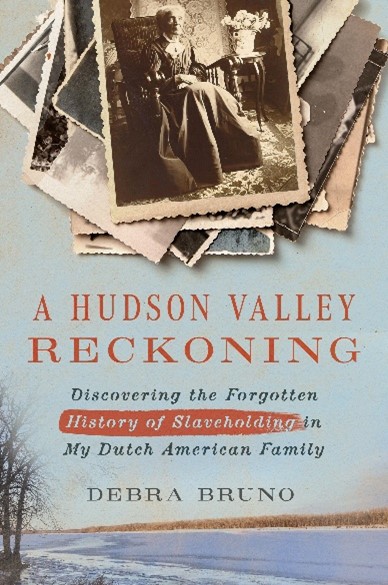
Book Review: A Hudson Valley Reckoning: Discovering the Forgotten History of Slaveholding in My Dutch American Family

For many, slavery in the North is nothing but a long-ago memory, a story that is often untold due to the cruelties of enslavement in the South and the long-lasting impact of enslavement in the Southern part of the United States. The general public is not always aware of the enslavement of African people in the North with only recent discoveries being brought to light. A Hudson Valley Reckoning: Discovering the Forgotten History of Slaveholding in My Dutch American Family showcases the stories of enslaved people who lived in Greene County, New York. The author, Debra Bruno, offers a new perspective on the enslaved in New York by exploring her own lineage and that of a distant cousin named Eleanor.

In this thirteen-chapter narrative, Bruno tells the story of her slave-holding Dutch family and the connection between her relatives and those who they might have enslaved. Eleanor is a descendant of the individuals whom Bruno’s family enslaved. Bruno discusses how historians, politicians, journalists, and every day people have erased significant features of enslavement in the North and painted a quaint picture of enslaved people helping the Dutch with their farms, houses, and livestock. Bruno, however, provides a much clearer picture of the reality of slavery in Dutch New York. She visited Macon, Georgia, and Curacao as she dug deeper into her family’s history.

In the introduction, Bruno describes her upbringing and the proud nature of her family’s Dutch heritage. She draws the reader in by describing her hometown of Athens and Coxsackie, places located along the Hudson River. Her American family began with Lambert Van Valkenburg, who settled in New Amsterdam in the early 1600s and later sold this land relocated on the North River, now the Hudson River. Her ancestor originally owned land in New Amsterdam where the where Empire State Building is located.

While digging into the history of her family, Bruno decided to explore whether they were enslavers. Bruno used Ancestry.com where she found various records including newspaper clippings, census data, photographs, and wills. Valkenburg did not provide significant results, so she searched under Collier, her grandmother’s family name. Bruno found a will from what would be her Great Grandfather five times back. He had many children and grandchildren around the Coxsackie area and left a will bequeathing much of his property to them. As Bruno combed through the pages of the will she saw it, “detailed like inventory along with his property and cows were slaves” (6).

Chapter four illustrates enslavement in the North with an analysis of a painting. “Van Bergen Overmantel” was commissioned by the Van Bergen family in the early 1700s to hang in the family home. It depicted what life was like in 18th century Hudson Valley and “is the first visual evidence of slavery on a New York farm” (56). According to Bruno, in 1714 Coxsackie’s population was 21% enslaved people. and by the 1790s in places such as Brooklyn, New York that number went up to 30%. In the late 18th century New York had an enslaved population of 319,000 enslaved people.

In the following chapters Bruno describes the challenges she faced in finding sources from the enslaved that could detail what their life was like on these farms. She notes that they were threatened with being sold down South or the Caribbean, some ran away killing their masters in the escape, and these details just go to show that enslaved life in the North was not a cakewalk as some may think. Even after being emancipated, African Americans still struggled in New York as they fought their right to be citizens and gain full citizenship rights as discussed in chapter nine.

In a discussion of why this history was so important to recover, Bruno emphasized that the Declaration of Independence and the Constitution, the nation’s founding documents, not grant the same freedoms to all people living on this land, and that individuals must “accept that only some people have benefited from their promises. To deny that and to distance ourselves from that truth is to misunderstand how our county grew, prospered, and exists today” (233.

Lesson Based on the Movie Glory

“Let the black man get upon his person the brass letter, U.S., let him get an eagle on his button, and a musket on his shoulder and bullets in his pocket, there is no power on earth that can deny that he has earned the right to citizenship.” – Frederick Douglass

  • Read the packet prior to our class viewing of the Edward Zwick’s film Glory (1989)
  • Highlight/underline and annotate the most important points; be sure you review the questions before we view the film.
  • Pay attention and answer the questions in the time allotted following the end of the film.

Background: The issues of emancipation and military service were intertwined from the onset of the Civil War. News from Fort Sumter set off a rush by free Black men to enlist in U.S. military units. They were turned away, however, because a federal law barred Negroes from bearing arms for the U.S. Army. The Lincoln administration was concerned that the recruitment of Black troops would prompt the Border States (Delaware, Maryland, Kentucky, and Missouri) to secede. By mid-1862, however, the escalating number of former slaves (contrabands), the declining number of white volunteers, and the needs of the Union Army pushed the Government into reconsidering the ban. As a result, on July 17, 1862, Congress passed the Second Confiscation and Militia Act, freeing slaves who had masters in the Confederate Army. Two days later, slavery was abolished in all the territories of the United States. In the Emancipation Proclamation, issued on January 1, 1863, President Lincoln announced that Black men would be recruited into the U.S. Army and Navy. Abolitionist leaders such as Frederick Douglass encouraged Black men to become soldiers to ensure eventual full citizenship (two of Douglass’s own sons enlisted). By the end of the Civil War, roughly 188,000 Black men (10% of the Union Army) served as soldiers and another 19,000 served in the Navy. 40,000 Black soldiers died over the course of the war. There were 80 Black commissioned officers; 21 Black soldiers and sailors won the Medal of Honor by the time it ended. Black women could not formally join the Army but served as nurses, spies, and scouts, the most famous scout being Harriet Tubman. In addition to the perils of war faced by all Civil War soldiers, Black soldiers faced additional problems stemming from racial prejudice. Segregated units were formed with Black enlisted men commanded by white officers. Black soldiers were initially paid $10 per month from which $3 was automatically deducted for clothing, resulting in a net pay of $7. In contrast, white soldiers received $13 per month from which no clothing allowance was drawn. In June 1864, Congress granted equal pay to the U.S. Colored Troops.

The film: Glory tells the story of the 54th Colored Massachusetts Infantry Regiment, one of the most celebrated regiments of Black soldiers that fought in the Civil War. Known simply as “the 54th,” this regiment became famous after the heroic, but ill-fated, assault on Fort Wagner, South Carolina. Leading the direct assault under heavy fire, the 54th suffered enormous casualties before being forced to withdraw. The courage and sacrifice of the 54th helped to dispel doubt within the Union about the fighting ability of Black soldiers and earned this regiment undying battlefield glory. Of the 5,000 Federals who took part, 1,527 were casualties: 246 killed, 890 wounded and 391 captured. The 54th lost a stunning 42 percent of its men: 34 killed, 146 wounded and 92 missing and presumed captured. By comparison, the Confederates suffered a loss of just 222 men. Despite the 54th’s terrible casualties, the battle of Fort Wagner was a watershed for the regiment. Civil War scholar James McPherson states, that the “significance of the 54th’s attack on For Wagner was enormous. Its sacrifice became the war’s dominant positive symbol of Black courage. Their sacrifice sparked a huge recruitment drive of Black Americans. It also allowed Lincoln to make the case to whites that the North was in the war to help bring a “new birth of freedom” to all Americans.

  1. List 2 reasons why men joined the 54th?
  2. Why do you think the white officers volunteered to lead them?
  3. Why do you think Colonel Shaw wants his regiment to lead the deadly assault on Fort Wagner?
  4. In the scene just before the final attack, Shaw approaches a reporter and says, “Remember what you see here.” Write a brief newspaper entry including a headline, dateline, photo (or drawing, engraving, map, etc.) and caption, and a brief (3-4 sentences) description stating what the reporter saw at the Battle of Fort Wagner.

In-class group activity: We will divide randomly into 4 groups. Each group will be assigned one of the images below. Your group will determine how the image represents the significance of the 54th’s achievements and legacy. Each group will then report back to the rest of the class.

Russell Duncan. Blue-Eyed Child of Fortune: The Civil War Letters of Robert Gould Shaw. This book contains a 67-page biography of Shaw as well as 300 additional pages featuring the various letters Shaw wrote to family members, some of which are read in the movie.

Joseph T. Glatthaar. Forged in Battle: The Civil War Alliance of Black Soldiers and White Officers. Paperback. Louisiana State University Press (April 2000).

David Blight’s article, “Race and Reunion: Soldiers and the Problem of the Civil War in American Memory” (6, no. 3 [2003]: 26-38).

A: Storming Fort Wagner. Lithograph by Kurz & Allison, 1890

Image B: Civil War photograph of Sergeant-Major Lewis H. Douglas, one of the first troops of the 54th to climb over the walls of Fort Wagner during the attack.

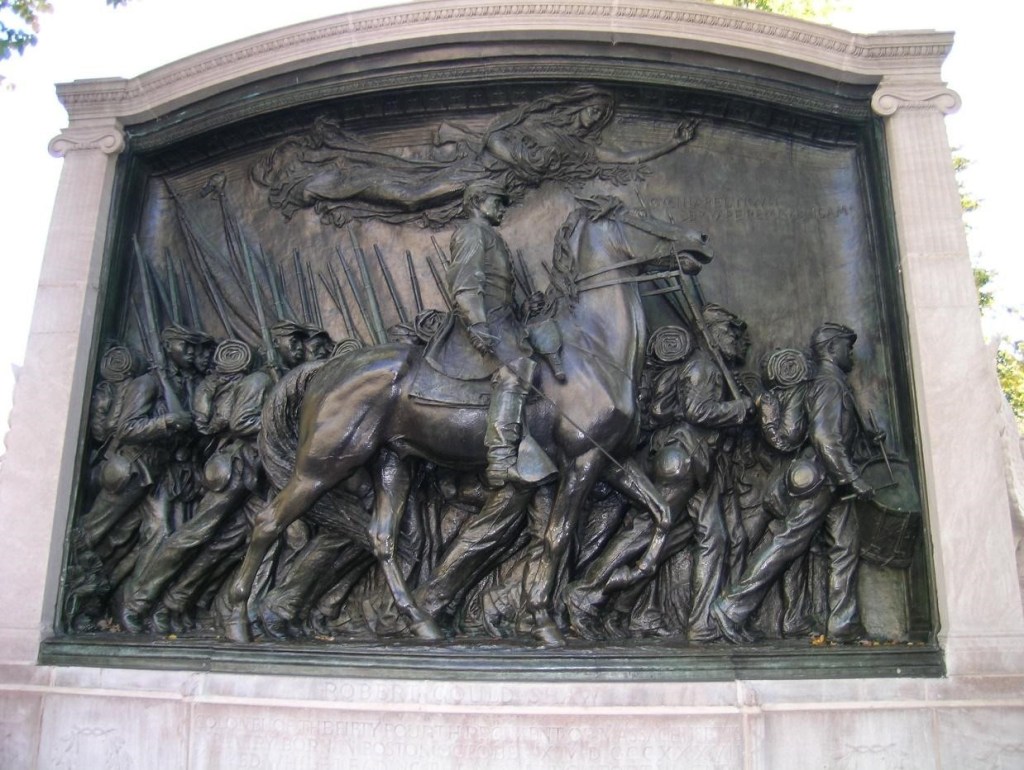
Image C: Augustus Saint-Gaudens (one of the premier artists of his day) took nearly fourteen years to complete this high-relief bronze monument, which celebrates the valor and sacrifices of the Massachusetts 54th. Colonel Shaw is shown on horseback and three rows of infantrymen march behind. This scene depicts the 54th Regiment marching down Beacon Street on May 28, 1863 as they left Boston to head south. The monument was unveiled in a ceremony on May 31, 1897.

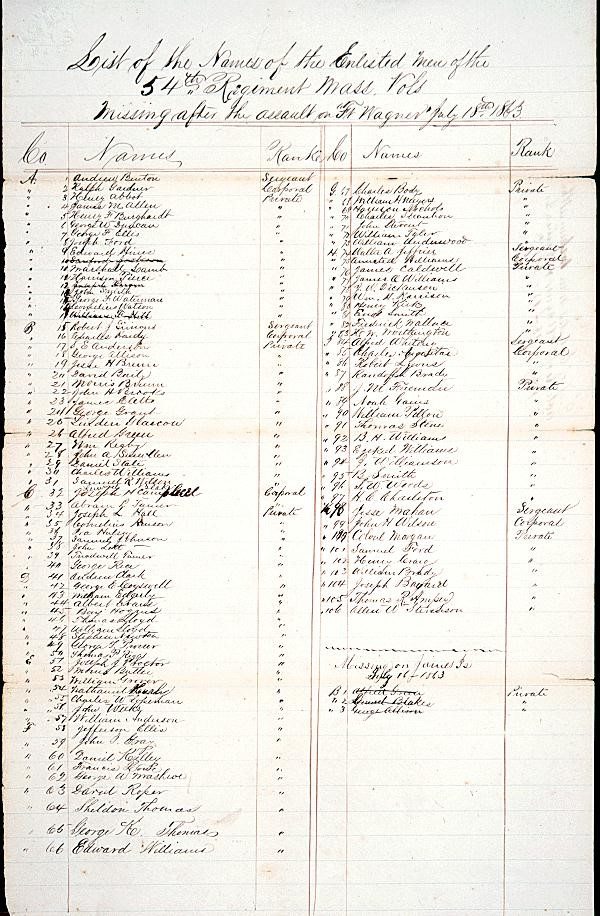
Image D: One of the 54ths casualty lists with the names of 116 enlisted men who died at the battle for Fort Wagner. National Archives, Records of the Adjutant General’s Office, 1780’s-1917

“The Captain’s Story” by Harriet Beecher Stowe

“The Captain’s Story” by Harriet Beecher Stowe

Ellen Gruber Garvey

This article is reprinted with permission of the author. It was originally published in the Washington Post under the headline “A forgotten 19th-century story can help us navigate today’s political fractures.”  https://www.washingtonpost.com/outlook/2021/03/23/forgotten-19th-century-story-can-help-us-navigate-todays-political-fractures/   

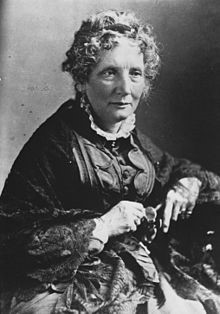
Harriet Beecher Stowe

Can Democrats truly reconcile with those Republicans who called President Biden’s election fraudulent and encouraged violent attack of the U.S. Capitol? Earlier moments in U.S. history should caution us about the lure and danger of reconciliation when one side refuses to acknowledge wrongdoing. After the Civil War, former Union partisans sought to get along with the Southerners who fought to keep Black people enslaved even after the war. But later, they doubted the wisdom of having done so.

One of those people was Harriet Beecher Stowe, the author of “Uncle Tom’s Cabin” (1852), the most influential novel in the United States during the 19th century. Her famous book kindled readers’ sense that they could and must end slavery, even if that meant disrupting alliances, friendships and family ties with enslavers and their supporters. Thirty years later, Stowe wrote a story little known even it its own time, in which she considered what happened when these same White Northerners who fought against slavery reconciled too easily with former enslavers.

Can Democrats truly reconcile with those Republicans who called President Biden’s election fraudulent and encouraged violent attack of the U.S. Capitol? Earlier moments in U.S. history should caution us about the lure and danger of reconciliation when one side refuses to acknowledge wrongdoing. After the Civil War, former Union partisans sought to get along with the Southerners who fought to keep Black people enslaved even after the war. But later, they doubted the wisdom of having done so.

One of those people was Harriet Beecher Stowe, the author of “Uncle Tom’s Cabin” (1852), the most influential novel in the United States during the 19th century. Her famous book kindled readers’ sense that they could and must end slavery, even if that meant disrupting alliances, friendships and family ties with enslavers and their supporters. Thirty years later, Stowe wrote a story little known even it its own time, in which she considered what happened when these same White Northerners who fought against slavery reconciled too easily with former enslavers.

Written in 1882, but set in 1866, “The Captain’s Story” tells of two former Union army captains who visit Florida, where they once fought on the battlefield. They hope to relax and recuperate from the toll the war had taken on their health. The two listen to their white Floridian guide’s ghost story, which includes his casual mention of having murdered enslaved African captives. The ghost of one captive continues to haunt a nearby plantation, he says. Despite moral qualms, the two captains decide to continue their trip with their murderous guide who can show them all the best fishing grounds. They will get along, and leave his punishment to God.

Stowe began spending winters in Florida just after the Civil War, about the time the story is set, initially hoping to help her son recover from his own Civil War trauma. She wrote popular travel articles in the 1870s touting the state’s pleasures for Protestant Northern Whites, hoping to attract them to politically overwhelm the Southern planters. Full of chummy advice on how to travel south and where to buy land, the accounts spurred the state’s first tourist boom while also raising money for a Black school. In “The Captain’s Story,” she swerves to remind her readers of the brutalities of her Florida neighbors who once enslaved people.

Although Stowe was a founder of the Atlantic Monthly, “The Captain’s Story” was not published there, perhaps because few 1880s editors wished to take the horrors of slavery seriously. Albion Tourgée, the editor of the short-lived but high-paying weekly Our Continent, did, however. He was a Union veteran who worked for Reconstruction then wrote about his experiences in two best-selling novels focusing on the difficulties and assaults the freed people faced. He went on to fight Jim Crow, as the lawyer representing a Black plaintiff attacking segregation in public facilities in Plessy v. Ferguson.

Although Our Continent was not a crusading publication and sought to attract White Southern readers, too, Tourgée published other works that acknowledged that the Civil War was fought over slavery. Yet Our Continent was obscure enough that “The Captain’s Story” received no notice in the press at the time. It was not anthologized or reprinted.

The story’s questioning of White complicity in postwar racism is subtle and conflicted. But it does stand in stark contrast to other popular magazine stories of the time. Northern magazines shoveled out stories romanticizing Southern plantations as places where sweet, quasi-familial ties between enslavers and enslaved people infused life with graciousness. Plantation fiction frequently featured a tired Northern businessman who, like the two captains, goes South to rest and comes to appreciate relaxed Southern hospitality.

Marriage to a Southern woman in these stories offered an allegory of reconciliation between Northern and Southern Whites. As the White abolitionist and orator Anna E. Dickinson noted, “The fashion of the day has been, and is, to talk of the love feast that is spread between old foes, till at last we of the North and of the South are doing what our forefathers did 30 years ago — grasping hands across the prostrate body of the negro.”

Of course, former Confederates did not seek reconciliation. Instead, they created the cult of the Lost Cause, celebrating the nobility and heroism of the Confederacy, leading to the erection of statues honoring Confederate leaders and school textbooks that continued to inculcate this version of history for over a century.

That is why Stowe’s story is significant. It called out the murderous past, presented plantation owners and their friends as lawless, brutal, disloyal, casual killers, scornful of the family ties of enslaved people.But the story disappeared, and that illuminated the shifting reality of race relations in 1882. Reconstruction had ended, a reign of racial terror lynchings had commenced, and states passed Black Codes that allowed Southern Whites to continue to coerce the labor of African Americans.White supremacy had regrouped with new legal structures and Northern collusion, and former Confederates were back in power in the South. Ex-Confederates suppressed the Black vote and reinstated slavery under different names.

The myth of benevolent plantation life took hold through sheer repetition in fictional work, most familiar now through “Gone With the Wind,” imagery and plantation tours. Burying Stowe’s story while celebrating that myth matters. It is another small part of concealing slavery’s past and obscuring the power of white supremacy, which still haunt the United States.