
A History of Civil Disobedience Lesson
by John Staudt
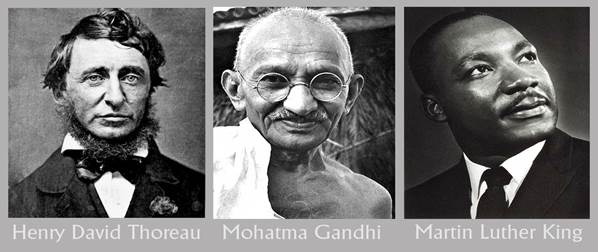
PBS and Ken Burns have a new three-part series on the legacy of 19th century American philosopher and writer Henry David Thoreau and his 1849 essay “Civil Disobedience,” which inspired activists including Mohandas Gandhi, Martin Luther King, Jr. and Malcolm X. The website includes a seven minute video and excerpts from the well-known essay.
Parts 1–2 work well as paired reading and analysis. Part 3 is designed for longer written responses or small-group discussion. Part 4 may be assigned as a take-home shot essay prompt. This worksheet is designed to serve as the capstone activity for a civil rights unit.
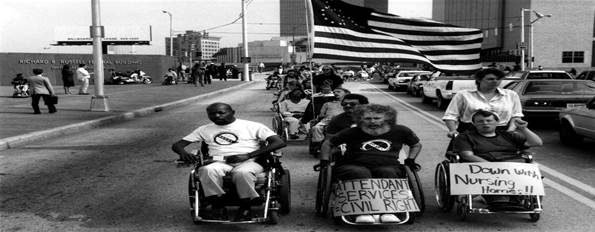
ADAPT (American Disabled for Attendant Programs Today)
| Part 1 | Thoreau & the Origins of Civil Disobedience |
CONTEXT: In 1846, Henry David Thoreau refused to pay his poll tax, was arrested, and spent a night in jail. He opposed both slavery and the Mexican-American War (1846–1848), which he saw as an unjust war designed to expand slavery itself. His 1849 essay “Civil Disobedience” became the philosophical foundation for mass movements around the world.
Unjust laws exist: shall we be content to obey them, or shall we endeavor to amend them, and obey them until we have succeeded, or shall we transgress them at once?… Under a government which imprisons any unjustly, the true place for a just man is also a prison. – Henry David Thoreau, Civil Disobedience, 1849
I saw that, if there was a wall of stone between me and my townsmen, there was still a more difficult one to climb or break through before they could get to be as free as I was. – Henry David Thoreau, regarding his night in jail
Questions:
1. Thoreau argues that “the true place for a just man” under an unjust government is prison. What does he mean? How can accepting imprisonment represent freedom rather than defeat?
2. Thoreau was upset not just with the federal government, but with Massachusetts (his home state), a state that claimed to oppose slavery but still collected taxes that funded it. What does his critique of complicity tell us about moral responsibility in a democracy? Is paying taxes that fund an unjust policy the same as supporting it?
3. Reportedly, when Thoreau was in jail, his friend, Ralph Waldo Emerson visited him and asked “Henry, what are you doing in there?” Thoreau replied, “Waldo, what are you doing out there?” What argument is Thoreau making in this exchange? Why does he consider Emerson’s freedom to be a kind of imprisonment for his friend?
| Part 2 | Four Movements Comparing Civil Disobedience in Practice |
REFERENCE TABLE: Use the comparison table and the core principles card to ground your analysis. Return to both as you work through each question.
| Movement | Act of Disobedience | Unjust Law Targeted | Scale | Outcome |
| Henry David Thoreau 1846 United States | Refused to pay state tax; accepted one night in jail | Fugitive Slave Act; tax support of an unjust war | Individual | Essay “Civil Disobedience” (1849); philosophical foundation for all later movements |
| Mahatma Gandhi 1930 British India | Led 240-mile Salt March; thousands deliberately violated British salt law | British colonial salt monopoly | Mass Movement | Exposed colonial injustice globally; accelerated Indian independence (1947) |
| Martin Luther King, Jr. 1955–1968 United States | Sit-ins, marches, boycotts; Letter from Birmingham Jail written while imprisoned | Jim Crow segregation laws throughout the South | Mass Movement | Civil Rights Act (1964); Voting Rights Act (1965) |
| ADAPT Disability Rights Activists; 1990 United States | 60 protesters crawled up 83 Capitol steps; arrested | Inaccessible built environment; no federal disability civil rights law | Organized movement | ADA signed July 26, 1990 four months after the Capitol Crawl |
| Thoreau’s Four Core Principles of Civil Disobedience |
| 1. Break the unjust law publicly; The act itself is the argument made visible |
| 2. Accept the legal consequences willingly; Punishment demonstrates the law’s injustice |
| 3. Use sacrifice to awaken public conscience; Suffering must be made meaningful, not merely endured |
| 4. Force systemic change through moral pressure; The goal is transformation of law or policy |
Questions:
1. What core principles of civil disobedience remained unchanged across all four movements from Thoreau (1846) to the Capitol Crawl (1990)? Identify at least two that appear in every case and explain why those specific principles are essential to the strategy of Civil Disobedience.
2. Thoreau’s act was individual. Gandhi turned the principle into a mass movement. King organized city-wide boycotts, sit-ins, and marches. ADAPT mobilized a coordinated national campaign. What did each movement gain by expanding from individual to collective action? What did it risk losing?
3. Is individual civil disobedience one person refusing, accepting arrest, making a point politically effective on its own? Or does it require mass participation to force change? Explain your response.
| Part 3 | Conditions for Success: What Made Each Movement Effective? |
ANALYTICAL FRAME: Effective civil disobedience does not operate in a vacuum. Timing, media coverage, public response, government reaction, and the clarity of the injustice being demonstrated all shape whether a movement succeeds or fails. Use the reading and the comparison table to analyze what specific conditions made each movement’s disobedience effective.
ANALYTICAL QUESTION COMPARATIVE ANALYSIS:
Compare the outcomes of at least two of the four movements identified above.
1. How did specific conditions, timing, public response, media attention, and government reaction make each form of civil disobedience effective?
2. Why did Thoreau’s individual act produce an essay rather than immediate political change? Why did the Capitol Crawl produce the ADA within four months?
3. Each of the four movements used protesters’ own bodies to make injustice visible: Thoreau in a jail cell, Gandhi marching to the sea, King’s marchers facing police dogs and fire hoses in Birmingham, disability activists crawling up the U.S. Capitol steps. Why is using the body itself as the instrument of protest so powerful? What does it communicate that speeches and petitions cannot?
4. King wrote in the ̈Letter from Birmingham Jail ̈ that direct action “creates such a crisis and fosters such a tension that a community which has constantly refused to negotiate is forced to confront the issue.” How did each action or movement succeed in forcing confrontation?
| Part 4 | Synthesis: The Legacy of Civil Disobedience |
CORE SYNTHESIS QUESTION: Thoreau, Gandhi, King, and ADAPT activists all believed that breaking an unjust law openly, accepting punishment willingly, and making injustice visible could lead to changing unjust laws. Their success proves that civil disobedience works under specific conditions. What are those conditions?
PERSONAL REFLECTION: Is there an issue today for you which civil disobedience: breaking a law publicly and accepting the consequences willingly would be justified? What would be required before you made your move?
Excerpts from Thoreau’s Essay on “Civil Disobedience.”
Excerpt 1: Thoreau Believed there is a Moral Obligation to Resist Unjust Laws
“He who gives himself entirely to his fellow-men appears to them useless and selfish; but he who gives himself partially to them is pronounced a benefactor and philanthropist. How does it become a man to behave toward this American government to-day? I answer, that he cannot without disgrace be associated with it. I cannot for an instant recognize that political organization as my government which is the slave’s government also. All men recognize the right of revolution; that is, the right to refuse allegiance to, and to resist, the government, when its tyranny or its inefficiency are great and unendurable. But almost all say that such is not the case now. But such was the case, they think, in the Revolution of ’75. If one were to tell me that this was a bad government because it taxed certain foreign commodities brought to its ports, it is
most probable that I should not make an ado about it, for I can do without them. All machines have their friction; and possibly this does enough good to counterbalance the evil. At any rate, it is a great evil to make a stir about it. But when the friction comes to have its machine, and oppression and robbery are organized, I say, let us not have such a machine any longer. In other words, when a sixth of the population of a nation which has undertaken to be the refuge of liberty are slaves, and a whole country is unjustly overrun and conquered by a foreign army, and subjected to military law, I think that it is not too soon for honest men to rebel and revolutionize. What makes this duty the more urgent is the fact that the country so overrun is not our own, but ours is the invading army.”
Excerpt 2: Thoreau Rejected a Moral Obligation to Obey Authority
“[William] Paley, a common authority with many on moral questions, in his chapter on the “Duty of Submission to Civil Government,” resolves all civil obligation into expediency; and he proceeds to say that “so long as the interest of the whole society requires it, that is, so long as the established government cannot be resisted or changed without public inconveniency, it is the will of God… that the established government be obeyed, —and no longer. This principle being admitted, the justice of every particular case of resistance is reduced to a computation of the quantity of the danger and grievance on the one side, and of the probability and expense of redressing it on the other.” Of this, he says, every man shall judge for himself. But Paley appears never to have contemplated those cases to which the rule of expediency does not apply, in which a people, as well as an individual, must do justice, cost what it may. If I have unjustly wrested a plank from a drowning man, I must restore it to him though I drown myself. This, according to Paley, would be inconvenient. But he that would save his life, in such a case, shall lose it. This people must cease to hold slaves, and to make war on Mexico, though it cost them their existence as a people.”
Note: William Paley was an 18th century British philosopher and theologian who argued that people had a duty to submit to government authority.
Excerpt 3: Thoreau Argued Against Waiting for Reforms that Might Never Happen
“Unjust laws exist: shall we be content to obey them, or shall we endeavor to amend them, and obey them until we have succeeded, or shall we transgress them at once? Men generally, under such a government as this, think that they ought to wait until they have persuaded the majority to alter them. They think that, if they should resist, the remedy would be worse than the evil. But it is the fault of the government itself that the remedy is worse than the evil. It makes it worse. Why is it not more apt to anticipate and provide for reform? Why does it not cherish its wise minority? Why does it cry and resist before it is hurt? Why does it not encourage its citizens to be on the alert to point out its faults, and do better than it would have them? Why does it always crucify Christ, and excommunicate Copernicus and Luther, and pronounce Washington and Franklin rebels?”
Excerpt 4: Thoreau Advocated for Nonviolent Resistance
“One would think, that a deliberate and practical denial of its authority was the only offence never contemplated by government; else, why has it not assigned its definite, its suitable and proportionate, penalty? If a man who has no property refuses but once to earn nine shillings for the State, he is put in prison for a period unlimited by any law that I know, and determined only by the discretion of those who placed him there; but if he should steal ninety times nine shillings from the State, he is soon permitted to go at large again. If the injustice is part of the necessary friction of the machine of government, let it go, let it go: perchance it will wear smooth, — certainly the machine will wear out. If the injustice has a spring, or a pulley, or a rope, or a crank, exclusively for itself, then perhaps you may consider whether the remedy will not be worse than the evil; but if it is of such a nature that it requires you to be the agent of injustice to another, then, I say, break the law. Let your life be a counter-friction to stop the machine. What I have to do is to see, at any rate, that I do not lend myself to the wrong which I condemn.
Excerpt 5: Thoreau Condemned the State’s Resistance to Change
As for adopting the ways which the State has provided for remedying the evil, I know not of such ways. They take too much time, and a man’s life will be gone. I have other affairs to attend to. I came into this world, not chiefly to make this a good place to live in, but to live in it, be it good or bad. A man has not everything to do, but something; and because he cannot do everything, it is not necessary that he should do something wrong. It is not my business to be petitioning the Governor or the Legislature any more than it is theirs to petition me; and if they should not bear my petition, what should I do then? But in this case the State has provided no way: its very Constitution is the evil. This may seem to be harsh and stubborn and unconciliatory; but it is to treat with the utmost kindness and consideration the only spirit that can appreciate or deserves it. So is any change for the better, like birth and death, which convulse the body. I do not hesitate to say, that those who call themselves Abolitionists should at once effectually withdraw their support, both in person and property, from the government of Massachusetts, and not wait till they constitute a majority of one, before they suffer the right to prevail through them. I think that it is enough if they have God on their side, without waiting for that other one. Moreover, any man more right than his neighbors constitutes a majority of one already.
Excerpt 6: Thoreau Believed in the Power of Truth and the Individual
“Under a government which imprisons any unjustly, the true place for a just man is also a prison. The proper place today, the only place which Massachusetts has provided for her freer and less desponding spirits, is in her prisons, to be put out and locked out of the State by her own act, as they have already put themselves out by their principles. It is there that the fugitive slave, and the Mexican prisoner on parole, and the Indian come to plead the wrongs of his race should find them; on that separate, but more free and honorable, ground, where the State places those who are not with her, but against her – the only house in a slave State in which a free man can abide with honor. If any think that their influence would be lost there, and their voices no longer afflict the ear of the State, that they would not be as an enemy within its walls, they do not know by how much truth is stronger than error, nor how much more eloquently and effectively he can combat injustice who has experienced a little in his own person. Cast your whole vote, not a strip of paper merely, but your whole influence. A minority is powerless while it conforms to the majority; it is not even a minority then; but it is irresistible when it clogs by its whole weight. If the alternative is to keep all just men in prison, or give up war and slavery, the State will not hesitate which to choose. If a thousand men were not to pay their tax-bills this year, that would not be a violent and bloody measure, as it would be to pay them, and enable the State to commit violence and shed innocent blood. This is, in fact, the definition of a peaceable revolution, if any such is possible. If the tax-gatherer, or any other public officer, asks me, as one has done, “But what shall I do?” my answer is, “If you really wish to do anything, resign your office.” When the subject has refused allegiance, and the officer has resigned his office, then the revolution is accomplished. But even suppose blood should flow. Is there not a sort of blood shed when the conscience is wounded? Through this wound a man’s real manhood and immortality flow out, and he bleeds to an everlasting death. I see this blood flowing now.”

