Era 6 The Emergence of Modern America: Progressive Reforms (1890–1930)

New Jersey Council for the Social Studies

www.njcss.org

The relationship between the individual and the state is present in every country, society, and civilization. Relevant questions about individual liberty, civic engagement, government authority, equality and justice, and protection are important for every demographic group in the population.  In your teaching of World History, consider the examples and questions provided below that should be familiar to students in the history of the United States with application to the experiences of others around the world.

These civic activities are designed to present civics in a global context as civic education happens in every country.  The design is flexible regarding using one of the activities, allowing students to explore multiple activities in groups, and as a lesson for a substitute teacher. The lessons are free, although a donation to the New Jersey Council for the Social Studies is greatly appreciated. www.njcss.org

Era 6 The Emergence of Modern America: Progressive Reforms (1890–1930)

The development of the industrial United States is a transformational period in our history. The United States became more industrial, urban, and diverse during the last quarter of the 19th century. The use of fossil fuels for energy led to mechanized farming, railroads changed the way people traveled and transported raw materials and goods, the demand for labor saw one of the largest migrations in world history to America, and laissez-faire economics provided opportunities for wealth while increasing the divide between the poor and rich. During this period local governments were challenged to meet the needs of large populations in urban areas regarding their health, safety, and education.  

Read the information below from the constitutions of the United States and Israel on the election of the head of State and discuss the similarities and differences. Until the 20th Amendment was ratified, the United States did not have a designated date for the transfer of power from one elected leader to the next.

Twentieth Amendment

Section 1

The terms of the President and the Vice President shall end at noon on the 20th day of January, and the terms of Senators and Representatives at noon on the 3d day of January, of the years in which such terms would have ended if this article had not been ratified; and the terms of their successors shall then begin.

Section 2

The Congress shall assemble at least once in every year, and such meeting shall begin at noon on the 3d day of January, unless they shall by law appoint a different day.

Section 3

If, at the time fixed for the beginning of the term of the President, the President elect shall have died, the Vice President elect shall become President. If a President shall not have been chosen before the time fixed for the beginning of his term, or if the President elect shall have failed to qualify, then the Vice President elect shall act as President until a President shall have qualified; and the Congress may by law provide for the case wherein neither a President elect nor a Vice President elect shall have qualified, declaring who shall then act as President, or the manner in which one who is to act shall be selected, and such person shall act accordingly until a President or Vice President shall have qualified. (See the 25th Amendment, ratified on February 10, 1967)

Section 4

The Congress may by law provide for the case of the death of any of the persons from whom the House of Representatives may choose a President whenever the right of choice shall have devolved upon them, and for the case of the death of any of the persons from whom the Senate may choose a Vice President whenever the right of choice shall have devolved upon them. Ratified: January 23, 1933 (See the 25th Amendment, ratified on February 10, 1967)

BASIC LAW. THE PRESIDENT OF THE STATE OF ISRAEL (1964)

1. A President shall stand at the head of the State.

2.The place of residence of the President of the State shall be Jerusalem.

3.The President of the State shall be elected by the Knesset for seven years.The President will serve for one term only.

4.Every Israel national who is a resident of Israel is qualified to be a candidate for the office of President of the State.

5.The election of the President of the State shall be held not earlier than ninety days and not later than thirty days before the expiration of the period of tenure of the President in office. If the place of the President of the State falls vacant before the expiration of his period of tenure, the election shall be held within forty-five days from the day on which such place falls vacant. The Chairman of the Knesset, in consultation with the Vice-Chairmen, shall fix

the day of the election and shall notify it to all the members of the Knesset in writing at least three weeks in advance. If the day of the election does not fall in one of the session terms of the Knesset, the Chairman of the Knesset shall convene the Knesset for the election of the President of the State.

6. Proposal of Candidates (Amendment 8)

A proposal of a candidate for President of the State shall be submitted in writing to the Chairman of the Knesset, together with the consent of the candidate in writing, on the fourteenth day before the day of the election;

A member of the Knesset shall not sponsor the proposal of more than one candidate; A person that any ten or more members of the Knesset proposed his candidacy shall be candidate for President of the State, except if the number of sponsors decreased below ten because of the deletion of the name of a member of the Knesset as described in subsection (3);

Where a member of the Knesset sponsored the proposal of more than one candidate, the name of that member of the Knesset shall be deleted from the list of sponsors for all candidates he sponsored; Where the number of sponsors of a candidate decreased below ten because of the deletion of a name from the list of sponsors, a member of the Knesset who did not sponsor any proposal may add his name to the list of sponsors of that candidate, no later than eight days before the day of the election.

The Chairman of the Knesset shall notify all the members of the Knesset, in writing, not later than seven days before the day of the election, of every candidate proposed and of the names of the members of the Knesset who have proposed him and shall announce the candidates at the opening of the meeting at which the election is held.

7. The election of the President of the State shall be by secret ballot at a meeting of the Knesset assigned only for that purpose.

8.If there are two candidates or more, the candidate who has received the votes of a majority of the members of the Knesset is elected. If no candidate receives such a majority, a second ballot shall be held. At the second ballot only the two candidates who received the largest number of votes at the first ballot shall stand for election. The candidate who at the second ballot receives a majority of the votes of the members of the Knesset who take part in the voting and vote for one of the candidates is elected. If two candidates receive the same number of votes, voting shall be repeated.

If there is only one candidate, the ballot will be in favor or against him and he is elected if the number of votes in his favor outweighs the number of votes against him. If the number of votes in his favor equals the number of votes against him, a second ballot shall be held.

1. What was the main problem the 20th Amendment solved? Was this a significant concern at the time?

      2. How did the 20th Amendment solve that problem and what problems were not solved?

      3. Should the United States consider amending the Constitution to provide for the election of the president and vice-president by the House and Senate?

      4. Are the limitations or weaknesses in the way Israel is currently governed or is there system superior to others with popular elections?

      Presidential Term and Succession

      Date Changes for Presidency, Congress, and Succession

      Interpretation and Debate of the 20th Amendment

      Historical Background to the 20th Amendment

      Democracy and Elections in Israel

      Israel’s Elections

      Reforming the Israeli Electoral System

      Regulating communications in the United States has been going on since the Radio Act of 1912. The military, emergency responders, police, and entertainment companies each wanted to get their signals out over the airwaves to the right audiences without interference. The Radio Act of 1912 helped to establish a commission that would designate which airwaves would be for public use and which airwaves would be reserved for the various commercial users who needed them.

      In 1926, the Federal Radio Commission was established to help handle the growing complexities of the country’s radio needs. In 1934, Congress passed the Communications Act, which replaced the Federal Radio Commission with the Federal Communications Commission. The Communications Act also put telephone communications under the FCC’s control. The FCC broke up some of the communications monopolies, such as the National Broadcasting Company (NBC) which part of it became the American Broadcasting Company (ABC).  

      The FCC has been in the middle of controversial decisions. In 1948, the FCC put a freeze on awarding new television station licenses because the fast pace of licensing prior to 1948 had created conflicts with the signals. The freeze was only supposed to last a few months but was extended to four years.

      The breakup of the telephone monopoly AT&T into a series of smaller companies is another example of a controversial decision. The Telecommunications Act of 1996 allowed competition by mandating that the major carriers allow new companies to lease services off of their lines and they could then sell those services to customers.

      Another area where the FCC has been criticized is in regulating the content (“decency”) of radio and television broadcasts. There was an incident at the 2004 Super Bowl halftime show when the wardrobe of Janet Jackson malfunctioned, and part of her breast was exposed. The FCC does not set the content standards for movies but has the authority to issue fines.

      Since 2014, the idea of “net neutrality” has been before the federal courts regarding an open and free internet and permission for providers to charge subscription fees.

      British Broadcasting Corporation (BBC)

      Daily broadcasting by the BBC began on November 14, 1922. John Reith was appointed as the director. There were no rules or standards to guide him. He began experimenting and published the Radio Times.

      The BBC was established by Royal Charter as the British Broadcasting Corporation in 1927. Sir John Reith became the first Director-General. The Charter defined the BBC’s objectives, powers and obligations. It is mainly concerned with broad issues of policy, while the Director-General and senior staff are responsible for detailed fulfilment of that policy.

      1. Is the regulation of radio, television, telephone and internet communications democratic?
      2. Should the freedom of speech be unlimited in the United States or does the government have the responsibility and authority to control the content and images?
      3. Do the Regulatory Agencies of the United States promote the general welfare, or do they restrict the blessings of liberty?
      4. Are monopolies in the communications and technology industries justified because of the expense and protection of patents?
      5. Does the United Kingdom have a state sponsored news media in the BBC?
      6. Which country’s policies on communications do you agree with? Why?

      BBC Guidelines for Inappropriate Content

      The Communications Act of 1934

      History of the Federal Communications Commission

      History of Commercial Radio

      Suez Canal Crisis (1956)

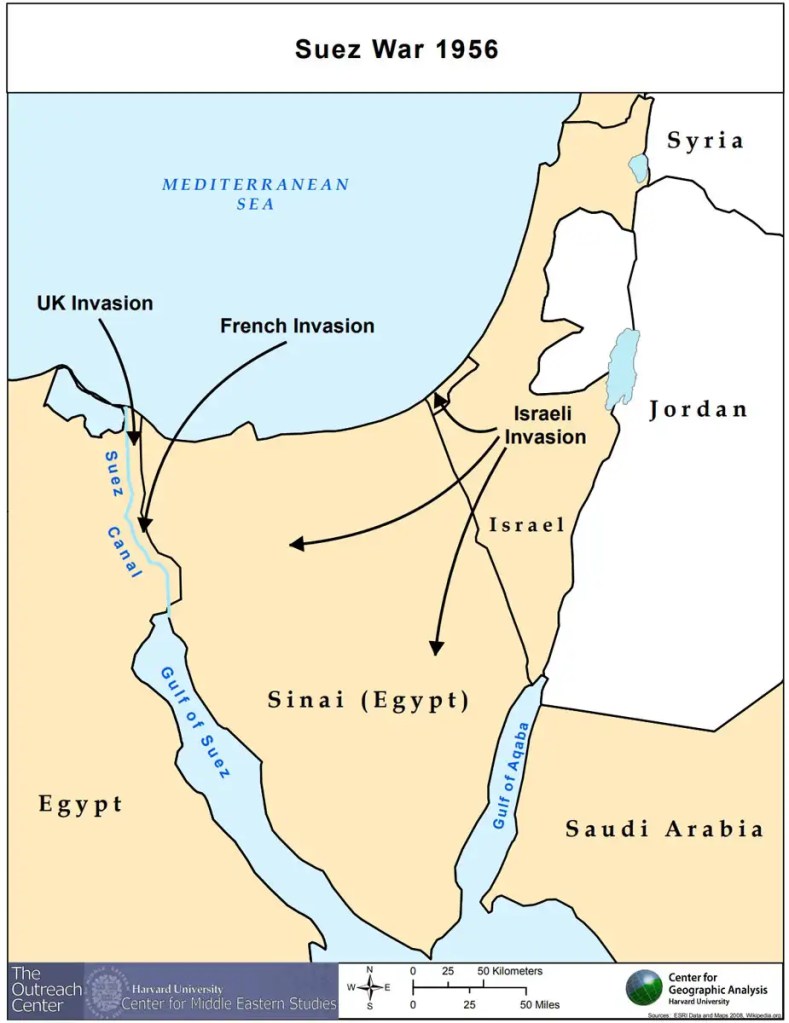
      On July 26, 1956, Egyptian President Gamal Abdel Nasser announced the nationalization of the Suez Canal Company, which was jointly operated by a British and French company since its construction in 1869. The British and French held secret military consultations with Israel, who regarded Nasser as a threat to its security. Israeli forces attacked Egypt’s Sinai Peninsula on October 29, 1956, advancing to within 10 miles of the Suez Canal. Britain and France landed troops of their own a few days later.

      The relations between the United States and Britain weakened when Britain bombed Egypt over their blockade of the Suez Canal. The United Nations threatened Britain with sanctions if there were any civilian casualties. This led to economic panic and Britain faced having to devalue its currency. President Eisenhower was shocked that he was not informed of the British military response and put pressure on the International Monetary Fund to deny Britain any financial assistance. The British reluctantly accepted a UN proposed ceasefire. Under Resolution 1001 on 7 November 1956 the United Nations deployed an emergency force (UNEF) of peacekeepers into Egypt.

      The canal was closed to traffic for five months by ships sunk by the Egyptians during the operations. British access to fuel and oil became limited and resulted in shortages. Egypt maintained control of the canal with the support of the United Nations and the United States. Under huge domestic pressure and suffering ill-health Eden resigned in January 1957, less than two years after becoming prime minister.

      1. Does the United States have a responsibility to support its allies even when our policies do not agree with their policies or actions?
      2. Did President Eisenhower overstep his authority by asking for economic sanctions against Britain?
      3. Did President Roosevelt overstep his constitutional authority in signing the Hay-Bunau-Varilla Treaty or was the overstep committed by the Philip Bunau-Varilla, Panama’s ambassador to the United States?
      4. In matters of foreign policy, do economic interests justify military actions?

      History of the Panama Canal

      The Panama Canal

      International Law and the Panama Canal

      The Suez Canal Crisis

      Why was the Suez Canal Crisis Important?

      Poll Taxes and the 24th Amendment

      The US Constitution leaves voter qualifications, except for age, to individual states. By the mid-19th century, however, most states did not limit voting by property ownership or poll taxes. A poll tax of $2 in 1962 would convert to approximately $17 in 2020 dollars. After the ratification of the 15th Amendment, in an attempt to limit Black voter registration and turnout, many states re-established poll taxes. The combination of poll taxes, literacy tests, White primaries (permitting only Whites to vote in primary elections), intimidation, violence, and disqualification of people convicted of felonies succeeded in reducing voter participation.

      In his 1962 State of the Union Address, President Kennedy put the issue on the national agenda when he called for the elimination of poll taxes and literacy tests, stating that voting rights “should no longer be denied through such arbitrary devices on a local level.” The proposal to ban literacy tests did not make it past a Senate filibuster, but after debating the substance of the proposal to end the poll tax and whether or not the tax should be eliminated by a Constitutional amendment, Congress passed the 24th Amendment, abolishing poll taxes in federal elections on August 27, 1962.

      The passage of the 24th Amendment and the Voting Rights Act of 1965 did not completely eliminate the obstacles for voter registration or voting. On March 24, 1966, the Supreme Court ruled in Harper v. Virginia Board of Elections that poll taxes could not be collected in any election, including state and local elections, since they violated the 14th Amendment’s Equal Protection Clause. The 19th Amendment gave women the right to vote but enforcement is dependent on congressional legislation. To what extent are citizens denied the right to vote today?

      Chartist Movement in the United Kingdom

      In 1838 a People’s Charter was drawn up for the London Working Men’s Association (LWMA) by William Lovett and Francis Place, two self-educated radicals, in consultation with other members of LWMA. The Charter had six demands:

      All men to have the vote (universal manhood suffrage)

      Voting should take place by secret ballot.

      Parliamentary elections every year, not once every five years

      Constituencies should be of equal size.

      Members of Parliament should be paid.

      The property qualification for becoming a Member of Parliament should be abolished.

      The Chartists’ petition was presented to the House of Commons with over 1.25 million signatures. It was rejected by Parliament. This provoked unrest which was swiftly crushed by the authorities. A second petition was presented in May 1842, signed by over three million people but again it was rejected, and further unrest and arrests followed. In April 1848 a third and final petition was presented. The third petition was also rejected but there were no protests. Why did this movement fail to complete its objectives?

      1. Should the requirement of having a birth certificate or another state ID document as proof of residency a modern-day poll tax? In all states these documents have a cost.
      2. Does the Voting Rights Act of 1965 need to be updated with the John R. Lewis Voting Rights Advancement act?
      3. Was the poll tax a financial burden on a low-income family? (In today’s currency about $34 for two adults)
      4. What led to the rise of the Chartists Movement?
      5. Why did the Chartist Movement fail to achieve its objectives?
      6. With the many criticisms of a democracy and a republic, is it the preferred form of government?

      Barriers to Voting: Poll Taxes

      Abolition of Poll Taxes: 24th Amendment

      Voting Rights for African Americans

      Equal Protection Clause of the 14th Amendment

      Voting Rights Act of 1965

      The Chartist Movement

      The Importance of the Chartist Movement

      The Trumpist Supreme Court: Off the Rails of Democracy

      Norman Markowitz

      Rage and confusion over the recent Supreme Court decisions is sweeping the nation. The Roe v. Wade decision (1973) establishing women’s reproductive rights has been repealed. A New York State law prohibiting the carrying of concealed guns, passed in response to escalating shootings and deaths, has been declared unconstitutional. The court has sharply reduced the regulatory powers of the Environmental Protection Agency, established in 1970. This comes after decades of scientific research showing the dangers of climate change and global warming.

      What is the logic behind this? There is a standard used in philosophy which should be applied to the Court’s recent decisions. Statements, or assertions, should be judged by their “validity and reliability.” Are they true statements in terms of logic, reason, and consistency (validity)? Is the evidence (facts, data) used to support the statement true (reliability)? I will use this standard to look at the Court’s rulings.

      The Constitution was a political compromise among merchant capitalists, landlords, slaveholders, creditors, and debtors on a variety of issues — slavery, the payment of debts, and the regulation of trade. It cannot be interpreted like the Jewish Torah, the Christian Gospels, or the Muslim Koran — sacred, unchanging texts. And the Supreme Court has no right to interpret legislation passed by Congress or the directives of the president, since the Constitution did not give the Court the power of judicial review.

      However, that power was in effect taken by the Court in 1805 in a brilliant maneuver by Chief Justice John Marshall in Marbury v. Madison. The court has maintained the power of judicial review for over two centuries, often adjusting its interpretations to major changes in society.

      The representatives who drafted and approved the Constitution, much less the former colonies/states which ratified it, all rejected the principle of universal suffrage. The leaders of the revolution associated the term “democracy” with mob rule. Property qualifications for voting in federal elections was the established rule. If one took the original intent seriously, the Court would have the power to establish property qualifications for voting, since there is no constitutional amendment abolishing property qualifications for voting, just as there are constitutional amendments abolishing slavery and giving women the right to vote.

      When the Constitution was drafted and enacted, English common law defined life as existing when a fetus could be felt moving or kicking in the mother’s womb, called “quickening.” If the mother claimed that the fetus had been aborted before this “quickening,” she was held harmless. Laws banning abortion and contraception, and pamphlets and manuals about both in the mails, were enacted at the state and federal levels in the late 19th century as part of a movement led by the Reverend Anthony Comstock, organizer of the Society for the Suppression of Vice. These laws were part of a backlash against the growing movement for women’s civil rights, equality under the law, and the right to vote. The women’s rights/women’s liberation movement of the 1960s, following in the path of the civil rights/Black liberation movement, led the successful campaign to repeal these laws, which finally resulted in Roe v. Wade, a century after they began to be enacted.

      The Court’s decision invalidating a New York state law prohibiting the carrying of concealed handguns is also unreliable. Here the evidence is direct and incontrovertible. The Second Amendment to the Constitution states, “A well-regulated Militia, being necessary to the security of a free State, the right of the people to keep and bear Arms, shall not be infringed.” But in English law and in colonial theory and practice, as Joshua Zeitz in an excellent analysis argues, the amendment never meant that all citizens had the right to bear arms. This right “was inextricably connected to the citizen’s obligation to serve in a militia and to protect the community from enemies domestic and foreign.” And “well-regulated militias” meant militias constituted by legitimate authorities, not private groups like the later KKK, Nazi storm troopers, or self-proclaimed state militias.

      Zeitz makes the important point that James Madison, a major author of the Constitution and the Bill of Rights, had earlier drafted legislation in the Virginia legislature barring individuals from openly carrying and displaying guns, like the present New York State law that the Court has declared unconstitutional. The purpose of the amendment was clearly to prevent a government from doing what Britain did in the aftermath of the Boston Tea Party: disperse the colonial legislature and its militia and in effect declare martial law. Also, the guns in question fired single “balls,” not bullets, and had very limited range and accuracy. Today’s AR-15 rifles, for example, used in recent mass shootings, have greater fire power and accuracy than the assault rifles used during World War II and the Korean War.

      The Supreme Court’s other decisions on the regulatory powers of the Environmental Protection Agency, and the right of a school employee to engage in religious action, are neither valid in their relationship to the Constitution nor reliable in regard to their factual assertions. They are a repudiation of more than a century of law and policy of the federal regulation of industry and the post–Civil War 14th Amendment defending the civil rights and liberties of citizens from their infringement and/or denial by the states.

      The Supreme Court and the judiciary have been the most conservative section of the federal government throughout most of U.S. history. The fact that the justices are not elected and can be removed only through impeachment, resignation, or death explains this.

      The courts have in the past and once more in recent decades used the Commerce Clause of the Constitution to declare unconstitutional legislation that regulates business and promotes social welfare. Beginning in the 1880s, they declared corporations “persons” to give them 14th Amendment protections from regulation and taxation by the states, and have over and over again used the 10th Amendment to support states’ rights.

      The political nature of the Supreme Court from its very inception is indisputable. The Court, for example, represented the interests of the slaveholder class from the administration of George Washington (himself a slaveholder) up to the Civil War. But as the nation changed, industrial capitalism grew, and the anti-slavery movement became broader, the demands of the slaveholders and the actions of their Supreme Court became more extreme. The Dred Scott decision (1857), which in effect repealed the earlier restrictions on the expansion of slavery in the Western territories, supporting legislation advanced by pro-slavery congresses and presidents, reflected this development. As an afterthought, the slaveholder-dominated Supreme Court claimed that the authors of the Constitution had not intended any Black person, slave or free, to have the rights of an American citizen, an expression of “original intent” which both enraged and strengthened the increasingly militant anti-slavery national coalition.

      With the defeat of the Confederacy, slavery was abolished through constitutional amendment in all the states, and the former Confederate states now under Union army occupation had to ratify the amendment to regain admission to the Union. With the support of President Andrew Johnson, a pro-Union former senator from Tennessee (and himself a former slaveholder), they did so while enacting labor codes that in effect declared the former slaves to be unemployed vagrants and returned them to the “custodial care” of their former owners.

      In response to these acts, Thaddeus Stevens, Charles Sumner, and other militant anti-slavery leaders of the Republican Party proposed a second constitutional amendment to establish national citizenship and protect the civil rights and civil liberties of the nearly 4 million former slaves. They did this for two reasons. They feared that President Johnson would veto the civil rights legislation they were advancing in Congress. And even if they were able to override his veto, they feared that the Supreme Court, where the now former slaveholders remained a powerful force, would declare such legislation unconstitutional.

      The 14th Amendment establishing national citizenship was passed, followed by the 15th, which extended the right to vote. However, the war was a victory for the industrial capitalists and their banker allies, who within a generation betrayed both the former slaves and the workers and farmers who saw Civil War policies like the Homestead Act and the creation of land grant colleges as advancing their class interests.

      The Supreme Court and the federal judiciary in the aftermath of the Civil War fiercely defended the interests of “big business” against organized farmers, workers, state governments, and the federal government. In the 1880s, the Supreme Court in a series of decisions invalidated the civil rights acts of the Reconstruction era and the 14th Amendment’s protection of citizenship rights from state government policies. States were permitted to ignore the Civil Rights Act of 1875, which banned exclusion and discrimination in public accommodations. That protection would only be restored by the Civil Rights Act of 1964 after a century of de jure segregation.

      In 1896, the Plessy v. Ferguson decision gave states the right to establish segregation by law, using as a cover the principle of “separate but equal” under such laws, although it was clear to everyone that the systematic exclusion of African Americans from public schools, public employment, public transportation, and commercial establishments was crudely unequal. The courts also endorsed state laws which denied the overwhelming majority of Black people the right to vote; the convict lease system, a form of slave labor for prisoners; and state “poll taxes,” which primarily discriminated against poor whites (in most places African Americans had been already disenfranchised).

      At the same time, the Court in the 1880s took the 14th Amendment’s defense of the rights of “persons” and applied it to business and corporations, declaring state laws regulating business to be unconstitutional.  At the time the 14th Amendment was proposed and enacted, everyone understood that the “persons” referred to were the 4 million former slaves, no longer under law, but not yet citizens.

      But this was just the beginning. An early modest federal income tax (a surcharge on high incomes) was declared unconstitutional in the Pollock case. It negated the Sherman Anti-Trust Act (1890) by declaring that the federal government and the states could only regulate commerce — not manufacture — under the Constitution. In an industrial society, regulation became a farce.

      Decades later, a constitutional amendment gave the federal government the right to levy income taxes, and Congress passed legislation that, to a limited extent, regulated trade and restructured the banking system. However, the Court routinely declared unconstitutional state laws protecting the right of workers to organize unions, providing for the health and safety regulation of workplaces, minimum wages, and the 1916 federal law outlawing child labor.

      It was not until the Great Depression of the 1930s, which saw the great upsurge of labor with the Communist Party playing a central role, that the New Deal government enacted the most important labor and social welfare legislation since the abolition of slavery and battled to compel the judiciary to accept these major reforms in the interests of the working class and the whole people.

      The struggle for major judicial reform went back to the late 19th century. It sought to de-emphasize precedence, the “dead hand” of previous decisions, and make the law respond to social changes and realities, to connect the “facts” as they existed in the present with past decisions under the law. Law professor Roscoe Pound and attorney Louis Brandeis were the champions of this approach to law, called “legal realism.” Brandeis especially popularized the doctrine in leading campaigns against corporate monopolistic price fixing and business corruption of public officials, which earned him the name “the People’s Attorney.”

      He also developed a legal brief which incorporated social research (the Brandeis brief) in arguing cases. His fame in the early 20th-century Progressive movement led Woodrow Wilson to appoint him to the Supreme Court, where he joined with Justice Oliver Wendell Holmes to represent a minority that supported the regulation of industry, social legislation, and the defense of First Amendment civil liberties. Regarding civil liberties, the minority supported freedom of speech, assembly, and association unless, in Holmes’s language, there was a “clear and present danger” to society, and not just a “dangerous tendency” that certain acts might lead to others, which was the conservative position.

      In the 1936 elections, Roosevelt campaigned against the old-guard Court and the “economic royalists” whom they represented, reviving the language of the American revolution in his and the New Deal’s sweeping victory. Roosevelt sought to expand the court for every justice over the age of 70, which would have increased its size to 15 justices.

      Conservatives fought back, wrapping the Court in the Constitution, attacking his court reorganization plan as “court packing.” In the Court fight, conservative Southern Democrats, including many who had worked behind the scenes against the New Deal like senators Tom Connally of Texas and Walter George of Georgia, along with the vice president, John Nance Garner, turned against Roosevelt. The weakened GOP let the Democrats carry the ball, but it was from this court fight that the informal conservative coalition of Southern Democrats and Republicans began to take shape.

      Faced with the attack, the Court, which had four Coolidge/Hoover “Business of America is Business” conservatives, three urban liberals, and two moderate conservatives, shifted. In 1936 the Court had voted 6-3 against the New York minimum wage law. But in 1937 the Court upheld by a vote of 5 to 4 a similar Washington State minimum wage law, ruled in favor of the Wagner Act in the Jones and Laughlin Steel case, and upheld the Social Security Act and unemployment insurance. In all these rulings, Owen Roberts and Chief Justice Charles Evans Hughes changed their votes to side with Roosevelt.

      By the end of 1937, as the old-guard conservatives began to retire, Roosevelt, defeated in the reorganization fight, began to replace them with New Dealers and by the time of the Pearl Harbor attack had forged a New Deal majority. The new Court moved away from the old doctrines of constitutional original intent associated with the corporate-dominated courts of the post–Civil War era toward a view that the Court must change with changing economic and social conditions. Most of all, the Court retreated from its support for business and its defense of the absolute right of freedom of contract. Instead, a law was to be “presumed constitutional” on questions concerning economic power and government regulation — constitutional regulation came to be seen, as one decision put it, as regulation for the “public good.” Economic freedom was no longer the preferred freedom of the court, and economic activity was no longer local and thus not regulatable.

      The court also upheld in the Fair Labor Standards Act minimum wages for all citizens, whereas later it vetoed state minimum wage legislation for women, refused to apply the anti-trust laws to unions, and outlawed the sit-down strike in 1939 (NLRB v. Fansteel Metallurgical Corp.), but in a decision that defended and established peaceful picketing.

      At the same time, the Court under New Deal leadership began to develop a new doctrine of preferred freedoms, a doctrine that stressed the need to protect the rights of political dissenters and minorities. In late 1937, the Court declared unconstitutional state laws barring speech and assembly that had been used to convict and imprison Communist Party activists like Angelo Herndon in Georgia, later explicitly defended religious freedom in the case of Jehovah’s Witnesses’ refusal to swear allegiance to the flag and revived the clear and present danger criteria to protect free speech and assembly. In 1938 the Court, for the first time since the end of Reconstruction, enforced some civil rights claims when it contended that the state of Missouri, by not supplying legal education for Black students had violated the separate but equal doctrine of Plessy (Missouri had offered to pay part of their tuition). While the decision didn’t challenge segregation, it pressured Southern states to increase educational programs under segregation for African Americans.

      In the Hague case, the Court declared unconstitutional a local Jersey City ordinance against picketing and demonstrations which had been used for mass arrests — subsequently, this was defined to mean peaceful picketing. In U.S. v. Carolene Products (1938), the majority ruled that the court would no longer apply “heightened scrutiny” to economic legislation; however, in a footnote, Harlan Fiske Stone added that the Court was obligated to apply a “more exacting judicial scrutiny” in cases where laws or regulations contradicted the Bill of Rights or adversely affected minorities. The famous “footnote 4” had important implications for Bill of Rights freedoms for dissenters and minorities.

      Following the recession of 1937 and the business-conservative counterattack and backlash of 1938, the New Deal was politically stalemated in Congress and without a clear program. However, by this time, the labor social welfare program was consolidated, at least for the short term. Further, the great fortress of conservative power protected from the electoral process — the Supreme Court — was overthrown.

      Democratic President Harry Truman’s appointees set back the Court’s support for civil liberties, especially in the 1950–51 Eugene Dennis case, where the Court upheld the convictions and imprisonment of the leadership of the CPUSA under the 1940 Smith Act. The appointments of Earl Warren as Chief Justice and William Brennan by Republican President Dwight Eisenhower, however, greatly strengthened the Court’s progressive majority at a time when Cold War policies moved Congress and the president to the right.

      In the Brown decision (1954), the Court declared school segregation unconstitutional. The Supreme Court also in the Yates and other decisions made illegal some of the worst aspects of state and federal anti-Communist policies, leading the FBI to establish its secret Cointelpro program. In the later Miranda and Gideon decisions the Court limited police power to interrogate and hold suspects without formally charging them and reading them their rights, including their right to legal representation or a court-appointed attorney to represent them. The Court also rejected early challenges to the Civil Rights Acts of 1964 and 1965. Although Richard Nixon’s election to the presidency and his appointments moved the Court in a more conservative direction over time, Court decisions in the early 1970s effectively abolished the death penalty in the U.S. and, in Roe v. Wade, legalized abortion.

      Even before Ronald Reagan gained the presidency, the Nixon-influenced Court began to move to the right. In 1976, the court gave states the right to reestablish the death penalty (subsequently the death penalty would be established at the federal level in a more extensive way than at the state level). In 1980, the Supreme Court upheld an amendment to the funding of Medicaid in 1976 which barred the use of Medicaid funds for abortions, a cruel blow to the rights of low-income and poor women.

      Over the following four decades, a series of decisions chipped away at civil rights and civil liberties; weakened the regulation of commerce, industry, and finance; and removed restrictions on the use of money in elections. The Court’s conservative majority became more militantly reactionary, destroying earlier compromise decisions brokered by conservatives. Donald Trump, who gained the presidency in large part because of the deeply undemocratic nature of U.S. politics, failed to implement his far-right domestic policies, which both large numbers of Americans and people throughout the world saw as “neofascism.” However, his “success” in appointing three Supreme Court judges is now his “legacy,” in that they are doing what he failed to accomplish.

      First, we must understand that a large majority of the people oppose these decisions, just as in 1857 and 1936 a large majority of the people opposed the Supreme Court’s pro-slavery Dred Scott decision and its decisions declaring New Deal regulatory and social legislation unconstitutional. The Republican Party mobilized opposition to the Dred Scott decision to win the 1858 congressional elections. More than 70 years later, the Democratic Party mobilized opposition to the conservative Court’s decisions to propel Roosevelt to an overwhelming victory in the 1936 national elections. The same kind of united opposition must be organized now. We must point out that the present Court has set the nation back and may continue to block progress regarding immediate issues such as inflation, health care, or the cost of energy and transportation. Were the government to attempt, for example, to establish price controls, create a national public health system, and expand public transportation, the Court would not be on the people’s side.

      The trade union movement, all civil rights and women’s rights organizations, and all environmental organizations must mobilize supporters and communities throughout the nation to vote against the Republican senators and congresspeople who over decades have created this judiciary. Such an electoral victory is necessary but not in itself sufficient. Many today are calling for an expansion of the Court. Congress and the president have the power to do that, since the number 9 is not in the Constitution. We should begin to think about a larger expansion of the federal judiciary itself. Since the 1980s, the conservative Federalist Society has advanced the doctrine of original intent as a cover to restore Court rulings opposing federal regulation of business and social welfare legislation. A government committed to restoring what the Court had represented in the New Deal–Great Society era should actively appoint attorneys who support those positions.

      Finally, the question of judicial review itself could be formally ended by Congress and the president. As was contended earlier, it is not a part of the Constitution, and there is no evidence that the Constitutional Convention intended it to be established. The Court has acted to strike down and take away from the people major social protections and rights. As such its power of judicial review can and should be taken away from it.

      Constitutional Textualism, Undocumented Immigrants, and the 14th Amendment

      Constitutional Textualism, Undocumented Immigrants, and the Fourteenth Amendment

      Alan Singer

      This article was originally serialized as a three-part post in History News Network.

      Posting on History News Network, Elliott Young, professor of History at Lewis & Clark College, examined the Supreme Court decision in Department of Homeland Security v. Thuraissigiam (2020). Young described the decision as a “fundamental threat to equal protection of the law for all undocumented immigrants” that defied long established legal principles. I strongly support Young’s arguments and, in this article, I wish to extend them. Equally distressing is that it was a seven-to-two majority decision with Ruth Bader Ginsburg and Stephen Breyer joining the rightwing court bloc. Sonia Sotomayor and Elena Kagan posted a powerful joint dissent.

      The 1996 Illegal Immigration Reform and Immigrant Responsibility Act “placed restrictions on the ability of asylum seekers to obtain review under the federal habeas statute.” In this case, Vijayakumar Thuraissigiam, an undocumented immigrant from Sri Lanka applying for refugee status because as a Tamil he faced beatings, torture, and death, claimed that since he had already entered the territory of the United States, he was entitled to due process. Thuraissigiam was represented by the American Civil Liberties Union (ACLU). The Court upheld the constitutionality of the 1996 law and ruled that he was not.

       The majority decision for the rightwing bloc was written by Samuel Alito. Alito argued “Respondent’s Suspension Clause argument fails because it would extend the writ of habeas corpus far beyond its scope ‘when the Constitution was drafted and ratified’” and that the “respondent’s use of the writ would have been unrecognizable at that time.” Not once did Alito reference the 14th Amendment to the United States Constitution. Breyer and Ginsburg, in a concurring opinion written by Breyer, stated that they supported the court majority “in this particular case,” but not the broader assertions made by Alito.

      In a dissent endorsed by Kagan, Sotomayor wrote that “The majority declares that the Executive Branch’s denial of asylum claims in expedited removal proceedings shall be functionally unreviewable through the writ of habeas corpus, no matter whether the denial is arbitrary or irrational or contrary to governing law. That determination flouts over a century of this Court’s practice.” She argued “Taken to its extreme, a rule conditioning due process rights on lawful entry would permit Congress to constitutionally eliminate all procedural protections for any noncitizen the Government deems unlawfully admitted and summarily deport them no matter how many decades they have lived here, how settled and integrated they are in their communities, or how many members of their family are U. S. citizens or residents.” If Sotomayor is correct, and I believe she is, the Thuraissigiam decision puts all DACA (Deferred Action for Childhood Arrivals) recipients at immediate risk.

      I’m not a big fan of the national Common Core Standards and its high-stakes standardized reading tests, but as a historian and social studies teacher, I like the idea that they promote close reading of text. Former Associate Supreme Court Justice Anton Scalia, the halcyon of judicial conservatism and the patron saint of the Supreme Court’s dominant bloc, justified his rightwing jurisprudence claiming to be a textualist. According to Scalia, “If you are a textualist, you don’t care about the intent, and I don’t care if the framers of the Constitution had some secret meaning in mind when they adopted its words. I take the words as they were promulgated to the people of the United States, and what is the fairly understood meaning of those words.”

      But, as Shakespeare reminded us in Hamlet’s famous “To be, or not to be” soliloquy, “There’s the rub.” There is always “the rub.” The problem, with both Common Core and Constitutional textualism is that words have different meanings at different times and to different people and sometimes words are chosen, not to convey meaning, but to obscure it. Understanding “words” requires historical context.

      The word slavery did not appear in the United States Constitution until slavery was banned in 1865 by the Thirteenth Amendment because the Constitution, as originally written, represented a series of compromises and contradictions that the authors left to be decided in the future. It was a decision that three score and fourteen years later led to the American Civil War.

      The humanity of Africans was generally denied at the time the Constitution was written; they were chattel, property. But in Article I, Section II of the Constitution, which established the three-fifth plan for representation in Congress, enslaved Africans are referred to as “other Persons.” And in Article IV, Section II, the Constitution mandates that “No Person held to Service or Labour in one State, under the Laws thereof, escaping into another, shall, in Consequence of any Law or Regulation therein, be discharged from such Service or Labour, but shall be delivered up on Claim of the Party to whom such Service or Labour may be due.”

      I read text pretty well. As persons, enslaved Africans should have been included in the people of the United States who wrote the Constitution “in Order to form a more perfect Union, establish Justice, insure domestic Tranquility, provide for the common defense, promote the general Welfare, and secure the Blessings of Liberty to ourselves and our Posterity, do ordain and establish this Constitution for the United States of America.”

      But of course, they weren’t. Just reading the Constitutional text, without context, does not help us understand what Scalia called “the fairly understood meaning of those words.”

      Unfortunately for the nation, political bias blinded Scalia while he was on the Supreme Court and blinds the rightwing cabal that dominates the Court today so badly that they just don’t read with any level of understanding and ignore historical documents. Because of this, one of the most pressing issues in the 2020 Presidential election is the appointment of future Supreme Court Justices who can read text with understanding, especially the 14th Amendment to the United States Constitution, and are willing to search for supporting historical evidence.

      In his war on immigration, Donald Trump has repeatedly tried to implement regulations that speed-up dismissal of refugee claims so they can be thrown out of the country and others that permit the Department of Homeland Security to indefinitely detain families that cross the Southern border with Mexico into the United States without proper documentation. Trump calls constitutionally protected birthright citizenship “ridiculous” and says his administration is “looking very, very seriously” at ideas for stopping it because the promise that their children will be American citizens is a “magnet for illegal immigration.”

      I am not an expert on magnets, but I do know what the Constitution says, why it was written that way, and what it means. In the 14th amendment to the Constitution, approved after the Civil War, national citizenship, including birth right citizenship, and the rights of citizens of the United States, were defined for the first time. According to Section 1 of the Amendment, “All persons born or naturalized in the United States, and subject to the jurisdiction thereof, are citizens of the United States and of the state wherein they reside.” The only persons born in the United States and excluded from automatic citizenship were Native Americans who were members of sovereign tribes and the children of foreign diplomats stationed in the United States. Native Americans were finally granted birth right citizenship by the Indian Citizenship Act of 1924. According to the 14th Amendment, the children of immigrants, both documented and undocumented, as long as they are born in the United States and subject to its laws, are automatically citizens whether their parents become citizens or not. Among other people, that included my parents – and by extension, me.

      In addition, Section 1 states, “No state shall make or enforce any law which shall abridge the privileges or immunities of citizens of the United States; nor shall any state deprive any person of life, liberty, or property, without due process of law; nor deny to any person within its jurisdiction the equal protection of the laws.” Equal protection of the law, due process, the right to life, liberty, and property, are assured by the Constitution to all persons, not just to citizens, including undocumented immigrants. If we exclude some people from personhood rights, we return to a reading of the Constitution that allowed “other Persons” to be enslaved. To prevent this from happening again, Section 5 of the amendment granted Congress “power to enforce, by appropriate legislation, the provisions of this article,” but not the power to violate it.

      The due legal process guaranteed to persons was earlier defined in the Bill of Rights. The Fifth Amendment bars prosecution for a crime without an indictment from a Grand Jury; the Sixth Amendment ensures that “the accused shall enjoy the right to a speedy and public trial, by an impartial jury of the State and district wherein the crime shall have been committed”; and the Eighth amendment bans “cruel and unusual punishments.” All of these rights were violated during slavery days when Blacks had no legal rights, including a public trial before an impartial jury. The case against Solomon Northup’s kidnappers in Washington DC was dismissed because a Black man could not legally testify against whites. It is important to note that the Sixth Amendment does not make an exception denying legal protection to undocumented immigrants, while the Eighth Amendment would probably be read by a legitimate Supreme Court as denying the separation of children from their parents and indefinite detention at the border – and at Guantanamo.

      The Fourteen Amendment was written to protect persons and to empower Congress to enforce their protection because before the Civil War, Fugitive Slave laws denied due process to persons accused of being runaway slaves. The Fugitive Slave Act of 1850, permitted someone to be detained based on an “affidavit made by the claimant of such fugitive”; provided for the appointment of commissioners who reviewed claims outside of regular judicial channels; required “marshals and deputy marshals” to enforce provisions of the act and paid them doubled if an accused fugitive was enslaved; established penalties for “any person who shall knowingly and willingly obstruct, hinder, or prevent” a “claimant, his agent or attorney, or any person or persons lawfully assisting him, her, or them, from arresting such a fugitive”; and most disturbingly, a “deposition or affidavit” by a claimant against an accused freedom-seeker, was sufficient grounds for a commissioner to declare someone a fugitive and order them enslaved.

      The phrasing of the 14th Amendment was also necessary because Supreme Court Chief Justice Roger Taney, in the 7-2 majority opinion he wrote for the Dred Scott decision, claimed that people of African ancestry “were not intended to be included, under the word ‘citizens’ in the Constitution, and can therefore claim none of the rights and privileges which that instrument provides for and secures to citizens of the United States.” Taney, blinded by his bias against Blacks and determined to permit the spread of slavery into western territories, ignored the Constitutional provision that legal rights were guaranteed to persons, not just to citizens, and that Africans were recognized in the Constitution as persons.

      In his dissent to the Dred Scott decision, Associate Justice Benjamin Curtis made clear that the ruling by Taney and the Court majority were in violation of both the text and intent of the Constitution, and after the decision was made, he resigned in protest. Curtis wrote that “At the time of the ratification of the Articles of Confederation, all free native-born inhabitants of the States of New Hampshire, Massachusetts, New York, New Jersey, and North Carolina, though descended from African slaves, were not only citizens of those States, but such of them as had the other necessary qualifications possessed the franchise of electors, on equal terms with other citizens.” In addition, the Constitution’s fugitive slave clause (Article IV, Section II) established the personhood of enslaved Blacks when it referred to them as “persons held to service in one State, under the laws thereof.”

      Antonin Scalia, rejected examining the original intent of the authors of the Constitution and its amendments, claiming we cannot know what they meant by what they wrote. But the thing is, their explanations of the meaning of the text are often well documented, especially as in the case of the 14th Amendment. Fortunately, while many current justices, like Scalia was when he served on the court, are limited in their understanding of what authors mean by the text, historian don’t have those limitations.

      The Congressional Globe, predecessor to the Congressional Record, contains verbatim debate over the Fourteenth Amendment including extended statements by Congressman John A. Bingham from Ohio (House of Representatives, 39th Congress, 1st Session), the principal author of the amendment, and an elected official who could read very well, especially when the text was the United States Constitution. Bingham’s extended comments on the 14th Amendment appear pages 1088-1094.

      According to Bingham, “I propose, with the help of this Congress and of the American people, that thereafter there shall not be any disregard of this essential guarantee of your Constitution in any State of the Union. And how? By simply adding an amendment to the Constitution to operate on all States of this Union alike, giving to Congress the power to pass all laws necessary and proper to secure to all persons – which includes every citizen of every state – their equal personal rights . . .” Bingham clarified, “the divinest feature of your Constitution is the recognition of the absolute equality before the law of all persons, whether citizens or strangers . . .” Based on this, Bingham advised President Andrew Johnson that “the American system rests on the assertion of the equal right of EVERY MAN to life, liberty, and the pursuit of happiness; to freedom of conscience, to the culture and exercise of all his faculties.”

      As Bingham explained, “Equality before the law” under the Fourteenth Amendment means exactly what it says it means; it is a right guaranteed to “all persons, whether citizens or strangers.”

      In his speech to Congress, Bingham echoed some of the arguments made by Frederick Douglass when Douglass rejected the idea that the United States Constitution was a pro-slavery document. Douglass denied “that the Constitution guarantees the right to hold property in man. Douglass believed “The intentions of those who framed the Constitution, be they good or bad, for slavery or against slavery, are so respected so far, and so far only, as we find those intentions plainly stated in the Constitution . . . Its language is ‘we the people;’ not we the white people, not even we the citizens, . . but we the people . . . The constitutionality of slavery can be made out only by disregarding the plain and common-sense reading of the Constitution itself.”

      Bingham, who analyzed context, as well as text, stated that “everybody at all conversant with the history of the country knows that in the Congress of 1778, upon the adoption of the Articles of Confederation as an article of perpetual union between the States, a motion was made then and there to limit citizenship by the insertion in one of the articles of the word ‘white,’ so that it should read, ‘All white freemen of every State, excluding paupers, vagabonds, and so forth, shall be citizens of the United States.’ There was a vote taken upon it, for all our instruction, I suppose, and four fifths of all the people represented in that Congress rejected with scorn the proposition and excluded it from that fundamental law; and from that day to this it has found no place in the Constitution and laws of the United States, and colored men as well as white men have been and are citizens of the United States.”

      Bingham turned the Comity Clause in the Constitution, which affirms that states must respect each other’s laws and was used by slaveholders to demand the return of freedom-seekers as stolen property, on its head. He argued it should be read as written; that “The citizens of each State shall be entitled to all the privileges and immunities of citizens in the several States.” He argues “This guarantee of your Constitution applies to every citizen of every State of the Union; there is not a guarantee more sacred, and none more vital in that instrument.” Essentially, Bingham believed, as did Douglass, that the slave states and slavery had been in violation of the Constitution all along, and the 14th Amendment, was need because its fifth clause empowered Congress to “enforce, by appropriate legislation, the provisions of this article,” hopefully eviscerating the ability of states and localities to defy the law.

      Supreme Court decisions based on text without context have been responsible for some of the greatest perversions of justice in United States history. The 14th Amendment empowered Congress to pass laws ensuring the rights of citizens and persons. One of the first laws, the Civil Rights Act of 1866, predated approval of the amendment, so Congress ratified it again in 1870. In Congressional debate over the law, Representative James Wilson (Republican-Iowa) explained that it “provides for the equality of citizens of the United States in the enjoyment of ‘civil rights and immunities,’ and that the civil rights protected by the law are “those which have no relation to the establishment, support, or management of government” (Congressional Globe, House of Representatives,  39th Congress, 1st Session,  1115-1117).

      Section 1 of the Civil Rights Act declared “That all persons within the jurisdiction of the United States shall be entitled to the full and equal enjoyment of the accommodations, advantages, facilities, and privileges of inns, public conveyances on land or water, theatres, and other places of public amusement.” Again, a right granted to persons irrespective of citizenship. Section 2 described penalties for violating the law.

      But in 1883, by a seven-to-one vote, the Supreme Court endorsed Jim Crow racism as the law of the land when it ruled the Civil Rights Act unconstitutional. Writing for the court majority, Associate Justice Joseph Bradley argued that the Thirteen Amendment, as written, outlawed slavery, not discrimination, and the text of the Fourteen Amendment only authorized Congress to prohibit government action, not actions by individuals or non-governmental groups.

      The only dissenting voice on the Court was Associate Justice John Marshall Harlan who wrote “The opinion in these cases proceeds, it seems to me, upon grounds entirely too narrow and artificial. I cannot resist the conclusion that the substance and spirit of the recent amendments of the Constitution have been sacrificed by a subtle and ingenious verbal criticism.” Harlan attacked the decision because “the court has departed from the familiar rule requiring, in the interpretation of constitutional provisions, that full effect be given to the intent with which they were adopted” and has “always given a broad and liberal construction to the Constitution, so as to enable Congress, by legislation, to enforce rights secured by that instrument.

      Harlan then cited an interesting precedent for his view of the Constitution – the Court’s position on Fugitive Slave Acts. According to Harlan, “Congress passed the Fugitive Slave Law of 1793, establishing a mode for the recovery of fugitive slaves and prescribing a penalty against any person who should knowingly and willingly obstruct or hinder the master, his agent, or attorney in seizing, arresting, and recovering the fugitive, or who should rescue the fugitive from him, or who should harbor or conceal the slave after notice that he was a fugitive,” a view upheld by the Supreme Court in its 1842 Prigg v. Commonwealth of Pennsylvania decision, which recognized the power of Congress to pass legislation enforcing the rights of slaveholders.

      In a series of rhetorical questions about the Thirteenth Amendment, Harlan asked whether “the freedom thus established involve nothing more than exemption from actual slavery? Was nothing more intended than to forbid one man from owning another as property? Was it the purpose of the nation simply to destroy the institution, and then remit the race, theretofore held in bondage, to the several States for such protection, in their civil rights, necessarily growing out of freedom, as those States, in their discretion, might choose to provide? Were the States against whose protest the institution was destroyed to be left free, so far as national interference was concerned, to make or allow discriminations against that race, as such, in the enjoyment of those fundamental rights which, by universal concession, inhere in a state of freedom?”

      Harlan warned, “Today it is the colored race which is denied, by corporations and individuals wielding public authority, rights fundamental in their freedom and citizenship. At some future time, it may be that some other race will fall under the ban of race discrimination. If the constitutional amendments be enforced according to the intent with which, as I conceive, they were adopted, there cannot be, in this republic, any class of human beings in practical subjection to another class . . .”

      It is significant that in 1896, Harlan was the only dissenting voice in the Supreme Court’s Plessy v. Ferguson legalizing the “separate but equal” doctrine that remained in affect until it was overturned in 1954 by the Brown v. Board of Education decision.

      Returning to John Bingham and Congressional debate over the 14th Amendment, Bingham’s explanation of the amendment as an all embracing guarantee of civil rights was adopted by the woman’s suffrage movement, whose white leadership initially opposed the 14th Amendment because in its second section it included the word male, writing gender distinctions into the Constitution for the first time, and the 15th Amendment because it granted voting rights to Black men, but not white women.

      In 1869, Attorney Francis Minor, whose wife Virginia was the President of the Woman Suffrage Association in Missouri, drafted a series of resolutions that were adopted by National Woman Suffrage Association and endorsed by Elizabeth Cady Stanton and Susan B. Anthony. Minor argued that the Fourteen Amendment barred “provisions of the several state constitutions that exclude women from the franchise on account of sex” as “violative alike of the spirit and letter of the federal Constitution.” Following up on these resolutions, in November 1872, Virginia Minor attempted, unsuccessfully, to vote in St. Louis, while Anthony and fourteen other women in Rochester, New York voted in the Presidential election and Anthony was later arrested. Francis Minor sued the St. Louis registrar because Virginia Minor, as a married woman, was legally not permitted to sue in her own right. In the case Minor v. Happersett (1875), the Supreme Court ruled that while women were citizens of the United States and the state in which they reside, the right to vote was a privilege not granted by the 14th amendment. John Marshall Harlan had not yet been appointed to the Supreme Court

      In 1884, Susan B. Anthony testified before the Senate Select Committee on Woman Suffrage, “The Constitution of the United States as it is protects me. If I could get a practical application of the Constitution it would protect me and all women in the enjoyment of perfect equality of rights everywhere under the shadow of the American flag.”

      Anthony’s testimony is of great importance today because the Supreme Court will be deciding a series of cases on the legal rights of both women and undocumented immigrants. Virginia recently became the thirty-eighth state to approve the Equal Rights Amendment, first passed by Congress in 1972. The amendment simply states, “Equality of rights under the law shall not be denied or abridged by the United States or by any state on account of sex.” The version passed by Congress included an expiration date, later extended to 1982. Congress and the Supreme Court most decide if the expiration date is Constitutional and if the United States now has a new 28th Amendment.

      The Supreme Court decision on DACA was narrowly decided on technical grounds and the Trump Administration is pursuing new legal avenues to end legal protection for about 800,000 undocumented immigrants who arrived in the United States as children. If the Court ultimately overturns DACA and subjects DACA recipients to deportation, at issue will be their Constitutional right to due process under provisions of the 14th Amendment.