The 25th Amendment

It is important for students to understand the constitutional procedures for the transfer of power in the event of the death or physical or mental incapacity of the president. The 25th amendment has been invoked three times since its ratification in 1967. Section 2 was invoked twice, and Section 3 was invoked once in 1981.

1973 Resignation of V.P. Spiro Agnew (R) when both houses approved Gerald Ford (R) as Vice-President

1974 Resignation of President Richard Nixon when V.P. Gerald Ford (R) became President and both houses approved Nelson Rockefeller (R) as Vice-President.

1981 Surgery for President Ronald Reagan following a gunshot wound.

Read Section 2 of the 25th Amendment and discuss the following scenarios:

Section 2

“Whenever there is a vacancy in the office of the Vice President, the President shall nominate a Vice President who shall take office upon confirmation by a majority vote of both Houses of Congress.”

Scenario A: President Trump passes unexpectedly, and Vice-President J.D. Vance becomes President under Section 1 of the 25th Amendment.

Who should President Vance nominate as the new Vice-President?  (Member of Congress, Governor, Cabinet Secretary, someone from the media, business executive, etc.)

  1. Speaker of the House Mike Johnson (Since Rep. Johnson is not able to vote for himself, the Republican majority is 219 with 218 votes required for a majority).
  • If Rep. Mike is not elected by the House, would the election of someone from the Democratic Party be accepted?

119th Congress, Senate (2025–2027) 51 votes needed for a majority.

Majority Party: Republicans (53 seats)

Minority Party: Democrats (45 seats)

Other Parties: 2 Independents

Total Seats: 100

119th Congress, House (2025–2027) 218 votes needed for a majority.

Majority Party: Republicans (220 seats)

Minority Party: Democrats (215 seats)

Other Parties: 2 Independents (Caucus with Democrats)

Total Seats: 435

Scenario B: President Trump passes unexpectedly between the 2026 Midterm Elections and the meeting of the new Congress on January 3, 2027.and Vice-President J.D. Vance becomes President under Section 1 of the 25th Amendment.

  1. Who should President Vance nominate as the new Vice-President if the Democratic Party controls either the House or the Senate?
  • Should the current Congress (House and Senate) that was meeting at the time the Vice-President became President continue until a Vice-President was selected or should the newly elected Congress vote on the candidate?

Scenario C: Who should President Vance nominate as the new Vice-President if the Democratic Party controls both the House and the Senate?

  1. Is there a Republican who would be acceptable to a majority of Democratic representatives in both houses?
  • What would happen if President Vance refused to nominate a Vice-President?
  • If we do not have a Vice-President and if the Speaker of the House is a Democrat but the Senate Majority Leader a Republican, should the person next in line to succession as president be the Speaker of the House as current law states or should the presidency go to the Majority Leader in the Senate who is from the same political party as the President?

Scenario D: If there is no Vice-President, would it be possible under Section 4 to declare that President Vance was unable to discharge the powers and duties of his office? (in the event of a physical, emotional, or mental incapacity.)

Section 4:

Whenever the Vice President and a majority of either the principal officers of the executive departments or of such other body as Congress may by law provide, transmit to the President pro tempore of the Senate and the Speaker of the House of Representatives their written declaration that the President is unable to discharge the powers and duties of his office, the Vice President shall immediately assume the powers and duties of the office as Acting President.

  1. What ‘other body’ should Congress select?
  2. If the Speaker of the House is a Democrat and the person next in line to become Acting President, could this be challenged if the Majority Leader in the Senate was a Republican (same party as President Vance)?
  3. If a Democrat becomes Acting President, could this person fire all members of the Vance Cabinet and replace them with new officers consistent with his/her political party? (Democrat) Would this be challenged?

From Yale University

“In a purely legal sense, as Acting President, the Vice President can employ all the powers and tools of the office of the president. Historians have characterized the Acting President as playing “a critical role as decisionmaker,” and “tak[ing] care of the day-to-day business” of the White House. The Acting President has the constitutional authority to “move the troops, report on the State of the Union, propose a new budget, send judicial nominees to the Senate for confirmation, remove the secretary of the treasury, do virtually all the things that presidents do. He might even prepare to control his national party apparatus and to secure its presidential nomination.” (Page 44)

From Yale University

“Senator Bayh responded by noting that the Vice President does “not have the office of President but that of Acting President. He does not get the full powers and duties of the office of President unabated. He is Acting President.”

Setting this symbolic distinction aside, the Acting President would be constitutionally empowered to conduct the same acts as the President. In the floor debate in the Senate, for instance, Senator Bayh expressed his belief that the Vice President acting as President would be able to fire and appoint cabinet officials. When Senator Hart expressed concern that a Vice President acting as President would remove cabinet members to “consolidate[] his position” as Acting President, Senator Bayh admitted that this concern was legitimate, but declared, “we do not want a Vice President who is acting in good cause, say, for example, in a 3-year term of office, being unable to reappoint Cabinet members who may have died or resigned.” (Page 71)

Scenario 5: President Vance continually frustrates both Houses of Congress with a nomination for Vice-President.

According to the following statement from the Yale Law Reader’s Guide, could President Vance be impeached? From Yale University

“Depending on the circumstances, actions taken by the President or other officials to frustrate the Twenty-Fifth Amendment process may constitute an impeachable offense.” (page 8)

The 25th Amendment

Section 1

In case of the removal of the President from office or of his death or resignation, the Vice President shall become President.

Section 2

Whenever there is a vacancy in the office of the Vice President, the President shall nominate a Vice President who shall take office upon confirmation by a majority vote of both Houses of Congress.

Section 3

Whenever the President transmits to the President pro tempore of the Senate and the Speaker of the House of Representatives his written declaration that he is unable to discharge the powers and duties of his office, and until he transmits to them a written declaration to the contrary, such powers and duties shall be discharged by the Vice President as Acting President.

Section 4

Whenever the Vice President and a majority of either the principal officers of the executive departments or of such other body as Congress may by law provide, transmit to the President pro tempore of the Senate and the Speaker of the House of Representatives their written declaration that the President is unable to discharge the powers and duties of his office, the Vice President shall immediately assume the powers and duties of the office as Acting President.
     
Thereafter, when the President transmits to the President pro tempore of the Senate and the Speaker of the House of Representatives his written declaration that no inability exists, he shall resume the powers and duties of his office unless the Vice President and a majority of either the principal officers of the executive department or of such other body as Congress may by law provide, transmit within four days to the President pro tempore of the Senate and the Speaker of the House of Representatives their written declaration that the President is unable to discharge the powers and duties of his office. Thereupon Congress shall decide the issue, assembling within forty-eight hours for that purpose if not in session. If the Congress, within twenty-one days after receipt of the latter written declaration, or, if Congress is not in session, within twenty-one days after Congress is required to assemble, determines by two-thirds vote of both Houses that the President is unable to discharge the powers and duties of his office, the Vice President shall continue to discharge the same as Acting President; otherwise, the President shall resume the powers and duties of his office.


Read Interpretations of the 25th Amendment

From Yale University

National Constitution Center

President Bill Clinton – Tariffs and Free Trade Agreements

Most decisions by American presidents and other world leaders do not have an immediate impact on the economy, regarding the macroeconomics of employment and inflation, at least in the short term of their administration. For example, President Franklin Roosevelt’s bank holiday, President John Kennedy’s tariff on imported steel, and President Ronald Reagan’s Economic Recovery Tax Act had limited immediate effects on the economy, but their long-term effects are significant. The accomplishments or problems of the previous administration will likely impact the administration that follows. For example, President Biden faced criticism about the economy in his administration, but the steps taken to address them may not show results until years later. The drop in Real Disposable Income from the administration of President Trump is significant because it measures income after taxes and inflation.

PresidentGDP GrowthUnemployment RateInflation RatePoverty RateReal Disposable Income
Johnson2.6%3.4%4.4%12.8%$17,181
Nixon2.0%5.5%10.9%12.0%$19,621
Ford2.8%7.5%5.2%11.9%$20,780
Carter4.6%7.4%11.8%13.0%$21,891
Reagan2.1%5.4%4.7%13.1%$27,080
H.W. Bush0.7%7.3%3.3%14.5%$27,990
Clinton0.3%4.2%3.7%11.3%$34,216
G.W. Bush-1.2%7.8%0.0%13.2%$37,814
Obama1.0%4.7%2.5%14.0%$42,914
Trump2.6%6.4%1.4%11.9%$48,286
Biden2.6%3.5%5.0%12.8%$46,682

This series provides a context of important decisions by America’s presidents that are connected to the expected economic decisions facing our current president’s administration. The background information and questions provide an opportunity for small and large group discussions, structured debate, and additional investigation and research. They may be used for current events, as a substitute lesson activity or integrated into a lesson.

In the case study below, have your students investigate the economic problem, different perspectives on the proposed solution, the short- and long-term impact of the decision, and how the decision affects Americans in the 21st century.

Students in your class are likely familiar with mercantilism and its benefits to the “mother country” or “home country”. 18th century mercantilism utilized the resources and cheaper labor of colonies or other places to the benefit of one country. Adam Smith challenged the benefits of mercantilism and advocated laissez-faire economics, the balance of supply and demand, and open markets. Smith believed that mercantilism was a self-defeating system that limited economic growth and national wealth. He argued that a free-market system and free trade would produce true national wealth. 

However, political leaders may not agree (or understand) economic theories or how economic systems work. In Washington’s administration, Secretary of the treasury, Alexander Hamilton argued for a tariff. His Report on Manufacturers argued for the protection of the new manufacturing sector of the United States (Paterson and the Great Falls) and having a tariff to raise revenue for the federal government. Hamilton compromised on his tariff plan and the Tariff Act of 1789 was only 5%.

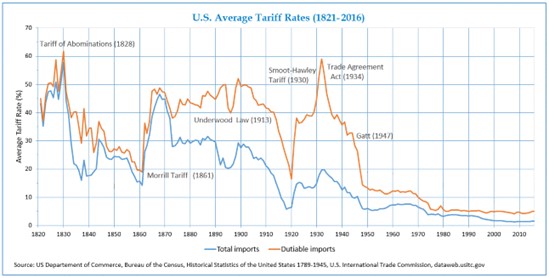
Henry Clay’s American System supported tariffs to protect our economic growth from foreign imports. His speech in 1824 was the first attempt to make America self-sufficient and independent of other countries. In 1828, Congress passed the Tariff of Abominations which led South Carolina to pass the Nullification Act.  The Tariff of 1828 set a 38% tax on some imported goods and a 45% tax on certain imported raw materials.

  1. How was the American System designed to work?
  2. What impact did the American System have on the U.S. economy during the early to mid-1800s?
  3. Did the American System benefit each region equally or did some regions have an advantage?
  4. How did the American System set the stage for the Industrial Revolution and sectionalism?
  5. What lessons should have been learned from the Tariff of 1828?

In the chart below, use the data beginning in 1800 with the Per Capita Income (per person) set at 200. This number indicates that the per person income from 1700 to 1800 doubled. Next, examine the indicator in 1850, which is set at 220. This indicates that the per person income increased only 20% in the fifty years since 1800. This is less than one-half percent per year on average.

Next, compare the date on tariff rates in the graph above with the per capita income rates in the graph below. Do tariffs impact economic growth?

At the beginning of the 19th century, the United States was a rural and agricultural country. Our nation’s population was small compared to Britain and France and scattered over a large area. Our population was 5.3 million in 1800, compared to Britain’s 15 million and France’s 27 million. Tariffs from Britain and France were high and significantly made the price of imported goods in the United states high.

After the War of 1812, the American economy began to grow. The development of steamboats, canals, railroads and the telegraph reduced costs and made communications faster. The growth of cities created markets for industrial goods. New inventions increased agricultural production and textile manufactures.  Children, immigrants, and women provided affordable labor.  Source

Discuss and debate the role of the federal government in the economy.

Do tariffs support or restrict economic growth?

Does free trade support or restrict economic growth?

Why do you think Britain lowered tariffs after 1828 and France did not?

Is economic growth dependent on the age, health, and skills of the labor force?

Is economic growth dependent on the infrastructure of a country to facilitate the distribution of goods and services?

How can governments best distribute wealth equally in the economy?

Do national leaders have any significant influence on economic growth?

How did the stock and commodities markets provide money (capital) for economic growth?

After the Civil War, the United States experienced unprecedented economic growth with the Industrial Revolution, imperialism, and immigration. The use of greenbacks and silver provided capital, cities provided markets for stores, immigrants provided affordable labor, and new technologies increased productivity and the efficient distribution of goods and services.

The beginning of a market exchange for bonds, agricultural products, and stocks developed with the Buttonwood Agreement in Manhattan. Stockbrokers and merchants met under the Buttonwood tree to sign an agreement that established the foundation for the New York Stock Exchange. The building with the flag is the Tontine Coffee House, where stocks were eventually traded.

The Mohawk & Hudson Railroad Company was the first railroad stock listed on the NYSE in 1830. At that time, the Exchange was called the New York Stock & Exchange Board. Banks and steel foundries were also listed. Mercantile exchanges for agricultural products provided guidance on the future demand for wheat, rice, tobacco, cotton and other products. These investments supported economic growth more than the protectionism of tariffs.

The flow of international capital into the United States provided capital for the Industrial Revolution that followed the Civil War. The market cap/GDP ratio tripled from around 15% in the 1860s to 50% by 1900. The inflation in the United States that occurred after World War I, World War II and the Vietnam War reduced the relationship of the market cap/GDP ratio and slowed the rate of economic growth. After each of these inflationary cycles, a return to higher tariffs to limit cheaper imports from other countries was the solution proposed by political leaders.  Economists, Joseph Schumpeter, Friedrich Hayek, John Maynard Keynes and Milton Friedman advocated for lower tariffs, innovation, and entrepreneurs to promote economic growth. The ratification of the 16th amendment and the adoption of the income tax in the United States undermined the argument that tariffs were necessary to fund the government and to protect industries from foreign competition.

President Hoover signed the Smoot-Hawley Tariff Act in 1930 raising the tariff by an average of 20% to protect American farmers from the effects of the stock market crash. The tariff caused trade between Europe and the U.S. to decline by two-thirds. At the end of World War II, tariffs were decreased substantially, and the U.S. supported the establishment of the World Trade Organization, which has sought to promote the reduction of tariff barriers to world trade.

  1. Does the public or private sector have the greater influence on economic growth and stabilizing inflation?
  2. What can be done to limit the effects of business cycles leading to inflation and unemployment?
  3. How effective are tariffs, embargoes, and sanctions in getting leaders of countries to negotiate or change their policies to align with the interests of the United States?
  4. Under what circumstances might tariffs be justified or effective?
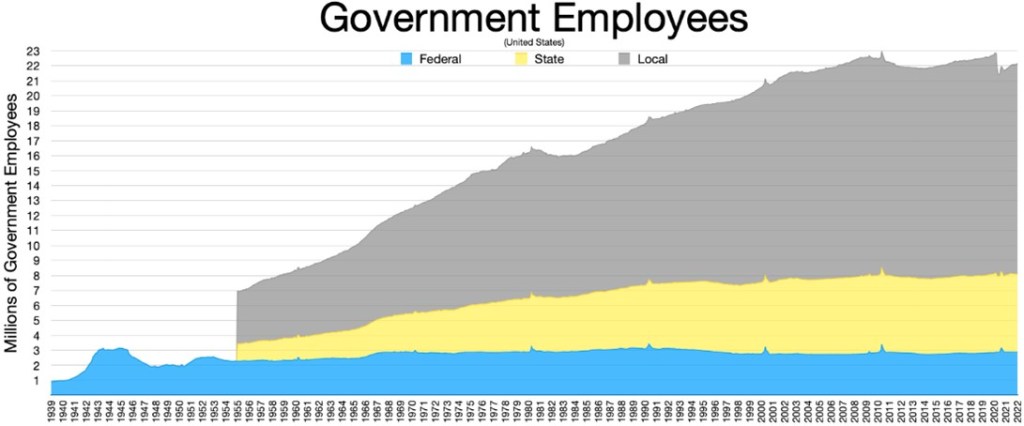
  5. Examine the graph below to determine the biggest employer in the United States.
  • What conclusions can you make about the largest private employers in each state from the map below?

RWJBarnabas Health is the largest private employer in New Jersey, with 31,683 employees. Healthcare is a major employer in the state, accounting for 16% of all jobs. Who is the largest private employer in your county?

Use the chart below to compare the change in prices for an automobile before and after a hypothetical tariff of 20%. Because automobiles have thousands of parts and assembling an automobile often occurs in different countries, a tariff has the greatest impact on new cars.

Interview a local car dealer in your community about how a tariff will affect their business and how they plan to respond with sales, rebates, reduced financing, layoffs of workers, etc. Also ask about how a tariff will affect parts, tires, and the repair or maintenance of automobiles.

Make a list of five or more other businesses in your community that import supplies from other countries. (phones, Dollar Stores, coffee, clothing, TV monitors, etc.) If possible, research or interview the manager of a local big box store (Walgreens, Target) about how a tariff will affect their business.

Create a graphic design or flow chart to illustrate how the effect of higher prices from tariffs will affect consumer spending. For example, if prices increase by 20% and salaries increase by 5%, how will this affect businesses and households? Higher prices from tariffs are considered inflationary and layoffs from reduced sales are considered recessionary. Discuss what the short-term impact (three years) will be on the economy and your family.

In 1951, six countries (France, Germany, Italy, Belgium, Netherlands, and Luxembourg) agreed to sell coal and steel to each other without tariffs. The European Coal and Steel Community (ECSC) established a single common market. In 1957, the European Economic Community (ECC) was created by the Treaty of Rome. The six countries that formed the European Coal and Steel Community agreed to trade additional goods without tariffs, to work together on nuclear power plants for energy, and to form a parliament. In 1992 the Maastricht Treaty was signed by 12 countries leading to the European Union and a common currency, the euro, in 1999. The euro was fully implemented by 2002.

President Clinton’s administration signed the North American Free Trade agreement with Mexico and Canada in 1993 (it became effective on January 1, 1994) removing tariffs between these countries. The Transatlantic Trade and Investment Partnership (T-TIP) is a trade and investment agreement currently being negotiated between the United States and the European Union. This agreement will allow American families, workers, businesses, farmers and ranchers through increased access to European markets for Made-in-America goods and services.

In 2020, the Conservative Party in Britain convinced the people to leave the European Union (Brexit).  The United Kingdom was the second-largest economy in Europe, its third-most populous country, and one of the largest contributors to the budget of the European union.  In January 2024, an independent report by Cambridge Econometrics claimed there were two million fewer jobs, and the prices of essential goods were higher. As a result of Brexit, the average citizen (per person) lost about 2,000 pounds and someone living in London about 3,400 pounds as a result of leaving the common market.

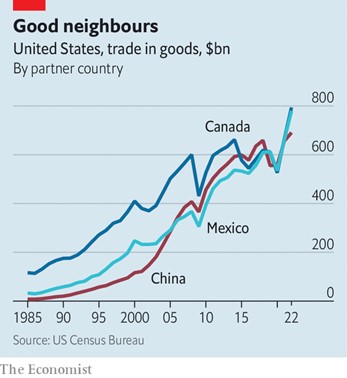
It is difficult to assess the impact of NAFTA on the United States because of currency value fluctuations, trade with China, the impact of technology, the relocation of some corporations, and the values placed on agricultural products.  The Center for Economic and Policy Research estimated in 2014 a decline from a surplus of $1.7 billion to a deficit of $54 billion. The data in the graphs below suggest a positive trade balance with Canada and Mexico over the past 30 years. (1994-2022) Mexico, Canada, and China are the three major trading partners with the United States.

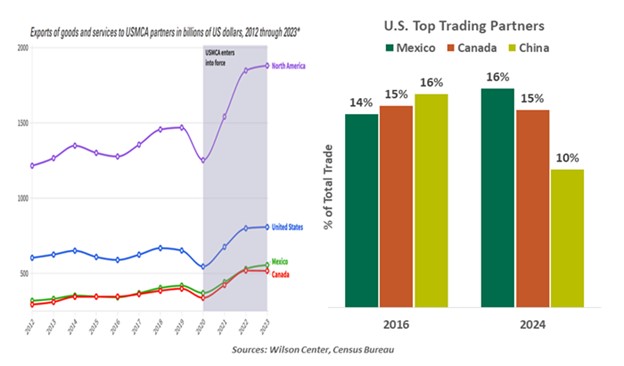
In the graph below there is a slight increase in exports from the United States to Mexico and exports with Canada continue at 15%. Exports to China had a significant drop of about one-third.

Data Reflecting the new USMCA ratified in 2019.

Maple syrup, pine lumber, and cranberries are a few items in our homes that are likely imported from Canada under NAFTA or the new USMCA. Lululemon and Blackberry are brands from Canada. Appliances, automobiles, tomatoes, avocados, electronics, monitors are some items from Mexico.

Identify items in your home with labels from Mexico and Canada, interview merchants in supermarkets and department stores, and conduct research to identify the importance of trade between the United States, Canada, and Mexico.

Develop a position statement or a short paper explaining your opinion on tariffs and free trade agreements to stimulate economic growth and stabilize inflation.

Era 6 The Emergence of Modern America: Progressive Reforms (1890–1930)

New Jersey Council for the Social Studies

www.njcss.org

The relationship between the individual and the state is present in every country, society, and civilization. Relevant questions about individual liberty, civic engagement, government authority, equality and justice, and protection are important for every demographic group in the population.  In your teaching of World History, consider the examples and questions provided below that should be familiar to students in the history of the United States with application to the experiences of others around the world.

These civic activities are designed to present civics in a global context as civic education happens in every country.  The design is flexible regarding using one of the activities, allowing students to explore multiple activities in groups, and as a lesson for a substitute teacher. The lessons are free, although a donation to the New Jersey Council for the Social Studies is greatly appreciated. www.njcss.org

Era 6 The Emergence of Modern America: Progressive Reforms (1890–1930)

The development of the industrial United States is a transformational period in our history. The United States became more industrial, urban, and diverse during the last quarter of the 19th century. The use of fossil fuels for energy led to mechanized farming, railroads changed the way people traveled and transported raw materials and goods, the demand for labor saw one of the largest migrations in world history to America, and laissez-faire economics provided opportunities for wealth while increasing the divide between the poor and rich. During this period local governments were challenged to meet the needs of large populations in urban areas regarding their health, safety, and education.  

Read the information below from the constitutions of the United States and Israel on the election of the head of State and discuss the similarities and differences. Until the 20th Amendment was ratified, the United States did not have a designated date for the transfer of power from one elected leader to the next.

Twentieth Amendment

Section 1

The terms of the President and the Vice President shall end at noon on the 20th day of January, and the terms of Senators and Representatives at noon on the 3d day of January, of the years in which such terms would have ended if this article had not been ratified; and the terms of their successors shall then begin.

Section 2

The Congress shall assemble at least once in every year, and such meeting shall begin at noon on the 3d day of January, unless they shall by law appoint a different day.

Section 3

If, at the time fixed for the beginning of the term of the President, the President elect shall have died, the Vice President elect shall become President. If a President shall not have been chosen before the time fixed for the beginning of his term, or if the President elect shall have failed to qualify, then the Vice President elect shall act as President until a President shall have qualified; and the Congress may by law provide for the case wherein neither a President elect nor a Vice President elect shall have qualified, declaring who shall then act as President, or the manner in which one who is to act shall be selected, and such person shall act accordingly until a President or Vice President shall have qualified. (See the 25th Amendment, ratified on February 10, 1967)

Section 4

The Congress may by law provide for the case of the death of any of the persons from whom the House of Representatives may choose a President whenever the right of choice shall have devolved upon them, and for the case of the death of any of the persons from whom the Senate may choose a Vice President whenever the right of choice shall have devolved upon them. Ratified: January 23, 1933 (See the 25th Amendment, ratified on February 10, 1967)

BASIC LAW. THE PRESIDENT OF THE STATE OF ISRAEL (1964)

1. A President shall stand at the head of the State.

2.The place of residence of the President of the State shall be Jerusalem.

3.The President of the State shall be elected by the Knesset for seven years.The President will serve for one term only.

4.Every Israel national who is a resident of Israel is qualified to be a candidate for the office of President of the State.

5.The election of the President of the State shall be held not earlier than ninety days and not later than thirty days before the expiration of the period of tenure of the President in office. If the place of the President of the State falls vacant before the expiration of his period of tenure, the election shall be held within forty-five days from the day on which such place falls vacant. The Chairman of the Knesset, in consultation with the Vice-Chairmen, shall fix

the day of the election and shall notify it to all the members of the Knesset in writing at least three weeks in advance. If the day of the election does not fall in one of the session terms of the Knesset, the Chairman of the Knesset shall convene the Knesset for the election of the President of the State.

6. Proposal of Candidates (Amendment 8)

A proposal of a candidate for President of the State shall be submitted in writing to the Chairman of the Knesset, together with the consent of the candidate in writing, on the fourteenth day before the day of the election;

A member of the Knesset shall not sponsor the proposal of more than one candidate; A person that any ten or more members of the Knesset proposed his candidacy shall be candidate for President of the State, except if the number of sponsors decreased below ten because of the deletion of the name of a member of the Knesset as described in subsection (3);

Where a member of the Knesset sponsored the proposal of more than one candidate, the name of that member of the Knesset shall be deleted from the list of sponsors for all candidates he sponsored; Where the number of sponsors of a candidate decreased below ten because of the deletion of a name from the list of sponsors, a member of the Knesset who did not sponsor any proposal may add his name to the list of sponsors of that candidate, no later than eight days before the day of the election.

The Chairman of the Knesset shall notify all the members of the Knesset, in writing, not later than seven days before the day of the election, of every candidate proposed and of the names of the members of the Knesset who have proposed him and shall announce the candidates at the opening of the meeting at which the election is held.

7. The election of the President of the State shall be by secret ballot at a meeting of the Knesset assigned only for that purpose.

8.If there are two candidates or more, the candidate who has received the votes of a majority of the members of the Knesset is elected. If no candidate receives such a majority, a second ballot shall be held. At the second ballot only the two candidates who received the largest number of votes at the first ballot shall stand for election. The candidate who at the second ballot receives a majority of the votes of the members of the Knesset who take part in the voting and vote for one of the candidates is elected. If two candidates receive the same number of votes, voting shall be repeated.

If there is only one candidate, the ballot will be in favor or against him and he is elected if the number of votes in his favor outweighs the number of votes against him. If the number of votes in his favor equals the number of votes against him, a second ballot shall be held.

1. What was the main problem the 20th Amendment solved? Was this a significant concern at the time?

      2. How did the 20th Amendment solve that problem and what problems were not solved?

      3. Should the United States consider amending the Constitution to provide for the election of the president and vice-president by the House and Senate?

      4. Are the limitations or weaknesses in the way Israel is currently governed or is there system superior to others with popular elections?

      Presidential Term and Succession

      Date Changes for Presidency, Congress, and Succession

      Interpretation and Debate of the 20th Amendment

      Historical Background to the 20th Amendment

      Democracy and Elections in Israel

      Israel’s Elections

      Reforming the Israeli Electoral System

      Regulating communications in the United States has been going on since the Radio Act of 1912. The military, emergency responders, police, and entertainment companies each wanted to get their signals out over the airwaves to the right audiences without interference. The Radio Act of 1912 helped to establish a commission that would designate which airwaves would be for public use and which airwaves would be reserved for the various commercial users who needed them.

      In 1926, the Federal Radio Commission was established to help handle the growing complexities of the country’s radio needs. In 1934, Congress passed the Communications Act, which replaced the Federal Radio Commission with the Federal Communications Commission. The Communications Act also put telephone communications under the FCC’s control. The FCC broke up some of the communications monopolies, such as the National Broadcasting Company (NBC) which part of it became the American Broadcasting Company (ABC).  

      The FCC has been in the middle of controversial decisions. In 1948, the FCC put a freeze on awarding new television station licenses because the fast pace of licensing prior to 1948 had created conflicts with the signals. The freeze was only supposed to last a few months but was extended to four years.

      The breakup of the telephone monopoly AT&T into a series of smaller companies is another example of a controversial decision. The Telecommunications Act of 1996 allowed competition by mandating that the major carriers allow new companies to lease services off of their lines and they could then sell those services to customers.

      Another area where the FCC has been criticized is in regulating the content (“decency”) of radio and television broadcasts. There was an incident at the 2004 Super Bowl halftime show when the wardrobe of Janet Jackson malfunctioned, and part of her breast was exposed. The FCC does not set the content standards for movies but has the authority to issue fines.

      Since 2014, the idea of “net neutrality” has been before the federal courts regarding an open and free internet and permission for providers to charge subscription fees.

      British Broadcasting Corporation (BBC)

      Daily broadcasting by the BBC began on November 14, 1922. John Reith was appointed as the director. There were no rules or standards to guide him. He began experimenting and published the Radio Times.

      The BBC was established by Royal Charter as the British Broadcasting Corporation in 1927. Sir John Reith became the first Director-General. The Charter defined the BBC’s objectives, powers and obligations. It is mainly concerned with broad issues of policy, while the Director-General and senior staff are responsible for detailed fulfilment of that policy.

      1. Is the regulation of radio, television, telephone and internet communications democratic?
      2. Should the freedom of speech be unlimited in the United States or does the government have the responsibility and authority to control the content and images?
      3. Do the Regulatory Agencies of the United States promote the general welfare, or do they restrict the blessings of liberty?
      4. Are monopolies in the communications and technology industries justified because of the expense and protection of patents?
      5. Does the United Kingdom have a state sponsored news media in the BBC?
      6. Which country’s policies on communications do you agree with? Why?

      BBC Guidelines for Inappropriate Content

      The Communications Act of 1934

      History of the Federal Communications Commission

      History of Commercial Radio

      Suez Canal Crisis (1956)

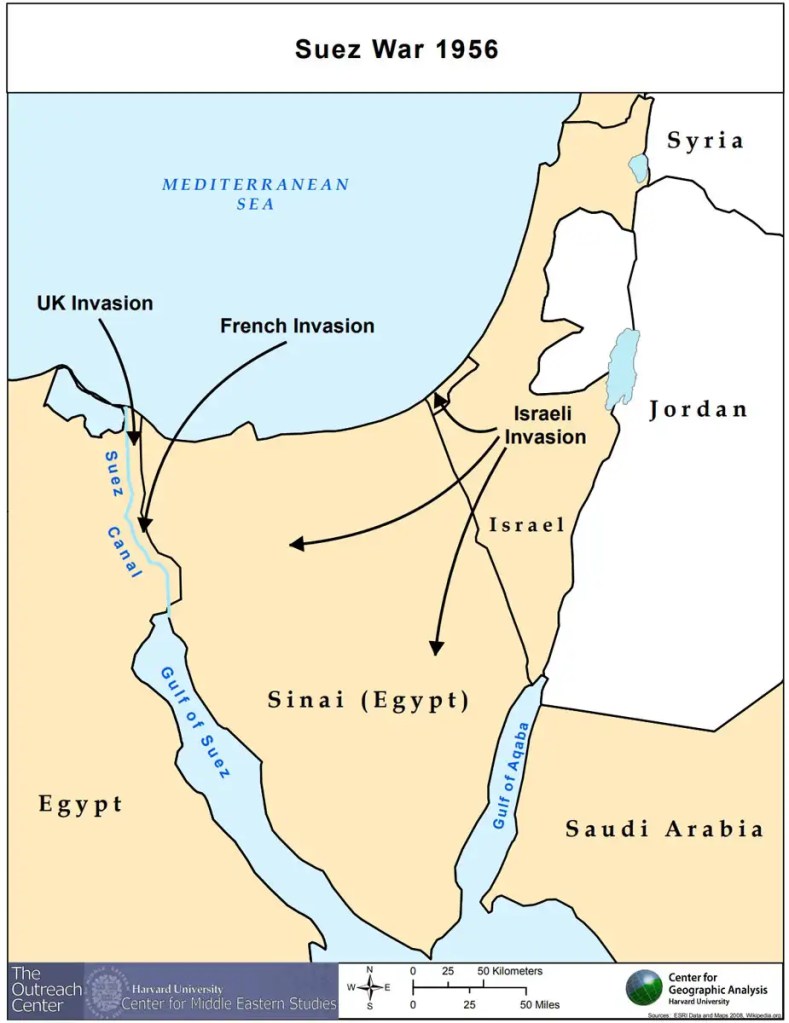
      On July 26, 1956, Egyptian President Gamal Abdel Nasser announced the nationalization of the Suez Canal Company, which was jointly operated by a British and French company since its construction in 1869. The British and French held secret military consultations with Israel, who regarded Nasser as a threat to its security. Israeli forces attacked Egypt’s Sinai Peninsula on October 29, 1956, advancing to within 10 miles of the Suez Canal. Britain and France landed troops of their own a few days later.

      The relations between the United States and Britain weakened when Britain bombed Egypt over their blockade of the Suez Canal. The United Nations threatened Britain with sanctions if there were any civilian casualties. This led to economic panic and Britain faced having to devalue its currency. President Eisenhower was shocked that he was not informed of the British military response and put pressure on the International Monetary Fund to deny Britain any financial assistance. The British reluctantly accepted a UN proposed ceasefire. Under Resolution 1001 on 7 November 1956 the United Nations deployed an emergency force (UNEF) of peacekeepers into Egypt.

      The canal was closed to traffic for five months by ships sunk by the Egyptians during the operations. British access to fuel and oil became limited and resulted in shortages. Egypt maintained control of the canal with the support of the United Nations and the United States. Under huge domestic pressure and suffering ill-health Eden resigned in January 1957, less than two years after becoming prime minister.

      1. Does the United States have a responsibility to support its allies even when our policies do not agree with their policies or actions?
      2. Did President Eisenhower overstep his authority by asking for economic sanctions against Britain?
      3. Did President Roosevelt overstep his constitutional authority in signing the Hay-Bunau-Varilla Treaty or was the overstep committed by the Philip Bunau-Varilla, Panama’s ambassador to the United States?
      4. In matters of foreign policy, do economic interests justify military actions?

      History of the Panama Canal

      The Panama Canal

      International Law and the Panama Canal

      The Suez Canal Crisis

      Why was the Suez Canal Crisis Important?

      Poll Taxes and the 24th Amendment

      The US Constitution leaves voter qualifications, except for age, to individual states. By the mid-19th century, however, most states did not limit voting by property ownership or poll taxes. A poll tax of $2 in 1962 would convert to approximately $17 in 2020 dollars. After the ratification of the 15th Amendment, in an attempt to limit Black voter registration and turnout, many states re-established poll taxes. The combination of poll taxes, literacy tests, White primaries (permitting only Whites to vote in primary elections), intimidation, violence, and disqualification of people convicted of felonies succeeded in reducing voter participation.

      In his 1962 State of the Union Address, President Kennedy put the issue on the national agenda when he called for the elimination of poll taxes and literacy tests, stating that voting rights “should no longer be denied through such arbitrary devices on a local level.” The proposal to ban literacy tests did not make it past a Senate filibuster, but after debating the substance of the proposal to end the poll tax and whether or not the tax should be eliminated by a Constitutional amendment, Congress passed the 24th Amendment, abolishing poll taxes in federal elections on August 27, 1962.

      The passage of the 24th Amendment and the Voting Rights Act of 1965 did not completely eliminate the obstacles for voter registration or voting. On March 24, 1966, the Supreme Court ruled in Harper v. Virginia Board of Elections that poll taxes could not be collected in any election, including state and local elections, since they violated the 14th Amendment’s Equal Protection Clause. The 19th Amendment gave women the right to vote but enforcement is dependent on congressional legislation. To what extent are citizens denied the right to vote today?

      Chartist Movement in the United Kingdom

      In 1838 a People’s Charter was drawn up for the London Working Men’s Association (LWMA) by William Lovett and Francis Place, two self-educated radicals, in consultation with other members of LWMA. The Charter had six demands:

      All men to have the vote (universal manhood suffrage)

      Voting should take place by secret ballot.

      Parliamentary elections every year, not once every five years

      Constituencies should be of equal size.

      Members of Parliament should be paid.

      The property qualification for becoming a Member of Parliament should be abolished.

      The Chartists’ petition was presented to the House of Commons with over 1.25 million signatures. It was rejected by Parliament. This provoked unrest which was swiftly crushed by the authorities. A second petition was presented in May 1842, signed by over three million people but again it was rejected, and further unrest and arrests followed. In April 1848 a third and final petition was presented. The third petition was also rejected but there were no protests. Why did this movement fail to complete its objectives?

      1. Should the requirement of having a birth certificate or another state ID document as proof of residency a modern-day poll tax? In all states these documents have a cost.
      2. Does the Voting Rights Act of 1965 need to be updated with the John R. Lewis Voting Rights Advancement act?
      3. Was the poll tax a financial burden on a low-income family? (In today’s currency about $34 for two adults)
      4. What led to the rise of the Chartists Movement?
      5. Why did the Chartist Movement fail to achieve its objectives?
      6. With the many criticisms of a democracy and a republic, is it the preferred form of government?

      Barriers to Voting: Poll Taxes

      Abolition of Poll Taxes: 24th Amendment

      Voting Rights for African Americans

      Equal Protection Clause of the 14th Amendment

      Voting Rights Act of 1965

      The Chartist Movement

      The Importance of the Chartist Movement