
The Impact of Economic Decisions by American Presidents Series
Presidents and Labor Strikes
Hank Bitten, NJCSS Executive Director
Most decisions by American presidents and other world leaders do not have an immediate impact on the economy, especially regarding the macroeconomic issues of employment and inflation. For example, President Franklin Roosevelt’s bank holiday, President John Kennedy’s tariff on imported steel, and President Ronald Reagan’s Economic Recovery Tax Act had limited immediate effects on the economy, but their long-term effects were significant. The accomplishments or problems of a previous administration may impact on the administration that follows.
For example, President Biden faced criticism about the economy during his administration. The jobs created with the Bipartisan Infrastructure Law and the interest rate policy of the Federal Reserve Bank to lower inflation did not show results until years later. The drop in Real Disposable Income from the administration of President Trump is another example. Real Disposable Income is a measure of income that is adjusted for inflation. The drop between the administration of President Bident and Trump is the result of extended unemployment benefits, people working from home during the pandemic when businesses were closed, and stimulus checks from the government. The economic transition following the end of the pandemic had a significant impact on the economy.
| President | GDP Growth | Unemployment Rate | Inflation Rate | Poverty Rate | Real Disposable Income |
| Johnson | 2.6% | 3.4% | 4.4% | 12.8% | $17,181 |
| Nixon | 2.0% | 5.5% | 10.9% | 12.0% | $19,621 |
| Ford | 2.8% | 7.5% | 5.2% | 11.9% | $20,780 |
| Carter | 4.6% | 7.4% | 11.8% | 13.0% | $21,891 |
| Reagan | 2.1% | 5.4% | 4.7% | 13.1% | $27,080 |
| H.W. Bush | 0.7% | 7.3% | 3.3% | 14.5% | $27,990 |
| Clinton | 0.3% | 4.2% | 3.7% | 11.3% | $34,216 |
| G.W. Bush | -1.2% | 7.8% | 0.0% | 13.2% | $37,814 |
| Obama | 1.0% | 4.7% | 2.5% | 14.0% | $42,914 |
| Trump | 2.6% | 6.4% | 1.4% | 11.9% | $48,286 |
| Biden | 2.6% | 3.5% | 5.0% | 12.8% | $46,682 |
This series provides a context of important decisions by America’s presidents that are connected to the expected economic decisions under the second administration of President Trump. The background information and questions provide an opportunity for small and large group discussions, structured debate, and additional investigation and research. They may be used for current events, as a substitute lesson activity or integrated into a lesson.
In the case study below, have your students investigate the economic problem, different perspectives on the proposed solution, the short- and long-term impact of the decision, and how the decision affects Americans in the 21st century.
The Economic Problem
One of the first labor strikes in the United States occurred in Paterson, New Jersey on July 3, 1835. About 2,000 textile workers stopped working in about 20 textile mills demanding better hours. Workers, including women and children worked 13 hours a day six days a week and their wages were reduced as fines for infractions. The strike eventually led to a 12-hour day and a nine-hour day on Saturday.

In 1835 carpenters, masons, and stonecutters in Boston staged a seven-month strike in favor of a ten-hour day. The strikers demanded that employers reduce excessively long hours worked in the summer and spread them throughout the year. In Philadelphia, carpenters, bricklayers, plasterers, masons, leather dressers, and blacksmiths went on strike. In Lowell, MA, women also went on strike. The history of labor complaints and strikes date back to the colony of Jamestown. Although the common law in England provided protection for peaceful demonstrations, the courts in the colonies and states often fined workers because their organization as a group was viewed as a ‘restrain of free trade’ or a violation of the right of property for employers. In 1842, the Commonwealth of Massachusetts v. Hunt was a landmark decision that allowed peaceful demonstrations. “In March 1842, Chief Justice Lemuel Shaw ruled that labor combinations were legal provided that they were organized for a legal purpose and used legal means to achieve their goals.”

The economic problem was long hours, low wages, and oppressive working conditions. The market revolution led to the demand for consumer goods. The new inventions of the cotton gin, steamboats, locomotives, and factories. The nature of work was changing and this led to profound changes in society. Employers and entrepreneurs believed this was the idea behind the pursuit of happiness in the declaration of Independence and how a republic was governed. Laborers used the press to voice their concerns which led to the organization of trade unions in Philadelphia.
President Andrew Jackson’s decision to let the charter of the Second Bank of the United States to expire had an unexpected and profound impact on ordinary people. Working conditions continued to decline and President Jackson’s decision led to an increase in paper money and inflation. Higher prices led to unemployment and longer hours for those who were employed. Illness or injury and debt led to homelessness and poverty. According to a New York City physician, the laboring poor in the 1790s lived in “little decayed wooden huts” inhabited by several families, dismal abodes set on muddy alleys and permeated by the stench from “putrefying excrement.” Source
In 1840 the federal government introduced a ten-hour workday on public works projects. In 1847 New Hampshire became the first state to adopt a ten-hour day law. It was followed by Pennsylvania in 1848. Both states’ laws, however, included a clause that allowed workers to voluntarily agree to work more than a ten-hour day. Despite the limitations of these state laws, agitation for a ten-hour day did result in a reduction in the average number of hours worked, to approximately 11 by 1850. On May 19, 1869, President Grant issue Proclamation 182 making an 8-hour day for all federal government employees. This expanded the decision of Congress made in 1868.
After the Civil War, manufacturing and economic growth increased dramatically. There were many strikes as farmers and laborers, both skilled and unskilled, formed associations and unions. Below are examples of larger strikes that are likely part of the high school curriculum.
Haymarket Square:
During the first week of May,1886 workers in Chicago staged demonstrations and strikes demanding an eight-hour day. On May 4 a bomb exploded near Haymarket Square in Chicago. Several police officers and protesters were wounded or killed by the blast, and 8 individuals were arrested and convicted. Source

A day to recognize the rights of workers was first proposed by Matthew Maguire from Paterson, NJ in 1882. The balance between the right to have peaceful demonstrations under the First Amendment was respected but the Haymarket Riot became violent, strikes were costly to the profits of employers, and violence and strikes were a threat to property. President Cleveland was the first president challenged by the threat of anarchy from socialists. After the Haymarket Riot, a few states, including New York and New Jersey, recognized a Labor Day holiday. This was the fourth federal holiday after Independence Day, Christmas Day, and New Year’s Day. Congress considered making Labor Day a federal holiday in May, but President Cleveland feared this would become a recognition of the violence of the Haymarket Riot. President Cleveland was the first president to involve the federal government in resolving issues between labor and business interests or capital. Source

Newspaper Accounts of the Haymarket Riot, 1886
Questions:
- Under what conditions would you support workers on strike? (higher wages, better working conditions, unfair practices by an employer, benefits, job security, etc.)
- Are labor strikes a violation of the property rights of employers?
- Do workers have a right to disrupt the production of goods or services by a slowdown in the workplace, strict adherence to their contract agreement, coordinating a sick out, making public expressions or statements about their situation, etc.
- Do workers need to be paid in wages or can employers also pay them in other ways? (time off, goods produced, etc.)
- Should workers receive an annual salary increase based on their months or years of service, inflationary costs of living, or only if they produce more than in the past?
- How would you determine a fair wage?
- Do the students in your class (or a larger group) support the right to strike workers?
Activity #1
Open the three-day lesson on the 1835 strike in Paterson, NJ. (Update the CPI index from 2012 to the present)
Carnegie Company Strike:
In the months before the presidential election of 1892, President Harrison was faced with a violent strike at the Carnegie Steel Company in Homestead, PA near Pittsburg. The Knights of Labor and the Amalgamated Association of Iron Workers went on strike on June 30 when their contract expired. Workers in Carnegie’s companies in the area supported the striking workers. Henry Clay, the manager of the Homestead plant, hired private Pinkerton guards to protect the plant and keep the striking workers away. President Harrison privately sent Whitelaw Reid to mediate the conflict.
The strikers threw rocks at the guards, the crowd size was estimated to be about 5,000, and gunshots were fired. At one point amid the chaos, shots were fired. The Pinkertons surrendered and the strikers continued with verbal abuse and assaulted them with rocks as they marched them to a local Opera Hall.
On July 12, Pennsylvania Governor Robert Pattison sent 8,500 National Guardsmen to end the strike. In less than 30 minutes the Carnegie mill was under martial law, the strikers were arrested. Sixteen of the strikers were arrested for conspiracy, murder, and inciting riots. The strike ended three months later in November with the workers agreeing to lower wages, the elimination of 500 jobs, and a 12-hour day. The labor unions lost, and their membership declined.


Pullman Company Strike:
President Cleveland faced a nationwide railroad strike that began on May 11, 1894. The American Railway Union went on strike against the Pullman Company and the major railroads. It became a turning point in U.S. labor law. The workers at Pullman protested the layoff of 2,000 workers and wage cuts that amounted to 25%-50% of their wages. The Pullman workers lived in a company town and paid rent to the Pullman Company, which was located near Chicago, Il. The rents were not reduced. The Pullman Company also had a surplus of $4 million at the time of the strike and consistently paid dividends to shareholders.
The Panic or recession of 1893 negatively affected many companies as production declined. The railroads depended on shipping farm products, which were reduced as a result of crop failures. This was the most serious economic recession in the world as investors in Europe purchased gold from U.S. banks, Americans took their savings out of banks, and companies that had speculated in the stock, bond, and commodity markets lost money/ The economic recovery after the recession ended would take several years.
On July 3, 1894, President Cleveland ordered 2,000 armed federal troops to Chicago to end the strike. The strike ended within a few weeks, union leaders were arrested and jailed on charges of conspiracy to obstruct interstate commerce. The justification of using federal troops to move the U.S. mail was based on the Sherman Anti-Trust Act of 1890. This was not the first time federal troops were used to end a strike. President Jackson used troops in 1834 to end the strike by workers building the Chesapeake and Ohio Canal and in 1877 President Hayes send troops to end the violence in Baltimore during the Great Railroad strike.

Coal Strike:
In May 1902 President Teddy Roosevelt was faced with a nationwide strike by coal miners. Many homes were heated by coal and a prolonged strike in the winter could be catastrophic, deadly, and cause riots. On October 3, 1902, with winter weather approaching, President Theodore Roosevelt called a precedent-shattering meeting to negotiate a settlement. The President did not have any legal authority to settle a labor dispute, although Presidents Jackson, Hayes and Cleveland used federal troops to end labor disputes.
President Roosevelt’s administration proposed the Anthracite Coal Commission to complete a fact-finding report and negotiate a settlement. The strike ended on October 20, 1902, and the Commission recommended in March 1903 increasing miners’ pay by ten percent (one-half of their demand) and reducing the working day from ten to nine hours.
Samuel Gompers wrote: “Several times I have been asked what in my opinion was the most important single incident in the labor movement in the United States and I have invariably replied: the strike of the anthracite miners in Pennsylvania … from then on the miners became not merely human machines to produce coal but men and citizens…. The strike was evidence of the effectiveness of trade unions ….
The victory in the anthracite coalfields breathed new life into the American labor movement.55 It strengthened moderate labor leaders and progressive businessmen who championed negotiations as a way to labor peace. It enhanced the reputation of President Theodore Roosevelt. Sometimes overlooked, however, is the change the conflict made in the role of the Federal Government in important national strikes.” Source
Paterson Silk Strike of 1913:

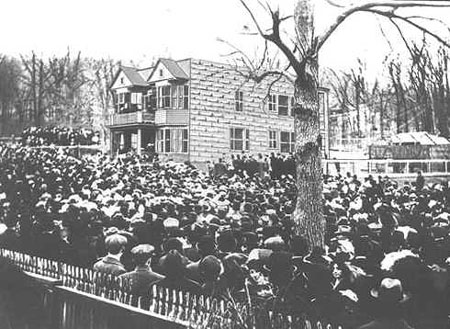
The silk strike began in February 1913 when twenty-five thousand striking silk workers shut down the three hundred silk mills and dye houses in Paterson, New Jersey, for almost five months. There were several textile strikes that preceded the one in Paterson. The Paterson strike was related to an increased workload and the desire for an eight-hour day. The other strikes occurred because of wages. The Industrial Workers of the World (I.W.W.) were active in organizing the strike and produced the “Pageant of the Paterson Strike” in Madison Square Garden on June 7. Pietro Botton opened his home to the labor leaders from New York City and on May 25, a rally of more than 20,000 people took place outside his home. These rallies continued on Sundays until the strike ended in July.
The strikers returned to work without any concessions, although the employers did not implement the plan to have one worker operating four looms instead of two.
Questions:
- What is a yellow dog contract, scab, collective bargaining, closed shop, and right to work protections
- What are the differences between skilled and unskilled laborers?
- How is an Association different from a labor or trade union?
- Who has the advantage in a strike: labor employees or employers?
- How do strikes affect the economy and the lives of people who are not associated with the union?
- Why do you think the union and workers failed to achieve their goal in the Paterson Strike of 1913?
Activity #2:
- Make a list of labor unions and associations in the United States.
- Use these sources to categorize the list of strikes by length of time, size of the unions, and frequency? List of Unions (Wikipedia) 200 Years of Labor History (NPS)
The Seattle General Strike, 1919

The Seattle General Strike of February 1919 was the first 20th-century solidarity strike in the United States to be proclaimed a “general strike.” Seattle had 101 unions that were part of the American Federation of Labor (AFL). On the morning of February 6, 1919, over 25,000 union workers stopped working to support the 35,000 shipyard workers who were already on strike. Although wartime inflation created a need for higher wages, the goals of the striking workers were not clearly articulated. Mayor Ole threatened to declare martial law and two battalions (about 3,000) U.S. Army troops arrived. The union members had already implemented a plan to provide food deliveries, transport people to hospitals, and patrol the streets to prevent crime. Below is an image of a soup kitchen. Union members distributed 30,000 meals a day during the strike.

The strike lasted six days and was peaceful. There were minimal gains for the workers, but most returned to work. There were several outside agitators who were identified as “Reds” or communists who were arrested. The strike is generally viewed as unsuccessful.
Seattle General Strike Project
History of the General Strike (9-minute Video)
History of the General Strike (4-minute Video)
The Seattle General Strike (Roberta Gold)
The Boston Police Strike
The Boston Police went on strike on September 9, 1919. Police officers worked long hours, received low wages, and had inadequate working conditions. They worked thirteen-hour days and wanted an eight-hour day. They had to purchase their own uniforms which cost $200 (about two months’ salary), were required to sleep overnight in the police station several nights a month, and they had not received a salary increase in over ten years. They were paid about 25 cents an hour and earned about $1,400 a year.
U.S. Supreme Court Decisions (1905 – 1923)
The three cases below were landmark decisions in the labor movement. The Lochner decision ruled that employers could issue contracts without any restrictions such as an 8- or 10-hour day. The Adkins decision supported this and ruled it was illegal to have a minimum wage for workers. The Muller decision ruled that the hours of women could be less than those of men if their health was at risk.
Lochner v. New York (1905)
The general right to make a contract in relation to one’s business is part of the liberty protected by the Fourteenth Amendment, and this includes the right to purchase and sell labor, except as controlled by the state in the legitimate exercise of its police power.
Muller v. Oregon (1908)
The regulation of the working hours of women falls within the police power of the state, and a statute directed exclusively to such regulation does not conflict with the Due Process or Equal Protection Clauses.
Adkins v. Children’s Hospital (1923)
Legislation fixing hours or conditions of work may properly take into account the physical differences between men and women, but the doctrine that women of mature age require (or may be subjected to) restrictions on their liberty of contract that could not lawfully be imposed on men in similar circumstances must be rejected.
Frances Perkins was asked to serve as FDR’s Secretary of Labor. As Secretary, she would pursue: a 40-hour work week; a minimum wage; unemployment compensation; worker’s compensation; abolition of child labor; direct federal aid to the states for unemployment relief; Social Security; a revitalized federal employment service; and universal health insurance. She is the longest serving labor secretary and one of only two cabinet secretaries to serve the entire length of the Roosevelt Presidency.
The Wagner Act (1935) created the National Labor Relations Board to enforce employee rights rather than to mediate disputes. It gave employees the right, under Section 7, to form and join unions, and it obligated employers to bargain collectively with unions selected by a majority of the employees in an appropriate bargaining unit.
The U.S. Supreme Court in NLRB v. Washington Aluminum in 1962 upheld the right of employees to go on strike whether they have a union or not. However, workers and unions still needed to be careful to avoid an unlawful strike.
A strike is likely protected by law if it is in response to “unfair labor practice strikers” or “economic hardship from low wages, excessive hours, or difficult working conditions.”
A strike may be unlawful when it supports an unfair labor practice such as requiring an employer to stop doing business with another company. Workers cannot legally strike if their contract prohibits strikes, although workers can stop working if they are subject to dangerous or unhealthy conditions.
Taft Hartley Act, 1947
After World War II, there were several major strikes and unions were unpopular because of the strikes and fear of the expansion of communism after Churchills’ Iron Curtain speech. The Taft Hartley Act amended the Wagner Act (1935). It was proposed by Rep. Fred Hartley from New Jersey and Senator Robert Taft from Ohio. The Taft-Hartley Act made major changes to the Wagner Act. It was vetoed by President Truman and required a vote by both houses of Congress to override his veto. The Act was amended to protect employees’ rights from unfair practices by unions by making the closed shop and wildcat strikes to be illegal and prohibiting unions from charging excessive fees for membership.
Questions:
- What are the differences between a walkout, lockout, strike, and sit-down strike? Do the definitions or labels matter if work stops?
- Should certain employees be prevented from having a union to represent their interests?
- Should certain employees who serve the public be prevented by law from being able to strike when the public’s safety or interest is at risk? (teachers, bankers, police, sanitation, transportation workers, nurses, etc.)
- What is arbitration, fact-finding, and collective bargaining? What is the purpose of each?
- What is back pay? Should striking workers be compensated for the days or weeks they did not work?
Activity #3
- Interview two or three people or groups of people regarding labor conditions they would like to have negotiated in their favor.
- Review the contract between teachers and the Board of Education in your district or another district. Discuss the protections in the contract that are not directly related to salary?
New York City
In January 1966, there was a 13-day transit strike in New York City. The buses and trains were shut down. In 1968, the teachers and sanitation workers went on strike. Thousands of New York City teachers went on strike in 1968 when the local school board of Ocean Hill – Brownsville, fired nineteen teachers and administrators without notice. The newly created school district, in a heavily black neighborhood, was an experiment in community control over schools—those dismissed were almost all Jewish. The strike began in September and ended on November 17. There are many important issues relevant to this strike – civil rights, integrated schools, poor performing districts, and local control vs. a central Board of Education. The strike raised the issue if public sector employees (police, fire, teachers, and private sector employees should have the right to strike over unfair business practices.
On the morning of August 5, 1981, approximately 13,000 workers of the air traffic control facilities called a strike. President Reagan spoke from the Rose Garden at the White House telling them to return to work within 48 hours or be fired. About 2,000 returned to work and the rest were fired. The government used people from the military and retired air traffic controllers to monitor the flights and hired new air traffic controllers. This one event had a proof und effect on the labor movement as workers feared losing their jobs if they went on strike.
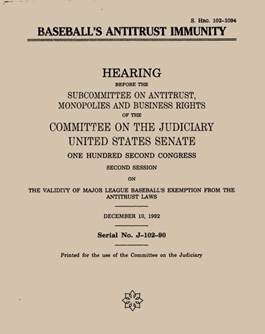
The 232-day baseball strike of 1994-95 was the biggest one in professional sports. Although there have been many work stoppages in professional baseball dating back to 1912, the study of this strike is important because of the challenges it presented to labor negotiators. This problem has historical origins and dates back to the Sherman Antitrust Act of 1890. In 1922, the U.S. Supreme Court ruled that professional baseball was exempt from the anti-trust protection because it was not considered to meet the definition of trade or commerce. Federal Baseball Club of Baltimore, Inc. v. National League of Professional Baseball Clubs et al. The case was appealed several times but not reversed. The only option for players was to strike. Source
The strike began on August 12, 1994, and the World Series was cancelled on September 14. One of the main issues was the salary cap that owners placed on the players. The cancellation of the World Series prompted some senators to propose legislation to end the anti-trust exemption given to baseball. This divided the Congress because the protection was favored by owners of smaller teams. President Clinton attempted to intervene but was not able to negotiate a settlement. As the 1995 baseball season was about to begin, baseball owners planned to hire non-union replacement players, a tactic used by the National Football League in 1987. On March 31, 1995, U.S. District Judge Sonia Sotomayor issued an injunction, and the baseball players returned to the field.
Chronological History of Labor Strikes in the United States (NPS
 njcssjournal