Cesar Chavez and the National Farm Workers Association

Cesar Chavez, a Mexican American, is the president of the National Farm Workers Association, an organization of farm workers fighting for more benefits and equality. Cesar Chavez’s goals for his fellow farm workers were to create a Union, an insurance program for farm workers, higher wages and contracts for farm workers, and equality. Cesar Chavez’s historic strike, the Delano Grape Strike, is one of the many strikes he takes pride in for expressing his unwavering conviction that he is on the right side of history and that the violence and humiliation that the growers are showing towards the workers will only fuel them more with conviction and determination to strike until they receive the benefit they are entitled to because of their hard work. Thousands of supporters helped Cesar Chavez in their fight for unionizing by participating in strikes, boycotting the companies’ products, and much more. This constant fight for equality painted a bad image for the company. The companies were both Schenley Industries and the DiGiorgio Corporation. This nonviolent approach and fight for equality was inspired by Dr. Martin Luther King Jr., who also had peaceful protests. Dr. Martin Luther King Jr. is one of the many prominent figures throughout Cesar Chavez’s career who supported Cesar Chavez and was able to inspire him to take a peaceful approach in order to achieve his goals for these strikes, which are being able to Unionize insurance programs to better benefits for farm workers.

This research dives into the challenges and struggles Cesar Chavez, and the National Farm Workers Association faced as they tirelessly worked to achieve fundamental rights and improved working conditions for marginalized and exploited farm laborers by shedding light on the strategies used by Cesar Chavez and his National Farm Workers Association in their fight against the obstacles standing in the way of their equality. Cesar Chavez’s legacy as a labor leader and civil rights activist is a testament to how hard he fought in the face of adversity.

Cesar Chavez was influenced by his own experiences in a migrant farm-working family, he then decided to face the injustices prevalent in his community. Working under Fred Ross Jr. Cesar Chavez learned about the rights of Hispanic, specifically Mexican, farmworkers and was empowered by his community and the injustices to fight against discrimination. Cesar Chavez’s journey in building a labor movement, started with grassroots efforts in his community. Challenges such as fear of reprisal and deportation scared and made people reject Cesar Chavez, Cesar Chavez successfully recruited supporters, including religious figures and community organizers. The lack of unity and coordination within the United Farm Workers is also an obstacle the organization had to overcome, as well as the violence and intimidation faced by supporters from anti-union groups. Cesar Chavez’s goals included creating a union, insurance programs, higher wages, and contracts for farmworkers to improve their living conditions. The success of the United Farm Workers is thanks to various strategies, including boycotts, strikes, and protests, which pressured large companies like Di Giorgio to negotiate with Cesar Chavez and the organization. Cesar Chavez’s leadership and organizational skills, played an important role in advancing the cause for farmworker justice.

Through the movement Cesar Chavez was supported by a diverse group of people. It highlights Cesar Chavez’s ability to connect with various groups, such as the Mexican Pentecostal church, religious leaders, college students, and workers from different ethnic backgrounds such as Mexican Americans, Filipinos, and Puerto Ricans. The Mexican Pentecostal community provided moral and financial support, while college students actively participated in protests, strikes, and fundraising efforts. The teamwork among different ethnic groups in the civil rights movement, notably influenced by Dr. Martin Luther King Jr., contributed to the movement’s strength. Despite facing hardships and sacrifices, the labor movement achieved its goals, in succeeding in getting contracts with major growing companies and paving the way for the Agricultural Labor Relations Act to govern farm workers’ rights and union activities. Cesar Chavez and the United Farm Workers faced hardships and challenges in their mission to better the rights and working conditions of farm laborers, facing industry resistance, violent opposition, and internal struggles. Despite the obstacles faced, Cesar Chavez’s strategic approach, marked by nonviolent protests, strikes, and boycotts, garnered crucial attention and support for the movement. The community, including Mexican Americans, Filipinos, Puerto Ricans, college students, and religious leaders, emerged as a pivotal force in achieving the movement’s goals. Cesar Chavez’s dedication, inspired by personal experiences and the struggles of farm workers, led to the success of the United Farm Workers.

This article provides a summary of Cesar Chavez’s activism, the challenges faced by the National Farm Workers Association, and the broader labor movement in the southwest. Some reasons why Cesar Chavez should be taught in school is because it sheds light on the historical context of the labor movement in the southwest, providing students with insights into the challenges faced by marginalized and exploited farm laborers during that time. Cesar Chavez’s connection with the civil rights movement, particularly his inspiration from Dr. Martin Luther King Jr., offers an opportunity to explore the different social justice movements during the 20th century. Students can also analyze how Cesar Chavez adapted nonviolent protest strategies from the civil rights movement to advocate for the rights of farm workers. Students can learn about the challenges and criticisms faced by Chavez and analyze how he overcame them to achieve the goals of the United Farm Workers. Highlighting the diverse support of the labor movement, showing the unity between different ethnic groups, religious communities, and college students. Students can explore how diverse communities came together to support a common cause and the role of solidarity in achieving social justice goals. By incorporating this article into the classroom, teachers can help provide a diverse perspective about social justice, labor rights, leadership, and the unity of historical movements. It encourages critical thinking, analysis of historical events, and reflection on the ongoing struggles for equality and justice.
Bartolomé de Las Casas: Defender of the Indians

Dan La Botz

Reprinted with permission from NewPolitics.

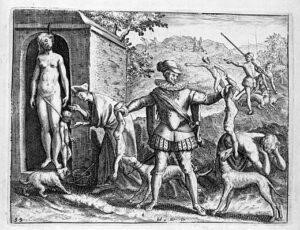
Figure 1: Theodore de Bry’s illustrations to Las Casas’ Brief Account of the Conquest of the Indies.

Bartolomé de las Casas was born in 1484 in Seville, to a French immigrant merchant family that had helped to found the city. One biographer believes his family were conversos, that is, Jews who had converted to Catholicism. As a child, in 1493 he happened to witness Christopher Columbus’ return from his first voyage to the Americas to Seville with seven Indians and parrots that were put on display. Queen Isabella ordered the Indians to be returned to their native land.

Bartolomé’s father, Pedro de las Casas, joined Columbus on his second voyage and brought home to Seville as a present for his son Bartolomé an Indian. In 1502 Pedro took Bartolomé with him on the expedition of Nicolás de Ovando to conquer and colonize Española (in English the island of Hispaniola, today made up of the Dominican Republic and Haiti). Bartolomé conducted slave raids on the Taino people (who were virtually annihilated by the Spaniards) and was rewarded with land and became the owner of a hacienda as well as slaves. In 1506 he returned to the University of Salamanca, where he had previously studied, and then traveled to Rome where he was ordained, becoming a priest in 1507.

When in 1510 Dominican friars led by Pedro de Córdoba arrived in Santo Domingo, they were horrified at the Spaniards’ treatment of the Indians, the massacres, the brutality of slavery, and the intense exploitation of the natives and they denounced it. Las Casas rejected the Dominicans’ criticism and defended the encomienda system by which Spaniards distributed laborers to the conquerors.

In 1513, Las Casas joined the expeditions of Diego Velázquez de Cuéllar and Pánfilo de Narváez to conquer Cuba, acting as chaplain. He witnessed horrifying murders and torturers of the indigenous people. Once again, he received a reward, this time of gold and slaves. For a year he lived as both colonist and priest. Then in 1514, while studying the Book of Ecclesiasticus, he came across a passage that called his beliefs into question. It read:

Reading this passage — and no doubt meditating on the horrors that he had both participated in and witnessed — Las Casas suddenly decided to break with his past. He gave up his haciendas, his encomienda, his slaves. He began to encourage others Spaniards to do the same, but of course they refused and they resented him.,Las Casas then traveled to Spain to take his case to King Ferdinand, and he succeeded in having one meeting with him, but then the monarch died in 1516. Many of the other higher-ups in the Spanish state and Church, such the Bishop of Burgos, Juan Rodríguez de Fonseca, who controlled the Crown’s business in the Americas, were themselves encomenderos who profited from the labor of the indigenous and they rejected Las Casas’ appeals to protect the Indians. Fearing that the entire population of the Indies, the Caribbean islands, might be annihilated, Las Casas wrote his Memorial de Remedios para las Indias (Memorandum on Remedies for the Indies) to be presented to the regents who now rules, calling for a moratorium on all Indian labor to protect the indigenous people and allow the recuperation of their populations.

Convinced by Las Casas’ argument that the Indians needed to be protected, one of the regents, Cardinal Ximenes Cisneros, put the Carmelite monks in charge of the Indies. Las Cases himself was given the official title and position of “Protector of the Indians. Under pressure from Las Casas, in 1542 King Charles V promulgated the New Laws to protect the Indians from exploitation. 

King Carlos V, concerned about conditions in the Spanish American colonies decided to organize a debate between the two principal intellectuals on opposite sides of the question. Juan Ginés de Sepúlveda, claimed that the indigenous people of the Americas were barbarians: ignorant, unlettered, and unreasoning, incapable of learning anything except the simplest tasks. The Spaniards, he argued, being superior in intelligence and morality, had the right to make war on them and conquer them. The Indians were, he said, incapable of governing themselves. He argued that they were sunk in depravity, worshiping idols and engaging in human sacrifice. He quoted the Bible and other authorities to argue that in ancient times such people had been justly exterminated or enslaved. Natural law, he averred, dictated that the Spaniards, superior in intelligence and morality, should govern them.

In response, Las Casas either refuted Sepúlveda’s arguments, such as the claim that the indigenous Americans were ignorant and incapable of governing themselves, by providing evidence of their intelligence and self-government, or he argued, as in the case of idolatry and human sacrifice, that these practices had to be seen as demonstrating their religious inclination, their attempts to worship God. Las Casas denied the Spaniards’ right to ever invade, occupy, conquer, and subject the indigenous. He argued that the Spaniards’ wars against the Indians were unjust and therefore enslavement of the Indians was illegal and wrong, since only the captives of a just war could be enslaved.

De Las Casas and Sepúlveda Debate Treatment of the Indigenous Peoples of the Americas

Theologian Juan Ginés de Sepúlveda

Fray Bartolomé de Las Casas

“Among our Indians of the western and southern shores (granting that we call them barbarians and that they are barbarians) there are important kingdoms, large numbers of people who live settled lives in a society, great cities, kings, judges, laws, persons who engage in commerce, buying, selling, lending, and the other contracts of the law of nations . . . Reverend Doctor Sepúlveda has spoken wrongly and viciously against peoples like these, either out of malice or ignorance . . . and therefore, has falsely and perhaps irreparably slandered them before the entire world? From the fact that the Indians are barbarians it does not necessarily follow that they are incapable of government and have to be ruled by others, except to be taught about the Catholic faith and to be admitted to the sacraments. They are not ignorant, inhuman, or bestial. Rather, long before they heard the word Spaniard they had properly organized states, wisely ordered by excellent laws, religion and custom . . . Since, therefore, every nation by the eternal law has a ruler or prince, it is wrong for one nation to attack another under pretext of being superior in wisdom or to overthrow other kingdoms. For it acts contrary to the eternal law, as we read in Proverbs . . .  ‘This is not an act of wisdom, but of great injustice and a lying excuse for plundering others.”
  1. What term does Sepúlveda use to describe the indigenous people of the Americas?
  2. According to Sepúlveda, when are slavery and “booty” justified?
  3. What does Sepúlveda recommend for governance in the Americas?
  4. What evidence does De Las Casas offer to refute claims made by Sepúlveda?
  5. If you were in the audience during this debate, what questions would you ask them?
  6. Whose position do you agree with more? Why?