
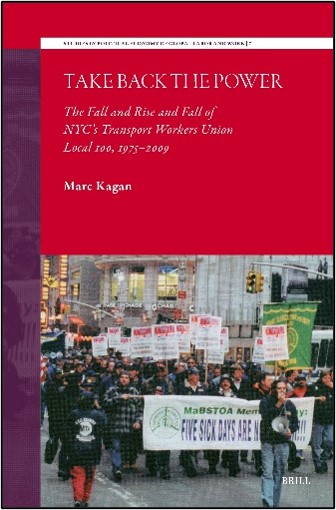
Take Back the Power: The Fall and Rise and Fall of NYC’s Transport Workers Union Local 100, 1975-2009
by Marc Kagan
Review by Alan Singer
Marc Kagan, the author of Take Back the Power, and I share what I suspect is a pretty
unusual work history, we were both New York City transit workers and New York City high school social studies teachers, and we currently both teach at colleges. Kagan was a mechanic and forklift operator at the 207th Street subway yard in Upper Manhattan and a local union activist. He later taught social studies at the Bronx High School of Science where New York City Mayor Zohran Madani was one of his students. Kagan has a PHD in History from the CUNY Graduate Center and is an adjunct professor at the City University. I was an MTA bus driver for only a year in the 1970s after being laid off as a teacher when New York City went bankrupt. Kagan, however, spent twenty years as a union activist while a member of Local 100 of the
Transit Workers Union (TWU) fighting against on site management authoritarianism, trade union bureaucracy, and broader anti-worker austerity
economics.
In this book Kagan draws on his own experience as an organizer, interviews with TWU activists, and the history of the TWU to present a strategy for revitalizing the labor movement. The book is volume 7 of Studies in Political Economy of Global Labor and Work. Part 1 analyzes “The Fall of the House of Labor” and the “New Directions Project” that helped radicalized transit union members, and “Local 100, the Transit Industry, and New York City’s Fiscal Crisis.” Part 2 focuses on “The Fall of TWU Local 100, Part 3 on the local’s resurrection, and Part 4 on internal conflicts that contributed to its defeat. The text is 438 pages with additional appendixes.
After college, Kagan, a graduate of Yale University and a self-identified “enthusiastic
communist,” joined the working class as a leftist organizer and trade union activist and in 1984 he starting working for the New York City Metropolitan Transit Authority (MTA). At the MTA and as a member of the TWU worked was aligned
with Roger Toussaint, who would become the local President, to shape the program of the TWU union’s progressive New Directions caucus. Kagan reported that he and Toussaint were part of the same “left organization” that decided to colonize the TWU, a small group known as the Marxist-Leninist Party. There were also other left factions active in the TWU at the same time.
The New Directions caucus appealed to transit workers disenchanted with the union
leadership and demoralized by defeat in a 1980 strike. Promising to promote union democracy, “take back the power” through shop floor militancy and in the process gain “dignity and respect” for transit workers, New Directions members were elected officers of the 35,000-person local in 2001. However, transformation of the work place proved difficult as they faced an entrenched bureaucratic MTA and a hostile political climate. Reform efforts sputtered and an unsuccessful 2005 strike by the local, what Kagan describes as largely a defensive effort, failed to secure contract demands satisfactory to the rank-and-file.
The problems faced by the New Directions caucus in transforming TWU Local 100 into a militant working-class organization were similar to situations in other labor unions. Leftist union activists have to combat powerful national anti union trends and “neo-liberal” ideas and organizations that shape government policy. Kagan and other labor union leftists believed that worker engagement is key to greater union power but found that their co-workers tend to accept workplace conditions and even when “restive about even egregious violations of safety or elimination of long-observed work routines,” their upset is often temporary and does not contribute to a broader understanding of the power they could marshal as a class-conscious union. In many cases, workers turn apathetic or even hostile towards union leadership as shop stewards become seen as agents of corporations and government agencies, enforcing contractual work rules that workers found unfair and instead of issues being resolved on the shop floor, they became enmeshed in long, drawn out, multi-layered, grievance procedures.
Part of the problem Kagan sees is that even if reformers gain power within unions like the TWU they can grow distant from their rank-and-file roots and are perceived as partners with management in enforcing contractual guidelines on union members. This problem eventually led to Kagan’s split with Roger Toussaint who he argues once in office shifted away from democratic unionism to a more autocratic top-down style. The acquisition of power in the union also led to the demise of the TWU New Directions caucus as the conflicting agendas of different factions broke up what was essentially a coalition. The collapse of New Directions prevented what could have been a potential break on Toussaint’s drift away from democratic unionism.
An additional problem in organizing in the TWU is related to the nature of the work, which is similar to other industrial unions with diverse job categories and pay scales. Kagan worked in a shop where workers could congregate, bullshit with each other, and develop relationships. Much of his experience as a transit worker was shaped by shop comradery. Bus drivers like me drove alone and saw each other only briefly during short breaks. With little experience or job protection, I was very dependent on the shop steward when I was involved in a fender bender and when I tried to shift my days off to a weekend because of family responsibilities.
Once I was late for a midnight shift and the dispatcher covered for me, reassigning me to a later route. In some ways the dispatcher was more of a friend to me as a worker than was the shop steward who represented the union. I learned from a friend that many of the dispatchers had been stewards before being promoted, so that steward was seen as a path to advancement.
I had planned to work for the MTA much longer and become involved with union organizing, but the hiring freeze at the New York City public school system was lifted and I returned to teaching. The most important thing I learned as a bus driver is that my co-workers on the midnight shift at the East New York Brooklyn garage (who were almost all African Americans) were very proud of being transit workers. It was a decent paying job with health benefits. It gave them the ability to be homeowners and many were deacons in their churches and active in local youth sports. These were not things they were willing to jeopardize through union militancy.
Kagan does discuss racial/ethnic division within the union. When I was at transit, shop or operating authority (OA) workers were much more likely to be white than bus drivers. Many were Irish and still had connections to radical union leadership
with communist ties that led a successfully 1966 mass transit strike. Kagan believes these divisions became less pronounced in later decades, but there were always new divisions as more women entered the MTA workforce as well as Latinx and South Asians.
Kagan titled his last chapter, Chapter 12, “The Dilemmas of Union Revitalization.” He
opened the chapter with an insightful and problematic quote from Paulo Freire’s Pedagogy of the Oppressed (NY: Continuum, 2005). “Since the leaders need the adherence of the people so the revolution can be achieved (but at the same time mistrust the mistrustful people), they are tempted to utilize the same procedures used by the dominant elites to oppress.” Of course this is not just a problem for union organizers, but it is a problem in every successful revolutionary movement. “By advancing along these paths, the paths of oppression, they will not achieve revolution; or if they do, it will not be authentic revolution” (166).
In this chapter Kagan discusses the dilemmas that face union activists, conflicts that
need to be resolved, pathways that need to be established, but given the broader conditions, may not be resolvable. Kagan believes New Directions was too focused on fighting the established TWU leadership and not focused enough on fighting management so when it elected new leaders its energy dissipated. Because of the focus on getting rid of the old guard, New Directions did not invest enough time and effort on educating union members on the importance of union militancy and the need for broader worker consciousness. Most workers were concerned with bread-and-butter demands, while the left activists had broader aims for transforming work and potentially society.
A commitment to participatory democracy also created problems for progressives who thought there plan of action was the correct path but were not necessarily able to convince people to go along with them. Participatory democracy also could lead to endless and crippling factional debates. Even within a leftwing group like the Marxist-Leninist Party, the demand for group disciple once decisions were made bridled people who felt the decision was undemocratic or unwise and continued to disagree.
I’m from the 1960s radical generation that Kagan describes shaping New Directions in the TWU, although my commitment was to community organizing rather than Kagan’s decision to try to build a radical union movement. I think we both saw teaching as a way to continue our progressive agendas after organizing efforts stalled. In much of this book, Kagan rechews the battles he fought and I was glad to revisit them with him. Sometimes it seems he was stuck in refighting them, however for me, and I think Marc Kagan, the reason to write this book was to influence the next generation of progressive organizers so hopefully they will be more successful than we were. Kagan’s analysis of the history and the squabbles within New Directions and the TWU leadership provides incredibly valuable lessons for organizers and I am very glad he chose to share them with us.

