
Promoting Student Discussion Using Prompts and the Rule of THREE
Alan Singer
We have all experienced the frustration of asking a class and question and being greeted by silence. Students either didn’t understand what we were asking, didn’t know the answer, or no one was prepared to risk themselves by answering. Even when someone answers, it is often difficult to promote more general discussion. I find the most effective way to engage students in examining a topic together is by providing them with material to respond to, such as a chart, graph, image, map, or text with specific questions to answer before discussion begins. I try to organize questions from simple to more complex, from identifying information to forming opinions. While students are writing, I circulate around the room, identifying students with different points of view that I can call on to open discussion. Then I deploy what I call the rule of THREE, twice. What does it say? Where is the evidence in the text? What do you think? I will ask two students to answer and a third student, “Which of the two do you agree with more and why?” After that I open discussion to the full class, generally with good results.
Aim: What were the underlying causes of the Great Irish Famine (1845-1852)?
Instructions: Read the selection below, examine the political cartoon, and answer questions 1-6.
- According to the author, how would France and England have responded to “blight and famine” if they had occurred in those countries?
- Why does the author dismiss English claims that famine relief was too costly?
- How was the world made aware of conditions in Ireland?
- What does the author propose as the solution to what was taking place in Ireland?
- Does the cartoonist agree or disagree with the author? Explain.
- In your opinion, was the author writing as a political activist or a historian? Explain.
“If blight and famine fell upon the South of France, the whole common revenue of the kingdom would certainly be largely employed in setting the people to labour upon works of public utility; in purchasing and storing for sale, at a cheap rate, such quantities of foreign corn as might be needed, until the season of distress should pass over, and another harvest should come. If Yorkshire and Lancashire had sustained a little calamity in England, there is no doubt such measures as these would have been taken promptly and liberally. And we know that the English Government is not slow to borrow money for great public objects, when it suits
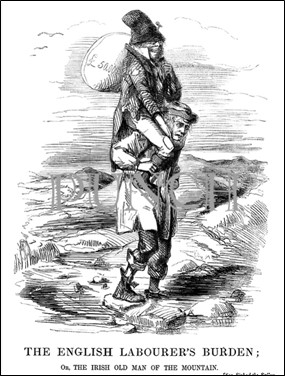
Source: Punch, 1849
British policy so to do. They borrowed twenty million sterling to give away to their slaveholding colonists for a mischievous whim . . . It will be easy to appreciate the feelings which then prevailed in the two islands — in Ireland, a vague and dim sense that we were somehow robbed; in England, a still more vague and blundering idea, that an impudent beggar was demanding their money, with a scowl in his eye and a threat upon his tongue . . . In addition to the proceeds of the new Poor law, Parliament appropriated a further sum of £50,000, to be applied in giving work in some absolutely pauper districts where there was no hope of ever raising rates to repay it. £50,000 was just the sum which was that same year voted out of the English and Irish revenue to improve the buildings of the British Museum . . . In this year (1847) it was that the Irish famine began to be a world’s wonder, and men’s hearts were moved in the uttermost ends of the earth by the recital of its horrors. The London Illustrated News began to be adorned with engravings of tottering windowless hovels in Skibbereen, and elsewhere, with naked wretches dying on a truss of wet straw; and the constant language of English ministers and members of Parliament created the impression abroad that Ireland was in need of alms, and nothing but alms; whereas Irishmen themselves uniformly protested that what they required was a repeal of the Union, so that the English might cease to devour their substance.”
Instructions: Working with your team, examine the six statements below. Which statement or statements come closest to your understanding of the underlying cause of the Great Irish Famine? Select a representative to present your teams views to the class.
A. “The time has not yet arrived at which any man can with confidence say, that he fully appreciates the nature and the bearings of that great event which will long be inseparably associated with the year just departed. Yet we think that we may render some service to the public by attempting thus early to review, with the calm temper of a future generation, the history of the great Irish famine of 1847. Unless we are much deceived, posterity will trace up to that famine the commencement of a salutary revolution in the habits of a nation long singularly unfortunate, and will acknowledge that on this, as on many other occasions, Supreme Wisdom has educed perm-anent good out of transient evil.” – Charles Trevelyan, Assistant Secretary to the Treasury, 1848
B. “The poorer Irish are the most easily contented and the most truly happy of any peasantry I have ever seen. They are faithful, generous, warm-hearted, fearless and reckless. They smile in peace over a handful of bad potatoes and devoutly thank God who provides it.” – E. Newman, Notes on Irish Natural History (1840).
C. “The Irish poor are the cause of their own misery. The potato crop encourages, from childhood, habits of laziness, negligence and waste. No other crop produces such an abundance of food on the same amount of ground, requires so little skill and labor, and leaves so large a portion of the laborer’s time unoccupied, as the potato. These are great temptations. It requires thought and energy to overcome them. When the Irish go to England or America, they earn their keep.” – The Plough (1846).
D. “No destruction of a city or attack on a castle ever approached the horror and dislocation to the slaughters done in Ireland by government policies and the principles of political economy. The Almighty sent the potato blight, but the English created the famine.” – John Mitchel, The Last Conquest of Ireland (1861).
E. “Famine seems to be the last, the most dreadful resource of nature. The power of population growth is much greater than to the power of the earth to provide all people with enough food to survive. Because of this, premature death must visit the human race. The vices of mankind are active contributors to depopulation. They come before the great army of destruction and often complete the dreadful work. But if human vices fail in this war of extermination, epidemics, pestilence, and plague advance in terrific array, and sweep off their thousands and tens of thousands. Should success be still incomplete, gigantic inevitable famine stalks in the rear, and with one mighty blow levels the population.” – Thomas Robert Malthus, Essay on the Principle of Population (1798).
F. “The cause of poverty in Ireland lies in the existing social conditions. The land is divided into small units for rental. This causes sharp competition between tenant farmers. It prevents farmers from investing in improving their farms.” – Friedrich Engels, The Condition of the Working Class in England (1845).

 njcssjournal