Book Review-Homeless Outreach and Housing First: Lessons Learned

Jay S. Levy has written an excellent book for aldermen, social workers, counselors, taxpayers, nurses, street helpers, and many others to read.  It is excellent because of how it gets the reader into the topic and provides clear definitions and examples.  *See the two articles below for more explanation of this important topic, housing first.

This book looks like a workbook, actually.  It is a thinner paperback, and it is a brief and clear guide about not only providing outreach to get people ready to be housed but also moving ahead with the well-known strategy of using “housing first.”  Housing first is the successful—but underused—process of getting persons indoors right away in the move to solve homelessness.  Rather than making people jump through a dozen hoops, plus half-way houses and shelters, plus appropriate counseling, housing first gets the person stable housing so that all of the other pieces can fall into place.

The phenomenon of housing first, developed by Stefancic and Tsemberis, is highly successful, but more expensive than approaches which pick and choose from the homeless person’s needs.  Books and articles by those two experts are easy to locate through a quick search.

It costs more because in housing first somebody has to pay the rent for the ex-homeless person to be housed—typically in an apartment.  The documentation is very clear.  The successes are great.  It is a longer-term solution.  Housing first allows the newly-indoors individual to save money by having a refrigerator to keep leftovers, a place to keep any needed medication, a place to be safe from attack and danger and murder.

Housing first provides—very importantly—a secure dwelling for sleep and safety.  Therefore, Housing first is a lifesaver.  This should be simple to understand.

The book’s clarity and brevity are both plusses.  The book can be read easily in one sitting and therefore it is perfect for weekend retreats with board members and others who need to come to a quick understanding of how housing first works as the key element to successful placement of persons into the indoors. 

Also helpful is the way Levy brings together three different pieces to provide context, definitions, and an example of an individual who “makes it” despite his challenges of addiction, homelessness, and depression.  It is a good and quick reference—clear explanation—of the world of housing first.

Part One is an article about hope and ethics.  Part Two is the first housing first process used by the author, Jay S; Levy.  Part Three is an interview with someone who was helped by Levy’s intervention.

The author is a social worker who tells of the quality of the housing first strategy and his own growth—not just that of the individuals he helps.  It is an inspiring book, and the author is an encouraging and prayerful professional.  Levy has written not only about homeless first strategies but also about the pretreatment necessary for the system to work.  This is a piece of the puzzle people need to know more about.

As an educator, I recommend this book highly and hope all persons helping the homeless will read it, study it, and reflect on it.  I admire professionals who can write clearly and well, explaining, using illustrations, and making their point succinctly.  Great information here, and easy to understand and utilize.  

As an educator with a Jesuit background, I am forever reflecting on my own ideas and decisions, thinking about how I could have done things better… how I can communicate better, and how I can help the unhoused with their challenges more effectively.  I grew from reading this book.  

The book is good background reading and important to get onto your bookshelf to be loaned to others.  The book would also be great for professional development classes, retreats, fundraising, and other uses.  I encourage everyone to read it soon. 

Levy, J. S. (1998, Fall). “Homeless Outreach: On the Road to Pretreatment Alternatives.  Families in Society: The Journal of Contemporary Human Services, 81(4), pp. 360-368.

Levy, J. S., (2011, July). “The Case for Housing First: Moral, Fiscal, and Quality of Life Reasons for Ending Chronic Homelessness.  Recovering the Self: A Journal of Hope and Healing, III(3), pp. 45-51.

Book Review – Aporophobia: Why We Reject the Poor Instead of Helping Them

The author is a professor emerita of ethics and political philosophy and paints a broad sweep of a picture here including both the history and politics of what people think of the poor. Cortina speaks to the changes in this country—President Biden welcoming the poor immigrants in—and the ongoing nightmares—such as the Haitians who were chased by guards on horseback.

All is not well in the land of the poor, which Cortina explains, is pretty much every land. The notion that immigrants bring lots of problems but certainly nothing of value to offer is an important theme in the book.

Since the days of the “undeserving poor” and the various battles against poverty (none have really succeeded in conquering it) persons who find themselves trapped in poverty have been in the news. Every day, we hear about what the poor are doing, what the homeless are up to, and what the people
out there without jobs and money are (supposedly) doing to destroy our nation.

Currently, just within Chicago, we have over 60,000 (native) homeless, over 20,000 new migrants who are homeless, and all the numbers are up, up, up. There are over 16,000 homeless students who attend Chicago Public Schools. There are over 50,000 children in Illinois.

These ideas of this big (and growing) part of the world population are strong in the media and the sources and causes of the views and opinions about this burgeoning sector of the US (and world) population. Without giving away all of the book’s content, I must say, I do not like to tell readers all the most important parts and facts and conclusions of a book. Rather, I
leave the discovery and discussion to the reader to find, consider, and ponder.

What this text does is provide an interesting outline of where our fear of the poor comes from… a clear understanding of the Greek root words used to come up with a term for this fear, and an ethical framework for understanding all of this.

Now, it is up to the reader, the educator, the social worker, and the taxpayer to make sense of the outline, the map, provided here, and develop a better understanding of oneself as we venture out
into the street to help the poor.

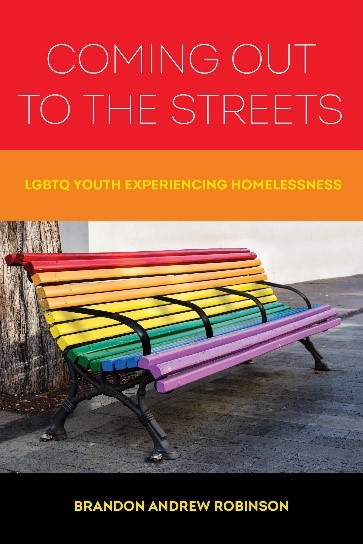
Coming Out of the Streets: LGBTQ Youth Experiencing Homelessness

Coming Out to the Streets: LGBTQ Youth Experiencing Homelessness, by Brandon Andrew Robinson (Oakland: University of California Press)

Review by Thomas Hansen

This is the story of a qualitative research study in which the professor was an observer who was able to get a great deal of trust and information from the subjects interviewed.  Volunteering at the shelter where the subjects were housed temporarily, the professor conducted this ethnographic study by using in-depth interviews to look at the lives and goals of young homeless persons.   

I disagree with the author making the clear point throughout the book that the family does not shoulder much of the blame for the young people becoming disenfranchised or bullied or shunned by society.  The author hopes people will move beyond simply blaming the family for all the difficulties youth must conquer in order to survive the young-adult years.  The author insists it is “the system” that needs to be fixed—not the youth and not the family.  There would be many people who disagree with this author on this point, including many people who have battled through those difficult years and somehow made it to the other side.

While I leaf back through the book and thought again about what I had recently read, two young gay men at the next table are telling of the terrible experiences they had growing up, coming out, and finally escaping a damning and hateful family—in both of their cases.  I keep moving away from them, but I can still hear every word they are saying and do not want to listen.  However, they get louder and louder as they share their experiences and hopes out loud. 

I am embarrassed I can hear all this—at the same time I am thankful I am hearing such a timely discussion when I am trying to write some notes that will lead to a review of this book. 

They share a common story about the oppressive life they have lead “at their family’s house.”  I know very little–if anything—about these two young men.  I do not know their names or where they are from or what their parents are like.  I do not know if anything they are sharing very loudly is true or not.  But most everything they are saying is similar to a story I have heard from many young people for years.   

It is true that different people, in different situations and cities, will have disparate realities as they “come out” into whatever sexuality or personality they take on as adults.  I would argue with this author that it is the great majority of young LGBTQ persons who have had the most difficulties at home—the very people who should be loving, supporting, and protecting the youths are instead perhaps the biggest challenge facing them. 

Children’s families often abandon them and turn them off.  Without the support of the very people who should be helping, these youth often have to make sure very hard decisions and face some terrible dangers to survive.  In the meantime, the family continues to withhold their assistance.         

The professor who conducted this study insists it is society—not the family—that is the culprit in the destruction of young people who are meant to come out and live the responsible gay lives they should be allowed to live.  The professor attempts to show how blame for the young people’s stress can be levied against several different pieces of the system.  Teachers, school administrators, the courts, the police, and mainstream society in general are all to blame for presenting the young persons with great challenges and judgment.  The author makes the point that the family is not the main problem and she does this strongly in the book.

Maybe in this particular shelter where the author interviewed young people, and throughout this study, and elsewhere in this book, the family is not to blame.  However, I maintain the family is one of the most guilty parties in the oppression, judgment, and ostracizing of the young people who wind up out on the streets and facing terrible choices.

I know it is the average families, including the parents without much cultural and educational understanding, who have no idea how much they are contributing to creating a whole population of young adults in stress.  These are young persons who are struggling to gain their independence and who have to make difficult decisions to do so.  Young LGBTQ persons become involved in prostitution, selling drugs, using drugs, shoplifting and other sorts of crimes. 

The book does a good and typical glimpse of the young people who have been damaged by their families (and church and school and neighbors and etc.).  There is so much wasted time.  Instead of transitioning easily from being children to being adults, these young people have to use a huge amount of energy to survive, learn, begin to work, and then establish new goals later in life, and become adults “later” than they wanted to in some ways, and “way too early” in other ways.

Much as these young persons are still children, they are thrust into the rougher realities of an adult world not very interested in protecting them.  While I agree society can be one of the culprits, I maintain it is principally the family who bears the responsibility for making life difficult for the young people. 

There is plenty of evidence in the literature of the family’s negative role in the lives of such young adults.