New Jersey Council for the Social Studies
Engaging High School Students in Global Civic Education Lessons in U.S. History
The relationship between the individual and the state is present in every country, society, and civilization. Relevant questions about individual liberty, civic engagement, government authority, equality and justice, and protection are important for every demographic group in the population. In your teaching of World History, consider the examples and questions provided below that should be familiar to students in the history of the United States with application to the experiences of others around the world.
These civic activities are designed to present civics in a global context as civic education happens in every country. The design is flexible regarding using one of the activities, allowing students to explore multiple activities in groups, and as a lesson for a substitute teacher. The lessons are free, although a donation to the New Jersey Council for the Social Studies is greatly appreciated. www.njcss.org
Era 10 The Great Depression and the New Deal (1929–1945)
The beginning of the 20th century marks the foundation of the transformation of the United States into a world power by the middle of the century. In this era economic prosperity and depression, the ability of our government to provide for the needs of people experiencing economic hardship, and the rise of dictators attacking innocent civilians and threatening the existence of democratic governments leading to a second world war dominate the narrative of this historical period. The development of the new technologies of electricity, transportation, and communication challenged our long-held traditional policies of limited government, neutrality, and laissez-faire capitalism.
Activity #1: Father Charles Coughlin, BBC and ABC: Can the ruling political party use public media to advocate for its policies?
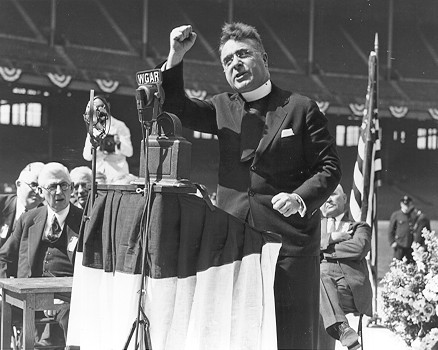
In the 1930s, Father Charles Coughlin, a Roman Catholic priest, had a weekly radio program with millions of listeners in the United States. In 1926 he broadcast weekly sermons but as the economy shifted into a recession and depression, his broadcast became more political and economic. They also reflected anti-Semitism with verbal attacks on prominent Jewish citizens. His broadcast following Kristallnacht on November 10, 1938 was particularly divisive. The owner of WMCA, a New York station, refused to broadcast Father Coughlin’s messages
The owner of WMCA, the New York station that carried his program, refused to broadcast Coughlin’s next radio message. The Nazi press reacted to the news with fury: “America is Not Allowed to Hear the Truth” declared one headline. “Jewish organizations camouflaged as American…have conducted such a campaign…that the radio station company has proceeded to muzzle the well-loved Father Coughlin.” A “New York Times” correspondent in Germany noted that Coughlin had become for the moment “the hero of Nazi Germany.”
In the United States the Federal Communications Act of 1934 and subsequent additions regarding television and quiz shows mostly protects licenses, ensures equal access to all geographic areas, and provides for a rapid communications system regarding emergencies and national defense. It protects First Amendment rights regarding content, with some restrictions regarding profanity or inappropriate sexual content or images. The absence of specific content regulations allowed Orson Welles in 1938 to produce “War of the Worlds” over the radio leading to a panic by many citizens regarding their fear of an alien invasion. The Fairness Doctrine of 1949 requires broadcasters to allow responses to personal attacks and controversial opinions. In 1969, the U.S. Supreme Court’s decision in Red Lion Broadcasting Co., Inc. v. Federal Communications Commission challenged the constitutionality of the Fairness Doctrine allowing the popularity of political radio and television talk and news programs.
Federal Communications Act of 1934
Broadcast Media Policy in the United Kingdom
The use of public media in the United Kingdom has specific statues to balance the perspectives of opinions and to prevent or limit the public broadcast media as a platform to present the views of the government, propaganda, or to advocate for a particular point of view on a controversial issue. The diversity of opinion in the United Kingdom for the BBC must respect opinions reflecting urban and rural populations, age, income, geography, culture, and political affiliations. There are also reasonable guidelines regarding the editor’s judgment to exclude a particular perspective. Facts and opinions must be defined and clearly stated. Section 4 Impartiality: 4.3.14 BBC Editorial Policy
Questions:
- How is broadcast media (radio and television) substantially different than print, telegraph or telephone media?
- How is social media substantially different than radio and television broadcasting?
- Does the U.S. Constitution allow for government regulation of content?
- To what extent is self-regulation effective or ineffective regarding news, weather, traffic, programs, and ethical standards?
- Are the regulations of content justified when their protect the mental health of people and prevent false or misleading statements and prohibit explicit sexual images and content determined to be pornographic?
- To what extent is censorship a problem in the publication of information. Should restrictive editorial policies be considered a form of censorship?
Activity #2: The Federal Deposit Insurance Corporation in the United States and Bank Deposit Insurance in Other Countries

In the United States, deposits in most banks are protected up to $250,000 for each investor. This protection restored confidence in American banks during the Great Depression and is an important reason for a sound financial system in the United States. Investments in stocks and bonds fluctuate with market conditions. Every bank in the United States also has deposits that are not insured. Investments in stocks, mutual funds, and corporate bonds are not insured by the Federal Deposit Insurance Corporation.
The Federal Reserve Bank establishes a reserve requirement, currently 10%, for banks to maintain to ensure adequate funds for withdrawals. The Federal Reserve Bank also monitors the member banks in the Federal Reserve System. Banks are assessed on all of their deposits quarterly and a formula is used to calculate their insurance payment. The FDIC is self-insured, although backed by Congress in the event of a catastrophic collapse of the banking system.
The Banking System in Japan
In Japan, the Deposit Insurance Act was enacted in 1971. The DIA fully insures deposits that do not earn interest. In the United States amounts in checking, savings, money market accounts, and Certificates of Deposit are insured. Deposits that earn interest in Japan are insured up to 10 million yen, or about $70,000.
The most recent crisis in Japan is the exposure of the Aozora Bank to bad loans and investments in the United States. In 2024, it posted a net loss of 28 billion Japanese yen or about $191 million in U.S. dollars. A major earthquake in Japan, effects from extreme weather, or a military conflict would likely present major risks to Japan’s banks.
Examples of countries without any defined deposit insurance are China, Egypt, Israel, Pakistan, and South Africa. Perhaps one-third of the countries in the world do not protect deposits in their banks.
Failed Banks in the U.S. by Year (Forbes)
Federal Deposit Insurance Corporation
Video: FDIC (13 minutes)
Japan’s Banking Crisis in the 1990s (Video)
Questions:
- There are about 6 million households in the United States without bank accounts. If you consider this a concern, what can be done to address this situation?
- What is the role of banks in the macroeconomy?
- Does the deposit insurance system in the United States provide sufficient protection?
- Are some banks too big to fail? If yes, then is the federal government justified in using taxpayer dollars to protect a large bank from failure or takeover?
- To what extent should pension investments, property and homes, investments in government bonds be protected? Should insurance for these investments be paid for by the depositor or the bank?
- Is the primary purpose of federal deposit insurance to protect the banks or its depositors?
Activity #3: Governor Huey P. Long and Health Insurance in the United States and other Countries
Huey P. Long is a challenging person for historians and educators. His ‘Share the Wealth’ program, use of the media, authoritarian actions, and criticisms of voter manipulation provide for diverse perspectives. However, he improved healthcare in Louisiana by expanding the Charity Hospital System, creating the Louisiana State University Medical School, reforming institutions to care for the disabled and mentally challenged, and providing free health clinics and immunizations. As a result, many lives were saved.
As governor, Long tripled funding for public healthcare. The state’s free health clinics grew from 10 in 1926 to 31 in 1933, providing free immunizations to 67 percent of the rural population. By building bridges and paving new roads, he made it possible for the rural poor to have access to medical and dental health care and hospitals. In the long historical timeline toward universal health care insurance in the United States, Huey P. Long is a pioneer.
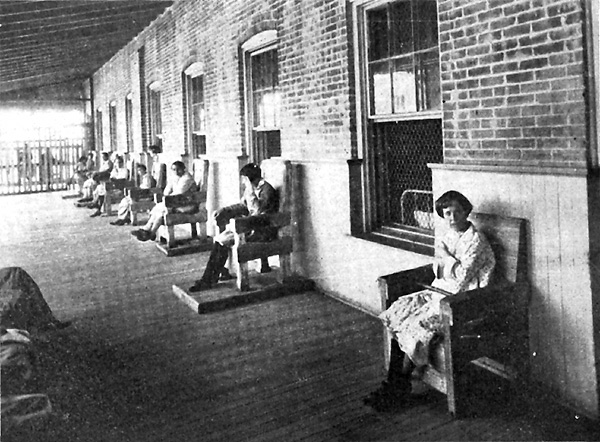
Before Huey Long’s reforms, patients at the Central Hospital for the Insane were locked in chairs during their ‘recreation’ time. from Every Man a King by Huey Long; reproduced by permission.
Long by-passed the negative press by distributing his own newspaper, “The American Progress,” and he spoke directly to a national audience through radio speeches and speaking engagements. In a national radio broadcast on February 23, 1934, Huey Long unveiled his “Share Our Wealth” plan a program designed to provide a decent standard of living to all Americans by spreading the nation’s wealth among the people. Long proposed capping personal fortunes at $50 million each (roughly $600 million in today’s dollars) through a restructured, progressive federal tax code and sharing the resulting revenue with the public through government benefits and public works. In addition, he advocated for a 30 hour work week, four weeks of paid vacation for every worker, free college or vocational educational and limiting annual incomes to $1 million or about $60 million in today’s dollars. He also advocated for pensions and health care provided by businesses and the government.
Long believed that it was morally wrong for the government to allow millions of Americans to suffer in poverty when there existed a surplus of food, clothing, and shelter. By 1934, nearly half of all American families lived in poverty, earning less than $1,250 annually. He supported a health care system for all people using government funds. Long’s authoritarian use of power helped him achieve his goals until his assassination in 1935.
There are four basic health care models
The United States has one of the most expensive health care systems in the world. It invests in research,

However, in 2021, 8.6 percent of the U.S. population was uninsured. The U.S. is the only country where a substantial portion of the population lacks any form of health insurance. The U.S. has the lowest life expectancy at birth, the highest death rates for avoidable or treatable conditions, the highest maternal and infant mortality, and one of the highest suicide rates in the world. It also has the highest rate of people with multiple chronic conditions and an obesity rate nearly twice the average of other developed countries.
The current programs provided by Medicare (for people over age 65), Medicaid (for people with low incomes), and the Affordable Care Act (current program for most people) are each under attack because of the high costs associated with them and government regulation of the prices paid.
In your research and discussion consider the following models of health insurance and the programs Gov. Huey P. Long implemented in Louisiana in the 1930s.
The Beveridge Model
This model is named after William Beveridge, the social reformer who designed Britain’s National Health Service. In this system, health care is provided and financed by the government through tax payments, just like the police force or the public library.
Many, but not all, hospitals and clinics are owned by the government; some doctors are government employees, but there are also private doctors who collect their fees from the government. This system has the lowest costs per person, because the government controls what doctors can do and what they can charge. Great Britain, Spain, most Scandinavian countries, New Zealand, and Cuba are countries using this model or one that is similar.
The Bismarck Model
The Bismarck models uses an insurance system financed jointly by employers and employees through payroll deduction. Every person is covered. Doctors and hospitals are private operators. Although there are many payers to this model, costs tend to be regulated by the government. Germany, France, Belgium, the Netherlands, Japan, Switzerland, and some Latin American are countries that use this model.
The National Health Insurance Model
This system has elements of both Beveridge and Bismarck models. It uses private-sector providers, but payment comes from a government-run insurance program that every citizen pays into. Costs are considered low because there are no profits, no advertising, and claims are pre-approved. It is a single payer system and as a monopolist it is in a position to negotiate for the lowest prices. This system also has the ability to limit the medical services it will pay for, such as preventive care or what is considered elective procedures. Canada, Taiwan, and South Korea are countries using this model. For Americans over the age of 65, Medicare is similar to this model.
The Out-of-Pocket Model
Health insurance is mostly a benefit for industrialized countries. Of the 195 countries on planet Earth, about 40 or 25% have established health care systems. In countries using this model, the poor are neglected. This is a problem for hundreds of millions of people who have low incomes or are living below the poverty line.
Questions:
- Does preventive care provide long-term savings for a country?
- Who has the primary responsibility for physical and mental health care in a country?
- Is government sponsored health care part of the vision of the Declaration of Independence and the U.S. Constitution?
- Are there limits to what a government or business can and should provide for its populations?
- Local communities finance public education with taxes and the salaries of educators and graduation requirements are controlled by local Boards of Education with some supervision from the state government. Should this model be considered for health care?
- Which of the four models would you adopt or adapt for the United States?
- How can the United States best address the health care crises it faces regarding obesity, mental health, cancer, and chronic conditions. (i.e. diabetes, hypertension)
- Should health care models also include the costs of vision, hearing, and dental expenses?
Activity #4: Dr. Francis Townsend and Direct Payments to Citizens Living in Poverty and Income Transfer in the United Kingdom
In 2023, the official poverty threshold in the United States was $30,900 for a family of two adults and two children. Families can earn well over this amount and still find they cannot pay all of their bills.
Poverty is relative. Someone in your class, school, community, etc. will be in the bottom 25% of income earners. An individual earning an hourly wage of $20.00 an hour who works for 35 hours a week earns $700 a week or $36,400 a year. This total is reduced by state and federal taxes and a 7.65% tax on Medicare and Social Security. Although $20 an hour is higher than the minimum wage in every state, it is not considered a living wage.
About one in seven (14%) of children under age 16 are in poverty in the United States. This means that about 10 million kids in 2023 were living in households that did not have enough resources for basic needs such as food, housing and utilities. The poverty rate in New Jersey is 10% of the population or about 950,000. See the SPM child poverty rate in your state The highest rates of poverty generally occur for the youngest children — under age 5 — kids in single-mother families, children of color and kids in immigrant families. The numbers of children and adults living in poverty are increasing and they are a serious problem. The effects of living in poverty are the concern of your discussion as is the most effective way to reduce or eliminate it.
The effects of economic hardship disrupt the cognitive development, physical and mental health, educational success of children. Researchers estimate the total U.S. cost of child poverty ranges from $500 billion to $1 trillion per year based on lost productivity and increased health care expenses.
Poverty in the United Kingdom
In the United Kingdom, the poverty rate for children is 31% or double the rate in the United States. There is no single, universally accepted definition of poverty for the world. The United States identifies an income level for family categories and the United Kingdom uses a measure of disposable income (after taxes) below 60% of the median income (income of the largest group in the population) on an annual basis.
For example, the median income in the United States is $40,000. If we used this formula, the poverty level would be $24,000 (after taxes). If we consider a 20% federal tax, 8% FICA and Medicare tax, and a 5% state tax for a person employed in New Jersey making $40,000, their disposable income would be approximately $27,000 or similar to the measure used in the United Kingdom. If you consider the cost of rent at $2,000 a month, transportation costs at $200 a month, and food at $500 a month for a family or individual in New Jersey, these expenses are $2,700 a month or $32,400 a year. An income threshold of $30,000 a month is not practical.
The Townsend Plan
Dr. Francis Townsend, a medical doctor living in Long Beach, California, introduced a plan in 1933 to provide direct payments to people over the age of 60. The money would be raised through a national sales tax, which in some countries is labeled a Value Added Tax of VAT.
“It is estimated that the population of the age of 60 and above in the United States is somewhere between nine and twelve millions. I suggest that the national government retire all who reach that age on a monthly pension of $200 a month or more, on condition that they spend the money as they get it. This will ensure an even distribution throughout the nation of two or three billions of fresh money each month. Thereby assuring a healthy and brisk state of business, comparable to that we enjoyed during war times.
“Where is the money to come from? More taxes?” Certainly. We have nothing in this world we do not pay taxes to enjoy. But do not overlook the fact that we are already paying a large proportion of the amount required for these pensions in the form of life insurance policies, poor farms, aid societies, insane asylums and prisons. The inmates of the last two mentioned institutions would undoubtedly be greatly lessened when it once became assured that old age meant security from want and care. A sales tax sufficiently high to insure the pensions at a figure adequate to maintain the business of the country in a healthy condition would be the easiest tax in the world to collect, for all would realize that the tax was a provision for their own future, as well as the assurance of good business now.”
Dr. Townsend’s plan became popular with the people and became known as The Townsend Movement. Although it was criticized by President Franklin Roosevelt, the Social Security Administration is similar to what Dr. Townsend proposed. He published a newsletter, The Modern Crusader, to promote his plan. The Social Security plan is funded by a tax on incomes because the burden is shared proportionately by different income levels.
Welfare, unemployment compensation, Medicaid, Medicare, and Social Security are payments to United States’ citizens that are currently being discussed and evaluated. The average monthly payment is slightly less than $2,000. These are direct payments to people from the government, which also benefit local communities as the money is spent on food, housing, and basic needs, and provides a safeguard against bankruptcy and financial hardship. They may also increase the federal debt of a country in times of high unemployment or a pandemic.
Policy makers and economists must also consider public policies regarding the poor and senior citizens. The discussion questions below address the question of poverty for the young, disabled, and elderly and how to finance them.

Questions:
- Do governments have a responsibility to provide financial assistance or a guaranteed living wage to individuals or families with inadequate finances for basic needs?
- Are direct income payments a burden on a government or do they provide an efficient return on their investment over time?
- Is the question of how to reduce or prevent poverty a matter of taxation or a a matter relating to the priorities of the federal budget?
- When people with mortgages apply the cost of interest as a deduction on their income tax, should this be considered an income transfer policy of the government providing assistance to people who are able to own property or their own home?
- Should income transfers be made in cash or in-kind benefits such as food stamps, vouchers for health care, etc.?
- Should the government regulate the consumption expenses of people receiving income transfers?
- Should income transfers be financed by income taxes, consumption taxes, or another method?
- What will likely be the effects of our government ending its income transfers for Social Security, medical, and/or unemployment? What will be the short-term and long-term effects?
Resources:
https://www.ssa.gov/history/towns5.html (The Townsend Plan)
https://www.ssa.gov/history/towns8.html (Francis Townsend’s Autobiography)
https://socialwelfare.library.vcu.edu/eras/great-depression/townsend-dr-francis/ (Social Welfare History Project)
https://lordslibrary.parliament.uk/child-poverty-statistics-causes-and-the-uks-policy-response/#heading-2 (House of Lords Library)
 njcssjournal