History of European Antisemitism

Institute for Curriculum Resources

This lesson plan on the History of European Antisemitism is a critical tool for social studies teachers, empowering students with the context and critical skills to analyze the evolution of deep-seated hatred. The lesson is indispensable for World History by demonstrating how the Holocaust was the result of centuries of cumulative antisemitism. Furthermore, it strengthens U.S. History curricula by providing the historical framework needed to study WWII and genocide.

Essential Questions


  • What is antisemitism? 
  • What are four historical forms of antisemitism?
  • How have these four forms of antisemitism been expressed throughout history?
  • How can these four forms of antisemitism be expressed in modern times?
  • What does modern antisemitism, or anti-Jew hate look like?

Learning Objectives

Students will be able to:

  • Define antisemitism.
  • Identify four forms of antisemitism (religious, economic, political, and racial) which are interconnected and have manifested in various ways over time.
  • Trace the evolution of antisemitism from pre-Christian to modern times.
  • Understand that anti-Jew hate evolves and manifests in ways that don’t fit into the historical forms.

Materials Needed

PRIMARY SOURCES

This slide deck contains the nine primary source examples below. The speaker notes on each slide explain the type of historical form of antisemitism the source represents, as well as offer guides for analysis of each source. Additional context and suggested use for them can be found in the lesson plan, beginning at Section 4.

  • SOURCE 1: Ecclesia And Synagoga, 1300 CE
  • SOURCE 2: (optional) Excerpt from Law of Theodosius II, 438 CE
  • SOURCE 3: German depiction of Blood Libel and Judensau, 15th century
  • SOURCE 4: (optional) Excerpt from Solomon bar Simson Chronicle, 1140
  • SOURCE 5 Excerpt from Henry Ford’s The International Jew, 1920
  • SOURCE 6: Political cartoon “Metamorphosis” from Simplicissmus, 1903
  • SOURCE 7: Excerpt from a letter written by Hitler to Adolf Geimlich, 1919
  • SOURCE 8: Magazine cover of the French publication “La Libre Parole,” 1893
  • SOURCE 9: Excerpt from speech by Senator Ellison DuRant Smith of South Carolina in support of the 1924 Federal Immigration Act

RESOURCES FOR TEACHERS

HANDOUTS

OPTIONAL ADDITIONAL ACTIVITIES ON ICS WEBSITE

Note on Lesson Content

  • This lesson contains information, images, and text that reveal the extensive discrimination that Jews have faced historically and continue to face in the modern world.
  • This information can be difficult; allow time to reflect and process.
  • The term “anti-Jew hate” is a synonym for antisemitism, and both terms are used throughout the lesson. Simply put, antisemitism is anti-Jew hate.
  • Education about history is key to learning from society’s past injustices and creating a more equitable society. By educating students about anti-Jew hate, we can help them understand the harmful effects of prejudice and encourage them to work towards creating a more tolerant and inclusive society.  Here are some specific reasons why we should teach students about antisemitism:
    • To raise awareness: Many students may not know what antisemitism is or how it manifests in our society. By teaching them about anti-Jew hate, teachers can help raise awareness and encourage students to recognize and challenge instances of antisemitism when they encounter them.To encourage critical thinking: Learning about antisemitism can help students develop critical thinking skills. They can analyze the historical and cultural contexts that have contributed to anti-Jew hate and evaluate the different and evolving ways that it manifests in our society.To promote empathy: Learning about anti-Jew hate can help students develop empathy for those who have experienced discrimination and prejudice. This can help students better understand the experiences of others and become more compassionate and tolerant individuals.
    • To prevent hate crimes: Antisemitism is a form of hate that can lead to violence and discrimination. By teaching students about it, teachers and students can help prevent hate crimes and create a safer and more inclusive community.

Lesson Plan

1.   INTRODUCTION

It’s important to learn about the wider context – the various historical events – which have influenced the evolution of antisemitism. 

The following points may be helpful as you introduce the topic:

  • Today, we will be learning about the history of European antisemitism, including its origins in the ancient Mediterranean world, its evolution through European history, and its manifestations in modern culture. Many people think that antisemitism started with Hitler and the Nazis. However, antisemitism goes back to ancient times.
    • Unfortunately, antisemitism continues today – both abroad and in the United States. In fact, there are sometimes incidents of antisemitism in countries with very few or no Jews.
    • Antisemitism is complex and has a number of forms. Antisemitism cannot be properly understood without understanding its religious roots, which is where this lesson begins.

Understanding lesson structure: The following content of the lesson plan is directly mirrored in the presentation deck, which is available on the website. As you are reviewing this lesson plan, please make sure you are referring to the Google Slides Deck for Classroom Presentation to familiarize yourself with the full content and its presentation.

2.            DEFINING THE TERM “ANTISEMITISM”

Before diving into the history of antisemitism, it’s important to first define the term and ensure that everyone has a clear understanding of what it means. You can begin by asking your students how they would define antisemitism. Then, ask them to consider their answers in light of the definition of antisemitism outlined below. You will find a slide with the definition in the Google Slides Deck for Classroom Presentation as well as the Antisemitism Glossary of Terms (PDF).

Definitions for antisemitism vary, but ultimately, they all come down to the same thing: Antisemitism is hatred, discrimination, fear, and prejudice against Jews based on stereotypes and myths that target their ethnicity, culture, religion, traditions, right to self-determination, or connection to the State of Israel.

The term Jew-hate can be used interchangeably with the word antisemitism, as they both mean the same thing.

To best communicate that antisemitism is a word for anti-Jew hate, ICS, along with the US Holocaust Memorial Museum, the Associated Press, and the New York Times all use the single-word spelling.

3.   ASSESS PRIOR KNOWLEDGE

Before jumping into the history of antisemitism, begin with what students may already know about this particular type of hatred. Choose one of the following activities to introduce the topic:
  • Option 1: Using the Prior Knowledge Handout, assess prior knowledge and particular areas of interest among students.
  • Option 2: More informally, have a brief class discussion around the topic. Some possible questions for starting the conversation can include the following questions. You may want to consider allowing your students time to process these questions in writing first, so that they feel more prepared to share their thoughts.
    • How long do you think anti-Jew hate has been around?
    • Where have you learned about antisemitism or past antisemitic events?
    • Why do you think it is important to learn about antisemitism?
    • What does it mean for a group of people to feel “othered”?
    • What do you know about how anti-Jew hate looks today?

Next, explain to your students that you’ll be exploring the history of this hatred. As you go through the presentation, students will see how and why the various stereotypes and myths developed. Understanding this history will also help students to identify antisemitism in their own world, especially as they see the modern examples in the closing activity.

Note:As you go through the Google Slides Deck for Classroom Presentation, you can have your students take notes using the graphic organizers. There are two versions of the organizer – one that has specific prompts to help students look out for key information, and the other is open-ended and allows students to jot down whatever notes they feel are most important.

4.   ANTISEMITISM’S ANCIENT ROOTS

Guiding Questions: Why were Jews seen as “other” in the Ancient world? What external factors contributed to furthering Jews’ status as “other”?
Share an overview of antisemitism’s ancient roots. The notes below, as well as additional content, are presented through correlating slides in the Google Slides Deck for Classroom Presentation. Please refer to the Antisemitism Glossary of Terms for additional definitions of the bolded words below.
  • Judaism originated in the Land of Israel around the 12th century BCE.
  • Judaism’s notion of monotheism was seen as a radical departure from the polytheistic beliefs that were prevalent in ancient times. This difference in belief, as well as distinct religious practices, often set Jews apart, leading them to be viewed as “other” in the societies in which they lived.
  • The destruction of the Second Jewish Temple and the creation of the Jewish Diaspora in 70 CE furthered the“othering” of Jews. Jews became viewed as outsiders, with their safety and well-being dependent on the tolerance of others.
  • Meanwhile, upon the Roman crucifixion of Jesus in 30 CE, Christianity began to spread. One of the ways that Christianity distinguished itself from Judaism was through the concept of replacement theology.
  • In 380 CE, Christianity became the official religion of Rome. In 438 CE, the Roman Empire codified anti-Jewish laws through the Theodosian Code, which established Christianity’s legal dominance over Judaism.
  • Even after the Roman empire dissolved in the 5th century, succeeding kingdoms and monarchs continued to use the anti-Jewish legal codes of the Roman Empire.

Share SOURCE 1: Ecclesia and Synagoga[1]

Context:

Tell students that this pair of figures personifies the Christian Church (Ecclesia) and Judaism (Synagoga). In the medieval period, they often appeared sculpted as large figures on either side of a church or cathedral entry, and still exist at some places like Notre Dame Cathedral in Paris. Use the “see-think-wonder” structure to have students analyze what these sculptures are communicating. Facilitation instructions for this primary source analysis discussion are included in the Google Slides Deck for Classroom Presentation.

Primary Source:

Step 1: SEE – What do you notice about the figures? Possible responses:

  • Young, attractive, adorned with a crown
  • Holding a chalice and cross-topped staff
  • Looking confidently forward
  • Blindfolded and drooping/hunched over a bit
  • Carrying a broken lance (possibly an allusion to the Holy Lance that stabbed Jesus) and the tablets of Jewish Law that may be slipping from her hand

Step 2: THINK – What do these details suggest? What message do you think these details communicate?

  • Elicit student ideas and guide students in their thinking to understand that this is a visual representation of replacement theology. Judaism is being portrayed as an obsolete or flawed religion that is “blind” to the “true” revelation of Christianity.

Step 3: WONDER – What questions do you have?

  • Students may wonder about the objects in their hands, or they may wonder about the difference in dress. These are great opportunities for further student inquiry.

Optional: Share SOURCE 2: Excerpt from Law of Theodosius II

Context:

The Theodosian Code, which codified anti-Jewish laws, was adopted in 438 CE, roughly 60 years after Christianity became the official religion of the Roman Empire. The following excerpt reveals some of its concrete prohibitions against Jews, as well as some of the attitudes that formed their basis.

Primary Source:

First, consider guiding a discussion allowing students to again share what they see – what stands out to them from this quote. Then, ask students to more specifically identify:

  • How are Jews being described/perceived by Roman law?
    • sly/untrustworthy
    • dangerous
  • Where do you see elements of a Christian theological view?
    • Jews being described as “enemies of the heavenly majesty,” and  “insult to our faith”
  • What are Jews prohibited from doing?
    • serving in public office, presiding in courts → in other words, having any kind of authority over Christians

Explain to students that the ancient origins of antisemitism laid the groundwork for the emergence and persistence of various forms of antisemitism throughout history. In the remainder of this lesson, we will explore four forms of antisemitism – religious, economic, political, and racial – and how they were expressed in the past. It’s important to note that, even though some forms developed earlier than others, there is often overlap or a combination of multiple forms.

5.   HISTORICAL FORM OF ANTISEMITISM: RELIGIOUS 

Guiding Questions: How did Christianity depict Jews as a threat? What are some historical examples of religious antisemitism?
The notes below, as well as additional content, are presented through correlating slides in the Google Slides Deck for Classroom Presentation. Please refer to the Antisemitism Glossary of Terms for additional definitions of the bolded words below.
●  By the early medieval period, Christianity had emerged as the dominant force in both daily and political European life. This power structure reinforced the belief that Christians were superior to Jews. Depicting Jews as a threat to the social order became central to European culture, as the following examples illustrate:
  • Jews were accused of deicide
    • The deicide charge was used to justify the murder and forced conversion of Jews during the Crusades (1096-1272)
    • Jews were seen as a threat to Christian purity
      • Jews were forced to wear identifying markers (such as yellow badges or special hats) to ensure that a Christian would not accidentally marry a Jew (1215)
      • Jews were forced to live in segregated areas known as ghettos and were excluded from all activities in mainstream society (13th century)
    • Jews were associated with the devil and evil
      • Jews were commonly depicted as having devilish features (e.g., horns, forked tail); Judensau (pronounced you-den-saw) became a category of art portraying Jews engaging in derogatory interactions with pigs
    • Jewish customs were seen as nefarious, for example, Christians claimed Jews used the blood of Christian children in baking matzah for Passover
      • The blood libel accusation resulted in the blame and killing of Jews when a Christian child would go missing

Share SOURCE 3: German depiction of Blood Libel and Judensau.

Context:

The artwork below from Medieval Germany displays several of the elements of religious antisemitism described above, including blood libel, Judensau, associations with the devil and evil, and Jews being forced to mark their identity through their clothing. Ask students to carefully examine the visual and describe the connections they make to religious antisemitism.

*Important Teacher Note – Content Warning: Please note that the visual content in this source contains more mature elements. Please consider if this is appropriate for the age group and setting in which you teach. Consider using the alternate image provided below.

Primary Source [3]:
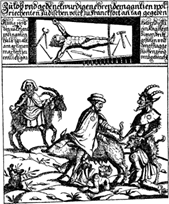
Questions for students: How are Jews being depicted in the image? What harmful myth about Jews is represented? How does an image like this reinforce religious antisemitic views?

Possible Responses:

  • On top is an image of Simon of Trent, reinforcing the blood libel myth
  • Below, Jews are depicted as being engaged in disgusting and lewd actions with a pig (considered an unclean animal in Jewish tradition) – this represents the idea of Judensau:
    • A Jewish man is placing his mouth on a pig’s anus
    • A Jewish child is suckling from the pig
    • A Jewish man is riding backwards on the pig, alluding to his “backwards” nature in his rejection of Christianity
  • Both the Jews and the devil are wearing circular badges (one of the identifying markers that Jews were forced to wear in parts of Europe)

Alternate image option: [4]

Optional: Share SOURCE 4: Excerpt from Solomon bar Simson Chronicle[5].

Context:

By the 11th century, as a result of becoming a diaspora, Jews had settled across many regions of Europe and the Middle East. In 1096, Pope Urban II launched the First Crusade to regain the Holy Land from Muslim rule. Unfortunately, a number of Jewish communities lay en route to the Eastern Mediterranean and were attacked by the Crusaders. Many Christians viewed Jews negatively because they did not embrace Jesus. So, although the Crusaders set off to fight “enemy Muslims,” they quickly incorporated attacking “enemy Jews” as part of their mission. As the Crusaders made their way through France and Germany, they burned synagogues, forced conversions, brutally massacred Jews, and incited anti-Jewish riots.

The following excerpt is from a source known as the “Solomon bar Simson Chronicle.” The chronicle is a Jewish account of the First Crusade.

Primary Source:

First, consider guiding a discussion, allowing students to again share what they see – what stands out to them from this quote? Then, ask students to specifically discuss:

  • According to this quote, what did the Crusaders want to do to the Jews?
    • Kill them all (“exterminate them from among the nations”)
  • What religious antisemitic notions did the Crusaders use to justify their actions?
    • Deicide charge (“those whose forefathers murdered and crucified him for no reason”)
    • Jews being evil (“offspring of promiscuity”)

Optional: The graphic organizer gives students space to reflect after learning about each historical form of antisemitism. If time permits, give students a few moments to reflect, either through writing or discussion, about what they have learned in this part of the lesson.

Transition: Explain that the second form of antisemitism we will be discussing is economic antisemitism. The image of the “greedy Jew” may be the most enduring antisemitic stereotype of all. It is during the medieval period that economic antisemitism began to take on forms that are familiar to us today.

6.   HISTORICAL FORM OF ANTISEMITISM: ECONOMIC 

Guiding Questions: How did Jews first become associated with money/money lending? What are some historical examples of religious antisemitism?
The notes below, as well as additional content, are presented through correlating slides in the Google Slides Deck for Classroom Presentation. Please refer to the Antisemitism Glossary of Terms for additional definitions of the bolded words below.
●   Starting in the 11th century, many medieval European legal systems prohibited Jews from owning land, farming, or joining craft guilds. These legal systems were based on the types of legal codes from the Roman period, like the Theodosian Code, which were designed to limit Jews religiously and economically.
●   With few economic opportunities available, many Jews turned to marginalized occupations, such as tax/rent collecting and money lending on behalf of wealthier Christians. Many Christian lords would use Jews as middlemen to bypass the Christian religious prohibition on usury.
●   As a result, the Christian populace depended on Jewish moneylenders, which resulted in resentment and hostility towards Jewish debt collectors (rather than the rulers who were enacting the taxes or charging high interest in the first place).
●   Christian leadership exacerbated these tensions by positioning Jews as a scapegoat for the common person’s financial troubles. Though Jews were not the only ones involved in lending money at interest during the Middle Ages, eventually usury – and finance more generally – became identified as a “Jewish practice.”
●   This association between Jews and money became deeply entrenched in Western society to the point where it is now a Jewish stereotype.
o   Shylock – perhaps the most notorious Jewish moneylender – is a fictional character created by William Shakespeare. It’s important to note that Shakespeare debuted this play at a time when nearly no Jews were living in England – they had all been expelled 300 years earlier. However, the stereotype of the Jewish moneylender was so entrenched by this point that audiences didn’t need to have Jews around for the caricature to resonate.
o   Hundreds of years later, Henry Ford, founder of the Ford Motor Company, propagated virulently antisemitic notions about Jews in his newspaper The Dearborn Independent, in the 1920s, drawing on medieval tropes that described Jews as ruthless, money-hungry, and in control of the world’s finances. The antisemitic content that was published in Ford’s newspaper had a significant impact because of its vast readership, with articles being picked up by other news outlets across America. Consequently, Ford’s published works played a role in the rise of antisemitism in the United States.
Share SOURCE 5: Excerpt from The International Jew.

Context:

The following excerpt is an illustration of the ideas propagated by Henry Ford in his newspaper, The Dearborn Independent. He collected and published his articles in a book entitled The International Jew: The World’s Foremost Problem. The book became widely read, was translated into several languages, and served as a point of inspiration for later Nazi leadership.

Primary Source:

“Business is to [a Jew] a matter of goods and money, not of people. If you are in distress and suffering, the Jewish heart would have sympathy for you; but if your house were involved in the matter, you and your house would be two separate entities…the Jew would naturally find it difficult, in his theory of business, to humanize the house…he would say that it was only “business.” (June 5, 1920)[6]

Ask students:

●      How are Jews being portrayed in this quote?

o     Cruel, heartless, entirely driven by greed
o     Incapable of displaying “sympathy” or “humanizing” situations if money is involved

Optional: The graphic organizer gives students space to reflect after learning about each historical form of antisemitism. If time permits, give students a few moments to reflect, either through writing or discussion, about what they have learned in this part of the lesson.

Transition: Explain that the third form of antisemitism we will be unpacking is political antisemitism. To understand the roots of this kind of anti-Jewish thought, we need to go back to the French Revolution and the rise of the modern nation-state.

7.   HISTORICAL FORM OF ANTISEMITISM: POLITICAL

Guiding Questions: What is the “Jewish Question”? How did the political situation differ for the Jews of Western and Central Europe compared to the situation of those in Eastern Europe? How did the backlash to Jewish emancipation in Europe contribute to political antisemitism? What are some historical examples of political antisemitism?
The notes below, as well as additional content, are presented through correlating slides in the Google Slides Deck for Classroom Presentation. Please refer to the Antisemitism Glossary of Terms for additional definitions of the bolded words below.
  • In the late 1700s and 1800s, the cultural and political status of Jews in Western and Central Europe would begin to change.
  • The French Revolution created a new category of “citizen” that granted equal rights to everyone (at least in theory). However, some French people wondered whether Jews were capable of really being “French enough” to be entitled to political rights like other citizens of France. This became known as the “Jewish Question.
  • In the end, France decided to emancipate its Jewish population in 1791. However, in return, Jews were expected to make changes to various aspects of their cultural and communal life (e.g., stop using traditional Jewish names, refrain from using Hebrew/Yiddish in business transactions, keep their Jewishness private and out of the public sphere).
  • However, in Eastern Europe (where the majority of European Jews lived) the political situation was very different. Jews in Eastern Europe were not emancipated until 126 years later in 1917.
  • In Imperial Russia in the 19th and early 20th centuries:
    • Jews were only allowed to live in the so-called “Pale of Settlement.
    • Russian authorities encouraged antisemitic violence and riots known as pogroms.
  • By the mid-19th century in Western and Central Europe, objections to emancipation began to grow. Resentment and fear helped fuel the prejudices that would manifest into political antisemitism.
    • Resentment of perceived economic success among Jews fueled false notions that Jews were stealing jobs from Christians and were over-represented in important fields.
    • As Jews became politically active, they were viewed as proponents of radical/dangerous political views – those held by whatever the powers that be feared.
      • For example, because figures like Karl Marx and Leon Trotsky were of Jewish descent, this led people to closely associate Jews with communism (even though most Jews were not communists).
      • More broadly, however, there were widespread conspiracy theories throughout Europe about Jewish governmental and economic control, which hinged on small numbers of Jews in positions of power.
    • The Protocols of the Elders of Zion, published in Russia in 1905, is one of the most widely cited pieces of political antisemitism to this day.
  • Despite efforts to assimilate and become part of their host societies, Jews continued to stay connected to their own communities and retain aspects of their cultural identities. This led critics to believe that Jews were benefiting from emancipation while remaining a separate group – a group whose loyalty would always be questioned. Jews, therefore, continued to be perceived as “other” and as a threat to European society.

Share SOURCE 6: Political Cartoon – “Metamorphosis”

Context:

The following political cartoon, printed in 1903, comes from a German weekly satirical magazine called Simplicissimus. [7] Explain that metamorphosis means a thing/person changing from one thing to something completely different (such as a caterpillar becoming a butterfly). Then have students take a look at the image below.

Primary Source:

First, consider guiding a discussion allowing students to share what they see – what do they notice when first examining this cartoon? Then ask students more specifically:

  • What is going on in this cartoon?
    • A Jewish immigrant is transforming himself from a pauper into a well-respected and affluent member of society
  • What about the way the Jewish man is portrayed stays the same throughout the three pictures? What changes?
    • The exaggerated and distorted features remain (hooked nose)
    • The clothes are more expensive and modern
    • The items he holds become more valuable and modern
  • What is this cartoon implying about Jewish emancipation?
    • That a Jew will always be a Jew – an “other” – no matter how much he changes externally and tries to assimilate

Reinforce the point that many in European society opposed emancipation because their prejudice against Jews led them to interpret Jewish efforts to join society as being motivated by ill intent. Additionally, the reference to the Jewish nose is based on pseudo-scientific notions of Jews being an inferior race, which will be addressed in the final form of antisemitism outlined in this lesson plan.

Optional: The graphic organizer gives students space to reflect after learning about each historical form of antisemitism. If time permits, give students a few moments to reflect, either through writing or discussion, about what they have learned in this part of the lesson.

Transition: Explain to students that the last form of antisemitism you’re going to examine is called racialized antisemitism. While political antisemites fear a “Jewish” political agenda for “world domination”, racial antisemites claim that there is a Jewish agenda for “racial domination.”

8.   HISTORICAL FORM OF ANTISEMITISM: RACIAL

Guiding Questions: What term did Wilhelm Marr coin, and what did the term describe? How were the scientific concepts of natural selection and biological inheritance misappropriated by antisemites? What are some historical examples of racial antisemitism?
The notes below, as well as additional content, are presented through correlating slides in the Google Slides Deck for Classroom Presentation. Please refer to the Antisemitism Glossary of Terms for additional definitions of the bolded words below.
●     In 1859, Charles Darwin debuted his theory of evolution and natural selection. In 1865, Gregor Mendel introduced the concept of biological inheritance – the basis for what we now call genetics.
●     Racists and antisemites misappropriated these notions to support their beliefs in white superiority.
●     In 1879, German journalist Wilhelm Marr introduced the term “antisemitism” to describe his opposition to Jews as a supposed inferior “race” (please reference the Appendix for more information). Soon, Marr’s new term was being used throughout Europe.
●     Marr’s notion of Jews being an inferior race marked a dangerous turn. According to Marr, Jews were a problem because of innate and unchangeable biological differences.
●     Racial antisemitism was the primary manifestation of antisemitism in Nazi Germany.
●     According to Nazi racial theory, Jews constituted a biologically inferior race which was thought to corrupt the pure German-Aryan stock through “race-mixing” and intermarriage. It became extremely important to the Third Reich to distinguish between those with Jewish and “Aryan” ancestry.
●     In 1935, the Nazi government passed the Nuremberg Laws, which legally made Jewish Germans different from non-Jewish Germans. They restricted marriages and sexual relations between those deemed racially German and those with Jewish backgrounds. Under the Nuremberg Laws, only “Aryans” were allowed citizenship. Jews were stripped of citizenship and denied their political rights, and their passports invalidated.
●     Eventually, the Nazis passed more discriminatory laws that  forced Jews out of many professions, severely limited their movements, and required them to self-identify in public with the infamous yellow stars.
●      The Nazis made a great effort to define who was and was not racially acceptable. Their racialized understanding applied to: religious Jews, non-religious Jews, converts from Judaism to other religions, those who were not considered Jewish according to Jewish law but had some amount of Jewish ancestry. 

Share SOURCE 7: Excerpt from a letter written by Adolf Hitler to Adolf Geimlich.[8]

Context:

In the politically unsettled period after World War I, the Bavarian state government in Germany established a group on May 11, 1919, to keep an eye on political groups and to carry out “educational work” in order to combat revolutionary activities among disgruntled army veterans. Adolf Hitler joined the “Information Department” as a propaganda writer and informant and participated in education courses organized by the department. Because of his noted rhetorical gifts, Hitler was appointed as a lecturer. He was asked to respond to Adolf Gemlich, a course participant, on September 16, 1919, on the government’s position on the so-called “Jewish Question.” 

The letter is an early example of Hitler’s views on Jews before he became the leader of the National Socialist Democratic Party, also known as the Nazi Party, in 1921. The full letter builds on all of the types of antisemitism explored in this lesson. To analyze racial antisemitism, please examine the following excerpt with students:

Primary Source:

Then, discuss the following questions with students:

  • Where do you see racialized antisemitism expressed?
    • “thousand years of inbreeding”, “the Jew has preserved his race and character”, “non-German, foreign race, unwilling and unable to sacrifice its racial characteristics”
      • reveals the thought that Jews are a ‘foreign race’ with undesirable traits, and that they cannot be changed
    • “the feelings of the Jew are concerned with purely material things”
      • claims that the so-called greediness of Jews is in fact an inalterable racial characteristic
    • “his activities produce a racial tuberculosis”
      • Jews are described as causing disease in society – something malignant and insidious
  • What other types of antisemitism does Hitler express in this passage?
  • “possesses all the political rights that we ourselves have”
    • Disturbed that Jews have equal political rights – echoes the idea that Jews use political rights for nefarious gain
  • “the feelings of the Jew are concerned with purely material things”
    • ties in racialized perception of Jews with economic antisemitism

Share SOURCE 8: Speech by Ellison DuRant Smith”[9]

Context:

The Jewish immigrant population in the U.S. significantly grew between 1880-1924. Fears that immigrants posed a threat to the racial and cultural makeup of the U.S. led to efforts to keep Jews out. As a result, America created a new federal law that primarily aimed to exclude Eastern European Jews and Southern Italian Catholics from immigrating to the country: the 1924 Immigration Act. Many of the arguments put forward in support of the law, like this one, were explicitly racist. While the text does not name Jews specifically (aside from Son of a German Immigrant), it’s important to note that this is the kind of thinking that went along with racialized antisemitism – a belief in white superiority above ALL other “races”.

Primary Source:

Then, discuss the following questions with students:

  • How does DuRant Smith express racialized antisemitism?
    • That only true Americans should only come from “pure” Anglo-Saxon (meaning mostly English) families. They even want to “breed” more of these “pure” Americans.
    • This idea is part of a bigger way of thinking where people are judged and ranked based on their race. By saying what they think is the “right” race for America, they are automatically saying that other races are “wrong” or “less than.”
  • How do these ideas suggest a specific, and potentially harmful, vision for who should be considered truly “American” and how immigrants should be treated?
    • These ideas are harmful because they basically say that only people who are from a specific background (Anglo-Saxon) are truly American and valuable. Everyone else, especially immigrants, is seen as “less than” or a “problem” that needs to be changed.

Share SOURCE 9: Magazine cover of “La Libre Parole”[10]

As a final primary source analysis activity, ask students to look for the four forms of antisemitism they have learned about in a single source, which demonstrates the idea that these types of antisemitism are often interconnected and influence each other. Use the Library of Congress analysis method, “Observe, Reflect, Question,” to analyze the following magazine cover, which reflects many of the concepts from this lesson and can help students visually synthesize those ideas.

Context:

This magazine cover is from a French publication called La Libre Parole. It was printed on October 28, 1893 (just over 100 years after the emancipation of Jews in France).The editor and founder of this magazine was Edouard Drumont, who founded the Antisemitic League of France in 1889. Consider how this cover reflects antisemitic ideas held by parts of French society at the time.

Primary Source:
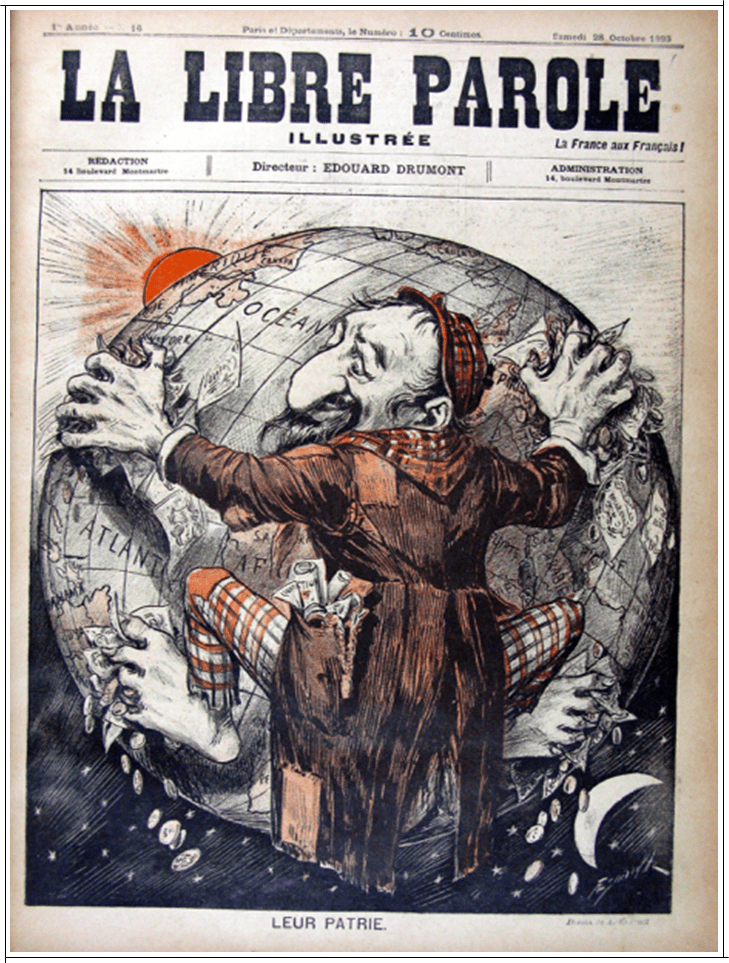
Step 1 – OBSERVE: Start by having students make observations, focusing on concrete details that they notice.

Observations may include: Tattered clothes, enlarged nose, animalistic/dehumanized features like claws, the money stuffed in his pockets and coming out of the world, he seems to be doing harm to the planet. He’s also in the dark – the sun is on the other side.

Step 2 – REFLECT: Next, ask students to reflect and use the prompt questions to help guide their thinking. What do the details suggest? What stereotypes are represented? In what ways are the four forms of antisemitism discussed in this lesson represented in this one image?

Reflections might include: If you recognize the stereotyped features, then we know this is a dehumanizing depiction of a Jew. Clearly, the illustrator believed that this man is harming the world in multiple ways. That he’s in the dark, along with the claw-like hands, suggests evil activity.

As for how the four types of antisemitism manifest in this image, here are some possible insights:

  • Political antisemitism. The figure appears to be maliciously grabbing onto the globe, eagerly climbing his way as far as he can go. This reflects a perceived threat of Jewish world domination.
  • Racialized stereotypes – the enlarged nose, the pointy beard, the beastly features – all exaggerated, and are reminiscent of the idea that Jews are less human and an inferior race trying to soil the purity of white Europeans.
  • Economic stereotype of the greedy Jew with money stuffed in his pockets echoes the idea that Jews perform harmful economic activities.
  • While not as overtly featured as the other forms of antisemitism, we can still see representations of religious antisemitism. First, there is the association between Jews and darkness, and therefore evil – a common trope in religious antisemitism. The man also covers his head, something that marks him as a religious Jew.

Step 3 – QUESTION: Finally, encourage students to ask additional questions to help further their learning. Possible questions might include: Why does the figure have exaggerated features? Why does he have on ragged clothes, while shown with an excessive amount of money in his pockets? Why is he illustrated as doing some sort of harm to the world?

Transition to Gallery Walk Activity: Explain to students that, like in the La Libre Parole image, the four forms of antisemitism continue to manifest in society, which will be demonstrated in the following activity. However, as important as it is to be able to recognize these influences, sometimes the way antisemitism is expressed in the current context does not fit neatly into the four historical forms. Today, we are seeing unprecedented levels of anti-Jew hate showing up in schools, sports, social media, and more, with the intent to hurt, intimidate, and marginalize Jews. In the following activity, we will refer to some examples as Evolving Anti-Jew Hate when they do not distinctly fit into the four categories we have learned about.

9.    GALLERY WALK ACTIVITY

This activity may be used as a final assignment or as a lesson wrap-up. Students will apply what they have learned through direct instruction in the lesson to modern examples of antisemitism, or anti-Jew hate, that they will analyze independently.

Objective

Through close examination of primary source documents and collaborative group work, this activity will enrich student understanding of how the four forms of antisemitism have manifested in the past as well as the present.

Materials: Modern Antisemitism Gallery Walk: instructions, sources, questions, student note-catcher (PDF)

Set Up

Display the primary sources around the classroom. These primary sources should be displayed “gallery style,” at different stations in a way that allows students to disperse themselves around the room. The primary sources can be arranged in any order. They can be hung on walls or placed on tables. The most important factor is that the stations are spread far enough apart to reduce significant crowding.

There are 14 stations for this activity, so you may want to divide the class into groups and assign each group two or three stations, depending on the number of students in the class. Of course, you may decide to use fewer primary sources, depending upon the amount of time you have to spend on this lesson or what content you want to emphasize.

Instructions

Explain to the students that they will participate in a “gallery walk activity.” Students will move around from station to station, like in a museum or art gallery. They will review the source at each station and answer a few questions per station.  Students should write their responses in the space provided on the Gallery Walk Note-Catcher (included in the PDF).

Alternative Gallery Walk Experience: Interactive Digital Gallery

Share a link to the Digital Version of the Modern Antisemitism Gallery Walk.

Then, instruct students to click on each image to interact with it by reading an example, answering a self-assessment question about the form of historical antisemitism shown, and considering discussion questions. Teachers can further assess understanding through class discussions or by collecting individual responses to provided prompts. Note that student responses entered on the slide identifying the historical form of antisemitism will not be available to the teacher.

10. CONCLUSION

Have students fill out the exit slip (PDF | Google Doc) or use the questions to hold a class discussion.


Appendix: Race vs. Ethnicity

The term ‘ethnicity’ falls short when describing Jewish identity. The more fitting, ancient term is Am (people). This category predates and differs from later social constructs like race, religion, and ethnicity, explaining why Jewish people don’t fit neatly into any of them.

However, to help students better understand how to define Jews as a group of people, it can be helpful to understand the difference between race and ethnicity, since Jews are often classified as an ethnic and/or a religious group, but NOT a race.

  • Ethnicity refers to a people’s shared cultural identity, often based on factors such as ancestry, language, religion, customs, and a sense of common history or heritage. It distinguishes one group of people from another based on these cultural characteristics.
  • The term race is often used to categorize and differentiate people based on physical traits such as skin color, facial features, and hair texture. However, it’s important to note that the concept of race is a social construct and not a scientifically valid biological category. All people are part of the human race.

It’s inaccurate to call Jews a race because they come from a wide variety of backgrounds and exhibit significant physical and visible diversity. This is why ethnicity is the preferred term to describe the Jewish people.


[1] Statues of Ecclesia and Synogoga in Freiburg Germany Cathedral Entrance, c. 1300

[2] A Law of Theodosius II, January 31, 439, Novella III: Concerning Jews, Samaritans, Heretics, and Pagans can be found at https://faculty.uml.edu/ethan_spanier/Teaching/documents/TheCodexTheodosianus.pdf

[3] The Jews in Christian Art: An Illustrated History (New York: Continuum, 1996), 337.

[4] Source: Wikipedia commons, https://en.wikipedia.org/wiki/Judensau#/media/File:Wimpfen-stiftskirche-judens.jpg

[5] Source: Shlomo Eidelberg, The Jews and the Crusaders: The Hebrew Chronicles of the First and Second Crusades (Madison, WI: The University of Wisconsin Press, 1977), pg. 22.

[6] The Dearborn Independent, Issue June 5, 1920, pg. 23 https://archive.org/details/the-international-jew-henry-ford/page/n21/mode/2up

[7] Harris, Constance. The Way Jews Lived: Five Hundred Years of Printed Words and Images. McFarland, 2008. p. 335.

[8] Source of English translation: Jeremy Noakes and Geoffrey Pridham, eds., Nazism 1919-1945, Vol. 1, The Rise to Power 1919-1934. Exeter: University of Exeter Press, 1998, pp. 12-14.

[9] Speech by Ellison DuRant Smith, April 9, 1924, Congressional Record, 68th Congress, 1st Session (Washington DC: Government Printing Office, 1924), vol. 65, 5961–5962. https://shec.ashp.cuny.edu/items/show/1249

[10] Source:“Leur Patrie, (Their Homeland) La Libre Parole illustrée, No. 16, 28 October 1893 , Duke Library Exhibits, accessed July 8, 2013, http://exhibits.library.duke.edu/items/show/20981

The Black Plague: A Positive Spin on Death?

How can mass mortality be viewed in a positive light? This is a question that arises when it comes to contemporary discussions of the fourteenth-century Black Death epidemic which wiped out nearly one-third of the population of Europe.[1] It is difficult to understate the immediate negative consequences of the Plague as it dismembered families, ripped apart social structures, and threw the economy into shock. Yet, some historians have now come to see the depopulation of the continent as a sort of necessary evil. Shortages of resources and job opportunities were prevalent by the beginning of the fourteenth century, especially in England, the country this paper will focus on.[2] In contrast, the Plague eliminated the shortages caused by overpopulation which immediately increased demand for workers. This led to increased wage growth and the widening of options of employment for average civilians. So, did the Black Death have a more positive or negative short-term impact on the English labor force? This essay argues that while the epidemic brought about a period of brief devastation, it ultimately eased the shortages of the years that preceded it leading to rapid labor reform which can be seen in first-hand accounts and the post-plague policies aimed at curtailing it.

            The advancements made by laborers as a result of the Black Death can most obviously be seen by comparing their circumstances from before and after the Plague’s onset. As mentioned previously, it is therefore important to begin by establishing the former. This can be done by analyzing “The Statute of Labourers,” a 1351 policy put in place by the English government which attempted to maintain the social structure that was present before the epidemic. In so doing, the law continuously reverts back to the conditions of the “20th year of the king’s reign” which refers to 1346, just one year before the onset of the Black Death.[3] One of the Statute’s stipulations is that most employees, especially in agricultural fields could not be hired for periods less than a year, or other extended tenures that existed beforehand.[4] This severely limited the options of laborers and forced them to remain in jobs that might not pay as well as others. Therefore, not only were there severe shortages of jobs in England during the beginning of the fourteenth century, but workers were often unable to switch jobs, being signed for lengthy terms of service. Furthermore, the Statute makes it clear that virtually no benefits were offered by employers. Laborers were therefore expected to work for their dwindling salaries alone.[5] This shows a circumstance in which there was such a high supply of workers, that employers did not need to create many incentives to fill their openings.

            Karakacili furthers the image of pre-Plague life that the Statute of Labourers provides. Her findings show that the majority of workers in England at the time were farmers. And just as the provisions of the Statute mandated certain tenures of service for employees, Karakacili claims that much of the labor by said farmers was completed by serfs. In addition, Karakacili applies the Malthusian crisis she explains earlier to the predicament of English laborers. As such, she claims that “the average output of a farm worker did not suffice…to feed him or herself.”[6] Therefore, wages were so low, and resources were so scarce, that the majority of people were not able to provide for themselves. But workers remained in their struggling positions because it was likely the best they could achieve.[7] So, in this situation as well, workers were limited in their ability to leave their jobs, both because they were legally prevented from doing so, and because there were very few other viable options.

All aspects of society were affected by the Black Death, and limitations for employees in England were no exception. To this point, Alfani and Murphy explain in “Plague and Lethal Epidemics” that “an inequality decline after a severe mortality is what we should expect.”[8] By this, they mean that various economic consequences of epidemics contribute to a narrowing of the wage gap. This is because as the population declines, so does the supply of labor. And the general rule of economics that Alfani and Murphy outline is that as a resource becomes scarcer, it becomes more expensive.[9] This was clearly the case with the Black Death as it had one of the highest mortality rates of any epidemic in history. Therefore, the mortality of the Plague diminished the supply of workers which immediately led to increased wages and competition between employers for laborers.

            The increase in competition for English laborers can be seen in various accounts of serfs leaving their old employers behind as there were finally better options available. As such, after the Black Death, there are abundant instances showing the diminishing disconnect between serfs and their masters as the former could now achieve sustainable compensation. An account of the East Riding estates of Meaux Abbey in the 1350s outlines several examples of serfs discovering new opportunities in the wake of the Plague. In one instance, the account describes a series of serfs bound to the church in the town of Wawne. However, it goes on to ridicule them saying that despite their long history of being bound to serve the church, they have declared themselves free of their service. Still, it does not say that they just left to wander about the country. Rather, they called themselves servants of the king as they “apparently considered it more glorious to be…royal serfs.”[10] Another example of this trend comes in the Durham hallmoot book of 1350-55 which discusses the experiences of a lord in northern England whose serfs abandon him. These farmers are described as “malicious” as their actions were seen as a betrayal of the master they were bound to. Again though, they are not seen as completely leaving their jobs altogether, but with the intention to “tak[e] holdings elsewhere.”[11] This shows the occurrence of the pattern that Alfani and Murphy discuss. The Black Death wiped out so many workers that demand for them increased dramatically thereby widening the prospects of the labor force. As a result, workers who previously had no hope of ever leaving their insufficient circumstances, could now easily find work elsewhere and for better wages. The serfs of Wawne and Durham are emblematic of this trend as they departed their old livelihoods for better ones in the wake of the Black Death upheaval.

            The Black Death’s economic consequences can be seen not only in firsthand accounts, but also in the legislation instituted by governments following it. Leading Plague historian Samuel Cohn discusses such legislation in his article “After the Black Death: Labour legislation and attitudes towards labour” in which he outlines the motivation behind it and its differences throughout Europe. Cohn explains that these policies were put in place to stimy the supposed advancements that laborers were making as a result of the fear and anxiety that accompanied the great mortality.[12] As Herlihy explained, the Black Death represented an unalterable shift in the labor dynamics of the fourteenth century[13] and this perception was felt throughout Europe just as Cohn describes. Therefore, the reverberations of the Plague on English labor can be seen in post-epidemic policies aimed at curtailing them.

            An example of these post-Plague policies is that of Simon Sudbury who as the Archbishop of Canterbury in the 1370s was the foremost religious leader in England behind the Pope. In a 1378 letter to the Bishop of London, Sudbury lays out both his displeasure with the changes in labor, and his solution to them. He thus begins by describing his own priests as “infected with the sin of greed” for they had been selling their services for “vastly inflated salaries” outside the church.[14] In response, the Archbishop raises the wages of the priests in order to get them to stay, but also imposes strict penalties for those would still not adhere to the new salaries.[15] Sudbury’s letter thus proves that post-plague advancements were not only occurring for farmers and serfs, but also for members of the church. This situation widens the scope of Black Death reform from the lowliest peasants to include the clergy as well.

            The hallmark of English post-Plague labor legislation came in the form of the aforementioned 1351 Statute of Labourers which attempted to return the social order to the characteristics it embodied five years earlier.[16] It therefore made it illegal for workers to sign employment contracts that were binding for less than a year, instituted strict salaries for various jobs that were not to be exceeded, and required that employers offer no benefits to their laborers.[17] Its fears of workers making advancements are confirmed by the various accounts of individuals being charged for violating it. In a 1353 case in the town of Lincoln, a ploughman named John Skit is described as fleeing to “distant parts,” fearing his prosecution for accepting a new job under better working conditions before his contract was concluded.[18] In a similar 1360 case from Bolingbroke, a bishop named Alan is recorded as being charged forty pence for leaving his employment to a figure known as “Lady Roos” before his term of service was over.[19] Another case from 1374 describes a so-called “vagabond” named Richard Rote as being placed in stocks until he agreed to work again. However, the case also claims that two people attempted to free Rote, openly defying the provisions of the Statute of Labourers.[20] There are countless examples of violations of the Statue, thereby showing how labor reform was in fact taking place.

            It is not at all difficult to point out the destructive repercussions of the Black Death. By eliminating one-third of the population of Europe, it tore apart institutions, families, and impacted nearly every corner of society. However, there has emerged a sound argument for the Plague having a positive effect on English labor. Before the epidemic ravaged the country, England, like most places in the continent, was suffering immense shortages in both resources and job opportunities. However morbidly, the Black Death’s mortality ended this crisis and opened up the job market. As there were now shortages of workers, employers were forced to raise wages and benefits, and laborers could now leave their jobs (albeit illegally according to the Statutes) as there were other viable options. This trend was not without resistance and the English government attempted to stimy the advancements of employees in order to maintain the social structure. But, these policies prove that reform was indeed taking place, especially since there are many documented violations of them. As such, these circumstances beg the question, was the English workforce more positively or negatively affected by the Black Death? By ending the Malthusian Crisis of the early fourteenth century, the Plague opened up the job market increasing wages and opportunities for average English workers in a way that would not be seen again for centuries.

            At this point, it seems appropriate to ask, so what? What does an epidemic from the fourteenth century have to do with your classroom today, 700 years later. Well, especially considering the events of the last few years, it seems almost more relevant than ever before. The Coronavirus Pandemic we all experienced is perfect fodder for a compare and contrast activity. A clear example is the fact that the Coronavirus was classified as a pandemic but was less deadly. Why was this the case? What were the characteristics of each that they were classified differently? Furthermore, one could easily conduct a simulation with this lesson. It might be a good idea to have the students imagine the methods they would use to handle the Black Death epidemic which might rationalize some of the actions taken by Plague doctors. And if you’re looking for a lesson specifically concerning the labor reforms discussed in this article, consider tying it in with your economics unit. It’s a clear example of supply and demand. There is definitely no shortage of options for lessons on this topic, which could be an eye-opening, yet relatable subject for your class.

Alfani, Guido, and Murphy, Tommy. “Plague and Lethal Epidemics in the Pre-Industrial World.” The Journal of Economic History 77, no. 1 (2017): 314–43.

Bardsley, Sandy. “Women’s Work Reconsidered: Gender and Wage Differentiation in Late Medieval England.” Past & Present, No. 165 (Nov. 1999): 3-29

Cohn, Samuel. “After the Black Death: Labour Legislation and Attitudes Towards Labour in Late-Medieval Western Europe.” The Economic History Review 60, no. 3 (2007): 457–85

Herlihy, David. “The New Economic and Demographic System.” In The Black Death and the Transformation of the West (Cambridge: Harvard University Press, 1997), pp. 39-57

Karakacili, Eona. “English Agrarian Labor Productivity Rates before the Black Death: A Case Study.” The Journal of Economic History 64, no. 1 (2004): 24–60.

Rosemary Horrox, ed. and trans., The Black Death (Manchester: Manchester University Press, 1994).

“Difficulties in finding tenants,” pp. 326-331

“Rebellious Serfs at Wawne,” pp. 331-338

“A selection of cases from Lincolnshire,” pp. 319-320

Simon Sudbury, “Simon Sudbury increases priests’ wages,” pp. 311-312

“The Statute of Labourers,” pp. 312-316


[1] Guido Alfani, and Tommy E. Murphy. 2017. “Plague and Lethal Epidemics in the Pre-Industrial World.” The Journal of Economic History 77 (no. 1), 318.

Alfani and Murphy discuss the Black Death’s emergence in the Himalayas in the 1330s and its recognition by the Mongols in control there. From central Asia, it traveled west eventually reaching the shores of the Black Sea, the Hellespont, and then the Mediterranean. Because of the wide area affected by the disease, mortality rates ranged from place to place. The one-third rate discussed in the first paragraph of this essay refers to that of Europe at large and is estimated to be closer to two-thirds in some regions throughout the continent.

[2] Eona Karakacili. “English Agrarian Labor Productivity Rates before the Black Death: A Case Study.” The Journal of Economic History 64, no. 1 (2004), 25.

[3] “The Statute of Labourers” in The Black Death, ed. and trans. Rosemary Horrox (Manchester: Manchester University Press, 1994), 312.

[4] Ibid., 313

[5] Ibid.

[6] Karakacili, 26.

[7] Ibid.

[8] Alfani and Murphy, 334.

[9] Ibid.

[10] “Rebellious Serfs at Wawne” in Horrox, The Black Death, 332

[11] “Difficulties in finding tenants” in Horrox, The Black Death, 327

[12] Samuel Cohn. “After the Black Death: Labour Legislation and Attitudes Towards Labour in Late-Medieval Western Europe.” The Economic History Review 60, no. 3 (2007), 457

[13] Herlihy, 40

[14] Simon Sudbury, “Simon Sudbury increases priests’ wages” in Horrox, The Black Death, 311

[15] Ibid., 312

[16] “The statute of labourers,” 312

[17] Ibid.

[18] “A selection of cases from Lincolnshire,” in Horrox, The Black Death, 320

[19] Ibid.

[20] Ibid.


Stalin: Waiting for Hitler, 1929-1941, by Dr. Stephen Kotkin, Princeton University

Stalin: Waiting for Hitler, 1929-1941 By Dr. Stephen Kotkin, Princeton University

Application to European and World History by Hank Bitten

The opening sentence, the thesis statement, by Dr. Kotkin is capitalized: “JOSIF STALIN WAS A HUMAN BEING.” This is supported by the evidence that he carried documents wrapped in newspapers, was an avid reader with a personal library of more than 20,000 books, and a man who enjoyed his tobacco from Herzegovina. Throughout the book there are the details of the floor plans of his apartments and hunting lodge, passion for his 1933 Packard Twelve luxury car and relationships with his mother, two wives, and children.

1933 American-made Packard Twelve

This is a fascinating read about Stalin, the ‘seemingly humane man’ and totalitarian ruler, his handling of the failures in agriculture and limited successes in manufacturing, propaganda and party purges, solidification of Party power, perspectives on capitalism, fascism, socialism, and communism, and the threats the U.S.S.R. faced from Germany, Japan, the long civil war in China, and even the small independent state of Poland. As a teacher of U.S., European, and World History, I likely spent too much time on the impact of the Great Depression and the rise of dictatorships than on the global perspective of the new Soviet empire and Japan’s vision in the Far East. The advantage of Stalin: Waiting for Hitler, 1929-1941 is that it provides teachers with examples for decision-making lessons in every year from the first Five Year Plan until the evening of Operation Barbarossa.

The eloquently phrased statement below by Dr. Kotkin is an argument for high school students to analyze and debate. History is about thinking and students need to investigate sources, determine their reliability, and develop their own thesis statement.

“A human being, a Communist and revolutionary a dictator encircled by enemies in a dictatorship circled by enemies, a fearsome contriver of class warfare, an embodiment of the global Communist cause and the Eurasia multinational state, a ferocious champion of Russia’s revival, Stalin did what acclaimed leaders do: he articulated and drove toward a consistent goal, in his case a powerful state backed by a unified society that eradicated capitalism and built industrial socialism. “Murderous” and “mendacious” do not begin to describe the person readers will encounter in this volume.  At the same time, Stalin galvanized millions.  His colossal authority was rooted in a dedicated faction, which he forged, a formidable apparatus which he built, and Marxist-Leninist ideology, which he helped synthesize.  But his power was magnified many times over by ordinary people, who projected onto him their soaring ambitions for justice, peace, and abundance, as well as national greatness.  Dictators who amass great power often retreat into pet pursuits, expounding intermittingly about their obsessions, paralyzing the state.  But Stalin’s fixation was a socialist great power.  In the years 1929-36, covered in part III, he would build that socialist great power with a first-class military.  Stalin was a myth, but he proved equal to the myth.” (p. 8)

It is difficult to find humor in a book about a leader responsible for killing (and starving) millions of people but Dr. Kotkin finds the right time to tell us about the goodwill tour of Harpo Marx.  In the middle of a counterrevolutionary terrorist plot against Stalin, a possible war with Japan, and FDR trying to save American capitalism from default. Harpo Marx (an American comedian) while interacting with a Soviet family in the audience has 300 table knives cascade from his magical sleeves! (p.145)

The lessons for teachers and students are enriched by the details in this book. For example, Dr. Kotkin’s analysis of the failures of the collective farms in the first four years of the First Five Year Plan provide factual data for teachers and resources for developing engaging decision-making activities for students.

In 1929, the USSR had only 6 million out of 60 million workers employed, an unemployment rate of about 90%! Livestock and grain prices crashed as did the U.S. stock market with a 25% decline in four days of October. But in the USSR, there was a surprise harvest of 13.5 million tons. This led to forced collectivization of 80% of the private farms and the deportation of kulaks as Stalin understood the importance for agricultural security in an insecure state. Food was essential to the industrialization of the Soviet Union and for the police, army, and ordinary people. By contrast, a Soviet worker needed to labor for sixty-two hours to purchase a loaf of bread, versus seventeen minutes for an American. (p.544)

“But the dictator himself would turn out to be the grand saboteur, leading the country and his own regime into catastrophe in 1931-33, despite the intense zeal for building a new world.  Rumblings within the party would surface, demanding Stalin’s removal.” (pp. 70-71)

Decision Making Activity:

Should the USSR focus on agricultural reforms before starting a program of industrial reforms? (1929-1934)

The decisions facing Stalin had to be overwhelming:

  • His government faced increasing debt
  • There was no organized educational system to assimilate the diverse population
  • He needed to increase agricultural productivity
  • The Communist Party was divided between followers of Trotsky and Stalin
  • The military did not have any airplane or pilots
  • Peasants were quitting the collectives by the hundreds of thousands in search of food with millions facing starvation.  
  • There were violent protests against local officials as one-third of the livestock perished and inflation soared.
  • Cholera epidemics killed about one-half million and the catastrophe in the Ukraine resulted in 3.5 million deaths, 10% of the population.

“Collectivization involved the arrest, execution, internal deportation, or incarceration of 4 to 5 million peasants, the effective enslavement of another 100 million; and the loss of tens of millions of head of livestock.” (p.131)

Decision Making Activity:

With military expansion in Japan and Germany, civil war in China, and the Japanese invasion of Manchuria, should Stalin and the USSR focus on investment in military technology and building an army?

The research of Dr. Kotkin offers teachers a treasure of statistical data and insights into these critical years of Stalin’s survival. In 1931, “Japan had 250,000 troops (quarter of a million) in the Soviet Far East and Stalin had 100,000 with no fleet, storage facility or air force.  At best they could transport troops on five trains a day.” (p.84). Without exports and with severe budget cuts, the USSR manufactured 2,600 tanks by the end of 1932. This was possible because Stalin secretly increased the budget for military spending from 845 rubles to 2.2 million.

The construction of the White Sea-Baltic Canal (1933) was a significant investment for exporting minerals and increasing state revenue. Stalin’s infrastructure projects illustrate his understanding of the importance of industrialization. Unfortunately, the White-Sea Baltic Canal was less than fifteen feet deep in most places, limiting use to rivercraft. Stalin was said to have been disappointed finding it ‘shallow and narrow.’”  In 1937, Stalin celebrated the opening of the Moscow – Volga River canal with a flotilla of forty-four ships and boasting that Moscow was linked to five seas. (White, Black, Baltic, Caspian, and Azov). Sadly, it was built with Gulag prisoners and according to Professor Kotkin, 20,000 perished. (p.404)   Stalin also started The Great Fergana Canal (1939) and the Moscow subway system.

The White Sea-Baltic canal system

The personal accounts from diaries and interviews is a reason for teachers to read this book. For example, Stalin’s wife, Nadya, was diagnosed with angina and a defective heart valve. Although Dr. Kotkin notes that Stalin was not a playboy, as was Mussolini, Stalin’s flirtation with a 34-year-old actress after the November 7 Revolution Day parade pushed Nadya over the edge. Her body was found in a pool of blood in her room on the morning of November 9 by Karolina Til, the governess of young Svetlana, Vasily, and Artyom. The cause of death was reported as appendicitis, although it was a suicide.  In the middle of this personal tragedy, 9-year-old Svetlana wrote:

“Hello, my Dear Daddy.” I received your letter and I am happy that you allowed me to stay here and wait for you….When you come, you will not recognize me. I got really tanned. Every night I hear the howling of the coyotes.  I wait for you in Sochi. I kiss you.”  Your Setanka.” (p.135)

Another example of the ‘seemingly human qualities’ of Josif Stalin is a description of an evening birthday celebration for Maria Svanidze, governess, Svetlana said she wanted to ride on the new Moscow metro and Stalin and the family walked on the newly opened subway.  It was dark.

Moscow’s subway system

“Stalin ended up surrounded by well-wishers.  Bodyguards and police had to bring order.  The crowd smashed an enormous metal lamp.  Vasily was scared for his life. Svetlana was so frightened, she stayed in the train car. We ‘were intimidated by the uninhibited ecstasy of the crowd,’ Svanidze wrote. “Josif was merry.” (p.234)

By 1933, Stalin’s fortunes were changing for the better. This is why history is often unpredictable. The collectivized fall harvests were good and the unbalanced investments of the first Five-Year Plan finally produced results.  Socialism (anti-capitalism) was victorious in the countryside as well as in the city. The USSR joined the League of Nations, Harpo Marx toured the USSR, and the United States sent Ambassador William C. Bullitt to Moscow.

Decision Making Activity:

Did the United States and other countries extend diplomatic recognition to Stalin and the USSR prematurely?

Although Stalin refused to pay (or negotiate) the debt of 8 billion rubles owed to the United States since the end of World War I, he announced debt forgiveness of 10 million gold rubles to Mongolia on January 1, 1934, about 45 days after President Roosevelt agreed to formal recognition. (p.196) In 1983, the USSR repaid its debt to the United States.

The anti-terror law to protect the security of the Soviet Union led to the arrests of 6,500 people following the death of Kirov, a member of the politburo.  Gulag camps and colonies together held around 1.2 million forced laborers, while exiled “kulaks” in “special settlements” numbered around 900,000.  But the state media was able to boast that there were less murders in all of Soviet Union than in Chicago (p.286) For the two years 1937 and 1938, the NKVD would report 1,575,259 arrests, 87 percent of them for political offenses, and 681,692 executions.” (The number is closer to 830,000 since many more died during interrogation or transit.) (p.305)

Decision Making Activity:

Did Stalin have a reason to fear for his power or did he desire the personal power of a despot?

First, the economy between 1934-36 was relatively good as the Soviet Union escaped the tremendous debts of other countries during the Great Depression because of its limited exposure to global trade, a planned economy, and the famine ended.  Stalin was suspicious of the imperialists in Britain and France, feared they would establish an anti-Soviet coalition, and attack through Eastern Europe. He needed to isolate or eliminate potential threats in the military and friends of Trotsky whose publications presented Stalin as a counter-revolutionist and one who betrayed the teachings of Marx. The Soviet empire (USSR) is a large country and assassinations are difficult to prevent.

The influence of Trotsky continued for more than a decade after his exile. Trotsky headed the Red Army until 1925 and everyone worked with him. In 1936, the NKVD arrested 212 Trotyskyites in the military, including 32 officers. (p.350)  “After a decree had rescinded Trotsky’s Soviet citizenship, he had written a spirited open letter to the central executive committee of the Soviet…asserting that ‘Stalin has led us to a cul-de-sac….It is necessary, at last, to carry out Lenin’s last insistent advice: remove Stalin.” (p.372) Who could Stalin trust?

In the Middle of the Thirties the World Changed

Dr. Kotkin offers a detailed analysis of how these civil wars impacted the geopolitical balance of the new class of world leaders in Britain, France, and Germany along with the poor military record of Mussolini in Ethiopia.  The Spanish and Chinese civil wars in the east and west presented challenges and opportunities for Stalin. Stalin sent 450 pilots and 297 planes, 300 cannons, 82 tanks, 400 vehicles and arms and ammunition. Stalin is the leader of the politburo but none of his top leaders had a university education.

Although these two conflicts are different, they are caused by extreme poverty and the failure of government to solve the social and economic problems. They also involved foreign interference, although in the Chinese civil war, Japan occupied significant areas of the country. Although communism was a political presence in both civil wars, it did not follow the revolutionary reforms of Lenin or Stalin. The situation in Spain likely clarified Stalin’s world view regarding his fear of conspiracies from within, the consequences of a long conflict, and the complexities of revolutionary movements.

An example of scholarship I found useful is the removal of Spain’s gold reserves, estimated at $783 million, dating back to the Aztecs and Incas. (p.343) A significant portion of this money flowed to Moscow financing the costs of new armaments. A second example is the tragic record of genocide resulting in the execution of more than 2,000 prisoners in Madrid’s jails. The human rights abuses involved the evacuation of several thousand innocent people. I was not aware of this organized attempt by Spanish communists and their Soviet advisors. (p.350) but important to classroom instruction.

The madness continued “On April 26, 1937, the German Condor Legion, assisted by Italian aircraft, attacked Guernica, the ancient capital of the Basques, at the behest of the Nationalists, aiming to sow terror in the Republic’s rear.  The attack came on a Monday, market day.  Not only was the civilian population of some 5,000 to 7,000 (including refugees) carpet-bombed, but as they tried to escape, they were strafed with machine guns mounted on Heinkel He-51s.  Some one hundred and fifty were killed.” (p.407)

The Basques surrendered.   Every effort was taken to keep Soviet involvement from the people, although Trotsky was able to influence. “He sent a telegram from Mexico to the central executive committee of the Soviet, formally the highest organ of the state, declaring that ‘Stalin’s policies are leading to a crushing defeat, both internally and externally. The only salvation is a turn in the direction of Soviet democracy, beginning with a public review of the last trials.  I offer my full support in this endeavor.” (p.434)

Kristallnacht (November 9-10, 1938) is only 18 months into the future.

Guernica by Pablo Picasso, 1937

Some 10,000 miles away in China, the USSR is confronted with the Nanking Massacre, invasion of Mongolia, and continuing fighting between Chiang Kai-shek and Mao Zedong. But in 1936, there was an attempted coup in Tokyo. There was much confusion regarding who in the military was behind this failed attempt because it was clearly anti-capitalist but according to Richard Sorge, the Soviet intelligence officer in the German embassy in Tokyo, it was not connected to any communist or socialist organizations.  Stephen Kotkin provides substantial research on the work and missteps of Richard Sorge providing insights into how Soviet intelligence worked during the Stalin years, especially in Berlin and Tokyo. For example, Sorge photographed the full text of a secret document and sent it to a Soviet courier in Shanghai who eventually got it to Moscow stating that “should either Germany or Japan become the object of an unprovoked attack by the USSR,” each “obliges itself to take no measures that would tend to ease the situation in the USSR.” (p.356)

The Capture of Chiang Kai-shek

Stalin in the middle of his “House of Horrors” and the purges of 1937-38 discovered that history would test him as a diplomat, military strategist, and intelligence gatherer even though he had no experience in these areas. One of his first tests came to him on a cold December morning with the capture of Chiang Kai-shek, age 49, in central China. This was a turning point.

“At dawn on December 12, (1937) his scheduled day of departure, a 200- man contingent of Zhang’s personal guard stormed the walled compound.  A gun battle killed many of Chiang’s bodyguards.  He heard the shots, was told the attackers wore fur caps (the headgear of the Manchurian troops), crawled out a window scaled the compound’s high wall, and ran along a dry moat up a barren hill, accompanied by one bodyguard and one aide.  He slipped and fell, losing his false teeth and injuring his back, and sought refuge in a cave on the snow-covered mountain. The next morning, the leader of China-shivering, toothless, barefoot, a robe over his nightshirt-was captured.” (p.360)

The detailed and descriptive connections that teachers love to share with their students, especially Zhang Xueliang’s relationship with Edda Ciano, Mussolini’s daughter and the wife of the Italian minister to China, make the story of history very realistic and relevant!

Decision Making Activity:

Should Stalin support Chiang Kai-shek or order him killed based on Shanghai Massacre in 1927 with the execution of thousands of communists?

If Chiang Kai-shek is killed, will Japan extend its presence in China?

If Chiang Kai-skek is released, will he defeat Mao Zedong, someone Stalin considered influenced by Trotsky?

In the middle of this turning point situation and the continuing fighting in Spain, Stalin’s House of Horrors executed 90 percent of his top military officers in the purges of 1937-38, about 144,000. “Throughout 1937 and 1938, there were on average nearly 2,200 arrests and more than 1,000 executions per day.” (p.347) “The terror’s scale would become crushing.  More than 1 million prisoners were conveyed by overloaded rail transport in 1938 alone.” (p.438)

“Violence against the population was a hallmark of the Soviet state nearly from its inception, of course, and had reached its apogee in the collectivization-dekulakization…They would account for 1.1 million of the 1.58 million arrests in 1937-38, and 634,000 or the 682,000 executions.” (p.448). The news of Hitler’s territorial acquisition of Austria (March 12, 1938) and annexation of the Sudetenland (September 30, 1938) will occur within a few weeks and months.

For teachers looking for an inquiry or research-based lesson on Stalin’s purges, consider this statement by Dr. Kotkin: “World history had never before seen such carnage by a regime against itself, as well as its own people-not in the French Revolution, not under Italian fascism or Nazism.” (p. 488) The madness was similar to the spread of a virus with one arrest infecting others. It only required an executive order (or consider it a ‘prescription’) to cure the infection of suspicion.

On the Eve of Destruction

By 1938, Stalin had 11 years of experience as the absolute leader of the Soviet government. During these 11 years he had changed the domestic policy of the Soviet Union. In 1939, Time Magazine honored him as Man of the Year for his accomplishments. The issue characterized Stalin as a man of peace by comparing him to Mussolini, Hitler, and Roosevelt. He was also Man of the Year in 1943. Your students will find this interesting!

Time Magazine’s Man of the Year issue for 1939

This is the year Stalin celebrated his 60th birthday (Dec. 18, 1878) and it is also the time when the world changed.  Stalin would begin a journey where he lacked experience and because he arrested and executed 90% of his top military leaders resulting in no one to go to for diplomatic or military advice. Stalin was left with Peter the Great and the realpolitik of Bismarck for the play book on how to handle Mussolini, Hitler, and Chamberlain, Churchill, and Roosevelt.

“Germany’s mobilization was so sudden, ordered by the Fuhrer at 7:00 p.m. on March 10, 1938…Events moved very rapidly.  On March 12, a different Habsburg successor state vanished when the Wehrmacht, unopposed, seized Austria, a country of 7 million predominantly German speakers.  It was the first time since the Great War that a German army had crossed the state frontier for purposes of conquest, and, in and of itself, it constituted an event of perhaps greater import than the assassination of Archduke Franz Ferdinand, which helped spark the Great War mobilizations of 1914.” (pp.558-559)

The Soviet Union had a border on the west of almost 2,000 miles and a 2,600-mile border in the east with China. The Soviet Union had an inefficient transcontinental railroad, a small air force, an army that did not understand the Russian language, 6,000 nautical miles of coastline, seaports that were easily blocked by mines or ice, and a small navy! Stalin understood the fate of the Soviet Union as Japan had 300,000 forces in Manchukuo and 1,000,000 in northern China and controlled Peking, Tientsin, and Shanghai in less time than it took me to write this review! (p. 457)

The brilliance of this book is in the details and interesting personal stories. In the context of writing about Stalin’s introduction to foreign policy, Dr. Kotkin describes the life of Benito Mussolini in vivid detail with comparisons to Stalin and Hitler.

“On a typical day in 1938, spent an hour or two every afternoon in the downstairs private apartment in the Palazzo Venezia of Claretta Petacci, whom he called little Walewska, after Napoleon’s mistress.  The duce would have sex, nap, listen to music on the radio, eat some fruit, reminisce about his wild youth, complain about all the women vying for his attention (including his wife), and have Walewska dress him. Before and after his daily trysts…the duce would call Claretta a dozen times to report his travails and his ulcer.” (p.525) 

“Stalin’s world was nothing like the virile Italian’s.  Women in his life remained very few. He still did not keep a harem, despite ample opportunities…..If Stalin had a mistress, she may have been a Georgian aviator, Rusudan Pachkoriya, a beauty some twenty years his junior, whom he observed at an exhibition at Tushino airfield.” (p.525)

Decision Making Activity:

Faced with these rapidly changing events as a result of the decisions of Japan and Germany, what should Stalin do?

  1. Seek an alliance with another state?
  2. Change the budget priorities from rebuilding the infrastructure of the Soviet Union to military spending?
  3. Begin a campaign of disinformation to the Soviet people about the international threats?
  4. Double down on finding Trotsky and have him executed to avoid an internal threat of revolution?
  5. Name a possible successor, should something happen to Stalin.

Throughout the book there are provocative claims that should challenge AP European History students to think: For example: “So that was it: Germany foaming at the mouth with anti-Communism and ant-Slav racism, and now armed to the teeth; Britain cautious and aloof in the face of another continental war; and France even more exposed than Britain, yet deferring to London, and wary of its nominal ally, the USSR.  Stalin was devastating his own country with mass murders and bald-faced mendacities, but the despot faced a genuine security impasse: German aggression and buck-passing by great powers-himself included.” (p.593)

Investigate or Debate:

Stalin passed the supreme test of state leadership in 1939.

Stalin failed the supreme test of state leadership in 1939.

The first argument should investigate the evidence regarding the risks and rewards of selling resources to Hitler and Germany. Did this enable Hitler to become stronger or did it enable the Soviet Union to gain trade revenue to rebuild its military and infrastructure? The lessons of geography, imperialism, alliances, and military preparation from 1914 are complex and difficult for a state leader to master. 

Hitler needed the resources of oil, steel and grain and the Ukraine in the Soviet Union was the treasure. Poland understood Hitler’s motives and knew that an attack on the Soviet Union by Japan would likely extend their short-lived independence.   Dating back to the end of World War I, Polish forces still occupied the western Ukraine along with German troops. If the Blitzkrieg was to take place in six months, Germany needed these troops. Meanwhile, the Organization of Ukrainian Nationalists (OUN) desired independence and Pavel Sudoplatov, from the Soviet Union, blew up Yevhen Konovalets, the OUN leader, with a concealed time bomb in a box of chocolates in a Rotterdam restaurant. In two years, he will get to Trotsky. (p.596)

Students should also use the analysis and end notes in this book to determine if Stalin made the right decisions regarding who he trusted.  Could he trust President Roosevelt? Neville Chamberlain, Adolph Hitler? Richard Sorge? Edouard Daladier?  Stalin: Waiting for Hitler. 1929-1941 is a debater’s dream with 160 pages of notes and a Bibliography of almost 50 pages in size 3 font!

The year, 1939 marked the opening of the World’s Fair in New York City with thousands of visitors; it is also the year when the Nazi’s smashed Jewish owned stores, businesses, and synagogues in November 9-10, killing at least 100 innocent Jewish people.  Was Stalin the best person to stop Hitler or did his silence empower him? There is evidence in the book to support both arguments.

These are challenging events for students to grasp and some of the best lessons for historical inquiry and “What If” scenarios. To emphasize the complexities of role-playing history in real time, consider that Lithuania relinquishes the deep-water Baltic port of Memi (Klaipėda) to Hitler’s ultimatum and Romanian businesses negotiate partnerships with Germany providing access to the unlimited oil supplies in the Ploiesti region. (p.613). During these fast-moving events, Stalin promoted Nikita Khrushchev to the politburo (p.605), Alexi Kosygin as commissioner of textile production, and Leonid Brezhnev to party boss in his region. (p.603).

“Khrushchev had to authorize arrests, and, in connection with the onset of ‘mass operations,’ he’d had to submit a list of ‘criminal and kulak elements,’ which in his case carried an expansive 41,305 names; he marked 8,500 of them ‘first category’ (execution). At least 160,000 victims in Moscow and Ukraine, would be arrested under Khrushchev during the terror.” (p.520)

We are now on a countdown of less than six months to Blitzkrieg and two years to Operation Barbarossa.

Historical Claim: “The Fuhrer really be stopped or even deflected?” (p.641)

The arguments below are a sample of the resources in the narrative of Dr. Kotkin’s book.

Hitler’s rearmament starved Germany of resources. This limited Hitler’s ability to fight in a long war and it negatively affected the German people.  Hitler could not risk a war with the Soviet Union if his intention was to dominate western Europe.

Three weeks before the planned attack on Poland, Stalin entered into official talks with Germany on August 11, 1939 and by August 20, an economic agreement was finalized.

Mussolini did not sign the Pact of Steel until August 25, less than one week before the invasion.

France had 110 divisions compared to Germany’s 30, with only 2 considered to be combat ready. (p. 680)

The invasion of Poland was planned for August 25 but Hitler got cold feet after he gave the final order.  Would Hitler risk a world war over Poland, which he could also obtain by negotiation or ultimatum?

Italy also desperately needed resources. Mussolini told Hitler he needed 7 million tons of gasoline, 6 million tons of coal, and 2 million tons of steel.

The history of the world might have taken a different course. For example, one week before the blitzkrieg of Poland, the Soviet air force fired on Hitler’s personal Condor by mistake when it was flying to Moscow with Joachim von Ribbentrop aboard to sign the German-Soviet Non-Aggression Pact. They missed. (See another example on page 10 about Rudolph Hess’ plane crash in Scotland and the failed assassination plot against Adolph Hitler in Munich)

On September 1, 1939 the blitzkrieg began. “The Germans in Poland, by contrast, had lost between 11,000 and 13,000 killed.  At least 70,000 Poles were killed and nearly 700,000 taken prisoner. The atrocities would continue long after the main combat was over.  More than a million Poles would be forced to work as slaves in Germany.” (p.688) The day before Hitler gave the order to double the production of the new long-range ‘wonder bomber”, the Ju88 for use against Britain.

Frozen in Finland

On the afternoon of November 26, 1939, five shells and two grenades were fired on Soviet positions at the border, killing four and wounding nine. “An investigation by the Finns indicated that the shots had emanated from the Soviet side. They were right.  “The Finns maintained that Soviet troops had not been in range of Finnish batteries, so they could not have been killed by Finnish fire, and suggested a mutual frontier troop withdrawal.” (p.722) The Soviets never issued a formal declaration of war. Hitler would now see the strength of the Soviet armor, even though the Finns were still using 20-year-old tanks from World War I. (p.726)

The Winter War of 1940-41 is a significant event in the timeline of World War II. Unfortunately, it is one that most teachers and students overlook because of the fast-moving events between Blitzkrieg and Barbarossa. The Red Army suffered frostbite in the -45-degree weather, guerrilla attacks with flammable liquids stuffed in bottles and ignited by hand-lit wicks (Molotov cocktails), and stuck on the ice of frozen lakes. (p.727) Would the history of the 20th century be different if Stalin defeated Finland in a matter of weeks and Hitler and Mussolini saw the strength of the Soviet military? Would the history of Europe be different if Finland maintained its independence? Students need to investigate what went wrong with the strategy of the Soviet Union to control Finland and the Baltic Sea. Winston Churchill had limited knowledge of Stalin and the Soviet Union when he made the statement below. In fact, he only gained popularity as few months before as a result of Hitler’s Lebensraum. Given this understanding, how accurate is his statement below?

Winston Churchill stated it clearly on January 20, 1940: “The service rendered by Finland to mankind is magnificent.  They have exposed, for all the world to see, the military incapacity of the Red Army and of the Red Air Force.  Many illusions about Soviet Russia have been dispelled in these few fierce weeks of fighting in the Arctic Circle.” (p.740)

“Finland paid a heavy price for the avoidable war.  Nearly 400,000 Finns (mostly small farmers) upward to 12 percent of its population – voluntarily fled the newly annexed Soviet territories for rump Finland, leaving homes and many possessions behind, and denying the NKVD victims to arrest.  Finland suffered at least 26,662 killed and missing, 43,357 wounded, and 847 captured by the Soviets.” (p.748) Finland lost its independence to Nazi Germany.

“Still the Soviets lost an astonishing 131,476 dead and missing; at least 264,908 more were wounded or fell to illness, including the frostbitten, who lost fingers, toes, ears. Total Soviet losses neared 400,000 casualties, out of perhaps 1 million men mobilized – almost 4,000 casualties per day.” (p.748) On March 5, 1940, Stalin approved the execution of 21,857 captured or arrested Polish officers.

Another “What if” situation, similar to the shooting down of the plane taking Ribbentrop to Moscow in August, occurred only two months after the blitzkrieg and during this winter war in Finland when “Georg Elser planted a bomb in one of the columns right behind the podium of the Munich Beer Hall where Hitler was scheduled to speak on November 8, 1939. It was a year-long plot planned by Elser. But fog forced Hitler to travel from Berlin to Munich by a regularly scheduled train.  He began his speech early and left ten minutes before the explosion. Eight were killed and 60 were wounded.” (p.700)

If you enjoy these unexpected stories, Dr. Kotkin offers another bizarre account, involving Rudolph Hess, which took place during the Attack on Britain in 1940.

“On May 13, although details were scarce, he (Stalin) learned of a sensation reported out of Berlin the previous night: Rudolf Hess, deputy to the Fuhrer within the Nazi party, had flown to Britain.  “Late on May 10, a date chosen on astrological grounds, in a daring, skillful maneuver, he piloted a Messerschmitt Bf-110 bomber across the North Sea toward Britain, some 900 miles, and, in the dark, parachuted into Scotland.  His pockets were filled with abundant pills and potions, including opium alkaloids, aspirin, atropine, methamphetamines, barbiturates, caffeine tablets, laxatives, and an elixir from a Tibetan lamasery. He was also carrying a flight map, photos of himself and his son, and the business cards of two German acquaintances, but no identification.  Initially, he gave a false name to the Scottish plowman on whose territory he landed; soon members of the local home Guard appeared (with whisky on their breath).  The British were not expecting Hess; no secure corridor had been set up.  Hess was among the small circle in the know about the firmness of Hitler’s intentions to invade the USSR.” “Hitler stated that Hess had acted without his knowledge, and called him a ‘victim of delusions.’” (pp.866,67)

On the eve of the Battle of Britain and Fall of France, Dr. Kotkin offers a view of the Soviet home front. Stalin, a leader with no military experience, worked aggressively since 1936 to build the largest army in the world. Considering the debt of the Soviet Union during the 1930s, what price did the people pay?

(I apologize that I cannot verify the accuracy of the data below but offer it for the purpose of discussion regarding the changes occurring in the Second Five Year Plan with an emphasis on industrial production.)

Soviet Union GNP, 1928
Soviet Union GNP, 1937

source: (R.W. Davies, Soviet economic development from Lenin to Khrushchev, 40.)

“The Red Army was expanding toward 4 million men (as compared with just 1 million in 1934). Some 11,000 of the 33,000 officers discharged during the terror had been reinstated. Consumer shortages had been worsening since 1938.  At the same time, alcohol production reached 250 million gallons, up from 96.5 million gallons in 1932.  By 1940, the Soviet Union had more shops selling alcohol than selling meat, vegetables, and fruit combined.” (p.781)

Britain, France and the Fate of the Soviet Union

As the war intensified in 1940 with the attack on France, Stalin was forced to reassess what was developing. He knew, or thought he knew, that the Soviet Union would be safe from German invasion for resources as long as Hitler was fighting in western Europe. But the battle in France began on Mother’s Day and ended shortly after Father’s Day. (May 10 – June 25) The French air force was no match for the Luftwaffe and the French had done little regarding the installation of antitank obstacles and bunkers in the Ardennes. (p.766) “The French lost 124,000 killed and 200,000 wounded, while 1.5 million western troops were taken prisoner; German casualties were fewer than 50,000 dead and wounded.” (pp.767)

What did Stalin think?  Stalin depended on the French military and Germany fighting in western Europe. Did Stalin connect the missing pieces of the puzzle regarding the importance of Russian oil and supplies to Germany’s power? Between July 10 and the end of October 1940, Germany bombed Britain. The British lost 915 planes but the Germans lost 1,733 planes, almost double the number. (p.794)

The only silver lining in the storm clouds over western Europe for Stalin was on August 20, 1940. After five years of failed attempts to get Leon Trotsky, including the discharge of 200 bullets into his bedroom on May 27, 1940, Ramon Mercader managed to smash a pick into his head.  Nearly 250,000 watched the funeral possession in Mexico City. For Stalin, the revolution was now complete!

Decision-Making Activity:

Meeting of the politburo, January 1941. Have your students prepare a report to Stalin about the best defensive strategy for the Soviet Union for 1941. The members of the politburo have just received an intelligence report from Richard Sorge in the Germany embassy in Tokyo regarding an expected target date for an attack on the Soviet Union on May 15, 1941.

Here are the facts: (pp.819-830)

  1. The Soviet-German Non-Aggression Pact is no longer certain.
  2. The Winter War against Finland was a military disappointment.
  3. Germany controls a significant part of France, including Paris.
  4. It is a risk for Germany to fight a two-front war against Britain and the Soviet Union at the same time.
  5. It is estimated that Germany has 76 divisions in the former Poland and 17 in Romania, with an estimate of 90-100 in western Europe.
  6. The Soviet Union is spending 32 percent of its budget on the military and has the largest army in the world at 5.3 million. Germany spends about 20% of its budget on the military.
  7. Germany and Italy need supplies of oil, steel, and grain.
  8. The USSR promised to ship Germany 2.5 million tons of grain, some from strategic reserves, and 1 million tons of oil by August 1941, in return for machine tools and arms-manufacturing equipment.
  9. The Soviet border from the White Sea to the Black Sea is 2,500 miles and vulnerable to attack at any point.
  10. Franklin Roosevelt will be inaugurated as President of the United States on January 20, 1941 and is committed to supplying Britain with aid as an ‘arsenal for democracy’.
  11. The war in the Balkans began on October 28, 1940 and Italy’s offensive is moving slowly.
  12. The United States broke the Japanese intelligence code, should Stalin explore help from the United States?
  13. The Soviet Union needs to expand the trans-Siberian Railroad.
  14. Stalin does not believe Hitler and the German army are invincible and they can be defeated.
  15. The NKVD captured 66 German spy handlers and 1,596 German agents, including 1,338 in western Ukraine, Belarus, and the Baltics.

Here are the Unknown Factors: “Hitler estimated it would take four months to defeat USSR” (p.882).

  1. Would a blitzkrieg attack on German forces along the Soviet frontier deliver a knockout blow?
  2. Will a surprise Soviet attack on Germany move Britain and Germany to negotiate a settlement.
  3. Should the Soviet Union move back 100 miles to draw the Germany army into Soviet territory and they encircle them?
  4. How will Churchill and Britain react to a German attack on the Soviet Union? How will FDR and the United states react?
  5. Are the Germans secretly moving their army on trains from western Europe to the Soviet frontier?
  6. If Germany intervenes in the Balkans will this enable them to invade the Soviet Union?
  7. Is Richard Sorge a double agent that should not be trusted?
  8. What are Hitler’s plans?
  9. Will a Soviet campaign of disinformation be effective?
  10. Will an accidental war break out with an unknown incident at the border?

This is a fascinating book to read and I have decided to leave the creative and carefully researched Conclusion that Stephen Kotkin has written as a surprise. It is perhaps the best ending of a book or documentary that I have read. I cannot wait to read the third volume of the attack on the Soviet Union and the aftermath.

Regarding my opening statement: “The opening sentence, the thesis statement, by Dr. Kotkin is capitalized: “JOSIF STALIN WAS A HUMAN BEING.” Perhaps the argument is correct. Stalin loved his mother, was the father of three children, and witnessed the unfortunate early deaths of his two wives, Kato Svanidze, at age 22 of illness and Nadezhda Alliluyeva, of suicide at age 31. Even though in my reading of this book, I understood Stalin as stoic and emotionally removed from his executive orders leading to the imprisonment and execution of millions, I kept thinking that he lived with feelings, remorse, and personal guilt. I may never know but I can speculate.

Personal Note:

A thousand-page book is not a quick read. My five grandchildren were impressed with the size of the book and why the grandfather would read about a man who did terrible things. I documented my quotations carefully with the intention that teachers might use them as a reference guide should they purchased this book. I am happy to give them to you upon request.

My first course in Russian history was in 1967. It was a wonderful introduction to Russian culture, geography, socialism, communism, and 20th century foreign policy. As a teacher, I read Professor Kotkin’s books and attended several of his lectures, I never had the luxury of taking a second college course.  As a first-year teacher in New York City in 1969, I made arrangements for Alexander Kerensky to speak with my students. Unfortunately, he broke his arm and was hospitalized in April and passed in June 1970. In the 1960s, Stalin’s daughter, Svetlana, moved to Long Island and later to Pennington, NJ and Princeton. Although I never had an opportunity to see her, I was mesmerized by her decision to come to the United states so soon after the Cuban Missile Crisis. In 1999, I had the pleasure of dinner with Sergei Khrushchev, the son of Nikita Khrushchev.

The NJCSS also advertises the Prakhin International Literary Award on Nazi Holocaust & Stalinist Repression.  Information is on our website, www.njcss.org