The New Jersey Department of Education has taken an important step in avoiding a climate disaster. Beginning in September 2022, every New Jersey student in Grades K-12 will be studying the causes and effects of climate change in their community, state, nation, and world. In Social Studies classes, students will be researching, debating, proposing, and implementing solutions to reduce their carbon foot print, propose strategies for a sustainable environment in their schools and community, propose solutions at the state and national level, and collaborate with students and professionals in other countries about global initiatives. The goal of changing behavior at this critical time is to educate students with an interdisciplinary model and approaches in all disciplines.
Bill Gates focuses on solutions to the impending climate crises regarding the harms of the 51,000,000,000 (billion) tons of greenhouse gases that 7,500,000,000 (billion) people contribute to every year! Although on the average this is 70 tons a day, the per person contribution is significantly higher in the United States, New Jersey, and some other countries. Europe has a plan to become the first continent to become carbon neutral in 30 years. (What is the EU’s Green Deal? And could Europe become the first climate-neutral continent? | World Economic Forum (weforum.org))
The first application in How to Avoid a Climate Disaster is with the metaphors that will help students in the elementary grades to understand the effects of global warming.
For example: Imagine a bathtub of water with the drain closed that is slowly filling up with water. What will eventually happen? What will be the damage to the room or house? Why is it not enough to slow the amount of water filling up the bathtub?
Imagine sitting in a car with the sun shining on the glass windows. What happens to the temperature inside the car? Will opening the window half an inch make the car safe for passengers? Why is the temperature of the earth increasing every year? What will be the result if it continues to increase?
These metaphors will help students understand that small changes in our behaviors are helpful but they are not likely to solve the problem for what is causing the earth’s temperature to continually increase. Teachers will find valuable resources for teaching young children how electricity and cars contribute to greenhouse gas emissions. (Page 55) For example, electricity contributes about 27% of greenhouse gases to our environment. For younger children, teachers need to help their students understand how much electricity (megawatts and kilowatts) one family contributes. The average home uses 28 kilowatt hours of electricity per day. For example, my electric bill stated that our home consumed 630 kilowatt hours over 28 days or 23 kilowatt hours per day.
Ask your students to identify everything in their apartment of home that uses electricity. Then compare kilowatts to a cup or glass of water that would be emptied into a sink or tub with the drain closed. Have your students explain the effects of increasing and decreasing the amount of electricity consumed. The more electricity used and the more people using electricity will generate additional greenhouse gases that will harm the environment.
Another important understanding for younger children is to understand that each item they identify as using electricity uses different amounts of energy. For example, a light bulb might use 40 watts but the hair dryer uses 1,500. The critical application for younger students is to understand that by reducing the amount of electricity consumed helps the environment. In this context, teachers should scaffold to a higher conceptual level by understanding the impacts of more people in the home, community, and world. Reducing greenhouse gases is very difficult which is why understanding that everything we do and everything we produce has a harmful effect on our planet.
The second application is the useful information to support middle school student debates on the solutions to reduce greenhouse gases at the local, state, and national levels.
Middle school students should understand how human activity is accelerating climate changes by warmer temperatures. The technology of renewable sources, (i.e., solar, wind, nuclear, geothermal) should also be familiar to most students. However, the cost, amount of space needed to produce energy for a city, and the durability of the equipment are important areas for student research, problem-solving, and debate.
In the United States we have replaced energy several times over the past century. Many homes have fire places but wood burns quickly and heat is lost through the chimney. Coal and oil were more efficient resources to heat homes. They were eventually replaced in many homes with natural or propane gas. In the 1950s and 1960s the government supported high-powered transmission lines for electricity and underground pipes for natural gas. In the 1970s we transitioned from leaded gasoline to a more expensive grade of unleaded fuel. Understanding the processes of continuity and change over time for how people live is critical to understanding the societal costs of inexpensive fossil fuels.
In Zurich, Switzerland there is a DAC (direct air capture) facility operated by Climeworks which can remove (or absorb) carbon from the atmosphere as it is released. The cost is $100 per ton. Since the world is currently producing 51 billion tons of harmful carbon emissions EACH year, the cost is $5.1 trillion. The United States has a per person carbon footprint of 15 tons per person. The cost would be $1,500 per person or $6,000 for a family of four. This would be the cost EACH YEAR and a very expensive solution.
There are interesting hypothetical scenarios in How to Avoid a Climate Disaster regarding a place near Seattle or a large city the size of Tokyo. In these scenarios, students will find enough information for them to ask probing questions or search for more research regarding the average number of days with sunlight or wind speeds, the impact of severe weather, the amount of space on land or in water to build an energy farm, the costs to transmit electricity over long distances, and how to store sufficient power for evenings and when energy supplies are less than what is demanded.
Another interesting topic for middle school students to debate or discuss is the impact of electric vehicles on home energy supplies. Students need to consider the impact of charging multiple vehicles per household and in a city with high-rise apartments. The book also provides basic information that should motivate students to research the technologies of fusion, batteries, and nuclear power. The ITER project in southern France will likely be operational within this decade. Is fusion the magical answer for our goal of zero carbon emissions? Teachers will find empirical evidence in this book regarding current technology and experiments which are essential when teaching students how to support their claims and arguments with evidence.
The third application is for high school students to determine proposals for reducing the one-third of greenhouse gas emissions that come from producing plastics, cement, and fertilizers.
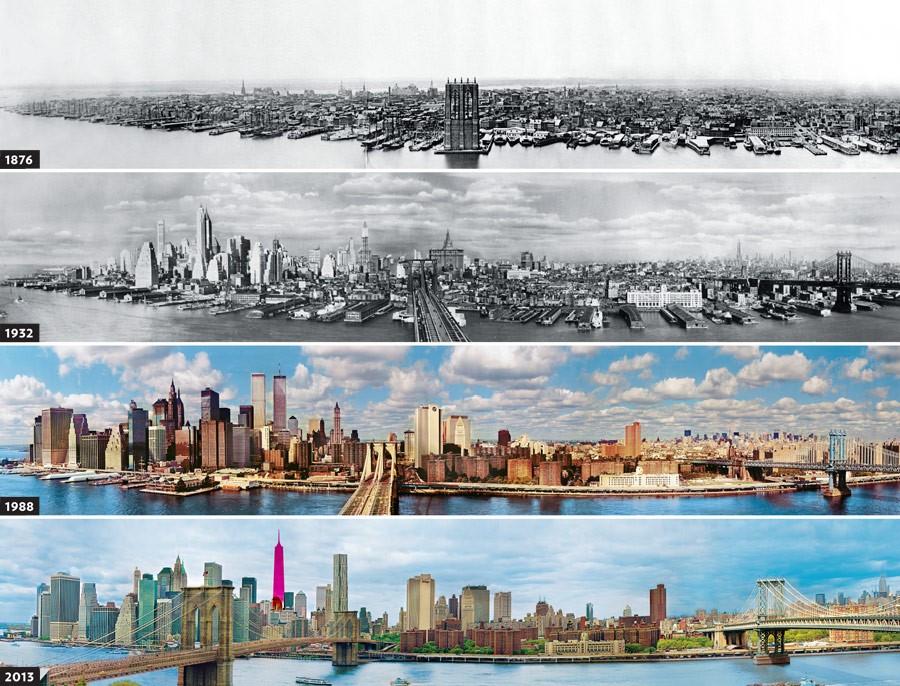
The media focuses on emissions from the fossil fuels of vehicles and the generation of electric power. Two areas that may not be familiar to students are that 19 percent of global emissions come from the production and application of fertilizers and 31 percent from industrial production. The combination of these two areas represents about one-half of the 51 billion tons of greenhouse gas emissions currently contributing to the increase in temperature. When studying continuity and change over time, students visually see how communities and cities change over 100 years, 50 years, or less. For example:
Shanghai, China in 1987 (on the left) and 2013 (on the right) Source
New York City (1876-2013)
When studying the impact of land use on climate, students should explore the environmental costs to society from the use of cement, steel, glass, generation of electricity, loss of forested land, waste, and traffic. How to Avoid a Climate Disaster provides an opportunity for classroom exploration, research, inquiry, collaboration, and solutions. The contribution of the social sciences to understanding the causes of greenhouse gas emissions, strategies for changing the way we currently are doing things, and analyzing the externality of societal costs is found in what students do best – asking questions, researching, debating private and public solutions, analyzing the costs and long-term benefits, and presenting information clearly and concisely in graphs, tables, maps, and images.
Examples of questions for collaboration, researching, and interviewing by students are:
How are we producing automobiles?
Is natural gas the most efficient method for cooking food and heating buildings?
What are the societal costs for raising animals for food?
How should we recycle food waste?
How would a Green Premium be calculated in analyzing the costs and benefits over time?
How significant are the societal costs of air-conditioning on a global scale?
Standard 6.3 for climate for high school students in New Jersey requires them to collaborate with other students on proposed solutions.
6.3.12.GeoGI.1: Collaborate with students from other countries to develop possible solutions to an issue of environmental justice, including climate change and water scarcity, and present those solutions to relevant national and international governmental and/or nongovernmental organizations.
The competitive advantage of Social Studies in learning about the biggest issue to impact our planet in history is with our ability to engage in problem solving, understanding perspectives from different cultures, historical lessons of strategies to address problems over time, the ability to analyze the economics of the problem and solutions, and to debate the effectiveness of public and private solutions. The Social Studies classroom, especially in grades 6-12, is a laboratory for analyzing the marginal costs and losses of incremental changes, preventative solutions, investments in research and development, and the cost of inaction.
“Climate science tells us why we need to deal with this problem but not how to deal with it. For that, we’ll need biology, chemistry, physics, political science, economics, and other sciences.” (Page 198)
One of the best chapters in How to Avoid a Climate Disaster is the one on government. The perspectives on the electrification or rural America, installing natural gas lines, building the interstate highway system, implementing the Clean Air Act or 1970, the Montreal Protocol of 1987, and the Human Genome Project provide empirical examples of what the government of the United States has accomplished in the 20th century. The lessons of innovation and the call to debate solutions for reaching the goal of zero carbon emissions are opportunities that should be integrated into the existing curriculum. The Sunshot Initiative sponsored by the U.S. Department of Energy to reduce the costs of solar energy is one example worth studying in Economics or U.S. History. Here are some examples:
Will the steps taken to reduce carbon emissions in your community or average size city in New Jersey work in Tokyo with a population of 38 million, or Mexico City, New York, or Mumbai?
Is the best strategy for reducing carbon emissions one that is implemented at the local or state level of government, through national or global commitments, or by incentives to private firms?
Are there dangers in making immediate but small reductions by 2030 or will it be more effective to wait for new technologies from current research?
If society delays implementing carbon emission reductions now, will the costs be significantly more expensive if implementation is postponed five or ten years?
What are the most effective incentives to lower costs and reduce risks? (tax credits, subsidies, loan guarantees, carbon tax, cap and trade system, etc.)
How important are the actions taken by citizens, consumers, and producers in taking the initiative in reducing carbon emissions?
What lessons have we learned from the Covid-19 pandemic that apply to our response to impending warmer temperatures and rising sea levels from carbon emissions?
As teachers in New Jersey begin to implement the K-12 mandated curriculum standards on climate and environmental sustainability, they should consider an interdisciplinary model that includes learning in every grade focusing on causes, effects, and solutions at the local, state, national, and global levels. Students who are age five in Kindergarten in 2021 will be 34 in 2050. Teachers who are age 25 or 30 now will be 55-60 in 2050. The curriculum that is planned and implemented will have a measurable legacy in the foreseeable future. In 1921, a nuclear bomb, sending a man to the moon, CT images, Global Positioning Systems (GPS) were impossible to imagine but by the middle of the 20th century they were in development of considered possible. Social Studies teachers must look beyond what is predictable today and teach students for a world that may be in conflict and crisis or one that can be safer and better.
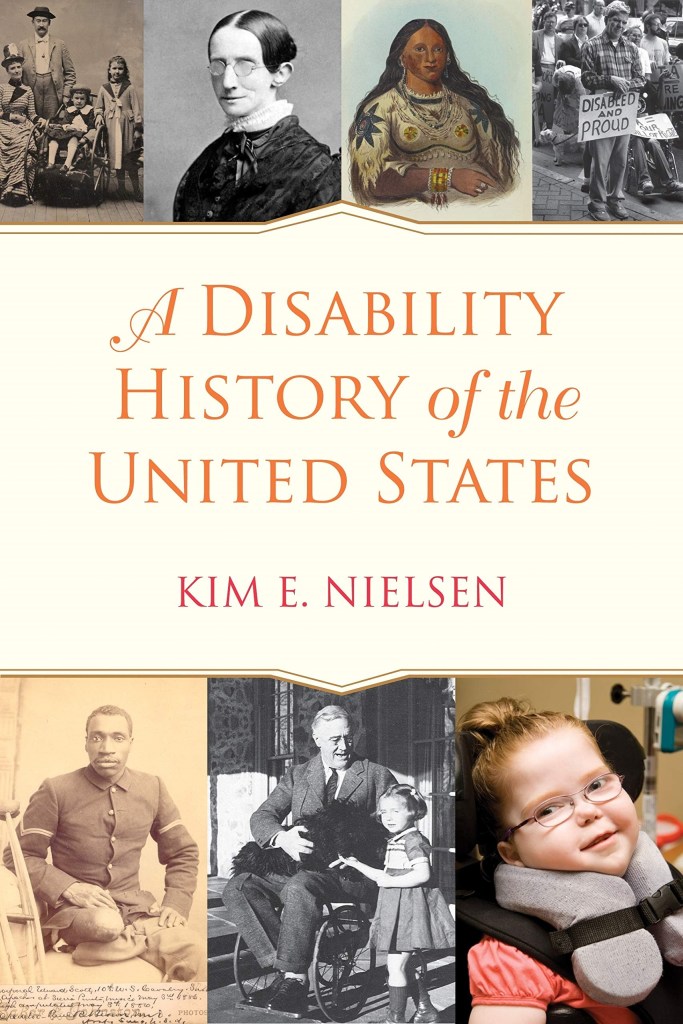
“Disability” as a whole is not a topic commonly found in the average social studies curriculum. I had history classes that would mention President Franklin D. Roosevelt’s use of a wheelchair after contracting polio, or a brief aside to discuss President Woodrow Wilson’s handicaps of paralysis and loss of partial vision after a stroke in his second term. During my time student teaching, not one of the historical figures we learned about had a disability that we discussed as a class. I struggled between choosing to read either Kim E. Nielsen’s A Disability History of the United States, or Roxanne Dunbar-Ortiz’s An Indigenous Peoples’ History of the United States, but I decided to write my review of Nielsen’s book as I am not getting my special education certification as many of my other friends in the cohort are. Though my knowledge of the indigenous peoples of the Americas is not incredibly broad, I do have more experience with that topic as I took several Native American history classes during my time as an undergraduate at Rutgers University. But, aside from an online “Intro to Special Education” class, I felt I needed to learn more about the history of people with disabilities in the United States as an educator who will not only most likely be working at some point with students who have disabilities of their own, but also to educate all of my students about a history that has largely been ignored, in my own experience as a student.
Nielsen wrote a book which not only kept
my attention with how clear it is, but also with how truly fascinating she kept
her writing by including personal anecdotes from people with disabilities, as
well from those who have discriminated against them throughout various time
periods or witnessed this discrimination.
The main argument of A Disability
History of the United States remains clear throughout the entire book:
people with disabilities have a history all their own that has fallen by the
wayside in terms of historical coverage and mass education to students. Nielsen
argues that this is a history that changes based on time period and culture,
opening her book with a Native American view of disabilities before
colonization, followed immediately after by a contrasting chapter of how early
colonial settlers viewed disabilities.
But more subtle arguments appear throughout the book as themes, such as
the reoccurring theme of discrimination against people with disabilities by
those without disabilities.
Discrimination against people with disabilities is still a civil rights issue today, which is how Nielsen concludes her book, bringing the reader to the twenty-first century with anecdotes of modern-day activists. Another theme of the book is juxtaposing not only how able-bodied view people with disabilities, but how people with disabilities view themselves. In no way does Nielsen write this book in condescending pity for people with disabilities. She rather raises people with disabilities up to be identified by more than simply what they cannot do, but by highlighting what they can do in spite of their disability and how in various cultures and time periods, disability was not frowned upon, but instead those individuals were cared for by the community rather than shunned away.
The
argument of Nielsen’s
book is effective mainly in its use of evidence to support her claims. Her information has clearly been well
researched with footnotes leading the reader to page after page of resources
ranging from peer reviewed journals such as the Journal of the History of
Behavioral Sciences (Nielsen,
2012, p. 206) to the text from exhibit posters found at the Library of Congress
(p. 201). When Nielsen makes a claim about the treatment
of people with disabilities, it is followed almost always by evidence to back
up that claim. For example, in Chapter
Three, “The Late Colonial Era: 1700-1776,” Nielsen writes, “[Those considered
valueless and often killed]… likely included those with physical disabilities
that made them ineligible for slavery (pp. 43-44).” The next page provides an excerpt of a
primary source by a young boy named J.D. Romaigne serving on the slave ship Le
Rodeur where many of the slaves on board for transport to the New World
contracted blindness from ophthalmia, a contagious eye disease. Nielsen
cites Romaigne as saying, “The mate picked out thirty-nine negroes who were
completely blind, and… tied a piece of ballast to the legs of each. The miserable wretches were then thrown into
the sea” (p. 45). This gruesome
retelling of such an appalling event perfectly supports Nielsen’s claim from just a page earlier;
slaves with disabilities were typically “considered valueless and often killed”
(p. 43).
Alternative
interpretations of disability are the core content of the beginning of the
book, especially, and
this content continues throughout, though more sparsely, as the book goes
on. The remainder of the book focuses
more often on disability as widely recognized, but not protected, and it then
becomes a civil rights battle for equal rights.
I really enjoyed how the book is written in chapters that follow one
another chronologically, to show the history of people with disabilities as one
that does simply have an upward growth towards equal rights, but how that
battle for equal rights was nonexistent, and then partially won, and then
partially lost again, and how this battle continues into today’s society. It is captivating how Nielsen starts with the treatment of
people with disabilities amongst Native American cultures before European
arrival, as this is an aspect of the topic I had never learned before.
But the book is limited, though it acknowledges this in the title, since it is only A Disability History of the United States. The examination of Native American culture is the only look the reader gets at disability viewed by another culture other than mostly European immigrants to the United States. She writes how Native Americans were generally unfazed by disability as, especially physical disability, was so common in the difficult work required to survive. And anyone who could provide some service to the community was valued despite their disability. The author does write two contrasting views immediately following one another, as disability was defined differently by separate tribes and individuals without any laws to define the rights of the disabled and who those laws should include. Nielsen writes, “Some groups viewed the behaviors and perceptions of what today we call psychological disability as a great gift to be treasured and a source of community wisdom (p. 5). She then contrasts this statement by following up with, “Others considered them a form of a supernatural possession, or evidence of the imbalance of an individual’s body, mind, and spirit” (p. 5). Alternative interpretations of disability are presented throughout the book within the setting of the chapter’s time period; for example, the varying accounts of disability and its differing treatments and levels of acceptance in the next chapter about European settlers, but it is up to the reader to connect those alternative interpretations within one chapter to past chapters.
The
content of this book could inform classroom instruction in U.S. History not
only in New Jersey schools, but schools across the nation. Personal accounts of disability stretch from
California protests for equal rights in the 1970s to “founding the nation’s first
disability-specific institution in the United States, the American Asylum for
the Deaf, in Hartford, Connecticut” (Nielsen, p.67). And on the topic of asylums and other
institutions for people with disabilities, the content of this book can connect
to classroom instruction through the form of visual media. Educators can connect Nielsen’s discussion of the conditions and
purposes of asylums and institutions at their founding to their actual
perpetuity in an example such as showing clips from journalist Geraldo Rivera’s
publicly broadcast special about the horrors of Willowbrook State School in New
York. I recently watched the special in
my “Inclusive Teaching” class this semester, and though it is from the 1970s,
Rivera’s piece still sends shivers down my spine today. It is a powerful visual component to
incorporate into classroom instruction when discussing disabilities.
The
content of this book could also be used to engage students in current events by
learning about the past. For example, Nielsen writes, “Don Galloway of the
Governor’s Advisory Committee on the Handicapped testified that every day, his
office received phone calls from ‘people who are being discriminated against,’
and that as many as three hundred thousand Colorado citizens with disabilities
needed civil rights protection” (Nielsen,
p. 170). Students could be asked to
connect acts of the 1980s such as this, to modern acts of civilian
participation in seeking to influence government. Students could be given
examples such as this one provided by Nielsen and be asked to compare to the
current events in which many American citizens have been calling their local
senators to oppose the appointment of Betsy DeVos to the position of Secretary
of Education. Articles about the two
Republican senators who voted against DeVos, though not preventing her
appointment, can be found from reliable sources such as the New York Times,
quoted as saying “The two Republicans who voted against the nominee, Senators
Susan Collins of Maine and Lisa Murkowski of Alaska, said Ms. DeVos was
unqualified… Ms. Murkowski also said she had been influenced by thousands of
messages she had received urging her to reject the nomination” (Alcindor &
Huetteman, 2017). Students can be asked
to draw comparisons between the activism that influenced the acts of these
government officials, and in turn, learn about being active citizens in a
democracy and exercising their rights.
The
social studies curricula we have analyzed thus far in class, Jarolimek,
Hartoonian-Laughlin, and Kniep, all seem to have at least one common curriculum
goal: create active
citizens in a democracy. I believe that A Disability History of the United States
could absolutely fit into the curriculum design of U.S. History for middle or
secondary school students. I found Nielsen’s book to be so clear, concise,
and grabbing to read more, that I would recommend it as reading for secondary
students. The vocabulary used by Nielsen is easy to understand and the
story she tells is compelling, especially to students who mostly likely have
never learned anything about the history of disability. This book can be used to inform students of
both middle and secondary education of the contributions and struggles of
people with disabilities throughout history.
Nielsen
offers countless examples of tales of strife and triumph of those with
disabilities for educators to choose from based on grade level
appropriateness. On one hand, maybe
middle school students could not emotionally handle the previously mentioned “Le
Rodeur” example. People with
disabilities have always existed, and these time periods and cultures in which
they are living are mostly being covered in U.S. history classes, but the
individuals with disabilities themselves are not.
The
content of this book could inspire empathy, a goal our cohort discussed as a
class that we would like to see in our own curricula. The number of inclusion classes in the United
States seems to be growing every year, I taught two during my student teaching,
and I believe it is important for the peers in these classes of both students
with disabilities and students without disabilities to respect one
another. Knowing the history of the
disability movements in the United States can engender respect for a group of
people who have been historically oppressed such as when Paul S. Miller, a
top-of-his-class Harvard graduate had “over
forty firms seeking his application”, but “after interviewing Miller, who was
four and half feet tall, firms changed their minds” (Nielsen, p. 171). This example can be taught to students to
show the struggles of those with disabilities, but also their successes, as
“Miller later become a commissioner of the US Equal Employment Opportunity
Commission and an international disability-rights expert” (Nielsen, p. 171).
A
curriculum based around including the history of disabilities in the United
States, such as the story of Paul S. Miller, would not be difficult to
create. Social studies educators already
teach the time periods marked in Nielsen’s
book. For example, Nielsen writes, “The story of Robert Payne
and the Disabled Miners and Widows is a story of class, labor, race, and place;
it is also the story of the social reform movement that culminated in President
Lyndon B. Johnson’s Great Society… (p. 159).
Mainstream approaches to U.S. History, based on my own experience in
history classes in high school as a student, already include discussions of
“class, labor, race, and place.” To
include the discussion of disability in this mix is natural as Nielsen in the aforementioned quote
proves, the stories of people with disabilities overlap with other historical
contexts already being taught. To
include a history of people with disabilities in the mainstream curriculum
would challenge a curriculum that does not always include the stories of
minorities based on race, gender, or ability.
During my student teaching, I was expected to follow a curriculum that
mentioned a few historic women, barely any historic racial minorities other
than those conquered or enslaved by Europeans, and no discussion of those with
disabilities. Curriculum design that
includes the stories of people with disabilities paves the way for social
studies educators to discuss the stories of all minorities, as people with
disabilities can also be racial or gender minorities. Nielsen’s
book makes it easy for the social studies curriculum to include content from A Disability History of the United States,
especially with her chapters clearly marked by the eras already being taught in
the mainstream social studies curriculum of U.S. History.
A problem framing the economics curriculum is disagreement about what should be included and even when there is a consensus on topics and themes, how they should be presented. The Business Dictionary, the NCSS C3 Framework, New York Times columnist Paul Krugman, and the New York State 12th Grade Social Studies Framework even offer very different conceptions of what economics is. In Social Studies for Secondary Schools (Routledge, 2014) I provide teachers with a very simple definition. “Economics examines how societies produce and distribute the goods and services that people, communities, and nations need to survive.” But of course, it is really complex, because how societies “produce and distribute the goods and services” involves individual, business, social, and political decisions, and competition between different interests, as does defining what “people, communities, and nations need to survive.” A good example is the debate over the regulation of industry to protect the environment and human civilization from the negative effects of climate change.
Business Dictionary: “The theories, principles, and models that deal with how the market process works. It attempts to explain how wealth is created and distributed in communities, how people allocate resources that are scarce and have many alternative uses, and other such matters that arise in dealing with human wants and their satisfaction.” Their focus is on the market process and does not include the role of labor in production or government regulation.
NCSS C3 Framework: “Effective economic decision making requires that students have a keen understanding of the ways in which individuals, businesses, governments, and societies make decisions to allocate human capital, physical capital, and natural resources among alternative uses. This economic reasoning process involves the consideration of costs and benefits with the ultimate goal of making decisions that will enable individuals and societies to be as well off as possible. The study of economics provides students with the concepts and tools necessary for an economic way of thinking and helps students understand the interaction of buyers and sellers in markets, workings of the national economy, and interactions within the global marketplace.” Their focus is on economic decision-making and cost benefits. They recognize the role of multiple forces in the process, but don’t specifically cite workers or unions, or discuss how programs that benefit one group can be catastrophic for another.
Nobel Prize winning economist and New York Times columnist Paul Krugman: “The economy is everything that involves making or using goods and services . . .Self-interest is still the best motivator we know – or more accurately, the only consistent motivator. So I’m for market economies. But I’m for market economies with strong safety nets, with adult supervision in capital markets, with public provision of goods the private sector does badly. An idealized New Deal is about as far as I go.” Krugman is a left-Keysnian who supports an active role for the government in regulating markets and meeting human needs, but he still relies on market solutions.
NYS 12th Grade Framework: “Economics, the Enterprise System, and Finance” examines the principles of the United States free market economy in a global context. Students will examine their individual responsibility for managing their personal finances. Students will analyze the role of supply and demand in determining the prices individuals and businesses face in the product and factor markets, and the global nature of these markets. Students will study changes to the workforce in the United States, and the role of entrepreneurs in our economy, as well as the effects of globalization. Students will explore the challenges facing the United States free market economy in a global environment and various policy-making opportunities available to government to address these challenges.”
This is the worst of the definitions. First, the United States does not have a free-market economy and never has. Second, the stress on individual responsibility ignores the broader forces shaping our lives. Individuals, especially children, do not choose to be poor, unemployed, or homeless. Third, nothing is mentioned about competing interests or economic inequality. Good points are recognition of global forces and a role for government, but these are secondary in the,curriculum.
The
idea of free markets is generally associated with 18th century Scottish
Enlightenment thinker Adam Smith and his notion of an “invisible hand”
self-regulating markets. Smith actually only mentioned the “invisible hand”
once in “The Wealth of Nations,” his signature work. The idea was actually
promoted by 20th century economists, including F.A. Hayek who described it as
“spontaneous order” and Joseph Schumpeter who called it “creative destruction.”
As a result of Smith, Hayek, and Schumpeter, free-market economists often
describe the “invisible hand” and the supply/demand curve as “economic law.” According to Smith: “Every individual necessarily labors to render
the annual revenue of the society as great as he can … He intends only his
own gain, and he is in this, as in many other cases, led by an invisible hand
to promote an end which was no part of his intention … By pursuing his own
interests, he frequently promotes that of the society more effectually than
when he really intends to promote it. I have never known much good done by
those who affected to trade for the public good” (https://www.investopedia.com/terms/i/invisiblehand.asp).
Economists
from Karl Marx through John Maynard Keynes and contemporary Nobel Prize winners
Joseph Stiglitz and Paul Krugman argue that political policies and government
decisions actually play a much more important role in shaping modern economies
than hypothesized economic laws. Most political economists argue that
government intervention in modern economies is a positive benefit to society
although they disagree on how active the government’s role should be.
This series of activities are
designed to involve economics students in discussion of whether “economic law”
or political policy should govern modern economies. The articles are edited
down to less than 500 words to meet the standard for fair-use replications.
They were also selected as challenging, but within the literacy expectations of
students who are ready to do college-level work.
Aim: Does economic law or political
policy govern modern economies?
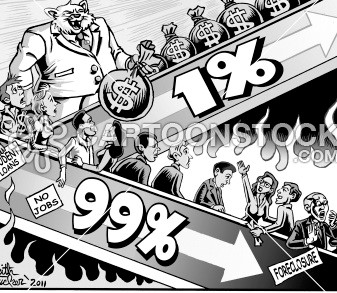
Do Now: Read the definition of the “Invisible Hand,” examine the
cartoons, and answer questions 1-4.
Invisible Hand: The term “invisible hand” was introduced by
Adam Smith in his book An Inquiry into the Nature and Causes of the
Wealth of Nations
(1776).
It describes unobservable, or
invisible, market forces that help the demand and supply of goods in a free
market capitalist economy to automatically reach equilibrium (balance) at the
most productive or beneficial level. – https://economictimes.indiatimes.com/definition/invisible-hand.
Questions
What
is the origin of the term, the “invisible hand”?How
is it supposed to operate?How
are the depictions of the “invisible hand” in the cartoons similar and
different?In
your opinion, which cartoonist has a more accurate view of how the “invisible
hand” of free market capitalism actually works? Explain.
Introduction (Modeling — Reading
with video): Tax
policies are definitely government decisions and affect people and industries
differently. Donald Trump argues that cutting taxes on the wealthy and on
corporations will unleash productivity and create new jobs. He is generally
supported by free-market advocates, primarily members of the Republican Party.
This chart is drawn from an article from Time
magazine (http://time.com/5030731/the-republican-tax-bills-winners-and-losers/).
The page also includes a video presenting multiple views on tax cuts.
The
Republican Tax Bill’s Winners and Losers
The
ultra-wealthy, especially those with dynastic businesses — like President
Donald Trump and his family — do very well under a major Republican tax bill
moving in the Senate, as they do under legislation passed this week by the
House . . . On the other hand, people living in high-tax states, who deduct
their local property, income and sales taxes from what they owe Uncle Sam, could
lose out from the complete or partial repeal of the deductions. And an
estimated 13 million Americans could lose health insurance coverage over 10
years under the Senate bill.
Winners
Losers
* Wealthy individuals and their heirs win big. The hottest class-warfare debate around the tax overhaul legislation involves the inheritance tax on multimillion-dollar estates. The House bill initially doubles the limits — to $11 million for individuals and $22 million for couples — on how much money in the estate can be exempted from the inheritance tax, then repeals it entirely after 2023. The Senate version also doubles the limits but doesn’t repeal the tax. Then there’s the alternative minimum tax, a levy aimed at ensuring that higher-earning people pay at least some tax. It disappears in both bills. The House measure cuts tax rates for many of the millions of “pass-through” businesses big and small — including partnerships and specially organized corporations — whose profits are taxed at the owners’ personal income rate. The Senate bill lets pass-through owners deduct some of the earnings and then pay at their personal income rate on the remainder.
* Corporations win all around, with a tax rate slashed from 35 percent to 20 percent in both bills — though they’d have to wait a year for it under the Senate measure.
* U.S. oil companies with foreign operations would pay reduced taxes under the Senate bill on their income from sales of oil and natural gas abroad. Beer, wine and liquor producers would reap tax reductions under the Senate measure. Companies that provide management services like maintenance for aircraft get an updated win. The Senate bill clarifies that under current law, the management companies would be exempt from paying taxes on payments they receive from owners of private jets as well as from commercial airlines.
* An estimated 13 million Americans could lose health insurance coverage under the Senate bill, which would repeal the “Obamacare” requirement that everyone in the U.S. have health insurance. The projection comes from the nonpartisan Congressional Budget Office. Eliminating the fines is expected to mean fewer people would obtain federally subsidized health policies. * People living in high-tax states would be hit by repeal of federal deductions for state and local taxes under the Senate bill, and partial repeal under the House measure. That result of a compromise allows the deduction for up to $10,000 in property taxes.
* Many families making less than $30,000 a year would face tax increases starting in 2021 under the Senate bill, according to Congress’ nonpartisan Joint Committee on Taxation.
* By 2027, families earning less than $75,000 would see their tax bills rise while those making more would enjoy reductions, the analysts find. The individual income-tax reductions in the Senate bill would end in 2026.
Questions 1. Based on this report, who benefits the most from tax reform proposals?
2. Based on this report, who loses the most from tax reform proposals?
3. In your opinion, are these proposals fair? Explain.
4. Does government tax policy support the idea that the “invisible hand” is operating or that economies are driven by political decisions? Explain.
Questions 1. Based on this report, who benefits the most from current economic policies?
2. Based on this report, who loses the most from current economic policies?
3. In your opinion, are these policies fair? Explain.
4. Does government policy support the idea that the “invisible hand” is operating or that economies are driven by political decisions? Explain.
The Republican tax bills moving through
Congress could significantly hobble the United States’ renewable energy
industry because of a series of provisions that scale back incentives for wind
and solar power while bolstering older energy sources like oil and gas
production.
The possibility highlights the degree to
which the nation’s recent surge in renewable electricity
generation is still sustained by favorable tax
treatment, which has lowered the cost of solar and wind production while provoking
the ire of fossil-fuel competitors seeking to weaken those tax preferences.
Whether lawmakers choose to protect or
jettison various renewable tax breaks in the final bill being negotiated on Capitol Hill could
have major ramifications for the United States energy landscape, including the
prices consumers pay for electricity.
Wind and solar are two of the fastest-growing
sources of power in the country, providing 7 percent of electricity last year.
Sharp declines in the cost of wind turbines and photovoltaic panels, coupled
with generous tax credits that can offset at least 30 percent of project costs,
have made new wind and solar even cheaper than running existing fossil-fuel plants in
parts of the country.
In different ways,
direct and indirect, the House and Senate bills each imperil elements of that
ascension. A Senate bill provision intended to stop multinational companies
from shifting profits overseas could unexpectedly cripple a
key financing tool used by the renewable energy industry, particularly solar,
by eroding the value of tax credits that banks and other financial institutions
buy from energy companies.
The House bill’s effects
would be more direct, rolling back tax credits for wind farms and electric
vehicles, while increasing federal support for two nuclear reactors under construction in Georgia. Fossil
fuel producers are under little pressure in either bill and some would stand to
benefit: The Senate legislation would open the Arctic National Wildlife Refuge in Alaska to oil drilling,
while a last-minute amendment added by Senator John Cornyn, Republican of Texas,
would allow oil and gas companies to receive lower tax rates on their profits.
The tension between new and old energy was on
display this week at a White House event to promote the Republican tax
legislation, where a coal plant employee from North
Dakota thanked President Trump for a provision in the House bill that would
drastically reduce the value of the production tax credit for wind.
“The production tax credit has destroyed the
energy market, especially in the Midwest,” the employee, Jessica Unruh, who is
also a state representative, told the president. “Wind production has really
eroded our state tax base and replaced coal production when it comes to
electricity production.”
The wind industry has warned that
the House language, which would reduce the wind tax credit to 1.5 cents per
kilowatt-hour, from 2.4 cents, and change eligibility rules, could eliminate
over half of the new wind farms planned in the United States.
Questions 1. Based on this report, who benefits the most from current economic policies? 2. Based on this report, who loses the most from current economic policies? 3. In your opinion, are these policies fair? Explain. 4. Does government policy support the idea that the “invisible hand” is operating or that economies are driven by political decisions? Explain.
An
insidious trend has developed over this past third of a century. A country that
experienced shared growth after World War II began to tear apart, so much so
that when the Great Recession hit in late 2007, one could no longer ignore the
fissures that had come to define the American economic landscape. How did this
“shining city on a hill” become the advanced country with the greatest level of
inequality?
Our
current brand of capitalism is an ersatz capitalism. For proof of this go back
to our response to the Great Recession, where we socialized losses, even as we
privatized gains. Perfect competition should drive profits to zero, at least
theoretically, but we have monopolies and oligopolies making persistently high
profits. C.E.O.s enjoy incomes that are on average
295 times that of the typical worker, a much higher ratio than in the past,
without any evidence of a proportionate increase in productivity.
If
it is not the inexorable laws of economics that have led to America’s great
divide, what is it? Part of the answer is that as World War II faded into
memory, so too did the solidarity it had engendered. As America triumphed in
the Cold War, there didn’t seem to be a viable competitor to our economic model
. . . Ideology and interests combined nefariously. Some drew the wrong lesson
from the collapse of the Soviet system. The pendulum swung from much too much
government there to much too little here. Corporate interests argued for
getting rid of regulations, even when those regulations had done so much to
protect and improve our environment, our safety, our health and the economy
itself. But this ideology was hypocritical. The bankers, among the strongest
advocates of laissez-faire economics, were only too willing to accept hundreds
of billions of dollars from the government in the bailouts that have been a
recurring feature of the global economy since the beginning of the
Thatcher-Reagan era of “free” markets and deregulation.
The
American political system is overrun by money. Economic inequality translates
into political inequality, and political inequality yields increasing economic
inequality . . . So corporate welfare increases as we curtail welfare for the
poor. Congress maintains subsidies for rich farmers as we cut back on
nutritional support for the needy. Drug companies have been given hundreds of
billions of dollars as we limit Medicaid benefits. The banks that brought on
the global financial crisis got billions while a pittance went to the
homeowners and victims of the same banks’ predatory lending practices.
The
problem of inequality is not so much a matter of technical economics. It’s
really a problem of practical politics. Ensuring that those at the top pay
their fair share of taxes — ending the special privileges of speculators,
corporations and the rich — is both pragmatic and fair . . . Widening and
deepening inequality is not driven by immutable economic laws, but by laws we
have written ourselves.
Questions 1. Based on this report, who benefits the most from current economic policies? 2. Based on this report, who loses the most from current economic policies? 3. In your opinion, are these policies fair? Explain. 4. Does government policy support the idea that the “invisible hand” is operating or that economies are driven by political decisions? Explain.
Some
15 years ago, searching for a consistent way to compare wages of equivalent
workers across the world, Orley Ashenfelter, an economics professor at
Princeton University, came upon McDonald’s. The uniform, highly scripted
production methods used throughout the McDonald’s fast-food empire allowed
Professor Ashenfelter to compare workers in far-flung countries doing virtually
the same thing. The company also offered a natural index to measure the
purchasing power of its wages around the world: the price of a Big Mac. Some of
his findings are depressing. Real wages — measured in terms of the number
of Big Macs they might buy, declined over the first decade of the millennium
widely across the industrialized world.
Even
before the financial crisis struck, the wages of McDonald’s workers in the
United States, many Western European countries, Japan and Canada went nowhere
between 2000 and 2007, a period of steady, though unspectacular, economic
growth in most of the developed world. In the United States, real wages
actually declined . . . Faced with a tightening labor market and besieged by a
vocal, combative movement demanding higher wages for America’s worst-paid
employees, McDonald’s, Walmart and other large employers of cheap labor have
offered modest raises to millions of workers scraping the bottom of the job
market.
The
battle for public opinion is fought mostly on ethical grounds — pitting the
healthy profits of American corporations and the colossal pay of their
executives against bottom-end wages that force millions of workers to rely
on public assistance to survive. But what is often overlooked in the
hypercharged debate about corporate morality is how a similar dynamic is taking
hold around the industrialized world.
Lane
Kenworthy, a professor of sociology at the University of California, San Diego,
has disentangled the evolution of household incomes over the last three or four
decades. The wages from work, he found, are playing a diminishing role for a
growing swath of the labor force . . . A combination of sluggish employment and
stagnant wages has forced more families to rely on the public purse in many
developed nations.
In
Canada, for example, labor market earnings for the bottom fourth of the income
ladder grew by roughly $25 a year between 1979 and 2007. Government transfers
increased by $78. For Canadian households one rung higher — between the 25th
and the 50th percent of the earnings distribution — there were no increases in
labor market compensation. All gains came from the government. In Germany —
often portrayed as the gold standard of the postindustrial labor market — the
entire bottom half of households experienced shrinking earnings from work. They
only got ahead because of rising government benefits.
Perhaps
it is simply that the demand for skill in the modern job market has grown
faster than its supply. The United States, notably, hasn’t increased
educational attainment at the rate the labor market requires. And the economy
simply doesn’t need as many less-educated workers as it once did.
Team D: Top 10% Took Home Half Of U.S. Income in 2012 by Annie Lowrey, NYT, September 11, 2013, B4
Questions 1. Based on this report, who benefits the most from current economic policies? 2. Based on this report, who loses the most from current economic policies? 3. In your opinion, are these policies fair? Explain. 4. Does government policy support the idea that the “invisible hand” is operating or that economies are driven by political decisions? Explain.
The
top 10 percent of earners took more than half of the country’s total income in
2012, the highest level recorded since the government began collecting the
relevant data a century ago, according to an
updated study by the prominent
economists Emmanuel Saez and Thomas Piketty. The top 1 percent took
more than one-fifth of the income earned by Americans, one of the highest
levels on record since 1913, when the government instituted an income tax. The
figures underscore that even after the recession the country remains in a new
Gilded Age, with income as concentrated as it was in the years that preceded
the Depression of the 1930s, if not more so.
High
stock prices, rising home values and surging corporate profits have buoyed the
recovery-era incomes of the most affluent Americans, with the incomes of the
rest still weighed down by high unemployment and stagnant wages for many blue-
and white-collar workers.
The
income share of the top 1 percent of earners in 2012 returned to the same level
as before both the Great Recession and the Great Depression: just above 20
percent, jumping to about 22.5 percent in 2012 from 19.7 percent in 2011 . . .
[R]icher households have disproportionately benefited from the boom in the
stock market during the recovery, with the Dow Jones Industrial Average more
than doubling in value since it bottomed out early in 2009. About half of
households hold stock, directly or through vehicles like pension accounts. But
the richest 10 percent of households own about 90 percent of the stock,
expanding both their net worth and their incomes when they cash out or receive
dividends.
The
economy remains depressed for most wage-earning families. With sustained,
relatively high rates of unemployment, businesses are under no pressure to
raise their employees’ incomes because both workers and employers know that
many people without jobs would be willing to work for less. The share of
Americans working or looking for work is at
its lowest in 35 years. There is a glimmer of good news for the 99
percent in the report, though. Mr. Piketty and Mr. Saez show that the incomes
of that group stagnated between 2009 and 2011. In 2012, they started growing
again — if only by about 1 percent. But the total income of the top 1 percent
surged nearly 20 percent that year. The incomes of the very richest, the 0.01
percent, shot up more than 32 percent.
Questions 1. Based on this report, who benefits the most from current economic policies? 2. Based on this report, who loses the most from current economic policies? 3. In your opinion, are these policies fair? Explain. 4. Does government policy support the idea that the “invisible hand” is operating or that economies are driven by political decisions? Explain.
Thirty years ago, Bonnie Svarstad and Chester
Bond of the School of Pharmacy at the University of Wisconsin-Madison
discovered an interesting pattern in the use of sedatives at nursing homes
in the south of the state. Patients entering church-affiliated nonprofit homes
were prescribed drugs roughly as often as those entering profit-making
“proprietary” institutions. But patients in proprietary homes received, on
average, more than four times the dose of patients at nonprofits. Writing about
his colleagues’ research, . . .the economist Burton Weisbrod provided a
straightforward explanation: “differences in the pursuit of profit.” Sedatives
are cheap, Mr. Weisbrod noted. “Less expensive than, say, giving special
attention to more active patients who need to be kept busy.”
This behavior was hardly surprising.
Hospitals run for profit are also less likely than nonprofit and
government-run institutions to offer services like
home health care and psychiatric emergency care, which are not as profitable as
open-heart surgery. A shareholder might even applaud the creativity with which
profit-seeking institutions go about seeking profit. But the consequences of
this pursuit might not be so great for other stakeholders in the system —
patients, for instance. One study found that patients’ mortality rates spiked
when nonprofit hospitals switched to become profit-making, and their staff
levels declined.
These profit-maximizing tactics point to a
troubling conflict of interest that goes beyond the private delivery of health
care. They raise a broader, more important question: How much should we rely on
the private sector to satisfy broad social needs? From health to pensions to
education, the United States relies on private enterprise more than pretty much
every other advanced, industrial nation to provide essential social services.
The government pays Medicare
Advantage plans to deliver health care to aging Americans. It provides a tax
break to encourage employers to cover workers under 65. Businesses devote
almost 6 percent of the nation’s economic output to pay for health insurance
for their employees. This amounts to nine times similar private spending on
health benefits across the Organization for Economic Cooperation and
Development, on average. Private plans cover more than a third of pension
benefits. The average for 30 countries in the O.E.C.D. is just over one-fifth.
Our reliance on private enterprise to provide
the most essential services stems, in part, from a more narrow understanding of
our collective responsibility to provide social goods. Private American health
care has stood out for decades among industrial nations, where public universal
coverage has long been considered a right of citizenship. But our faith in
private solutions also draws on an ingrained belief that big government serves
too many disparate objectives and must cater to too many conflicting interests
to deliver services fairly and effectively.
Our trust appears undeserved, however. Our
track record suggests that handing over responsibility for social goals to
private enterprise is providing us with social goods of lower quality,
distributed more inequitably and at a higher cost than if government delivered
or paid for them directly.
Questions 1. Based on this report, who benefits the most from current economic policies? 2. Based on this report, who loses the most from current economic policies? 3. In your opinion, are these policies fair? Explain. 4. Does government policy support the idea that the “invisible hand” is operating or that economies are driven by political decisions? Explain.
At the Philips Electronics factory on the
coast of China, hundreds of workers use their hands and specialized tools to
assemble electric shavers. That is the old way. At a sister factory here in the
Dutch countryside, 128 robot arms do the same work with yoga-like flexibility.
Video cameras guide them through feats well beyond the capability of the most
dexterous human. One robot arm endlessly forms three perfect bends in two
connector wires and slips them into holes almost too small for the eye to see.
The arms work so fast that they must be enclosed in glass cages to prevent the
people supervising them from being injured. And they do it all without a coffee
break — three shifts a day, 365 days a year. All told, the factory here has
several dozen workers per shift, about a tenth as many as the plant in the
Chinese city of Zhuhai.
This is the future. A new wave of robots, far
more adept than those now commonly used by automakers and other heavy
manufacturers, are replacing workers around the world in both manufacturing and
distribution. Factories like the one here in the Netherlands are a striking
counterpoint to those used by Apple and
other consumer electronics giants, which employ hundreds of thousands of
low-skilled workers.
Many industry executives and technology
experts say Philips’s approach is gaining ground on Apple’s. Even as Foxconn,
Apple’s iPhone
manufacturer, continues to build new plants and hire thousands of additional
workers to make smartphones, it plans to install more than a million robots
within a few years to supplement its work force in China. Foxconn has not
disclosed how many workers will be displaced or when. But its chairman, Terry
Gou, has publicly endorsed a growing use of robots. Speaking of his more than
one million employees worldwide: “As human beings are also animals, to manage
one million animals gives me a headache.”
Take the cavernous solar-panel factory run by
Flextronics in Milpitas, south of San Francisco. A large banner proudly
proclaims “Bringing Jobs & Manufacturing Back to California!” Yet in the
state-of-the-art plant, where the assembly line runs 24 hours a day, seven days
a week, there are robots everywhere and few human workers. All of the heavy
lifting and almost all of the precise work is done by robots that string
together solar cells and seal them under glass. The human workers do things
like trimming excess material, threading wires and screwing a handful of
fasteners into a simple frame for each panel.
Such advances in manufacturing are also
beginning to transform other sectors that employ millions of workers around the
world. One is distribution, where robots that zoom at the speed of the world’s
fastest sprinters can store, retrieve and pack goods for shipment far more
efficiently than people. Robots could soon replace workers at companies like C
& S Wholesale Grocers, the nation’s largest grocery distributor, which has
already deployed robot technology.
Questions 1. Based on this report, who benefits the most from current economic policies? 2. Based on this report, who loses the most from current economic policies? 3. In your opinion, are these policies fair? Explain. 4. Does government policy support the idea that the “invisible hand” is operating or that economies are driven by political decisions? Explain.
The
metro areas that offered the highest pay in 2000 have grown by some of the
slowest rates since then, while people have flocked to lower-wage metros like
Las Vegas, Phoenix and Charlotte, N.C. Similarly, the metros with the highest
G.D.P. per capita are barely adding workers relative to much less productive
areas. Some people aren’t moving into wealthy regions because they’re stuck in
struggling ones. They have houses they can’t sell or government benefits they
don’t want to lose. But the larger problem is that they’re blocked from moving
to prosperous places by the shortage and cost of housing there. And that’s
a deliberate decision these wealthy
regions have made in opposing more housing construction, a prerequisite to make
room for more people.
Compare
that with most of American history. The country’s economic growth has long
“gone hand in hand with enormous reallocation of population,” write the
economists Kyle Herkenhoff, Lee Ohanian and Edward Prescott in a recent studyof what’s hobbling similar
population flows now. Workers moved north during the Great Migration and west
out of the Dust Bowl. The lure of the Gold Rush made San Francisco a boomtown
after the 1850s. The rise of the auto industry helped triple the size of Detroit
between 1910 and 1930. Other northern cities like Cleveland similarly swelled
as they became manufacturing hubs. Los Angeles grew to a city of more than a
million in the 1920s as film sets, oil wells and aircraft manufacturing
promised opportunity. Seattle boomed after World War II, as Boeing did. Houston’s
population took off as it became the center of the country’s energy economy.
On the night of October 4, 1957, Americans could tune in on their radios to hear a small sphere floating in orbit sounding off beeps as it goes along. Sputnik was the first human-made object to go into an orbit around Earth, and thus start something called the Space Race. For such a breakthrough technological achievement, however, it was somewhat limited in its own performance. It could orbit and transmit radio signals back to earth, but beyond that, Sputnik was practically useless except for its role in Cold War Symbolism. It is this symbolism that is thought more often than not, then the education reform that comes after it. The launch of Sputnik is much more than the start of the Space Race; it was a catalyst for education reform and by my calculations, it will take another Sputnik to launch another wave of widely accepted reforms instead of the patchwork introduction of fixes like SGOs, Common Core, and PARCC.
“It is essential to examine the America school system before the launch of Sputnik in 1957. Before 1947 and stemming out of World War Two American schools were still primarily influenced by Progressivist school of ideas and practices from John Dewey. Progressivism emphasized the concept that students could only learn when they had “internalized what they had gained through experience and practiced in their own lives.” (Olson, 2000) In the mid-1940s, a new group called the ‘Life-Adjusters’ began to challenge the progressivist idea and thus began to change them. The main reason being that progressive education failed the majority. This so-called failure along with these new ideas for education and its purpose were based in the 1918 study titled Cardinal Principles of Secondary Education. The goal of this new educational philosophy entitled ‘Life-Adjustment’ was to change the fundamental practices of the school. What fundamental practices did this study mean, it was no other than the core academic classes. By disregarding traditional academics, this meant that history, languages, science, and mathematics were less valued to instead focus on the concept of ‘fundamental processes.’ The fundamental process was the curricula and activities for the general student and would thus be the considerations for vocational education, use of leisure time, and other wholesome topics that would improve the capability of a student to live a good and productive life. What supported this study was a national education conference in 1945. From its findings, the committee has found that no more than 20% of students could be reasonably expected to ever attend college, with another 20% destined for a vocational program. This means that only 40 percent of students can further their education and contribute to society; the other problem becomes the other 60%. The obvious recommendation was the adoption of the previously mentioned Life Adjustment education model. It, however, was not going to be all in favor of the Life Adjusters, as these beliefs were incorporated with some progressive concepts. The most important being the concept of tracking students by ability level on every topic. This meant that higher achieving college-and vocational school-bound kids could still get the same education while the other students can get a more general track in which they can succeed. In 1951 the Life Adjustment approach was formalized in the Educational Policy Commission’s report, Education for All American Children. (Bybee, 1997) Life-adjustment education was more utilitarian when compared to the previous progressive practices of earlier education models. The reason for this utilitarian nature is that schools were failing in preparing a majority of its student population for its future so this model instead focused on the needs of the general student. Its proposed curriculum was on functional experiences in areas such as arts, family living, and civic participation. This kind of curriculum was more about preparing an active citizen instead of an educated academic.
Now, when you examine these tracks based on the ability for the student you can draw a comparison to the modern day with Special Education with the process of inclusion and mainstreaming. The method of mainstreaming and inclusion is the result of placing students in the Least Restrictive Environment as a part of the requirements of the IDEA act. (Morin) Mainstreaming is the process of taking your kids with disabilities and putting them in a general classroom, hence the mainstream. This typically comes with some form of help for the student or that the student spends time in special education or resource classes. Without the IDEA act, special education would not have advanced as quickly as it did which thus leads us to why Sputnik was so important.
The National Defense Education Act was spurred into creation off the impact of the Sputnik launch. The overall goal of this specific legislation was to change the country’s educational system to meet the standards of the national government concerning the nation’s defense. Regarding the national defense that meant the subject thought and focused on would have a direct benefit to those job fields. Thus, by increasing the standards of education, the United States hoped the changes would help them either compete or pass the Soviet Union. The importance of the NDEA, much like IDEA, is in the acceleration for reform it caused. The overall effects of NDEA are grants and federal aid for higher education and also a restructuring of school curriculum around that funding. Because of the scientific nature and international significance of Sputnik, the course requirements for students became aligned toward national security and jobs of that nature. Thus, the standard course load stiffened away from Life-Adjustment and added more Math and Science classes. If The Association of American Universities described the NDEA as “inspiring generations of U.S. students to pursue study in fields vital to national security and aide.” (American Association of Universities, 2006) Then it was effective in changing education as they knew it. And when you examine education curricula today, you see that the impact clear as day as almost every high school student for graduation shall have four years of math and 2-3 years of science by the time they do so.
The apparent result of Sputnik is not just in the historical context of historians of Devine and Dickson who propose a situation of American paranoia in retrospect to their calm leader, but rather the impact on education reform that we can see in the foundation of today’s schools. (Divine, 1993; Dickson, 2001) In an interesting article by a psychologist, he recognizes that there is a problem with modern educational reform. At the national level, the federal government spending on education has skyrocketed, with no comparable improvement in educational outcomes in such programs like Head Start, New Math, Nation at Risk, Goals 2000, Race to the Top, No Child Left Behind, charter schools, Next Generation Science Standards, and Common Core? (Klemm). We have had little to show in terms of the results of these programs as we keep trying to create better-standardized tests and are even thinking of replacing the common core in many states even though it only came out in 2009. The problem with modern education reform may not be with the program, but with the implementation. If states are allowed to pick and choose on adopting or adapting these reforms based on the fear of losing government spending, then the speed and acceptance rate would be relatively minor and too late before it impacted most of the nation. Klemm later states in the previous article “I think the real problem is that students generally lack learning competencies. Amazingly, schools tell students more about what to learn than how to learn” (Klemm, 2014). This is something that can have a much more lasting impact because it is on the level of teacher adaptation. If we are teaching these competencies instead of solely content, we can make sure that students can turn into these lifelong learners. It is effortless for a teacher to teach Organization, Understanding, Synthesis, Memory, Application, Creativity because it involves no money, but instead an adaptation of a lesson plan. Organization can be as simple as upgrading our technology to a cohesive system like Google Classroom where students can access all work and assignments and the same can be said for teachers. Creativity can be new ways to teach a lesson or new activities.
It’s important to touch on memory, which is commonly related to tests. Instead of teaching kids to take these tests, let’s make them create better mental connections for better learning. If students can connect historical themes to present day events than they can more easily recall this knowledge for other subjects. The problem with social studies is the idea that we teach to one test, and then the student can forget that knowledge. If we work on creating these connections, they can easily recall this knowledge in other classes or everyday life. Instead of a focus on a national reform movement that is bogged down by politics, let’s do something that only teachers have control over, which is how we teach students.
If we want to change education before national reform is ever sufficient, we as teachers must be proactive and as Social Studies teacher that may be the essential part of our jobs. If we can get tour students to transfer the Think like a Historian skill to other subjects, we can change their mind on the value of history. So until we have another Sputnik, we are stuck in the process of revolution. (Kuhn 1962) We had Sputnik in 1957, We had The Nation at Risk in 1983, what is the next event to revolutionize education? The next logical step is the quick improvement in technology, which may drastically change how and where we teach. Whatever the next Sputnik is, to make sure it is a more effective reform like NDEA it takes us as Teachers to be open-minded and accepting to the changes. Because, whatever reform or new ideas are thrown our way, we still need to be ready to change for the sake of our students.
References:
American
Association of Universities. (2006). A National Defense Education Act for the
21st century: Renewing our commitment to U.S. students, science,
scholarship, and security.
Bybee, R. (1997). The Sputnik era: Why is this educational
reform different from all the others? Center
for Science, Mathematics, and Engineering Education Symposium “Reflecting on Sputnik: Linking the Past,
Present, and Future of Educational Reform.” Washington, DC.
Dickson,
P. (2001). Sputnik: Shock of the Century.
New York, NY: Walker Publishers.
Divine, R.A.
(1993). The Sputnik Challenge. New
York: Oxford University Press.
Olson, L. (2000). Tugging at tradition. In V. Edwards (Ed.), Lessons of a Century: A Nation’s Schools Come of Age (94-118). Bethesda, MD: Editorial Projects in Education.





 njcssjournal