The First World War and New York City

On April 6, 1917, President Woodrow Wilson declared America’s entrance into the First World War and initiated a nation wide drive to strengthen the armed forces. It was decided that the commemorations of Patriots’ Day on April 19 should coincide with a “Wake up America Day” of
recruitment. Every city hosted its own parties and spectacles.

In New York City, festivities were organized with decorated floats, patriotic banners and a grand vaudeville at Carnegie Hall starring Will Rogers, Ethel Barrymore, and others. James Montgomery Flagg designed the posters announcing the event. Fifth Avenue hosted a parade, whilst Army and Navy planes dropped pamphlets encouraging the crowd to summon the “Spirit of 1776.”

The manifestation started with a parade that re-enacted Paul Revere’s legendary “Midnight Ride” in April 1775 to warn the colonial militia of approaching British forces. At midnight the bells at
Trinity Church rang whilst, dressed as a Continental soldier, a young feminist named Jean Earle Moehle rode on horseback through Manhattan beckoning both men and women to “wake up” to the fight.

Despite America’s initial neutrality, the conflict was a headache for New York’s authorities. After recent mass arrivals, the city was largely populated by first- or second-generation European immigrants.

With their former homelands at war, residents responded by either declaring allegiance to the “motherland” or by identifying with their adopted nation and engaging in debates regarding the morality of global war.

The arguments were taken outdoors. The fighting front may have been far away, but the battle raged on the streets of the city. The war sharpened the focus on issues of American and civic identity.

A City of foreign villages? New York had grown rapidly with different immigrant nationalities living in a network of small communities. By 1900, the metropolis consisted of multiple foreign “villages” with a population that included 300,000 Germans; 275,000 Irish; 155,000 Russians; 145,000 Italians; 117,000 Austro Hungarians; 90,000 British; 30,000 Polish people and many other smaller groupings.

One of the most extensive communities was Little Germany (Klein Deutschland) in the Lower East Side where German banks, businesses, breweries and newspapers flourished. Little Italy (Piccola Italia) on Mulberry Street was likened to an insular Neapolitan village with its own language, customs, and institutions.

By 1900 there were many other ethnic enclaves dotted around the city. Little Syria was centered on Washington and Rector streets. Its name derived from some 95,000 Arabs who had arrived from Ottoman controlled Greater Syria (covering what is now Syria, Lebanon, Palestine and Jordan) in the Great Migration between 1880 and the early 1920s. In 1892, the first American-Arabic language newspaper Kawkab America (Planet of America) was printed there.

Throughout the nineteenth century New York served as a financial hub for industrial growth and became the nation’s de facto cultural capital. It created a divided city. While Fifth Avenue and the Central Park district were monopolized by the elite, part of Manhattan’s Lower East Side was stricken by poverty. New York’s political landscape became shaped by migration issues in which the Democratic Party and Tammany Hall dominated municipal government.

The loyalty of immigrants to the Democratic Party was born out of the perception that the city’s wealth was not shared, causing stark levels of inequality. The rule of oligarchs also caused the emergence of anarchist groups. It was against this background of social unrest and militancy that New York City was drawn into the war in Europe.

The United States initially decided on neutrality for a number of reasons. It was generally expected that the “distant” war would not last long. Politicians agreed that the fragile status quo between communities with ancestral ties to either the Allied or the Central Powers should not be endangered as the war was bringing conflicting ties and allegiances to the fore.

The German-language New Yorker Staats-Zeitung extolled the virtues of the German Kaiser; the Yiddish socialist Forverts(Forward) explained the murder of Austria’s Archduke Franz Ferdinand in Sarajevo as a consequence of social repression; and the Gaelic American complained that Britain’s colonial rule forced Ireland into entering the war. Large crowds with divided loyalties gathered
around newspaper offices in Times Square and Herald Square to learn the latest news from the battlefields.

Consulates encouraged patriotic support. Schemes were set up to raise money for war widows and orphans. German-American residents paraded down Fifth Avenue and queued to sign up. City authorities became increasingly concerned that New York’s diverse population could prove to be a tinderbox of a conflict that was ripping Europe apart. Demonstrations of sympathy towards any of the combatants were soon forbidden.

In spite of internal tensions, Woodrow Wilson’s decision not to get involved was shared by many. That consensus changed when both Germany and Britain started targeting enemy supply lines on the high seas. The British North Sea blockade annoyed politicians, but the German move towards “total” submarine warfare became intolerable once American ships were attacked and lives lost at sea. Outrage was expressed after a German U Boat torpedoed the British liner Lusitania off the coast of Ireland on May 7, 1915, killing 1,198 civilians, 128 Americans among them.

Parades for and against military participation were held around the nation. Woodrow Wilson remained determined not to take sides. Why would a President who was of Ulster-Scottish descent and the son of a Presbyterian minister commit himself to a morally abhorrent conflict that might spill over into the streets of American cities? Why imperil an emerging economy that was heavily dependent on trade with the United Kingdom in particular, closely followed by Germany?

Former President Theodore Roosevelt by contrast advocated expanding the military in anticipation of a widening of hostilities, especially since Wilson’s appeals for peace talks and offers of mediation were ignored.

One effect of growing public anger was unease about New York City’s “American” identity. Addressing an audience at Carnegie Hall in October 1915, Roosevelt stated that “hyphenated
Americanism” was no longer tolerable. His words instigated a period of chauvinistic jingoism, accompanied by a campaign of orchestrated propaganda that permeated the city.

With the formation of the Preparedness Movement in August 1915 and the concurrent rise of the National Security League (NSL: a quasi-paramilitary organization which campaigned for the assertion of “American” values), New York’s streets were closely observed by municipal and national authorities. The call for Americanization had a belligerent undertone intended to ensure law and order amongst a split population.

Americans started to doubt Wilson’s policy of “armed neutrality” and were getting ready for intervention. On May 13, 1916, a Preparedness Parade along Fifth Avenue was attended by an estimated 130,000 marchers who joined ranks behind a banner that proclaimed, “Absolute and
Unqualified Loyalty to our Country.” The manifestation inspired Childe Hassam’s painting “Flags, Fifth Avenue.” An anti-German Francophile, the artist passionately backed the Allied cause.

Isolated incidents intensified the city’s febrile atmosphere. The Black Tom Island Explosion in New York Harbor on July 30, 1916, which destroyed a large ammunition depot, damaging the Statue of Liberty and buildings in downtown Manhattan, heightened the suspicion that German saboteurs were active in the city (although arrests were made, the culprits were never identified).

Responding to recent news of the February Revolution in Russia, New York’s 95th Mayor John Purroy Mitchel stated in an address of March 1917 to a gathering of Russian-Americans that the
city’s citizens should be divided in two classes: “Americans and traitors.”

In April 1917, Wilson went before Congress to ask for a declaration of war. He cited Germany’s resumption of submarine warfare, its sabotage, and the revelation of the “Zimmermann Telegram” (an attempt by the German Foreign Office to recruit Mexico to attack the United States) as evidence of the nation’s hostile intent. It was a pivotal moment. For the first time in the nation’s history, America joined a coalition to fight a war not on its own soil or of its own making. The decision transformed life in New York City. All foreign-language publications were monitored; socialist and anarchist newspapers were censored or restricted.

Vigilantes attacked people identified as “pro-German”; schools sacked German teachers; butchers no longer sold Frankfurters; orchestras stopped playing German masterpieces; the German American Bank was re-introduced as the Continental Bank of New York; and countless German-Americans changed their names to demonstrate their loyalty.

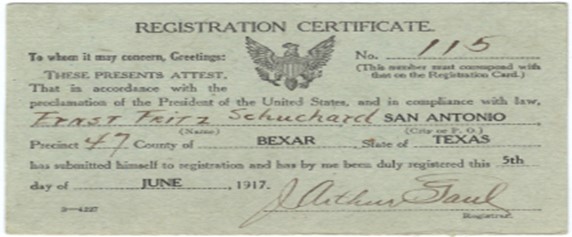
Six weeks after formally entering the war, Congress passed the Selective Service Act which authorized the government to impose conscription. Men between the ages of twenty-one and forty
five were required to register for military service. The move was widely resisted. As the spectre of the 1863 Draft Riots haunted politicians, the process in New York (and elsewhere) was enforced by a heavy police presence, backed up by NSL volunteers. Patriotism was tightly policed.

Speaking out against the war meant risking prosecution, while posters whipped up emotions and encouraged subjects to enlist, conserve food, buy liberty bonds and keep on the lookout for foreign spies. The (intimidating) calls for loyalty raised the issue of citizenship, especially amongst African-Americans.

By supporting the government’s call many black leaders hoped to gain full citizenship, but others suspected that the war would lead to more injustice. In response to racist perpetrating the East St
Louis Massacre, the National Association for the Advancement of Colored People (NAACP) and African-American Churches in Harlem conducted a Silent Parade on July 28, 1917, in which about 10,000 participants marched along Fifth Avenue.

Protesters carried banners and placards that alluded to a draft that demanded African-Americans to fight for freedom and democracy in Europe, whilst they themselves were not only deprived of representation and equal rights, but in danger of being assaulted or lynched.


Through conscription, the army grew in a relatively brief period from a constabulary force of some 300,000 troops to an American Expeditionary Force (AEF) of more than four million soldiers. These
forces reflected the population’s ethnic and racial diversity.

The slogan “Americans All!” promoted wartime service as a unifying experience that rendered differences in language, culture and religion irrelevant – but race still mattered. The army-at-war
remained rigidly segregated.

When American forces arrived in Europe, they quickly turned the tide in favor of Britain and France, leading to an Allied victory in November 1918. They had been engaged in six months of fighting at
the cost of 53,000 lives. In addition, nearly 63,000 men died of disease, primarily from influenza (misnamed “the Spanish flu”), and 200,000 veterans returned home wounded.

The number of casualties weighed on Wilson’s conscience. It motivated him to support the creation of an international body based on collective security. Even though joining the League of Nations would require the United States to sacrifice a measure of sovereignty, the President was prepared to pay the price for the sake of peace.

His opponents declared it foolish to relinquish America’s newfound stature as a military superpower. The toxic discussion on what later became known as “America First” has divided opinion ever since.

The marking of the Armistice in November 1918 was a moment that New Yorkers came together to celebrate their collective identity. Whereas in 1914, German-Americans had paraded down Fifth Avenue proclaiming their attachment both to the Fatherland and to the United States, now mobs of cheering citizens kicked effigies of the Kaiser through the city. The war had turned New Yorkers into “real” Americans.

Book Review – School Climate Change: How Do I Build a Positive Environment for Learning?

DeWitt and Slade give us in this brief ARIAS series book a variety of ways in which schools can be positive environments for learning. They remind us the National School Climate Council recommends the climate include components such as these (p. 2):

  • Norms, values and expectations that support people feeling socially, emotionally, and physically safe.
  • People are engaged and respected.
  • Educators model and nurture attitudes that emphasize the benefits and satisfaction gained from learning.

This very helpful but brief book drives home the point that violence, bullying, harassment, and intimidation have no place in a positive learning environment. Students of all cultures and backgrounds must be made welcome.

Administrators must work hard to make sure all marginalized groups of students are made to feel safe and feel valued in our schools. This attention to the student takes time, and it can be difficult to find that time in this day and age of obsession with test scores and with improvement in the quality
of the instruction.


However, improvement in test scores means little without the safety and comfort of all students, teachers, staff members, parents, visitors, and administrators. Improvement in teaching and learning are indeed important. The authors include three key questions for students and their teachers:
Where am I going? How am I going? …and Where am I going next? (p. 17)

Administrators are the leaders that can help the school climate become more positive. The authors remind us that there are four essential components of a beneficial school climate (p. 14):

  1. Engagement
  2. Empowerment and Autonomy
  3. Inclusivity and Equity
  4. Environment

They also provide some very good ideas on how to make it clear we are striving for a positive school climate. Some examples are: having a student ambassador; using safe space stickers for students of the LGBT community; and embracing a diverse curriculum.

Many states have adopted various outcomes, standards, and guidelines for how K-12 teachers should act and communicate in the classroom. Illinois (because of 2003 legislation) and other states have adopted social and emotional standards for students also.


The Illinois State Board of Education has proposed 10 Standards for Social and Emotional Learning (Social and Emotional Learning (isbe.net)). At the core of these, students and their teachers acquire the knowledge, attitudes, and skills they need to:

  • recognize and manage their emotions;
  • demonstrate caring and concern for others;
  • establish positive relationships;
  • make responsible decisions; and
  • handle challenging situations constructively.

I recommend this book for new administrators and for professional development sessions attended by many types of stakeholders. Including parents, students, and community members in the process of creating a more positive learning environment is important also.

Book Review – Sapiens: A Brief History of Humankind

This book is incredibly interesting and brings up a lot of new information and stresses new and up-to-date theories such as an insistence on the co-existence of several “different types” of humans—including yet another explanation of why Homo sapiens and the Neanderthals must have co-existed.
Also detailed here are a few possible reasons the Neanderthals did not make it but Sapiens did.

This is a big book, full of theories, illustrations, great examples, and of course a lot of information about the origins, descriptors, capacities, abilities, and developmental stages of Homo sapiens. The
book is divided into four main sections all relating directly to Homo sapiens: The Cognitive Revolution; The Agricultural Revolution; The Unification of Mankind, and The Scientific Revolution.

As in most my book reviews, I do not give away too much content because the readers should experience that for themselves. In the case of this particular book, I will talk about the interesting and
entertaining way in which the book is written.

Professor Harari writes in a very readable fashion and uses many clever phrases in addition to humor. For example, he states, “That evolution should select for larger brains may seem to us, like, well, a no-brainer” (p. 9). He explains domestication of animals and the use of certain animals for food: “With each passing generation, the sheep became fatter, more submissive and less curious. Voila! Mary had a little lamb and everywhere that Mary went the lamb was sure to go” (p. 92).

Harari writes with such an enjoyable style, such as in this sentence: “Most likely, both the gossip theory and the there-is-a lion-near-the-river theory are valid” (p. 24). Harari seems to really enjoy the writing of the book, and it comes through very clearly to the reader. Another interesting sentence is this one: “Presumably, everyone reading this book is a Homo sapiens – the species sapiens (wise) of the genus Homo (man)” (p. 4).

I recommend the book to teachers of science and of archeology, social studies, and history. There is technical information here great for the classroom, cultural information wonderful for the salon, and
pensive passages for those times we are alone with our thoughts and we want to reflect on what is written in the clever book we are reading. There is also ample info here for experts in prehistory and for fans of early humankind alike.

I enjoyed reading the book very much and cannot emphasize enough how clever the writing is and how clear the passages are. Harari has done a wonderful job here of explaining very technical information in everyday language so that non-specialists can participate in pondering and discussing
some of the most interesting stages, questions, and stories of sapiens.

Book Review – Mankind: The Story of All of Us

Teachers are going to really enjoy this approach to story-telling that focuses more on themes than on the old fashioned linear method of discussing history. Themes and topics such as the use of tools,
differences in diet, domestication of certain animals and what that has meant for mankind, and the use of weapons, jewelry, boats, and architecture through history will astound and captivate the more technically oriented readers looking into this glossy, beautiful book.

More general readers, perhaps fans of the story of Homo sapiens up to current times will also love this book and will wonder what is next in mankind’s journey. This book tells us of great adventures in the past and gives us hints of what is in store, given our talents, strengths, and weaknesses. Pamela Toler has assembled here some incredibly cool ways to talk about the history of mankind and does something very new and unique: using modern drawings and actors to portray the stages of mankind over time. This makes for very interesting and lively illustrations.

Toler also uses a great deal of scenarios—created to advance theories of how wheat was first sown, how people reacted to the “Sea People” invading around the Mediterranean and bringing their women and children with them, and ways people thought and acted. The rationale for different actions over time are interesting to consider, and she uses them throughout the book to make the major and minor events alike more understandable.

As long as readers understand that is her method, they will be alright as they watch mankind progress through the themes, wars, discoveries, changes in regime, and differences in lifestyles over time. The use of the themes and topics, again, is very interesting. Chapter Five, for example, is
called “Plagues.” The book tells us where the words “algebra” and “algorithm” come from also, in addition to many other facts important to showing the contributions of many cultures to world knowledge

A third thing Toler does is uses clever phrases and humor in the book. This will make the book even more entertaining for those readers who want a little more “fun” in their dealing with the story of us.

For example, when discussing the supposed complete disappearance of Neanderthals from the earth, she reminds us that recent research has shown that the Neanderthal genome makes up between 1 and 4 percent of the DNA of humans who are not from Australia or sub-Saharan Africa. She states comically, “Evidently the rumors of Neanderthal man’s extinction are exaggerated. He lives on in us” (p. 16).

Without giving too much content away, I will say this book is a “must-read” for educators and all other readers who need a new and refreshing way to look at the history of us. It is a shiny, interesting, innovative, and thrilling book indeed. I am so lucky I was able to receive a copy to review!

The book could also be a clever tool to get some students interested in the story of us and to watch as they consider the photos, drawings, and scenarios presented in this lively and colorful presentation of
history. Many short sidebars and other bits of information fill the book, much as in many current high school books and undergraduate textbooks. I would champion the use of this book to see if teachers can “hook” some students into the realms of history, science, and discovery.

The design of the book is shared by the History Channel. It is also available via download to own, in Blu-Ray, DVD, eBook, and graphic novels. These other formats may be just what the teacher ordered for some students to be able to handle—and to reach them using technology they prefer.

As an educator, I can see many great uses for this book. It could also stimulate some wonderful discussions among teachers of science, technology, history, social studies, culture, mathematics, art, design, religion, and language.

As with many such books, interdisciplinary units can be crafted rather easily by creative teachers who will see many possible connections. Helping students become constructivists themselves and see connections is yet another possible use for the book as both a reference source and reading for getting good in-depth conversations going among secondary school students.

As with each and every book teachers use with students in K-12 settings, a thorough reading is important before students are encouraged to read the book. Some adult topics arise in the book and
should be considered, of course.

Book Review – Lies My Teacher Told Me: Everything Your American History Textbook Got Wrong

Reviewed by Thomas Hansen, Ph.D


James Loewen does a great job here of presenting some very interesting and different perspectives on some of the most important events, persons, wars, and traditions in American history. In fact, what he provides here is a lot of information that is the exact opposite of what is reported in the great majority of the high school history books. In some cases, the truth is not presented at all in those textbooks.

Writing this book did cause some large waves at the time, as I remember. I had heard about the book but never read it. I came across a copy the other day and had to see what was so shocking and revealing and other-worldly about Loewen’s revelations about US history.

Experiencing it now, I can see why it was so iconoclastic back when it appeared. The book dispels a huge number of myths and explains how high school US history books are meant to paint a White,
ethnocentric, idyllic, patriotic, and just plain false account of so many things in our past. The way the history books have discussed Native Americans, Blacks, racism, wars, and so many covered up facts and realities is incredible.

I would recommend the book to all those readers who wish to be better informed about the truth about our history and who wish to get the basic information they need to be able to do their own research on the people and places whose pictures have been painted very differently from what one will expect once you get the real explanations of what went on in the past.

Woodrow Wilson, Helen Keller, and others are not presented the same way here as they are in typical high school history books. I urge you to read this book and embark on some interesting research
journeys to get a different version of history. It is an enjoyable and unsettling book, at the same time.

Certainly all teachers should read this book, and obviously teachers of American history need to have this one on their shelf if they are going to engage in discussions with other professionals who want to know the truth. Why textbooks are so general and vague is a theme addressed throughout this revealing book. How we as educators can figure out a way to teach students about the truth of so many magical and mythical stories is a challenge. There has been so much written in the attempt to use a glorifying approach to American history.

Loewen is a good writer and presents his information here completely and through the use of references. Note that he has a long bibliography and is funny and sarcastic throughout the book (e.g., pp. 14, 15, 16). He is not afraid to write down some very controversial and clear information in this book. For example, he includes five key images of the Vietnam War with their explanations (p. 242). Loewen also spells out the most important question regarding why we fought the Vietnam War (p. 248).

Loewen sure did stir things up. I recommend you read this book… see if you agree or disagree… certainly interesting to considering some challenging and different perspectives on some of the most important events, persons, wars, and traditions in American history. Yet another good book to make us think!

Book Review: Legacies of the War on Poverty

Bailey and Danziger assemble here ten papers on the history of the war on poverty, covering its beginnings with JFK to the current great recession creating and disabling the poor in our country. They write the first chapter, explaining how Lyndon B. Johnson took up the torch and planned to eradicate poverty in the USA. They show the origin of many charitable programs, from food stamps to unemployment benefits, and they make it clear the numbers of poor persons in this land have not been small.

The book has more than one use, as it provides in-depth explanations of the origin of programs and the political connections related to funding, legislation, and public perspectives on spending. From
the point of view of historical developments, public policy, and political processes, the book could be not only good background reading for teachers but also very helpful for developing or enriching social science units in the classroom.

What led up to and exploded in 2008 and 2009 is profiled clearly here… great background reading for educators, to say the least.

The readings in the rest of the edition are also helpful, though some include rather technical terminology and concepts from fields such as economics. The text would lend itself well to use in graduate courses or longer summer classes on developing either teacher understanding of the current
recession or on creating more informative units on social science topics in the classroom.

The second part of the book includes four readings on increasing human capital, employment, and earnings. Here, four topics in education are discussed: the origins and impacts of Head Start; K-12 education battles; access to higher education; and workforce development. The third part of the book includes: the safety net for families with children; the safety net for the elderly; and the origins and impact of housing programs for families. The last section covers improvements in access to medical care and health.

These last two chapters on medical care and health are very important as a connection to on Obamacare (and its history), current events, and political processes. Like the other chapters in the
book, these two can provide teachers with one solid reference when designing materials and questions for students to ponder. Much of the data here can be used not only for teachers to come to a better understanding of what has been done to help disadvantaged persons in this nation but also for teachers to design and enrich units related to all of the Social Science Goals within the Illinois Learning Standards.

I would suggest that the themes and data in the book relate to specific strands within the Social Science Goals. Based on the information in this book, I would propose the book includes insights and data helpful specifically related to units addressing these strands in the Illinois Social Science Goals: 14.A, 14.B, 14.C; 14.D; 14.F; 15.A.c; 15.A.d.; 15.E; 16.C.b (US); 16.E.b; 17.C.a; 18.A; 18.B; and 18.C.

These two specific benchmarks could be impacted also, given the global interdependence of economies: 16.C.5b (W) and 16.C.5c (W). We could also impact benchmarks related to the environment, how it contributes to the current poverty in our nation, and ways to remedy the problems: 17.C.5b and 17.D.5. In addition, it would be interesting to look at how the book could be
used as a basis to locate other materials for designing units related to communicating about poverty, politics, social policy, hunger, unemployment, social change, and poverty.

There are cultural and other connections to be made from the materials in this book. To do so, we could impact possibly these specific benchmarks within the Illinois Fine Arts Goals: 26.A.5; 27.A.4b; 27.B.4b; and 27.B.5.

These are only a few suggestions; I would suggest there are more connections, including across subjects. As examples, links could be shown between the above information, plus the various strands and benchmarks suggested, to help impact other learning areas. For districts interested in knowing, they would be possibly impacting these particular Illinois Foreign Language benchmarks: 29.D.5; 29.E.5; 30.A.5a; and 30.A.5c.

To summarize, I would recommend the book for use in various graduate courses and professional development sessions of some length for teachers. I suggest the book is helpful for both developing teacher understanding of the current recession and on creating more informed units on social
science topics in the classroom. Teachers will clearly make their own connections to different strands, benchmarks and subject. The above is simply an attempt on my part to call attention to some possible interesting uses for this detailed text.

Although the text has some dense passages with technical terms and ideas, it is enlightening to read such great detail about poverty and ways it has been addressed in the USA in the last several decades.

Book Review – Aporophobia: Why We Reject the Poor Instead of Helping Them

The author is a professor emerita of ethics and political philosophy and paints a broad sweep of a picture here including both the history and politics of what people think of the poor. Cortina speaks to the changes in this country—President Biden welcoming the poor immigrants in—and the ongoing nightmares—such as the Haitians who were chased by guards on horseback.

All is not well in the land of the poor, which Cortina explains, is pretty much every land. The notion that immigrants bring lots of problems but certainly nothing of value to offer is an important theme in the book.

Since the days of the “undeserving poor” and the various battles against poverty (none have really succeeded in conquering it) persons who find themselves trapped in poverty have been in the news. Every day, we hear about what the poor are doing, what the homeless are up to, and what the people
out there without jobs and money are (supposedly) doing to destroy our nation.

Currently, just within Chicago, we have over 60,000 (native) homeless, over 20,000 new migrants who are homeless, and all the numbers are up, up, up. There are over 16,000 homeless students who attend Chicago Public Schools. There are over 50,000 children in Illinois.

These ideas of this big (and growing) part of the world population are strong in the media and the sources and causes of the views and opinions about this burgeoning sector of the US (and world) population. Without giving away all of the book’s content, I must say, I do not like to tell readers all the most important parts and facts and conclusions of a book. Rather, I
leave the discovery and discussion to the reader to find, consider, and ponder.

What this text does is provide an interesting outline of where our fear of the poor comes from… a clear understanding of the Greek root words used to come up with a term for this fear, and an ethical framework for understanding all of this.

Now, it is up to the reader, the educator, the social worker, and the taxpayer to make sense of the outline, the map, provided here, and develop a better understanding of oneself as we venture out
into the street to help the poor.

Book Review: A Brief History of the Third Reich: The Rise and Fall of the Nazis, by Martyn Whittock

Martyn Whittock assembles here the accounts of what is what like to be a German and go through all the things that happened before, during, and after World War II. He includes stories from people coming from all walks of life, and he adds his own theories and ideas.

In 22 chapters, Whittock describes the economic, political, and spiritual life in Germany leading to the Nazis seizing power and discusses both German complacency and involvement in contributing to the party’s rise to leading the nation. Whittock talks a great deal about Hitler’s reasons and motivations leading to some of the worst decisions possible.

Hitler had a tendency to make very dramatic and quick decisions without listening to the advice of those who would try to help him, or help Germany, in times of crisis. Hitler tended to stretch resources too thin and to make decisions which caused other greater problems unforeseen.

Without giving away too much content, I will say that this book does include the strength of using so many different persons’ stories to give the reader different perspectives on how the Nazis were actually able to get as far as they did. It is important to continue to read such accounts to try to sort out what makes sense and what does not.

Whittock gives the reader a great deal of information on the concentration camps and on how they were run. He does give us a glimpse into the desperate lives of the Germans who assisted in the murders, as he does regarding all of the persons who helped Hitler come to power.

There was something in it for everyone, it appears, and Whittock attempts to explain how and why the Germans allowed the Nazis to take so much power. He also provides the death tolls and discusses the methods used for murdering the inmates. Whittock provides a full description of the murders and numbers. However, he also uses more contemporary examples of bloodshed such as the Rwanda murders.

Maybe this is done to show that murder on a huge scale is to be expected in the world? Nothing could compare to the Nazis’ slaughter of entire peoples and communities, so that idea is lost on this reader—and on most all readers, I would assume.

The reader can profit from trying to understand what happened in Germany during those say 50 years of time. Teachers can perhaps get a little better understanding of how to begin to explain what was going on in the minds of Germans who watched all of it.

This is important reading because of the different perspectives revealed here.

Book Review: Clearing the Air in Los Angeles: The Fight Against Smog

Clearing the Air in Los Angeles: The Fight Against Smog tells how the mystery of Los Angeles’ notorious smog was solved. Los Angeles was once known as the Smog Capital of the World. No longer. Today the city has changed “air you can see” into “air you can breathe.” While the fight to
eliminate pollution in the city continues, modern smog is not the thick, oppressive, silver-blue haze that drove people to move out of Los Angeles altogether during the mid-twentieth century. Professor Arie Haagen-Smit became a key leader in the fight against smog after making a crucial discovery—what caused it. The last Stage 3 smog, considered the unhealthiest, struck in 1974, and in 2003 the city saw its last Stage 1 smog.


Clearing the Air in Los Angeles uses an organizational development lens to describe how concerned people uncovered the root cause of Los Angeles’ thick silver-blue smog—a serious problem for sixty years, from 1943 to 2003, and the changes they made to eliminate it, changes that to this day
also affect the nation and much of the world.

The book supports courses in social studies, business, business ethics, organizational behavior, environmental sustainability, and any course that examines corporate social responsibility and “business for good.”

Book Review: Breaking the Chains: African American Slave Resistance

(reprint of the 1990 edition with a new introduction by Robin D.G. Kelley)

When various localities are seeking to return to rhetoric of enslavement being beneficial or benevolent, Breaking the Chains: African American Slave Resistance is a book that is timely and beneficial for both teachers and students to understand the story of African Americans in their time of bondage. William Loren Katz did an amazing job of telling the story of African American enslavement through the eyes of the enslaved. Katz does this by describing a life in which enslaved people were not complacent but rather fought for every freedom awarded to them by their enslavers.

Katz explains, through this history, that African Americans were not only dealt physical blows but also had to fight against the master’s version of history after enslavement ended.

For much of American history enslaved people were described as complacent, willing to work, not upset about their condition or, as historians Allan Nevins and Henry Steele wrote, enslaved people
“were cared for and apparently happy” (9).

In other historical texts historians such as W.E. Woodward falsely stated that African Americans “were the only people in the history of the world who became free without any effort of their own” (234).

Although this had been a standard narrative for many years, Katz pushed back on this idea saying that historians had not done enough to find the stories of the enslaved in order to tell the true story of their resistance and their disdain for enslavement. He even goes as far as to say that “most scholars
have ignored this mountain of evidence” (13). But Katz refused to be another historian who gets history wrong and he wrote this book to detail the lives of the enslaved through the beginnings of the slave trade in Africa up to the passing of the Emancipation Proclamation.

Shown through many different angles and time periods, Katz described a people who resisted enslavement in every way. The book is broken up into four parts with a varying number of chapters in each part. The book begins with two introductory chapters, one written in 2023 in which Robin G. Kelley does the introduction and the other in which the author opens up the book setting the stage for the first chapter.

With the use of large print and historical images this book could easily be used to teach secondary students in grades 7-12 or could be used in an undergraduate college course. The writing is impeccably understandable and uses various sorts of sources including narratives of the enslaved,
accounts from white enslavers, foreign visitors to the United States, reports from the military and government, newspapers, and legal documents. In a society where it feels taboo to talk about the enslavement of African Americans, Katz’s thorough research is paramount to telling the story of
African Americans and their refusal to accept bondage.

Chapter two sets up the rest of the book by detailing why African Americans felt they needed to resist. In this chapter, Katz details the re-enslavement of African Americans on a daily basis and the horrors of what enslavement meant to them. He begins the chapter by stating “The reason for enslaved people’s resistance was slavery” (35). Enslavers understood that in order for them to achieve their goal of assimilating formerly free people into bondage, they would need to assert a form of dominance that denied African Americans the right to be human. Enslaved people were viewed as animals, chattel, property, and were purposefully kept from any knowledge beyond the plantations they toiled in. Chapter 2 details the fact that African Americans were not allowed to mourn, to be educated, to have their own thoughts, and were met with violence when they sought to
show any form of disobedience to Whiteness. In two narratives shared in this
chapter, one Louisiana woman was whipped for saying “‘My mother sent me’” (40) because calling her mother “mother” was akin to claiming the status of Whiteness.

In another story, Roberta Manson expressed that “They said we had no souls, that we were like animals’” and this was shown when her father was whipped for shedding tears after looking at an enslaved person who had been killed (40). Settlers thrived off of this system as they reaped the benefits of this free labor. As Katz explains that the South’s economy depended on the labor of
enslaved people and would not have thrived without them. White settlers were not willing to lose their power or control because they understood how vital enslaved people were to their economic prosperity.

While enslavers were concerned about enforcing and safeguarding their dominance, African Americans sought to play on this thought of enslaved people as inferior, dumb, and senile. Enslaved people deceived their masters into thinking they were joyfully working companions who looked forward to plantation labor. As Katz says “Black people pretended to be meek, happy, and dumb. They learned to answer an enslaver’s questions with the words they wanted to hear” (47). While enslavers were working to suppress the knowledge of the world around them, enslaved people worked to combat this through deception. Enslaved people would “forget” about tasks they were
told to perform or play dumb stating that they didn’t understand the job they were coerced to do. Enslaved people became the best actors claiming to be ill, not able to work due to a physical body strain, or in some cases even pretending to be pregnant. Enslaved people would smile and laugh with their enslavers before possibly running away that exact night. Although African Americans may have seemed dumb and senile, in reality this was a part of them reclaiming their agency to combat the
institution of enslavement.

In the wake of rhetoric that denies African Americans worked tirelessly to undermine the institution of slavery, this book does a great job of bringing to light the various ways in which African Americans resisted. Through the words of the enslaved themselves, as well as other primary source
documents, this book does the work of a historian, by uncovering the truth about African American resistance and their role in obtaining their own freedom.