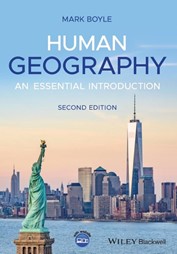
Book Review: Human Geography: A Concise Introduction

By Thomas Hansen, Ph.D.

This is a very interesting book because it is not from mainstream sources and is not a traditional format text.

This is a textbook meant for college and university courses within the United Kingdom, but the book can be used as a textbook anywhere, good background reading, and interesting data for writing social studies units and lessons in K-12 classrooms.  Meant for a semester-long course, the book includes major points in history to illustrate what human geography is.

As in most of my reviews, I try not to give away all of the content and key ideas in the review.  I talk more in this particular review about the overall approach of the book, some interesting features and themes, my personal reaction, and some possible uses for the book.  I begin here by discussing how the book’s author sets up the discussion.

The author uses a historical approach in discussing human geography and this is mirrored in the way the book is organized—from the beginnings of civilization and the notion of what geography is.  The vocabulary and basic concepts of the subject are presented in the first chapter.  

There are 12 chapters, including a wide range of watershed events, natural disasters, migration, changing economies, and our current understanding of geography.  Each chapter begins with a table of contents and a list of learning objectives.  Each chapter ends with a conclusion of the most important points made, a bank of three essay questions, and references for further reading of what was found in the chapter.  The format of the chapters could be helpful for students seeking lots of clarity in their reading. 

One thing that really stands out in the book is the use of the “zoom-in boxes.”  These are similar to sidebars, but they take up sometimes a full page or more than one page of text, stories and examples related to whatever the information is they interrupt.  The problem is, there are so very many of them that they are aggravating.  Right in the middle of a section on a given topic or subtopic, there is some discussion of how something is an example of X.  When faced with these,

I did not know if I should stop reading the chapter and read the zoom-in box instead, or read for a while and come back to it.

The zoom-in box phenomenon was a very strange aspect of the book for me.  Perhaps this sort of zoom-in box is a tradition in some fields, or in some lands, but it was something I did not ever get used to.  I did not know how to incorporate them into the flow of what I was reading.  Maybe the use of the zoom-in box is aimed at readers with short attention spans?

Another noticeable aspect of the book for me was the persistent theme of the West having imposed its will so strongly worldwide that this has resulted in a strong and pervasive clash of cultures noticeable around the globe (e.g., p. 99).  This sentiment appears throughout the book and is also spelled out at several points.  Readers will see it early on, and they will draw their own conclusions from it.

In responding to this text, I must admit I enjoyed very much the topics and discussion of the different themes and components of what makes geography work.  Aside from the strange tone of the book, and the zoom-in boxes, I got a great deal out of reviewing this topic—one I have always felt is greatly slighted in schools. 

I remember in my own case studying geography in elementary school—we had a book on it one year!  In high school, I took a course on physical geography—in addition to taking French, German and Spanish language courses.  A survey course on cultural geography was one of the very first electives I took in college.  I went on to study several other world languages in college. 

Of course, in studying about other languages and cultures, a knowledge of geography is essential.  Therefore, I do not need to be convinced it is an important topic for study.   

I would recommend the book to give teachers of social studies, world languages, and other subjects a different perspective and a way to connect history and geography.  It is always interesting to me to see how books are laid out in other countries and learn from different points of view.  This is good material for a teacher’s professional library, and the book can also be used to help inform and design units for the classroom. 

Because the book is too long for a short professional development session, it fits more in the category of resource and reference material for teachers of cultural and world-focused subjects. 

Human Geography: A Concise Introduction, by Mark Boyle.  Malden, MA: Wiley-Blackwell. 2015, paper, 318 pages.

By Thomas Hansen, Ph.D.

This is a very interesting book because it is not from mainstream sources and is not a traditional format text.

This is a textbook meant for college and university courses within the United Kingdom, but the book can be used as a textbook anywhere, good background reading, and interesting data for writing social studies units and lessons in K-12 classrooms.  Meant for a semester-long course, the book includes major points in history to illustrate what human geography is.

As in most of my reviews, I try not to give away all of the content and key ideas in the review.  I talk more in this particular review about the overall approach of the book, some interesting features and themes, my personal reaction, and some possible uses for the book.  I begin here by discussing how the book’s author sets up the discussion.

The author uses a historical approach in discussing human geography and this is mirrored in the way the book is organized—from the beginnings of civilization and the notion of what geography is.  The vocabulary and basic concepts of the subject are presented in the first chapter.  

There are 12 chapters, including a wide range of watershed events, natural disasters, migration, changing economies, and our current understanding of geography.  Each chapter begins with a table of contents and a list of learning objectives.  Each chapter ends with a conclusion of the most important points made, a bank of three essay questions, and references for further reading of what was found in the chapter.  The format of the chapters could be helpful for students seeking lots of clarity in their reading. 

One thing that really stands out in the book is the use of the “zoom-in boxes.”  These are similar to sidebars, but they take up sometimes a full page or more than one page of text, stories and examples related to whatever the information is they interrupt.  The problem is, there are so very many of them that they are aggravating.  Right in the middle of a section on a given topic or subtopic, there is some discussion of how something is an example of X.  When faced with these,

I did not know if I should stop reading the chapter and read the zoom-in box instead, or read for a while and come back to it.

The zoom-in box phenomenon was a very strange aspect of the book for me.  Perhaps this sort of zoom-in box is a tradition in some fields, or in some lands, but it was something I did not ever get used to.  I did not know how to incorporate them into the flow of what I was reading.  Maybe the use of the zoom-in box is aimed at readers with short attention spans?

Another noticeable aspect of the book for me was the persistent theme of the West having imposed its will so strongly worldwide that this has resulted in a strong and pervasive clash of cultures noticeable around the globe (e.g., p. 99).  This sentiment appears throughout the book and is also spelled out at several points.  Readers will see it early on, and they will draw their own conclusions from it.

In responding to this text, I must admit I enjoyed very much the topics and discussion of the different themes and components of what makes geography work.  Aside from the strange tone of the book, and the zoom-in boxes, I got a great deal out of reviewing this topic—one I have always felt is greatly slighted in schools. 

I remember in my own case studying geography in elementary school—we had a book on it one year!  In high school, I took a course on physical geography—in addition to taking French, German and Spanish language courses.  A survey course on cultural geography was one of the very first electives I took in college.  I went on to study several other world languages in college. 

Of course, in studying about other languages and cultures, a knowledge of geography is essential.  Therefore, I do not need to be convinced it is an important topic for study.   

I would recommend the book to give teachers of social studies, world languages, and other subjects a different perspective and a way to connect history and geography.  It is always interesting to me to see how books are laid out in other countries and learn from different points of view.  This is good material for a teacher’s professional library, and the book can also be used to help inform and design units for the classroom. 

Because the book is too long for a short professional development session, it fits more in the category of resource and reference material for teachers of cultural and world-focused subjects. 

By Thomas Hansen, Ph.D.

This is a very interesting book because it is not from mainstream sources and is not a traditional format text.

This is a textbook meant for college and university courses within the United Kingdom, but the book can be used as a textbook anywhere, good background reading, and interesting data for writing social studies units and lessons in K-12 classrooms.  Meant for a semester-long course, the book includes major points in history to illustrate what human geography is.

As in most of my reviews, I try not to give away all of the content and key ideas in the review.  I talk more in this particular review about the overall approach of the book, some interesting features and themes, my personal reaction, and some possible uses for the book.  I begin here by discussing how the book’s author sets up the discussion.

The author uses a historical approach in discussing human geography and this is mirrored in the way the book is organized—from the beginnings of civilization and the notion of what geography is.  The vocabulary and basic concepts of the subject are presented in the first chapter.  

There are 12 chapters, including a wide range of watershed events, natural disasters, migration, changing economies, and our current understanding of geography.  Each chapter begins with a table of contents and a list of learning objectives.  Each chapter ends with a conclusion of the most important points made, a bank of three essay questions, and references for further reading of what was found in the chapter.  The format of the chapters could be helpful for students seeking lots of clarity in their reading. 

One thing that really stands out in the book is the use of the “zoom-in boxes.”  These are similar to sidebars, but they take up sometimes a full page or more than one page of text, stories and examples related to whatever the information is they interrupt.  The problem is, there are so very many of them that they are aggravating.  Right in the middle of a section on a given topic or subtopic, there is some discussion of how something is an example of X.  When faced with these,

I did not know if I should stop reading the chapter and read the zoom-in box instead, or read for a while and come back to it.

The zoom-in box phenomenon was a very strange aspect of the book for me.  Perhaps this sort of zoom-in box is a tradition in some fields, or in some lands, but it was something I did not ever get used to.  I did not know how to incorporate them into the flow of what I was reading.  Maybe the use of the zoom-in box is aimed at readers with short attention spans?

Another noticeable aspect of the book for me was the persistent theme of the West having imposed its will so strongly worldwide that this has resulted in a strong and pervasive clash of cultures noticeable around the globe (e.g., p. 99).  This sentiment appears throughout the book and is also spelled out at several points.  Readers will see it early on, and they will draw their own conclusions from it.

In responding to this text, I must admit I enjoyed very much the topics and discussion of the different themes and components of what makes geography work.  Aside from the strange tone of the book, and the zoom-in boxes, I got a great deal out of reviewing this topic—one I have always felt is greatly slighted in schools. 

I remember in my own case studying geography in elementary school—we had a book on it one year!  In high school, I took a course on physical geography—in addition to taking French, German and Spanish language courses.  A survey course on cultural geography was one of the very first electives I took in college.  I went on to study several other world languages in college. 

Of course, in studying about other languages and cultures, a knowledge of geography is essential.  Therefore, I do not need to be convinced it is an important topic for study.   

I would recommend the book to give teachers of social studies, world languages, and other subjects a different perspective and a way to connect history and geography.  It is always interesting to me to see how books are laid out in other countries and learn from different points of view.  This is good material for a teacher’s professional library, and the book can also be used to help inform and design units for the classroom. 

Because the book is too long for a short professional development session, it fits more in the category of resource and reference material for teachers of cultural and world-focused subjects. 

This is a very interesting book because it is not from mainstream sources and is not a traditional format text.

This is a textbook meant for college and university courses within the United Kingdom, but the book can be used as a textbook anywhere, good background reading, and interesting data for writing social studies units and lessons in K-12 classrooms.  Meant for a semester-long course, the book includes major points in history to illustrate what human geography is.

As in most of my reviews, I try not to give away all of the content and key ideas in the review.  I talk more in this particular review about the overall approach of the book, some interesting features and themes, my personal reaction, and some possible uses for the book.  I begin here by discussing how the book’s author sets up the discussion.

The author uses a historical approach in discussing human geography and this is mirrored in the way the book is organized—from the beginnings of civilization and the notion of what geography is.  The vocabulary and basic concepts of the subject are presented in the first chapter.  

There are 12 chapters, including a wide range of watershed events, natural disasters, migration, changing economies, and our current understanding of geography.  Each chapter begins with a table of contents and a list of learning objectives.  Each chapter ends with a conclusion of the most important points made, a bank of three essay questions, and references for further reading of what was found in the chapter.  The format of the chapters could be helpful for students seeking lots of clarity in their reading. 

One thing that really stands out in the book is the use of the “zoom-in boxes.”  These are similar to sidebars, but they take up sometimes a full page or more than one page of text, stories and examples related to whatever the information is they interrupt.  The problem is, there are so very many of them that they are aggravating.  Right in the middle of a section on a given topic or subtopic, there is some discussion of how something is an example of X.  When faced with these,

I did not know if I should stop reading the chapter and read the zoom-in box instead, or read for a while and come back to it.

The zoom-in box phenomenon was a very strange aspect of the book for me.  Perhaps this sort of zoom-in box is a tradition in some fields, or in some lands, but it was something I did not ever get used to.  I did not know how to incorporate them into the flow of what I was reading.  Maybe the use of the zoom-in box is aimed at readers with short attention spans?

Another noticeable aspect of the book for me was the persistent theme of the West having imposed its will so strongly worldwide that this has resulted in a strong and pervasive clash of cultures noticeable around the globe (e.g., p. 99).  This sentiment appears throughout the book and is also spelled out at several points.  Readers will see it early on, and they will draw their own conclusions from it.

In responding to this text, I must admit I enjoyed very much the topics and discussion of the different themes and components of what makes geography work.  Aside from the strange tone of the book, and the zoom-in boxes, I got a great deal out of reviewing this topic—one I have always felt is greatly slighted in schools. 

I remember in my own case studying geography in elementary school—we had a book on it one year!  In high school, I took a course on physical geography—in addition to taking French, German and Spanish language courses.  A survey course on cultural geography was one of the very first electives I took in college.  I went on to study several other world languages in college. 

Of course, in studying about other languages and cultures, a knowledge of geography is essential.  Therefore, I do not need to be convinced it is an important topic for study.   

I would recommend the book to give teachers of social studies, world languages, and other subjects a different perspective and a way to connect history and geography.  It is always interesting to me to see how books are laid out in other countries and learn from different points of view.  This is good material for a teacher’s professional library, and the book can also be used to help inform and design units for the classroom. 

Because the book is too long for a short professional development session, it fits more in the category of resource and reference material for teachers of cultural and world-focused subjects. 

Book Review: The Children of Willesden Lane: Beyond the Kindertransport—A Memoir of Music, Love, and Survival,

The Children of Willesden Lane is based on the true story of the pianist Lisa Jura, a Jewish girl from Vienna, who was sent by her parents to England where she was supposed to be assisted by a cousin there during the time of the Kindertransport, the program sending children out of Austria and Germany to safety. The book is written by her daughter, Mona, who reports on what was happening in Vienna after the Annexation.

When Lisa arrives in England, the cousin who is supposed to house and feed her reneges on the agreement. This leads her to the hostel on Willesden Lane where she and a score of other Jewish children from various countries in Europe form bonds, become strong, and face with dignity and perseverance a very uncertain future.

Lisa fights hard to get her older sister to England, enlisting the help of the other children in the facility to find a sponsor for her. Lisa herself is protected by the woman running the hostel, and Lisa becomes a leader of the other youngsters. Lisa’s father is a tailor, and he has taught her how to use a sewing machine. Because of this, she is hired right away to work in a factory making trousers. Her income helps support the hostel.

A musician, Lisa is faced with a lifetime of servitude until she has some decent breaks because of the woman in charge of the hostel and others who are pulling for her. She is allowed to audition for a scholarship to study classical music.

Teachers, writers, and musicians will appreciate this book because it tells of worlds that sometimes can only be imagined. I was able to understand most (not all!) of the technical information about music here because of my mother filling our home with melodies—and constant discussion of music theory. I too studied the piano, but alas I was not meant to be a pianist!

Lisa perseveres in the story. She fights hard to practice for the scholarship, at the same time she works making uniforms in the factory.

The human spirit is so strong. I am always amazed by this fact.

Lisa’s story is a beautiful one. It includes such hope and so much good news. The story also includes some bad news, however, because of what is happening in Europe with the war and all of Hitler’s policies uprooting and destroying entire threads of history, family ties, destiny of entire peoples, and freedom.

It is freedom itself that is at the core of the themes in this book. Losing freedom and gaining freedom are two of the biggest events we can experience as thinking persons.


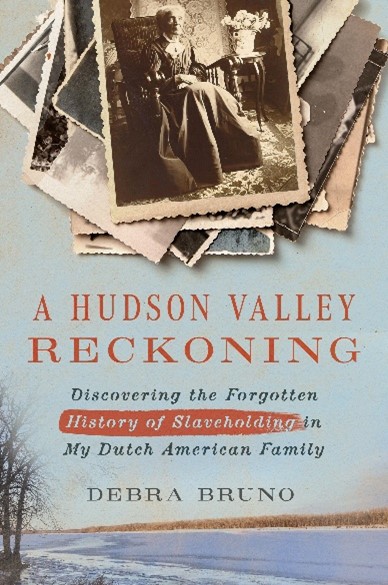
Book Review: A Hudson Valley Reckoning: Discovering the Forgotten History of Slaveholding in My Dutch American Family

For many, slavery in the North is nothing but a long-ago memory, a story that is often untold due to the cruelties of enslavement in the South and the long-lasting impact of enslavement in the Southern part of the United States. The general public is not always aware of the enslavement of African people in the North with only recent discoveries being brought to light. A Hudson Valley Reckoning: Discovering the Forgotten History of Slaveholding in My Dutch American Family showcases the stories of enslaved people who lived in Greene County, New York. The author, Debra Bruno, offers a new perspective on the enslaved in New York by exploring her own lineage and that of a distant cousin named Eleanor.

In this thirteen-chapter narrative, Bruno tells the story of her slave-holding Dutch family and the connection between her relatives and those who they might have enslaved. Eleanor is a descendant of the individuals whom Bruno’s family enslaved. Bruno discusses how historians, politicians, journalists, and every day people have erased significant features of enslavement in the North and painted a quaint picture of enslaved people helping the Dutch with their farms, houses, and livestock. Bruno, however, provides a much clearer picture of the reality of slavery in Dutch New York. She visited Macon, Georgia, and Curacao as she dug deeper into her family’s history.

In the introduction, Bruno describes her upbringing and the proud nature of her family’s Dutch heritage. She draws the reader in by describing her hometown of Athens and Coxsackie, places located along the Hudson River. Her American family began with Lambert Van Valkenburg, who settled in New Amsterdam in the early 1600s and later sold this land relocated on the North River, now the Hudson River. Her ancestor originally owned land in New Amsterdam where the where Empire State Building is located.

While digging into the history of her family, Bruno decided to explore whether they were enslavers. Bruno used Ancestry.com where she found various records including newspaper clippings, census data, photographs, and wills. Valkenburg did not provide significant results, so she searched under Collier, her grandmother’s family name. Bruno found a will from what would be her Great Grandfather five times back. He had many children and grandchildren around the Coxsackie area and left a will bequeathing much of his property to them. As Bruno combed through the pages of the will she saw it, “detailed like inventory along with his property and cows were slaves” (6).

Chapter four illustrates enslavement in the North with an analysis of a painting. “Van Bergen Overmantel” was commissioned by the Van Bergen family in the early 1700s to hang in the family home. It depicted what life was like in 18th century Hudson Valley and “is the first visual evidence of slavery on a New York farm” (56). According to Bruno, in 1714 Coxsackie’s population was 21% enslaved people. and by the 1790s in places such as Brooklyn, New York that number went up to 30%. In the late 18th century New York had an enslaved population of 319,000 enslaved people.

In the following chapters Bruno describes the challenges she faced in finding sources from the enslaved that could detail what their life was like on these farms. She notes that they were threatened with being sold down South or the Caribbean, some ran away killing their masters in the escape, and these details just go to show that enslaved life in the North was not a cakewalk as some may think. Even after being emancipated, African Americans still struggled in New York as they fought their right to be citizens and gain full citizenship rights as discussed in chapter nine.

In a discussion of why this history was so important to recover, Bruno emphasized that the Declaration of Independence and the Constitution, the nation’s founding documents, not grant the same freedoms to all people living on this land, and that individuals must “accept that only some people have benefited from their promises. To deny that and to distance ourselves from that truth is to misunderstand how our county grew, prospered, and exists today” (233.

Book Review: The Hundred Years’ War on Palestine, A History of Settler Colonialism and Resistance, 1917- 2017

A year after the brutal attack on Israel by Hamas on October 7, 2023 and the devastating Israeli military response that has killed over 45,000 Palestinians, I reexamined The Hundred Years’ War on Palestine, A History of Settler Colonialism and Resistance, 1917- 2017 by Columbia University Professor Rashid Khalidi, originally published in 2020. A reviewer for The Nation (Hawa, 2020) described it as “one of the best-researched general surveys of 20th and early 21st century Palestinian life, but it’s also a deeply personal work.” A review in The Guardian (Hughes, 2020) called it “informed and passionate. It pulls no punches in its critique of Jewish-Israeli policies (policies that have had wholehearted US support after 1967), but it also lays out the failings of the Palestinian leadership . . . An elegy for the Palestinians.” The New York Times (Anderson, 2020) reviewer was more critical arguing that Khalidi failed to spell out a resolution to the conflicts between Israel and Palestine and dismissing what he did offer as having an “increasingly fantastic quality.”

Rashid Khalidi’s main arguments are that during the 100-year war on Palestine, the dominant powers, including the United States, favored Zionist ambitions and either ignored or thwarted Palestinian nationalism and that Israel justifies inequality and its aggressive nationalism as part of its need for security. Khalidi’s response is that there are two peoples who legitimately occupy Palestine and there can be no resolution until they both acknowledge the legitimacy of the other. This would require removing external support for the discriminatory and unequal current arrangement. At best the United States has paid lip service to the idea of a two-state solution, but it never placed the needed pressure on Israel to make this possible (245-247). 

Khalidi comes from a prominent Palestinian family, so the history of Palestine is interwoven with his family’s history and his own personal experiences. Khalidi was born and educated in New York City while his father was a United Nations official. He has lived and taught in Lebanon and frequently visited Palestine/Israel for research and family visits. His Palestinian family included generations of Islamic and legal scholars and government officials. One noteworthy relative warned of the threat of Zionism to Palestinians as early as 1899 (4). His grandfather was Hussain al-Khalidi, an advocate for Palestinian rights, a mayor of Jerusalem, and member of the Ottoman parliament. A paternal uncle, Husayn al-Khalidi, was mayor of Jerusalem from 1934 to 1937 when he was sent into exile by the British to the Indian Ocean Seychelles archipelago. He was not able to return to Palestine until 1943.

In The Hundred Years’ War on Palestine, Rashid Khalidi writes a history of the region from a Palestinian lens and deconstructs what he considers to be myths about the founding of Israel and its rise as a regional military power. While Khalidi’s title has the history of the struggle of Palestinians for nationhood beginning in 1917, the book actually begins in the 1890s when Theodore Herzl offered a Zionist vision for a Jewish homeland in Palestine. Herzl proposed a settlement plan based on the expulsion of Palestinians that continued to be implemented after the founding of Israel as an independent state in 1948. Herzl believed that European Jews had to “expropriate gently the private property on the estates assigned to us. We shall try to spirit the penniless population across the border by procuring employment for it in transit countries, while denying it employment in our own country” (4).

Yusuf Diya, the late 19th century Palestinian Mayor of Jerusalem, responded to growing Zionist sentiment in an 1899 letter to the chief rabbi of France. Diya argued that “Palestine is an integral part of the Ottoman Empire, and more gravely, it is inhabited by others.” He concluded the letter “in the name of God, let Palestine be left alone” (5). Herzl answered Diya’s letter acknowledging that a Jewish state in Palestine would be a European settler colony and argued it would “form a part of a wall of defense for Europe in Asia, an outpost of civilization against barbarism” (10). In the 1920s, Ze’ev Jabotinsky, a British World War I veteran who promoted a militaristic Zionism, called for military action to support a Jewish state. In 1925, Jabotinsky wrote “If you wish to colonize a land in which people are already living, you must find a garrison for the land, or find a benefactor who will provide a garrison on your behalf . . . Zionism is a colonizing venture, and therefore, it stands or falls on the question of armed forces” (51).

Khalidi believes that the British Empire was never motivated by altruism towards colonized people, but supported Jewish emigration to Palestine because it would buttress Britain’s position in the eastern Mediterranean and solve its own antisemitic “Jewish Problem.” At the same time during and after World War I the British were promising European Zionists a Jewish state in Palestine with the Balfour Declaration, they were also promising Middle Eastern Arab leaders that independent Arab states including a Palestinian state would be carved out of the Ottoman Empire (25). Balfour recognized the contradictory promises that were made, and in a confidential memo to the British cabinet he wrote “we do not propose even to go through the form of consulting the wishes of the present inhabitants of the country . . . the 700,000 Arabs who now inhabit that ancient land” (38).

The hypocrisy of the British position continued when the League of Nations Mandate for Palestine issued in 1922 formalized British control over Palestine. It included a pledge to honor the Balfour Declaration’s promise of a “national home for the Jewish people” in Palestine and while the mandate included a clause that “nothing should be done which might prejudice the civil and religious rights of existing non-Jewish communities,” it never directly referenced Palestinians as a people with a right to self-determination, something British and the Americans continued to do in Middle East peace talks into the 1990s (34).

In the 1930s, as Jewish migration from Europe to Palestine expanded, there was growing Palestinian nationalist resistance to the British Mandate including armed battles between the British military and Palestinian rebels that resulted in about one-sixth of the Palestinian male population killed, wounded, imprisoned, or exiled. In response to the uprisings, a British Commission recommended the division of the mandate into two separate states with the formation of a small Jewish homeland on less than 20% of the territory from which the Palestinian population would be transferred, a euphonism for expelled. Khalidi argues that prior to and during World War II, the Palestinian nationalist movement was weakened by British repression and internal division while the Zionist movement was strengthened by British policy that included creating a Jewish Brigade that marched under their own banner in the British Army and arming and training Jewish settlers to help defeat a wartime Palestinian uprising (43-47). The Jewish Brigade and the armed settlers became the core of the Israeli army during the war for independence.

As the horrors of the Nazi extermination campaign became known, with increasing support from diasporan Jews living in the United States and the American and British governments, Zionists positioned themselves for creation of a post-war Jewish state either in a portion of the Palestinian Mandate or in the entire territory (61). After the war, the British Empire receded as the British were forced to accept Indian independence, faced armed colonial resistance in a number of areas, and Jewish settler opposed continuation of the Palestinian Mandate. Great Britain finally turned the future of Palestine over to the newly established United Nations which issued a proposal highly favorable to the Jewish settlers. The Jewish minority would receive over half of the mandate territory to establish an independent state while the much larger Palestinian population would receive a significantly smaller amount of land. The proposed revision led to the Nakba, the catastrophe, the expulsion of tens of thousands of Palestinians from what would become the Jewish state and war between Israel and neighboring Arab states. Khalidi describes the forced removal of Palestinians from their land and villages as ethnic cleansing (72-75).

According to Khalidi’s chronology, the expulsion of Palestinians began in November 1947, six months before the declaration of Israeli independence in May 1948 and before the invasion of a well-armed Israel by virtually non-existent Arab armies, an invasion that Khalidi dismisses as ill-conceived at best and not necessarily intended to benefit Palestinians. It is a myth that a small and ill-prepared Jewish state defeated seven powerful Arab nations against overwhelming odds to secure its independence. The reality, according to Khalidi, is that Lebanon, Iraq, Saudi Arabia, and Yemen did not significantly participate, Egypt and Syria were overmatched, and Transjordan, later Jordan, used the Israeli war for independence as an opportunity to seize control over West Bank territory that was intended as part of an independent Palestinian state (75-77).

Israel’s military victory was aided by a shift in American foreign policy from balanced support for both a Jewish state and newly emerging Arab governments in the region, to near total diplomatic and military support for Israel. While elements of the American foreign policy establishment initially expressed concern that support for Israel would hurt American oil interests in the region, that did not manifest as a problem until the 1970s when the United States began sending Israel massive amounts of military aid. Decisions were often made because of domestic political concerns. President Truman reportedly told a meeting of U.S. diplomats “I am sorry gentlemen, but I have to answer to hundreds of thousands who are anxious for the success of Zionism. I do not have hundreds of thousands of Arabs among my constituents” (79-80).

After independence, Israel treated the remaining Palestinians within its territory as second-class citizens subject to martial law. Dispossessed Palestinians within Israel were prevented from leasing or purchasing land that they had been driven off that was now reserved for Jewish settlement. Palestinians forced into refugee camps in Gaza, Jordan, Lebanon, and Syria were completely dependent on the United Nations for relief aid and for maintaining the most basic conditions for survival. They were never integrated into host countries and increasingly they identified as Palestinians with a desire to return to their traditional homes. Military incursions into Israel by Palestinian nationalist groups were met with disproportionate force and collective punishment by Israel which only intensified the desire for an independent Palestinian state (83-88).

One of Khalidi’s more controversial assertions is that justifications given by Israel for the 1967 preemptive strike that destroyed the Egyptian, Syrian, and Jordanian air forces are unfounded. Israel claimed that it faced an impending attack that threatened its existence. Khalidi cites a report by U.S. Secretary of Defense Robert McNamara to President Lyndon Johnson and Israeli Foreign Minister Abba Eban stating that no attack was imminent and that if the Arab states actually did attack Israel, they would be easily defeated by a far superior Israeli military. In support of his argument, Khalidi cites Lyndon Johnson’s The Vantage Point: Perspectives of the Presidency (Holt, Rinehart and Winston, 1971) and a Department of State analysis from 1967 (Foreign Relations, 1964-1968, Volume XIX, Arab-Israeli Crisis and War, 1967). At the meeting, President Johnson added “All of our intelligence people are unanimous” that if Egypt did attack “You will whip hell out of them” (97). According to U.S. documents later published, General Earl Wheeler, the chairman of the Joint Chiefs of Staff, informed the President “The UAR’s [United Arab Republic, Egypt and Syria] dispositions are defensive and do not look as if they are preparatory for an invasion of Israel” and a C.I.A. memorandum reported “Israel could almost certainly attain air superiority over the Sinai Peninsula in 24 hours after the initiative or in two or three days if the UAR struck first” (276). Despite U.S. intelligence reports and the meeting between Johnson, McNamara, and Eban, the head of the Israeli intelligence agency informed McNamara that Israel planned to go ahead with a preemptive attack and McNamara gave tacit approval (104). These documents undermine the myth that the preemptive Israel strike on its neighbors in 1967 was necessitated by survival.

Khalidi accuses the America media of being complicit with this country’s one-sided approach to repeated Middle Eastern crises and the treatment of Palestinians. He opens Chapter 4 with a quote from a 1982 communication between Thomas Friedman, at the time the New York Times Beirut Bureau Chief, with editors at the newspaper. Friedman accuses them of being “afraid to tell our readers and those who might complain to you that the Israelis are capable of indiscriminately shelling an entire city” (139), a telling complaint given Israel’s current bombing campaigns in the Gaza Strip and Lebanon and Israel’s claims that the bombings are carefully directed at military targets.

Pointedly, United Nations efforts to mediate the conflict between Israel and its neighbors with Security Council Resolution 242 in 1967 made no mention of Palestinians except to call for a resolution of the refugee crisis. Ignoring the existence of the Palestinian people as a party to the conflict contributed to a claim by Israeli Prime Minister Golda Meir in an interview published in the Sunday Times of London on June 15, 1969 (106). Khalidi quoted an excerpt from the interview; however, the full statement is worth citing because of its total denial of a Palestinian nationality. According to Meir “There was no such thing as Palestinians. When was there an independent Palestinian people with a Palestinian state? It was either Southern Syria, before the First World War, and then it was a Palestine, including Jordan. It was not as though there was a Palestinian people in Palestine considering itself as a Palestinian people and we came and threw them out and took their country from them. They did not exist.”

Israel’s resounding victory in the 1967 war the exposed military weaknesses of the major Arab nations. Khalidi believes their failure to advance the Palestinian cause spurred a sense of political, literary, and artistic Palestinian nationalism and the emergence of Yassar Arafat, the PLO, and Fatah as dominant forces in Palestinian society. Israel countered this resurgence by continually equating Palestinian with terrorist in efforts to discredit the movement in the United States and on the international stage, although the Fatah and the PLO were never a military threat to Israel (110-119). The 1978 Camp David Accords between Egypt and Israel, Khalidi considers them part of a United States Cold War strategy for pulling Egypt out of the Soviet orbit and effectively dividing the Arab bloc, excluded Palestinians from the negotiations (122). They established as a goal respecting the “legitimate rights of the Palestinian people” and the creation of civilian “autonomy” on the Israeli occupied West Bank, but not statehood, something Khalidi criticized in Brokers of Deceit: How the U.S. Has Undermined Peace in the Middle East (Beacon Press, 2013) as “devoid of meaning and content.” Developments since the 1978 agreement bear out Khalidi’s view as Israel has absorbed East Jerusalem, built West Bank settlements that are illegal under international law, effectively blockaded the Gaza Strip, and it has continually blocked efforts to create an independent Palestinian state, even after the PLO and Fatah endorsed a two-state solution, accepting the legitimacy of a Jewish state (126).

Khalidi provides much greater coverage of the Israeli invasion of Lebanon in 1982, than the 1973 Yom Kippur War. In his view it was much more closely linked to the future of Palestine and argues that proponents of a “Greater Israel,” including Ariel Sharon, Menachim Begin, and Yitzhak Shamir, believed the battle to defeat Palestinian forces in Lebanon would destroy the PLO as an effective military force and severely weaken the Palestinian nationalist movement. He quotes former Israeli Chief of Staff Mordechai Gur’s explanation of the war to a Knesset committee that in the “Occupied Territories” it would provide Israel with “greater freedom of action” (142-143). Khalidi also believes that United States Secretary of State Alexander Haig had prior knowledge of the invasion and gave Israel tacit approval.

In an effort to prevent a broader war, the Reagan administration did propose limiting Israeli settlements on the West Bank and the creation of an autonomous Palestinian Authority, but not an independent Palestinian state (151). Despite warnings to Israel, the United States never limited its support for Israeli action in Lebanon, even after the Western press documented Israel’s role in massacres carried out by its local allies at the Sabra and Shatila Palestinian refugee camps (158-162). We see similar warnings by the U.S. today that continued Israeli attacks on civilians in Gaza and Lebanon will lead to reduced U.S. support, but in both cases the United States took no action.

Unanticipated results of the Israeli invasion of Lebanon were the emergence of Hizballah as a new armed opponent of Israel, growing international sympathy for Palestinians, and increased militancy by Palestinians on the West Bank and in Gaza as they realized they could not rely on the either the major powers or Arab nations to mediate conflicts with Israel or to press for creation of the long promised Palestinian state. This new Palestinian awareness led to the spontaneous eruption of the First Intifada in 1987 in Gaza that then spread to the West Bank with street battles between largely unarmed young Palestinian protesters and heavily armed Israeli troops (168-169). The Intifada also exposed a growing rift between the PLO/Fatah leadership in exile and the local Palestinian population directly challenging the Israeli occupation although in 1988, the PLO did issue a Palestinian “Declaration of Independence “(178).

In his discussion of the Madrid Peace Conference in 1991 and Oslo Accords meetings in 1993, Khalidi believes an important concession by Israel was acceptance that the Palestinians were a people and that the PLO were their legitimate representatives. However, the Palestinian delegation at Oslo was a delegation of exiles who had not been in occupied Palestine for decades; they were not well versed on conditions there and were ill-prepared for negotiations. In exchange for receiving limited administrative responsibility for scattered areas across the West Bank and the ability to return from exile, the PLO leadership conceded the continuation of the Israeli occupation. Arafat mistakenly believed that future negotiations based on the Oslo Accords would bring further concessions from Israel, something the Israeli’s were never prepared to do as they drew out the timeframe for reaching new agreements. The United States, solidly in the same camp as Israel, blamed the PLO and Arafat for any delays. U.S. bias and Israeli intransigence torpedoed the accords despite PLO willingness to acquiesce on virtually every front, acquiescence that further alienated the PLO from Palestinian activists on the West Bank and in Gaza (194-199).

Relocated to the West Bank headquarters, the PLO served at consent of the of the Israeli military, and in 2002, during a Second Intifada set off by Palestinian frustration and Israeli provocations, the headquarters of the Palestinian Authority were forcibly closed (199-203). Khalidi views the Second Intifada as a setback for Palestinians because scenes of violence broadcast globally seemed to justify the Israeli intransigence that caused the violence (2019).

Following Oslo, the Israeli occupation completely sealed off the Gaza Strip. Awareness that Oslo agreements would never end the occupation eventually brought Hamas to power in the Gaza and created the conditions that ultimately forced Israel to close its settlements there and withdraw. Meanwhile, the United States in the wake of the attacks on September 11, 2001, stiffened laws against terrorism making an even remote connection to an organization or individual on its terrorist list impossible to maintain, isolating the groups, reinforcing their alienation, and preventing any attempts to modify their goals or actions (221).

Khalidi cites instances where Israeli actions ran counter to U.S. policy goals, especially during the Cold War with the Soviet Union. In these cases, the United States attempted to put a break on aggressive Israeli actions, however American governments were primarily concerned with its relationship with Arab governments and not with Israel’s treatment of Palestinians. Writing before the October 7, 2023 Hamas attack and the Israeli response, Khalidi believed there was a gradual shift taking place in American public opinion recognizing the legitimacy of Palestinian grievances and aspirations. The problem, he saw, was that the political leadership in the country was non-responsive to this shift. The Republican Party was heavily dependent for votes on Evangelical Christian supporters that perceived the State of Israel as signaling the fulfillment of Biblical prophecy and both parties relied on wealthy pro-Israel donors to finance election campaigns. Israel’s success in equating Palestinians with terrorists undermined sympathy for the Palestinian cause after al Qaeda attacked the United States on September 11, 2001 and the Bush administration launched a war on terror that continued into the Obama presidency (228-232).

In his conclusion, Khalidi addresses possibilities for shifting public opinion in the United States to become more favorable to the Palestinian cause. One approach is to identify the Palestinian cause with other liberation movements by colonized indigenous people, specifically South Africa, Ireland, and Native Americans. However, this has been difficult because Zionism claims biblical roots in Palestine and that the ancient Jews are the indigenous population, not Palestinian Arabs. American perceptions of United States history and a positive view of settler colonialism have also made it difficult to change American views about Palestinian statehood (41-242).

A second tactic proposed by Khalidi is challenging the myth that Israel is David hoping for peace but prepared to fight against a powerful Arab Goliath. Khalidi wants to reverse the idea of who is powerful and who is victimized. He also wants to challenge the moral legitimacy of Israel, that it cannot be both Jewish and democratic. The Israeli charter ensures Jewish supremacy which makes it illiberal and discriminatory (243-244).

Khalidi believes that at this point the United States cannot be relied on to broker a fair solution and a massive campaign within the United States is needed to shift public opinion. Palestinians will also need to win support in Europe, Russia, India, China, and Brazil. In Arab countries, Khalidi argues Palestinians must appeal to sympathetic populations rather than unsympathetic regimes (252). It may also be possible to influence Israelis tired of decades of war and the intense fighting and hostage situation in the latest conflict. Palestinians, for their part, need to reject Oslo gradualism, demand an entirely new timetable, and insist on a set of conditions based on the initial United Nations decision to establish two independent states.

Khalidi’s coverage of most of the events in the hundred years’ war on Palestine are comprehensive, however there is almost no discussion of the 1973 Yom Kipper War. I think it is a significant omission because in that war neighboring Arab states did attack Israel in an attempt to regain territory seized by Israel in 1967, and at least at the start, Israel appeared to be vulnerable. For many American Jews and for Israelis the attack on Israel and the successful Israeli counterattack justified their belief that Israel’s survival as a small country was continually threatened by hostile neighbors, could only be ensured through a dominant military supported by U.S. aid, and that the occupation of Gaza Strip, the Golan Heights, and the West Bank were essential for Israel’s defense. I can only conjecture that the 1973 war is of limited importance in Khalidi’s narrative because the United States was already committed to one-sided support for Israel in Middle Eastern conflicts and because it did not significantly change the situation for Palestinians in the occupied territories.

Anderson, S.  (2020, January 28). “Is There Any Way to End the Israeli-Palestinian Conflict?” New York Times. https://www.nytimes.com/2020/01/28/books/review/the-hundred-years-war-on-palestine-rashid-khalidi.html. Accessed December 23, 2024.

Hawa, K. (2020, August 10/17). “Present Absences, A century of struggle in Palestine,” The Nation. https://www.thenation.com/article/world/hundred-years-war-on-palestine-rashid-khalidi/. Accessed December 23, 2024.

Hughes, M. (2020, May 7). “The Hundred Years’ War on Palestine by Rashid Khalidi review – conquest and resistance,” The Guardian. https://www.theguardian.com/books/2020/may/07/the-hundred-years-war-on-palestine-by-rashid-khalidi-review-conquest-and-resistance#  Accessed December 23, 2024.

Marantz, A. 2023, December 2. “Columbia Suspended Pro-Palestine Student Groups. The Faculty Revolted,” The New Yorker. https://www.newyorker.com/news/our-local-correspondents/columbia-suspended-pro-palestine-student-groups-the-faculty-revolted. Accessed December 23, 2024.

Mashiach, I. (2024, November 30). “Palestinian-American Historian Rashid Khalidi: ‘Israel Has Created a Nightmare Scenario for Itself. The Clock Is Ticking,” Haaretz. https://www.haaretz.com/israel-news/2024-11-30/ty-article-magazine/.highlight/rashid-khalidi-israel-has-created-a-nightmare-scenario-for-itself-the-clock-is-ticking/00000193-7b6a-d1df-a79f-7beab0db0000. Accessed December 23, 2024.

Notes and Commentary 2023, December “Tenured Barbarians, On academic antisemitism,” The New Criterion, v. 42, n. 4. https://newcriterion.com/article/tenured-barbarians/ . Accessed December 23, 2024.

Shezaf, H. (2019, July 5) “Burying the Nakba: How Israel Systematically Hides Evidence of 1948 Expulsion of Arabs,” Haaretz

https://www.haaretz.com/israel-news/2019-07-05/ty-article-magazine/.premium/how-israel-systematically-hides-evidence-of-1948-expulsion-of-arabs/0000017f-f303-d487-abff-f3ff69de0000.  Accessed December 23, 2024.

Israel, Russia, and International Law

This article is reprinted with permission from Foreign Policy in Focus

International law―the recognized rules of behavior among nations based on customary practices and treaties, among them the United Nations Charter and the Universal Declaration of Human Rights―has been agreed upon by large and small nations alike. To implement this law, the nations of the world have established a UN Security Council (to maintain international peace and security) and a variety of international courts, including the UN’s International Court of Justice (which adjudicates disputes between nations and gives advisory opinions on international legal issues) and the International Criminal Court (which prosecutes individuals for crimes of genocide, crimes against humanity, war crimes, and the crime of aggression). Yet nations continue to defy international law.

In the ongoing Gaza crisis, the Israeli government has failed to uphold international law by rebuffing the calls of international organizations to end its massive slaughter of Palestinian civilians. The U.S. government has facilitated this behavior by vetoing three UN Security Council resolutions calling for a ceasefire, while the Israeli government has ignored an International Court of Justice ruling that it should head off genocide in Gaza by ensuring sufficient humanitarian assistance to the Palestinian population. The Israeli government has also refused to honor an order by the International Court of Justice to halt its offensive in Rafah and denounced the International Criminal Court’s request for arrest warrants for its top officials.

Russia’s military assault upon Ukraine provides another example of flouting international law. Given the UN Charter’s prohibition of the “use of force against the territorial integrity or political independence of any state,” when Russian military forces seized and annexed Crimea and commenced military operations to gobble up eastern Ukraine in early 2014, the issue came before the UN Security Council, where condemnation of Russia’s action was promptly vetoed by Russia. Similarly, in February 2022, when the Russian government commenced a full-scale invasion of Ukraine, Russia again vetoed Security Council action. That March, the International Court of Justice, by an overwhelming vote, ordered Russia to halt its invasion of Ukraine—but, as usual, to no avail. Unfortunately, these violations of international law are not unusual for, over many decades, numerous nations have ignored the recognized rules of international conduct.

What is lacking is not international law but, rather, its consistent and universal enforcement. For decades, the five permanent members of the UN Security Council (the United States, Russia, China, Britain, and France) have repeatedly used their veto power in that entity to block UN action to maintain international peace and security. Furthermore, nearly two-thirds of the world’s nations do not accept the compulsory jurisdiction of the International Court of Justice, while  more than a third of the world’s nations (including some of the largest, such as Russia, the United States, China, and India) have resisted becoming parties to the International Criminal Court.

Despite such obstacles, these organizations have sometimes played very useful roles in resolving international disputes. The UN Security Council has dispatched numerous peacekeeping missions around the world―including 60 alone in the years since the dissolution of the Soviet Union―that have helped defuse crises in conflict-ridden regions.

For its part, the International Court of Justice (ICJ) paved the way for the Central American Peace Accords during the 1980s through its ruling in Nicaragua v United States, while its ruling in the Nuclear Tests case helped bring an end to nuclear weapons testing in the Pacific. In addition, the ICJ’s ruling in Chad v Libya resolved a territorial dispute between these two nations and ended their military conflict.

Although the International Criminal Court has only been in operation since 2002, it has thus far convicted ten individuals of heinous crimes, issued or requested warrants for the arrest of prominent figures charged with war crimes (including Vladimir PutinBenjamin Netanyahu, and the leaders of Hamas), and conducted or begun investigations of yet other notorious individuals. But, of course, as demonstrated by the persistence of wars of aggression and massive violations of human rights, enforcing international law remains a major problem in the contemporary world.

Therefore, if the world is to move beyond national impunity―if it is finally to scrap the long and disgraceful tradition among nations of might makes right―it is necessary to empower the world’s major international organizations to enforce the international law that nations have agreed to respect. This strengthening of global governance is certainly possible.

Although provisions in the UN Charter make outright abolition of the UN Security Council veto very difficult, other means are available for reducing the veto’s baneful effects. In many cases ―including those of the Ukraine and Gaza conflicts―simply invoking Article 27(3) of the UN Charter would be sufficient, for it states that a party to a dispute before the Security Council shall abstain from voting in connection with that dispute. Furthermore, 124 UN nations have already endorsed a proposal for renunciation of the veto when taking action against genocide, crimes against humanity, and mass atrocities. Moreover, the UN General Assembly has occasionally employed “Uniting for Peace” resolutions to take action when the Security Council has failed to do so.

Improving the effectiveness of the international judicial system has also generated attention in recent years. The LAW Not War campaign, championed by organizations dedicated to improving global governance, advocates strengthening the International Court of Justice, principally by increasing the number of nations accepting the compulsory jurisdiction of the Court. Similarly, the Coalition for the International Criminal Court, representing numerous organizations, calls on all nations to ratify the Court’s founding statute and, thereby, “expand the Court’s reach and reduce the impunity gap.”

National impunity is not inevitable, at least if people and governments of the world are willing to take the necessary actions. Are they? Or will they continue talking of a “rules-based international order” while they avoid enforcing the rules?

What You Need to Know about Plagiarism

This article was reprinted with permission from https://njsbf.org/wp-content/uploads/2017/03/plagiarism_2016.pdf

            What is plagiarism? Generally speaking, plagiarism is the taking of someone else’s ideas or means of expression and passing them off as your own work. In some cases, educational institutions define plagiarism in faculty or student handbooks.

Is plagiarism a crime? There is a fair amount of misunderstanding about this. For an act to be criminal and punishable by law, legislation would need to be passed by either a state legislature or the U.S. Congress. Some sources refer to plagiarism as an “academic crime,” but that should not be confused with state or federal law. If a state were to pass a criminal law that described behavior understood to be plagiarism, that behavior would be a crime under that particular state’s statute. As a matter of federal law, while there is no national crime of plagiarism, there is criminal liability for certain copyright infringement.

Is plagiarism fraud? Plagiarism could be considered a form of “fraud” because you are misrepresenting as your own someone else’s ideas or work product, with the intention that others rely on it. Whether or not it is actionable and can subject you to liability would depend upon the rules and regulations of your academic institution or the laws of the state in which the act occurs. It may also be deemed “misappropriation,” which may also be actionable.

Is plagiarism cheating? The online version of Merriam-Webster Dictionary lists one definition of “cheat” as “to practice fraud or trickery.” Since you are acting dishonestly or fraudulently when you plagiarize, it could be considered cheating. Whether it subjects you to punishment in an academic context would depend on your school’s rules and regulations. Some academic institutions may deem it a “breach of contract” based on an expressed or implied contract between student and school.

Is it considered plagiarism if someone takes parts of an old research paper turned in last year and uses it for a current assignment? Some teachers will look upon plagiarism in its broad sense as representing that you have done work that you really have not done, and may view you as plagiarizing yourself to the extent you try to pass off a paper in one class as new and original, when you previously submitted it in another class. Some may not view this technically as plagiarism since you are not taking someone else’s work product. However, if you do not reference that it is a prior paper, then some may consider it a different form of cheating. Even if you are expanding on a prior paper, it is better to cite your own prior work rather than simply recycle it as a “new” paper. If you are using certain information from your prior paper in an entirely new way it may not need to be referenced, but it is probably better to err on the side of caution and cite it.

How can someone avoid plagiarism when doing research? How can information be rewritten without using some of the original writer’s words? Many academic institutions offer advice on their websites on how to avoid plagiarism. Your teachers may have their own ideas as well. In general terms, you should: (1) take careful notes and citations; (2) put quotation marks around any direct quotations; (3) identify specific citation information when you paraphrase; (4) indicate in your notes where you have injected original thoughts or comments. Because plagiarism can occur even when it is not intentional, you need to be thorough not only in your note taking but in how you reference your sources. Direct quotations, paraphrases, reference to another’s ideas or theories, and use of another’s charts or graphs, for example, must be acknowledged. Common facts do not have to be cited, such as the fact that Abraham Lincoln was assassinated on April 14, 1865. There is probably no one definitive statement as to what is common knowledge; if in doubt, consult your teacher. Even when you use attribution, if you overdo it, and have very little of your own work, it may be considered inappropriate, if not actually plagiarism.

What is the distinction between summarizing and paraphrasing? When you summarize, you are condensing the main points or ideas from someone else. When you paraphrase, you are restating the way someone else expressed something in your own words.

If information is summarized or paraphrased, must the source still be cited? Yes, unless you are summarizing or paraphrasing common facts.

Is an author’s permission needed to use long passages from his or her book or article in a report? The Copyright Act permits you to use appropriately cited material from someone else’s work as “fair use,” if the use is for “purposes such as criticism, comment, news reporting, teaching…scholarship, or research…” However, whether you need permission from an author is not simply a function of the length of a particular passage; it would depend upon the “purpose and character of the use,” the “nature” of the other work, the amount and substantiality of the passages used in relation to the other work as a whole, and the effect of the use on the market or value of the other work. Different journals and academic institutions themselves may have rules of thumb as to how substantial the passage must be in order to require permission. When in doubt, consult your teacher.

What source material needs to be cited in a report to avoid a charge of plagiarism? Different teachers will have different requirements. There are certain reference works, such as The MLA Handbook for Writers of Research Papers, (MLA), The Chicago Manual of Style, (CMS), or A Manual for Writers of Term Papers, Theses, and Dissertations, (Turabian). These books will tell you what information you’ll need for your bibliography and your footnotes or endnotes, and how citations are used internally and in bibliographies, and in different subject areas. For example, you will generally need to cite in a bibliography the author, title of the work, publisher, city of publication and year of publication.

If parents help to write a paper, is that cheating? Your paper must be your own work product. Most would probably agree that if you write a 20-page paper and ask your father or mother to read it and they say, “It was interesting, but I suggest you rewrite these paragraphs since they are not clear, and you have some spelling errors,” this would not be cheating. However, to the extent your parents actually write part of the paper for you, or give more than the kind of suggestion a teacher might, you are probably crossing the line. Because of the vagueness of the term “help,” there is no hard and fast rule, other than the work must be your own.

What does it mean when someone says to “use your own voice?” You should try to interpret things in your own words and bring your own independent thinking to the subject.

Does writing about personal experiences or thoughts ever require citations? Generally not, unless you are referring to an earlier published or submitted work of your own.

Can you plagiarize facts? Generally, you cannot plagiarize commonly known facts or items of common knowledge, but if the fact itself is someone else’s work product, then failure to cite it appropriately could be considered plagiarism. The University of Pennsylvania calls common knowledge “information that the average, educated reader would accept as reliable without having to look it up.”

What if something is considered common knowledge and is found in several sources? Must each source be cited to avoid a plagiarism charge? You should have a bibliography that refers to all the books you consulted. One school of thought is that if identical information is found in five different sources, then it is common knowledge and does not need to be cited. If the common fact or knowledge, however, is expressed in a particularly different way and you express it that way, you should cite the source of that expression. Again, if in doubt, consult your teacher.

What is the public domain? The public domain refers to works that are no longer copyrighted as a matter of law and that are open to use by anyone. For example, all works published in the United States before 1923 are in the public domain as a result of expiration of copyright.

Is citing material in the public domain necessary? Yes. While you are not subject to copyright infringement issues, if you do not appropriately cite the source, you would be plagiarizing. Consider, in an extreme example, if you are given a creative writing assignment and you turn in Charles Dickens’ A Tale of Two Cities, passing it off as your own. You would not be liable for copyright infringement in that instance, but you would be plagiarizing, because you have passed off someone else’s book as your own.

How do you know if you have “substantially rewritten” information you obtained through research? This is very fact sensitive. There has to be some level of common sense and good judgment. One way to approach this is to ask yourself whether the average, objective reader would think that you have simply copied the passage. If, for some reason, the issue reached the courts, various technical tests would be used to determine if there was any type of infringement. If you have any doubts, you should probably try to rework your writing and/or consult your teacher.

Is copying material from the Internet considered plagiarism? Copying material from the Internet and passing it off as your own and not appropriately explaining it is plagiarism. The same rules apply in determining whether you have engaged in copyright infringement. The words appearing on a website are someone else’s product and should be treated the same as a hard copy source. There is no difference between copying from the Internet and copying out of a book. The only thing that matters is whether or not you are passing off someone else’s work as your own, and the same tests will apply. The fact that it is easier because you can cut-and-paste does not change the principle.

What is the appropriate use of Internet material? The same rules apply as for hard copy sources. It’s another published source. Consult the style manuals noted above for the particular format of such a citation.

Is it illegal to purchase an entire term paper from the Internet? If you purchase a term paper and pass it off as your own product, then it is plagiarism. If you wish, however, to purchase the legitimate work product of another for your own reference, you may do so, assuming that work itself is not infringing and the website or company selling the paper is legitimate. For example, you may be able to purchase a student’s unpublished thesis that is in the library of a university and use it as another source. Note: In some states it is illegal to sell terms papers to students.

Can a teacher tell if a term paper came from the Internet? If so, how? In many cases, teachers can tell. First, there are software programs that teachers may use to analyze your paper. Another way the teacher can tell is if the writing or quality of work is uncharacteristic of the particular student; for example, if the vocabulary reflects words that the teacher has never heard the student use or the writing style is inconsistent with prior work. In other instances, the teacher may be familiar with the idea or theory being passed off as the student’s own.

Can someone be suspended or expelled for purchasing a term paper off the Internet and passing it off as their own? If your school’s disciplinary code indicates that one of the penalties for plagiarism could be suspension, then it doesn’t matter from what source you got the paper. What matters is whether you have plagiarized and violated the school’s rules. Plagiarizing someone else’s work and passing it off as your own can be a serious offense, depending upon your school’s rules. Other penalties may apply depending upon the teacher’s rules or policies, particularly in a high school setting.

Is copying information out of the encyclopedia considered plagiarism? Encyclopedias are treated no differently than any other source. While a fact is a fact and you are entitled to use that fact, you cannot simply copy word for word an entry in an encyclopedia and pass it off as your own.

Is copying information from a sourcebook considered plagiarism? There are two different issues here. If someone has prepared a table or chart of data, you should cite the source of that chart or data. On the other hand, if you are citing a particular fact that is a common fact, it would probably not be plagiarism. For example, if the sourcebook contains the annual rainfall over 10 years in the Brazilian rainforest, you should not just copy that chart and pass it off as your own. If you wanted to refer to the rainfall in one year, that, too, may not be a commonly known fact, and you probably should cite the source—not only for protection against plagiarism, but to identify the source for other interested persons. If the sourcebook places information in a particular or creative form, that, too, should be acknowledged. On the other hand, if the sourcebook lists the presidents of the United States and their terms of office, that information in and of itself is commonly known and should be able to be utilized without concern. Again, when in doubt consult your teacher or your school’s website and plagiarism policies.

How can it be proven that someone did not plagiarize? The proof is going to be a comparison of the source or sources to what you wrote. You would seek to prove that either you documented the source and that you’ve given credit, or that you did not need to because you were referring to common facts, or that you have appropriately utilized your own language and thoughts. In essence, you would need to prove that you did not do any of the things that have been discussed in this brochure.

What are the consequences of plagiarism? It depends on an individual school’s policies. Apart from personal embarrassment and damage to reputation, you may be subject to discipline that could include suspension, expulsion or delay in obtaining your degree; or receive a failing or reduced grade on the paper or in the course.

What does “ignorance of the law is not a defense” mean? What this means is that even if you have inadvertently plagiarized, you may still have a problem. Schools have made clear in their rules and regulations, and on their websites, what is and is not permitted, so it is probably not going to help you to say you did not know, particularly if you have had the opportunity to find out. While it is an oversimplification to say in all instances that ignorance of the law is not a defense, it generally means that you cannot rely on ignorance when you have a responsibility to find out what your obligations are. In some instances where intent is required, ignorance may be a mitigating element.

What if you accidentally plagiarized a passage because you couldn’t remember if you copied it from somewhere or rewrote it in your own words? Are you still liable for plagiarism? Yes, you can be liable for accidental or inadvertent plagiarism. While it might be a mitigating factor, in other words the school may take into account the fact that your plagiarism was accidental, depending upon the school’s rules, you might still be subject to disciplinary procedures.

Who is hurt by plagiarism? You are hurt by plagiarism because you are not learning proper research habits or disciplining yourself in proper research and writing techniques, and you are not fully thinking through your arguments. The integrity of the academic institution is hurt if this kind of behavior is tolerated. Other students are hurt because they are competing against someone who is taking unfair advantage and otherwise cheating.

If someone is accused of plagiarism, must the accuser prove that he or she plagiarized, or must the accused prove that he or she didn’t plagiarize? In an academic context, the institution needs to show that you plagiarized. If someone accuses you of copyright infringement, they have the burden of proof. However, once they prove ownership and substantial copying, you have the burden of proving your defense, such as fair use.

Is it better to try to turn a paper in on time even if you have to plagiarize, rather than get an “F” on an assignment? No, since there is no guarantee you’ll get a failing grade if you discuss the situation with your teacher prior to submitting the assignment. Moreover, if you are caught plagiarizing, you can still receive an “F” anyway. If it is a true emergency, most teachers will probably work with you. If you have simply waited until the last minute, however, then you have brought the problem on yourself. You cannot justify plagiarism to cure your own lack of planning.

If caught, should the plagiarist be publicly identified, or should the matter be handled privately? An honor code may provide for a type of private intervention by one student to another as a means of ensuring compliance, and the school’s disciplinary proceedings may have confidentiality requirements. Sometimes dealing with a situation privately does more good than publicly embarrassing someone. On the other hand, the particular institution may have different policies on how public or private a particular incident becomes. Certainly, in a civil lawsuit for copyright infringement, the allegations are generally public.

What is an honor code? An honor code is a set of commitments you make to honor certain principles, whether you’re at a company or in an academic environment. In some circumstances it might take on contractual status, which if breached can trigger consequences in accordance with a school’s rules and regulations.

Is plagiarism a violation of the honor code? Most honor codes would make plagiarism a violation, but each school’s code would have to be consulted for the particulars. The penalty for plagiarism under an honor code would be for an individual school to decide. An honor code may provide for sequential and increased penalties for subsequent offenses. Offenses can include getting a zero or the equivalent of receiving a failing grade on the particular assignment, withdrawal of school privileges, and suspension or delay in receiving a degree, and may depend on whether the institution is a public or private school.

Steven M. Richman, a commercial lawyer whose practice includes aspects of copyright and international law, provided the legal information contained in this brochure. The New Jersey State Bar Foundation thanks Mr. Richman for his time and diligence in the production of What You Need to Know About Plagiarism. For more information or copies of program materials, visit the New Jersey State Bar Foundation online at http://www.njsbf.org or call 1-800 FREE LAW. Please follow the Bar Foundation on Social Media and invite your friends to like and follow us as well. @NJStateBarFdn can be found on Facebook, Instagram and Twitter. The Foundation also has a YouTube channel.

Enhancing Student Learning with AI-Powered Image Features

Andy Szeto

Plaza de Toros de la Real Maestranza de Caballería de Sevilla, a Bullring in Seville, Spain. Photo Credit: Andy Szeto

Artificial[HB1]  intelligence (AI) is transforming the way we approach education, providing tools that enhance student engagement and make abstract concepts more accessible. One such innovation is AI-powered image recognition, which has the potential to revolutionize real-world learning experiences, from understanding historical documents to visualizing complex ideas.

My recent experience in Seville, Spain, underscores how AI can make learning more dynamic and personal.  While traveling with my family in Seville, Spain in August 2024, my soon-to-be teenage daughter turned to me as we stood inside a bullfighting ring and asked, “Hey dad, what do the two red circles mean?” I acknowledged my lack of knowledge on the matter but soon recognized that AI could provide valuable assistance. 

Using my paid version of ChatGPT, I uploaded a picture of the bullring, and within moments, the answer appeared. The red circles in the Plaza de Toros de la Real Maestranza are reference points used during bullfighting events, helping the matador and participants position themselves during key stages of the fight. ChatGPT’s photo upload feature, available in its paid version, allowed artificial intelligence to analyze the image quickly and provide a detailed answer to my question, which amazed us both. My daughter was excited to learn this fact, while I marveled at the power of AI in delivering such precise information. This moment highlighted how AI could revolutionize education, by promoting independent learning and engaging students with real-world questions, both inside and outside the classroom.

This small but powerful moment made me reflect on the broader implications of AI in education. Beyond answering real-world questions, AI can also assist students in engaging with historical materials in new ways, such as transcribing handwritten documents or visualizing historical events.  Students can utilize AI image recognition features to enhance their understanding of historical archival materials by uploading images of primary sources, such as draft cards, census records, or letters, into an AI system. These AI tools can process and analyze a wide range of documents, extracting key details such as names, dates, locations, and occupations that are often embedded in handwritten or faded text. This process allows students to work more independently with primary sources, reducing the manual effort needed to transcribe difficult-to-read documents, particularly those written in older or cursive styles.

While the technology is not flawless—certain handwriting styles, ink smudges, or document wear can cause errors—it offers substantial support, especially for novice researchers who might otherwise find these documents inaccessible. For example, students could create a prompt like, ‘Find attached an image, and extract every piece of information from the draft card,’ to encourage the AI to analyze the content in detail. This could include not just the soldier’s name and registration date, but also contextual clues like regional differences in draft registration forms or patterns in the types of exemptions requested.

Furthermore, by leveraging AI’s ability to scan and highlight particular elements, such as identifying a certain region mentioned or flagging unfamiliar terms, students can dive deeper into their analysis. In a classroom setting, teachers can encourage students to compare their own interpretations of a primary source with the AI-generated output, sparking discussions on the reliability and limits of technology in historical research. Through this process, students gain a more hands-on approach to examining archival documents, enhancing their critical thinking skills and historical inquiry capabilities (UTSA Institute of Texan Cultures, 2017)

Similarly, AI can help students transcribe historical handwriting, assisting them in reading handwriting from primary sources. For instance, a student may struggle to read government records, such as those about the Governor’s Mansion in North Carolina, detailing the cost of a house in Raleigh for the governor. In this case, AI can assist with the transcription (North Carolina Digital Collections, 2024). Additionally, AI can help students with cursive handwriting, making it easier for them to understand cursive text, which is often seen in older documents. Again, this technology, like extraction, is not perfect but is useful in supporting students as they delve into historical records. This allows for a deeper exploration of historical documents by aiding in the extraction of text and details that might otherwise be difficult to read manually.

WWI Draft Registration Certificate for Ernst Fritz Schuchard, issued June 5, 1917, in Bexar County, Texas

Governor’s Mansion: Payment to Penitentiary for Construction of Governor’s Mansion and Payment for Yard Work  An AI-generated Image depicting Election Day, November 1884, inspired by Walt Whitman’s poem.  

Beyond text recognition, AI’s image generation capabilities further enrich student learning by bringing historical concepts to life. By transforming abstract texts, like Whitman’s poetry, into visual scenes, students can engage more emotionally and intellectually with the material.  Using AI’s image generation feature to create an illustration inspired by Walt Whitman’s poem Election Day, November 1884 offers a powerful and engaging experience. The poem reflects the importance of civic duty and voting rights during a significant moment in 19th-century America, when the concept of suffrage was expanding, but not yet fully inclusive. Through imagery rooted in historical contexts—voters gathered at polling places, and the somber, reflective mood of Whitman’s work—the visuals deepen students’ understanding of the era’s political and social dynamics.

This process highlights how visual learning can enhance comprehension of abstract or complex ideas, such as the evolution of voting rights and the struggles for representation. By turning Whitman’s words into visual scenes, students can grasp the weight of these moments in American history more profoundly. The combination of poetry and historical imagery helps students emotionally engage with the topic, making the importance of suffrage and the responsibilities of citizenship more tangible.

Beyond aiding comprehension, AI-generated image tools offer creative opportunities for students to engage with historical texts and events. For example, students can generate visuals that reflect their interpretations of political movements or historical milestones, giving a personal touch to their learning. By visualizing historical settings, they can immerse themselves in the world of 19th-century America, imagining what it might have felt like to be at the center of political change. This not only brings history to life but also encourages students to think critically about the significance of voting rights in a democratic society.

Using the image analysis feature to teach data interpretation and visualization is an effective way to engage students in real-world data analysis across multiple disciplines, including economics. For instance, beginning with a handwritten data table, such as voter turnouts for a local election by demographic groups from 2011 to 2015, teachers can guide students in reading, interpreting, and analyzing the data from the image. This activity can extend into mathematics by encouraging students to calculate growth rates, percentages, and year-over-year comparisons. For example, students might calculate the percentage increase in voter turnout for Asian Americans in the five-year period or determine the rate of decline for another demographic group, applying key concepts from algebra and statistics.

Once the data is understood, it can be converted into a graph using tools like Python, Excel, or other data analysis software. In this case, a line graph might be created to visualize trends in voter turnouts. 

As another example, students can use data analysis tools to explore economic principles, such as by examining a company’s online sales data. They can utilize the image feature to create graphs that illustrate trends, such as a clear rise in online sales alongside a decline in phone sales over the years. This step could serve as a foundation for discussions around key economic concepts like supply and demand, market shifts, and consumer behavior. Students can also analyze the economic factors that may have driven the increase in online sales, such as the availability of faster internet services or changing consumer preferences for convenience.

From answering spontaneous questions in a bullring to transcribing historical documents, AI tools help make learning more relevant and personalized. These innovations empower students to interact with their studies in a hands-on way, fostering critical thinking and independent exploration.

AI-powered tools, such as image generators and recognition features, are transforming education by making abstract concepts more tangible and promoting real-world problem-solving. From my personal experience using AI to answer a question in a bullfighting ring in Seville, to students transcribing historical documents or interpreting data, AI fosters engagement and critical thinking across disciplines. It enhances inclusivity by providing personalized support, particularly for multilingual learners. As educators integrate AI into their practices, they can create more dynamic, interactive, and meaningful learning experiences that equip students with the skills needed to thrive in a complex world.

North Carolina Digital Collections. Governor’s Mansion: Payment to Penitentiary for Construction of Governor’s Mansion and Payment for Yard Work, Raleigh, North Carolina. Accessed October 6, 2024. https://digital.ncdcr.gov/Documents/Detail/governors-mansion-payment-to-penitentiary-for-construction-of-governors-mansion-and-payment-for-yard-work/5836538.

UTSA Institute of Texan Cultures. (2017). Object: Draft card. Retrieved from https://texancultures.utsa.edu/collections-blog/object-draft-card/


Museums in New York and New Jersey

New York and New Jersey are home to many historical landmarks and sites, some better known than others. Below are several such sites which may not be as familiar to teachers and students.

30 West Main Street
Oyster Bay, NY 11771

Video tour: https://www.youtube.com/watch?v=tSZVM6-qEbw

In 1740, 23-year-old Samuel Townsend purchased the property now known as Raynham Hall, moving from his father’s place in nearby Jericho. His move to Oyster Bay allowed him easier access to the waterfront and benefited his growing shipping business, co-owned with his brother, Jacob, who moved in next door on Main Street. Samuel’s property consisted originally of a four-room frame house on a sizable plot of land, with an apple orchard across the street, hundreds of acres of nearby pasture and woodlands for his livestock, and a meadow leading down to the harbor, where he and Jacob kept their ships.

In short order, Samuel had enlarged the house to eight rooms by building a lean-to addition on the north side, creating a saltbox-style house. This property, then known simply as “The Homestead,” would have been a hub of activity during the years leading up to the Revolutionary War, and was home to Samuel, his wife Sarah Stoddard Townsend, their eight children, and 20 enslaved people.

By 1769, Samuel and his brother Jacob owned five ships, which sailed to Europe, Central America, and the West Indies. They traded in an impressive range of goods, including most importantly logwood (which was and continues today to be a crucial ingredient in the dyeing of textiles), tea, lumber, molasses, sugar, china, wine, textiles, dye and rum. In addition to the shipping business, Samuel operated a general store, providing local access to a wide variety of imported wares. He was an active member of local and state government, as Oyster Bay’s Justice of the Peace and Town Clerk, a member of the New York Provincial Congress from 1774 to 1777, and, after the Revolution, a New York State Senator from 1786 to 1790.

Although most of Oyster Bay sided with the British during the American Revolution, Samuel’s sympathies were with the Patriots, despite the far greater risks those sympathies posed to his position, family and fortune. Following the Patriots’ decisive defeat in 1776 at the Battle of Long Island, British forces occupied all of New York City and Long Island, often brutally. Many people in the area who ran afoul of British authorities were confined to prison ships on which more than 12,000 people would die of illness or starvation by the end of the war in 1783, at a time when Manhattan’s entire population was around 20,000. The Townsend family, unlike many Patriots who fled, decided to stay in their home throughout the occupation.

Typical of wealthy New York families, the Townsends of Raynham Hall held many enslaved people who labored to maintain the house and grounds, the livestock and the fields, as well as possibly working on the Townsends’ ships. Samuel Townsend’s business interests also were intertwined with the economics of slavery, including, as they did, trade in such products as logwood, sugar, rum and tobacco.

The earliest slave record concerning the Townsends is a receipt of the purchase of a man bought by Samuel in 1749 for 37 pounds. No name is listed on the receipt. A Bible in Raynham Hall Museum’s collection contains entries from 1769 to 1795 recording the names, births and deaths of seventeen people held enslaved by the Townsends, as well as a partial genealogy. The record lists first names only, including Hannah, Violet, Susannah, Jeffrey, Susan, Catherine, Lilly, Harry, Gabriel and Jane. When the oldest Townsend son, Solomon, married his cousin Anne in 1782, they were given two people, Gabriel and Jane, as wedding presents. Gabriel and Jane’s children, Nancy, Kate, Jim and Josh, also became enslaved to Solomon, as did several others not listed in the Bible, named Charles, Shadwick, Pricilla, and her unnamed son. Additionally, letters show Samuel also owned a young woman named Elizabeth, who escaped Oyster Bay with the British Queen’s Rangers when they decamped in 1779. Samuel’s daughter Audrey and her husband Capt. James Farley owned a woman named Rachel Parker, and Audrey’s sister Phebe’s husband Ebenezer Seeley held a man named Amos Burling as his property. Interestingly, Robert Townsend was a member of the New York Manumission Society, founded in 1785, which worked towards the abolition of slavery.

Other enslaved people from the Oyster Bay area are recorded as having come to the Townsends’ store to purchase goods for their masters or for themselves, and a ledger now in the collection of the New-York Historical Society, but kept back in the day by sons William and David, records many purchases made during the 1760s and 1770s. In 2015, Raynham Hall Museum’s historian Claire Bellerjeau discovered a document at the New-York Historical Society that was revealed to be the sixth known poem by Jupiter Hammon, the first published African-American author in America, also an enslaved person owned by the Lloyds of Lloyd Harbor.

In September of 1776, British soldiers came to Samuel Townsend’s home in Oyster Bay to arrest him for his outspoken Patriotic beliefs, and to imprison him on one of the notorious prison ships in New York Harbor, where horrendous conditions would result in the deaths of over 12,000 captives by the end of the war. According to the recollection of family members, a British officer in the home smashed a hunting rifle that was mounted above the mantle, declaring that a rebel had no right to possess such a weapon, and then motioned to a portrait of the Townsends’ oldest son, Solomon, demanding to see him as well. When told that Solomon was at sea, he expressed regret that they could not arrest him as well. Outside the house, wife Sarah and daughters Sally and Phebe were frantic, afraid they might never see Samuel again.

Samuel was led away through the village and towards Jericho, traveling up the long hill in Pine Hollow. Coming down the hill in the opposite direction were Thomas Buchanan and his wife Almy, Samuel’s brother Jacob’s daughter, riding in a Phaeton carriage, with Samuel’s daughter Audrey alongside on horseback. Though he was considered a Tory, Buchanan was very close to the Townsends. He was also in the shipping business with the Townsends and had hired Samuel’s oldest son Solomon to captain his merchant ship, the Glasgow.

According to family history, when Buchanan saw Samuel being led away, he took Audrey’s horse and followed the soldiers to Jericho, where he paid a huge sum of money — several thousand pounds — to secure Samuel’s freedom. To the great relief of family and friends in Oyster Bay, Samuel returned home, unharmed, though he was then compelled to sign an oath of allegiance to the king, foreclosing any overt action against the crown. Following the end of the war in 1783, when all British were required to evacuate, Thomas Buchanan’s great loyalty and friendship were remembered, and he was allowed to stay and continue his successful merchant business in New York, unlike many Loyalists who were forced to emigrate, forfeiting their property.

For a six-month period from 1778 to 1779, the Townsend home served as headquarters for a regiment of over 300 British troops called the Queen’s Rangers, and their commander, Lt. Col. John Graves Simcoe, who quartered himself in the house, alongside the family. Daily officers’ meetings were held in the front parlor, and the presence of British officers in the house became an everyday fact of life. In March of 1779, Simcoe was visited for several weeks by a close friend, British officer and intelligence chief Maj. John André, who would later be hanged as a spy for his role in helping Benedict Arnold turn traitor in 1780. André, by all accounts a remarkable charismatic person, and an accomplished amateur artist, was 29 years old at the time of his death. After the war, Lt. Col. Simcoe founded the city of Toronto, where he served as Governor of Upper Canada.

At the time he accepted to join George Washington’s intelligence network in 1779, Robert Townsend operated a Manhattan-based merchant shipping firm with his brother William and cousin John. Using his work as a merchant as a cover, Robert could move about the coffee houses, social events, shops and docks of Manhattan, eavesdropping and observing British troop movements, without arousing suspicion.

Under the code name “Culper Junior,” Robert formed the first link in a chain of agents who came to be known as the Culper Spy Ring. Using a special invisible ink formula, invented by John Jay’s brother Sir James Jay, as well as an elaborate numeric code, the spies supplied Washington with critical information about New York City and Long Island.

Robert Townsend served his country well, and at great risk to himself and his family. Though he moved back to Raynham Hall following his father’s death in 1790 and lived for years with his sisters Sarah and Phebe, he kept his involvement in the Culper Spy Ring a total secret from his family and friends for the remainder of his life. Indeed, Robert’s involvement in the Culper Spy Ring was not uncovered until the 1930s, when historian Morton Pennypacker hired a well-known handwriting analyst to prove the true identity of Culper Junior.

1003 Morris Avenue
Union, NJ 07083

In 1760, when lawyer William Livingston, a member of the prominent Livingston family, was planning to build a country home, he bought 120 acres in what was then sleepy bucolic Elizabethtown, New Jersey, just across the river from his New York home. For the next twelve years, Livingston developed the extensive grounds, gardens and orchards. and oversaw the building of a beautiful fourteen-room Georgian-style home. In 1774, Livingston and his wife, the former Susannah French of New Brunswick, moved to Liberty Hall on a full-time basis with their children and the several people he and his family enslaved. The peace and quiet Livingston sought was short-lived. From 1774 to 1776, Livingston put his retirement on hold and served as a member of the First and Second Continental Congress and as Brigadier General of the New Jersey militia. On August 31, 1776, Livingston became New Jersey’s first elected governor. The ensuing war years were difficult ones for the governor, who spent them on the run from British troops. Finally, after the war in 1783, he was able to return to his home, which was heavily damaged by both British and American troops. Livingston also signed the United States Constitution, in addition to chairing two major committees at the Constitutional Convention. While juggling the demands of governing, Livingston also managed to pursue his great love of gardening and agriculture, utilizing the labor of free and enslaved individuals. Governor Livingston served as governor for fourteen years until his death on July 25, 1790. He is credited with making the New Jersey governorship one of the strongest.

At Liberty Hall, our goal is to deepen our visitors’ understanding of history and nature through the lens of the people who lived and worked in our over 250-year history. We strive to engage with our broader community by providing entertaining and educational programming that will inspire curiosity about the world around them and how that world has changed over time.

Liberty Hall stands at the center of the American Revolution and academic excellence. Home to trailblazing governors, congressmen, senators, assembly persons, philanthropists, and entrepreneurs, its plush gardens have spurred civic change and social innovation for centuries. Inhabited by William Livingston, New Jersey’s first elected governor and a signer of the United States Constitution, the 14-room Georgian-style home evolved over time into a 50-room Victorian mansion.

Liberty Hall began welcoming the public to experience its history and participate in its future in the year 2000. The museum has hosted educational programs, community events, civic ceremonies, and holiday celebrations.

The site is not just home to the stories of public servants and bold industrialists, its magnificent grounds also include an elegant English parterre garden and maze. Visit to view the scenery or explore the collections of antique furniture and decorative artifacts collected by the seven generations, including both the Livingston and Kean families, who called Liberty Hall home.

45 Macculloch Ave. Morristown, NJ 07960

Newly arrived British immigrants George and Louisa Macculloch built Macculloch Hall in 1810. They expanded their Federal-style mansion in 1812 and 1819, tripling its size, as their family’s prominence in local, state, and national affairs grew. Come explore the largest collection of original work of political cartoonist Thomas Nast (1840-1902), art, and American history where it happened.

In 1810 George and Louisa Macculloch purchased a 26-acre parcel of land on which they built Macculloch Hall. The Maccullochs cultivated the land primarily to feed their family, planting a traditional kitchen garden as well as apple and pear orchards. George Macculloch (1775-1858) loved the gardens and kept meticulous journals. From them we know what was planted when and where, how crops did and what the family ate. Some of Louisa Macculloch’s (1785-1863) recipes are among the family’s papers in the Museum’s Archives. Modern adaptations of many of them are under “Interactive Activities.”

In the span of five generations, the Macculloch/Miller/Post family members went from owning enslaved men, women, and children to donating land for one of Morristown’s first Black churches, to speaking out on the national stage against the expansion of slavery, to commanding Civil War African American soldiers, and to raising money to support an African American industrial school in Georgia—all while the family lived at Macculloch Hall. George and Louisa Macculloch arrived in Morristown in 1810 with their daughter Mary Louisa and son Francis. They also brought with them three enslaved adults: Cato, Susan, and Betty, as well as a toddler, Emma. Since no legal requirements existed to record slave sales, it is not known when or where George purchased them. The Morris County manumission records have not survived, so there is no record of their being freed.

We know from the family Bible the names of the children born into slavery at Macculloch Hall: William (1811), Henry (1814), and Helen (1817). Their Bible does not name the parents. However, there is some additional information in birth certificates filed with the county clerk. This registration was required by the 1804 Gradual Emancipation Act. On January 8, 1812, George Macculloch registered the births of Emma “on or about September 1809, mother Susan”, and William “April 18, 1811, mother Susan”. No record is noted about the father. It also seems that Henry and Helen’s birth were not registered.

Very little is known about the enslaved men, women, and children at Macculloch Hall. With one exception, they are not mentioned in the surviving archive of family letters and documents. Although not mentioned, we know that their forced servitude, together with the paid labor of men and women in the area, enabled the Maccullochs to run their house and farm. Mary Louisa Macculloch Miller (1804-1888), George and Louisa’s daughter, spent her entire life at Macculloch Hall. She and her husband Senator Jacob Miller raised their nine children there. The fact that her family had owned enslaved men, women, and children and that Mary Louisa grew up in a house with enslaved servants, did not preclude her from supporting the African Methodist Episcopal Church, one of the first independent Black churches in Morristown.

Jacob W. Miller (1800-1862), a lawyer from Long Valley, N.J., married Mary Louisa Macculloch in 1825. In 1838 he was sent to the New Jersey Legislature and was elected to the U.S Senate in 1840 where he served two terms as a member of the Whig party. After his defeat in 1852, he joined the newly formed Republican party. Although never a full-fledged abolitionist, he remained a staunch supporter of the Union and was opposed to the extension of slavery into the territories. Views he shared in common with Abraham Lincoln in the 1850s. His feelings on the burning issues of the day were expressed in speeches he delivered on the annexation of Texas, the Mexican War, the Wilmot Proviso, and the Compromise of 1850.

On May 23, 1844, Miller delivered a speech in the Senate opposing the annexation of Texas because it would give an advantage to the slave states. He also saw a danger in the Mexican War arguing that President Polk’s…” conquered peace in Mexico will become the fierce spirit of discord at home.” Following the end of the war in 1846, he supported the Wilmont Proviso that would have prohibited slavery in the territory acquired from Mexico. This proposal never passed into law.

In 1850, Henry Clay attempted to seek a compromise and avert a crisis between North and South on the issue of slavery. Senator Miller opposed the combination of Clay’s recommendations into a single Omnibus bill, but he did support several of these measures when split into separate bills. His speeches on these matters reveals the complex nature of his views on slavery and emancipation reflecting the fact that many anti-slavery advocates opposed the western expansion of slavery, but had little interest in the fate of enslaved people in the South. Miller voted to admit California as a free state, abolish slavery in the District of Columbia, and prohibit slavery in Utah and New Mexico. The results were mixed. California was admitted, Utah and New Mexico could be organized with no restrictions on slavery, and in the District of Columbia slavery was permitted, but the slave trade was outlawed.

In the vote on the Fugitive Slave Act, Miller abstained. However, in the debates he revealed what many of his fellow New Jerseyans thought about the plight of the runaways by stating:

Macculloch Hall Historical Museum’s Historic Archives contain materials from five generations of the descendants of George (1775-1858) and Louisa (1785-1863) Macculloch, United States Senator Jacob Welch Miller (1800-1862), political cartoonist and illustrator Thomas Nast (1840-1902), and museum founder W. Parsons Todd (1877-1976). Garden highlights include the wisteria trellised along the rear porch, given to the Maccullochs by Commodore Matthew Perry in 1857; the sundial on the upper lawn installed in 1876; the sassafras tree at the far end of the lawn, believed to be the second oldest and largest sassafras tree in New Jersey; and many varieties of heirloom roses, meaning their cultivars date to before 1920. Mrs. Macculloch paid Francis Cook $1.00 to plant the first roses in 1810.

Using Stories in History and Social Studies Courses

Teachers often find that stories are a good way to engage students in their U.S. history and social studies courses.  Stories illustrate historical themes, bring historical events and characters to life, and leave a lasting impression. People can sometimes remember a particular story from history years later even if they cannot recall all of the context. There are many stories from New York history that may be of interest to teachers in Grades 4 (local and state history), 7-8 (New York and U.S. history). Lots of them are also useful in Grade 11 (U.S. history) because, while the history-makers were New Yorkers, the stories also illustrate national themes and developments as well.

The historical episodes cited below are all good examples of engaging stories. Each one centers around an event or events, illustrates what led up to the event, and also shows the consequences of it. They all fit into and illustrate broader themes in state and local history. Perhaps best of all, they all have exciting people at their core. In several cases, in fact, the story is best told by the people themselves, through first-hand accounts that students can access and use.

The stories included here – and others — are all covered in my three new books, cited at the end of this article. The first privacy law is included in The Crucible of Public Policy, the others in The Spirit of New York and there is also a Glenn Curtiss document in Progressive New York. But the stories are also covered in many other sources. I have tried to cite some of the most helpful for each story.

Two good starting points for any New York history topic are Peter Eisenstadt, ed., The Encyclopedia of New York State (2005) and Kenneth T. Jackson, The Encyclopedia of New York City (2010). Two sites where you can follow developments in New York history and find out about news books are the Office of State History in the State Museum (https://www.nysm.nysed.gov/research-collections/state-history) and New York Almanack (https://www.newyorkalmanack.com). The journal New York History (https://www.cornellpress.cornell.edu/new-york-history) carries articles and book reviews.

New York State’s “Birthday,” April 20, 1777: The upcoming 250th anniversary of the American Revolution is a great time to examine New York’s experiences and its role in the war. At the beginning of 1777, “New York State” did not actually exist yet. A convention elected to draft a constitution worked in Kingston to complete the document on April 20, 1777, in effect New York’s “birthday.” That document laid out state government and powers. The first governor and legislature were elected in the summer and got to work in the fall. Before the end of 1777, New York would survive British onslaughts, including the burning of its temporary capital, Kingston, and invasions from the north, west, and east. 1777 might be called New York’s “miracle year,” an exciting time when the state got started.

William A. Polf’s booklet 1777: The Political Revolution and New York’s First Constitution (1977)is available at https://babel.hathitrust.org/cgi/pt?id=osu.32437123007011&seq=3

A copy of the first state constitution is available on the State Archives website, https://digitalcollections.archives.nysed.gov/index.php/Detail/objects/10485; the text is at https://avalon.law.yale.edu/18th_century/ny01.asp. The Archives Partnership Trust has made available the chapter on the first constitution from my book, The Spirit of New York: https://considerthesource.s3.amazonaws.com/3917/2556/5316/Dearstyne_Constitution_Chapter.pdf

“Anti-Rent Wars,” 1839-ca. 1880: New York tenant farmers in the Hudson valley waged one of the largest tenant rebellions in history in these years. They were fighting for the right to purchase and own the farms; where as tenants they had to pay exorbitant rents. They kicked it off with a declaration against the tyranny of landlords on July 4, 1839. The intrepid farmers’ struggle was waged in the courts, the state legislature, a state constitutional convention, and sometimes through armed resistance to sheriffs who tried to evict them for non-payment of rents. By 1880, most owned their farms, but their struggle had been a heroic and exciting one. Henry Christman, Tin Horns and Calico (1945); Charles McCurdy, The Anti-Rent Era in New York Law and Politics (2001).

Elizabeth Cady Stanton led the campaign for women’s rights. This is really two stories in one – the famous 1848 Seneca Falls women’s rights convention, which demanded the right to vote for women, with Stanton as the chief organizer; and Stanton’s long career as an advocate for woman suffrage and women’s rights generally at the state and federal level (she kept working until the time of her death,1902).

Elisabeth Griffith, In Her Own Right: The Life of Elizabeth Cady Stanton (1984); Lori D. Ginsberg, Elizabeth Cady Stanton: An American Life (2009); Elizabeth Cady Stanton, Eighty Years and More: Reminiscences, 1815-1897 1898; reprint, 1993). Women’s Rights National Historical Park. https://www.nps.gov/wori/index.htm

Syracuse citizens rescued a fugitive slave, 1851. On October 3, 1851, a mob of over 2,000 citizens broke down the doors of a Syracuse police station to liberate William “Jerry” Henry, a fugitive slave, who had been arrested by a Deputy U.S. Marshal under the federal Fugitive Slave Law. That law provided for arrest and return of slaves fleeing the oppression of slavery in the south. New York was an important part of the “underground railroad” which helped escaping slaves find new homes in the North (where slavery was illegal) or Canada (which had also abolished it.). The “Jerry Rescue” was one of the most dramatic events in New York’s growing opposition to slavery. Fergus M. Bordewich, Bound for Canaan: The Epic Story of the Underground Railroad, America’s First Civil Rights Movement (2006); Monique Patenaude Roach, “The Rescue of William ‘Jerry’ Henry: Antislavery and Racism in the Burned-Over District, New York History (2001); Gerald Sorin, The New York Abolitionists: A Case Study of Political Radicalism (1970). “Jerry Rescue” historic marker: https://www.hmdb.org/m.asp?m=138797

New York’s – and the nation’s– first personal privacy law, 1903. In the late 19th and early 20th centuries, advertisers widely used the photos of women in ads for their products, without the women’s consent. There was no law against it. That changed when a seventeen-year old Rochester girl, whose photo was being used in ads for flour, went to court to stop it. The Court of Appeals ruled against her in 1902, but, under pressure from the public, the legislature took up the cause and passed a personal privacy law in 1903, the first in the nation. The main provisions of that law are still on the statute books. New York State Archives Partnership Trust, “Who Owns a Photo of Your Face? The Right of Privacy and the Courts,” (Podcast, October 18, 2022. https://www.nysarchivestrust.org/events/recorded-events); Sarah E. Igo, The Known Citizen: A History of Privacy in Modern America (2018); Jessica Lake, The Face That Launched a Thousand Lawsuits: The American Women Who Forged the Right to Privacy (2016).

Hammondsport aviation pioneer Glenn Curtiss made aviation history. Most students probably have heard of the Wright Brothers and their famous flight at Kitty Hawk, NC in 1903. But the story of their contemporary and rival, Glenn Curtiss, is almost equally important and unknown to post[HB1]  people. Curtiss developed essential airplane designs and controls, including ailerons – adjustable wing flaps on the trailing edges of wings, essential for take offs and landings — still in use today. He made the first pre-announced, publicly witnessed, professionally certified airplane flight (July 4, 1908), and the first flight from Albany to New York City, May 29, 1910). He made the first amphibious flight and convinced the Navy to buy airplanes and train pilots, earning him the title “The Father of Naval Aviation.” This is a story of invention, daring, and doing what has never been done before. Lawrence Goldstone, Birdmen: The Wright Brothers, Glenn Curtiss, and the Battle to Control the Skies (2915); Seth Shulman, Unlocking the Sky: Glenn Hammond Curtiss and the Race to Invent the Airplane (2002); Glenn H. Curtiss Museum, Hammondsport. https://glennhcurtissmuseum.org 

Jackie Robinson broke the color barrier in major league baseball, April 15, 1947. Major league baseball was a whites-only sport until the day in 1947 when Jackie Robinson debuted as the first Black player for a major league team, the Brooklyn Dodgers. Robinson proved to be a stellar player, and his pioneering role paved the way for other Blacks who followed. He also helped undermine racial prejudice and discrimination and was an early example of what would be called the Civil Rights movement. Jackie Robinson and Alfred Duckett, I Never Had it Made: The Autobiography of Jackie Robinson (2003); Carl T. Rowan with Jackie Robinson, Wait Till Next Year: The Life Story of Jackie Robinson (1960); Jules Tygiel, Baseball’s Great Experiment: Jackie Robinson and His Legacy (1983)

Hamilton: An American Musical debuted in New York City. Feb. 17, 2015. The hit musical Hamilton presented the life and achievements of New Yorker Alexander Hamilton, Revolutionary war patriot leader and the first U.S. Secretary of the Treasury, in the form of a lively musical. The play features a multi-ethnic cast, superb acting, smart dialog, humor, and rap and hip-hop musical scores. It recasts Revolutionary era history in the language of today; it is about “America then, as told by America now,” as its writer and lead actor, Lin-Manuel Miranda put it.  This is an exciting way to explore history. Students can study the history behind the musical, watch the musical itself, and compare and contrast the two. Sources: Ron Chernow, Alexander Hamilton (2004); Edward Delman, “How Lin-Manuel Miranda Shapes History,” Atlantic September 29, 2015; Lin-Manuel Miranda and Jeremy McCarter, Hamilton the Revolution. Being the Complete Libretto of the Broadway Musical and a True Account of its Creation (2016)


Governed by Despots: John Swanson Jacobs Chronicles Enslavement and Resistance

(reprinted with permission from New York Almanack (https://www.newyorkalmanack.com/2024/12/john-swanson-jacobs-enslavement/)

The University of Chicago Press recently published a unique account of an escape from enslavement in North Carolina decades before the Civil War. The United States Governed by Six Hundred Thousand Despots (2024) by John Swanson Jacobs tells of his escape from enslavement by North Carolina plantation owner and Congressional Representative Samuel Sawyer in 1838 while he and the slaveholder were in transit through the City of New York. Jacobs eventually made it to Australia where his story was published serially in 1855 by the Sydney Empire. It was later republished in 1861 in London, UK under the title “A True Tale of Slavery” by The Leisure Hour: A Family Journal of Instruction and Recreation. The 1861 version of Jacob’s story is available online at the website Documenting the American South.

John Swanson Jacobs was born in 1815 in Edenton, North Carolina, the younger brother of his better-known sister Harriet Jacobs, author of Incidents in the Life of a Slave Girl (1861). Harriet Jacobs originally published her book under the pseudonym Linda Brent, possibly to protect those who remained enslaved at home. In the book she referred to her brother John as “William” and Samuel Sawyer, the white father of her two children who “owned” both them and John, as “Mr. Sands.” John Swanson Jacobs, safely in Australia, published under his own name.

In 1838, Sawyer traveled north because he and his fiancé planned to be married in Chicago, Illinois where she had family. He was able to bring an enslaved John Swanson Jacobs with him to New York State because although slavery had been abolished there in 1828, state law permitted enslavers visiting or residing in New York part-time to maintain slaves within their households for up to nine months. This statute was not repealed until 1841.

The following is an excerpt from chapter 5 of A TRUE TALE OF SLAVERY that was published in The Leisure Hour: A Family Journal of Instruction and Recreation (No. 478–February 21, 1861). In this excerpt, Jahn Swanson Jacobs describes his escape from slavery while in New York City.

“THE latter end of the third year after I was sold, my master was elected Member of Congress. I was ordered to get ready for Washington . . .  After my master had been there a short time, he went to board with Mrs. P—-, who had two young nieces here, to one of whom he was soon engaged to be married. As good luck would have it, this young lady had a sister living in Chicago, and no place would suit her like that to get married in . . . Everything was ready, and the hoped-for time came. He took his intended, and off we started for the West. When we were taking the boat at Baltimore for Philadelphia, he came up to me and said, “Call me Mr. Sawyer; and if anybody asks you who you are, and where you are going, tell them that you are a free man, and hired by me.”

We stopped two or three days at the Niagara Falls; from thence we went to Buffalo, and took the boat for Chicago; Mr. Sawyer had been here but a few days before he was taken sick. In five weeks from the time of his arrival here, he was married and ready to leave for home. On our return, we went into Canada. Here I wanted to leave him, but there was my sister and a friend of mine at home in slavery . . . I tried to get a seaman’s protection from the English Custom-house, but could not without swearing to a lie, which I did not feel disposed to do.

We left here for New York, where we stopped three or four days. I went to see some of my old friends from home, who I knew were living there. I told them that I wanted their advice. They knew me, they knew my master, and they knew my friends also. “Now tell me my duty,” said I. The answer was a very natural one, “Look out for yourself first.” I weighed the matter in my mind, and found the balance in favour of stopping. If I returned along with my master, I could do my sister no good, and could see no further chance of my own escape. I then set myself to work to get my clothes out of the Astor House Hotel, where we were stopping; I brought them out in small parcels, as if to be washed. This job being done, the next thing was to get my trunk to put them in. I went to Mr. Johnson’s shop, which was in sight of the Astor House Hotel, and told him that I wanted to get my trunk repaired.

The next morning I took my trunk in my hand with me: when I went down, whom should I see at the foot of the steps but Mr. Sawyer? I walked up to him, and showed him a rip in the top of the trunk, opening it at the same time that he might see that I was not running off. He told me that I could change it, or get a new one if I liked. I thanked him, and told him we were very near home now, and with a little repair the old one would do. At this we parted. I got a friend to call and get my trunk, and pack up my things for me, that I might be able to get them at any minute. Mr. Sawyer told me to get everything of his in, and be ready to leave for home the next day. I went to all the places where I had carried anything of his, and where they were not done, I got their cards and left word for them to be ready by the next morning. What I had got were packed in his trunk; what I had not been able to get, there were the cards for them in his room.

They dine at the Astor at three o’clock; they leave the room at four o’clock; at half-past four o’clock I was to be on board the boat for Providence. Being unable to write myself at that time, and unwilling to leave him in suspense, I got a friend to write as follows: — “Sir–I have left you, not to return; when I have got settled, I will give you further satisfaction. No longer yours, JOHN S. JACOB.”

This note was to be put into the post-office in time for him to get it the next morning. I waited on him and his wife at dinner. As the town clock struck four, I left the room. I then went through to New Bedford, where I stopped for a few months . . . The lawyer I have quite a friendly feeling for, and would be pleased to meet him as a countryman and a brother, but not as a master.”

Once free, John Swanson Jacobs moved to New England where he became an active abolitionist. His efforts took him to Rochester, New York and vicinity on a number of occasions and to New York City at least three times, in May 1849, October 1850, and July 1862. On May 11, 1849, the New York Herald printed an account of a speech by Jacobs at an American Anti-Slavery Society meeting where he called on attendees to make it “disreputable” for people who claimed to be Christians to hold other people in bondage. According to North Star on October 24, 1850, Jacobs spoke in New York City calling for active resistance to fugitive slave laws following the seizure of James “Hamlet” Hamilton by slavecatchers and on July 28, 1862, New York Independent reported on an interview with Jacobs where he recounted his experience as a cook on a British ship, with the support of British authorities in the Bahamas, that was attempting to enter the port of Charleston, South Carolina in violation of the federal blockade of Southern ports (252-258). Excerpts from these articles follow.

“A slaveholder named Skinner, who was a skinner in every sense of the word, was in the habit of coming every year, to visit his brother, Re. Dr. Skinner, who . . . lived at 160 Green[e] street; and yet the baby-stealing, women-whipping tyrant never received a rebuke from his reverend brother, at whose table he sat . . . If anyone asked him what must be done to abolish slavery, his answer was, that it must cease to be respectable. They must make it disreputable, and then slaveholders would be ashamed of it . . . If they had less of religion, and more of Christianity, it would be all for the better” (252-254).

“My colored brethren, if you have not sword, I say to you, sell your garments and buy one . . . I would, my friends, advise you to show a front to our tyrants, and arm yourselves; aye, I would advise the women to have their knives too . . . I advise you to trample on this bill, and I further advise you to let us go on immediately, and act like men” (256).

“[A] very intelligent colored man, formerly a slave in North Carolina, but recently for several years a resident of England, called at our office the other day, and related facts showing that British vessels are stilled engaged in running our blockade, and that the British officials in the Bahamas are, if possible, more inimical to our Union than are the same class of people at home . . . He shipped as a cook on board the steamship Lloyds, at London . . . ‘for Havana and any of the West Indies Islands’ . . . the captain (Smith) announced to the crew that he designed to run the blockade before Charleston, and offered three months pay extra to such as would remain with the ship . . . Jacobs refused to go to Charleston at any price whatever, and demanded, what was his undoubted right, that he be sent home to London. After various efforts on the part of Capt. Smith to indure (sic) Jacobs to either go to Charleston or to settle and sign a satisfaction, he attempted coercion. He had Jacobs taken before a police magistrate to answer the charge of having deserted the ship . . . The law was all on the side of Jacobs, but the public sentiment of Nassau was so strongly against him, and in favor of the unlawful and contraband trade with the Rebels” (257-258).