
New Jersey Council for the Social Studies
Engaging High School Students in Global Civic Education Lessons in U.S. History
The relationship between the individual and the state is present in every country, society, and civilization. Relevant questions about individual liberty, civic engagement, government authority, equality and justice, and protection are important for every demographic group in the population. In your teaching of World History, consider the examples and questions provided below that should be familiar to students in the history of the United States with application to the experiences of others around the world.
These civic activities are designed to present civics in a global context as civic education happens in every country. The design is flexible regarding using one of the activities, allowing students to explore multiple activities in groups, and as a lesson for a substitute teacher. The lessons are free, although a donation to the New Jersey Council for the Social Studies is greatly appreciated. www.njcss.org

Era 3 Westward Expansion
Concept of Self-Government
In the late 17thcentury the colony of New Jersey was divided between East Jersey with a capital city in Perth Amboy and West Jersey with a capital city in Burlington. The situation was chaotic with arguments over property investments and the selection of governors. In 1702, a decision was made for New Jersey to become a royal colony with the appointment of Edward Hyde, Lord Cornbury.
In the first 50 years of the 19th century the United States expanded its territory from the Atlantic to the Pacific Ocean and from Canada to the Rio Grande River. The expansion of territory also challenged the fundamental principles of democracy in the United States with the debt of purchasing land, wars with other countries, determining the meaning of equality, the migration of populations, and conflicts between the branches of government. In this era, teachers and students will discover that these conflicts in our government are not unique.
Activity #1: Orders of Nullification and Conflicts over Laws – United States (1832) and Catalonia(2017)
One of the challenges facing sovereign states is when the right of self-determination conflicts with the rule of law, especially constitutional law. The people of South Carolina opposed the Tariff of 1828, the law of the land, because of the economic harm to their citizens. On November 24, 1832, the state legislature adopted the Orders of Nullification which included the following statement, …”and that the people of this State will henceforth hold themselves absolved from all further obligation to maintain or preserve their political connection with the people of the other States; and will forthwith proceed to organize a separate government, and do all other acts and things which sovereign and independent States may of right do.”
In 2017, the state of Catalonia, one of Spain’s wealthiest states, filed a petition for independence following the sentencing of nine of their citizens to jail for protests against the government and charges that the government does not tax the people of Catalonia equally with other citizens in Spain.
Questions:
- Do the people of a territory have the legal right to withdraw from a compact or union?
- If a federal government violates the rights of the people it promises to protect, does this justify a right to withdraw from the compact or union?
- What states or territories have attempted to separate from a federal union? (Quebec,
Activity #2: Missouri Compromise (1820) and European Union (1992)
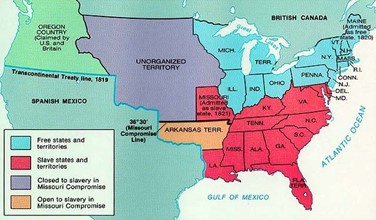
Missouri applied for statehood in 1819 allowing for slavery. Congress was already divided and there was a competitive debate over human rights and how Missouri’s application would tip the balance of an equally divided legislature of 11 free states and 11 slave states. The last state admitted was Louisiana in 1812. Illinois was admitted on December 3, 1818 and Alabama on December 14, 1819. The compromise was that Maine (part of Massachusetts) would be admitted as a free state and Missouri as a slave state, providing that slavery would be banned north of the latitude line 36o 30’.
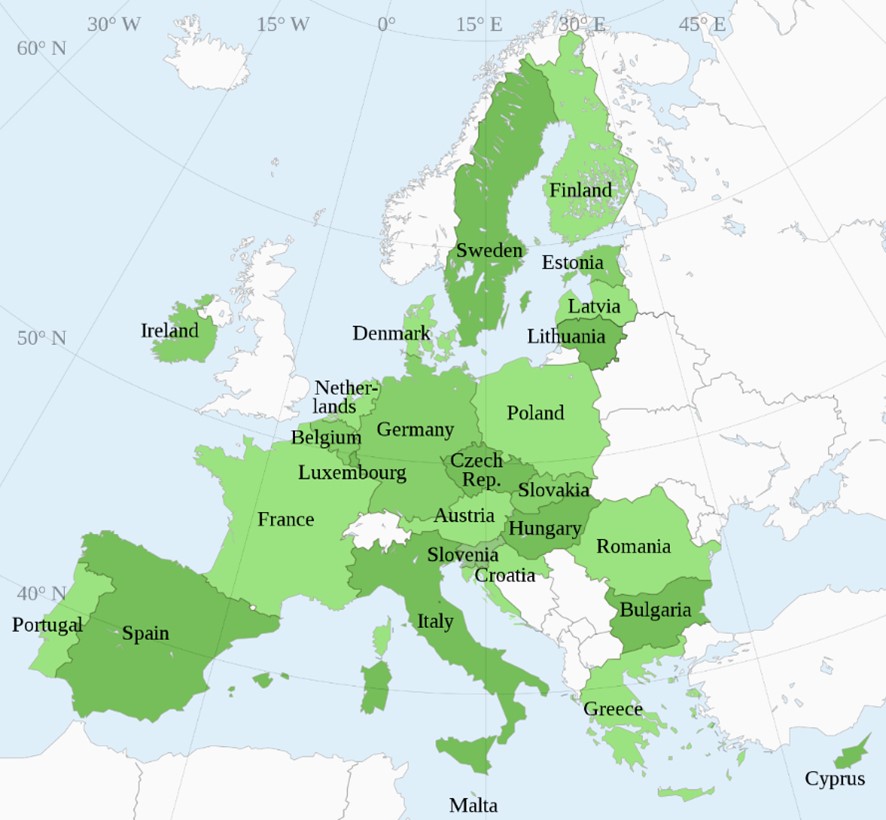
The European Union was created in 1993 with the signing of the Maastricht Treaty. Today it has 27 states. In 2009 the Lisbon treaty amended the constitution and adopted the Charter of Fundamental Rights of the European Union and the acceptance of this charter and human rights is a requirement for membership. However, Hungary and Poland do not embrace the Charter of Fundamental Rights in the same manner as the other member states.
The newly elected leaders in Poland and Hungary have taken strong positions against abortion and the equality of individuals identifying as LGBTQ. The constitutional question before the Court of Justice is similar to the Dred Scott v. Sanford case of 1857 which challenged the legal authority of the Missouri Compromise and prohibiting slave property in states.
Questions:
- Why was the United Kingdom allowed to leave the European Union?
- Should states without an ‘opt out’ clause be allowed to leave the European Union? What conditions should be considered?
- How does the secession of one state impact its own people and the other states in Europe?
- Under Article 7 of the Treaty of the European Union, can a state leave if it is suspended?
- Is it possible for member states to end diplomatic relations with another member state?
Activity #3: The U.S. Election of 1824 and the Election of 2018 in Germany with the Green Party
After eight years of government by the Democratic-Republican Party, in 1824, the Democratic-Republican Party splintered as four separate candidates sought the presidency. The election tested the Twelfth Amendment. Since no candidate received a majority of the electoral vote, it was decided by the House of Representatives. Although Andrew Jackson received the most popular votes and the most electoral votes, he did not become president. At this time, several states did not have a popular vote for president and electors in some states were chosen by state legislators.

In 2018, the Green Party in Germany became the second strongest political party. After years of government by the Social Democratic Party and the Christian Democratic Party, the Green Party has rallied the citizens of Germany around environmental issues, specifically climate change. They also have positions against racism and support immigration. The parliamentary system of government selects the chancellor or leader of Germany through alliances of the political parties elected.

Questions:
- How would you describe a competitive democracy?
- Are political parties supporting a single issue with limited experience in diplomacy or political administration qualified to govern in countries defined as the G20?
- Why do populist movements emerge? Is there strength based on the issues or the charisma of an individual?
- How do new voices and political leaders gain support withing their countries?
- Does the Electoral College in the United States provide protection against third parties? Is this appropriate for a 21st century democracy?
- Do you think the Democratic and Republican parties will be the leaders of the two-party system of government in the United states at mid-century, the election of 2048 or 2052?
Activity #4: Gag Rule and Democratic Centralism in the Soviet Union
The ‘gag rule’ was a legislative tactic employed by southern members of Congress beginning in the 1830s to prevent any discussion of enslavement in the House of Representatives. The silencing of enslavement opponents was accomplished by a resolution first passed in 1836 and renewed repeatedly for eight years.
The suppression of free speech in the House was naturally deemed offensive to northern members of Congress and their constituents. What came to be widely known as the gag rule faced opposition for years, most notably from former president John Quincy Adams. The gag rule was finally rescinded in December 1844.
Democratic Centralism is essential to the internal political debates withing the Communist Party of the Soviet Union. To what extent is debate permitted withing the Soviet Congress influencing policy and implementing changes? In the 1920’s there was dissent within the Communist Party regarding the proletariat and farmers. In December 1927, the opposition voices led by Leon Trotsky were expelled from the Congress, a ‘gag rule’ as debate was ended. In the 1980s, some voices within the Communist Party called for reforms and supported market forces in the economy and more democracy. The principle of democratic centralism challenged the authority of Gorbachev in a failed attempt to overthrow his authority. Eventually, democratic centralism changed the government as the former Soviet Union collapsed.

Questions:
- Is a single party system, two-party-system, or a multi-party system the most practical way to govern in the 21st century?
- In a democracy, should the majority have the right to limit or suppress debate on controversial issues?
- What is the most effective way for people to change their government: public protests or elections?
- How effective is a strong leader with charisma in today’s government?
- To what extent is the news media (including social media) a political influence or force in the United States?
- What type of government does Russia have today and what type of government does the United States have today?
- Is a parliamentary system of government more effective than the two-party system of representative government that the United States has?
 njcssjournal