
Missing in Action: Africans in History Textbooks
Laura J. Dull


(Reprinted from World History Connected Vol. 18, no. 1 February 2021)
In American schools, the history of transatlantic slavery often begins with the terrors experienced by enslaved persons in ships across the Atlantic or on auction blocks in the Americas. This means that students do not learn about processes of capturing and selling people in Africa, let alone the African societies that were present when Europeans arrived. These knowledge gaps were present among the secondary and college students I have taught and observed. For example, in a seventh grade class on civil disobedience, a black student asked his teacher for details about how slave trading operated in Africa. He was curious about how people were captured—in wars or “just walking along?” The student yearned for historical context about how the monumental trade in the Atlantic worked and what Africans brought with them to the US. We teachers owe this student a fuller history, one that can combat longstanding beliefs that ‘uncivilized’ Africans were just waiting to be taken when Europeans came along.
Omissions, silences, and mystifications have plagued stories of slavery told in school textbooks and lessons. For example, curriculum and textbook writers avoid directly naming those who participated in trading or imply that the slave trade simply involved “theft” by Europeans. As David Northrup (2017) explains, “The records of the slave trade into the Atlantic make it clear that Europeans did not steal slaves but bought them for prices negotiated with their African trading partners.” Beyond historical inaccuracy, says Northrup, the myth that Europeans “stole” Africans prolongs erroneous notions that “Africans were easily exploited, and that their societies were weak and brittle.” Such conceptions “underestimate Africans’ strength, intelligence, and adaptability.” In reality, after initial attempts to kidnap slaves, the Portuguese built “permanent, as opposed to haphazard, commercial ties” by seeking out African leaders with whom they could trade in a peaceful manner. As historian Herman L. Bennett (2018) explains, West Africa’s “sovereigns regulated the slave trade, like all trade, and indeed during the earliest phase of the encounter with Europeans . . . [African leaders] bore responsibility for those deprived of their African mooring.”
The erasure of Africans as traders and trading nations denies them a place as central players in world history. Enslaved Africans are often portrayed as lacking agency as well. School materials, films, and books for popular audiences perpetuate the narrow image that slavery was based on southern plantation life and focus mostly on the terrors of enslavement, pursuing a victim narrative that can “[rob] black people of humanity.” Indeed, teaching materials “tend to center on the white experience” of planters and small farmers rather than the diverse experiences of enslaved people. These shortcomings can make it difficult for teachers seeking to tell a fuller story. As one teacher explained, “I don’t . . . understand where the proper ‘balance’ is between getting across the physical and psychological pain of slavery without losing sight of the efforts made by enslaved people to build emotional, spiritual and family and community resources to cope with the institution” (SPLC, 2018: 28).
Seeking to learn whether other countries brought Africans “onto the stage as fully drawn historical actors” in the story of Atlantic trading, I conducted a textbook analysis using the collection at the Georg Eckert Institute for International Textbook Research (GEI) in Braunschweig, Germany. I found secondary history textbooks from countries at each point of the triangle of trade—England, Ghana, and Jamaica and the Caribbean (test preparation guides for Caribbean Secondary Education Certificate [CSEC] exams for 16 West Indian countries, including Jamaica). The textbook analysis focused on African agency on two levels. First, I asked how African traders and their actions were portrayed. I took note of the names and numbers of African and European trading nations or ethnic groups identified by the authors, reasoning that equal numbers showed that authors acknowledged a trading partnership. Next, I looked for representation of enslaved people as individuals, not simply helpless victims, by examining how much space and description the authors gave to the lives of enslaved people outside of their work and their contributions to present-day society.
English accounts reflected a Eurocentric perspective that focused mostly on the actions of Europeans and rendered African traders as invisible. For example, they named far more European nations than African nations. In addition, enslaved persons appeared primarily as brutalized victims, with little to no discussion of their social, cultural, or economic lives before, during, or after slavery. In Ghana, authors named equal numbers of trading nations and ethnic groups in the transatlantic trade. But in promoting a story of African innocence, they tended to overlook or underplay African involvement in trans-Saharan slaving that predated the Atlantic trade, suggesting instead that Africans began slave trading in the Atlantic due to a temporary bout of immorality. Their accounts also gave little space to the lives of enslaved people. Only in Jamaican and Caribbean textbooks did African traders appear as full participants in the Atlantic trade. Moreover, the diverse lives and experiences of enslaved people across time and space were described, presenting them as historical actors even amidst the terrible conditions of enslavement.
As “the self-descriptions of nation-states,” textbooks and curricula represent a country’s official stance on what and how children should learn. Textbook authors write narratives to legitimize existing political, social, and economic systems, so they often “forget” history that might undermine governmental authority or exacerbate social divisions. In the US, for example, textbook authors have presented slavery as “an aberration” rather than at the “heart of [American] history.” Authors use passive sentence constructions to avoid identifying slave traders, as in “Africans ‘were brought’ to the colony.” Many Africans have struggled with acknowledging their part in this history as well. Roger Gnoan M’Bala, an Ivory Coast filmmaker who made a movie about African slave traders, urged Africans “to open the wounds of what we have always hidden and stop being puerile when we put responsibility on others . . . In our own oral tradition, slavery is left out purposefully because Africans are ashamed.”
The complexity of slaving practices and the justifications for it are staggering: slavery has taken place across most societies throughout the history of humanity, and continues today. Captive people were significant sources of change in the societies where they lived. They provided “knowledge of new technologies, design styles, foodways, religious practices, and more.” Despite these enduring creations, there is often little discussion in American textbooks of the diversity and depth of the lives of enslaved people across time and locations. Instead, textbooks and other media propagate stereotypes that enslaved Africans were passive victims working on large plantations.
Representations of the slave trade are also limited. In many textbooks, ‘triangle of trade’ maps are used to illustrate the trans-Atlantic slave trade. According to this map, Africans were enslaved and brought to the Americas to produce raw materials that were shipped to Europe, where these materials were turned into manufactured goods to sell back to Africans. This simple image diminishes the massive scope of global trading and slaving taking place during this period. People of all ‘races’ traded for slaves and were taken into slavery between the 14th and 19th centuries. Muslim and Christian corsairs raided for slaves in the Mediterranean Sea and European coasts; European and Arab slavers traded for Indians, Tamils, and other Asians in the Indian Ocean; and Ottomans enslaved Mongols, Tatars, and others. Meanwhile, Africans had long experience with slaving before Europeans arrived on the Atlantic coastline. North and east Africans and Arabs sent about 10 million Africans across the Sahara, Red Sea, and Indian Ocean between 650 and 1900. Then, starting in 1500, Europeans and Americans transported about 10–15 million Africans across the Atlantic from 1500–1800. When slavery was abolished in Europe and the Americas, internal African slavery grew and many pre-existing trades continued. These facts are part of the historical record, but are often omitted from the story of early modern slavery. Without this context, cruel ideas circulate, such as the falsehood that “black people were meant to be slaves,” as one British teacher told his students.
England, Ghana, and Jamaica and the Caribbean were deeply interconnected during the transatlantic trade. The Portuguese began trading for captives on the west coast of Africa in the late 1400s. As British colonizers opened sugar plantations in Jamaica and the Caribbean in the mid-1600s, people in England increased their involvement in the Atlantic trade to obtain enslaved labor. Africans tended to set the terms of trade with Europeans, who paid tribute, gave gifts, signed treaties and contracts, and engaged in other diplomacy with African leaders. Europeans built castles along the coast of Ghana to conduct trading and hold captives. Some former slave castles are now used as tourist sites, enduring reminders of the slave trade. Various African ethnic groups, as well as individual merchants who led small armies, captured slaves from among other groups that are all now part of the modern nation of Ghana. They also traded with Muslims to the north. At the end of the 19th century, Britain took control of the region and called the colony the Gold Coast.
In the GEI library, I found at least three recent textbooks for each country and region. For Ghana, there were two textbooks for junior high and one senior secondary textbook covering African and Ghanaian history for the West African Secondary School Certificate Exam (WASSCE). There were three junior high school texts on Jamaican history and three Caribbean history textbooks meant to prepare students for the Caribbean Secondary Education Certificate (CSEC) exams. Among these were two older Jamaican junior high textbooks that provided compelling stories of slave trading. Finally, four textbooks from England were reviewed: One covered the years 1509–1745 for Key Stage 3 (KS3—local, British, and world history from 1066–1901); another for KS3 provided an in-depth topic study on whether Britain should pay reparations for the slave trade; one textbook was for the International Baccalaureate middle year program, 1700 to present; and the last was for the General Certificate of Secondary Education (GCSE) for ages 15–16, 790 to present.
These questions guided analysis of each textbook’s sections on slavery and the slave trade: How was slave trading explained? In what roles did Africans appear in the story? How were enslaved Africans represented? Did authors move beyond the labor and harsh conditions of enslavement to describe enslaved people’s cultural and social lives, gender relations, and other experiences across different places and times? I looked for historically accurate details that provided insight into how trading worked and the lives of enslaved people. Sentence structures and language used to characterize trading and slavery were also examined—for example, did authors use passive construction to mask perpetrators? Did they use language that was dated or colonialist? Below, I present my analysis and provide excerpts to illustrate how the authors told the stories of slave trading and slavery.
The review starts with Jamaica and the Caribbean, as these narratives stood out for their representations of Africans and their history.
Africans in action: Jamaican and Caribbean textbooks
The curriculum for Jamaica and the Caribbean countries reflected a willingness to fully embrace the history of slavery that gave rise to their contemporary nations. As the vast majority of the populations in Jamaica and the other 15 Caribbean nations in the secondary examination community (CSEC) are descendants of enslaved Africans, their citizens have a personal stake in telling a richer, more complex story about how their ancestors came to the Americas. The exams cover nine themes, four of which are directly related to enslavement of Africans: Caribbean economy and slavery; resistance and revolt; metropolitan movements toward emancipation; and adjustments to emancipation, 1838–1876. Jamaica’s curriculum is closely linked to the CSEC program.
In the textbooks, West Africans emerged as full participants in the trade. Caribbean authors Kevin Baldeosingh and Radica Mahase (2011) explained, “as the Europeans could not invade and settle within Africa, they had to depend on African rulers to supply them with slaves.” Jamaican author Philip M. Sherlock (1966) acknowledged African power by noting that when Europeans arrived, “they [often] had to get permission from the chief or king before they dared to start trading.” Caribbean authors Brian Dyde et al. (2008) evoked historians like John Thornton (1998) and Toby Green (2019) by stressing African development and skills in trading: “Along the [African] coast during the fifteenth century, they [Portuguese] found a recognizable commercial organization in existence. This was equally capable of distributing the European goods . . .and of providing the slaves.”
Baldeosingh and Mahase provided detailed economic explanations for the growth in trade, such as African consumers’ desires for brass pots, basins, and bracelets from Germany. Their accounts contradict stereotypes of an uncivilized continent by explaining that Africans had “a fairly developed manufacturing capability [and] African goldsmiths’ skills reportedly surpassed the Europeans.” However, they contended, Europeans could produce certain goods more cheaply, which explains why those goods were more valuable than slaves to Africans. Jamaican and Caribbean authors also took note of changes over time, revealing slavery as “temporally- and spatially-changing” rather than a monolithic, static condition. According to Dyde et al., although Europeans initially kidnapped victims “during raids on coastal towns,” later, “kidnapping was carried out by Africans.” Presented as shrewd decision-makers, Africans actively shaped the trade. For example, the trade “encouraged African chiefs and headmen to distort and alter the local sanctions that led to enslavement,” the profits from which led to the rise of kingdoms like Asante and Dahomey.
Jamaican authors acknowledged that their nation was founded on the labor of captives and made the story of enslaved Africans central to their narratives. Sherlock tried to find the “balance” that eluded the teacher quoted in the introduction: “The story of slavery . . . is a story of endurance and of triumph. The African fitted himself [sic] to life in a strange land far from his own home and loved ones; he cleared the forests and tamed the land, grew food crops and made for himself a new way of life. By his strength of spirit he rose above the brutality of the system into which he was forced.”
This focus on enslaved Africans and their actions sets the tone for a narrative that included enslaved people as multifaceted individuals: terrorized laborers, but also resistors, artists, entrepreneurs, and people with flaws. Dyde et al. devoted entire sections to work and life on sugar, coffee, and cotton plantations as well as in logging and shipping industries. In addition to explaining differences in status between enslaved people working in homes and the elds, they noted political sources for divisions: “In the early days, the mistrust felt by Africans toward other Africans helped to divide slave society.” Baldeosingh and Mahase explained that such disunity was encouraged by planters, who tried to buy Africans from different regions to inhibit communication. They also included a lengthy section on “Women’s situation under slavery,” describing how women “played a significant role in undermining the system” by “spreading messages of revolt” in the markets. But enslaved and freed people were not idealized—they had to make tough decisions to survive, as when women practiced “abortion and infanticide to deprive the master of gaining more slaves” or collaborators reported on “escape plots” in forts and plantations. By portraying enslaved people as historical actors within the terrible constraints of their circumstances, Jamaican and Caribbean authors refuted more meager accounts of Africans as solely victims.
Africans as innocent: Textbooks in Ghana
Textbook authors in Ghana reflected the nation’s ambivalence about slavery and the slave trade. The senior secondary author provided a strong discussion of how trading worked, but none of the authors expanded on lives of slaves in the Americas or fully confronted the long-running trans-Saharan trade that involved West Africans. Ghana was the first country in Africa to gain independence from their colonizer, England. The country recognizes nine ethnic groups, many of whom were slavers in the Atlantic trade and enemies. For teachers, sustaining national citizenship amidst this animosity required the reduction of ethnic ties in favor of African and Ghanaian pride. To promote unity, teachers emphasized that their diverse cultures were “almost the same” and taught a “national story of subjugation, struggle, and sacrifice” in which heroic Ghanaians overcame deceptive, cruel, and racist Britons. The desire to minimize past transgressions like slave raiding was reflected in the junior high textbooks. In brief histories of Ghana’s ethnic groups, Nikoi A. Robert’s (2010) textbook named only the Denkyiras as slavers during the Atlantic trade. Junior high textbook author Agyare Konadu (2014) did not acknowledge any group as engaged in transatlantic slave trading and veiled the involvement of Africans in this awkward sentence: “The European merchants exchanges [sic] their goods such as guns, gun powder, drinks, beads, etc. with slaves [sic] from Africa and sold them to North America.” African traders were later described as undifferentiated “chiefs” or “middlemen” who were “very greedy for more money” and “enrich[ed] themselves by selling domestic slaves and captives of wars.”
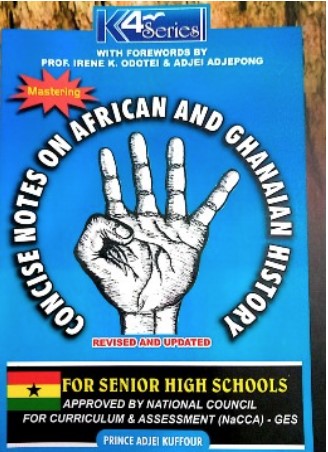
Though junior high students would learn little about who was involved in trading and how it worked, high school students had the opportunity to learn the active roles of traders during the Atlantic trade. Senior secondary school author Prince A. Kuffour (2015) noted that, “Ghanaians were deeply involved in ethnic wars, slave raids and kidnapping just to satisfy the unjusti able demands by the European merchants.” Ethnic groups like the Fante, Asante, and Akwamu were named as raiders in the Atlantic trade. Kuffour also argued that Africans controlled the trade, explaining “As Africans violently resisted against [kidnapping of Africans], the Europeans came to the realization that the only practical way to obtain slaves was to bring items the Africans wanted . . . Within a short time, Europeans and Africans established a systematic way of trading that changed little over centuries.”
But Ghanaian authors downplayed centuries-long slave trading across the Sahara that demonstrates Africans’ long experience with slaving and helps explain the shift to Atlantic trading. Europeans sailed along the coast in an effort to circumvent the Saharan trade and gain direct access to African markets. West Africans also gained by this, as they could purchase trade goods more cheaply. Ghana’s founders took the name of the great trans-Saharan gold and slave-trading kingdom to the north of present-day Ghana. Robert did not mention slave trading by ancient Ghana, though Konadu said the empire became “very great as it had a lot of gold, grew a lot of food, fought many wars, conquered many states and captured a lot of slaves.” Kuffuor explained that Western Sudanese states “participated in and controlled the Trans-Saharan trade” and this “trade brought wealth . . . and enabled them to sustain, expand and consolidate their territories.” But given his stance on European slavers as “brutal and immoral” and African chiefs’ “diabolical intentions” in trading with them, it is notable that Kuffour made no mention of the cruelties committed by North African and Arab traders during the deadly journey across the desert. In fact, he emphasized African innocence prior to the arrival of Europeans, noting that greed caused by the Atlantic trade “forced the naturally moral-minded peoples of Africa to throw morality to the wind.”
The junior high textbooks did not cover the lives of enslaved Africans in the Americas, focusing instead on the trade’s negative effects on Africa, including depopulation, increased warfare, and discrimination. Kuffour’s longer textbook included sections on how captives were obtained and traded in Africa, conditions in the slave castles, and the horrific journey across the Atlantic. Kuffour introduced slave life in the Americas by stating that “Slaves faced a variety of experiences in the Americas . . . [and] nearly all involved heavy physical labour, poor housing, and insufficient medical care.” But he devoted only one paragraph to this topic, focusing on numbers of captives, mortality rates, and types of work. Kuffour included six paragraphs on achievements and contributions in arts, politics, science, and sports in the African diaspora. So while Ghanaian students had little opportunity to learn about life once Africans left the continent, high school students could get some sense of the enduring impact of Africans on American life.
Africans as invisible: British textbooks
Starting in 2008, British teachers were mandated to teach “the nature and effects of the [Atlantic] slave trade, resistance to it and its abolition.” In explaining this change, Children’s Minister Kevin Brennan (BBC, 2008) stated, “Although we may sometimes be ashamed to admit it, the slave trade is an integral part of British history.” Given the duration and impact of the slave trade on England’s history, politics, economy, and culture, it is shocking that this topic had not already been required. Nevertheless, these curriculum reforms could not overcome the textbook authors’ Eurocentric focus on the actions of white people. Most authors detailed diverse European beneficiaries of the slave trade and took full responsibility for English people having been slavers, but there was far less discussion of African participants. For example, besides “ship owners, slave traders and slave owners,” Aaron Wilkes (2014) named “many other Britons . . . linked to slavery,” including “dockworkers unloading ships full of cotton the slaves had grown, workers turning the cotton into shirts and even the shop owners selling sugar and tobacco.” On the other hand, Wilkes identified only “local African tribesmen” as involved in “swap[ping] the goods in the ship for prisoners from other tribes.” Besides being the only reference to Africans, the designation of ‘tribesmen’ by Wilkes (and Bruce et al. 2016) replicated colonialist language. Jo Thomas and Keely Rogers (2015) included a source explaining that “The economics of slavery permeated American and European life,” listing wealthy merchants from Liverpool and Bordeaux, banks, insurance companies, and universities like Yale and Brown as beneficiaries. These authors pointed out that the “only beneficiaries in Africa were the rulers and wealthy merchants who engaged in the slave trade,” otherwise it “had a wholly negative impact on African nations.”
John D. Clare’s (2010) textbook on the trade provided more coverage of European and African participation. The author provided a two-page discussion of the vicious cycle of violence caused by slave trading, focusing on the Ceddo wars in Senegal and exploits of traders like Lat Sukkabe Faal. In a listing of “Arguments against the British paying reparations” at the end of the book, Clare hinted at African motives and gains in the trade: “The British did not steal the slaves—they bought them from the African rulers in what both sides regarded as a business deal, and pumped millions of pounds into the African economy of the time.” However, in most of the 48 pages, Europeans were the primary historical actors, and students would search in vain for African agency. This is starkly illustrated in the names of African nations identified by the authors in texts (I did not count names on maps). Ghanaian, Jamaican, and Caribbean authors named equal numbers of African and European trading nations, while British author Clare named only two African regions (Senegambia and the Kingdom of Futu Toro) as involved in trading.
All the English textbooks discussed the transatlantic journey and noted that most slaves were destined to work on cotton and sugar plantations, but they provided no coverage of enslaved people’s social or cultural lives. There was little discussion of their oppression either. Wilkes did not mention any cruelty or difficulty in the lives of slaves. Bruce et al. said that enslaved Africans lived “short and brutal lives of hard work and extreme misery . . . [ate] a poor diet, faced tough punishments, and had no proper medical attention.” Thomas and Rogers provided a paragraph from Olaudah Equiano about oppressive slave ship conditions. Clare’s book on the slave trade also used Equiano’s diary to illustrate life in Africa before capture, the process of enslavement in Africa, and the journey across the Atlantic. But while the author devoted eight pages to abolition and its heroes, most of whom were white, there were only three paragraphs about Africans’ daily lives once they arrived in the Americas. Life was portrayed as unrelentingly harsh: “house slaves . . . were often better treated, but even small mistakes might result in terrible punishment—the law allowed a slave-owner to beat a slave to death.” While it is important for students to understand the cruelties suffered by enslaved people, an emphasis solely on victimization defines people only by what is done to them. It is no wonder that an African-Caribbean student in Britain reported feeling bad “about being black when we did the slave trade . . . They [teachers] made me feel ashamed.”
Citizens in Jamaica and other Caribbean countries have the opportunity to learn the most comprehensive accounts of transatlantic slave trading. African nations and traders were presented as sophisticated actors in the trade. Enslaved Africans were portrayed in nuanced ways, as people who overcame terrible oppression to create independent nations. Only the Jamaican and Caribbean textbooks provided coverage of the diversity of enslaved people’s experiences outside of their work—and in most of their textbooks, coverage far exceeded two sentences about the topic, the standard counted as covering these topics. Most of the other textbooks could not meet this standard.
Ghana’s colonial-era border brought together former slave traders and societies who were victimized by those traders. For junior high textbook authors, creating a nation out of this diversity meant ignoring inter-ethnic slaving that could stir up old wounds. None of the authors fully confronted West Africans’ complicity in the trans-Saharan trade either. In the postcolonial period, Africans found allies among Middle Eastern nations who had also suffered under European imperialism. As Simon Simonse (2005) argued, “In the context of this African-Arab solidarity there was no place for discussing the crimes committed in a period when Arabs enslaved Africans on a large scale.” Silence about this trading helps sustain the idea that Africans were innocent and morally pure before Europeans arrived.
Bennett argued that a “savage-to-slave trajectory” continues to contort Western ideas of Africa. In this conception, African history is wrongly viewed as in a state of savagery that became a source of slaves when Europeans showed up. Today, this narrative continues to obscure the history and politics of African civilizations whose interactions with Europeans and others shaped the modern world. In England, white citizens took full responsibility for engaging in and pro ting from slavery—ultimately comforting themselves that British people ended slavery in the Atlantic world. But in telling this story, they presented African traders as undifferentiated middlemen or kings, and enslaved people as brutalized victims, sidelining black people and their agency in the national narrative.
Acknowledgment of African agency would help teachers tell a more robust, candid, and humanistic story of slavery. To do this, textbook authors should identify and describe the roles of African as well as European traders (and also name Africans who tried to stop slave trading, as was done by Ghanaian author Kuffour). I argue for including African trading nations and traders not to assuage the guilt of white people by calling out African slavers or as an argument against reparations. Rather, to be viewed as participants in history, Africans need to be acknowledged as political actors—they too engaged in diplomacy, trade, oppression, and manipulation to serve their interests. Current conceptions “grant Europeans far too much power.” At the same time, educators need to be clear that enslaved people were not simply acted upon by white people. They lived rich lives before they were captured, created societies and cultures amidst the terrors of slavery, and faced additional struggles once slavery ended. Because most of the authors included very little about slaves’ lives beyond their arduous labors and vicious punishments, the image of enslaved people as brutalized victims remained unchanged. As Toby Green explained, a focus only on slavery when teaching about Africa and Africans replicates “an old trope of primitivism and oppression.” Jamaican and Caribbean textbooks stood out for their honesty, depth, and attention to historical change. Students learned about life in Africa before capture, the complex and varied lives of enslaved people, the long and contested process of emancipation, cultural and other achievements, and enduring racism.
The aims of critical linguistic analysis of materials like textbooks, according to Ruth Wodak (1989), are “to uncover and de-mystify certain social processes . . .to make mechanisms of manipulation, discrimination, demagogy, and propaganda explicit and transparent.” In the US, myths about African history and persistent racism can hinder the efforts of teachers to fully address the tragedy of the Atlantic slave trade. This study of textbooks reveals that citizens in other nations are also denied a full accounting of slavery and slave trading. I urge teachers to join with their students to bring forms of discrimination and propaganda to light. Students can evaluate the accounts below to determine which tells a better story. They could also find equivalent passages from their textbooks to compare to the narratives in other countries. In this way, students provide their own analyses of why authors write the ways they do: How do their textbooks compare with others? Do US textbook narratives support historical agency? What story should textbooks tell?
References
BBC News (2008, August 26). “All Pupils to Learn about Slavery,” BBC News.
Bennett, Herman (2018). African Kings and Black Slaves: Sovereignty and Dispossession in the Early Modern Atlantic. Princeton NJ: Princeton University Press.
Green, Toby (2019). A Fistful of Shells: West Africa from the Rise of the Slave Trade to the Age of Revolution. Chicago IL: University of Chicago Press.
Northrup, David (2017). Seven Myths of Africa in World History. Indianapolis IN: Hackett Publishing Company.
Simonse, Simon (2005). “Addressing the Consequences of Arab Enslavement of Africans: The Impasse of Postcolonial Cultural Relativism,” in Kwesi Kwaa Prah, ed., Reflections on Arab-Led Slavery of Africans. Cape Town, South Africa: Centre for the Advanced Studies of African Society.
SPLC (2018). Teaching Hard History: American Slavery. Montgomery AL: Southern Poverty Law Center.
Thornton, John (1998). Africa and Africans in the Making of the Atlantic World, 1400–1650. Cambridge UK: Cambridge University Press.
Wodak, Ruth, ed. (1989). Language, Power, and Ideology: Studies in Political
Discourse. Philadelphia PA: John Benjamins Publishing.
| Textbooks in this Study Caribbean Baldeosingh & Mahase (2011), Caribbean History for CSEC Dyde et al. (2008), History for CSEC Exams: Amerindians to Africans, Book 1 (Grades 10-11) Dyde et al. (2008), History for CSEC Exams: Emancipation to Emigration, Book 2 (Grades 10-11) England Bruce et al. (2016), Oxford AQA GSCE History: Thematic Studies c790 to Present Day (Grade 10) Clare (2010), The Slave Trade: Should Britain Pay Compensation for the Slave Trade (Grade 7-9) Thomas and Rogers (2015), History: MYP by Concept 4 & 5 (Grade 6-10) Wilkes (2014), Key Stage 3 History: Renaissance, Reformation, and Revolution: Britain 1509–1795 (Grade 7-9) Ghana Konadu (2014), Effective Social Studies for Junior High Schools, 1, 2 & 3 (Grade 7-9) Kuffour (2015), Concise Notes on African and Ghanaian History, for Senior High Schools (Grade 12) Robert (2010), Social Studies for Junior High Schools (Forms 1–3) (Grade 7-9) Jamaica Bell-Coates et al. (2008), Living Together: Social Studies for Grade 7 (Grade 7) Black (1993), History of Jamaica (Grade 7-9) Sherlock (1966), Jamaica: A Junior History (Grade 7-9) |
Excerpts from Textbooks
1. Accounts from middle school textbooks about how the triangular trade operated.
| Ghanaian textbook by Konadu (2014) | Jamaican textbook by Bell-Coates (2008) |
| “The Transatlantic slave trade involved the buying and selling of slaves across the Atlantic Ocean to America and West India . . . The European merchants exchanged their goods such as guns, gun powder, drinks, beads etc. for slaves from Africa and sold them to North America for raw materials to feed their industries in Europe” (65). | “The Africans were snatched from their village homes along the coast of West Africa to be sold as slaves, first to the Spanish settlers, then, from 1665, to the English . . . Captains of slave ships would offer [goods], many of them manufactured in Britain, to African slave dealers” (31). |
2. Accounts from high school textbooks on how Europeans and Africans became involved in slave trading.
| Ghanaian textbook by Kuffour (2015) | Caribbean textbook by Dyde et al (2008) |
| “The first Europeans to sail down Africa’s west coast in the mid- fifteenth century attempted to acquire slaves by means of force . . . As Africans violently resisted, the Europeans came to the realization that the only practical way to obtain slaves was to bring items the Africans wanted in exchange. Within a short time, Europeans and Africans established a systematic way of trading that changed little over centuries” (272). | “To begin with, slaves were obtained by the snatching and kidnapping of suitable victims by Europeans but . . . after about 1700, although kidnapping continued, it was carried out by Africans. The desire of European traders for large numbers of slaves, in exchange for a wide range of goods, stimulated slave raiding in the interior. It also encouraged African chiefs and headmen to distort and alter the local sanctions which led to enslavement” (123). |
3. Accounts from middle school textbooks explaining what happened when British colonists in the Caribbean began buying enslaved Africans.
| Jamaican textbook by Sherlock (1966) | British textbook by Bruce et al. (2016) |
| “The story of slavery . . . is a story of endurance and of triumph. The African fitted himself to life in a strange land far from his own home and loved ones; he cleared the forests and tamed the land, grew food crops and made for himself a new way of life. By his strength of spirit he rose above the brutality of the system into which he was forced” (62). | “By 1619, African slaves were introduced to British plantations . . . Slaves had no legal rights and had to work their whole lives without payment. Any slave children born became slave owners’ property too. Purchasing slaves allowed plantations to become more pro table, as the unpaid workforce increased in size” (203). |
 njcssjournal