
Assignments Matter: Making the Connections that Help Students Meet Standards by Eleanor Dougherty (Alexandria, VA: Association for Supervision and Curriculum Development. 2012)
Reviewed by Thomas Hansen, Ph.D
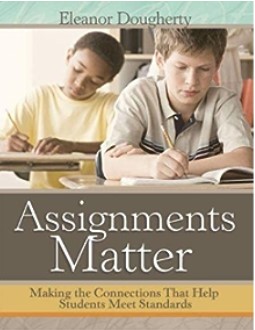
This helpful book provides information on all stages of assignments, including basic starting points, reasons for the strategies employed, assessment ideas, and rubrics to help the classroom teacher evaluate what has happened. The author walks us through why we include assignments as part of the educational process for students, how to design them, why they are important in the classroom, and what they mean outside the school also.
The book is divided into three main sections. The first, “Why and What,” explains the basics of assignments and why they matter. The second, “In the Classroom,” talks about crafting assignments and how they reflect and expand the teaching of the related topics. Included is a discussion of how to properly sequence assignments and five design principles—including literacy as common practice (p. 88). The third section deals with assignments serving as anchors to instruction and also being used as data in themselves. These connect assignments to life outside the classroom.
Included in this short book are links to technology that will yield additional resources and ideas for designing and enriching lessons and assignments (inside cover, back cover, and p. 180). An appendix (pp. 171-180) yields even more information, including websites for assignment content and for organizations providing some interesting prompts also.
The book does reference standards and common core issues and statements, so teachers in Illinois and many other states can make use of it. In the prairie state, teachers are making use of a variety of standards, anchors, statements, and other outcomes-related guidance in their teaching and testing. There is nothing in this book that contradicts such an eclectic approach to education.
I would recommend the book as a good basic introduction for teacher education courses. The book would also be beneficial for new teachers, I think. It is clear and thorough, and I really like the examples. I think more experienced teachers who want to make more use of technology when designing units and writing lessons may wish to look into this book also.
As a professional development book, this is suitable as general background reading for teachers in different fields to come up with their own adaptations of the ideas and strategies employed. The book would also perhaps work for people coming to teaching from other fields and who have a great deal of technical knowledge on their subject but who want a thorough treatment of how to get assignments and assessments planned quickly for use in the classroom right away.
 njcssjournal