Reimagining AI in Social Studies: Four Educator Archetypes and the Path Forward

Michael Fullan’s 2011 paper Choosing the Wrong Drivers for Whole System Reform offered a powerful caution that still rings true today. Schools often rush to adopt new technology without the deeper instructional shifts needed to make it meaningful. Early in my teaching career, I saw this firsthand with the rollout of interactive whiteboards. The promise was exciting and the investment was significant, but the implementation fell short. Without the right training, support, and connection to instructional goals, many of those boards became little more than digital display tools.  They were not used the way they were intended, and the opportunity to transform teaching practice was largely missed.

We are at another crossroads. Just as interactive whiteboards once promised transformation but too often delivered status quo, AI now arrives with the potential to reshape how students think, write, and engage with civic life. Fullan reminds us that real, lasting change does not come from devices or tools alone. It comes from building instructional capacity, strengthening relationships, and creating coherent systems. In the age of AI, his warning is more relevant than ever. If we adopt these tools without clear purpose or thoughtful pedagogy, we risk repeating old mistakes with even more powerful technology.

In 2025, two major federal initiatives signaled a nationwide commitment to integrating generative artificial intelligence into education and educator development. In April, the White House issued Executive Order 14277, Advancing Artificial Intelligence Education for American Youth, which focused on expanding educator capacity and increasing student access to AI tools (Federal Register, 2025). Just months later, it released Winning the Race: America’s AI Action Plan, a strategy outlining more than 90 actions focused on expanding AI education, supporting teacher training, and ensuring equitable integration across learning environments (White House, 2025). While neither document names social studies directly, their emphasis on “fostering a culture of innovation and critical thinking” (Federal Register, 2025) has clear implications for K–12 social studies classrooms. Guidance from organizations such as the National Council for the Social Studies (NCSS), the International Society for Technology in Education (ISTE), and Common Sense Media reinforces the need for educators to critically evaluate tools, protect student data, and promote responsible use of generative AI. However, national ambitions alone won’t shape daily classroom practice – teachers will. And to do that effectively, we must start by understanding where each educator is on the journey. Some are skeptical of AI’s role in civic learning. Others are experimenting with basic tools. A few are already transforming their practice in bold, creative ways.

This article introduces a four-archetype framework: Skeptic, Novice, Designer, and Trailblazer, to capture the diverse ways social studies educators are engaging with AI, each reflecting a distinct mindset and stage of instructional readiness. Each archetype is grounded in practical, student-facing classroom examples designed to support critical thinking, historical inquiry, and civic reasoning in an AI-powered world.

“I want students to wrestle with complexity—not rely on shortcuts. AI worries me because it might undercut the deep analysis and civic responsibility we’re trying to teach.”

Skeptics approach AI with deep caution, grounded in a firm belief that students should be thinkers, not just content consumers. They worry that AI tools may undercut historical reasoning, obscure authorship, or dilute opportunities for authentic civic learning. For these educators, AI is not neutral. They raise valid questions about equity, surveillance, and how easily confident-sounding misinformation can circulate unchecked. Their hesitation is often grounded in research on how students misinterpret digital content and confuse fluency with accuracy, a concern amplified in recent studies on AI-generated misinformation (Wineburg & Ziv, 2024). Yet even skeptical educators recognize the importance of engaging with these tools critically, so students are not left unprepared.

These activities emphasize critique, caution, and civic responsibility, helping students question AI rather than accept it at face value:

  • Facilitate an activity where students fact-check AI-generated historical claims using vetted primary sources.
  • Guide students to verify an AI-generated historical claim using lateral reading—opening new tabs to cross-check with trusted sources—and reflect on how polished responses can still be misleading (Wineburg & Ziv, 2024).
  • Have students use AI to generate a fake historical image or event description, then analyze it using Common Sense Media’s AI literacy principles to identify signs of manipulation and discuss real-world implications (Common Sense Media, 2025).
  • Use ChatGPT’s Study Mode to help students unpack a dense primary source, then lead a discussion critiquing how the AI framed key ideas and what it overlooked (Sawchuk, 2025).

“I’ve tested a few AI tools, but I’m still figuring out how to connect them to real learning, especially sourcing, analysis, and classroom discussion.”

Novices are intrigued by AI and willing to try it, but they’re still figuring out where it fits. Their experimentation often centers around one-off tasks, like generating an image for a warm-up or asking ChatGPT to summarize a reading. While eager to explore, they haven’t yet connected AI use to core social studies practices like sourcing, historical inquiry, or civic discourse. According to Hernholm (2025), even teachers who express curiosity about AI still need structured support, especially when it comes to tools, time, and training. As AI for Education (2024) notes, starting with small activities, like brainstorming prompts or using generative tools for warm-ups, helps build confidence without overwhelming teachers new to AI. These early successes lay the foundation for deeper exploration and help novices envision how AI might eventually align with their instructional goals. Structured tools like MagicSchool AI, Claude, Adobe Express, and NotebookLM give these teachers a way to test ideas in real classrooms while building the capacity to move from occasional use to intentional design. When AI is framed as a way to enhance, not replace, core learning goals, novices begin to shift from curiosity to confidence.

These entry points offer low-risk ways to explore AI tools while building confidence and connection to core social studies practices:

  • Use AI tools like NotebookLM to reorganize historical sources into thematic clusters, then have students analyze how the AI grouped them and evaluate the accuracy and bias of those groupings (Wasik, 2025).
  • Prompt students to use Claude.ai or ChatGPT to generate differing perspectives on a historical event, then evaluate them for bias and omissions.
  • Facilitate a role-play simulation using Character.AI, where students question historical figures and fact-check the responses.
  • Use Adobe Express to co-create civic posters or infographics with AI-generated draft text, then revise for accuracy and tone.

With the right support, tools, time, and professional learning – these educators begin moving from curiosity to confidence.

“AI gives us new ways to simulate civic life, reimagine debate, and engage students in building—and challenging—systems of power and justice.”

Designers integrate AI with purpose. They go beyond surface-level use to embed it into thoughtful lessons that support historical reasoning, civic writing, and student discourse. These educators treat AI as a tool to elevate, not replace, student learning. They maintain instructional control, designing experiences where students use AI to revise, question, and deepen understanding. They are clear about their instructional goals and use AI as a tool to help students engage more deeply with content. Designers are neither dismissive nor blindly enthusiastic. They see the promise of AI, but they also understand its limits.

Recent research supports this balanced mindset. Clark and van Kessel (2024) found that AI-generated lesson materials often reflect embedded assumptions or miss opportunities for meaningful inquiry. They encourage educators to treat AI as a collaborator that needs to be questioned and shaped, not a neutral source. Similarly, Klein (2025) reported that many AI-generated civics lessons lack depth and fail to promote the kind of student thinking social studies demands. Designers are aware of these limitations. That’s why they stay close to their pedagogical aims and use AI as a tool for design, not a substitute for it.

In the classroom, Designers guide students to use AI purposefully: drafting historical arguments, analyzing civic texts, or refining written responses. They help students question AI outputs and compare them to disciplinary thinking models. They use AI to scaffold participation for multilingual learners or struggling writers, while still expecting students to revise, debate, and cite. In short, Designers make AI useful by keeping it anchored in student learning.

These practices use AI intentionally to deepen historical reasoning, support civic discourse, and elevate student writing:

  • Use NotebookLM to create a video overview from source documents, then have students critique its accuracy and revise it to reflect stronger historical thinking (TechCrunch, 2025).
  • Use AI to model civic writing, like letters to elected officials or op-eds, followed by analysis of argument strength and tone.
  • Support multilingual learners by using AI to generate sentence starters, vocabulary scaffolds, or translated prompts (Szeto, 2024a).
  • Ask students to use AI to generate multiple historical perspectives on an event, then evaluate how each aligns with available primary sources and disciplinary thinking (Szeto, 2024b).

 ”AI lets us simulate debates, test civic arguments, and rethink how students engage with the past and present.”

Trailblazers are reimagining what’s possible with AI. They don’t just use tools, they create new experiences where students build, critique, and explore ideas at the intersection of technology and civic life. Their classrooms are laboratories for inquiry, civic action, and reflection. Trailblazers lead boldly but with intention, staying grounded in social studies goals like justice, democracy, and historical thinking.

These educators often lead professional learning, collaborate across content areas, and pilot new strategies. They guide students in building with AI, critiquing its limitations, and using it to examine democracy, memory, and power. They are not reckless with innovation; they’re intentional, equity-focused, and transparent about what AI can and cannot do.

Trailblazers also recognize that students must learn how to ask hard questions of systems, not just generate answers. Projects in their classrooms often blend social studies content with algorithmic thinking, civic action, and ethical reflection. While some of their work pushes the boundaries of what’s typical in a classroom, it remains rooted in the goals of social studies education: inquiry, citizenship, and justice.

These projects invite students to co-create with AI, interrogate systems, and use emerging tools for civic innovation and justice:

  • Lead an AI-powered civic simulation where bots draft policy proposals and students must revise or defend them using constitutional principles
  • Guide students to train their own lightweight LLMs on curated primary sources and analyze how outputs differ from general models
  • Have students investigate algorithmic bias or digital redlining using AI-generated maps or predictive tools and connect their findings to environmental justice or civil rights issues.
  • Have students use AI and local datasets, such as NYC Open Data, to take informed action by proposing policy solutions to real community issues, aligned to social studies standards.

Supporting all educators on the AI journey: A path forward

While archetypes offer a useful lens, sustainable integration of AI in social studies requires system-level support that recognizes where educators are and helps them move forward with clarity and confidence. Below are five key actions for leaders, curriculum teams, and policymakers to consider:

  1. Leverage Professional Learning Communities (PLCs)
    Some of the most powerful shifts in practice emerge through sustained, peer-driven collaboration. Districts and schools can embed AI integration into existing PLC structures by identifying and supporting Designers and Trailblazers as lead learners who model and share instructional strategies. Within these communities, Novices can build confidence through co-planning and reflection, while Skeptics are invited to engage in inquiry without pressure. PLCs foster collective efficacy, promote shared responsibility for innovation, and ensure that professional learning remains rooted in classroom practice.
  2. Provide tools, time, and trust
    Teachers won’t use what they don’t understand or don’t have time to explore. Access to quality AI tools, along with dedicated time to explore them meaningfully, is essential. As Hernholm (2025) reminds us, capacity grows when schools invest not just in technology, but in the people using it.
  3. Focus on student thinking, not just use
    Rather than measuring AI adoption in terms of tool usage, districts should evaluate how it supports disciplinary thinking, civic engagement, and student growth. AI that helps students revise a DBQ, analyze bias, or debate constitutional issues is more impactful than AI used to generate generic content. The goal isn’t AI integration; it’s better thinking.

Across all four archetypes, whether skeptical, curious, intentional, or trailblazing, one truth holds: AI is only as powerful as the pedagogy behind it. As Michael Fullan (2011) warned more than a decade ago, technology alone doesn’t drive meaningful change. Real impact comes from purposeful design, skilled teaching, and systems that support both.

Used thoughtfully, AI can scaffold reasoning, simplify complex texts, and provide fast, iterative feedback. It can lower the barrier to entry for drafting and help students engage with challenging sources they might otherwise avoid. For multilingual learners and struggling writers, it can act as a helpful drafting partner, not a shortcut, but a springboard.

But the risks are real. Without intentional framing, students may bypass the intellectual heavy lifting that defines social studies. AI can hallucinate facts, misrepresent sources, or mask bias in confident tones. As Dan Meyer (2024) reminds us, AI can do the heavy lifting of generating and organizing, but “we have to help teachers go the last mile.” That last mile is where historical thinking, civic reasoning, and disciplinary literacy live. It’s where students learn to evaluate claims, wrestle with complexity, and build arguments from evidence.

Each archetype contributes to that journey. Skeptics ground us in ethical questions. Novices push us to offer practical supports. Designers model how to integrate tools with intention. Trailblazers show what’s possible when innovation meets purpose.

AI can support great teaching, but it cannot replace it.  We are not preparing students to use AI for trivia. We are preparing them to ask hard questions of systems, sources, and society.

That is the heart of social studies.

AI for Education. (2024, March 12). Getting started with AI: A guide for educators. https://www.aiforeducation.io/blog/getting-started-with-ai

Clark, C. H., & van Kessel, C. (2024). “I, for one, welcome our new computer overlords”: Using artificial intelligence as a lesson planning resource for social studies. Contemporary Issues in Technology and Teacher Education, 24(2). https://citejournal.org/volume-24/issue-2-24/social-studies/i-for-one-welcome-our-new-computer-overlords-using-artificial-intelligence-as-a-lesson-planning-resource-for-social-studies/

Common Sense Media. (2025, June 26). Deepfakes can be a crime: Teaching AI literacy can prevent it. Retrieved August 3, 2025, from https://www.commonsensemedia.org/kids-action/articles/deepfakes-can-be-a-crime-teaching-ai-literacy-can-prevent-it

Fullan, M. (2011). Choosing the wrong drivers for whole system reform. Centre for Strategic Education. https://theeta.org/wp-content/uploads/2011/11/eta-articles-110711.pdf

Guskey, T. R. (2014). Planning professional learning. Educational Leadership, 71(8), 10–16. Retrieved August 3, 2025, from https://tguskey.com/wp-content/uploads/Professional-Learning-2-Planning-Professional-Learning.pdf

Hernholm, S. (2025, June 19). AI in education: Why teachers need tools, time, and training. Forbes. https://www.forbes.com/sites/sarahhernholm/2025/06/19/ai-in-education-why-teachers-need-tools-time-and-training/

Klein, A. (2025, June 30). Why AI may not be ready to write your lesson plans. Education Week. https://www.edweek.org/technology/why-ai-may-not-be-ready-to-write-your-lesson-plans/2025/06

Meyer, D. (2024, May 3). The difference between great AI and great teaching [Video]. YouTube. https://www.youtube.com/watch?v=iH4Pn4bpOfQ

Sawchuk, S. (2025, July). What teachers should know about ChatGPT’s new Study Mode feature. Education Week. https://www.edweek.org/technology/what-teachers-should-know-about-chatgpts-new-study-mode-feature/2025/07

Szeto, A. (2024a). AI and social studies: Supporting multilingual learners with generative tools. Teaching Social Studies. https://teachingsocialstudies.org/tag/english/

Szeto, A. (2024b). Enhancing Student Learning with AI-Powered Image Features Teaching Social Studies. https://teachingsocialstudies.org/tag/historical-perspectives/

TechCrunch. (2025, July 29). Google’s NotebookLM rolls out video overviews. https://techcrunch.com/2025/07/29/googles-notebooklm-rolls-out-video-overviews/

The White House. (2025, April 23). Executive Order 14277 of April 23, 2025: Advancing artificial intelligence education for American youth. Federal Register, 90, 17519–17523. https://www.govinfo.gov/content/pkg/FR-2025-04-28/pdf/2025-07368.pdf

The White House. (2025, July 23). Winning the race: America’s AI action plan [PDF]. Office of the President of the United States. https://www.whitehouse.gov/wp-content/uploads/2025/07/Americas-AI-Action-Plan.pdf

Wasik, B. (2025, June 16). A.I. is poised to rewrite history. Literally. The New York Times Magazine. https://www.nytimes.com/2025/06/16/magazine/ai-history-historians-scholarship.html

Wineburg, S., & Ziv, N. (2024, October 25). What makes students (and the rest of us) fall for AI misinformation? Education Week. https://www.edweek.org/technology/opinion-what-makes-students-and-the-rest-of-us-fall-for-ai-misinformation/2024/10
What You Need to Know about Plagiarism

This article was reprinted with permission from https://njsbf.org/wp-content/uploads/2017/03/plagiarism_2016.pdf

            What is plagiarism? Generally speaking, plagiarism is the taking of someone else’s ideas or means of expression and passing them off as your own work. In some cases, educational institutions define plagiarism in faculty or student handbooks.

Is plagiarism a crime? There is a fair amount of misunderstanding about this. For an act to be criminal and punishable by law, legislation would need to be passed by either a state legislature or the U.S. Congress. Some sources refer to plagiarism as an “academic crime,” but that should not be confused with state or federal law. If a state were to pass a criminal law that described behavior understood to be plagiarism, that behavior would be a crime under that particular state’s statute. As a matter of federal law, while there is no national crime of plagiarism, there is criminal liability for certain copyright infringement.

Is plagiarism fraud? Plagiarism could be considered a form of “fraud” because you are misrepresenting as your own someone else’s ideas or work product, with the intention that others rely on it. Whether or not it is actionable and can subject you to liability would depend upon the rules and regulations of your academic institution or the laws of the state in which the act occurs. It may also be deemed “misappropriation,” which may also be actionable.

Is plagiarism cheating? The online version of Merriam-Webster Dictionary lists one definition of “cheat” as “to practice fraud or trickery.” Since you are acting dishonestly or fraudulently when you plagiarize, it could be considered cheating. Whether it subjects you to punishment in an academic context would depend on your school’s rules and regulations. Some academic institutions may deem it a “breach of contract” based on an expressed or implied contract between student and school.

Is it considered plagiarism if someone takes parts of an old research paper turned in last year and uses it for a current assignment? Some teachers will look upon plagiarism in its broad sense as representing that you have done work that you really have not done, and may view you as plagiarizing yourself to the extent you try to pass off a paper in one class as new and original, when you previously submitted it in another class. Some may not view this technically as plagiarism since you are not taking someone else’s work product. However, if you do not reference that it is a prior paper, then some may consider it a different form of cheating. Even if you are expanding on a prior paper, it is better to cite your own prior work rather than simply recycle it as a “new” paper. If you are using certain information from your prior paper in an entirely new way it may not need to be referenced, but it is probably better to err on the side of caution and cite it.

How can someone avoid plagiarism when doing research? How can information be rewritten without using some of the original writer’s words? Many academic institutions offer advice on their websites on how to avoid plagiarism. Your teachers may have their own ideas as well. In general terms, you should: (1) take careful notes and citations; (2) put quotation marks around any direct quotations; (3) identify specific citation information when you paraphrase; (4) indicate in your notes where you have injected original thoughts or comments. Because plagiarism can occur even when it is not intentional, you need to be thorough not only in your note taking but in how you reference your sources. Direct quotations, paraphrases, reference to another’s ideas or theories, and use of another’s charts or graphs, for example, must be acknowledged. Common facts do not have to be cited, such as the fact that Abraham Lincoln was assassinated on April 14, 1865. There is probably no one definitive statement as to what is common knowledge; if in doubt, consult your teacher. Even when you use attribution, if you overdo it, and have very little of your own work, it may be considered inappropriate, if not actually plagiarism.

What is the distinction between summarizing and paraphrasing? When you summarize, you are condensing the main points or ideas from someone else. When you paraphrase, you are restating the way someone else expressed something in your own words.

If information is summarized or paraphrased, must the source still be cited? Yes, unless you are summarizing or paraphrasing common facts.

Is an author’s permission needed to use long passages from his or her book or article in a report? The Copyright Act permits you to use appropriately cited material from someone else’s work as “fair use,” if the use is for “purposes such as criticism, comment, news reporting, teaching…scholarship, or research…” However, whether you need permission from an author is not simply a function of the length of a particular passage; it would depend upon the “purpose and character of the use,” the “nature” of the other work, the amount and substantiality of the passages used in relation to the other work as a whole, and the effect of the use on the market or value of the other work. Different journals and academic institutions themselves may have rules of thumb as to how substantial the passage must be in order to require permission. When in doubt, consult your teacher.

What source material needs to be cited in a report to avoid a charge of plagiarism? Different teachers will have different requirements. There are certain reference works, such as The MLA Handbook for Writers of Research Papers, (MLA), The Chicago Manual of Style, (CMS), or A Manual for Writers of Term Papers, Theses, and Dissertations, (Turabian). These books will tell you what information you’ll need for your bibliography and your footnotes or endnotes, and how citations are used internally and in bibliographies, and in different subject areas. For example, you will generally need to cite in a bibliography the author, title of the work, publisher, city of publication and year of publication.

If parents help to write a paper, is that cheating? Your paper must be your own work product. Most would probably agree that if you write a 20-page paper and ask your father or mother to read it and they say, “It was interesting, but I suggest you rewrite these paragraphs since they are not clear, and you have some spelling errors,” this would not be cheating. However, to the extent your parents actually write part of the paper for you, or give more than the kind of suggestion a teacher might, you are probably crossing the line. Because of the vagueness of the term “help,” there is no hard and fast rule, other than the work must be your own.

What does it mean when someone says to “use your own voice?” You should try to interpret things in your own words and bring your own independent thinking to the subject.

Does writing about personal experiences or thoughts ever require citations? Generally not, unless you are referring to an earlier published or submitted work of your own.

Can you plagiarize facts? Generally, you cannot plagiarize commonly known facts or items of common knowledge, but if the fact itself is someone else’s work product, then failure to cite it appropriately could be considered plagiarism. The University of Pennsylvania calls common knowledge “information that the average, educated reader would accept as reliable without having to look it up.”

What if something is considered common knowledge and is found in several sources? Must each source be cited to avoid a plagiarism charge? You should have a bibliography that refers to all the books you consulted. One school of thought is that if identical information is found in five different sources, then it is common knowledge and does not need to be cited. If the common fact or knowledge, however, is expressed in a particularly different way and you express it that way, you should cite the source of that expression. Again, if in doubt, consult your teacher.

What is the public domain? The public domain refers to works that are no longer copyrighted as a matter of law and that are open to use by anyone. For example, all works published in the United States before 1923 are in the public domain as a result of expiration of copyright.

Is citing material in the public domain necessary? Yes. While you are not subject to copyright infringement issues, if you do not appropriately cite the source, you would be plagiarizing. Consider, in an extreme example, if you are given a creative writing assignment and you turn in Charles Dickens’ A Tale of Two Cities, passing it off as your own. You would not be liable for copyright infringement in that instance, but you would be plagiarizing, because you have passed off someone else’s book as your own.

How do you know if you have “substantially rewritten” information you obtained through research? This is very fact sensitive. There has to be some level of common sense and good judgment. One way to approach this is to ask yourself whether the average, objective reader would think that you have simply copied the passage. If, for some reason, the issue reached the courts, various technical tests would be used to determine if there was any type of infringement. If you have any doubts, you should probably try to rework your writing and/or consult your teacher.

Is copying material from the Internet considered plagiarism? Copying material from the Internet and passing it off as your own and not appropriately explaining it is plagiarism. The same rules apply in determining whether you have engaged in copyright infringement. The words appearing on a website are someone else’s product and should be treated the same as a hard copy source. There is no difference between copying from the Internet and copying out of a book. The only thing that matters is whether or not you are passing off someone else’s work as your own, and the same tests will apply. The fact that it is easier because you can cut-and-paste does not change the principle.

What is the appropriate use of Internet material? The same rules apply as for hard copy sources. It’s another published source. Consult the style manuals noted above for the particular format of such a citation.

Is it illegal to purchase an entire term paper from the Internet? If you purchase a term paper and pass it off as your own product, then it is plagiarism. If you wish, however, to purchase the legitimate work product of another for your own reference, you may do so, assuming that work itself is not infringing and the website or company selling the paper is legitimate. For example, you may be able to purchase a student’s unpublished thesis that is in the library of a university and use it as another source. Note: In some states it is illegal to sell terms papers to students.

Can a teacher tell if a term paper came from the Internet? If so, how? In many cases, teachers can tell. First, there are software programs that teachers may use to analyze your paper. Another way the teacher can tell is if the writing or quality of work is uncharacteristic of the particular student; for example, if the vocabulary reflects words that the teacher has never heard the student use or the writing style is inconsistent with prior work. In other instances, the teacher may be familiar with the idea or theory being passed off as the student’s own.

Can someone be suspended or expelled for purchasing a term paper off the Internet and passing it off as their own? If your school’s disciplinary code indicates that one of the penalties for plagiarism could be suspension, then it doesn’t matter from what source you got the paper. What matters is whether you have plagiarized and violated the school’s rules. Plagiarizing someone else’s work and passing it off as your own can be a serious offense, depending upon your school’s rules. Other penalties may apply depending upon the teacher’s rules or policies, particularly in a high school setting.

Is copying information out of the encyclopedia considered plagiarism? Encyclopedias are treated no differently than any other source. While a fact is a fact and you are entitled to use that fact, you cannot simply copy word for word an entry in an encyclopedia and pass it off as your own.

Is copying information from a sourcebook considered plagiarism? There are two different issues here. If someone has prepared a table or chart of data, you should cite the source of that chart or data. On the other hand, if you are citing a particular fact that is a common fact, it would probably not be plagiarism. For example, if the sourcebook contains the annual rainfall over 10 years in the Brazilian rainforest, you should not just copy that chart and pass it off as your own. If you wanted to refer to the rainfall in one year, that, too, may not be a commonly known fact, and you probably should cite the source—not only for protection against plagiarism, but to identify the source for other interested persons. If the sourcebook places information in a particular or creative form, that, too, should be acknowledged. On the other hand, if the sourcebook lists the presidents of the United States and their terms of office, that information in and of itself is commonly known and should be able to be utilized without concern. Again, when in doubt consult your teacher or your school’s website and plagiarism policies.

How can it be proven that someone did not plagiarize? The proof is going to be a comparison of the source or sources to what you wrote. You would seek to prove that either you documented the source and that you’ve given credit, or that you did not need to because you were referring to common facts, or that you have appropriately utilized your own language and thoughts. In essence, you would need to prove that you did not do any of the things that have been discussed in this brochure.

What are the consequences of plagiarism? It depends on an individual school’s policies. Apart from personal embarrassment and damage to reputation, you may be subject to discipline that could include suspension, expulsion or delay in obtaining your degree; or receive a failing or reduced grade on the paper or in the course.

What does “ignorance of the law is not a defense” mean? What this means is that even if you have inadvertently plagiarized, you may still have a problem. Schools have made clear in their rules and regulations, and on their websites, what is and is not permitted, so it is probably not going to help you to say you did not know, particularly if you have had the opportunity to find out. While it is an oversimplification to say in all instances that ignorance of the law is not a defense, it generally means that you cannot rely on ignorance when you have a responsibility to find out what your obligations are. In some instances where intent is required, ignorance may be a mitigating element.

What if you accidentally plagiarized a passage because you couldn’t remember if you copied it from somewhere or rewrote it in your own words? Are you still liable for plagiarism? Yes, you can be liable for accidental or inadvertent plagiarism. While it might be a mitigating factor, in other words the school may take into account the fact that your plagiarism was accidental, depending upon the school’s rules, you might still be subject to disciplinary procedures.

Who is hurt by plagiarism? You are hurt by plagiarism because you are not learning proper research habits or disciplining yourself in proper research and writing techniques, and you are not fully thinking through your arguments. The integrity of the academic institution is hurt if this kind of behavior is tolerated. Other students are hurt because they are competing against someone who is taking unfair advantage and otherwise cheating.

If someone is accused of plagiarism, must the accuser prove that he or she plagiarized, or must the accused prove that he or she didn’t plagiarize? In an academic context, the institution needs to show that you plagiarized. If someone accuses you of copyright infringement, they have the burden of proof. However, once they prove ownership and substantial copying, you have the burden of proving your defense, such as fair use.

Is it better to try to turn a paper in on time even if you have to plagiarize, rather than get an “F” on an assignment? No, since there is no guarantee you’ll get a failing grade if you discuss the situation with your teacher prior to submitting the assignment. Moreover, if you are caught plagiarizing, you can still receive an “F” anyway. If it is a true emergency, most teachers will probably work with you. If you have simply waited until the last minute, however, then you have brought the problem on yourself. You cannot justify plagiarism to cure your own lack of planning.

If caught, should the plagiarist be publicly identified, or should the matter be handled privately? An honor code may provide for a type of private intervention by one student to another as a means of ensuring compliance, and the school’s disciplinary proceedings may have confidentiality requirements. Sometimes dealing with a situation privately does more good than publicly embarrassing someone. On the other hand, the particular institution may have different policies on how public or private a particular incident becomes. Certainly, in a civil lawsuit for copyright infringement, the allegations are generally public.

What is an honor code? An honor code is a set of commitments you make to honor certain principles, whether you’re at a company or in an academic environment. In some circumstances it might take on contractual status, which if breached can trigger consequences in accordance with a school’s rules and regulations.

Is plagiarism a violation of the honor code? Most honor codes would make plagiarism a violation, but each school’s code would have to be consulted for the particulars. The penalty for plagiarism under an honor code would be for an individual school to decide. An honor code may provide for sequential and increased penalties for subsequent offenses. Offenses can include getting a zero or the equivalent of receiving a failing grade on the particular assignment, withdrawal of school privileges, and suspension or delay in receiving a degree, and may depend on whether the institution is a public or private school.

Steven M. Richman, a commercial lawyer whose practice includes aspects of copyright and international law, provided the legal information contained in this brochure. The New Jersey State Bar Foundation thanks Mr. Richman for his time and diligence in the production of What You Need to Know About Plagiarism. For more information or copies of program materials, visit the New Jersey State Bar Foundation online at http://www.njsbf.org or call 1-800 FREE LAW. Please follow the Bar Foundation on Social Media and invite your friends to like and follow us as well. @NJStateBarFdn can be found on Facebook, Instagram and Twitter. The Foundation also has a YouTube channel.

Intentional Use of AI in the Social Studies Classroom for Multilingual Learners


Andy Szeto


The introduction of ChatGPT in 2022 has opened up numerous exciting possibilities for teachers, making AI increasingly relevant in the classroom. For social studies teachers working with multilingual learners, AI offers valuable tools to enhance content comprehension and engagement. The intersection of social studies language demands and AI’s powerful capabilities represents a perfect synergy. The recent proliferation of AI-powered tools has significantly improved educators’ ability to bring social studies content to life and address the diverse needs of multilingual students. This article explores how AI can support these social studies teachers by providing tailored resources and facilitating effective teaching strategies.

In modern social studies education, we must move beyond rote memorization of facts, events, and dates to create more engaging and meaningful experiences for students. The integration of AI presents a significant opportunity to enhance SWIRL—speaking, writing, interacting,
reading, and listening—within lessons.1

1 Andrea Honigsfeld and Maria G. Dove, Collaborating for English Learners: A Foundational Guide to Integrated Practices, 2nd ed. (Thousand Oaks, CA: Corwin, 2020).

For instance, when exploring the decision of the United States to join the League of Nations after World War I, teachers can utilize historical chatbots to offer students diverse perspectives on the issue, fostering interactive learning. An activity could involve students preparing and participating
in a debate, supported by real-time audio translation and captioning to ensure inclusivity. AI can transcribe and translate these debates into multiple languages, allowing all students to engage fully.

Additionally, students can write about the topic in their native language, with AI translating their work for peer review and feedback. Through such applications, AI not only facilitates active participation in all aspects of SWIRL but also enriches the learning experience by bridging language
barriers and promoting deeper engagement with historical content. 2
2Tan Huynh, “3 Strategies to Support English Language Learners in Social Studies,” Edutopia,
January 24, 2022, https://www.edutopia.org/article/3strategies-support-english-language-learners-socialstudies/ .

Teaching academic vocabulary in social studies instruction is crucial as it empowers students to comprehend complex concepts, engage in higher-order thinking, and effectively communicate their
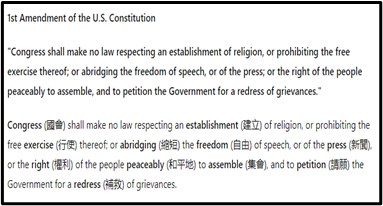
understanding of historical and contemporary issues.3 AI-powered tools can support multilingual learners by offering customized language resources tailored to individual student language needs. These tools can assist social studies teachers by identifying key vocabulary and facilitating the translation or integration of terms in various languages. For example, a government teacher working with primarily Chinese-speaking students, who is covering the First Amendment and individual rights, might use AI to create a presentation slide with key terms highlighted in a complex text. AI can identify these terms in English, translate them into Chinese, and either embed the translations within the text or provide them as a separate reference.

This screenshot displays an output from ChatGPT used to create a handout featuring key vocabulary
words. These words have been identified and translated into Traditional Chinese to assist in understanding and learning.

AI integration in the classroom allows students to use language more expressively and intentionally. It enables teachers to seamlessly plan for the use of academic language while leveraging all of the students’ language resources. In the same example, the teacher can ask students to choose which of the freedoms from the First Amendment they view as most important and discuss their choices with partners in either language, with the aid of AI-powered tools. 3 This approach not only helps students understand critical concepts but also improves their comprehension by offering translations in their native languages, making the content more accessible and inclusive.4

3 Bárbara C. Cruz and Stephen J. Thornton, “Social Studies for English Language Learners: Teaching Social Studies that Matters,” Social Education 73, no.6 (2009): 271–74.
4 WIDA. Focus Bulletin: Translanguaging. Accessed July 20, 2024.

This screenshot displays an output from ChatGPT used to create a handout featuring key vocabulary
words. These words have been identified and translated into Traditional Chinese to assist in understanding and learning.

Additionally, research has shown that cognates can significantly aid language acquisition for multilingual students.5 Social studies teachers can use this concept into their pedagogical strategies to enhance student comprehension. AI-powered tools are particularly useful in this context. For
instance, an American History teacher, serving students who speak French, English, and Spanish might use such tools to generate a slide illustrating all possible cognates in the Gettysburg Address. This visual aid can facilitate students’ understanding of the document. To be inclusive of all students’
languages, the teacher should ensure that the slide includes cognates relevant to each language spoken in the classroom. The table of cognates, produced automatically and efficiently by AI, serves as a valuable resource for these students.

https://wida.wisc.edu/sites/default/files/resource/Focus-Bulletin-Translanguaging.pdf.
5 “Using Cognates to Develop Comprehension inEnglish,” Colorín Colorado, accessed July 19, 2024,
https://www.colorincolorado.org/ellstrategies/cognates.

Screenshot of the output table from the prompt: “Identify any cognates in French and Spanish in the Gettysburg Address.”

AI-powered tools have greatly improved the accessibility of media content, particularly benefiting language acquisition for multilingual students. These tools can produce transcripts and captions for videos found on online platforms such as YouTube and Vimeo, making it easier for educators to
share content in various languages. They can also efficiently create transcripts and captions for student or teacher-created content, presenting material in multiple languages. For instance, a social studies teacher might ask students to share their immigrant arrival stories, which can then be recorded, transcribed, or captioned in multiple languages. This approach honors students’ cultures, facilitates collaboration, and maximizes translanguaging as a pedagogy, helping students understand
themselves and others better. Students can also practice public speaking by presenting their stories to the class and receiving constructive feedback from their peers. With AI tools, feedback can be offered in any language, further supporting diverse language needs and enhancing the learning experience.

Social studies teachers can foster an environment that supports multilingual learners by being flexible with their planning. This involves allowing students to navigate and utilize different language practices as they learn. For instance, in a World History class studying the social aspects during the Industrial Revolution in England, students who speak various native languages might read primary sources translated, in parts or in whole, in their own language, engage in group debates in
English, and annotate texts in any language they choose. Flexibility is crucial here; the goal is to help students process and make sense of what they have learned with direct translation only as needed. AI-powered tools can greatly facilitate this process.

These tools can assist teachers in creating discussion prompts in multiple languages, generating translated texts or primary sources, or even developing multilingual word walls. Such capabilities make it easier to integrate diverse language practices in the classroom and support students’
understanding across different languages.

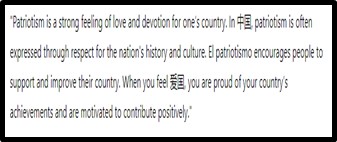
Teachers can design learning objectives that foster bilingualism and multilingualism by emphasizing skills that transcend specific languages. For example, objectives could include: “Students will be able to analyze the concepts of nationalism and patriotism through collaborative research and discussion,” enabling them to engage with diverse perspectives. By utilizing tools like Google Docs or virtual whiteboards, students can collaborate in real-time, contributing in different languages and using AI to translate their contributions effortlessly. AI allows students to navigate and integrate multiple languages in their work, thus enhancing their language acquisition and comprehension. This
approach encourages inclusive participation and deepens understanding of social studies concepts across linguistic boundaries.

Sample Output from ChatGPT: Exploring the question ‘What does patriotism mean to you?’—a
snapshot of sample student reflection on the essence of national pride and identity. 6 (Katie Novak, “Why UDL Matters for English Language Learners,” Language Magazine, March 9, 2018,
https://www.languagemagazine.com/2018/03/09/why-udl-matters-for-english-language-learners/.
7 Anya S. Evmenova, Jered Borup, and Joan Kang Shin, “Harnessing the Power of Generative AI to
AI and Universal Design for Learning (UDL)

AI intersects with Universal Design for Learning (UDL) by promoting flexible language use to support diverse learners, aligning with UDL’s principles of Multiple Means of Representation and Engagement.6

AI can enhance this intersection by using students’ languages as a starting point for brainstorming ideas, creating real-life scenarios that honor their cultures, reducing writer’s block, and producing materials with varying demands and levels.7 Additionally, AI can provide personalized feedback in
multiple languages, facilitate comparisons between student-generated and AI-generated content for reflective learning, and incorporate speech recognition software to support diverse communication needs. For example, a teacher preparing students for a group debate on whether to join the Patriots’ cause or remain loyal to the British at the onset of the Revolutionary War can encourage engagement by allowing students to research in any language and prepare their talking points in both English and their native languages. The debates can then be conducted in the languages of the students’ choosing, with real-time translation and speech recognition software available to support their participation, making the activity inclusive and accessible for all learners. 8
(Support ALL Learners,” Journal of Educational Technology, 2024, https://doi.org/10.1007/s11528
024-00966-x.
(Published May 14, 2024).
8 Cioè-Peña, M. (2022). TrUDL, a path to full inclusion: The intersectional possibilities of translanguaging and Universal Design for Learning.)

The use of AI in education empowers social studies teachers to effectively support multilingual students in academic writing. AI-powered resources, such as Ethiqly and Khanmigo’s Writing Coach, can assist with the writing process by providing sentence starters, suggesting outlines, and brainstorming ideas for multilingual learners.9 In multilingual classrooms where teachers may not be fluent in all languages spoken by their students, this is especially helpful.

AI can also translate and interpret various languages simultaneously, enabling teachers to enhance students’ understanding and expression in their native tongues. For example, a government teacher can use AI to create sentence starters or templates when asking students to write an argumentative
essay on voting rights. These supports can be provided in their native language, in English, or both, as AI offers the flexibility and simplicity needed to accommodate diverse linguistic needs.

The integration of AI in social studies classrooms has emerged as a transformative tool for supporting multilingual learners, offering unprecedented opportunities to enhance engagement, comprehension, and participation. By leveraging AI’s capabilities, educators can create dynamic
and inclusive learning environments that address the diverse linguistic needs of their students. Whether through enhanced media accessibility, flexible lesson planning, or personalized academic support, AI tools enable teachers to break down language barriers and foster a deeper connection to
historical content.
8 TESOL Quarterly, 56(2), 799–812. https://doi.org/10.1002/tesq.3074
9 “AI and Education: Will Chatbots Soon Tutor Your Children?” The New York Times, January 11, 2024,

As we continue to explore the potential of AI in education, it is essential to prioritize intentional and thoughtful integration, ensuring that these tools complement and enhance traditional teaching methods. By embracing AI’s potential, educators can empower multilingual learners, enrich their
educational experiences, and contribute to a more inclusive and equitable learning environment. Through ongoing innovation and adaptation, AI can play a pivotal role in advancing social studies education and supporting the diverse needs of multilingual learners.
https://www.nytimes.com/2024/01/11/technology/ai
chatbots-khan-education-tutoring.html
.