Note-making is active writing. Students are given formats or frames which organize thinking and hence notemaking.
Learning More Quickly and Forgetting More Slowly
Regardless of what social studies course we teach, World History, World Cultures, US History, Geography, or any of the social sciences;
Regardless of what academic level we teach, AP, honors, college prep, basic, special education or bilingual/esl:
Regardless of whether we teach live on line or in-person;
Regardless of how we teach, direct instruction “listen to me and do as I say”, cooperative inquiry groups of independent digital assignments;
All teachers need and want their students to achieve more and forget less. The key to this process is using four academic literacy skills.
A. Gather and organize information from print, visual, and data sources
B. Process this information through thinking and reasoning
C. Store, retain, and rehearse the information through memory
D. Produce thought in writing, speech or through the creative actions of drama, art, music, and movement.
Following are three ideas that will assist students in Memory skills. But before we begin examining these activities let’s consider 3 Nos. There will be NO “taking” notes. We will “make” thoughts or notes. Use NO notebooks. We will give students or show them how to make special notemaking paper. Finally, save money. Buy NO notebooks!
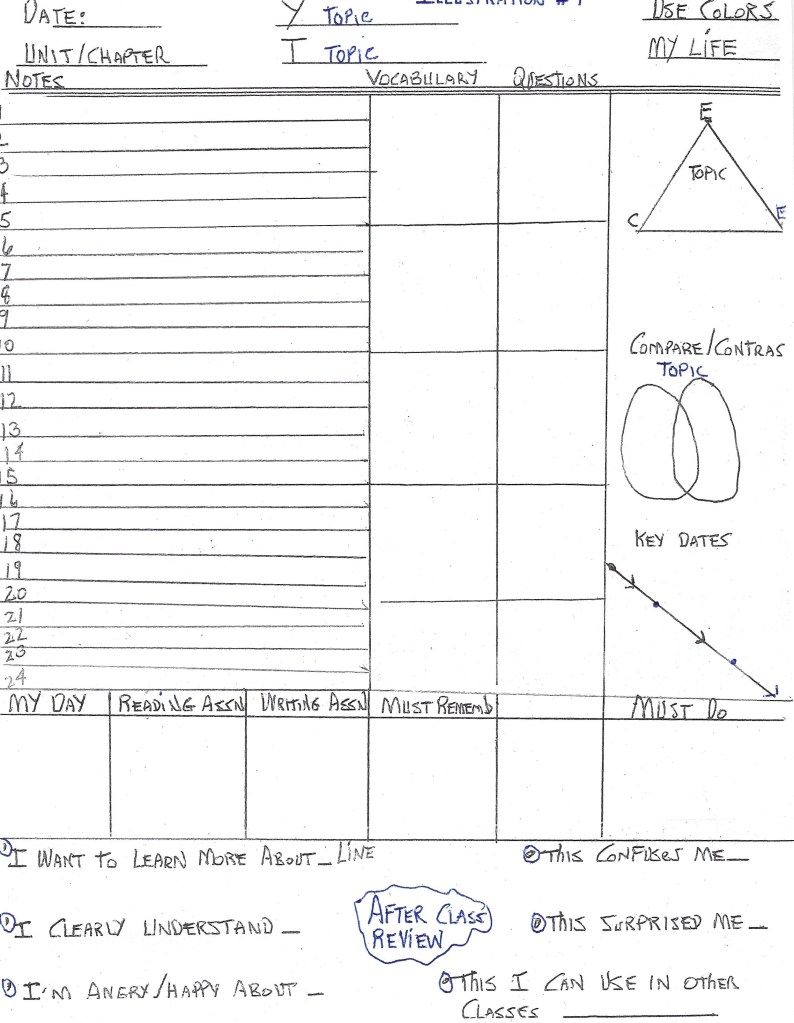
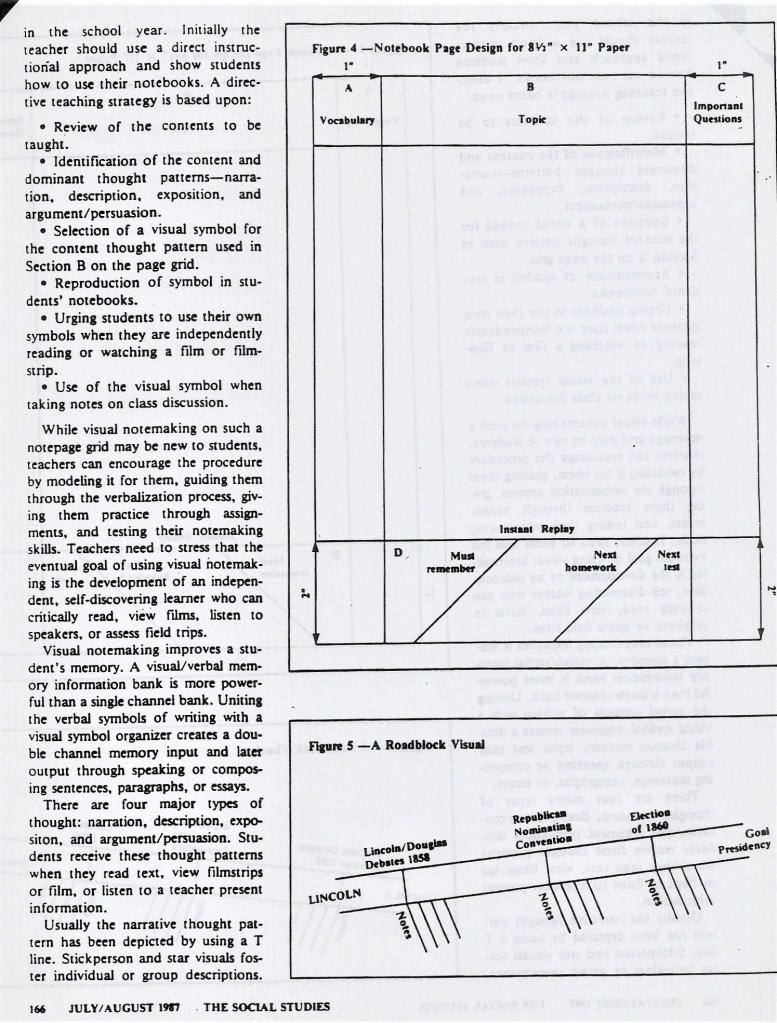
Illustration #1 is used for reading assignments. Create and distribute this illustration to students using standard size paper. If available use different colors for different marking periods. Colors enhance memory. Let’s examine #1. Top Center the Y=yesterday, what did we study yesterday? Note it. The T is for Today. Note today’s topic. Notes are made on the numbered lines. Key vocabulary, people, events, dates, ideas etc. are noted. Critical questions are copied or created.
On the right side are 3-line graphs: the topic, event, cause, effect triangle, the Venn Diagram for comparison/contrast within a given topic and a single chronology date line to capture key dates.
Illustration #1
On the bottom of the notemaking paper is a review section. Note the KEY on the lower left side. What is the key or unlocking ideas of the reading/research assignment? Note them below the KEY. What does the student NEED to know and DO? Write it down! What am I curious about? What is the next assignment?
Towards the bottom of the page are review end of class note boxes. The most important is the MY DAY. In this box note the weather, clothing worn, food eaten, or anything special in the student’s life that day. Personal memory must be linked tri academic study. The other boxes are self-evident. What is my next reading/writing assignment? What must I remember from this class and what Must I do for the class? The open space if for ideas from the teacher or student.
The notemaking page ends with a review section completed at home and turned in to the teacher. These reactions give feedback information to the teacher and can guide future classes.
Finally, look at the upper right of the illustration and find the words Use Colors. Ask students at the start of the year to buy a 4-color pen. Use it in class or for review. Here’s how it works.
Original notes are done in black. Green is used in review. Green=growth. Red is used to locate confusion. Red=danger. Blue is for clarity or I understand. Blue-clear in my mind as in a blue sky. Colors focus study and enhance memory. Use them.
This technique uses eight one-half by fourteen size paper. But it can be done on standard paper. It is used for assigned readings or research. Illustration #1 is used in an active class learning situation. The notemaking paper has a Text Reading Chart with vocabulary extensions to the left. The text reading chart has an area to note page locations. The illustration uses a visual flow chart to organize information and question “stems” to note questions and answers found in the reading.
Illustration #2
On the bottom of the notemaking paper is a review section. Note the KEY on the lower left side. What is the key or unlocking ideas of the reading/research assignment? Note them below the KEY. What does the student NEED to know and DO? Write it down! What am I curious about? What is the next assignment?
As you examine these 2 illustrations ask ourselves these questions. What do our student notebooks now look like? What is their current value? Can we try one of these illustrations in one of our classes and see how they work toward achieving our goal: learning more quickly and forgetting more slowly.
Now, lets’ go to another activity used in reading articles. Not all reading is text or document reading. Reading occurs in different formats. Oh, yes! Those of us who use digital texts and not books are still using texts. The word “text” is from Latin meaning “threads”. When we use digital devices, they are still using text which live as pixels behind the screen.
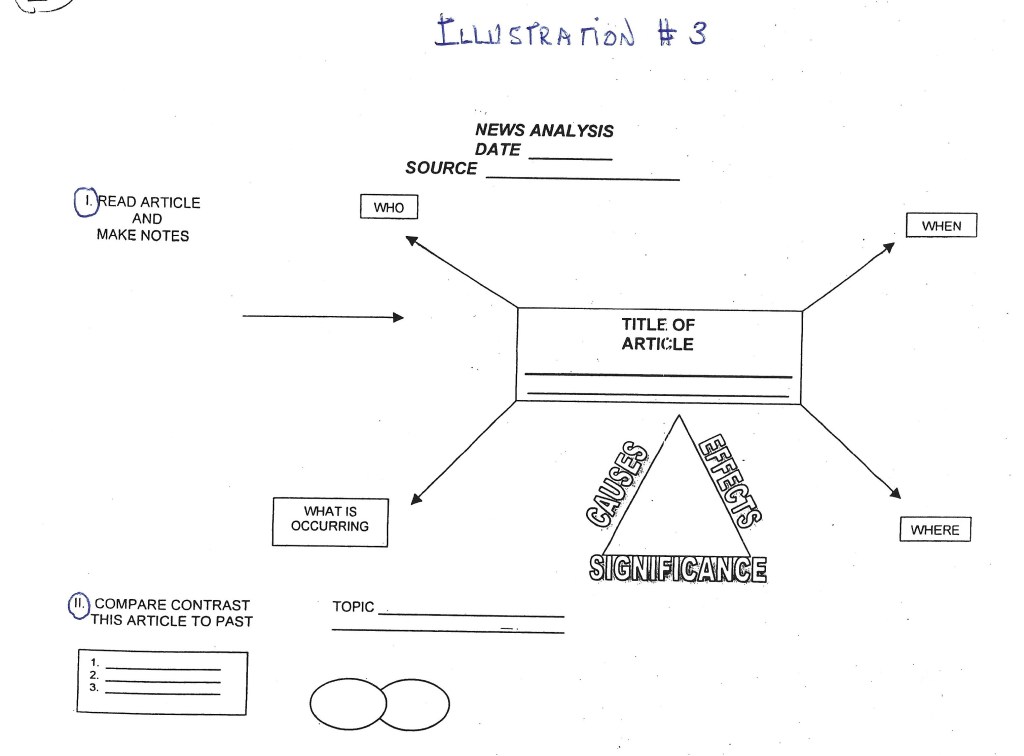
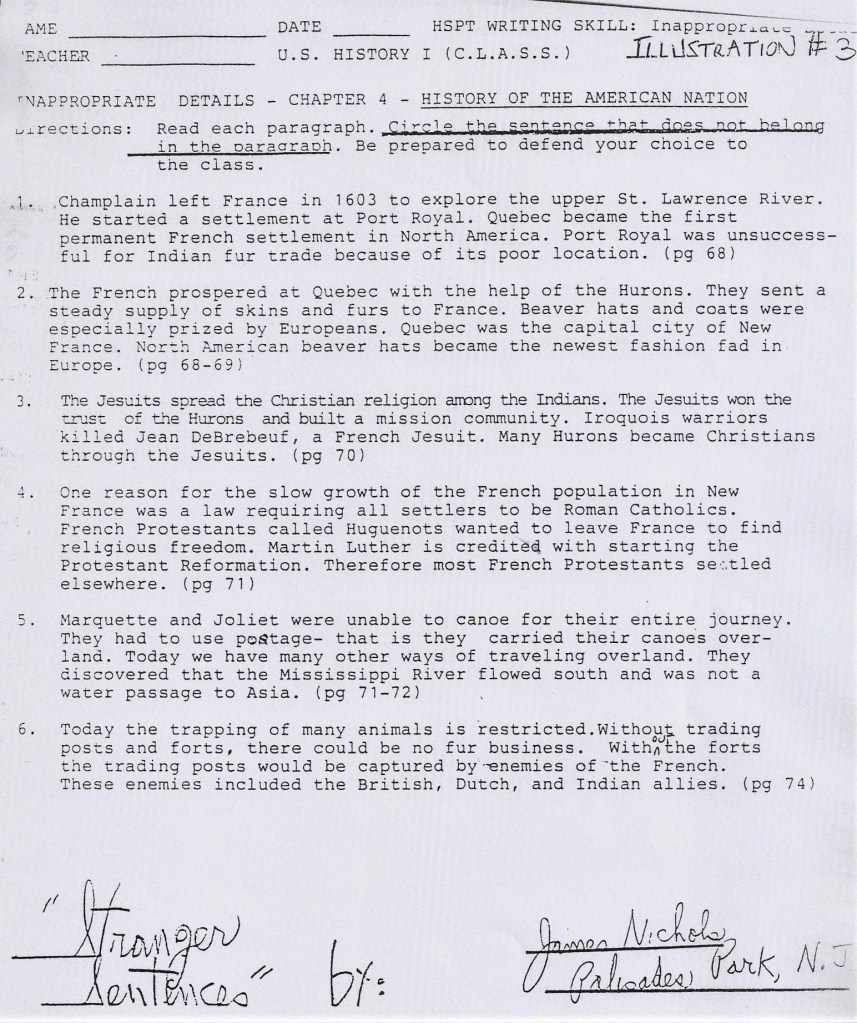
Illustration #3 is used by students when reading a NEWS ARTICLE or an essay from a periodical. The notemaking elements are self-evident. Remember ask students to use the 4 colors and somewhere on the paper note something about an event in their life, the food they just ate, the clothing they are wearing, or even how they feel. Private memory and academic memory link and help the academic emerge when students take exams, write, or speak.
Illustration #3
Finally, use the notemaking paper in phased practice reviews after classes and require that they turn in samples of their notemaking paper with exams. Give the finished notes credit. You can even ask them to create their own exams or add to yours using their notes. Reward successful practice as well as content mastery.
Creating Memory Using Visual Palates
Academic Literacy has 4 elements: gathering and organizing information, thinking/reasoning, building useable memory, and producing thought. Visual palates help build visual memory. They create a video tape or CD of a particular content topic.
Illustration #1 – Range of Visual Palates
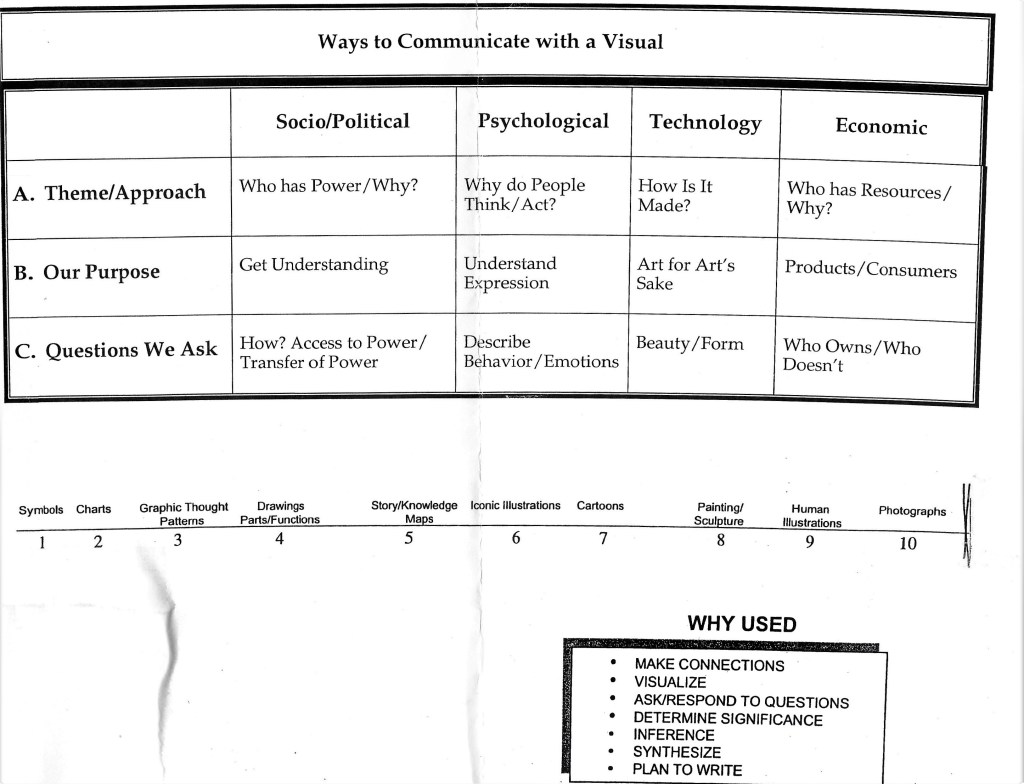
Illustration #1 describes the range of visual palates and their functions. At the bottom of the page there are 10 types on a spectrum from abstract symbols such as an arrow to realistic photographs. Visuals act a metaphor for both content information and a particular dominant thinking skill used when students encounter the content. Teachers locate and reproduce the visual palate on standard size 8 ½ x 11 paper although they can also be used on larger paper. Each student is given a visual palate. They are used in class, for assignments, or as test items.
American History Thinking Skills – Notemaking and Visuals: Tools for Improved Achievement
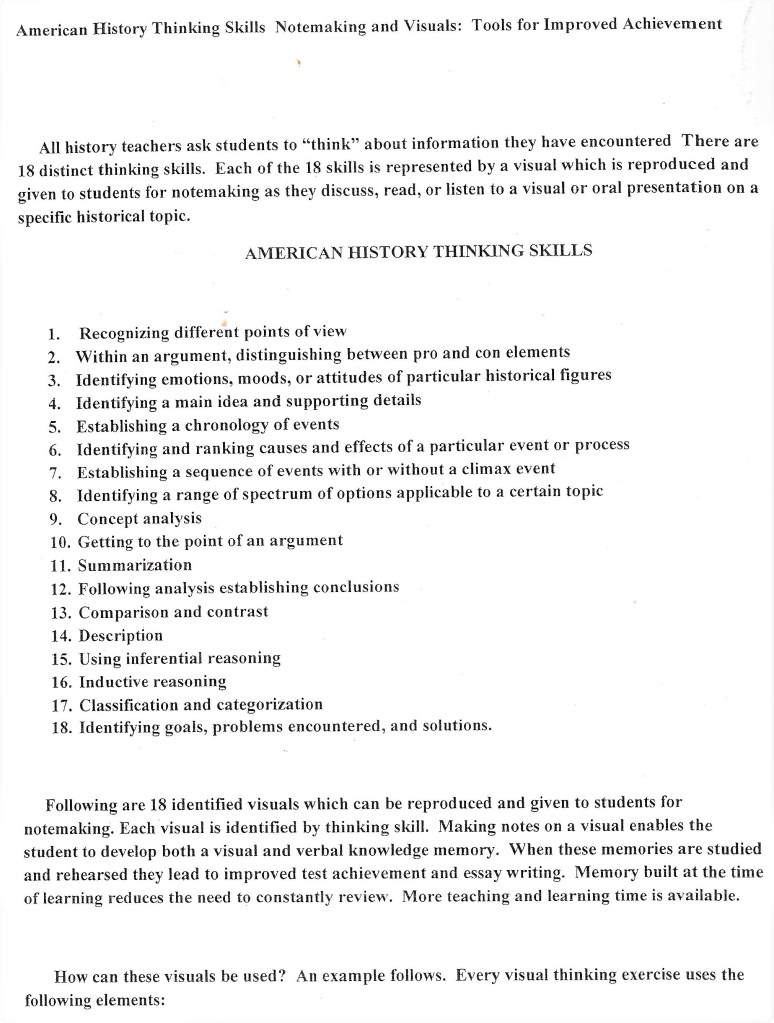
Illustration #2 lists the types of thinking skills used in our courses. Several may occur in a single class or assignment but normally one or two will dominate learning.
Illustration #2 – Thinking Skills
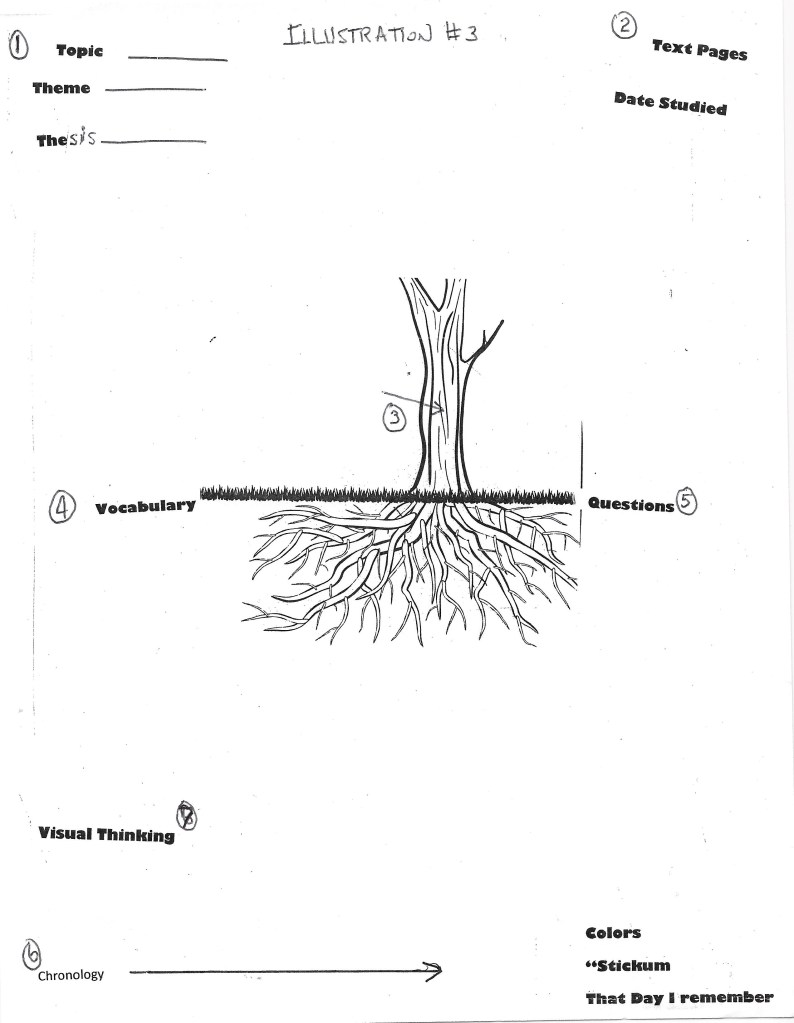
Illustration #3 is our first visual palate. It is line drawing of a tree embedded in soil. The major content focus is preprinted on the trunk of the tree. As students listen, read, watch videos they will make notes or begin to PAINT the visual palate. Let’s examine the 7 sections in the visual.
Illustration #3 – Example of a Visual Palate
Upper left corner there are 3 Ts. Students make notes on each. The first is the TOPIC, the facts of who/where/when/what the second is the THEME or thread that runs through the entire learning topic. The third is the THESIS or argument that drives our inquiry. This is the triple T
2. In the upper right are sections that link the visual to text pages and the date when learning first occurred.
3. The trunk depicts the content topic. Below the trunk are the roots or CAUSES of the topic. Extending out from the trunk are branches which become the EFFECTS of the topical events. Students make their notes on the many roots and branches. Some roots and branches are primary and some are secondary or minor.
4. Key vocabulary is isolated to the left of the roots and key questions are noted at (5) to the right of the roots.
5. At the very bottom of the palate is a time or chronology line. Students note critical dates.
6. This visual thinking area might have a Venn Diagram for compare and contrast or a star for an important person.
In the extreme right corner are 3 memory builders. Colors, use a 4-color pen on a palate. Black is for critical notes, red is for confusing ideas and hence dangerous, green is for notes we make when studying and represents growth, and blue is for ideas we clearly see like a sky blue. We can also attach postal notes or stickums to the paper. They focus the eyes. Finally, we must note something that personally occurred to us on that day. It might be the weather, the food we ate, the clothing we have, the shoes we wear, or how we feel. Connect the personal to the academic learning. The personal will rehearse or ignite the academic when we study or when we want to write or speak.
All visual palates have the same elements. Illustration #4 shows a clock with attached sticks of dynamite. This visual is used for revolution, American, French, Civil War, Nazi Germany, USSR 1917, Mao’s China, Castro in Cuba etc. As students learn they paint the palate with their 4-color pen. The dynamite=causes. The clock hours=events.
So, what to do? If we like the visual palate idea try it with only one class. When? try the last class of the day. Do something different. If it works the day ends well. If it does not get out of school, turn on the radio, and go home. If we use new ideas early in a day and they do not work they often leave an aftertaste in the mind and air since students will tell one another that the teacher is doing something weird today.
Limit creativity to the margins of our daily school life. We are already doing a good job. We are not working from a deficit. Visual palates can be used in any course, with any student type, and within any instructional/learning study. They can be used in class, for assignments, or on tests. We need to show them how to use them, permit them to use them in small groups, and then ask students to practice independently. They have one goal increase faster learning and slow the relentless decay of memory.
When we announce an exam and want students to study their notes what do these notes now look like? If they have created visual palates, they use them. They are videos and aural recordings of their learning.
The Knowledge Map. (KM)
The KM is a specially designed 8 ½ X 14 paper used when a class has a long unit or chapter that might go for 10 or even 15 classes. The content might be a long chronology or complex series of events. KMs may be used in any subject and are especially useful learning and memory tools in AP classes which are both fast-paced and intensive.
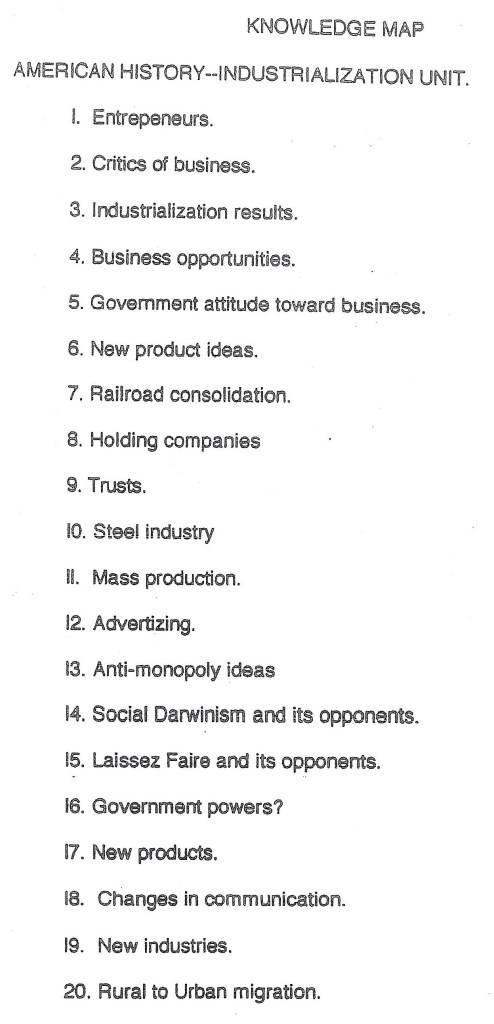
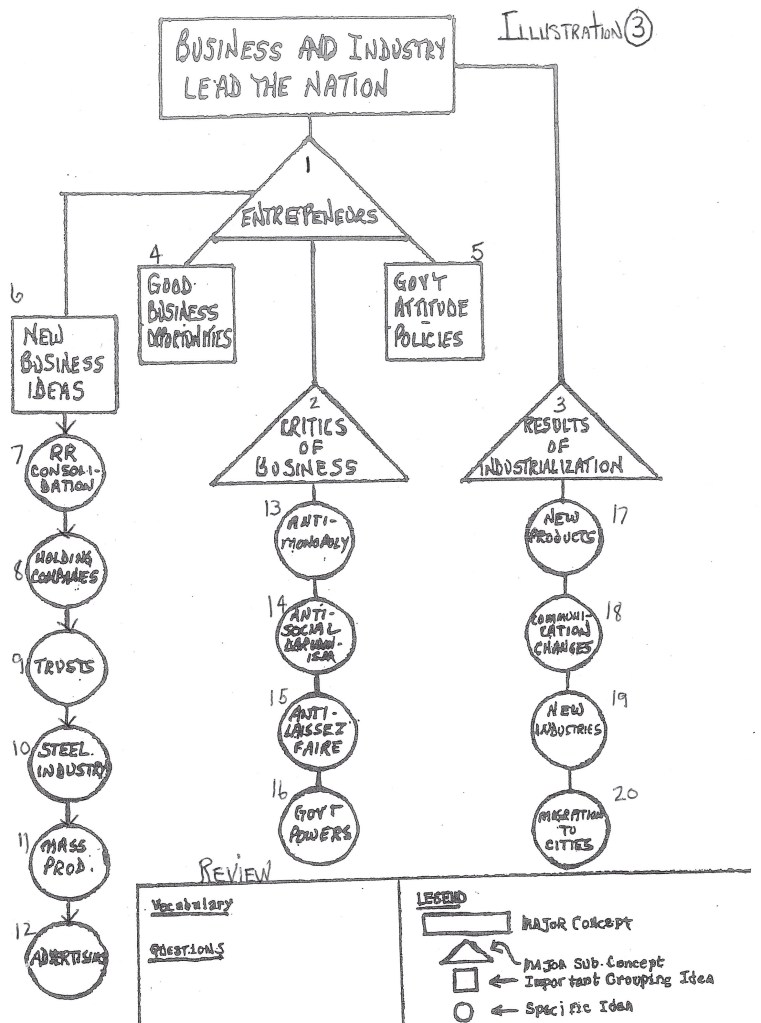
This is how a KM is created. Get legal-size paper. Step I-Identify the content topics you want students to investigate. The topics might be people, events, or ideas. Our example shows a teacher KM with 20 topics. Step 2-arrange the topics in a flow chart and number each one. Step 3-decide a flow chart type. There are 3.
A, The “completed” or fully clothed chart showing names of all topics.
B. The “naked” or incomplete flow chart showing empty chart spaces that students will fill in during the unit.
C. The “checker board” chart in which random spaces are filled in by the teacher and others are left empty for later student work.
Give the one you choose to students at the start of the unit or chapter. Tell them they will be used throughout the unit and turned in with all quizzes or exams. They are given credit for completed KMs.
Illustrations 1-2-3 show the topic list, a naked KM, and a completed KM.
Illustration #1 – Knowledge Map
Illustration #2 – A ‘Naked” Knowledge Map
Illustration #2 – A ‘Naked” Knowledge Map
Illustration #3 – A Completed Knowledge Map
KMs are used in 3 class learning times, these are at the start of a class to review and preview, during a class as a “time out” or integration moment, or at the end of a class as a “wrap it up” final one or two minutes. They can also be used for assignment notemaking or test preparation. They replace notes in a notebook. They integrate many learning days and different forms of learning.
Following are 13 tips for using KMs. Pick a few and try them.
If you can, create the KM on colored paper. It is harder to lose. Make friends with art teachers. They may have a ream.
Organize the class into teams of 3 or 4. If a student is absent, they can share work on their phones or in class.
On each chart area note the date the topic was first studied.
On each chart box note the page number in the text where this information is located.
To the left of each box note a question (Q) about the topic. The ? may come from the teacher or is student created. Interact with the topic!
To the right of the topic note an associated vocabulary word or date (V) Again, interact and extend learning.
Use a 4-colored pen. Black for original notes. Green for review or growth notes. Red for confusion and danger. Blue for “I understand this.” Study the red and green.
Create a chronology or time line at the bottom of the KM.
Notes which topics are homework or project assignments and their due dates,
Get some post-it “stickums” of different colors and attach them to different chart topics you want to emphasize.
Sketch visual graphics on the chart such as a STAR for an important person or a VENN diagram for compare/contrast thinking.
Occasionally make notes about your personal life on the chart: the weather, food you ate, clothing you wear, videos you saw etc. Merge the personal with the academic.
Anywhere on the chart write old exam questions on the chart.
There are five learning principles embedded in KMs
Spaced time-interval review.
Self-inquiry
Short quizzes or tests review and response
Using colors
Merging personal memory with academic memory
Try a KM in one course in one class. Determine if that class has a greater grasp of complex content when compared to another class. Consider using the KM the last of the day. Often student athletes or club members may be absent for special events. Their team members can keep them up to date until they return to class.
One teacher uses the KM on a test review day. The teacher creates a completed KM and then cuts it into many pieces and puts them into an envelope which is given to a team. The team opens the envelop and has to reconstruct the KM and justify their thinking.
Learning more quickly and forgetting more slowly is our goal. The KM is one tool we can use. A middle school might use a smaller KM with 10 topics. A high school class might have 20. A complex AP unit might have 30. KMs are used in any teaching or learning style, in a room with desks or tables or lined with individual computers. The KM integrates content, time, and a variety of teaching materials into a single memory device.
They are RW recognizing writing, copying, note-making, RD or redesigned writing, composition, media writing, and website design.
Illustration #2
Element #5 composition is divided into styles and scales. Styles refers to narrative, descriptive, expository, and point of view writing. Scale refers to sentences, paragraphs, MP or multiple paragraphs, E or essays, and RP research papers. During the course of an academic year students should practice all styles and scales.
The 7 AW writing elements are practiced in three settings: the classroom, assignments, and on tests.
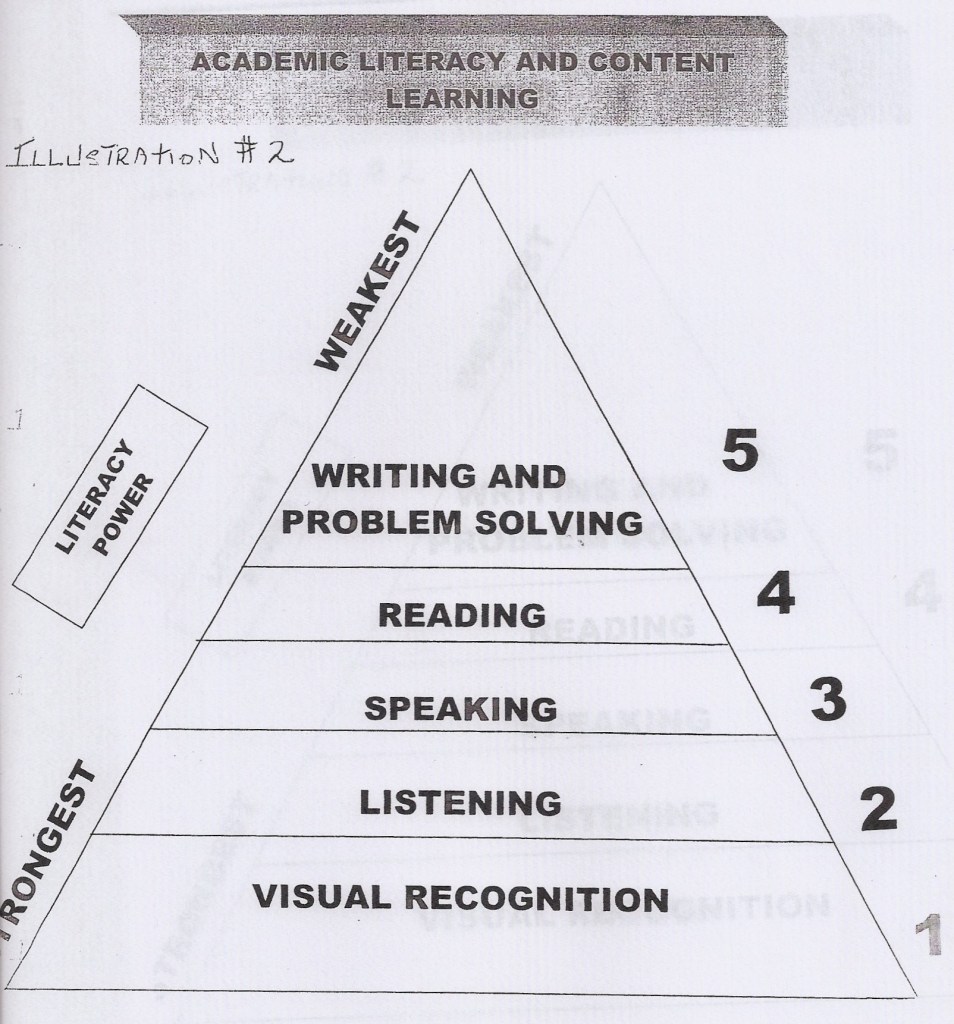
Illustration #2 shows the relationship between five literacy skills.
Writing is the most difficult because it cannot occur without gathering and organizing information, critical thinking, and memory. Writing is both a product and a process of learning. It is slowly and consistently developed over an entire year.
Academic Writing Skill #1 Recognizing Writing
Illustration #3AIllustration 3B
Illustrations #3 ABC shows three examples of this skill. They are teacher developed and used in CAT, the classroom, assignments, or on tests.
Stop! Wait! A teacher will ask how and when do I have the time to create these activities for my classes. I am busy with 5 sections and 100-125 students. My commercial supplemental materials do not have these examples. A problem! Yes, but solvable.
Consider the following tactics. 1.Before February ask your supervisor to budget a summer staff development time for you to to create these lessons. 2. If you are told there is no money ask the supervisor to eliminate your school duty period in the next year and let you use the period to develop the activities which you will offer to other faculty. This effort becomes your duty. Do this before a master schedule is created with supervisory assignments. 3. If you cannot get a duty release ask the supervisor to approach a parent group for an initiative grant for a summer effort. 4. Most districts require that faculty create an improvement plan for the following year. Let AW activity development become your plan and during the coming school year occasionally ask your supervisor for released time during a school day to create the activities. Schools have money for daily subs and period coverage.
Academic Writing Skill #2: Copying
Copying is notetaking. Think of copying as Xerox reproduction. This is a critical skill. It is unrecognized. Copying occurs in two ways: we listen and reproduce or we read and reproduce. At the end of a period take three or four minutes for a copying activity. Find a critical sentence or two in a reading. Ask students to get paper/pen ready.
Read aloud. Stop! Give them a paper copy of what you said or refer them to a text page. Did they get it right? You may have an old overhead projector and could show them the passage they just heard. Discuss the sentence.
Some teachers ask students to read a short passage and copy it. Sometimes, even though the passage is in front of their eyes they fail to replicate it because copying requires careful attention and precise effort.
Note-making is active writing. Students are given formats or frames which organize thinking and hence notemaking.
Illustration #6
Illustration #6 is a standard chart used in an International Baccalaureate Theory of Knowledge course. As students read or learn in class they fill in the chart.
Another chart form is called a triple screen. Students are given an 8 1/2 X 11 paper and told to fold it vertically into 3 columns. The left column is labeled reading notes, the middle column is called class discussion, and the right-side column is called review notes. A four-color pen is used. Reading notes are in black. Class discussion notes are in blue for clear understanding and red for confusing ideas. Green is used for the final column. Green shows growth or change incurred during the review.
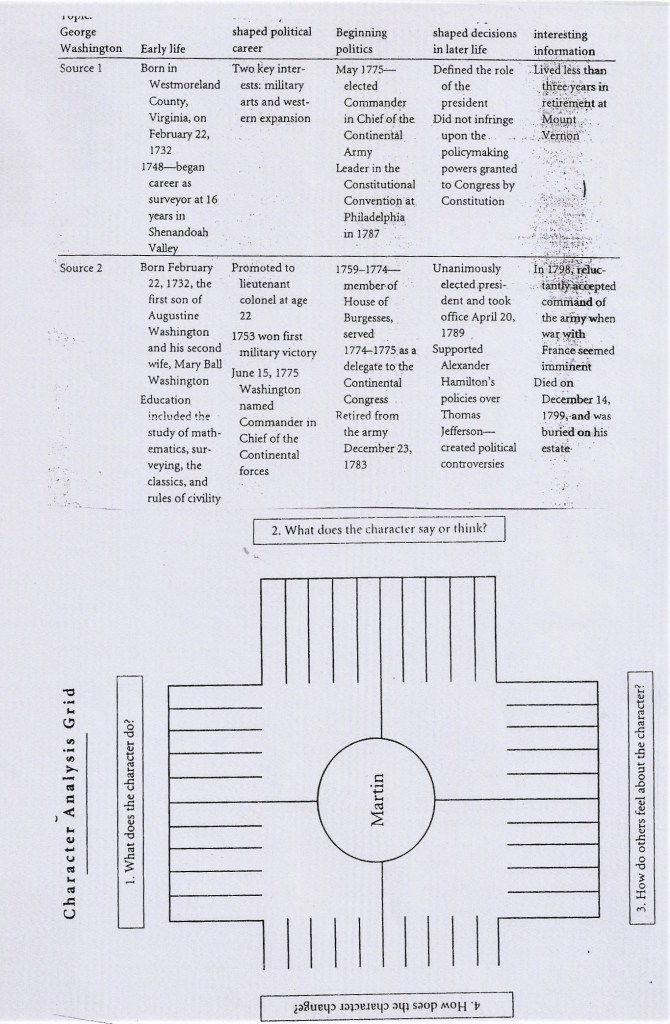
Illustration #7
Illustration #7 depicts two techniques used when studying an important person or group. In this example we used George Washington. The Inquiry Chart is self-explanatory. The character analysis chart was originally used in a literature class. Eliminate the word MARTIN and substitute GEORGE WASHINGTON and we have a Character Analysis Chart. Both tactics, CAT, are used in the classroom, for assignments, or as a testing challenge.
Illustration #8
Illustration #8 is called a “story chain.” This example is from a literature class. History teachers would create their own story chain word series. Using the chain students in class or on a reading assignment expand or extend the words in the story chain into a larger narrative or series of events. See the example of French and Indian War.
As we examine these note-making frames or palates they have one trait. We do not ask or tell students to “take notes.” We provide them with an organizing frame. They use it as a painting palate brushing in their thoughts.
Illustration #9
Illustration #9 is a visual icon frame. There are 11 content thought patterns. Examine #7 Main Idea/Detail. Students are given a four circle visual. The central and smallest circle is main idea. Students make an arrow into the small circle and print the main idea on arrow. The other circles are details or outer ideas. #11 is a football field. At each end are goal lines. The names of one or another group are printed on the lines and an arrow is extended from the group toward and across their goal line. When a student studies the goals of the North or South in the Civil War, they study a football field with notes. #1 is called a Reverse 7. On the top at left 7 we see the word Federalist and at the top of the inverted 7 we see the word Antifederalist. They are facing off looking at one another. Notes are made below each figure. The gap between them is a note room for their differences. Visual icons are powerful ways to organize thinking and their results.
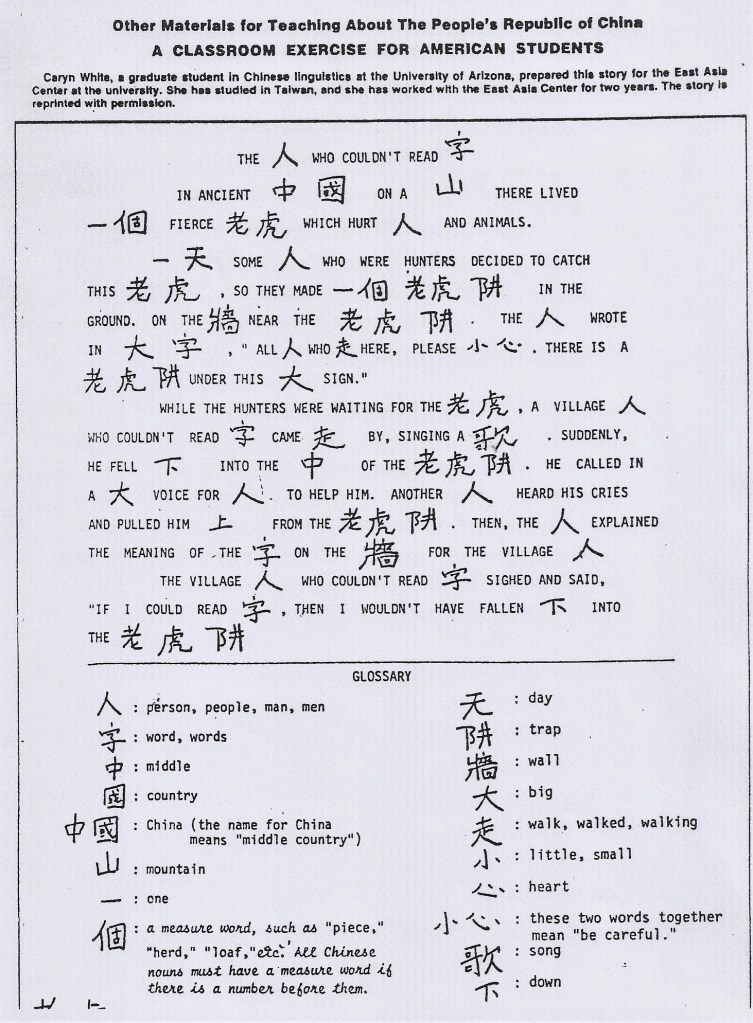
Illustration #10
Illustration #10 is a “time out” device one teacher developed to develop see/search/think/note skills. Try it even though it may not fit your exact lesson content. Students may learn a little Chinese!
Academic Writing #5 – Composing
The next type of academic writing is composing. Composing has two features, styles and scale or quantity of words. In general, the first composing efforts should be short and simple sentences and paragraphs. Don’t assign complex essays or research papers early in a term. English teachers may tell us that students know how to write. This is not the issue. They do not have content mastery in our subject. They may not understand the natural logic or continuity of academic learning. So, start short and simple gradually moving toward extended multiple paragraph and essay writing in the second or even third marking periods.
Qualify the above statement. With high achieving AP or IB classes move more quickly. They need rapid and continual work in short answer essays, open-ended longer essays, the DBQ form essay. Their examination is in mid-May. Time is short. Demands are long.
Adopt a composing plan for each 9 week marking period.
Follow it ending with research papers. Research is a year long achievement but gradually escalate the size from a simple paragraph to more extensive works.
Illustration #15
Illustration #15 shows an example of sentence writing and an outline of different paragraph types. The sentence example is called “Right-write” to the point. Have students place their pen on a paper and draw an outline of its shape. Go to the back of the pen and begin to write a sentence about an assigned topic ending at the point of the pen. The visual forces students to very carefully limit their thinking to a few precise words in their response. The sentence can be narrative, descriptive, expository, or point of view. Just write to the point. Brevity is beauty.
On the left side of the illustration are six organizational patterns. At the bottom is a writing space. One metaphor used in many schools is the “hamburger” approach. The top of the bun is the topic sentence or claim. In the middle is the evidence with salt, pepper, mustard, or ketchup as details. The bottom of the bun is the ending. Hamburger writing can be used in the classroom for assignments, or on tests.
Illustration #16
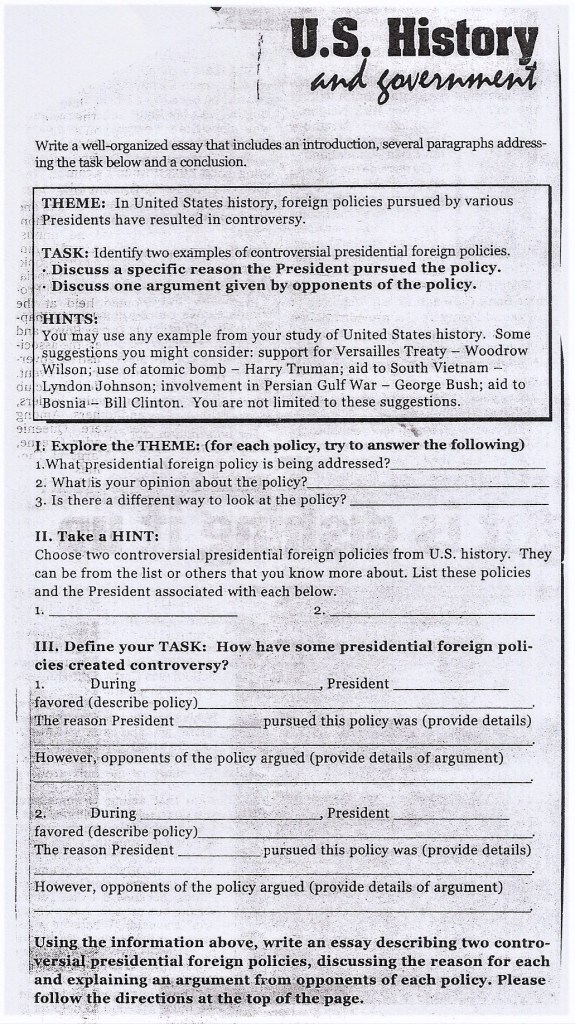
Illustration #16 is a multiple paragraph assignment. AP exams in world, European, and American history require SAQs or short answer questions. Within the SAQ format they use an ACE technique. A=a direct answer to the prompt. C=how the writer defines and describes their claim in the answer. E=explain your choice of the claim and logically connect your claim to relevant historical developments. In short, bring more information to the SAQ. The multiple paragraph challenge makes a claim, provides evidence, and ends with commentary. 3 examples of SAQs follow. They were presented at an AP professional development program in Tampa, Florida.
Before examining them take a look at the essay questions you have assigned. Now, examine A B C D.
Illustration #17 has 4 essay examples: A B C D
Illustration #17A
Illustration #17B
Illustration #17C
Illustration #17D
How do they compare or contrast with our work? Look for clear, precise, linear directions. What does the end product look like? What is the font size in the directions.
Are due or progress dates clear? What are expectations for A quality work? Have you posted examples of A quality work from previous years? What is the essay worth in computing semester grades? When is the teacher available for individual help? Set the context. Ask students to locate the dictionary definition of the French word “essay.”
The final type of essay is the DBQ or document-based questions. See illustration #18. This DBQ has 5 documents. Creating DBQs is extremely hard and time-consuming. Teachers get them from AP, IB, State agencies, or commercial sources. Except for AP courses, they should be assigned well into a course. Responding to a DBQ requires both integrated knowledge from the course and the documents and powerful synthesis writing skills. An inclass DBQ can be assigned to a cooperating group or an individual.
Illustration #18
What does a good DBQ response read like. Illustration #19 is a reading sheet given to teachers who read AP DBQs. The notes were made by the author. This DBQ has 10 documents. Current DBQs are 6 or 7.
Illustration #19
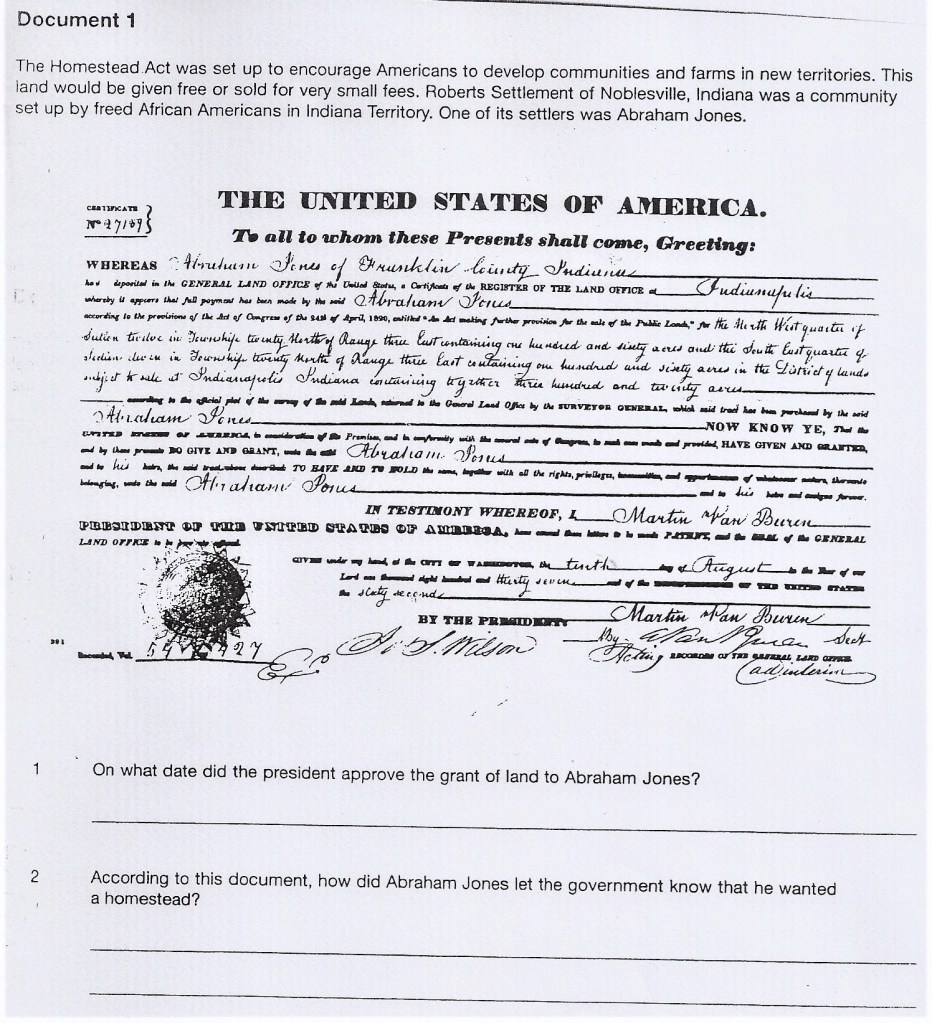
Document #1 – Homestead Act
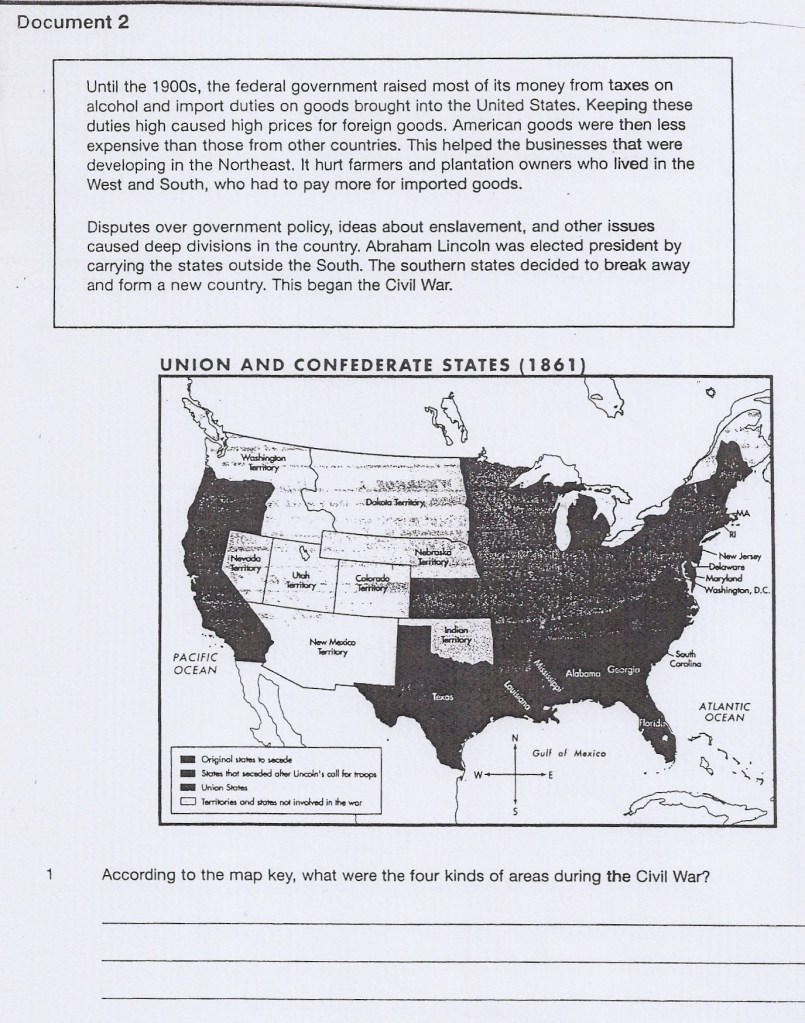
Document 2 – Reactions to the Morrill Tariff
Document #3 – Benjamin Singleton and Exodus to Kansas
Document #4 – Migration to Kansas
Document #5 – Exodus to Kansas
This DBQ was graded on a scale of 0-1 to 8-9. The average DBQ score in this reading from 2007 was slightly over a 3. An 8-9 score occurred in less than 5% of the papers. Illustration #20 shows a English language State testing rubric. It is not designed for DBQs but may be useful in grading the DBQ.
2007 DBQ in United States History
2007 DBQ United States History
2007 DBQ United States History
2007 DBQ United States History
2. determine the audience or target for the message,
Illustration #20
The research paper is the final type of composing.
In a middle or high school the format for these papers normally comes from the English Department. In a few schools the format may be cooperative merging social studies and even science teachers in a joint effort.
The research paper involves style conventions such as bibliographies and footnoting. These are always taught by English faculty. We need to carefully consult with our colleagues. We can not assign research papers and assume students know how to follow style conventions. We have to coordinate the timing of our research papers with their instruction and practice. This is complicated and one reason why research papers almost always occur toward the end of a course.
Academic Writing #4 – Media Writing and Website Design
Media writing is the very opposite of linear, left to right composition. Media writing has 3 planning elements:
1. pick a medium or carrier of a message,
3. decide on the quantity of information in the message.
Two quick examples: what word messages about the causes of the American Revolution might be printed on a T shirt or a cup or an advertising billboard. A tee shirt can not carry an essay. The message has to be short and direct.
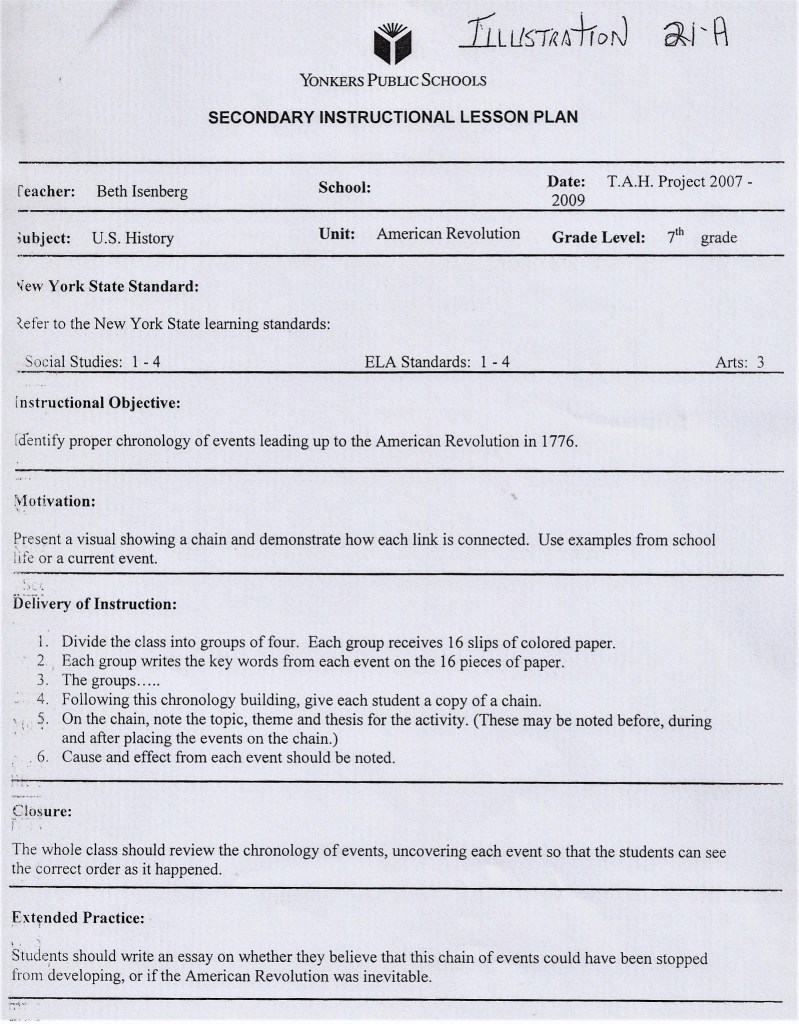
Illustration #21A
Illustration #21B
Illustration #21 shows a chain. The chain is a set of interlocking parts and is especially suited to showing events, their causes, and effects. The chain is the medium and notes are appended to each side of the chain. This example uses a “triple T” organizer in the upper left where the student notes their topic, theme, and thesis claim.
Beth Isenberg was a 7th grade teacher in the Yonkers Public School system. She chose the medium of a cup to show FDR’s plan to remake American society during the Depression. Illustration #22 shows a draft of her media writing. Note the “triple T” in the upper right and a time line at the bottom of the page.
Illustration #22
Ms. Isenberg used this cup media writing in 3 dimensions, the classroom, the assignment or on a test. She gave students the cup and they had to put the pieces together.
Ms. Isenberg’s class also used the chain medium.
The final type of writing is website design. Instead of asking students to compose an essay or research paper on a given topic ask them to create a website. How?, they will ask. Go to your IT person in the building or district and discuss your project with her/him. Invite them into the class after you have had students go to one of their favorite sites and analyse the type of information at the site. Did the site contain words, how many? Did the site have data, pictures, or icons. Did the site carry sound? What colors or shapes were used? Were vocabulary featured? All web sites have design features and before we make one using history content students have to see their design features.
With the help of an IT person and planning the web site assignment over a long period of time we can begin to introduce new writing forms to our students. All writing is symbol making. When we underline or circle we are are writing. When we star a word we are writing. Writing is more than composing. Writing occurs when we take our private thoughts and make them public. Reading is symbol absorption. Writing is symbol production. Reading is silent and private. Writing takes our private thoughts and proclaims them to an audience. Writing is a risk-taking venture. We expose ourselves to the critical eye or “I” of another person. When we ask students to write they need the confidence of their own thoughts.
Finally, Illustration #23 shows a planning chart for academic writing. It is broken into MP or marking periods, an MY exam (mid-year exam) and a final exam. The chart enables the teacher to plan and record the types of writing activities for the entire year. A similar chart can easily be constructed for a 9 week marking period. The CATs strategy is noted enabling the teacher to place the activity in the C= classroom A=assignment or T=the test.
Illustration #23
A set of academic writing beliefs concludes the chart.
Conclusion
Academic Literacy is not only an idea it is a series of social studies teaching and learning activities for our classrooms, assignments, and evaluations. We need to link these activities to four other mandated ideas that affect teachers and students. These are school district mandated planning procedures, the mandated observation and evaluation of teachers, required teacher professional development, and the general philosophies that guide education in the fifty states and 12,000 public school districts.
Illustration #1 – Weekly Academic Literacy Chart
Illustration #1 is a weekly Academic Literacy Planning chart. It is a supplement to normal district plans that call for the identification of State standards, content teaching/learning objectives, selection of materials, and assessment.
This planning chart identifies the four major elements in Academic Literacy, gathering and organizing information (I and II) critical thinking (III and IV) memory (V) and Writing (VI). Using the Activities Handbook teachers can identify which activities they might use as students interact with content materials.
At the bottom of the chart is a section showing how social studies teachers might coordinate with other faculty members. Some students also go the remedial reading and writing teachers. NCLB, NO Child Left Behind or Title I) staff. Some go to ELL staff, English language literacy. If they know what content is being taught in a social studies class they can find similar content and use it for their skill objectives. The inclass support teacher is assigned to be with special education students mainstreamed in a social studies class.
Illustration #2 – Charlotte Danielson Framework for Teaching Theory
Illustration #2 shows the commonly used Danielson theory for teacher observation and evaluation. Academic Literacy activities are part of Domain 3 Instruction.
Illustration #3 is a framework for creating a permanent professional learning community in a school or district.
Illustration #3 – Professional learning Communities in Schools
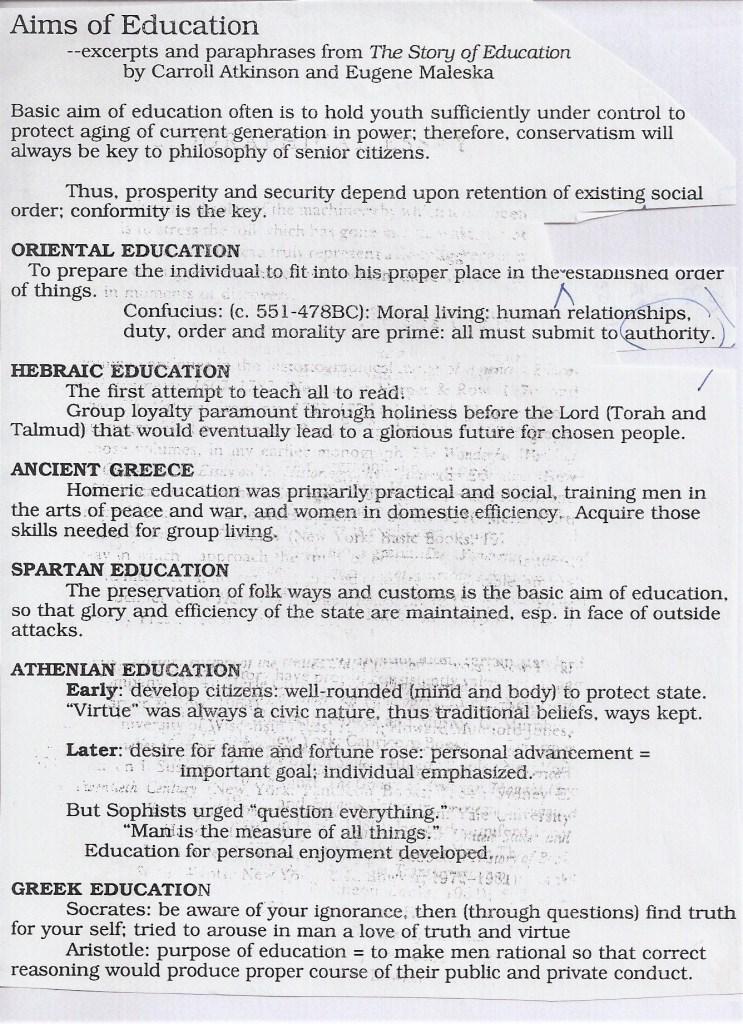
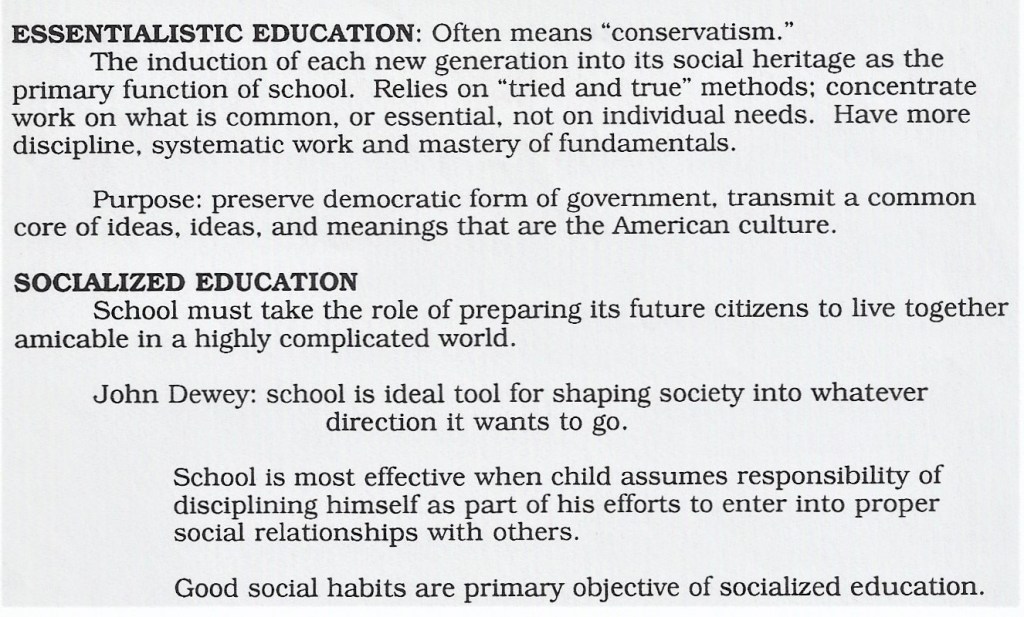
Finally, Academic Literacy is always a tool in carrying out an educational belief. The Aims of Education thinking of Eugene Maleska offers a wide variety of choices.
Illustration #3 – Framework for Professional Learning Communities in Schools
Media writing is the very opposite of linear, left to right composition. Media writing has 3 planning elements:
1. pick a medium or carrier of a message,
3. decide on the quantity of information in the message.
Two quick examples: what word messages about the causes of the American Revolution might be printed on a T shirt or a cup or an advertising billboard. A tee shirt can not carry an essay. The message has to be short and direct.
Illustration #21AIllustration #21B
Illustration #21 shows a chain. The chain is a set of interlocking parts and is especially suited to showing events, their causes, and effects. The chain is the medium and notes are appended to each side of the chain. This example uses a “triple T” organizer in the upper left where the student notes their topic, theme, and thesis claim.
Beth Isenberg was a 7th grade teacher in the Yonkers Public School system. She chose the medium of a cup to show FDR’s plan to remake American society during the Depression. Illustration #22 shows a draft of her media writing. Note the “triple T” in the upper right and a time line at the bottom of the page.
Illustration #22
Ms. Isenberg used this cup media writing in 3 dimensions, the classroom, the assignment or on a test. She gave students the cup and they had to put the pieces together.
Ms. Isenberg’s class also used the chain medium.
Academic Writing – Website Design
The final type of writing is website design. Instead of asking students to compose an essay or research paper on a given topic ask them to create a website. How?, they will ask. Go to your IT person in the building or district and discuss your project with her/him. Invite them into the class after you have had students go to one of their favorite sites and analyse the type of information at the site. Did the site contain words, how many? Did the site have data, pictures, or icons. Did the site carry sound? What colors or shapes were used? Were vocabulary featured? All web sites have design features and before we make one using history content students have to see their design features.
With the help of an IT person and planning the web site assignment over a long period of time we can begin to introduce new writing forms to our students. All writing is symbol making. When we underline or circle we are are writing. When we star a word we are writing. Writing is more than composing. Writing occurs when we take our private thoughts and make them public. Reading is symbol absorption. Writing is symbol production. Reading is silent and private. Writing takes our private thoughts and proclaims them to an audience. Writing is a risk-taking venture. We expose ourselves to the critical eye or “I” of another person. When we ask students to write they need the confidence of their own thoughts.
Finally, Illustration #23 shows a planning chart for academic writing. It is broken into MP or marking periods, an MY exam (mid-year exam) and a final exam. The chart enables the teacher to plan and record the types of writing activities for the entire year. A similar chart can easily be constructed for a 9 week marking period. The CATs strategy is noted enabling the teacher to place the activity in the C= classroom A=assignment or T=the test.
Illustration #23
A set of academic writing beliefs concludes the chart.
Academic Literacy: Critical Thinking and Reasoning
Dr. Harry Stein, Manhattan College
Academic Literacy has one goal: learn more quickly and forget more slowly. Learning has four elements: gathering and organizing information, critical thinking (CT) and reasoning, memory/retention, and creating thought through writing, speaking, and creative acts in art, music, dance, and drama.
How can we describe and define critical thinking? There is no single, agreed upon definition. Critical thinking has different components including recognizing information and assumptions, accurate evaluation of ideas and comprehending how conclusions are reached. Critical thinking should consistently be practiced in school and used in everyday life.
Reasoning is more defined. If thinking is a mind’s highway then reasoning is the curves. ups and downs, and directions the highway takes. There are five kinds of reasoning: inductive, deductive, metaphorical, analogistic, and syllogistic. The first two are most practiced in academic settings. For example, if we ask students to discuss the affirmed generalization “Lincoln saved the Union” and then ask students for evidence we are practicing deductive reasoning. We have a true statement and are now providing the facts and ideas as the foundation for the statement. In inductive reasoning we would ask students to assemble random facts and ideas and then ask what generalization do they prove.
In 2007 the National Institute for Literacy published the guidebook “What Content Area Teachers Should Know About Adolescent Literacy.” An introduction stated that “adolescents entering the adult world in the 21st. Century will read and write more than at any time in human history. They will need advanced levels of literacy to perform their jobs, run their households, act as citizens, and conduct their personal lives.” Academic literacy extends this focus of literacy beyond print to many forms of visual and quantitative learning. The flood of modern information is not restricted to print. Images and data are critical. Writing is critical but for others producing thought in art, music, dance, and dramatic forms is their way of responding to information.
If we can agree that critical thinking is an important learning achievement mental processing act once we have gathered and organized information. How do teachers and different students start this critical thinking process? The critical thinking will be later stored and produced as our writing, speaking, or creative response to information.
Illustration #1
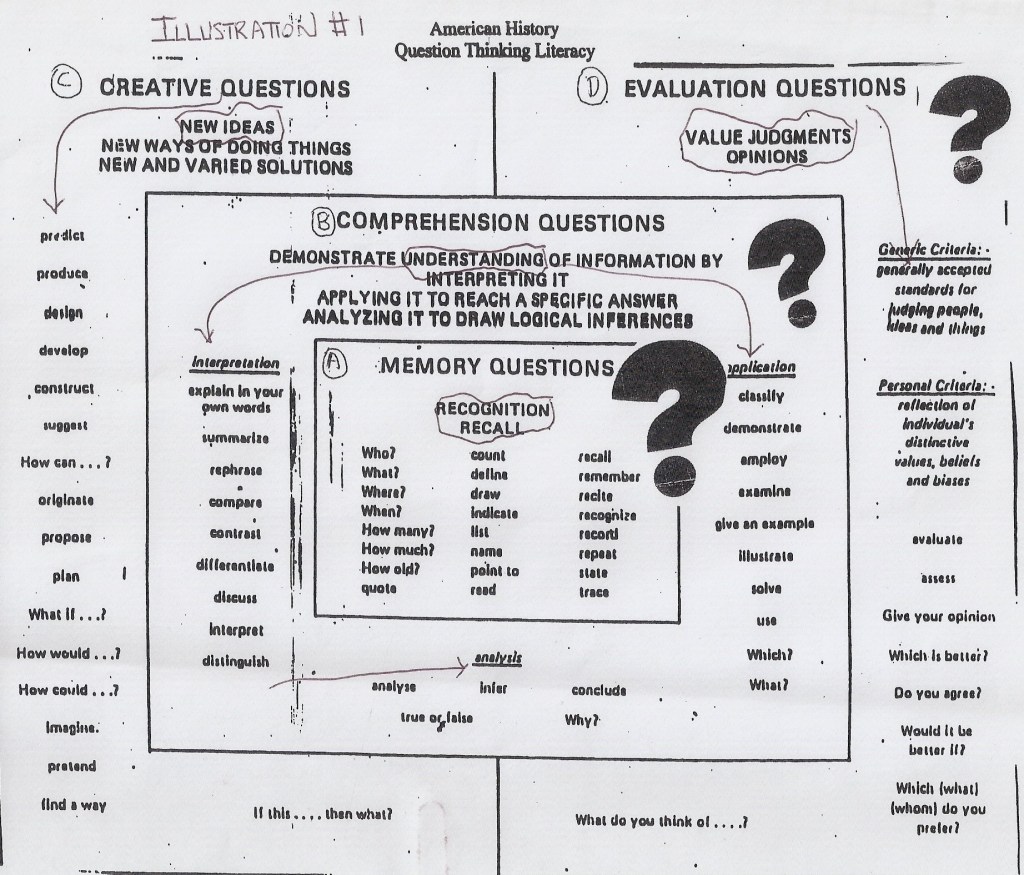
Illustration #1 is a visualized chart showing the critical thinking process. Every student is given a copy. Large copies are mounted on the classroom walls. Part of our dilemma in thinking is that it is a silent and hidden process. If we are asked to read or see we use our eyes. When we are asked to think we do not have self-directed tools. How do I think? The chart makes the idea tangible to the eye. The letters A B C D show the four types of thinking skills. The skills are circled. Questions are the matches that ignite or fire-up the thinking skill target.
There are four thinking targets:
recognition and recall of explicit information,
understanding,
creating new ideas
arriving at judgments and opinions.
There are three types of understanding skills:
interpretation,
application, and
analysis.
Illustration #1 can be used by a teacher in planning content knowledge objectives. It can be used in classroom or assignment questions. If students take State tests, IB exams or AP exams the visual can be used to analyze the types and frequency of questions on these external examinations. Finally, it can be used when designing a school quiz or test.
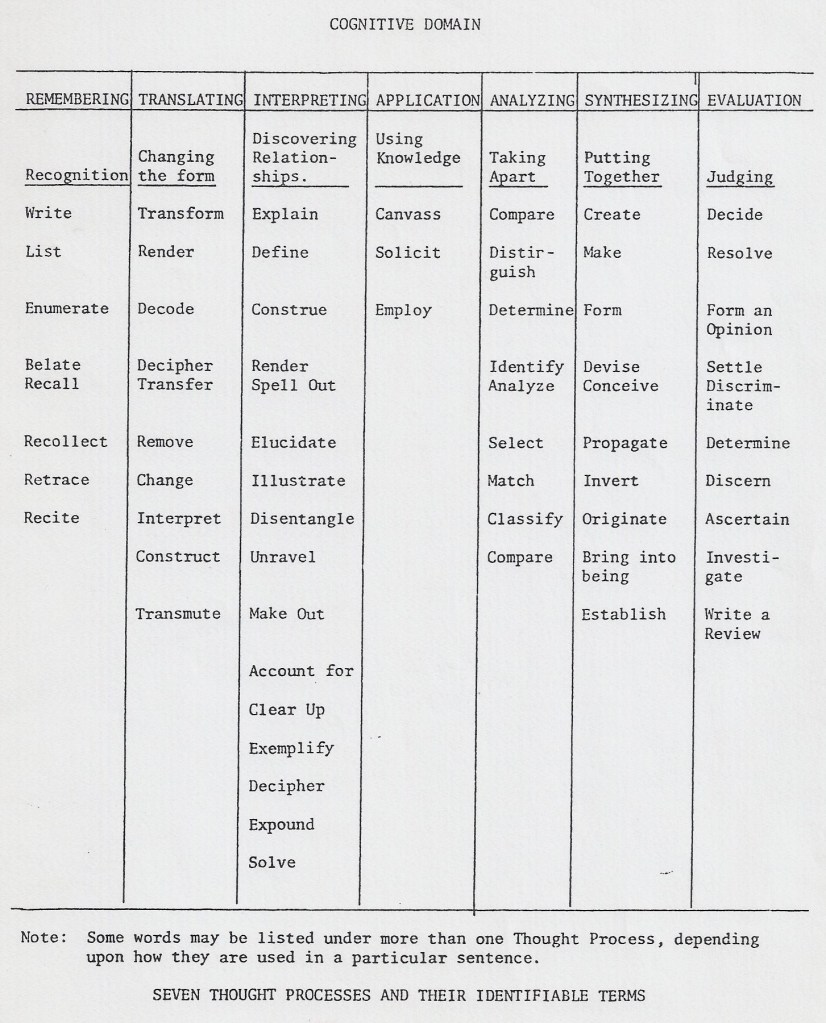
Often, parents want to discuss a student’s achievement. If assignments and tests follow the A B C D elements in the visual, student results can be quickly identified by thinking skill. High achievement students consistently think at the C D level after they have mastered A B levels. Some students never elevate their thinking beyond factual recognition and recall. Their test results and assignments do not rise to the B C D level. These levels become achievement goals. When students can “see” their thinking results and goals, they can consciously reflect on what a Cor an A student means, Illustration #2 is a chart that identifies thinking skills and the questions we use to ignite the skill.
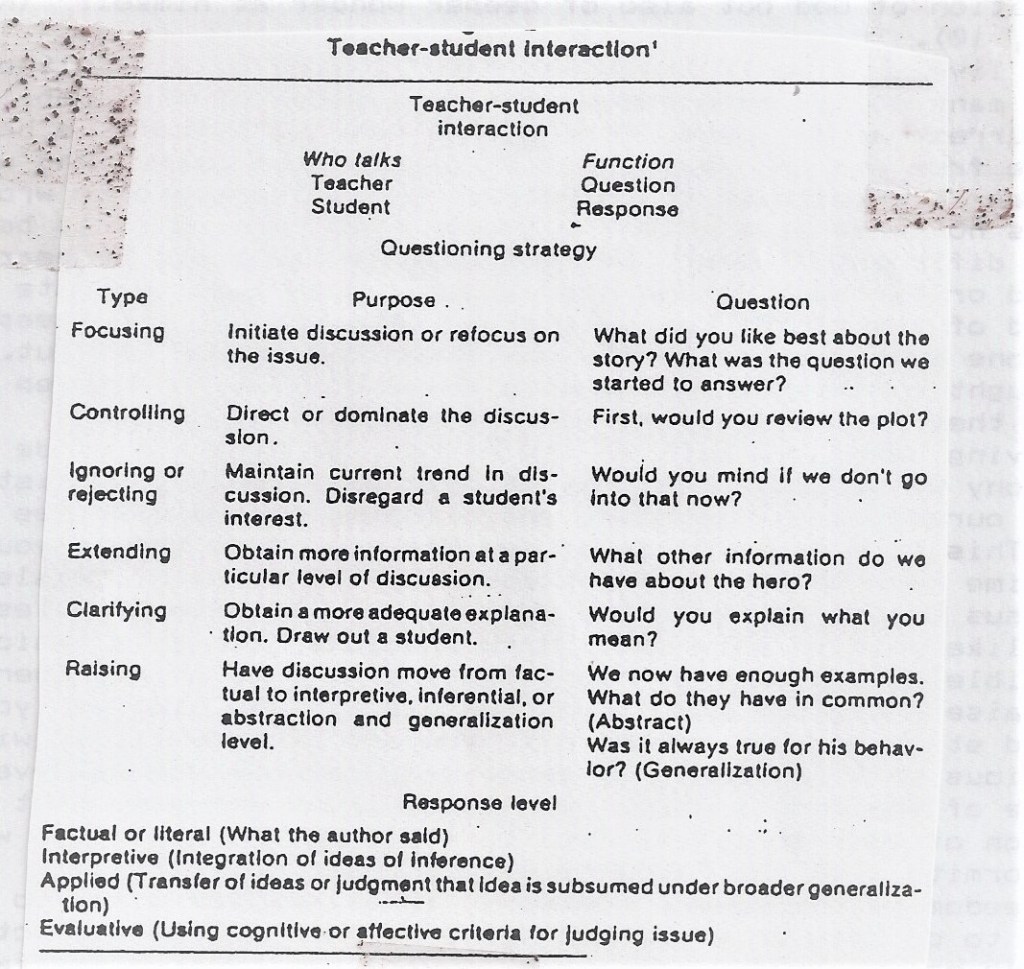
Illustration #2
When students can “see” their thinking results and goals, they can consciously reflect on what being a C or an A student means. Illustration #2 is a chart that identifies thinking skills and the questions we use to ignite the skill.
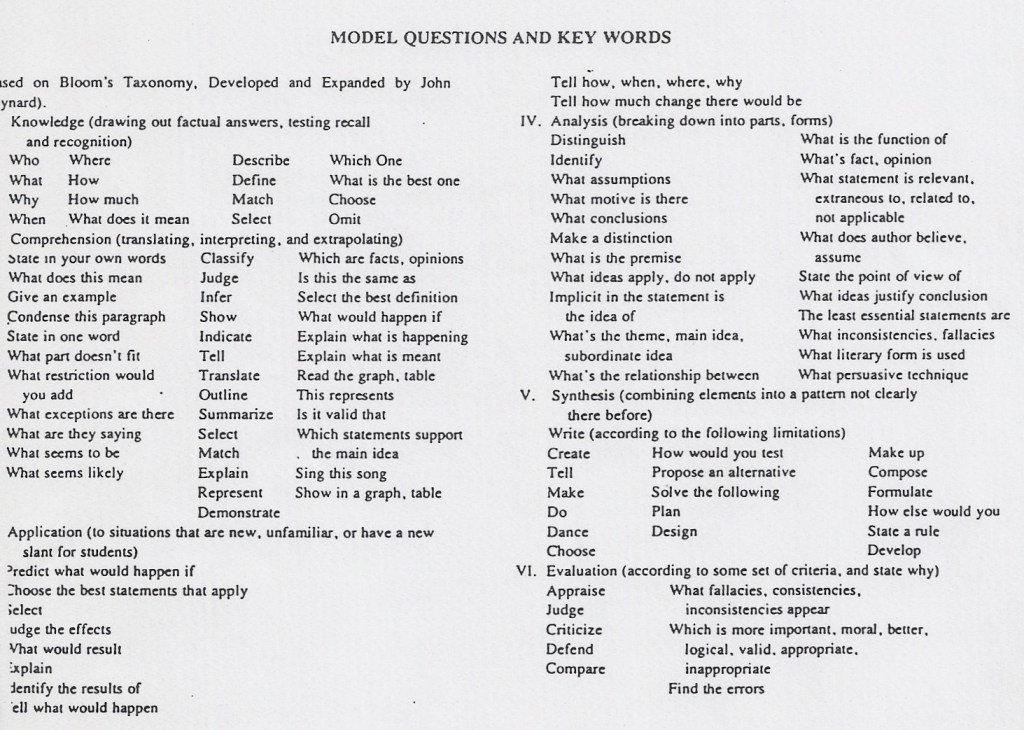
Illustration #3
Illustration #3 is another question taxonomy. Stress with students the difference between the thinking skill target and the question arrow. Once they practice with our question they can create their own questions or even an examination using the menu of illustrations 2 and 3. Students learn to think about thinking.
We have now defined critical thinking and examined visual examples showing the relationships between Critical thinking and questions. Critical thinking occurs within a class setting.
Illustration #4
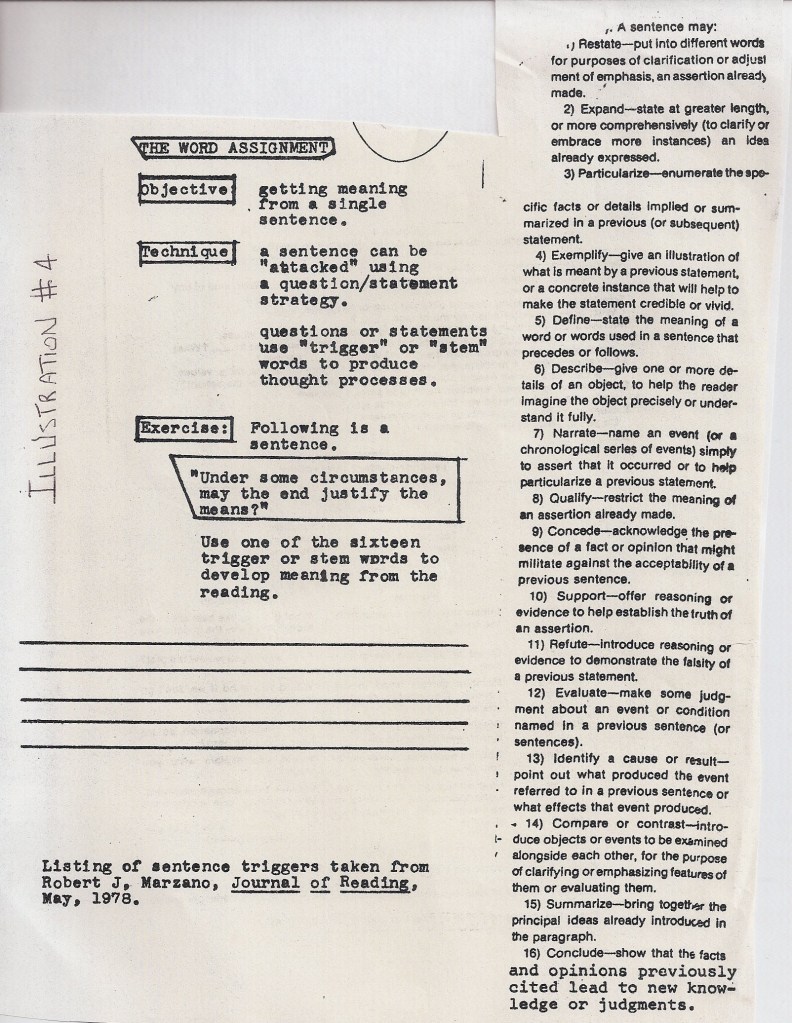
What are the teaching tactics which will help us reach our Critical thinking strategical goal? One strategy from Robert Marzano is applied to a single sentence classroom reading. See Illustration #4.
Marzano asks the class to respond to the question “Under some circumstances may the end justify the means?” Students may read or listen to the question. He then lists 16 possible ways the teacher can activate student thinking by direct questions or asking students to create their own question responses to the statement.
Illustration #5 (Q/R) Question and Response
In Illustration #5, Robert Stahl of Arizona State University developed a multistep question approach to questions centering on values and moral education. When encountering information, print, visual, or quantitative, Stahl took students through four critical thinking actions:
Knowing,
Thinking,
Valuing,
Feeling.
For each stage he used certain specific questions. To know requires explicit evidence yielding precise facts. He used “I see it there” focus questions. Then he asked students researching for implicit evidence.
Stahl used two question tactics. “Define” and “restate in your own words.” To focus on values relating to critical thinking, he asked students to compare and contrast and finally he used questions summarizing, concluding, or clarifying that helped students make judgments.
Illustration #6 (Dr. Sylvia Gaylor)
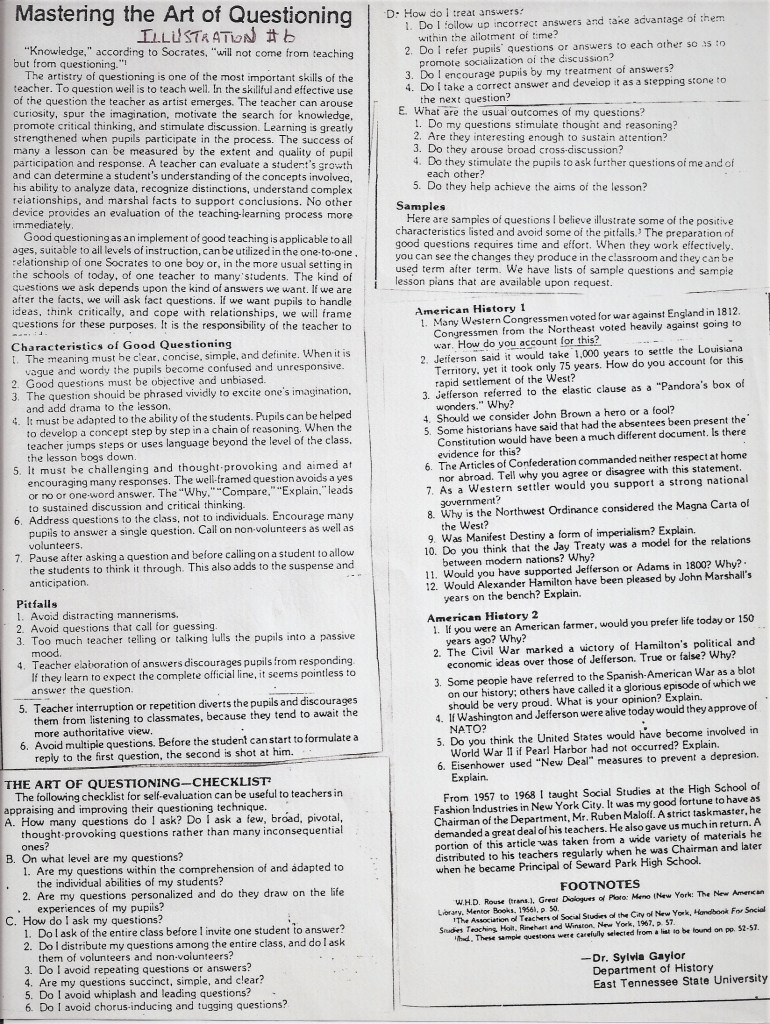
Dr. Sylvia Gaylor gives us some concluding advice in her article MASTERING THE ART OF QUESTIONING, Illustration #6
Illustration #7
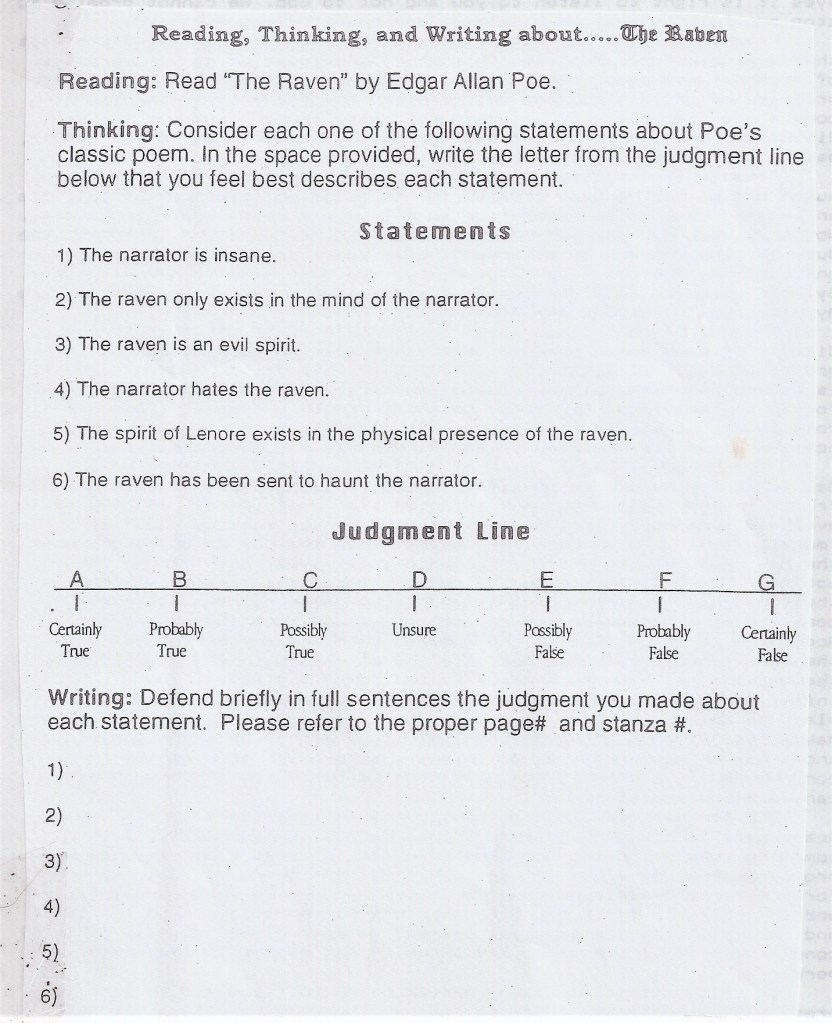
Two examples of deductive reasoning follow. The first called J line orJudgment Thinkingis by an American Studies middle school teacher Jay Wordsman (Valley Middle School, Oakland NJ). The activity in Illustration #7 has 4 elements:
A. Assign a reading-The Raven by Edgar Allan Poe.
B. Following the reading students are given a response form called J Line containing six statements.
C. Students are asked to read the statement and consider its validity remembering evidence about each statement. Using the Judgment Line they circle one of the responses A B C D E F G writing a few words above the letter noting their evidence.
D. Finally, the defend each of their six choices in a sentence.
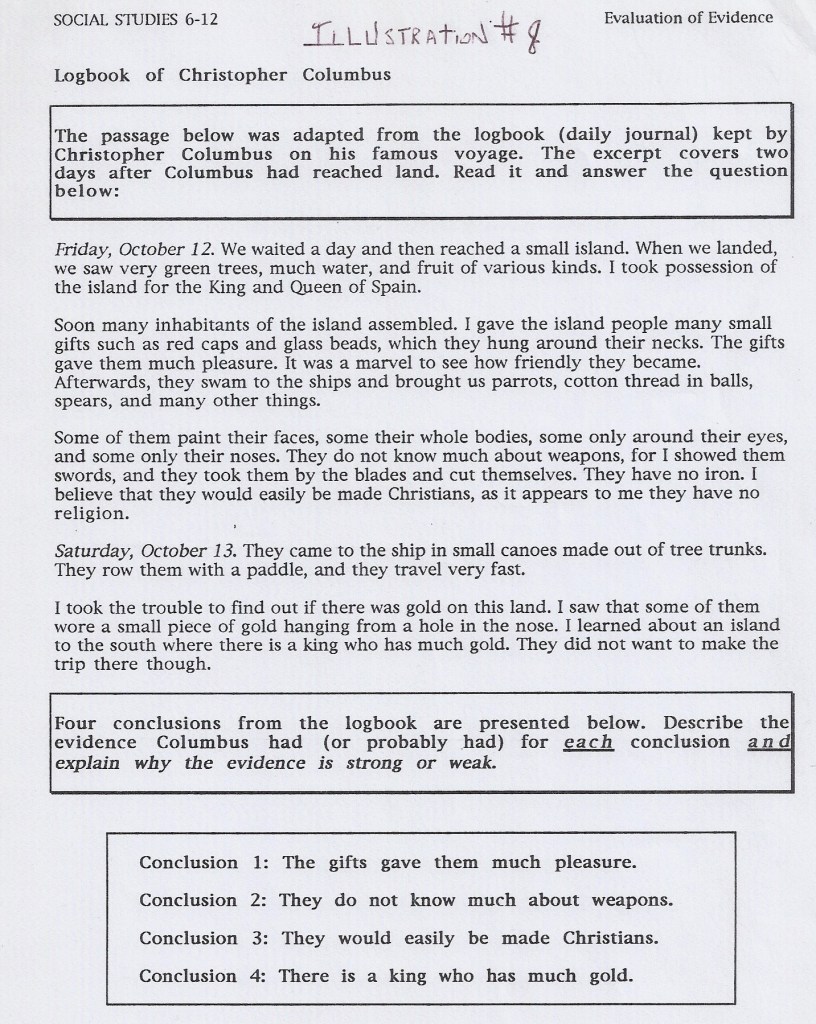
The final example of deductive reasoning is from the Massachusetts Department of Education, Illustration #8.
Illustration #8
It lists four conclusions from a Columbus reading and asks students to evaluate the strength or weakness in the conclusion.
Critical thinking and reasoning are the second element in Academic Literacy. These skills are used in the classroom, for assignments and in evaluation. By its very nature thinking is hidden and silent. We need to visualize it and engage students using the visuals so that private thinking becomes public discussion.
American students are in school for thirteen disconnected years. In grades K-5 students learn in a reading/language arts/mathematics skill-based school. Most students have one classroom teacher. Literacy means reading and language arts, a term that combines writing, speaking, and listening. Testing assesses reading, language arts skills, and occasionally writing short compositions.
Then a change occurs in grade 6. Students go to a ‘second” school. This is a middle or junior high school with departments. Teacher certifications and expectations change. Every day students will now see six or seven teachers. Except for the language arts teacher these teachers do not teach literacy. They use it as one tool to achieve their academic goals. These schools, grades 6-12, have redefined literacy.
“Second” schools use four literacy elements:
Information Sources – reading, visual cognition, quantitative analysis and kinesthetic learning skills.
Information Processing – Thinking operations and reasoning odes
Retention – The most critical literacy skill in grades 6-12.
Producing Thought – Responding to objective test items. Writing in 7 forms, speaking, and creating performances in music, theatre, art, and dance.
Knowledge retention is a new and now most critical skill. Without memory students can’t achieve or produce original thought. These 4 elements are known as Academic and Career Literacy (ACL). Attachments A and B illustrate in mathematics and other departments.
Elementary or skilled-based schools focus on reading and writing composition. These experiences are important but inadequate for success in knowledge-based “second” schools. Whether instruction is authoritarian lecture, inquiry project guided, cooperative groups, or individual instruction via technology, these teachers in “second: schools have no exclusive loyalty to academic learning through reading. They are eclectic in choosing learning materials and teaching tactics. Their loyalty is to their students and academic subject matter. This is their identity and mission. Walk down the hall in a K-5 school and ask a teacher who he or she is. Their response will be, “I teach 3rd grade.” They identify by child cohort. Walk down the hall of a “second” school, middle, junior, or senior high school and ask the same question. “Who are you and what do you do?” The response will be different. The Literacy Big Short emerges from this disconnection between elementary schools and “second” school function and literacy use. The disconnection is deep, harms students, and is not easily corrected through teacher education reform or new State certification requirements.
ORIGINS OF THE BIG LITERACY SHORT
Educators have been aware of the literacy disconnection and have made efforts to define and connect literacy between elementary and adolescent “second” schools. A 2006 project funded by the Carnegie Corporationin association with the International Reading Association and the Alliance for Excellent Education. Fifteen key elements were identified within a reading and writing literacy concept. They are abridged and paraphrased below:
Direct comprehension instruction.
Effective instructional principles embedded within comprehension activities.
Motivation and self-directed learning.
Text-based collaboration.
Strategic tutoring.
Use diverse texts.
Intensive writing.
Use technology.
Ongoing formative assessment.
Extended time for literacy.
Professional Development.
Ongoing summative assessment.
Teacher teams or cross-departmental reading.
Administrative leadership.
Cross grade and departmental coordination.
The elements do not reflect the actual nature of literacy in “second’ schools They were and remain a response to standardized reading and language arts testing mandates found in district tests, state examinations, PSAT, SAT-1 and the ACT. These mandates are critical and permanent. Except for the New York State Regents content graduation examinations, high stakes testing in American “second” schools, middle and high schools, assesses reading and mathematics. But, “second” school students learn and graduate by earning credits in departments that use academic and career literacy, not only the reading component.
What is missing? The following ACL skills are used across all grades and departments in “second” schools and directly linked to college entrance examinations and achievement.
Visual Cognition: Print and Electronic
Thinking and Reasoning: Applied to all information sources
Cognitive Science: Focus on attention, toleration for frustration, impulsive control, goal setting, task completion, and self-generating questions.
Retention: Both short and long-term academic memory
Applied Quantitative Analysis: Statistics and Data interpretation
Writing in 7 forms: recognizing writing, copying, note-making, redesigned writing, composition, media writing, and web site design
The greatest deficiency in a reading centered literacy is the near total absence of instructional emphasis on retention and memory. Reading contests determining who has read the most books in a year are very important. They nurture motivation and develop skills. But does any student who has read 112 books remember what they read in book #56? There is no need to remember until they enter “second” schools where reading is transformed into literature study. Remembering Act 2 Scene 4 in Hamlet is critical to understanding Act 3 Scene 1. The challenge becomes not what we read but how quickly we can learn and how much more slowly can we forget. Without useable memory, every Monday is Friday and teachers can’t go forward. Review is necessary. Memory is constructed at the time of instruction and not only through study which only rehearses embedded memory.
This literacy disconnection will continue. University reading preparation programs train reading experts. State certification requirements reflect these goals. Some students in “second” schools must have intensive reading remediation. Many more new English-language learners are also entering these schools. Special education enrollment is rising. There is a growing need for expert reading diagnostic-based instruction. Yet when these students enter content classrooms their teachers are not loyal to reading as the primary information instructional system. Success in isolated clinical settings or small group instruction do achieve reading gains. Schools and districts are judged by these test results. But, credit-driven content learning requires skills other than reading skills. Students do not graduate high school because they can read. They graduate when they meet credit requirements. Some drop out.
CLOSING THE BIG LITERACY SHORT GAP
First, can we accept the reality that literacy in the “second” school is not the literacy in the elementary, skill-based school? Can we accept the reality that university-based degree literacy programs will not easily change since they must produce reading experts and the reformed programs would have to include members from other university departments such as psychology, communications, English, and perhaps, philosophy? Changing state certification requirements is very difficult, time-consuming, and may require administrative code or statutory change.
Any effort to improve achievement in “second” schools must begin in the district. The first step is an administrative commitment to a new concept of literacy instructional leadership. Then, in every “second” school can we identify an educator who will embrace and use the ACL concept and gradually begin serving other faculty? This person could be a reading specialist or a science teacher. As this teacher assumed a professional development role, they must retain a full teaching schedule. Any reduction in teaching periods will increase costs, and possibly divide faculty harming the outreach effort. Administrators should eliminate all school duties for this person. Their duty will be to practice literacy in their classroom and communicate to other teachers either in their departments or to all teachers during their duty period. A stipend, summer work, professional travel and other incentives can be offered.
This academic and career literacy leader and administrators can then form a professional learning community (PLC) within the school. The PLC would include a mathematics, English, science, history, special education, and English-language learner teachers. The PLC would learn about and use ACL and then turnkey their classroom practices within their own departments. Schools would have a permanent cadre of ACL teachers and eliminate outside consultants.
The ACL/PLC project would then assist faculty in meeting school and district goals. Services could be offered or mandated to new teachers, untenured teachers, teachers at different grade levels, teachers in different departments, and teachers whose observation/evaluation and personal needs include some form of ACL.
THE BIG LITERACY SHORT: A CODA
All “second” schools are fragmented and consist of teaching tribes with different certifications and indeed even locations within the school. These schools are centrifugal and fracture a student’s experience in a 6-8 period day. They lack common academic purpose because every subject has its own claim to virtue. Academic and career literacy can be binding glue in this planned decentered adolescent education ecology. ACL also gives a common definition to Common Core in “second” schools. A shared center is created where none existed.
Schools grappling with changing demographic, economic, and social circumstances realize that their future is already rapidly receding behind them. They are in catchup reaction mode. Part of the dilemma lies in the recognition that the student achievement goal is restrained by an older concept of literacy which is them again disconnected by the current information communications technology that affects all teaching and learning across the different tribal cells in our “second” schools.
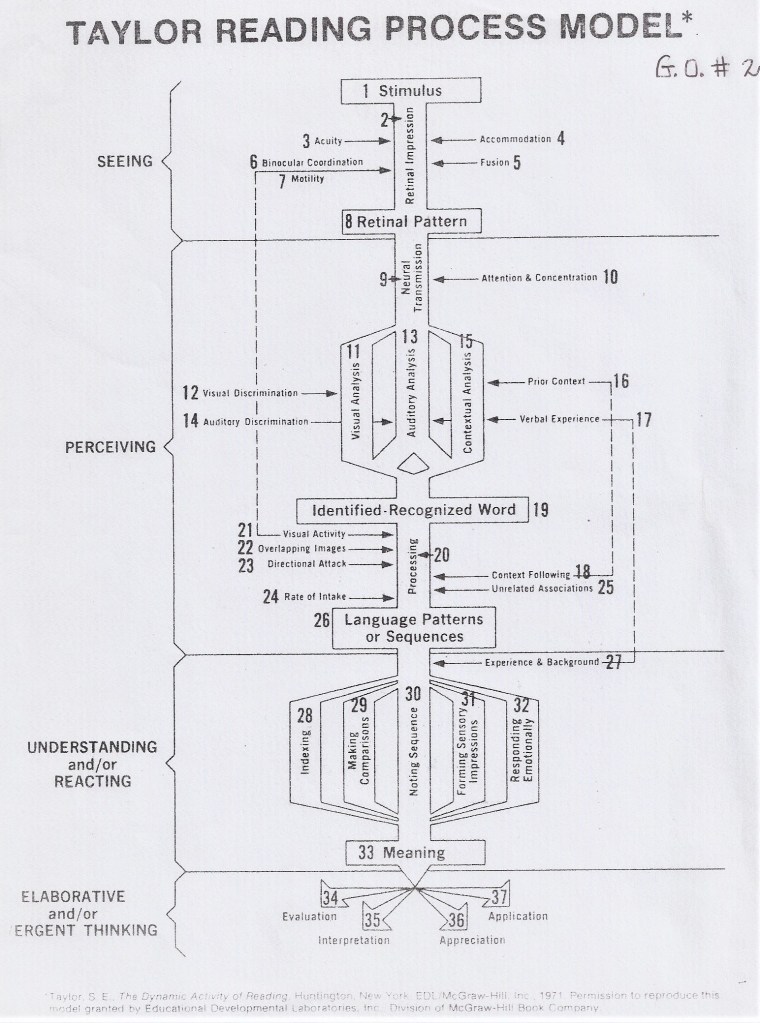
Inputs are depicted in the upper left. Reading is one means whereby students practice Gathering and Organizing. It is the first input which leads to processing, storage, and then producing thought.
First, we must describe and define the term “reading.”
Illustration #2 – Taylor Reading Process Model
Academic Literacy is used in knowledge-based classes with content teachers. They are never reading teachers and do not teach reading. They use reading for academic content goals. Academic literacy begins at #27 on the Taylor model. If students can not progress through points #1-26 they must receive direct reading instruction from reading teachers. Their comprehension level must be 4th grade or higher. Academic literacy gives content teachers the tools to create content learning after students can decode words and minimally comprehend. Academic literacy is a teaching/learning concept in departmentalized middle and high schools. It assumes minimal reading skills, #1-26 and proceeds from #27 to #37 on the Taylor model.
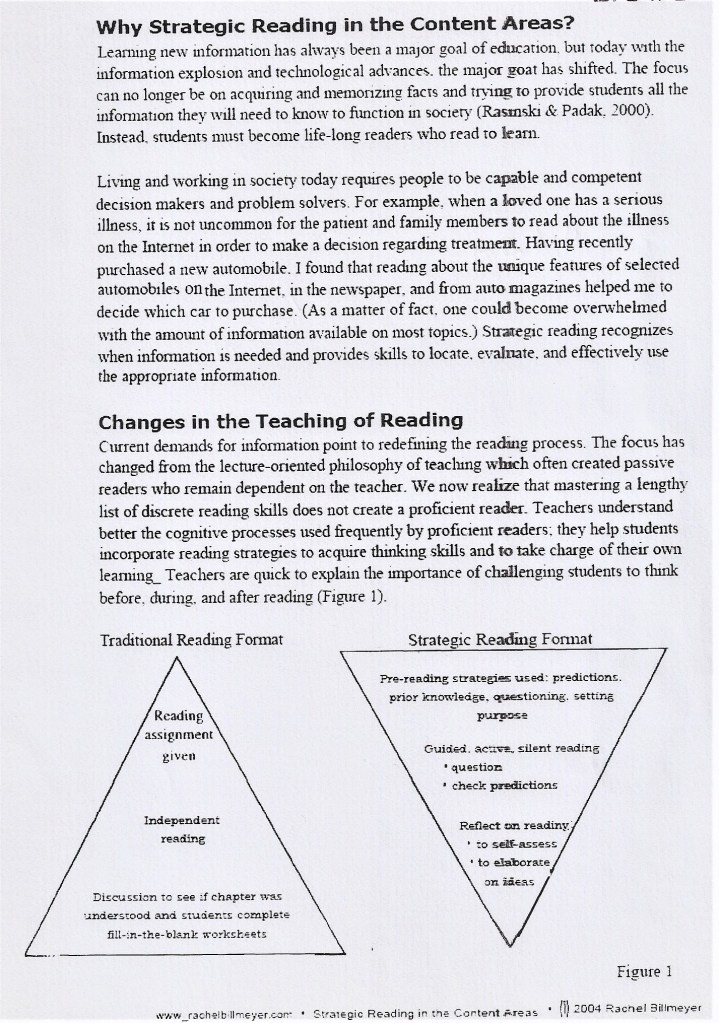
Academic Literacy reading is strategic reading. Reading is a tool for achieving content learning. Illustration #3 describes strategic reading in the content areas. It differentiates between traditional reading activities and strategic reading. The former assumes students can read, retain, and discuss after an assignment. The latter is planned and directive.
Illustration #3 – Strategic Reading in the Content Areas
In Social Studies reading occurs in three settings: the classroom, the independent assignment, and within tests.
The acronym CAT defines these settings: class, assignment, and test.
Classroom Reading—The short passage
Find a critical, short reading passage. Refer students to their text or handout. “Short” means no more than three or four reading minutes. Attention research indicates that the student focus span rarely exceeds four minutes. The content must be absolutely critical for meeting our goals.
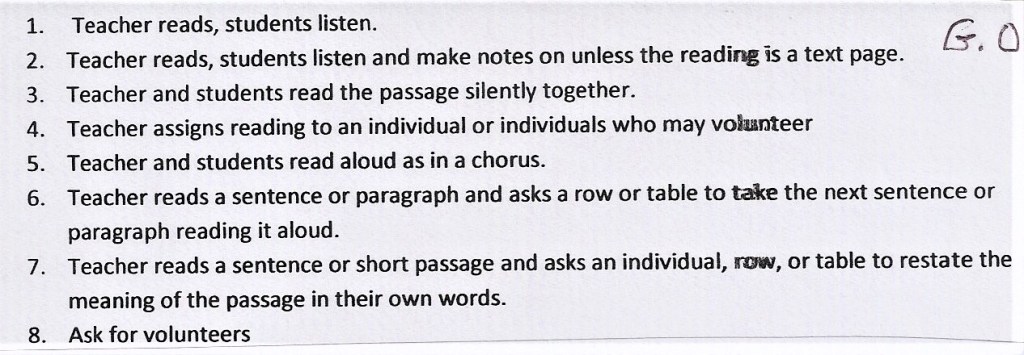
Illustration #4 – Eight Steps for Close Reading
So, how can we start the reading? Illustration #4 gives us eight ways. Set a purpose for the reading. Tell students what they will do after the reading. Then, begin the short “tight” reading.
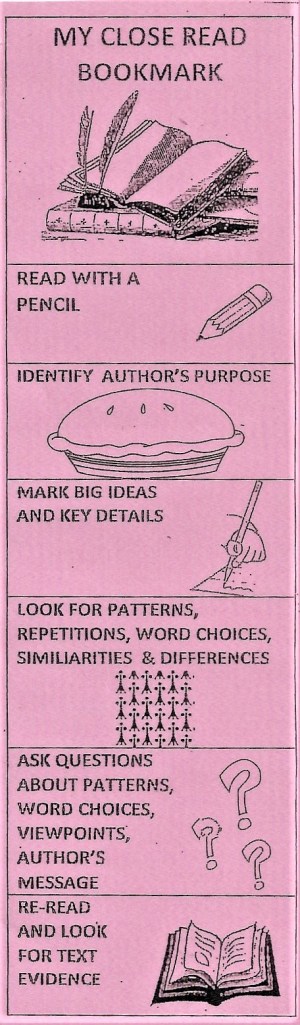
Mary Byatt and Laura DiPetro of Washington Township in New Jersey created a tool they call My Close Read Bookmark. Give one to each student, Illustration #5.
Illustration #5 – Close Read Bookmark
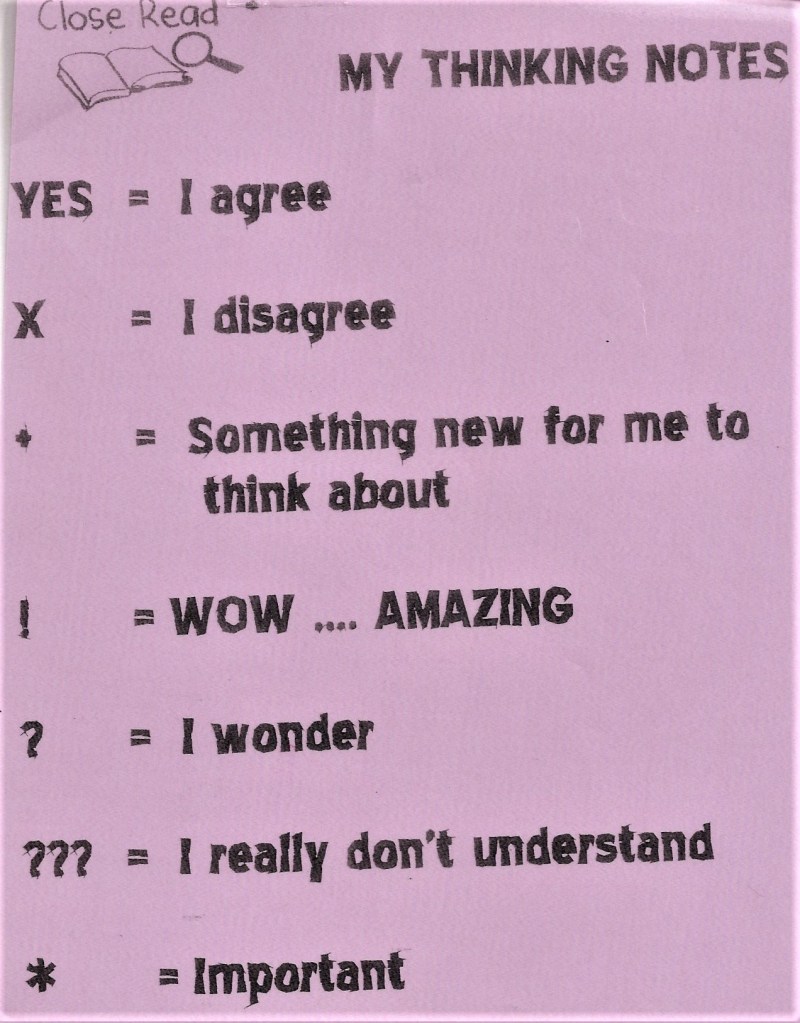
Using this tool they make “thinking notes.” Illustration #6
Illustration #6 – Thinking Notes
Before class ask students to bring in a 4 color pen. Use black for important notes, red for confusing ideas, blue for clear ideas, and green for post-reading review notes. Green for growth or change.
For memory ask students to note the weather that day, the type of clothing they wore, what they ate for breakfast or lunch or any other personal marker of their lives that day. Personal memory and academic reading memory unite.
Classroom Reading—The primary source document.
Faculty at Knox College in Iowa use Illustration #7 when examining documents. Students make notes on the handout.
At a 2015 U.S. History AP Reading Conference, Christopher Lewis and Jennifer Yoo Brannon, both AP teachers, presented another tool they called the HAPPY Analysis Chart. Illustration #8. When reading/discussing the document the chart is a note-making tool. H-A-P–P sections are indicated. The Y is for “why” is the document significant.
Illustration #8 – H-A-P-P-Y Analysis Chart
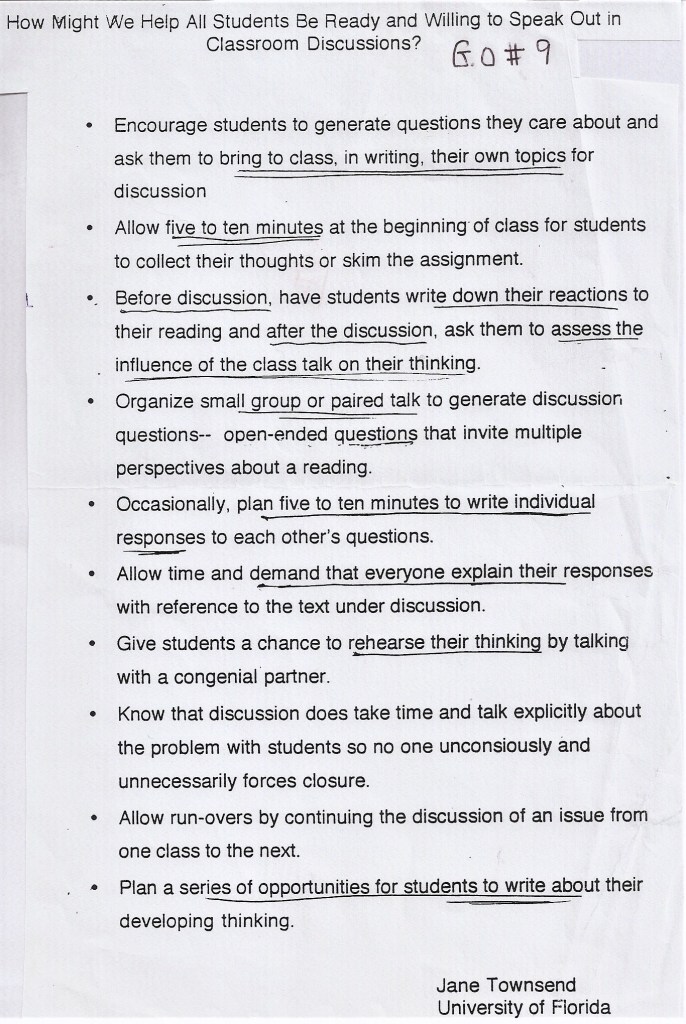
Classroom Reading QUESTION/DISCUSSION STRATEGY. Jane Townsend, University of Florida Illustration #9 gives us general guidelines for in-class readings.
Illustration #9 – A Strategy for Questions & Discussion
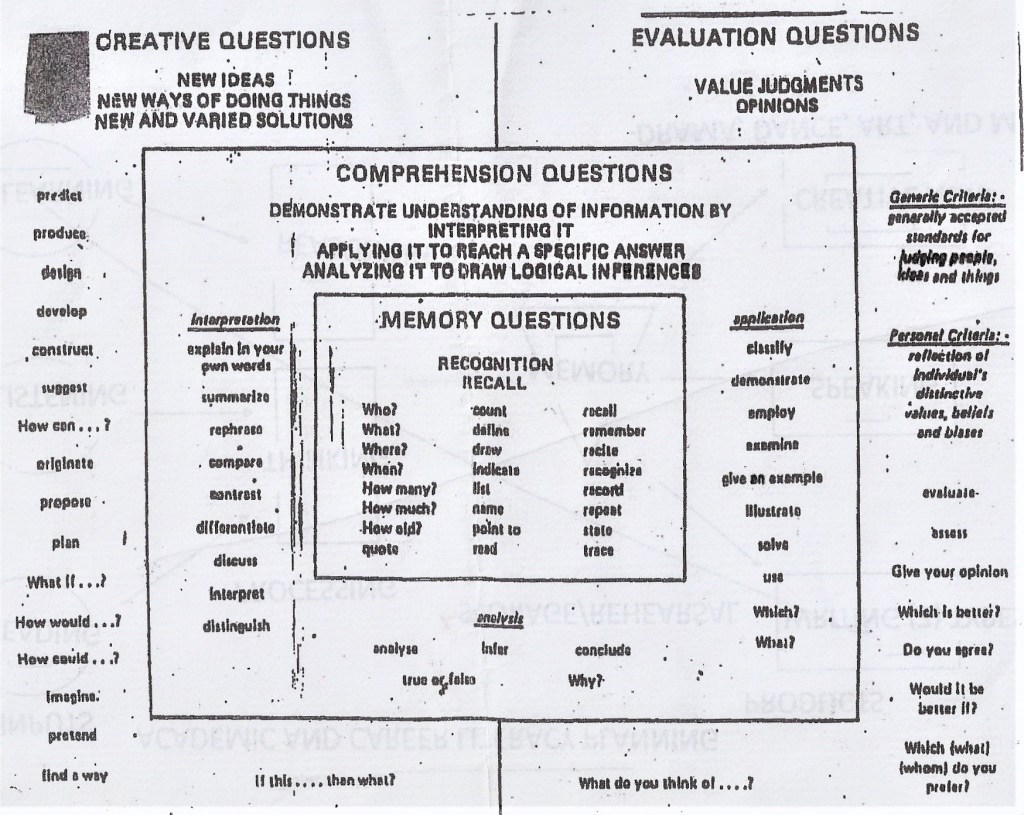
Every classroom reading needs a question strategy the teacher shares with the readers. Illustration #10 visualizes 4 types of thinking skills and the question triggers for each.
Illustration #10 – Thinking Skills
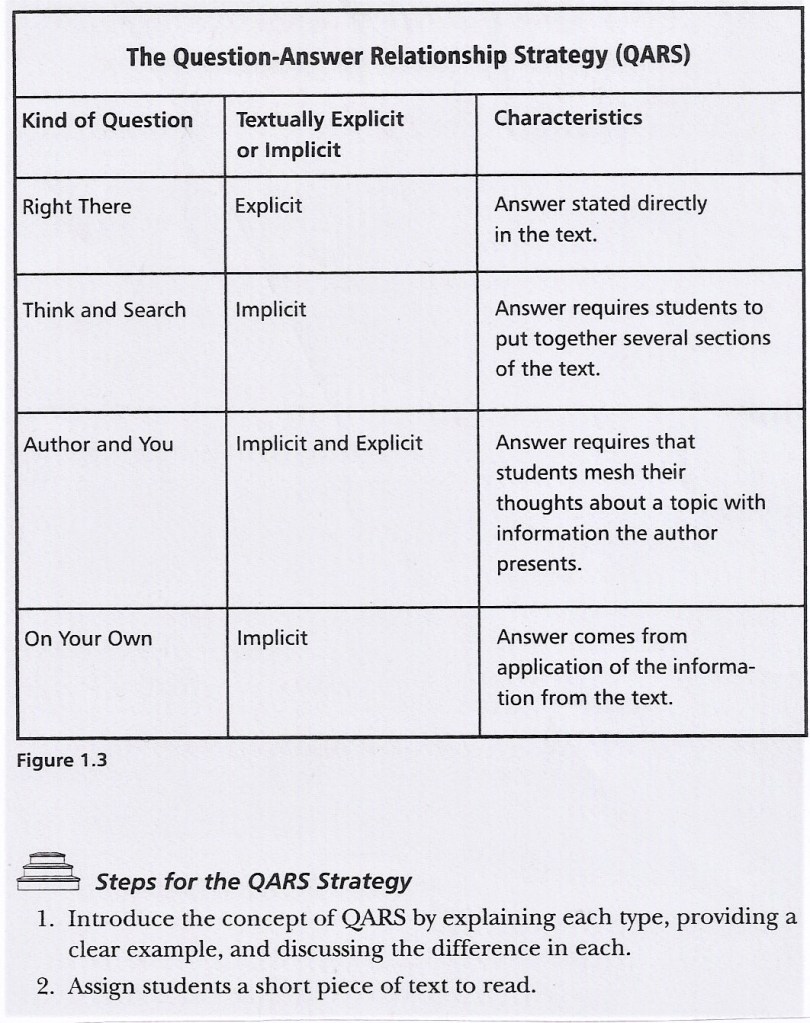
Illustration#11 shows the QARS strategy.
Illustration #11 – Q-A-R-S Strategy
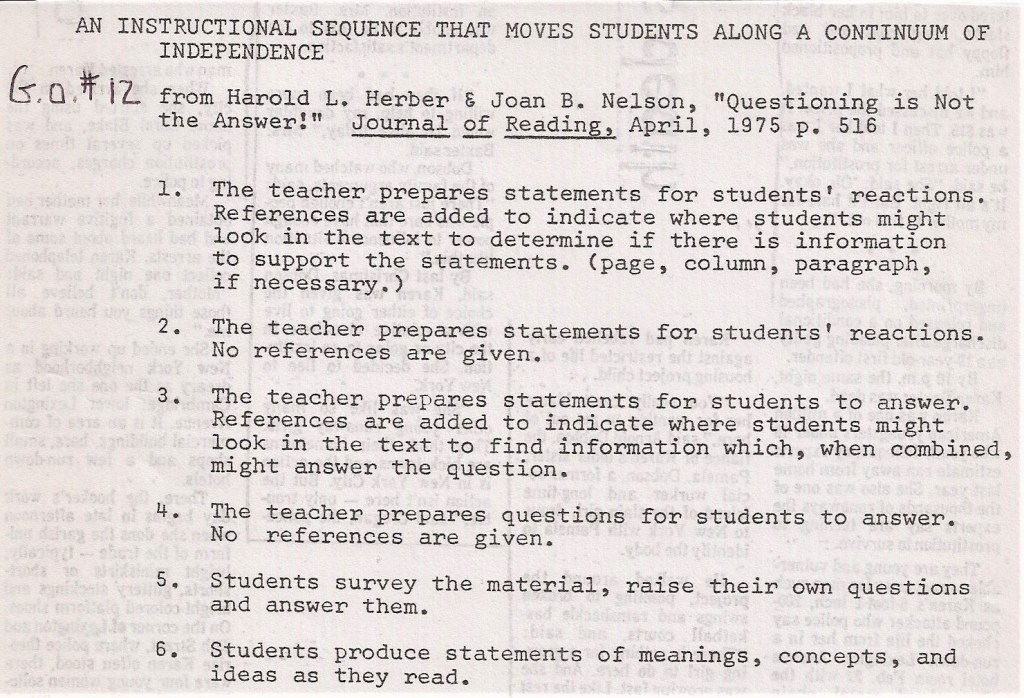
Illustration #12 must be carefully read because it gives teachers a question road map whereby students move from depending on the teacher for questions to their being able to create their own questions or statements.
Illustration #12 – Road Map for Asking Questions
=========================================
Reading Assignments—Guidelines.
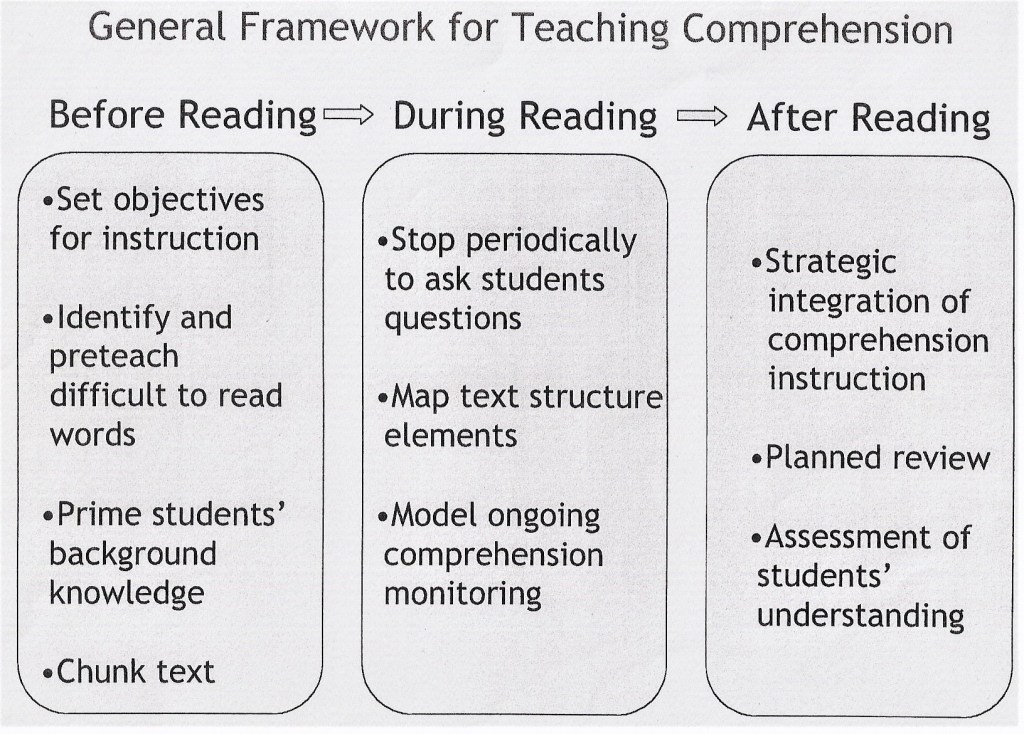
Often, we ask students to independently read before the next class. Then, we expect them to effectively discuss what they have read in class or use the reading to work cooperatively with new materials. Usually, they have not done the reading or if they have they have not retained any meaning. Illustration #13 gives teachers a strategy. Before the assigned reading we must prep students. As they independently read they need note-making tools to direct their reading and capture their reactions. Then, when they arrive in class the next day we can proceed. This is called a BDA strategy. B=Before, D=During, and A=After the reading.
Illustration #13 – B-D-A Strategy
Post Assignment Learning Strategies—Guides.
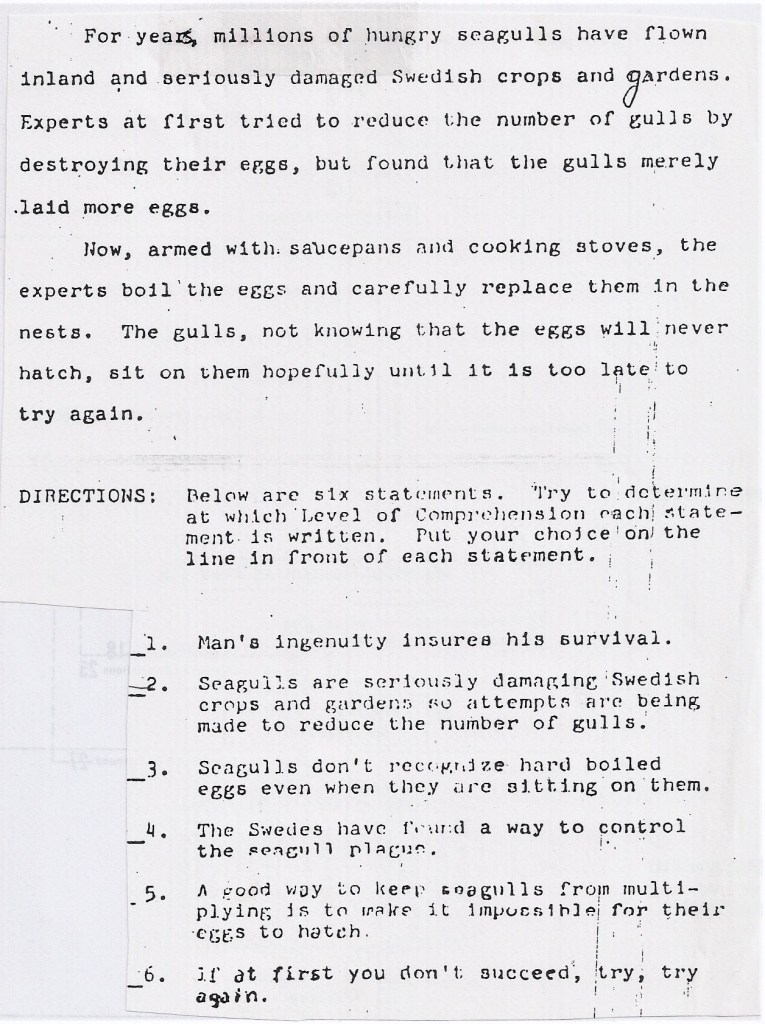
On the previous day we assigned a reading. Now, in the next class we want to build learning based on their reading. Guides are a tool. There are different types. GO#14 illustrates a comprehension levels guide.
Illustration #14 – Guide for Reading Comprehension
GO#14 illustrates a comprehension levels guide. There are 3 levels: factual, interpretation, and judgement.
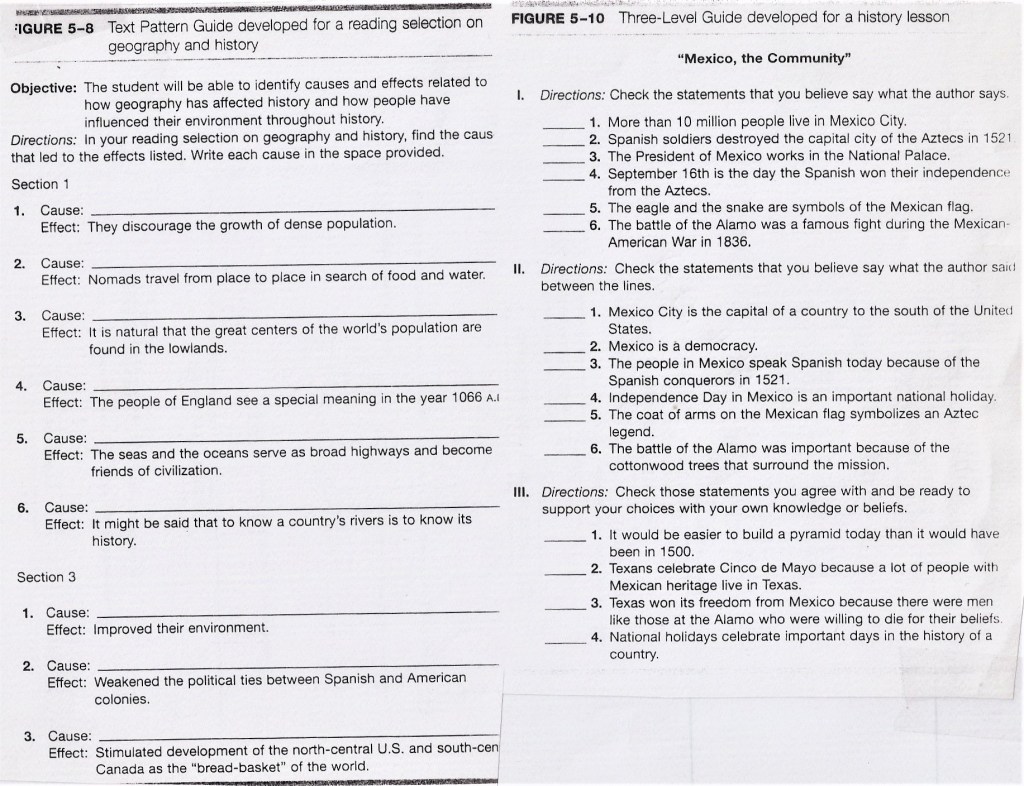
Illustration # 15 – Cause & Effect Patterns
This is a statement not a question guide. Use statements to trigger thinking. Statements open the mind. Questions corner the mind in one direction. Illustration #15 shows a cause/effect pattern guide and an author’s intention guide.
Illustration #16 uses lyrics from a ballad At Seventeen and develops a concept guide.
Illustration #16 – Seventeen
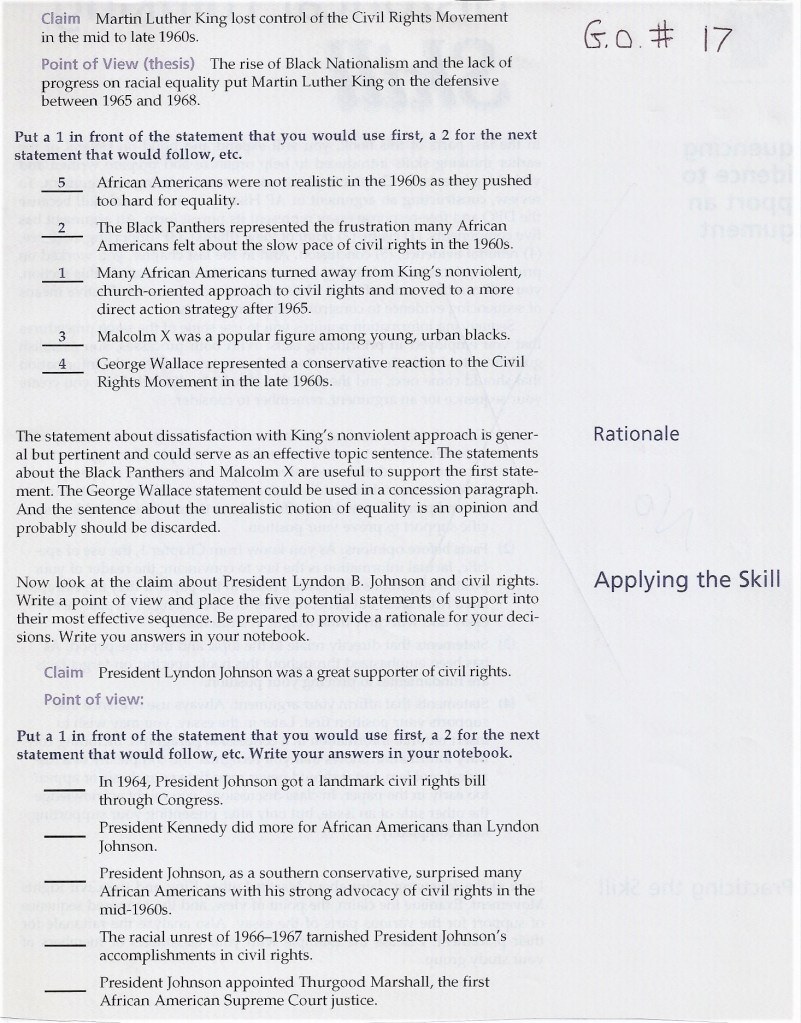
Illustration #17 uses a Claim/Point of View Statement Guide
Illustration #17 – Stating Claim
Illustration #18 concludes our guide samples by showing how our colleagues in science use guides. This two part guide was developed by Dr. Judith Thelen from Frostburg State, Maryland.
Illustration #18 – Example from Science
=====================================
Reading is one tool we use for learning. We don’t teach it. We use it for our academic goals. But, in using it we must not assume students automatically will read and bring critical skills to our classroom. We have to use our tools in the teaching learning process.
Part 1 – Academic Literacy – Learning with Visuals
“In elementary school all students are taught to read. Who teaches them to see. They may be mentally blind.”
Task #1 is defining the term “visual.” See illustration Gathering and Organizing #19. At the bottom is a line graph. Numbers 1-10 are flat, frozen visuals. The numbers proceed from #1 abstract symbols such as a plus or minus sign to #10 realistic photographs. Numbers #11 to #13 are electronic moving visuals. Our focus is on flat frozen visuals.
Illustration #20 is a visual interpretation chart. The chart argues that all visuals have a producer with intent and aim. The visual can vary. Finally, there is a receiver or audience which has a memory and reason for seeing the visual. We can always use this generic chart in our classes.
Illustration #21 – Visual Interpretation Chart
The most commonly used visual is the photograph. Read illustration #21 for an orientation to photographs. Pick one of the Thoughts at the bottom and discuss its meaning with students.
“Looking is easy. Seeing is an achievement”
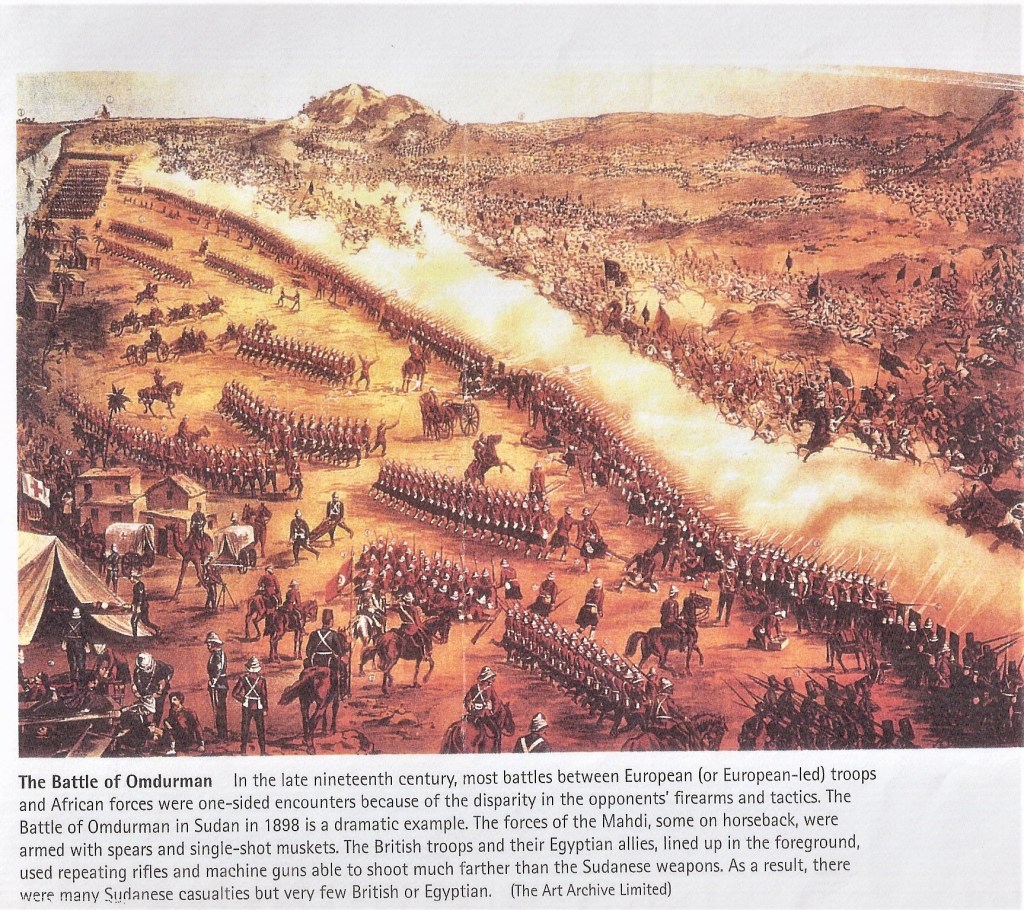
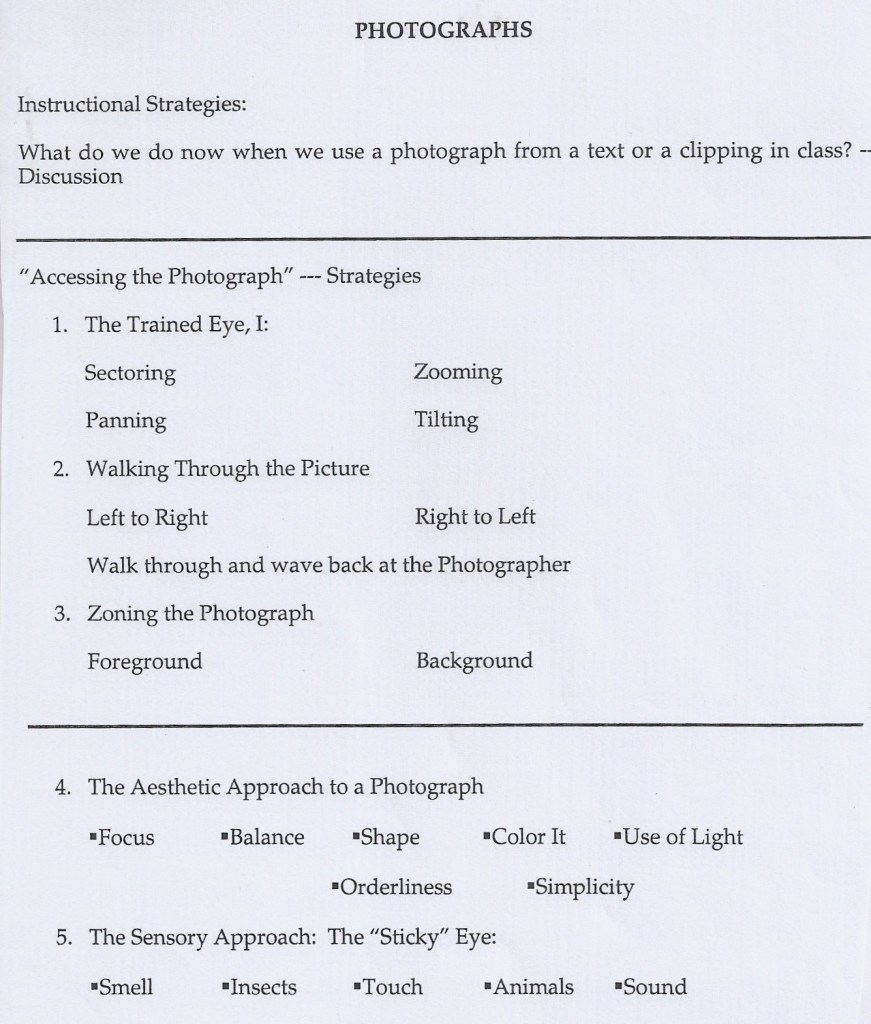
Following are instructional activities we can use when a photograph or pictorial illustration serves our teaching objectives. Illustration #21 is called Invading the Picture. Let’s use it with an illustration of the Battle of Omdurman in the Sudan in 1898. The illustration is extremely dense with information. We can ask students to tell use what they see or we can deliberately guide them in an inductive teaching manner. Accessing the illustration has three approaches. First is the trained eye. We can sector or divide the scene into observable parts. The white area seems to divide the two forces. We can pan the scene from left to right or top to bottom gathering information. We can zoom shot on one tiny feature and expand the meaning. For example, using a clock technique go to 11 o’clock in the extreme upper left. There is a river. In the river are boats. Next to the river are masses of assembled troops.
Illustration #21 – Battle of Omdurmam in the Sudan (1898)
What does this zoom or punctum (point) shot tell us? Rather than walk across a desert to the battle the British brought their rested troops aboard ships before disembarking them. They were well fed and had plenty of water so when put into the battle they were fresh. A final technique is called the “tilt” eye shot in which the viewer is looking down on the scene as if in a drone. We do not simply look. We have a guided eye.
A second approach is called walking through a picture. A third is called zoning the illustration
“A photograph or illustration is time’s witness stopping it forever.”
The 4th and 5th approach to invading a photograph or illustration are the aesthetic and sensory approach.
Illustration #22 – Analyzing Photographs
“Does a photograph have meaning or is the meaning brought to the photograph?’
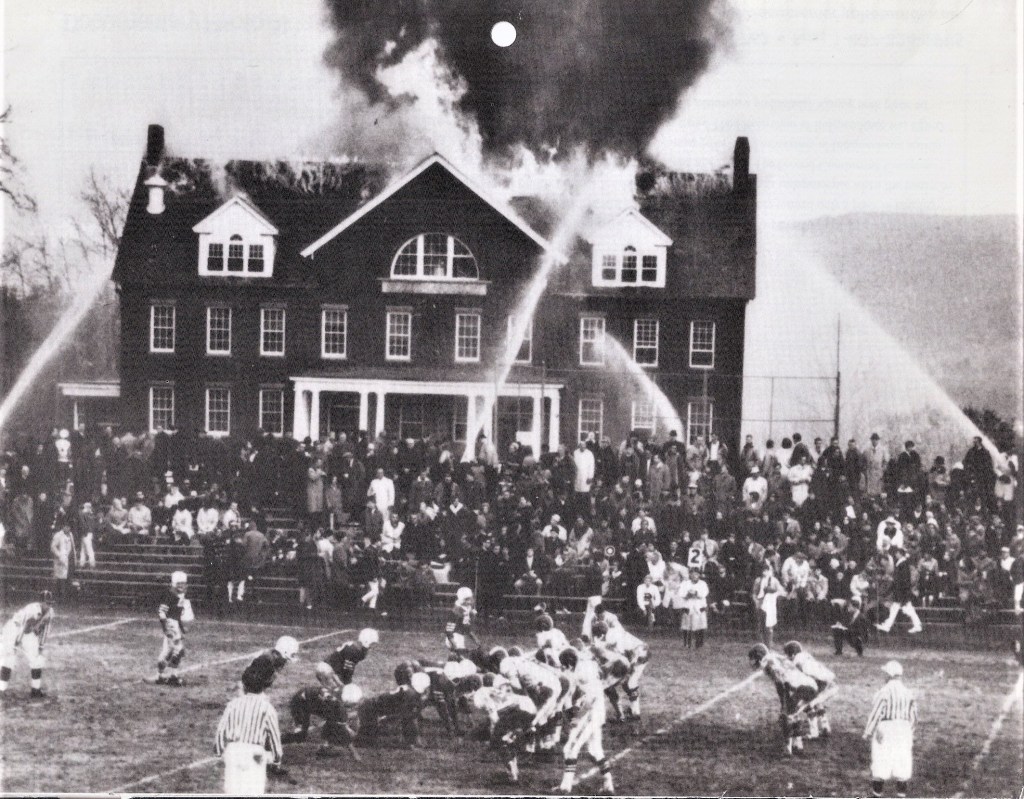
Illustration #23 is an action photographs that accompanied an article about a football game being played while a school was burning down.
Illustration #23 – School on Fire
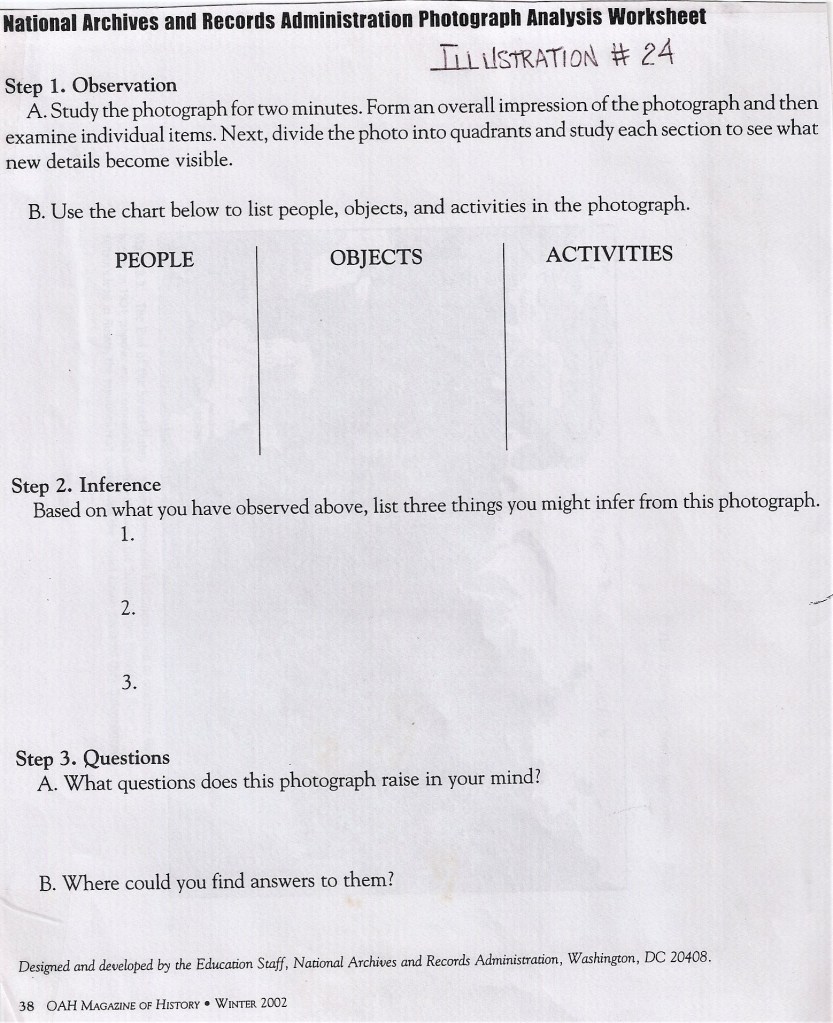
Illustration #24 can be used with the same photograph. A four column analysis is used. People-who are the people we see? Objects-what things do we see? Connect them to the people, Activities-what actions do we see? Now, add a 4th column IDEAS what ideas or idea does the photograph convey? This is a POAI-Chart.
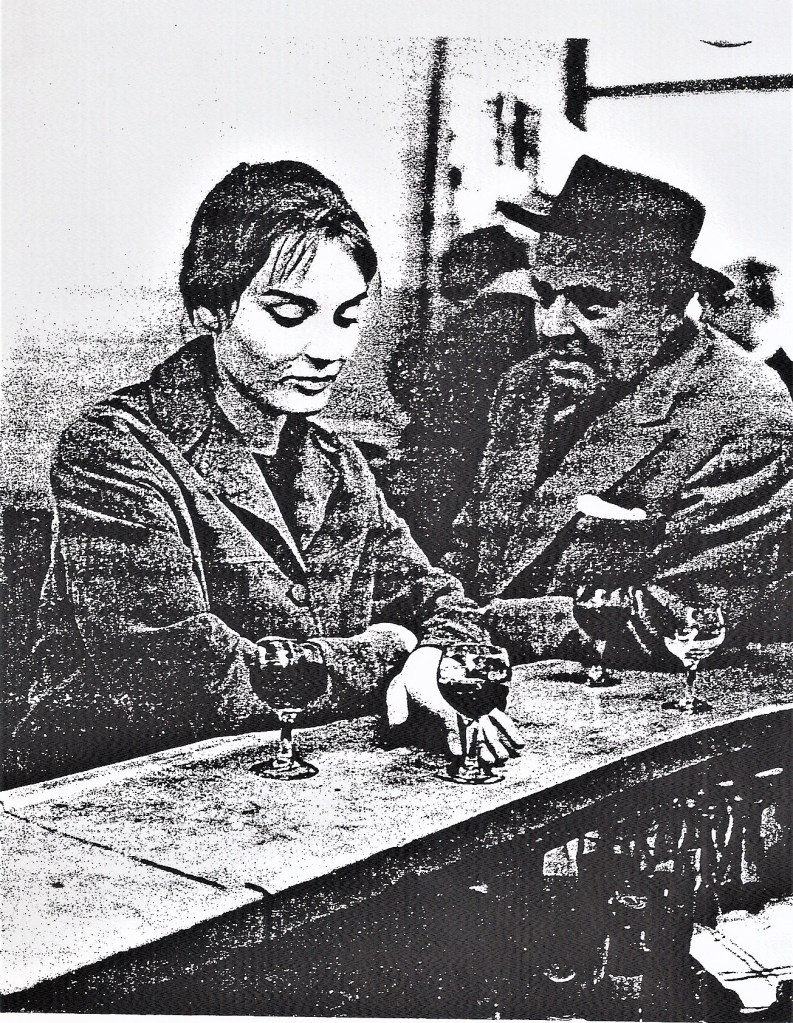
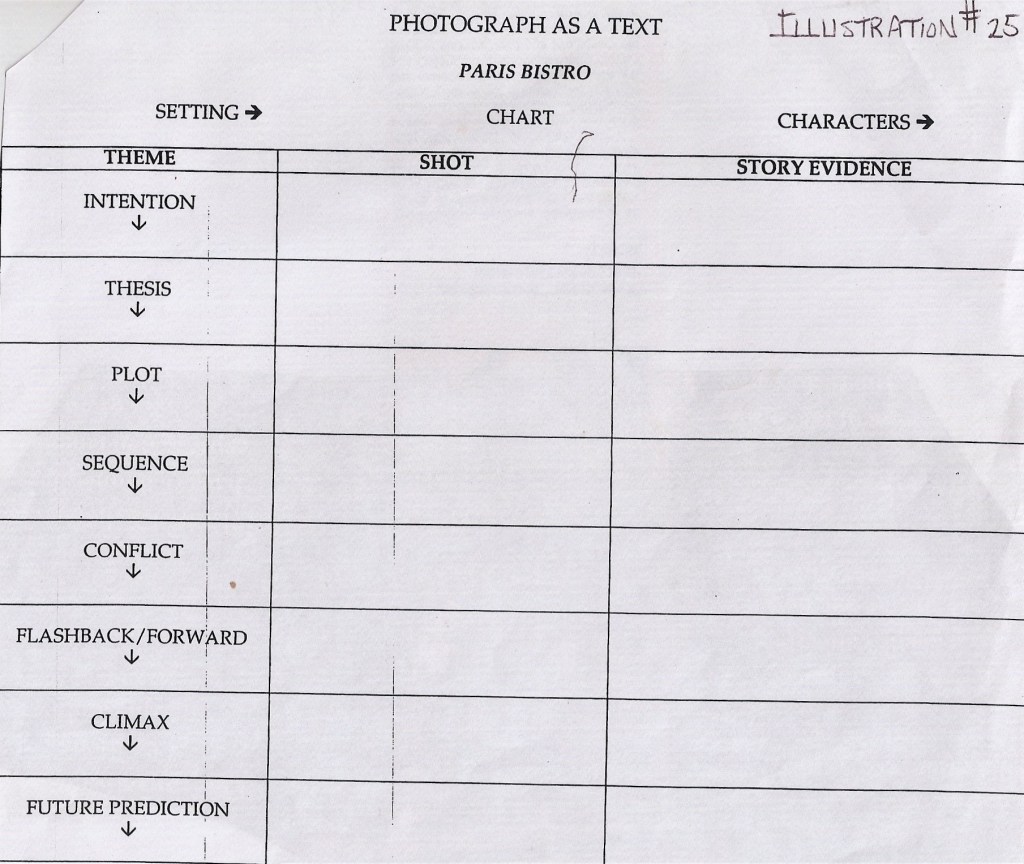
Illustration #25 Photograph as a Text shows us how we can tell a Story from a photograph. Students are given the story chart in the illustration. A photograph called Paris Bistro is our scene.
Paris Bistro
The left side of the chart sets our theme. What are the intentions of the two people in the picture. Where in the SHOT is there evidence of the intentions, the argument or thesis claim of the photographer. What might the plot be? What is the sequence of events. What were these two people doing an hour before they met and an hour after. Do we see any conflicts?
Illustration #25 -Paris Bistro Analysis Chart
What happened before? Later? How might this end. Is this a father speaking to a daughter? Is this a husband talking to a wife? What does the future hold? This story telling technique could have also been applied to the Omdurman illustration.
“A photograph is insight, not sight.”
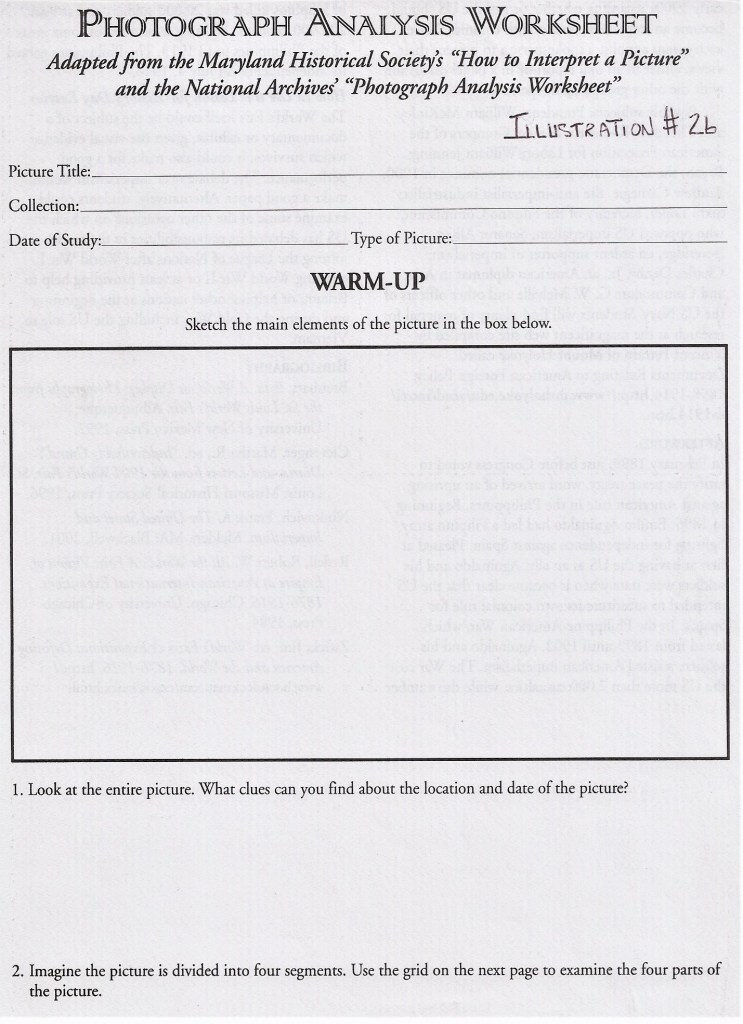
Illustration #26 shows another learning strategy.
Illustration #26 – Photograph Analysis Worksheet
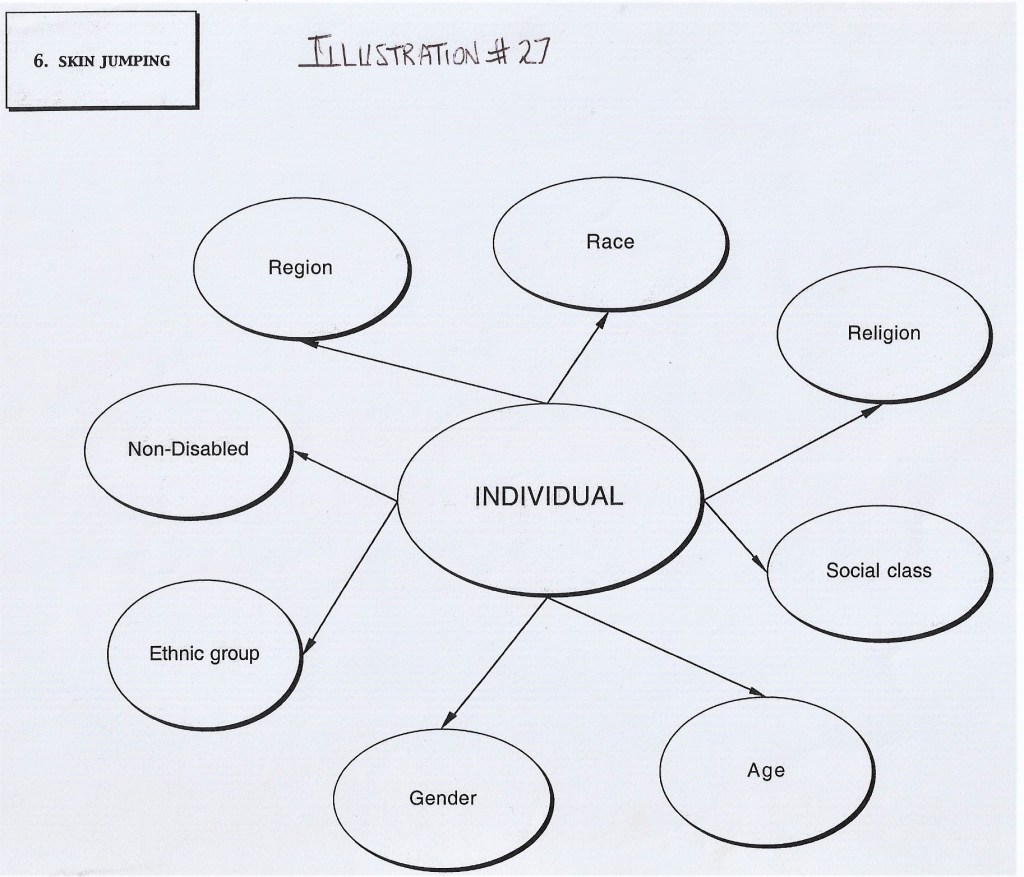
Illustration #27 is a very different learning idea. It is called skin jumping. Different people bring a different “eye” or “I” to a picture. Using the Paris Bistro picture how could or would a viewer of a certain race, religion, social class, age, gender, ethnic group, non-disabled, disabled, or from a certain region of a country view the picture.
Illustration #27 -Skin Jumping
“The mind is the real instrument of sight and observation.”
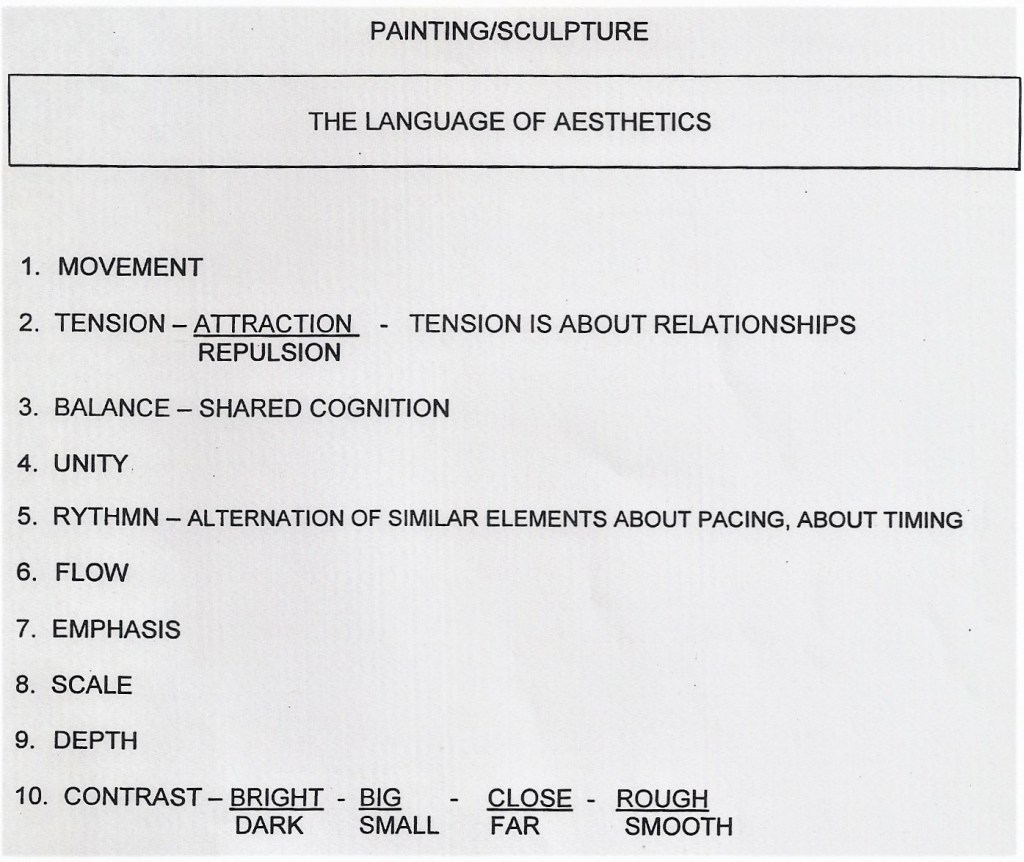
Photographs and illustrations are two visual types. Paintings and portraits can also be used in our classes. Illustration #28 gives us some general ideas about comparing and contrasting these visual forms.
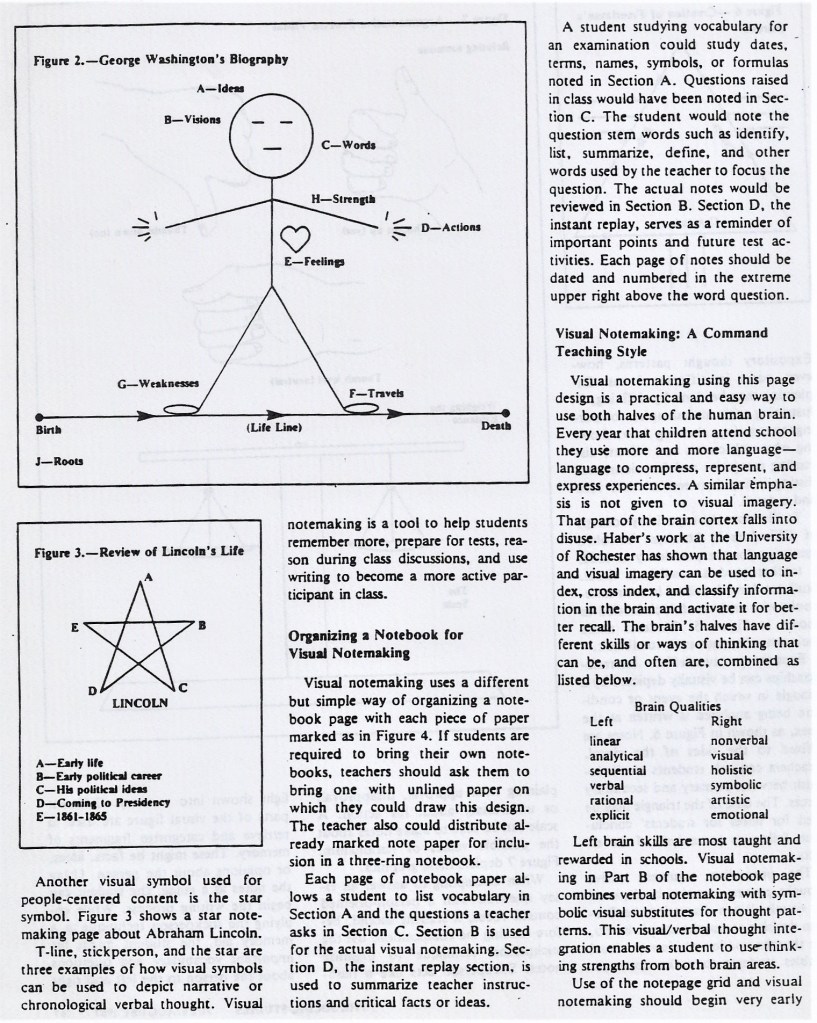
Illustration #29 depicts a young Frederick Douglass. What do we “see” or “feel” in him? As you learn about Douglass, using his portrait draw a line from his head outward. On the line print the major ideas he is thinking. Next, draw a line outward from his eyes. On the line print what you think his hopes are. Then draw a line from his mouth outward. On the line print what you think he might have said. Next draw a line from his ears outward. On this line write what you think he might have heard. Look at his hands. Draw a line indicating what actions he took. Draw a line from his upper arm. This is his muscle. Write his strengths on this line. Finally, locate his heart and draw a line outward from his heart. On this line write what you think his feelings were. Therefore, when you teach Frederick Douglass, use a visual with your students to help them in organizing their thoughts.
Illustration #29 – Young Frederick Douglass
“The painted portrait, a sign of wealth. The photograph a sign of democracy.”
Illustration #30 is used with artistic images.
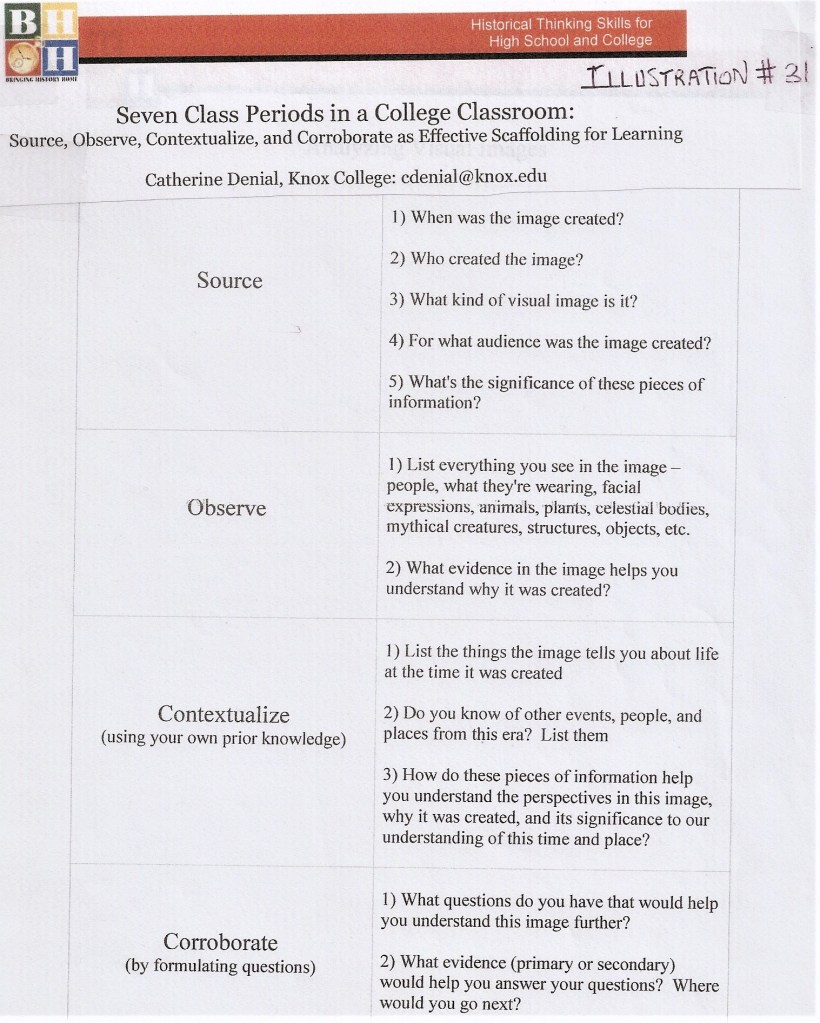
Illustration #31 – S-O-C-C Approach
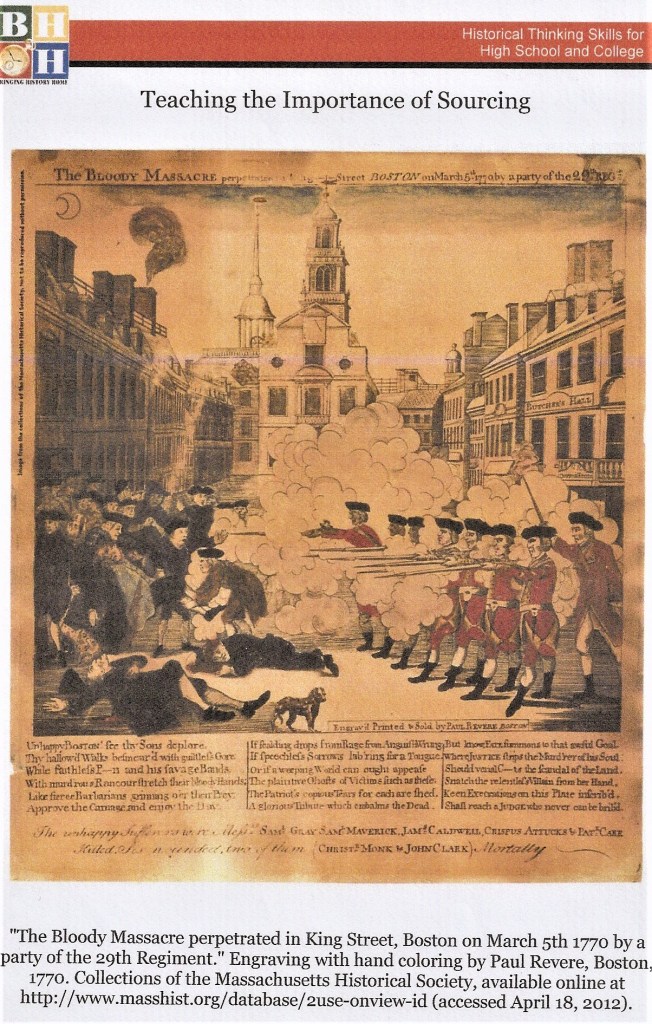
Illustration #31 from Catherine Denial of Knox College gives us an SOCC approach: source, observe, contextualize, and corroborate. This approach could be used with either Omdurman or the football fire scene. She uses it with the famous Boston Bloody Massacre scene of 1770.
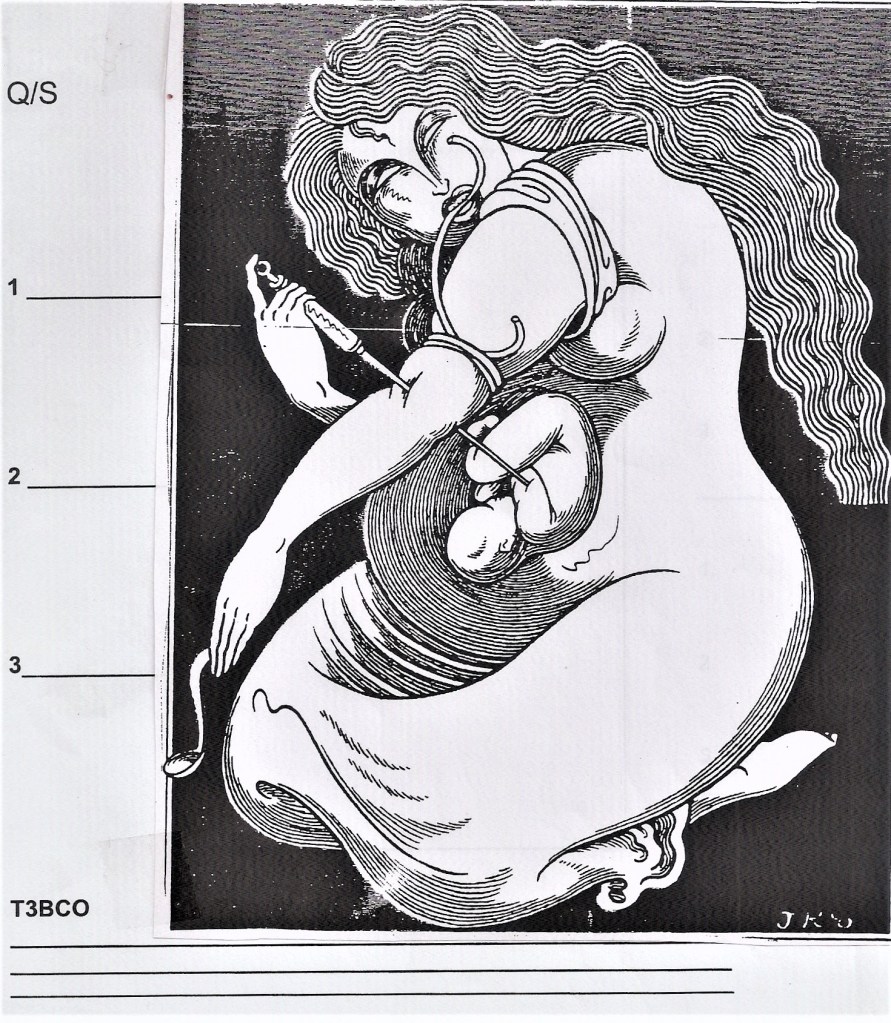
Our final visual is a graphic illustration #32 used in a history of American addictions. A POAI approach from Illustration #24 could first be used. Make notes on the handout illustration. On the left side is a Q/S column. Students are asked to write and answer 3 questions or statements they have about the illustration. At the bottom of the illustration is a paragraph writing technique called T3BCO. In a paragraph state the T or topic. Then list the three ‘becauses’ or evidence to support the topic. C=the conclusion.
Illustration #32 – History of American Addictions
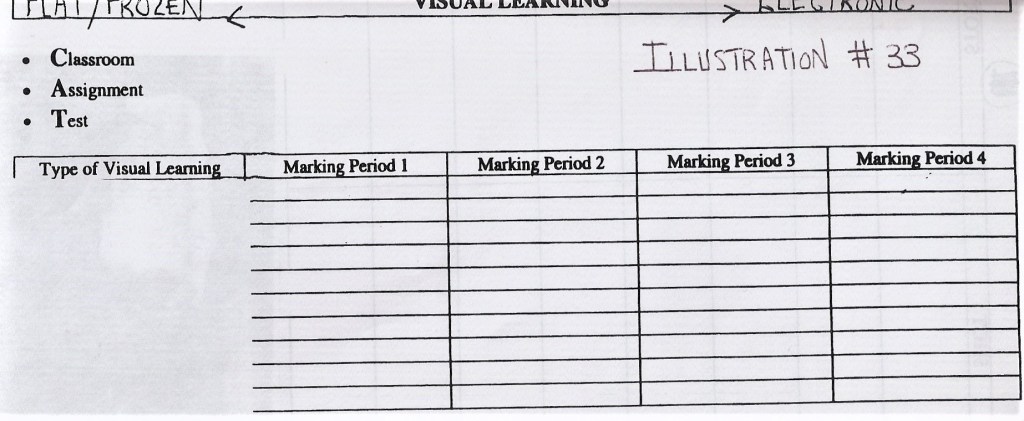
Illustration #33 is a visual teaching planning chart. Using illustration #19 plan how you can teach with visuals in a 9 week marking period.
Illustration #33 – Visual Learning Planning Chart
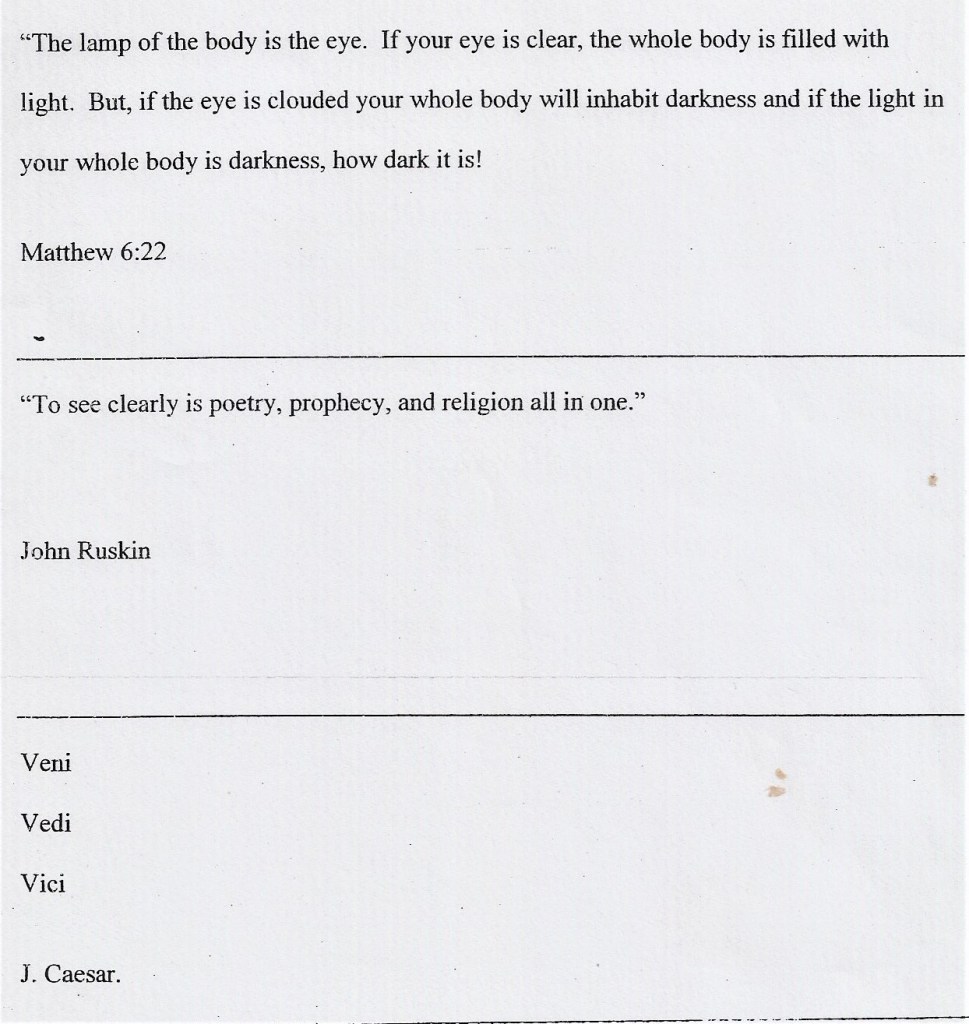
Illustration #34 conveys three ideas about visual learning.
Illustration #34 – Visual Learning
An article on Visualized Notemaking concludes the gathering and organizing activities and gives students a transition from observing to notemaking, the precondition for building memory leading to writing and speaking.
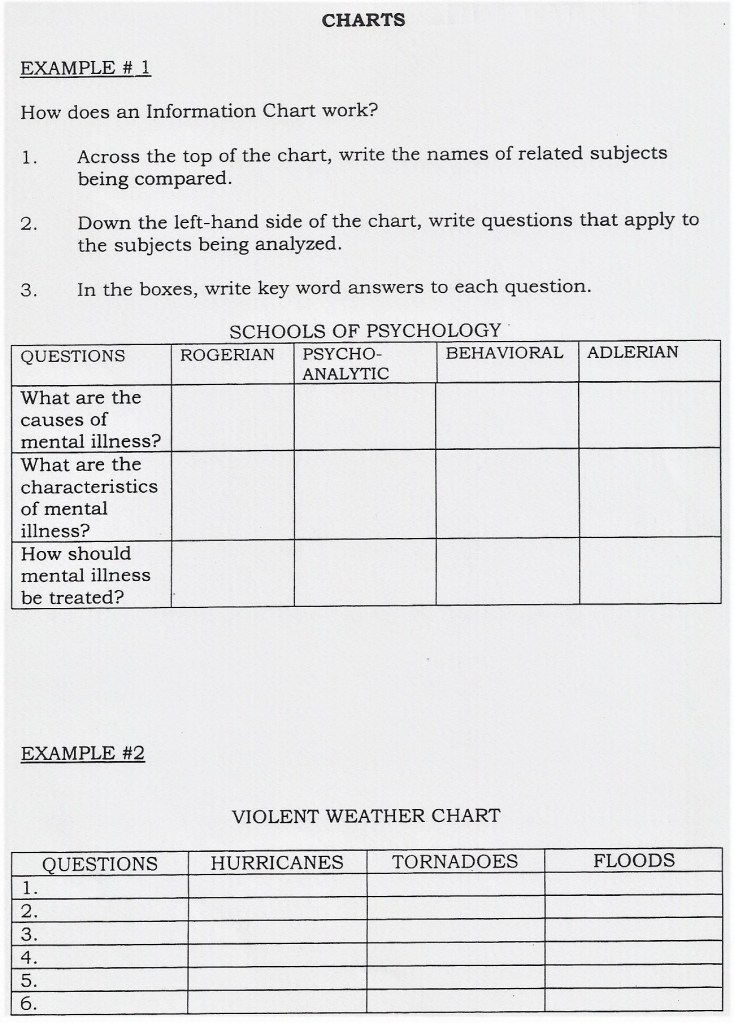
One type of graphical aid is the familiar chart form. Illustration #35 informs us about sexually transmitted infections. Use 3 steps to analyze any chart. Turn the heading into a question, “what are the”. Identify the vertical content, the diseases, and finally identify the horizontal content, the variables of cause, transmission etc. Then complete the chart.
Illustration #35 – Sexually Transmitted Diseases
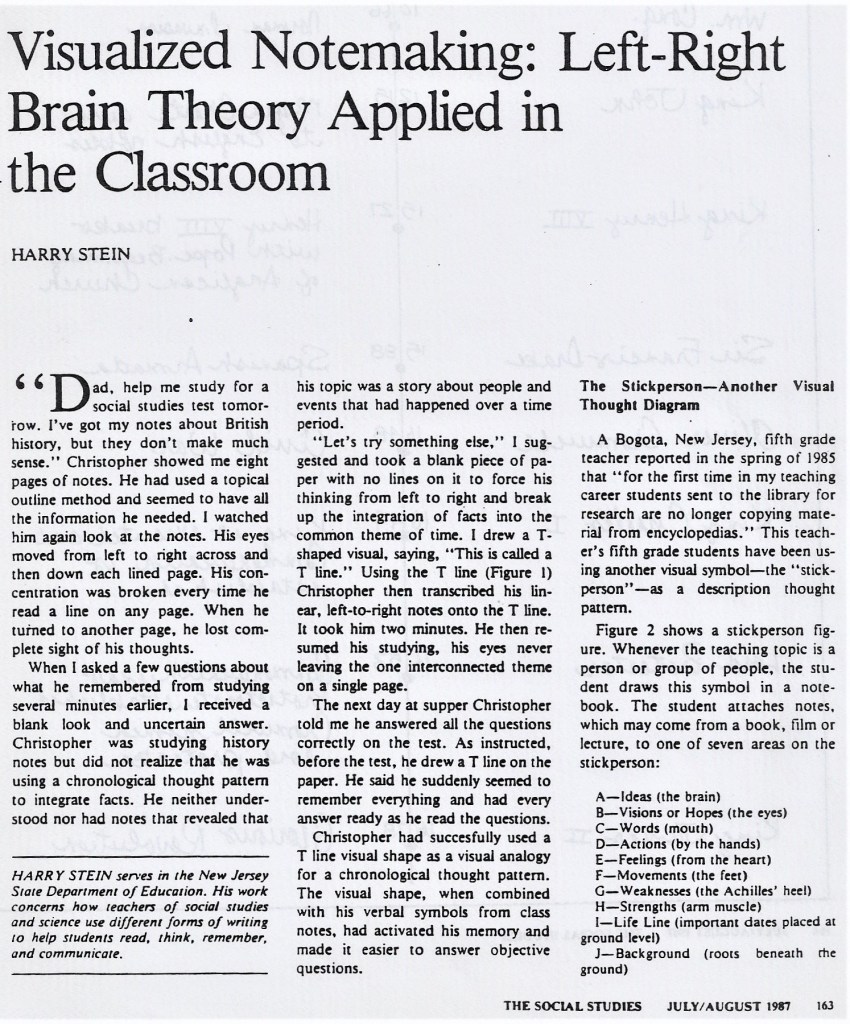
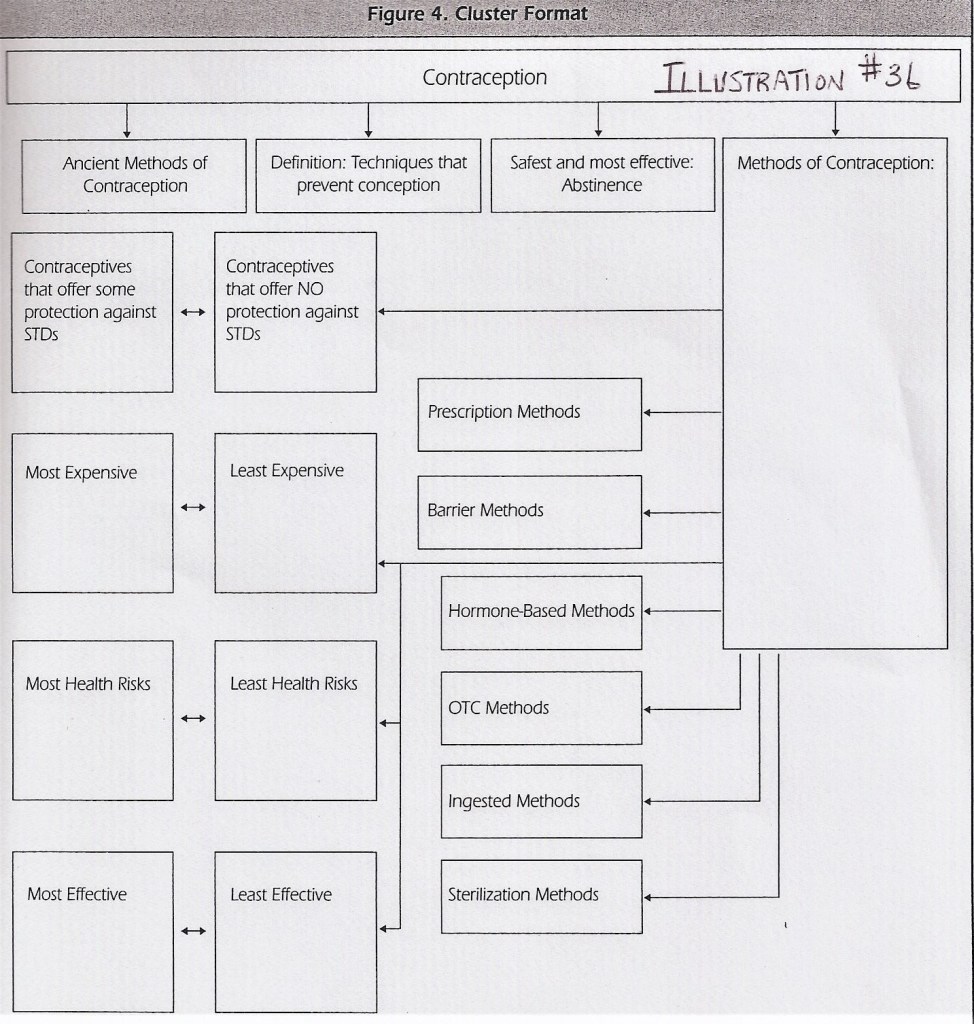
Illustrations #36 and #37 show 2 different chart forms, the CLUSTER and the WEB. Students are directed to the central theme and its offshoots. When viewing these charts use a pen to circle the main theme and draw connecting lines with arrows to the parts. Drawing focuses the eye and mind.
Illustration #36 – Cluster FormatIllustration #37 – Web Format
Additional types of charts are depicted in Illustration #38 ABC.
Illustration #38 A – Types of ChartsIllustration #38B – Research or Information ChartsIllustration #38C – Research & InformationIllustration #38D – Comparison Chart
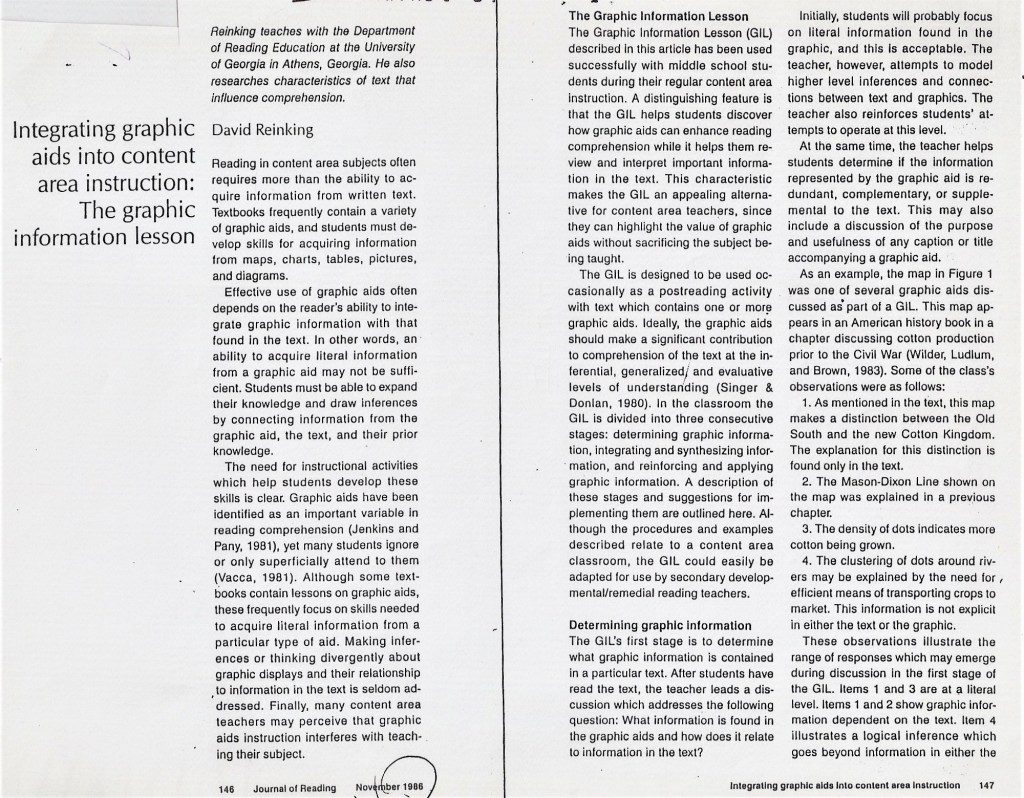
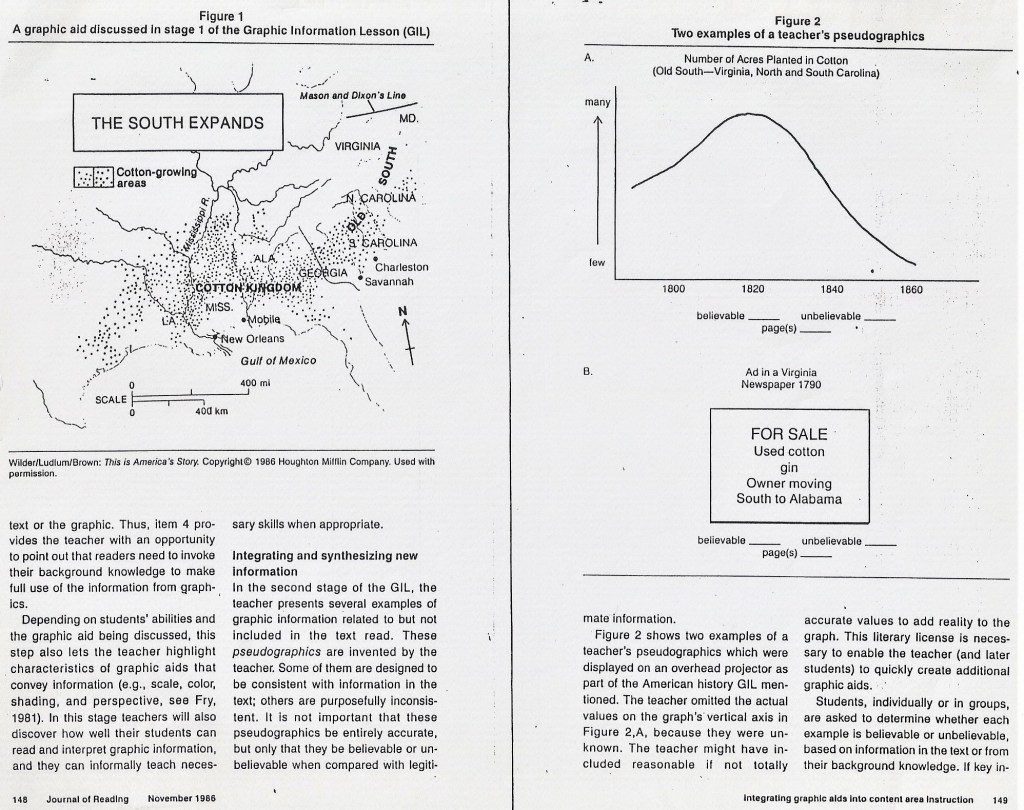
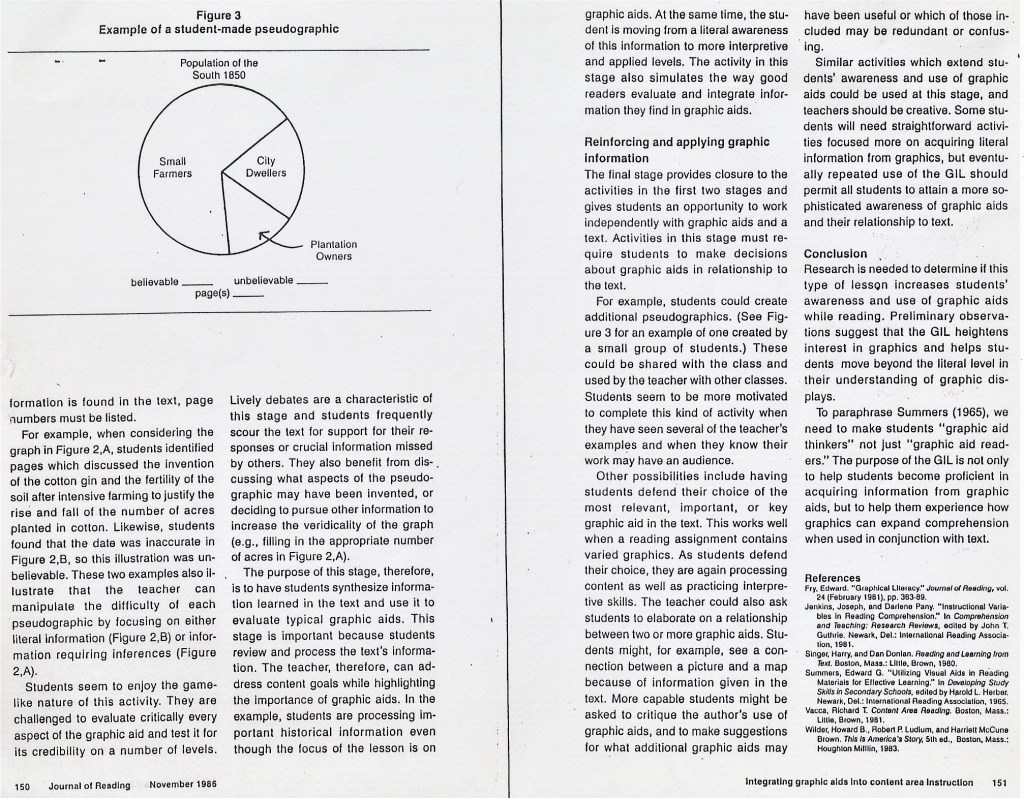
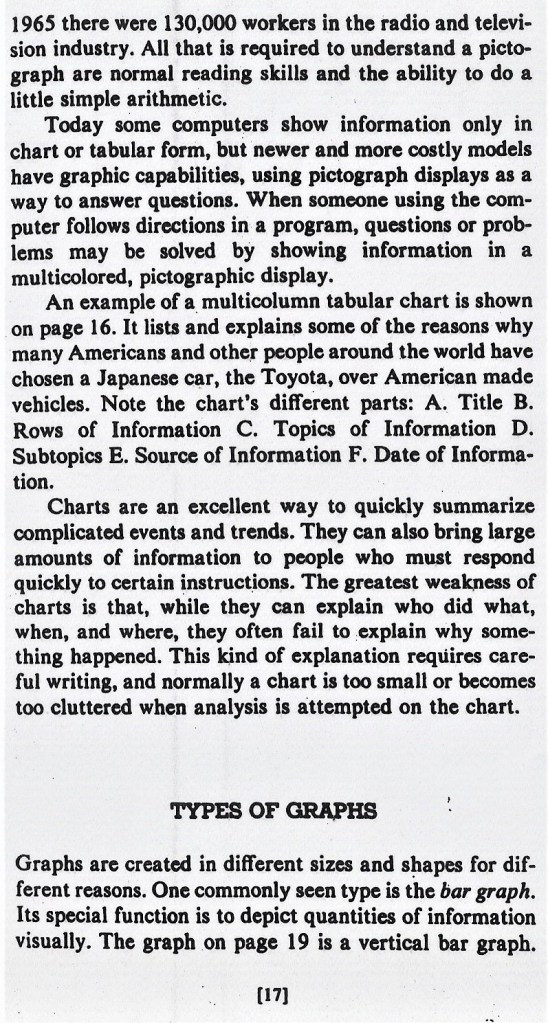
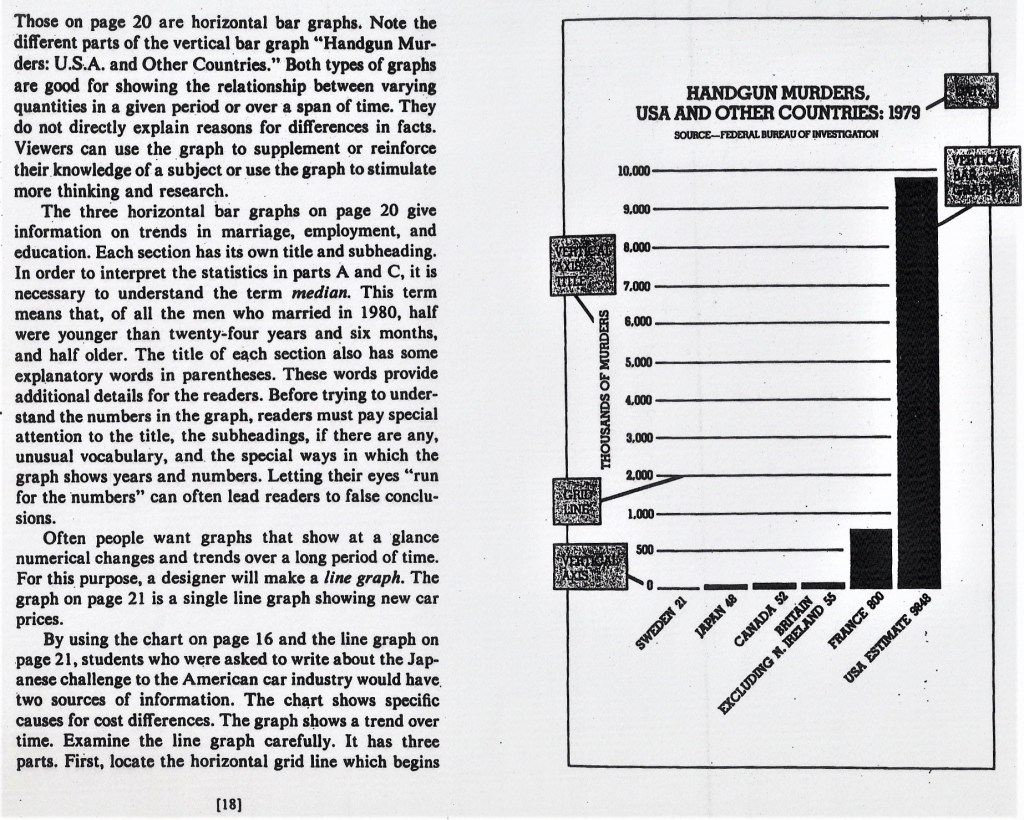
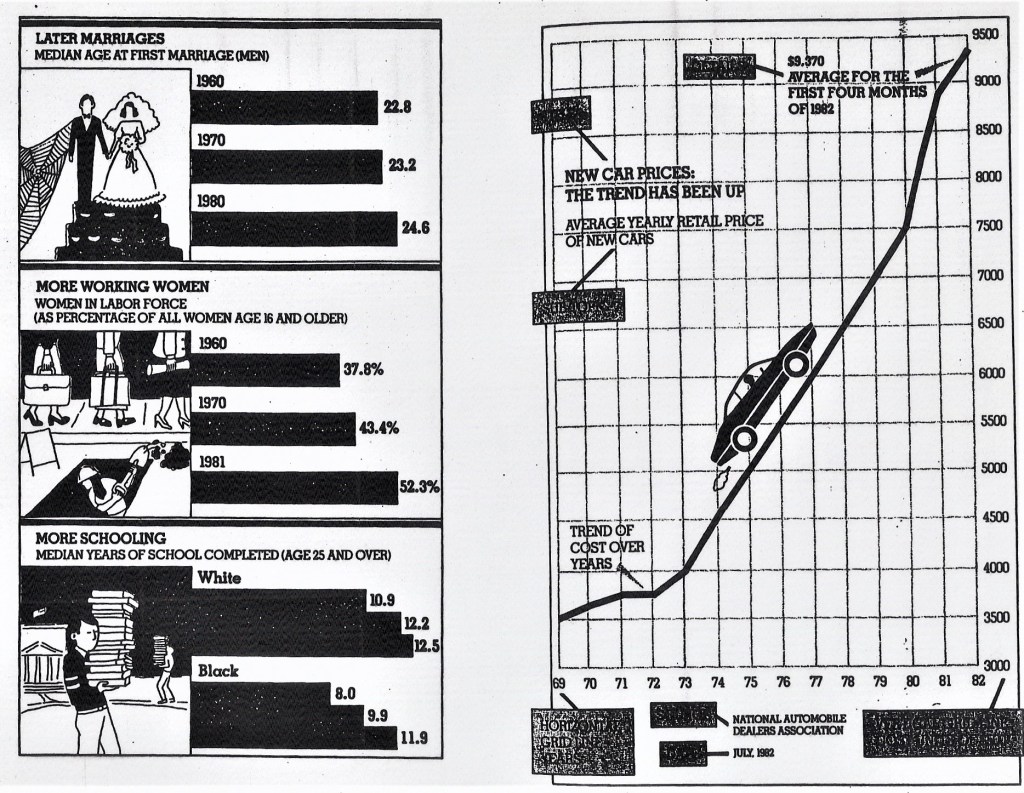
Illustration #39 is an article called the Graphic Information Lesson. It combines maps, graphs, and charts. The author skillfully integrates visual types and thinking skills.
Illustration #39 – Graphic Information Lesson – Page 1Illustration #39 – Graphic Information Lesson – Page 2Illustration #39 – Graphic Information lesson – Page 3
Illustration #40 is an information map that examines the relationships between economic production, the role of government, geography, demography, beliefs, behavior, and economic principles. The concept of public investment infrastructure is shown with an arrow linking government investment to 7 forms of infrastructure: T=transportation, E=energy, C=communication, H=health, I=information/education, PH=public health, ands S=security, police, fire, courts, weather prediction, military, and currency management. Students use the chart for note-making. Apply this to any country or historical era.
Illustration #40 – Information Map
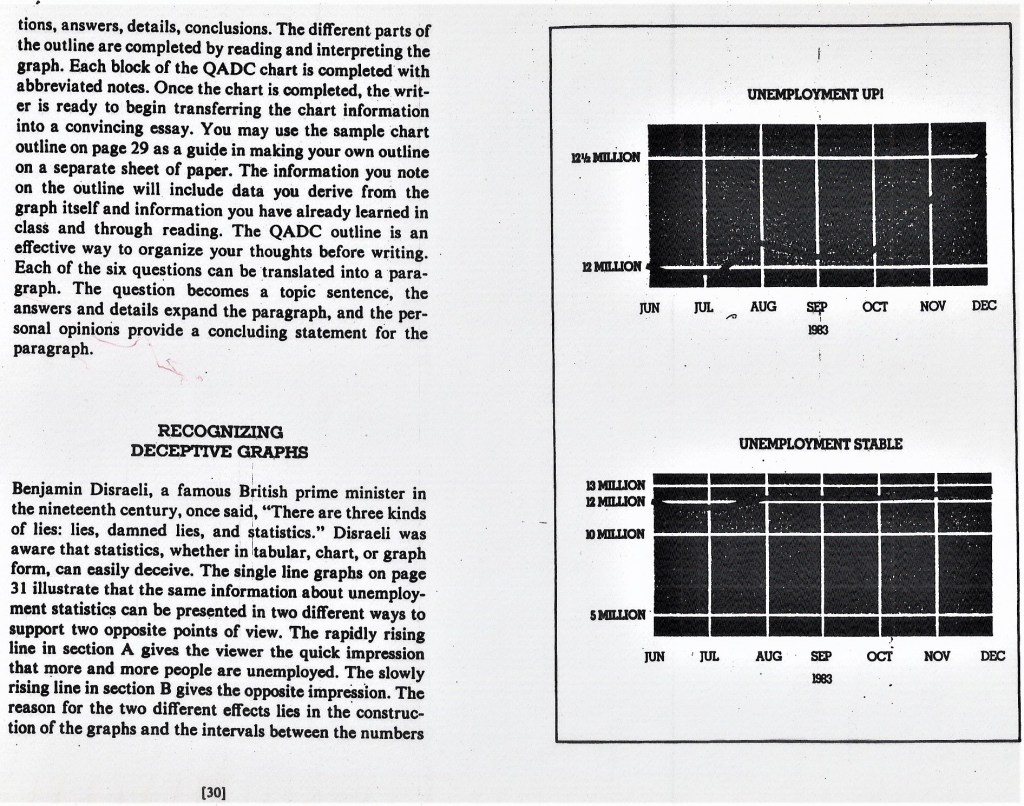
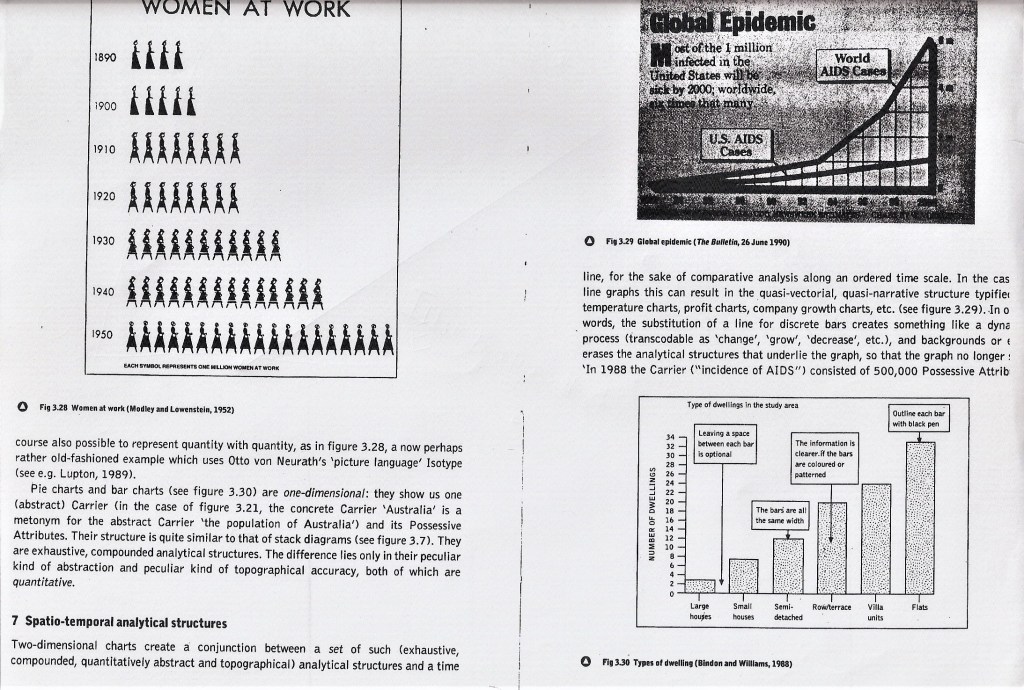
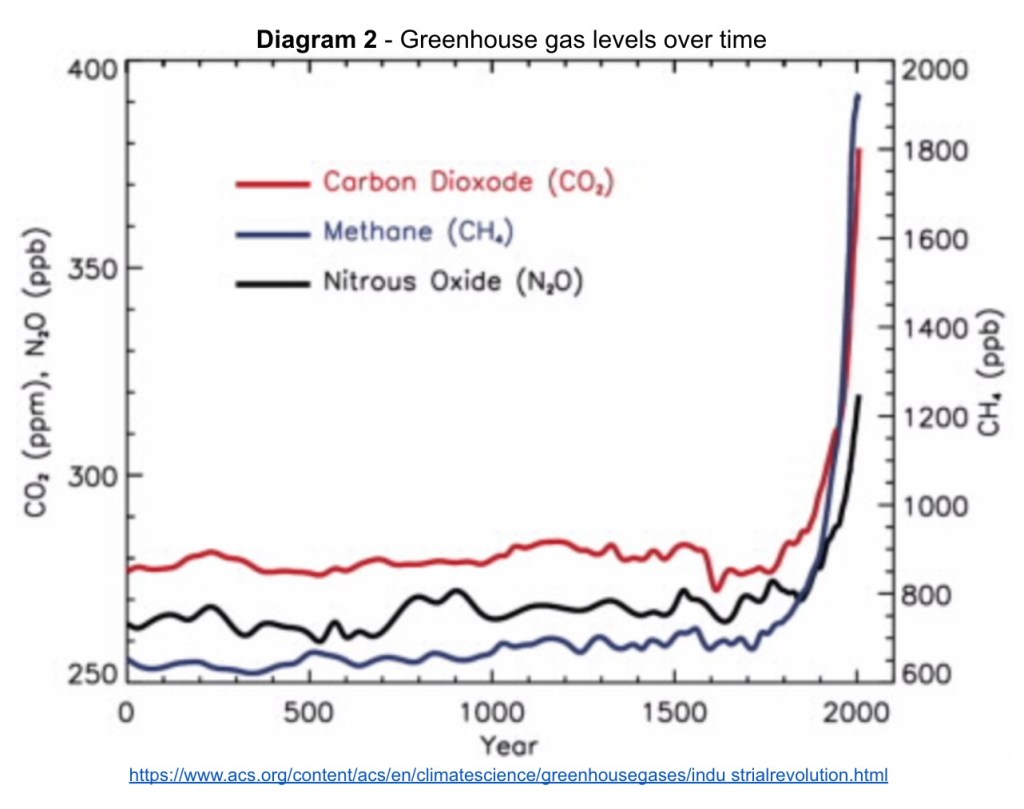
Illustration #41 is the author’s chapter on graphs, supplemented by two additional examples.
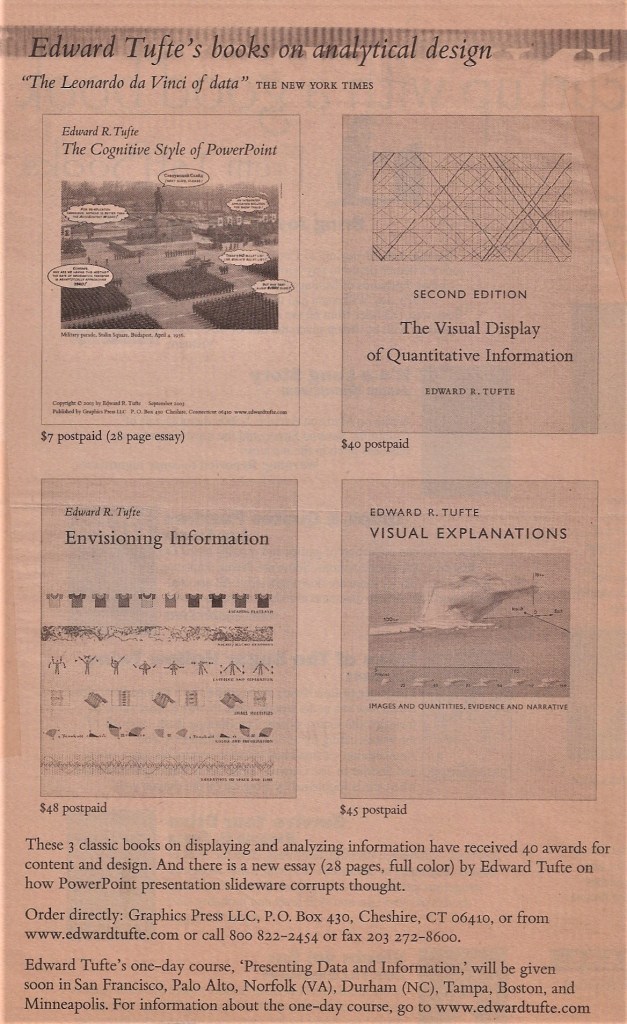
Illustration #42 is a valuable resource by Edward Tufte, the 20th century’s foremost thinker in information design. Gathering and Organizing Information has three components: reading, representational visuals, and graphical aids. These forms occur in all of our texts and materials. Learning to use them is critical and produces life-long learning skills transferable to all careers and daily life. When students can gather and organize information they create a highway for practicing thinking and reasoning. When thinking and reasoning are organized into retrievable memory they are the building blocks for writing, speaking, and other creative acts.
Illustration #42 – Edward Tufte’s Books on Analytical Design
Book Reviewed by Hank Bitten, NJCSS Executive Director
I am a history teacher who wanted to learn about the perspectives of racial inequality and social justice as a result of the events during the summer of 2020. Although I have a strong content background in the history of African Americans, slavery, reconstruction, prejudice and discrimination, constitutional law, the economics of poverty, and human rights, I never taught a course on social inequality, criminal justice, or how to address problems in this area.
A former student, Dr. Christopher Borgen, who is a law professor at St. John’s University, introduced me to the Equal Justice Initiative and its founder, Bryan Stevenson. After visiting the EJI website and learning from others that Bryan Stevenson was a past speaker at an NCSS convention, I read his book, all 66 pages in about 30 minutes!
The book was different from what I was expecting. When I read the description on the Amazon website, I was expecting stories of convicted felons on death row who were falsely accused and then represented by Dr. Stevenson and the Equal Justice Initiative. Instead, I discovered that I shared the same hopes, values, and mission as Bryan Stevenson, even though our life experiences were very different. The things we shared were loving grandmothers, disappointing high school educational experiences, religious faith, and a calling to help people by making a difference in their lives. My world view that we are placed into situations by circumstance (or divine intervention) was reinforced in the 66 pages of what I read.
Bryan Stevenson lived in a rural town in southern Delaware from 1959 until he graduated from Eastern University (PA) in 1977. He attended the Kennedy School of Government at Harvard where he earned a Master of Arts degree in Public Policy and a Juris Doctor degree from Harvard Law School. After moving to Atlanta, he was an attorney with the Southern Center for Human Rights in 1989 he founded the non-profit law center, Equal Justice Initiative in Montgomery. His life’s work is committed to eliminating life-without-parole sentences and capital punishment for juveniles. The Equal Justice Initiative have won reversals or release for 135 wrongly convicted death row prisoners.
The EJI opened the Legacy Museum in 2018 in Montgomery, Alabama to focus on racial inequality and the challenges of race discrimination in the criminal justice system in the United States. The current digital exhibits on racial justice, Reconstruction, and criminal justice reform are informative.
As a white, middle class, educated person living in a suburban community, my wife and I taught our children and now we are teaching our grandchildren that the police are your friend. We instill in them that if you are ever in trouble to seek the advice of the police who are easily recognized by their uniforms. This is teachable because all of us deserve to be treated equally! The book provides examples of how “our society applies a presumption of dangerousness and guilt to young black men, and that’s what leads to wrongful arrests ad wrongful convictions and wrongful death sentences, not just wrongful shootings.” The example of injustice is the story of Walter McMillian who was sentenced to death in 1986 for the murder of Ronda Morrison, an eighteen-year old white woman. He was treated unfairly because he was targeted, the victim of false testimonies, convicted of a life sentence by an all-white jury, and then this sentence was changed to the death sentence by judicial override. This short book emphasizes the power of mercy and redemption and how simple interventions based on perseverance can lead to justice and goodness and change lives.
The K-12 educational experience of Bryan Stevenson gave me a different perspective of my own experiences. I was educated in the Paterson Public Schools from 1952-1964. I went to overcrowded schools, we were attacked by black teenagers from the other side of the real estate dividing line, lacked a college preparatory experience even though I was in the Academic program, and skipped two years graduating at age 16. Bryan Stevenson’s experience was similar and yet opposite. Although he went to school a decade later, his mother and grandmother were anxious every day about his experiences in an integrated school. Both of our mothers and grandparents were influential in teaching us to read (newspapers and encyclopedias) and we were both the first in our families to attend and graduate from college.
The second perspective I gained from this book was first introduced to me in Race Matters by Cornell West. I read this book in the 1990s and the narrative demonstrated by African Americans through all the years of segregation, insecurity, and prejudice is one of love, hope, and a desire for acceptance. During the current national dialogue of racial inequality and social injustice, I think back to my first years as a teacher at Martin Luther High School in Maspeth, Queens. This was the year of the strike by teachers in the New York Public Schools and the year that neighborhood schools ended and busing to integrated schools began. As a new teacher, I was instructed to start an African American History course, even though college courses in this field were rare and not part of my education. As a result, I learned with my students, enrollment increased to multiple sections, and my students taught me about their experiences in East New York, (and other communities), threats against them on public transportation, and the difficulty in finding work. I also learned about the experiences of their parents in the workforce at a time when the Bakke decision by the Supreme Court challenged the validity of minority quotas.
The third perspective, the one that motivated me to write this book review, was the role and influence of the church and the driving values that motivated the life work and decisions of Bryan Stevenson. I discovered in this narrative the importance of social and emotional learning, that solutions are always a process rather than an answer, and the importance of teachers in educating students.
It is important for teachers to understand the narrative of fear. This is evident in the restrictions of the plantation, denial of literacy, and Jim Crow segregation. It is also evident in the classification of drug addicts and users as criminals instead of individuals with a sickness or mental health condition. Fear is a powerful force in the human condition. We are taught to fear the consequences of breaking laws and rules as well as fearing failure.
It is equally important for teachers to teach and be a voice of hope and help. The social studies teachers I am privileged to know want to make a positive difference in the lives of their students. This is why civic education and historical context is important to them because the context supports equality, freedom, respect, justice, respect, and human rights. These are the threads that weave every day in the lessons of ancient societies, the Enlightenment, totalitarian rulers, colonial America, abolition, suffrage, Reconstruction, the New Deal, Fair Deal, Great Society, and the American Dream.
The impressive personal story of Bryan Stevenson is one of notable accomplishments but the difference he has been able to make in the lives of people through the Equal Justice Initiative is very similar to the impactful stories of teachers. Although our calling is to teach social studies, we are also teachers of life skills, the extraordinary lessons of handling crises, and how to persevere through the frustrations of declining test scores and disappointments. Teachers are always modeling resilience, perseverance, and help.
Another lesson that was reinforced for me through this book was the concept of leadership. Leadership in the classroom is demonstrated by getting our students to support common goals of listening to others, searching for the truth, asking questions, doing our best, and supporting each other. Bryan Stevenson also includes speaking out for what is right! This includes making our classrooms and schools free from fear and anger, free from complacency and ignorance, and places where students feel comfortable to ask questions, learn different perspectives, and respect the competing ideas that are inherent in a democracy.
There are many lessons throughout this book and they will speak to each person in a different way. Regarding civic engagement, it is important to follow the calling in one’s heart in addition to their cognitive knowledge of what needs to be changed. It also means to think small when there are big problems. Bryan Stevenson lives in a state with a very high poverty rate and a record of harsh punishments against people. The lesson I came away with is to make a difference where I can, even if it is in the lives of just a few. For your students, let them know that they are witnesses to everything they see – bullying, sexism, injustice, inequality, favoritism, patronizing, cheating, lying, exaggerating, complacency, etc.
The book takes only a few hours to read but the messages in the book will last a long time!
The word, “Interdisciplinary” has been circulating in education for years. Over time, “interdisciplinary collaborations” and “interdisciplinary learning spaces” have become more prevalent in schools and institutions across the country. Just this year, I have proposed a new interdisciplinary class called “Science and Society” to my district Curriculum Committee and got it approved for implementation. However, the significant increase in interdisciplinary learning over the years is hardly a surprise given its vast appeal.
To begin with, the very prospect of learning through a marriage of multiple disciplines is an inherently progressive standard. It is a clear break from the status quo of traditional disciplinary barriers that have been established in education systems for decades. As a result, interdisciplinarity is an innovative and exciting topic for many teachers, supervisors, and students. More recently, it has begun to move into frontline conversations about 21st century education reform and a fundamental structuring of pedagogy itself.
As a student interested in education policy, I too share the enthusiasm of others who are excited to see the rise of a new learning model that aims to boldly change the educational landscape. At the same time, the hype and novelty surrounding such a learning paradigm can often overshadow the reality behind what interdisciplinary education truly is and why it has become essential for schools across the nation. I would like to take this opportunity to share why interdisciplinary education is much deeper and more profound than it appears to be, and why it has become a fundamental necessity for the education system in America.
The Fourth Industrial Revolution
Currently, the world is seeing tremendous advancements in science and technology that will certainly permeate every aspect of society. With giant leaps being made in robotics, artificial intelligence, 5G connectivity, gene editing, virtual reality, robotics, and sustainable technology to name a few, the world is building upon the previous digital revolution (the “3rd” Industrial Revolution) in ways never seen before. Ever since the World Economic Forum introduced the realization of this new “Fourth Industrial Revolution” in 2015, people have started to grasp just how drastic these technological changes are going to be.1
The Job Market
An obvious result of these enormous changes in technology is a corresponding shift in the job market. The predicted impact of automation and artificial intelligence on jobs is staggering: a McKinsey study claims that 400 million workers across the world will be displaced by automation within the next 10 years2, while an Oxford University study reveals that around 47% of American jobs are at high risk of being taken over by computerization.3 While there is much debate on the extent of the Fourth Industrial Revolution’s impact on net job growth, it is indisputable that employees in the next few years will work in an environment increasingly dominated by automation. At this point, it is important to take a step back and consider what this all really means for workers and what kinds of skills they will need to bring to the workplace. Simply put, what are the things people can do that automation cannot already do better and more efficiently? Our ability to collect and analyze data, memorize, calculate, and perform repetitive physical tasks are not on that list and will be at high risk of being supplanted by automation. The reality is that certain job skills will not maintain the same value at a time of such rapid change in the world. Not being able to identify what skills may be placed at higher value as a result of the Fourth Industrial Revolution (FIR) could be disastrous for people and the economy.
This is where interdisciplinary education will make a difference. In the coming years, one of the most coveted and important job skills will be the ability to think about and approach problems by drawing from multiple disciplines. More specifically, this will come in the form of being able to understand modern technologies and scientific developments within societal, historical, economic, and moral contexts – perspectives that artificial intelligence would not be fully trusted with in the near future. People who have developed the capacity and willingness to approach the complex issues of today from an interdisciplinary standpoint will not only be assets to the workforce by being able to provide nuanced solutions covering both objective and subjective perspectives, but will also be most conscientious about how to deal with the FIR technologies that are dramatically impacting the job market.
Public Policy and Scientific Progress
The Fourth Industrial Revolution will bring about significant dilemmas for government at the federal and local levels. While technological progress is amazing and currently improving the quality of life for millions, it has limited value until society determines how it will advance civilization and be regulated. The current controversy surrounding the role of giant tech companies (Facebook, Amazon, Twitter, Google) in politics as well as partisan strife on issues such as abortion, artificial intelligence, climate change, cyber security, and healthcare are just the beginning. Novel technologies brought on by the Fourth Industrial Revolution will be radically more pervasive in the lives of people and much more multifaceted than the issues of today.
One prominent example is the bioethical issue of embryonic gene editing (the technology for which already has been used) which will have a tremendous impact on people’s relationship with biomedical technology. If granted the decision to choose on an individual basis whether gene editing is a viable option for their own children, people could potentially be given the ability to dictate the evolution of the human species by selecting certain characteristics. From what kind of moral or even policy-based foundation can society learn to adequately deal with such decisions? People in this nation are already extremely polarized and struggling to make significant strides in reconciliating opposing viewpoints over the single controversy of abortion, which is just the tip of the iceberg of dilemmas brought by increasing biotechnological capabilities. This is ignoring the host of moral, political, economic, and social quandaries that will result from the rise of artificial intelligence, human-machine interfaces, augmented reality, and much more. As of now, the world is woefully unprepared to deal with the inevitable technological dilemmas that will arise in the future. Future generations need to be able to relate perspectives from economics, ethics, behavioral psychology, and sociology to the current rise of advanced FIR technologies.
Outside FIR, the necessity for interdisciplinary thinking relating to modern issues is already being put into the spotlight due to the complex nature of the current pandemic. The immediate COVID-19 crisis has demonstrated the need to approach a topic as complicated as a pandemic from scientific, economic, and social standpoints.
When the world’s current events are so obviously multifaceted and require not just dialogue among experts from different fields but also people able to integrate different disciplines, it is the responsibility of the education system to take notice and adapt appropriately. Education is the only wide-encompassing entity that can systematically influence young people, and is the key to empowering a new generation of people who will be prepared for such dramatic changes in the world.
Historical Precedent
Examining the drastic advancements in technology throughout time and their effects on society is extremely relevant in regards to the current Fourth Industrial Revolution and the importance of interdisciplinarity. The transformation of society in Europe and the United States from an agrarian to an industrial civilization (~1740-1860) undeniably had many positive effects such as the overall increase in quality of life and wealth for the average person. On the other hand, the failure to consider mechanization and industrialization from a holistic view of multiple perspectives presented unprecedented consequences such as soaring income inequality, vast overcrowding of cities, and loss of individuality and sense of agency for many workers. Perhaps the most disastrous overlooked consequence of industrialization was its devastating effect on the environment, as the government made practically no effort to mitigate the pollution produced by factories. Below is a report from the Intergovernmental Panel of Climate Change showing the dramatic increase in greenhouse gas levels as a direct result of industrialization. The inability for society to prepare for the interdisciplinary nature of technological changes has had ramifications lasting to this day.
The necessity for taking a nuanced approach to the world’s problems did not begin with the Fourth Industrial Revolution and has always been prevalent throughout history.
The Essence of Interdisciplinary Learning
Many educators are familiar with interdisciplinarity as a newer approach to education. However, the idea of combining multiple disciplines dates back to pedagogy used in ancient Greece with the Trivium and Quadrivium, which represent early philosophical approaches to a “unified” form of liberal arts education. Although originating in ancient Greece, the Trivium and Quadrivium primarily came into use in the early Middle Ages, and are often associated with that era historically. While there has been much evidence over time indicating the benefits of interdisciplinarity,4, 5, 6, 7 what about this learning model in particular makes it go beyond simply recognizing the connections between concepts learned in two different classes? The word “Interdisciplinary” literally means “between or among disciplines.” But what does “between or among disciplines” really mean? Perhaps the true essence of learning between disciplines is much deeper and more profound than it immediately seems.
“Mindsets”
Every academic discipline, whether it be social studies, math, science, or language arts, has a certain knowledge base to go along with it. A foundation of facts and fundamental skills are necessary to advance a student’s learning in any subject. It would not make sense to do calculus without having a solid grounding in algebra, or to analyze historic events without first learning at least the basic factual details of those events. However, too often the disciplines are viewed as really just a set of facts, formulas, and “knowledge bases.” Interdisciplinarity takes the disciplines and elevates the meaning behind them to the point that such restricted viewpoints no longer become sustainable.
By its very nature, an interdisciplinary approach requires an understanding of the disciplines far above the informational level. Actually “combining” multiple disciplines in a profound and meaningful way is simply not feasible without first viewing them as different “mindsets” and not just “knowledge bases.” Through this approach, it is possible to put the social studies, natural sciences, and humanities into larger and more applied contexts that exist across and beyond the spheres of those respective fields. When multiple disciplines are not only juxtaposed but truly integrated, the differences and similarities of what they each offer and aim to accomplish through different ways of approaching issues become illuminated. One of the most prevalent issues in society is unnecessary conflict between people with differing perspectives who are unwilling to compromise or take each other’s viewpoints seriously. Interdisciplinarity eliminates the notion that one perspective is superior and fosters a healthy dialogue that seeks to value and combine multiple disciplines and ways of thinking. Thus, Interdisciplinary thinking is not simply defined by the ability to make obvious, surface-level connections across different fields.
Innovative Thinking
A unique quality to interdisciplinary learning is that in many ways it opposes thinking by analogy. Thinking by analogy builds off of what has already been long-established, which is often the case when studying or conducting research in a single discipline. Granted, there are obvious benefits to specialization in one subject area that can have tremendous applications in society and academia. Advancing knowledge in an area over time is intrinsically valuable, and interdisciplinarity does not aim to overhaul or “dethrone” the existing educational paradigm but rather gain more presence and importance in the learning process.
However, exclusively thinking by analogy is what prevents innovation and progress. Being stuck in the past when the world is being upturned by the Fourth Industrial Revolution is dangerous, and a learning model that can create new perspectives and ways of approaching nuanced issues of today is needed now more than ever. By exploring a scientific issue through a social studies lens or vice versa, students are pushed to think critically about what connections can be made that have never been identified before.
Interdisciplinary Learning in the Classroom
While the theory behind interdisciplinarity may sound attractive, actually implementing it in the classroom is a different story entirely. The key point is that there is no one way to effectively do this. Education policy itself is highly localized, and each district has its unique way of implementing and maintaining the standards outlined by the state. This is not too surprising considering the fact that different students make up the population in different areas. These are the personal thoughts of a student which were enhanced by various conversations over the past years with education professionals.
Distinct Class
A direct pathway to increase interdisciplinary education would be the implementation of a separate class (or classes) specifically designed to foster this thinking in students. In my own district, the Curriculum Committee approved a “Science and Society” elective class built on specific topics that were identified to be effective in helping students think from both a scientific and societal perspective: the origin of scientific thought, Darwinian evolution and society, and the scientific revolution and enlightenment. However, the resources that were used to develop the components and structure of this class were very specific to the school and district where it was being implemented.
A plausible approach to implement “interdisciplinary” classes in a more general sense is the idea of thematic classes. These would not be attached or affiliated with any one department in particular, but rather a shared responsibility between or among multiple departments. If this is the case, faculty who develop the curriculum and coordinate the logistics might have more leeway to cooperate in a joint-effort. Perhaps even a classroom with a two-teacher dynamic, each from a different discipline, might be fitting for a class of this type. This goes back to the idea of interdisciplinarity as a convergence of “mindsets,” not simply knowledge bases. The specific experiences and perspective that a social studies teacher brings to a classroom environment is significantly different from that of a science teacher, and even a simple dialogue or sharing of ideas between professionals from different disciplines in a classroom can be very powerful.
Furthermore, the NJ Student Learning Standards that were recently revised contain specific curricular areas that are great candidates for thematically oriented classes. These include a section in the social studies standards called “Renaissance, Scientific Revolution, Reformation, and Enlightenment,” the unit on biological evolution in the science standards, and a unit called “Influence of Engineering, Technology, and Science on Society and the Natural World” also from the science standards. These are areas that are not only explicitly part of the learning curriculum as mandated by the New Jersey Student Learning Standards, but also areas that can be targets of thematically organized classes that can very easily bring in multiple disciplinary perspectives.
Depth Over Breadth
An alternative approach to creating a distinct interdisciplinary class is something that might be more broadly implemented in traditional social studies and science classes. This is not necessarily about changing the curriculum content itself, but how this content is conveyed to students. By creating a larger emphasis on how curricular content relates to real contemporary issues and society at large, students will have a more efficient and holistic learning experience.
This broadly based approach addresses an aspect of education that needs improvement, which is how students personally view their learning. On too many occasions students are bombarded with the rapid pace and workload of classes, which leaves them with insufficient room to seriously consider the importance and realistic implications of what they are learning. Too often, the curriculum taught in the class is left in the classroom only and interpreted by students as merely a series of strategies and memory points to be utilized in assessments. Classrooms brimming with potential to explore concepts in a deep and substantive manner are sometimes forced to prioritize breadth over depth, out of fear that the required units might not all get covered. How will this prepare the next generations for the rapidly changing world and the slew of complex interdisciplinary issues that will force us to think outside of traditional education models? Students need an educational model that is inherently interdisciplinary and thematically based in multiple subject areas.
While having a knowledge base of facts and concepts is necessary in a social studies class, it is important for students to understand how this knowledge fits into a larger context that includes disciplines other than the social studies. This educational approach is not only a more accurate reflection of the real world that is not arbitrarily divided into separate disciplines, but also a far more efficient and engaging way of teaching. It goes back to the idea of interdisciplinarity as “mindsets.” Considering one discipline in the context of another is impossible unless the student is willing to go beyond the superficial and internalize what kind of thought process or approach a certain discipline brings to a nuanced dialogue. As such, an increased focus on the holistic applications of a discipline will naturally enhance students’ understanding of that discipline itself.
Conclusion
Interdisciplinary learning is no longer a privilege for schools but a necessity. Change in the education system is time-sensitive and needs to start happening now. In many ways, this change is already becoming evident. Only recently the initiative to implement curricula for climate change was added to the NJ Student Learning Standards, and there has been a clear move in the right direction from the NJ Department of Education to increase the prevalence of interdisciplinary learning. Little by little, cumulative changes will hopefully provide the next generations with increasingly innovative and advanced ways of thinking and learning about the world around them.
Acknowledgments
I would like to thank Mr. Hank Bitten at NJCSS for his tremendous support throughout this. I also want to thank Mr. Gold, Ms. d’Adolf, Dr. Mamman, and the wonderful educators and professionals back at Tenafly High School for being such a positive influence in my life.
3 – Frey, Carl Benedikt, and Michael A. Osborne. “The future of employment: How susceptible are jobs to computerisation?.” Technological forecasting and social change 114 (2017): 254-280
4 – Hall, Pippa, and Lynda Weaver. “Interdisciplinary education and teamwork: a long and winding road.” Medical education 35.9 (2001): 867-875
5 – Strauss, Ronald P., et al. “Cognitive and attitudinal impacts of a university AIDS course: interdisciplinary education as a public health intervention.” American Journal of Public Health 82.4 (1992): 569-572
6 – Jones, Casey. “Interdisciplinary approach-advantages, disadvantages, and the future benefits of interdisciplinary studies.” Essai 7.1 (2010): 26.
7 – Coops, Nicholas C., et al. “How an entry-level, interdisciplinary sustainability course revealed the benefits and challenges of a university-wide initiative for sustainability education.” International Journal of Sustainability in Higher Education (2015).
As I am writing this, we are scheduled to return to school in a hybrid approach for 2020-2021. Significantly, it appears that at least 20% of families will be opting for an all-remote experience to begin the school year. Additionally, it certainly seems at least possible that Governor Murphy could either require a remote start to the year, or we could be forced to use the all-remote plan after a few weeks if the rate of infection increases with back-to-school.
by Timothy B. Monahan
Teacher and Technology & Innovation Specialist at Ridgewood High School (NJ)
On a personal level, I accept that I have very little control or influence on the numerous reopening issues at hand. With this in mind, I have been focusing most of my attention on remote teaching for 2020-2021. More specifically, one question has driven me: “How can I implement a package of meaningful, reasonable assessments that resemble what I would normally give in-person under observation to deter violations of academic integrity?”
The Challenges of Remote Learning
Frankly, I have enough trouble enforcing academic integrity when I am present in the classroom, so remote assessment presents quite a challenge for me. Formative assessment and remote learning go hand in hand, as I am sure many educators found last spring. Summative assessment can be much trickier, especially if your course is not tied to essay responses or is tied to a rigorous AP exam. Unfortunately, in my case, I teach a course where students are expected to succeed on two extremely rigorous AP Exams in May. Therefore, abandoning the traditional (summative) modes of assessment that motivate and validate student learning is not an option if I intend to achieve my district’s mandate for high student achievement.
Since last March, I have been planning ways to preserve rigorous, traditional summative assessment in a remote learning environment. Naturally, academic integrity is a monumental hurdle. As it stands, it appears that we will need to solve this question for at least the approximately 20% of students opting for all-remote learning. Obviously, there remains a distinct possibility that we could need a plan for all our students if and when we go to the all-remote schedule.
I am not only a teacher; I am also a member of my district’s Technology & Innovation Specialist team (formerly called Tech Coaches). Naturally, we spent hundreds of crisis hours in 2020 cataloging and pushing platforms & strategies for remote learning to our colleagues. I focused on screening everything out there for the most valuable strategies for high school classes. Fortunately, our team has been doing this type of in-house professional development work for many years prior to 2020, a major credit to the Ridgewood Public Schools!
Formative vs. Summative: Rethinking Assessment in the Remote Arena
We don’t advocate our teachers to merely lecture in a Zoom or Google Meet. Our district philosophy is based on a standards based approach, with formative and summative assessment being implemented to both engage students and check for learning at various intervals. While our approach in the 2020 crisis provided a teacher option to teach synchronous (live) or asynchronous (flipped lessons due at 8pm each night), heading into the 2020-2021 we have adopted a much more synchronous approach. This coming year, we will lean heavily on formative assessment during or after synchronous lessons. It seems likely that many teachers will start each remote period with the full-class meeting before breaking-out into smaller rooms on Google Meet or Zoom to accomplish an objective. The teacher can bounce group-to-group virtually, or even have groups record their break-outs to promote focus on the group objective. For example, in the course I teach, the group objective will vary between going over a problem assigned for homework previously, or solving a new problem in real time.
Other teachers will have their students discuss or debate a topic, or maybe even produce work digitally. The possibilities are confined to the virtual setting, but remain limitless! At the end of the period, the teacher can then bring the whole class back together to debrief and complete a formative assessment which is a “check for learning.” There are dozens of ways our teachers can push formative assessment, and our Technology and Innovation Specialist team will continue to work with teachers individually to build-out their remote courses.To accomplish this, our teachers will likely use an interactive platform, such as Pear Deck, for direct, synchronous instruction with formative assessment embedded. Our teachers also craft their own formative assessments in Google Forms and the Skyward SMS to supplement direct instruction. Furthermore, in our district we recently completed Summer Professional Development to craft Standards Based Assessment & Rubrics to lean on during remote instruction. As it pertains to rubrics, I strongly advocate teachers use the Google Classroom Rubric functionality.
Good news: we seem to have figured-out synchronous teaching and formative assessment during the unexpected 2020 Crisis. While it wasn’t easy, hopefully you agree that teachers have remote instruction and formative assessment under control. But what about summative assessment? Remember, those are the traditional unit tests that check for long-term learning. Those are invaluable in education, too, because they check to make sure students are retaining and building upon the skills they learn day-to-day.
We’re not talking about the old-days of rote memorization here, because that went out of fashion with the advent of Google. No, summative assessment is where the student demonstrates the ability to analyze, critique, or solve complex problems by applying thinking skills to a relevant (“real world”) scenario. I used to tell parents on Back-to-School Night that summative assessment in my World History course would never be “How tall is the Great Pyramid of Giza?” but something closer to, “What does our knowledge of the methods required to construct pyramids in Egypt indicate about the structure of the government and economy of the Old Kingdom period of Ancient Egyptian civilization?”
Keep in mind that concluding formative assessment means multiple choice while summative assessment means essay is a common mistake. While the second question could certainly work as a free-response question, both those questions about Ancient Egypt can be multiple choice stems. One way I differentiate between formative and summative assessment is to lean on my experience as a sports coach. Formative assessment is like evaluating how my players did on specific skills in the drills we execute during practice. Summative assessment is how well they put all the skills together during scrimmages or games.
How to Preserve Traditional Formative Assessment in the Remote Arena
Normally, my course features 10 different unit exams that cover several clusters of content standards each. These are my traditional summative assessments. Based on professional collaboration with teachers of the same course at other schools, there is absolutely nothing revolutionary about what I do. However, with the 2020 Crisis, traditional summative assessment got immediately marginalized out of despair over security. Many teachers, including me, opted to replace traditional summative assessment with project-based assessment where academic integrity was not an issue. Also, this allowed the students a chance to socialize virtually during the darkest days of the quarantine. However, that was March 2020, a point where my students had already completed 9 of the 10 traditional summative assessments. I don’t have the luxury of abandoning traditional summative assessment for the entirety of 2020-2021, and there is no guarantee I’ll be able to pull-it-off in the physical classroom with so many opting for all-remote.
What I will be doing in my classroom is a variation of what my neighbor was subjected to as he finished a graduate program last spring. It goes something like this:
Step 1: The teacher must first decide how to best digitize his/her traditional assessment for remote access. (e.g.: Google Doc, Google Form, Skyward, etc. etc.)
Step 2: Where practical, teachers are encouraged to make several versions of each assessment by scrambling questions, slightly changing numbers/wording to reduce the temptation and ease for students to violate academic integrity.
Step 3: On the day of the summative assessment, the teacher will assign students to individual break-out rooms (e.g. Google Meet). During testing, the teacher can choose to have every room open (but muted) as a tab in Chrome or to bounce room-to-room to check in.
Step 4: Students will be instructed as to the teacher expectations in advance. For example, “all students must put their phones away.” Here are the expectations I plan to push to my students:
You must locate yourself in a quiet area/room of their house where you will not be interrupted during the assessment.
All students must have their cameras & volume on (teacher will check for each), and must refrain from communicating with anyone else present in their home during the testing period.
All students must share their screen to ensure no unauthorized tabs are open and to provide a record of the session. (Note: in my district we have a GoGaurdian license and I’ll have this running, but it only works on district issued Chromebooks, and many use personal devices. So I’m doing this for the Mac Book users.)
Each students’ testing session will be recorded and archived by the teacher only (not the student). In the event of any issues, the recording will be scrutinized for irregularities.
All of the above are considered an extension of the school Academic Integrity Policy.
Step 5: Stress the expectation that academic integrity extends firmly into the remote arena. Do this early (on your syllabus and first day of class), seek administrative support to reinforce this value, and make sure to hold students accountable. The best deterrent for cheating is vigilance. I know that during in-person assessments, I often have a bad habit of grading work at my desk, despite my better judgement telling me I should spend the entire period vigilantly patrolling the classroom. In the remote arena, this is even more important. I am planning in advance to spend the entire period closely watching the test-takers, and doing nothing else.
I should also mention that some teachers might also want to incorporate the approach used by the College Board for the 2020 AP Exams. In that case, the students were allowed to access their notes, but strictly forbidden from communicating with each other during the exam period. Upon release of the exams, it became apparent that the College Board had re-designed the format of the exams to be very difficult to complete in the allotted time, presumably scoring the exams on a greater curve to compensate. This format not only assesses student mastery of the content by further emphasizing the time constraint, but it also discourages cheating because sorting out the answers to different versions of the exam would potentially take-up valuable time. Notably, teachers who have multiple sections of a course (e.g. I usually have 4-5 sections of one AP course) face the challenge of preventing inter-section breaches of exam security (screen shots, etc.) However, that issue transcends remote learning vs. in-person learning, and remains elusive.
While the particular approach described here is what I am planning to adopt and use for this September, I am not suggesting everyone adopt this approach. In fact, not every teacher will need or want to implement this type of plan for the 2020-2021 school year. However, as I said earlier, something I am specifically trying to accomplish is overall preparedness for two extremely rigorous AP exams in May 2021. I have to believe this approach gives me the best chance to replicate the annual student achievement I have been able to obtain with in-person instruction.
Stalin: Waiting for Hitler, 1929-1941 By Dr. Stephen Kotkin, Princeton University
Application to European and World History by Hank Bitten
The opening sentence, the thesis statement, by Dr. Kotkin is capitalized: “JOSIF STALIN WAS A HUMAN BEING.” This is supported by the evidence that he carried documents wrapped in newspapers, was an avid reader with a personal library of more than 20,000 books, and a man who enjoyed his tobacco from Herzegovina. Throughout the book there are the details of the floor plans of his apartments and hunting lodge, passion for his 1933 Packard Twelve luxury car and relationships with his mother, two wives, and children.
1933 American-made Packard Twelve
This is a fascinating read about Stalin, the ‘seemingly humane man’ and totalitarian ruler, his handling of the failures in agriculture and limited successes in manufacturing, propaganda and party purges, solidification of Party power, perspectives on capitalism, fascism, socialism, and communism, and the threats the U.S.S.R. faced from Germany, Japan, the long civil war in China, and even the small independent state of Poland. As a teacher of U.S., European, and World History, I likely spent too much time on the impact of the Great Depression and the rise of dictatorships than on the global perspective of the new Soviet empire and Japan’s vision in the Far East. The advantage of Stalin: Waiting for Hitler, 1929-1941 is that it provides teachers with examples for decision-making lessons in every year from the first Five Year Plan until the evening of Operation Barbarossa.
The eloquently phrased statement below by Dr. Kotkin is an argument for high school students to analyze and debate. History is about thinking and students need to investigate sources, determine their reliability, and develop their own thesis statement.
“A human being, a Communist and revolutionary a dictator encircled by enemies in a dictatorship circled by enemies, a fearsome contriver of class warfare, an embodiment of the global Communist cause and the Eurasia multinational state, a ferocious champion of Russia’s revival, Stalin did what acclaimed leaders do: he articulated and drove toward a consistent goal, in his case a powerful state backed by a unified society that eradicated capitalism and built industrial socialism. “Murderous” and “mendacious” do not begin to describe the person readers will encounter in this volume. At the same time, Stalin galvanized millions. His colossal authority was rooted in a dedicated faction, which he forged, a formidable apparatus which he built, and Marxist-Leninist ideology, which he helped synthesize. But his power was magnified many times over by ordinary people, who projected onto him their soaring ambitions for justice, peace, and abundance, as well as national greatness. Dictators who amass great power often retreat into pet pursuits, expounding intermittingly about their obsessions, paralyzing the state. But Stalin’s fixation was a socialist great power. In the years 1929-36, covered in part III, he would build that socialist great power with a first-class military. Stalin was a myth, but he proved equal to the myth.” (p. 8)
It is difficult to find humor in a book about a leader responsible for killing (and starving) millions of people but Dr. Kotkin finds the right time to tell us about the goodwill tour of Harpo Marx. In the middle of a counterrevolutionary terrorist plot against Stalin, a possible war with Japan, and FDR trying to save American capitalism from default. Harpo Marx (an American comedian) while interacting with a Soviet family in the audience has 300 table knives cascade from his magical sleeves! (p.145)
The lessons for teachers and students are enriched by the details in this book. For example, Dr. Kotkin’s analysis of the failures of the collective farms in the first four years of the First Five Year Plan provide factual data for teachers and resources for developing engaging decision-making activities for students.
In 1929, the USSR had only 6 million out of 60 million workers employed, an unemployment rate of about 90%! Livestock and grain prices crashed as did the U.S. stock market with a 25% decline in four days of October. But in the USSR, there was a surprise harvest of 13.5 million tons. This led to forced collectivization of 80% of the private farms and the deportation of kulaks as Stalin understood the importance for agricultural security in an insecure state. Food was essential to the industrialization of the Soviet Union and for the police, army, and ordinary people. By contrast, a Soviet worker needed to labor for sixty-two hours to purchase a loaf of bread, versus seventeen minutes for an American. (p.544)
“But the dictator himself would turn out to be the grand saboteur, leading the country and his own regime into catastrophe in 1931-33, despite the intense zeal for building a new world. Rumblings within the party would surface, demanding Stalin’s removal.” (pp. 70-71)
Decision Making Activity:
Should the USSR focus on agricultural reforms before starting a program of industrial reforms? (1929-1934)
The decisions facing Stalin had to be overwhelming:
His government faced increasing debt
There was no organized educational system to assimilate the diverse population
He needed to increase agricultural productivity
The Communist Party was divided between followers of Trotsky and Stalin
The military did not have any airplane or pilots
Peasants were quitting the collectives by the hundreds of thousands in search of food with millions facing starvation.
There were violent protests against local officials as one-third of the livestock perished and inflation soared.
Cholera epidemics killed about one-half million and the catastrophe in the Ukraine resulted in 3.5 million deaths, 10% of the population.
“Collectivization involved the arrest, execution, internal deportation, or incarceration of 4 to 5 million peasants, the effective enslavement of another 100 million; and the loss of tens of millions of head of livestock.” (p.131)
Decision Making Activity:
With military expansion in Japan and Germany, civil war in China, and the Japanese invasion of Manchuria, should Stalin and the USSR focus on investment in military technology and building an army?
The research of Dr. Kotkin offers teachers a treasure of statistical data and insights into these critical years of Stalin’s survival. In 1931, “Japan had 250,000 troops (quarter of a million) in the Soviet Far East and Stalin had 100,000 with no fleet, storage facility or air force. At best they could transport troops on five trains a day.” (p.84). Without exports and with severe budget cuts, the USSR manufactured 2,600 tanks by the end of 1932. This was possible because Stalin secretly increased the budget for military spending from 845 rubles to 2.2 million.
The construction of the White Sea-Baltic Canal (1933) was a significant investment for exporting minerals and increasing state revenue. Stalin’s infrastructure projects illustrate his understanding of the importance of industrialization. Unfortunately, the White-Sea Baltic Canal was less than fifteen feet deep in most places, limiting use to rivercraft. Stalin was said to have been disappointed finding it ‘shallow and narrow.’” In 1937, Stalin celebrated the opening of the Moscow – Volga River canal with a flotilla of forty-four ships and boasting that Moscow was linked to five seas. (White, Black, Baltic, Caspian, and Azov). Sadly, it was built with Gulag prisoners and according to Professor Kotkin, 20,000 perished. (p.404) Stalin also started The Great Fergana Canal (1939) and the Moscow subway system.
The White Sea-Baltic canal system
The personal accounts from diaries and interviews is a reason for teachers to read this book. For example, Stalin’s wife, Nadya, was diagnosed with angina and a defective heart valve. Although Dr. Kotkin notes that Stalin was not a playboy, as was Mussolini, Stalin’s flirtation with a 34-year-old actress after the November 7 Revolution Day parade pushed Nadya over the edge. Her body was found in a pool of blood in her room on the morning of November 9 by Karolina Til, the governess of young Svetlana, Vasily, and Artyom. The cause of death was reported as appendicitis, although it was a suicide. In the middle of this personal tragedy, 9-year-old Svetlana wrote:
“Hello, my Dear Daddy.” I received your letter and I am happy that you allowed me to stay here and wait for you….When you come, you will not recognize me. I got really tanned. Every night I hear the howling of the coyotes. I wait for you in Sochi. I kiss you.” Your Setanka.” (p.135)
Another example of the ‘seemingly human qualities’ of Josif Stalin is a description of an evening birthday celebration for Maria Svanidze, governess, Svetlana said she wanted to ride on the new Moscow metro and Stalin and the family walked on the newly opened subway. It was dark.
Moscow’s subway system
“Stalin ended up surrounded by well-wishers. Bodyguards and police had to bring order. The crowd smashed an enormous metal lamp. Vasily was scared for his life. Svetlana was so frightened, she stayed in the train car. We ‘were intimidated by the uninhibited ecstasy of the crowd,’ Svanidze wrote. “Josif was merry.” (p.234)
By 1933, Stalin’s fortunes were changing for the better. This is why history is often unpredictable. The collectivized fall harvests were good and the unbalanced investments of the first Five-Year Plan finally produced results. Socialism (anti-capitalism) was victorious in the countryside as well as in the city. The USSR joined the League of Nations, Harpo Marx toured the USSR, and the United States sent Ambassador William C. Bullitt to Moscow.
Decision Making Activity:
Did the United States and other countries extend diplomatic recognition to Stalin and the USSR prematurely?
Although Stalin refused to pay (or negotiate) the debt of 8 billion rubles owed to the United States since the end of World War I, he announced debt forgiveness of 10 million gold rubles to Mongolia on January 1, 1934, about 45 days after President Roosevelt agreed to formal recognition. (p.196) In 1983, the USSR repaid its debt to the United States.
The anti-terror law to protect the security of the Soviet Union led to the arrests of 6,500 people following the death of Kirov, a member of the politburo. Gulag camps and colonies together held around 1.2 million forced laborers, while exiled “kulaks” in “special settlements” numbered around 900,000. But the state media was able to boast that there were less murders in all of Soviet Union than in Chicago (p.286) For the two years 1937 and 1938, the NKVD would report 1,575,259 arrests, 87 percent of them for political offenses, and 681,692 executions.” (The number is closer to 830,000 since many more died during interrogation or transit.) (p.305)
Decision Making Activity:
Did Stalin have a reason to fear for his power or did he desire the personal power of a despot?
First, the economy between 1934-36 was relatively good as the Soviet Union escaped the tremendous debts of other countries during the Great Depression because of its limited exposure to global trade, a planned economy, and the famine ended. Stalin was suspicious of the imperialists in Britain and France, feared they would establish an anti-Soviet coalition, and attack through Eastern Europe. He needed to isolate or eliminate potential threats in the military and friends of Trotsky whose publications presented Stalin as a counter-revolutionist and one who betrayed the teachings of Marx. The Soviet empire (USSR) is a large country and assassinations are difficult to prevent.
The influence of Trotsky continued for more than a decade after his exile. Trotsky headed the Red Army until 1925 and everyone worked with him. In 1936, the NKVD arrested 212 Trotyskyites in the military, including 32 officers. (p.350) “After a decree had rescinded Trotsky’s Soviet citizenship, he had written a spirited open letter to the central executive committee of the Soviet…asserting that ‘Stalin has led us to a cul-de-sac….It is necessary, at last, to carry out Lenin’s last insistent advice:remove Stalin.” (p.372) Who could Stalin trust?
In the Middle of the Thirties the World Changed
Dr. Kotkin offers a detailed analysis of how these civil wars impacted the geopolitical balance of the new class of world leaders in Britain, France, and Germany along with the poor military record of Mussolini in Ethiopia. The Spanish and Chinese civil wars in the east and west presented challenges and opportunities for Stalin. Stalin sent 450 pilots and 297 planes, 300 cannons, 82 tanks, 400 vehicles and arms and ammunition. Stalin is the leader of the politburo but none of his top leaders had a university education.
Although these two conflicts are different, they are caused by extreme poverty and the failure of government to solve the social and economic problems. They also involved foreign interference, although in the Chinese civil war, Japan occupied significant areas of the country. Although communism was a political presence in both civil wars, it did not follow the revolutionary reforms of Lenin or Stalin. The situation in Spain likely clarified Stalin’s world view regarding his fear of conspiracies from within, the consequences of a long conflict, and the complexities of revolutionary movements.
An example of scholarship I found useful is the removal of Spain’s gold reserves, estimated at $783 million, dating back to the Aztecs and Incas. (p.343) A significant portion of this money flowed to Moscow financing the costs of new armaments. A second example is the tragic record of genocide resulting in the execution of more than 2,000 prisoners in Madrid’s jails. The human rights abuses involved the evacuation of several thousand innocent people. I was not aware of this organized attempt by Spanish communists and their Soviet advisors. (p.350) but important to classroom instruction.
The madness continued “On April 26, 1937, the German Condor Legion, assisted by Italian aircraft, attacked Guernica, the ancient capital of the Basques, at the behest of the Nationalists, aiming to sow terror in the Republic’s rear. The attack came on a Monday, market day. Not only was the civilian population of some 5,000 to 7,000 (including refugees) carpet-bombed, but as they tried to escape, they were strafed with machine guns mounted on Heinkel He-51s. Some one hundred and fifty were killed.” (p.407)
The Basques surrendered. Every effort was taken to keep Soviet involvement from the people, although Trotsky was able to influence. “He sent a telegram from Mexico to the central executive committee of the Soviet, formally the highest organ of the state, declaring that ‘Stalin’s policies are leading to a crushing defeat, both internally and externally. The only salvation is a turn in the direction of Soviet democracy, beginning with a public review of the last trials. I offer my full support in this endeavor.” (p.434)
Kristallnacht (November 9-10, 1938) is only 18 months into the future.
Guernica by Pablo Picasso, 1937
Some 10,000 miles away in China, the USSR is confronted with the Nanking Massacre, invasion of Mongolia, and continuing fighting between Chiang Kai-shek and Mao Zedong. But in 1936, there was an attempted coup in Tokyo. There was much confusion regarding who in the military was behind this failed attempt because it was clearly anti-capitalist but according to Richard Sorge, the Soviet intelligence officer in the German embassy in Tokyo, it was not connected to any communist or socialist organizations. Stephen Kotkin provides substantial research on the work and missteps of Richard Sorge providing insights into how Soviet intelligence worked during the Stalin years, especially in Berlin and Tokyo. For example, Sorge photographed the full text of a secret document and sent it to a Soviet courier in Shanghai who eventually got it to Moscow stating that “should either Germany or Japan become the object of an unprovoked attack by the USSR,” each “obliges itself to take no measures that would tend to ease the situation in the USSR.” (p.356)
The Capture of Chiang Kai-shek
Stalin in the middle of his “House of Horrors” and the purges of 1937-38 discovered that history would test him as a diplomat, military strategist, and intelligence gatherer even though he had no experience in these areas. One of his first tests came to him on a cold December morning with the capture of Chiang Kai-shek, age 49, in central China. This was a turning point.
“At dawn on December 12, (1937) his scheduled day of departure, a 200- man contingent of Zhang’s personal guard stormed the walled compound. A gun battle killed many of Chiang’s bodyguards. He heard the shots, was told the attackers wore fur caps (the headgear of the Manchurian troops), crawled out a window scaled the compound’s high wall, and ran along a dry moat up a barren hill, accompanied by one bodyguard and one aide. He slipped and fell, losing his false teeth and injuring his back, and sought refuge in a cave on the snow-covered mountain. The next morning, the leader of China-shivering, toothless, barefoot, a robe over his nightshirt-was captured.” (p.360)
The detailed and descriptive connections that teachers love to share with their students, especially Zhang Xueliang’s relationship with Edda Ciano, Mussolini’s daughter and the wife of the Italian minister to China, make the story of history very realistic and relevant!
Decision Making Activity:
Should Stalin support Chiang Kai-shek or order him killed based on Shanghai Massacre in 1927 with the execution of thousands of communists?
If Chiang Kai-shek is killed, will Japan extend its presence in China?
If Chiang Kai-skek is released, will he defeat Mao Zedong, someone Stalin considered influenced by Trotsky?
In the middle of this turning point situation and the continuing fighting in Spain, Stalin’s House of Horrors executed 90 percent of his top military officers in the purges of 1937-38, about 144,000. “Throughout 1937 and 1938, there were on average nearly 2,200 arrests and more than 1,000 executions per day.” (p.347) “The terror’s scale would become crushing. More than 1 million prisoners were conveyed by overloaded rail transport in 1938 alone.” (p.438)
“Violence against the population was a hallmark of the Soviet state nearly from its inception, of course, and had reached its apogee in the collectivization-dekulakization…They would account for 1.1 million of the 1.58 million arrests in 1937-38, and 634,000 or the 682,000 executions.” (p.448). The news of Hitler’s territorial acquisition of Austria (March 12, 1938) and annexation of the Sudetenland (September 30, 1938) will occur within a few weeks and months.
For teachers looking for an inquiry or research-based lesson on Stalin’s purges, consider this statement by Dr. Kotkin: “World history had never before seen such carnage by a regime against itself, as well as its own people-not in the French Revolution, not under Italian fascism or Nazism.” (p. 488) The madness was similar to the spread of a virus with one arrest infecting others. It only required an executive order (or consider it a ‘prescription’) to cure the infection of suspicion.
On the Eve of Destruction
By 1938, Stalin had 11 years of experience as the absolute leader of the Soviet government. During these 11 years he had changed the domestic policy of the Soviet Union. In 1939, Time Magazine honored him as Man of the Year for his accomplishments. The issue characterized Stalin as a man of peace by comparing him to Mussolini, Hitler, and Roosevelt. He was also Man of the Year in 1943. Your students will find this interesting!
Time Magazine’s Man of the Year issue for 1939
This is the year Stalin celebrated his 60th birthday (Dec. 18, 1878) and it is also the time when the world changed. Stalin would begin a journey where he lacked experience and because he arrested and executed 90% of his top military leaders resulting in no one to go to for diplomatic or military advice. Stalin was left with Peter the Great and the realpolitik of Bismarck for the play book on how to handle Mussolini, Hitler, and Chamberlain, Churchill, and Roosevelt.
“Germany’s mobilization was so sudden, ordered by the Fuhrer at 7:00 p.m. on March 10, 1938…Events moved very rapidly. On March 12, a different Habsburg successor state vanished when the Wehrmacht, unopposed, seized Austria, a country of 7 million predominantly German speakers. It was the first time since the Great War that a German army had crossed the state frontier for purposes of conquest, and, in and of itself, it constituted an event of perhaps greater import than the assassination of Archduke Franz Ferdinand, which helped spark the Great War mobilizations of 1914.” (pp.558-559)
The Soviet Union had a border on the west of almost 2,000 miles and a 2,600-mile border in the east with China. The Soviet Union had an inefficient transcontinental railroad, a small air force, an army that did not understand the Russian language, 6,000 nautical miles of coastline, seaports that were easily blocked by mines or ice, and a small navy! Stalin understood the fate of the Soviet Union as Japan had 300,000 forces in Manchukuo and 1,000,000 in northern China and controlled Peking, Tientsin, and Shanghai in less time than it took me to write this review! (p. 457)
The brilliance of this book is in the details and interesting personal stories. In the context of writing about Stalin’s introduction to foreign policy, Dr. Kotkin describes the life of Benito Mussolini in vivid detail with comparisons to Stalin and Hitler.
“On a typical day in 1938, spent an hour or two every afternoon in the downstairs private apartment in the Palazzo Venezia of Claretta Petacci, whom he called little Walewska, after Napoleon’s mistress. The duce would have sex, nap, listen to music on the radio, eat some fruit, reminisce about his wild youth, complain about all the women vying for his attention (including his wife), and have Walewska dress him. Before and after his daily trysts…the duce would call Claretta a dozen times to report his travails and his ulcer.” (p.525)
“Stalin’s world was nothing like the virile Italian’s. Women in his life remained very few. He still did not keep a harem, despite ample opportunities…..If Stalin had a mistress, she may have been a Georgian aviator, Rusudan Pachkoriya, a beauty some twenty years his junior, whom he observed at an exhibition at Tushino airfield.” (p.525)
Decision Making Activity:
Faced with these rapidly changing events as a result of the decisions of Japan and Germany, what should Stalin do?
Seek an alliance with another state?
Change the budget priorities from rebuilding the infrastructure of the Soviet Union to military spending?
Begin a campaign of disinformation to the Soviet people about the international threats?
Double down on finding Trotsky and have him executed to avoid an internal threat of revolution?
Name a possible successor, should something happen to Stalin.
Throughout the book there are provocative claims that should challenge AP European History students to think: For example: “So that was it: Germany foaming at the mouth with anti-Communism and ant-Slav racism, and now armed to the teeth; Britain cautious and aloof in the face of another continental war; and France even more exposed than Britain, yet deferring to London, and wary of its nominal ally, the USSR. Stalin was devastating his own country with mass murders and bald-faced mendacities, but the despot faced a genuine security impasse: German aggression and buck-passing by great powers-himself included.” (p.593)
Investigate or Debate:
Stalin passed the supreme test of state leadership in 1939.
Stalin failed the supreme test of state leadership in 1939.
The first argument should investigate the evidence regarding the risks and rewards of selling resources to Hitler and Germany. Did this enable Hitler to become stronger or did it enable the Soviet Union to gain trade revenue to rebuild its military and infrastructure? The lessons of geography, imperialism, alliances, and military preparation from 1914 are complex and difficult for a state leader to master.
Hitler needed the resources of oil, steel and grain and the Ukraine in the Soviet Union was the treasure. Poland understood Hitler’s motives and knew that an attack on the Soviet Union by Japan would likely extend their short-lived independence. Dating back to the end of World War I, Polish forces still occupied the western Ukraine along with German troops. If the Blitzkrieg was to take place in six months, Germany needed these troops. Meanwhile, the Organization of Ukrainian Nationalists (OUN) desired independence and Pavel Sudoplatov, from the Soviet Union, blew up Yevhen Konovalets, the OUN leader, with a concealed time bomb in a box of chocolates in a Rotterdam restaurant. In two years, he will get to Trotsky. (p.596)
Students should also use the analysis and end notes in this book to determine if Stalin made the right decisions regarding who he trusted. Could he trust President Roosevelt? Neville Chamberlain, Adolph Hitler? Richard Sorge? Edouard Daladier? Stalin: Waiting for Hitler. 1929-1941 is a debater’s dream with 160 pages of notes and a Bibliography of almost 50 pages in size 3 font!
The year, 1939 marked the opening of the World’s Fair in New York City with thousands of visitors; it is also the year when the Nazi’s smashed Jewish owned stores, businesses, and synagogues in November 9-10, killing at least 100 innocent Jewish people. Was Stalin the best person to stop Hitler or did his silence empower him? There is evidence in the book to support both arguments.
These are challenging events for students to grasp and some of the best lessons for historical inquiry and “What If” scenarios. To emphasize the complexities of role-playing history in real time, consider that Lithuania relinquishes the deep-water Baltic port of Memi (Klaipėda) to Hitler’s ultimatum and Romanian businesses negotiate partnerships with Germany providing access to the unlimited oil supplies in the Ploiesti region. (p.613). During these fast-moving events, Stalin promoted Nikita Khrushchev to the politburo (p.605), Alexi Kosygin as commissioner of textile production, and Leonid Brezhnev to party boss in his region. (p.603).
“Khrushchev had to authorize arrests, and, in connection with the onset of ‘mass operations,’ he’d had to submit a list of ‘criminal and kulak elements,’ which in his case carried an expansive 41,305 names; he marked 8,500 of them ‘first category’ (execution). At least 160,000 victims in Moscow and Ukraine, would be arrested under Khrushchev during the terror.” (p.520)
We are now on a countdown of less than six months to Blitzkrieg and two years to Operation Barbarossa.
Historical Claim: “The Fuhrer really be stopped or even deflected?” (p.641)
The arguments below are a sample of the resources in the narrative of Dr. Kotkin’s book.
Hitler’s rearmament starved Germany of resources. This limited Hitler’s ability to fight in a long war and it negatively affected the German people. Hitler could not risk a war with the Soviet Union if his intention was to dominate western Europe.
Three weeks before the planned attack on Poland, Stalin entered into official talks with Germany on August 11, 1939 and by August 20, an economic agreement was finalized.
Mussolini did not sign the Pact of Steel until August 25, less than one week before the invasion.
France had 110 divisions compared to Germany’s 30, with only 2 considered to be combat ready. (p. 680)
The invasion of Poland was planned for August 25 but Hitler got cold feet after he gave the final order. Would Hitler risk a world war over Poland, which he could also obtain by negotiation or ultimatum?
Italy also desperately needed resources. Mussolini told Hitler he needed 7 million tons of gasoline, 6 million tons of coal, and 2 million tons of steel.
The history of the world might have taken a different course. For example, one week before the blitzkrieg of Poland, the Soviet air force fired on Hitler’s personal Condor by mistake when it was flying to Moscow with Joachim von Ribbentrop aboard to sign the German-Soviet Non-Aggression Pact. They missed. (See another example on page 10 about Rudolph Hess’ plane crash in Scotland and the failed assassination plot against Adolph Hitler in Munich)
On September 1, 1939 the blitzkrieg began. “The Germans in Poland, by contrast, had lost between 11,000 and 13,000 killed. At least 70,000 Poles were killed and nearly 700,000 taken prisoner. The atrocities would continue long after the main combat was over. More than a million Poles would be forced to work as slaves in Germany.” (p.688) The day before Hitler gave the order to double the production of the new long-range ‘wonder bomber”, the Ju88 for use against Britain.
Frozen in Finland
On the afternoon of November 26, 1939, five shells and two grenades were fired on Soviet positions at the border, killing four and wounding nine. “An investigation by the Finns indicated that the shots had emanated from the Soviet side. They were right. “The Finns maintained that Soviet troops had not been in range of Finnish batteries, so they could not have been killed by Finnish fire, and suggested a mutual frontier troop withdrawal.” (p.722) The Soviets never issued a formal declaration of war. Hitler would now see the strength of the Soviet armor, even though the Finns were still using 20-year-old tanks from World War I. (p.726)
The Winter War of 1940-41 is a significant event in the timeline of World War II. Unfortunately, it is one that most teachers and students overlook because of the fast-moving events between Blitzkrieg and Barbarossa. The Red Army suffered frostbite in the -45-degree weather, guerrilla attacks with flammable liquids stuffed in bottles and ignited by hand-lit wicks (Molotov cocktails), and stuck on the ice of frozen lakes. (p.727) Would the history of the 20th century be different if Stalin defeated Finland in a matter of weeks and Hitler and Mussolini saw the strength of the Soviet military? Would the history of Europe be different if Finland maintained its independence? Students need to investigate what went wrong with the strategy of the Soviet Union to control Finland and the Baltic Sea. Winston Churchill had limited knowledge of Stalin and the Soviet Union when he made the statement below. In fact, he only gained popularity as few months before as a result of Hitler’s Lebensraum. Given this understanding, how accurate is his statement below?
Winston Churchill stated it clearly on January 20, 1940: “The service rendered by Finland to mankind is magnificent. They have exposed, for all the world to see, the military incapacity of the Red Army and of the Red Air Force. Many illusions about Soviet Russia have been dispelled in these few fierce weeks of fighting in the Arctic Circle.” (p.740)
“Finland paid a heavy price for the avoidable war. Nearly 400,000 Finns (mostly small farmers) upward to 12 percent of its population – voluntarily fled the newly annexed Soviet territories for rump Finland, leaving homes and many possessions behind, and denying the NKVD victims to arrest. Finland suffered at least 26,662 killed and missing, 43,357 wounded, and 847 captured by the Soviets.” (p.748) Finland lost its independence to Nazi Germany.
“Still the Soviets lost an astonishing 131,476 dead and missing; at least 264,908 more were wounded or fell to illness, including the frostbitten, who lost fingers, toes, ears. Total Soviet losses neared 400,000 casualties, out of perhaps 1 million men mobilized – almost 4,000 casualties per day.” (p.748) On March 5, 1940, Stalin approved the execution of 21,857 captured or arrested Polish officers.
Another “What if” situation, similar to the shooting down of the plane taking Ribbentrop to Moscow in August, occurred only two months after the blitzkrieg and during this winter war in Finland when “Georg Elser planted a bomb in one of the columns right behind the podium of the Munich Beer Hall where Hitler was scheduled to speak on November 8, 1939. It was a year-long plot planned by Elser. But fog forced Hitler to travel from Berlin to Munich by a regularly scheduled train. He began his speech early and left ten minutes before the explosion. Eight were killed and 60 were wounded.” (p.700)
If you enjoy these unexpected stories, Dr. Kotkin offers another bizarre account, involving Rudolph Hess, which took place during the Attack on Britain in 1940.
“On May 13, although details were scarce, he (Stalin) learned of a sensation reported out of Berlin the previous night: Rudolf Hess, deputy to the Fuhrer within the Nazi party, had flown to Britain. “Late on May 10, a date chosen on astrological grounds, in a daring, skillful maneuver, he piloted a Messerschmitt Bf-110 bomber across the North Sea toward Britain, some 900 miles, and, in the dark, parachuted into Scotland. His pockets were filled with abundant pills and potions, including opium alkaloids, aspirin, atropine, methamphetamines, barbiturates, caffeine tablets, laxatives, and an elixir from a Tibetan lamasery. He was also carrying a flight map, photos of himself and his son, and the business cards of two German acquaintances, but no identification. Initially, he gave a false name to the Scottish plowman on whose territory he landed; soon members of the local home Guard appeared (with whisky on their breath). The British were not expecting Hess; no secure corridor had been set up. Hess was among the small circle in the know about the firmness of Hitler’s intentions to invade the USSR.” “Hitler stated that Hess had acted without his knowledge, and called him a ‘victim of delusions.’” (pp.866,67)
On the eve of the Battle of Britain and Fall of France, Dr. Kotkin offers a view of the Soviet home front. Stalin, a leader with no military experience, worked aggressively since 1936 to build the largest army in the world. Considering the debt of the Soviet Union during the 1930s, what price did the people pay?
(I apologize that I cannot verify the accuracy of the data below but offer it for the purpose of discussion regarding the changes occurring in the Second Five Year Plan with an emphasis on industrial production.)
Soviet Union GNP, 1928
Soviet Union GNP, 1937
source: (R.W. Davies, Soviet economic development from Lenin to Khrushchev, 40.)
“The Red Army was expanding toward 4 million men (as compared with just 1 million in 1934). Some 11,000 of the 33,000 officers discharged during the terror had been reinstated. Consumer shortages had been worsening since 1938. At the same time, alcohol production reached 250 million gallons, up from 96.5 million gallons in 1932. By 1940, the Soviet Union had more shops selling alcohol than selling meat, vegetables, and fruit combined.” (p.781)
Britain, France and the Fate of the Soviet Union
As the war intensified in 1940 with the attack on France, Stalin was forced to reassess what was developing. He knew, or thought he knew, that the Soviet Union would be safe from German invasion for resources as long as Hitler was fighting in western Europe. But the battle in France began on Mother’s Day and ended shortly after Father’s Day. (May 10 – June 25) The French air force was no match for the Luftwaffe and the French had done little regarding the installation of antitank obstacles and bunkers in the Ardennes. (p.766) “The French lost 124,000 killed and 200,000 wounded, while 1.5 million western troops were taken prisoner; German casualties were fewer than 50,000 dead and wounded.” (pp.767)
What did Stalin think? Stalin depended on the French military and Germany fighting in western Europe. Did Stalin connect the missing pieces of the puzzle regarding the importance of Russian oil and supplies to Germany’s power? Between July 10 and the end of October 1940, Germany bombed Britain. The British lost 915 planes but the Germans lost 1,733 planes, almost double the number. (p.794)
The only silver lining in the storm clouds over western Europe for Stalin was on August 20, 1940. After five years of failed attempts to get Leon Trotsky, including the discharge of 200 bullets into his bedroom on May 27, 1940, Ramon Mercader managed to smash a pick into his head. Nearly 250,000 watched the funeral possession in Mexico City. For Stalin, the revolution was now complete!
Decision-Making Activity:
Meeting of the politburo, January 1941. Have your students prepare a report to Stalin about the best defensive strategy for the Soviet Union for 1941. The members of the politburo have just received an intelligence report from Richard Sorge in the Germany embassy in Tokyo regarding an expected target date for an attack on the Soviet Union on May 15, 1941.
Here are the facts: (pp.819-830)
The Soviet-German Non-Aggression Pact is no longer certain.
The Winter War against Finland was a military disappointment.
Germany controls a significant part of France, including Paris.
It is a risk for Germany to fight a two-front war against Britain and the Soviet Union at the same time.
It is estimated that Germany has 76 divisions in the former Poland and 17 in Romania, with an estimate of 90-100 in western Europe.
The Soviet Union is spending 32 percent of its budget on the military and has the largest army in the world at 5.3 million. Germany spends about 20% of its budget on the military.
Germany and Italy need supplies of oil, steel, and grain.
The USSR promised to ship Germany 2.5 million tons of grain, some from strategic reserves, and 1 million tons of oil by August 1941, in return for machine tools and arms-manufacturing equipment.
The Soviet border from the White Sea to the Black Sea is 2,500 miles and vulnerable to attack at any point.
Franklin Roosevelt will be inaugurated as President of the United States on January 20, 1941 and is committed to supplying Britain with aid as an ‘arsenal for democracy’.
The war in the Balkans began on October 28, 1940 and Italy’s offensive is moving slowly.
The United States broke the Japanese intelligence code, should Stalin explore help from the United States?
The Soviet Union needs to expand the trans-Siberian Railroad.
Stalin does not believe Hitler and the German army are invincible and they can be defeated.
The NKVD captured 66 German spy handlers and 1,596 German agents, including 1,338 in western Ukraine, Belarus, and the Baltics.
Here are the Unknown Factors: “Hitler estimated it would take four months to defeat USSR” (p.882).
Would a blitzkrieg attack on German forces along the Soviet frontier deliver a knockout blow?
Will a surprise Soviet attack on Germany move Britain and Germany to negotiate a settlement.
Should the Soviet Union move back 100 miles to draw the Germany army into Soviet territory and they encircle them?
How will Churchill and Britain react to a German attack on the Soviet Union? How will FDR and the United states react?
Are the Germans secretly moving their army on trains from western Europe to the Soviet frontier?
If Germany intervenes in the Balkans will this enable them to invade the Soviet Union?
Is Richard Sorge a double agent that should not be trusted?
What are Hitler’s plans?
Will a Soviet campaign of disinformation be effective?
Will an accidental war break out with an unknown incident at the border?
This is a fascinating book to read and I have decided to leave the creative and carefully researched Conclusion that Stephen Kotkin has written as a surprise. It is perhaps the best ending of a book or documentary that I have read. I cannot wait to read the third volume of the attack on the Soviet Union and the aftermath.
Regarding my opening statement: “The opening sentence, the thesis statement, by Dr. Kotkin is capitalized: “JOSIF STALIN WAS A HUMAN BEING.” Perhaps the argument is correct. Stalin loved his mother, was the father of three children, and witnessed the unfortunate early deaths of his two wives, Kato Svanidze, at age 22 of illness and Nadezhda Alliluyeva, of suicide at age 31. Even though in my reading of this book, I understood Stalin as stoic and emotionally removed from his executive orders leading to the imprisonment and execution of millions, I kept thinking that he lived with feelings, remorse, and personal guilt. I may never know but I can speculate.
Personal Note:
A thousand-page book is not a quick read. My five grandchildren were impressed with the size of the book and why the grandfather would read about a man who did terrible things. I documented my quotations carefully with the intention that teachers might use them as a reference guide should they purchased this book. I am happy to give them to you upon request.
My first course in Russian history was in 1967. It was a wonderful introduction to Russian culture, geography, socialism, communism, and 20th century foreign policy. As a teacher, I read Professor Kotkin’s books and attended several of his lectures, I never had the luxury of taking a second college course. As a first-year teacher in New York City in 1969, I made arrangements for Alexander Kerensky to speak with my students. Unfortunately, he broke his arm and was hospitalized in April and passed in June 1970. In the 1960s, Stalin’s daughter, Svetlana, moved to Long Island and later to Pennington, NJ and Princeton. Although I never had an opportunity to see her, I was mesmerized by her decision to come to the United states so soon after the Cuban Missile Crisis. In 1999, I had the pleasure of dinner with Sergei Khrushchev, the son of Nikita Khrushchev.