Why did some New Yorker’s show support for slavery? 4th Grade NYS and Slavery Inquiry

Putnam/Northern Westchester BOCES Integrated Social Studies/ELA Curriculum

by April Francis Taylor

Editors Note: This is the second day of a multi-day lesson in a three-lesson sequence designed for fourth grade on slavery and New York developed by April Francis Taylor  for the Putnam | Northern Westchester BOCES Integrated Social Studies/ELA Curriculum. Lesson 3 will be included in a future issue of Teaching Social Studies. Lesson 1 addresses the compelling question “What were the experiences of enslaved African Americans in New York State?”

Compelling Question: Why did New Yorkers have differing views of American slavery in the 1800s?

  • NYS Social Studies Framework: 4.5a: There were slaves in New York State. People worked to fight against slavery and for change. Students will examine life for enslaved people in New York State.

NYS Social Studies Practices

  • Gathering, Interpreting, and Using Evidence; Comparison and Contextualization; Economics and Economic Systems; Civic Participation
  • NYS Next Gen. ELA Standards: 4R6: In informational texts, compare and contrast a primary and secondary source on the same event or topic. (RI); 4R8: Explain how claims in a text are supported by relevant reasons and evidence. (RI&RL); 4W5: Draw evidence from literary or informational texts to respond and support analysis, reflection, and research by applying grade 4 reading standards.

Learning Objectives

  • Identify the Universal Declaration of Human Rights, 1948; Examine reasons why some New Yorker’s would support the slavery system; Organize various sources into categories; Develop ways to effectively work in a group setting; Formulate a persuasive letter using various sources

Suggested Timeframe: 1.5 days (90 mins.)

Materials

  • Source 1- “Universal Declaration of Human Rights, 1948” adapted excerpt
  • Source 2 -Newspaper advertisements
  • Source 3- Inventory List
  • Source 4- “Why did some New Yorkers support slavery?” (reading)
  • Source 5- NYS Slave Codes

Graphic Organizer, Video on Human Rights: humanrights.com/what-are-human-rights/videos/born-free-and-equal.html

Formative Task: Pretend you are a human rights advocate, write a persuasive letter to a supporter of slavery stating why it violates human rights.

Lesson Narrative & Procedure

In this lesson, students will be introduced to the “Universal Declaration of Human Rights, 1948” document that highlights reasons slave systems are inhumane. Additionally, students will analyze various documents that demonstrate reasons (economic and social) why some New Yorkers supported the slave system between the 1600s to the mid-1800s as a Northern state. As a culminating activity, students will role play as Human Rights Advocates and write a letter to supporters of slavery informing them of the reasons why slavery is inhumane.

Preparation for Day 1: Make copies of Source 1 and the “Graphic Organizer” Smart board to project documents 2-3 sets of printed (enlarged if possible) copies of Source 2a, 2b, 3, 4, 5 for a classroom gallery walk.

gallery walk.

Day 1 Engage (15 mins.) Note: Suggested strategy- using the “Talking Circle” strategy from the “Let’s Talk” booklet.

  1. The teacher should begin the lesson by asking students, “What do you think is a human right?” The teacher should have students share their ideas and give examples.
  • Next, the teacher should state, “Did you know in 1948, most of the countries in the world created a document called the Universal Human Rights Declaration, do you want to know what the first human right they listed was? Let’s watch this video to see.” Teacher should queue video “United for Human Rights.” (1 min.) – So what was the first human right they listed? Why do you think that was the first one?” (have students share)
  • Next, the teacher should distribute Source 1: Universal Human Rights Declaration, display it on the smartboard, and state “Let’s review some other Human Rights they listed.” The teacher can then have a whole class read aloud. During the read aloud, the teacher can include annotation or close-read strategies. After the reading the document, the teacher can ask the following questions:
  • Who created this Declaration? (UN) Does anyone know where they met? (NY)
  • Why do you think they created it? (if students mention it was after World War II- the teacher can choose to briefly share about the Holocaust and how millions of European Jews were killed based on prejudice and discrimination by the Nazi government in Germany in the 1930s-1940s)?
  • What is one right that stands out to you in this document? Why? (varies)
  • Based on what we have already learned about NYS and the slave system, do you believe they had laws like these in the 1600s-1800s? Why or why not? (This question can be a lead into the activity- Why did some New Yorkers show support for slavery? – there were no laws against it then.)
  • The teacher can transition by stating, “Well, today we are going to examine ‘Why did some New Yorkers support the system of slavery?’ And then we will think of what we would tell them today based on the Universal Declaration of Human Rights Laws.”
  • Next, the teacher can inform students that they are going to participate in a “Gallery Walk” to explore the supporting question. The teacher should distribute the Graphic Organizer to each student. Suggested arrangement of the gallery walk could be placing students into groups of three or four. The teacher should model how students can use the graphic organizer by using Source 1 as a practice. (see Graphic Organizer worksheet). Alternative activity: Teachers can choose to have students work in groups, each student can receive a different document and then participate in a “Think-Pair-Share” with their group.

Explore & Explain (25 mins.)

1. Students will explore each station, using the guiding questions to help them analyze the documents. After reviewing the document for 5-7 mins., students should fill in the area on their chart that coincides with the document they are examining, each student should fill in their own chart.

2. Students should repeat step 1 for each document station. (total 5 stations)

Elaborate (15 mins.)

1. After students have completed each station, the teacher can ask students to return to their seats, and have a whole class share and discussion on the information they wrote on their charts. The teacher can clarify any information shared

2. The teacher should record student answers on large chart paper or the smart board for a visual for all students.

3. The teacher should bring student attention back to Source 1 “Universal Declaration of Human Rights,” and ask students, “Would the reasons for support of slavery in NYS be in violation of the Universal Human Rights Declaration today? Why?” (Students should all answer yes, they would be in violation- and share various reasons.)

Evaluate (20 mins.)

1. After students share their answers, the teacher can have students begin the Formative Task

Activity:

a. Pretend you are a human rights advocate (a person who publicly supports a cause) and write a persuasive letter to a supporter of slavery stating why it violates human rights. [Note: This task may need additional time to complete, depending on individual student needs.]

Source 1: Universal Declaration of Human Rights, 1948

The United Nations (UN) General Assembly adopted the original version of the Universal Declaration of Human Rights in 1948, to safeguard all people from inhumane (cruel) treatment. Below is an excerpt from the adapted version:

In the Universal Declaration of Human Rights, the United Nations has stated in clear and simple terms the rights which belong equally to every person. 1 When children are born, they are free and each should be treated in the same way. They have reason and conscience and should act towards one another in a friendly manner . . .   3 You have the right to live, and to live in freedom and safety. 4 Nobody has the right to treat you as his or her slave and you should not make anyone your slave. 5 Nobody has the right to torture you. 6 You should be legally protected in the same way everywhere, and like everyone else. 7 The law is the same for everyone; it should be applied in the same way to all . . .   Source: www.tolerance.org
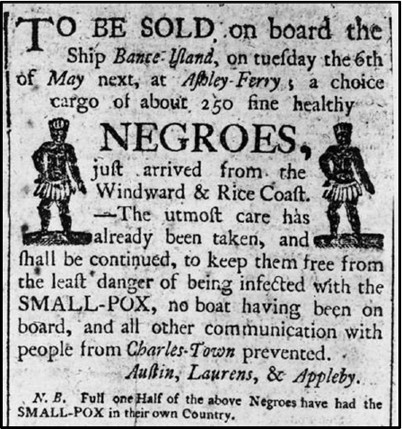
2a: NY Slave Auction Advertisement
undefined
2b: NY Runaway Advertisement


Source: New-York Gazette; or, the Weekly Post- Boy, October 27, 1763

teaching.msa.maryland.gov

Source 3: Inventory from the Will of Frederick Philipse II (1749)

From “New York and Slavery: Complicity and Resistance” Social Science Docket V. 5 N. 2

Vocabulary: Will- distributes a person’s possessions to people they choose upon their death.

Inventory- list of items, goods, products of a building

Men: Ceaser Dimond Sampson Keiser Flip Tom VentureMen not fit for work: James Charles Billy  Boys: Tom abt 9 years old Charles 9 Do Sam 8 Do Dimond 7 Do Hendrick 5 Do Ceaser 2 Do Harry 1 & 4 monthsWomen: Susan Abigal Massy Dina Sue Betty 3 years old a girl  
2 Silver Tankards 1 Do Mugg 6 New Silver Spoons 6 old Ditto 1 Silver Teapott 6 Silver forks 1 Do pepper box(In the Garrett) April 19th 1750 6 flax Spinning wheels 2 Woll . . . Do 1 old gun Some wool & Tow a Miners pick Ax 4 Siths & 2 handles a flax Reel a pr of old scales and weights Some old baskets and old Cask a tin Cullender

Source 3: Guiding Questions

  1. What is an “inventriy?”
  2. Whose “will” does this inventory belong to?
  3. Where does this person live?
  4. What “goods” are described in this inventory? Does this surprise you?

Source 4: Why did some New Yorkers support slavery?

Vocabulary: clergyman- religious leaders

1. It was said that in New York City the rich merchants, politicians, and clergymen were completely tied into the economic system of [using slave] labor for profit. The sugar [factory] businesses first based in Manhattan and then in Brooklyn relied on those crops grown by slaves. The New York merchants provided the money and operated the Southern cotton trade:  “Cotton production by slaves in the South was a major source of profits and employment for shipping, banking, insurance, and textile (cloth) industries that were based in New York.”  
2. Roman Catholic Archbishop John Hughes in a sermon at the old St. Patrick’s Cathedral “cited passages from the Gospel (Bible) . . . to justify slavery, comparing the slave master to the father of a family. Hughes claimed to recognize “slavery as an evil” but declared that it was “not an absolute . . . evil” because it brought Africans to Christianity.

Source: “New York and Slavery: Complicity and Resistance” Social Science Docket V5 N2

Source 4: Guiding Questions

  1. According to the document, what did the sugar factory business rely on from enslaved Africans?
  2. What other economic areas relied on enslaved people’s labor?
  3. What did Archbishop John Hughes use to justify the slave system?
  4. Why do you think supporters of the slave system would use the Christian Bible to justify slavery?

Source 5: New York’s first slave code (1702):

Slave codes are laws to limit the rights of enslaved people. Below is an excerpt from the New York General Assembly (lawmakers).

REGULATING OF SLAVES IT ENACTED BY HIS EXCELLENCY THE GOVERNOR AND COUNCIL AND REPRESENTATIVES convened [gathered] in General Assembly, and by authority of the same, That no Person or Persons hereafter throughout this [colony], do presume to trade with any [enslaved person] either in buying or selling, without…consent of the Master or Mistress [slave owners], [if they do they would have to pay] triple the value of the thing traded for… to the Master or Mistress of such slave . . .

AND BE IT FURTHER ENACTED by the authority, That [now] it shall…be lawful for any Master or Mistress of slaves to punish their slaves for their Crimes and offences at Discretion, not exceeding to life.

Source: “New York and Slavery: Complicity and Resistance” Social Science Docket V. 5 N. 2

Source 5: Guiding Questions

  1. What are slave codes?
  2. When were New York’s first slave codes adopted?
  3. Why do you think they needed to create laws to:
    1. Not allow traders to trade with enslaved people without their owners knowing?
    1. Allow slave owners to punish their enslaved people?

Graphic Organizer: Why did some New Yorkers support slavery?

Directions: Use this chart to organize your information when you review each document.

DocumentPrimary or SecondaryHow does it support the slave system?Evidence
1- Universal HR   
2a   
2b   
3   
4   
5   

Formative Task Activity: Pretend you are a Human Rights Advocate. Write a persuasive letter to the 1702 NYS General Assembly of New York, making the claim that slavery violates the “Universal Declaration of Human Rights.” In your letter include evidence from at least two documents from the Gallery Walk to support your claim.

New York State’s Mohawk Code Talkers

During World War II American Indians from 33 tribal groups were recruited by the United States Army as Code Talkers. These soldiers sent send secret messages in codes based on their native languages so that enemy forces could not understand communications between American troops. The word for “turtle” might be used for tank.

The best known Code Talkers were members of the Navajo Nation from the Southwestern United States. There were also Mohawk Code Talkers from the St. Regis reservation in New York State. Mohawk Code Talkers served in New Guinea, the Philippines and the South Pacific. In 2008 Congress passed the Code Talker Recognition Act to commemorate the achievements of all of the Code Talkers.

The St. Regis reservation is known in the Mohawk language as Akwesasne. It is located along both the American and Canadian sides of the St. Lawrence River. Most of Akwesasne and the area with the largest population are located in New York. The Mohawk Nation is one of the Six Nations of the Iroquois Confederacy. They are the “People of the Flint.” The Iroquois Confederacy includes the Cayuga, Oneida, Onondaga, Seneca, and Tuscarora Nations.

Kanien’kéha, the Mohawk language, is a living language. Several Kanien’kéha words and phrases along with English translations are included below. There is an online Mohawk Dictionary at www.kanienkeha.net/ and a spelling and pronunciation guide at www.native-languages.org/mohawk_guide.htm. There is a video with Mohawk pronunciations at www.youtube.com/watch?v=nPRaVOd-UrQ.

Kanien’kéha word or phraseEnglish Translation
Oh nahò:ten iesá:iats?What is your name?
Tó: na’tesohseriià:kon?How old are you?
Sátien tánon tesatská:honSit down and eat
Orhen’kè:ne í:ieks / Énkie / Okara’snéha i:ieksBreakfast / Lunch / Dinner
Ahserí:ie tanon kenenio’kón:niSpaghetti and meat balls
Ka’serehkówa Ratórie’s Ka’serehkowa Iotórie’sTruck Driver (male) Truck Driver (female)
Shakorihonnién:ni Iakorihonnién:niTeacher (male) Teacher (female)
Skén:nen / Karihwakweniénhtshera /Kanoronhkwáhtshera / Atenró:seraPeace / Respect / Love / Friendship
Sekon / Ó:nenHello / Goodbye
Ista / Raké:niMother / Father

Empowering Students to Tackle Fake News

by Michael Catelli and John O’Leary

In today’s global society we are bombarded with sources of information from thousands of different outlets with varying degrees of expertise and knowledge. All consumers of media have heard the term fake news as a catch all term to describe information that is falsified or misrepresented, but not many know what to do about it.  When people have a question, the first step most take is to input the question into Google or to check out social media for a list of relevant links that friends have shared. A study of the 2016 presidential election determined that 62% of adults obtained some of their news through social media (Allcott & Gentzkow, 2017). With the rise of the internet comes easier access to established news sources, but also easier access to unverified information. In a 21st-century classroom, our students need to examine fake news in all its forms which must be integrated through a robust media literacy lens.

One of the difficulties in discussing methods to teach fake news is that the term itself is fluid and ever changing.  In the past, the term fake news was generally used to describe fabricated news, but recently the term has also been used to refer to other types of news typically targeting opinions. To break down some of these complexities for educators, we will divide fake news into two types: falsified news and biased news.

The most obvious use of the term fake news is news that is completely made up, or fabricated news. It could be fabricated to target a specific issue or it may be fabricated based on a rumor that was not validated by a source. The reasons for creating fabricated news may be as varied as the fake news itself. It may be for political motives, for profit, or an author provoking responses for their own amusement. It is important to note that there is a difference between fabricated news and news that was reported, but turned out to be wrong—rather, fabricated news refers to news that is intentionally falsified. What’s more, the term fake news is frequently thrown around as a means of discrediting opposing viewpoints, making the term even more convoluted.  In today’s social media landscape, many fake news sources start as Facebook or Twitter posts, but students must learn essential media literacy skills to test the validity of sources like this and how to confirm information to determine if something is true.

Biased news, or articles that clearly state an opinion, is a more nuanced category that may be labeled fake news by some. It is not inherently false information, but may be called fake by a person with an opposing point of view. Opinion pieces are clear examples of this, as they express a viewpoint which can be disagreed with, the reader’s bias often plays a large role regarding how they view these types of sources. This category can also be applied to more subtle issues, such as news that is trying to change the focus of an issue to distract from debatable points on the topic at hand. These types of articles may attempt to redirect the topic away from relevant facts to focus on a different issue. Critics of an opinion may refer to it as fake news in an effort to bring up a new idea that they want to discuss since the initial opinion may not be favorable to them. Students cannot simply check if a fact is true to assess this type of information, but rather need to examine an author’s voice and argument.

Teachers and schools cannot hide from discussing the concept of fake news because they feel it could be a politically heated. Media literacy, or the ability to interpret and evaluate information from news sources, is an essential 21st-century skill, but this skill has become far more complicated and is ever-changing. Schools cannot simply block fake news websites on their servers or provide a simple list of credible versus non-credible publications—after all, students can still access them outside of school. Also, these strategies fail to teach students how to deal with the issue when they encounter it in their daily lives. Some school districts have approached this topic with their media specialist, but fake news has become more nuanced over time and all teachers need to accept responsibility to teach this topic.  Social Studies educators must make sure students are equipped with the necessary critical reading and thinking skills that will help them evaluate what is credible within the news source. Educators must make sure students are comfortable using strategies outside of the classroom, this is the only way to create real change.

There are many ways to help students be successful with these skills in the classroom. The best way to address fake news is for educators to push their students to make an argument for why they do or do not support a point of view based on credible facts, not just opinion. Educators must work with students to examine how critically they are examining a source, but students must also learn to think about their own confirmation bias (Nickerson, 1998)—in other words, are students giving more weight to an article because it confirms something they want to believe? Students also need to understand the dangers of a filter bubble (Flaxman, Goel, & Rao, 2016) and examine multiple sources of news. If students are only taking in information from sources that support their opinions, they may be stuck in a filter bubble. It can be difficult for students to gauge if they are only getting one perspective, since it can seem like a person in a filter bubble is taking in a lot of information. Staying in touch with news that is different, even counter, to one’s opinion can help them to understand multiple perspectives on an issue. Over multiple days, students can collect information on what media sources and websites they see news from, then create a word cloud using sites like wordle.com to visualize their information sources.

As mentioned previously, a person’s inherent beliefs or bias can play a large role in how they view a particular topic. This can be even more troubling when viewing fake news, since the difficulty of deciphering what is credible increases exponentially. The first hurdle that one must approach with students is making them more self-aware of their own implicit biases. Implicit biases refers to the idea that we all have positive and negative beliefs that affect the way we view certain issues, people, and events. Since we all have these inherit beliefs, the natural reaction for most people is to find information to reinforce what they already believe. Confirmation bias helps explain this idea of why we gravitate towards information that confirms our thoughts and opinions. Social media outlets and search engine filters have made it convenient for consumers to omit information and stories that do not coincide with their opinions and instead selectively choose stories that reinforce their current beliefs and biases.

The cornerstone to helping students understand and decipher fake news can be found in a set of skills often used in the Social Studies classroom: sourcing, close reading, contextualizing, and corroborating. Sourcing asks students to think about who produced the document in order to determine the author’s viewpoint and intentions. Close reading asks students to analyze the language within the text and think about what is said and how it is said. Contextualizing then focuses on when and where the event took place. This helps students place the document into a broader context of what they are reading. Lastly, corroborating allows students to determine points of agreement and disagreement and to compare these points across multiple documents (Whelan & Leon, 2016). This also helps with biased news because students can utilize these skills to see how different pieces of information can create a narrative across different sources.

Once you have established a set of skills necessary for the analysis of informational text like close reading and contextualizing students will be in a more comfortable position to discuss some of the nuances that appear when analyzing fake news. A good way to introduce the topic of fake news is to play a modified version of the game telephone. This game is fun and familiar to students and is a simple way to pull them into the complexity of the topic. In this version of telephone the only difference is prior to the game starting secretly place a student in a location to tell them to spread a false message regardless of what they are told. At the end of the game you can debrief with students to discuss how misinformation can spread so easily either unintentionally or intentionally through fake news sources. This introduction helps enforce the idea with students that just because they hear information for a source doesn’t necessarily mean that it is true, their job as consumers is to know how to decipher who is telling the truth versus who is trying to manipulate their thoughts or opinions.

The next step in teaching fake news is to equip students with a set of strategies they can use to determine whether or not a source they are viewing is a credible news source or falsified in some manner. We would recommend that students use four basic steps laid out in Mike Caulfield’s (2017) Web Literacy for Student Fact Checkers. These are simple strategies to pick up and apply since they leverage the power of the internet to help with the investigation. The first step in this approach asks students to check already established fact checking sites like the ones listed in the appendix section of this article, to see if another source has already analyzed the source in question. The next step students take in this investigative process is to use the power of search engines like Google to find the original origin of the source they are analyzing. Once students have found the source the last step research what others say about aspects of the source such as author and publisher to determine if the source should be deemed trustworthy. If at any point students run into roadblocks, have them return to the original source and search a different aspect of the article to help find the original source (Caulfield, 2017). Once an investigation method has been established it is helpful to practice these new skills with students. A fun and engaging way to do this is by playing a game where students need to detect the fake news story and what makes it fake. If possible, arrange students into teams and share various fake news sources with them electronically. It helps to have a mixture of absurd sources to those that are only slightly biased so students can understand the different iterations of fake news. After each source review with students what makes the source fake or false. It is recommended that you pick some sources that deal with important issues. This is important for debriefing with students at the end of the activity. Picking issues of significance helps students understand the dangers and influence articles and news sources like the ones presented in the attached lesson can have on individuals and communities. 

Common questions that students should ask when analyzing a news source for perspective and bias are: What are the motives or intentions of the author? Why is the reporter’s information credible? Who is the intended audience? What other relevant stories or events have recently taken place? Having students ask these questions about fake news sources will help them start to realize that rarely is any news source completely unbiased. Often the author has their own opinion on the subject, or they may be motivated to get the reader to buy a certain product. By using historical thinking and close reading with news and current events teachers can make a process students often see as tedious feel more connected.

Covering fake news in a classroom will vary depending on time available, objectives, and the level of the students in the class. Using the lesson described above and partnering with your media specialist to discuss the resources and goals you have in mind when having students analyze fake news is a great place to start. Due to the complexity of the topic, the approach that one may take will be influenced by grade level and ability. A media specialist can provide you with school resources you may not know about. If time is a constraint and devoting a full lesson to analysis of fake news is not possible, there are still ways to incorporate the same analysis strategies into other places within the curriculum. Handout One is a tool that can be used either as homework or in class activity to analyze sources that are found online. This could be incorporated into a multitude of different subjects including early explorers. One suggestion would be to show students various new sources regarding who discovered America and have them determine what sources are credible or false.

Lastly, since biased news is so nuanced, a teacher may wish to approach the topic with a long-term assignment. Many politicians and pundits now use various social media platforms like Twitter and Facebook to reach their followers. Have students track the links and language used by these various figures and answer questions about the intent behind their posts. Students could even compare various figures and see how they discuss similar events, or start a Twitter account themselves where they play the role of fact-checkers and correct mistakes or fabrications by these individuals.

Our primary goal as social studies educators is not simply to transfer facts of history, but to help students develop necessary civic discourse and civic engagement skills that will make them productive citizens. Fake news has created an obstacle that our students must overcome if they wish to effectively be part of true civic discourse. Addressing fake news is a complicated task for a social studies educator. It is a multi-layered issues that requires multi-layered approaches to be able to tackle in a classroom. The risks, however, of not addressing it in classrooms are too great. Students will come across falsified news or extremely biased news when they are not in school, and they must be equipped with the tools to be able to address that situation.

References

Allcott, H. & Gentzkow, M. (2017). Social media and fake news in the 2016 election. Journal of Economic Perspectives, 31(2), 211 – 236.

Caulfield, M. (2017).Web Literacy for Student Fact-Checkers. (n.p.) Author

Flaxman, S., Goel, S., & Rao, J. M. (2016). Filter bubbles, echo chambers, and online news consumption. Public Opinion Quarterly 80(Special Issue), 298 – 320.

Nickerson, R. (1998). Confirmation bias: a ubiquitous phenomenon, many guises. Review of General Psychology, 2(2), 175 – 220.

Whelan, S. & Leon S. (2008). Model of historical thinking. Loudon County Public Schools. www.chnm.gmu.edu/tah-loudoun/wp-content/guidelines/historical-thinking.pdf

Appendix A: Teacher Resources

1.  Media Bias/Fact Check: A website that looks at the bias of various news sources- https://mediabiasfactcheck.com/

2.  Lead Stories: a website that debunks fake news stories using international fact checking sites- https://leadstories.com/

3.  FactCheck: a website that fact checks mostly political news stories- https://www.factcheck.org/fake-news/

4.  Snopes– A fact checking website that looks at a verity of topics- https://www.snopes.com/

5.  Web Literacy for Student Fact Checkers- a book that provides helpful tips on how students can become fact checkers- https://webliteracy.pressbooks.com/

6.  William Paterson University Library– Tips from media specialist on how to determine the validity of a source- https://guides.wpunj.edu/fakenews

7.  Pace University Library- Tips from media specialist on how to determine the difference fake and real news- https://libguides.pace.edu/fakenews

8.  Politifact- Fact checking website that looks at the truthfulness of political news stories- https://www.politifact.com/truth-o-meter/

9.  PBS News Hour: Contains lessons regarding the topic of fake news and how analyze the news. Includes lessons for grades 7-12. https://www.pbs.org/newshour/extra/tag/fake-news/

10.  TedEd Damon Brown: A short video that gives helpful hints regarding how to approach the news and tips to ensure that you are being a smart consumer of information. https://ed.ted.com/lessons/how-to-choose-your-news-damon-brown#watch

The Role of the Aesthetics within Advanced Placement History Courses

by Georgia Belesis

Art is a universal language shared by all civilizations, despite their regional, social, cultural, and economic differences. Learning history from art, changes the way history has been documented, since artistic masterpieces reveal a history that has collectively and equally been created by both males and females belonging to all socio-economic spectrums of society (Eisner, 1991). Aristotle defined art, as “capacity to make, involving a true course of reasoning,” (p.143), emphasizing that the predominant objective of art is to externally represent the internal beauty of an individuals’ endoskeleton. Art is perceived to be the first form of reasoning and communication that an individual has with the visible world.  Correspondingly, the history of humanity has depicted that the earliest forms of artistic expression and communication were illustrated almost 75, 000 years ago in the caves of Lascaux, Chauvet, and Altamira. Therefore, the study of history through the aesthetics becomes the literal bridge that unifies the individual with their origins.

What are the Aesthetics?

The aesthetics are a field of study, concentrated upon the interrelated studies of the arts, music, literature, drama, visual arts, and philosophy. Aesthetic education is defined by Maxine Greene (2018) as “a process of initiating persons into faithful perceiving, a means of empowering them to accomplish the task—from their own standpoints, against the background of their own awareness” (p.45). As a veteran pedagogue of Advanced Placement World History courses who integrates the aesthetics within their instruction, I have witnessed through my own students, how the aesthetics have gradually developed their historical literacy and have also assisted them to obtain a three or better in the AP World History Examination. Therefore, I have determined based on my own pedagogical justifications and evidence-based research, that aesthetic-based teaching and learning practices have a significant impact upon Advanced Placement History Courses, since students can become emotionally connected to the past, develop their historical literacy and advance their academic performance in their Advanced Placement examinations. 

How does aesthetic-based instruction within AP Courses impact students’ historical literacy and academic performance?

Aesthetic-based teaching and learning practices within Advanced Placement Social Studies Courses can emotionally connect students to the past. Historians are artists and artists are historians, since according to John Dewey (1988), “Artists have always been the real purveyors of news, for it is not the outward happening in itself which is new, but the kindling by it of emotion, perception, and appreciation” (pp. 183-184). Through works of art students become engaged in a continuous cycle of discovery between the visual, personal, and historical dimensions of that masterpiece (Greene, 2018).  Learning history through the arts, “makes perceptible, visible, and audible that which is no longer, or not yet perceived, said, or heard in everyday life” (Marcuse,1977/1978, p.72), (Greene, 2018, p.49). Therefore, having students think “aesthetically” not “anesthetically” (Greene, 2018, p.49).  The art of teaching is the art of questioning, which can inspire an individual to discover the unsung voice of their endoskeleton. Brooks (2013), states that “young learners have the opportunity to develop and display historical understanding when they are given the chance to formulate their own questions about the past, to examine related historical evidence, and to create historical narratives and arguments of their own” (p.61). 

Art and history educators must design open-ended questions about particular pieces of art, about “art in itself and about its place in the art of human life” (Greene, 2018, p.37). Only if educators do so Greene (2018) claims, “they are likely to clarify what they bring about in their classrooms, whether they call it enhanced awareness, heightened understanding, enlightenment, or a new mode of literacy (p.37). When bulletin boards of history classes, become draped by eminent pieces of art, by Leonardo da Vinci, El Greco, Francisco Goya, Paul Cezanne, Claude Monet, Pablo Picasso, Frida Kahlo, among others, students become conceptually and emotionally inquisitive to learn about the art and the individuals concealed behind these illustrations (Greene, 2018).   

 History can be interpreted differently by an individual, through the distinct instrument of art (Eisner, 1991).  Many students are visual learners, and when they study artistic masterpieces or graphic novels, they become socially and emotionally connected to these images because they directly relate them to their personal lives and become inspired to learn more about the history concealed behind those illustrations. Terrie Epstein (1997) who is an adherent of Elliot Eisner’s educational ideology, correspondingly argues that by integrating the arts into the history curriculum, educators are stimulating students to connect with the past through the process of historical empathy. “The music of the slaves, the myths and stories that were a part of their lives, their folksay, programs like Roots, the music and dance of the period, the architecture of their quarters, and those of their masters, are all relevant sources for enlarging understanding (Epstein, 1989, p. 253). Accordingly, Anne McCrary Sullivan (2000) claims that, “aesthetic vision suggests a high level of consciousness about what one sees… Teachers who function with aesthetic vision perceive the dynamic nature of what is unfolding in front of them at any given moment” (pp. 220-221). The epicenter of aesthetic education starts and continues with the cognitive and emotional pathos of the instructor, that is reflected upon the students; therefore, Greene (2018) states, that learning becomes paradigmatic, since it is stimulated by the desire to explore, to find out, to go in search” (p.47). History educators teaching Advanced Placement courses, should have the “aesthetic vision” to design intellectually stimulating lessons that encourage students to not only evaluate the history related to the aesthetic masterpieces but investigate their meaning and connection upon their lives. Through the instrument of aesthetic education students in history courses will comprehend that the past was not an invisible world, but a visible world that transcended to the present through the contributions of individuals who chose to become agents and recipients of change (Greene, 2018).  Pedagogical creativity that is enhanced through the aesthetics, develops both cognitive and emotional intelligence and fosters the foundations for a learners cognitive reframing since they provide a positive and rational approach of explicating an individual’s concealed endoskeletons.   

How do I implement Aesthetics into my Advanced Placement History Courses?

When I teach the Spanish Civil War in my AP World History Course, I introduce the lesson through the visual window of Picasso’s Guernica, which was his most renowned masterpiece. The lesson is an introduction to the concept of war through the critical lens of political art; exposing students to the dehumanization of war that plagued Europe and the International Community from 1936-1945. Imperatively, through this lesson, students evaluate how art can be utilized as an instrument to not only illustrate history but essentially act as a defensive symbol for social and political changes.  Therefore, through the aesthetics, students are analyzing and interpreting significant multi-faceted historical pieces of the social, cultural, political, and economic progression of humanity.  Subsequently, another lesson that I have designed for my AP World History Course requires students to design a virtual interview with three earlier or contemporary philosophers or artists.  For example, Through the evaluation of Plato’s, Leonardo da Vinci’s and Nikos Kazantzakis’, perspectives of art, students can recognize the predominant role the aesthetics have within the development of transformative knowledge. These scholars of aestheticism collectively perceived that art is a visible expression of the invisible fragments concealed within an individual’s mind and soul.  The instrumental and communicative domains of Mezirow’s (1991) transformational learning are evident within each of their ideology since they all, distinctly interpret art as an expression of cognitive and emotional intellect. The conclusions that can be retrieved from this interview is that every individual is an artist; whether they exemplify Plato’s true artist, da Vinci’s artistic scientist, or Kazantzakis’ hero-warrior artist; as human beings we innately acquire the capability of accomplishing the impossible-if we correlate the power of our minds, bodies, and souls. Consequently, art becomes the unifying bridge, which reveals the beauty of the endoskeleton through the instrument of our exoskeleton.

Correspondingly, to my aesthetic-based history instruction, Pulitzer Prize winning author, Art Spiegelman, argued that “Comics are a gateway drug to literacy”.  For a history instructor, comics are an alternative pedagogical approach to develop and improve a student’s historical literacy (Robinson, 2011). Primarily, the topic I incorporate comics, through the instrument of a graphic novel within my AP World History Course, is the Arab-Israeli Conflict. The Middle East has historically been inundated as a region encompassed by religious and geopolitical dispute; it has been the primary focus of conflict that continues to have an international impact. Therefore, I have designed a summative unit project that is based upon students aesthetically formulating their own resolution to the multi-faceted Arab-Israeli Conflict (Robinson, 2011). The graphic novel that this project is culminated upon is Joe Sacco’s ‘Palestine’.  I first have students read the novel individually, and then I have them critique it within their designated groups (Nass & Yen, 2012). After students have examined the novel-using it as a prototype, in addition to both primary and secondary sources, as contextual evidence, students design and illustrate their own resolution to the Arab-Israeli Conflict through the construction of a graphic novel. Subsequently, within their groups-each student is responsible for at least one visual component of the graphic novel (Nass & Yen, 2012).  Art is the visual passage to history; directly linking the past with the present. Art is a universal language shared by all civilizations, despite their regional, social, cultural, and economic differences. Learning history from art, changes the way history has been interpreted, since it had been initially written from the male point of view. However, artistic masterpieces reveal a history that has collectively been created by both men and women and by individuals belonging to all socio-economic spectrums of society. Fundamentally, art represents the soul of society, it represents as Aristotle says, “the inward significance” of a society, and individuals can interpret it any way they want.       

 Aesthetic-based teaching and learning practices within Advanced Placement History Courses can also develop students’ historical literacy.  The foundations for inquiry- based learning were first designed by Socrates whose method of questioning has established the conceptual framework for inquiry- based instruction.  The case study conducted by John K. Lee and referenced by Yaeger & Davis (2005) evaluated the teaching methodology of AP European History instructor Mike Nance, who despite the pedagogical challenges he encountered with standardizing testing, his pedagogy focused upon the high order historical thinking of his students through inquiry-based instruction.  Nance’s lectures encompassed dialectical discourse, which is a form of interactive explanatory pedagogy, and supports student’s conceptual and emotional interests (Yaeger & Davis, 2005).  The framework of aesthetic education and aesthetic thinking is fostered upon questioning, “and the questions must multiply and not be covered by the answers” (Greene, 2018). Through inquiry-based instruction, students’ can develop their high order historical thinking in high school history classes that execute high stakes examinations.Nance’s lectures are a historical narrative focused upon the central theme of the lesson which transcend into student discussion by the level of questions that he asks his students.  Nance’s primary instructional objective is to develop his student’s historical literacy, and he accomplished that, by facilitating critical thinking through questions aligned with Bloom’s Taxonomy; questions that alternatively teach, not test students about history (Yaeger & Davis, 2005).  Through the obscure knowledge of the textbook, students in high school history courses have been taught to objectively study the contextual work of the source without evaluating the point of view of the author or inquire about the reasons why they wrote their work (Epstein, 1997). Accordingly, to Nance’s (Yaeger & Davis, 2005) pedagogical ideology and instruction of his advanced placement course, Eisner (1991) argues that social studies textbooks can severely limit the development of students’ historical literacy.  “Thus, attention to the arts, to music, to literature in social studies programs is not a way to gussy-up the curriculum.  It is a way to enlarge human understanding and to make experience in the social studies vivid” (Eisner, 1991, pg. 553).  Correspondingly, to Nance’s (Yaeger & Davis, 2005) pedagogical approach, inquiry- based instruction is established in my AP world history course through dialectic discussions such as Socratic seminars. During the execution of my Socratic seminars, my students possess the autonomy to question, comment, and argue historical sources in an ethical and democratic methodology; in which they listen, respect, and are tolerant and empathetic of each other’s commentary. Through the critical discourse of Socratic seminars, one can interpret and question the validation of empirical knowledge. Consequently, with Socratic seminars my learners become active participants of an ethical democratic society. 

Analogously, to Nance’s (Yaeger & Davis, 2005) case study and Eisner’ (1991) ideology, in 1991, Epstein (1997) formulated a two-week American history curriculum in a Boston high school to develop students’ comprehension of the slavery period in America, through the implementation of television programs, stories, myths, music, visual art, and poetry. Through the student feedback collectively retrieved from interviews and questionnaires, Epstein (1997) argued that students commented on how the aesthetic-based curriculum provided them with a feeling and vivid illustration on what slavery was like as opposed to the summary and subjective account of facts documented in their textbook. Through this discipline arts-based integration students, Greene (2018) claims that educators can initiate their students “into what it feels to live in music, move over and about in a painting, travel round and in between masses of a sculpture, dwell in a poem” (Reid,1969, p.302), (Greene, 2018, p.8). Correspondingly, to both Eisner (1991), Epstein’s (1997) studies, and Greene’s (2018) studies, Laney (2007) in the article, Jacob Lawrence’s the migration series: Art as narrative history argues:

The natural affinity of the arts and social studies is obvious. Society and culture impact the arts, and the arts impact society and culture. The arts are a reflection, of cultural heritage, serving as vehicles for expressing diverse view- points within democracy…….Discipline-based arts educators and comprehensive arts educators advocate using works of art as organizing centers for interdisciplinary instruction. In the discipline-based arts education approach, students analyze a work of art through art history (including general history and social studies), art criticism, aesthetics, and art production. Comprehensive arts education expands the integrated approach to include nonvisual forms of art such as music, drama, theater, dance, movement, and literature…”(pg. 131).

Educators as myself who are teaching AP World History courses can utilize the studies by Epstein (1997), Laney (2007) and Greene (2018), to integrate poetry, while teaching historical content within their courses. One of the achievements that distinguish the Tang Dynasty and identify the rise and decline of their civilization is their literature. Poets such as Li Bo and Tu Fu are still considered the greatest poets produced by the Chinese civilization.  Through the study and analysis of the Tang’s cultural advancements- with the principle case study being Chinese poetry, students will comprehend how the Golden Age of the Tang Dynasty changed China politically, economically, socially, and culturally. Students will also develop their cognitive skills for historiography, since they will analyze the poetry of the two predominant poets of the Tang Dynasty and evaluate the commonalities and differences of their work.  Primarily, the intent for this lesson is for students to comprehend how primary sources such as poetry can reveal the political, economic, social, and cultural aspects of any earlier or contemporary civilization, which are integral to their academic performance in the AP World History examination. Consequently, through this aesthetic lesson students, will be able to collectively develop their aesthetic and historic literacy, by emotionally and conceptually connecting to the literary arts.

Service learning has become an integral constituent within the nation-wide school curriculum and specifically within the Social Studies and Advanced Placement world history curriculum. Dr. Rahima Wade (2008), has analytically evaluated educational research on service learning, defining service learning, it’s “rationale”, and application within Social Studies education. According to the Alliance for Service Learning in Education Reform (ASLER):

Service Learning is a method by which young people learn and develop through active participation in thoughtfully organized service experiences: that meet actual community needs, that are coordinated in collaboration with the school and community, that are integrated into each young person’s academic curriculum, that provide structured time for a young person to think, talk and write about what he/she did and saw during the actual service activity, that provide young people with opportunities to use newly acquired academic skills and knowledge in real life situations in their own communities, that enhance what is taught in the school by extending student learning beyond the classroom, that help to foster the development of a sense of caring for others (pg. 111). 

This type of learning provides an external learning experience for the student, therefore coercing them not only to academically excel, but to become present and future active civic and political members of their society. Therefore, for my AP World History Course, I have designed an aesthetic- civic based simulation lesson on the Party Negotiations within the Conference of India between 1930-1932.  These series of conferences were organized by the British Government to deliberate constitutional reforms in India. Accordingly, I divide my students into the four political and religious parties of India, to diplomatically evaluate, deliberate, and argue with their opposition about the formulation of an equitable central government for India, that would equally support all of their rights. My instructional methodology is constructed upon student directed instruction, however as the moderator and facilitator of this simulation, I will ensure that all my students explicate their intellectual excellence, guiding and encouraging them within their groups to thoroughly develop their arguments (Robinson,2011). The design and execution of this simulation focused upon my learners exhibiting high order historical thinking and substantive critical discussion within their groups and with their adversaries; as they struggle to develop governmental policies that would collectively support their and their oppositions political interests. Through this activity my students developed their cognitive skills, because they utilize historical evidence, such as the philosophies of the political and religious parties in India to create decisions that will have prolific social and political implications upon society.  Through this simulation, students examined and comprehended the developmental stages of government policy, regardless if these policies were created in India and not in the United States. For instance, a group designed their central government, within the political framework of the United States. Imperatively, through their group deliberations, students not only evaluated the ideology of their parties, but also of the lawmaker, who arduously struggles to find possible resolutions to impossible issues. These young adults through this simulation exercise, became the actual policy makers, and become challenged by the political and religious issues in India, that still remain unresolved today. Subsequently, this particular aesthetic- based inquiry lesson inherently synthesizes the pedagogical ideologies of Dr. Wade’s (2008) service learning approach and Cornel West’s (2008) democratic paideia, since my students became inspired to pursue their civic involvement in the future, and have the education, experience, and passion to develop a more progressive democratic American society and international community(Robinson,2011).

Aesthetic-based teaching and learning practices within Advanced Placement History Courses can also contribute to the advancement of their academic performance in their Advanced Placement examinations. Within my AP World History Courses, ever since I started integrating the aesthetics four years ago within my instruction, I have identified significant one to point increase within my students’ examination scores. Concurrently, along with the aesthetics and questioning, the impact of my student’s scores also derived from their intensive writing. Along with questioning, the integral component of teaching history is writing. Intensive writing was another key feature of Nance’s instruction and the essential foci of Advanced Placement History examinations.  In Nance’s course students independently and interdependently worked on essays, that he gave as assignments in advance so that they could formulate study groups (Yaeger & Davis, 2005).  Nance also offered personal and public commentary to students about their essays; perceiving that through the discussion of his student’s weaknesses in writing they can autonomously and collectively improve their historical thinking and writing (Yaeger & Davis, 2005).  Analogously to Nance’s (Yaeger & Davis, 2005) methodology another innovative aesthetic assignments that I integrate within my AP course having my students write weekly reflective journal entries of their academic triumphs, challenges, and personal interests within the AP course. During the closure of every Friday’s class, my students, through the means of critical dialectical discourse collectively discussed their journal entries with, myself and each other; critically reflecting and learning autonomously within an interdependent team of learners, that contributed to their overall intellectual and emotional excellence within the course. After the conclusion of each of my AP classes on Friday afternoons, I documented the strengths and weaknesses of each of my lessons in my academic journal, through the journal responses of my students. Through the documentation of my students’ journal entries, I aesthetically aspired to utilize my content reflection of my student journal entries as an instrument towards the development and reconstruction of my instructional methodology. Subsequently, I also applied my student’s journal responses as an instructional framework to design inquiry-based pedagogical activities that could explicate my student’s intellectual and emotional creativity; lessons that intertwined with their personal historical interests and develop their historical literacy.  Comparatively, to Nance’s (Yaeger & Davis, 2005) study, Eisner states:

“Like the arts, the school curriculum is a mind-altering device; it is a vehicle that is designed to change the ways in which the young think…Each of the different art forms participates in a different history, has its own features, and utilizes different sensory modalities. By learning to create or perceive such forms, the arts contribute to the achievement of mind”. (Eisner, 1991, pg.16).

Within this discipline, arts-based integration students are not only expected to think like historians, but they are also able to distinguish between diverse historical sources and argue their evidence within Advanced Placement History courses. Lastly, through an inter-disciplinary art-based pedagogical approach, such as the one advocated by Eisner (1991), Epstein (1997), Laney (2007), and Greene (2018), within Advanced Placement History courses students will develop their high order historical thinking and writing skills and consequentially improve their examination scores, as my students have gradually accomplished.

Conclusion

“The successful search for knowledge requires the ability to analyze a line of reasoning and evaluate a work of art. It requires honesty, the willingness to question one’s beliefs, and the willingness to subordinate personal desires and preconceptions to the dictates of logic” (Markie, 2004, pg. 487).  Aesthetic-based instruction provides an internal learning experience for the student, coercing them not only to academically excel in their AP History courses and examinations, but to also become present and future active civic and political members of their society. Correspondingly, Aesthetic-based instruction is also reflective of Cornel West’s (2008) concept of a democratic paideia; which is a form of education in which learners perceive themselves as agents of change; comprehending that they can make mistakes, learn from them, and consequently utilize that new-found knowledge to collectively empower their lives and the lives of others (West, 2013).  Greene (2018), quoting Sartre states:

“at the heart of the aesthetic imperative is the moral imperative” because “the work of art, from whichever side you approach it (1949, pp.62-63) is an act of confidence in the freedom of human beings.  We feel that freedom here—to interpret, to reflect, and (now and then) change our lives” (p.198).

Fundamentally, aesthetic education within Advanced Placement History courses will provide students with the skills of empirical and aesthetic excellence to restructure the ethical utilitarian framework of the international community; that is essentially embedded upon the socio-economic happiness and prosperity for all human beings.  Through the ideals engrained by an aesthetic -based education the current trend of “The Millennial Generation insisting on solutions to accumulated problems and injustices, and an emerging Generation E calling for equilibrium” (Marx, 2006, p. 48) will be achieved through the disciplines of history, philosophy, literature, the visual arts, music, and religion (Sullivan & Rossin, 2008).  Consequentially, students will apply their aesthetic knowledge within any career path they decide to embark upon in the future.

References

Aristotle (2007). “The Nicomachean Ethics”, p.143, Filiquarian Publishing, LLC

Brooks, S. (2013). Teaching for Historical Understanding in the Advanced Placement Program: A Case Study. The History Teacher, 47(1), 61-76. 

California State University Sonoma. (2008). Cornel West.  Retrieved from: www.youtube.com/watch?v=9ZzWWq_rQt8   

Dewey, J. (1988). The Public and Its Problems: Athens, OH: Swallow Press.

Eisner, E. W. (1991). What the arts taught me about education. Art Education44(5), 10-19.

Epstein, T. (1997). Social Studies and the Arts. The Social Studies Curriculum, 235.

Greene, Maxine. (2001). Variations on a blue guitar: The Lincoln Center Institute lectures on aesthetic education. New York: Teachers College Press

Markie, P. (1994). A professor’s duties: Ethical issues in college teaching. Lanham, MD: Rowan & Littlefield Publishers, Inc.

Marx, G. (2006). Future focused leadership: Preparing schools, students, and communities for tomorrow’s realities. Alexandria, VA: Association for Supervision and Development.

McCrary, A. S. (2000). Notes from a marine biologist’s daughter: On the art and science of attention. Harvard Educational Review, 70, 211–227.

Mezirow, J. (1991). Transformative dimensions of adult learning (1st ed.). San Francisco: Jossey-Bass.

Robinson, K. (2011). Out of our minds: Learning to be creative. West Sussex, UK: Capstone Publishing Ltd.

Yaeger, E.A. & Davis, O.L. (Eds.). (2005). Wise social studies teaching in an age of high stakes testing: Essays on classroom practices and possibilities. Greenwich, CT: Information Age Publishing.

Americans Growing Mistrust in Government and Media Paralleled to the Decline of Victory Culture

by Kyle Stapinski

America has seen many hills and valleys when it comes to trust in media and government. Beginning with the Comstock laws of the late 1800s where Americans were subject to mail subversion to prevent the spread of “reproductive products”, Americans have typically been at the cannon’s mouth of both the government and the media. As the Comstock laws declined, American trust in government was never fully restored. During the early 1900s, Muckrakers would survey the United States, and uncover some of the social equalities they found. This was one of the first major pushbacks against the current state of news media. What was being reported prior to the Muckrakers sphere of influence was typically what the government or military was doing. After the Muckrakers revolution before the First World War, this elitist-style of reporting would quickly be paralleled to reporting the “average Joe”—the everyday American and their struggles.

            According to Tom Engelhardt, the post-World War II period was comprised of a declining victory culture, where Americans would spend the second half of the twentieth century learning how to lose. The theory of victory culture is used to promote the idea that before the Cold War and Korean conflict, Americans were used to victory, so used to it that it was engraved into American culture. America also required an enemy, according to this theory, that would prove itself over the latter half of the century. After the decline in German and Japanese influence, America was hoisted to the pedestal of a world stage, where it would find itself assuming a role way beyond its borders. Now America was responsible for instilling a system to restore the destroyed world. The United Nations was created to fill this gap, but the United States held many of the responsibilities of the United Nations.

            This decline of victory culture, beginning with the Korean Conflict and continuing until today, can be viewed through the lens of news media. Media has always been a major contributor to the American war effort, but Korea is the first time during this technological era where America was not as blatantly victorious as they had been before. Also, with the looming communist ideology also in competition on the world stage, America found itself stretched thin in terms of influence and deemed it necessary to save the free world. Korea was more than just a foreign civil war. American press coverage of the Korean Conflict varied differently than the previous major military conflicts. At first, the American press was encouraged to report the war in its totality. The government figured it would be a quick conflict, where America could continue its running victory culture, but through the following years they come to a different result.

            Since the UN forces were successful in their push against the North Koreans, General MacArthur and the American government were fine with this total style of reporting. The New York Times provides two different style of articles during the early days of 1951. First, the article titled Korea Front Calm before Offensive discussed what United Nations’ soldiers were doing on New Year’s Day, 1951. Not even a week after, the New York Times released another publication titled Korea censorship Tightened Again which highlights some of the legislative changes paralleled to the military defeats in Korea. As the North Koreans began to challenge the UN forces, censorship was strictly imposed, even to where censors were appointed to read any and all information leaving Korea. This created a state where the media was less free to report what they wanted and had to submit to MacArthur’s wishes. He claimed it was for the security of the military but had no problem with the same information being published while they were on the offensive. This strict censorship remained in place until the deportation of United Nations’ troops in 1953.

            A decade later, the United States is attending another civil war overseas to prevent the spread of communism in Vietnam. The reporting of Vietnam was drastically different than that of Korea, not just the style of reporting but media technologies as well. The television was much more common in houses now than during the previous Korean conflict, and Americans are generally more exposed to these atrocities. Aside from the technologies, the style of reporting varied as well. The military did not want to repeat its stance on media that it underwent during the Korean conflict, but instead would call for a more open press. When reporting any war, it can be dangerous, and reporters often find themselves alongside soldiers in these sticky situations. Vietnam is no exception, but compared to a majority of previous American conflicts, the guerilla fighting style of the North Vietnamese’s made for a more total war. Reporters would have to rely on the flow of information from the top, so the stories they were actually able to report were often identical to that of other publication companies, but with their own little twists.

            Americans decline in trust of these major establishments is severely strengthened during the Vietnam conflict, and the following greater Cold War. The mishaps in publication made for incomplete stories, and as the American people would realize that media and government were not always on the same side, they began to question the integrity of these establishments. The overall declining victory culture set the stage for Americans to lose faith over time and can be observed through News Media and war time press.

            Today, Americans are continuing this growing mistrust in government. Fake news is a major talking point, and people are generally aware of the declining credibility of media and government. Being a Secondary Education and Social Studies teacher would constitute talking about these modern political issues in class. Students will always have questions about the world around them, but to better equip them to understand the current relationship between the people, government and media is essential. This research can be broken into a lesson, where students view print media publications prior to, and after the Second World War. Students could compare the different media corporations or discuss specific individual articles. The style of reporting prior to the second world war is generally more in favor of the United States government then after, due to the decline of victory culture. By comparing these articles, students will be able to identify this overall decline on the positive outlook of government and can trace how it formed the current day political and news media scene.

            Another way to teach this concept would be to have students compare magazine or newspaper articles from the Korean or Vietnam wars. Here, there are many events that received media coverage, and students can take the same event and compare different companies’ reports on that event. This will help contextualize biases within reporting and can contribute to a greater unit about credibility of sources. All of these skills are necessary for successful history students, and twenty-first century citizens.

References

“Nixon has no Peace Plan, Says Harriman.” (1970). Chicago Tribune, May 08, 1970. Retrieved from http://library.rider.edu:4048/login?url=https://athena.rider.edu:2278/docview/169857897?accountid=37385.

“Tiny Peorian Outtalks 19 Nazis; Nabs All.” (1944). Chicago Daily Tribune, Jan 10, 1944. Retrieved from http://library.rider.edu:4048/login?url=https://athena.rider.edu:2278/docview/176921012?accountid=37385.

“After the Tet Offensive.” (1968). New York Times. February 8, 1968. Retrieved from https://timesmachine.nytimes.com/timesmachine/1968/02/08/88925050.pdf

 “Korea Censorship Tightened Again.” (1951). New York Times. January 7, 1951. Retrieved from https://timesmachine.nytimes.com/timesmachine/1951/01/07/87088432.html?pageNumber=14.

 “Korea Front Calm before Offensive.” (1951). New York Times. January 1, 1951. https://timesmachine.nytimes.com/timesmachine/1951/01/01/89765923.html?pageNumber=2.

 “U.S. Group to Push Free Press in UNO.” (1945). New York Times. December 30, 1945. Retrieved from https://timesmachine.nytimes.com/timesmachine/1945/12/30/109349330.html?pageNumber=1.

Engelhardt, T. (1995).  The End of Victory Culture: Cold War America and the disillusioning of a generation. Amherst: University of Massachusetts Press. www.jstor.org/stable/j.ctt1cx3t0j.

The Impact of Eliminating the New York State Elementary Social Studies Assessment

by Scott Eckers

High-stakes testing policies have reduced elementary-level instructional time for untested subjects, raising questions about the extent to which students’ content knowledge in social studies has been compromised. My research compared social studies assessment performance of two student cohorts from the same New York State school district, one required to take a state assessment (2009) and one eight years after its elimination (2017). Students in the later cohort produced significantly lower overall achievement scores and lower scores on most sections of the test, including skill-based constructed-response items and four of five strands of social studies content tested with multiple choice items. Special Education students in the later cohort produced lower scores on all sections of the test and were impacted approximately twice as much on constructed-response items. Findings suggest that social studies curriculum as prescribed by the state was not taught as thoroughly in elementary schools following elimination of the state test. Recent instructional trends applying literacy skills to social studies have been insufficient to mitigate deleterious effects associated with elimination of the assessment.

Students were assessed on overall content knowledge and achievement in five strands of social studies (United States and New York History; World History; Geography; Economics; Civics, Citizenship, and Government) using content-based multiple-choice questions and skill-based constructed-response questions. Controlling for gender, ethnicity, and disability status, there was an 11.0% reduction in overall social studies knowledge from the 2009-2010 to 2017-2018 school years. Students had a greater drop on the multiple-choice section than they did on the constructed-response section (12.9% and 8.7%, respectively). This suggests that students were affected by the elimination of the assessment but were not affected equally on all components of social studies. Although students in both cohorts exhibited lower scores on the multiple-choice section than on the constructed-response section, the content-driven questions on the multiple-choice section of the assessment were more problematic for the 2017-2018 cohort than the skills-driven questions on the constructed-response section. The elimination of the assessment had a larger effect on aggregate multiple-choice achievement than on constructed-response achievement.

Within the multiple-choice section, the elimination of the assessment affected different strands of social studies unequally. Students had the largest drop (21%) in knowledge on historical facts related to United States and New York History, the strand of social studies featured most prominently in the curricula of the fourth and fifth grades. Strand 5 (Civics, Citizenship, and Government) is also a major part of the fourth and fifth grade curricula. Students learn, for the first time, the basics of how the United States government was founded and how the Constitution helps guide the nation. The study showed a 12.7% reduction of knowledge on this strand. Student knowledge of economics (the study of money, trade, and scarcity) dropped 11.5%. Given these clear reductions, there is a strong reason to believe that the core curriculum as prescribed by the New York State Education Department (1998, 2014) was not taught as thoroughly as when the students were assessed on the same material in years past. This affected basic knowledge and appreciation of American society and government, civics, history, and economics.

The strand of social studies affected the least by the elimination of the assessment was World History. Only three questions on the assessment addressed the World History strand, which may not have been enough to draw solid conclusions. Additionally, the study of foreign cultures and world civilizations is not stressed until sixth grade, the last year of the New York State elementary curriculum. Since the basic curriculum guide has not changed in decades, it would stand to reason that World History was the most inconsequential strand of social studies on a fifth-grade assessment and the one least likely to have been affected by its elimination.

Social studies is not simply about names, dates, and facts. Students are expected to improve their literacy and develop critical analysis skills. The constructed-response section of the assessment was designed to measure these skills and the research showed a reduction of 8.7% from the 2009-2010 cohort to the 2017-2018 cohort. Although recent trends in Common Core instruction apply literacy skills to social studies, this study suggests that such effort is not enough to mitigate the full effect of the elimination of the assessment.

The reduction of social studies knowledge among elementary students requires changes in secondary school instruction. Students who arrive in seventh grade without a working knowledge of elementary facts and skills could face difficulties learning historical content. Previously, students and teachers were able to “spiral” information learned and taught in fourth- and fifth-grade American History lessons and then apply higher-level analytical skills to some of the same information in later years. For example, students might learn some of the main reasons for the American Revolution in elementary school (e.g., taxes or the Quartering Act) and then read and analyze Enlightenment-era primary sources in junior high school that explain the foundational reasons for such a rebellion. Without the specific content knowledge about British taxes and laws, students in seventh grade have to spend time learning basic facts before attempting to work on higher-order thinking skills. Teaching research methods or the writing process through historical inquiry is stymied if students need to spend more of their time and effort playing catch-up on content. Further, many students may need remedial work in social studies skills such as reading maps, identifying bias, or understanding charts.

The length of time for social studies instruction, however, is not expected to increase at the secondary level. Teachers will be faced with a dilemma: spend time remediating incoming students or finish the curriculum. If seventh-grade teachers do not get to cover the Civil War, eighth-grade teachers must start earlier in history. This would result in topics being cut or curtailed – especially those following the Cold War era. Recent history such as the Clinton, Bush and Obama presidencies, years, the events of September 11 the war on terror, and current events would fall by the wayside.

The problem would cascade through the curriculum as high school teachers would be pressed to help students achieve mastery rates on subject-specific exit examinations. If a goal of social studies is to produce informed, participatory citizens who are critical thinkers, it is essential that students leave high school with not only basic facts and skills but an experience that will help them contribute positively to the world. In these challenging post-fact times, social studies knowledge is as important as ever before.

In all areas of the test except Civics, Citizenship, and Government students classified as disabled scored significantly lower than their general education peers. General education students had an 11.6% reduction in overall knowledge while special education students had a 13.8% reduction. A particularly significant reduction for special education students was on constructed-response performance. This section, which focused largely on social studies skills and analysis, saw an 8.5% drop in achievement for general education students and a 16.5% drop for special education students. The elimination of the fifth-grade assessment had almost twice the negative impact on special education students on questions that called for reading, analyzing, and writing about maps, charts, texts, and pictures.

The district in which the research was conducted was one of general affluence. A quick look at an online real estate website showed the typical home for sale listed between 1.5 and two million dollars. Fewer than 6% of the students received free or reduced-price lunch. This affluence has affected school-age residents by creating a school atmosphere that many would consider conducive to broadening students’ minds.

Students were enrolled in a school that provided a vast array of curricular and extracurricular offerings, even at the elementary level. The school offered programs in computer coding, performing and visual arts, athletics, and special education. Despite literature showing a connection between affluence and cultural literacy, the data indicated that scores on the elementary social studies assessment were still significantly lower when students and teachers were not held accountable by the state. This suggests that social studies instruction matters at the

Elementary-level regardless of affluent socioeconomic status; having a good supplemental education in the social sciences was not enough to match social studies knowledge of children taught in the previous decade.

From the Roundtable: Lessons in Civic Action Education from the National 4-H Conference

by Julianna Ezzo

Talking to high schoolers about sex is most adults’ worst nightmare.  Now, imagine that you were tasked with talking about sex, and issues like dating violence and sexual assault, with teenagers, and that these teens were all from different states, both red and blue.  Pretty stressful, right?  Differences in background, though, are not this groups’ only challenge.  Imagine that you, as the leader of this group, only have about fourteen hours of instructional time with these youth before they present their ideas to the federal government in an hour long illustrated-talk-style presentation, followed by another hour-long question and answer period.  The stakes just got a bit higher, did they not? 

While this may seem like a scenario that was destined for chaos, this was my reality as a Collegiate Facilitator at the 2019 National 4-H Conference.  I was handed twelve youth, from twelve different states, and after meeting on Sunday, my delegates presented to the Family and Youth Services Bureau (FYSB), which falls under the Administration for Children and Families within the United States Department of Health and Human Services, on Tuesday.  In the sessions leading up to the presentation, the Healthy Relationships Roundtable was asked, by the FYSB, to discuss the characteristics of healthy and unhealthy relationships, the challenges and strategies youth use when discussing, refusing, and negotiating intimacy with peers, the motivations of and factors that contribute to youth becoming intimate and abstaining from intimacy, and the emotions associated with the pressures to either become or withhold from intimacy.  After answering all of these questions, youth then designed model materials and programming initiatives for the FYSB.  Needless to say, the youth of the Healthy Relationships Roundtable worked hard to not only answer all of the challenge questions posed to them by the FYSB, but also create and generate the specific materials and aids that they thought would best assist the federal government in discussing sex with teenagers. 

For those unfamiliar with 4-H, you might be wondering just what this program is and how exactly it has access to US federal employees.  And for those who are vaguely familiar with 4-H, you are probably wondering why these farm kids are talking about healthy relationships and not their cows.  The answer to these questions lies in 4-H’s history, as it is a product of the Progressive Era and a long-time advocate of the “learn by doing” educational approach.

4-H: A Brief History of America’s Largest Youth Development Program

4-H members, often referred to as 4-Hers, frequently recite the phrase “Green Since 1902” when discussing the history of 4-H in the United States.  1902 is the year that AB Graham started hosting experimental and agricultural youth club meetings in Ohio.  Graham was inspired by Liberty Hyde Bailey, of Cornell University, who used funds from New York’s land grant college to better educate rural youth on agricultural topics.  The Morrill Act of 1862 established land grant universities in each state, which were tasked with improving both general education and the agricultural and mechanical arts.  Bailey then used New York’s land grant university as an avenue to reach youth, which inspired Graham.  By having his young club members participate in hands-on, experimental activities, Graham’s agricultural clubs became the personification of John Dewey’s “progressive education,” as club members were learning by doing (Wessel & Wessel, 1982, pp. 2-4).

            Local agricultural clubs, like Graham’s, remained largely unregulated for the next twelve years; the Smith-Lever Act would change that.  As youth agricultural clubs popped up throughout the country, the US Department of Agriculture (USDA) took note of the work they did.  The USDA, at this point, was “stymied by adult farmers,” as they were unwilling to alter their agricultural methods and move “toward mechanized, industry-backed” agricultural practices (Rosenberg, 2016, p. 6).  To get rural communities to improve their agricultural methods, the USDA believed they needed to bypass stubborn farmers who were unwilling to change.  Thus, with the passage of the Smith Lever Act in 1914, Congress provided both its support and funds through the USDA’s Cooperative Extension Service (CES) (Rosenberg, 2016, p. 6; Wessel & Wessel, 1982, p. 25).  The agricultural club movement, which had already begun to brand itself under the name 4-H, now had a permanent home within the CES, where it received funds from the US government, direction and educational materials from the USDA, and reach across the country through the nation-wide network of land grant colleges (Wessel & Wessel, 1982, p. 25).  This unique structure, with the US government at the top, would allow these simple agricultural clubs to develop into a nation-wide organization.

            As Tracy S. Hoover, Jan F. Scholl, Anne H. Dunigan, and Nadezhda Mamontova argue in “A Historical Review of Leadership Development in the FFA and 4-H,” 4-H moved away from simply educating children on the best, most effective agricultural techniques.  4-H blossomed into a youth development organization through its learning by doing approach.  4-Hers were tasked with working with their peers, mentoring younger club members, and demonstrating their skills to others (Hoover, Scholl, Dunigan, & Mamontova, 2007, pp. 100 & 102).  In 4-H, learning about leadership happened naturally, as 4-Hers gained experience and expertise in the project area they chose.  4-H’s metamorphosis, from local agricultural clubs into the national youth development and leadership program which Hoover, Scholl, Dunigan, and Mamontova describe, is seen today at all levels of the program, including at the national level, through events like National 4-H Conference.

Why Healthy Relationships: An Explanation of National 4-H Conference

            According to the Iowa 4-H Foundation’s website, National 4-H Conference started in 1927 as the National 4-H Club Camp.  The organizers of the first-ever National 4-H Club Camp aimed to provide its delegates with the opportunity for the “development of leadership, recreation, and citizenship” (Iowa 4-H Foundation, 2012).  In 1927, the main goals of the program were to “bring together the most outstanding club members, and give them an opportunity to exchange ideas that they might share in their communities (Iowa 4-H Foundation, 2012).  While the venue may have changed – the delegates of the 1927 National 4-H Club Camp slept in tents on the National Mall, while today’s delegates stay at the National 4-H Conference Center in Chevy Chase, Maryland – the goals of the modern National 4-H Conference have changed very little overtime.  According to 4-H’s website, National 4-H Conference gives “4‑H youth… the opportunity to engage in personal development experiences that increase their knowledge, resources, and skills while discussing topics affecting youth and 4‑H programming nationwide” (National 4-H Council, 2019).  Thus, while the delegates learn a lot, both through their pre-conference research and on-site activities, delegates “are empowered to create positive social change in their communities and have the opportunity to practice and apply their skills in a real-world setting” through the roundtable and federal briefing experiences (National 4-H Council, 2019).  In fact, many delegates will be challenged, by their state 4-H program leader, to bring what they have learned home, and educate their community on their roundtable topic and/or attempt to implement some of the solutions which the roundtable thought of while generating their presentation. 

The roundtable topics for National 4-H Conference can be almost anything.  In my five years at the event, my topics were distracted driving (in 2014 and 2015), physical activity and exercise (in 2017), vocational job availability (in 2018), and healthy relationships (in 2019).  These, though, were just the topics with which I was personally involved.  My co-facilitators, many of whom also returned to this event multiple times, facilitated roundtables dealing with other “hot button” issues including the opioid crisis, mental health, bullying and cyber bullying, alternative energy resources, and emergency preparedness.  Just like 4-H had expanded its programming throughout its existence to include much more than, as the saying goes, “cooking and cows,” National 4-H Conference expanded its programming as well, while retaining the program-wide “learn by doing” approach which Hoover, Scholl, Dunigan, and Mamontova discuss.  At National 4-H Conference, youth voice matters, and youth are empowered by the opportunity they have to share their ideas with those in positions of power. 

Action Civics in Public Education: A Summary and Evaluation of Generation Citizen

As Alexander Pope, Laurel Stolte, and Alison K. Cohen demonstrate in their article, Closing the Civic Engagement Gap: The Potential of Action Civics, educational civic opportunities are not limited to 4-Hers.  In their article, Pope, Stolte, and Cohen discuss Generation Citizen, an action civics program designed for public education, which they describe as being “action-oriented, community-based, and student-centered” (Pope, Stolte, & Cohen, 2011, p. 265).  The Generation Citizen framework is pretty simple: students chose an issue of importance, research how to take action, and then take the action that they determined would lead them to success (Pope, Stolte, & Cohen, 2011, p. 266).  More specifically, though, Generation Citizen is based upon this idea that “[s]tudents take charge of their learning,” as the process is only facilitated by the classroom teacher and a Generation Citizen collegiate volunteer (Pope, Stolte, & Cohen, 2011, p. 265).  This type of “[s]tudent-centered, project-based learning,” according to Pope, Stolte, and Cohen, “improves student motivation, knowledge retention, understanding, enthusiasm, and appreciation of material” (Pope, Stolte, & Cohen, 2011, p. 265).  Then, by having students carry out their action strategies, educators give their students the opportunity to “[take] real-world action on their issue of interest” and develop key life skills, like “oral and written persuasive communication” (Pope, Stolte, & Cohen, 2011, p. 265). 

One of Generation Citizen’s strengths is that it allows students to choose the “important local community issues” that they will attempt to remedy (Pope, Stolte, & Cohen, 2011, p. 265).  Giving students this choice is inherently engaging, as they get to pursue an issue they care about.  Another strength, which Pope, Stolte, and Cohen discuss early in their piece, is Generation Citizen’s “ability to work within the public education system” as it is “aligned with state education standards in history, English/language arts, and civics for each state in which it operates” (Pope, Stolte, & Cohen, 2011, p. 265).  Not only has Generation Citizen’s compatibility with state standards made it so the program has gained “credibility and validity [within] the curriculum among school administrators and teachers, thereby increasing the likelihood of program uptake,” it has also made it so educators can better justify spending an extensive amount of class time on one topic/project (Pope, Stolte, & Cohen, 2011, p. 265). 

While it has its strengths, one of the inherent weaknesses of Generation Citizen is that its youth participants may not have their solutions or ideas heard by anyone who could implement major change.  Take, for example, two of Pope, Stolte, and Cohen’s four case studies.  In the first case study, students in Rhode Island attempted to change their school district’s busing system by having members of their community sign a petition.  Their efforts, based upon Pope, Stolte, and Cohen’s description, received no response from local officials, who could have changed the disliked busing system (Pope, Stolte, & Cohen, 2011, pp. 265-266).  Pope, Stolte, and Cohen argue that the students’ experience was still valuable because it forced them to conduct “extensive research” which utilized “their critical analysis and higher-order thinking skills,” think cross-curricularly because their solution involved math and economics, and improve their “persuasive communication skills as they prepared to engage with governmental officials” and peers about their cause (Pope, Stolte, & Cohen, 2011, p. 266).  Undoubtedly, the development of those skills has value; however, it is disheartening for students to put in all this effort, to create petitions and conduct economic analyses, for their project to be overlooked by those in charge. 

The students in a separate case study had it even worse, as their project, which involved advocating on behalf of keeping their specialty high schools open, was disregarded, and their schools were closed (Pope, Stolte, & Cohen, 2011, p. 267).  Pope, Stolte, and Cohen are excited by this; they believe that students learned, through this failure, “that political change is difficult, and does not come overnight” and “hypothesize that the lessons learned from this experience will inform and motivate civic engagement and civic action in the future” (Pope, Stolte, & Cohen, 2011, p. 267).  While these lessons are, of course, valuable, the students who lost their school were, most likely, devastated that their project did not work and that their multi-media campaign was ignored.  There must be a way for students to still learn these lessons – that political change is difficult and that it does not happen overnight – while allowing students to feel empowered, and have their solutions heard by people who could implement their ideas and/or participate in the initiatives that they develop.  Here, then, is where the idea for a hybrid program, that takes the strengths of Generation Citizen and combines it with those of National 4-H Conference, emerges into an ideal civic action program for public education that empowers youth. 

A Merger: Student Choice of Generation Citizen with The Youth Empowerment of National 4-H Conference

            One of Generation Citizen’s biggest strengths, as established, is that it allows students to choose an issue in which they are interested.  That, plus its close alignment with state curriculums and standards, have made it gain popularity amongst educators.  The student choice found with Generation Citizen differs from that of National 4-H Conference, where youth only get to select their top three favorite topics from the list of roundtables, which was determined in advance by the federal partners.  This process, due to limited space in each roundtable and the finite number of facilitators, can leave delegates with a topic about which they are not passionate.  One of Generation Citizen’s weaknesses, though, is that the students can be left without their ideas being actualized or recognized.  While Pope, Stolte, and Cohen feel this is valuable, because youth are still enhancing critical thinking and communicative skills while also experiencing the woes of the democratic process, it is disheartening that students may leave this experience feeling as if their voice does not matter.  This, however, does not occur at National 4-H Conference, as all of the roundtables brief their federal agency, which makes delegates feel “empowered to create positive social change in their communities” because their thoughts were valued by federal employees (National 4-H Council, 2019). 

            This guaranteed feeling of empowerment is something that Generation Citizen cannot promise its participants; however, merging the Generation Citizen program model with that of National 4-H Conference assures that all students experience it.  To ensure that students can both chose an issue of value in their community and have an opportunity to share their projects with someone who can assist them in either further implementing their ideas or affecting change, the following sequence of events would be followed.  Students would complete the Generation Citizen program following the basic model shared above, where students chose an issue of importance, research how to take action, and then take the action they determined would lead them to success (Pope, Stolte, & Cohen, 2011, p. 266).  By having students follow these steps, the previously determined benefits of Generation Citizen programming, including student choice and the connections to the curriculum, remain intact. 

After completing these steps, students monitor the success of their projects for a given period of time determined by the teacher.  Students then, in accordance with the National 4-H Conference model of civic education, present their ideas to others.  To make this presentational experience most impactful and empowering, it is encouraged that educators try to involve community members, including students’ families and local government officials – like the town’s mayor and county freeholders – in this presentation.  In a science-fair-like set-up, community members, including these invited local politicians, would circulate from one group of students to the other, asking them about the issue they chose, how they attempted to remedy it, and the outcome, if any, of their work.  Ending the Generation Citizen project with a National 4-H Conference briefing-like presentation enables students to both learn the lessons associated with a failed project – that political change is difficult and far from instantaneous – while still leaving the experience empowered, as people within their hometown, and those governing their community, were interested in their work and valued their attempt to better the community.

To Make the Best Better

            As evident by their article, Pope, Stolte, and Cohen (2011) believe that the Generation Citizen program is an excellent framework through which students can take on an active citizenship role in their communities.  In accordance with the 4-H motto, to make the best better, this article aimed to, after establishing the history of both 4-H and National 4-H Conference, evaluate and then improve upon the existing Generation Citizen framework, and make it better.  By applying the presentational aspect associated with National 4-H Conference to the Generation Citizen framework, a new civic action educational model emerges, one where students not only have a choice in their “hot button” issue, but one where students leave the experience feeling empowered, despite the initial success or failure of their brainstormed solutions. 

At the end of their article, Pope, Stolte, and Cohen state that “schools can empower the next generation of young people in figuring out how to make a difference” by giving “renewed attention to civic knowledge, skills, motivation, and participation” (Pope, Stolte, & Cohen, 2011, p. 268).  The original Generation Citizen model, undoubtedly “empowered” teens by helping them figure out how they can make a difference, but their experience may not have been empowering, depending on the success and reception of their projects.  The hybrid framework, though, allows for instantaneous empowerment, through the presentation to the community, while also retaining the empowerment that comes with learning to take civic action.  Merging the two models together then truly is an attempt to make the best better, and demonstrates the benefit of sharing ideas between traditional, public education and cooperative extension education through 4-H programming.   

References

Hoover, T. S., Scholl, J. F., Dunigan, A. H., & Mamontova, N. (2007). A historical review of leadership development in the FFA and 4-H. Journal of Agricultural Education, 48(3), 100-110. https://doi.org/10.5032/jae.2007.03100

Iowa 4-H Foundation. (2012, April 16).

National 4-H Conference History. Retrieved from Iowa 4-H Foundation website: https://www.iowa4hfoundation.org/index.cfm/36964/4368/national_4h_conference_history

National 4-H Council. (2019). National 4-H Conference. Retrieved from 4-H website: https://4-h.org/parents/national-4-h-conference/#!about

Pope, A., Stolte, L., & Cohen, A. K. (2011). Closing the civic engagement gap: The Potential of Action Civics. Social Education, 75(5), 265-268.

Rosenberg, G. (2016). The 4-H harvest: Sexuality and the state in rural America. Philadelphia, PA: University of Pennsylvania Press

.

Wessel, T., & Wessel, M. (1982). 4-H: An American idea 1900-1980. Chevy Chase, MD: National 4-H Council.

How Important Were the Trans-Atlantic Slave Trade, Slave Revolts, and the Abolitionist Movement?

by Alan Singer

The short answer, the wrong answer, is that the trans-Atlantic slave trade, slave revolts, and Abolitionist movements were not very important if high school students are preparing for the Advanced Placement® World History exam.

Ways of the World, A Global History with Sources (4th edition, 2019) by Robert Strayer and Eric Nelson is the Bedford/St. Martin’s Advanced Placement® aligned global history textbook, although a small note on the back cover alerts purchasers that the College Board, the group that owns the AP® trademark and markets the tests for high school students, “does not endorse” the “product.” Ways of the World is over 1,200 pages long, and although the authors cannot fit every piece of human history into one textbook, they certainly try. To help students and teachers decide what is important to know for the World History AP® test, pages are bordered with AP® exam tips, AP® “Digging Deeper” hints, and AP® analyzing evidence clues, themes, and comparison questions. In fact, overstressed students can probably skip the 1,200 pages of text and just look at the illustrations and the various “hints.”

The big problem for me as a historian and teacher, with the textbook, the AP® test, and the entire AP® program, is that every event and piece of information in human history seems to get equal weight, although the authors manage to ignore the role of soccer (football) and other sports as examples of cultural diffusion and global integration. Major historical forces that receive short shrift because they are buried in chapters with otherwise unrelated material are trans-Atlantic slave trade, slave revolts, and Abolitionist movements.

On page 709, in a two-inch high box in the lower right-hand corner of the page labeled AP® Exam Tip, students learn that “The abolition of slavery in the Atlantic world is considered one of the greatest political and social achievements of the nineteenth century. This is an important turning point to take note of.” It is such a major event that it merits two and a half pages of text and approximately 1,500 words. The textbook also has approximately two pages on the Haitian Revolution (703-705), two charts on the volume of the trans-Atlantic slave trade (637-b), and a sub-chapter on “Commerce in People: The Transatlantic Slave System” (612-623) that includes a map of the Atlantic world with slave trade routes, two graphs, three images, and a sub-section on the impact of the trans-Atlantic slave trade on Africa.

In the AP® Exam Tip box on page 617 students are alerted to “Pay attention to this discussion of important factors in the development of the Atlantic slave trade.” However, coverage of the trans-Atlantic slave trade is imbedded in Chapter 14, Economic Transformations, Commerce and Consequences, 1450-1750 (pgs. 593-637). The chapter starts with details on “European and Asian Commerce” (594-603), “Silver and Global Commerce” (604-607), and “Fur in Global Commerce” (607-612), before the slave trade is introduced and covered as just another example of expanding global commerce. The chapter ends with a “Reflections” section comparing economic globalization in the past with the present. Missing is any discussion of capitalism as a transformative force in global history, the way the trans-Atlantic slave created the conditions for 19th century European imperialism and colonization in Africa, and the role played by the trans-Atlantic slave trade and the sale of slave produced commodities in developing the political, financial, and commercial institutions, the infrastructure, and the accumulation of capital that made possible the Industrial Revolution and European dominance over much of the rest of the world.

There are several other major educational and historical problems with the way Ways of the World presents the trans-Atlantic slave trade, slavery and slave rebellions. More than half of the pages in the sub-chapter “Commerce in People: The Trans-Atlantic Slave System” are used to discuss the whether the “Atlantic World” is a meaningful concept, early enslavement of Slavic people, the Islamic slave trade, and slavery in pre-Columbian Africa. However, in one paragraph on page 616 students do learn that “The slave system that emerged in the Americas was distinctive in several ways,” including its size, inherited status, and race. Apparently, these distinctions are so important that they merit two sidebars, one calling for students to compare different systems of enslavement and another asking them to analyze evidence in a picture.

Information on slave revolts is scattered and initially minimal. On page 619 students learn that “about 10 percent of the transatlantic voyages experienced a major rebellion by desperate captives, and resistance continued in the Americas, taking a range of forms from surreptitious slowdowns of work to outright rebellion.” Chapter 16, “Atlantic Revolutions, Global Echoes, 1750-1900” (691-733), opens by stating “The Haitian Revolution was part of and linked to a much larger set of upheavals that shook both sides of the Atlantic world between 1775 and 1825” (691). On page 704 students are told that in Haiti “something remarkable and unprecedented had taken place, a revolution unique in the Atlantic world and in world history,” yet this “remarkable and unprecedented” event merits only two and a half pages, much of it centered on the horrors of the revolution and its destructiveness.

In the same chapter, Ways of the World’s authors finally address the movement to abolish slavery, another “remarkable transformation” in human affairs. Because of space, the section conflates two different movements, opposition to the trans-Atlantic slave trade and opposition to slavery, into one. While the chapter credits slave revolts for their role in propelling abolition, it does not explain how and why the abolitionist movement was finally successful. Much credit is given to “Enlightenment thinkers” and religious dissenters, but economic transformation in Europe and the United States brought about by the Industrial Revolution is ignored.

As a historian in a teacher education certification program, I evaluate student transcripts to see if they meet minimum state certification requirements for social studies. New York State requires a minimum of two courses in American history, two courses in Western Civilization (European history), and two courses in “Non-Western” history (something other than the United States and Western Europe). In recent years more high schools are offering and more students are taking AP® history classes using textbooks like Ways of the World. Unfortunately, many students use AP credit to substitute for genuine college history classes where they actually analyze historical events and trends. Textbooks like Ways of the World and the proliferation of AP® courses that focus on memorizing minutiae and test prep may also explain why students don’t want to major in history when they get to college.

Dungeons & Dragons

by Sean Demarest

Dungeons & Dragons (or D&D) is a role-playing game invented by Gary Gygax and first published by TSR in 1974. To those that have never played it must look so strange. There is no board and weird multi-sided dice. The game allows each player to come up with their own character and go on adventures in a fantasy world. Their characters choose between a race and a class (common races being humans, elves and dwarves and class being essentially jobs like barbarian, cleric or wizard). A Dungeon Master (commonly referred to as the DM) serves as the game’s referee, storyteller and essentially creator of the world the game occurs. They maintain the setting in which the adventures take place and play the role of the inhabitants of the game world. The characters form a party and they interact with the setting’s inhabitants and each other. Rolling different numbered sided dice, they work together to solve puzzles, battle monsters, and gather treasure and knowledge. The more they play; the characters earn experience points (referred to as XP) in order to rise in levels. As they rise in levels their characters become increasingly powerful over a series of separate gaming sessions.

During the 1980s a fear swept over the United States and other parts of the western world of an evil that was considered a threat to all Americans, but especially the American youth. No, this threat was not the Soviet Union and their nuclear arsenal; it was Satan himself. The Satanic Panic took place mostly in the 1980s but has early roots in the mid-1970s. It was a response by concerned parents and conservative groups to what they saw as a corruption of the youth by different aspects of popular culture. The notion of “we must protect women and children” became prevalent in society and among lawmakers (Jenkins, 2006, pg. 271). This movement offered many scandalous images for the media to terrify the people with. Big name news personalities, such as Geraldo Rivera hopped on the topic with his two-hour program, Devil Worship: Exposing Satan’s Underground. It seems almost every level of news from the local paper to the nationally televised 60 Minutes ran segments and articles on the dangers threatening youth. The common images of “children and teenagers being stalked by sex rings, seduced by drug dealers… and [being] ensnared by evil cults” (Jenkins, 2006, pg. 129) filled the airways. Concerns about cults and satanic influence over the youth greatly increased by the mid-1970s. For some this eventually devolved into a fear of actual satanic cults and a hysteria not seen since and often compared to the Salem Witch Trials.

Parents looked for anything they could blame for what they saw as corruption of the youth. One of their biggest targets was in fact the game Dungeons & Dragons. Many crimes and suicides were blamed on the game. The original being the disappearance of seventeen-year-old college student, James Dallas Egbert the III, which Private Investigator William Dear would say was caused by the boy’s obsession with Dungeons & Dragons. Egbert was eventually found in Louisiana (after an attempted suicide) and returned to his family. He would later die by suicide on August 16, 1980. Dear wrote a book about his investigation of Egbert’s disappearance in 1984 and wrote many more stories about his other investigations. His latest book published in 2012 O.J. Is Innocent and I Can Prove It, argues that O.J. Simpson’s son killed Nicole Simpson and Ron Goldman (Ewalt, 2014).

For almost the entirety of Dungeons &Dragons’ shelf life it had a connection with the lonely outsider. This is what also pushed players of this game away from the mainstream and made it a “cultural bugaboo – seen, along with Satanism and heavy metal music, as a corrupter of youth” (Ewalt, 2014, pg. 157). Which is why the irony of it being used in the classroom should not be lost on anyone. A role-playing game that was once feared and banned from several schools being used to teach is genuinely funny.

How can Dungeons & Dragons be used in a classroom? The question is, how can it not? The game is built around working together with others to solve a problem. Most Dungeons & Dragons games are really an extended exercise in problem-solving—just with the most zany, mind-bending problems you never imagined you’d face. These challenges can be anything from fighting a horde of zombie hamsters or convincing a giant not to step on you. A creative teacher can use this set up to sneak a lesson into the game. For example, say during the game the students’ characters go into a dungeon and need to solve a puzzle to get inside. This puzzle could be math equations or even chemistry related questions. Another example could be that students’ characters help reform the government of a small town after a dragon attack. This will allow the class a chance to learn about basic civics. This may seem farfetched, but it has been done before. Ethan Schoonover is the Technical Director at the Lake Washington Girls Middle School (LWGMS) in Seattle. He is also the Dungeon Master of the Dungeons & Dragons club turned Dungeons & Dragons class.  Initially while playing Ethan would supplement math into the games, having students calculate their own modifiers, calculate the size of the chambers they were in and one example of them calculating the volume of the mist based on the size of the room and depth of the fog itself. He also sees the great potential in using the role-playing game to teach other subjects, such as history, ecology, political science, etc. (Knox, 2018)

Dungeons & Dragons may be the largest name in role-playing games, but it is far from the only one. Patriots, Loyalists, and Revolution in New York City, 1775-1776 is a roleplaying game used to teach pre-American Revolutionary war and the build up to the war. Students assume the roles of actual historic patriots, loyalists and moderates. The classroom is transformed into New York City in 1775, where Patriot and Loyalist forces fight for advantage among a divided populace. Confronted with issues like bribery, the loss of privacy, and collapsing economic opportunity along with ideological concerns like natural rights, the philosophical foundations of government, and differing definitions of tyranny, students witness how discontent can lead to outright revolt. It is just one of several Reacting to the Past games that take students into the past and try to interact with the content they are learning.

            A similar approach to this can also be done with Dungeons & Dragons. The role play and basic gameplay mechanics of the game can be applied to practically any setting from a fantasy world of elves and dragons to the dangerous streets of the French Revolution. The idea of students embodying characters or historical figures can go very far in engaging students in the content. Is there a level of engagement higher than being in the content? That is what this role-playing gaming mechanic popularized by Dungeons & Dragons can offer a classroom.

Role playing games such as Dungeons & Dragons and Reacting to the Past can be incredible tools for an educator to use. Giving their students a chance to either fully immerse themselves in the content or simply go on a fantasy journey with their lessons dropped in throughout. The irony that a game that was so feared a little over thirty years ago being used successfully in the classroom to promote hands on learning should not be lost. Using this game to fully dive into content should be used in every classroom.

References

Ewalt, D. M. (2014). Of Dice and men: The story of Dungeons & Dragons and the people who play it. New York: Scribner.

Jenkins, P. (2006). Decade of nightmares: The end of the Sixties and the making of Eighties America. Oxford University Press.

Knox, K. (2018, May 23). This Girls Middle School D&D Club Is a Font of Inspiration. Retrieved from https://geekandsundry.com/this-girls-middle-school-dd-club-is-a-font-of-inspiration/.

Offutt, W. M. (2015). Patriots, loyalists, and revolution in New York City, 1775-1776. New York: W.W. Norton & Company.

The Lavender Scare: A Hidden Era of anti-LGBTQ+ Lies, Fear, and Persecution

by Ryan Pierson

Starting in the 1950s, in an unsubstantiated panic parallel to the Red Scare, known as the Lavender Scare, several thousands of LGBTQ+ people were fired or intimidated into resigning from jobs in the federal government. Because LGBTQ+ people were seen as “sex perverts” and security risks, they were banned from federal employment in 1953. What followed was years of persecution on the basis of their sexual orientation, ruining their careers, often outing them, and sometimes even driving them to suicide.  Given the lingering effects of the Cold War-era discriminatory practices, the federal government’s failure to compensate for its wrongdoing is particularly egregious.  It is important to come to terms with the implications of this witch hunt and its long-term effects on LGBTQ+ American lives. During the Lavender Scare, the United States government committed a blatant violation of the 14th Amendment by systemically targeting LGBTQ+ American government workers on the basis of their sexual orientation, setting the precedent for modern employment discrimination and lack of government protections for LGBTQ+ people. 

Figure 1: Perverts Called Government Peril.  19 April 1960.  New York Times.  https://www.nytimes.com/1950/04/19/archives/perverts-called-government-peril-gabrielson-gop-chief-says-they-are.html 

Although living in a heteronormative society has never been easy for LGBTQ+ people, the Lavender Scare represented a particular harmful manifestation of anti-LGBTQ+ bigotry fueled by fear that they were traitors.  During the Cold War, when tensions with the Soviet Union were at an all-time high, fear of Communism ran rampant in America.  Communism was seen as counter-culture in America, as was homosexuality, so the two were often linked.  Additionally, people believed that LGBTQ+ people were vulnerable to blackmail because they feared their sexuality being exposed (Gleason, 2017).  The first NSA defection proved to fuel the fire by acting as supposed evidence.  When cryptologists Bernon F. Mitchell and William H. Martin left the NSA to work with the Soviet Union in September 1960, they became symbols of one of Americans’ worst fears- disloyal Americans aiding the Soviet Union.  Because they were accused of being gay, the situation was further complicated.  Although there was no evidence for this accusation, the hatred Americans had for these two men extended to all LGBTQ+ folks (“The First NSA Defection,” 2013).  In keeping with a traditional facet of bigotry, all members of the marginalized group were held responsible for the actions of a few.  This fueled the assumption that all LGBTQ+ people were unfit to serve in the State Department or other government positions.  As demonstrated by the news article above, sensational headlines perpetuated these myths in an effort to try to convince Americans that the federal persecution of LGBTQ+ people was necessary for national security. 

Figure 2: C.D Bachelor.  31 March 1950.  Washington Times Herald.  https://pbs.twimg.com/media/Cgzgel0WYAAy4FF.jpg

As much as some government officials fed anti-LGBTQ+ narratives to the people, the people also put pressure on the government.  In the 1950s, the US government faced immense pressure from its citizens to expose information regarding findings of LGBTQ+ workers in the State Department.  The cartoonist who created the above political cartoon accused Truman of duplicity, claiming that he had extensive knowledge of “traitors and queers in [his] administration” but refused to share this information with the American people.  Americans largely viewed LGBTQ+ people as security risks so any action by the government seen as protecting them, such as not releasing information about their employment in the government, was viewed as support for a dangerous group. 

Additionally, there was also general hatred for LGBTQ+ folks, as there has been throughout the history of the world in certain cultures.  The artist uses the term “queers” to refer to LGBTQ+ people, which, although it has developed to have varying connotations, was distinctly a slur at this time.  This confirms the homophobic viewpoints of the author and the general approval of anti-LGBTQ+ attitudes in American society.  At some points in American history, LGBTQ+ people have found ways to live out their identities, albeit covertly.  However, the 1950s was a time when suburbs bloomed, as did conformity in America.  Because being LGBTQ+ subverted the norm, those within the community were hated and even their private relations were seen as a risk to the social and moral order.    Given the fear and anger that permeated American society, the government felt empowered to persecute LGBTQ+ folks as they wished.  After all, very few people would stand up for themselves or act as allies given the deeply homophobic culture, so the US government had no check on its power from the American people.  As a result, the Lavender Scare could bulldoze through the lives of LGBTQ+ people with very few obstacles in its path. 

Figure 3: If You Don’t Want a Man Let Him Go- Don’t Ruin His Entire Life in the Process.  17 April 1965.  ABC News. https://s.abcnews.com/images/US/ABC_first_gay_rights_protest_02_jef_150417_4x3_992.jpg

During the Lavender Scare, LGBTQ+ people were not just fired; their lives were ruined, as explained by the sign carried by a protester in a march in front of the white house against the mistreatment of LGBTQ+ federal workers.  After the passage of Executive Order 10450, which banned all people deemed security risks including “homosexuals” from working in the government or for government contractors, LGBTQ+ people found their lives forever changed.  The US government understood that LGBTQ+ people were deathly afraid of being out because it could mean institutionalization, rejection, ostracization, or violence.  Hence, those who were suspected or known to be gay were often interrogated and threatened, their strength broke down until they resigned out of fear and intimidation.  Others who did not resign were not only fired but sometimes outed to their families (Gleason, 2017).  Without due process, they were deprived of their lives as they had known them and their liberty to keep their personal relationships private.  They were also deprived of their economic well-being; many LGBTQ+ people found themselves unable to find a job in the government sector.  Those who were forced out of the military often received dishonorable discharges, impacting their abilities to find any well-paying job.  Even as American citizens, they were denied access to jobs, military service, and privacy, all of which are crucial aspects of life and liberty.  However, the US Government did not stop at simply violating LGBTQ+ people’s basic 14th Amendment rights; government officials also pushed some to suicide and then attempted to cover it up.

Figure 4: Find Victim in Gas Filled Home.  8 September 1954.  The Morning Herald, Uniontown, PA. 

Some LGBTQ+ folks, when faced with the decision between being outed or resigning to a life of economic difficulty and shame, chose the only way out they could see: taking their own life.  The number of suicides linked to the Lavender Scare is difficult to estimate because the circumstances of these people’s deaths were largely kept secret.  Media would sometimes report deaths of federal workers but the cause of death was often omitted or if it was reported, the circumstances that caused it were not revealed.  For example, in the case of Andrew Ference shown above, a thirty-four-year-old man who killed himself after two days of intense questioning that led to him admitting he was gay, his family was not made aware of the events that led to his death until two years after his passing  (Johnson 159).  Any common newsreader would find no indication of government involvement with the above death because it was very explicitly excluded from the story.  The fact that the government was averse to news of the reality of LGBTQ+ workers deaths being revealed, suggests that it knew on some level that its policies were partially responsible for them.  After all, while there was minimal mainstream resistance to the Lavender Scare, the grassroots movement against it could potentially grow if it was revealed that the government essentially blackmailed people into committing suicide.

Figure 5: State Maps of Laws and Policies: Employment.  28 January 2019.  Human Rights Campaign.  https://www.hrc.org/state-maps/employment

While the anti-LGBTQ+ bans in federal organizations were officially ended in 1995, LGBTQ+ workers are far from protected.  American homophobia has shifted away from anti-Communist fervor and towards general bigotry often with a religious veil.  Although the specific motives are different, it all comes from the same root: disgust or fear of those who are different.  This prejudice still has far-reaching effects for LGBTQ+ people and for some it may feel as if the Lavender Scare never really ended.  Only 21 states and DC, shown in dark purple, protect against employment discrimination on the basis of sexual orientation and gender identity, while 8 states, shown in medium purple, protect against employment discrimination on these bases for public employees only, and 4 states, shown in light purple, protect against employment discrimination for public employees only on the basis of sexual orientation.  This means that in 17 states, shown in gray, there are no protections for any LGBTQ+ workers and workers in the private sector are not protected in 29 states (Human Rights Campaign).  In many places in America, LGBTQ+ people can still be fired for living openly.  This situation sounds eerily familiar to the days of the Lavender Scare in which LGBTQ+ people could only be open about their identities in largely underground groups.  Evidently, the fervor that created anti-LGBTQ+ legislation during the Lavender Scare has left a legacy of anti-LGBTQ+ sentiment in the realm of employment protections. 

State governments and employers across the nation continue to violate the 14th amendment similar to the federal government during the Lavender Scare.  Civil Rights law has improved since the Lavender Scare, but LGBTQ+ workers in the Midwest and Southeast have not been able to enjoy the fruits of these improvements.  The 14th Amendment guarantees that all people should be equally protected under the law.  Yet, LGBTQ+ people are denied employment protections under the Civil Rights Act of 1964 which explicitly outlaws discrimination on the basis of, among other factors, sex  (History.com).  Given that the Supreme Court ruled in 1989 that discrimination on the basis of sex stereotyping is discrimination on the basis of sex, LGBTQ+ people should be protected (Gulati, 2003).  After all, the idea that a woman should love a man and vice versa is one of the most prevalent sex stereotypes, and LGBTQ+ people face discrimination for subverting that stereotype.  The law clearly spells out protections for many groups of people and LGBTQ+ people should be included.  States that refuse LGBTQ+ people protection under these laws are violating the 14th Amendment because they are denying them equal protection under the law, despite the fact that they are rightful citizens of the United States.  Clearly, the hatred and aversion to change that fueled the Lavender Scare and the 14th Amendment violations that resulted from it are still alive and well in present-day America, exemplified by the striking lack of employment protections for LGBTQ+ people.

During the Lavender Scare, the US government deprived LGBTQ+ workers of their life and liberty without due process by firing, blackmailing, and outing them, hence violating the 14th Amendment.  The anti-LGBTQ+ sentiment that fueled the Lavender Scare has evolved to cause continuing employment discrimination today.

References

“The First NSA Defection.” (2013). Cold War & Internal Security (CWIS) Collection. J.Y. Joyner Library, East Carolina University. Retrieved from https://blog.ecu.edu/sites/cwis/2013/09/first-nsa-defection-1960/  

Gleason, J. (2017).  LGBT History: The Lavender Scare. National LGBT Chamber of Commerce.  Retrieved from https://www.nglcc.org/blog/lgbt-history-lavender-scare.

Gulati, S. (2003).  The use of gender-loaded identities in sex-stereotyping jurisprudence. New York University Law Review.  Retrieved from https://www.nyulawreview.org/issues/volume-78-number-6/the-use-of-gender-loaded-identities-in-sex-stereotyping-jurisprudence/

Johnson, D.K. (2009).   The Lavender scare: The Cold War persecution of gays and lesbians in the federal government. University of Chicago Press.