
Proven Climate Solutions: Leading Voices on How to Accelerate Change
Edited by BF Nagy
Reviewed by Hank Bitten, NJCSS Executive Director

Our world made a monumental change during the Industrial Revolution when homes and buildings converted from wood-burning fireplaces to coal and oil furnaces allowing for heat and hot water. This change came 4,000 years after the invention of fire and revolutionized the way people live. Eventually, it brought electricity and light into their homes. Every aspect of home life became more efficient than it had been when people split wood for fireplaces.

Around 1950 the world converted to natural gas. As a young boy I shoveled coal into the two furnaces in our basement around 6:00 a.m. each morning. In 1957, I remember the backhoes and tractors digging up our Paterson, N.J. street to install natural gas lines. By 1970, most areas of New Jersey were using natural gas for heating and cooking. This change took about 20 years.
By 2,000, we began to realize that combustion engines and fossil fuels were harming our environment and were a cause of respiratory and cancer-related deaths. We understood that “natural” gas was not natural because the release of methane was even more harmful than the soot and smoke from coal and oil. We began to look for new sources of energy in solar, wind, nuclear, biomass, geothermal, tidal, and hydrogen.
From the perspective of a social studies educator, our students need to focus on the solutions to these problems. Proven Climate Solutions includes nineteen concise chapters that take less than ten minutes to read. Each chapter provides a solution on the technology, economics, and empirical examples of how and where they are working. For teachers who use classroom debates or a simulated congress, the chapters in the book provide information on the advantages of solar and wind over every other source of renewable energy!
An example of factual information for a classroom debate is in the chapter, “Opportunity Costs and Distractions” by BF Nagy, editor of this book. Here are some examples:
- “In 2022, massive leaks of oil in Thailand, Peru, Ecuador, and Nigeria led to explosions, fatalities, fires, and extensive water pollution.” (Page 50)
- “The world’s biggest tanker containing 1.1 million barrels of oil began leaking after being abandoned in the Red Sea near Yemen by a Chevron subsidiary.” (Page 50)
- “In 2023, Massachusetts state regulators denied a permit modification that would allow discharge of more than one million gallons of toxic wastewater into cape Code Bay.” (Page 50)
- “Nuclear power costs about $180 per megawatt/hour compared with $50 for wind and $60 for solar.” (Page 51)
- “Just two generations ago, in 1979, the United States built the Runit Dome in the Marshall Islands. Below an eighteen-inch concrete cap, they stored 111,000 cubic yards of radioactive debris from twelve years of nuclear tests. It is already cracking and leaking into the sea.” (Page 52)
The chapter on VPP (Virtual Power Plants) fascinated me because I had never heard about them. As I learned more about the need to use a decentralized electric grid and the technology that is making this feasible, I realized the connections for students in their lessons on the Industrial Revolution and the efficiency of how VPP and DERs (Distributed Energy Resources) are making a difference in our economy and environment. In addition, they foster community engagement and shared resources.
The information on artificial intelligence in constructing pre-fab housing units, passive house designs meeting low carbon standards, virtual power plants, and the recent research on battery technology will engage students in thinking ten years into the future. The possibilities of airplanes and homes powered by batteries is transformative in the ways we are currently conditioned to think about travel, energy, and home heating systems.
“Sendero Verde means ‘green path’ and is among the signature achievements of two brilliant women: engineer Lois A. from Steven Winter Associates and architect Deborah M. from Handel Architects.
The duo designed Sendero Verde within the confines of an affordable housing budget, and their companies also collaborated on The House, a twenty-six story passive house certified student residence for Cornell University’s tech school on New York’s Roosevelt Island. Another of their projects is the massive fifty-three story Winthrop Center in Boston, which in the early 2020s, was considered the biggest passive house office project in the world.” (Page 110)
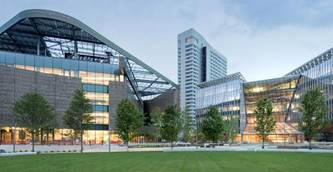
“The House” Cornell University’s Student Residence using a Passive House design.
Teachers who use an interdisciplinary approach will find helpful research on the new carbon sinks being formed as the ice caps are melting. These polar foodwebs are helpful as deforestation has reduced the amount of carbon being absorbed by rainforests. The information on biodiversity and the impact of how our planet is adapting to a warmer climate with melting ice is an area of research that students should find interesting.
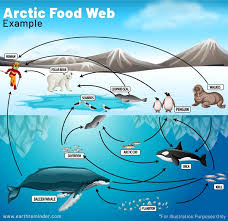
“Less than half of all carbon captured by polar phytoplankton or macro algae is stored in foodwebs, and nearly all the rest is recycled into the water column by bacteria in what is termed the microbial loop (rotting). Vast numbers and biomass of water column (pelagic) zooplankton, such as copepods or krill, which are shrimp-like crustaceans, store much of this carbon.” (Page 136)
Perhaps the most informative chapter in this book is titled “Circular Food Systems: Feeding the Urban World” because it identifies small innovative companies that are implementing important solutions. Examples for students to research include the White Moustache Yogurt Company, Back of the Yards Algae Sciences, Spare Foods Company, LivinGreen, Evergrain, TripleWin, and Portland Pet Center. When I was a 16-year-old high school student, my Earth Science teacher’s lesson about the impact of the end of civilization as we knew it with the birth of the 3 billionth person had a lasting impact on me. In just ten years, the world’s population will be 9 billion and in 2050 it will likely be 10 billion. As the population increases, the urban density will also increase from 55 percent today to 63 percent by 2050 and provide an urgent need to reduce greenhouse gas emissions. Solutions are needed!
| Year | Population | Net Change | Density (P/Km²) |
| 2025 | 8,231,613,070 | 69,640,498 | 55 |
| 2026 | 8,300,678,395 | 69,065,325 | 56 |
| 2027 | 8,369,094,344 | 68,415,949 | 56 |
| 2028 | 8,436,618,886 | 67,524,542 | 57 |
| 2029 | 8,503,285,323 | 66,666,437 | 57 |
| 2030 | 8,569,124,911 | 65,839,588 | 58 |
Students need to understand how hydroponic agriculture and circular food systems can sustain life on our planet in the future. Our current dependence on rice, wheat, soybeans, and corn contribute significant amounts of carbon and methane into our atmosphere through their production and distribution. The current agricultural revolution needs to produce food in urban areas and reduce food waste. Source
“The food system we have in place today, one we have nurtured for a half-century and that produces some 43 percent of the world’s calorie supply, is itself in jeopardy due to the growing climate crisis, rising temperatures and prolonged droughts are withering crops; frequent floods are destroying them. The reliance on intensive farming practices such as tilling and heavy fertilizer and pesticide use robs the soils of their productivity, jeopardizing yields necessary to continue feeding rising populations.” (Page 150)
An important thread throughout this book is that proven climate solutions are likely to be local. Heating and electric power will be de-centralized, food production will be on urban rooftops and in parks, and transportation will be redesigned. The school curriculum needs to include case studies from urban ‘smart’ cities. One suggestion for the next edition of Proven Climate Solutions might be to include information on the importance of recycling clothing.
Top 12 Smart Cities in the U.S.
 njcssjournal