
Longing and Belonging: Parents, Children, and Consumer Culture, by Allison J. Pugh (Berkeley, CA: University of California Press, 2009)
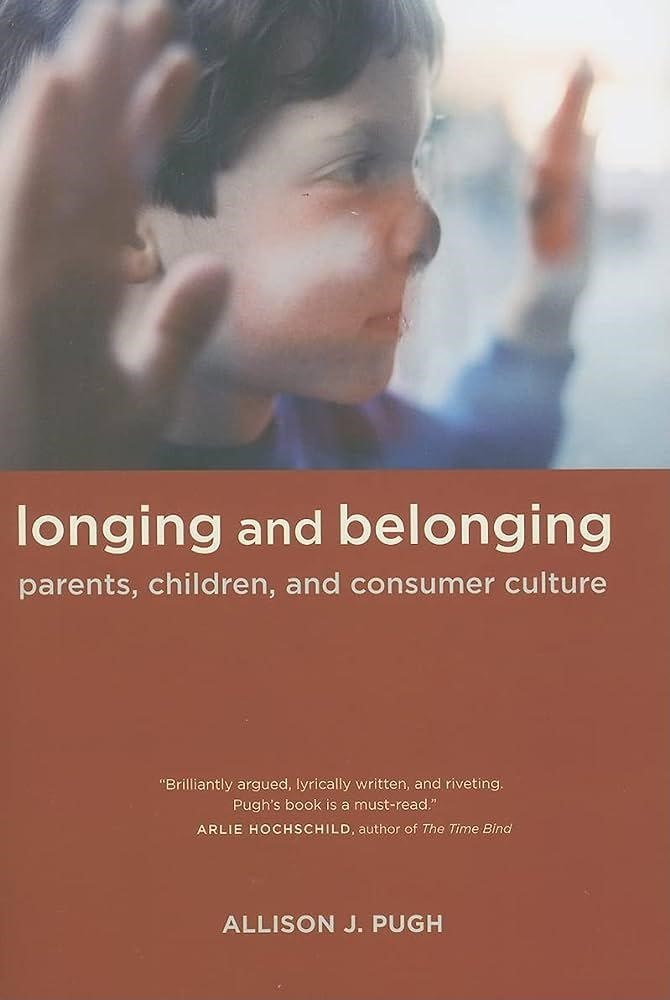
This is a very important book for teachers, teacher trainers, and teacher candidates to read because it offers an explanation of the desires of children and the interesting way the desires are met, or not met, by their parents. In this day of increasing demand for newer and better toys and technology, children ask for more and more expensive items.
Allison Pugh uses a qualitative research approach from the side of sociology to look at the phenomenon, namely the decision to reward children with gifts or to withhold them, and why or why not. Pugh looks at the desires and needs of kids from very disparate family backgrounds, socioeconomic class, and racial and cultural experiences in a region of southern California.
The pivotal point is the school, the type of school, including whether it is public or private, and the ways that having technology and other assets are viewed by the students. The author interviews several parents to find out how the decision is made as to whether the kids will receive something they want. In some cases, the parents do buy the items so that the kids will not stand out as being too different from others, so that the kids will be able to participate with others in their school and be able to “save face.”
Not all parents immediately purchase items for their child, however, sometimes waiting to make sure it is a wise choice or until the family can afford it. In other cases, the parents can indeed afford the time but wait before buying it. The author uses the term “symbolic deprivation” to describe parents waiting until the child truly deserves the item or it is somehow time to go ahead and purchase the gift, toy, or technology.
In this ethnographic study, the author discovers some surprising aspects many people do not consider. Parents often want their children to fit in, so buying them fruit snacks or certain kinds of lunch items is very important as they help their kids to be part of the scene. Some parents consider the social life at school to be as important or even more important than what the kids are learning. Sometimes parents do try to get children to adopt better eating habits, but they agree to help them fit in better by purchasing trendy snacks or desserts for the lunchbox.
For a variety of reasons, parents do or do not buy certain items. Parents of all income levels explained it was a struggle to know when to say enough is enough. In many cases, the parents say they try to buy the majority of the things the kids want, and sometimes that means kids do have to wait so the family will not wind up “in trouble” financially. Still, though, kids in this study tended to eventually get the lion’s share of what they had on their conscious wish list.
Important reading for educators, this book shows the social and family side of the desires and needs of children in three very different kinds of schools. Other factors such as class and race place interesting roles in the decision process employed by parents. It is essential to better understand the kinds of pressures on kids and their parents in terms of the technology and toys so much of the kid landscape these days. Understanding what is going on behind the scenes, in the lunchroom, and in the playground can be very helpful in comprehending a little more of the kid’s world and that of the parents raising them.
It will be interesting to study these patterns and decisions after COVID-19 has come to a more secure stop at the end of the road.
 njcssjournal